Awhile ago the pro-Israel editor of the College of Charleston’s online campus newspaper published two articles containing offensive accusations against me — one even before I spoke on campus and one afterward.
The newspaper has now finally posted my response – but it isn’t listed in any of the website’s menus; standard practice would be to list it in the Opinion section.
In other words, editor Sarah Sheafer (who calls Israel her “second home”) has officially “published” my response, thus finally adhering to journalistic requirements, while keeping the op-ed virtually invisible to the vast majority of the newspaper’s readers.
My emails to Sheafer about this bizarre situation have brought no change, and now the staff is gone for a week. I plan to continue to request that the newspaper include my letter in the Opinion section, where letters to the editor and op-eds would normally be… but perhaps not if they expose uncomfortable facts about Israel and its partisans…
On April 19th I spoke at the College of Charleston at an event sponsored by the Department of Sociology and Anthropology and a local organization called Charleston Peace One Day.
The title of my lecture was “Israel-Palestine: What the Media Leave Out,” and in it I documented the extremely flawed nature of US news coverage of this conflict. This material was gleaned from 12 years of researching this subject, eight statistical media studies, independent reporting trips to the region, many dozens of articles on the topic, and an upcoming book.
Sadly, the two articles on my talk by the CofC student newspaper, one before my lecture and one after, exemplify the deeply faulty reporting frequently found in articles concerning Israel. In addition to numerous inaccuracies, they violated some of the basic principles of journalism.
Sarah Sheafer, the newspaper’s editor in chief, wrote both articles. Sheafer’s first article consisted of accusations by Israel-partisans claiming that I was “anti-Semitic” and labeling my talk – in advance – “hate speech.” Sheafer repeated inaccurate claims about me without investigating their veracity, and failed to include my very public rebuttals of these falsehoods. While Sheafer included interviews defending the event in the name of academic freedom and free speech, she did not include any defense of me or response to the terrible accusations about me.
Violating a fundamental principle of journalism
And in violation of the most basic tenet of fair reporting, she never attempted to contact me to respond to the claims. This ignored one of the most fundamental requirements of journalistic ethics: According to the Society of Newspaper Editors, “Persons publicly accused should be given the earliest opportunity to respond.”
Her piece similarly failed to quote anyone in favor of my my work, though I have been honored to receive plaudits from diverse sources and have been asked to speak at a multitude of universities and other venues both in the U.S. and abroad. Nor did her very long article contain any information about my multitude of articles describing Palestinian suffering under occupation or those on Israel’s lethal attack on a US Navy ship.
When I discovered Sheafer’s article and emailed and phoned her to discuss it, she did not return my call and did not respond to requests to print a rebuttal. (She did eventually email us back.)
Article #2
The second article followed my talk. This article again focused on defamatory claims (I am called anti-Semitic in the second paragraph), misquoted me at times, and incompletely depicted what took place, though it included some information from my presentation in the second part of the article (the part least likely to be ready by readers in a hurry).
While Sheafer stated that there was “incivility” during the event, the reality is that a large group of fanatic Israel partisans (perhaps in part stirred up by Sheafer’s first article) attended the event, shouted over my attempts to answer their questions fully and respectfully, and ultimately prevented CofC students from engaging in the kind of extended question-and-answer discussion that normally follows a presentation and that students have a right to expect. Particularly troubling is the fact that apparently some CofC faculty were involved in this behavior.
Several students wrote me after the event apologizing for this group. One said, “This conduct was deeply embarrassing to me as a student. I felt you were treated rudely and disrespected.” The person went on to write, “I respect how calmly you maintained your professional demeanor and continued to be courteous and respectful to the audience.”
Following my presentation, which included a video and numerous slides, Sheafer apologized for not contacting me for her previous story and finally interviewed me. However, she included none of the information I gave her in her second article. Nor did the newspaper print a formal correction or apology.
In the piece, she quoted many of the hostile questions addressed to me by a somewhat organized group that had clearly come to the event to do battle, and then either misquoted my answer, included only a small part of it, or, in most cases, completely left it out.
Perhaps this is because the questioners and allied mob largely shouted over all my answers to their questions; it’s possible that Sheafer often couldn’t hear my full responses. I certainly had trouble hearing myself.
More omissions
While Sheafer reported on my presentation and included much valuable information, she left out some of the most important points and watered down others.
She failed to report the fact that, in the current uprising, over 12 times more Palestinian children have been killed than Israeli children, and that 91 of them were killed before a single Israeli child was killed. She omitted the fact that US media consistently and erroneously term Israeli actions “retaliation,” and primetime news shows report on Israeli children’s deaths at rates up to 14 times greater than they report on Palestinian children’s deaths.
Sheafer similarly omitted the information I provided about a 2003 Capital Hill briefing in which a commission that included a four-star admiral, a rear admiral, and the highest-ranking recipient of the Congressional Medal of Honor reported that Israeli forces had tried to sink a US Navy ship, had killed 34 American servicemen and injured over 170, and that rescue flights had been recalled because the President of the United States said he “didn’t want to embarrass an ally.”
These extremely grave statements on Capitol Hill by this extraordinarily high-ranking commission can be found in the Congressional Record.
Partisan bias
Perhaps Sheafer’s most significant violation of journalistic ethics was to assign herself to cover these events in the first place, rather than sending a neutral reporter.
The fact is, as Sheafer publicly admits, she has a strong emotional attachment to Israel, once writing: Israel is “the country I consider my second home.”
The particular article with this statement was written on Nov. 15th, 2012, the day a 10-month-old Gaza baby was killed by Israeli forces – the fourth Palestinian child killed by Israeli forces that week – though Sheafer mentions none of these deaths.
While Sheafer says that she condemns “some of [Israel’s] controversial decisions (i.e. illegal settlements),” her piece focuses on her intense anguish over Israeli difficulties, her deep empathy with Israelis (at one point she writes she wishes she were there), and, tellingly, her anger at those who criticize Israeli actions.
She wrote this column during an Israeli onslaught in which Israeli forces killed at least 169 Gazan men, women, and children, and Palestinians killed 6 Israelis, none of them children. (During the previous year, Israelis had killed 64 Palestinians in Gaza, while Gazans had killed no Israelis.)
None of these facts are in Sheafer’s column, “Israel At War.”
Destructive actions
While Sheafer and the group who disrupted this event consider themselves pro-Israel and brevity requires me to identify them as such, in reality I feel that their actions do not benefit Israelis.
Israel was created through violence and has been maintained through violence, a reality that is not only tragic for the Muslim and Christian victims of this violence, but is also tragic for Israelis themselves.
If Israelis are to live a normal existence free of war and conflict, it is essential that they change their policies and become a nation that treats all people with equality, an approach that many Israelis desire, and that they recognize the historic injustice at the core of the conflict.
Such a policy change, however, is unlikely to occur while American politicians continue to bankroll Israel to the tune of over $8 million per day and to provide diplomatic cover no matter what the Israeli state does. This blind support gives the Israeli government such power that its leaders feel free to ignore Palestinians, other world players, and dissenting Israelis alike.
Given this seemingly blank check of American financial and diplomatic support, Israeli leaders feel no need to negotiate honestly to reach a compromise in which Jews, Muslims, and Christians can share the land that is sacred to all three groups. This won’t change until Americans become sufficiently informed on this issue to demand changes to US policy.
It is essential that Americans learn the facts on this issue. I believe strongly that we have the power to bring peace to the core issue in the Middle East – a conflict that has spawned numerous wars, caused dangerous instability to the region and the world, and has placed Americans increasingly in danger.
It is sad that an event on this urgent issue was in many ways sabotaged. I hope that additional speakers providing factual information will be invited to lecture at the College of Charleston, and that they will not receive the treatment I experienced.
~
Alison Weir is the president of the Council for the National Interest and executive director of If Americans Knew. She is a former journalist and has a degree in journalism.
“…an article entitled “Jewish journalists grapple with ‘doing the write thing,’” in the Nov. 23, 2001 Jewish Bulletin of Northern California [interviewed Jewish] journalism students about how they would cover Israel. Its findings were inconclusive. Some students felt they would cover Israel impartially, some didn’t. The Bulletin described one of the latter, Uzi Safanov: “’I’m a Jew before being a journalist, before someone pays me to write,’ he said. ‘If I find a negative thing about Israel, I will not print it and I will sink into why did it happen and what can I do to change it.’ Safanov said that even if he eventually wrote about negative incidents that happen in Israel, he would try to find the way ‘to shift the blame.’”
Another also spoke of the need to protect Israel: “’On campus there is already so much anti-Israeli sentiment that we have to be careful about any additional criticism against Israel,’ said Marita Gringaus, who used to write for Arizona State University’s newspaper. ‘This is our responsibility as Jews, which obviously contradicts our responsibilities as journalists…’”
Israeli soldiers kidnapped the Grand Mufti of Jerusalem and the Holy Land, Sheikh Mohammad Hussein, after surrounding his home and breaking into it Wednesday.
Local sources reported that the army invaded As-Suwwana neighborhood, in Jabal Al-Mokabbir in occupied East Jerusalem, and broke into the home of the Mufti before kidnapping him.
Sheikh Hussein asked to follow the soldiers by car to the Al-Maskobiyya Police Station and interrogation facility in the city, but they refused and placed him in one of their vehicles.
In related news, the army kidnapped Engineer Mustafa Abu Zahra, head of a committee in charge of maintaining Islamic graveyards in Jerusalem.
Furthermore, Israeli police officers were heavily deployed at the gates of the Al-Aqsa Mosque in Jerusalem, interrogated dozens of worshipers while inspecting their ID Cards, withheld their ID cards and informed them that they will get their ID’s back once they leave the mosque area.
In addition, a number of settlers invaded the Al-Aqsa Mosque yard through the Al-Magharba Gate accompanied by dozens of soldiers and police officers.
On Tuesday evening, the Israeli Police handed orders to Palestinian shop owners in the Old City ordering them not to display their products in front of their shops on Wednesday evening in order to allow the settlers to march through the city and its markets while marking the so-called “Jerusalem Day”.
The “Jerusalem Day” is a an Israeli “national holiday” that started in June 1967 after the Israeli forces occupied East Jerusalem, and the rest of Palestine following the six-day war. In 1982, the Israeli Knesset passed a “legislation” considering Jerusalem “complete and united” as the eternal capital of Israel.
A few days ago, I noticed this piece at FDL: “’Homeland Security’ Spending Overtakes New Deal” TomDispatch: this country has spent a jaw-dropping $791 billion on ‘homeland security’ since 9/11. To give you a sense of just how big that is, Washington spent an inflation-adjusted $500 billion on the entire New Deal.
Two indicators of the expanding security state that caught my attention in the last few days:
A fugitive, Paris Poe, whom the FBI wanted for parole violation and questioning in a murder investigation, was spotted at a hotel in a Madison, WI suburb. Poe had previously been imprisoned for armed robbery. A large area encompassing much of Vernona, Fitchburg, and part of Madison, WI was then essentially locked down and swarmed with SWAT teams in a day-long manhunt.
Reverse 911 calls were made to all landlines (about 30,000 homes) asking residents to lock their doors and remain inside. Police asked all the businesses in their area to close and lock their doors. All six schools in the area were placed on lockdown and surrounded by police. In Verona, no-one could enter or exit the schools. In some classrooms, children were told to crouch under their desks for hours. In some schools, children were herded into the gym. Children were prohibited from using the bathroom, since that would involve leaving their rooms, and were told to urinate in buckets. Parents could not pick up their children since entry or exit was prohibited. Once the lockdown was ended, parents were required to present ID to take their children home. During the escalating panic, it was stated that Poe was on the FBI’s most wanted list, but he was not.
Late in the day, Poe was arrested far outside the locked down area. He was apparently unarmed, faces no charges in WI, and will be transported back to IL. News stories here, here, here, here, here, here, here, and here.
Does anyone else see something wrong with this picture?
With neoconservatives and neoliberals amplifying calls for US military intervention in Syria, it is worthwhile to take a moment and consider all the places in the world, where the US currently has forces engaged in daily operations.
Secrecy, the reality that a substantial portion of US military or espionage operations with troops are likely happening covertly, may mean it is impossible to truly get a complete picture of where America is projecting power and targeting and killing people. But, Linda J. Bilmes and Michael D. Intriligator, ask in a recent paper, “How many wars is the US fighting today?”
Today US military operations are involved in scores of countries across all the five continents. The US military is the world’s largest landlord, with significant military facilities in nations around the world, and with a significant presence in Bahrain, Djibouti,Turkey, Qatar, Saudi Arabia, Kuwait, Iraq, Afghanistan, Kosovo, and Kyrgyzstan, in addition to long-established bases in Germany, Japan, South Korea, Italy, and the UK.1 Some of these are vast, such as the Al Udeid Air Force Base in Qatar, the forward headquarters of the United States Central Command, which has recently been expanded to accommodate up to 10,000 troops and 120 aircraft.
Citing a page at US Central Command’s (CENTCOM) website, they highlight the “areas of responsibility” publicly lists:
The US Central Command (CENTCOM) is active in 20 countries across the Middle Eastern region, and is actively ramping-up military training, counterterrorism programs, logistical support, and funding to the military in various nations. At this point, the US has some kind of military presence in Afghanistan, Bahrain, Egypt, Iran, Iraq, Jordan, Kazakhstan, Kuwait, Kyrgyzstan, Lebanon, Oman, Pakistan, Qatar, Saudi Arabia, Syria, Tajikistan, Turkmenistan, U.A.E., Uzbekistan, and Yemen.
US Africa Command (AFRICOM), according to the paper, “supports military-to-military relationships with 54 African nations.”
Altogether, that makes 74 nations where the US is fighting or “helping” some force in some proxy struggle that has been deemed beneficial by the nation’s masters of war.
Beyond that, there are Special Operations forces in countries. Jeremy Scahill in Dirty Wars: The World is a Battlefield, writes, “By mid-2010, the Obama administration had increased the presence of Special Operations forces from sixty countries to seventy-five countries. SOCOM had about 4,000 people deployed around the world in countries besides Iraq and Afghanistan.”
The forces were deployed, as the Washington Post reported, to “go beyond unilateral strikes” and train “local counterterrorism forces” and engage in “joint operations with them.” Plans for both “preemptive” and “retaliator strikes” existed in “numerous places around the world, meant to be put into action when a plot” was identified or “after an attack linked to a specific group.”
Scahill also reports, based on his own “well-placed special operations sources”:
…[A]mong the countries where [Joint Special Operations Command] teams had been deployed under the Obama administration were: Iran, Georgia, Ukraine, Bolivia, Paraguay, Ecuador, Peru, Yemen, Pakistan (including in Baluchistan) and the Philippines. These teams also at times deployed in Turkey, Belgium, France and Spain. JSOC was also supporting US Drug Enforcement Agency operations in Colombia and Mexico…
Since President Barack Obama has been willing to give the go ahead to operations that President George W. Bush would not have approved, operations have been much more aggressive and, presumably, JSOC has been able to fan out and work in far more countries than ever expected.
Global assassinations have been embraced by the current administration, opening the door to night raids, drone strikes, missile attacks where cluster bombs are used, etc. Each of these operations, as witnessed or experienced by the civilian populations of countries, potentially inflame and increase the number of areas in the world where there are conflict zones.
A Congressional Research Service (CRS) provides an accounting of all the publicly acknowledged deployments of US military forces. It indicated that, as many Americans may not be aware, in February of this year, 100 military personnel were deployed to Niger to “provide support for intelligence collection” and to “facilitate intelligence sharing with French forces conducting operations in Mali, and with other partners in the region,” according to President Obama.
Also, according to the report, Pentagon chief Chuck Hagel ordered American troops to be deployed to Jordan. Hagel told the Senate Armed Serivces in a statement on Syria that they would be there to “work alongside Jordanian forces to ‘improve readiness and prepare for a number of scenarios.’” Up to 200 troops would be deployed.
In 2012, Obama reported to Congress that “US combat-equipped military personnel” had been deployed to Uganda “to serve as advisors to regional forces” that were “working to apprehend or remove Joseph Kony and other senior Lord’s Resistance Army (LRA) leaders from the battlefield and to protect local populations.” About 90 US military personnel were deployed and “elements” were sent to “forward locations in the LRA-affected areas of the Republic of South Sudan, the Democratic Republic of the Congo and the Central African Republic.” President Obama stated US forces were not to engage LRA forces “except in self-defense.”
Approximately 817 military personnel were contributed to the NATO-led Kosovo Force (KFOR), presumably to “stop the ‘movement, arming, and financing of certain international terrorist groups,’ as well as the “proliferation by sea of weapons of mass destruction and related materials.’” there were continued operations in Libya as well as operations in Yemen that were acknowledged. [By the way, it takes thirty-three pages for CRS to list all “notable deployments of military forces overseas” since 1798.]
Obama administration officials might argue that none of these operations in various different countries represent different conflicts or wars. All are connected to the “Global War on Terrorism” and the Authorized Use for Military Force (AUMF) after the 9/11 attacks give the president the executive authority to have forces in all parts of the world conducting whatever operations are deemed necessary to fight “terrorism.” Or, they might claim the US is technically not “involved” in wars if they are merely operating as advisors, who help facilitate military operations of other allied or proxy forces.
Any number of games with semantics or euphemism can be played by officials authorizing these operations. Undoubtedly, there are probably countries where the US has forces that have gone unmentioned in this post.
The reality is current US wars are not limited to the one winding down in Afghanistan and the other one that recently ended in Iraq. There are numerous wars going on unannounced, undeclared and in secret. The world is literally a battlefield with conflicts being waged by the US (or with the “help” of the US). And, no country is off-limits to US military forces.
Britain is negotiating out-of-the-court settlements to compensate thousands of Kenyans severely mistreated under British colonial rule during the 1950s Mau Mau uprising.
According to a letter sent to lawyers representing some of the claimants, the Foreign Office has changed its mind on appealing last October’s High Court ruling that gave victims the green light to sue the government, The Guardian reported.
“The parties are currently exploring the possibility of settling the claims brought by our clients,” Dan Leader, a partner with the Leigh Day law firm told the paper.
“Clearly, given the ongoing negotiations, we can’t comment further.” He added.
The Foreign Office has refused to comment on the issue, but admitted the victims suffered “pain and grievance” during the bloody events of the Emergency period in Kenya.
Three victims won the case to sue the government at the High Court last year.
The trio’s lawyers said one of them was castrated, antoher severely tortured and the third subjected to appalling sexual abuse in detention camps during the Mau Mau rebellion.
There was also a fourth claimant Susan Ngondi who has died since legal proceedings began.
The British government has admitted to British forces’ torturing of detainees at the time following disclosure of a vast archive of colonial-era documents which the Foreign Office had kept secret for decades.
Félix Diaz, leader of the Qom community, speaks to the crowd in January 2011. (Photo Patricio Guillamón.)
Late Saturday night, 4th May, a street gang brutally attacked two youths of indigenous descent in the northern province of Formosa. One of the victims is 21-year-old Abelardo Díaz, the son of Qom leader Félix Díaz.
The boys were surrounded by a mob of about 30 people that abruptly began beating them, allegedly using clubs and other objects to attack Abelardo and his peer Carlos Sosa. Both had to be hospitalised, first taken to a local clinic but later transferred to the Juan Domingo Perón hospital in the provincial capital.
Although most details about the attack are still unknown, the Qom community assumes that it is related to their fight to reclaim ancestral lands, in which Félix Díaz has played a key role. On 18th April, Félix received a court order for his prosecution regarding the ‘theft’ of territory he claims for the Qom people.
Abelardo reported a similar instance in which he was beaten in June of last year, when another group armed with knives attacked him, threatening to slit his throat.
After his son’s hospitalisation, Félix stated: “My family continues being victim to this violence generated by the province again and again.” He added, “They criminalise me for ‘usurping’ our historic territories. However they will never break me — I will continue asking for respect for our rights and for true justice.”
Two weeks ago a group of congress members part of the Population and Human Development Commission headed by Antonio Riestra began a series of meetings with representatives from local indigenous groups to discuss the humanitarian situation of these communities in Formosa. During the talks, indigenous leaders called for a return of historic lands, access to healthcare, and bilingual education.
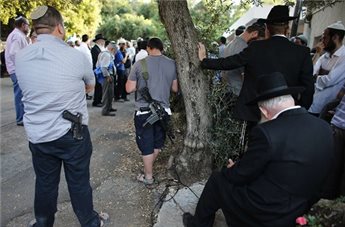
Jewish settlers raided a West Bank village near Ramallah on Saturday night, attacking several houses and prompting clashes between residents and Israeli forces, Ma’an news agency reported.
Israeli forces were standing guard as hundreds of settlers stormed the village of Ras Karkar, reportedly barring ambulances from entering the village before allowing an ambulance to take only two people to the hospital.
Eight residents of Ras Karkar were wounded as Israeli troops fired tear gas and rubber bullets at them. Live bullets were also fired into the air to scare the residents and prevent them from defending their property.
Rubber-coated bullets hit one Palestinian in the eye, one in the head and another in the chest. Four others sustained bruises and fractures from the attack by settlers and Israeli troops, locals said.
According to local sources, three houses in Ras Karkar were attacked and set on fire, as well as a number of olive trees.
One settler was wounded after being hit by a stone.
Settlers were also gearing up to attack another village near Ramallah on Sunday, Ma’an reported.
According to a witness, dozens of settlers were being escorted by Israeli troops and police officers near the village of al-Janiya in northwest Ramallah.
Residents of al-Janiya were trying to close the road to the village with rocks, only to be met with stun grenades and tear gas. Activists used the village mosque’s loudspeakers to urge residents to defend their village.
Settlers routinely attack Palestinians and their property in the occupied West Bank, as Israeli forces regularly turn a blind eye or even assist settler crimes.
According to figures compiled by Israeli group Yesh Din, nine out of 10 police investigations about settler crimes fail to lead to a prosecution.
“A nonpartisan, independent review of interrogation and detention programs in the years after the Sept. 11, 2001, terrorist attacks concludes that ‘it is indisputable that the United States engaged in the practice of torture’ and that the nation’s highest officials bore ultimate responsibility for it.”
So began a page-one story in the New York Times that should have dominated public discussion for days and begun the process of coming to terms with this shameful chapter in American history. Unfortunately, the story ran April 16, the day after the Boston Marathon bombing, and thus got little notice. And just as attention on Boston was waning, the George W. Bush Library and Museum was dedicated in Dallas. Unsurprisingly, neither President Obama nor the ex-presidents assembled to celebrate the event (and the Bush administration), mentioned this “nonpartisan, independent review.”
It’s been pretty much consigned to the memory hole. But maybe it’s not too late to retrieve it.
The review was done by The Constitution Project’s Task Force on Detainee Treatment, which included members not normally associated with critics of the Bush administration, such as former Republican Rep. Asa Hutchinson (co-chairman), who was an undersecretary in the Bush administration’s Department of Homeland Security and administrator of the Drug Enforcement Administration.
The task force concluded that in Iraq, Afghanistan, Guantanamo, and other places, American forces engaged in torture and other practices that violated U.S. laws and international treaties — conduct that has been condemned by the U.S. government when practiced by other governments. Such conduct has long been considered a war crime, the task force noted. While it stopped short of claiming that the highest government leaders explicitly called for the use of torture against detainees, it said the use was a consequence of the administration’s declaration that the Geneva Conventions did not apply to people captured in the “war on terror.” (PDF) The report states,
The Task Force believes there was no justification for the responsible government and military leaders to have allowed those lines to be crossed. Doing so damaged the standing of our nation, reduced our capacity to convey moral censure when necessary and potentially increased the danger to U.S. military personnel taken captive.
Democracy and torture cannot peacefully coexist in the same body politic. The Task Force also believes and hopes that publicly acknowledging this grave error, however belatedly, may mitigate some of those consequences and help undo some of the damage to our reputation at home and abroad.
The task force also found,
There is no firm or persuasive evidence that the widespread use of harsh interrogation techniques by U.S. forces produced significant information of value. There is substantial evidence that much of the information adduced from the use of such techniques was not useful or reliable.
It notes that some former officials insist their interrogation techniques were effective, adding, “but those officials say that the evidence of such success may not be disclosed for reasons of national security.” The task force discounts such assertions, however, because the former officials “generally include those people who authorized and implemented the very practices that they now assert to have been valuable tools in fighting terrorism.… It is reasonable to note that those former officials have a substantial reputational stake in their claim being accepted.” The task force went so far as to reject the claim that torture led to the locating of Osama bin Laden, citing the Senate Intelligence Committee finding to that effect. (The fundamental case against torture, of course, is not that it is ineffective, but that it is immoral.)
The task force also called attention to the continuing detention of prisoners at Guantanamo, over half of whom have long been cleared for release. At the moment 100 of the 166 prisoners are conducting a hunger strike, and 21 are being force-fed by nasal tube, which in itself has been called torture and is condemned by the task force. A majority of the task force called for civilian or military trials of some of the detainees and release of others to countries in which they will not be tortured. It continued,
Those prisoners who are deemed to still be a threat to the safety of the U.S. and its citizens and who would be difficult (a) to prosecute because they were subjected to torture or the relevant criminal laws did not apply overseas at the time of their conduct; or (b) to transfer due to lack of suitable receiving country, would be brought to the mainland United States and held in custody until a suitable place to transfer them was found. Their cases would be subject to periodic review.
This recommendation is not good enough. How can men be held indefinitely because the alleged evidence against them was obtained by torture and is inadmissible? That is grounds for release. But even worse is the recommendation from the two-member minority consisting of Hutchinson and Richard Epstein (yes, alas, thatRichard Epstein):
As troubling as indefinite detention might be, there are currently no good or feasible alternatives. Those prisoners who are deemed to be a continuing threat to the United States and for whom a trial is not currently feasible, and where there is no other suitable country that will accept them, should remain in detention for the foreseeable future. They should not be brought to the U.S., and Guantánamo remains the best location to hold them.
Justice demands to know why people against whom there is apparently no trial-worthy evidence are to be left to rot in an American prison in Cuba. This is truly a disgrace. And notice the self-reinforcing nature of the argument. These people are said to be a threat, but holding them at Guantanamo sows the seeds of hostility and the desire for revenge. Even if they were tried and acquitted, they might be angry at the U.S. government for the treatment they received. Are they still to be held even if acquitted? (The Bush administration thought that in some cases, yes.)
It’s good to see that the task force report holds the Bush administration lawyers responsible for the mistreatment of detainees:
Lawyers in the Justice Department’s Office of Legal Counsel (OLC) repeatedly gave erroneous legal sanction to certain activities that amounted to torture and cruel, inhuman or degrading treatment in violation of U.S. and international law, and in doing so, did not properly serve their clients: the president and the American people.
Extraordinary rendition, the practice (begun in the Clinton years) of outsourcing torture to foreign governments, and abuse of detainees at secret CIA prisons, or “black sites,” also come in for condemnation as violations of international law. Unfortunately, the task force did not call for an end to turning people over to other governments; it simply recommended that there be more than “diplomatic assurances” that torture will not take place.
Refreshingly, physicians and psychologists are taken to task for their participation, in violation of age-old ethical standards, in the abuse of detainees, both by devising techniques that constituted torture and for failing to report abuses. It’s about time a floodlight was shined on this shameful conduct by medical and so-called mental-health professionals.
Also welcome is the recommendation that “the executive branch should declassify evidence regarding the CIA’s and military’s abuse and torture of captives.” We have a right to know what this lawless government did in our names.
The task force also called on the government to comply with its obligation under the Convention Against Torture to assure “that the victim of an act of torture obtains redress and has an enforceable right to fair and adequate compensation.” Quite the opposite has happened: “The United States has not complied with this requirement, in large part because of the government’s repeated, successful invocation of the state-secrets privilege in lawsuits brought by torture victims.” The Obama administration has been particularly determined to keep such suits out of court. This is a blot on the country.
The report further indicted the government for not complying with its obligation under the Convention Against Torture to “criminalize all acts of torture, attempts to commit torture, or complicity or participation in torture” and “proceed to a prompt and impartial investigation, wherever there is reasonable ground to believe that an act of torture has been committed in any territory under its jurisdiction.” It notes that “no CIA personnel have been convicted or even charged for numerous instances of torture in CIA custody.” Conspicuous by its absence is the call for prosecution of President Bush, Vice-President Dick Cheney, members of the Office of Legal Counsel who cooked up legal justifications for torture, CIA director George Tenet,and other top officials.
President Obama says “looking backwards” at past conduct is unproductive when it comes to the interrogation of detainees. That’s odd. The government doesn’t find it unproductive to look back when private individuals commit crimes. Why should government officers get special treatment?
We can only hope that someday, when these people are traveling abroad, they will be arrested and brought before the International Criminal Court.
Finally, the task force notes that Obama, despite apparent promises to end the abuses, has not lived up to expectations. Guantanamo is still open (he said this week he would push to close it), and reporter Jeremy Scahill has exposed the CIA’s continued participation in interrogations in a secret prison beneath Somalia’s National Security Agency. Scahill’s reporting reveals that the administration has simply outsourced torture — hardly an improvement over the Bush years. Of course, Obama also claims the power to kill people and to detain them indefinitely in a military prison without due process.
“The Obama administration has ended the most inhumane treatment of detainees,” the report states, “though some troubling questions about current policies remain unanswered. But it is unclear whether it has taken sufficient steps to prevent a future administration from resorting to torture or cruel treatment.”
When it comes to conserving the national-security state, it matters little which party is in power.
Hebron:Two Palestinian children arrested in Hebron on April 28th by the Israeli authorities are the latest in a series of arrests which have increased rapidly since February of 2013. Swedish human rights activist, Gustav Karlsson, is currently in immigration detention in Givon prison after objecting to the arrest of the two children.
Gustav plans to resist deportation because he was arrested under false allegations of assaulting a soldier and given no chance to defend himself, despite clear video evidence that he committed no wrongdoing. The International Solidarity Movement has severe concerns about both the widespread arrests of children and the practice of deportation of peaceful human rights observers under false allegations of violence.
In the afternoon of April 28th several children from an illegal Hebron settlement attacked two Palestinian children, aged 11 and 12, who were walking home from school. The soldiers proceeded to arrest the Palestinian victims of the attack despite the fact that according to eyewitnesses, they never struck back.
Having witnessed the arrests of the children, Swedish human rights observer Gustav asked Israeli soldiers “why are you arresting these children?” only to be violently grabbed and also arrested. Following this, the children and Gustav were taken to a nearby military base. Gustav said, “I was blindfolded, but I could hear the children crying and screaming next to me. Twice, the soldiers pointed their guns at me, loaded them and pretended to pull the triggers”. As well as these mock-executions, soldiers violently shoved Gustav with their guns as they moved him and the children around.
The children were released later the same day, while Gustav is currently in Givon prison accused of assaulting a soldier, despite clear video evidence to the contrary. Gustav plans to resist deportation in protest of the dramatic increase in child arrests, the fact that he has been falsely accused and has not received a trial. Gustav has been working with Palestinian communities in Hebron for several months and has witnessed child arrests nearly every day.
Occupied Childhoods, a report compiled of child arrests witnessed in Hebron since February 2013, when the rise in child arrests seemingly began, is available here. This rise in arrests of minors is very concerning – one chilling example from recent months is the random arrest of 27 children aged 7-15, while they were on their way to school.
The other theme made clear by this case is the Israeli practice of arresting international human rights observers under false accusations and deporting them without a chance to defend themselves. Eight non-violent activists have been arrested and deported, falsely accused of using violence in the last three months. Since the founding of ISM, Israel has never pressed charges against any human rights activist but they have deported hundreds under charges such as Gustav’s which are clearly false.
US President Barack Obama today condemned the Guantanamo Bay prison camp run by US President Barack Obama, channeling the moral outrage last heard on the 2008 campaign trail.
“The idea that we would still detain forever a group of individuals that have not been tried, that is contrary to who we are, that is contrary to our interests and it has to stop,” the president said during a press conference at the White House.
The rhetoric was bold and progressive. The reality? At least half of 166 never-tried, never-convicted prisoners that reside at Guantanamo Bay are engaged in a hunger strike that is making the president look bad. And so the man with a kill list who is ultimately responsible for them being there – and who’s initial plan for closing the prison was simply moving it to Illinois – had to act as if he was deeply troubled by his poor human rights record, like an oil executive shedding tears for Mother Earth after a big spill.
What Obama is banking on is the fact that most people (including his base) aren’t terribly detail oriented. The tale liberal Democrats tell themselves, and which the liberal media tells the rest of us, is that the fight over Guantanamo Bay is Obama and a bunch of ACLU lawyers on one side, the forces of fear-mongering, reactionary insanity on the other. The president, it is to be understood, is facing irrational hostility from the Chicken Littles of the right and would like to the do the right thing — of course he would — but, you know: Republicans.
That narrative, unfortunately, is false. The true story, obfuscated by the president’s occasional condemnations of his own human rights record, is that Obama himself signed an executive order creating “a formal system of indefinite detention for those held at the U.S. military prison at Guantanamo Bay.” Rather than repudiate the notion of “detain[ing] forever a group of individuals that have not been tried,” Obama (through a task force he commissioned) determined that 48 of the prison camp’s detainees were “too dangerous to transfer but not feasible for prosecution.” The evidence against those men would not be admissible even by the weakened standards of a military court – that is, it was probably gained through torture – but rather than release them, as if they were persons endowed with certain inalienable rights, the Obama administration would prefer to lock them away until they die.
The president has even refused to release dozens of Yemeni citizens who have been cleared of all wrongdoing. Obama also signed (and his lawyers later defended in court) a bill that allows for the indefinite detention of US citizens. And let’s not forget that kill list, which is based on the idea that it’s alright for the president to act as judge, jury and executioner, so long as the unilateral justice is being delivered abroad. So when the president of the United States righteously condemns the idea of imprisoning someone forever without charge or trial, it’s important to remember the truth about his record. It’s important to remember he is lying.
As documented by the Associated Press and other journalists, the NYPD has built a program dedicated to the total surveillance of Muslims in the greater New York City era.
Officers have routinely monitored restaurants, bookstores and mosques and created detailed records of innocent conversations they’ve both had with individuals and eavesdropped on.
The NYPD has also sent paid infiltrators into mosques, student associations and beyond to take photos, write down license plate numbers and keep notes on people for no reason other than because they are Muslim.
Partnering civil rights attorneys filed papers in federal court seeking to stop the NYPD from creating dossiers on innocent Muslim New Yorkers and end the Police Department’s ability to initiate investigations into Muslim New Yorkers when there is no belief that they have engaged or are about to engage in unlawful activity or an act of terrorism.
The filing is part of the Handschu v. Special Services Division proceeding, a decades-old federal case that has produced a series of court orders regulating NYPD surveillance of political and religious activity.
Cops who testified against the New York City Police Department’s stop-and-frisk policy have faced retribution from higher-ups and officers who subscribe to the idea that the controversial tactic, deemed unconstitutional by major courts, is fair and legal.
NYPD officer Pedro Serrano told the Associated Press he’s faced harassment at work after testifying that stop-and-frisk, which was enacted in 2002, targets minorities and requires patrol officers to meet monthly quotas.
Serrano said that, along with finding a sticker of a rat pasted to his locker, he says he’s been micromanaged – including transferred to a different precinct to work an overnight shift. He also claimed that he was refused overtime hours amid an otherwise erratic schedule.
“A lot of people told me not to come forward because of what would happen – they said the department would come after me,” Serrano said. “But I’ve been thinking about it since 2007. I felt I couldn’t keep quiet.”
Serrano, along with fellow officers Adrian Schoolcraft and Adhyl Polcano, secretly recorded hours of patrol briefings and meetings with superior officers. The audio was played during the current federal trial meant to determine if black and Hispanic men are targeted by NYPD cops seeking to boost their numbers.
Polcano testified that he was told he needed to have 20 summonses, five street stops and one arrest each month.
“I was extremely bothered by what I was seeing out there,” he said on the stand. “The racial profiling, the arresting people for no reason, being called to scenes that I did not observe a violation and being forced to write a summons that I didn’t observe.”
Polcano was suspended from duty and charged with filing false arrest paperwork after he detailed a list of grievances to the police department’s internal affairs. He now works in a video review department. Schoolcraft, who remains suspended, did not testify at the trial because he has filed his own federal suit accusing superior officers of forcefully taking him to a psychiatric hospital in 2009.
Other officers who testified painted Serrano’s complaints as an unfortunate but necessary part of the job. Joseph Esposito, the former chief of the department, testified that most officers “leave their house every day to go to work to protect the city. They have the best intentions all the time, and they do it. There is a small percentage…we’re talking about in any profession, there is a group that will try to do the least amount and get paid the most.”
The alleged harassment would fit in the narrative of the NYPD. In the early 1970s plainclothes officer Frank Serpico accused the department of widespread corruption only to be shot in the face during a later investigation. Labeled a traitor by the police but a hero by others, Serpico was portrayed by Al Pacino in a popular eponymous movie chronicling his story two years later.
During an interview with the Associated Press Serpico said recent events prove NYPD groupthink hasn’t evolved past a “kill the messenger” mentality.
“I’ve become their grandfather,” he said. “They don’t want nothing. They just want somebody who knows what they’re going through. I give them moral support.”
The trial has been underway for more than a month, and recently included testimony from a parade of officers trying to discredit Polcano and Serrano as malcontents who often caused trouble. NYPD policy dictates that officers are required to report corruption without fear of retribution.
“It hasn’t been a picnic,” Serrano said. “They have their methods of dealing with someone like me.”
By Mazin Qumsiyeh | Popular Resistance | August 18, 2013
There is no way to say this truth nicely: Politicians lie. That includes Japanese, American, Egyptian, Israeli, and Palestinian politicians! Is there something more common sense than that? Yet, so many citizens around the world believe their own politicians or wistfully acknowledge lies but think it is part of the job needed to run things. They believe even when politicians contradict themselves blatantly. This phenomenon is rather remarkable. It is a dissonance and disconnect from reality that many seem oblivious to. It is very dangerous because it can lead to accepting rationales for going to war. These can be deadly wars that lead to millions of lives lost as happened in what was called World War 1 and WW2. Even when incredible and declassified evidence abound, politicians continue to lie and old mythologies refuse to die. Here are just a few of the countless lies told to us over the past few decades… continue
This site is provided as a research and reference tool. Although we make every reasonable effort to ensure that the information and data provided at this site are useful, accurate, and current, we cannot guarantee that the information and data provided here will be error-free. By using this site, you assume all responsibility for and risk arising from your use of and reliance upon the contents of this site.
This site and the information available through it do not, and are not intended to constitute legal advice. Should you require legal advice, you should consult your own attorney.
Nothing within this site or linked to by this site constitutes investment advice or medical advice.
Materials accessible from or added to this site by third parties, such as comments posted, are strictly the responsibility of the third party who added such materials or made them accessible and we neither endorse nor undertake to control, monitor, edit or assume responsibility for any such third-party material.
The posting of stories, commentaries, reports, documents and links (embedded or otherwise) on this site does not in any way, shape or form, implied or otherwise, necessarily express or suggest endorsement or support of any of such posted material or parts therein.
The word “alleged” is deemed to occur before the word “fraud.” Since the rule of law still applies. To peasants, at least.
Fair Use
This site contains copyrighted material the use of which has not always been specifically authorized by the copyright owner. We are making such material available in our efforts to advance understanding of environmental, political, human rights, economic, democracy, scientific, and social justice issues, etc. We believe this constitutes a ‘fair use’ of any such copyrighted material as provided for in section 107 of the US Copyright Law. In accordance with Title 17 U.S.C. Section 107, the material on this site is distributed without profit to those who have expressed a prior interest in receiving the included information for research and educational purposes. For more info go to: http://www.law.cornell.edu/uscode/17/107.shtml. If you wish to use copyrighted material from this site for purposes of your own that go beyond ‘fair use’, you must obtain permission from the copyright owner.
DMCA Contact
This is information for anyone that wishes to challenge our “fair use” of copyrighted material.
If you are a legal copyright holder or a designated agent for such and you believe that content residing on or accessible through our website infringes a copyright and falls outside the boundaries of “Fair Use”, please send a notice of infringement by contacting atheonews@gmail.com.
We will respond and take necessary action immediately.
If notice is given of an alleged copyright violation we will act expeditiously to remove or disable access to the material(s) in question.
All 3rd party material posted on this website is copyright the respective owners / authors. Aletho News makes no claim of copyright on such material.


 Israeli forces were standing guard as hundreds of settlers stormed the village of Ras Karkar, reportedly barring ambulances from entering the village before allowing an ambulance to take only two people to the hospital.
 Aletho News
