Stranded in Shuhada: Hebron’s Qurtuba school
By Salam Muharam – Ma’an – 15/02/2013
HEBRON — Children and teachers at Qurtuba school in Hebron say getting to class past Israeli soldiers and settlers is like navigating a minefield every day.
The school, for children aged 7 to 16, is adjacent to the illegal Jewish settlement of Beit Hadassah in the center of the West Bank city.
Israeli forces fenced off the school’s stairs with barbed wire in 2002. Now the only route to the school is a muddy path up a steep hill.
Some pupils live beside the school, but have to walk two kilometers around a circuit to reach the entrance, Najah Abu Munshar, a teacher in the school told Ma’an.
Across the street from the school, “Gas the Arabs” has been scrawled on a door. Next to the school gates, a mural of a girl holding a book, painted by a French activist, has been covered by racist graffiti. A gallery in a school corridor shows photos of Israeli soldiers and settlers assaulting students.
International volunteers escort children to and from school as a protective measure, but pupils and teachers are still frequently harassed and assaulted on their way to the school, which has been vandalized and set on fire.
“School students start their day by crossing the checkpoint of Shuhada street. I can only describe daily life at Qurtuba school as suffering and struggle,” school principal Noura Nasser told Ma’an.
Teachers must also pass an Israeli checkpoint and metal detectors to get to work, and Israeli soldiers decide whether to let them pass each day.
Pupil Yasmeen Ghareb, 12, says settlers have assaulted her and her siblings. “Sometimes they say bad words to me, and sometimes they throw fluids at me on my way to school.”

Yasmeen Ghareb stands in front of a checkpoint on her way to school
(MaanImages/Salam Muharam)
Other students told Ma’an that settlers have attacked them with stones, water and rotten vegetables.
Najah Abu Munshar has taught at Qurtaba school for 15 years. “The settlers used to let their dogs attack the students, and when settlers attack a student, I try my best to calm him or her down, and if he or she has any wounds, I provide first aid,” she told Ma’an.
The Ministry of Education hired a psychological counselor for the school, to work with children suffering psychological trauma which often manifests as bed wetting, Nasser, the school principal, told Ma’an. “The school focuses on the extracurricular activities and days of joy.”
Nasser said settler attacks were usually heightened during periods of political instability.
A grid of walls, fences and checkpoints divides Jewish settlers and Palestinians who live in close proximity to each other in Hebron, which was divided into two sections in the 1997 Hebron Agreement.
The Palestinian Authority controls the larger area, while Israeli forces control the city center, including the old market, the Ibrahimi Mosque and the historic Old City.
Qurtaba school lies on Shuhada street, a once-bustling thoroughfare and now a shuttered ghost town, with a military checkpoint restricting Palestinians’ access to this part of the city.
Israel started restricting access to Shuhada street after an Israeli settler Baruch Goldstein broke into the Ibrahimi Mosque and shot dead 29 Palestinians.
During the second intifada, Israel closed the street to traffic and many traders were not even able to collect their goods before their shops were welded shut.
Palestinian families who remained on Shuhada street must climb through side doors and across rooftops to get to their homes.
Waed Zeidan al-Sharabati, a 9-year-old pupil at Qurtuba school who lives on Shuhada street, recounted to Ma’an how settlers assaulted her and her cousin in 2011 when they were harvesting almonds nearby.
“They threw stones on us… The settler kidnapped my cousin, and I called the neighbor to come check the situation. My neighbor talked to the settlers, and after a long argument, my cousin was returned. One settler threw a stone on my leg. They tried to take me another time, but I escaped to my neighbor’s wife, and she hid my inside her home, and closed the door.”
“I got used to it, and at the beginning I used to be scared, but now I am not scared of them,” she told Ma’an.

Ward al-Sharabati, 9, lives on Shuhada street, a hub of settler violence in the West Bank
(MaanImages/Salam Muharam)
Related articles
- Local activist detained in Hebron (alethonews.wordpress.com)
- Israeli occupation forces kill woman near Hebron (alethonews.wordpress.com)
- Israeli army dogs attack elderly Palestinian, two-year-old child injured in the head in Jewish settlers’ attack (alethonews.wordpress.com)
- Israel detains Palestinian cartoonist, family says (alethonews.wordpress.com)
Message from Samer el Issawi, day 209 hunger strike
February 16, 2013
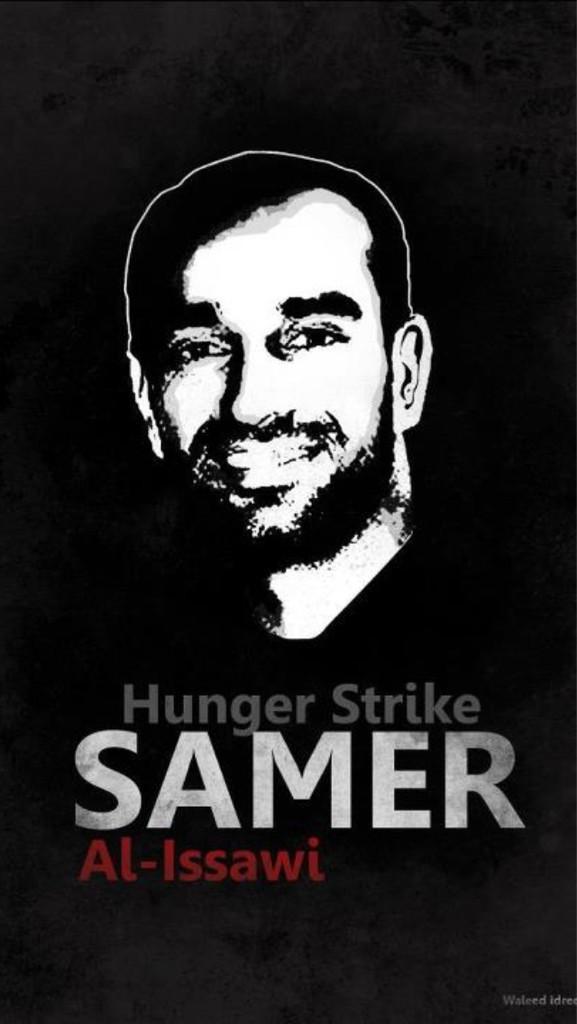 “I turn with admiration to the masses of our heroic Palestinian people, to our Palestinian leadership, to all forces, parties and national institutions. I salute them for standing by our fight to defend our right to freedom and dignity.
I draw my strength from my people, from all the free people in the world, from friends and the families of the prisoners who continue day and night chanting for freedom and an end to the occupation.
My health has deteriorated dramatically and I’m hung between life and death. My weak body is collapsing but still able to be patient and continue the confrontation. My message is that I will continue until the end, until the last drop of water in my body, until martyrdom. Martyrdom is an honor for me in this battle. My martyrdom is my remaining bomb in the confrontation with the tyrants and the jailers, in the face of the racist policy of the occupation that humiliates our people and exercises against us all means of oppression and repression.
I say to my people: I’m stronger than the occupation army and its racist laws. I, Samer al-Issawi, son of Jerusalem, send you my last will that, in case I fell as a martyr, you will carry my soul as a cry for all the prisoners, man and women, cry for freedom, emancipation and salvation from the nightmare of prisons and their harsh darkness.
My battle is not only for individual freedom. The battle waged by me and by my heroic colleagues, Tariq, Ayman and Ja’affar, is everyone’s battle, the battle of the Palestinian people against the occupation and its prisons. Our goal is to be free and sovereign in our liberated state and in our blessed Jerusalem.
The weak and strained beats of my heart derive their steadfastness from you, the great people. My eyes, which started to lose their sight, draws light from your solidarity and your support of me. My weak voice takes its strength from your voice that is louder than the warden’s voice and higher than the walls.
I’m one of your sons, among thousands of your sons who are prisoners, still languishing steadfast in the prisons, waiting for an end to be brought to their plight, their pains and the suffering of their families.
The doctors told me I became exposed to stroke because of the disorder of my heartbeats, the shortage of sugar and the drop in blood pressure. My body is full of cold and I can’t sleep because of the continued pain. But despite the extreme fatigue and chronic headaches, as I move on my chair, I’m trying to summon all my resources to continue on the road till its end. There is no going back, only in my victory, because I’m the owner of Right and my detention is invalid and illegal.
Do not be afraid for my heart if it will stop, don’t be afraid for my hands if they will be paralyzed. I am still alive now and tomorrow and after death, because Jerusalem is moving in my blood, in my devotion and my faith.”
**Via Rona Merrill, Neta Golan
Related article
- Shireen Al-Issawi: PA did not take prisoners’ issue to the UN (alethonews.wordpress.com)
Academy Awards for the Promotion of Torture?
By Dave Clennon | Dissident Voice | February 16th, 2013
I’m a member of Hollywood’s Motion Picture Academy. At the risk of being expelled, for disclosing my intentions, I will not be voting for Zero Dark Thirty — in ANY Academy Awards category.
Everyone who contributes skill and energy to a motion picture — including actors — shares responsibility for the impressions the picture makes and the ideas it expresses. If I had played the role that was offered to me on Fox’s 24 (Season 7), I would have been guilty of promoting torture, and I couldn’t have evaded my own responsibility by blaming the writers and directors.
So Jessica Chastain won’t get my vote for Best Actress. With her beauty and her tough-but-vulnerable posturing, she almost succeeds in making extreme brutality look weirdly heroic.
There’s plenty of “Oscar buzz” around Zero Dark Thirty. Several associations of film critics have awarded it their highest honors. I have watched the film (2hrs, 37min). Although torture is an appalling crime under any circumstances, Zero never acknowledges that torture is immoral and criminal. It does portray torture as getting results. The name of Osama Bin Laden’s courier is revealed (in the movie) by a “detainee,” Ammar, who has endured prolonged and horrifying torture.
The two lead interrogators, both white, are not torturing Ammar at the moment he gives up the name (Abu Ahmed), but he is still utterly depleted from at least 96 hours of sleep-deprivation, and he knows they will torture him again, if he resists. “Y’know, I can … hang you back up to the ceiling,” says chief interrogator Dan.
The “moral” of this particular screen story? Torture sometimes works. Not always. Later, the female interrogator (and Zero’s heroine Maya [Chastain]), supervises
the “enhanced interrogation” of another detainee, Faraj. These are some of the enhancements we see her employ: first, a thick brown liquid is poured into a funnel which has been pushed into Faraj’s mouth and rammed part-way down his throat; then Maya supervises his beating and near-drowning (aka waterboarding); he gasps for air, gags, shudders and chokes.
Director Kathryn Bigelow then shows Chastain in a clean, well-lighted restroom, looking pretty, but tired and frustrated; Bigelow does not give us a view of Faraj after HIS ordeal. Next we see Maya complaining to her mentor Dan that Faraj hasn’t cracked. “You want to take a run at him?” she asks, smiling hopefully.)
In minute 45 of Zero, we learn that Faraj has “gone south.” Maya’s relentless, merciless torture has finally killed her detainee. She is now a murderer. So, for the next hour and 45 minutes, we’re rooting for a gorgeous, murdering thug to track down a charismatic, murdering jihadist.
If, in fact, torture is a crime (a mortal sin, if you will) — a signal of a nation’s descent into depravity — then it doesn’t matter whether it “works” or not. Zero Dark Thirty clearly condones torture. Not a single character involved in “The Greatest Manhunt in History” expresses any regret about the CIA’s use of torture. Maya/Chastain gets her man (code named “Geronimo”!) and that’s all that counts. The end justifies the vicious means.
Individuals and groups protesting the easy tolerance of torture in Zero Dark Thirty have been dismissed by some commentators as having “a political agenda.” The grievous problem presented by torture is NOT political. It’s moral. And it’s criminal. Decent people of the left, the right, and the center would all judge the torture in Zero Dark Thirty as immoral and criminal.
If the deeply racist landmark film Birth of a Nation were released today, would we vote to honor it? Would we give an award to Leni Riefenstahl’s brilliant pro-Nazi documentary, Triumph of the Will? Hundreds of millions around the world watch the Oscars, we’re told. Are we going to show the world that we Americans STILL approve of torture?
After Jessica Chastain won Zero Dark Thirty’s only Golden Globe Award, it occurred to me that she is the new face of American torture — as Kiefer Sutherland was, for several years. If the Academy votes her an Oscar, it wouldn’t be surprising if the world community concluded that the U.S.A. still tolerates this vicious, criminal behavior.
Sometimes, it’s not just a movie. And acting in it isn’t just a job. It’s a moral choice.
Dave Clennon can be reached at djjc123@earthlink.net.
Related articles
- Oscar-nominated Palestinian director detained at LAX
- Hollywood’s Imperial Propaganda
- Abe Lincoln, Racist Fascist?
- Hollywood myths harming the whole world: Ken O’Keefe
- Academy Awards for the Promotion of Torture?
- Oscar Prints the Legend: Argo’s Upcoming Academy Award and the Failure of Truth
- Hollywood Snubs Best Film as ‘Zero Dark Thirty’ Odds Fade – Bloomberg
Double Standards for Prisoners Vanished In Israel

By Yahya Dbouk | Al-Akhbar | February 15, 2013
The case of Ben Zygier, known as “Prisoner X,” has opened the door to questions about the possibility of Israel secretly detaining other prisoners and abductees.
Zygier, a Jewish-Australian citizen, died in an Israeli prison two years ago, in a case Israel went to extreme lengths to cover up, imposing media gag orders.
This is not the first time Israel has hidden information related to the whereabouts and conditions of prisoners. Consider, for example, reports of the three Iranian diplomats kidnapped by the Lebanese Forces during the Israeli invasion of Lebanon in 1982, who were reportedly moved to prisons in occupied Palestine.
Then consider the case of Lebanese prisoner Yahya Skaf. In addition to a wealth of reporting on his case, testimonies by other detainees all aver that he is still alive and being held in an Israeli prison. It’s a claim that Tel Aviv denies, maintaining that it lost Skaf’s body.
In the same vein, reports from various sources assert that Iranian General Mohammed Reza Asgari, who was kidnapped in Turkey in 2007, is being held in Israel.
Until recently, the global norm was to accept that Israel is a state where the rule of law is paramount. Any reports that questioned Israel’s democratic credentials were considered prejudiced or even anti-Semitic.
Yet if Tel Aviv was able to conceal the truth about Zygier for so long – the fact that he had committed suicide more than two years ago – then it’s entirely fathomable that Israel is withholding the truth about other prisoners like Skaf, Asgari, and the above-mentioned Iranian diplomats.
The answer is now clear and backed up by damning evidence: Israel has both the capability and the willingness to engage in such acts.
A simple hypothetical exercise. Let’s say the kidnapping, detention, and subsequent suicide of the Australian Prisoner X had happened to another detainee of a different nationality. How would the global media reaction differ? Would it have been as fervent as with the Australian Prisoner X?
Just look to the cases of the Lebanese and Iranian detainees, specifically with the three Iranian diplomats and General Asgari. Iran repeatedly declared that it had evidence as to their whereabouts, and the Iranian press reported extensively on the matter. Yet Israeli denials were enough to refute the Iranian account. Western and Israeli reports did not stop there, and Iran was even mocked as a source of fabricated news.
The same applies to cases involving Lebanese citizens, such as Skaf. Israel cannot possibly deny it has him, and that he had entered occupied Palestine. For one thing, Tel Aviv’s claims about Skaf and his lost body make little sense. If he had been a citizen of Australia, or other nations of similar stature, Israel’s account would have differed.
Israeli assertions that Tel Aviv had kept the Australian government in the loop on Prisoner X created more – not less – ramifications. Indeed, Israel is not only able to hide the facts and detain people in secret, but also to involve Western governments in the cover-up.
Italy Imprisons Military Intelligence Chief for Helping CIA Kidnap Egyptian Cleric
By Noel Brinkerhoff and David Wallechinsky | AllGov | February 15, 2013
Unable to imprison the Americans behind the kidnapping of an Egyptian cleric, Italy has successfully jailed five Italians who took part in the 2003 controversy, including the government’s former military intelligence chief.
Niccolò Pollari was sentenced to 10 years in prison for complicity in the Central Intelligence Agency’s (CIA) abduction of Abu Omar (Hassan Mustafa Osama Nasr). His former deputy, Marco Mancini, received nine years, and three Italian secret service officials were sentenced to six years each.
In November 2009, an Italian court tried 23 Americans (all but one of whom worked for the CIA) in absentia for the Abu Omar kidnapping. All of the convicted received jail sentences of seven years, except for Robert Seldon Lady, the former Milan CIA station chief, who had his sentence increased to nine years after appealing. During the original trial, Lady told an Italian newspaper he was not guilty—but also indicated he may have been involved in the abduction. “I’m only responsible for carrying out orders that I received from my superiors,” he told Il Giornale. The U.S. government has refused to turn over any of those convicted.
After being abducted, Abu Omar was transferred to U.S. military bases in Italy and Germany and eventually shipped to Egypt, where he says he was tortured. “You cannot imagine,” he told Human Rights Watch. “I was hung up like a slaughtered sheep and given electric shocks…. I could hear the screams of others who were tortured too.”
The CIA later allowed him to be released after determining that he was not actually a part of a terrorist organization.
To Learn More:
Italy’s Ex-Intelligence Chief Given 10-Year Sentence For Role In CIA Kidnapping (by Glenn Greenwald, The Guardian)
Egypt floods Gaza lifeline tunnels
Al-Akhbar | February 13, 2013
Egyptian forces have flooded smuggling tunnels under the border with the Palestinian-ruled Gaza Strip in a campaign to shut them down, Egyptian and Palestinian officials said.
The network of tunnels is a vital lifeline for Gaza, bringing in an estimated 30 percent of all goods that reach the enclave and circumventing a deadly blockade imposed by Israel for more than seven years.
Reuters reporters saw one tunnel being used to bring in cement and gravel suddenly fill with water on Sunday, sending workers rushing for safety. Locals said two other tunnels were likewise flooded, with Egyptians deliberately pumping in water.
“The Egyptians have opened the water to drown the tunnels,” said Abu Ghassan, who supervises the work of 30 men at one tunnel some 200 meters (yards) from the border fence.
An Egyptian security official in the Sinai told Reuters the campaign started five days ago.
“We are using water to close the tunnels by raising water from one of the wells,” he said, declining to be named.
While Gaza’s rulers have been reluctant to criticize Mursi in public, ordinary Gazans are slightly more vocal.
“Egyptian measures against tunnels have worsened since the election of Mursi. Our Hamas brothers thought he would open up Gaza. I guess they were wrong,” said a tunnel owner, who identified himself only as Ayed, fearing reprisal.
“Perhaps 150 or 200 tunnels have been shut since the Sinai attack. This is the Mursi era,” he added.
Dozens of tunnels had been destroyed since last August following the killing of 16 Egyptian soldiers in a militant attack near the Gaza fence.
Cairo said some of the gunmen had crossed into Egypt via the tunnels – a charge denied by Palestinians – and ordered an immediate crackdown.
The move surprised and angered Gaza’s rulers, the Islamist group Hamas, which had hoped for much better ties with Cairo following the election last year of Egyptian President Mohamed Mursi, an Islamist who is ideologically close to Hamas.
A Hamas official confirmed Egypt was again targeting the tunnels. He gave no further details and declined to speculate on the timing of the move, which started while Palestinian faction leaders met in Cairo to try to overcome deep divisions.
The tunnelers fear the water being pumped underground might collapse the passage ways, with possible disastrous consequences.
“Water can cause cracks in the wall and may cause the collapse of the tunnel. It may kill people,” said Ahmed Al-Shaer, a tunnel worker whose cousin died a year ago when a tunnel caved in on him.
Six Palestinians died in January in tunnel implosions, raising the death toll amongst workers to 233 since 2007, according to Gazan human rights groups, including an estimated 20 who died in various Israeli air attacks on the border lands.
Israel imposed its vicious blockade on the coastal strip in 2007. Food imports to Gaza were cut by nearly 75 percent, from 400 trucks per day to 106 by the start of the blockade.
At one stage an estimated 2,500-3,000 tunnels snaked their way under the desert fence but the network has shrunk markedly since 2010, when Israel eased some of the limits they imposed on imports into the coastal enclave.
All goods still have to be screened before entering Gaza and Israel says some restrictions must remain on items that could be used to make or to store weapons.
This ensures the tunnels are still active, particularly to bring in building materials. Hamas also prefers using the tunnels to smuggle in fuel, thereby avoiding custom dues that are payable on oil crossing via Israel.
(Reuters, Al-Akhbar)
Colombia: Drummond Contractor Convicted in Unionists’ Deaths
Weekly News Update on the Americas | February 11, 2013
On Jan. 25 Colombian judge William Andrés Castiblanco sentenced Jaime Blanco, a former contractor for the Alabama-based Drummond Co. Inc. coal company, to 37 years and 11 months in prison for masterminding the March 2001 murders of two union leaders in the northern department of Cesar. The court found that Blanco, who supplied food services for Drummond’s La Loma mine, had arranged with rightwing paramilitaries, including one known as “Tolemaida,” for the killing of Valmore Locarno and Víctor Hugo Orcasita, leaders of the mine’s union. Blanco’s assistant, Jairo Charris, was convicted in 2009 in the same murder plot and was sentenced to 30 years.
Judge Castiblanco also sent trial records to Colombian prosecutors so that they could investigate other people possibly connected to the crimes: Drummond’s president, Garry Drummond; two company directors, Augusto Valencia and Jean Adkins; Alfredo Araújo Castro, Drummond’s public relations director for Cesar; and former Colombian legislator Jorge Castro Pacheco, who was convicted in 2010 of maintaining ties to paramilitary organizations. In addition, the judge supported a request by the victims’ relatives to ask the Supreme Court to investigate former assistant prosecutor Edgardo Maya for allegedly failing to act to protect unionists in Cesar; Maya is Jaime Blanco’s half-brother.
Drummond management has long been suspected of involvement of the murders of Locarno and Orcasita and of another La Loma unionist, Gustavo Soler, who was killed later in 2001. The US-based International Labor Rights Fund (ILRF) and the United Steelworkers (USW) union filed a civil suit against Drummond in March 2002 under the 1789 Alien Tort Statute in federal court in Birmingham, Alabama, where the company is based. The Birmingham jury found the company not liable in 2007, but ILRF executive director Terry Collingsworth announced plans to appeal [see Update #911]. In an April 2011 interview Blanco told the Associated Press wire service that Drummond senior managers ordered the murders of Locarno and Orcasita and that if he was convicted, they would be able to “wash their hands” of the case. (El Tiempo (Bogotá) 2/5/13; Miami Herald 2/6/13 from AP)
Related article
- Mine contractor jailed for trade unionists’ murders (morningstaronline.co.uk)
Israeli forces arrest Hamas-affiliates across West Bank
Ma’an – 12/02/2013
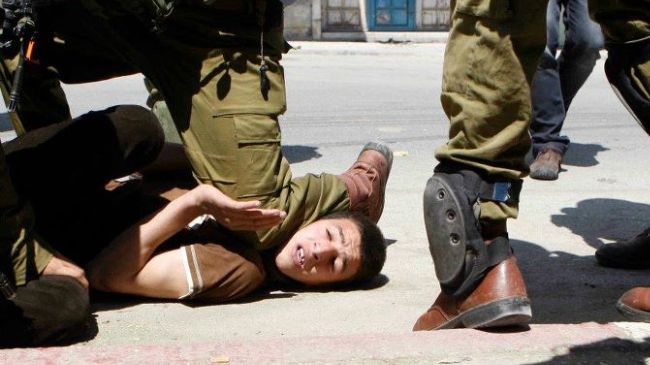
BETHLEHEM – Israeli forces launched multiple arrest raids overnight Monday against Hamas affiliates in the West Bank, Hamas sources and locals said.
Hamas leader Rafat Jamil Nasif, 45, was detained in Tulkarem in an arrest raid on his home, sources in the Islamist movement said. Nasif’s family were forced to stand outside in the cold while sniffer dogs searched his home.
Musab al-Ashqar, Abdullah Ismail al-Khalil and Ammar Jihad Ameir, students at al-Khadouri university, were also arrested in Tulkarem, together with the local Imam’s son Qitad Amar Bidawi.
In Nablus, Israeli forces detained a local Islamist student leader Muthanna Jamil Eshtayeh and students Osama Khalid Yamin and Walid Jamal Asida from An-Najah university, locals said.
Mousa Ahmad Yamin and Abed al-Ghani Ayesh Samara were also detained in nearby villages.
Four people were arrested in Qalandia refugee camp in Ramallah, including two ex-prisoners, and in Hebron two other students were detained.
An Israeli army spokeswoman said that 13 people were detained overnight, including four in Nablus, five in Tulkarem, three in Bethlehem and one in Hebron.
Another military spokesman said nine people arrested were affiliated with Hamas.
The latest detentions follow a sweep of arrests of Hamas-affiliated officials in the West Bank over the past week.
Last Tuesday, Israeli forces arrested 12 people including at least three Hamas-affiliates.
A day earlier, Israeli soldiers arrested 23 members of Hamas, including three lawmakers — Ahmed Attoun in al-Bireh, Hatem Qafisha in Hebron and Mohammed al-Tal in al-Dhahiriyya.
Hamas condemned the arrests as a “criminal act.”
Related article
- Israel arrests 22 Hamas members ahead of Fatah-Hamas talks (alethonews.wordpress.com)
Light on the Dark Side of Dorner’s Rampage

By Linn Washington Jr. – This can’t be happening – 02/11/201
On September 10, 2012 the Los Angeles Times published an article with the headline: “LAPD to hold meetings on use of force policies.”
Top Los Angeles police officials announced those community meetings to counter growing criticism about videoed brutality incidents involving LA police officers in the preceding months, that article noted.
On November 24, 2012 The Daily Beast posted an article with the headline: “In Los Angeles, Questions of Police Brutality Dog LAPD” reporting abuse incidents by officers of that department placed under federal oversight between 2001 and 2009 after repeated brutality and corruption scandals.
Over two months after that Daily Beast posting about LAPD brutality a fired LAPD officer unleashed a murderous rampage as revenge against his claimed unfair firing by the LAPD.
That former LAPD cop, military veteran Christopher Dorner, claimed his attack campaign was retaliation against retaliation LAPD personnel directed against him for his reporting a 2007 brutality incident he observed while on duty.
LAPD officials found Dorner’s brutality claim against a policewoman unfounded and fired him for filing false statements. The father of the alleged victim said his mentally ill son confirmed Dorner’s account.
LA police officials contend that man sustained facial injuries from falling into some bushes while resisting arrest by Dorner, not from the female officer’s kick.
Despite the recent record of brutality detailed in news coverage last fall, a New York Times article on the Dorner rampage inferred brutality by Los Angeles police – brutality that sparked two of America’s most destructive urban riots – was not a current problem.
The last sentence in the seventh paragraph of that February 7, 2013 New York Times article stated: “Mr. Dorner laid out grievances against a police department that he said remained riddled with racism and corruption, a reference to a chapter of the department’s history that, in the view of many people, was swept aside long ago.”
That ‘view’ of many people cited in the NY Times article obviously did not include the views of the dozens participating in an October 2012 demonstration against police brutality outside the LAPD headquarters.
On October 22, 2012 the Los Angeles Times published an article with the headline: “Downtown L.A. streets closed by protest at LAPD headquarters.”
Yes, the 1992 riots that rocked LA following the state court acquittal of the four LA police officers charged in the videoed savaging of Rodney King – a disturbance causing over $1-billion in damages and claiming 53 lives – arguably qualifies as long-ago.
But long-ago does not apply to incidents within the past year like the woman kicked in her groin by a female LAPD officer in July 2012 who died minutes later while hog-tied inside a patrol car.
That ‘view’ cited in the NY Times article is not shared by victims of the incidents triggering those LAPD brass community meetings like the skate boarder suckered punched by police, the nurse slammed to the ground by two officers who gave each other a fist-bump for their take-down and the handcuffed man shot by police.
While ‘many people’ certainly believe or want-to-believe LAPD brutality is long gone, perhaps by reforms implemented during that federal oversight, news media accounts pushing that view without balance of companion context comprise an element (albeit small) in the constant framing of police brutality as isolated incidents instead of long standing, systemic procedure by police across America.
At least that NY Times article referenced racism and brutality unlike many media entities that reported Dorner’s rampage without providing context beyond his crazed reaction to his firing.
The March 1968 Kerner Commission Report on sixties-era urban riots – the majority triggered by police abuse incidents including the deadly 1965 LA Watts Riots – criticized the news media for failing to “analyze and report adequately on racial matters” in America that included coverage of festering grievances like police brutality.
Compounding context-deficient coverage, news media reportage on police brutality rarely examines the central role played by prosecutors in perpetuating the problem.
The Los Angeles DA’s Office pushed one case protecting alleged police misconduct all the way to the U.S. Supreme Court, where in 2006 that court’s conservative majority issued a ruling experts said eroded protections for whistle-blowing public employees.
The case involved a veteran LA prosecutor who said supervisors retaliated against him arising from his exposing improprieties by a deputy during a drug investigation. Those supervisors pursued the drug prosecution despite those improprieties and then bashed the whistle-blower for providing the defense details of the improprieties as required by law.
That 11/12 Daily Beast article began with an anecdote about LA city prosecutors declining to charge officers caught lying about a December 2010 incident where a woman was beaten and tazed by four officers, one of whom videoed the incident.
Fired Officer Dorner alleged that his LAPD problems began in July 2007 when his training officer, a female, kicked a man during an arrest outside a hotel. Dorner claimed that training officer and their immediate supervisor compelled him to fudge his official report omitting the kicking, according to court findings.
LAPD officials found Dorner guilty of making false statements relying largely on an Internal Affairs investigation. The IA investigator interviewed the training officer and two hotel employees but neither Dorner nor the victim according to an October 2011 California state appellate court ruling that upheld a trial court ruling rejecting Dorner’s appeal of his 2009 LAPD firing.
LAPD officials, in their administrative proceeding, faulted Dorner for failing to immediately report the alleged kicking incident. Officials brushed aside Dorner’s stated fears of backlash for exposing that alleged misconduct and his having quickly reported that incident privately to two LAPD supervisors he knew whom he also had told about racial slurs directed at him during his police academy training.
Officials also claimed Dorner manufactured the brutality complaint to maliciously deflate an adverse performance evaluation he suspected he would receive from his training officer.
LAPD officials have initiated a reexamination of Dorner’s firing since the rampage began.
Dorner, in an online manifesto posted before his rampage, criticized the fact that officers involved in both the Rodney King and other brutality scandals were promoted not penalized.
An analysis of the Dorner incident prepared by Drexel University professor George Ciccariello-Maher and Mike King, a PhD candidate at UC Santa Cruz reminded that brutality against non-whites remains a “structural function” of the LAPD.
“It is the commonness of excuses for police abuse/murder, the erasure of the victims as collateral damage that should be highlighted when trying to make sense of this broken, rogue, former Los Angeles cop,” Ciccariello-Maher and King wrote.
Photo – credit Wikipedia
Related Articles:
Americans protest police brutality
10 Shocking U.S. Police Brutality Videos Caught on Surveillance Cameras
Canaan protest village
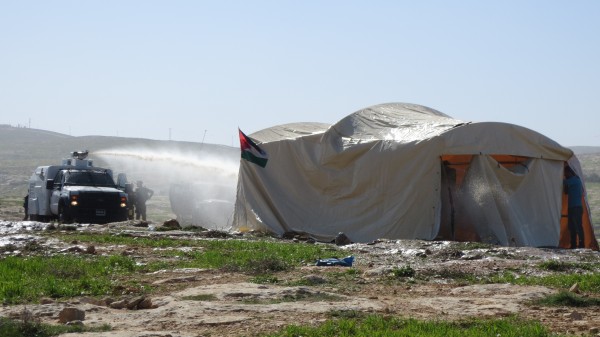 Canaan tent being skunk watered (Photo: ISM)

Beit Ommar Popular Movement | February 10, 2013
South Hebron Hills, Occupied Palestine – Today, the South West Popular Committee along with international activists embarked on a new effort to establish a village, Canaan, on Palestinian land in South Hebron Hills. The village’s name was not accidental. We wanted to declare that we are the indigenous people of Palestine. We are the descendants of the Canaanites and our ties to the land can never be broken or taken away. Early last night, various Palestinian activists from a wide array of villages in the South West Bank area along with international activists met in a home to discuss plans for the coming day.
Signs were prepared which stated ‘Our Land is Our Right’, ‘Canaan Village’ and a declaration of intent which stated that “we are the sons and daughters of the Cananites, we establish Canaan Village on endangered Palestinian land.” “We declare that it is our natural right to develop, reclaim, improve, use and live on all our lands free and without threat from occupiers/colonizers.”
In the early morning hours, following a night of planning, we established Canaan as our first attempt, in the south of Yatta (the entrance to Twani). Within less than a minute, while we barely managed to establish the tent, an occupation jeep arrived. The occupation soldiers encircled us and told us we must leave. We refused to obey such a racist demand. An officer of the occupation army then went on to demolish our tent, steal our additional tents and equipment and violently prevent us from reclaiming our land and our belongings.
Several hours later, we went on with a much larger group of activists, international supporters and an especially large number of journalists, to east Yatta, near Ein Mai’in, Hazawai, we established a large tent and began building a room from stones of the land. Within half an hour, we were heavily encircled by at least 6 jeeps of the occupation forces. A large military vehicle which fires skunk water was brought in. We were told that we have 10 minuets to leave the area and that the land was a ‘closed military zone’. We did not yield of course and were immediately showered upon by heavy skunk water.
Occupation soldiers then went on to attack journalists and arrest them. They beat an elderly woman and other activists. In several instances, activists jumped in and prevented with their bodies the arrest of two people. After several hours of struggling with the occupation soldiers which numbered more than 50, 4 journalists, 8 Palestinians and 2 international activists were arrested, our tent was destroyed and we were prevented from returning to our land. For many hours during the hot afternoon, hundreds of activists remained in the area and demanded the right to return to the Canaan Village.
Related article
Featured Video

Death Spikes & Rising Cancer In Our Youth Explained
or go to
Aletho News Archives – Video-Images
From the Archives
Politicians lie
By Mazin Qumsiyeh | Popular Resistance | August 18, 2013
There is no way to say this truth nicely: Politicians lie. That includes Japanese, American, Egyptian, Israeli, and Palestinian politicians! Is there something more common sense than that? Yet, so many citizens around the world believe their own politicians or wistfully acknowledge lies but think it is part of the job needed to run things. They believe even when politicians contradict themselves blatantly. This phenomenon is rather remarkable. It is a dissonance and disconnect from reality that many seem oblivious to. It is very dangerous because it can lead to accepting rationales for going to war. These can be deadly wars that lead to millions of lives lost as happened in what was called World War 1 and WW2. Even when incredible and declassified evidence abound, politicians continue to lie and old mythologies refuse to die. Here are just a few of the countless lies told to us over the past few decades… continue
Blog Roll
 Aletho News
- RSF military group defects, joins Sudanese army: State media
- Ireland goalkeeper refuses to play ‘Israel’ as squad weighs boycott
- China pushes back against US on Cuba, Iran
- Ukrainian Soldiers, Potential Mercenaries: Have Gun, Will Travel!
- Burnham’s UN debut… A masterclass in British disinformation
- Iran flights continue despite US aviation sanctions
- Global Tipping Points Lead the World Into a State of Entropy
- The day-after at the White House: USA and Xi Jinping
- The Geopolitical Balance in the Red Sea: The UAE Being Displaced by New Players
- Iraqi resistance group vows to stage airport sit-ins over Iran aerial blockade
- If Americans Knew
- Deconstructing Netanyahu’s pants-on-fire UN rant – Daily Update
- Trump betrayed voters with his campaign lies and prioritized a foreign country once he took office
- Netanyahu calls Israel’s war in Gaza ‘opposite of genocide’ in UN speech to near-empty hall
- Settler Kidnappings: Torture, Sexual Abuse and Terrorisation of Palestinian Abductees as Israel Deepens Annexation of West Bank
- Gaza winter nears as 162,000 tents become unusable, raising fears of humanitarian crisis
- Netanyahu says, “It’s the opposite of genocide”; UN says Gaza economy is world’s ‘most severe crisis on record’ – Daily Update
- Israel’s US-Backed Assault on Gaza Has Created the ‘World’s Most Severe Economic Crisis on Record’: UN
- ‘Protecting U.S. Citizens’… From Israel
- ‘This is where I live now, the back of a truck’: a day in the life of a grandmother in Gaza
- In UN Speech, Iran’s President Displays Pictures of Children Killed by US, Brings Attention to Israel’s Nuclear Arsenal
- No Tricks Zone
- New Study: Earth And Venus Surface Warmth Largely Explained By Convection And Lapse Rate, Not CO2 Or Radiation
- 2025 Nature Paper Claiming Worsening Global Drought Gets RETRACTED …Heavily Flawed
- New Study: ‘Global Drought Shows No Detectable Recent Acceleration Under Climate Warming’
- Economic Masterminds: German Socialists Suggest Taxing Productivity Gains Stemming From Using AI
- The South China Sea Has Not Been Cooperating With The Climate Change Narrative
- Energy Crisis: Germany Enters Heating Season With Historically Low Gas Reserve Fill Levels
- New Study: The Antarctic Ice Sheet Gained Mass From 2020-2024 Due To Staggering Snow And Ice Accumulation
- Study: Ocean Heating Rates From Thousands Of Years Ago ‘Dwarf’ Modern Ocean Heating Rates
- Climate Extremists Target, Attack Large-Scale Power Grid Infrastructure In Germany!
- New Study: Antarctic Ice Melt Has Contributed Less Than 1 Centimeter To Sea Level Rise In The Last 30 Years

