Abla Saadat: A Palestinian Stateswoman marked by “Terrorism”
By Christof Lehmann | No Spin News | September 24, 2012
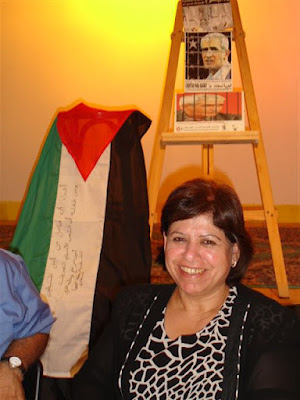 Abla Sa’adat, the Chairwoman of the Palestinian Women Organizations and wife of the Secretary General of the Popular Front for the Liberation of Palestine (PFLP) visited Denmark. I met Abla Sa’adat at a meeting where she told a group of mostly young Danes about Palestine. Had one expected an Abla Sa’adat who conforms with the dehumanizing stereotyping of Palestinians by Israeli and western politicians and main stream media, one would have been surprised by the depth and complexity of Abla Sa ‘adat, her perception of the Palestinian problems and possible solutions.
Behind the veil of the “terrorist” stereotype one discovers an Abla Sa’adat who is a true stateswoman, humanist, human rights advocate, an advocate for international law, justice and peace, the wife of a long term prisoner of war and political prisoner, as well as a mother and grandmother who puts the systematic dehumanization and stereotyping of Palestinians to shame.
In spite of the Hamas – Israeli negotiated prisoner exchange earlier this year, Abla Sa’adat states, more than 5.000 Palestinians remain in prison under administrative detention. She is active in organizations which advocate Palestinian prisoners rights. It is not for personal reasons, so she states, that she is using her husband, PFLP Secretary General Ahmad Sa’adat as an example for how Israel systematically terrorizes politically active Palestinians and their families, but because due to her own experience she knows his case best and because his case is representative of those of thousands of other prisoners and their families.
On the other hand, who would blame Abla Sa’adat for wanting to advocate for her illegally detained husband, the father of her children and grandfather to her grandchildren. At a recent appearance of Ahmad Sa’adat in an Israeli court he was denied physical contact with Abla and his newborn granddaughter Mayar. The destruction of politically active Palestinian families family ties and the destruction of Palestinians’ family systems is systemic and systematic.
After the PLO signed the Oslo Accords and the Palestinian Authority (PA) was established, the situation in the occupied Palestinian territories within the 1967 borders has not improved and the Israeli governments have systematically avoided adhering to the provisions of the Oslo Accords. Contrary to improvements, the reality of the matter is that: Israel has confiscated more land, increased its infringements on Palestinians’ water rights, built more settlements and settler only roads and railways, built the so called “security wall” which isolates Palestinian West Bank villages in micro enclaves, continued a policy that devastates Palestine’s economy; Israel continues to illegally arrest and detain Palestinians under illegal forms of imprisonment, the use of torture is endemic, the use of disproportionate military force is well documented, and these items only touch the surface of the daily violations of the Oslo Accords. According to the Oslo Accords Palestinian prisoners should have been released from prison. Israel did not adhere to this provision either.
What Palestinians gained by signing the Oslo Accords can be described with a few words. The right to establish a Palestinian Authority, which is utterly dependent on the goodwill of Israel. The political factions have gained the privilege to compete with each other for the Presidency over the self-administrated Zionist genocide on themselves while splitting the PLO, rendering it in a state of internal conflict rather than fighting for the liberation of Palestine. In other words, the PLO was entrapped in the glory of Presidency over its own destruction and the destruction of Palestine.
It is within this context one has to understand the arrest and detainment of Ahmad Sa’adat. Israel demanded that the Palestinian Authority arrest him for “terrorism,” and the Fatah led PA made sure that he was arrested and detained. The tragic irony of the situation is that the Oslo Accords resulted in the Palestinian Authority arresting and detaining the Secretary General of the PFLP Ahmad Sa’adat on behalf of Israel, and that Israeli pressure and US and British complicity since have resulted in Sa’adat being imprisoned in an Israeli prison and not, as initially, in a Palestinian prison with US and UK military guards. In fact each and every detail of Ahmed Sa’adat’s imprisonment is in violation of the Geneva Conventions, the Conventions against the use of Torture and other bodies of international law. Ahmed Sa’adat was sentenced to thirty years in prison for being the Secretary General of the PFLP, which is designated as a “terrorist organization” by the USA, Israel and the E.U. He has spent years on end in isolation.
Prior to his arrest Ahmed Sa’adat was elected to the Palestinian parliament. Abla Sa’adat explained that 22 members of parliament are currently imprisoned in Israeli prisons, many of them in isolation. The occupation is in fact preventing the functioning of Palestine’s democratic institutions.
Isolated prisoners are locked up for 23 hours a day. For one hour they can leave their cells and spend their time in an indoor yard, in shackles and hand-cuffs, without the possibility to exercise. There is absolutely no contact to other prisoners. Ahmed Sa’adat was isolated for three years before he was granted ” the privilege” to have his first visitor. Other families, Abla Sa’adat said, have been waiting ten years before they could see their imprisoned husband or father for the first time. Many can not even visit their relatives even if they are granted permission because road blocks and bureaucracy make it impossible to get to the prison and back.
Both Amnesty International, the Red Cross and lawyers complained that this form for imprisonment constitutes torture as well as a breach of the Geneva Conventions, but to no avail. Israel disregards these organizations and laws as well as it has disregarded almost any of the UN Resolutions pertaining Israel, Palestine or the Situation in the Middle East. Ironically, Israel is claiming the legitimacy of the state of Israel from the very organization whose resolutions it systematically disregards.
The impact of isolation and sensory deprivation on prisoners is well documented in numerous and comprehensive scientific studies. Even short term isolation for one to two weeks has a significant impact on a prisoners ability to concentrate, on memory, and general psychological well-being. Longer term and long term isolation for months to years on end have a devastating effect on the human being. Already after a few weeks most isolated prisoners experience several of the following symptoms.
-
Loss of the ability to concentrate
-
Loss of the ability to think coherent thoughts.
-
Loss of short and long-term memory.
-
Visual, auditory and tactile hallucinations, such as the sensation that the entire cell is driving like a train carriage or rotating.
-
Severe mood disorders.
-
Severe dissociative symptoms or dissociative disorders.
-
Suicidal ideas and increased prevalence of suicide attempts and death due to suicide compared to non-isolated prisoner populations.
-
Symptoms of learned helplessness.
-
Inability to participate as an active part of a legal defense.
-
And a cohort of other, severe symptoms.
It is for very good, science-based reasons that long term isolation is internationally recognized as torture. Israel is systematically using isolation to psychologically and physically destroy politically active Palestinian prisoners.
While the systematic and wide spread use of long-term isolation has a devastating effect on the prisoners themselves has a devastating effect on the isolated prisoners family systems as well. Spouses who have not seen one another for years on end risk growing strangers to one another. Children who are infants when a parent is imprisoned often see their father or mother for the first time when they are teens. It is impossible to remedy the lack of early attachment and the lack of a possibility to to know ones parents or ones children intimately or at least to such a degree as a normal imprisonment allows, which is devastating enough.
One of the long term prisoners, Nabeel Barghouti was imprisoned for 30 years. His wife who was pregnant when he was imprisoned gave birth to a son, Fahdi. At the age of 16 his son decided that the only way to see his father was to become a prisoner. After his arrest and imprisonment he fought for the right to be imprisoned under conditions that made it possible for him to see his father. Incidents like these are not extraordinary, although they are extraordinarily tragic.
At a visit, Ahmad Sa’adat would have been unable to recognize his own son on a photograph had it not been for the fact that the boy held a trumpet and that he knew that his son is playing the trumpet. Abla Sa’adat’s worst concern about her husband, she said, is not that he is breaking down mentally. Naturally the long term isolation has set its marks but he is determined in his struggle for liberation. What concerns her most is that she can see, that her husband is suffering the physical effects on the body which long term prisoners in Israel are suffering.
It took a months long hunger strike of Palestinian prisoners to finally end all long-term isolation of Palestinian prisoners in Israel’s prison industry; and it is a prison industry, in the literal sense of the word. E.U. Subsidies per prisoner exceed Israel’s costs per prisoner per day, and there are other methods such as fines which make it a lucrative business for Israel to hold as many prisoners as possible.
Years ago, Abla Sa’adat recalled, she was arrested while her husband already was imprisoned. Who would take care of the children? Israel is systematically using illegal forms of arrest and imprisonment to terrorize and destroy politically active families, and those who help targeted families in coping risk being targeted too.
The Stateswoman in Abla Sa’adat came out when she raised concerns about the targeting and imprisonment of Palestinian children. Stateswoman in the true sense of the word, as a politician, a revolutionary, as well as a mother for her own children, and a politician who has a motherly love for the plight of the children of Palestine and families with children.
Children are regularly arrested, beaten, shot at and killed for protesting the occupation. Many of them are provoked into conflicts with the occupation forces. Tanks rattling near school buildings for hours, stressing the children and making it impossible for them to follow a normal schedule are just one of hundreds of ways to provoke the throwing of a stone. The response can be everything from being beaten, arrested and imprisoned, injured or killed.
Abla Sa’adat draws attention to the fact that the international conventions and laws which regulate the rights of imprisoned children are also systematically circumvented or ignored by Israel. Besides that the child prisoners have become a lucrative form of income for Israel. The fines are high and children are often not released before the fine is paid.
Another way of destroying Palestinian family systems is the placement of children who are sentenced to house arrest with family members so far away from their parents that road blocks and daily chicane makes it impossible for the parents to maintain contact with the children.
Abla Sa’adat is drawing attention to the fact that the prevalence of psychological disorders among Palestinian children is extremely high. In fact, the prevalence of psychological disorders is extremely high in the general Palestinian population, regardless which age group one studies. Many of these psychological problems are caused by the occupation, and the prevalence of trauma-related problems is staggering.
A 1996 Study by Save the Child documented that most children internalize the conflict with the occupation. The violent problem-solving models are then transferred into the family system and into school teacher relations, leading to immense pedagogical problems. The violent problem solving models are also transferred to child on child relations. Children growing up under such conditions are, as adults, prone to use violent problem solving models. The effect is not only felt in the resistance against the occupation. In fact, the effect is more likely to manifest in spousal abuse, child abuse, proneness to the use of violence to settle family disputes, political disputes, financial disputes, and so forth. This internalization during childhood has an all pervasive and devastating effect on all levels, individual, family, community level, and in the halls of government.
The Oslo Accords, says Abla Sa’adat, have not brought any improvements for Palestinians and the debate among Palestinian factions to abandon the Oslo Accords and all subsequent agreements is finally being seriously debated among the factions.
Abla Sa’adat made a point of clarifying that she has nothing against Jews in Palestine or anywhere else. Jewish, Christian, Muslim and Secular people have been living in Palestine for centuries. The often used propaganda, that Palestinians want to drive the Jews back into the sea, she states, has nothing to do with reality. Her cause and the cause of the Palestinian liberation is not directed against Jews but against Zionism and Zionists. There is a difference, she states, between Jewish families who have been living in Palestine for centuries, and those who came and still are coming to Palestine to steal Palestinian land and evict or murder Palestinians.
A two State solution, says Abla Sa’adat, is the very minimum and it would be difficult to implement. She asks, if a Palestinian state should be established within the borders of 1967, what about those families who have been refugees since 1948? The most realistic solution would be, she said, to establish one secular state in all of Palestine. One secular, democratic state for Jews, Christians, Muslims and Secularists within all of the Palestinian territories. The greatest obstacle to the establishment of such a state is, that Zionists insist on a Jewish State, where Muslims, Christians and Secularists alike have no place, and if at all, then as second class citizens.
With a Middle East on fire, with a Libya that has fallen into the hands of Islamic extremism, and with Syria under attack from western sponsored extremists and Al Qaeda associated organizations from throughout the world, with Qatar, Jordan, Bahrain, Saudi Arabia, the U.A.E., the USA, NATO member states and Israel sponsoring and backing the extremists’ subversion of Syria, Abla Sa’adat, who is widely decried as “terrorist,” sounds like one of the most reasonable Middle Eastern voices of moderation I have heard since the onset of the so-called Arab Spring. If Abla Sa’adat is marked by terrorism, it is because a lifetime of enduring the terror of the Zionist occupation is as imprinted in her as it is in every Palestinian.
* Dr. Christof Lehmann, a life time peace activist, psychologist, and advisor in behavior, finance, economics and politics.
Related articles
- The racism behind a two-state solution (alethonews.wordpress.com)
- Saadat: “Zionist War Criminals Are The Ones Who Must Be Prosecuted” (imemc.org)
- Ahmad Sa’adat refuses to recognize legitimacy of Israeli court, “a tool of repression against Palestinian prisoners” (altahrir.wordpress.com)
Ex-prisoner explains self-immolation attempt
Ma’an – 21/09/2012

Former prisoner Abeer Odeh (MaanImages/File)
RAMALLAH – A former prisoner who tried to set herself on fire in Ramallah on Thursday says the Palestinian Authority is neglecting released detainees.
Abeer Odeh, 30, tried to self-immolate in Ramallah’s Manara square on Thursday but was stopped by police, a Ma’an correspondent said. She was taken to a nearby police station.
Odeh was released from Israeli detention last year in a prisoner swap deal between Israel and Hamas.
Speaking to Ma’an on Thursday evening, Odeh accused the PA ministries of health and prisoner affairs of failing to assist prisoners struggling with health problems and financial difficulties after their release. She said she tried to set herself on fire to draw attention to the plight of ex-detainees.
Odeh receives a salary from the PA but has had to cover the cost of several surgeries since her release, she said.
She says she was tortured during her nine years in Israeli detention and suffers colon infections, hernias, jaw erosion and spinal problems.
The former prisoner rejected statements made by some Palestinian officials that she was suffering from psychological problems, and considered the claims efforts to discredit her.
She said police in Ramallah mistreated her after her attempt to self-immolate.
Six of Odeh’s brothers have spent time in Israeli jails, and one brother was killed by Israeli forces. Another brother is disabled after he was injured by Israeli soldiers.
Israeli forces arrested Odeh’s mother in August, and she is now subject to movement restrictions by the Israeli military.
Related articles
- Palestinian Authority curbs freedom of expression in the West Bank (alethonews.wordpress.com)
Hebron man walks down street for first time in years
September 10, 2012 | International Solidarity Movement, West Bank
 Hashem Azzeh in front of the graffiti on his door
Photos: EA Phelie Maguire
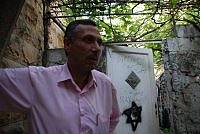
On Sunday 9th September, Hashem Azzeh walked down the street outside his house for the first time in years.
Hashem lives with his artist wife Nasreen and their four children (14, 9, 4 and 2 years old) on a hillside in the Tel Rumeida district of Hebron. The street outside Hashem’s house is barred to Palestinians and overseas visitors, with an army checkpoint at the end of the street to enforce the ban. To reach their house, the family have to go via a treacherous back route, clambering over walls and around other properties on the way.
Despite all the harassment and violence, Hashem remains determined to stay in his house, and today said he wanted ‘an adventure’. Hashem and five ISM volunteers from the UK, Italy and the USA clambered up from the house to the street, then walked the 200 or so metres to the checkpoint at the end of the street. The Israeli soldier at the checkpoint appeared astonished to see Hashem and international volunteers come along the street from the ‘wrong’ direction and immediately started radioing for back-up. When the soldier asked Hashem why he was walking on the street, Hashem replied, ‘I am walking to my house’.
Hashem’s family have faced years of harassment from residents of the illegal Israeli settlement on the hillside just above their house. The settlement happens to be home to some of the most fanatical settlers in Hebron, including American-born extremist Baruch Marzel.
Over the years, Hashem’s family have faced attacks on their property by settlers, with Israeli soldiers standing alongside doing nothing to intervene. Settlers have also poisoned his water supply, and killed his olive trees, fruit trees and vines. When Hashem installed his own water tank, the settlers shot it full of holes in yet another attack.
As well as attacks on their property, the family have faced regular physical violence. Hashem’s nephew had his teeth knocked out by rocks, and his brother was also smashed in the face with rock and suffered damage to his teeth and nose. Nasreen has had two miscarriages. An ISM activist, 77 year old Australian academic Mary Baxter, also faced violence in the past, when accompanying Hashem’s children to school in 2005. She and the children were attacked, and Mary had four bones in her back broken and is now disabled as a result.
Related articles
- Soldiers Physically Attack Palestinian Youth In Hebron (alethonews.wordpress.com)
- Hebron: Over 30 detained (alethonews.wordpress.com)
- Hebron: settler illegally enters Palestinian home (occupiedpalestine.wordpress.com)
- Hebron: Palestinian streets closed for Israeli settlers (alethonews.wordpress.com)
- French activist injured as Israeli troops attack Hebron (alethonews.wordpress.com)
- Jewish Settler’s Vehicle Rams Child in Hebron Hit and Run (alethonews.wordpress.com)
- Hebron: Settlers gas attack Palestinians, victim arrested and refused aid (occupiedpalestine.wordpress.com)
- Soldiers Kidnap Girl, Her 12-Year-Old Brother In Hebron (imemc.org)
Three injured from tear gas after settlers raid in Qusra
September 10, 2012 | International Solidarity Movement, West Bank
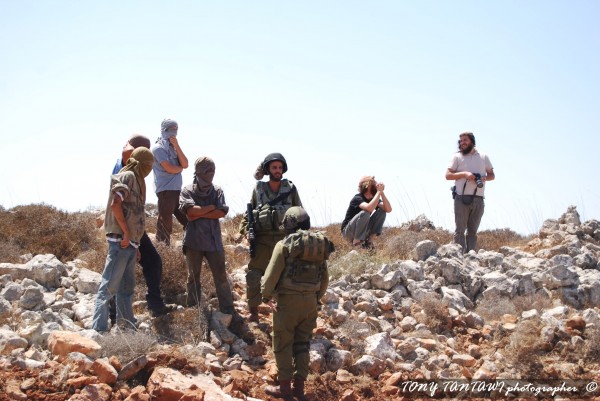
Settlers together with Israeli soldiers in Qusra. Picture from Tantawi Aljiniral
Three people were treated for injuries related to tear gas after an attack by illegal settlers in the village of Qusra near Nablus on Saturday night. The attack comes roughly a year after Qusra resident Issam Kamel Odeh, 33, died from Israeli gunfire after settlers invaded the village in September of 2011.
Shortly before six in the evening Saturday, five settlers came onto the land of Akram Taysir Daoud at the edge of Qusra village. Soon after, they began beating the man’s wife and yelling obscenities at his mother. Additional raiders arrived until there were a total of fourteen settlers on the land.
In an attempt to get help, Akram Taysir called the mayor of the town. The mayor alerted the people of the village to come to the farm, and then called both the local District Coordination Offices to report the attack.
The invading settlers sealed a well on the property with a large stone.
Israeli soldiers arrived at the village thirty minutes later. According to Abdel Ahrim, a resident who observed the event, soldiers began firing tear gas shortly after their arrival. Abdel Ahrim stated that soldiers fired 30 total tear gas bombs. Thirteen of these were fired directly into the house of Abdul Majid Towfeek, a resident of Qusra.
Abbdel Ahrim reported that the commanding officer told the mayor that if any of the villagers followed the soldiers over the hill, he would burn the village down.
Soldiers fired three times before leaving the immediate area of the conflagration.
According to Red Crescent workers, three people were treated for injuries related to tear gas, two for inhalation, and one for an injury he received when a canister hit him in the ankle.
This is the second invasion by settlers on the village of Qusra in as many days. Yesterday, settlers from the nearby illegal development of Aish Coddish came onto land belonging to the residents of Qusra village.
Photos of that incident show that they were armed with an M16 rifle.
At that time, officials from the occupation forces told the mayor of the town that the only recourse for the farmer involved was to go to the local Israeli-administered court and file a complaint against the settlers. This type of legal appeal requires the petitioner to either hold an Israeli identification card, or to hire a lawyer who holds an Israeli ID to file the complaint.
Related articles
- #PHOTOS | Settlers and soldiers attack village near Nablus, injuring 5. Torched trees. Killed sheep (occupiedpalestine.wordpress.com)
- Kufr Qaddoum: Israel fires at peaceful protest, man injured in head (alethonews.wordpress.com)
- With Protection from IDF Israeli Settlers Attack Unarmed Palestinians And Force Them Off their Land (windowintopalestine.blogspot.com)
3 More Palestinians Killed In Gaza, 6 Since Wednesday At Night
By Saed Bannoura | IMEMC & Agencies | September 06, 2012
Palestinian medical sources in the Gaza Strip reported that three Palestinians were killed, on Thursday morning, when the Israeli army bombarded Beit Hanoun, in the northern part of the Gaza Strip. Three Palestinians were killed, late on Wednesday at night, when the Israeli Air Force fired missiles into an area east of the Al-Boreij refugee camp, in central Gaza.
The sources stated that the army fired missiles at residents near the Agricultural College, east of Beit Hanoun, killing three residents and wounded at four others.
The army also opened fire at Palestinian medics and ambulances in an attempt to keep them away from the area as they attempted to evacuate the slain residents and the wounded to Kamal Adwan Hospital, in the area.
The three slain residents were identified as Ehab and Akram Az-Za’aneen, and Tareq Al-Kafarna.
The army also carried out a limited invasion into Beit Hanoun, and bulldozed farmlands while firing at random.
The Israeli army claimed that the shells were fired at a group of Palestinian fighters who tried to plant explosives near the electronic fence, in northern Gaza.
Meanwhile, the Abu Ali Mustafa Brigades, the armed wing of the Popular Front for the Liberation of Palestine (PFLP) said that its fighters fired shells and into a nearby military base in retaliation to the latest Israeli military escalation.
On Wednesday at night, three Palestinians were killed, and a fourth was seriously wounded, when the army bombarded a car transporting resistance fighters in Al-Maghazi refugee camp, in central Gaza.
Medical sources reported that the bodies of the slain fighters were severely mutated, while the wounded resident is in a serious condition. The slain fighters were identified as Khalil Al-Jarba, 27, Zakariyya Al-Jammal, 23, and Khaled Al-Qarm, 23.
The Maan News Agency reported that Al-Jarba got married only six months ago, and his wife is currently pregnant. He is also the brother of Marwan Al-Jarba, who was killed in an Israeli bombardment that took place in central Gaza on April, 13, 2010.
Eyewitnesses reported that six military bulldozers and three armored vehicles invaded Al-Fakhari area in Khan Younis, in the southern part of the Gaza Strip, and bulldozed farmlands while firing at random.
Related articles
- 13 Israeli attacks on Palestinian fishermen in past two months (alethonews.wordpress.com)
- Three Palestinians Killed By Israeli Missiles In Central Gaza (imemc.org)
UK blocks probe into Malaysian massacre

Press TV – September 5, 2012
The British High Court has chosen to support the government rather than justice seekers by blocking calls for an official inquiry into British troops’ carnage of 24 Malaysian plantation workers in December 1948.
Relatives of the victims who wanted to challenge the government’s decision not to conduct an investigation into the massacre at Batang Kali said the killings are a “blot on British colonization and decolonization” and blasted the court for failing to order an inquiry despite presence of adequate evidence to justify one.
Judge Sir John Thomas said he sees “no grounds” for “disturbing” the decision by Foreign Secretary William Hague and Defense Secretary Philip Hammond to oppose the relatives’ demand for an inquiry.
The killings happened during the Anti-British National Liberation War led by Malayan fighters against British colonizers that killed 2,478 civilians.
“We are appealing. As long as the injustice remains, the families will be pursuing legal action,” said solicitor John Halford, who represents the victims’ relatives.
Related articles
- Malaysians lose High Court battle over 1948 ‘massacre’ (morningstaronline.co.uk)
13 Israeli attacks on Palestinian fishermen in past two months
Palestine Information Center – 03/09/2012

GAZA — The Palestinian Centre for Human Rights (PCHR) documented thirteen violations against Palestinian fishermen in the Gaza Strip perpetrated by the Israeli navy forces, during the past two months.
PCHR documented the Israeli violations against Palestinian fishermen during the reporting period 26 July to 01 August 2012 including 10 incidents in which the IOF fired at fishermen.
The center also confirmed the arrest of two fishermen by the Israeli forces while fishing at a distance of 300 meters from Gaza port.
The center considered the Israeli attacks against Palestinian fishermen in the Gaza Strip as a flagrant violation of international humanitarian and human rights law, especially the right to life and security of the person, in accordance with Article 3 of the Universal Declaration of Human Rights and Article 6 of the International Covenant on Civil and Political Rights, to which the State of Israel is a party.
The IOF perpetrated violations against Palestinian fishermen in the sea, when these fishermen did not pose any threat to Israeli naval troops. The fishermen were practicing their right to work and seek their livelihood within the territorial waters of the Gaza Strip when the IOF indiscriminately fired at them.
During the reporting period, PCHR documented 11 cases in which the IOF fired at Palestinian fishermen in the sea off the Gaza shore, and the arrest of 2 Palestinian fishermen, including a 16-year-old boy
These attacks took place within the 3 nautical miles allowed for fishermen to sail and fish in. PCHR also noticed that these firing incidents against fishermen and their boats took place in the context of seeking their livelihood, and the imposition of more restrictions to terrify and prevent the fishermen from practicing their work freely.
The report pointed out that Israeli gunboats fired on August 28 Palestinian fishing boats in front of the coast of northern Gaza Strip, causing damage to Palestinian boat, an issue that pushed the fishermen to go back to the shore.
Despite the fact that the fishermen were trying to steer their boats back to the shore, the Navy boats continued to target them.
Related articles
- Israeli Navy Chases Fishing Boats, Tries To Sink Them (alethonews.wordpress.com)
- IOF gunfire targets fishermen and farmers in Gaza (altahrir.wordpress.com)
Featured Video

Death Spikes & Rising Cancer In Our Youth Explained
or go to
Aletho News Archives – Video-Images
From the Archives
Politicians lie
By Mazin Qumsiyeh | Popular Resistance | August 18, 2013
There is no way to say this truth nicely: Politicians lie. That includes Japanese, American, Egyptian, Israeli, and Palestinian politicians! Is there something more common sense than that? Yet, so many citizens around the world believe their own politicians or wistfully acknowledge lies but think it is part of the job needed to run things. They believe even when politicians contradict themselves blatantly. This phenomenon is rather remarkable. It is a dissonance and disconnect from reality that many seem oblivious to. It is very dangerous because it can lead to accepting rationales for going to war. These can be deadly wars that lead to millions of lives lost as happened in what was called World War 1 and WW2. Even when incredible and declassified evidence abound, politicians continue to lie and old mythologies refuse to die. Here are just a few of the countless lies told to us over the past few decades… continue
Blog Roll
 Aletho News
- From Unipolar Universalism to Multipolar Civilizational Distinctiveness
- RSF military group defects, joins Sudanese army: State media
- Ireland goalkeeper refuses to play ‘Israel’ as squad weighs boycott
- China pushes back against US on Cuba, Iran
- Ukrainian Soldiers, Potential Mercenaries: Have Gun, Will Travel!
- Burnham’s UN debut… A masterclass in British disinformation
- Iran flights continue despite US aviation sanctions
- Global Tipping Points Lead the World Into a State of Entropy
- The day-after at the White House: USA and Xi Jinping
- The Geopolitical Balance in the Red Sea: The UAE Being Displaced by New Players
- If Americans Knew
- Deconstructing Netanyahu’s pants-on-fire UN rant – Daily Update
- Trump betrayed voters with his campaign lies and prioritized a foreign country once he took office
- Netanyahu calls Israel’s war in Gaza ‘opposite of genocide’ in UN speech to near-empty hall
- Settler Kidnappings: Torture, Sexual Abuse and Terrorisation of Palestinian Abductees as Israel Deepens Annexation of West Bank
- Gaza winter nears as 162,000 tents become unusable, raising fears of humanitarian crisis
- Netanyahu says, “It’s the opposite of genocide”; UN says Gaza economy is world’s ‘most severe crisis on record’ – Daily Update
- Israel’s US-Backed Assault on Gaza Has Created the ‘World’s Most Severe Economic Crisis on Record’: UN
- ‘Protecting U.S. Citizens’… From Israel
- ‘This is where I live now, the back of a truck’: a day in the life of a grandmother in Gaza
- In UN Speech, Iran’s President Displays Pictures of Children Killed by US, Brings Attention to Israel’s Nuclear Arsenal
- No Tricks Zone
- New Study: Earth And Venus Surface Warmth Largely Explained By Convection And Lapse Rate, Not CO2 Or Radiation
- 2025 Nature Paper Claiming Worsening Global Drought Gets RETRACTED …Heavily Flawed
- New Study: ‘Global Drought Shows No Detectable Recent Acceleration Under Climate Warming’
- Economic Masterminds: German Socialists Suggest Taxing Productivity Gains Stemming From Using AI
- The South China Sea Has Not Been Cooperating With The Climate Change Narrative
- Energy Crisis: Germany Enters Heating Season With Historically Low Gas Reserve Fill Levels
- New Study: The Antarctic Ice Sheet Gained Mass From 2020-2024 Due To Staggering Snow And Ice Accumulation
- Study: Ocean Heating Rates From Thousands Of Years Ago ‘Dwarf’ Modern Ocean Heating Rates
- Climate Extremists Target, Attack Large-Scale Power Grid Infrastructure In Germany!
- New Study: Antarctic Ice Melt Has Contributed Less Than 1 Centimeter To Sea Level Rise In The Last 30 Years

