Aqaba: Family of 12 receives home demolition order
28 June 2012 | International Solidarity Movement, West Bank
On Sunday, June 24 in Aqaba, Muhammed and Nassa Al-Jabba received a demolition order by Israeli authorities demanding that they evacuate the premises of their home within the next 3 days. The Al-Jabba family have not evacuated the home as it is the sole residence for their family of 10 children. The Israeli military may arrive at any time to demolish the building in the Area C (Israeli civil and security control) village.
Upon arriving in the village of Aqaba, International Solidarity Movement (ISM) volunteers spoke with the mayor, Haj Sami, an older man left wheelchair bound after suffering 3 gunshots from Israeli soldiers while working on his farm in 1971. He was only 16 years old at the time and fortunate to survive.
Haj Sami introduced ISM volunteers to Nassa Al-Jabbar, the mother of 10 who has been faced with a demolition order, giving her only 3 days to abandon the premises before the Israeli army is able to arrive with bulldozers and raze her home.
Nassa and her husband Muhammed have spent 10 years building their home. When asked why it took them so long, Nassa replied that because a permit to build on their own land is impossible to attain from Israel, the house was built in 7 different stages in order to avoid the soldiers attention.
Nassa says that if Israeli forces demolish her home, she, her husband, and her 10 young sons and daughters will have no other place to go. They do not have the funds to build another home.
Muhammed states that regardless of the outcome, he will not leave his home. If demolished, their house will join the over 24,000 Palestinian homes that have been demolished since 1967.
Nassa and Muhammed’s home is not the only building that faces demolition. Four other shelters and a concrete factory have received orders as well.
The village of Aqaba has suffered extensively from the Israeli occupation. Of a population of 1000, 700 residents are internal refugees. The villagers live in constant threat of home demolition.
On September 15, 2011, two animal shelters and a home were demolished. There was no advance warning, not even a demolition order. The roads that provide easy access into the village were also destroyed by Israeli forces. On a weekly basis, Israeli forces hold military training near the village, subjecting Aqaba to the sound of gun shots. On Tuesday morning however, the Israeli military began also training with tanks. The explosions are resulting in stress and trauma for the villagers.
If allowed to happen, Nassa and Muhammed’s home will join the list of thousands of demolitions inflicted on Palestinians by the Israeli military occupation.
Related articles
- Five houses, and another five, and a bulldozer, and a prison cell (adam-keller2.blogspot.com)
- Israel Plans Demolition of Entire Palestinian Village (alethonews.wordpress.com)
- Israeli military training in Al ‘Aqaba village, West Bank | #PHOTOS & #VIDEOS (occupiedpalestine.wordpress.com)
- Al Aqaba (altahrir.wordpress.com)
- Israel’s military training in Al-Aqaba northern Jordan Valley (occupiedpalestine.wordpress.com)
22 Elected Legislators Still Imprisoned By Israel
IMEMC & Agencies | June 29, 2012
 Head of the Census Department at the Palestinian Ministry of Detainees, Abdul-Nasser Farawna, reported that the current number of elected Palestinian legislators imprisoned by Israel dropped to 22 after Israel released, on Thursday afternoon, two legislators, the Palestine News Network, PNN, reported.
The two legislators who were released Thursday are Khalil Ar-Rabaey from Hebron, and Nasser Abdul-Jawad from Salfit.
Farawna said that Israel released, over the past five days, five legislators identified as Anwar Zboun, Ayman Daraghma, and Mohammad At-Til, in addition to Ar-Rabaey and Abdul-Jawad.
He added that 22 legislators are still imprisoned by Israel, 19 of them are members of the Hamas Change and Reform parliamentary bloc, in addition to the Secretary-General of the Popular Front for the Liberation of Palestine, legislator Ahmad Saadat, legislator Marwan Barghouthi and legislator Jamal At-Terawi, both members of Fateh movement.
Farawna stated that the continued abduction and imprisonment of the elected legislators and officials is a direct violation of international law and basic principles of human rights, and a violation of the principles of democracy.
He added that kidnapping Palestinian officials is a rude Israeli meddling in internal Palestinian affairs, and called on Arab and international parliamentarian to act on obliging Israel to secure the release of all elected officials.
Related articles
- Israeli Government Fails to Carry Out Terms of Prisoner Agreement (alethonews.wordpress.com)
- Palestinian prisoners’ conference declaration statement (windowintopalestine.blogspot.com)
- Israel arrests 800,000 Palestinians since 1948 (alethonews.wordpress.com)
Ecuador Will Cease Participation In School Of The Americas
School of the Americas Watch Statement on Ecuadoran Decision to Cease Participation in SOA/WHINSEC | June 28, 2012
This Wednesday, June 27, Ecuadoran President Rafaeal Correa, after hearing from a delegation of SOA Watch, has taken the decision to cease sending Ecuadoran soldiers to the School of the Americas.
We wish to express our happiness for this decision by the Ecuadoran government, convinced that the School of the Americas – now called the Western Hemisphere Institute for Security Cooperation –indeed trained and trains Latin American soldiers under the doctrine of National Security, based on fighting the internal enemy. This doctrine has borne human rights violations throughout Latin America.
In 2010, in the Truth Commission Report that investigated human rights violations in Ecuador, the training that Ecuadoran soldiers had received at the School of the Americas was called to attention, and the report recommended that the State cease sending troops to the military school. Today that recommendation has been taken into account and we are happy.
The thousands of victims of human rights violations in Ecuador and all of Latin America have the right to know those responsible for the killings, forced disappearances and torture, and that they are brought to justice to pay for their crimes. At the same time, nations must give guarantees to society and survivors that this will not happen again. One concrete way to do this is to end military training at the SOA, that has caused so much damage and suffering to our people.
Ecuador joins Venezuela, Uruguay, Argentina and Bolivia, who have pulled out of the SOA. As a result, we call on the other countries of Latin America to stop sending their troops to the School of the Americas as soon as possible.
We congratulate President Rafael Correa for this sovereign decision and to finally protect the Ecuadoran people from being subject to future human rights violations.
In solidarity,
School of the Americas Watch
UK Report finds Israel breaches International Law in treatment of Palestinian children
By Julie Webb-Pullman – Scoop – 27/06/2012
A group of nine British lawyers lawyers from the fields of human rights, crime and child welfare released the Children in Military Custody report on Tuesday, concluding that Israel is in breach of the United Nations Convention on the Rights of the Child, and the Fourth Geneva Convention in its treatment of Palestinian children.
The Report compared Israeli domestic law as it applies to Israeli children, and Israeli military law as it applies to Palestinian children, and found significant differences.
“What is important is that, whatever the offence charged, an Israeli child and a Palestinian child should from start to finish be treated by the Israeli justice system, whether civilian or military in form, according to the same principles and procedures,” the Report states.
Practices criticised in the report included discrimination, failure to observe the child’s best interests, premature resort to detention, confining children with adult prisoners, delayed access to lawyers, and the use of shackles. The group also considered that other practices they were informed of, if proven, would constitute cruel, inhuman or degrading treatment.
The Report contains a litany of abuses of Palestinian children at every stage of the process, from arrest through interrogation, bail hearings and plea bargains, trial, sentencing, detention and complaints.
One section (Section 36, of the 120 in the Report) describing only the detention process, states:
“…those who have been identified as offenders or suspects are arrested by soldiers, usually in nighttime raids on their homes are blindfolded, and, with their wrists painfully bound behind them, are then transported to interrogation centres, sometimes face-down on the floor of military vehicles. The majority are verbally and / or physically abused and, without being informed of their right to silence or the right to see a lawyer, are sometimes held in solitary confinement, pressured to inculpate themselves and others, and are often made to sign statements which they cannot read because they are written in Hebrew. Interrogations are not, save on rare occasions, audio-visually recorded, and those tapes that do exist are almost impossible to obtain by defence lawyers representing the children.”
The details of these detentions, as well as the remand and jail conditions, make horrifying reading.
The project was funded by the United Kingdom Foreign and Commonwealth Office, and the reporting group was comprised by The Rt Hon Sir Stephen Sedley, The Rt Hon the Baroness Patricia Scotland of Asthal QC, Frances Oldham QC, Marianna Hildyard QC, Judy Khan QC, Jayne Harrill, Jude Lanchin, Greg Davies and Marc Mason.
The stature of the reporting group, and the fact that “a substantial and balanced body of relevant information was collated” from key parties, including Israeli Government departments and the military, Israeli and Palestinian NGOs, UN agencies, former Israeli soldiers and Palestinian children, gives some hope that international pressure will be brought upon Israel to end these illegal and inhumane practices.
Whether Israel bows to the pressure, and observes international law, is quite another matter.
Related articles
- Israeli ex-top diplomat backs boycott (alethonews.wordpress.com)
Israeli Government Fails to Carry Out Terms of Prisoner Agreement
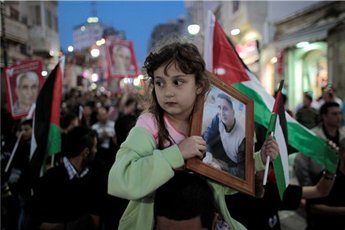
By Saed Bannoura | IMEMC News | June 28, 2012
Palestinian and international rights groups have condemned the Israeli government’s failure to live up to the agreement made one month ago in order to end the month-long hunger strike of over 2,000 Palestinian prisoners.
The promises made by the Israeli government in order to end the hunger strike included an end to solitary confinement, improved living conditions for prisoners, proper medical care and increased family visits. A month after the hunger strike was declared over, however, the Israeli authorities have yet to implement these agreed-upon terms.
The one item that Israeli authorities did carry out was the return of 91 bodies from the so-called ‘Numbers’ cemetery in Israel – a cemetery made up of Palestinians who died or were killed inside Israel. Although Israel has always denied the existence of this cemetery, mocking those Palestinians who insisted that it did exist, the release of the bodies constituted an admission by the Israeli government that the Numbers cemetery does exist. Those 91 bodies are not all of the Palestinians buried in the Numbers cemetery, but no one on the Palestinian side knows how many bodies remain, and Israel has refused to release any data.
Some prisoner rights groups are blaming the Palestinian Authority for giving in to easily during negotiations with the Israelis regarding the hunger striking prisoners, and for failing to pressure Israel to live up to its end of the bargain.
In fact, there is no mechanism by which the Palestinian Authority can force Israel to carry out its promises regarding prisoners, as Palestinians have no legal recourse to take the Israeli government to court.
One of the promises made by the Israeli government was hailed at the time as a success for prisoners, but prisoner rights groups including Addameer have cautioned that it does not constitute a real change in policy. That is the decision to not extend so-called ‘administrative detention’ orders under which Palestinians are held without charges. The caveat, however, is that Israel can extend those orders if there is ‘new information’ in the case. Since the charges and trial in these cases are held in secret, with no possibility of mounting a defense, this caveat makes the change in policy virtually meaningless.
One representative of Addameer, Mourad Jadallah, told reporters with the Ma’an news agency, “Israel also does not want Palestinians to feel they reached something with the hunger strike or let the prisoners movement feel like they reached their demands. They want to say: We can control everything.”
Related articles
- Outrage as Israel breaks prisoner agreement (altahrir.wordpress.com)
Why Do We Keep Building Needless Prisons?
By Amy Fettig, ACLU National Prison Project | June 26, 2012
Why are the Feds spending $250 million in taxpayer dollars to build an unnecessary and counter-productive prison for women in rural Aliceville, Alabama?
As the New York Times pointed out recently, most women in federal Bureau of Prisons (BOP) custody are incarcerated for non-violent offenses; over half of them have minor children. Many of these women do not need to be incarcerated in order to protect public safety. Locking them up hundreds of miles away from their families, children and communities is exactly the wrong step to take if we want them to re-enter society successfully. Decades of research demonstrates the success of policies that keep prisoners near their homes – and for women especially, concern for their children is most often cited as a prime motivator for successful rehabilitation.
But visits to remote Aliceville by most prisoners’ family members and children will be difficult, if not impossible. And the increased recidivism and negative effects this will have on the women prisoners, their children, and the community will be devastating.
What could possibly justify a decision with such a predictably bad result? The BOP claims that its overcrowding problems continue to justify prison expansion, such as the Aliceville facility, but it’s hard to credit these claims – especially since the BOP has continually failed to implement sentencing reduction measures that would help alleviate overcrowding and lower the federal prison population at great savings to the taxpayer.
Here are just a few examples:
• BOP does not allow prisoners to take full advantage of its community corrections programs, so that prisoners now serve an average of only four of the available 12 months in the community authorized by the Second Chance Act.
• The Residential Drug Abuse Program incentive for nonviolent offenders is underutilized so that successful participants rarely receive the 12 month sentence reduction to which they are legally entitled.
• BOP rarely uses its authority to request sentence modifications for “extraordinary and compelling reasons,” often referred to as “compassionate release,” which deprives sentencing judges of the opportunity to shorten the terms of deserving prisoners, especially the elderly and infirm whose continued imprisonment involves some of the highest prison costs.
These management failures lead to both over-incarceration and overcrowding and they waste millions: just by increasing home confinement by three months, the BOP could save up to $111.4 million each year.
In condemning the Aliceville facility as an example of misguided and costly policy, the New York Times noted that in contrast to the BOP, state corrections systems are scaling back incarceration due to its crushing costs. A recent report by the ACLU, Smart Reform is Possible, highlighted reform efforts in several states, including New York and Texas, which were both able to stop building prisons, save money and lower crime rates by implementing sensible alternatives to incarceration.
It’s time for BOP leadership to look to the states for new ideas and approaches. Based on the successful reforms being implemented around the country it’s clear that we don’t need another federal prison for women in a remote corner of Alabama. We need leadership dedicated to producing the best, most cost-effective outcomes for women, their children and the community.
Related articles
- ACLU: Releasing Old Prisoners Is Low Risk, Financially Prudent (blogs.wsj.com)
- Plantations, Prisons and Profits: Louisiana is the prison capital of the WORLD (innerstandingisness.wordpress.com)
Bedouins forced to leave their homes to make way for Israeli maneuvers
Palestine Information Center – 27/06/2012
JORDAN VALLEY — Israeli occupation forces (IOF) forced Bedouins inhabiting Wadi Al-Maleh in the northern Jordan Valley to leave their homes on Tuesday evening.
The municipal council of Al-Maleh and the Bedouin tribes said that the IOF command told the inhabitants that they should leave their homes for two days to make way for military exercises.
It said that the soldiers forcibly evacuated dozens of families from Wadi Al-Maleh.
The council said that the IOF regularly launches maneuvers near the area using live ammunition threatening lives of the inhabitants, adding that the Israeli army never launches such maneuvers near the Jewish settlements.
Related articles
- Zionist occupation forces launch large-scale demolition spree of Bedouin homes (occupiedpalestine.wordpress.com)
- Jordan Valley: Palestinian family’s water confiscated, internationals arrested (alethonews.wordpress.com)
- 18 year old shepherd shot by Israeli soldiers in Jordan Valley (alethonews.wordpress.com)
- State of Israel Dispossesses Negev Bedouin (alethonews.wordpress.com)
- Occupation destroys Palestinian houses in the northern Jordan Valley (occupiedpalestine.wordpress.com)
- Bedouin Community Demolished, Thirty People Displaced (altahrir.wordpress.com)
Israeli ex-top diplomat backs boycott
Al Akhbar | June 27, 2012
Former top Israeli diplomat Alon Liel threw his backing behind renowned author Alice Walker’s decision to shun an Israeli publishing house, citing an international boycott against Israel for its oppression of Palestinians, the Times of Israel reported.
Liel, who served as Israel’s ambassador to South Africa between 1992 and 1994 and was also the director of Israel’s foreign ministry, said he supported the international campaign against Israel, adding that he too boycotted goods from illegal Jewish settlements in the occupied West Bank.
“If nobody speaks about the [Israeli-Palestinian] conflict, nothing will happen. I think that such a move, boycotting products from Israeli factories in the settlements, is a kind of wake-up call,” he wrote in South Africa’s Business Day paper published on Sunday.
“I can understand the desire, by people of conscience, to reassert an agenda of justice, to remind Israelis that Palestinians exist. I can understand small but symbolic acts of protest that hold a mirror up to Israeli society,” he said
Liel went on to back Walker’s refusal to allow her best-selling novel “The Color Purple” be translated into Hebrew by an Israeli publishing firm to highlight the plight of the Palestinian people.
“I think it’s needed, yes. Unfortunately, I don’t see Israeli politicians waking up from these calls. But it’s better than nothing,” he said.
The former Israeli diplomat also defended South Africa’s decision to ban “Made in Israel” labels on products from the occupied West Bank.
“I cannot condemn the move to prevent goods made in the occupied Palestinian territory from being falsely classified as ‘Made in Israel.’ I support the South African government’s insistence on this distinction between Israel and its occupation,” he wrote in his column.
Palestinian children tortured
Britain is preparing to challenge Israel over alleged malpractices by the Jewish state of Palestinian children, which could amount to torture, The Independent newspaper reported on Wednesday.
An investigation by senior British lawyers – funded by the Foreign Office – included shocking acts of cruelty against detained Palestinian children, including solitary confinement, blindfolding and being forced to wear leg irons.
The findings, based largely on testimonies by Palestinian children from the West Bank, were published in Children in Military Custody.
“We were sitting in court and saw a section of a preliminary hearing when a very young looking child, a boy, was brought in wearing a brown uniform with leg irons on. We were shocked by that. This was a situation where we had been invited into the military courts for briefings from senior judges,” Greg Davies, a human rights barrister involved in the investigation wrote.
“To hold children routinely and for substantial periods in solitary confinement would, if it occurred, be capable of amounting to torture,” the report said.
The report also found Palestinian children were often dragged from the beds in the middle of the night, and subjected to verbal and physical abuse in jail in a bid to have them sign confessions they were not permitted to read, The Independent said.
Britain’s Foreign Office said it would “lobby” Israel “for further improvements” without clarifying.
“The UK government has had long-standing concerns about the treatment of Palestinian children in Israeli detention, and as a result decided to fund this independent report. While recognizing that some positive recent steps have been made by the Israeli authorities, we share many of the report’s concerns, and will continue to lobby for further improvements,” The Independent quoted the Foreign Office as saying.
Israel maintains a military occupation of the West Bank, and a siege on Gaza, subjecting the indigenous Palestinian population to extremely harsh measures that many activists have dubbed apartheid.
(Al-Akhbar, Times of Israel, The Independent)
Related articles
- Samah Sabawi responds to Liberal Zionists (alethonews.wordpress.com)
Jordan Valley: Palestinian family’s water confiscated, internationals arrested
25 June 2012 | International Solidarity Movement, West Bank
On Thursday, June 21, Israeli forces confiscated a water tank from a Bedouin Palestinian family in the Jordan Valley, leaving them with no access to water. Three Swedish women were arrested for standing in solidarity with Palestinian women and children who peacefully protested by standing in between the Israeli military and the water tank at risk of theft.

Israeli soldiers deal violently with a Palestinian woman peacefully protesting the theft of her water tank
The Jordan valley is a fertile area ideal for agricultural production. When Israel took control of the West Bank, it immediately took hold of water resources and began to target Palestinian communities and empty them from the Jordan Valley. The villages left are isolated from each other not only by distance but by Israeli checkpoints, closed military zones, and other restrictions on movement. The Israeli military performs military training in proximity to many communities, putting them at constant risk.
The illegal occupation of water resources has made water access an urgent problem. The United Nations declares water a basic human right. The World Health Organization has declared that each individual needs access to 100 litres of water per day, but Palestinians use on average between 50 to 70 litres per day. Many Palestinians in the Jordan Valley however, receive as little as 10-20 litres per day. This is a figure lower than the absolute minimum daily consumption required to avoid ‘mass health epidemics.’ Families in the Jordan Valley are forced to buy water at incredibly inflated prices. Some households spend 40-50% of their income to buy water from Israeli companies.
“When we came to the Bedouin camp, children were crying and there were a lot of soldiers trying to drag them away from the tractor that they tried to block. There were no men, only women and children, and around 60 soldiers and policemen. The Bedouin men were scared to show any resistance because of the risk of administrative detention,” says Rosa Andersson, one of the women who was later arrested.
The Swedish women were released after 30 hours of arrest and they are now prohibited from being in the West Bank. No one, Palestinian or International, showed any violence. The Palestinian family dependent on the confiscated water tank now has no access to water as the driest season of the year has just begun.
Related articles
- 18 year old shepherd shot by Israeli soldiers in Jordan Valley (alethonews.wordpress.com)
- Palestinian farmland exploited for Israeli military exercises (alethonews.wordpress.com)
- The Forcible Transfer of the Palestinian People from the Jordan Valley (alethonews.wordpress.com)
- Israeli Forces Destroy Tents, Shacks in Jordan Valley (occupiedpalestine.wordpress.com)
- Susiya: Another Casualty of Israeli Occupation? (alethonews.wordpress.com)
- Bedouin Community Demolished, Thirty People Displaced (altahrir.wordpress.com)
- Israelis Stop Palestinians from Getting Drinking Water (altahrir.wordpress.com)
- IOA serves demolition notices in occupied Jerusalem, Jordan Valley (occupiedpalestine.wordpress.com)
Featured Video

Death Spikes & Rising Cancer In Our Youth Explained
or go to
Aletho News Archives – Video-Images
From the Archives
Politicians lie
By Mazin Qumsiyeh | Popular Resistance | August 18, 2013
There is no way to say this truth nicely: Politicians lie. That includes Japanese, American, Egyptian, Israeli, and Palestinian politicians! Is there something more common sense than that? Yet, so many citizens around the world believe their own politicians or wistfully acknowledge lies but think it is part of the job needed to run things. They believe even when politicians contradict themselves blatantly. This phenomenon is rather remarkable. It is a dissonance and disconnect from reality that many seem oblivious to. It is very dangerous because it can lead to accepting rationales for going to war. These can be deadly wars that lead to millions of lives lost as happened in what was called World War 1 and WW2. Even when incredible and declassified evidence abound, politicians continue to lie and old mythologies refuse to die. Here are just a few of the countless lies told to us over the past few decades… continue
Blog Roll
 Aletho News
- From Unipolar Universalism to Multipolar Civilizational Distinctiveness
- RSF military group defects, joins Sudanese army: State media
- Ireland goalkeeper refuses to play ‘Israel’ as squad weighs boycott
- China pushes back against US on Cuba, Iran
- Ukrainian Soldiers, Potential Mercenaries: Have Gun, Will Travel!
- Burnham’s UN debut… A masterclass in British disinformation
- Iran flights continue despite US aviation sanctions
- Global Tipping Points Lead the World Into a State of Entropy
- The day-after at the White House: USA and Xi Jinping
- The Geopolitical Balance in the Red Sea: The UAE Being Displaced by New Players
- If Americans Knew
- Deconstructing Netanyahu’s pants-on-fire UN rant – Daily Update
- Trump betrayed voters with his campaign lies and prioritized a foreign country once he took office
- Netanyahu calls Israel’s war in Gaza ‘opposite of genocide’ in UN speech to near-empty hall
- Settler Kidnappings: Torture, Sexual Abuse and Terrorisation of Palestinian Abductees as Israel Deepens Annexation of West Bank
- Gaza winter nears as 162,000 tents become unusable, raising fears of humanitarian crisis
- Netanyahu says, “It’s the opposite of genocide”; UN says Gaza economy is world’s ‘most severe crisis on record’ – Daily Update
- Israel’s US-Backed Assault on Gaza Has Created the ‘World’s Most Severe Economic Crisis on Record’: UN
- ‘Protecting U.S. Citizens’… From Israel
- ‘This is where I live now, the back of a truck’: a day in the life of a grandmother in Gaza
- In UN Speech, Iran’s President Displays Pictures of Children Killed by US, Brings Attention to Israel’s Nuclear Arsenal
- No Tricks Zone
- New Study: Earth And Venus Surface Warmth Largely Explained By Convection And Lapse Rate, Not CO2 Or Radiation
- 2025 Nature Paper Claiming Worsening Global Drought Gets RETRACTED …Heavily Flawed
- New Study: ‘Global Drought Shows No Detectable Recent Acceleration Under Climate Warming’
- Economic Masterminds: German Socialists Suggest Taxing Productivity Gains Stemming From Using AI
- The South China Sea Has Not Been Cooperating With The Climate Change Narrative
- Energy Crisis: Germany Enters Heating Season With Historically Low Gas Reserve Fill Levels
- New Study: The Antarctic Ice Sheet Gained Mass From 2020-2024 Due To Staggering Snow And Ice Accumulation
- Study: Ocean Heating Rates From Thousands Of Years Ago ‘Dwarf’ Modern Ocean Heating Rates
- Climate Extremists Target, Attack Large-Scale Power Grid Infrastructure In Germany!
- New Study: Antarctic Ice Melt Has Contributed Less Than 1 Centimeter To Sea Level Rise In The Last 30 Years

