Extremist settlers hurl concrete blocks at Hebron’s Old Market
3 December 2011 | International Solidarity Movement
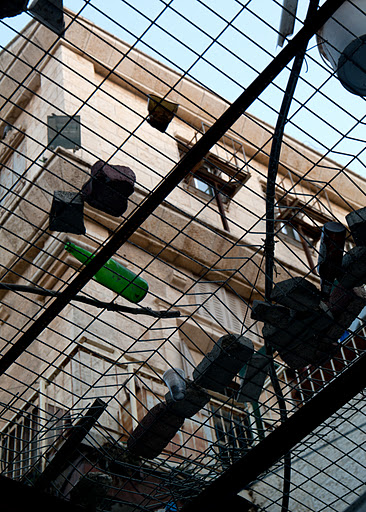 West Bank – Settlers from Avraham Avino targeted Palestinians in the Old Souq in Hebron during the Saturday market on December 3rd 2011. At approximately 11 AM Five unmasked settlers, aged around 20-30, threw concrete blocks down from a roof above the Old City at the booths outside of the shops, and at the people passing. The blocks were of considerable size – each weighing around 5-10 kilos. As they were thrown from a height of eight meters, anyone hit would be severely maimed or killed. Some of the blocks became lodged in the roof above the shops while some landed in the street.
To access the Souq the settlers had to pass over the roofs of several Palestinian families in clear view of the military posts that are stationed on the rooftops. They were standing next to a military post as they threw the concrete blocks – uninterrupted by the military. “If it was a Palestinian (throwing stones from a roof), he [the soldier] would shoot him!” a shop owner said.
A witness identified two of the settlers as people who had taken part in an attack on Palestinians two years ago when the Eawawy family’s home was burned down. The arson was investigated by the Israeli police, as the Old City is in Israeli controlled H2, but the police have failed to take action even though the perpetrators have been identified. The shopkeepers were reluctant to report today’s attack to the police due to the Israeli authority´s failure to investigate settler attacks.
International observers arrived at the area before the military, who arrived after they had been contacted by the Temporary International Presence in the City of Hebron (TIPH). Attacks by settlers who live next to the Old City are frequent and the residents have had to attach netting above shops and streets to protect frequently targeted areas.
Egyptians in US protest gas manufacturer
Basant Zain-eddine – Al-Masry Al-Yuom – 04/12/2011
Egyptians in the United States staged fresh protests on Friday outside the Combined Systems Inc. (CSI) firm in Pennsylvania, which is believed to be the manufacturer of the tear gas used by Egyptian security forces.
At least 43 protesters were killed in week-long clashes with security forces that erupted on 19 November near the Interior Ministry building in downtown Cairo. Eyewitnesses and medical sources reported that many protesters suffocated due to intensive use of tear gas by police.
The protesters outside CSI, who were joined by Occupy Wall Street activists, laid on the ground and played dead to denounce the export of tear gas to Egypt and other Arab states. Some of the firm’s employees tried to forcibly remove the protesters.
The demonstrators wore eye patches in solidarity with several protesters in Cairo who lost their eyes due to rubber bullets used by security forces during the encounters.
Meanwhile, a number of Washington-based Egyptians and Americans have submitted a memo to the White House in which they call for halting the export of tear gas to Arab states, as it is being used to hurt peaceful demonstrators.
Protests outside the Egyptian consulates in New York and Canada also took place in solidarity with demonstrators in Cairo.
Occupation forces set up tent next to the home of liberated captive
 Palestine Information Center – 03/12/2011

AL-KHALIL — Israeli occupation forces on Saturday afternoon set up a tent on the roof of a house adjacent to the house of liberated captive Randah Shahatit from the village of Abu Seif to the south of Dor in al-Khalil district in the southern Gaza Strip.
Sources close to liberated captive Shahatit told the PIC correspondent: “IOF troops boarding four military vehicles raided the village in the afternoon and they built a tent on the roof of a house belonging to Ismail Shawamra, adjacent to the home of liberated captive Randah Shahatit.”
The sources added that the soldiers were still on the roof at the time of the writing of this report and that when Shahatit went out of her home to visit a friend in the village the soldiers were watching.
Villagers are staying in their homes fearing the IOF have aggressive intentions.
The IOF troops raided the home of liberated captive Shahatit last Sunday and summoned her to Etsion interrogation centre to the south of al-Khalil on Wednesday where she was warned of participating in any activities and that she was being watched by the occupation army.
‘The bullets made the water splash up in my face’
PCHR | 01 December 2011
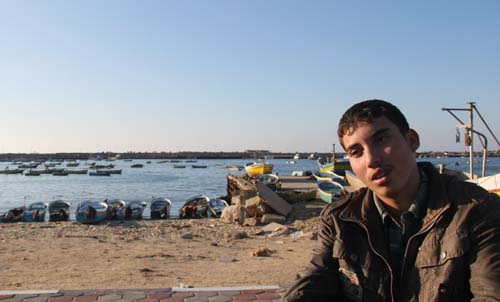
“The bullets made the water splash up in my face. The soldiers shouted at us to take off our shirts and trousers. We had to jump into the water and swim towards them one by one” says 17-year old Mohammed Bakr, as he recounts how Israeli naval forces detained him from his family’s fishing boat, together with his cousin and uncle.
Mohammed Wisam Lutfi Bakr is the oldest of 9 children. He is from a fisherman’s family living in Gaza City’s Remal neighbourhood. He has been helping out on his father’s fishing boat since he was 7 years old. As he explains what happened to him, his cousin, and their uncle on the early morning of 10 November he relives the fear he felt during the initial attack, arrest and subsequent detention.
Like every morning when the weather allows, Mohammed, his cousin Abdul Kader Wael Bakr (17), and their uncle Arafat Lutfi Bakr (28) went out fishing off the shore of Gaza City, leaving at approximately 03.00. At around 03.30, when they were approximately 2 nautical miles off Gaza City’s shore, they were suddenly approached by a large Israeli gunboat. Without warning soldiers started firing shots in the water around them, very close to the boat. “The bullets made the water splash up in my face. The soldiers shouted at us to take off our shirts and trousers. We had to jump into the water and swim towards them one by one” Mohammed recalls. His uncle Arafat went first. Mohammed watched how his uncle was pulled on board of the gunboat by the soldiers. Then his cousin Abdul Kader followed. “I went last” says Mohammed, “they handcuffed us with plastic straps and blindfolded Arafat. There were at least 5 soldiers. They kicked and beat me on my arms and legs. They did the same to my cousin. I’m almost sure they gave our uncle even worse treatment, but I could not see him because they took him out of our sight”. All three of them were taken to a detention facility in Ashdod and held there blindfolded. “It was very dirty. At some point I said I needed to go to the toilet. Then they put me in an open area where everyone could see me. There was not even a toilet.”
Around 12.00h Mohammed and Abdul Kader were transferred to Erez checkpoint, between Israel and the Gaza Strip. There the two cousins were held and questioned until 22.30h. Then the soldiers at the Erez called Mohammed’s father and grandfather to tell them that they released the two cousins. The two men had been waiting for news about the boys since noon, when a fisherman told them they had been taken by soldiers. The father and grandfather had heard shots being fired while they were in the mosque for morning prayers. Later they realized they had heard the attack on Mohammed, Abdul Kader and Arafat.
Mohammed cannot stop thinking about his uncle, who is still being held in Israeli detention; “Arafat and I would go everywhere together and do all the fishing together. I am very worried about him. The soldiers even said; ‘you always go fishing with Arafat’. I am very afraid for how they are treating him.” Arafat is a member of the Palestinian Naval Police.
On the day of the arrest, the family’s fishing boat, including the motor and net, were confiscated. The boat was passed from Mohammed’s grandfather to his father and has been the livelihood of the extended family for as long as Mohammed can remember: “we have no money for a new boat, motor, and net. Altogether it would cost us around 46,000 NIS.” With the confiscation Mohammed and many of his relatives lost their only source of income.
Mohammed is in his last year of high school and is preparing for the final tawjihi exams; “all my classmates take extra classes for the tawjihi but it costs a lot of money, which my family doesn’t have.” Mohammed would like to take the extra classes too but with the loss of the family income, that has become an impossible challenge.
The Israeli army violence against the fishermen has a major impact on Mohammed and his family: “last year my twenty year old cousin, Mohammed Mansour Bakr, was attacked by the Israeli army while fishing. The soldiers shot him and he died. The army is merciless. We stopped fishing for a little while but eventually we had no choice but to get back to our work. We are attacked a lot by the soldiers. They harass us. During this year’s Ramadan they chased and harassed us seven times. It feels like they want to disturb us more during our holy month. At sea the thoughts of risks are constantly in my head. Everyone can feel the same fear at sea. It feels like watching a frightening movie”. However, there is no other option for Mohammed and his family but to continue fishing; “There is no other work for us. Where can we possibly get other work from in Gaza? Even though our work is very dangerous, there is no other choice but to go back to the see because we need the money. If and when we get another boat, I will go again.”
For the past two decades the fishing waters of the Gaza Strip have gradually shrunk by access restrictions imposed as a result of the Oslo agreement and more recently by illegal unilateral restrictions imposed by Israel. Even within the currently enforced 3 nautical mile limit, the Israeli navy regularly attacks, arrests, and sometimes even kills fishermen. This year at least 32 fishermen were arrested, 17 in the month of November. Another 5 fishermen were injured and at least 20 boats were confiscated. In conjunction with the restriction on fishing waters, the income of Gaza’s fishing community (8,200 fishermen and workers in the fishing sector) has steadily decreased. By 2010 the fishing catch had decreased by 37% compared to 2008 and this amounted to only half of the 1999 fishing catch. The sardine catch, which makes up 70% of Gaza’s total fishing catch, now only reaches 20% of the sardine catch that existed before the restrictions, representing a loss of $10 million. Finally, according to the Fisherman’s Syndicate, around 60% of the small fishing boats and 22% of trawler boats in the Gaza Strip are not used because of the high risks involved and the limited catch.
Hebron: Occupation and Sterilization

The divisions have been institutionalized. (Markus Balázs Göransson)
By Markus Balázs Göransson | Palestine Chronicle | December 2, 2011
The center of Hebron is surreal and terrifying. It is strange and overwhelming to see this schizophrenic place with my own eyes. As I walk along the streets, my senses are heightened yet I cannot fully process what I see. It feels like I am walking in a dream or on an empty movie set. The legacy of violence is stark and in your face and I am reminded of the ruins and craters that I saw when visiting Srebrenica in Bosnia several years ago. Yet, unlike Srebrenica, there has been no attempt to move past the divisions in Hebron. Instead, the divisions have been frozen and institutionalized and today Hebron is relatively quiet only because people are kept physically apart.
A handful of Jewish settlers – 800, in a city of 170 000 – have moved into the heart of the city and to protect them the Israeli army has created “sterilized zones” where the movement, residence and business of Palestinians are sharply restricted. On parts of some streets Palestinians are allowed to pass but when they do so they walk swiftly with their heads down to escape notice by Israeli settlers and soldiers. Other streets are closed to Palestinians, who cannot work or walk there. Technically, they are allowed to live in some buildings but the front doors of these buildings have been bolted shut and the residents are able to enter and leave them only through back windows or over rooftops.
Some Jewish settlers living nearby harass the Palestinians regularly with impunity. The Israeli army division stationed in Hebron is there to protect Jewish settlers and is not authorized to defend Palestinians against settler violence which is frequent and vicious. Five hundred Israeli soldiers are deployed to protect eight hundred Jewish settlers. And since the Palestinian police are not allowed to enter the sterilized zones there is little or no safeguarding of Palestinian rights. Most Palestinians who could escape the zones have escaped. Only the poorest families – and the criminals seeking a refuge – remain.
In one courtyard, where a thick stench of trash and rotting food hangs in the air fifty Palestinian families used to live. Today only two remain. They live in a building scarred by violence, where the front door is blocked and the windows covered with iron bars and metal nets. They enter and exit through a back window leading to the Arab part of the city. The courtyard in front of their apartment used to be full of life but is now covered in trash. Alleyways leading from the courtyard are blocked with slabs of concrete and giant rolls of barbed wire. An Israeli soldier is standing nearby, eyeing us uneasily as we move around listening to our guide explaining the history and nature of the conflict in Hebron.
My visit to Hebron was arranged by the Israeli NGO Breaking the Silence, a veterans organisation which collects and publishes testimonies of Israeli soldiers about the abuses they have committed in the occupied Palestinian territories. The founder of this organization, Yehuda Shaul – a bearded Jewish man who wore a kippa and described himself as Orthodox – guided us around the deserted streets of the now Jewish parts of Hebron, showing us destroyed architecture, boarded-up Palestinian homes and the ubiquitous presence of the Israeli army. He had himself taken part in the occupation, serving as a grenade launcher operator with the IDF in Hebron during the Second Intifada (2000-4).
Explaining the military logic of the occupation, Shaul stressed two messages. First, he insisted that there is no such thing as a “good occupation” and that the Israeli public is simply soothing its conscience with the myth that the Israeli Defense Force is enforcing a moral occupation. On the contrary, he argued, an occupation cannot be effective without involving serious abuses of the rights of the local people. This is irrespective of the virtues and morality of the individual soldier. The logic and pressures of the situation will lead soldiers to treat certain categories as security threats and hence deprived of certain rights. Add to this, he noted, the psychological stress that many soldiers suffer on account of being stationed in hostile territory and the widespread atmosphere of impunity around them and you have a combustible mix.
Shaul went on to say that many of the abuses committed by the Israeli army have a clear military purpose. They are not the result of indiscipline or frustration but part and parcel of the very strategy of the occupation. He gave as an example that Israeli forces systematically disrupt the daily life of local Palestinians in order to keep them on their toes and thereby discourage them from engaging in organized violence. He also recalled from his own military service in Hebron that Israeli soldiers would repeatedly break into Palestinian homes to snatch with them young boys that they would force to walk in front of their vehicles during patrols. This was not an act of cruelty but an effective tactic to prevent other Palestinians from throwing stones at them.
Shaul’s central message was that the occupation, despite the lofty rhetoric surrounding it, carries a dark underside, and it is this underside that Breaking the Silence wants to expose and bring to the attention of the Israeli public. He emphasized that Israelis must take responsibility for the crimes committed in their name. There is a large moral price tag to the occupation, Shaul insisted, and the Israeli people must face up to this.
Unsurprisingly, our tour group was not greeted warmly by many Hebron settlers. Many shouted abuse at us, and at one point a group of children, aged 7-8 years, took a hose and sprayed us with water as we passed a settlement. Two of them ran after us and punched, kicked and jumped on Shaul, calling him names. I was disgusted, not because of their obvious hatred, but because they were so steeped in a sense of self-righteousness and impunity that they felt safe and entitled to attack a group of adult visitors.
It is difficult not to be outraged by the situation in Hebron. The visit brought home some of the injustice and intractability of the Israel-Palestine conflict, and the structural logic and powerful interests that sustain it.
– Markus Balázs Göransson is currently studying for a PhD in International Politics at Aberystwyth University. He has previously worked as a conflict researcher and written on conflicts in the Philippines, the Balkans and the Middle East.
Israeli army targets PFLP in dawn raids
Ma’an – 01/12/2011
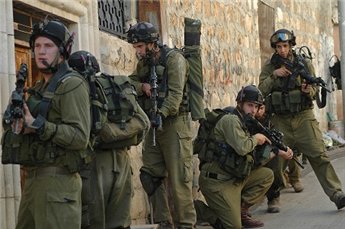
JENIN – Israeli troops detained 22 people in dawn raids across the West Bank on Thursday, including nine leaders of the Popular Front for the Liberation of Palestine.
An Israeli military spokeswoman said 22 people were taken for questioning, including 10 in the northern West Bank city of Jenin.
PFLP officials said a large force of 20 army jeeps raided Jenin and detained nine PFLP leaders. Among them are student union chief Nasser Abu Aziz, 57, local councilor Alam Sami Masad, 45, popular committee member Fada Zgheebe, 46, and his 61-year-old brother Salah Abdullah Zgheebe, a lawyer, as well as Mohammad Abu al-Haija, 35.
Witnesses told Ma’an that Israeli soldiers ransacked homes without regard for women’s privacy, the presence of children or the health of those detained. Abu Aziz is sick and Abu Abu al-Haija is disabled, they added.
The raid was the second operation targeting the leftist faction in the last month. In November, 13 PFLP leaders were detained in Ramallah and Jenin.
Israel frees Gaza fishermen but keeps boats
Ma’an – 30/11/2011
GAZA CITY – Israel has freed 10 fishermen detained off the Gaza coast but has not released their boats, a Palestinian official said Wednesday.
Mahfouz al-Kabarety, head of the Palestinian society for fishing and marine sports, said eight of the men had been detained on Tuesday and were released Wednesday. Two fishermen detained on Monday were freed Tuesday, he added.
On both occasions, Israel confiscated the fishermen’s boats and has not returned them, the official said.
On Tuesday, an Israeli military spokeswoman said a boat “deviated from a designated fishing area” off the Gaza coast, and was instructed to reverse course by naval forces in the area. The boat failed to comply with the instructions and the crew was taken into custody, she said.
Palestine’s UN observer said in October that by preventing fishermen from reaching 80 percent of available fishing waters, Israel exacerbated poverty in the Gaza Strip, in a report to the General Assembly.
Noting that most Gaza residents were dependent on food aid, the International Red Cross said in July that Gaza’s fishing industry had almost disappeared due to Israeli restrictions.
Suez port employees reveal 21-ton US tear gas order for interior ministry
Port workers in Suez refuse to receive initial seven ton shipment as the interior ministry looks to restock after firing tear gas at protesters in Egypt for six days last week
Ahram Online | November 29, 2011
A group of customs employees at the Suez seaport have revealed that the Egyptian Ministry of Interior is in the process of receiving 21 tons of tear gas from the US.
The claim was supported by Medhat Eissa, an activist in the coastal city of Suez, who provided documents he says he obtained from a group of employees at the Suez Canal customs. The employees have been subjected to questioning for their refusal to allow an initial seven ton shipment of the US-made tear gas canisters enter the port.
A group of employees at the Adabiya Seaport in Suez have confirmed, with the documents to prove it, that a three-stage shipment of in total 21 tons of tear gas canisters is on course for the port from the American port of Wilmington.
Employees say the container ship Danica, carrying seven tons of tear-gas canisters made by the American company Combined Systems, has already arrived at the port, with two similar shipments from the same company expected to arrive within the week.
Israel Apologizes To Pregnant U.S. Reporter Strip-Searched By Soldiers
By Saed Bannoura | IMEMC & Agencies | November 29, 2011
Israeli sources reported that the Israeli Defense Ministry issued an apology for a pregnant American reporter who was forced to be strip searched, humiliated, and forced into a X-Ray search machine, at a military roadblock while heading to Israel from Gaza.
Israel,s Ynet News reported that the reporter, identified as Lynsey Addario, who works for the New York Times, asked the soldiers not to force her to go through the X-Ray search machine because she is pregnant.
In a letter sent to the Israeli Defense Ministry, the reporter said that, despite her pleads, the soldiers forced her through the X-ray machine three times while laughing at her.
After the search, female soldiers took her to another room, and forced her to strip down to her underwear, Ynet News added.
The reporter, winner of a Pulitzer Prize, wrote her letter on October 25, and stated in it that she was never humiliated like this when she worked in more than 60 countries around the globe.
Ynet said that the Defense Ministry investigated the incident and found out that Addario made an official request not to go through the X-ray machine due to her pregnancy before she arrived at the terminal, “but the request was not properly relayed”.
The Israeli Defense Ministry issued an official apology to the reporter for what it described as “the mishap in coordination and the trouble it may have caused”.
The Ministry tried to excuse the behavior of the soldiers by stating that security measures are very tight on the border with Gaza in order “to prevent terrorist attacks from taking place in Israel”, but never explained the motive behind humiliating her.
Ethan Bronner, New York Times Bureau Chief in Israel, said that he is shocked by the way Addario was treated, and how long it took Israel to investigate the incident.
It is worth mentioning that Bronner, known for his support to Israel, has a son who joined the Israeli Army.
Single truckload of strawberries leaves Gaza
Ma’an – 29/11/2011
GAZA CITY – One truckload of strawberries left the Gaza Strip on Tuesday for export to Europe, crossings officials said.
Farmers in Gaza started to export limited amounts of produce to Europe via the Kerem Shalom crossing on Sunday, said crossings liaison officer Raed Fattouh.
The strawberries and carnations were the first produce to leave the coastal enclave in six months due to an Israeli ban on exports which has crippled the Gaza economy.
The agricultural goods are exported under an agreement between Israel and the Dutch government to allow five trucks of farm produce to leave Gaza each day.
The Israeli legal rights organization Gisha notes that if Israel fully implements the agreement, the exports represent just 1 percent of the exports Israel agreed to in 2005.
Under the 2005 agreement, Israel pledged to allow 400 trucks of Gaza produce to be exported every day.
“This exception to the ban is helpful for select growers, but it fails to address the manufacturing shut-down and massive unemployment caused by the export ban,” Gisha said in a statement released Monday.
Before 2007, 85 percent of Gazan produce was sold to Israel or the West Bank, Gisha said, adding that exporting to Europe was expensive due to high shipping costs and low demand.
Gaza farmer Monthar al-Boudi told Gisha he exported 1,500 tons of strawberries annually before Israel banned exports from Gaza to Israel and the West Bank in 2007.
In 2010, al-Boudi was only allowed to sell seven tons of strawberries to Europe.
Gisha director Sari Bashi said: “It is not clear how preventing producers in Gaza from selling eggplants, school desks, and oranges to the West Bank enhances Israeli security, but the ban is clearly harming Palestinians trying to engage in productive, dignified work.”
Featured Video

AIDS Inc. by Gary Null (2007)
or go to
Aletho News Archives – Video-Images
From the Archives
Clash of Civilization, Iran Part II
By Jamal Kanj – Intifada-Palestine.com – January 14, 2011
Israel’s survival kit is: perpetuate conflict, insecurity to rationalize collective hate and finally playing victim.
Devoid of conflict, Israel implodes internally; without hate, Zionism loses its justification; and playing eternal victim to continue blackmailing the West. Absence of this holy trinity, Israel ceases to exist.
From its inception, the house of Zion has mastered exploiting adversarial powers to advance Israel’s cause. For instance, their influence over the Democratic Party in the US began with President Truman’s bid for 2nd term election in 1948.
Responding to strong opposition from Secretary of State General George Marshall and Department experts urging against recognition of Israel, President Truman replied: “I’m sorry gentlemen but I have to answer to hundreds of thousands [Jewish voters] who are anxious for the success of Zionism. I do not have hundreds of thousands of [voting] Arabs among my constituents”
Zionists influence over liberal American politics was matched with the doctrinal school of Conservative theoreticians aligning the Republican Party’s platform with Israel’s objectives. The Neoconservative Zionists, coined Zioncons, invented the “Clash of Civilization” concept to fight Israel’s wars. … continue
Blog Roll
 Aletho News
- Merck Virologists Admitted to Falsely Certifying Vaccine Efficacy
- Mandatory Folic Acid for every man, woman & child
- Pro-Palestine protesters arrested outside UK’s ruling Labour Conference in Liverpool
- Mauritius denies landing permit to flight from Israel, forcing cancellation: Tour operator
- Israeli finance minister calls for genocidal war on West Bank, annexation of south Lebanon
- 12 Things Your Psychiatrist Was Trained Not to Tell You
- From Unipolar Universalism to Multipolar Civilizational Distinctiveness
- RSF military group defects, joins Sudanese army: State media
- Ireland goalkeeper refuses to play ‘Israel’ as squad weighs boycott
- China pushes back against US on Cuba, Iran
- If Americans Knew
- Israel forces Gazans to live in constant peril – Daily Update
- Deconstructing Netanyahu’s pants-on-fire UN rant – Daily Update
- Trump betrayed voters with his campaign lies and prioritized a foreign country once he took office
- Netanyahu calls Israel’s war in Gaza ‘opposite of genocide’ in UN speech to near-empty hall
- Settler Kidnappings: Torture, Sexual Abuse and Terrorisation of Palestinian Abductees as Israel Deepens Annexation of West Bank
- Gaza winter nears as 162,000 tents become unusable, raising fears of humanitarian crisis
- Netanyahu says, “It’s the opposite of genocide”; UN says Gaza economy is world’s ‘most severe crisis on record’ – Daily Update
- Israel’s US-Backed Assault on Gaza Has Created the ‘World’s Most Severe Economic Crisis on Record’: UN
- ‘Protecting U.S. Citizens’… From Israel
- ‘This is where I live now, the back of a truck’: a day in the life of a grandmother in Gaza
- No Tricks Zone
- New Study: Earth And Venus Surface Warmth Largely Explained By Convection And Lapse Rate, Not CO2 Or Radiation
- 2025 Nature Paper Claiming Worsening Global Drought Gets RETRACTED …Heavily Flawed
- New Study: ‘Global Drought Shows No Detectable Recent Acceleration Under Climate Warming’
- Economic Masterminds: German Socialists Suggest Taxing Productivity Gains Stemming From Using AI
- The South China Sea Has Not Been Cooperating With The Climate Change Narrative
- Energy Crisis: Germany Enters Heating Season With Historically Low Gas Reserve Fill Levels
- New Study: The Antarctic Ice Sheet Gained Mass From 2020-2024 Due To Staggering Snow And Ice Accumulation
- Study: Ocean Heating Rates From Thousands Of Years Ago ‘Dwarf’ Modern Ocean Heating Rates
- Climate Extremists Target, Attack Large-Scale Power Grid Infrastructure In Germany!
- New Study: Antarctic Ice Melt Has Contributed Less Than 1 Centimeter To Sea Level Rise In The Last 30 Years

