Israeli occupation forces tear down 13 structures in Jordan Valley
Palestine Information Center – 31/05/2011
JENIN– The Israeli occupation forces (IOF) led military bulldozers into the Al-Farisiyya and Al-Meita areas in the Salt Valley in the northern Jordan Valley, and destroyed 13 structures owned by Arab Bedouins.
The force crushed eight homes in Al-Meita in the upper Salt Valley where Bedouins have been residing for many years, although the homes were remote from Israeli military camps. It destroyed six more buildings in neighboring Al-Farisiyya.
Damage was inflicted on homes and barns as military jeeps took guard to protect the bulldozers. Other hamlets and shelters used for animals have been destroyed within the last few months in the same area.
Locals say Israeli forces seek to restrict shepherds in the area in order to curtail their usage of the land for grazing and it also seeks to push them out.
The Salt Valley is characterized by warm and plentiful water resources. It is also an agricultural and pastoral area valuable to many farmers in the provinces of Tubas and Tamoun. There are five Bedouin hamlets and communities that live there.
The IOF handed locals notices in April 2010 declaring the area a closed military zone and forbidding Palestinians from roaming there or using the land.
Israeli bulldozers destroy farmer’s land in Al Ma’sara
30 May 2011 | International Solidarity Movement
 Yesterday private Israeli bulldozers arrived in the village of Al Ma’sara in the West Bank and destroyed a section of farm land belonging to the Brijia family, uprooting five grape trees and an abundance of wheat. The bulldozers were accompanied by Israeli military jeeps which belonged to an electrical company that was installing an underground cable to provide electricity to the nearby illegal settlement of Efrat. The family of farmers, who have legally owned the land since 1964 had been given no prior warning of the destruction and neither the workers nor the army could provide any paperwork when asked.
This latest destruction of property is a sad blow to a family who have already lost four dunums of their land to illegal Israeli construction.
Al Ma’sara, 13 km south of Bethlehem, is home to about 900 people. The village is situated in a mountainous and fertile rural area which enjoys an abundance of natural water resources. Construction and expansion of Gush Etzion – one of the nearby illegal settlements – has already confiscated a large portion of village lands.
Villagers believe that this latest destruction of land is part of the Israeli government’s bigger plan to expand the illegal settlements around Bethlehem and link them together, isolating Palestinian villages, who are already a minority in the area and strengthening Israel’s hold on the West Bank.
Bahraini women recount abuse, torture
Press TV – May 30, 2011
Bahraini female doctors have detailed the humiliations and beatings they suffered after being arrested on suspicion of supporting anti-government protests.
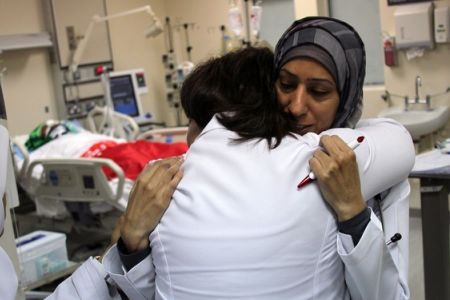 Recently freed from prison but in fear of being rearrested, the doctors said they were released only after they agreed to sign every confession papers they were given after days of brutal torture and being subjected to verbal abuse, AFP reported.
They were also forced to sign many pledges, including not to take part in any protests and not to talk to the media. […]
“I advise you that we will get you to say whatever we want, either by you saying it willingly, or we will beat you like a donkey and torture you until you say it,” AFP quoted a female doctor as saying, citing her interrogator.
Another female doctor, who spent over 20 days in detention, said she was severely beaten by her interrogators after she refused to sign a confession paper reading that doctors themselves killed two anti-government protesters while trying to “expand (their) wounds in order to make them look bad,” for cameras.
Manama officials claim that the two protesters had arrived at the hospital suffering only minor injuries.
“I couldn’t tell on which side of my head the slaps would land,” said the doctor adding that she was made to stand blindfolded in the interrogation room, where she claimed she was repeatedly called a “wh**e.”
Another doctor said she was forced to testify against some male doctors accusing them of mobilizing medics to join anti-regime protests. … Full article
Israeli occupation forces place tight grip on village near Nablus
Palestine Information Center – 29/05/2011

The gate villagers have to cross

QALQILYA — The Israeli occupation forces (IOF) has tightened procedures at the gates of the separation wall in the Azzun Atma village near Qalqilya, locals have reported.
For the past week, the IOF has been curbing civilian movement there through provocative searches and inspections.
Long lines of students, farmers, and laborers have mounted daily outside the gates as searches continue.
Azzoun Atma is encircled by the Orinet, Shaarei Tikva, Elkana settlements, which are said to serve as a “death certificate” to the farming village as they blockade it and take the majority of the land and restrict the possibility of its expansion.
Walls have been erected on all four sides of the village for alleged security reasons.
Khalid Raddad, a resident, points out that the planning situation has isolated Azzoum Atma from nearby villages Beit Amin and Sineria, which serve as natural extensions to it. The result is that families are separated from each other as well as farmers from their fields.
“We are forced to cross the wall’s gates which are only opened for us during the daytime after waiting hours in an inspection line. We have to also cross a physical inspection whenever we want to leave the village to buy something or for work or for school or just to go to whatever is beyond the wall,” Khalid says.
He goes on to say that outsiders are not permitted to enter, and school teachers and women married outside face major inconveniences when going in and out of the village and must produce permits for that.
Christian Peacemaker Teams: Settlers torch Palestinian olive grove
Ma’an – 29/05/2011
HEBRON — Israeli settlers set fire to an olive grove belonging to a Palestinian family near Hebron on Friday, an international monitoring group reported.
The fire damaged 16 trees belonging to the Abu Haikel family in Tel Rumeida, Christian Peacemaker Teams said, adding that some of the trees affected were over 1,000 years old.
Palestinian firefighters arrived to put out the blaze, but Israeli soldiers confiscated their hoses and gave them old equipment to use, CPT said.
Volunteers with the US organization said they asked soldiers to return the equipment but the troops did not respond.
Asked if the trees would produce olives again, Abu Haikel’s son told CPT: “No, they’ve burned them for the last seven years.”
International Federation of Journalists Condemns Brutal Assault of Journalist in Bahrain
Moqawama | May 27, 2011
 The International Federation of Journalists (IFJ) joined its affiliate in Bahrain, the Bahrain association of Journalists (BJA) in condemning the savage beating and inhuman treatment of reporter Nazeeha Saeed who was arrested on 22 May over the story she had filed about the repression of anti-government protesters.
The female reporter, who was covering the uprising for France24 and Radio Monte Carlo in the of Pearl Square area, suffered severe injuries at the Rafa police station where she was badly beaten by her interrogators. She also bore torture marks, according to the reports.
“We are appalled by this senseless and cruel treatment of a working journalist and we urge the Bahraini authorities to hold accountable the officers involved,” said Jim Boumelha, IFJ President. “The brutal behavior of security forces towards Saeed shows there is no end to media repression in Bahrain and the world must make it clear that these gross violations of peaceful protesters’, women’s and journalists’ rights will not go unpunished.”
Saeed was summoned to the Rafa police for questioning over her report on the death of Ali Abdelhassan who was allegedly killed by security forces during the anti-government protests of 17 February 2011. She was detained for 12 hours during which she reportedly was savagely beaten and tortured. After her release, the French consulate arranged for the journalist to receive medical treatment in France due to the gravity of her condition.
The BJA has also called for a full investigation into the allegations of torture and requested from the authorities a copy of the complaint made by the reporter, stressing the need for transparency and independence in the investigation in this case.
The IFJ has accused the Bahraini government of widespread intimidation and systematic harassment against journalists which have already led to the arrests and sackings of at least 68 media personnel in the country since the start of the protests for political reforms.
Israeli soldiers injure 3 Gaza fishermen
Press TV – May 27, 2011

Israeli forces have shot and wounded three Palestinian fishermen off the coast of the Gaza Strip as Tel Aviv continues its grip on the coastal sliver.
The fishermen’s boat caught fire after the incident which left the three Palestinians injured, AFP reported.
Palestinian officials in Gaza say the attack is not the first of its kind and aims to tighten the screws on fishermen living in the territory.
This comes after tens of fishermen organized a sit-in in the port of Gaza on Thursday, calling on the international community to intervene and help lift the Israeli maritime siege, reduce restrictions on their operations, and provide them with international protection.
The Israeli military controls Gaza’s territorial waters, but under 1993 Oslo Accords it has agreed to allow fishing boats to sail into the Mediterranean for up to 20 nautical miles.
However, over the past decade, Gaza fishermen have been able to fish only in a narrow stretch of water up to three miles and even within that restricted area they come under increasing Israeli attacks.
According to health officials in Gaza, at least 10 Palestinian fishermen have been killed and dozens wounded since 2010.
Bahrain Sentences Four People for ‘Protesting’
Al-Manar – May 26, 2011
A military court in Bahrain has sentenced four protesters to one year in prison for taking part in anti-government protests, a human rights group says.
The Bahrain Youth Society for Human Rights said on Wednesday that in a series of closed-door trials in Bahrain’s military courts, three of the four defendants were convicted a day earlier on charges of participating in anti-government protests, the Associated Press reported.
The fourth Bahraini protester was ruled guilty on Wednesday for possessing pamphlets calling for the overthrow of the country’s ruling system.
The rights group has also raised concerns about a 15-year-old boy being tried in the same court. He faces charges of “rioting” and gathering in a group of more than five people without authorization.
Meanwhile, regime forces raided a women’s salon in the Bahraini island of Sitra on Wednesday.
In Diraz, one Bahraini person was also arrested by regime forces after being dragged out of his house.
The Bahraini regime has unleashed a massive brutal crackdown on protesters since the beginning of the demos since February.
Meeting senseless aggression face-to-face
NABI SALEH 13-5-2011
By Gershon Baskin | The Jerusalem Post | 25 May 2011
For months I have been hearing about disproportionate use of force by the army against weekly demonstrations in Nabi Saleh – a small pastoral Palestinian village northwest of Ramallah. Last week, I watched several YouTube videos filmed by activists in the village, providing vivid visual images of the forceful arrests of protesters by the army. I was disturbed because all of the clips showed how the demonstrations ended; none showed how they began. I was convinced that there must have been stone-throwing by the shabab in the village which provoked the violent army responses. So I decided I had to see for myself.
When I contacted the Israeli activists who regularly participate in the Nabi Saleh demonstrations, I was warned that it was dangerous… continue
Israel detains mother of senior Hamas official
Palestine Information Center – 23/05/2011
 Arouri’s mother hugs him when he was released from an occupation jail

RAMALLAH — Israeli forces arrested the mother of senior Hamas official Saleh al-Arouri Monday morning after raiding her home in Aroura village near Ramallah.
Soldiers surrounded the Arouri residence in the village and then tampered with the contents inside while searching the premises, Salama al-Arouri told the Palestinian Information Center.
He added that they notified Arouri’s mother Aisha, 70, that an arrest warrant had been issued against her. The soldiers brutally apprehended her when she expressed refusal to respond.
Arouri said his mother suffers from several illnesses and is unable to walk without the help of others. He held Israel liable for harm caused to her.
Arouri’s son Asim was arrested a few days back for questioning.
The Hamas politburo member spent a total of 18 years in Israeli prisons before Israel exiled him to Syria last year.
The Ahrar prisoner studies center said in a statement that the ”cowardly act” was aimed at pressuring the Arouris, an active Palestinian family.
It was not the first incident where Israel abducted the mothers of activists, said Fuad al-Khuffash, Ahrar center director. A year back, Rabi’a Bilal was arrested to pressure her sons during interrogations. Israel also arrested the mother and wife of Yahya Ayyash, who was wanted and on the run.
Featured Video

New positive ivermectin evidence
or go to
Aletho News Archives – Video-Images
From the Archives
Fanatical Followers of the Covid Regime: A Jim Jones-Style Cult?
By Professor Roger Watson and Dr. Niall McCrae | The Daily Sceptic | November 15, 2021
As scholars at leading British universities over recent decades, we witnessed the replacement of critical thinking and debate by narrative: facts are discrimination and scientific method is imperialism; truth, instead, is derived from ‘progressive’ values. This educational trend may be a major contributory factor to the ease in which society has been inculcated to the Covid ‘new normal’ of masking, testing, and repeated doses of vaccines for a disease of similar risk to severe influenza.
One doesn’t need much critical reasoning to observe the flawed logic of some vaccination enthusiasts, such as people who respond to experiencing any side effects, however debilitating, by saying “at least I know it’s working”, or, after contracting the disease despite their promised inoculation (over 90% effective, according to initial drug company claims), “I’d have been worse off without the jab.” … continue
Blog Roll
 Aletho News
- The Coming GOP Bloodbath?
- Arctic Scare Stories Melt Away
- Wrong, Euronews: Climate Change Has Not Created a Food, Energy, and Economic “Meta-Crisis”
- New positive ivermectin evidence
- Met Office Caught Fabricating Daily Temperature Record Claims
- Merck Virologists Admitted to Falsely Certifying Vaccine Efficacy
- Mandatory Folic Acid for every man, woman & child
- Pro-Palestine protesters arrested outside UK’s ruling Labour Conference in Liverpool
- Mauritius denies landing permit to flight from Israel, forcing cancellation: Tour operator
- Israeli finance minister calls for genocidal war on West Bank, annexation of south Lebanon
- If Americans Knew
- In Gaza, ‘Whoever Survives the Bombing Won’t Survive the Rubble’
- Israel kills more Palestinians, amid push to resettle Gaza – Daily Update
- Israel forces Gazans to live in constant peril – Daily Update
- Deconstructing Netanyahu’s pants-on-fire UN rant – Daily Update
- Trump betrayed voters with his campaign lies and prioritized a foreign country once he took office
- Netanyahu calls Israel’s war in Gaza ‘opposite of genocide’ in UN speech to near-empty hall
- Settler Kidnappings: Torture, Sexual Abuse and Terrorisation of Palestinian Abductees as Israel Deepens Annexation of West Bank
- Gaza winter nears as 162,000 tents become unusable, raising fears of humanitarian crisis
- Netanyahu says, “It’s the opposite of genocide”; UN says Gaza economy is world’s ‘most severe crisis on record’ – Daily Update
- Israel’s US-Backed Assault on Gaza Has Created the ‘World’s Most Severe Economic Crisis on Record’: UN
- No Tricks Zone
- New Study: Earth And Venus Surface Warmth Largely Explained By Convection And Lapse Rate, Not CO2 Or Radiation
- 2025 Nature Paper Claiming Worsening Global Drought Gets RETRACTED …Heavily Flawed
- New Study: ‘Global Drought Shows No Detectable Recent Acceleration Under Climate Warming’
- Economic Masterminds: German Socialists Suggest Taxing Productivity Gains Stemming From Using AI
- The South China Sea Has Not Been Cooperating With The Climate Change Narrative
- Energy Crisis: Germany Enters Heating Season With Historically Low Gas Reserve Fill Levels
- New Study: The Antarctic Ice Sheet Gained Mass From 2020-2024 Due To Staggering Snow And Ice Accumulation
- Study: Ocean Heating Rates From Thousands Of Years Ago ‘Dwarf’ Modern Ocean Heating Rates
- Climate Extremists Target, Attack Large-Scale Power Grid Infrastructure In Germany!
- New Study: Antarctic Ice Melt Has Contributed Less Than 1 Centimeter To Sea Level Rise In The Last 30 Years

