Occupied Afghanistan: Logar resident dies in detention with foreign troops
By Abdul Maqsud Azizi | Pajhwok Afghan News | 20 May, 2011
PUL-I-ALAM: Foreign troops handed over to family the body of a 25-year-old man with his hand cut off six days after he was arrested on the charge of “links” with Taliban militants in central Logar province, officials said on Friday.
Amir Mohammad, the victim, had been arrested by foreign troops during an operation six days ago in Sheikhi village , Charkh district for alleged ties with the Taliban.
His body was handed over to his family on Thursday night, the provincial council chief, Dr. Abdul Wali Wakeel, told Pajhwok Afghan News. He said Mohammad had been arrested on the charge of having links to the Taliban, but had no link to the movement. His hands were cut off and throat had been slit before his body was handed over to his family, Wakeel said.
He said the family was reluctant to receive the body, but later they took the body and buried him at a graveyard. Mohammad had died two days after his arrest at the Bagram prison where he was taken by foreign troops. His dead body, with his hands cut and throat slit, was handed over to family four days after his death, the public representative said.
The district development council chief, Mohammad Naeem, said foreign troops had cut off Mohammad’s hands during interrogation.
He asked the central government to order an investigation into the death of Mohammad in detention. He feared the incident could spark violent protest demonstrations by residents.
The governor’s spokesman, Din Mohammad Darwish, confirmed the hand over of Mohammad’s body to his family, but provided to further details.
NATO’s International Security Assistance Force (ISAF) media office in Kabul confirmed the death of Mohammad in detention and said he had died a natural death.
Specialist doctors operated upon Mohammad after his death to determine the causes which led to his demise, the force said in a statement. The signs on his body were operation wounds, it said.
Israeli occupation forces ransack village, fire teargas inside homes in Al-Khalil
Palestine Information Center – 22/05/2011

AL-KHALIL — Israeli occupation forces fired teargas into citizens homes in the Old City of Al-Khalil on Saturday night and earlier wreaked havoc in a nearby village.
Witnesses said that Jewish settlers during a march in the Old City threw stones at Palestinian homes and burnt Palestinian flags and banners while shouting racial slurs.
They said that soldiers escorting the march fired teargas and sonic bombs at the Palestinians who retaliated against the settlers’ provocations.
The locals said that Palestinian ambulance vehicles carried 8 Palestinians to local clinics to be treated for gas inhalation including four children.
Meanwhile, an Israeli border police patrol stormed the village of Qalqas southeast of Al-Khalil city escorting an officer of the civil administration and military bulldozers. They closed the main road in the village and blocked hundreds from heading to their fields.
Local sources said that the soldiers demolished a sheep pen at the entrance of the village at the pretext of being built without permit and plowed and destroyed ten dunums of cultivated land.
The inhabitants denounced the destruction streak, and appealed to human rights groups to expose the occupation’s crimes.
Soldiers fire on protesters near Gaza border
Ma’an – 20/05/2011
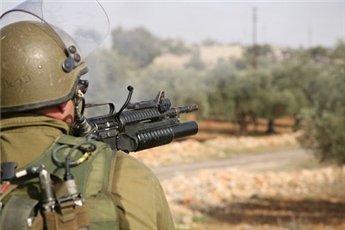 GAZA CITY — Israeli forces fired on protesters in the southern Gaza Strip on Friday afternoon, medical officials said.
One protester was injured in the incident east of Khan Younis, medics told Ma’an.
The protester was taken from Abasan village to the European Hospital for treatment, they said.
An Israeli military spokeswoman said the army confirmed shooting one “inciter” in the leg as he approached a fence separating Palestinians from forces on the border.
Demonstrations organized on Facebook called for Palestinians to demand the right of return.
In response to the demonstrations, Israel’s military is increasing a state of alert in Jerusalem and deploying more forces at its Syrian and Lebanese borders, Israel Radio reported.
More protests were expected in Nabi Saleh, where a busload of 50 soldiers had arrived, and Qalandiya, activists said. The two villages are near Ramallah in the occupied West Bank.
The protests come less than a week since Israeli forces killed over a dozen demonstrators crossing into Israeli-controlled territory in the occupied Syrian Golan Heights and from Lebanon.
Over 100 Palestinians were injured in separate clashes throughout the West Bank marking Nakba Day, the 63rd anniversary of the mass exodus of Palestinians amid Israel’s creation in 1948.
Ameer Makhoul: One Year of Imprisonment
Ameer Makhoul, Gilboa Prison-2011
 A year has passed since my imprisonment. My share has been more modest compared to other prisoners who are about to enter their fourth decade in Israeli prisons. It’s true, one should not differentiate between the sentences the same way we should not differentiate between the fighters for freedom – the sentence of the judges of oppression is always one of cruelty, terror and abuse. What is most important, however, is that it is always temporal.
Things in Palestine occur according to the following rule: the harsher the escalation of state sponsored terrorism, oppression, political persecution and deportation policies, the stronger is our steadfastness, challenge, remaining, preservation of our identity and commitment to our cause and dispossessed rights. They wish to fragment our cause according to geography and the color of identification cards, but our senses are never suppressed and our struggle for liberation is one in all of its components. While they continue to reproduce oppression, we reproduce freedom and break out of their vicious circle, transforming their actions into reactions to ours. Our right to Palestine, whether we are in our homeland or in exile, is one: the return, self-determination, ending the occupation, prisoners’ release, recovery of confiscated land, dismantling settlements and the apartheid wall, protection of Jerusalem, the Naqab, the Galilee and the coast from Judaization and eviction projects and breaking the Israeli blockade on Gaza- all these causes form part of our one cause.
But the struggle for our cause is not waged only by us Palestinians, for it is being complemented by the rebellions in the Arab world and the global BDS movement, succeeding in isolating Israel on both the Arab and international levels. These actions are nothing but an extension of the Palestinian anti-normalization movement inside Israel and of our struggle to strip the racist colonizing regime from its legitimacy.
Speaking on behalf of prisoners’ movement, I wish to allude to the dangers of the so-called security coordination between Israel and any Palestinian or Arab party. The victims of such coordination are, first and foremost, the fighters and prisoners of the freedom of Palestine and the Arab peoples. We call on the Arab peoples to stop the complicity of some Arab regimes with Israel on the so-called security-coordination level by launching an Arab and Palestinian campaign for this cause.
To spend one year in prison is a high price to pay for their unjust rule. However, free will has made of this year an act of steadfastness, challenge and struggle for our people. I here send a message of appreciation and love to all the people who call for my release, as well as to the popular committee for my defense and the Popular Committee for the Defense of Political Freedoms, which has launched a campaign for my release from the very first moment when I was arrested. From inside the prison cells I also wish to greet my loving and supportive family, and to all those who are in solidarity with our cause, here and abroad, as individuals and the organizations they represent. They are in constant contact with me, and are partners in our struggle for liberation and freedom. What we seek, we the political prisoners, is freedom and not to accumulate more years of imprisonment. We were born free, and protecting our freedom is our responsibility.
On May 15th we commemorated the 63rd anniversary of the ongoing Palestinian Nakba. Our strength continues to stem from the justice of our cause and rights, which can be fulfilled only through struggle. To struggle for liberation, as well as to rebuild ourselves as people and institutions, is our right and obligation. As for the price that is paid- it will always be painful, whether it is individual or collective. Regardless of how painful it is, we will never deviate from the road to liberation and freedom of our people and land.
Their rule, not matter how long, is temporal, but our freedom is our destiny.
~
Ameer Makhoul is the General Director of Ittijah- Union of Arab Community-Based Organizations in Palestine 48 and president of the Committee for the Defense of Political Freedoms of Palestinians 48. He is a Palestinian political prisoner who has been in prison since May 2010.
Translated to English by Shadi Rohana, Alternative Information Center (AIC
EU official: Open Gaza crossings immediately
Ma’an – 19/05/2011
GAZA CITY — EU Commissioner Kristalina Georgieva called for the “immediate, sustained and unconditional opening of crossings for the flow of humanitarian aid, commercial goods and persons,” following her trip to the coastal enclave Tuesday.
It was a message she also conveyed to Israeli Defense Minister Ehud Barak in Tel Aviv, when she met with the official after her Gaza visit.
Her trip, a statement from her office of International Cooperation, Humanitarian Aid and Crisis Response said, “highlighted the dramatic human and far-reaching effects of the blockade of the Gaza Strip.”
Israel’s four-year siege on Gaza has seen the slow closure of import terminals and imposition of strict control on the goods permitted to enter the area. The ban includes a prohibition on the import of a long list of goods, like construction material, industrial items for manufacturing, electronics, medical equipment and many fertilizers. Without access to the materials, factories remain closed, homes remain in rubble, the medical sector remains inadequate and farming undeveloped.
The “blockade exacerbates the predicament of a large number of Palestinians, and hinders the flow of humanitarian aid, persons and commercial goods to and from the Gaza Strip,” Georgieva’s statement noted.
The commissioner said the 2005 Agreement on Movement and Access for Gaza should be implemented; a comprehensive agreement mandating international forces on the Rafah border area between Egypt and Gaza, as well as a regular system of imports from Israel into the coastal enclave.
“The blockade maintains Gaza people in a state of humanitarian vulnerability and dependency. By impeding the movement of people and the import and export of goods, there is hardly no prospect for development. For example, it is very difficult to bring construction materials into Gaza, where they are urgently needed to build houses and schools as well as health and sanitary basic facilities,” she said.
British Colonial War Crimes in 1950s Kenya Mau-Mau Rebellion Whitewashed
By Jemima Pierre | BAR | 05/17/2011
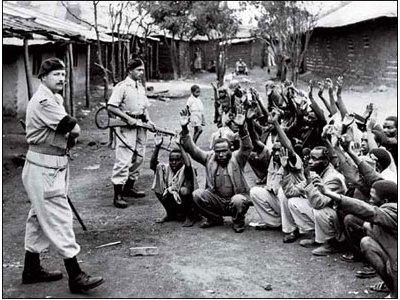
The western-manipulated International Criminal Court, which has indicted only African leaders, tries to give the world the impression that barbarity descended on the continent when the white colonists left. But four aging Kenyan “Mau Mau” freedom fighters, demanding reparations, are forcing Britain to acknowledge the savagery of white settlers and soldiers. “The generation of Africans who fought against colonialism is dying without recognition of their fight or their suffering at the hands of racist colonialism.”
In early April 2011, four elderly Kenyansi—three men and one woman—appeared in the High Court in London, accusing England of systematic torture during their siege of the so-called Mau Maus and demanding reparations for their treatment. One of the men was castrated by the British colonial government in Kenya. Handcuffed and pinned to the ground with his legs pulled apart, his genitals were sliced off by the white officers. He was then left for days without medical attention until he was liberated by Kenyan rebels. The one woman claimant was subjected to sexual torture. White soldiers repeatedly inserted bottles of boiling hot water into her vagina. In addition to these cases, thousands of Kenyans were maimed, lynched and brutally murdered by the British during the last century. Thousands of others were subjected to rape, forced labor, and gross abuse and torture in detention camps. It was part of a deliberate policy of the colonial British government to break a civilian population cast as “baboons,” “barbarians,” and “terrorists” and who were seen as a threat to the colonial order in east Africa.
The proper name for the liberation forces that fought against British colonialism and land-grabbing in East Africa was the Kenya Land and Freedom Army.ii The movement was derisively called “Mau Mau” by the British propaganda machine in an attempt to depict these African freedom fighters as a primitive and anti-white tribal cult. Against this, the late C. L. R. James described the movement as “an ad hoc body of beliefs, oaths, disciplines newly created for the specific purpose of gathering and strengthening the struggle against British imperialism, its military, political and economic domination and, in particular, the Christianity it sought to inject and impose.” And it was land and white settlers, not African “tribal” beliefs that were at the heart of the so-called Mau Mau revolt against British colonialism.
The colonial invasion of Central Kenya began in the late 1880s. It was formalized through military conquest, particularly over the most numerous ethnic group, the Gikuyu, as well as the Embu and the Meru. By 1903, the British colonial government sent in waves of white settlers, from South Africa and England, with the hope of creating another “white man’s country” in Kenya. They stole between 60,000 and 1 million acres of land, settling whites in the most fertile regions with the coolest climates—an area they eventually named the “White Highlands.” By the time the colony of Kenya came into being in 1920, more than 10,000 whites had settled over 25% of Kenya’s best territory. At the same time, the African population, mainly but not entirely the Gikuyu, were driven into reservations or were forced to work as sharecroppers. Then, through hut and poll taxes, restrictions on movement through the issuing of kipande (identity passes), and limits on agricultural production, Africans became systematically entrapped into the racist Kenyan colonial system. Add to this mix the ever-expanding power of the white settlers and Christian missionaries, and Kenya was primed for a revolution.
Though all ethnic groups were affected by British colonial land-grabbing and dispossession, the Gikuyu experienced this most acutely. They did not take lightly the heavy theft of land. When, in 1943, the colonial government threatened groups of Gikuyu with yet another eviction from their lands, they decided to take action. Their struggle began with overt passive resistance but was quickly radicalized. Wings of the movement began armed guerilla attacks on white settler holdings and on Africans who supported the British regime. At the height of the revolt, it was estimated that 1.5 million Gikuyu and other Kenyan groups had taken secret oaths of unity to fight against white settlers and colonial rule. They were met with a brutal armed retaliation. By late 1952, the colonial governor of Kenya declared a state of emergency. The colonial government established and enforced communal punishment, curfews, schemes to confiscate African properties, censors for publications, detention without trial, control of African markets, forced migrations, and detention and labor camps.
By late 1954 the revolt was said to have been militarily defeated by the British army, but the state of the emergency was not lifted until 1960. During the six intervening years, the Mau Mau struggle continued as the British colonial government established a terrorist state. The assault on the Africans continued both through the campaign to arrest and dispose of the alleged Mau Mau leadership, and in detention camps, prisons, and “emergency villages.” The British focused primarily on forcing the Gikuyu to renounce their oath of unity by the most brutal means. According to the Kenya Human Rights Commission, by the time the colonial government ended the state of emergency, over 90,000 Kenyans were executed, maimed, or tortured, while 160,000 were held in detention camps. Others have argued that the numbers were higher. What is well documented is how colonial agents were unrivaled in their barbarity. They castrated and sexually abused, starved, and maimed detainees in order to force the alleged oath takers to confess. They used electric shock, cigarettes and fire, broken bottles, gun barrels, knives, snakes, vermin, and hot eggs were thrust up men’s rectums and women’s vaginas. The assault only came to an end when the Gikuyu population was almost physically decimated and psychologically broken.
If not for the legal case brought against the British government by four surviving Kenyans, we would not know about the trove of secret colonial files documenting the systematic nature of their torture of Africans. The generation of Africans who fought against colonialism is dying without recognition of their fight or their suffering at the hands of racist colonialism. In the current context where Africans, through organizations such as the ICC, are constructed and targeted as the greatest purveyors of “crimes against humanity,” it is well worth remembering the venal work of Europeans in Africa. The demands for reparations may begin with four elderly Kenyans traveling to the old center of the British empire, but the colonial archive surely documents crimes against the Herero, the Congolese, and many other victims of European colonialism. We should not forget their struggles.
i – Wambugu Wa Nyingi, Jane Muthoni Mara, Paulo Nzili, and Ndiku Mutwiwa Mutua
ii – For Further Reading: C. L. R. James, A History of Pan-African Revolt (1995); Caroline Elkins, Britain’s Gulag: The Brutal End of Empire in Kenya (2005); Cora Presley, Kikuyu Women, the Mau Mau Rebellion, and Social Change in Kenya (1992); Gerald Horne, Mau Mau in Harlem? The U.S. and the Liberation of Kenya (2009)
Jemima Pierre can be reached at BAR1804@gmail.com.
Israeli soldier shoots photographer
Press TV – May 17, 2011
 An Israeli soldier has deliberately shot Palestinian photographer Mohammad Othman as he was covering protests in the Gaza Strip, says Reporters Without Borders.
The group said on Tuesday that Othman was clearly identifiable as a journalist at the time of the shooting and was deliberately targeted on Sunday.
The photographer was covering demonstrations near the Erez crossing in northern Gaza Strip.
On Sunday, thousands of Palestinians staged protests to mark the anniversary of the Nakba Day or “day of the catastrophe,” May 15, 1948, when Palestine was occupied by Israel.
Israeli Apache helicopters and F-16 fighter planes flew over the demonstrators, whereas troops fired tank shells near marching protesters on the border crossing.
Medical sources and Othman’s family told AFP on Tuesday that he was still in hospital in a “critical but stable” condition.
“He underwent an operation early this morning to remove a piece of shrapnel from his spine,” said Adham Abu Selmiya, a spokesman for the medical services in Gaza.
A doctor said the 26-year-old Othman was shot in the arm and was hit in the chest by shrapnel, which entered his lungs and spine.
War Crimes & the Bombing of Libya
Conn Hallinan | Dispatches From The Edge | May 16, 2011
According to the New York Times (5/16/11), Gen. Sir David Richards, “Britain’s top military commander,” is proposing that the North Atlantic Treaty Organization (NATO) target Libyan “infrastructure,” including electrical power grids and fuel dumps, in government held areas.
Frustrated by the two-month old stalemate, Gen. Richards told the Times that “The vice is closing on [Muammar el-] Qaddadi, but we need to increase the pressure further through more intense military activity.” The British are playing a major role in the bombing campaign, and Gen. Richards was in Naples, the command center for the war in Libya, when he talked with the Times.
The Times went on to write, “The General suggested that NATO should be freed from restraints that precluded attacking infrastructure targets.”
Let us be clear what “infrastructure” means: “The fundamental facilities and systems serving a country, city or area, as transportation and communication systems, power plants and schools”(Random House Dictionary, Second Edition).
Now let’s see what the 1977 Protocol Addition to Geneva Conventions of 12 August 1949 say on the business of attacking “infrastructure.”
“In order to ensure respect for and protection of the civilian population and civilian objects, the Parties to the conflict shall at all times distinguish between the civilian population and combatants and between civilian objects and military objectives and accordingly shall direct their operations only against military objectives.”
Part IV, Section I, Article. 48
“It is prohibited to attack, destroy, remove or render useless objects indispensable to the survival of the civilian population, such as foodstuff, agricultural areas for the production of foodstuffs, crops, livestock, drinking water installations and supplies and irrigation works…”
Article 54
“It is prohibited for the Parties to the conflict to attack, by any means whatsoever, non-defended localities…”
Article 59
In short, you can’t bomb power plants, electrical grids, water pumping plants, or transport systems that service the civilian population, even if the military also benefits from them. As Article 50 states: “The presence within the civilian population of individuals that do not come within the definition of civilians does not deprive the population of its civilian character.”
The pressure to step up the bombing and widen the delineation of targets reflects the fact that the war has turned into a stalemate. “We need to do more,” Gen. Richards told the Times, “If we do not up the ante now there is a risk that the conflict could result in Qaddafi clinging to power.”
That last statement appears to be a violation of United Nations Resolution 1973, which called for “protection of civilians,” a “no-fly zone,” “sanctions,” a “freeze of assets” and an “arms embargo.” Nowhere does 1973 mention regime change and getting rid of Qaddafi.
So are we being dragged into a war whose goals violate UN Resolution 1973, and whose means violate the Geneva Conventions for the Protection of Victims of International Armed Conflicts? It is hard not to answer that question in anything but the affirmative.
SOUTH HEBRON HILLS: Israeli settlers invade Palestinian village of Tuba
CPTnet | 16 May 2011
Israeli settlers invaded the village of Tuba in the South Hebron Hills late Sunday night, 15 May. They damaged property and killed and stole livestock belonging to the Ali Awad family. Palestinians of Tuba reported that they counted seven masked settlers, who entered and left the village on foot, and saw two cars at the outskirts of Tuba, near the chicken barns of Ma’on settlement. sight where one of the sheep was attacked and killed 008
The rampaging settlers stole seven sheep, killed two, and injured others, including one which lost an eye. In addition, the settlers upended three water tanks, which held a total of 4.5 cubic meters of water. They destroyed fences, punctured a storage tent and three large sacks of yogurt, damaged a goat pen and destroyed the ventilation pipe of an outhouse. They also set loose a donkey, which later returned.
A Tuba resident called Christian Peacemaker Teams about midnight Sunday to report the settler invasion and request help in urging the Israeli police to respond. The police refused to go to the village because no one there could speak to them in Hebrew. Two Israeli soldiers arrived in Tuba on Monday morning, but did not speak Arabic and so could not communicate with the villagers.
The Ali Awad family is considering making a complaint to the Israeli police, despite the fact that all their previous complaints about settler attacks, vandalism or harassment have not yet resulted in any indictments or compensation. On 21 March 2011, a masked settler from the illegal outpost of Havat Ma’on stabbed Mahmoud Ibrahim Ali Awad as the Palestinian traveled by donkey from Tuba to the city of Yatta. Mahmoud Ali Awad spent a week in the hospital recovering from stab wounds on his chest and arm.
Interview: Undercover Israeli soldiers arrest West Bank demonstrators
Electronic Intifada | 15 May 2011
Approximately 250 persons were injured today at the Qalandiya checkpoint between Ramallah and East Jerusalem in the occupied West Bank. Israeli forces opened fire on approximately 600 marchers demanding the right of return of Palestinian refugees on the date that Palestinians mark the Nakba or “catastrophe” — the forced dispossession of their homeland in 1947-48 with the establishment of the State of Israel.
Palestinian medical crews reported that of the 250 who were treated for injuries and tear gas inhalation, “40 had been marked as seriously injured from bullet wounds,” Ma’an News Agency reported (“Clashes at Qalandiya see 40 seriously injured,” 15 May 2011).
“A report from the Palestinian Red Crescent said two were hit with live rounds, 15 were injured by rubber-coated bullets, and 120 suffered tear-gas inhalation,” Ma’an added.
The Electronic Intifada spoke with Jon Elmer (www.jonelmer.ca), a Canadian independent journalist based in Bethlehem who documented protests in the occupied West Bank today.
The Electronic Intifada: Describe where you were today. Set the scene.
Jon Elmer: Things got going at about 11:00am, with a couple of marches that left from different places. There was a [Palestinian] government-sanctioned march that left from Arafat’s tomb to al-Manara square [in Ramallah] … it was a brief demonstration.
The march that happened at Qalandiya began a little bit earlier. People had marched towards the checkpoint, where protests usually take place. The Israeli soldiers were on the other side of the wall — they had come inside to confront the demonstrations. And that set off to what amounted to about six or seven hours of back and forth street fighting between stone-throwing teenagers and Israeli security forces who fired mostly tear gas and rubber-coated steel bullets. Palestinians set up makeshift defenses within the refugee camp itself and on the border of the camp.
It was hard to say how many people were in the street. It wasn’t a massive demonstration but it definitely had staying power. People were in the streets all day and demonstrations took place in a number of different spots throughout the West Bank.
EI: How would you describe the mood of the people on the streets, and the mood of the soldiers?
JE: With such an overwhelming power dynamic with massive amounts of weaponry, it’s always interesting to watch how the Israeli army operates. The soldiers move in packs, they’re constantly wide-eyed and seem to have their hands full despite the fact that they have the strength of an army behind them, whereas the [Palestinian] teenagers who are just out in the streets with their neighbors and friends and comrades are willing to stay out in the streets for seven hours, challenging that army at every step.
If people are determined not to leave, and the army is inside their community, and that’s the way that it carries out all day, the soldiers are left with very few options besides escalating the violence to try to quell the demonstrations.
We saw that late in the afternoon — the undercover units broke out of the demonstration where they had been hiding in disguise, acting as Palestinian demonstrators. They pulled out their handguns and made a series of arrests while the army backed them up by moving forward and basically trying to put an end to the demonstration. While they arrested people, the protesters began the demonstration again within moments once people re-emerged from the alleyways.
There is so much concern within the Israeli army about what they’re going to do and how they are going to quell demonstrations. If there were, let’s say, thirty demonstrations [across the West Bank], that is a worst-case scenario for the Israeli army. The army reported that there were more than ten today.
EI: What about the mood in Bethlehem, where you are based, and elsewhere around the West Bank on Nakba day?
JE: The demonstrations have been moving from community to community over the last four or five days. Bethlehem had a demonstration a few days ago.
It’s important to understand that while there are exciting political formations developing and re-emerging at this moment, there is a significant malaise that has dominated Palestinian political culture over the last few years, particularly with the aggressive crackdown on the second intifada, which really devastated the core elements of life here in the West Bank and in the Gaza strip as well.
[Israel] attacked people’s livelihoods and their ability to carry on the most basic necessities of life … So there is a period right now of regeneration which is natural after significant national trauma. And the Fatah-Hamas voided election, and the internal fighting, left Palestinians with not too many favorable options.
EI: Given that this is the 63rd anniversary of the Nakba, what are the conversations that are happening in the West Bank right now? What are people saying about the significance of this date in the context of the expansion of both Israel apartheid policies and Palestinian resistance?
JE: [The Nakba is] an important part of the national narrative, arguably the most important part of the national narrative. At the same time, day to day life in the West Bank tends to be dominated by the more direct concerns of the settlements and the checkpoints and the lack of ability to move and the lack of independence and the lack of decent-paying jobs. Basic life necessities are most in focus at the moment.
Although we read in The New York Times about these “success stories” about Ramallah and the transformation of the Palestinian economy in the West Bank over the last five years, the development aid has benefited really only a narrow sector of the population.
In general, people are still dealing with the same elementary needs of citizenship, identification cards, the ability to travel to one now-ghetto to the next. It keeps people focused on the here and now, and the long string of political let-downs and failures of the international community to affect a just resolution to the conflict keeps people modest about envisioning future successes. But the refugee issue is alive; it affects every Palestinian family.
EI: You’ve been documenting various upheavals and protests and demonstrations over the last decade in Palestine. What was most emblematic of what you witnessed today?
JE: I think what happened in south Lebanon was a very significant moment. The descriptions of people going back to their villages and hiking over those mountains today — both young children who have it ingrained in their psyches and the elderly who have never given up — today marching on the border is something that was a great moment. And it was something we can point to as something emblematic.
Although it ended in typically tragic circumstances, that type of spirit and continuity and steadfastness is what is the most threatening to Israel. People never forget, and people will never leave again. These sort of national narratives are crucial to understanding the Palestinian political situation.
Israel Attacks Humanitarian Ship to Gaza in International Waters
By Michel Chossudovsky | Global Research | May 16, 2011
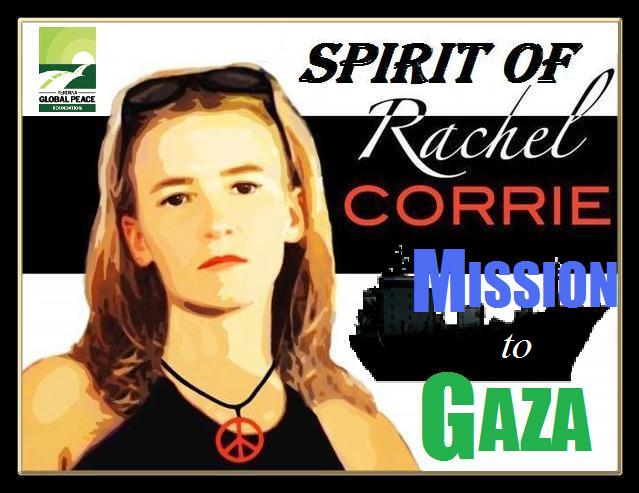
Global Research has been in contact with the Spirit of Rachel Corrie, a Malaysian ship carrying a humanitarian aid cargo to Gaza, which has been attacked in international waters by Israel.
The vessel left the Port of Piraeus, Greece on Wednesday, May 11 carrying 7.5 kilometers of UPVC (plastic) sewage pipes to help restore the devastated sewerage system in Gaza. The humanitarian initiative is sponsored by Perdana Global Peace Foundation (PGPF) and participating in this mission includes anti-war activists and journalists, consisting of 7 Malaysians, 2 Irish, 2 Indians and 1 Canadian.
The Spirit of Rachel Corrie is an initiative of The Perdana Global Peace Foundation (PGPF) chaired by Malaysia’s former Prime Minister Dr. Mahathir Mohamed. The Centre for Research on Globalization (CRG) (Global Research) is also participating in this mission.
At 10.54 pm Eastern Time (EDT), the Spirit of Rachel Corrie was intercepted by an Israeli ship and a Egyptian ship in international waters.
10:54pm EDT, Gaza 5:54am: We have been intercepted by Israeli ship and Egyptian ship. We are disobeying the orders and sailing ahead to Gaza.
10:57pm EDT, Gaza 5:57am: One Israeli warship coming to us very fast! We are in international waters, therefore they have no right to attack us. We are still sailing ahead.
10:59pm EDT, Gaza 5:59am: They are opening fire across our ship! We are still sailing ahead.
11:09pm EDT, Gaza 6:09am: They are shooting all over the place. We can’t continue …
11:35pm EDT, Gaza 6:35am: They circled our ship twice and fired across our ship. Machine guns. No one was injured. One of the fishing nets caught the propeller, so we can’t move now.
11:37pm EDT, Gaza 6:37am: The Israeli ship was coming from one end and the Egyptian ship was coming from another end. Firing. We are just stalled now. Everybody is okay. No one is injured.
In a subsequent communication from the boat, it would appear that Israel sought the active collaboration of Egypt in the interception of the humanitarian mission to Gaza, involving prior coordination between the Israelis and the Egyptian navy.
We will be informing our readers as events unfold.
UPDATE
AFP REPORT
The first press reports state that:
“Israeli naval forces fired warning shots at a Malaysian ship carrying aid to Gaza as it approached the shore, forcing it to withdraw to Egyptian waters, the vessel’s Malaysian organiser told AFP.”
“The MV Finch, carrying sewage pipes to Gaza, had warning shots fired at it by Israeli forces in the Palestinian security zone this morning at 0654 Jordan time (0354 GMT),” said Shamsul Azhar from the Perdana Global Peace Foundation.
Israeli naval forces fired warning shots at a Malaysian ship carrying aid to Gaza as it approached the shore, forcing it to withdraw to Egyptian waters, the vessel’s Malaysian organiser told AFP.
“The MV Finch, carrying sewage pipes to Gaza, had warning shots fired at it by Israeli forces in the Palestinian security zone this morning at 0654 Jordan time (0354 GMT),” said Shamsul Azhar from the Perdana Global Peace Foundation.
“Currently the ship has been forced to anchor in Egyptian waters, 30 nautical miles from Gaza,” he told AFP.” emphasis added
The information we have received from the ship is that (1) these were not “warning shots” as conveyed in the press reports.
The ship was (2) in international waters when it was attacked by Israel in violation of international law.
Featured Video

New positive ivermectin evidence
or go to
Aletho News Archives – Video-Images
From the Archives
Fanatical Followers of the Covid Regime: A Jim Jones-Style Cult?
By Professor Roger Watson and Dr. Niall McCrae | The Daily Sceptic | November 15, 2021
As scholars at leading British universities over recent decades, we witnessed the replacement of critical thinking and debate by narrative: facts are discrimination and scientific method is imperialism; truth, instead, is derived from ‘progressive’ values. This educational trend may be a major contributory factor to the ease in which society has been inculcated to the Covid ‘new normal’ of masking, testing, and repeated doses of vaccines for a disease of similar risk to severe influenza.
One doesn’t need much critical reasoning to observe the flawed logic of some vaccination enthusiasts, such as people who respond to experiencing any side effects, however debilitating, by saying “at least I know it’s working”, or, after contracting the disease despite their promised inoculation (over 90% effective, according to initial drug company claims), “I’d have been worse off without the jab.” … continue
Blog Roll
 Aletho News
- The Coming GOP Bloodbath?
- Arctic Scare Stories Melt Away
- Wrong, Euronews: Climate Change Has Not Created a Food, Energy, and Economic “Meta-Crisis”
- New positive ivermectin evidence
- Met Office Caught Fabricating Daily Temperature Record Claims
- Merck Virologists Admitted to Falsely Certifying Vaccine Efficacy
- Mandatory Folic Acid for every man, woman & child
- Pro-Palestine protesters arrested outside UK’s ruling Labour Conference in Liverpool
- Mauritius denies landing permit to flight from Israel, forcing cancellation: Tour operator
- Israeli finance minister calls for genocidal war on West Bank, annexation of south Lebanon
- If Americans Knew
- Christian Leader Responds To Netanyahu’s Claims Regarding Palestinian Christians
- In Gaza, ‘Whoever Survives the Bombing Won’t Survive the Rubble’
- Israel kills more Palestinians, amid push to resettle Gaza – Daily Update
- Israel forces Gazans to live in constant peril – Daily Update
- Deconstructing Netanyahu’s pants-on-fire UN rant – Daily Update
- Trump betrayed voters with his campaign lies and prioritized a foreign country once he took office
- Netanyahu calls Israel’s war in Gaza ‘opposite of genocide’ in UN speech to near-empty hall
- Settler Kidnappings: Torture, Sexual Abuse and Terrorisation of Palestinian Abductees as Israel Deepens Annexation of West Bank
- Gaza winter nears as 162,000 tents become unusable, raising fears of humanitarian crisis
- Netanyahu says, “It’s the opposite of genocide”; UN says Gaza economy is world’s ‘most severe crisis on record’ – Daily Update
- No Tricks Zone
- New Study: Earth And Venus Surface Warmth Largely Explained By Convection And Lapse Rate, Not CO2 Or Radiation
- 2025 Nature Paper Claiming Worsening Global Drought Gets RETRACTED …Heavily Flawed
- New Study: ‘Global Drought Shows No Detectable Recent Acceleration Under Climate Warming’
- Economic Masterminds: German Socialists Suggest Taxing Productivity Gains Stemming From Using AI
- The South China Sea Has Not Been Cooperating With The Climate Change Narrative
- Energy Crisis: Germany Enters Heating Season With Historically Low Gas Reserve Fill Levels
- New Study: The Antarctic Ice Sheet Gained Mass From 2020-2024 Due To Staggering Snow And Ice Accumulation
- Study: Ocean Heating Rates From Thousands Of Years Ago ‘Dwarf’ Modern Ocean Heating Rates
- Climate Extremists Target, Attack Large-Scale Power Grid Infrastructure In Germany!
- New Study: Antarctic Ice Melt Has Contributed Less Than 1 Centimeter To Sea Level Rise In The Last 30 Years

