‘Bahrain protesters face death penalty’
Press TV – April 26, 2011
The Bahraini regime is seeking the death penalty against a group of anti-government protesters at a martial court, says an opposition activist.
Seven protesters are accused of killing two security forces during the regime’s crackdown on the popular uprising, former lawmaker Matar Matar told AFP on Tuesday.
He added that the trial was being held in camera, and that lawyers were not given enough time to study the case.
The verdict is expected on Thursday and the prosecution has demanded death sentences, Matar noted.
The seven are Ali Abdullah Hassan, Qasim Hassan Mattar, Saeed Abdul Jalil Saeed, Issa Abdullah Kazem, Abdul Aziz Abdullah Ibrahim, Sadiq Ali Mahdi, and Hussein Jaafar Abdul Karim, according to ex-MP.
People in Bahrain have poured to the streets since February 14 to protest against the Al Khalifa dynasty.
In March, Saudi Arabia, the United Arab Emirates and Kuwait deployed their troops in the country to reinforce the brutal armed clampdown against the mass protests.
Security forces have arrested hundreds of people. Scores of protesters have also been killed and many others gone missing during the harsh Saudi-backed crackdown in the Persian Gulf state.
~
See also Anti-war.com:
Seven Face Death Over ‘Terrorism’ Allegations Related to Protests
By Jason Ditz | April 25, 2011
Seven of Bahrain’s Shi’ite protesters are to be sentenced to death, according to the nation’s state media, for their role in the protests and the deaths of two policemen. The regime claimed the protesters “committed their crime for terrorist reasons.”
Several hundred thousand protesters took to the streets over the past few months to demand democratic reforms and to complain about sectarian discrimination. A strong majority of Bahrain’s population is Shi’ite, but the ruling family is Sunni. The protests ended following the invasion of 1,500 GCC troops, led by Saudi Arabia, to help the government put down the demonstrations.
At least 13 protesters were slain during the rallies, and reports have a number of others dying in custody. The government also reported the deaths of four policemen. They did not indicate how the police were slain, but claimed to have “confessions” from the seven.
Bahrain had seldom used the death penalty over the past several years, and human rights groups had pushed them into a de facto moratorium. With the introduction of martial law to the tiny island nation, it seems this too may be changing.
Palestinian worker injured by police dogs
Ma’an – 25/04/2011
HEBRON — Palestinian worker Hatem Abdul Razzaq At-Talahma, 42, was injured Thursday morning in the city of Hebron, when Israeli military police dogs bit him at his workplace.
At-Talahma told Ma’an that he believed the dogs were released in order to attack him, as he worked in the area adjacent to a wall separating the city’s settler population from Palestinians in the Ar-Ramadeen area.
Medics said the man was treated for dog bites on his limbs and body.
At-Talahma said that following the attack, Israeli forces refused to give him first aid. He was evacuated to hospital by Palestinian Red Crescent medics.
Representatives of the Israeli police in Hebron could not be reached for comment.
Tensions are high in the city, as hundreds of Jewish worshipers travel to Hebron, where a large community of Jewish settlers illegally reside in the city center and in built-up settlements around Hebron.
During Passover, the Ibrahimi Mosque is closed off to Muslims and parts of the city are blocked to Palestinians.
Israeli forces arrest Palestinian writer
KUNA – 4/23/2011
RAMALLAH — Palestinian writer Ahmad Qatamish was arrested by Israeli forces after raiding his home in Ramallah early Saturday.
Suha Al-Barguthee, Qatamish’s wife, told KUNA that the Israeli forces raided their empty home at the wee hours of dawn.
“When the Israeli troops found no one home, they called Qatamish’s brother’s house, where we were at that time, and threatened to destroy the house if he did not come to his house for arrest,” Qatamish’s wife added.
She noted that one of her husband’s lawyers was able to visit him in Oufer Jail, where he is currently held, and he was informed by the lawyer that he will be moved soon to administrative detention, a form of detention without charge or trial that is authorized by administrative order rather than a judicial decree and can be indefinitely renewed.
Qatamish was arrested by the Israeli authorities in 1992 then released in 1998, which is considered the longest administrative detention that ever took place.
The latest arrests of Palestinian figures come after Israel’s Prime Minister Benjamin Netanyahu threatened to eliminate the Popular Front for the Liberation of Palestine (PFPL) whom he accuses of being responsible for the Itamar incident in which five Jewish settlers were killed. Qatamish’s wife said that her husband has nothing to do with the PFPL.
Israeli Army Bombards Gaza, Three Injured
Electrical generators for industrial zone damaged
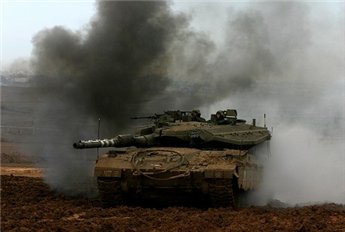 Ma’an Images
By Saed Bannoura – IMEMC & Agencies – April 22, 2011
Palestinian medical sources reported on Friday morning that three residents were wounded when the Israeli army fired artillery shells at warehouses that were previously bombarded, near the Karni Commercial terminal, east of Gaza city.
Adham Abu Salmiyya, media spokesperson of Emergency Services in Gaza, stated that the three suffered mild-to-moderate wounds, and were moved to Al Shifa Hospital.
The three were only identified by their initials while their ages are 48, 41, and 31.They work at a local factory.
On Thursday, a Palestinian farmer was moderately wounded after the army fired shells at Palestinian farmlands, north of Beit Lahia, in the northern part of the Gaza Strip.
On Thursday morning, soldiers invaded the industrial area and an area near Al Mintar Crossing, and bulldozed several areas in the Industrial Zone and the Karni terminal.
The bulldozed areas also include the warehouse that was bombarded on Friday morning.
On the wrong side of the wall
IRIN – 20 April 2011

Photo: Phoebe Greenwood/IRINMalak, eight, is in her last year at Al Nabi Samwil School, east Jerusalem.
JERUSALEM – The one-room school building in the Palestinian village of An Nabi Samwil, near Jerusalem, serves as a classroom for eight pupils, a staff room, storeroom and the principal’s office. During the winter months or on hot summer days, it is also the children’s playground.
“The biggest difficulty I face here is that I am not able to add anything more to our premises,” says school principal Khalil Abu Argu. “We have no facilities.”
The school serves 30 families in the picturesque village, which has panoramic views of Jerusalem and the West Bank. But a major problem for residents is that it is a struggle to reach either, as the village – along with 15 others – lies on the Jerusalem side of Israel’s “Separation Wall”.
The “Separation Wall”, or barrier, has been under construction since 2002. Israel claims it is essential to protect its citizens from Palestinian “terrorism”. In Jerusalem this wall, however, has not been built along the Jerusalem municipal boundary, meaning that these 16 Palestinian communities are cut off from their families and basic services.
An Nabi Samwil village also falls within Area C, where Israel retains military authority and full control over building and planning permission. Responsibility for the provision of services falls to the Palestinian Authority (PA), but because of the wall, the PA cannot access the area.
Most of the villagers hold West Bank IDs and so are not recognized by Israel as Jerusalem residents. This means they are forbidden from entering the city and anyone in the West Bank wishing to visit the village needs an Israeli permit to pass through the checkpoints surrounding it.
There is another challenge that Argu, who lives in the West Bank city of Ramallah, faces. He has been working at the school for four years. He now needs a permit allowing him to pass through the Al Jib checkpoint but is not allowed any further in the direction of Jerusalem than the end of An Nabi Sawil village boundary.
“That wall went up last year,” he says, pointing out the black electric fence winding through the valley below. “In the past, when the way was open, it was a 20-minute walk to school. Now it takes me an hour and I need a car.”
Planning restrictions in Area C mean that new structures and the expansion of existing buildings can only be carried out with Israel’s permission. No permission has been given to Argu’s school.
Demolition orders
Instead, the Israeli Defense Forces have issued demolition orders on the school’s small outside toilet and a tent they had been using as an extra classroom because they were built without permits. Israeli soldiers have visited the school more than once, warning that the illegal structures must be taken down.
Argu remains defiant: “They’ll come and take it down and I’ll put something else up. I plan to bring a shipping container to the school next year and turn it into a classroom.”
At An Nabi Sawil, lack of space has forced the school to only teach grades 1-3. From grade four onwards, local children must travel to schools in the nearby villages of Al Jib and Beit Iksa, which the principal says are more than an hour’s drive away thanks to the wall.

Al Nabi Samwil School’s principle, Khalil Abu Argu, lives in Ramallah and passes a checkpoint to get to school each morning. Photo: Phoebe Greenwood/IRIN
One of Argu’s brightest students, Malak, aged eight, is looking forward to starting grade four at a bigger school in Al Jib this October.
“I like my school now but it’s very small; there isn’t enough space,” she said. “It would be better if we could have different classrooms for the different grades. It’s very difficult now, because we have to wait for the teacher to go through three different sets of lessons.”
“Cut off”
Within the boundaries of East Jerusalem there is a different set of educational problems. Around 50 percent of the educational system is run by the Israeli municipality, the rest by a combination of the UN Relief and Works Agency (UNRWA), private educators and Waqf, an Islamic religious endowment that essentially operates in lieu of the Palestinian Authority in Israeli-controlled East Jerusalem, which is not able to operate on the Jerusalem side of the “Separation Wall”.
A recent report published by the UN Office for the Coordination of Humanitarian Affairs warned of the long-term impact of the restrictions on access to education in East Jerusalem.
Permit restrictions, checkpoints and the wall, it said, meant that pupils, and especially teachers with West Bank ID cards, face significant difficulties getting to schools in East Jerusalem, which is increasingly cut off from the rest of occupied Palestinian territory.
Ray Dolphin, the report’s author, told IRIN a key concern is the shortage of classrooms: “Even within Jerusalem [the Jerusalem Municipality] where students don’t need to cross checkpoints to get to school, there aren’t enough school buildings to meet their needs.
“And many of the buildings that are there weren’t designed as schools. Palestinian children living in Jerusalem have the right to an education but there currently aren’t the facilities.”
Despite the significant obstacles his school faces, Argu is full of enthusiasm: “I’m not at all frustrated with my job. My students work hard and that makes me proud and happy. What brings me most satisfaction is when I managed to develop the school somehow. It would be shameful for me to give up.”
Israeli troops raid Hebron school
Ma’an – 21/04/2011

Israeli soldiers at a checkpoint in the West Bank city of Hebron on
August 26, 2009. [MaanImages/Mamoun Wazwaz]
HEBRON — Israeli forces surrounded the Tareq Ben Ziyad Secondary School for boys in Hebron’s city center on Thursday morning, then entered the building deploying sound grenades, witnesses said.
School was in progress when the soldiers arrived at approximately 10 a.m., entering the school and classrooms.
No detentions were reported, and troops withdrew to an area outside of the school, which is in the Israeli-controlled zone of the city.
An Israeli military spokeswoman said soldiers had been targeted by rock throwers from the vicinity of the school, and “went into the school to check,” adding that no students were questioned or detained.
Observers from the Temporary International Presence in Hebron and parents of the schoolboys witnessed the incident, and entered the school after the soldiers, demanding that they leave.
A teacher at the school said his students were terrified when the soldiers entered the classroom, and added that soldiers had not made clear the reason they were in the building.
HEBRON: “Let them walk three miles”; Passover brings further restrictions on Palestinians
CPTnet | 21 April 2011
The Jewish Passover/Pesach holiday has imposed further restrictions on the residents of Hebron. All of the gates allowing entrance to and exit from the Old City souq on its east side were locked or barred shut to Palestinian residents and non-Jewish international visitors.
The closure caused significant difficulties for teachers and pupils. A woman—widely known as the “ladder lady”— whose house is on Shuhada Street, along which the Jewish worshipers walk, allowed Palestinians to use her house for getting in and out of the souq (market). In the morning, they rang her bell, and walked through her house and down the stairway into Shuhada Street. The Israeli police on duty in the morning allowed the children and teachers then to cross Shuhada Street on their way to school.
However, when school ended for the day and the children and teachers tried to make the return trip, Israeli soldiers and police initially refused to allow them to cross Shuhada Street, saying that the Old City souq was closed. Teachers, a local community leader, and CPTers asked the police to let the children cross. They pointed out to a senior Israeli policeman that if he did not allow the children to cross Shuhada Street they would have to take a detour of at least three miles. ‘Let them walk three miles,’ he responded. An Israeli peace activist contacted the Israeli DCO (District Coordinating Office) to ask them to intervene. For whatever reason, after a delay, the soldiers and police allowed the children and teachers to cross Shuhada Street, and the ladder lady allowed them to go through her house on their way home.
However, a gate to the Old City was open to some visitors. During the morning, Israeli soldiers accompanied several groups of settler-led Jewish groups through the Palestinian souq.
Passover continues through next Tuesday.
Injured Palestinian Worker Arrested When Trying to Raise Complaint Against Soldiers Who used Dogs to Attack Him
Ahmad Jaradat and Emma Mancini for the Alternative Information Center | 17 April 2011
During the morning hours of Sunday 10 April, three Palestinian workers were attacked by Israeli soldiers, southwest of Hebron. The three men were walking to work when the army stopped them near Ramadin, a village in Area C adjacent to the Green Line. The soldiers attacked the workers with the dogs.

One of them, ‘Ala Adel Hawwarin, a 21 year old resident in the village of Dahirriya, was seriously injured in his left hand by a dog. The other two men, Mohamed Majed Abu Cawud, a 20 year old from Ramadin, and Raed Ismail Najjar from Yatta, suffered lower body injures.
‘Ala was brought to the hospital in Hebron, where he was treated.
Three days later, on Wednesday 13April, ‘Ala Adel Hawwarin went to the police station in the settlement of Kiryat Arba to make an official complaint against the soldiers. The Military Police denied the complaint, treating ‘Ala as a criminal. The police arrested the young man, accusing him of attempting to enter the Israeli State illegally, without permission. ‘Ala called his family from the prison and told them what’s happened. The worker was in prison for two days. He was just released by the police after paying 1000 shekels.
During the days before the soldiers’ attack on the three workers, on Saturday the 9th and Sunday the 10th, several Palestinians were threatened and injured by army dogs. This is a systemic act on the part of the Israeli soldiers in South Hebron Hills in order to scare Palestinian residents.
Furthermore, the Israeli Military Police usually denies the complaints of Palestinian residents against the settlers’ violence and the army’s harassment.
Refusing this kind of complaint is a common practice, according to human rights organizations and international humanitarian associations. But now the behavior has also been admitted by the Police. On Thursday 14 April the Brigadier Meir Ohanna, commander of the Israeli Military Police, testified in front of the Turkel Committee that “most of the complaints that the Palestinians did against the Israeli soldiers end without investigations. Most of the complaints die without any accusation or any disciplinary measure against the soldiers.”
Ohanna, who was assigned by the Committee to investigate the practices of the Israeli Military Police, said that only 6-9% of the complaints by Palestinians are taken into consideration and followed by official accusations. The rest are totally ignored. Thus, hundreds of cases of abuse, harassment and attacks against Palestinian people aren’t punished: only a few soldiers have gone in front of a court to be judged.
Those kind of attacks and intimidation are forbidden by international law. The military occupation of a population is regulated by the fourth Geneva Convention: the international humanitarian law signed in 1949 establishes that “the persons protected by the Convention are those who, at a given moment and in any matter whatsoever, find themselves in case of a conflict or occupation in the hands of a Party to the conflict or Occupying Power of which they are not nationals” (art. 4).
Thus the Geneva Convention establishes that in Occupied Territories, as is Palestine, the protected persons are entitled to respect for their persons, family rights, religious convictions and practices; they shall at all times be humanely treated, especially against violence or any kind of threats and insults (art. 27).
The article 32 prohibits any measures of brutality applied by civilian or military agents against protected people: applying the international law to the case of the three workers in Ramadin, soldiers should be punished for the attack they committed.
Further, the Convention forbids collective penalties and all measures of intimidation carried out by the army of the Occupying Power, like Israel in the Occupied Territories. But in the South Hebron Hills and in the rest of West Bank, collective punishments and threats are the systematic way of intimidating Palestinian people. House demolitions, illegal searches and arrests used by the army, are also helped by the Israeli Military Police, who do no investigate and punish the guilty soldiers.
Israeli occupation forces, settlers storm West Bank cities, villages
Palestine Information Center – 20/04/2011
QALQILIA — Israeli occupation forces (IOF) stormed the city of Qalqilia on Wednesday, detained citizens, and questioned them before handing six of them summonses to the intelligence headquarters.
Local sources said that IOF troops in four army vehicles entered the city in the company of an intelligence officer ad picked a number of young men at random and questioned them.
IOF soldiers arrested a Palestinian youth in Bardala village, east of Tubas city, at a roadblock on its entrance on Wednesday. They later burst into the village and stole the car of a 55-year-old Palestinian man before leaving the village. Similar roadblocks were installed east and west of Jenin city but no arrests were reported.
The soldiers in Awarta village installed electricity poles east of the village, its municipal council chairman Qaid Awad said in a radio statement. He added that the electricity poles would be used to supply power to a number of settlers’ caravans in addition to an army base to be pitched on 1000 dunums of village lands that were earlier confiscated. Awad warned that the IOA was planning to confiscate 4000 more dunums of the village land.
Meanwhile, eyewitnesses in Burin village, south of Nablus, said that dozens of Jewish settlers entered the village in buses on Wednesday morning.
Locals warned of possible attacks after the settlers on Tuesday assaulted and wounded a farmer. The head of the municipal council in the village said that the settlers were planning to set up a settlement outpost south of Nablus near the village.
Israeli army blocks access by car to Palestinian neighborhood with more than 150 residents
B’Tselem | April 14, 2011
The village of Khirbet a-Deir, which lies next to the village of Tuqu’, is built on both sides of Route 356 that connects Bethlehem and Hebron. On 9 February 2011, a bulldozer accompanied by two army jeeps laid dirt piles and boulders at the two entrances to the Abu Ghassan neighborhood, which is the northern section of the village, and at the entrance to the nearby village of al-Halqum, thus blocking access by car through these entrances. The action was taken without informing the residents in advance and without explanation.

Residents of Abu Ghassan carry provisions on foot. Photo: Suha Zeid, B’Tselem, 10 Feb. ’11.
Following firm exchanges between residents and representatives of the Civil Administration, the army opened the entrance to al-Halqum the same day. The entrances to the Abu Ghassan neighborhood remain closed. As a result, 150 people have been left with no ability to access their neighborhood by car.
Taysir Abu Mifrah, who works for the Tuqu’ Municipality, went to the Etzion Coordination and Liaison Office the day after the piles were laid, to find out why the entrances had been blocked. He was told that the action had been taken for security reasons, and also because the access roads are close to a dangerous curve in the main road.

A supply truck blocked from entering the village. 10 Feb. ’11.
For more than a month now, residents of Abu Ghassan have had to leave their cars on the main road and climb over the dirt piles and boulders to reach home. They have to carry all shopping products, including gas canisters and animal feed, on their backs. As the village has no medical services whatsoever, residents have carry persons needing medical care over the piles and boulders to reach the main road. Children meeting the school bus are in danger, as they now have to walk out to the main road.
The blocking of car access to an entire neighborhood infringes the villagers’ rights to freedom of movement, to earning a livelihood, and to receiving medical treatment. On 14 April 2011, the Association for Civil Rights in Israel wrote to the military commander of Judea and Samaria, demanding that the blocks be removed immediately.
Israeli army used white phosphorous in latest attack on Gaza
Medical examinations point to the continued use of prohibited weapons by Israel in Gaza
Saleh Naami | Al-Ahram | 18 Apr 2011
The head of the justice department’s medical examiner’s office in the Gaza Strip, Ihab Keheal, has stated that examinations conducted by his office have unveiled evidence indicating that the Israeli army used white phosphorous and other internationally prohibited weapons in its latest operation in Gaza.
Making his comments in a press statement released Monday, Keheal said that the bodies of Palestinians killed in the latest escalations were torn apart and charred to the extent that they were barely recognizable.
Keheal added that his office was conducting delicate tests to discover the instruments used by the occupation army in its operations on civilians, including weapons and chemical munitions forbidden under international law.
The Palestinian Ministry of Justice, according to Keheal, is in contact with committees responsible for documenting war crimes as well as Palestinian and international rights organizations.
He hopes the reports issued by his office could be used to try the Israeli occupation for its crimes in an international court of justice.
In this way, explained Keheal, it is of the utmost importance that the world is aware that the occupation forces persist in using internationally forbidden weaponry against Palestinian civilians. He called on the world to take responsibility and protect civilians especially in light of Israel’s renewed threats of launching military operations on the Gaza Strip.
In the aftermath of Operation Cast Lead, which claimed the lives of 1,400 Palestinians, most of which were civilians, Israel admitted using white phosphorous against civilian targets in the strip.
Featured Video

New positive ivermectin evidence
or go to
Aletho News Archives – Video-Images
From the Archives
Fanatical Followers of the Covid Regime: A Jim Jones-Style Cult?
By Professor Roger Watson and Dr. Niall McCrae | The Daily Sceptic | November 15, 2021
As scholars at leading British universities over recent decades, we witnessed the replacement of critical thinking and debate by narrative: facts are discrimination and scientific method is imperialism; truth, instead, is derived from ‘progressive’ values. This educational trend may be a major contributory factor to the ease in which society has been inculcated to the Covid ‘new normal’ of masking, testing, and repeated doses of vaccines for a disease of similar risk to severe influenza.
One doesn’t need much critical reasoning to observe the flawed logic of some vaccination enthusiasts, such as people who respond to experiencing any side effects, however debilitating, by saying “at least I know it’s working”, or, after contracting the disease despite their promised inoculation (over 90% effective, according to initial drug company claims), “I’d have been worse off without the jab.” … continue
Blog Roll
 Aletho News
- Ex-Greek MEP files complaint against Israeli spyware firm over alleged Pegasus surveillance
- Troubling ideas throughout the Torah, Talmud, Mishneh Torah and Tanya
- ‘Grave, alarming’: Iran mission on Trump’s UNGA ‘annihilation’ threats
- Najaf airport to reopen to Iranian flights within 24 hours: Ambassador
- From ‘How Will This End For Iran’ to ‘When America Walks Away’: A tale of two Economist covers
- Tehran blasts ‘baseless’ speculation linking Iran to alleged bomb plot at UK air base
- The Rise And… Rise Of ‘Color Revolutions’
- The Coming GOP Bloodbath?
- Arctic Scare Stories Melt Away
- Wrong, Euronews: Climate Change Has Not Created a Food, Energy, and Economic “Meta-Crisis”
- If Americans Knew
- Netanyahu Asked UAE Leader to Deny Report on Oct. 7 Warning in Secret Visit, Sources Say
- CNN Chief Int’l Correspondent Clarissa Ward on Journalists in Gaza
- Democratic Party Consultants Surround Troy Jackson with Pro-Israel Donors
- Christian Leader Responds To Netanyahu’s Claims Regarding Palestinian Christians
- In Gaza, ‘Whoever Survives the Bombing Won’t Survive the Rubble’
- Israel kills more Palestinians, amid push to resettle Gaza – Daily Update
- Israel forces Gazans to live in constant peril – Daily Update
- Deconstructing Netanyahu’s pants-on-fire UN rant – Daily Update
- Trump betrayed voters with his campaign lies and prioritized a foreign country once he took office
- Netanyahu calls Israel’s war in Gaza ‘opposite of genocide’ in UN speech to near-empty hall
- No Tricks Zone
- New Study: Earth And Venus Surface Warmth Largely Explained By Convection And Lapse Rate, Not CO2 Or Radiation
- 2025 Nature Paper Claiming Worsening Global Drought Gets RETRACTED …Heavily Flawed
- New Study: ‘Global Drought Shows No Detectable Recent Acceleration Under Climate Warming’
- Economic Masterminds: German Socialists Suggest Taxing Productivity Gains Stemming From Using AI
- The South China Sea Has Not Been Cooperating With The Climate Change Narrative
- Energy Crisis: Germany Enters Heating Season With Historically Low Gas Reserve Fill Levels
- New Study: The Antarctic Ice Sheet Gained Mass From 2020-2024 Due To Staggering Snow And Ice Accumulation
- Study: Ocean Heating Rates From Thousands Of Years Ago ‘Dwarf’ Modern Ocean Heating Rates
- Climate Extremists Target, Attack Large-Scale Power Grid Infrastructure In Germany!
- New Study: Antarctic Ice Melt Has Contributed Less Than 1 Centimeter To Sea Level Rise In The Last 30 Years

