Palestinian Prisoners’ Day
Tania Kepler for the Alternative Information Center | 17 April 2011
 Today, 17 April, is Palestinian Prisoners’ Day. The day commemorates the release of Palestinian prisoner Mahmoud Hijazi in the first prisoners’ exchange between the Palestinians and the Israelis in 1974.
This year Palestinian Prisoners’ Day comes in the midst of a wave of mass and arbitrary arrests by the Israeli military forces in the West Bank village of Awarta, following the murders of 5 family members in the nearby settlement of Itamar.
So far more than 500 men, women and children have been arrested, questioned, detained, and asked to sign statements in Hebrew, a language they do not understand.
While most villagers were released within hours of their arrest, 50 still remain in detention without charges, including two children, according to the Al Mezan Center for Human Rights.
The situation for Palestinians in Israeli prisons is grim. According to ADDAMEER, the Palestinian Prisoners’ Rights NGO, over 6,800 Palestinians, from the West Bank, Gaza, East Jerusalem, and 1948 Palestine, are currently imprisoned by the Israeli state. Of those, over 300 are children, 34 are women, 18 are elected Palestinian representatives and almost 300 are ‘Administrative Detainees’ – that is they have been interned without trial not having been charged with any crime or seeing the secret evidence against them.
The prisoners are being detained in 17 prisons and detention centers; such as, Nafha, Ramon, Ashkelon, Beersheba, HaDarom, Gilboa, Shata, Al-Ramla, Damon, Hasharon, Naqab, Ofer and Megiddo.
Over four decades of illegal Israeli military occupation, Palestinians from all walks of life have been illegally detained by Israel. Since the beginning of the occupation in 1967, over 650,000 Palestinians have been detained by Israel, reports ADDAMEER.
An estimated 10,000 Palestinian women have been arrested and detained since 1967 under Israeli military orders, which govern nearly every aspect of life in the occupied Palestinian territory. As of 1 February 2011, 36 Palestinian women remain in Israel’s prisons and detention centers, including 3 women in administrative detention. The two prisons in which Palestinian women are detained are located outside the 1967 occupied territory, in direct contravention of the Fourth Geneva Convention.
Sign this petition to free all Palestinian Women Prisoners in Israeli Jails:
http://www.thepetitionsite.com/6/free-Palestinian-women-political-prisoners/
Army arrests Hebron child after settlers attack home
Ma’an – 16/04/2011
HEBRON — Israeli soldiers detained a child from Hebron’s Old City after settlers attacked the boy’s home Saturday.
Mu’taz Al-Muhtaseb was beaten by soldiers and arrested, locals told Ma’an.
They added that Israeli forces came to the area after settlers from the illegal outpost Beit Hadasa attacked Mu’taz’s home.
An Israeli army spokesman confirmed that soldiers arrested a Palestinian but said that the army was unaware of any beating or unusual incidents since his arrest.
He also told Ma’an that the incident came after several Israeli civilians hurled rocks at a Palestinian house. “When an IDF force arrived at the scene, they dispersed,” the official said.
Teenage girl released from prison: Awarta
International Solidarity Movement | April 15, 2011
Late on Thursday afternoon sixteen year old Julia Manzen Awwad arrived back to the village of Awarta, following her release from Israeli military prison. She had been detained for five days after being arrested by force during an army raid on her family home in the early hours of Sunday morning. Upon arrest Julia was taken blindfolded and bound by her wrists and ankles to the military base at Huwwara, where she was detained for a night. She was then transferred to a military prison.
During her detention Julia was denied basic human rights and prevented from contacting either her family or a lawyer. Instead she was confined to a dark room and intensively interrogated about the murders of the Fogel family at Itamar, the nearby illegal settlement. Julia described being woken at regular intervals and asked the same questions repeatedly. Confused and frightened she answered that she knew nothing, only to be met with aggressive retorts accusing her of lying.
Ill treatment and abuses included the refusal of her request for a doctor when experiencing stomach pains, being fed food she described as fit for animals, and being handcuffed and marched to the toilet furthest from her cell. At times she was not even allowed to use the toilet. Prior to her release Julia was coerced into signing a document she could not understand and had wires attached to various parts of her body during a lie detector test.
Whilst Julia was welcomed by her mother, Noaf, and extended family members, she spoke of the sorrow she felt returning to her house as her brothers, George (20) and Hakim (17), along with their father, Mazen, still remain in custody. Her mother, who was also detained in the raid last weekend, was released on Monday.
Earlier in the day a demonstration organized by a local Palestinian womens group marched through Awarta in protest at the barbaric treatment of the community at the hands of the Israeli army over the last month. In a show of solidarity it finished outside the homes of other members of the Awwad family, which were ransacked and destroyed by soldiers in a raid last Monday night.
Since the brutal murder of five family members in Itamar settlement at the beginning of March the villagers of Awarta have been subjected to near continuous incursions by the Israeli army. Men and women, some in their 80s, and children, some as young and 14, have been arrested. Whilst many have been released after a few days, others, mainly men, remain in detention. On these early morning raids, the army fire sound grenades through windows prior to forcing their way into homes and brutalizing the occupants – regardless of age.
Bahraini Bookshop Owner Dies under Torture while in Police Custody
Al-Manar | April 13, 2011
 Abdul Karim Al-FakhrawiAbdul Kareem al-Fakhrawi, a prominent Bahraini businessman, was martyred on Tuesday due to severe torture while in prison, the opposition al-Wefaq group said.
Fakhrawi is the fourth Bahraini, tortured to death, since anti-government protests began in the country in mid-February. The 49-year-old businessman disappeared on or around April 4, when he went to file a police report against policemen who had earlier raided his home, reports said.
Fakhrawi had been a potential parliamentary candidate in Bahrain’s 2006 elections.
The circumstances surrounding his disappearance, detention, and death remain unclear but according to sources his brother identified the body at a local morgue. The Bahrain interior ministry has not commented on the incident.
Fakhrawi owned the Fakhrawi bookshop chain and was an investor in the independent daily al-Wasat.
His death comes just a day after Bahrain buried blogger Zakria Rashid al-Asherri, 40, martyred while in police custody.
Bahraini forces have severely suppressed the anti-regime protests with the help of Saudi, the UAE and Kuwaiti troops.
Signs of abuse on bodies of detained
In recent days Human Rights Watch, Amnesty International, and Doctors Without Borders/Medecins Sans Frontieres (MSF) among other rights groups had criticized the Bahraini government crackdown.
“Bahrain should investigate the death in police custody of three people,” U.S.-based HRW said on Wednesday, saying one of the bodies bore signs of physical abuse.
The opposition says hundreds have been arrested and four have died in police custody over the past 10 days.
“It’s outrageous and cruel that people are taken off to detention and the families hear nothing until the body shows up with signs of abuse,” said Joe Stork, deputy Middle East director for the New York-based group.
HRW said it had seen the body of Ali Saqer, one of the men who died in police custody, and that it bore signs of severe physical abuse.
Bahrain has accused human rights activist Nabeel Rajab, head of the Bahrain Center for Human Rights, of doctoring pictures of the corpse. “We viewed Ali Saqer’s body just prior to his burial and its condition was exactly as shown in the photo that Nabeel Rajab circulated,” Stork said.
Displaced indigenous Guatemalans, undaunted by war crimes, re-establish communities
Written by Emma Volonté, Translation by Alex Cachinero-Gorman | Upside Down World | 11 April 2011

“The CPRs [Communities of Popular Resistance] exist because the army has forced us to resist. We carry with us the scraps of bombs and bullets that you tried to kill us with. (…)You know very well that we are not guerrillas, but rather peasants, civilians; you know well how you have fired on our huts, which you’ve burned many times before (…) You have bombarded our communities, kidnapped thousands of our brothers; you have also ordered civilian patrols to stop us from setting up businesses (…). The Constitution gives us the right to resist when you place yourself above the reproach of civil society, when you persecute us, when you kidnap us illegally, when you have poisoned our rivers and tried to kill us by starvation.” ~ Message to the Guatemalan Army from the CPRs.
At first sight, CPR-Salvador Farjado (Petén) seems like any other community in Guatemala. A few small shops, a school, and houses made of wooden boards, out of which one can catch always smell that wafting, warm perfume—firewood being burnt in preparation for dinner.
About 400 families—hailing from Cobán, Santa Rosa, Alta Verapaz, Huehuetenango and Chimaltenango—now live in Salvador Fajardo, a meager human community carved out of a small portion of the Petén jungle. There, I got to know Ms. Elvira, who told me of her past and of the community’s history, which reflect the extreme extent of violence that Guatemala had seen until 1996.
The Guatemalan state has always been characterized as authoritarian, militarized, and managed by the ruling classes to serve their own interests. In the ’60s, various guerilla groups began to form as state violence and repression increased. These groups joined together as the URNG (Guatemalan National Revolutionary Unity) in 1982.
The tension between guerrillas and the army intensified between ’78 and ’83: but the atrocious “scorched earth politics” advanced by the ‘Kaibiles‘ special operations unit, the PACs (Civilian Self Defense Patrols), and various paramilitary groups, showed clearly that the growing counter-insurgency effort was, without a doubt, disproportionately brutal.
According to the Historical Clarification Commission of Guatemala, the total sum of both dead and ‘disappeared’ during the conflict in Guatemala is over 200,000, 83% of which are indigenous Mayans. In their report, the Commission writes: “The great majority of these human rights violations were carried out viciously and in public. […] Assassinating defenseless boys and girls, on many occasions by throwing them against walls or tossing them into ditches alive, only later to be buried by the corpses of adults; the traumatic amputation or removing of limbs; assassination by being burned alive; disembowelment of still-living victims with others looking on; the internment of victims who had already been fatally tortured, and keeping them alive deliberately in a state of constant agony; the cutting open of pregnant womens’ stomachs. Extreme cruelty was consciously utilized as a technique to create a climate of terror in the population. The vast majority of victims of the State’s actions were not guerrilla combatants, but rather civilians.”
It is estimated that in the early ’80s, between 500,000 and 1 and a half million people were forced to flee from Guatemala because of the violence: of these, around 150,000 took refuge in Mexico, while the rest were condemned to continual, internal displacement within the country. Some of these internally displaced persons [IDPs] formed the CPRs: in Ixcán, in the high plateaus of Quiché (CPR Sierra), and in the Petén jungle. These then became the preferred target of military operations.
The CPR-Petén hid in the impenetrable snare that is the Lacandon Jungle, in a strip of Guatemalan land that borders the Eastern frontier of Chiapas. Ms. Elvira, who was originally displaced from the Santa Rosa District, lived there for 12 years. She gladly recounted her experience there, in what has come to be known as “the mountain” in Salvador Fajardo.
Back then, military incursions were so frequent that every morning the families of the CPR-Petén packed up the few things that they had so that they would be ready to flee at any moment. “We always had lookouts at four different points”, Ms. Elvira told me. “When the army arrived, a shot fired into the air was the signal that it was time to grab your suitcase and go. And the army would make incursions continually: sometimes every four days, at the very least every month. When they came, we had to escape, to go to some other part of the mountains—if we didn’t have enough time to take our things, they would just destroy everything. So we would set up camp somewhere else, because the army already knew where we’d settled and would check to see if we came back—that’s why you would never return to the same encampment.”
Ms. Elvira told me about the difficulties she faced in those years, of the constant fear, of a solidarity of both the community and hunger. One ate what the jungle gave you: roots, plants, and fruits. Some managed to get into Mexico to get food—“a bit limited”, Ms. Elvira emphasizes. “Sometimes when community members walked around they would come across milpas [small crop fields] and they would steal a little bit of corn to feed their children…there were a lot of children in the mountain. We cooked what little bit of corn they took: we would walk around with a mill and a pot, and wherever you came across corn you would grind it right there. We would make little balls of dough out of it and then wrap it in leaves. Then we would go look for a place to eat safely, each person with their own portion tucked away in their bag, but you couldn’t light a fire in the daytime, because there was always a plane hovering over the mountain—if it detected the smoke from a campfire, it would drop bombs on the whole encampment. So we would cook at night.”
After the final offensive in 1992, the displaced families of CPR-Petén realised that the army would no longer be as vigilant of their presence, and that they had the possibility to settle down in the Lacandon Jungle. There they founded four communities: Fajardo, Esmeralda, Virgilio, and Albeño, where they sowed milpa fields and vegetable gardens. They also decided to begin pressuring the government to award them a finca [agricultural plot of land] so that they could leave the jungle and begin life anew.
It was in 1998 that the CPR-Petén founded a community in memory of Salvador Fajardo in Santa Rita, after the “Firm and Lasting Peace Agreement” (1996) was signed. Fajardo was a community member who, in the ’80s, after the umpteenth flight to the jungle, offered to return to the encampment to retrieve their pots and pans. When he arrived, he found that the army had already taken all except one pot, which was sitting in the middle of a campfire. When he lifted it up, it exploded—a mine had been planted beneath the firewood.
“When we came here we didn’t bring anything with us, because we had nothing to bring, but after being here for awhile many organizations supported us”, Ms. Elvira told me. “The only governmental institution that gave us a little bit of support was FONAPAZ [National Peace Fund]: they helped by giving us food, but it wasn’t much. Everything we have was possible because of support from international organizations: the preschool and elementary school, the clinic, the radio station, the store. But the government did not fulfill its promises—the only thing it followed up on was building a mechanical well to secure a water supply. And sure, they bore the well; they even bought a bomb to clear it out but in the end it didn’t serve us well: after three months it was completely dry and we were left without water. The municipality didn’t help us either, instead claiming we were guerrillas—they discriminated against us.”
Many have accused members of the CPRs of being part of the UNRG, but they have always responded that they have only ever served as bases of support for the guerrillas, whom they guaranteed a place to eat and rest. In exchange, the UNRG offered an indispensable service to the CPRs: “the guerrillas defended us, because in reality, if the guerrillas were not around, the army would have annihilated us already. They were with us; they knew that there were people, women and children, elders, defenseless people here. It was when they neglected us, when they retreated from the surrounding area, that the army would come in. But as long as they were with us, nothing would happen to us”, said Ms. Elvira—a very special woman indeed.
Director of Jerusalem Media Center Detained by Israeli Troops
By Saed Bannoura – IMEMC News – April 12, 2011
After filming an Israeli jeep blocking traffic and driving through pedestrians in Silwan neighborhood, in East Jerusalem, Muhammed Sadeq of the Jerusalem Media Center was detained by Israeli forces, then released soon after.
The neighborhood of Silwan has become a flashpoint for joint Palestinian-Israeli nonviolent protests against home demolitions and settler takeovers of Palestinian homes. The area was designated by the Jerusalem municipality five years ago, in the Jerusalem E1 Plan, as an area where the indigenous Palestinians would be removed, and Israeli Jewish settlers moved in. The municipality also plans to construct a Biblical Theme Park on the site of the historic homes and buildings, after it demolishes many of the homes.
According to local sources, Muhammed Sadeq was detained along with Fakhri Abu Diab, who is the leader of a non-governmental organization in Jerusalem known as the al-Bustan Committee.
They were questioned by an Israeli soldier, who took their IDs and held the men until a crowd gathered demanding their release. After several hours, the two men were released.
A number of people known as ‘leaders’ in the non-violent struggle in Silwan neighborhood have been detained and abducted by Israeli forces in recent days. Last week, Jawad Siyam, the head of the Wadi Hilweh Information Center, was held in Israeli custody until his wife agreed to come in and be interrogated. Such coercion of witnesses is considered illegal under international law.
14 year old girl taken in the latest wave of Awarta arrests
11 April 2011 | International Solidarity Movement

Halaa aged 6, kicked by soldiers as they raided her home
On Saturday night the Israeli army once again raided Awarta, putting the village under curfew for the fifth time since the murder in the illegal settlement of Itamar on 11th March. Awarta is situated next to Itamar and has endured a constant military presence for a month now.
According to the village mayor Qays Awwad, 23 people were arrested in the latest night raids; 20 males and three females.
One of the females arrested on Saturday night was 14 year old Julia Mazen Awwad, who was taken from her home together with her mother and father; Noaf and Mazen Awwad. Two days earlier, her two brothers; George and Hakeem were arrested, leaving only the smallest children not in Israeli custody. They were left alone after the latest arrests and were taken care of by one of the family’s neighbors until their mother was released Monday morning. Their sister, brothers and father remain in Israeli custody.
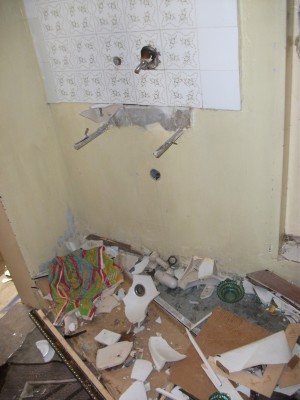
One of the families that had their home raided is the family of Muhammad Fawsi Awwad. At 4 am, while Muhammad was sleeping in his brothers home, Israeli soldiers awoke his sleeping wife and six children by throwing sound bombs through every window of the house. After entering the house, the soldiers forced the family to go outside and to sit on the ground while they were still in their pyjamas. One of the daughters, Halaa, who is six years old, was kicked by the soldiers in the process. Her brother, Amjad, 19 years old, was locked inside the bathroom where he had to stay for six hours, while the soldiers completely destroyed his family’s home from the inside. International activists who came to the house after the soldiers had left witnessed the devastation: windows, mirrors and photo frames had been smashed, wardrobes and beds were broken, the washing machine made useless, the bathroom sink was completely demolished, school books were ripped into pieces and oil poured into the sugar supply.
After destroying the family’s home, the soldiers arrested the sons – Majdi Awwad (20), Amjad (19) and Hakam (18) and took them to the Huwwara military base together with their father. The remaining children and their mother have no place to sleep since their beds have been destroyed and the children are too scared to stay in their home.

Windows smashed by sound bombs in the night
At 5 am, the soldiers arrived to Muhammad’s brother’s home. Hassan Fawsi Awwad and his family were also woken by sound bomb being thrown through their windows before the soldiers entered the house. The soldiers only stayed for 30 minutes, but managed to destroy the family’s washing machine and to pour sand and flour on the floor, before they arrested Hassan and left. This is the second time Hassan has been arrested since the beginning of the curfews. According to his wife Iman, and other eyewitnesses, he was blindfolded and handcuffed before he was forced to walk the road up the center of the village, the soldiers beating and kicking him along the way.
Ayoub Mustafa Daraoshi, 22 years old, was taken from his home at 10 am Sunday morning. According to his mother and his brother, who witnessed the arrest, the soldiers poured petrol on the piece of fabric they used to blindfold Ayoub with. After being blindfolded and handcuffed, he was dragged out on the ground just outside the house where he was beaten and kicked by the soldiers for an hour. At half-past midnight the night before, the soldiers had also arrested his 13- year- old brother Naje. He was forced to walk up to the center of the village where he was put in a military jeep and taken to the police station in the illegal Israeli settlement of Ariel. Naje, who was accused of throwing stones at military jeeps was kept in custody for five hours and questioned without his parents, or any lawyer being present, before he was released, contravening both international and Israeli law.
Since the brutal murder of five member of a settler family in the nearby illegal Israeli settlement of Itamar, hundreds of Awarta residents have been arrested, amongst them elderly, women and children. Some have been released after a couple of hours while others have remained in Israeli custody for almost a month, without being charged with any crime.

Sink torn off the wall
Rights group calls for monitoring of mass Awarta arrests
Ma’an – April 11, 2011
RAMALLAH — The Ramallah-based rights group Addameer issued a call Sunday for international observation and intervention over the mass arrest campaigns being carried out in the West Bank village of Awarta by Israeli forces.
Sunday morning another nine men and women were detained, bringing to five the number of arrest raids, which rounded up a combined 600-700 residents since 11 March, when five settlers were murdered in their beds, including two children and an infant.
Israel’s investigation of the killings appears to be centered on Awarta village residents, though no suspects have been identified and the case remains under gag-order.
“These arrests have taken place despite the fact that no evidence has been brought forth to indicate that the murders are related to Awarta, suggesting a campaign of collective punishment against the village,” Addameer said in a statement.
The statement said 55 villagers remain in detention, are being held without charge, and include two under the age of 18.
“The arrest procedures also raised serious concerns,” the organization said, citing reports of detention of the elderly, sick and pregnant, saying they were “unlikely candidates for the brutal murders.”
Addameer said it was concerned that “no female soldiers were present and no arrest warrants were presented during the arrest operation,” adding that home-to-home searches lasted up to three hours, and residents were harassed by masked soldiers who used sniffer dogs to search homes, terrorizing families.
“The women’s treatment at the Huwwara Detention Center fell short of basic requirements of international law,” the center further accused, saying many of were arrested in their night gowns, were held in barracks used as military sleeping quarters, and were interrogated repeatedly.
“They were then asked to sign a 2-page statement in Hebrew, a language they do not understand, and threatened with prolonged detention if they chose not to sign it,” the organization said, adding that no lawyers were present for the duration.
In response to the violations cited by the organization, they asked that international observers be installed in the village to monitor the situation in Awarta.
Bahrain abducts two senior clerics
Press TV – April 11, 2011
Bahraini forces have abducted two senior clerics as the government is putting more pressure to suffocate anti-regime protests.
The Saudi-backed Bahraini forces arrested clerics Sayyed Mohammad al-Alawi and Sheikh Abdul Adim al-Mohtadi in the capital Manama on Monday. It comes after the Bahraini government dismissed 30 doctors and 150 health ministry workers for supporting anti-government protests, a Press TV correspondent reported.
Meanwhile, police stormed schools on Monday and arrested teachers ahead of a planned strike.
Earlier, Bahraini authorities expelled 16 Lebanese nationals from the country. The move came after the leader of the Lebanese resistance movement Hezbollah, Seyyed Hassan Nasrallah, voiced support for the Bahraini protesters.
Bahraini people have been demanding an end to the two-century-long rule of the Al Khalifa dynasty since February 14. Scores of protesters have been killed and many others gone missing since the beginning of the revolution.
Bahraini forces have reinforced a massive armed crackdown on the uprising with the help of Saudi, the UAE and Kuwaiti troops.
Municipality: Israel shelled drinking water tank in Gaza city
Palestine Information Center – 11/04/2011
GAZA — The Gaza municipality accused the Israeli occupation forces (IOF) of targeting sources of potable water in Gaza city during the military escalation a few days ago.
It said in a statement on Monday that an IOF army tank fired a shell at the 12-meter high Mintar water tank, which fell inside and polluted it.
The municipality said that it had to stop pumping water from there to inhabitants of eastern Shujaia suburb causing a water shortage problem.
It said that water was pumped from another well to the suburb to alleviate the water crisis, which is still affecting the populace.
The municipality charged Israel with committing war crimes and crimes against humanity by targeting the citizens’ water sources, and asked the world community to assume its responsibility in bridling the Israeli aggression on the Gaza Strip.
Israeli Army fires on Palestinians planting olive trees
International Solidarity Movement | April 10, 2011
Bullets and tear gas were fired upon Palestinians and internationals whilst they planted olive trees on the land legally owned by the village of Iraq Burin yesterday.
The popular committee asked for a group of internationals to assist them in planting olive trees on the village land which is close to an army out post and the illegal Israeli settlement of Bracha. The trees were successfully planted even under the aggressive presence of the Israeli Army.
As the trees where being planted one army jeep came close and was a looming presence as local people took the chance to go further into the land to pick “akoub” (a plant used for cooking.)
After some 20 minutes, another jeep turned up, and the heavily armed soldiers started moving towards the people. One of the soldiers was seen aiming his gun directly at one of the boys.
When one boy, who in a symbolic act of resistance, threw a stone towards the soldiers in the far distance, they responded by firing shots and tear gas directly at the people, who had to run and duck to avoid being hit. More shots where fired at the youth but it is not clear if they were live or rubber coated steel bullets. However, what was clear was the completely disproportionate use of weapons and force on people partaking in a peaceful act of planting trees.
Despite the dangerous aggression of the Israeli army all 50 olive trees were planted on the hillside and three in the local cemetery – one for each of the boys that were killed in the village in the last year. On 19th March 2010, 16-year-old Muhammed Qadus, together with his cousin Asaud Qadus were shot and killed by the Israeli Army during a peaceful demonstration. On the 27th January this year, 19-year-old Oday Maher Hamza Qadous was shot dead by a settler on the hilltop just outside the village.
Featured Video

New positive ivermectin evidence
or go to
Aletho News Archives – Video-Images
From the Archives
Fanatical Followers of the Covid Regime: A Jim Jones-Style Cult?
By Professor Roger Watson and Dr. Niall McCrae | The Daily Sceptic | November 15, 2021
As scholars at leading British universities over recent decades, we witnessed the replacement of critical thinking and debate by narrative: facts are discrimination and scientific method is imperialism; truth, instead, is derived from ‘progressive’ values. This educational trend may be a major contributory factor to the ease in which society has been inculcated to the Covid ‘new normal’ of masking, testing, and repeated doses of vaccines for a disease of similar risk to severe influenza.
One doesn’t need much critical reasoning to observe the flawed logic of some vaccination enthusiasts, such as people who respond to experiencing any side effects, however debilitating, by saying “at least I know it’s working”, or, after contracting the disease despite their promised inoculation (over 90% effective, according to initial drug company claims), “I’d have been worse off without the jab.” … continue
Blog Roll
 Aletho News
- EU Council Advances Chat Control 2.0 Scanning Proposal
- Ex-Greek MEP files complaint against Israeli spyware firm over alleged Pegasus surveillance
- Troubling ideas throughout the Torah, Talmud, Mishneh Torah and Tanya
- ‘Grave, alarming’: Iran mission on Trump’s UNGA ‘annihilation’ threats
- Najaf airport to reopen to Iranian flights within 24 hours: Ambassador
- From ‘How Will This End For Iran’ to ‘When America Walks Away’: A tale of two Economist covers
- Tehran blasts ‘baseless’ speculation linking Iran to alleged bomb plot at UK air base
- The Rise And… Rise Of ‘Color Revolutions’
- The Coming GOP Bloodbath?
- Arctic Scare Stories Melt Away
- If Americans Knew
- Netanyahu Asked UAE Leader to Deny Report on Oct. 7 Warning in Secret Visit, Sources Say
- CNN Chief Int’l Correspondent Clarissa Ward on Journalists in Gaza
- Democratic Party Consultants Surround Troy Jackson with Pro-Israel Donors
- Christian Leader Responds To Netanyahu’s Claims Regarding Palestinian Christians
- In Gaza, ‘Whoever Survives the Bombing Won’t Survive the Rubble’
- Israel kills more Palestinians, amid push to resettle Gaza – Daily Update
- Israel forces Gazans to live in constant peril – Daily Update
- Deconstructing Netanyahu’s pants-on-fire UN rant – Daily Update
- Trump betrayed voters with his campaign lies and prioritized a foreign country once he took office
- Netanyahu calls Israel’s war in Gaza ‘opposite of genocide’ in UN speech to near-empty hall
- No Tricks Zone
- New Study: Earth And Venus Surface Warmth Largely Explained By Convection And Lapse Rate, Not CO2 Or Radiation
- 2025 Nature Paper Claiming Worsening Global Drought Gets RETRACTED …Heavily Flawed
- New Study: ‘Global Drought Shows No Detectable Recent Acceleration Under Climate Warming’
- Economic Masterminds: German Socialists Suggest Taxing Productivity Gains Stemming From Using AI
- The South China Sea Has Not Been Cooperating With The Climate Change Narrative
- Energy Crisis: Germany Enters Heating Season With Historically Low Gas Reserve Fill Levels
- New Study: The Antarctic Ice Sheet Gained Mass From 2020-2024 Due To Staggering Snow And Ice Accumulation
- Study: Ocean Heating Rates From Thousands Of Years Ago ‘Dwarf’ Modern Ocean Heating Rates
- Climate Extremists Target, Attack Large-Scale Power Grid Infrastructure In Germany!
- New Study: Antarctic Ice Melt Has Contributed Less Than 1 Centimeter To Sea Level Rise In The Last 30 Years

