Strike paralyzes Kashmir amid tensions
Press TV – April 9, 2011
The people of Indian-administered Kashmir have gone on a complete shutdown strike in response to the killing of a Muslim cleric in the Himalayan valley.
The strike paralyzed much of the region as most shops, businesses, schools and offices in Srinagar and other major towns were closed on Saturday, a Press TV correspondent reported.
The strikes are in protest at the killing of Muslim cleric Moulavi Shoukat Ahmad Shah on Friday. He was killed and several others were injured in a powerful explosion outside a mosque in Srinagar.
No one has claimed responsibility for the attack. However, a Pakistan-based Kashmir group has blamed it on “Indian agencies.”
The prominent leader was a well-known supporter of the separatist movement, which wants independence from India.
The region’s influential separatist politicians have described the killing as an “attack on the Kashmiri freedom movement.”
“It’s nothing but a conspiracy to deprive us of our religious and political leaders,” said a Muslim cleric and an influential moderate separatist Mirwaiz Umar Farooq.
“The killing has broken our back. We will expose those responsible,” said Yaseen Malik, head of the pro-independence Jammu and Kashmir Liberation Front.
Kashmiri protesters chanted anti-Indian slogans and threw stones during clashes with Indian troops in several towns across the Muslim-majority Kashmir valley over the past 24 hours. This comes as there have been almost daily demonstrations against Indian rule in the region since June 2010, when security forces killed a teenage protester.
Since then violent street protests and crackdowns have left more than 110 people dead.
Kashmir lies at the heart of more than 60 years of hostility between India and Pakistan. Both countries claim the region in full but have partial control over it.
Political analysts say the frequent street protests of the past two years are giving new life to the Kashmir liberation struggle.
New Delhi has been repeatedly criticized for resorting to force rather than finding a diplomatic solution to the dispute.
The conflict in Kashmir has left tens of thousands of people dead over the past two decades.
2 dead, 18 injured in Cairo’s protest
Press TV – April 9, 2011
At least two people have been killed and 18 others injured as thousands of Egyptians are calling for trial of ousted President Hosni Mubarak clashed with security forces in Cairo’s’ Liberation Square.
On Saturday, security forces faced off with Egyptian protesters, who converged onto the iconic square to ask for the immediate prosecution of Mubarak and his henchmen, AFP reported.
The protest turned violent as anti-riot police fired into the air, the report added.
The angry crowd on Saturday promised to remain relentless in the pursuit of their demands, including the social reforms and the prosecutions of former regime figures.
They also want the Egyptian army to hand over power to a civilian government as part of the promised reforms.
The protests come weeks after Mubarak handed over power to Egypt’s Supreme Council of the Armed Forces, which is headed by Defense Minister Gen. Mohammed Tantawi.
Activists demand the release of political prisoners, the lifting of a 30-year-old state of emergency and the disbandment of the military court.
The emergency law, in place since former Egyptian President Anwar Sadat was assassinated and Mubarak assumed power, allows authorities unfettered power to arrest people without charge and ban protests.
Over 500 activists detained in Bahrain
Press TV – April 8, 2011
The Bahraini Center for Human Rights (BCHR) has announced that the number of detained opposition activists in the Persian Gulf state has exceeded 500.
According to BCHR, 17 women are also among the detainees and 18 other activists are reportedly missing, a Press TV correspondent reported.
Since the beginning of the uprising in Bahrain dozens of anti-government protesters have been killed and many others have gone missing. The bodies of the missing are frequently found days after.
The head of BCHR, Nabeel Rajab, says now one in every 1,000 Bahraini is in detention for political reasons.
Witnesses say regime forces are conducting house to house searches to detain opposition activists.
Six opposition leaders have also been arrested and the Manama government has so far refused to provide any information on their fate.
The opposition leaders, five Shia and one Sunni, were rounded up on March 17.
Among the opposition leaders is Hassan Mushaima, the head of the Haq party, who returned to Bahrain from Britain in mid-February after Manama dropped charges against him.
His family members say Saudi troops were among Bahraini forces taking part in the arrest operation.
Reports coming from Bahrain suggest that regime forces backed by Saudi troops have intensified their crackdown on opposition figures and anti-government protesters.
Corrie lawsuit challenging Israeli impunity
Nora Barrows-Friedman, The Electronic Intifada, 8 April 2011
Several Israeli soldiers testified at the witness stand in the Haifa district court earlier this week, as trial hearings continued in the case of Corrie vs. the State of Israel. As the trial drags on, years after Rachel Corrie’s killing, Israel’s impunity is being challenged and carefully cross-examined.
Eight years ago last month, 23-year-old American solidarity activist Rachel Corrie was crushed to death by an armored US-made Caterpillar D9 bulldozer in Rafah, at the southern edge of the occupied Gaza Strip.
Wearing a fluorescent orange vest and wielding a bullhorn, Corrie attempted to defend the demolition of a Palestinian family’s home by the Israeli military along the Philadelphi corridor, a wide swath of land in Rafah at the border with Egypt in which hundreds of homes were demolished from 2002-2004, according to field reports from Human Rights Watch.
After years of legal proceedings, Rachel Corrie’s parents, Cindy and Craig, were able to bring soldiers who were on duty that day in Rafah into the Haifa district court. Hearings began in March 2010 and continued in September, November and earlier this week.
The Corries are suing the Israeli military for one dollar in damages, but, more significantly, are charging those responsible with the wrongful death of their daughter and criminal negligence.
Eyewitness testimony from fellow International Solidarity Movement (ISM) activists, supported by photographic evidence, shows that Rachel was crushed underneath the massive blade of a bulldozer and died shortly afterwards. The Israeli military and its defense team argues that Rachel’s death was an accident, that the bulldozer driver didn’t see her and that it was not the blade that killed her but perhaps a pile of rubble that was dropped on her body by the bulldozer as it was razing the land.
Saturated throughout the soldiers’ testimonies is the unwavering argument that all Palestinians in that area were considered armed and a danger to the military unit, and that the military orders had a strict shoot-to-kill policy as they demolished homes. They infer that because this was a closed military zone, Rachel and the other activists with the ISM put themselves at risk and therefore the soldiers and their commanders cannot be responsible for her killing.
But what fails to be addressed by the judge is how and why the soldiers and their armored bulldozers were there in the first place. The soldiers driving the bulldozers and their commanders operated from orders to destroy houses along the Philadelphi corridor — the name Israel gives to the strip of land it has used as a buffer zone– starting in 2002 and continuing throughout the next two years, displacing thousands of residents. Human Rights Watch reported that after the homes were demolished, a steel wall was constructed along the Philadelphi corridor (“Razing Rafah,” 17 October 2004). The demolition of Palestinian homes is a violation of Article 53 of the Fourth Geneva Convention, which states that “Any destruction by the Occupying Power of real or personal property belonging individually or collectively to private persons … is prohibited, except where such destruction is rendered absolutely necessary by military operations.”
Israel, which is a signatory to the convention, contends that the law “does not apply to its occupation of the West Bank and Gaza Strip,” according to a detailed report by Amnesty International (“Document – Israel and the Occupied Territories: Under the rubble: House demolition and destruction of land and property,” 17 May 2004).
Amnesty International adds “Whether it justifies such action on grounds of ‘military/security needs’ or whether such action is imposed as a form of collective punishment, or whether carried out in enforcement of planning regulations such large-scale forced evictions are inconsistent with the realization of the right to adequate housing. The obligation of the state under international law is that it must refrain from forced evictions.”
The occupying forces had been willingly engaged in layered violations of international law — violations that Rachel Corrie and her fellow activists attempted to confront and remediate.
S.R., a unit commander in the Israeli army who gave his testimony on Wednesday and was obscured by screens so the Corries could not see his face, stated that “none of the houses [in the area being razed] had anyone living inside … They were all being used as positions for terror activities.”
This blanket statement is untrue; the home that Rachel died trying to protect was inhabited by the Nasrallah family. Neither Dr. Samir Nasrallah, a pharmacist, nor his family members living in the home, were ever charged by the Israeli military with “terror activities.” Dr. Nasrallah was obviously never a threat to the Israeli military or its government, as Israel even allowed him to travel to the United States on a speaking tour with the Corries — something that would never be allowed for any Palestinian accused of being linked with such activities.
When I attended a round of hearings last September, another military training leader brazenly stated to the courtroom that “during war, there are no civilians.” Craig Corrie told me then that this admission was a shock to the family and to their supporters in the courtroom, but not a surprise given the attitude of the Israeli military since its inception.
This was not a war in Gaza; this was — and still is — an aggressive, lethal and unequal military occupation meted out against Gaza’s 1.5 million residents.
Human Rights Watch states that more than 2,500 homes were destroyed in Gaza from 2000-2004, as the Israeli military implemented its so-called “buffer zone” policies after the breakout of the second intifada. The buffer zone is a 300-meter-wide militarized no-go area near the boundary with Israel which has since taken 35 percent of Gaza’s total agricultural land — and the lives of more than 100 Palestinians who have been shot and killed since March 2010.
Attending this week’s hearing were members of the Corrie family, activists, journalists and legal observers from the the US embassy, the National Lawyers Guild, Human Rights Watch, Al-Haq, Avocats Sans Frontieres, Amnesty International, Yesh Din and other Palestinian, Israeli and international human and civil rights organizations.
In a press release, Zaha Hassan of the National Lawyers Guild stated that “[i]t has been eight years now and Rachel’s family and all of us who are attending the trial in support have been waiting for an answer to the question of why the unit commander ordered the bulldozer driver to move forward directly over the location where Rachel stood yelling into a blow-horn” (“National Lawyers Guild Free Palestine Subcommittee to Observe Resumption of Trial Brought by Family of Slain Peace Activist Rachel Corrie,” 4 April 2011).
Hassan added: “Justice demands that these questions be answered and that those responsible for her death be held to account.”
The judge, Oded Gershon, admitted proudly in court on Wednesday that he had been a military judge earlier in his career. It remains to be seen whether his potential proclivity toward defense of military policies will influence the final decision in the Corrie case, but the entire process sets an incredibly important precedent.
Israeli soldiers responsible for the demolition of homes and the killing of Palestinians and internationals are now being brought inside courtrooms. Military mandates are being meticulously scrutinized. Cracks in the solidified Israeli military system of impunity are starting to appear, and the Corries are determined to widen those cracks so that other bereaved families can seek justice, too.
The next round of hearings begins on 22 May, and the courtroom will once again be packed. For the Corries, and the family members of countless Palestinians awaiting true justice from the occupier state since 1948, the legal process may be tedious and excruciating but it is vital. And long overdue.
~
Nora Barrows-Friedman is an award-winning independent journalist, writing for The Electronic Intifada, Inter Press Service, Al-Jazeera, Truthout and other outlets. She regularly reports from Palestine.
For summaries of the hearings, and for more information, visit the Rachel Corrie Foundation website at rachelcorriefoundation.org.
Despite Ceasefire Declared by Palestinian Factions, Israel Bombards More Areas In Gaza
By Saed Bannoura – IMEMC & Agencies – April 08, 2011

Despite the fact that the Palestinian factions, including the Hamas movement, in Gaza declared a ceasefire with Israel starting Thursday midnight, the Israeli army bombarded several areas, and carried out a number of aerial attacks in Gaza.
The decision was made following talks between different Palestinian factions in the Gaza Strip, and talks held by the Hamas-led government in Gaza with a number of Arab and international parties.
The ministry of interior in Gaza said that the decision was made to curb any future Israeli assaults against Gaza.
The Israeli strikes had resumed on Thursday afternoon after a Palestinian shell hit a bus in southern Israel seriously wounding one student.
The al-Qassam Brigades of Hamas claimed responsibility for the attack and stated that it came in retaliation to the assassination of three Qassam leaders identified as Ismail Lubbad, Abdullah Lubbad, and Mohammad al-Dahya.
The three were killed in an Israeli Air Strike in Khan Younis in the southern part of the Gaza Strip.
On Thursday, the Israeli army killed three Palestinians in Gaza and wounded more than 40 others, including children.
Nabil Abu Rodeina, spokesperson of President Mahmoud Abbas, said that the escalation against Gaza is unjustified and that Abbas contacted several world leaders urging them to intervene.
Police training programs twin US-Israeli racism
Hira Mahmood and Wafa Azari, The Electronic Intifada, 7 April 2011
The racism of the American “war on drugs,” especially in the south, is notorious. So is the racism faced daily by Palestinians. In Atlanta, a university program allows these two manifestations of racism to feed off each other and community activists are organizing to shut the program down.
On the evening of 21 November 2006, the Atlanta Police Department’s recently disbanded Red Dog Unit killed Kathryn Johnston, a 92-year-old Black resident of the northwest Atlanta neighborhood of English Avenue. As she sat in her home watching television, several Atlanta policemen bashed in her front door to execute their fraudulently obtained “no-knock” search warrant. After firing 39 shots, the police officers handcuffed Johnston, placed a dime bag of marijuana on her and vacated her home, leaving her to bleed to death there (Ernie Suggs, “City to Pay Slain Woman’s Family $4.9 million,” Atlanta Journal-Constitution, 16 August 2010).
Organizers with the Movement to End Israeli Apartheid-Georgia (MEIA-G) read a newspaper article about the court proceedings following Johnston’s brutal murder, stumbled upon a brief note about the Georgia International Law Enforcement Exchange (GILEE) and wondered what it was and how was it connected to Johnston’s death.
MEIA-G was established in February 2009 after an unprecedented mobilization in response to the 23-day-long Israeli assault on Gaza. Hundreds rallied in the streets of Atlanta in solidarity with the Palestinian people, vowing to organize to support them in their struggle for liberation. After launching MEIA-G, we endorsed the 2005 Palestinian call for boycott, divestment and sanctions and identified GILEE as our primary campaign target.
Housed in Georgia State University’s (GSU) Criminal Justice Department, GILEE is a police exchange program whereby high-ranking Georgia police officers travel to Israel to learn counter-terrorism tactics from the Israel national police. Conversely, Israeli police officials travel to Atlanta every two years to learn Georgia’s drug enforcement tactics such as those employed against Johnston, Tremaine Miller, Pierre George and countless other African-American victims of police abuse and aggression. Through GILEE, the Israeli police adopt these tactics and employ them on Palestinian citizens of Israel and Palestinians residing in the occupied West Bank.
While GILEE has relationships with several international police agencies, its relationship with the Israeli police is the most intimate and most troubling. Israel is one of the most brazen violators of human rights and international law in the world. Israeli police, in their execution of the racist and discriminatory policies of the Zionist government, have been and are a major source of these violations. MEIA-G hopes to keep the brutal police methods and tactics employed by the Israeli police from being adopted and implemented in Atlanta. To do this, MEIA-G seeks to expose and shift the practices of both the Atlanta and Israeli police by eliminating this exchange program, the aim of which is to proliferate repressive police tactics internationally.
Alongside 18 campaign endorsers and more than 1,200 individual supporters, the MEIA-G and GSU’s Progressive Student Alliance have built, cultivated and sustained a growing coalition organizing to eliminate GILEE from GSU and ultimately from Atlanta.
While the collaboration between the US military and the Israeli military is well-documented, social justice activists in the US are just now beginning to uncover the depth of collaboration between US and Israeli police forces. These collaborations further underscore the extent of the “special relationship” between the US and Israel, and their similar needs, as European settler-colonial projects, for elaborate systems of social control to manage the troublesome “undesirables” in their midst.
The US south has a particularly troublesome history of managing “undesirables.” With the formal abolition of slavery after the Civil War, a critical social question arose: how would the Georgia elite maintain its wealth and power in a society dependent on cash crops like “King Cotton” that relied upon a cheap, controllable and stable labor force? Policing provided the answer: newly established law targeting such activities as vagrancy and loitering were used to arrest and incarcerate southern Blacks. In short, prisons replaced plantations and police officers replaced plantation overseers (see Angela Davis, Abolition Democracy: Beyond Empire, Prisons and Torture, pp. 7-18).
Both the US and Israel are rooted in outside colonial forces invading a territory with the goal of possessing the maximum amount of natural resources — namely land — while erasing its indigenous population. In both cases, the US and Israeli militaries were created to engage the “external” threats of the unconquered indigenous populations, while their police forces were created to maintain control over the conquered indigenous populations (and other subjugated peoples like enslaved Africans) absorbed and “internalized” within these nation-state projects.
The US boasts the highest incarcerated population in the world — more than two million persons, including more than 800,000 Blacks. This does not include those on parole, on probation or unable to be employed because of a criminal record. Policing plays an integral role in not only surveiling, controlling and intimidating communities of color but also in funneling people into prisons. With such an exorbitant national incarceration rate, what do Georgia police officials like current Atlanta Police Department Chief of Police George Turner, former Chief of Police Richard Pennington and current Georgia Bureau of Investigation Director — all of whom have sojourned in Israel for the GILEE training — have left to learn about terrorizing and controlling these communities?
The Zionist project of confiscating the most amount of Palestinian land with the least amount of indigenous Palestinians remaining has one vital flaw. Evidenced in more than 60 years of resistance and resiliency to occupation, apartheid and genocide, Palestinians continue to resist the Zionist program of ethnic cleansing. Following the expulsion of 800,000 Palestinians in 1948, the Israeli state was tasked with controlling that pesky, residual population throughout historic Palestine. Under the guise of counter-terrorism, it is the Israelis’ sophisticated social control mechanisms that Georgia police officials learn to inflict upon Georgia residents.
The Georgia International Law Enforcement Exchange operates within a public university but is largely funded by private donations, including donations from corporations and former graduates of the program. The extent of private support for this program is symptomatic of neoliberalism transforming public institutions in a way that compromises their integrity. GILEE does not reflect the desires of the Georgia State University community as evidenced by the opposition to the program voiced by numerous students, faculty and community members.
The director of the GILEE program is Dr. Robert Friedman, Professor Emeritus of Criminal Justice at GSU. Dr. Friedman serves on the advisory board of the International Institute for Counter-Terrorism (ICT), an Israeli organization that has actively opposed human rights groups and acted as an apologist for the Israeli security apparatus. Boaz Ganor, founder and executive director of the ICT, serves as a board member for the GILEE program.
Another highly influential, and controversial, Israeli politician — Avi Dichter — has visited Atlanta to meet with Georgia law enforcement officials as part of GILEE. Dichter has been charged with extrajudicial killings, war crimes and other human rights violations by the Center for Constitutional Rights for the 2002 air strikes on Gaza. The meetings between Israeli and Georgia officials, the unknown specificities of the training program, and the large infiltration of money into the GILEE program from unknown sources are all being done under the auspices of Georgia State University, a public institution.
Activists throughout the US are beginning to uncover more and more police exchange programs in which US law enforcement officials travel to Israel to learn “counter-terrorism” tactics. Campaigns organizing to shut them down continue to take root. We have a political obligation to expose these programs, highlight how they impact oppressed communities in the US and close them as we build a more just world free of racist violence in both the United States and Palestine.
Hira Mahmood is a student activist and BDS organizer studying English literature at Georgia State University.
Wafa Azari organizes with the Movement to End Israeli Apartheid-Georgia. Currently residing in Atlanta, she was born and raised in Oujda, Morocco.
Female protester killed in Bahrain
Press TV – April 7, 2011
A female protester has reportedly been killed in Bahrain’s crackdown as the government is putting more pressure on anti-government demonstrators.
Khadijah Al Abdulhayy has died from suffocation in the village of Sanabis, a Press TV correspondent reported on Thursday.
Her death comes after the killing of Seyyed Hamid al-Mahfood by the Bahraini regime forces after he went missing late Tuesday.
Mahfood’s body was found in a bin in the village of Sar, a few kilometers west of the capital Manama on Wednesday.
Dozens of anti-government protesters have been killed and many others gone missing since the beginning of the uprising in Bahrain.
Bahrain’s leading Shia opposition group Wefaq said over 450 opposition activists, including 14 women, have been also arrested since the uprising began in the country in mid-February.
Bahrainis have been demanding an end to the two-century-long rule of the Al Khalifa dynasty since February 14.
In March, Saudi Arabia, the United Arab Emirates and Kuwait deployed their troops to Bahrain to reinforce a massive armed crackdown on the popular uprising.
Meanwhile, Human Rights Watch said Wednesday it is worried about the growing abuses by the Bahraini regime against its citizens who are seeking political reforms and a voice in the government.
More than 100 women arrested in Awarta village
Ma’an – 07/04/2011
NABLUS — Israeli troops stormed a Palestinian village early Thursday, arresting more than 100 women in what local officials said was part of the ongoing investigation into the murder of five settlers in March.
Hundreds of troops entered Awarta — the village adjacent to Itamar, an illegal settlement where the murders took place — shortly after midnight and imposed a curfew after which they began rounding up the women, local council head Tayis Awwad said.
Officials told Ma’an that men and women were taken in the raids, which involved house-to-house searches in the early morning. Some of the women, witnesses said, were in their 60s, and many were taken by force.
Soldiers continued to conduct house-to-house searches through the night, the officials added. Palestinian security sources confirmed the report.
This was the fourth intensive raid of the village where scores were detained, the first coming the day after an unidentified attacker stabbed to death five members of the Fogel family, including two children and an infant.
But Thursday’s raid marked the first time they had arrested any women, Awwad said.
In the wake of the murders, Awarta has been the center of a massive manhunt. The village was put under military closure, and a curfew was imposed for five days between March 12 and 16. Some 40 men were detained during the closure, and since then two more mass roundups were reported.
Those detained have been questioned and subjected to DNA testing, officials said last week.
So far no one has been charged, with the military refusing to comment on the operation.
The Detainees’ Center in Nablus condemned the overnight arrest raid.
The mass detentions, a statement from the center said, were illegal and arbitrary and “go against the human rights of the residents.”
Awarta was the second village put under closure overnight, with locals in the Tubas area saying the Israeli army, backed by military bulldozers, entered the village of Aqaba where two homes were demolished.
‘CIA involved in Yemen repressions’
Press TV – April 6, 2011
Interview with Ali al-Ahmed, director of Institute of Gulf Affairs in Washington.
Al-Qaeda in Yemen has not been held responsible for the death of even one American for the past five years, yet the US continues to play the al-Qaeda card and provide the country’s regime with military aid.
In an interview with Press TV, Ali al-Ahmed, director of Intitute (Persian) Gulf Affairs (IGA) in Washington, shares his views on US military aid to Yemen, the exaggerated al-Qaeda connection, and optimal outcomes. The following is a transcript of the interview.
Press TV: What is your reaction toward the Pentagon state secretary saying there is no decision yet in stopping military aid to Yemen and of the US assertion that US weapons are not being used against demonstrators?
They have been used; it is not honest to say that they have not. We know that (there are) special units the US and CIA have been training; perhaps they have not directly taken part in the shooting and killing of demonstrators personally. However, they have displaced other forces, meaning that they freed other forces to do that. There is a direct link between US aid to Yemen and the killings of hundreds of demonstrators.
Press TV: Yemen is a very divided society as you and other analysts have mentioned previously; however, a lot of Yemenis have united for this revolution. Was the US essentially pressed in a corner — not having a choice, but to continue to provide military aid to Yemen?
No I don’t believe that. Saleh is sustaining al-Qaeda to use it as a bargaining chip with Saudi Arabia and the US. Once Saleh is outside of the palace, al-Qaeda’s threats will diminish greatly and the US knows this very well; however, they have not called on Abdullah Saleh to resign until recently, for which they want a transfer of power.
Focusing on supporting the people is going to be the best way for the US to diminish the threat of al-Qaeda – supporting these demonstrators. And instead of sending weapons they should send humanitarian aid. They should allow the people to govern their own country in reflection of what the people want, which is not dictatorship. That is the best tool to fight terrorism.
Press TV: What about US negotiations with the opposition?- There is a story that Riyadh may be getting involved in hosting negotiations of some sort. Do you see potential for success through these negotiations? Or is it simply too late for Saleh?
I think it is too late for Saleh to be part of any future plans for Yemen. I am worried and wary of any Saudi role in Yemen because so far, history has proven that Saudi Arabia’s role in Yemen has been a negative one. They have supported violence and bombed the country as everybody knows. So they are not a neutral player here. I think other countries, like Egypt, Syria — or Qatar even — would be a better choice.
It is a question that I’ve always asked – the US has been able to bring in coalitions to wage wars and they have not worked to building any coalition to mediate peace between Arab countries with Arab and Muslim majority populations. And that is disturbing.
The US could get a lot accomplished in terms of winning hearts and minds by becoming the peacemaker in Yemen and the other countries in the region. Instead of sending weapons, they could be sending in a delegation with authority, who would mediate between the enemies in the role of a broker just like they did when they mediated the treaty between Egypt and Israel, which was led by Jimmy Carter. Why not mediate between the enemies so that we can have a government that is responsible for the wishes of its people (and) not to the whim of a dictator and his family?
Press TV: Why are the US and a coalition involved now in Libya, but not in Yemen? All this talk about the al-Qaeda bogeyman in Yemen; certainly the al-Qaeda factor is considered highly important to the US, isn’t it?
Well, there is a threat of al-Qaeda in Yemen, but I think it has been exaggerated tremendously and so far, al-Qaeda in Yemen has not been able to kill a single American in the past five years so we are not really talking about something that is of catastrophic importance.
In Yemen we don’t need to have war. What you need is to apply political pressure on Yemeni parties to come and speak to each other to collaborate in building a government that is modern and responsible to its citizens. It doesn’t take a rocket scientist to do that and it would definitely be cheaper than dropping bombs on people like what happened last year in Yemen or what is happening now in Libya.
So there is a cheaper alternative with a much more positive outcome for the US. Rather than flying military jets, the US could be flying in peace envoys to bring the parties together and Yemenis would be shy and embarrassed by the fact that there is an American trying to get them to talk to each other to make peace for them. This is a far better position for the US.
Press TV: You speak of peace envoys being a better choice for the US in Yemen…
It revolves around a Saudi connection. John Brennan in the White House is the American architect of US foreign policy in Yemen and was the former CIA chief in Saudi Arabia so he is influenced by the desires of the Saudi monarchy. He is why we see the Yemen situation getting worse; an American official designing US policy heavily tied to Saudi wishes. His policy is solely been to support Abdullah Saleh and that’s all – he should be removed.
The solution is to talk to every party and they are not weak. In fact, Saleh is one of the weaker players. US policy right now is a failure.
Bahraini Injured Protesters were Beaten in Hospitals: Medecins Sans Frontieres
Al-Manar | April 7, 2011
Medical charity Doctors without Borders (MSF) said on Thursday that hospitals in Bahrain were being used as bait to snare wounded pro-democracy protestors after security forces took over health facilities.
MSF (Medecins Sans Frontieres) said in a report that the crackdown was denying the injured medical care.
The report also revealed testimony from patients admitted to the main public Salamaniya hospital who said they had been beaten there by security forces. One of them said he was beaten on a close range rubber bullet wound to his head following surgery.
The agency said it had treated people in their homes after the Gulf kingdom’s hospitals and clinics were turned into “places of fear” rather than safe havens for the sick and wounded.
“Health facilities are used as bait to identify and arrest those who seek treatment,” said MSF medical coordinator Latifa Ayada as the agency called for the removal of security forces from Salamaniya. “Wounds, especially those inflicted by distinctive police and military gunfire are used to identify people for arrest, and the denial of medical care is being used by Bahraini authorities to deter people from protesting,” she added.
MSF found that Salamaniya hospital was virtually empty during a visit on March 21. It concluded that the use of the hospital first as a venue for demonstrations and then its occupation by the military, along with the targeting of other health facilities, had undermined the provision of impartial medical care in the country.
However, MSF said that its offer to set up an emergency medical response in Bahrain had fallen through after it failed to secure guarantees from authorities that patients would not be targeted.
Human rights groups have reported that doctors and ambulance drivers have also been targeted in the crackdown. MSF noted a “high level of trauma” among health workers in Bahrain, with many afraid to even talk about the medical situation.
Israel targets international activists in Bil’in raid
Ma’an – 04/04/2011
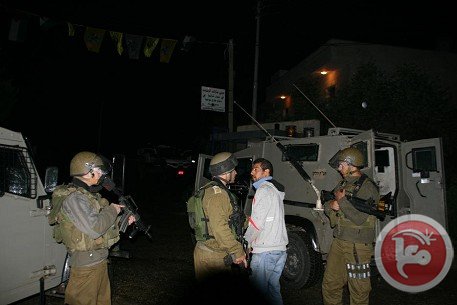
RAMALLAH — Israeli forces entered the central West Bank village of Bil’in on Monday morning, searching homes and harassing residents, reportedly in search of international solidarity activists who often remain in the area to document rights violations.
A spokesperson for the local popular committee said the raid began at 1:30 a.m. and lasted approximately an hour. The official said the homes of village residents Ali Birnat and Khamis Abu Rahma were targeted and searched.
Local committee members attempting to document the raid were prevented from accessing the scene of the searches.
An Israeli military spokeswoman did not immediately return calls seeking comment.
A statement from the Popular Struggle Coordination Committee said Abu Rahma was questioned about who was residing in his house, noting soldiers were “interested in internationals, although they could not find any,” noting that soldiers and police searched Abu Rahma’s home and garden, including the garbage and inside cars located nearby.
Groups of solidarity activists have for the past year stayed frequently in the village, which hosts the longest running weekly protest against Israel’s separation wall.
The prominent popular committee in the village has organized a yearly conference on popular non-violent resistance, and gained international support for its initiatives.
Since the early years of the protests, international solidarity activists have joined the demonstrations in an effort to mitigate the use of violence against the villagers. The use of high-velocity tear-gas canisters have caused death and injury to residents, and solidarity activists say an international presence witnessing and documenting the action often reduces the use of force.
Once activists left the village at the close of the protests, particularly during 2009 and 2010, Israeli forces would enter and detain teens they said were throwing stones at the soldiers, and later targeted protest leaders for detentions.
Activists began staying overnight in the village to document the night raids they said were being used to intimidate villagers, who have also launched court actions against the confiscation of land by Israel’s separation wall.
Sixty percent of the village lands now stand on the far side of the wall, and are largely inaccessible but for a gate that opens periodically allowing farmers to tend crops, without the use of heavy machinery or equipment.
Report: 32 Palestinians died during 2011 Israeli aggression
Palestine Information Center – 04/04/2011
GAZA — 32 Palestinians have died and 118 have sustained injuries in Israeli aggressions during the first quarter of 2011, said Adham Abu Salmiyya, spokesman for the Gaza emergency services.
Many of those deaths took place in the second half of March and included children as the Israeli army bombed numerous targets amid threats of a new war on the Gaza Strip.
The count is high compared to first three months of the previous year, when 15 Palestinians died and 70 were injured.
According to Salmiyya, several civilian sites had been targeted, including the largest, one of the Gaza health ministry’s drug reserves in mid-February. A health clinic also sustained damage during the Israeli escalation on the Gaza Strip late March.
In the aftermath of the ongoing Israeli aggression against the Strip, 18 have been killed, including 5 children, and 52 have been injured, including 17 children and six women, according to the official figures.
Israel has launched so far 34 air strikes against civilian targets and fired at least 90 artillery shells. The latest attack was an admitted assassination of leaders in Hamas’s armed wing Saturday morning in Khan Younis, southern Gaza Strip.
The Israeli army targeted more than 15 sites in February and killed seven Palestinians and caused injury to 46 others, among them children. Two others were killed the same month by artillery shells fired by Israeli forces.
He pointed out that explosive objects left behind by occupation forces killed two men and wounded six in January. Three others died that month in air strikes.
Salmiyya highlighted that a number of government and private buildings underwent significant damage during the recent attacks. They include a soft drink factory east of the Al-Zatoun district in Gaza, a health clinic in Tawam, a metal workshop, a brick factory, a tire shop and a warehouse in Khan Younis.
Featured Video

New positive ivermectin evidence
or go to
Aletho News Archives – Video-Images
From the Archives
Fanatical Followers of the Covid Regime: A Jim Jones-Style Cult?
By Professor Roger Watson and Dr. Niall McCrae | The Daily Sceptic | November 15, 2021
As scholars at leading British universities over recent decades, we witnessed the replacement of critical thinking and debate by narrative: facts are discrimination and scientific method is imperialism; truth, instead, is derived from ‘progressive’ values. This educational trend may be a major contributory factor to the ease in which society has been inculcated to the Covid ‘new normal’ of masking, testing, and repeated doses of vaccines for a disease of similar risk to severe influenza.
One doesn’t need much critical reasoning to observe the flawed logic of some vaccination enthusiasts, such as people who respond to experiencing any side effects, however debilitating, by saying “at least I know it’s working”, or, after contracting the disease despite their promised inoculation (over 90% effective, according to initial drug company claims), “I’d have been worse off without the jab.” … continue
Blog Roll
 Aletho News
- EU Council Advances Chat Control 2.0 Scanning Proposal
- Ex-Greek MEP files complaint against Israeli spyware firm over alleged Pegasus surveillance
- Troubling ideas throughout the Torah, Talmud, Mishneh Torah and Tanya
- ‘Grave, alarming’: Iran mission on Trump’s UNGA ‘annihilation’ threats
- Najaf airport to reopen to Iranian flights within 24 hours: Ambassador
- From ‘How Will This End For Iran’ to ‘When America Walks Away’: A tale of two Economist covers
- Tehran blasts ‘baseless’ speculation linking Iran to alleged bomb plot at UK air base
- The Rise And… Rise Of ‘Color Revolutions’
- The Coming GOP Bloodbath?
- Arctic Scare Stories Melt Away
- If Americans Knew
- Netanyahu Asked UAE Leader to Deny Report on Oct. 7 Warning in Secret Visit, Sources Say
- CNN Chief Int’l Correspondent Clarissa Ward on Journalists in Gaza
- Democratic Party Consultants Surround Troy Jackson with Pro-Israel Donors
- Christian Leader Responds To Netanyahu’s Claims Regarding Palestinian Christians
- In Gaza, ‘Whoever Survives the Bombing Won’t Survive the Rubble’
- Israel kills more Palestinians, amid push to resettle Gaza – Daily Update
- Israel forces Gazans to live in constant peril – Daily Update
- Deconstructing Netanyahu’s pants-on-fire UN rant – Daily Update
- Trump betrayed voters with his campaign lies and prioritized a foreign country once he took office
- Netanyahu calls Israel’s war in Gaza ‘opposite of genocide’ in UN speech to near-empty hall
- No Tricks Zone
- New Study: Earth And Venus Surface Warmth Largely Explained By Convection And Lapse Rate, Not CO2 Or Radiation
- 2025 Nature Paper Claiming Worsening Global Drought Gets RETRACTED …Heavily Flawed
- New Study: ‘Global Drought Shows No Detectable Recent Acceleration Under Climate Warming’
- Economic Masterminds: German Socialists Suggest Taxing Productivity Gains Stemming From Using AI
- The South China Sea Has Not Been Cooperating With The Climate Change Narrative
- Energy Crisis: Germany Enters Heating Season With Historically Low Gas Reserve Fill Levels
- New Study: The Antarctic Ice Sheet Gained Mass From 2020-2024 Due To Staggering Snow And Ice Accumulation
- Study: Ocean Heating Rates From Thousands Of Years Ago ‘Dwarf’ Modern Ocean Heating Rates
- Climate Extremists Target, Attack Large-Scale Power Grid Infrastructure In Germany!
- New Study: Antarctic Ice Melt Has Contributed Less Than 1 Centimeter To Sea Level Rise In The Last 30 Years

