American Citizens Killed and Tortured by Israel?
No one is ever held accountable
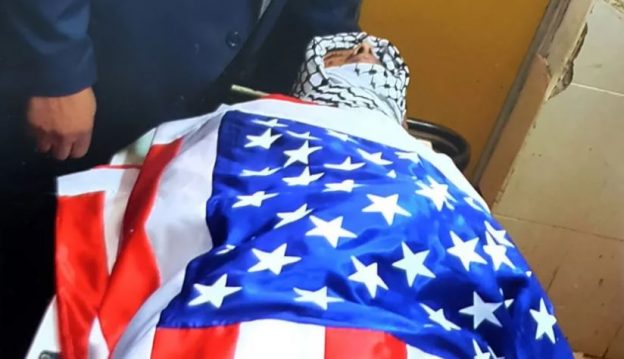
Palestinian-American Mahmoud Shaalan was shot five times by Israeli soldiers at a West Bank checkpoint
By Philip Giraldi | American Herald Tribune | February 15, 2020
One of the principal functions of a United States Embassy overseas is to provide citizen services, which includes coming to the assistance of Americans who are treated badly by the local government. It is a responsibility that most embassies take seriously, with the exception of the facility currently located in Jerusalem. One has to understand that that is so because the United States Embassy in Israel is like no other. In other countries, the American Embassy exists to support American travelers, businesses and a broad range of national interests. In Jerusalem the Embassy exists to support Israeli interests and to serve as an apologist every time the government of Prime Minister Benjamin Netanyahu goes on a killing spree or does something else that is similarly outrageous, to include bombing neighboring Syria every other day.
America’s current ambassador, former Trump bankruptcy lawyer David Friedman, has funded Israel’s illegal settlements, which did not in any way complicate his confirmation as nearly everyone in Congress and the White House does not believe that the Palestinians actually are human beings. Since taking up his position, Friedman has defended Israel when its army sharpshooters have shot down scores of unarmed Gazans, including children, and has both praised and endorsed out-and-out theft by the Israeli government in Jerusalem, on the West Bank and the Golan Heights.
What the U.S. Embassy under Friedman will not do is put any real pressure on the Israeli government if its security forces or rampaging settlers kill, beat, maim or torture an American citizen, especially if said citizen happens to be of Palestinian descent. Indeed, Friedman is only the latest manifestation of Israel-first-itis among U.S. Ambassadors, the rot having started inevitably with Bill Clinton, who appointed Australian citizen Martin Indyk as the first Jewish ambassador to Tel Aviv. The two most recent ambassadors, Friedman and Daniel Shapiro, both political appointees, have also been Jewish. Shapiro so enjoyed being an Israeli that he decided to remain in the country after his appointment as ambassador was completed. He now works for an Israeli government funded think tank.
The Israeli army and police have in fact killed a number of American citizens without any real pushback from the Department of State or White House. The unwillingness to confront Israel on any level stems from the formidable Jewish power in the United States, which uses money and media control to corrupt the political system at national, state and local levels. The media and the chattering political class worry about Russian interference while ignoring the implications of a Haaretz article that appeared on February 12th entitled “AIPAC Must Stop Bernie Sanders – At All Costs!” AIPAC is, of course, the American Israel Public Affairs Committee, widely regarded as the chief U.S. lobbying arm of the Jewish state.
And witness the fate of Congresswoman Betty McCollum from Minnesota, who fell afoul of the Israel Lobby when she introduced H.R.2407, legislation that prohibits American taxpayer money from being used by Israel to arrest and detain Palestinian children. She stated that “Israel’s system of military juvenile detention is state-sponsored child abuse designed to intimidate and terrorize Palestinian children and their families. It must be condemned, but it is equally outrageous that U.S. tax dollars in the form of military aid to Israel are permitted to sustain what is clearly a gross human rights violation against children.” She might have added that the estimated 10,000 Arab children who have been detained since 2000 are frequently tortured by the Israeli authorities. The bill currently has 23 cosponsors and is unlikely to attract more due to fear of the Lobby. It will never reach the House floor for a vote and will never become law.
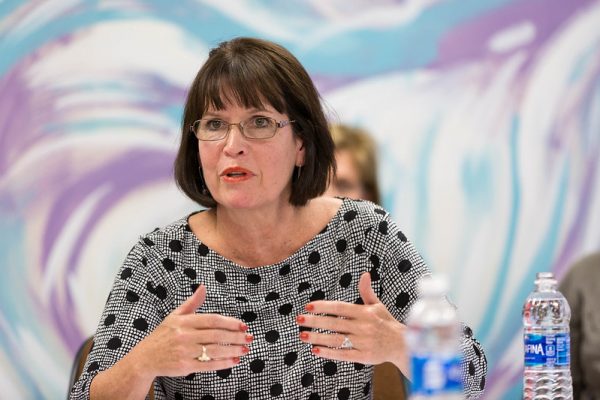
Betty McCollum U.S. Representative for Minnesota’s 4th congressional district at a women’s roundtable at Hillary for Minnesota Headquarters in St Paul, MN. Credit: Lorie Shaull/ Flickr
McCollum’s courage was on display when she was viciously attacked by AIPAC, which posted Facebook ads that referenced “radicals in the Democratic party,” including a photo of McCollum, with the text stating that “It’s critical that we protect our Israeli allies especially as they face threats from Iran, Hamas, Hezbollah ISIS and — maybe more sinister — right here in the U.S. Congress.” McCollum stood her ground against being called “more sinister” than ISIS and released a statement that describes AIPAC as a “hate group,” which of course it is, but she will find few in the Democratic party brave enough to defend her.
Israel’s willingness to kill Americans in support of what it perceives as its own interests goes back nearly to the founding of the state in 1948. The Lavon Affair of 1954 was an Israeli plot to bomb the U.S. Embassy Information Agency libraries in Alexandria and Cairo Egypt, blaming the attacks on the Egyptians to draw the United States closer to Israel. The bombs were placed by Egyptian Jews acting for Israeli intelligence. They exploded, but fortunately no one was killed.
In June 1967 Israel was at it again, attacking the intelligence gathering U.S. naval vessel the U.S.S. Liberty in international waters, killing thirty-four American sailors, Marines and civilians in a deliberate air and sea onslaught that sought to sink the intelligence gathering ship and kill all its crew. It was the worst attack ever carried out on a U.S. Naval vessel in peace time. In addition to the death toll, 171 more of the crew were wounded in the two-hour assault. The Israelis, whose planes had their Star of David markings covered up so Egypt could be blamed, attacked the ship repeatedly from the air and with gunboats from the sea. When one Israeli pilot hesitated, refusing to attack what was clearly an American ship, he was instructed to proceed anyway.
The most disgusting part of the tale relates to how U.S. warplanes sent to the Liberty’s aid from an aircraft carrier in the Mediterranean were called back by Defense Secretary Robert McNamara acting under orders from President Lyndon Baines Johnson, who declared that he would rather see the ship go to the bottom of the sea than embarrass his good friend Israel. Ironically, the first ship to reach the Liberty and offer assistance was from the Soviet Union, an offer that was declined.
More recently there have been a number of killings of Americans. In a bizarre incident in August 1988, an elderly Palestinian-American with a heart condition died after being forced to climb stairs to paint over anti-Israeli graffiti on a school wall. Rebhi Barakat Kaid, 67, of Columbus, Ohio, was on the West Bank visiting relatives. He died of a heart attack after three Israeli soldiers ordered him and his 14-year-old Chicago-born grandson at gunpoint to climb the 22 steep steps that led from the house to the street above without his being allowed to take his heart medicine first.
Much better known is the March 2003 killing of Washington State’s Rachel Corrie, who was deliberately run over by an Israeli military bulldozer when she was protesting the destruction of a Palestinian village. A month later there was an incident in which Brian Avery, a 24-year-old from Albuquerque, New Mexico, was shot in the face in the occupied West Bank city of Jenin by Israeli soldiers in an armored personnel carrier firing machine guns at protesters.

Rachel Corrie lies on the ground fatally injured by an Israeli bulldozer driver. Rachel’s fellow activists are trying to keep her neck straight due to spinal injury. Photo by Joseph Smith. Credit: ISM
In March 2009 Tristan Anderson, a 37-year-old from Oakland, California, suffered permanent brain damage when Israeli soldiers shot him in the face with a tear gas canister as he watched a protest in the West Bank village of Nilin.
Another American citizen, Furkan Doğan, an 18-year-old born in Troy, New York, was killed aboard the Turkish flagged Mavi Marmara in the Mediterranean Sea in May 2010 as a flotilla of international activists attempted to break Israel’s illegal blockade of the Gaza Strip to deliver humanitarian supplies. The United Nations’ General Assembly Human Rights Council determined that Doğan had been killed by Israeli naval commandos through an “extra-legal, arbitrary and summary execution.” He was shot five times, including once in the face from “point blank range.”

Furkan Doğan
The same day that Israel murdered Furkan Doğan, 21-year-old Emily Henochowicz of Potomac, Maryland, was protesting the attack on the flotilla at the Qalandiya checkpoint near Jerusalem, when an Israeli soldier shot her in the face with a teargas cannister, resulting in the loss of an eye.
And then there was in October 2014 the shooting by Israeli soldiers of Orwa Hammad, a 14-year-old Palestinian-American from Louisiana. The Israeli army claimed that Hammad was throwing a Molotov cocktail at the time of his death, but witnesses stated that he was among a group of children throwing rocks at the heavily armed and armored soldiers.
And most recently, there is the case of Florida-born 16-year-old Palestinian-American Mahmoud Shaalan who was shot repeatedly at an Israeli check point on the West Bank on February 26, 2016 while he was walking to a nearby village to visit his aunt. He was still alive after the shooting, but Israeli soldiers denied him any medical treatment for three hours and he died before an ambulance was allowed to approach him.
Arrest of Palestinians and others without probable cause under “administration detention” guidelines followed by torture has also become a hallmark of Israel’s occupation of Arab land. Torture methods used by Israel include stress positions, severe beatings, sleep deprivation, emotional blackmail, threats of torture of family members and the transfer of detainees to secret prisons where torture is constant. In one case reported to a Human Rights Association “The harsh beating was committed with the intention to kill the detainee.”
In another reported case of torture, nineteen-year-old Mahmoud Zakarner’s testicles were smashed by soldiers in front of his uncle to force the man to provide the names of Palestinian resistance members. Mahmoud is now paralyzed and unable to speak as a result.
Israeli expertise in torture is in demand from authoritarian regimes worldwide, creating a growth industry for the specialized “advisers and technicians.” Many are currently working with right wing regimes in South and Central America. Several even showed up at Abu Ghraib as trainers for U.S. interrogators and were able to suggest refinements like the “Palestinian chair.”
Inside Israel torture of Palestinians is routine on the grounds of “necessity” and absurd “ticking-bomb” scenarios. The courts and the medical profession aid and abet the practice. Over 1,200 complaints regarding the torture of Palestinians in Israeli prisons have not resulted in even a single indictment of the torturers.
So, killing Americans as well as many others and torturing prisoners are all in a day’s work for the Jewish state. What is disgraceful, of course, is the fact that the United States government, which has the power to do something about it, instead chooses to do nothing to stop the bleeding or even to demand inquiries to find out who is to blame. Instead, Washington lavishes money and praise on Israel, reportedly America’s best friend and closest ally, while it also avoids looking at the horrors that are evident to most of the rest of the world.
Philip M. Giraldi is a former CIA counter-terrorism specialist and military intelligence officer who served nineteen years overseas in Turkey, Italy, Germany, and Spain. He was the CIA Chief of Base for the Barcelona Olympics in 1992 and was one of the first Americans to enter Afghanistan in December 2001. Phil is Executive Director of the Council for the National Interest, a Washington-based advocacy group that seeks to encourage and promote a U.S. foreign policy in the Middle East that is consistent with American values and interests.
Palestinian Minor Reveals Harrowing Details in Israeli Custody

Palestine Chronicle | February 13, 2020
In a testimony made through his lawyer to the Committee of Prisoners and Former Prisoners Affairs, Palestinian teenage prisoner Mahmoud Thawabteh revealed details about the difficult conditions inside Israeli prisons.
Thawabteh, 17, was arrested from his house in Beit Fajjar in eastern Bethlehem when Israeli occupation soldiers stormed the neighborhood at dawn, the boy’s lawyer told the Committee.
According to the testimony, Thawabteh was harshly interrogated in the street, before army dogs were unleashed at him.
The boy revealed that he was brutally beaten and he had several dog bites on his legs.
“They beat me up on my head and back using their rifles and sticks”, Thawabteh said, as reported in Quds News Network.
After a harrowing journey in an Israeli army jeep, the teenage boy was taken to the notorious Etzion interrogation center, where dozens of Palestinian minors were held and reportedly tortured over the years.
Conveying Thawabteh’s testimony, his lawyer went on to say that the teenager was allowed to see a doctor just before his interrogation commenced. However, the Israeli doctor did little to stop the bleeding or to treat the bruises and bite marks, aside from taking Thawabteh’s blood pressure.
Thawabteh was held in the Etzion facility for three days, during which he was interrogated, assaulted, and beaten repeatedly, before being moved to the Ofer military jail, near Ramallah, in the occupied West Bank.
On January 13, Thawabteh was one of 34 Palestinian minors who were relocated from the Ofer prison to the Damon prison, inside Israel, without being accompanied by their adult overseers, according to the Palestinian Prisoner’s Society (PPS).
Commenting on that experience, Thawabteh told his lawyer that the children were placed in a squalid section of the prison that was infested with insects. They were left largely alone, as the Israeli prison guards refused to provide them with basic services or needs.
The Palestinian Prisoner Solidarity Network Samidoun had reported earlier that “every year, around 700 Palestinian children are brought before Israeli military courts after being arrested, detained and interrogated.”
“The vast majority report some form of torture and abuse, including kicking and beating in military jeeps as well as psychological torture during interrogation, including threats to arrest family members.”
Iran: Swiss-US channel for medicine too little, too late
Press TV – February 3, 2020
Iran has dismissed as insufficient a Swiss-US “humanitarian” channel set up to enable medicine transfers to the country, arguing that the United States is originally banned by the International Court of Justice from subjecting Iran’s much-needed medical supplies to sanctions.
“We do not recognize any such so-called humanitarian channel,” Foreign Ministry Spokesman Abbas Mousavi told a press conference on Monday. “We do not recognize sanctions [for that matter]. Medicine and foodstuffs were never subject to sanctions in the first place so they can now create a channel [for their transfer] with much publicity,” he added.
The US returned its sanctions against Iran after leaving a historic nuclear accord with the country and others in 2018. The measures defied the agreement’s multilateral nature and the fact that it had been ratified by the United Nations Security Council.
Washington then began forcing others to toe its sanctions line. Britain, France, and Germany have stopped their transactions with the Islamic Republic, bowing under the pressure.
On Thursday, Switzerland launched the so-called Swiss Humanitarian Trade Arrangement (SHTA), claiming it was aimed at facilitating the medicine trade, reportedly using the Central Bank of Iran’s credits. Swiss officials have, however, refused to clairfy how such transactions would continue if the CBI ran out of credit with Swiss banks.
On October 3, 2018, the Hague-based International Court of Justice, the UN’s principal judicial organ, issued a ruling ordering the US to halt its unilateral sanctions on “humanitarian” supplies to Iran. The verdict came following a lawsuit lodged by Iran in July of the same year.
Mousavi said Washington is well aware that as per the ruling, it bears an obligation not to block such transactions, adding that these “conditional waivers” from the sanctions will not result in the US war crimes passing into oblivion.
The medicine supplies, he added, were bound to enter the country a year and a half ago, but their imports were blocked by US obstructionism.
The Swiss company tasked with facilitating the transactions “has been paid to do so,” he said, noting, “Our expectations far exceed such measures. And their obligations are hundreds of times more than what they are offering.”
He noted that the Islamic Republic welcomes all efforts that are aimed at reducing the pressure faced by the country, but still Switzerland’s initiation of the SHTA, falls short of the expectations.
Also on Monday, Foreign Minister Mohammad Javad Zarif dismissed the efficiency of the Swiss channel and drew attention to the ICJ ruling in this regard.
The top diplomat noted that the US keeps pursuing the policy of “maximum pressure” and denying Iran the financial channels that enable it to import medicine.
“This is a small step and we thank the Swiss government for its efforts … but this channel is not a sign of America’s goodwill at all,” he said.
Last October, New York-based Human Rights Watch (HRW) warned that the US’s harsh sanctions against Iran posed a serious threat to the Iranian people’s right to health, urging Washington to adopt swift measures aimed at facilitating trade of humanitarian goods with the Islamic Republic.
The sanctions are compromising Iranians “access to essential medicines—and has almost certainly contributed to documented shortages— ranging from a lack of critical drugs for epilepsy patients to limited chemotherapy medications for Iranians with cancer,” it said.
Though the US government has supposedly built exemptions for humanitarian imports into its sanctions regime, “broad US sanctions against Iranian banks, coupled with aggressive rhetoric from US officials, have drastically constrained Iran’s ability to finance such humanitarian imports,” the rights organization added.
A month later, an NGO said Iranian children suffering from a rare skin condition known as EB were losing their lives as US economic sanctions hampered the flow of vital medical products.
Hamid Reza Hashemi-Golayegani, the head of the NGO that helps such patients, said that at least 15 Iranian children with epidermolysis bullosa (EB) had died since the US restored the sanctions.
Bolivia’s Coup-Born Regime Arrests Socialist Political Refugees

Former Mining Minister Cesar Navarro (L) and former Agriculture Minister Pedro Dorado (R), Bolivia. | Photo: Twitter/ @ATBDigital
teleSUR | February 1, 2020
Bolivia’s Former Mining Minister Cesar Navarro and former Agriculture Minister Pedro Dorado were arrested at the El Alto airport on Saturday when they were about to board a plane as political refugees.
For the past 82 days, these Socialists politicians remained at the Mexican embassy. Yesterday, they received a safe-conduct allowing their free departure from the country.
“The Mexican embassy transferred the asylees to the El Alto airport with the guarantee granted by the safe-conduct extended by the Bolivian government. In that sense, the asylees should be transferred to Mexico without any problem,” the Mexican diplomatic delegation tweeted.
 Even though international mediators accompanied the Socialist politicians, the Interior Ministry arrested them disrespecting the safe-conduct granted by its government.
Latin American social organizations immediately began to criticize harshly Karen Longari, the Foreign Minister appointed by the U.S.-backed, self-proclaimed president Jeanina Añez, who is ultimately responsible for the ongoing persecution against the Movement Towards Socialism (MAS) militants.
“We repudiate the arbitrary and illegal act of detention of former ministers Navarro and Damian, which violates all international standards. Solidarity!,” the Sao Paulo Forum secretary Monica Valente said.
Navarro was provisionally released a few hours after his arrest. According to his daughter, the former minister would have been beaten by paramilitary groups during his detention.
Later, Interior Minister Arturo Murillo said that Navarro and Dorado “had been arrested by mistake” and they will leave the country in the next hours. So far, however, their exact legal status is unknown.
Their detention is part of the long list of MAS supporters persecuted by the Interim government installed after the coup d’etat against Evo Morales, which took place on Nov. 10, 2019.
One More Social Leader Killed In Colombia, 21 So Far in 2020

Social leaders in Colombia are under threat since the peace agreement of 2016. | Photo: EFE
teleSUR | January 19, 2020
The Cordobexia Social Foundation denounced Saturday the assassination of social leader Luis Dario Rodriguez, the second activist killed in the northwestern department of Cordoba this week and the 21st so far in Colombia this year.
According to the statement released by the foundation, the social leader was murdered on Friday afternoon as he was returning home from a fishing trip in the municipality of Tierralta.
“He was shot by men on a motorcycle,” denounced the Cordobexia Social Foundation, as well as calling on the national government to protect and guarantee the exercise of human rights in Colombia.
Rodriguez was a member of the Association of Displaced and Vulnerable Families of Tierralta and of the human rights network of southern Cordoba. Also a father of three children and dedicated himself to fishing and agriculture.
His activism consisted of speeding up land claim processes after the flooding of the Alto Sinúu lands by the URRA 1 hydroelectric plant.
Less than a week ago, social leaders, Jorge Luis Betancourt and Tulio Sandoval were also murdered in their respective municipalities.
Betancourt also from Cordoba was killed in the municipality of Montelibanom and was a farmer’s rights activist.
While, Sandoval, who was participating in the crop substitution program, was killed by armed individuals who broke into his house, dragged him out and shot him repeatedly in front of his family.
In this context, Attorney General Fernando Carrillo recently called for an end to what he described as “the systematic murder of social leaders.”
Since the peace agreement signing, the Office of the United Nations High Commissioner for Peace in Colombia has counted more than 300 murders of human rights leaders.
Severe torture in Israeli prisons targets Palestinian steadfastness: Walid Hanatsheh, Samer Arbeed, Mays Abu Ghosh and more
Samidoun Palestinian Prisoner Solidarity Network | January 19, 2020
In the last months of 2019 and early 2020, a growing number of cases of severe physical torture against Palestinian detainees carried out by Israeli Shin Bet interrogators have been documented. While torture and abuse of various kinds have been a mainstay of the Israeli interrogation process, after a 1999 Israeli Supreme Court ruling and amid widespread international attention, torture under interrogation for some years focused on physical and psychological techniques that were less likely to leave physical scars. However, these tactics, including sleep deprivation, extreme heat and cold, solitary confinement and the use of prolonged shackling in painful positions, are often effective in extracting coerced confessions.
Torture: A mainstay of Israeli apartheid and colonialism
Indeed, many of the same techniques were documented as being used by U.S. interrogators holding detainees in Guantanamo, and U.S. and Israeli security agencies have shared information about interrogation and torture techniques. It must be noted that the Israeli Supreme Court never criminalized torture; it continually allowed “exceptions” through the designation of a detainee as a “ticking time bomb.” In practice, Palestinian victims of torture have repeatedly pursued legal accountability for the crimes committed against them, only to find that the Israeli Supreme Court considered their torture to be a permitted form of “extreme interrogation,” justified for the “security of the state” of occupation, colonialism, apartheid and racism.
Torture is unquestionably illegal under international law. The UN Convention Against Torture defines torture as any practice intentionally inflicting severe physical or mental pain on a victim in order to obtain information or a confession, or in order to punish the victim for their conduct or suspected conduct. Torture is also prohibited under the laws of war and the International Covenant on Civil and Political Rights.
The torture of Samer Arbeed
The case of Samer Arbeed helped to highlight the escalating return of severe physical torture as an official policy of the Israeli Shin Bet. Only days after his arrest, Arbeed was taken to Hadassah hospital unconscious with eleven broken ribs, lung injuries and kidney failure. While in the hospital, an Israeli guard released tear gas into his room, after which Arbeed developed pneumonia. Despite the clear evidence of severe torture and the medical records of his abuse, the Israeli Supreme Court denied Arbeed access to his lawyer for an extended period, while the Palestinian lawyers in the case were repeatedly subjected to gag orders.
Samer Arbeed is not alone. While Israeli Shin Bet spokespeople were smearing Palestinian prisoners in media attacks, these same prisoners have been subjected to severe physical and psychological torture under interrogation. In a December press conference, Addameer Prisoner Support and Human Rights Association highlighted some of the torture techniques used by Israeli interrogators, including harsh beatings, stress positions like the “frog” or “banana,” sleep deprivation and ongoing threats against family members.
Palestinian lawyers highlight torture and abuse
As Addameer noted, “On 10 September 2019, a gag order was issued on a number of cases under interrogation at al-Mascobiyya interrogation center. Hence, preventing the public, including Addameer the legal representative, from publishing any information regarding these cases. The gag order was issued based on a request from the Israeli intelligence agency and Israeli police and was renewed multiple times. Despite the gag order, Israeli media outlets and the Israeli intelligence agency published information to the public about some of those cases. This inconsistent enforcement of the gag order, where the Israeli sources exercised the freedom to publish, can only be understood as a means to influence public opinion. Most importantly, the issuance of this gag order is an attempt to hide crimes committed against the detainees and prevent the public and the legal representatives from exposing the details of the crimes of torture and ill-treatment that were committed against the detainees in question throughout the past months.”
Walid Hanatsheh: Torture under interrogation

Photo: Walid Hanatsheh after his interrogation
On 17 January 2020, photos of Walid Hanatsheh, one of the Palestinians detained, were released to the media, with his body showing clear signs of torture under interrogation. Bayan Hanatsheh, Walid’s wife, said in an interview published at Hadf News that the family obtained photos that displayed the bruises on his hands, neck, feet and throughout his body. She noted that he was brought to the military court in a wheelchair after his interrogation and that Walid said in court that he was unable to walk due to severe torture. His lawyer from Addameer demanded that the judge reveal the circumstances in which Hanatsheh was interrogated.

Photo: Walid Hanatsheh after his interrogation
“After the occupation court lifted the ban on our attendance at the trial, we entered the courtroom for two minutes and saw a man who seemed old and we did not recognize him at first, but he called me by my name,” Bayan said. “I was horrified to see him, his eyes were watering, his beard was patchy and plucked…his only concern was to reassure us because he had been forbidden to communicate with us throughout his interrogation.”

Photo: Walid Hanatsheh after his interrogation

Photo: Walid Hanatsheh after his interrogation
Bayan also noted that their daughter, Mays, 21, was detained by Israeli occupation forces for three days as a means of extracting a coerced confession from her husband. They told him that his daughter was imprisoned and under threat and also showed him a live feed of Israeli occupation forces storming their family home in Ramallah and taking measurements for its demolition.

Walid Hanatsheh with his daughter Mays, before his arrest
In Hanatsheh’s case, he was interrogated continuously for 23 hours at a time, with the replacement of interrogators approximately every eight hours. He was shackled in various stress positions and beaten while held there until he fell to the ground. Individual hairs were plucked from his beard and he was hit in the face by multiple interrogators, his lawyers said.

Walid Hanatsheh in his office, before his arrest
“Earth-shattering” crimes demand action
Sahar Francis, the executive director of Addameer, noted of the photos in Hanatsheh’s case that “These pictures are important in proving and documenting torture. Unfortunately, we do not succeed in receiving photos for all of the cases. In other cases, we have medical reports without pictures but a description of the prisoner’s situation, as in the case of Samer Arbeed.”
Former prisoner and long-term hunger striker Khader Adnan spoke out in response to the photos, calling them “earth-shattering.” He urged immediate Palestinian national attention to respond to the escalating crimes of torture, likening the experience of Palestinian prisoners to the infamous images of Abu Ghraib prison under U.S. occupation in Iraq.
The Popular Front for the Liberation of Palestine issued a statement in response to the repeated cases of severe torture, noting that “The Front has experienced and confronted the policy of torture for over 50 years and developed a revolutionary school that graduated generations of revolutionaries, who carried and still carry forward the banner in the dungeons and interrogation cells, who cannot be shaken by crimes or policies of torture.
The Front emphasized that the international community and concerned institutions have neglected the crimes taking place in the dungeons of the prisons of the Zionist occupier against the prisoners, indicating once again the complicity of imperialism in these crimes.”
The exposure of the use of torture is not limited to Hanatsheh and Arbeed; severe physical torture was also reportedly used in the cases of Qassam Barghouthi and Karmel Barghouthi, whose mother Widad was also detained as a method of pressure on her sons, and in the cases of Yazan Maghamis and Nizam Mohammed.
Palestinian youth activists face torture
Several other prisoners also experienced extensive physical torture, including beatings and the use of stress positions, including Palestinian youth activist and new graduate Mays Abu Ghosh, whose parents spoke about seeing her after the effects of her torture and interrogation. Rather than being brought for a family visit, Abu Ghosh’s parents were actually brought in a further attempt to extract a false, coerced confession from her.
Palestinian youth activist Tareq Matar has been repeatedly jailed without charge or trial under administrative detention; after his most recent arrest and interrogation in November 2019, Matar is now being brought into court in a wheelchair, despite his previous status of physical health and athleticism after being beaten in stress positions under interrogation.
Jamil Darawi, 37, previously spent 14 years in Israeli prison. He was once again detained in November 2019 when Israeli soldiers stormed their family home near Bethlehem, breaking down the door and confining his wife, Rawan, to a room with their three daughters. Like his fellow Palestinian prisoners, Darawi was severely beaten and tortured under interrogation. Rawan said that when she saw him in court, she thought that he was not present until he called out to her: “I am here, Rawan, I am Jamil!” His jaw had been broken after an Israeli interrogator punched him and stamped on his face after he fell to the ground. He was returned to interrogation after being given painkillers and his face was still disfigured when he was finally brought before the military courts.
Demanding justice
Addameer has announced its intention to raise these cases before international bodies to call for justice for Palestinian torture victims and accountability for the Israeli state, the perpetrator of these crimes. In Gaza, the Popular Front for the Liberation of Palestine called for a protest on Monday outside the International Committee of the Red Cross (ICRC) office to demand international action on institutionalized Israeli torture.
The systematic use of torture in Israeli interrogation not only intends to extract false and coerced confessions from Palestinians under interrogation; it also aims to undermine and prevent their steadfastness, the unwillingness to confess. Palestinian sumoud (steadfastness) under interrogation and the refusal to provide information has been the subject of numerous studies and tributes. The book, “Philosophy of Confrontation Behind Bars,” detailed how prisoners strengthen themselves in order to resist all forms of torture. During over 70 years of Israeli occupation, over 70 Palestinian prisoners have been killed under torture.
In recent decades, however, a vast majority of Palestinian prisoners’ cases have involved plea bargains; Israeli occupation forces will drag out military court sessions, interrogations and denied family visits in order to extract some form of limited confession for a plea agreement. Prisoners who refuse to provide the demanded confession are often transferred to administrative detention, imprisonment without charge or trial that is indefinitely renewable. Palestinians have spent years at a time jailed under administrative detention.
Attacks on Palestinian prisoners tied to attacks on global movement
The so-called “Erdan Commission,” named for Israeli Minister of Public Security (over the Israel Prison Service) Gilad Erdan – who also serves as the Minister of Strategic Affairs, responsible for attacking Palestine solidarity and boycott, divestment and sanctions (BDS) campaigns around the world – has announced an effort to roll back the gains won by Palestinian prisoners through years of struggle. Thus, women prisoners are denied access to a library or to goods for embroidery and crafts; child prisoners are transferred without their representatives; access to food and water is being cut; conditions of living are barely tolerable.
The reassertion of overt reliance on severe physical torture comes hand in hand with this overall policy of outright Israeli war against Palestinian prisoners. It also comes hand in hand with the escalating attacks internationally against Palestinian human rights organizations and global campaigners for Palestinian rights, smeared by Erdan’s ministry with allegations based on tortured, coerced confessions or direct Israeli military propaganda.
Erdan has attempted to get Palestinian human rights organizations that focus on Palestinian prisoners defunded. His ministry has also attempted – and failed – to have Samidoun activists and Palestinian leftists like Khaled Barakat blocked from speaking in the European Parliament about Israeli repression.
Need for action
Samidoun Palestinian Prisoner Solidarity Network recognizes the urgent need to build the strongest possible front to confront Israeli torture internationally through popular struggle, including escalating the boycott, divestment and sanctions (BDS) campaign. We must not allow the Israeli occupation to isolate Palestinian prisoners in solitary confinement or through our silence. Torture has been part and parcel of the Israeli colonial weapons of control for over 70 years, and the impunity of the Israeli state – backed up by U.S., European, Canadian and other imperialist powers’ support – may not be allowed to continue. We urge all to take action.
If you or your organization would like to join the growing campaign against torture, please contact us at samidoun@samidoun.net.
Israel to build more detention facilities for Palestinians

Palestine Information Center – January 14, 2020
OCCUPIED JERUSALEM – The Israeli occupation government has approved a plan to build more detention facilities to accommodate thousands of new Palestinian prisoners.
According to Israel’s Channel 7, four prisons will be built to accommodate about 4,000 Palestinians as part of a long-term plan to be finished in 2040.
The project will also include other detention centers, police stations and courts.
The Israeli prison service has 30 prisons and detention centers, the Channel said.
There are about 5,700 Palestinian prisoners in Israeli jails, including 47 women and girls, 250 children, six lawmakers, 500 administrative detainees and 700 patients.
Israel confiscates sole medical vehicle serving 1,500 Palestinians
MEMO | January 8, 2020
Israeli occupation forces have confiscated the only vehicle available to a medical team serving the needs of some 1,500 Palestinians in an isolated region of the southern West Bank, reported Haaretz.
According to the paper, this is the second time that the vehicle – which serves the residents of Masafer Yatta in the south Hebron hills – has been seized within a year, “cutting off healthcare to an isolated and impoverished population” living inside an Israeli military firing zone.
The medical team make weekly visits to the area’s Palestinian communities, which lie roughly one hour’s drive on dirt roads from the nearest town of Yatta. The jeep in question “is the only vehicle available for providing medical services to these communities”.
Last Thursday, Haaretz reported, Israeli occupation forces intercepted the medical team at Khirbet Al-Majaz, claiming that they were not allowed there “without prior coordination”. The patrol then impounded the jeep and held the medics for half an hour.
In February 2019 the vehicle was confiscated “under similar circumstances”, stated the paper, and only returned six months later after the medical team paid a 3,000 shekel ($865) fine. On that occasion, the team were unable to provide medical care for the entire six months.
The Israeli military commented that “the vehicle was impounded by supervisors at the Civil Administration since it was traveling in a fire zone, a forbidden area for vehicles by law”.
The Israeli military’s “Firing zone 918” was established in the 1980s, and the army has repeatedly sought to remove Palestinians from the area.
Israeli Forces Committed 255 Violations against Journalists in 2019
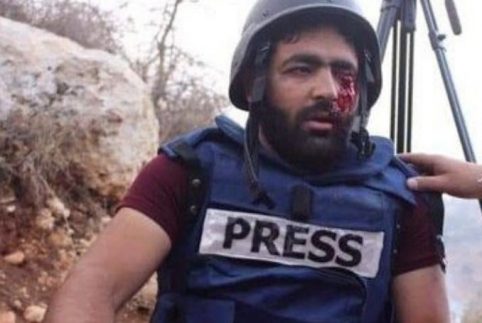
Moath Amarneh lost his eye by a rubber bullet while covering a peaceful protest in Hebron (Al-Khalil). (Photo: via Social Media)
Palestine Chronicle – January 5, 2020
In 2019, Israeli forces committed 255 violations against journalists and media institutions working in the occupied Palestinian territories, according to The Palestine News and Information Agency (WAFA).
The agency released its annual report on Israeli violations against journalists on Sunday.
Israeli violations included the use of live fire, rubber-coated bullets and teargas canisters against journalists, in addition to physical beating and arrest.
The report added that 145 journalists were injured by live fire or rubber-coated rounds, suffocated by teargas or beaten by Israeli forces during the year, while 145 journalists were either arrested or targeted by Israeli gunfire but were not injured. A total of 27 assaults by Israeli forces on media institutions were also documented.
“These daily crimes and violations against journalists,” the report said, “require an urgent and immediate intervention to pressure the Israeli government to stop its systematic and deliberate targeting of photographers and field journalists”.
Featured Video

Chinese jet fuel and the myth of energy independence
or go to
Aletho News Archives – Video-Images
Book Review
Former Insiders Criticize Iran Policy as U.S. Hegemony
By GARETH PORTER | CounterPunch | February 27, 2013
“Going to Tehran” arguably represents the most important work on the subject of U.S.-Iran relations to be published thus far.
Flynt Leverett and Hillary Mann Leverett tackle not only U.S. policy toward Iran but the broader context of Middle East policy with a systematic analytical perspective informed by personal experience, as well as very extensive documentation.
More importantly, however, their exposé required a degree of courage that may be unparalleled in the writing of former U.S. national security officials about issues on which they worked. They have chosen not just to criticise U.S. policy toward Iran but to analyse that policy as a problem of U.S. hegemony. … continue
Blog Roll
 Aletho News
- What is fueling unrest across the EU?
- Why no power can undermine Iran’s eternal dominance over the Strait of Hormuz
- Is The War Against Iran Over?
- Iran war will leave long-term ‘scar’ on Wall Street, investors warn
- How Iran decimated US power projection in West Asia: Military lessons of 40-day war
- Iran’s report details US-Israeli war crimes in targeting schools, hospitals, livelihoods
- NATO’s Slow Fracture: How Trump’s Iran War Exposed the Instrument of Hegemony
- Chinese jet fuel and the myth of energy independence
- Ukraine Sea Drone Fired From Libya Hit Russian Tanker in Mediterranean
- IRGC: Iranian forces launched no attacks during ceasefire hours
- If Americans Knew
- Military aid to Israel emerges as the latest political litmus test for Democrats
- The only Palestinian children’s rights organization closes following years-long Israeli campaign against it
- ‘I Can’t Forget the Smell’: Lebanese Reel After Israel Kills Over 300 in Single Day
- DNC Shoots Down Resolutions Calling Out AIPAC and Limiting Arms to Israel
- TCN: Is Israel Blackmailing President Trump?
- Israel killed at least 303 Lebanese yesterday – who were they? Daily Update
- Amnesty: Urgent – Protect Lebanese civilians from brutal escalation in Israeli attacks
- Is The War Against Iran Over?
- Inside the Israeli army’s propaganda wing
- Hundreds of Gaza Amputees Stranded in Legal Limbo
- No Tricks Zone
- New Study: No Linear Warming Or Glacier Retreat Along Northern Antarctic Peninsula Since 1980s
- An Inconvenient Tree: Uncovered In Alps… Europe Much Warmer Than Today 6000 Years Ago
- New Study Reports A 60% Slowdown In Greenland’s Ice Loss Rate In The Last Decade
- Low Intensity Tornado Wrecks Major Solar Farm, Creating A Potential Toxic Dump
- New Study Finds Warming Saves Lives…Cold Temperatures 12 Times More Deadly Than Excess Heat
- German Science Blog Accuses PIK Climate Institute Of Hallucinating Climate Tipping Points
- Devastating Assessment Of Comirnaty Vaccine By Former Senior Pfizer Europe Toxicologist
- New Study: CO2 Is ‘Effectively Negligible’ As An Explanatory Climate Change Factor Since 2000
- Former Pfizer Toxicologist Dr. Helmut Sterz Tells Bundestag Hearing Pfizer Vaccine Should Have Never Been Approved
- Energy Expert: Germany’s Nuclear Phaseout Was A “500 Billion Euro Mistake”
 Aletho News