As the United States prepared to sign a multi-billion dollar arms deal with Saudi Arabia, royal forces laid siege to al-Awamiya, a restive town of approximately 30,000 in the Qatif district of the country’s Eastern Province. Bulldozers, backed by armored tanks and helicopter gunships, systemically leveled homes and put entire families on the street in the historic Mosawara neighborhood. This came under the guise of a development and “renovation” project for the long-neglected and impoverished city although the regime saw fit to post doctored images of allegedly captured weapons to imply that it was also a security operation.
Last month, anticipating such a move, United Nations experts on poverty, culture and housing rights, “ … called on the Government of the Kingdom of Saudi Arabia to immediately halt the planned demolition of a 400-year-old walled neighborhood in the village of Awamia. The UN experts warned the development plan for the Al-Masora quarter threatens the historical and cultural heritage of the town with irreparable harm, and may result in the forced eviction of numerous people from their businesses and residences.
“The area is of importance not only to local people and the entire cultural landscape of Awamia, but also has national significance for the history and cultural heritage of Saudi Arabia,” said the UN Special Rapporteur in the field of cultural rights, Karima Bennoune. “The planned demolition would erase this unique regional heritage in an irreversible manner.” As the report makes clear, the project did not provide for the construction of residential buildings in place of those destroyed.
Awamiya was home to the late Sheikh Nimr al-Nimr, the fiery cleric who nonetheless peacefully demanded equal rights for the marginalized, oppressed Saudi Shia community. He was ultimately executed by the government in January 2016 after his capture in July 2012. Awamiya is no stranger to aggression, but this past week’s attack and ongoing siege is a new escalation by those yet to be satiated by the killing of Sheikh al-Nimr.
The city’s planned “development” was marked by blocking ambulance access, cordoning off the entrance to Mosawara with concrete barriers, cutting power and shooting at residents. As one said, “It is really painful to demolish a historic and archaeological city like Almosara whose lifespan extends for hundreds of years. Some people who want to close their eyes to the truth and are not affected by the demolition will believe in the lie of development.”
The action comes on the heels of an interview by deputy Crown Prince Muhammad bin Salman’s interview on state television in which he vowed to take the country’s standoff with Tehran inside of Iran’s borders. The offensive was still against Shia Muslims but instead within Saudi borders and the victims his fellow citizens.
It is erroneous and somewhat simplistic to frame the assault strictly in sectarian terms or as a move to appease the religious establishment’s anti-Shia proclivities. Rather, it was meant to send a message to all in the Kingdom of the fate of those who would oppose the authority and the legitimacy of the monarchy. It was to widen the narrow streets of Mosawara to allow tanks easy passage for future operations. It was a reminder to those in the Qatif who might still be emboldened by Sheikh Nimr’s famous declaration, “A century of oppression … enough, we will not be silent and we will not fear. We will call for separation even from this country and let be what will be. Our dignity is dearer than the unity of this land.”
Most importantly, it was to demonstrate that even when the President of the United States visits Saudi Arabia to speak about combating extremism, the regime itself can be extremist without consequence or reproach.
Qana, Lebanon has been the subject of two vicious Israeli attacks and massacres. Gaza withstood untold suffering from a suffocating blockade followed by attack from land, sea and air. The poor villages outside of Manama, Bahrain, have withered under the pervasive repression of the al-Khalifa dynasty. Now another has joined their ranks.
Al-Awamiya: city under siege, city of resistance.
May 23, 2017
Posted by aletho |
Civil Liberties, Ethnic Cleansing, Racism, Zionism, Subjugation - Torture, Timeless or most popular | Human rights, Saudi Arabia |
Leave a comment
Take the Salt Water Challenge

Marwan Barghouti has stopped drinking water. He started his hunger strike thirty-six days ago, together with 1,500 other Palestinians who are being held in Israeli prisons. Each day the strikers have been drinking water mixed with salt, the salt needed to keep their electrolytes functioning to stay alive, but their health has reached a critical phase in which they are experiencing vomiting, fainting and loss of vision. Barghouti, who has been in Israeli prisons for 15 years, is wagering with his own life in a bid to obtain better conditions for the 6,500 Palestinians in Israeli detention, most of whom have been imprisoned on faux terrorism related charges by military tribunals that have a 90% conviction rate. Nearly 500 children are among the prisoners, some of whom are only 12 years old, and there are also an estimated 500 Palestinians held in administrative detention, which permits the Israeli authorities to confine them indefinitely without any charges or any trial.
The Israeli authorities describe the hunger strike as a “violation of prison rules.” In the past, they have responded to such protests by bringing in doctors to help restrain and supervise force feeding of the strikers, but the practice proved very controversial among members of the medical profession and has been suspended, though there have been suggestions that “foreign” doctors might be brought in to do the dirty work. So it is to be presumed that the strike will continue until the protesters either win, begin to die or choose to cease and desist.
I have had the pleasure of speaking recently with Marwan’s youngest son Arab, a graduate of St. Mary’s College of California with a master’s degree in financial analysis, who has begun a campaign to publicize his father’s resistance against the Israeli prison authorities. He has been asking supporters to themselves drink salt water as a sign of solidarity with the hunger strikers. Many prominent Palestinians have done so publicly and the practice has become widespread both in Gaza and on the West Bank as well as among activists in Europe and the United States. It is also gaining strength on the social media, most particularly on Facebook, with videos of supporters of the Salt Water Challenge Salt Water Challenge inviting their friends to join the movement. Hunger striking is the ultimate personal statement, a peaceful form of protest that can only be effective if it helps to mobilize other forces to bring about change. With that in mind, the account of the suffering of Marwan Barghouti and his comrades in prison deserves the widest possible dissemination worldwide.
Marwan Barghouti is, not surprisingly, a controversial figure. His resistance to the Israeli occupation of his homeland began early at age 15 when he joined Fatah and eventually went on to co-found the organization’s youth movement. He later assumed leadership of its paramilitary wing Tanzim, though he eventually distanced himself from Fatah due to its corruption and for a short time headed his own reform party. He subsequently rejoined Fatah in 2006 and is now a member of the Palestinian Parliament. He is widely regarded as the most popular of Palestinian leaders even though he is in prison, or perhaps in part because of that.
Barghouti’s biography reads like a work of fiction. One of seven children, his father was a migrant worker. He completed high school while in an Israeli prison, where he learned Hebrew, and then went on to complete a BA in history and political science followed by an MA in international relations, both at the Palestinian Birzeit University. It required 15 years to complete his degrees because he was exiled to Jordan by the Israelis from 1987 to 1994 for his involvement in the First Intifada after being charged with “incitement,” a favorite catch-all phrase frequently used by Israel to indict anyone who is perceived as an opponent or critic when no actual charges can be plausibly supported by evidence.
Marwan Barghouti was indeed prominent in both the First and Second Intifadas due to his undoubtedly correct belief that a powerful Israel had no interest in any peaceful accommodation with the beleaguered Palestinians. He supported sometimes violent resistance and provocations directed at Israeli soldiers and settlers on the West Bank, though he did not consider Israeli citizens inside Israel legitimate targets. In 2002, he was arrested in Ramallah by the Israelis during the Second Intifada and eventually convicted of five counts of murder plus additional charges. He was given the maximum sentence of five cumulative life sentences for the alleged murders plus forty additional years for attempted murder and membership in an illegal organization.
In his trial Barghouti denied everything but refused to defend himself, claiming that the court had no jurisdiction and that he was legitimately resisting the Israeli occupation of his home. No one was able to demonstrate that he had actually killed anyone but the prosecution insisted that he had given the orders to do so. It should be noted that it was a political rather than a criminal event and completely illegal as he was a Palestinian living in Ramallah who was being tried in an Israeli court and sentenced to prison in Israel. The Inter-Parliamentary union subsequently reviewed the case and found that it had violated the accused’s rights and that numerous international legal agreements and norms were contravened.
Since 2002, there have been growing demands for Marwan Barghouti’s release, including from some Israeli politicians and peace groups, based on his relative moderation and desire to see a peaceful transition into a two-state solution for Israel and Palestine. He has sometimes been likened to Nelson Mandela as someone who could potentially bring order and justice to an apparently intractable situation. Barghouti is undeniably more popular than either Mahmoud Abbas of Fatah or Ismail Haniya of Hamas. If he were free and an election were held today, he would undoubtedly be elected Palestinian president.
It is important to understand the context of the plight of the Palestinian prisoners to appreciate where Barghouti’s struggle for Palestinian rights derives from. Israel shoots to kill Arab demonstrators, including children, who throw stones. It engages in illegal mass, arbitrary arrests of Palestinians who do not reside in Israel but are nevertheless subject to control by the Israeli military authorities who have a relatively free hand on the West Bank. Once convicted by a military court, which is almost always the case, the prisoners are then held in Israel, a violation of international law, while their homes back in the Palestinian territories are frequently demolished to collectively punish the families. The trip through Israeli security barriers from the West Bank to the prisons requires 20 hours travel each way, leading to a 45 minute visit with a barrier in between so no one can actually see anyone else. A one visit per year limit for anyone over 16 is part of a process intended to further punish the families. Prisoners are routinely tortured by Israel, including the “Palestinian Chair”, an excruciating procedure which was developed by the Israel Defense Force’s interrogators and later taught to Americans and used at Abu Ghraib. Hundreds of Arabs have also been killed while in custody and reports of organ harvesting have surfaced in the international media.
Over the past fifty years, an estimated 800,000 Palestinians have been imprisoned by Israel at one time or another, fully 40% of the adult male population. Meanwhile, Israeli settlers run amok on the West Bank, protected by the police and army as they attack Palestinians at random and systematically destroy their livelihoods. They are rarely arrested and, if they are, they are tried in Israeli civil courts where they are nearly always acquitted. It is a situation that would be unimaginable nearly anywhere else in the world but Israel gets away with it due to a sympathetic Jewish dominated media in the U.S. and lickspittle politicians worldwide who can easily be bought or coerced.
Numerous international laws and the Geneva Conventions have been violated in the horrific treatment of the Palestinians but Israel continues to act with impunity. Israel’s colonial occupation and theft of Palestinian land are illegal and have been frequently condemned by world bodies like the United Nations. The United States agrees that the settlements are illegal, though it avoids the word, but it balks at calling out the brutal Israeli military occupation for what it is. The U.S. has also served as Israel’s protector in the U.N. and elsewhere, meaning that there is no pushback against Israeli actions that is in any way commensurate to the crimes that its government commits.
The current American Ambassador to the U.N. Nikki Haley is a virtual echo chamber for Israel’s Foreign Ministry. She sells out U.S. interests to pander to the powerful domestic Israel Lobby which uses its money and political access to corrupt American politicians as well as judicial processes worldwide, as Alison Weir has recently demonstrated with her brilliant analysis of how any criticism of Israel is now being conflated with anti-Semitism and increasingly regarded as a universal “hate crime.”
Israeli apologists like to frame the Palestinian “problem” as a group of unredeemable terrorists who have to be dealt with harshly, a narrative that portrays all Arabs as a threat. But the reality is that Israel has overwhelming power and exercises brutal control over the Palestinian population, which is treated as if it were subhuman. Indeed, many Israelis believe that Arabs are subhuman and deserve to be “ethnically cleansed.” But a people under occupation, even if relatively powerless, has a right to resist under international law, to include the use of violence, which is what the two Intifadas were all about.
One has to hope that Marwan Barghouti succeeds in his resistance and that his son Arab will be able to reach the widest possible audience to publicize what exactly is going on in Israel’s prisons and by extension in its cruel occupation and settlement of what remains of Palestine. And we should not forget other prisoners of conscience like Israeli nuclear whistleblower Moredechai Vanunu, who has yet again had his liberty restricted by the country’s Supreme Court. Israel is an essentially racist police state in spite of its frequent boasts about its alleged democracy but the important message for us Americans is that we have unfortunately served as Benjamin Netanyahu’s enablers. The Palestinians deserve a state of their own and the time has come for the United States to demand that Israel free all political prisoners like Marwan Barghouti and allow that to happen.
May 22, 2017
Posted by aletho |
Ethnic Cleansing, Racism, Zionism, Subjugation - Torture | Human rights, Palestine, Zionism |
Leave a comment

Saba’ Obeid, Mohammad al-Kasaji, and Mohammad Bakr were killed by Israeli forces.
The Palestinian Center for Human Rights documents crimes committed in the occupied Palestinian territories in weekly reports. We summarize their reports and stories from other news agencies with the goal of informing Americans of the ongoing violence that Palestinian families face each day under Israel’s occupation of their ancestral lands. The Israeli government receives $3 billion per year in direct military aid from U.S. taxpayers.
May 11, 2017 – May 17, 2017
West Bank
- The Israeli military continued its 50-year long military occupation of Palestinian land in the West Bank, under which the 2.8 million Palestinians living there are subjected to a different set of laws and treatment than Jewish settlers (numbering 588,000) are.
- An Israeli sharpshooter shot 22-year-old Saba’ Obeid in the heart at demonstration supporting the Palestinian mass hunger strike, killing him. Israeli soldiers shot other demonstrators with rubber-coated steel bullets and teargas canisters and prevented journalists from entering the area.
- An Israeli police office killed Jordanian man Mohammad al-Kasaji, 57, in Jerusalem’s Old City after the man reportedly stabbed him. Palestinian sources said the officer is known for assaulting worshipers who come to Al-Aqsa Mosque (a Muslim holy site), including women.
- Hundreds of Palestinian political prisoners in Israeli jails continued their hunger strike, which reached the 4-week mark. Many are now suffering life-threatening conditions, unable to move or stand, are vomiting blood, and and have had their salts confiscated by Israeli prison authorities. Many have been placed in solitary confinement, are being transferred from prison to prison, and are forced to stand to be counted or face severe fines in spite of their deteriorating health. Israeli officials continue to refuse to negotiate with them.
- Israeli forces attacked demonstrations in support of the Palestinian hunger strikers and wounded 40 Palestinians, 13 of them children. Roughly half of the wounded were shot with live bullets or rubber-coated bullets. Israeli forces also damaged three ambulances.
- Israeli forces attacked the weekly demonstrations against Israeli’s Separation Wall in Bil’in and Nil’in villages, dispersing the protesters with tear gas and live bullets, and beat some of them.
- Israeli forces carried out 62 invasions of Palestinian communities, raiding and searching homes, and arrested 79 civilians, 9 of them children. One of those arrested and jailed was 67-year-old academic and writer Ahmad Qatamesh, who already spent 8 years of his life in Israeli jails without any charges or trial. A teenage girl was also arrested after soldiers invaded her family’s home at 2:00 in the morning.
- Israeli authorities announced they planned to demolish four buildings in a Palestinian neighborhood because they were built too close to Israel’s illegal Apartheid Wall.
- An Israeli police officer hit a Palestinian child with his vehicle in Jerusalem and fled the scene. In a different incident in the West Bank, a Jewish settler hit a Palestinian man with his vehicle and deserted the scene.
- Israeli forces uprooted 60 olive trees belonging to a Palestinian man.
- Israeli forces erected several temporary checkpoints, restricting movement for even more Palestinians. (There are 27 permanent checkpoints and hundreds of physical roadblocks placed by Israeli forces. Palestinians are prohibited from using 41 roads totaling 700 kilometers in the West Bank; only Israelis can travel on them.)
Gaza Strip
- Israel continued its 10-year illegal land, sea, and air blockade of the Gaza Strip, strictly controlling the movement of all 2 million Palestinians living there.
- Israeli navy forces killed Mohammad Bakr, a 23-year-old fisherman and married father of two, off the shores of Gaza on the 69th anniversary of the Palestinian Nakba. The Israeli gunmen chased the boat, opened fire on the four cousins on it, shot Mohammad in the stomach, and ordered his cousins to hand him over before taking him away. He died of his wounds later that day.
- Israeli navy forces opened fire at fishing boats off the coast of the Gaza Strip most days. They arrested six Gaza fisherman, including two children, confiscated a boat, and damaged another.
- At 1:00 am, Israeli forces raided and searched the home of Hamas leader Essa al-Jabari, 51, interrogated him, pointed weapons at his wife and daughters, and then arrested him and confiscated his car.
- Israeli forces continued to prevent most Gazans from entering or exiting the Strip (via the Israeli-controlled Erez crossing), allowing less than 2,000 people to travel.
- Israeli forces arrested a Palestinian patient who was on his way to the West Bank with his mother to receive medical care.
- Israeli forces opened fire on Palestinian agricultural lands near the border.
- Israeli forces continued to prevent most exports from Gaza, allowing only some produce items, fish and aluminum scraps. There is just one Israeli-controlled crossing (Kerem Shalom) for the movement of goods. Israel’s strict limits continue to severely cripple Gaza’s economy. Israeli officials told the U.S. that their goal is to keep Gaza “on the brink of collapse” and “‘functioning at the lowest level possible consistent with avoiding a humanitarian crisis.”
Read the full PCHR report, which also contains daily summaries. The UN Office for the Coordination of Humanitarian Affairs (UN-OCHA) also publishes a “Protection of Civilians” report on the occupied Palestinian territories every two weeks. Their latest report covers May 2 to May 15.
May 21, 2017
Posted by aletho |
Ethnic Cleansing, Racism, Zionism, Subjugation - Torture | Gaza, Human rights, Israel, Palestine, West Bank, Zionism |
Leave a comment
Mass incarceration is a central pillar of Israeli occupation. Hundreds of Palestinian prisoners are waging a hunger strike to fight it.
On April 17, on the anniversary of Palestinian Prisoners’ Day, over 1,500 Palestinians held in Israeli prisons launched a mass hunger strike. A month later, 834 of the prisoners remain on empty stomachs — with several dozens now placed on “close medical watch” by Israeli authorities. The strike has drawn a wave of solidarity among Palestinians and has been met with severe repression by Israeli authorities.
Weeks before the strike erupted, we visited the military courts in the West Bank as a part of a delegation from Stanford Law’s International Human Rights Clinic. Observing the court proceedings drove home how the prison system serves as a core pillar of the occupation — and why the prison strike has attracted so much support among Palestinians.
The prisoners are demanding better conditions: improved access to family visits and phone calls; access to books, newspapers, mail, and educational opportunities; and an end to administrative detention and solitary confinement.
Yet at the heart of their struggle lies a more insidious problem: the sprawling military court system that has stripped them of their dignity and incarcerated over one in three Palestinian men since 1967. Palestinians imprisoned in Israel are sentenced by a court system run by the Israeli military, without any of the safeguards of the Israeli civilian courts. These military courts are predicated on a legal double standard: they only prosecute crimes against Israeli citizens or property; they do not prosecute crimes committed by Israeli settlers living in the Occupied West Bank, or crimes with Palestinian victims.
As strike leader and political prisoner Marwan Barghouti has put it, Israel’s military courts are an “accomplice in the occupation’s crimes.”
Israeli authorities have cracked down swiftly on the hunger strike — not only have they punished those who have protested, but they are also reportedly looking into setting up a separate military hospital to force feed those still on strike. Far-right National Union activists, meanwhile, have organized a barbecue outside the prison, seeking to mock the hungry prisoners with the wafting scents of grilled meat. And Pizza Hut released an advertisement taunting Barghouti to end the strike with a slice of their pizza.
Israeli foreign ministry spokesman Emmanuel Nahshon has said that the Palestinian prisoners are not political prisoners, but “convicted terrorists and murderers” who were “brought to justice.”
Our observations of the military courts — and the statistics — tell a different story. The courts prosecute between five hundred and seven hundred children each year — 79 percent, between 2010 and 2015, for stone throwing, which under the Israeli military’s own classification is only a “public order” offense. This crime generally involves youth throwing stones at military targets so distant that no bodily harm occurs.
Several other offenses that the military courts process are also nonviolent in nature. Incitement — a catch-all crime that could include posting anti-occupation status on Facebook — increasingly appears on the docket. Infiltration — which involves Palestinians illegally entering Israel in order to work, usually as manual laborers — also accounts for a fair share of the men brought before military courts.
There is a good reason that the practice of trying civilians — especially children — in military courts for such a prolonged period of time is unprecedented in an ostensible democracy. International law does allow military courts for civilians in the exceptional case of belligerent occupation. But the international laws governing occupation never contemplated a situation of a fifty-year occupation. And Israel’s military courts prove exactly why.
A staggering 99.74 percent of the cases heard in military court end in conviction: once accused, a Palestinian has little chance of mounting a successful defense. Evidence, especially when it pertains to children, is often the result of coerced confessions — but exclusion motions throwing out such illicitly obtained evidence are rarely successful. The court proceedings are entirely in Hebrew — a language almost all defendants, and most of their lawyers, don’t speak. Translations are often inadequate, or sloppy: we witnessed a translator walk out of the court midway through a proceeding. Most cases are resolved through guilty pleas — because, according to the attorneys we interviewed, defendants and defense lawyers alike are often punished for attempting to take cases to trial.
Palestinian prisoners, in short, are not just faced with harsh prison conditions, in prisons that their families have limited or no access to. They arrive in these facilities after facing a dehumanizing trial in a language that they do not speak, where the presumption of innocence does not apply, and where they face little chance of defending themselves successfully. When they put their bodies on the line with a hunger strike, they are doing so because the system offers them no other option.
That system must fall.
Mass incarceration is a central pillar of Israeli control over the West Bank. Improving prison conditions or adding procedural protections will not solve the problem. Only ending military control over the civilian population will deliver justice to the striking prisoners, as well as the millions suffering daily indignities on the outside.
May 21, 2017
Posted by aletho |
Civil Liberties, Ethnic Cleansing, Racism, Zionism, Solidarity and Activism, Subjugation - Torture | Human rights, Israel, Palestine, Zionism |
Leave a comment
NABLUS – Israeli settlers at predawn Wednesday preformed sacrilegious rituals and yelled “death to Arabs” at Yitzhar crossroads, south of Nablus.
Palestinians driving in the area said over 100 Israeli settlers, escorted by heavily-armed soldiers, flocked to the northern entrance to Hawara town, south of Nablus, and yelled anti-Arab chants.
The Israeli settlers further called for revenge against the Palestinians, shouting “Death to Arabs and Muslims.”
On Tuesday evening, a horde of Israeli fanatics showed up at Hawara checkpoint and on the access road to Bracha settlement, illegally built on Palestinian land in Kafr Kalil and Irak Burin, to mark Israel’s establishment anniversary on the land of Palestine.
May 3, 2017
Posted by aletho |
Ethnic Cleansing, Racism, Zionism, Subjugation - Torture | Israeli settlement, Palestine, Zionism |
Leave a comment
Two courtroom events this week serve to remind us that, no matter which party’s president is in the White House, the right to life and liberty does not apply on the streets of Black America, where the police enjoy effective immunity from prosecution. On Tuesday, the U.S. Justice Department announced that it would not file charges in the death of Alton Sterling, the 37 year-old Black man who was shot to death by cops while helpless on the ground in Baton Rouge, Louisiana, last year. Also on Tuesday, the Justice Department and South Carolina officials accepted a former cop’s guilty plea to the charge of using excessive force when he shot 50 year-old Walter Scott five times, while he was running away after a traffic stop, in North Charleston, South Carolina. Both killings were recorded in gruesome detail on video. But, when it comes to killer cops, the best of evidence is never enough.
The police that killed Alton Sterling, in Baton Rouge, got away with murder, and then proceeded to brutalize and abuse the entire Black community, violently suppressing waves of protest. But, other cops would pay with their lives for the crimes of their brothers in blue. Two days after Alton Sterling was slaughtered, 25 year-old Michah Xavier Johnson launched his one-man war against the Dallas, Texas, police, killing five of them and wounding seven before they blew him up with a robotic bomb — a first in U.S. urban counter-insurgency warfare. Johnson was avenging both Sterling’s death in Louisiana and the police murder of Philando Castile, near Minneapolis, the same week. Castile’s girlfriend, displaying heroic calm in the face of police terror, went on Facebook Live while the cop was still pointing his weapon, with Castile’s body beside her and her young daughter in the back seat – another first in the annals of the one-sided police war against Black people in the United States. The cop that killed Castile has only been charged with manslaughter – by the state of Minnesota, not the feds — and has not yet gone to trial.
Ten days after Michael Xavier Johnson conducted his live ammunition protest in Dallas, former Marine Gavin Eugene Long ambushed six cops in Baton Rouge, killing three and wounding three others, before he was killed.
Sham Investigations
Walter Scott had his fatal encounter with a killer cop in April of 2016. A young immigrant, just passing by, had the presence of mind to video Officer Michael Slager pumping five bullets into Scott as he ran across a field. The Scott case is unique, because it is the only cop killing where the Obama Justice Department actually brought charges. Obama frequently announced that he was “investigating” police killings of Blacks, but nothing would ever come of it, and the case would finally be dropped. Which is what happened this week with the Alton Sterling case from Baton Rouge. You can expect the same result from the Justice Department’s ongoing “investigation” of the police killing of 12 year-old Tamir Rice, in Cleveland, back in November of 2014. It will fall to the Trump Justice Department to finally drop the case. But, make no mistake about it; when it comes to maintaining the police army of occupation in Black America, the Democrats and the Republicans are in complete agreement. There is no such thing as a sanctuary city for Black people in the U.S.
Glen Ford can be contacted at Glen.Ford@BlackAgendaReport.com.
May 3, 2017
Posted by aletho |
Civil Liberties, Subjugation - Torture, Timeless or most popular | Human rights, United States |
Leave a comment
OCCUPIED JERUSALEM – Israel will not pay terror victims’ compensation to Ahmed Dawabsha, a Palestinian boy whose parents and brother were killed in a 2015 arson attack carried out on their home by Israeli settlers, Israel’s war minister Avigdor Lieberman told a Knesset member in an official correspondence on the issue.
Writing to Joint (Arab) List MK Yousef Jabareen in response to a question as to why the now-orphaned Ahmed has not yet received money from Israel, Lieberman said the 6-year-old, who was badly injured in the attack, does not qualify as a “terror victim” and will therefore not receive compensation.
According to the Times of Israel daily, the current law stipulates that Israel must compensate Israelis affected by terrorism, but does not apply to Palestinians “who are not citizens or residents of Israel,” Lieberman wrote.
In January 2016, then-attorney general Yehuda Weinstein rejected a request from Jabareen for Dawabsha to be recognized as a terror victim.
“The compensation should be a right, not a gift,” he claimed. “The state needs to give him full compensation due to the severe incident he has suffered.”
Jabareen said the family would now “turn to the courts” in order to seek both recognition and compensation for Dawabsha.
Two homes in Duma, south of Nablus, were set alight in the July 31 attack. In the attack, Ali Dawabsha,18 months old, was burned to death and father Saad Dawabsha, his wife Riham and their son Ahmad, who was four at the time, were critically injured. Saad died in August and Riham in September. The only surviving member of the family, Ahmed, received months of treatment for severe burns.
Responding to Lieberman’s letter, Jabareen accused the war minister of implementing a racist policy towards the Palestinians.
“The defense minister’s position is based on racial discrimination,” Jabareen said in a statement. “If we were talking about Jewish settlers hurt by Palestinians, the victims would automatically receive compensation.”
The attack caused massive outrage in the occupied Palestinian territories and around the world.
In January 2016, a 21-year-old Israeli settler—Amiram Ben-Uliel—and an unnamed 16-year-old minor were indicted for carrying out the Duma terror attack.
May 1, 2017
Posted by aletho |
Ethnic Cleansing, Racism, Zionism, Subjugation - Torture | Human rights, Israel, Israeli settlement, Palestine, Zionism |
Leave a comment
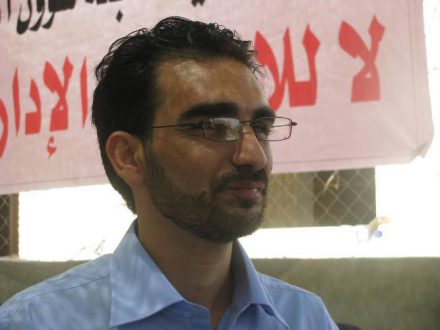
On Friday, 28 April, Thaer Halahleh, former long-term hunger striker in Israeli prisons, was seized by occupation forces at a suddenly placed checkpoint near Bethlehem, when his vehicle was stopped by israeli occupation forces.
Halahleh, from the village of Kharas near al-Khalil, was reportedly taken from the car, his hands tied and taken to an as-yet unknown destination, reported Asra Voice, quoting Halahleh’s family.
He has been seized by Israeli occupation forces on multiple occasions and has spent over nine years in Israeli prisons, most of them in administrative detention, imprisonment without charge or trial. He was most recently released in October 2016; he had been imprisoned without charge or trial since July 2014.
Halahleh engaged in a 77-day hunger strike in 2012, winning his freedom from administrative detention without charge or trial in June 2012 alongside fellow administrative detainee Bilal Diab. He was arrested again in April 2013 and released in May 2014, before being once again arrested and imprisoned without charge or trial.
Halahleh suffers from Hepatitis C, contracted during a dental operation in Israeli prisons where improper sterilization was used. During his previous imprisonment, Halahleh was denied family visits with his wife and children for seven months, and received only painkillers as treatment for his illness.
On 17 April, 1500 Palestinian prisoners launched a hunger strike for a series of demands, including the right to family visits, appropriate medical care, and the end of administrative detention, imprisonment without charge or trial. Protests throughout occupied Palestine and internationally have grown in support of the strikers, with former prisoners often in the leadership of these events.
April 29, 2017
Posted by aletho |
Ethnic Cleansing, Racism, Zionism, Subjugation - Torture | Human rights, Israel, Palestine, Zionism |
Leave a comment

Chilean dictator Agusto Pinochet (L) and Argentine dictator Rafael Videla (R) | Photo: Wikimedia Commons
U.S. President Donald Trump met with Argentine President Mauricio Macri on Thursday, handing over 931 declassified Department of State records related to Operation Condor.
Operation Condor was a Cold War-era campaign of violence across Latin America that resulted in tens of thousands of activist deaths.
Trump’s release falls in line with former President Barack Obama’s promise to release intelligence documents about human rights abuses committed by the Argentine military dictatorship during the 1970s and 1980s.
Entitled “Secret/Exdis,” the declassified documents provide new insight into U.S. support for human rights abuses in Argentina and neighboring countries. Here’s what the reports divulged.
They describe Operation Condor as a trans-border, multinational effort by Southern Cone secret police services to “track down” and “liquidate” regime opponents, the National Security Archive reports.
They reveal that the orchestrators of Operation Condor considered establishing “field offices” in the United States and Europe.
They provide information about former President Jimmy Carter’s propping up of former dictator Rafael Videla in 1977. It has also been confirmed that Orlando Letelier, chief economist for former Chilean President Salvador Allende, was killed by members of Chile’s intelligence service under the Augusto Pinochet dictatorship.
Moreover, they include details about the censorship of U.S. Buenos Aires embassy human rights officer Tex Harris, who tried making human rights abuses public.
The declassification of other top secret documents is expected to occur before the end of the year. Records of 14 intelligence agencies, including the CIA, FBI, and DIA, are expected to be included in the release.
April 28, 2017
Posted by aletho |
Deception, Subjugation - Torture, Timeless or most popular | Argentina, Chile, Latin America, Operation Condor, United States |
Leave a comment
Baltimore County police – an early adopter of body cameras spending $12.5 million of taxpayer money in the name of transparency – is withholding footage in three police-involved shooting incidents.
County police shot six people in four separate incidents since January, killing two of them, according to the Baltimore Sun, which first broke the story.
Body cameras captured all of the shootings but footage has only been made available in one case. Police said the other cases are still being investigated, or the county prosecutors have told them the footage is evidence in upcoming trials.
“Release could compromise the prosecution and the defendant’s right to fair trials,” Baltimore County police spokeswoman Elise Armacost said in a statement to the Sun.
Armacost said those releases were quick because there were no charges against a suspect.
The missing footage involves three incidents.
In March, two officers investigating a convenience store robbery in Woodlawn shot a vehicle rushing towards them killing a 20-year-old, and injuring two others.
On April 12, police shot a 27-year-old man suspected of breaking into cars in Parkville who police said reached into his waistband.
Nine days later, an officer shot a woman who was a passenger in a stolen car that was being pursued by police.
The department first deployed body cameras last July, with the promise of a gradual rollout through December 2018, after fast-tracking $12.5 million program to equip officers.
The program was accelerated after a series of shootings, including the fatal shooting of Korryn Gaines, 23, and the wounding of her 5-year old son in August 2016 during a standoff in Randallstown. The shooting was not recorded. That led to County Executive Kevin Kamenetz and then-police chief Jim Johnson to speed up the program.
Currently about 550 of the county’s 1,900 officers have body cams. More than 1,400 are to have cameras by the end of this September.
Kamenetz wouldn’t comment on the lack of transparency but his spokesperson, Ellen Kobler, said he had been clear from the beginning “that footage from police body cameras has been and will continue to be released without delay as soon as it can be determined that the release of the footage will not compromise an ongoing investigation.”
The police previously released footage from a case in December when an officer shot and wounded a man who had opened the door of his apartment carrying a knife and saying “Time to die! Time to die!”
County prosecutors ruled the shooting justified.
In another incident in January, footage was released of a police officer fatally shooting a man who had threatened his family and who had raised a “powerful scoped rifle” as an officer was talking to him.
Kamenetz then replaced Police Chief Johnson with Terry Sheridan, who had previously been the chief.
Armacost said there had been no change in policy since Sheridan took over.
The ACLU of Maryland called attempts to withhold the footage “concerning.”
“Despite lip service being paid to transparency and accountability, both their policies and in their actions, what we are seeing is the opposite,” said David Rocah, an attorney with the organization. He said the footage means “we don’t simply have to take officer’s word for what happened in particular situation.”
Cole Weston, president of the Baltimore County Fraternal Order of Police Lodge No. 4, said he’s not in favour of video footage being released to the public before an investigation is closed.
“I think everybody should be cautious about just looking at… one particular piece of what happened,” he told the Sun. “Body camera footage is one piece of information that is captured as it related to an entire incident.”
April 27, 2017
Posted by aletho |
Civil Liberties, Deception, Subjugation - Torture | Human rights, United States |
Leave a comment
Venezuelan trade union leader Esmin Ramirez was killed Sunday in the southeastern state of Bolivar after being kidnapped in an act that people close to him claim was politically motivated.
Ramirez, who was a member of the Movement 21 labor syndicate in the state-run iron ore producer Ferrominera and part of the PSUV political party in Cachamay, was killed in El Rinconcito sector in Guayana City, a city along the bank of the Orinoco River in Bolivar state.
The leader was killed by several gunshots to the head. He had been previously kidnapped on Saturday night in San Felix. His body was retrieved by officials Sunday.
Ferrominera expressed condolences in a statement on social media, saying the company hoped that authorities would investigate and clarify the details surrounding the Ramirez’ death.
Ramirez had denounced previous attacks against other members of his organization in the past and was an active participant in marches in support of President Nicolas Maduro, who has in recent weeks faced a wave of violent anti-government protests demanding his ouster.
The union leader was preparing for a massive march for International Worker’s Day on May 1.
Meanwhile, another grassroots leader, Jacqueline Ortega, was murdered in the greater Caracas area in Santa Lucia del Tuy on Saturday. Ortega was also a member of the PSUV as well as a leader in her community’s Local Production and Supply Committee, known as CLAP, a government-created alternative food distribution program.
Ortega was reportedly shot dead in her home by four masked assailants.
Edited by Venezuelanalysis.com.
April 26, 2017
Posted by aletho |
Subjugation - Torture | Latin America, Venezuela |
Leave a comment
Torture and mistreatment of detainees by Afghan security forces is as widespread as ever if not more so, despite promises from Afghan President Ashraf Ghani and new laws enacted by the government, a United Nations report has declared.
Investigators from UNAMA — UN Assistance Mission in Afghanistan — spent two years interviewing 469 detainees in 62 detention centers across Afghanistan.
In all, the report says 39 percent of conflict-related detainees interviewed by the UNAMA gave “credible and reliable accounts” of being tortured or experiencing severe mistreatment at the hands of the Afghan national police, intelligence, or military personnel while in custody.
Among the methods described by interviewees were severe beatings to the body and soles of the feet with sticks, plastic pipes or cables, electric shocks, including to the genitals, prolonged suspension by the arms, and suffocation.
The total compares with 35 percent of interviewees who reported ill treatment in the UN’s previous investigation into the issue in 2015, although this apparently slight uptick in brutality obscures significant spikes in specific areas — for instance, 45 percent who had had been detained by the National Police said they had been tortured or ill-treated, the highest level documented since UNAMA began its monitoring program in 2010, and a leap of 14 percentage points.
More than a quarter of tortured detainees were under the age of 18. Detainees held by the Afghan Local Police were even more likely to experience violence, with 60 percent reporting having been beaten, and 30 percent of interviewees held by the National Directorate of Security faced torture or mistreatment.
Afghan National Army soldiers were also accused of mistreating some detainees, but the prisoners held by the army usually fall in categories less vulnerable to torture.
The majority of detainees said they had been tortured in order to extort false confessions, and the torture ceased once they signed or thumbprinted pre-prepared confession statements. In many cases, interviewees did not understand or could not read what was written on the document.
“Torture does not enhance security. Confessions produced as a result of torture are totally unreliable. People will say anything to stop the pain. It is essential there is proper monitoring of detention facilities in Afghanistan and meaningful investigations to ensure those accused of torture are brought to trial and held accountable for this abhorrent crime. Ensuring accountability for such acts sends a strong message and helps to prevent future violations,” said UN High Commissioner for Human Rights Zeid Ra’ad Al Hussein.
Nonetheless, the report welcomes the government’s efforts to implement its National Plan on the Elimination of Torture, promulgated in February 2015, particularly with regard to enacting legislation, issuing policies, and establishing and developing mechanisms for humanitarian oversight within law enforcement and security institutions.
If proposed legislative changes are adopted, the report said, Afghanistan would formally recognize the authority of the UN Committee Against Torture to conduct visits to places of detention, and undertake to establish an independent monitoring body to visit places of detention with the support of the UN Subcommittee on the Prevention of Torture
The report is published days before senior Afghan officials are scheduled to appear before the UN Committee Against Torture in Geneva, to face a review of Afghanistan’s record of implementing anti-torture laws.
The International Criminal Court in The Hague is conducting a separate review of torture in Afghanistan, although their sphere of research includes abuses committed by US forces during their 13-year occupation of the country.
ICC Prosecutor Fatou Bensouda has said there is a “reasonable basis” for believing US forces and the Central Intelligence Agency resorted to techniques amounting to the commission of the war crimes, including “of torture, cruel treatment, outrages upon personal dignity, and rape.”
READ MORE:
Afghans Learned the Art of Torturing Their Prisoners From the West
April 24, 2017
Posted by aletho |
Subjugation - Torture | Afghanistan, Human rights |
Leave a comment

 A Review of Conspiracy Theories and Other Dangerous Ideas by Cass Sunstein (based on an earlier paper co-authored with Adrian Vermeule); In Defense of Troublemakers: The Power of Dissent in Life and Business by Charlan Nemeth; and Conspiracy Theories and the People Who Believe Them, edited by Joseph E. Uscinski

