When Do We Start Coming out of the Covid-19 Mass Hysteria?
By Michael Fumento | American Institute for Economic Research | December 13, 2020
Men . . . go mad in herds, while they only recover their senses slowly, and one by one.” So wrote Scottish journalist Charles Mackay in his 1841 book Extraordinary Popular Delusions and the Madness of Crowds, which for good reason to this day remains in print.
The Covid-19 hysteria, scientifically called mass psychogenic illness, that began in March has yet to peak. And if some have it their way it will continue indefinitely, merely going, in medical terminology, from epidemic to endemic. That is, it will never fully go away no matter what. We apparently finally have some medicines that work with countless more being tested, doctors have gotten better at applying treatments, vaccines are being administered in what is by far record time, and yet the media and public health community onslaught shows absolutely no sign of abating.
We have heard White House Covid-19 task force member Dr. Deborah Birx claim “This is not just the worst public health event. This is the worst event that this country will face, not just from a public health side.” Oy! This even as we’re now hearing the mainstream media, led by cult figure Dr. Anthony Fauci, say that the vaccinations now being rolled out don’t mean the masks can come off. Start with the second first.
There are any number of cute memes asking in some manner, “If masks work, why do we need social distancing? If social distancing works, why do we need masks?” Well, it’s called a layered defense (with no pun intended regarding the use of masks or those people you see wearing two at once.) Cars are filled with a vast number of safety devices and roads have also been made safer in myriad ways, but it doesn’t mean they all don’t work in their own manner. So whatever arguments there are against masks (such as that they don’t stop aerosolized virus) aren’t necessarily negated because social distancing is still encouraged or mandated.
But we are left wondering, “Then when do masks come off? When do the other measures end if it’s independent of vaccinations?”
Remember that originally lockdowns and masking were supposed to be extremely temporary, as little as 15 days, to “flatten the curve.” And it was supposed to be a one-time flattening. But it didn’t work out that way. Once the original goal was achieved, the posts were moved. And nobody told us to where. It’s like literal goalposts; if not the zero-yard line then any other goal is arbitrary.
Except. For. One. That’s total elimination of the disease. That may be close to impossible and incredibly expensive to even try, but like eliminating all carbon emissions in a decade it is a goal.
The problem, of course, is that we’ve never eliminated an airborne virus by quarantining healthy people and there’s no scientific breakthrough that has made that any more possible now than it’s ever been. For example, the masks virtually everyone is using, even first-liners, are no better than what some people used during the Spanish flu a century ago. Social distancing dividers at various businesses and schools are just like the sneeze guards at the local buffet. Contact tracing with use of mobile devices has been hailed as a savior of sorts, and perhaps can be of help, albeit at the expense of invading privacy. At least it’s targeted, right? Well, no. It seems to be of limited efficacy without distancing.
So again, when do masks get to come off? Can we ever return to pre-Covid life? Or is the answer contained in the term “New Normal?” That is at least until Covid-19 is eliminated, which took 25 years with a smallpox vaccine. (By the way, the polio eradication program has a target date of 2005.) That’s not a typo. And now it’s being threatened by a shift of resources to, you guessed it, Covid-19.
When is it okay to sit next to another human being or be touched again without being guilt-tripped – or fined and jailed? It doesn’t seem an unreasonable query, but nobody at the press conferences dazzled by the glow of Fauci’s halo ever thinks to ask.
As for Birx’s claim, repeated by CDC director Robert Redfield, she’s either off her rocker or simply lying. There’s no third option. In 1918-19, the so-called Spanish Flu swept through the world killing, adjusted to today’s population, 325 to 430 million. These people died of the flu, not with. And, notes the CDC, in direct contrast with coronavirus, “The high mortality in healthy people, including those in the 20-40 year age group, was a unique feature of this pandemic.”
At the same time the world was suffering the torment of WWI (perhaps 20 million deaths), not to mention the horrific smallpox, and vastly higher rates than today of malaria, yellow fever, Dengue, measles, mumps, rubella and a host of other lethal diseases against which there weren’t even treatments. Remember that President Calvin Coolidge’s son died of infection from a blister in 1924. No antibiotics.
As for Time’s “Worst Year Ever” cover, perhaps it’s a matter of perspective, as exemplified in the satirical term “First World Problem.” Which to a great extent is what Covid-19 is. Consider that all those comorbidities tied to higher mortality are related to the cultures of advanced societies – essentially bad diet, sedentary lifestyles, and simply living longer. Covid-19 this year could represent “a loss of less than 1/1,000th of the population’s remaining years to live,” according to one published analysis. Imagine throwing a brick into an Olympic-sized pool and trying to measure a rise in the waterline.
Meanwhile about 2.2 million children alone die each and every year in poorer countries from diarrhea, according to the CDC. That’s last year, this year, and next year as well. (Assuming coronavirus doesn’t drain anti-diarrheal efforts – which apparently it is. No Covid-19 shibboleth is more disingenuous than “All lives matter.” Perhaps, but obviously some lives matter more than most.
What we clearly have is a pandemic of self-absorption, part and parcel to mass psychogenic illness. At some point hopefully we will feel the shame of the Salem witch hunters and all those who aided and abetted them, those in the courts who squirmed and screamed every time a suspect witch was questioned. Maybe we’ll shun the current panic-mongers, as those people were later shunned. But for now it’s full-bore hysteria. And there’s no end in sight. It’s more for that reason that, indeed, 2020 has been a very bad year.
Michael Fumento is a lawyer, author, and journalist who has been writing on epidemic hysterias for 35 years. His Website is http://www.fumento.com.
The Sixth Carbon Budget
By Paul Homewood | Not A Lot Of People Know That | December 10, 2020
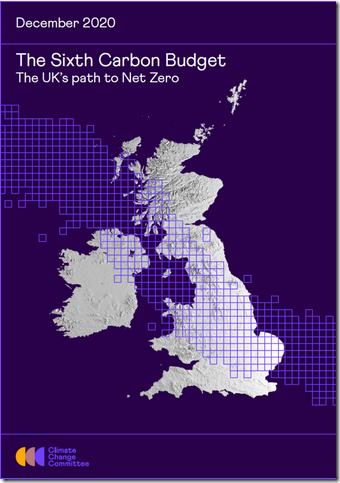 The Committee on Climate Change, the quango headed up by our old friend John Gummer, has just published its latest cunning plan to bankrupt the UK. The Sixth Carbon Budget lays out how we should meet our decarbonisation targets, with specific emphasis on the period 2032-2037.
For the first time they have included estimates of what all of this might cost us in the 2030s. Dressed up in percentages of GDP, talk of green jobs and claims of the economic growth it will all spawn, the CCC have attempted to obscure how much we are all actually going to have to fork out.
They reckon that their plan will involve spending around £50bn annually by 2030, which equates to nearly £2000 for every home in the country. But, as we shall see, even that figure is based on some highly optimistic (some would argue unrealistically so) assumptions.
They say that the £50bn could be marginally offset by savings on electric cars. But it turns out that these are based on a combination of Enron style accounting, and absurdly fanciful assumptions about falling prices of electric cars.
There is, of course, much jam promised tomorrow, or more precisely 2050, when half of us will be dead. But it’s not what might happen in thirty years time that matters to people, it’s the here and now.
But what will all of this mean to the man in the street?
As we already know, the sale of conventional petrol and diesel cars will be banned from 2030. According to the CCC, Battery Electric Vehicles (BEVs) currently cost a third more than conventional cars, typically a premium of £6400.
However, the CCC grandly assume that by 2030 BEVs will cost no more; all of this on the basis that the cost of BEV batteries will drop by two thirds in the next ten years, for which there is not the slightest evidence. Of course, if BEVs do become a lot cheaper, drivers will be queuing up to buy them, and the government won’t need to ban conventional cars!
The CCC also dishonestly include something called “carbon costs” in their running costs for petrol/diesel cars, which amounts to £200 a year per car, or £7bn for the country as a whole. There is, of course, no such a thing as a “cost of carbon”, which is included only to make low carbon alternatives appear more competitive.
When these factors, along with doubts about the second hand value of BEVs, are taken into account, most of the CCC’s fictional savings disappear. All the more significant, because those drivers who are forced to use public chargers are already finding their cars to be dearer than petrol ones to run.
We then come to heating our homes, with proposals that sales of gas boilers are banned by 2033. For most homes this will mean replacement with air source heat pumps, which typically cost around £10,000 to install and require thousands more to be spent on insulation if they are to work effectively.
Quite where ordinary families are expected to get this money from is not explained! To make matters worse, because electricity costs five times as much as natural gas in terms of energy, householders will find that their heating bills double as well.
And if we choose to carry on using our old gas boilers? Simples – we will have a stonking carbon tax added to our gas bills instead.
Not only are we expected to pay thousands out to meet carbon targets, but we are also told we must eat a third less red meat and dairy produce, drive our cars less and take fewer flights. Not that we will be able to afford any of these pleasures after the CCC have done with us.
Eating less meat and dairy will of course cause great damage to British farming, as well as pushing up food bills for poorer families.
And how will we actually power all of these new electric cars and heat pumps? By 2035, we will need nearly twice as much electricity as now, two thirds of which will be coming from wind and solar power, according to the CCC. This is four times the amount of power they generate now.
And when the wind does not blow and the sun does not shine? We will have to fall back on gas power stations, with the proviso that they can capture and store the carbon dioxide produced, even though nowhere in the world has managed to do this at scale.
Central to the case for wind power, is that the cost of offshore wind has fallen so much that it is now competitive. However, independent experts, who have looked at the published accounts of companies building these wind farms, maintain that these so-called falling costs are illusory, and that the real costs could be triple those of conventional power generators. If they are right, this would add another £20bn a year to the CCC’s plan.
No longer are these plans decades in the future. Within the space of a very few years, people will begin to experience the financial pain inflicted on them by these proposals, if they are allowed to go ahead.
And all for what?
The UK only accounts for 1% of global emissions, so whatever we do will have no effect at all on the climate. Meanwhile, despite COVID, this year China has continued to build new coal power stations, increasing its generating capacity by 3%. In the last two year’s the rise in China’s emissions of carbon dioxide has exceeded our total emissions.
Pope Francis plans to ‘fix’ global capitalism – with the help of the Rothschilds, Rockerfellers and Mastercard
By Robert Bridge | RT | December 11, 2020
The Vatican has said it will partner with Fortune 500 companies to address various economic grievances, including inequality and environmental degradation. But is it really incumbent upon the Bishop of Rome to virtue-signal?
Anyone entertaining hopes that planet Earth might escape the insanity of 2020 without any more mind-blowing stories may wish to fasten their seatbelts for a hard landing.
At a time when a global pandemic has swept away millions of jobs, and transformed a handful of global capitalists from ‘merely wealthy’ to fantastically wealthy overnight, Pope Francis has decided to take sides in this epic battle. Any hunches what side that might be? Hint: much like the Vatican, it is immensely wealthy, influential, and acts like a government unto itself.
Yes, you guessed it. Instead of the poor and destitute – you know, ‘the meek who shall inherit the earth’ rigmarole – taking their rightful place alongside the Pope to fight against globalization on steroids, the Vatican has announced it will form a “historic partnership” with big business, known as the Council for Inclusive Capitalism. You can’t make this stuff up. And make no mistake: this is no mere talk shop, but rather a vast undertaking that involves “more than $10.5 trillion in assets under management, companies with over $2.1 trillion of market capitalization, and 200 million workers in more than 163 countries.”
“Capitalism has created enormous global prosperity, but it has also left too many people behind, led to the degradation of our planet, and is not widely trusted in society,” said Lady Lynn Forester de Rothschild, Founder of the Council and Managing Partner of Inclusive Capital Partners. “This council will follow the warning from Pope Francis to listen to ‘the cry of the Earth and the cry of the poor’ and answer society’s demands for a more equitable and sustainable model of growth.”
In other words, in an apparent act of divine intervention, the Rothschild family (whose wealth is estimated at $20 billion, although nobody really knows for sure), together with other famous brand names of globalization, such as the Rockefellers and Mastercard, will now take up the standard for the world’s downtrodden. Who will be the first one to hold their breath?
I tried to contain my skepticism, I really did, until I read a bit deeper into this contract between the Catholic Church and corporate power. Any guesses as to who will ensure the corporate chieftains live up to their end of the bargain?
Known as the Guardians for Inclusive Capitalism – I kid you not – these 27 devout and morally outstanding individuals all hail from the golden one percent. Let’s call them the Pope’s 27 billionaire disciples. Really outstanding people, such as President of the Rockefeller Foundation Rajiv Shah, CEO of Mastercard Ajay Banga, and CEO of Salesforce Marc Benioff, will now behave like Good Samaritans, carrying out the will of the Holy See around a ravaged, lockdown-wearied planet. And here is the catch: there is not a single Vatican cardinal or even a deacon on the list of Guardians. So, who will guard over the guardians? Yes, the corporate elite themselves! They must have read Donald Trump’s ‘The Art of the Deal’.
My initial skepticism shot into overdrive when it became clear what acts of charity the council would promote: “The Guardians will hold themselves accountable, committing to a list of intended actions involving environmental, social and governance matters,” Forbes reported. “The Guardians … have said they plan to hire and promote more women, increase diversity hires, commit to clean energy by purchasing 100% renewable electricity, reduce greenhouse gas emissions…” Yada, yada, yada.
Forgive me, Father, but that sounds an awful lot like the controversial progressive platform being touted by Joe Biden and Kamala Harris that has divided the United States down the middle. In other words, this unholy marriage has already alienated at least one half of the US population, who fear a Biden presidency will herald in an age of socialism in America. Meanwhile, it is hardly reassuring that these profit-driven individuals will be allowed to “hold themselves accountable” to take on unspecified “social and governance matters” and “other initiatives,” whatever those happen to be.
The reason for suspicion should be obvious. Aside from the absurdity of letting profit-driven corporations play guardian over themselves, we are now living in a time when these out-of-control behemoths are no longer content to just hawk their products to consumers; they have taken a serious stand on cultural and political issues, which many people find unacceptable yet must bear silently with a smile.
Using their profits from consumer spending, corporations such as Coca-Cola can run an extremely controversial Sprite advertisement campaign, for example, that promotes a transgender lifestyle and that will be seen by millions of impressionable children. Or how about Gillette’s massively disappointing (and disliked) commercial that took issue with so-called ‘toxic masculinity.’ Are these the “other initiatives” that corporations will be forcing on an unsuspecting public with the stamp of papal authority? Personally, I’ve never heard Pope Francis speak out against these extremely provocative ideas.
Perhaps even more worrying is that many companies, compelled to prove they are taking a stand on behalf of the latest cause célèbre, have enthusiastically jumped aboard the Black Lives Matter juggernaut, which critics – of which there is no shortage, even among the black American population – say works to the disadvantage of other races, not least white Americans, who have become the bane of Western civilization overnight.
Is this the sort of ‘equality’ big business will be promoting with the quiet blessing of the Vatican? In their woke bid to become more ‘equal and diverse,’ will corporations begin to promote particular groups of people at the expense of others? After all, the Trump administration was just forced to take executive action against ‘critical race theory’ inside the government, while academia is now rampant with lectures teaching the evils of the ignoble white man. Are we on the precipice of a new age of racism in the United States and elsewhere, where the historic tables are turned with the help of corporate America?
Although Pope Francis may have the best intentions at heart in promoting this sort of dialogue between the Vatican and the corporate world, unless there is real involvement by the Church to rein in corporate power, it will become a wasted opportunity in very short order.
The Council for Inclusive Capitalism is nothing more and nothing less than a cynical PR stunt for corporate power that allows their controversial initiatives, heavily steeped in the rapacious accumulation of profit, as well as the promotion of dangerous ‘woke’ values, to win the seal of approval from one of the most powerful religious authorities on the planet.
Such a program really amounts to an act of mindless virtue-signaling from the Catholic Church, which has fallen out of favor of late, and a cheap opportunity for the corporate world to conceal its behavior behind the shroud of morality and saintliness. It would have been far more effective and symbolic had Pope Francis committed himself to a contract with the people, with his true followers, in the fight against corporate power. Instead, he made a pact with the devil.
Robert Bridge is an American writer and journalist. He is the author of ‘Midnight in the American Empire,’ How Corporations and Their Political Servants are Destroying the American Dream. @Robert_Bridge
Rich People & Journalists Made Exempt From Having to Enter COVID Quarantine
“High value business travellers” won’t have to self-isolate
By Paul Joseph Watson | Summit News | December 3, 2020
Journalists and rich people defined as “high value business travellers” will be made exempt from having to enter a 2 week COVID quarantine when they return to the UK under new rules announced by the government.
“From 4am on Saturday, people in a number of categories will no longer have to self-isolate upon returning to England, even if they are travelling from a country not on the travel corridors list,” reports Sky News.
Those categories include journalists, “high value business travellers,” performing arts professionals and wealthy sports stars.
Under current rules, anyone returning from a country not on the UK’s “travel corridor” list has to self-isolate at home for 14 days or face escalating fines.
Public Health England said the new measures will not raise the risk of domestic transmission of coronavirus.
The rule change is being pitched as a way to help boost the economy, but many responded by framing it as a classic example of elitist privilege.
“We are being governed by absolute fools, clowns and charlatans. If I’m rich enough to afford Business Class I’m immune to Covid?” asked one Twitter user.
“Ah! One rule for “us” and another for all the “little people”. Shrewd move just when trust and social cohesion is needed,” remarked another.
“What a load of rubbish. You mean those well off don’t need to follow “quarantine measures,” said another.
“There will be some big businesses that are able to take advantage of it,” said Paul Charles, chief executive of travel consultancy The PC Agency, underscoring once again how the rules favor large transnational corporations while small businesses continue to go bust.
The Great Pretext… for Dystopia
In their World Economic Forum treatise Covid-19: The Great Reset, economists Klaus Schwab and Thierry Malleret bring us the voice of would-be Global Governance.
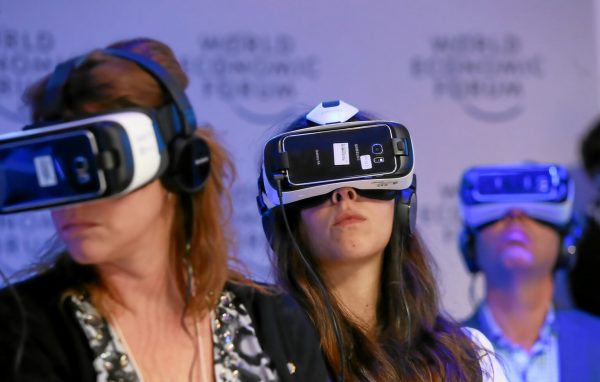
Viewing the virtual-reality film “Collisions” at a session of the World Economic Forum in Davos, Switzerland, January 2016. (World Economic Forum, Flickr, CC BY-NC-SA 2.0)
By Diana Johnstone | Consortium News | November 24, 2020
By titling their recently published World Economic Forum treatise Covid-19: The Great Reset, the authors link the pandemic to their futuristic proposals in ways bound to be met with a chorus of “Aha!”s. In the current atmosphere of confusion and distrust, the glee with which economists Klaus Schwab and Thierry Malleret greet the pandemic as harbinger of their proposed socioeconomic upheaval suggests that if Covid-19 hadn’t come along by accident, they would have created it (had they been able).
In fact, World Economic Forum founder Schwab was already energetically hyping the Great Reset, using climate change as the triggering crisis, before the latest coronavirus outbreak provided him with an even more immediate pretext for touting his plans to remake the world.
The authors start right in by proclaiming that “the world as we knew it in the early months of 2020 is no more,” that radical changes will shape a “new normal.” We ourselves will be transformed. “Many of our beliefs and assumptions about what the world could or should look like will be shattered in the process.”
Throughout the book, the authors seem to gloat over the presumed effects of widespread “fear” of the virus, which is supposed to condition people to desire the radical changes they envisage. They employ technocratic psychobabble to announce that the pandemic is already transforming the human mentality to conform to the new reality they consider inevitable.
“Our lingering and possibly lasting fear of being infected with a virus … will thus speed the relentless march of automation…” Really?
“The pandemic may increase our anxiety about sitting in an enclosed space with complete strangers, and many people may decide that staying home to watch the latest movie or opera is the wisest option.”
“There are other first round effects that are much easier to anticipate. Cleanliness is one of them. The pandemic will certainly heighten our focus on hygiene. A new obsession with cleanliness will particularly entail the creation of new forms of packaging. We will be encouraged not to touch the products we buy. Simple pleasures like smelling a melon or squeezing a fruit will be frowned upon and may even become a thing of the past.”
This is the voice of would-be Global Governance. From on high, experts decide what the masses ought to want, and twist the alleged popular wishes to fit the profit-making schemes they are peddling. Their schemes center on digital innovation, massive automation using “artificial intelligence,” finally even “improving” human beings by endowing them artificially with some of the attributes of robots: such as problem-solving devoid of ethical distractions.
Engineer-economist Klaus Schwab, born in Ravensburg, Germany, in 1938, founded his World Economic Forum in 1971, attracting massive sponsorship from international corporations. It meets once a year in Davos, Switzerland – last time in January 2020 and next year in May, delayed because of Covid-19.
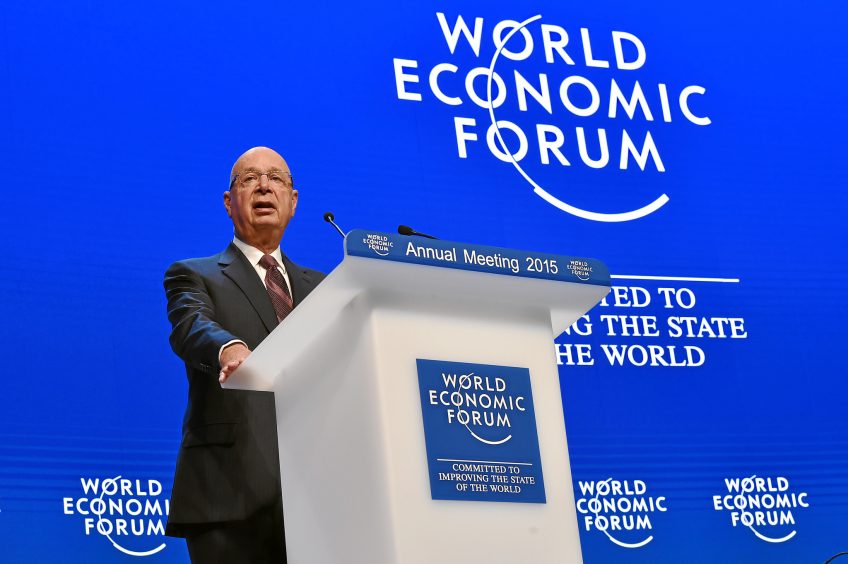
Klaus Schwab, founder and executive chairman, World Economic Forum, on Jan. 21, 2015. (World Economic Forum, Flickr, CC BY-NC-SA 2.0)
A Powerful Lobby
What is it, exactly? I would describe the WEF as a combination capitalist consulting firm and gigantic lobby. The futuristic predictions are designed to guide investors into profitable areas in what Schwab calls “the Fourth Industrial Revolution (4IR)” and then, as the areas are defined, to put pressure on governments to support such investments by way of subsidies, tax breaks, procurement, regulations and legislation. In short, the WEF is the lobby for new technologies, digital everything, artificial intelligence, transhumanism.
It is powerful today because it is operating in an environment of State Capitalism, where the role of the State (especially in the United States, less so in Europe) has been largely reduced to responding positively to the demands of such lobbies, especially the financial sector. Immunized by campaign donations from the obscure wishes of ordinary people, most of today’s politicians practically need the guidance of lobbies such as the WEF to tell them what to do.
In the 20th century, notably in the New Deal, the government was under pressure from conflicting interests. The economic success of the armaments industry during World War II gave birth to a Military-Industrial Complex, which has become a permanent structural factor in the U.S. economy.
It is the dominant role of the MIC and its resulting lobbies that have definitively transformed the nation into State Capitalism rather than a Republic.
The proof of this transformation is the unanimity with which Congress never balks at approving grotesquely inflated military budgets. The MIC has spawned media and Think Tanks which ceaselessly indoctrinate the public in the existential need to keep pouring the nation’s wealth into weapons of war. Insofar as voters do not agree, they can find no means of political expression with elections monopolized by two pro-MIC parties.
The WEF can be seen as analogous to the MIC. It intends to engage governments and opinion manufacturers in the promotion of a “4IR” which will dominate the civilian economy and civilian life itself.
The pandemic is a temporary pretext; the need to “protect the environment” will be the more sustainable pretext. Just as the MIC is presented as absolutely necessary to “protect our freedoms,” the 4IR will be hailed as absolutely necessary to “save the environment” – and in both cases, many of the measures advocated will have the opposite effect.
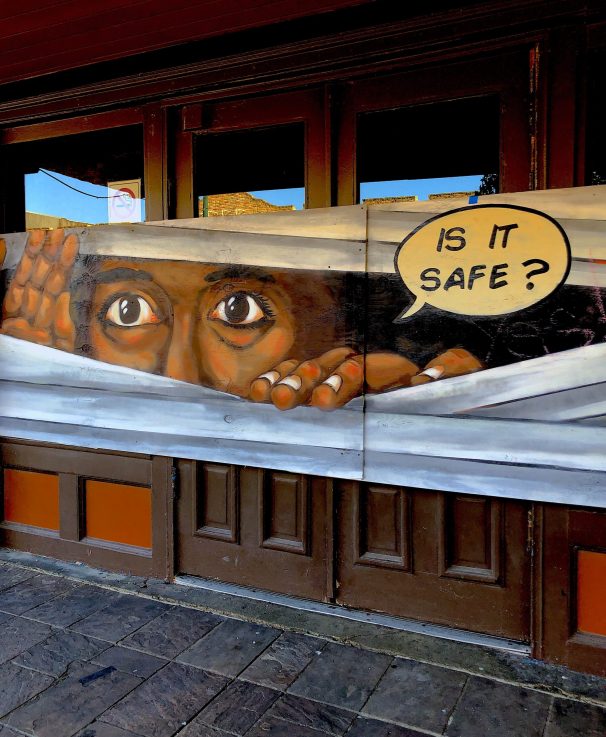
Public street art on 6th Street in Austin, Texas, depicting the impact of Covid-19 closings. (Leah Rodgers, CC BY 4.0, Wikimedia Commons)
So far, the techno-tyranny of Schwab’s 4IR has not quite won its place in U.S. State Capitalism. But its prospects are looking good. Silicon Valley contributed heavily to the Joe Biden campaign, and Biden hastened to appoint its moguls to his transition team.
But the real danger of all power going to the Reset lies not with what is there, but with what is not there: any serious political opposition.
Can Democracy Be Restored?
The Great Reset has a boulevard open to it for the simple reason that there is nothing in its way. No widespread awareness of the issues, no effective popular political organization, nothing. Schwab’s dystopia is frightening simply for that reason.
The 2020 presidential election has just illustrated the almost total depoliticization of the American people. That may sound odd considering the violent partisan emotions displayed. But it was all much ado about nothing.
There were no real issues debated, no serious political questions raised either about war or about the directions of future economic development. The vicious quarrels were about persons, not policy. Bumbling Trump was accused of being “Hitler,” and Wall Street-beholden Democrat warhawks were described by Trumpists as “socialists.” Lies, insults and confusion prevailed.
A revival of democracy could stem from organized, concentrated study of the issues raised by the Davos planners, in order to arouse an informed public opinion to evaluate which technical innovations are socially acceptable and which are not.
Cries of alarm from the margins will not influence the intellectual relationship of forces. What is needed is for people to get together everywhere to study the issues and develop well-reasoned opinions on goals and methods of future development.
Unless faced with informed and precise critiques, Silicon Valley and its corporate and financial allies will simply proceed in doing whatever they imagine they can do, whatever the social effects.
Serious evaluation should draw distinctions between potentially beneficial and unwelcome innovations, to prevent popular notions from being used to gain acceptance of every “technological advance,” however ominous.
Redefining Issues
The political distinctions between left and right, between Republican and Democrat, have grown more impassioned just as they reveal themselves to be incoherent, distorted and irrelevant, based more on ideological bias than on facts. New and more fruitful political alignments could be built through confrontation with specific concrete issues.
We could take the proposals of the Great Reset one by one and examine them in both pragmatic and ethical terms.

(Bob Mical, Flickr, CC BY-NC-SA 2.0)
No. 1 – Thanks to the pandemic, there has been a great increase in the use of teleconferences, using Skype, Zoom or other new platforms. The WEF welcomes this as a trend. Is it bad for that reason? To be fair, this innovation is positive in enabling many people to attend conferences without the expense, trouble and environmental cost of air travel. It has the negative side of preventing direct human contact. This is a simple issue, where positive points seem to prevail.
No. 2 – Should higher education go online, with professors giving courses to students via internet? This is a vastly more complicated question, which should be thoroughly discussed by educational institutions themselves and the communities they serve, weighing the pros and cons, remembering that those who provide the technology want to sell it, and care little about the value of human contact in education – not only human contact between student and professor, but often life-determining contacts between students themselves. Online courses may benefit geographically isolated students, but breaking up the educational community would be a major step toward the destruction of human community altogether.
No. 3 – Health and “well-being”. Here is where the discussion should heat up considerably. According to Schwab and Malleret: “Three industries in particular will flourish (in the aggregate) in the post-pandemic era: big tech, health and wellness.” For the Davos planners, the three merge.
Those who think that well-being is largely self-generated, dependent on attitudes, activity and lifestyle choices, miss the point. “The combination of AI [artificial intelligence], the IoT [internet of things] and sensors and wearable technology will produce new insights into personal well-being. They will model how we are and feel […] precise information on our carbon footprints, our impact on biodiversity, on the toxicity of all the ingredients we consume and the environments or spatial contexts in which we evolve will generate significant progress in terms of our awareness of collective and individual well-being.”
Question: do we really want or need all this cybernetic narcissism? Can’t we just enjoy life by helping a friend, stroking a cat, reading a book, listening to Bach or watching a sunset? We better make up our minds before they make over our minds.

User being monitored in a biometrics lab. (Grish068, CC BY-SA 4.0, Wikimedia Commons)
No. 4 – Food. In order not to spoil my healthy appetite, I’ll skip over this. The tech wizards would like to phase out farmers, with all their dirty soil and animals, and industrially manufacture enhanced artificial foods created in nice clean labs – out of what exactly?
The Central Issue: Homo Faber
No. 5 – What about human work?
“In all likelihood, the recession induced by the pandemic will trigger a sharp increase in labor-substitution, meaning that physical labor will be replaced by robots and ‘intelligent’ machines, which will in turn provoke lasting and structural changes in the labor market.”
This replacement has already been underway for decades. Along with outsourcing and immigration, it has already weakened the collective power of labor. But clearly, the tech industries are poised to go much, much further and faster in throwing humans out of work.
The Covid-19 crisis and social distancing have “suddenly accelerated this process of innovation and technological change. Chatbots, which often use the same voice recognition technology behind Amazon’s Alexa, and other software that can replace tasks normally performed by human employees, are being rapidly introduced. These innovations provoked by necessity (i.e. sanitary measures) will soon result in hundreds of thousands, and potentially millions, of job losses.”
Cutting labor costs has long been the guiding motive of these innovations, along with the internal dynamic of technology industry to “do whatever it can do.” Then socially beneficial pretexts are devised in justification. Like this:
“As consumers may prefer automated services to face-to-face interactions for some time to come, what is currently happening with call centers will inevitably occur in other sectors as well.”
“Consumers may prefer…”! Everyone I know complains of the exasperation of trying to reach the bank or insurance company to explain an emergency, and instead to be confronted with a dead voice and a choice of irrelevant numbers to click. Perhaps I am underestimating the degree of hostility toward our fellow humans that now pervades society, but my impression is that there is a vast unexpressed public demand for LESS automated services and MORE contact with real persons who can think outside the algorithm and can actually UNDERSTAND the problem, not simply cough up preprogrammed fixes.
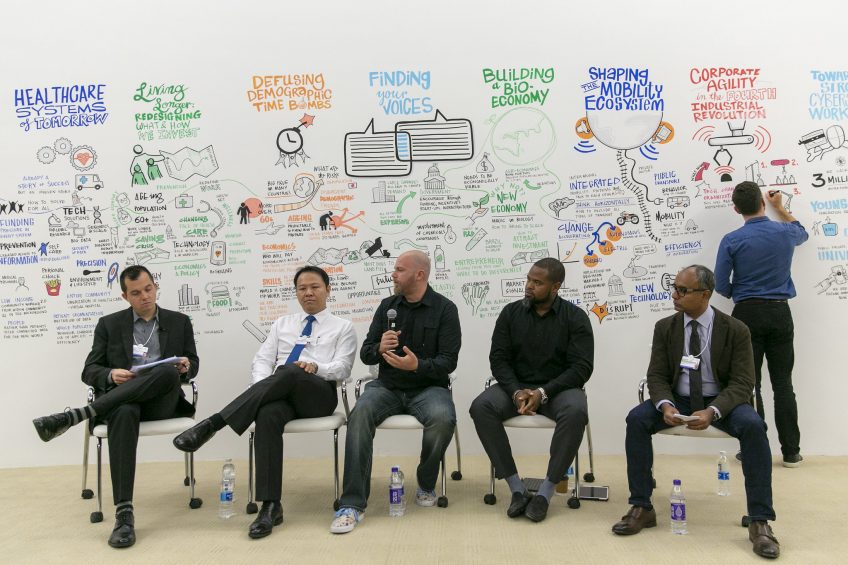
“Corporate agility in the Fourth Industrial Revolution” session held in Tianjin,China, September 2018. (World Economic Forum, Faruk Pinjo, CC BY-NC-SA 2.0)
There is a potential movement out there. But we hear nothing of it, being persuaded by our media that the greatest problem facing people in their daily lives is to hear someone exhibit confusion over someone else’s confused gender.
In this, I maintain, consumer demand would merge with the desperate need of able-minded human beings to earn a living. The technocrats earn theirs handsomely by eliminating the means to earn a living of other people.
Here is one of their great ideas. “In cities as varied as Hangzhou, Washington DC and Tel Aviv, efforts are under way to move from pilot programs to large-scale operations capable of putting an army of delivery robots on the road and in the air.” What a great alternative to paying human deliverers a living wage!
And incidentally, a guy riding a delivery bicycle is using renewable energy. But all those robots and drones? Batteries, batteries and more batteries, made of what materials, coming from where and manufactured how? By more robots? Where is the energy coming from to replace not only fossil fuels, but also human physical effort?
At the last Davos meeting, Israeli intellectual Yuval Harari issued a dire warning that:
“Whereas in the past, humans had to struggle against exploitation, in the twenty-first century the really big struggle will be against irrelevance… Those who fail in the struggle against irrelevance would constitute a new ‘useless class’ – not from the viewpoint of their friends and family, but useless from the viewpoint of the economic and political system. And this useless class will be separated by an ever-growing gap from the ever more powerful elite.”
No. 5 – And the military. Our capitalist prophets of doom foresee the semi-collapse of civil aviation and the aeronautical industry as people all decide to stay home glued to their screens. But not to worry!
“This makes the defense aerospace sector an exception and a relatively safe haven.” For capital investment, that is. Instead of vacations on sunny beaches, we can look forward to space wars. It may happen sooner rather than later, because, as the Brookings Institution concludes in a 2018 report on “How artificial intelligence is transforming the world,” everything is going faster, including war:
“The big data analytics associated with AI will profoundly affect intelligence analysis, as massive amounts of data are sifted in near real time … thereby providing commanders and their staffs a level of intelligence analysis and productivity heretofore unseen. Command and control will similarly be affected as human commanders delegate certain routine, and in special circumstances, key decisions to AI platforms, reducing dramatically the time associated with the decision and subsequent action.”
So, no danger that some soft-hearted officer will hesitate to start World War III because of a sentimental attachment to humanity. When the AI platform sees an opportunity, go for it!
“In the end, warfare is a time competitive process, where the side able to decide the fastest and move most quickly to execution will generally prevail. Indeed, artificially intelligent intelligence systems, tied to AI-assisted command and control systems, can move decision support and decision-making to a speed vastly superior to the speeds of the traditional means of waging war. So fast will be this process especially if coupled to automatic decisions to launch artificially intelligent autonomous weapons systems capable of lethal outcomes, that a new term has been coined specifically to embrace the speed at which war will be waged: hyperwar.”
Americans have a choice. Either continue to quarrel over trivialities or wake up, really wake up, to the reality being planned and do something about it.
The future is shaped by investment choices. Not by naughty speech, not even by elections, but by investment choices. For the people to regain power, they must reassert their command over how and for what purposes capital is invested.
And if private capital balks, it must be socialized. This is the only revolution – and it is also the only conservatism, the only way to conserve decent human life. It is what real politics is about.
Diana Johnstone lives in Paris. Her latest book is Circle in the Darkness: Memoirs of a World Watcher and is also the author of Fools’ Crusade: Yugoslavia, NATO, and Western Delusions. Her lates book is Queen of Chaos: the Misadventures of Hillary Clinton. The memoirs of Diana Johnstone’s father Paul H. Johnstone, From MAD to Madness, was published by Clarity Press, with her commentary. She can be reached at diana.johnstone@wanadoo.fr .
Electric Car Charging–A Dose Of Reality
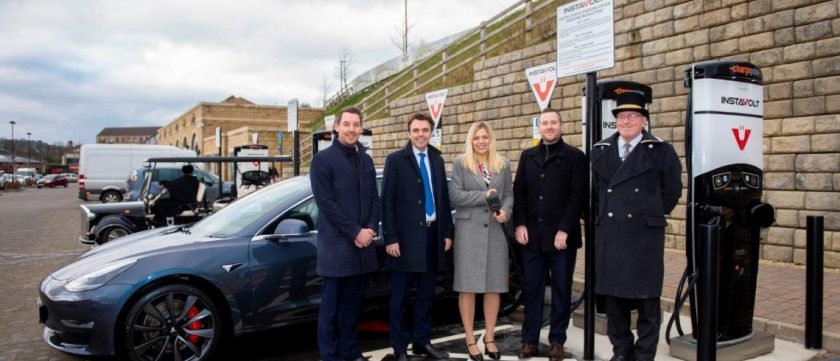
Fox Valley Electric Car Charging Bays
By Paul Homewood | Not A Lot Of People Know That | November 25, 2020
I have been doing a bit of digging into the EV chargers at our local shopping centre, which were installed last year.
They are run by a company called InstaVolt, whose Annual Accounts are here. The latest Accounts are for March 2019.
They show that they had 314 units installed at that date, with a Gross Asset value of £5.5m. This works out at an average of about £18,000 each. They all appear to be 50KW units, although there are plans to introduce higher power ones.
It is not clear who paid for the new substation (which you can just see to the right of that white van). But I would assume that must belong to the shopping centre, who will of course recover the cost via rental charges. That would of course significantly increase that figure of £18000, if all capital costs were taken into account.
Given that hardly anybody has an electric car, the finances of InstaVolt are unsurprisingly dire!
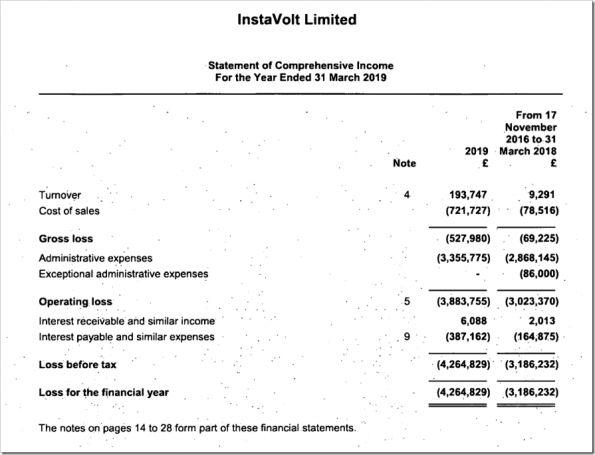
They are funded by an equity investment of £18m from Zouk Capital, an investment fund that specialises in renewable projects. At the current rate of loss, that equity will be wiped out in a couple of years.
Up to now, a lot of car chargers at the likes of Tesco have been free to use, a way of increasing footfall. However, at Tesco at least, these have all been slow 7KW chargers, the sort you would put in your garage at a cost of £1000.
An hour’s charge on one of these would cost around a quid, so they would make good business sense if they bring in customers who might spend £50.
However, 7KW chargers will be far too slow once there are millions of EVs on the road. You certainly would not be able to turn up at Tesco and leave your car there all day, if you had nowhere else to charge it.
Consequently Tesco are now beginning to introduce faster 22 and 50KW chargers. But these are “priced in line with market rates”, probably similar to the 35p/KWh charged by InstaVolt.
There is simply no way Tesco could give away £10 of electricity free to every customer. Nor could they afford to spend £20K for every charger installed. A typical Tesco supermarket with, say, 10 chargers would cost £200K.
The bottom line to all of this?
The free ride is over for EV owners. If you cannot charge at home, you will have to pay through the nose.
The same of course will apply to chargers run by local councils and other public bodies. They might be able to afford free power for the tiny number of EVs currently, but costs will soon balloon once numbers grow.
There is also an important warning here as well. There will be very few investors with either the will or the money to incur the sort of losses which InstaVolt have.
As a result we are unlikely to get the millions of public chargers needed until we have millions of electric cars on the road.
Chicken and egg, I think!
Which brings us back to the question of who will pay for them.
Boris’10-Point Plan pledges £1.3bn for charging infrastructure, but most of this appears to be for the 6000 high-powered chargers promised for motorways and trunk roads. (I would guess we are looking at at least £100,000 each, plus associated infrastructure. I have seen costs of £250,000 for the really fast chargers)

It is hard to see much money left over for local chargers. A million 50KW chargers, which is probably the minimum we would need, would cost at least £20bn, even before we count the cost of digging up roads and upgrading power cables.
Who will pay for that?
Why it is right to question the orthodox Covid-19 narrative
The authors of ‘Welcome to Covidworld’ defend their stance
By Matthew Ratcliffe and Ian James Kidd | The Critic | November 6, 2020
In a reply to our piece “Welcome to Covidworld”, Ben Bramble engages in precisely the sort of thinking that we raised concerns about. He suggests that we are mistaken in comparing harms done by lockdowns and other measures to harms caused by the virus. Instead, we ought to have weighed up the costs of lockdowns against what would have happened without them.
Bramble’s case hinges on a counterfactual claim: in the absence of lockdowns, the virus would have inflicted much more harm than it has done. The cost of not locking down would, he says, have been “mind-bogglingly great”.
What could be wrong with Bramble’s claim? First of all, his use of the term “lockdown” is insufficiently discerning. Lockdown is not a simple, straightforward policy measure that took the same form in every country. There are, for instance, important differences between early and late lockdowns. Australia and New Zealand both locked down early and suppressed the virus.
Setting aside the issue of whether or not the actions taken by these countries are morally justifiable, it remains to be seen whether or not this is a success story. If a highly effective vaccine is not forthcoming, both countries will face the painful options of cutting themselves off from the rest of the world indefinitely, having strict lockdowns whenever the virus reappears, or eventually succumbing to the virus, none of which amount to success.
However, the current UK situation is very different. Given where we are now, nobody is claiming that this second lockdown or any future UK lockdowns will be able to suppress the virus here. It is too well established for that. Rather, the stated aims have been to buy us some time until a vaccine arrives and, most recently, to ensure that the NHS is not overwhelmed. In evaluating the effectiveness and appropriateness of such policy measures, it will not do to make sweeping claims about the effectiveness of lockdowns in general. When considering interventions so extreme and destructive, we need to proceed more carefully.
Bramble simply accepts that lockdowns in general work. He does not specify exactly what it would be for a late lockdown to work, when the goal is no longer complete suppression. Presumably, the relevant criteria will include reducing hospitalizations and deaths due to Covid-19, during the lockdown and in the longer term as well. But where is the evidence that lockdowns generally have this effect? Bramble doesn’t provide any. Maybe he thinks it’s just obvious that they achieve this, but it really isn’t.
A strict lockdown in Peru is associated with one of the highest Covid-19 death tolls in the world (currently recorded as 1,047 people per 1 million of the population). Other countries that have resorted to exceptionally long and strict lockdowns, such as Argentina, have also fared badly. One could, of course, run Bramble’s counterfactual here: it would have been even worse for these countries had they not locked down. But where is the evidence for that? Indeed, what would even count as evidence?
It would be intellectually and morally unacceptable to make the pro-lockdown position unfalsifiable by always insisting on the following: (1) where cases drop after a lockdown was introduced, it must be the lockdown that achieved this; (2) where cases rise after a lockdown was introduced, it would certainly have been even worse without the lockdown; (3) if other countries, such as Sweden, adopt less extreme approaches than us and fare better or at least no worse, this must be due to other differences between the two countries – the Swedish strategy would never have worked here.
So, how do we go about evaluating the effectiveness of lockdowns? Where is the evidence that the virus ultimately causes far more deaths in the absence of extreme social restrictions? Where are those countries that followed a different course from countries like the UK (which locked down, but did not suppress the virus) and now have higher death tolls than us? By simply assuming that his counterfactual claim is true, Bramble illustrates our worry that lockdowns risk becoming an unfalsifiable article of faith. In fact, he even asserts that “the science on this is beyond question”. Is it really? If so, all the disease modelers who have made dire predictions concerning the current UK situation will be delighted to hear that their work will be forever immune from critique, even if it turns out that their models have little bearing on reality. And, in any case, none of them would endorse Bramble’s exaggerated claim that, without a lockdown, there would have been “many millions of deaths” in countries such as the UK.
In fact, much about the behaviour of this virus remains unclear, including how the infection rate is influenced by growing immunity within a population. There is no single, homogeneous entity called “the science”. Rather, there are many different and often conflicting perspectives, theories, and claims. Furthermore, this is a complicated, fast-changing situation that impacts on all aspects of human society. Relevant expertise thus encompasses a wide range of academic disciplines and areas of practice. Philosophers should not simply defer to “the experts”; they also have plenty of relevant expertise themselves.
What we do know is that lockdowns are immensely damaging in so many ways. This second UK lockdown will further disrupt the social and emotional development of our children, cause a substantial rise in severe mental health problems, force many elderly people to live out the final weeks and perhaps months of their lives in loneliness and misery, exacerbate and prolong the pain of bereavement by depriving people of interpersonal and social interactions that shape and regulate grief, destroy livelihoods and risk mass unemployment, increase regional social and economic inequalities, reduce the life-opportunities of young people while saddling them with an ever-growing mountain of debt to pay off, suspend much of what gives our lives meaning, deprive people of countless precious, irreplaceable life-moments, and cause deaths due to the numerous resulting impacts on people’s health.
However, the true extent of certain harms, such as the long-term effects of sustained lockdown measures on children’s development, may not become fully clear for some time.
Others have similarly warned that policy makers are paying insufficient attention to these growing costs. For instance, an open letter by psychologists, which appeared on 1 November, spells out the widespread and damaging psychological effects of continuing restrictions, including the harms done to children. Similarly, an article published in the British Medical Journal on 2 November raises the concern that the “collateral damage” caused by public health interventions has “yet to be considered systematically”. Others have drawn attention to the global costs of national lockdowns. For instance, the charity Oxfam has stated that, by the end of this year, over 12,000 people could be starving to death every day due the global impact of national-level responses to Covid-19.
Bramble observes that the orthodox view has in fact been subjected to critical scrutiny. But the problem is that – in the UK, at least – alternative perspectives have had little influence on the processes of recommending, making, and implementing policy decisions. And we worry that this may be partly because of blinkered and inflexible attitudes that are widely held. People are often very quick to dismiss or express moral disapproval of dissenting voices. However, those who confidently endorse lockdowns with an air of moral authority also need to acknowledge the full extent of the harms these measures have caused, are causing, and are likely to cause. Furthermore, explicit and sufficiently specific criteria should be supplied for determining the effectiveness of any proposed lockdown, accompanied by convincing evidence to show that it is very likely to achieve its intended effects.
Instead of pursuing such a path, Bramble speculates that our own concerns originate in cognitive impairments caused by our distressing experiences of lockdown. This is the kind of response that motivated our earlier account of “Covidworld”, a simplified, virus-centric reality where various norms of reason, scientific enquiry, and moral conduct have ceased to apply.
Copyright © Locomotive 6960 Limited 2020
The Last Days of the Trumpian Reich

CJ Hopkins | Consent Factory | October 27, 2020
So, according to the corporate media, this is it for Russian-backed Hitler. Game over. The walls are closing in. It’s the last days of the Trumpian Reich. Get those vuvuzelas ready!
Yes, apparently, the American people, who were all a bunch of Putin-worshipping, white-supremacist neo-Nazis when they elected Trump in 2016, have come to their senses and are going to deliver a landslide victory to “Slappy” Joe Biden and bring down the curtain on this “Age of Darkness,” or save the world from “racial Orwellianism” or the “bottomless pit of facsism,” or whatever.
White supremacy will be defeated and globalization will rise from the ashes! Decency will be restored! Love will trump hate! Black lives will matter!
Slappy and Kamala will immediately fly down and liberate the concentration camps. Trump will face some sort of Nuremberg trial, where he will have to answer for mass-murdering six million people with the Coronavirus by taking off his mask on the White House balcony.
Hillary Clinton will be appointed … something.
Exuberant liberals will pour into the streets, chanting unintelligible slogans through their designer masks and plastic head bubbles. OK, sure, the global economy will be ruined, and millions of people will be unemployed, and homeless, or will have needlessly died, so that GloboCap could simulate an apocalyptic global plague, and foment racialized civil unrest, and just generally create an atmosphere of confusion, depression, and paranoia, but the War on Populism will finally be over … and GloboCap will start to “Build Back Better!”
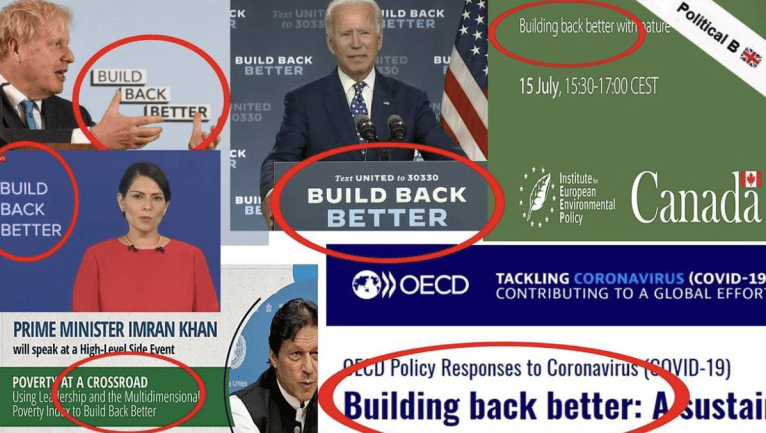
OK, it won’t be “better” right away. As our friends at the World Economic Forum note:
“Thanks to the ongoing pandemic, the world is off-balance – and it will remain so for years to come. Far from settling into a ‘new normal’, we should expect a Covid19 domino effect, triggering further disruptions – positive as well as negative – over the decade ahead. The wave of civil unrest that spread across America and beyond recently may be one example …”
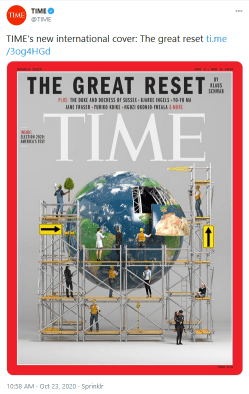
So, all right, maybe not quite the end of the War on Populism, but at least a new stage of it. A chaotic, destructive, violent stage of it, which will require a lot of “emergency measures” and will end up radically transforming the planet into one big pathologized-totalitarian marketplace.
We conspiracy theorists are calling it The Great Reset … but don’t take it from us, take it from TIME magazine, which just happens to be owned by a guy named Marc Benioff, a World Economic Forum Board of Trustees member, whose net worth is approximately $7.8 billion, and who is deeply concerned about the environment, and inclusivity, and economic fairness, as is everyone at the WEF these days.
Fortunately, just by sheer coincidence, this apocalyptic global plague has provided Marc and his billionaire buddies (who own the majority of the corporate media, and who meet once a year in a remote location guarded by heavily-armed security to discuss our future with major government leaders) with an opportunity to “reset” capitalism and save the planet from … well, themselves.
That’s not how they see it, naturally. No, the way they see it, they’re not the problem. The problem is … well, the problem is people. Not rich and powerful people like themselves, or the people they need to continue working, consuming, and servicing the interest on their loans, but … you know, all those other people. Uneducated, un-woke, working-class people. Gun-toting, fanatically religious people. Racist, conspiracy-theorizing people. Deplorable people. “Populist” people. People they don’t need anymore.
These people have been a problem recently. Not only are they a drag on the system, they have been actively interfering with it, voting for Brexit, electing Donald Trump, refusing to abandon their traditional values and outmoded ideas (e.g., national sovereignty, freedom of speech, and mammalian biology) and get on board with global capitalist ideology, and have been otherwise being a real pain in the ass.
It was one thing when these problem people were mostly black- and brown-skinned people with “extremist” beliefs in faraway countries that most Western consumers couldn’t care less about, because GloboCap could just bomb the crap out of them, but they can’t really do that here in the West. Hence, the War on Populism that we have been experiencing for the last four years … and whatever new, dystopian stage of it that awaits us in the post-Trump future.
2020 has been a preview of it. The lockdowns, the masks, the “social distancing,” and other so-called “emergency measures,” the Orwellian propaganda, the censorship of dissent, the banning of political protests, the corporate media finally transforming into a full-blown Goebbelsian keyboard instrument, the goon squads raiding people’s homes, the cult-like, totalitarian conformity … it’s just a taste of what’s to come.
This was always in the cards, of course. It was just a matter of time until we got here. The folks at GloboCap are no fools. They know they can’t remake the world into one big happy neo-feudal marketplace without breaking a few proverbial eggs … and not just in those “terrorist” countries, but everywhere, throughout the global capitalist empire. And that is exactly what they intend to do. So, they needed a new official narrative to justify all the broken eggs.
They haven’t settled on an official slogan yet. “The New Normal,” “The Great Reset,” “The Green New Deal” … they’re all just trial balloons at this point. It doesn’t really matter what they call it. It amounts to a new type of totalitarianism. As I noted in my previous column, “[i]t isn’t national totalitarianism, because we’re living in a global capitalist empire, which isn’t ruled by nation-states, but rather, by supranational entities and the global capitalist system itself.” But it is totalitarianism nonetheless.
They aren’t hiding it. They’re spelling it out, not in spittle-flecked Hitlerian speeches, but, clearly, unmistakably, in corporate-speak. Here is Klaus Schwab, Chairman of the WEF:
“[T]he world must act jointly and swiftly to revamp all aspects of our societies and economies, from education to social contracts and working conditions. Every country, from the United States to China, must participate, and every industry, from oil and gas to tech, must be transformed. In short, we need a ‘Great Reset’ of capitalism.”
I added emphasis for those new to corp-speak. And, for those interested in reading more about Klaus Schwab, Winter Oak has published this disturbing profile, which you can also read on Cory Morningstar’s blog (along with a lot of other censored content).
Sorry … I was supposed to be writing about the final days of the Trumpian Reich, and I got all sidetracked with this GloboCap business. I hope you’ll forgive me for not being able to get all fired up about the election next week. Given everything else that is happening, and everything that has happened over the last four years, I’m just having a little trouble believing that there is any realistic scenario wherein GloboCap lets Trump serve a second term, regardless of who actually wins. So, that kind of takes all the suspense out of it.
Don’t worry, though, I’ll get back on the horse when the post-election rioting begins, and Donald Trump finally goes full-Hitler, declares himself Führer, dissolves the Congress, and orders his legions of Russia-loving white supremacists to start rounding up the Jews, as the corporate media, the fake “left” media, the Intelligence Community, the Democratic Party, fascism experts, Hollywood celebrities, and every hysterical liberal in existence have been promising he would since 2016.
Seriously, if he doesn’t go full-Hitler this time, and start rounding up and mass-murdering somebody, or else order the nuking of the United States and then blow his brains out in his underground bunker, some people are going to have some explaining to do.
#
Photos: (1) Build Back Better collage/Ian Jenkins; (2) Time Magazine/Twitter
Scott Atlas: I’m disgusted and dismayed
Unherd | The Post | October 20, 2020
Freddie Sayers caught up with Scott Atlas, a healthcare policy academic from the Hoover Institute at Stanford, who has become the latest lightning rod for the controversy around Covid-19 policy and his support for a more targeted response.
Speaking from inside the White House, where he is now Senior advisor to the President and a member of the Coronavirus task force, he does not hold back. He tells us that he is disgusted and dismayed at the media and public policy establishment, sad that it has come to this, cynical about their intentions, and angry that lockdown policies have been allowed to go on so long.
He won’t be rushing back to Stanford, where his colleagues have rounded on him, if the President loses in November.
KEY QUOTES
Why him?
“I’m a healthcare policy person — I have a background in medical science, but my role really is to translate medial science into public policy. That’s very different from being an epidemiologist or a virologist with a single, limited view on things.”
Dr Fauci
“He’s just one person on the task force — there are several people on the task force. His background is virology, immunology and infectious disease. It’s a very different background, it’s a more limited approach, and I don’t speak for him.”
Herd immunity policy?
“No. It’s a repeated distortion, lie, or whatever you want to call it… What they mean by ‘herd immunity strategy’ is survival of the fittest, let the infection spread through the community and develop a population immunity. That’s never been the policy that I have advised. It’s never even been discussed inside the White House, not even for a single minute. And that’s never been the policy of the President of the United States or anybody else here. I’ve said that many many times… and yet it persists like so many other things, hence the term that the President is fond of using called fake news.”
On herd immunity
“Population immunity is a biological phenomenon that occurs. It’s sort of like if you’re building something in your basement: it’s down on the ground because gravity puts it there. It’s not a ‘strategy’ to say that herd immunity exists — it is obtained when a certain percentage of the population becomes resistant or immune to an infection, whether that is by getting infected or getting a vaccine or by a combination of both. In fact, if you don’t believe that herd immunity exists as a way to block the pathways to the vulnerable in an infection, then you would never advocate or believe in giving widespread vaccination — that’s the whole point of it… I’ve explained it to people who seemingly didn’t understand it; I’ve mentioned this radioactive word called herd immunity. But that’s not a strategy that anyone is pursuing.”
What is his policy?
“My advice is exactly this. It’s a three-pronged strategy. Number one: aggressive protection of high risk individuals and the vulnerable (typically the elderly and those with co-morbidities). Number two: allocate resources so that we prevent hospital overcrowding, so that people can be treated for this virus and get the other serious medical care that is needed. Number three: open schools, society and businesses because keeping them closed is enormously harmful — in fact it kills people.”
Has the policy changed?
“It is the White House policy on Coronavirus, but it always was. The President started this with an observation that was overlooked by most people in the world: he said in the third week of March that the cure cannot be worse than the disease… In April the White House released a formal ‘opening up America’ document, which included extreme protection of the vulnerable and opening up society… It’s not been a shift.”
Effect of lockdowns
“We must open up because we’re killing people. In the US, 46% of the six most common cancers were not diagnosed during the shutdown… These are people who will present to the hospital or their doctor with later stage disease — many of these people will die. 650,000 Americans are on chemotherapy — half of them didn’t come in for their chemo because they were afraid. Two-thirds of screenings for cancer were not done; half of childhood immunisations did not get done; 85% of living organ transplants did not get done. And then we see the other harms: 200,000 cases plus of child abuse in the US during the two months of spring school closures were not reported because schools are the number one agency where abuse is noticed; we have one out of four American young adults, college age, who thought of killing themselves in the month of June…
All of these harms are massive for the working class and the lower socioeconomic groups. The people who are upper class, who can work from home, the people who can sip their latte and complain that their children are underfoot or that they have to come up with extra money to hire a tutor privately — these are people who are not impacted by the lockdowns.
This is the topic, this is why you open up. A secondary gain might be population immunity, but this is the reason to open up.”
On short-term immunity
“We don’t know how long someone’s immunity lasts to this, but this is a coronavirus, this is not a completely novel disease… Coronavirus exposure typically has a year, or even a few years, of immunity — we can make a first guess that probably there’s a good chance that will happen… Yes, we know that antibodies disappear… but that’s true for every infection, that’s a typical scenario and not a cause for panic. Why? Because we know there is resistance to infection that seems to be coming out in the literature that is not purely due to antibodies, there are other components of the immune system. Suffice to say this: do we know that people have immunity? You don’t need to be a scientist to understand that when you have hundreds of millions of cases… do you know how many cases of reinfection there are? At the most, five in the world… It is not true that there is no immunity to this, that would be a bizarre conclusion.”
Climate of fear
“This is one of the biggest failures of the voices of public health in the United States and in the world — they specifically instilled fear with their proclamations and statements… And the models that were put forward that were worst case scenarios and were just hideously wrong, and the media that has hyped up these rare exceptions like multi-system inflammation in children even though we know the overwhelming evidence is that this disease is absolutely not high risk for children. All the hyperbole, the sensationalising and the failure of public health officials to articulate what we know instead of what we don’t know… The fear is due to what was said by the so-called experts, by the media and by a failure to understand or care that they were instilling hear… I just heard a famous epidemiologist from Harvard the other day say that to have the idea of herd immunity even being discussed is ‘mass murder’ — these kinds of statements are hideously outrageous.
It’s never appropriate to have fear. There is no such thing as a government leader who is competent who instills fear.”
How to protect old people
“We have not been perfect at it, there’s no question — it’s very challenging. The first is to educate people: put forward the guidelines. I think our society has learned — no-one knew what social distancing meant… that was a foreign concept and we now understand that — but there are more specific measures. We have shipped every single nursing home point of care rapid testing — we have mandated weekly testing of every staff that enters a nursing home, but when there is community increase we recommend going up to… four times a week.
We cannot guarantee that we can protect everybody — there is not such thing as zero risk in life…”
But
“I have a 93 year old mother in law, and she said to me 2 months ago, “I’m not interested in being confined in my home. I am not interested in living if that’s the life… I’m old enough to take a risk, I understand social distancing. I’m going to function, otherwise there’s no reason to live.” This sort of bizarre, maybe well-intentioned but misguided idea that we are going to eliminate all risk from life, we are going to stop people from taking any risk that they are well aware of, we’re going to close down businesses, we’re going to stop schools — these are inappropriate and destructive policies.
There are between 30,000 and 90,000 people a year that die — that are high risk elderly — in the United States every flu season. We don’t shut down schools in response to that…”
Is it politics?
“I see that there is a different philosophy in life. In my own family we have different views on things. But we need to start by looking at the data.
One thing that’s been really shocking to me is that in the US and I think all over the world, we have a really contaminated media. Their politics has really distorted truth… I think that has now contaminated public policy and science. There’s been a massive distortion — a complete almost disregard for objectivity, including in some of what were the world’s best journals like Lancet, New England Journal, Nature, Science: these people feel compelled to be politically visible, and that’s contaminated the discussion.”
On test and trace
“Now, there are 7 million registered cases in the US but even the CDC says that it’s probably tenfold that, that’s 70 million people at least; if we look at the world’s cases, maybe 40 million cases but we know that it’s probably 10 to 20 times that. So it’s not possible to do things like contact tracing and isolating asymptomatic people.
A lot of these people who have very fancy CVs have engaged in very sloppy thinking. And now, partly because it’s a political year in the US with a massively polarised electorate, the politics have entered the scene and there’s a massive amount of digging in to the original beliefs even though they are completely wrong…”
On his own reputation
“My position here is not political — zero politics. My motivation was that the President of the United States asked me, a public health policy person who understands medical science, to help in the biggest healthcare crisis of the century. There would be something wrong with you if you would say no to that, no matter what your politics…
When I did that though, I knew I would be vilified, because in the US there are a lot of people who think that this President is radioactive, so there is a massive destruction that ensues immediately when you associate with this President. It’s a very sad statement on America, on American culture, on the world — these people are blinded, even scientists, to the data because they despise the political side of this. And they have a massive ego, and can’t admit they’re wrong. OK I’m a contrarian, I’m used to being a contrarian, I’m proud to be an outlier when the inliers are wrong.
I’ve gone through various levels of being angry. I’m not angry but I’m sort of disgusted and dismayed at the state of things… It’s just sad to me. I’m cynical about the state we’re in right now and the future… I’m disturbed. I have children of my own who are in their twenties, and I wonder what the future is if we have lost truth in the media, to a great extent, and we are now starting to lose truth in science…
I am angry at the people who were wrong and who insist on prolonging these policies that are killing people, particularly people who are not in their socioeconomic class. It’s no problem for a person who has a high level job in government, or an academic job, to sit there and pontificate when the average guy is being destroyed. That I am angry about and I think history will record these people very harshly — it is an epic failure of massive proportion that they have abandoned regular people here with their own hubris and political agenda. In that sense – yeah I’m angry.”
On masks
“Things like universal mask wearing — honestly that is contrary to the science as well as common sense, to think that you need to wear a mask when you’re in the middle of the desert, when you’re in the car on your own, when you’re bicycling through St James’s Park. This kind of stuff is nonsense. There is no science to support universal masking.
You can look at LA County, Miami-Dade county, many states in the US, the Philippines, Spain, France, the UK, all over the world mandating masks does not stop, for the population, does not stop cases. That is just super naïve, wrong, and that’s just garbage science really. The WHO does not recommend widespread mandatory masks, the NIH does not recommend that, the CDC data itself shows that that doesn’t work. That’s bordering on wearing a copper bracelet as far as I am concerned.
I do think masks have a role… in medicine we wear masks for surgical procedures. The reason you wear a mask is when you’re very close to somebody, or a sterile environment like an open incision, you want to stop a cough or droplets from getting in there and infecting something. That’s very different from breathing… If you’re socially distanced, there’s no reason to wear a mask.”
On the Stanford letter
“They expose themselves for who they were when they wrote that letter… It’s preposterous what was said. But I have a lot of support inside the Hoover Institution, a lot of support in faculty… I certainly have lost some friends, there’s no question about that — would I do it again? Absolutely. It’s the most important thing I’ve ever done.
I’m disgusted by politics – completely disgusted — and it’s a sad statement. People were exposed when someone came into power who they didn’t agree with it they were exposed for who they were. That’s a gross embarrassment, and its sad… There’s a tremendous amount of emotion rather than rational thought.”
Featured Video

Houthis Keep Advancing as the Red Sea Crisis Deepens
or go to
Aletho News Archives – Video-Images
From the Archives
Clash of Civilization, Iran Part II
By Jamal Kanj – Intifada-Palestine.com – January 14, 2011
Israel’s survival kit is: perpetuate conflict, insecurity to rationalize collective hate and finally playing victim.
Devoid of conflict, Israel implodes internally; without hate, Zionism loses its justification; and playing eternal victim to continue blackmailing the West. Absence of this holy trinity, Israel ceases to exist. … continue
Blog Roll
 Aletho News
- Macgregor: We Haven’t Seen the Worst of the Iran War Yet
- ‘We are not like everyone else’ laws that bind other nations do not apply to Israel, says Likud lawmaker
- Report: Saudi Arabia seeks allies’ assistance as missiles deplete amid war on Yemen
- Fuel Crisis Deepens: Pakistan Warns Tanker Attack in Red Sea Would Be an ‘Act of War’
- ‘Bucha massacre’ a false flag orchestrated by UK – Moscow
- China Rejects Outside Pressure on Trade Ties After New US Russia Sanctions Bill
- Houthis Keep Advancing as the Red Sea Crisis Deepens
- Iran spent $1 million to wipe out $30 billion in data center plans, and take down Amazon in the ME
- Zionist billionaire pressure to silence Macklemore sparks exodus from Ed Sheeran tour
- House Votes to End Iran War for Third Time
- If Americans Knew
- Biden’s Genocide Accomplices Targeted by New Accountability Campaign
- AIPAC’s Network Has Already Spent $67.2 Million to Shape the Midterm Elections
- Jewish Supremacist Manufacturing a Civilizational Threat to License Bigotry
- US bans Palestinian president from speaking at the UN
- Israeli Forces Detain Journalist Alaa al-Rimawi amid Widespread West Bank Raids
- Even a pro-Israel Congress member has put a hold on 40,000 one-ton bombs to Israel
- As Gaza crumbles, Israel preps new ground invasion – Daily Update
- ‘We are not like everyone else’ laws that bind other nations do not apply to Israel, says Likud lawmaker
- Trump’s govt makes ‘treasonous’ claim of weapons shortages
- Palestinian-American Journalist Naqaa Hamed Imprisoned by Israeli Forces After Settlers Targeted Her
- No Tricks Zone
- New Study: ‘Global Drought Shows No Detectable Recent Acceleration Under Climate Warming’
- Economic Masterminds: German Socialists Suggest Taxing Productivity Gains Stemming From Using AI
- The South China Sea Has Not Been Cooperating With The Climate Change Narrative
- Energy Crisis: Germany Enters Heating Season With Historically Low Gas Reserve Fill Levels
- New Study: The Antarctic Ice Sheet Gained Mass From 2020-2024 Due To Staggering Snow And Ice Accumulation
- Study: Ocean Heating Rates From Thousands Of Years Ago ‘Dwarf’ Modern Ocean Heating Rates
- Climate Extremists Target, Attack Large-Scale Power Grid Infrastructure In Germany!
- New Study: Antarctic Ice Melt Has Contributed Less Than 1 Centimeter To Sea Level Rise In The Last 30 Years
- Fear Of Debate: Alarmist German Climate Scientist Calls On Mainstream Media To Discredit Skeptic Voices
- End-Of-August Arctic Sea Ice Extent Hasn’t Fallen In 20 Years, Official Data Show!
 Aletho News