The USA Is Now a 3rd World Nation

By Charles Hugh Smith | of two minds | July 8, 2018
I know it hurts, but the reality is painfully obvious: the USA is now a 3rd World nation.
Dividing the Earth’s nations into 1st, 2nd and 3rd world has fallen out of favor;apparently it offended sensibilities. It has been replaced by the politically correct developed and developing nations, a terminology which suggests all developing nations are on the pathway to developed-nation status.
What’s been lost in jettisoning the 1st, 2nd and 3rd world categories is the distinction between developing (2nd world) and dysfunctional states (3rd world), states we now label “failed states.”
But 3rd World implied something quite different from “failed state”: failed state refers to a failed government of a nation-state, i.e. a government which no longer fulfills the minimum duties of a functional state: basic security, rule of law, etc.
3rd World referred to a nation-state which was dysfunctional and parasitic for the vast majority of its residents but that worked extremely well for entrenched elites who controlled most of the wealth and political power. Unlike failed states, which by definition are unstable, 3rd World nations are stable, for the reason that they work just fine for the elites who dominate the wealth, power and machinery of governance.
Here are the core characteristics of dysfunctional but stable states that benefit the entrenched few at the expense of the many, i.e. 3rd World nations:
1. Ownership of stocks and other assets is highly concentrated in entrenched elites. The average household is disconnected from the stock market and other measures of wealth; only a thin sliver of households own enough financial/speculative wealth to make an actual difference in their lives.
2. The infrastructure of the nation used by the many is poorly maintained and costly to operate as entrenched elites plunder the funding to pad their payrolls, pensions and sweetheart/insider contracts.
3. The financial/political elites have exclusive access to parallel systems of transport, healthcare, education, etc. The elites avoid trains, subways, lenders, coach-class air transport, standard healthcare and the rest of the decaying, dysfunctional systems they own that extract wealth from the debt-serfs.
They fly on private aircraft, have their own healthcare and legal services, use their privileges to get their offspring into elite universities and institutions and have access to elite banking and lending services that are unavailable to their technocrat lackeys and enforcers.
4. The elites fund lavish monuments to their own glory disguised as “civic or national pride.” These monuments take the form of stadiums, palatial art museums, immense government buildings, etc. Meanwhile the rest of the day-to-day infrastructure decays in various states of dysfunction.
5. There are two classes that only interact in strictly controlled ways: the wealthy, who live in gated, guarded communities and who rule all the institutions, public and private, and the debt-serfs, who are divided into well-paid factotums, technocrat lackeys and enforcers who serve the interests of the entrenched elites and rest of the populace who own virtually nothing and have zero power.
The elites make a PR show of being a commoner only to burnish the absurd illusion that debt-serf votes actually matter. (They don’t.)
6. Cartels and quasi-monopolies are parasitically extracting the wealth of the nation for their elite owners and managers. Google: quasi-monopoly. Facebook: quasi-monopoly. Healthcare: cartel. Banking: cartel. National defense: cartel. National Security: cartel. Corporate mainstream media: cartel. Higher education: cartel. Student loans: cartel. I think you get the point: every key institution or function is controlled by cartels or quasi-monopolies that serve the interests of the few via parasitic exploitation of the powerless.
7. The elites use the extreme violence and repressive powers of the government to suppress, marginalize and/or destroy any dissent. There are two systems of “law”: one for the elites ($10 million penalties for ripping off the public for $10 billion, no personal liability for outright fraud) and one for the unprotected-unprivileged: “tenners” (10-year prison sentences) for minor drug infractions, renditions or assassinations (all “legal,” of course) and institutional forces of violence (bust down your door on the rumor you’ve got drugs, confiscate your car because we caught you with cash, so you must be a drug dealer, and so on, in sickening profusion).
8. Dysfunctional institutions with unlimited power to extract money via junk fees, licensing fees, parking tickets, penalties, late fees, etc., all without recourse. Mess with the extractive, parasitic bureaucracy and you’ll regret it: there’s no recourse other than another layer of well-paid self-serving functionaries that would make Kafka weep.
9. The well-paid factotums, bureaucrats, technocrat lackeys and enforcers who fatten their own skims and pensions at the expense of the public and slavishly serve the interests of the entrenched elites embrace the delusion that they’re “wealthy” and “the system is working great.” These deluded servants of the elites will defend the dysfunctional system because it serves their interests to do so.
The more dysfunctional the institution, the greater their power, so they actively increase the dysfunction at every opportunity.
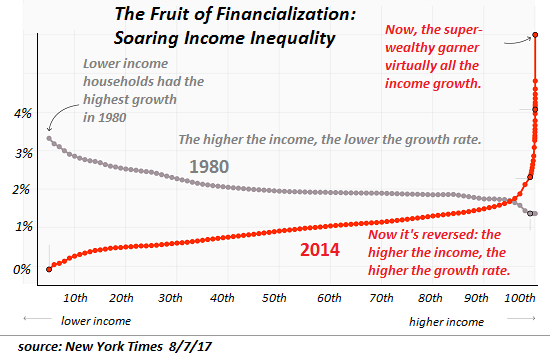
The USA is definitively a 3rd World nation. Read the list above and then try to argue the USA is not a 3rd World nation. Try arguing against the facts displayed in this chart:
I know it hurts, but the reality is painfully obvious: the USA is now a 3rd World nation.
My new book Money and Work Unchained is $9.95 for the Kindle ebook and $20 for the print edition.
Philippines makes ban on work in Kuwait ‘permanent’
Press TV – April 29, 2018
Philippine President Rodrigo Duterte on Sunday said the temporary ban on Filipinos going to work in Kuwait is now permanent, intensifying a diplomatic standoff over the treatment of migrant workers in the Persian Gulf nation.
Duterte in February imposed a prohibition on workers heading to Kuwait following the murder of a Filipino maid, whose body was found stuffed in a freezer in the Persian Gulf state.
The crisis deepened after Kuwaiti authorities last week ordered Manila’s envoy to leave the country over videos of Philippine Embassy staff helping workers in Kuwait flee allegedly abusive employers.
The two nations had been negotiating a labor deal that Philippine officials said could result in the lifting of the ban, but the recent escalation in tensions has put an agreement in doubt.
“The ban stays permanently. There will be no more recruitment for especially domestic helpers. No more,” Duterte told reporters in his hometown in the southern city of Davao.
Around 262,000 Filipinos work in Kuwait, nearly 60 percent of them domestic workers, according to the Philippines’ foreign department.
Last week, the Philippines apologized over the rescue videos, but Kuwaiti officials announced they were expelling Manila’s ambassador and recalling their own envoy from the Southeast Asian nation.
Duterte on Sunday described the situation in Kuwait as a “calamity.”
He said he would bring home Filipino maids who suffered abuse as he appealed to workers who wanted to stay in the oil-rich state.
“I would like to address to their patriotism: come home. No matter how poor we are, we will survive. The economy is doing good and we are short of our workers,” he said.
About 10 million Filipinos work abroad to seek high-paying jobs they were unable to find at home, and their remittances are a major pillar of the Philippine economy.
Duterte said workers returning from Kuwait could find employment as English teachers in China, citing improved ties with Beijing.
Describing China as a “true friend,” he said he would use Chinese aid to fund the workers’ repatriation.
Duterte added that he was not after “vengeance” against Kuwait and did not “nurture hate.”
“But if my people are considered a burden to some of them, to some government mandated to protect them and uphold their rights, then we will do our part,” he said.
Congress’s “Never Again Education Act” should call for ‘never again’ against anyone, including Palestinians
By Alison Weir | If Americans Knew | April 10, 2018
A new bill entitled “The Never Again Education Act” is reportedly about to be introduced in the U.S. House of Representatives. According to JTA and other reports, the legislation will fund Holocaust education programs in schools. JTA reports:
A bipartisan slate of House members is set to introduce a bill that would grant money to Holocaust education in schools.
The Never Again Education Act would establish the Holocaust Education Assistance Program Fund in the U.S. Treasury. A 12-member board would disburse the money to schools.
A draft of the bill, which is to be introduced Tuesday in the U.S. House of Representatives, says the fund would be privately funded.
Rep. Carolyn Maloney, D-N.Y., is the lead sponsor of the measure.
“Today, those who deny that the Holocaust occurred or distort the true nature of the Holocaust continue to find forums, especially online; this denial and distortion dishonors those who were persecuted, and murdered,” the draft of the bill says. “This makes it even more of a national imperative to educate students in the United States so that they may explore the lessons that the Holocaust provides for all people, sensitize communities to the circumstances that gave rise to the Holocaust, and help youth be less susceptible to the falsehood of Holocaust denial and distortion and to the destructive messages of hate that arise from Holocaust denial and distortion.”
The bill would also create a website that would include Holocaust education resources.
Maloney will launch the bill on Tuesday at the Olga Lengyel Institute for Holocaust Studies and Human Rights in New York City, accompanied by representatives of Hadassah, B’nai B’rith International and the Association of Holocaust Organizations. The Anti-Defamation League endorsed the bill.
Also sponsoring the bill are Reps. Peter Roskam, R-Ill.; Ted Deutch, D-Fla.; Ileana Ros-Lehtinen, R-Fla.; Eliot Engel, D-N.Y.; Kay Granger, R-Texas; Nita Lowey, D-N.Y.; and Dan Donovan, R-N.Y. Lowey and Granger are top House appropriators, which suggests the bill likely will pass.
A draft of the bill is not yet available, so we don’t yet know what it contains.
I hope the new law will fund full and accurate educational programs about all holocausts that have occurred throughout human history – slavery, past and ongoing genocides aimed at diverse populations, the ethnic cleansing of Palestinians, and many other cases of violence and cruelty around the world.
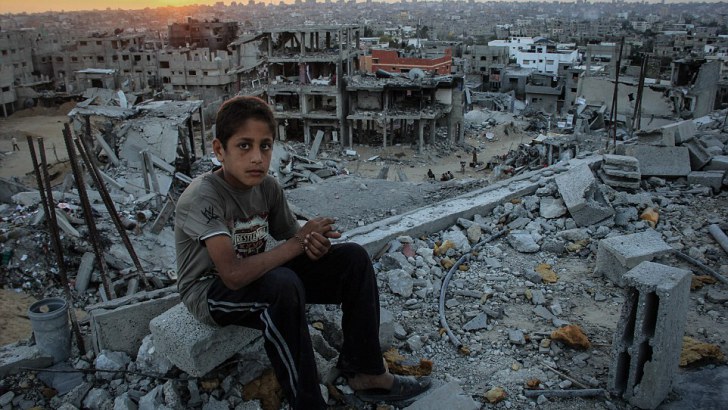
A case of oppression that has gone on for almost 70 years is acutely visible right now in Gaza.
Thousands of men, women, and children are participating in a massive “March of Return” against the theft of their homes, their virtual imprisonment in Gaza, and the periodic onslaughts against them by Israeli forces.
Israeli soldiers with “shoot to kill” orders against these unarmed marchers have shot hundreds of the demonstrators, some in the head and many in the back, including women, children, journalists, and medics.
I believe that “never again” should apply to everyone, everywhere.
I suggest that people phone their Congressional representatives (202-224-3121) and ask them if this bill addresses all instances of oppression, or just one that, thankfully, ended almost three-quarters of a century ago.
Congress has voted to give Israel over $10 million per day. Our representatives are responsible for how Israel is using this money.
Alison Weir is executive director of If Americans Knew and author of Against Our Better Judgment: The Hidden History of How the U.S. Was Used to Create Israel.
Jeremy, Get on your Knees!
By Gilad Atzmon | March 29, 2018
In their response to Labour leader Jeremy Corbyn, the Jewish Leadership Council (JLC) and the Board of Deputies of British Jews (BOD) claim to ‘propose an agenda of actions for discussion’ between the Labour party and those who claim to ‘represent’ British Jews.
In practice the two Zionist institutions have managed to produce one of the most disgusting documents in modern Jewish history. A text that is little more than an ode to the self-defamation of its own authors and to the community they claim to ‘represent’: it is rude, authoritarian, and disrespectful to a democratically elected leader of Europe’s biggest party.
Read the BOD/JLC’s public address to Corbyn here
When you read some of the extracts below, remember that despite BOD and the JLC claims to ‘represent’ British Jewry, these two organisations managed to pull just 1500 members of their community into their ‘Enough is Enough’ anti-Corbyn demonstration earlier this week. We are talking about 0.5% of British Jewry. The BOD/JLC’s authoritarian document outlines a set of humiliating conditions for Corbyn to meet. The text proves how detached these Jewish institutions are from British values, specifically, and the Western ethos, in general. In fact their vision of the political arena is Orwellian in nature and tyrannical in practice.
Apparently, if Corbyn expects to meet with the demands of these self-appointed ‘Jewish leaders’ he must appoint a watchdog who will take care of the so called ‘antisemites’ in his party and, of course, under the supervision of these two ardent Zionist bodies. He must also meet a strict time-frame defined by Judea.
“Outstanding and future cases (of alleged antisemitism) are to be brought to a swift conclusion under a fixed timescale. An independent, mutually agreed upon ombudsman should be appointed to oversee performance, reporting to the Party, as well as to the Board of Deputies and the Jewish Leadership Council.”
Consistent with the spirit of Talmudic herem (excommunication) and totally in contradiction to notions of British openness and Western tolerance, these Jewish institutions insist that “MPs, councillors, and other party members should not share platforms with people who have been suspended or expelled for antisemitism and CLPs should not provide them with a platform.” The Jewish institutions also suggest how to penalise the sinners. “Anybody doing so should, themselves, be suspended from membership; in the case of MPs, they should lose the party whip.” Maybe someone should make the effort to explain to the Jewish leaders that the labour party is an established political institution. It is not a ghetto, I mean, not as yet.
The Jewish bodies insist on dominating the language as well as boundaries of political discussion. Criticism of Israel should be completely restricted. The words ‘Zio’ and ‘Zionist’ as terms of abuse should be eradicated. I actually believe that if the BOD/JLC truly wanted ‘Zionist’ to not be used as a ‘term of abuse,’ they should simply stop abusing Corbyn in the name of Zion as their first step forward.
The British Jewish ‘leaders’ clearly know how to distinguish between the ‘good Jews’ and the bad ones. Corbyn is told to “engage with the Jewish community via its main representative groups, and not through fringe organisations who wish to obstruct the Party’s efforts to tackle antisemitism.” And I wonder, how exactly the BOD or the JLC are ‘representatives’ of British Jews. When were they elected and by whom? And if these two organisations are ‘representative of British Jews,’ how is it that they so selectively call upon Labour to ignore the voice of Jewish collectives they don’t agree with?
The Jewish institutions talk at Corbyn as if he is a schoolboy. “These changes must be sustained and enduring.” Corbyn better quickly meet the Zionist demands before a meeting with The Lobby can materialise. “We firmly believe that this must happen urgently, and certainly before we meet.”
The BOD and the JLC express hope in starting a process of “constructive anti-racist” work within the Labour Party. Talking about racism, we better hear from both the BOD and the JLC how many Muslims and Blacks are members of their executive boards. I ask because, unlike those ‘Jews only’ institutions, the Labour party is, actually, a multi-ethnic and multi-racial political body. If Jewish institutions want to counter racism, they are more than welcome to do so. The racist ‘Jewish State’ is where they should start.
Enough is More Than Enough!

By Gilad Atzmon | March 27, 2018
Jewish power, as I define it, is the power to suppress criticism of Jewish power.
For the last few days the Brits have been shown a spectacular display of that power and the manner in which it is mobilised. Without any attempt to hide their behaviour, a bunch of Jewish leaders have chosen to slander Europe’s biggest party and its popular leader in the name of ‘Jewish sensitivities.’
This blitz attack was sparked by Labour leader Jeremy Corbyn’s reaction to a mural back in 2012. The mural was painted by US street artist Kalen Ockerman. Apparently, at the time Corbyn defended the public display of the painting on the grounds of freedom of speech.
The Labour leader was heavily criticised by Jewish institutions for supporting a mural “depicting Jewish bankers playing Monopoly on the backs of the poor.” The clumsy British media didn’t do its homework and failed to actually examine the mural, but instead immediately delved into the hookedness of the noses of those alleged Jewish bankers.
Embarrassingly for them, Ockerman has came forward and identified the men he depicted in the mural. They are from left to right, “Rothschild, Rockefeller, Morgan, Aleister Crowley, Carnegie & Warburg.” Of the six men, only Rothschild and Warburg were Jewish. In fact, Aleister Crowley was noted for his antisemitic views. The take home message for the BBC & co is that maybe capitalists of all races share similar shaped noses.
I am left wondering if the British Zionist league was offended by the mural because it is they, the Zionists, who see the capitalist as the Jew and vice versa. After all, Labour Zionism began as an avowed attempt to liberate Diaspora Jews of parasitic capitalist traits. Zionism promised to cleanse the Jew of gluttony by means of a ‘homecoming.’
Yesterday 1,500 British Jews took to the streets outside Parliament. They protested Corbyn’s “systematic failure to deal with antisemitism.”
If you wonder what ‘systematic antisemitsm’ means, the Jewish Chronicle provides the answer. In his speech at the protest Jonathan Arkush, the leader of the ardent Zionist Board of Deputies of British Jews, cited Labour’s failure to take proper action on the claims of antisemitism against former London mayor Ken Livingstone and other Labour Party members.
Zionists do not like Ken Livingstone. This is understandable. The man is a legendary icon of ethical thinking. Despite their protests, it is still not easy for the Labour party to expel one of its legends simply for telling the truth about Hitler’s collaboration with Zionism. Maybe Arkush should just give it more time.
Arkush told the crowd that the “the Labour Party must go back to being the enemy of racists – not the refuge.” Of course Corbyn doesn’t have a drop of racism in his entire body, but maybe Jonathan Arkush can meet his own standards and tell us how many Blacks or Muslims are members of his own Jews-only Board of Deputies of British Jews.
The Jewish Leadership Council’s chair Jonathan Goldstein said that Mr Corbyn had become the “figurehead for an antisemitic political culture based upon obsessive hatred of Israel, conspiracy theories and fake news.”
Maybe the Jewish community leader could try to remember that obsession with justice is not a bad thing and also that interfering with freedom of speech can easily backfire.
It is clear why some Jews are upset by Corbyn. The Labour leader treats the Jews as ordinary people. He fails to respect their choseness and ignores their sense of exceptionalism. Perhaps he believes that Jewish politics like all other politics, ought to be subject to criticism. And now it is clear that Corbyn’s approach to Jewish politics is not acceptable to Britain’s Zionist Jewish establishment.
MP John Mann who has operated as a Zionist mouthpiece within the Labour party for more than a while, bemoaned to the Jewish gathering about his Labour comrades that “Some of them glory in being called anti-Zionists – racists that is the word for them.”
Does Mann think that opposing a political movement is ‘racism?’ Is opposition to Britain or the USA, or even North Korea also to be castigated as racism? And then, in an uber-Orwellian manner Mann added “we have to drive these people (the anti Zionists) out of the Labour Party.”
Maidenhead Synagogue Rabbi Dr Jonathan Romain told the JC that this ‘antisemitism crisis’ was Mr Corbyn’s “Watergate moment.” I suggest the Rabbi learn some Jewish history. This tsunami of Jewish self-love and empowerment could turn into a total disaster as it has time after time in the past.
British Jewish leadership is panicking. It has declared open war against a mainstream British political party. This is far from a reasonable move and if it is intended to oppose antisemitsm, its effect will inevitably be the opposite. Maybe gestalt psychology offers us the tools to understand such silly behavior. Jewish history teaches us that attitudes toward Jews resemble a gestalt switch. So that, for instance, once you see Israel for what it is you just can’t un-see it. Once you grasp that the Jewish State is a racist oppressive force no one will be able to uproot that perception in you. Jewish Zionists do face a growing wall of resentment. Instead of dealing with it by means of self reflection, they repeat Israel’s mistake and adopt the most oppressive authoritarian agenda. They are desperately trying to turn Britain into an Orwellian dystopia.
Left open is the question of how it is possible that the Jewish elite, despite its sophistication and education, never learn from the Jewish past. How is it possible that Jews keep repeating the same mistake time after time? I guess one possible answer is that Jewishness (יהודיות) is a form of severe blindness—and that this may be the dark side of choseness.
Gilad Atzmon Needs Your Immediate Support!
By Gilad Atzmon | March 16, 2018
I am being sued for libel in the High Court in England by Campaign Against Antisemitsm’s chairman Gideon Falter. I have made the decision to fight this crucial battle for freedom of expression even though this fight poses a real risk of bankrupting me and my family.
I choose to fight their suit because I believe that the CAA and its chairman and its use of libel laws pose a danger to freedom of speech and the future of this country as an open society. Enough is enough!
Mr. Falter has sued me for comments I made on my own website.
My comments were made in the context of expressing my opinion about the situation where, last July, The British Crown Prosecution Service (CPS) attested that there had been no increase in anti-Semitism in Britain, and Gideon Falter and the CAA refused to accept the CPS’s verdict. Falter and the CAA insisted that anti Semitism was on the rise. Sky news reported on the discrepancies between the findings of CPS and the CAA.
My article focused on the choice examined by Sky News between two accounts, one maintained by Falter and the CAA, an NGO that is dedicated to prosecuting antisemitism with “zero tolerance”, and the judicial approach of the CPS: a public body, subject to scrutiny and committed to impartiality.
My comments about the CAA are the basis of their lawsuit. I believe that I have the right to express my opinions on my own website: freedom of political expression is at the heart of freedom of speech. Mr. Falter claims that my criticisms of him do not amount to an opinion at all, and is seeking an order that would stop me from saying anything similar about him again, as well as paying him huge sums in libel damages and legal costs.
The CAA has contacted Jazz venues, community centres, concert halls and even overseas companies demanding that my events be cancelled. They have now escalated this battle and if they win this will ruin me financially. … continue
How Zionist is the New World Order

By Laurent Guyénot for the Saker Blog | March 6, 2018
Laurent Guyénot is the author of From Yahweh to Zion: Jealous God, Chosen People, Promised Land … Clash of Civilizations, 2018. ($30 shipping included from Sifting and Winnowing, POB 221, Lone Rock, WI 53556).
The Zionist paradox
Jewishness is full of paradoxes. For example, remarked Nahum Goldmann, founder and longtime president of the World Jewish Congress: “Even today it is hardly possible to say whether to be a Jew consists first of belonging to a people or practicing a religion, or the two together” (The Jewish Paradox, 1976)[1]. The answer has always depended on the circumstances. Another paradox is the relationship of Jewishness to both tribalism and universalism: Israelis, “the most separatist people in the world,” in Goldmann’s words again, “have the great weakness of thinking that the whole world revolves around them.”[2]
This great weakness is, of course, a great strength, and so is the ambiguity of Jewishness. It has served Israel—a secular “Jewish state”— very well. Theodor Herzl thought of Zionism on the model of European nationalistic movements, lobbying for the right of the Jews to become a nation among nations. But everyone can see now that Israel is no ordinary nation. It never was and never will be. It is the paradoxical nation.
Part of the ambiguity comes from the very name Israel, which already had a twofold meaning before 1948: it referred to an ancient kingdom supposedly founded in the first millennium BCE, and destroyed by the Romans in the first century CE. But for the following two thousand years, Israel was also a common designation for the Jewish community worldwide, “international Jewry” as some call it. That was the meaning of “Israel”, for example, when the British Daily Express of March 24, 1933 printed on its front page: “The whole of Israel throughout the world is united in declaring an economic and financial war on Germany.”[3] The members of Israel were then called Israelites interchangeably with Jews. Although quite contradictory in terms, the two notions (national Israel and international Israel) have been conflated by the 1948 Law of Return, which made every Israelite of the globe a virtual Israeli.
Today, Zionism has shifted into a kind of meta-Zionism where the greatest number of the Israeli elite—including individuals with no stamped Israeli citizenship but a profound loyalty to the Jewish state—reside outside Israel. Some of them hold key positions in state administrations, particularly in the United States. As Gilad Atzmon remarks, “there is no geographical center to the Zionist endeavor. It is hard to determine where Zionist decisions are made”; “the Israelis colonize Palestine and the Jewish Diaspora is there to mobilize lobbies by recruiting international support.”[4] The neoconservatives—“an intellectual movement in America to whose invention Jews can lay sole claim,” as correctly assessed the Jewish Daily Forward [5] — are the most influential group of Diaspora Jews dedicated to Israel. They are no conservatives in the traditional sense, but rather crypto-Likudniks posturing as American patriots in order to align US foreign and military policies with the Greater Israel agenda—high-level sayanim, so to speak (read John Mearsheimer and Stephen Walt, The Israel Lobby and U.S. Foreign Policy, 2008).
Their mentor Leo Strauss, in his 1962 lecture “Why We Remain Jews,” declared himself an ardent supporter of the State of Israel but rejected the idea that Israel as a nation should be contained within borders; Israel, he argued, must retain her specificity, which is to be everywhere.[6] Indeed, this paradoxical nature of Israel is vital to its existence: although its stated purpose is to welcome all the Jews of the world, the state of Israel would collapse if it achieved this goal. It is unsustainable without the support of international Jewry. Therefore, Israel needs every Jew of the world to define his/her Jewishness as loyalty to Israel. Ever since 1967, the hearts of an increasing number of American Jews began to beat secretly, and then more and more openly, for Israel. Reform Judaism, which had originally declared itself to be exclusively religious and opposed to Zionism, soon rationalized this new situation by a 1976 resolution affirming: “The State of Israel and the Diaspora, in fruitful dialogue, can show how a People transcends nationalism while affirming it, thus establishing an example for humanity.”[7]
How do they both affirm and transcend nationalism? The biblical way. The Hebrew Bible, the Tanakh, is the unalterable prototype of Jewish history: everything that follows the fall of the Hasmonean kingdom has to be biblical—the Holocaust, for example. Inevitably, Jewish nationalism, or patriotic love for Israel, resonates with the destiny of Israel as outlined in the Bible: “Yahweh your God will raise you higher than every other nation in the world” (Deuteronomy 28:1). Every nation is a narration, and Israel’s narrative pattern is cast into the Hebrew Bible. To love Israel is to love Israel’s biblical story, no matter of how mythical it is. And through biblical prophecy, the vision of the past becomes the vision the future: Solomon’s empire will come to pass.
That is why Zionism was never an ordinary form of nationalism, nor can Israel ever be a “nation like others.” The paradoxical nature of Israel is best embodied by its founding father Ben-Gurion: a secular Jew who saw himself as a new Joshua,[8] hoped for “the restoration of the kingdom of David and Solomon,”[9] and prophesized that Jerusalem will be “the seat of the Supreme Court of Mankind, to settle all controversies among the federated continents, as prophesied by Isaiah.”[10] Let us be fair and assume that Ben-Gurion was simply referring to Isaiah’s prophecy that “the Law will issue from Zion” and that Yahweh will “judge between the nations and arbitrate between many peoples” (2:3-4), not to the Second Isaiah’s prophecy that Israel “will feed on the wealth of nations” (61:6), and that nations who do not serve Israel “will be utterly destroyed” (60:12).[11] Ben-Gurion’s vision lives on: a 2003 “Jerusalem Summit” attended by three acting Israeli ministers including Benjamin Netanyahu and many American neoconservatives including Richard Perle, affirmed that “one of the objectives of Israel’s divinely-inspired rebirth is to make it the center of the new unity of the nations, which will lead to an era of peace and prosperity, foretold by the Prophets.”[12] Zionists have always been in love with the Bible.
Such are the geopolitical implications of the Jewish paradox: Zionism cannot be a mere nationalistic aspiration, as long as it claims to be Jewish, for “Jewish” means “biblical”. And more than two thousand years ago, the ancient prophets had bent over the cradle of Israel to predestine it as “a nation above other nations.” Israel carries in its biblical genes the plan for a world order headquartered in Jerusalem. I’m not talking about a secret conspiracy here: the Jewish plan to rule the world has been plainly outlined in the global bestseller for more than two thousand years. If most people in the Christian world don’t see it, it is because it is right under their nose. Christians claim that the Jews don’t read their Bible correctly, or that they got their Zionism from the Talmud or the Kabbalah. Both claims are pitiful attempts to exonerate the Old Testament from the Zionist catastrophe: the Hebrew Bible was written by Jews for the Jews, and I have never heard a Zionist quote the Talmud or the Kabbalah, whereas they quote the Bible every day.
The prophetic spirit that inspired Isaiah long ago has been very active since the beginning of the 20th century. It spoke through religious leaders like Kaufmann Kohler, a leading figure of American Reformed Judaism, who wrote in his major work on Jewish Theology (New York, 1918) that “Israel, the suffering Messiah of the centuries, shall at the end of days become the triumphant Messiah of the nations.”[13] And it spoke through secular thinkers like Alfred Nossig, a Zionist who collaborated with the Gestapo in the Warsaw ghetto for the emigration of selected Jews to Palestine, who wrote in his Integrales Judentum (Berlin, 1922):
“The Jewish community is more than a people in the modern political sense of the word. It is the repository of a historically global mission, I would say even a cosmic one, entrusted to it by its founders Noah and Abraham, Jacob and Moses. [. . .] The primordial conception of our ancestors was to found not a tribe but a world order destined to guide humanity in its development.”[14]
The Feuerbachan approach
The paradoxical nature of Jewishness (combining separatism and universalism), which is reflected in the ambiguous nature of Zionism (combining nationalism and internationalism), is ultimately linked to the Jewish conception of God. Is the biblical Yahweh the national god of Israel or the universal God of humankind? Let’s search for an answer into the Book of Ezra, the paradigmatic episode for the Jewish colonization of Palestine. It begins with an edict of the Persian king Cyrus, which says:
“Yahweh, the God of Heaven, has given me all the kingdoms of the earth and has appointed me to build him a Temple in Jerusalem, in Judah. […] Let [every Jew] go up to Jerusalem, in Judah, and build the Temple of Yahweh, the God of Israel, who is the God in Jerusalem” (Ezra 1:2–3).
Here Cyrus speaks in the name of “the God of Heaven” while authorizing the Judean exiles to build a temple to “the God of Israel […] the God in Jerusalem.” We understand that both phrases refer to the same God, called Yahweh in both instances, but the duality is significant. It is repeated in the Persian edict authorizing the second wave of return. It is now Artaxerxes, “king of kings,” who switches from the “God of Heaven” to “your God” or “the God of Israel who resides in Jerusalem” when addressing Ezra (7:12–15). The phrase “God of Heaven” appears one more time in the book of Ezra, and that is again in the edict of another Persian king: Darius confirms Cyrus’s edict and recommends that the Israelites “may offer sacrifices acceptable to the God of Heaven and pray for the life of the [Persian] king and his sons” (6:10). Elsewhere the book of Ezra only refers to the “God of Israel” (four times), “Yahweh, the God of your fathers” (once), and “our God” (ten times). In other words, according to the author of the book of Ezra, only the kings of Persia see Yahweh as “the God of Heaven” (a fiction, of course: for Persians, the God of Heaven meant Ahura Mazda) while for the Jews he is primarily the “God of Israel”. That is the deepest secret of Judaism, and the key to Jews’ relationship to universalism and to the nations: success rests on their ability to make Gentiles believe that the national god of Israel residing in the Jerusalem Temple is the God of Heaven who happens to have a preference for Israel.
The misunderstanding led to a public scandal in 167 CE, when the Hellenistic emperor Antiochos IV dedicated the temple in Jerusalem to Zeus Olympios, the supreme God. He was simply expressing the idea that Yahweh and Zeus were two names for the supreme cosmic God, the Heavenly father of all mankind. But the Jewish Maccabees who led the rebellion against him knew better: Yahweh may be the Supreme God, but He is Jewish. Only Jews are intimate with Him, and any way the Pagans worship Him is an abomination.
So is Yahweh God, or just the god of Israel? Why should we care? Well, let’s call it the Feuerbachan approach to the Jewish question. In his famous work The Essence of Christianity (1841), which was to influence greatly Karl Marx, Ludwig Feuerbach sees the universal God as “the deified and objectified spiritual essence of man”: theology is anthropology in disguise, and “The consciousness of God is the self-consciousness of man.” But if we regard the biblical Yahweh as a creation of Jews alone, rather than humanity at large, then we can consider him as a personification of the national character of the Jewish people—or, more correctly, a reflexion of the mentality of the Jewish elite who invented Yahweh.
It is known to biblical scholars that, in the oldest strata of the Bible, Yahweh appears as a national, ethnic god, not the supreme God of the Universe. “For all peoples go forward, each in the name of its god, while we go forward in the name of Yahweh our god for ever and ever” (Micah 4:5)[15]. “I am the god of your ancestors,” Yahweh says to Moses (Exodus 3:6), who is then mandated to declare to his people, “Yahweh, the god of your ancestors, has appeared to me,” urging them to talk to Pharaoh in the name of “Yahweh, the god of the Hebrews” (3:16–18). The Hebrews chant after the miracle of the Red Sea engulfing Pharaoh and his army, “Yahweh, who is like you, majestic in sanctity, among the gods?” (15:11).[16] And in Canaan, a Hebrew chief declares to an enemy king: “Will you not keep as your possession whatever Chemosh, your god, has given you? And, just the same, we shall keep as ours whatever Yahweh our god has given us, to inherit from those who were before us!” (Judges 11:24).[17] In all these verses, Yahweh is an ethnic or national god among others.
What sets him apart from other tribal gods of his kind is possessive exclusivism: “You shall have no other gods to rival me” (Exodus 20:3); “I shall set you apart from all these peoples, for you to be mine” (Leviticus 20:26). This is the justification for strict endogamy: it is forbidden to marry one’s children to a non-Jew, “for your son would be seduced from following me into serving other gods” (Deuteronomy 7:4).
Yahweh is known as “the Jealous One” (Exodus 20:5 and 34:14; Deuteronomy 4:24, 5:9, and 6:15). But jealousy is an euphemism for outright sociopathy, because what Yahweh demands from his people is not just exclusivity of worship, but the destruction of their neighbors’ shrines: “Tear down their altars, smash their standing-stones, cut down their sacred poles and burn their idols” (Deuteronomy 7:5). Judean kings are judged on the unique criterion of their obedience to that precept. Hezekiah, whose disastrous policy of confrontation with Assyria led to a shrinking of the country, is praised for having done “what Yahweh regards as right,” namely abolishing the “high places” (2 Kings 18:3–4). His son Manasseh, whose 50-year reign is known to historians as a time of peace and prosperity, is blamed for having done “what is displeasing to Yahweh, copying the disgusting practices of the nations whom Yahweh had dispossessed for the Israelites” (2 Kings 21:2). Manasseh’s son Amon is no better. Josiah, on the other hand, proved worthy of his great-great-grandfather Hezekiah, by removing from the temple “all the cult objects which had been made for Baal, Asherah and the whole array of heaven. […] He exterminated the spurious priests whom the kings of Judah had appointed and who offered sacrifice on the high places, in the towns of Judah and the neighborhood of Jerusalem; also those who offered sacrifice to Baal, to the sun, the moon, the constellations and the whole array of heaven” (2 Kings 23:4–5).
It is ironic that Yahweh, originally a minor tribal god, should compete with the great Baal for the status of supreme God, as when Elijah challenges 450 prophets of Baal in a holocaust contest, which ends up with the slaughter of them all (1Kings 18). In ancient Syria, Baal Shamem, the “Heavenly Lord,” was identified as the God of Heaven and honored by all peoples except the Jews.[18] The goddess Asherah, whom Yahweh loathed even more, was the Great Divine Mother worshipped throughout the Middle East. In Mesopotamia, she went under the name of Ishtar, while in the Hellenistic era, she was assimilated to the Egyptian goddess Isis. The Hebrews themselves called her “Queen of Heaven” and turned to her in times of trouble, to the dismay of their priest and prophet Jeremiah, who threatened them with Yahweh’s exterminating wrath (Jeremiah 44).
Historians of religion tell us that Yahweh was still a national god at a time when the notion of a supreme God was widespread. When and how the Levites declared the god of Israel to be the true and only God is not entirely settled, but it is generally admitted that it happened shortly before the time of Ezra, when the Book of Genesis was composed (with much borrowing from Mesopotamian and Persian myths). The process is easy to imagine, for it follows the cognitive logic of a narcissistic sociopath among the community of gods: from the commandment of exclusive worship and the destruction of other gods’ shrines, it is a small step to the denial of the very existence of other gods; and if Yahweh is the only existing god, he must be “The God.”
A curious story about King Hezekiah can serve as an illustration of this process. The Assyrian king threatens Hezekiah in the following manner, explicitly identifying Yahweh as the national god of Israel:
“Do not let your god on whom you are relying deceive you with the promise: ‘Jerusalem will not fall into the king of Assyria’s clutches’ […] Did the gods of the nations whom my ancestors devastated save them?”
Hezekiah then goes up to the Temple and offers the following prayer:
“It is true, Yahweh, that the kings of Assyria have destroyed the nations, they have thrown their gods on the fire, for these were not gods but human artifacts—wood and stone—and hence they have destroyed them. But now, Yahweh our god, save us from his clutches, I beg you, and let all the kingdoms of the world know that you alone are God, Yahweh” (2 Kings 19:10–19).
So here we witness how Yahweh was promoted from the status of a national god to that of universal God by the prayer of a devout king. In response to that prayer, according to the biblical story, “the angel of Yahweh went out and struck down a hundred and eighty-five thousand men in the Assyrian camp,” then struck their king by the hand of his sons (19:35–37). Pure fiction: the Assyrian annals tell us that in reality, Hezekiah paid tribute to the Assyrian king. Which proves that Hezekiah’s claim was deceptive.
Conclusion
The exclusive monotheism demanded by Yahweh is a degraded imitation of that inclusive monotheism toward which all the wisdoms of the ancient world converged by affirming the fundamental unity of all gods. As Egyptologist Jan Assmann emphasizes, the polytheisms of the great civilizations were cosmotheisms, insofar as the gods, among other functions, form the organic body of the world. Such a conception naturally led to a form of inclusive or convergent monotheism, compatible with polytheism: all gods are one, as the cosmos is one.[19] The notion of the unity of the divine realm naturally connects with the notion of a supreme God, creator of heaven and earth, enthroned atop a hierarchy of deities emanating from him—a concept familiar to Plato, Aristotle, Seneca, and most ancient philosophers. The exclusive and revolutionary monotheism that the Yahwist priests crafted for their own benefit is of a totally different kind: it is, in fact, the exact opposite of the inclusive and evolutionary monotheism of neighboring peoples.
From the historical perspective, it is not the Creator of the Universe who decided, at some point, to become the god of Israel; rather, it is the god of Israel who, at some point, was declared the Creator of the Universe by the Levites and their scribes. The Jewish conception of Yahweh parallels that historical process: for the Jews, Yahweh is primarily the god of Jews, and secondarily the Creator of the Universe. This is what Maurice Samuel kindly tried to tell us in You Gentiles (1924): “In the heart of any pious Jew, God is a Jew.” “We [Jews] and God grew up together,” that is why “we need a world of our own, a God-world, which it is not in your nature to build.”[20]
And so the paradoxical nature of Yahweh is, in reality, a deception. The idea that the Heavenly Father of humankind, somewhere in the second millennium BCE, chose a particular people and ordered them to dispossess and slaughter other peoples is, any way we look at it, an outrageous absurdity. The fact that billions of people have believed it for thousands of years makes no difference. Or rather, that is the problem: many peoples throughout history have believed themselves to have been chosen by God, but only the Jews have managed to convince others that they have. That has turned this outrageous absurdity into the most devastating idea in world history.
The deceptive nature of biblical monotheism is the key to understanding traditional Jewish attitude to universalism. For the Jewish conception of God is reflected in the Jewish conception of Humanity. Just like their tribal god speaks of himself—through his prophets—as the God of humankind, Jewish communitarian thinkers speak of Jewishness as the essence of humanity: Judaism constitutes a “particularism that conditions universality” so that “there is an obvious equation between Israel and the Universal”; in other words, “Israel equals humanity” (Emmanuel Levinas, Difficult Freedom: Essays on Judaism, 1990).[21] It is almost always in reference to their Jewishness that such opinion makers, who are often ardent Zionists, proclaim themselves universalists: see for example how Rabbi Joachim Prinz, a German Zionist who in 1934 had applauded the Nazi state for being “built upon the principle of the purity of nation and race,” declared in 1963, as chairman of the American Jewish Congress, that he supported the African-American civil rights movement “as a Jew.”[22] “Jewish universalism” is a contradiction in terms and therefore necessarily deceptive. It is self-deception in the case of most Jews, who believe what they have been taught by their representative elites ever since the Haskalah: that there is no contradiction in being a tribalist at home and a universalist in the street—provided that, in each of their universalist stand, they do not lose sight of the important question: “Yes, but is it good for the Jews?”[23] Of course, there are many remarkable exceptions: Jews who have broken through the mental “Jewish prison” (as Jewish journalist Jean Daniel calls it)[24] to reach for some universal truths. I call it the genius of the escapee.
Ultimately, the deceptive nature of both biblical monotheism and Jewish universalism is a key to unraveling the Zionist paradox: nationalism and internationalism go hand in hand in Israel’s destiny, because Israel is, fundamentally, a biblical and therefore universal project. For the Jewish cognitive elites who determine Jewish public opinion to a large extent, the New World Order is an ancient et eternal idea. It is Israel’s destiny carved in the Bible. It is inherent to Jewishness.
- Nahum Goldmann, Le Paradoxe juif. Conversations en français avec Léon Abramowicz, Stock, 1976 (archive.org), p. 9.
- Nahum Goldmann, Le Paradoxe juif, op. cit., p. 6, 31.
- Alison Weir, Against Our Better Judgment: The Hidden History of How the U.S. Was Used to Create Israel, 2014, k. 3280–94.
- Gilad Atzmon, The Wandering Who? A Study of Jewish Identity Politics, Zero Books, 2011, pp. 21, 70.
- Gal Beckerman, Jewish Daily Forward, January 6, 2006, quoted in Stephen Sniegoski, The Transparent Cabal: The Neoconservative Agenda, War in the Middle East, and the National Interest of Israel, Enigma Edition, 2008, p. 26.
- Leo Strauss, “Why We Remain Jews,” in Shadia Drury, Leo Strauss and the American Right, St. Martin’s Press, 1999, pp. 31–43.
- Quoted in Kevin MacDonald, Separation and Its Discontents: Toward an Evolutionary Theory of Anti-Semitism, Praeger, 1998, kindle edition 2013, k. 5463–68.
- Dan Kurzman, Ben-Gurion, Prophet of Fire, Touchstone, 1983, pp. 17–22.
- As he declared before the Knesset in 1956, quoted in Israel Shahak, Jewish History, Jewish Religion: The Weight of Three Thousand Years, Pluto Press, 1994, p. 10.
- David Ben-Gurion and Amram Duchovny, David Ben-Gurion, In His Own Words, Fleet Press Corp., 1969, p. 116
- All Bible quotes are taken from the Catholic New Jerusalem Bible, which has not altered the divine name YHWH into “the Lord,” as most other English translations have done for unscholarly reasons.
- Official website: http://www.jerusalemsummit.org/eng/declaration.php.
- Kaufmnann Kohler, Jewish Theology, Systematically and Historically Considered, Macmillan, 1918 (www.gutenberg.org), p. 290.
- Alfred Nossig, Integrales Judentum, Interterritorialer Verlag, 1922, pp. 1–5 (on http://www.deutsche-digitale-bibliothek.de/item/DXCTNNZZ3INPTI2S3MYPGLQOFR3XSW22).
- Most translations use a uppercase for the “God of Israel”, and a lowercase for other national gods, but ancient Hebrew does not distinguish between uppercase and lowercase letters, so here, and in further quotes, I have used a lowercase g for all national gods, including Israel’s, and reserved the uppercase G for the One supreme God.
- See also Psalms 89:7.
- Jean Soler, Qui est Dieu?, Éditions de Fallois, 2012, pp. 12–17, 33–37.
- Norman Habel, Yahweh Versus Baal: A Conflict of Religious Cultures, Bookman Associates, 1964, p. 41.
- Jan Assmann, Moses the Egyptian: The Memory of Egypt in Western Monotheism, Harvard University Press, 1998, p. 3.
- Maurice Samuel, You Gentiles, New York, 1924 (archive.org), pp. 74–75, 155.
- Online on monoskop.org/images/6/68/Levinas_Emmanuel_Difficult_Freedom_Essays_on_Judaism_1997.pdf.
- Prinz’s pro-Nazi statements from his 1934 bookWir Juden are quoted in Israel Shahak, Jewish History, Jewish Religion: The Weight of Three Thousand Years, Pluto Press, 1994, p. 86. Prinz’ introduction to King’s “I have a dream” speech on August 28, 1963, beginning with “I speak to you as an American Jew,” is at http://www.joachimprinz.com/images/mow.mp3.
- Jonny Geller made this paradigmatic question the title of his humorous book Yes, But Is It Good for the Jews? Bloomsbury, 2006.
- Jean Daniel, La Prison juive. Humeurs et méditations d’un témoin, Odile Jacob, 2003.
Featured Video

NEW FAUCI EMAILS EXPOSE ATTACK ON NATURAL IMMUNITY
or go to
Aletho News Archives – Video-Images
From the Archives
Fourteen Incredible Facts About 9/11
By Kevin Ryan | Dig Within | August 8, 2015
… What is known about 9/11 is that there are many incredible facts that continue to be ignored by the government and the mainstream media. Here are fourteen.
- An outline of what was to become the 9/11 Commission Report was produced before the investigation began. The outline was kept secret from the Commission’s staff and appears to have determined the outcome of the investigation.
- The 9/11 Commission claimed sixty-three (63) times in its Report that it could find “no evidence” related to important aspects of the crimes.
- One person, Shayna Steiger, issued 12 visas to the alleged hijackers in Saudi Arabia. Steiger issued some of the visas without interviewing the applicants and fought with another employee at the embassy who tried to prevent her lax approach.
Blog Roll
Recent Comments
Bill Francis on European leaders’ shift in the… seversonebcfb985d9 on Villains of Judea: Philip Esfo… loongtip on Report warns that ‘Jewish terr… Craig Nelms on New study shows that toxic gas… loongtip on A Funny Thing Happened on the… loongtip on EU free trade pact on hold as… John Edward Kendrick on Regime Change In Iran Is The F… Bill Francis on Australia Passes New Hate Spee… seversonebcfb985d9 on Australia Passes New Hate Spee… Bill Francis on Britain’s AI Policing Plan Tur… loongtip on Miami Beach Resident Questione… loongtip on Israeli agricultural export co…


 Aletho News
- Trump aims to create new UN and own it, Brazil’s Lula warns
- UN rapporteur says Israeli demolition of UNRWA compound reflects broader attack on UN system
- From Proxy to Disposable: The US Betrayal of the Syrian Kurds
- Six injured in stabbing spree at Kurdish rally in Antwerp, victims stabbed ‘indiscriminately’
- US pledges to ‘starve’ Iraq of oil revenue if pro-Iran parties join new government
- Is China a threat to Greenland?
- South Korea’s Prime Minister Proposes US Send Special Envoy to North Korea — Report
- Pentagon downgrades China threat, shifts focus to homeland, hemisphere
- Ireland Moves to Legalize Spyware Use by Police
- NEW FAUCI EMAILS EXPOSE ATTACK ON NATURAL IMMUNITY
- If Americans Knew
- Another Gaza baby freezes to death on Netanyahu’s watch – Not a ceasefire Day 106
- Oppose Israel’s Abuses While You Still Can
- UNRWA Heads Tell Ha’aretz: ‘We Don’t Radicalize Palestinians – Their Lived Existence Does’
- Plans Call for “New Rafah” Built in Israel’s Image — Without Palestinians
- Posing as priest, reporter is spat at many times, highlighting anti-Christian sentiment in Israel
- Leaked Documents: “Planned Community” in Rafah Would Force Palestinians Into Israeli Panopticon
- ‘Permits of Humiliation’: How Israel Strangles Christian Education in Jerusalem
- “The world sees death, destruction and injustice – and they see dollar signs” – Not a ceasefire Day 105
- War criminal Netanyahu kills 11 in Gaza, joins Board of Peace – Not a ceasefire Day 104
- Another baby dies of cold in Gaza, as Rafah crossing remains locked down – Not a ceasefire Day 103
- No Tricks Zone
- Polar Colding…Antarctica Saw Its Coldest October In 44 Years!
- New Study: Sea Levels Rose 20 Times The Modern Rate During The Roman Warm Period
- As German Gas Storage Dips Dangerously Low…Shortage Hardly Avoidable
- New Study: Brazil’s Relative Sea Level Was 2+ Meters Higher And SSTs 3-4°C Warmer 6000 Years Ago
- Philosopher Schopenhauer: Climate Science Certainty Stems From Stupidity, Ignorance
- New Study: Species Extinction Rates Declining Since 1980 – ‘Climate Change Is Not An Important Threat’
- Denmark Places Climate Protection Above Animal Welfare, Poisoning And Culling Cows
- New Study: Greenland Was 3-7°C Warmer And Far Less Glaciated Than Today 6000-8000 Years Ago
- German Media Report That Current Frigid Weather Can Be Explained By Arctic Warming!
- Berlin Blackout Shows Germany’s $5 Trillion Green Scheme Is “Left-Green Ideological Pipe Dream”
 Aletho News