Fighting Poverty with a Hate Map?
By Eve Mykytyn | OffGuardian | January 23, 2019
The name, ‘The Southern Poverty Law Center’ (SPLC) is misleading. The SPLC does little to alleviate poverty, its own stated goals are: fighting hate, teaching tolerance and seeking justice. At the moment, the SPLC lists its top activity as attempting to remove confederate statues and symbols. This is consistent with the activity for which the SPLC is best known, its annual hate map in which it locates so-called ‘hate’ groups on a map of the United States. How is it that one of the best funded poverty law centers acts as an arbitrar of hate instead of as an advocate for the poor?
The term ‘Poverty Law’ usually refers to the more mundane practice of representing poor people who are often un or under represented. But the SPLC’s goals are more lofty, here’s how Mark Potok, a Senior Fellow at SPLC described his mission.
It’s not what most in the media think. Sometimes the press will describe us as monitoring hate crimes…Our criteria for a ‘hate group’… have nothing to do with criminality or violence or any kind of guess we’re making about ‘this group could be dangerous.’ It’s strictly ideological. I want to say plainly that our aim in life is to destroy these groups, to completely destroy them”
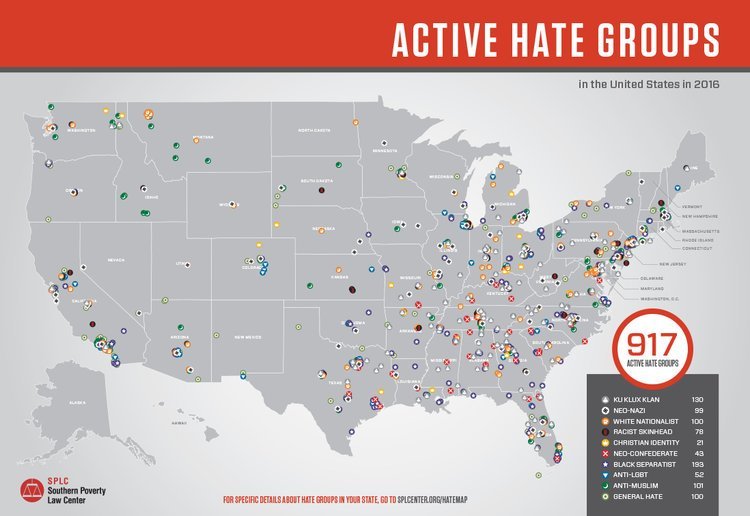
Each year, the SPLC advertises over 900 hate groups on its hate map. Author Laird Wilcox says the SPLC “Has specialized [in] a highly developed and ritualized form of defamation … a way of harming and isolating people by denying their humanity and trying to convert them into something that deserves to be hated and eliminated. They accuse others of this but utilize their enormous resources to practice it on a mass scale themselves.”
To begin with, the SPLC uses a very loose definition of a hate group as:
an organization that – based on its official statements or principles, the statements of its leaders, or its activities – has beliefs or practices that attack or malign an entire class of people, typically for their immutable characteristics.”
They bolster this with the false claim that the FBI uses a similar definition of hate crime:
[A] criminal offense against a person or property motivated in whole or in part by an offender’s bias against a race, religion, disability, sexual orientation, ethnicity, gender, or gender identity.”
But the FBI’s words do not refer to practices or beliefs, they characterize an actual crime which may have been inspired by bias.
Without advocating hate or prejudice I find the SPLC’s categories hilarious. They are: Ku Klux Klan, Neo-Nazi, White Nationalist, Racist Skinhead, Christian Identity, Neo-Confederate, Black Separatist, Anti-LGBT, Anti-Muslim, General Hate (Anti-Immigrant, Hate Music, Holocaust Denial and Radical Traditional Catholicism) and Other Hate (a grab bag of ‘hateful’ ideologies). Query, if a neo-nazi gets a haircut will he become a racist skinhead or a neo-confederate?
One ‘hate’ group, Radical Traditional Catholicism, are excoriated for blaming Jews for the killing of Christ and “They also embrace extremely conservative social ideals with respect to women.” Is this a hate group? Ultra Orthodox Jews have some pretty vile thoughts about non Jews and also adhere to extremely conservative social ideals for women. Why aren’t the Lubovitches, for instance, on the list?
Holocaust denial is the only hate group defined by simply questioning authority. SPLC claims such groups “only pretend to be interested in historical research.” Instead, even the claim that Jews may have died in ways other than the gas chambers form [hate groups] because they are used simply “to rehabilitate the German Nazis’ image as part of a bid to make the ideology of national socialism more acceptable.” A number of historians investigating World War II might find this assertion surprising.
“The SPLC’s list is wildly inflated,” said Mark Pitcavage, director of investigative research at the Anti-Defamation League. The National Socialist Movement, for example, was listed 49 times in the 2015 Hate Map, since the count included each of the NSM’s individual chapters. The SPLC also counts single individuals as a group or chapter. The result is a count totally at odds with Federal Bureau of Investigation statistics. Hate crimes plummeted 24% between 1998 and 2013, according to the FBI. Yet the SPLC claims the number of hate groups in the U.S. shot up by 75% during this same period.
The SPLC has so many categories of ‘hate’ and those categories are political as much as violent. So is there any actual harm from a listing on the hate map?
There was when Floyd Lee Corkins entered the Family Research Council intending to kill as many as possible because “he found us listed as a hate group on the SPLC website,” said executive vice president retired Gen. William Boykin.
We and others like us who are on this ‘hate map’ believe that this is very reckless behavior… The only thing that we have in common is that we are all conservative organizations…”
Gurnee IL is an unlikely location for a hate group. A prosperous suburb of 30,000, the town is careful with its reputation with tourists as it is home to Six Flags Great America amusement park, the Gurnee Mills indoor shopping mall and the water park, Great Wolf Lodge.
But the SPLC bestowed upon Gurnee the label that makes small-town officials sweat. Towns usually earn their reputations as harbors for hate groups in more public ways. They may be unlucky enough to be the place the Klan decides to march and someone later dies (Charlottesville) or be home to the media-trolling Westboro Baptist Church (Topeka, Kansas). But for towns like Gurnee, designation as one of the 917 locales on SPLC’s Hate Map comes without warning or explanation.
When the town asked the self appointed cartographers of hate to remedy the listing they were told, “I know it is disturbing to find hate groups in your community but I don’t think that should be seen as a reflection of what I am sure is a wonderful community.” Sorry, but the map is only updated once a year. “Call back in January.” The town protested that its police had searched and failed to find a hate group in Gurnee. SPLC Intelligence Chief Heidi Beirich would not budge. “Even though the police couldn’t locate them doesn’t mean they aren’t there.”
Given the low threshold for inclusion on the list, it is not surprising that other towns were included for questionable reasons. In 2004, Olathe, Colorado earned a white hood icon when a self-proclaimed “international imperial wizard” from Indiana told a Denver newspaper that a chapter in Olathe, “a little Klan klavern,” had asked him to come and speak. Neither he nor any of the town officials could name any of the members. Olathe stayed on SPLC’s list for three years.
Amana, Iowa, was placed on the hate map when someone at the SPLC spotted a chat thread on the Daily Stormer. Someone with the screen name “Concerned Troll” proposed a neo-Nazi “book club” meeting in an Amana café. No one in Amana was able to confirm to the SPLC whether or not the meeting actually took place, but that was enough to earn the corn-carpeted state its only swastika.
But still, Beidich worries more about undercounting than over inclusion. She thinks the undercount groups hide in shadows. She does not explain why listing what are ‘un’ hate groups, by her own criteria, will cause hate groups to emerge from the shadows. In fact, it is not clear why we are not all better off if a ‘hate’ group stays hidden.
French Democracy Dead or Alive?
The Gilets Jaunes in 2019

Gilets Jaunes song performed at French traffic circle: Les Gentils et les Méchants
By Diana Johnstone | Unz Review | January 11, 2019
Paris, France – French Democracy Dead or Alive? Or perhaps one should say, buried or revived? Because for the mass of ordinary people, far from the political, financial, media centers of power in Paris, democracy is already moribund, and their movement is an effort to save it. Ever since Margaret Thatcher decreed that “there is no alternative”, Western economic policy is made by technocrats for the benefit of financial markets, claiming that such benefits will trickle down to the populace. The trickle has largely dried up, and people are tired of having their needs and wishes totally ignored by an elite who “know best”.
President Emmanuel Macron’s New Year’s Eve address to the nation made it perfectly clear that after one unconvincing stab at throwing a few crumbs to the Gilets Jaunes (Yellow Vests) protest movement, he has determined to get tough.
France is entering a period of turmoil. The situation is very complex, but here are a few points to help grasp what this is all about.
- The METHODS
The Yellow Vests gather in conspicuous places where they can be seen: the Champs-Elysées in Paris, main squares in other cities towns, and the numerous traffic circles on the edge of small towns. Unlike traditional demonstrations, the Paris marches were very loose and spontaneous, people just walking around and talking to each other, with no leaders and no speeches.
The absence of leaders is inherent in the movement. All politicians, even friendly ones, are mistrusted and no one is looking for a new leader.
People are organizing their own meetings to develop their lists of grievances and demands.
In the village of Commercy, Lorraine, a half hour drive from Domrémy where Jeanne d’Arc was born, inhabitants gather to read their proclamation. Six of them read in turns, a paragraph each, making it quite clear that they want no leaders, no special spokesperson. They sometimes stumble over a word, they are not used to speaking in public like the TV talking heads. Their “Second appeal of the Gilets Jaunes de Commercy invites others to come to Commercy on January 26-27 for an “assembly of assemblies”.
- The DEMANDS
The people who first went out in the streets wearing Yellow Vests last November 17 were ostensibly protesting against a hike in gasoline and diesel taxes that would hit people in rural France the hardest. Obsessed with favoring “world cities”, the French government has taken one measure after another at the expense of small towns and villages and the people who live there. That was just the last straw. The movement rapidly moved on to the basic issue: the right of the people to have a say in measures taken that affect their lives. Democracy, in a word.
For decades, parties of the left and of the right, whatever their campaign speeches, once in office pursue policies dictated by “the markets”. For this reason, people have lost confidence in all parties and all politicians and are demanding new ways to get their wishes heard.
The fuel tax was soon forgotten as the list of demands grew longer. Critics of the movement note that achieving so many demands is quite impossible. It’s no use paying attention to popular demands, because the silly people ask for everything and its opposite.
That objection is answered by what has quickly emerged as the single overriding demand of the movement: the Citizens’ Initiative Referendum (CIR).
- The REFERENDUM
This demand illustrates the good sense of the movement. Rather than making a “must” list, the GJ merely ask that the people be allowed to choose, and the referendum is the way to choose. The demand is for a certain number of signatories – perhaps 700,000, perhaps more – to gain the right to call a referendum on an issue of their choice. The right to a CIR exists in Switzerland, Italy and California. The idea horrifies all those whose profession it is to know best. If the people vote, they will vote for all sorts of absurd things, the better-knowers observe with a shudder.
A modest teacher in a junior college in Marseilles, Etienne Chouard, has been developing for decades ideas on how to organize direct democracy, with the referendum at its center. His hour has come with the Yellow Vests. He insists that a referendum must always be held after a long debate and time for reflection, to avoid emotional spur-of-the-moment decisions. Such a referendum requires honest, independent media which are not all owned by special interests. It requires making sure that politicians who make the laws follow the popular will expressed in the referendum. All this suggests the need for a people’s constitutional convention.
The referendum is a bitter point in France, a powerful silent underlying cause of the whole Gilets Jaunes movement. In 2005, President Chirac (unwisely from his point of view) called for a popular referendum on ratification of the proposed Constitution of the European Union, certain it would be approved. The political class, with a few exceptions, went into full rhetoric, claiming a prosperous future as a new world power under the new Constitution and warning that otherwise Europe might be plunged back into World Wars I and II. However, ordinary citizens organized an extraordinary movement of popular self-education, as groups met to pour through the daunting legalistic documents, elucidating what they meant and what they implied. On May 29, 2005, with a turnout of 68%, the French voted 55% to reject the Constitution. Only Paris voted heavily in favor.
Three years later, the National Assembly – that is, politicians off all parties – voted to adopt virtually the same text, which in 2009 became the Treaty of Lisbon.
That blow to the clearly expressed popular will produced such disillusion that many backed helplessly away from politics. Now they are coming back.
- The VIOLENCE
From the start, the government has reacted with violence, in an apparent desire to provoke responding violence in order to condemn the movement as violent.
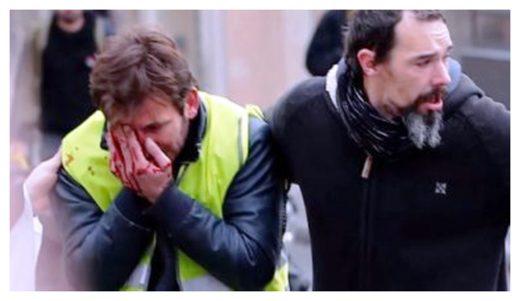
An army of police, dressed like robots, have surrounded and blocked groups of peaceful Yellow Vests, drowning them in clouds of teargas and firing flash balls directly at protesters, seriously wounding hundreds (no official figures). A number of people have lost an eye or a hand. The government has nothing to say about this.
On the third Saturday of protest, this army of police was unable to stop – or under orders to allow – a large number of hoodlums or Black Blocs (who knows?) to infiltrate the movement and smash property, vandalize shops, set fire to trash cans and parked cars, providing the world media with images proving that the Yellow Vests are dangerously violent.
Despite all this provocation, the Gilets Jaunes have remained remarkably calm and determined. But there are bound to be a few people who lose their tempers and try to fight back.
- The BOXER
On the 8th Saturday, January 5, a squad of plexiglass-protected police were violently attacking Gilets Jaunes on a bridge over the Seine when a big guy lost his temper, emerged from the crowd and went on the attack. With his fists, he beat down one policeman and caused the others to retreat. This amazing scene was filmed. You could see Yellow Vests trying to hold him back, but Rambo was unstoppable.
It turned out that this was Christophe Dettinger, a French Rom, former light heavyweight boxing champion of France. His nickname is “the Gypsy of Massy”. He got away from the scene, but made a video before turning himself in. “I reacted badly”, he said, when he saw police attacking women and other defenseless people. He urged the movement to go ahead peacefully.

Dettinger faces seven years in prison. Within a day, his defense fund had gathered 116,433 euros. The government shut it down – on what legal pretext I don’t know. Now a petition circulates on his behalf.
- The SLANDER
In his New Year’s Eve address, Macron patronizingly scolded his people telling them that “you can’t work less and earn more” – as if they all aspired to spending their lives lounging on a yacht and watching stock prices rise and fall.
Then he issued his declaration of war:
“These days I have seen unthinkable things and heard the unacceptable.” Apparently alluding to the few opposition politicians who dare sympathize with the protesters, he chastised those who pretend to “speak for the people”, but are only the “spokesmen for a hateful mob going after elected representatives, police, journalists, Jews, foreigners and homosexuals. It is simply the negation of France.”
The Gilets Jaunes haven’t been “going after” anybody. The police have been “going after” them. People have indeed spoken up vigorously against camera crews of channels that systematically distort the movement.
Not a word has been heard from the movement against foreigners or homosexuals.
The key word is Jews.
Qui veut noyer son chien l’accuse de la rage. (French proverb).
As the French saying goes, whoever wants to drown his dog claims he has rabies. Today whoever wants to ruin a career, take vengeance on a rival, disgrace an individual or destroy a movement accuses her, him, or it of antisemitism.
So, faced with a rising democratic movement, playing the “antisemitism” card was inevitable. It was almost a sure thing statistically. In almost any random batch of hundreds of thousands of people, you might find one or two who have something negative to say about a Jew. That’ll do it. The media hawks are on the outlook. The slightest incident can be used to suggest that the real motive of the movement is to revive the Holocaust.
This gently ironic little song, performed on one of France’s traffic circles, contrasts the “nice” establishment with the “bad” ordinary folk. It is a huge hit on YouTube. It gives the tone of the movement. Les Gentils et les Méchants.
It didn’t take long for this merry number to be accused of antisemitism. Why? Because it was ironically dedicated to two of the very most virulent critics of the Gilets Jaunes: May ’68 star Daniel Cohn-Bendit and old “new philosopher” Bernard-Henri Lévy. The new generation can’t stand them. But wait, they happen to be Jewish. Aha! Anti-Semitism!
- The REPRESSION
Faced with what government spokesman Benjamin Griveaux described as “agitators” and “insurrectionists” who want to “overthrow the government”, Prime Minister Edouard Philippe announced a new “law to better protect the right to demonstrate”. Its main measure: heavily punish organizers of a demonstration whose time and place have not had official approval.
In fact, the police had already arrested 33-year-old truck driver Eric Drouet for organizing a small candle ceremony in honor of the movement’s casualties. There have been many other arrests, with no information coming out about them. (Incidentally, over the holidays, hoodlums in the banlieues of several cities carried out their ritual burning of parked cars, with no particular publicity or crackdown. Those were cars of working class people who need them to go to work, not the precious cars in the rich section of Paris whose destruction caused such scandal.)
On January 7, Luc Ferry, a “philosopher” and former Minister of Youth, Education and Research, gave a radio interview on the very respectable Radio Classique in which he declared: “The police are not given the means to end this violence. It’s unbearable. Listen, frankly, when you see guys kick a poor policemen when he’s down, that’s enough! Let them use their arms once and for all, basta! […] As I recall, we have the world’s fourth army, capable of putting an end to this garbage.”
Ferry called on Macron to make a coalition with the Republicans in order to push through his “reforms”.
Last month, in a column against the Citizens’ Initiative Referendum, Ferry wrote that “the current disparaging of experts and criticism of elitism is the worst calamity of our times.”
- The ANTIFA
Wherever people gather, Antifa groups may pursue their indiscriminate search to root out “fascists”. In Bordeaux last Saturday, Yellow Vests had to fight off an attack by Antifa.
It is now completely clear (as indeed it always has been) that the self-styled “Antifascists” are the watch dogs of the status quo. In their tireless search for “fascists”, the Antifa attack anything that moves. In effect, they protect stagnation. And curiously enough, Antifa violence is tolerated by the same State and the same police who insult, attack and arrest more peaceful demonstrators. In short, the Antifa are the storm troopers of the current system.
- The MEDIA
Be skeptical. At least in France, mainstream media are solidly on the side of “order”, meaning Macron, and foreign media tend to echo what national media write and say. Also, as a general rule, when it comes to France, the Anglophone media often get it wrong.
- The END
It is not in sight. This may not be a revolution, but it is a revelation of the real nature of “the system”. Power lies with a technocracy in the service of “the Markets”, meaning the power of finance capital. This technocracy aspires to remake human society, our own societies and those all over the planet, in the interests of a certain capitalism. It uses economic sanctions, overwhelming propaganda and military force (NATO) in a “globalization” project that shapes people’s lives without their consent. Macron is the very embodiment of this system. He was chosen by that famous elite to carry through the measures dictated by “the Markets”, enforced by the European Union. He cannot give in. But now that people are awake to what is going on, they won’t stop either. For all the lamented decline in the school system, the French people today are as well-educated and reasonable as any population can be expected to be. If they are incapable of democracy, then democracy is impossible.
To be continued…
Priorities? Only 14 MPs showed up to debate ‘extreme poverty’ in the UK
RT | January 9, 2019
Ending poverty doesn’t seem to be a top priority for British MPs, as only 14 of them showed up to attend a parliamentary debate on the UN report urging the government to address the burning problem.
MPs were supposed to debate the findings of a United Nations report on ‘Extreme Poverty and Human Rights in Northern Ireland’ on Monday, but the House of Commons remained almost empty as the debate got underway.
Labour MP Liz McInnes, who did show up, accused the Conservative Party government of showing disdain towards the poor and said that the United States had shown similar disinterest when the UN highlighted poverty there.
“I know that we have a special relationship with the United States, but I think it shames us all that we share that disdain,” McInnes said.
UN Special Rapporteur on extreme poverty Professor Philip Alston said in November that the level of poverty in the UK risked causing damage to “the fabric of British society” and accused the Conservative government of favoring policies that compounded poverty levels in one of the richest countries in the world. The report said that the level of child poverty in particular in Britain was “not just a disgrace, but a social calamity and an economic disaster.”
Alston said that while the British government focuses on an impending exit from the European Union, it has treated poverty as an “afterthought” — an accusation which seems to be supported by the minimal attendance at Monday’s debate.
There was no sign of Theresa May or even new Work and Pensions Secretary Amber Rudd, who sent a junior minister in her place.
The debate was hosted by Labour’s Shadow Minister for Children, Emma Lewell-Buck MP, who said that 14 million people across the UK live in poverty — one fifth of the population — and accused the government of inflicting “degradation, shame and harm” on the poorest in society.
Conservative MP Justin Tomlinson said the government would consider the report “seriously” but added that it does “not agree with all the points” made by Alston.
Organizer of Macron’s ‘grand debate’ with Yellow Vests defends her ‘shocking’ €176,000 salary
RT | January 8, 2019
Emmanuel Macron’s plan for a nationwide public debate, intended to defuse months of Gilets Jaunes protests, is off to a rocky start. The spotlight has shifted to the extravagant salary of the official in charge of organizing it.
Chantal Jouanno is a former sports minister in the conservative government of Nicolas Sarkozy, and the current chairwoman of the CNDP, an official body for public debates, a role for which she receives an annual salary of €176,000 ($201,000).
The prominent position for yet another well-paid bureaucrat has caused outrage against the backdrop of street protests that were fueled by the disconnect between decisions taken by financially secure public officials, and the impact they have on ordinary citizens, such as the now-cancelled petrol tax.
Jouanno, a former national karate champion, deployed a series of blocks to stave off the discontent.
She insisted she was not specifically being paid for the “unprecedented” public discussions, but for a broader role that she assumed last year, adding that she does not negotiate her salary, which is set by the “CNDP, whoever they are.”
“I think it’s important that people can express their shock with my salary, and if they want to propose a different salary for my role, they are free to do so,” she told France Info TV.
She was also defended by her colleague, Ecology Minister Francois de Rugy, who said that if people wanted political posts to be “filled for free, or the minimum wage, it means society no longer recognizes that there is a scale of responsibilities.” With a self-reported salary of just €114,000 ($130,400) per annum – de Rugy must consider himself to be about a third less responsible than Jouanno.
The French president’s proposal for three months of public consultations and town-hall debates starting from January 15 was a bold gambit, but fraught with risk. As part of the process, the government is sure to receive thousands of ambitious and contradictory demands, which may be at odds with its own past tax and labor reforms, and its planned pension proposals.
The government has already vowed to push back against even widely popular suggestions, such as reintroducing a wealth tax, which was abolished in 2017. However, it has promised that ideas proposed during the consultations will reach the National Assembly as early as April.
It is not yet clear whether the proposed measures will be enough to thin out the ranks of those turning out in major cities, battling police each weekend. Many representatives of the Yellow Vest movement have rejected Macron’s plan, and officials suggested that 25,000 people took to the streets at the weekend, with organizers claiming higher figures.
Labour’s Shadow Chancellor plans to slap new ‘green’ taxes on plane tickets
By Paul Homewood | Not A Lot Of People Know That | January 6, 2019
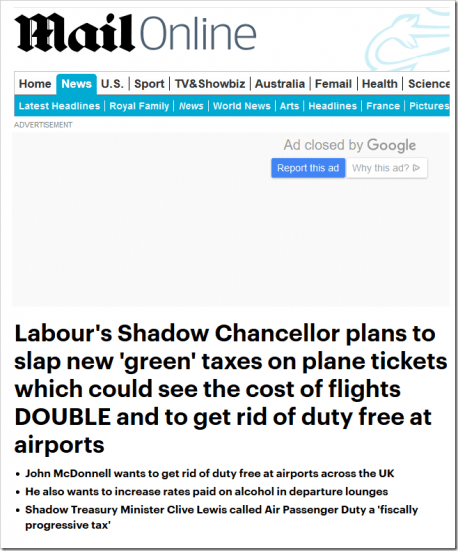
Labour’s John McDonnell is plotting a tax hike on plane tickets and getting rid of duty free at airports, the Treasury warned last night.
The Shadow Chancellor wants to put up levies on flying and increase rates paid on alcohol in the departure lounge, according to comments made by his team.
The changes could double the cost of a plane ticket – making a summer holiday somewhere sunny abroad out of reach for many hard-working families.
Shadow Treasury Minister Clive Lewis has vowed to crackdown on the ability of Briton fly by plane abroad if Labour are elected.
He said: ‘Growth in demand for UK air travel must be limited.’
He argued that they must ‘control and push down demand for flights’.
He called and a useful ‘lever’ to do this.
The current rate of APD sees the average family already paying £81 per year in ‘holiday tax’.
A new frequent-flyer tax and ending the duty-free status of flights and airport shopping are other options being discussed.
A £238 flight would rocket to £505 if all the measures are introduced, pricing many families out of a holiday completely, according to The Sun.
https://www.dailymail.co.uk/news/article-6561361/Warning-Labour-holiday-tax-families.html
Needless to say, the Labour Party assures us that this is not party policy, but we have heard that one before!
To argue that Air Passenger Duty a ‘fiscally progressive tax’ shows just how out of touch Labour are with their own roots. They seem to have the quaint idea that only rich people can afford to fly. It is working class families who will be hit hardest by APD, as they have kids to pay for as well.
No doubt McDonnell sees this as a nice little earner, but it is Clive Lewis who appears to give the game away. UK air travel must be cut, according to him, and to do so it must be priced out ordinary people’s budgets.
Meanwhile, Beijing’s new Daxing International Airport is due to open this autumn.
With eight runways serving 100 million passengers annually, Daxing International will becoming the world’s largest airport.
And China also aims to open 200 more airports by 2035:

The Civil Aviation Administration of China (CAAC) published a development report on Monday that aims to add 216 new airports by 2035 and develop a number of regional transport hubs.
According to the CAAC, China had 234 civil airports as of October this year and is expected to have around 450 by 2035, China Daily reports. Further, the demand for passenger transport in China will account for a quarter of the world’s total and exceed that of the US by 2035, making China the largest air passenger market in the world.
It also says that world-class airports will be built in the Yangtze River Delta region, the Beijing-Tianjin-Hebei region, the Guangdong-Hong Kong-Macau Greater Bay Area and the Chongqing and Chengdu city cluster.
“Service has improved substantially, but existing airports are far from adequate and are unevenly distributed throughout the country,” said Dong Faxin, director of the administration’s development and planning department.
China’s airports are expected to handle 720 million trips by 2020 – up from 552 million last year – according to the the administration.
https://gbtimes.com/china-aims-to-develop-over-200-new-airports-by-2035
Does Clive Lewis really think stopping working class families from flying to Majorca will make any difference to the world’s climate?
Why France’s Yellow Vest Protests Have Been Ignored by “the Resistance” in the U.S.

By Max Parry • Unz Review • January 2, 2019
”The rich are only defeated when running for their lives.”— C.L.R. James, The Black Jacobins
In less than two months, the yellow vests (“gilets jaunes”) movement in France has reshaped the political landscape in Europe. For a seventh straight week, demonstrations continued across the country even after concessions from a cowed President Emmanuel Macron while inspiring a wave of similar gatherings in neighboring states like Belgium and the Netherlands. Just as el-Sisi’s dictatorship banned the sale of high-visibility vests to prevent copycat rallies in Egypt, corporate media has predictably worked overtime trying to demonize the spontaneous and mostly leaderless working class movement in the hopes it will not spread elsewhere.
The media oligopoly initially attempted to ignore the insurrection altogether, but when forced to reckon with the yellow vests they maligned the incendiary marchers using horseshoe theory to suggest a confluence between far left and far right supporters of Jean-Luc Mélenchon and Marine Le Pen. To the surprise of no one, mainstream pundits have also stoked fears of ‘Russian interference’ behind the unrest. We can assume that if the safety vests were ready-made off the assembly line of NGOs like the raised fist flags of Serbia’s OTPOR! movement, the presstitutes would be telling a different story.
It turned out that a crisis was not averted but merely postponed when Macron defeated his demagogue opponent Le Pen in the 2017 French election. While it is true that the gilets jaunes were partly impelled by an increase on fuel prices, contrary to the prevailing narrative their official demands are not limited to a carbon tax. They also consist of explicit ultimatums to increase the minimum wage, improve the standard of living, and an end to austerity, among other legitimate grievances. Since taking office, Macron has declared war on trade unions while pushing through enormous tax breaks for the wealthy (like himself) — it was just a matter of time until the French people had enough of the country’s privatization. It is only a shock to the oblivious establishment why the former Rothschild banker-turned-politician, who addressed the nation seated at a gold desk while Paris was ablaze, is suddenly in jeopardy of losing power. The status quo’s incognizance is reminiscent of Marie Antoinette who during the 18th century when told the peasants had no bread famously replied, “let them eat cake” as the masses starved under her husband Louis XIV.
While the media’s conspicuous blackout of coverage is partly to blame, the deafening silence from across the Atlantic in the United States is really because of the lack of class consciousness on its political left. With the exception of Occupy Wall Street, the American left has been so preoccupied with an endless race to the bottom in the two party ‘culture wars’ it is unable to comprehend an upheaval undivided by the contaminants of identity politics. A political opposition that isn’t fractured on social issues is simply unimaginable. Not to say the masses in France are exempt from the internal contradictions of the working class, but the fetishization of lifestyle politics in the U.S. has truly become its weakness. We will have to wait and see whether the yellow vests transform into a global movement or arrive in America, but for now the seeming lack of solidarity stateside equates to a complicity with Macron’s agenda.
It serves as a reminder of the historically revisionist understanding of French politics in the U.S. that is long-established. The middle class dominated left-wing in America ascribes to a historical reinterpretation of the French Revolution that is a large contributor of its aversion to transformative praxis in favor of incrementalism. The late Italian Marxist philosopher and historian Domenico Losurdo, who died in June of this year, offered the most thorough understanding of its misreading of history in seminal works such as War and Revolution: Rethinking the Twentieth Century. The liberal rereading of the French Revolution is the ideological basis for its rejection of the revolutionary tradition from the Jacobins to the Bolsheviks that has neutralized the modern left to this day.
According to its revised history, the inevitable outcome of comprehensive systemic change is Robespierre’s so-called ‘Reign of Terror’, or the ‘purges’ of the Stalin era in the Soviet Union. In its view, what began with the Locke and Montesquieu-influenced reforms of the constitutional monarchy was ‘hijacked’ by the radical Jacobin and sans-culotte factions. Losurdo explains that counter-revolutionaries eager to discredit the image of rebellion overemphasize its violence and bloodshed, and never properly contextualize it as self-defense against the real reign of terror by the ruling class. The idea behind this recasting of history is to conflate revolutionary politics with Nazi Germany whose racially-motivated genocide was truly the inheritor of the legacy of European colonialism, not the ancestry of the Jacobins or the Russian Revolution.
Maximilien Robespierre’s real crime in the eyes of bourgeois historians was attempting to fulfill the egalitarian ideals of republicanism by transferring political power from the aristocracy and nouveaux riche directly into the hands of the working class, just as the Paris Commune did nearly 80 years later. It is for this reason he subsequently became one of the most misunderstood and unfairly maligned figures in world history, perhaps one day to be absolved. The U.S. reaction to the yellow vests is a continuation of the denial and suppression of the class conflict inherent in the French Revolution which continues to seethe beneath the surfaces of capitalism today.
In today’s political climate, it is easy to forget that there have been periods where the American left was actually engaged with the crisis of global capitalism. In what seems like aeons ago, the anti-globalization movement in the wake of NAFTA culminated in huge protests in Seattle in 1999 which saw nearly 50,000 march against the World Trade Organization. Following the 2008 financial collapse, it briefly reemerged in the Occupy movement which was also swiftly put down by corporate-state repression. Currently, the political space once inhabited by the anti-globalization left has been supplanted by the ‘anti-globalist’ rhetoric mostly associated with right-wing populism.
Globalism and globalization may have qualitatively different meanings, but they nevertheless are interrelated. Although it is shortsighted, there are core accuracies in the former’s narrative that should be acknowledged. The idea of a shadowy world government isn’t exclusively adhered to by anti-establishment conservatives and it is right to suspect there is a worldwide cabal of secretive billionaire power brokers controlling events behind the scenes. There is indeed a ‘new world order’ with zero regard for the sovereignty of nation states, just as there is a ‘deep state.’ However, it is a ruling class not of paranoiac imagination but real life, and a right-wing billionaire like Robert Mercer is as much a globalist as George Soros.
Ever since capitalism emerged it has always been global. The current economic crisis is its latest cyclical downturn, impoverishing and alienating working people whose increasing hardship is what has led to the trending rejection of the EU. Imperialism has exported capital leading to the destruction of jobs in the home sectors of Western nations while outsourcing them to the third world. Over time, deep disgruntlement among the working class has grown toward an economic system that is clearly rigged against them, where the skewed distribution of capital gains and widespread tax evasion on the part of big business is camouflaged as buoyant economic growth. When it came crashing down in the last recession, the financial institutions responsible were bailed out using tax payer money instead of facing any consequences. Such grotesque unfairness has only been amplified by the austerity further transferring the burden from the 1% to the poor.
Before the gilets jaunes, the U.K.’s Brexit referendum in 2016 laid bare these deep class divisions within the European Union. One of the most significant events in the continent since WWII, it has ultimately threatened to reshape the Occident’s status in the post-war order as a whole. Brexit manifested out of divisions within Britain’s political parties, especially the Torys, which had been plagued for years by internal dispute over the EU. Those in power were blind to the warning signs of discontent toward a world economy in crisis and were shocked by the plebiscite in which the working class defied the powers that be against all odds with more than half voting to leave.
In general, well-to-do Brits were hard remainers while those suffering most severely from the destruction of industry, unemployment and austerity overwhelmingly chose to leave in what was described as a “peasants revolt” by the media. The value of the pound sterling quickly plunged and not long after the status of the United Kingdom as a whole came into question as Britain found itself at odds with Scotland’s unanimous decision to remain. Brexit tugged at the bonds holding the EU together and suddenly the collective standing clout of its member states is at stake in a potential breakup of the entire bloc.
Euroscepticism is also by no means a distinctly British phenomenon, as distrust has soared in countries hit the hardest by neoliberalism like Greece (80%), with Spain and France not far behind. In fact, before there was Brexit there was fear among the elite of a ‘Grexit.’ In response to its unprecedented debt crisis manufactured by the International Monetary Fund (IMF), the Greek people elected the Coalition of the Radical Left, SYRIZA, to a majority of legislative seats to the Hellenic Parliament during its 2015 bailout referendum. Unfortunately, the synthetic alliance turned out to be anything but radical and a trojan horse of the establishment. SYRIZA was elected on its promise to rescind the terms of Greek membership in the EU, but shortly after taking office it betrayed its constituency and agreed to the troika’s mass privatization. Even its former finance minister Yanis Varousfakis admitted that SYRIZA was a controlled opposition and auxiliary of the Soros Foundation.
Apart from suffering collective amnesia regarding the EU’s neoliberal policies, apparently the modern left is also in serious need of a history lesson regarding the federation’s fascist origins. It has been truly puzzling to see self-proclaimed progressives mourning Britain’s decision to withdraw from a continental union that was historically masterminded by former fifth columnists of Nazi Germany. It was in the aftermath of WWII’s devastation that the 1951 Treaty of Paris established the nucleus of the EU in the European Coal and Steel Community, a cooperative union formed by France, Italy, West Germany, and the three Benelux states (Belgium, Luxembourg and the Netherlands). The Europe Declaration charter stated:
“By the signature of this Treaty, the involved parties give proof of their determination to create the first supranational institution and that thus they are laying the true foundation of an organized Europe. This Europe remains open to all European countries that have freedom of choice. We profoundly hope that other countries will join us in our common endeavor.”
The idea of forming a “supranational” union was conceived by the French statesman Robert Schuman, who during the outbreak of WWII served as the Under-Secretary of State for Refugees in the Reynaud government. When Nazi Germany invaded France in 1940, Schuman by all accounts willingly voted to grant absolute dictatorial powers to Marshall Philippe Pétain to become Head of State of the newly formed Vichy government, the puppet regime that ruled Nazi-occupied France until the Allied invasion in 1944. By doing so, he retained his position in parliament, though he later chose to resign. Following the war, like all Vichy collaborators Schuman was initially charged with the offense of indignité nationale (“national unworthiness”) and stripped of his civil rights as a traitor.
More than 4,000 alleged quislings were summarily executed following Operation Overlord and the Normandy landings, but the future EU designer was fortunate enough to have friends in high places. Schuman’s clemency was granted by none other than General Charles de Gaulle himself, the leader of the resistance during the war and future French President. Instantly, Schuman’s turncoat reputation was rehabilitated and his wartime activity whitewashed. Even though he had knowingly voted full authority to Pétain, the retention of his post in the Vichy government was veneered to have occurred somehow without his knowledge or consent.
Schuman is officially regarded as one of the eleven men who were ‘founding fathers’ of what later became the EU. One of the other major figures that contributed to the federal integration of the continent was Konrad Adenauer, the first Chancellor of the Federal Republic of Germany. The Nuremberg Trials may have tried and executed most of the top leadership of the Nazi Party, but the post-war government that became West Germany was saturated with former Third Reich officials. Despite the purported post-war ‘denazification’ policy inscribed in the Potsdam agreement, many figures who had directly participated in the Holocaust were appointed to high positions in Adenauer’s administration and never prosecuted for their atrocities.
One such war criminal was the former Ministry of the Interior and drafter of the Nuremberg race statutes, Hans Globke, who became Adenauer’s right hand man as his Secretary of State and Chief of Staff. Adenauer also successfully lobbied the Allies to free most of the Wehrmacht war criminals in their custody, winning the support of then U.S. General and future President Dwight Eisenhower. By 1951, motivated by the desire to quickly rearm and integrate West Germany into NATO in the new Cold War, the policy of denazification was prematurely ended and countless offenders were allowed to reenter branches of government, military and public service. Their crimes against humanity took a backseat to the greater imperialist priority of rearmament against East Germany and the Soviets.
In the years following WWII, there was also concern among the elite of anti-Americanism growing in Western Europe. The annual Bilderberg Group conference was established in 1954 by Prince Bernard of the Netherlands, himself a former Reiter-SS Corps and Nazi Party member, to promote ‘Atlanticism’ and facilitate cooperation between American and European leaders. Invitations to the Bilderberg club meetings were extended to only the most exclusive paragons in politics, academia, the media, industry, and finance. In 2009, WikiLeaks revealed that it was at the infamous assembly where the hidden agenda of the European Coal and Steel Community, later the EU, was set:
“E. European Unity: The discussion on this subject revealed general support for the idea of European integration and unification among the participants from the six countries of the European Coal and Steel Community, and a recognition of the urgency of the problem. While members of the group held different views as to the method by which a common market could be set up, there was a general recognition of the dangers inherent in the present divided markets of Europe and the pressing need to bring the German people, together with the other peoples of Europe, into a common market. That the six countries of the Coal and Steel Community had definitely decided to establish a common market and that experts were now working this out was felt to be a most encouraging step forward and it was hoped that other countries would subsequently join it.”
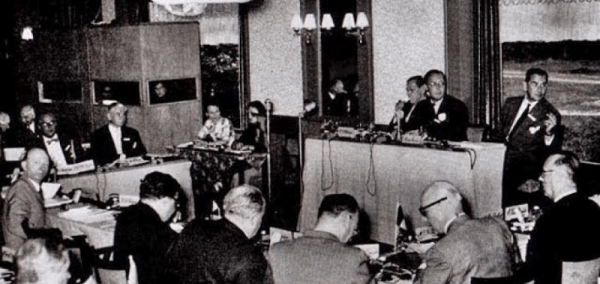
Prince Bernard presides over the first annual Bilderberg meeting in 1954.
At the 1955 conference, the rudimentary idea for a European currency or what became the Eurozone was even discussed, three years before the Treaty of Rome which established the European Economic Community, without the public’s knowledge:
“A European speaker expressed concern about the need to achieve a common currency, and indicated that in his view this necessarily implied the creation of a central political authority.”
The mysterious Bilderberg gatherings are still held to this day under notorious secrecy and are frequently the subject of wild speculation. One can imagine a topic behind the scenes at this year’s meeting would be how to address the growth of anti-EU ‘populism’ and uprisings like the gilet jaunes. Hitlerite expansionism had been carried out on the Führer’s vision for a European federation in the Third Reich — in many respects, the EU is a rebranded realization of his plans for empire-building. How ironic that liberals are clinging to a multinational political union founded by fascist colluders while the same economic bloc is being opposed by today’s far right after its new Islamophobic facelift.
While nationalism may have played an instrumental role in Brexit, there is a manufactured hysteria hatched by the establishment which successfully reduced the complex range of reasons for the Leave EU vote to racism and flag-waving. They are now repeating this pattern by overstating the presence of the far right among the yellow vests. Such delirium not only demonizes workers but coercively repositions the left into supporting something it otherwise shouldn’t — the EU and by default its laissez-faire policies — thereby driving the masses further into the arms of the same far right. Echoes of this can be seen in the U.S. with the vapid response to journalist Angela Nagle’s recent article about the immigration crisis on the southern border. The faux-left built a straw man in their attack on Nagle, who dared to acknowledge that the establishment only really wants ‘open borders’ for an endless supply of low-wage labor from regions in the global south destabilized by U.S. militarism and trade liberalization. Aligning itself with the hollow, symbolic gestures of centrists has only deteriorated the standards of the left participating in such vacuousness and dragged down to the level of liberals.
There is no doubt Brexit and Trump pushed the xenophobia button and could not have come about without it. However, such criticism means nothing when it comes from moral posturers who claim to “stand with refugees” while supporting the very ‘humanitarian’ interventionist policies displacing them. Nativism was not the sole reason the majority voted to leave the EU and many working class minorities also were Brexiters. Of course their fellow workers and migrants are not the true cause of their misery. After all, it was not just chattel slaves who came to the U.S. unwillingly but European immigrants fleeing continental wars and starvation as well — the crisis in the EU today is no different.
Fundamentally, migrants seek asylum on Europe’s doorstep because of NATO’s imperial expansion and the unexpected arrival of Brexit has threatened to weaken the EU’s military arm. Already desperate to reinvent itself and a new enemy in Russia despite its functional obsolescence, the shock of the referendum has inconveniently undermined NATO’s ability to pressure Moscow and Beijing, a step forward for mitigating world peace in the long run and a silver lining to its outcome. It is the task of the left to reject the EU’s neoliberal project while transmitting the message that capital, not refugees, is the cause of the plight of the masses. It is also necessary to have faith in the people, something cynical liberals lack. Racism may historically be the achilles heel of the working class but underlying Brexit, the election of Trump, and the yellow vests is the spirit of defiance in working people, albeit one of political confusion in need of guidance.
If the yellow vests are today’s sans-culottes, like those which became the revolutionary partisans in the French Revolution, they will eventually need a Jacobin Club. Relatively progressive but ultimately reformist figures like Mélenchon are no such spearhead and will only lead them down the same dead end of SYRIZA. The absence of any such vanguard has forced the working class to take matters into their own hands in the interim. If history is any guide, the gilets jaunes will be stamped out until a new cadre takes the reins whose objective is, as Lenin said,“not to champion the degrading of the revolutionary to the level of an amateur, but to raise the amateurs to the level of revolutionaries.” We also cannot fall into ideological fantasies that we live in permanent revolutionary circumstances or that a spontaneous uprising can become comprehensive simply because of ingenious leadership. Nevertheless, as Mao Tse-Tung wrote, “a single spark can start a prairie fire” and hopefully the yellow vests are that flame.
Max Parry is an independent journalist and geopolitical analyst. Max may be reached at maxrparry@live.com
Soros ‘person of the year’ indeed: In 2018 globalists pushed peoples’ patience to the edge

By Robert Bridge | RT | December 29, 2018
Since 2015, the proponents of neoliberalism have been pushing ahead with their plans for open borders and globalist agenda without the consent of the people. The last 365 days saw that destructive agenda greatly challenged.
In light of the epic events that shaped our world in 2018, it seems the Yellow Vests – the thousands of French citizens who took to the streets of Paris to protest austerity and the rise of inequality – would have been a nice choice for the Financial Times’ ‘person of the year’ award. Instead, that title was bestowed upon the billionaire globalist, George Soros, who has arguably done more meddling in the affairs of modern democratic states than any other person on the planet.
Perhaps FT’s controversial nomination was an attempt to rally the forces of neoliberalism at a time when populism and nascent nationalism is sweeping the planet. Indeed, the shocking images coming out of France provide a grim wake-up call as to where we may be heading if the globalists continue to undermine the power of the nation-state.
It is no secret that neoliberalism relentlessly pursues a globalized, borderless world where labor, products, and services obey the hidden hand of the free market. What is less often mentioned, however, is that this system is far more concerned with promoting the well-being of corporations and cowboy capitalists than assisting the average person on the street. Indeed, many of the world’s most powerful companies today have mutated into “stateless superpowers,” while consumers are forced to endure crippling austerity measures amid plummeting standards of living. The year 2018 could be seen as the tipping point when the grass-roots movement against these dire conditions took off.
Since 2015, when German Chancellor Angela Merkel allowed hundreds of thousands of undocumented migrants into Germany and the EU, a groundswell of animosity has been steadily building against the European Union, perhaps best exemplified by the Brexit movement. Quite simply, many people are growing weary of the globalist argument that Europe needs migrants and austerity measures to keep the wheels of the economy spinning. At the very least, luring migrants with cash incentives to move to Germany and elsewhere in the EU appears incredibly shortsighted.
Indeed, if the globalist George Soros wants to lend his Midas touch to ameliorating the migrant’s plight, why does he think that relocating them to European countries is the solution? As is becoming increasingly apparent in places like Sweden and France, efforts to assimilate people from vastly different cultures, religions and backgrounds is an extremely tricky venture, the success of which is far from guaranteed.
One worrying consequence of Europe’s season of open borders has been the rise of far-right political movements. In fact, some of the harshest criticism of the ‘Merkel plan’ originated in Hungary, where its gutsy president, Viktor Orban, hopes to build “an old-school Christian democracy, rooted in European traditions.” Orban is simply responding to the democratic will of his people, who are fiercely conservative, yet the EU parliament voted to punish him regardless. The move shows that Brussels, aside from being adverse to democratic principles, has very few tools for addressing the rise of far-right sentiment that its own misguided policies created.
Here it is necessary to mention once again that bugbear of the political right, Mr. Soros, who has received no political mandate from European voters, yet who campaigns relentlessly on behalf of globalist initiatives through his Open Society Foundations (OSF) (That campaign just got some serious clout after Soros injected $18bn dollars of his own money into OSF, making it one of the most influential NGOs in the world).
With no small amount of impudence, Soros has condemned EU countries – namely his native Hungary – for attempting to protect their territories by constructing border barriers and fences, which he believes violate the human rights of migrants (rarely if ever does the philanthropist speak about the “human rights” of the native population). In the words of the maestro of mayhem himself: “Beggar-thy-neighbor migration policies, such as building border fences, will not only further fragment the union; they also seriously damage European economies and subvert global human rights standards.”
Through a leaked network of compromised EU parliamentarians who do his bidding, Soros says the EU should spend $30 billion euros ($33bln) to accommodate “at least 300,000 refugees each year.” How will the EU pay for the resettling of migrants from the Middle East? Soros has an answer for that as well. He calls it “surge funding,” which entails “raising a substantial amount of debt backed by the EU’s relatively small budget.”
Any guesses who will be forced to pay down the debt on this high-risk venture? If you guessed George Soros, guess again. The already heavily taxed people of Europe will be forced to shoulder that heavy burden. “To finance it, new European taxes will have to be levied sooner or later,” Soros admits. That comment is very interesting in light of the recent French protests, which were triggered by Emmanuel Macron’s plan to impose a new fuel tax. Was the French leader, a former investment banker, attempting to get back some of the funds being used to support the influx of new arrivals into his country? The question seems like a valid one, and goes far at explaining the ongoing unrest.
At this point, it is worth remembering what triggered the exodus of migrants into Europe in the first place. A large part of the answer comes down to unlawful NATO operations on the ground of sovereign states. Since 2003, the 29-member military bloc, under the direct command of Washington, has conducted illicit military operations in various places around the globe, including in Iraq, Libya and Syria. These actions, which could be best described as globalism on steroids, have opened a Pandora’s Box of global scourges, including famine, terrorism and grinding poverty. Is this what the Western states mean by ‘humanitarian activism’? If the major EU countries really want to flout their humanitarian credentials, they could have started by demanding the cessation of regime-change operations throughout the Middle East and North Africa, which created such inhumane conditions for millions of innocent people.
This failure on the part of Western capitals to speak out against belligerent US foreign policy helps to explain why a number of other European governments are experiencing major shakeups. Sebastian Kurz, 32, won over the hearts of Austrian voters by promising to tackle unchecked immigration. In super-tolerant Sweden, which has accepted more migrants per capita than any other EU state, the anti-immigrant Sweden Democrats party garnered 17.6 percent of the vote in September elections – up from 12.9 percent in the previous election. And even Angela Merkel, who is seen by many people as the de facto leader of the European Union, is watching her political star crash and burn mostly due to her bungling of the migrant crisis. In October, after her Christian Democratic Union (CDU) suffered a stinging setback in Bavaria elections, which saw CDU voters abandon ship for the anti-immigrant AfD and the Greens, Merkel announced she would resign in 2021 after her current term expires.
Meanwhile, back in the US, the government of President Donald Trump has been shut down as the Democrats refuse to grant the American leader the funds to build a wall on the Mexican border – despite the fact that he essentially made it to the White House on precisely that promise. Personally, I find it very hard to believe that any political party that does not support a strong and viable border can continue to be taken seriously at the polls for very long. Yet that is the very strategy that the Democrats have chosen. But I digress.
The lesson that Western governments should have learned over the last year from these developments is that there exists a definite red line that the globalists cross at risk not only to the social order, but to their own political fortunes. Eventually the people will demand solutions to their problems – many of which were caused by reckless neoliberal programs and austerity measures. This collective sense of desperation may open the door to any number of right-wing politicians only too happy to meet the demand.
Better to provide fair working conditions for the people while maintaining strong borders than have to face the wrath of the street or some political charlatan later. Whether or not Western leaders will change their neoliberal ways as a populist storm front approaches remains to be seen, but I for one am not betting on it.
The War Against Globalism
By Philip M. GIRALDI | Strategic Culture Foundation | 13.12.2018
We are the Little Folk—we!
Too little to love or to hate.
Leave us alone and you’ll see
How we can drag down the State!A Pict Song, Rudyard Kipling
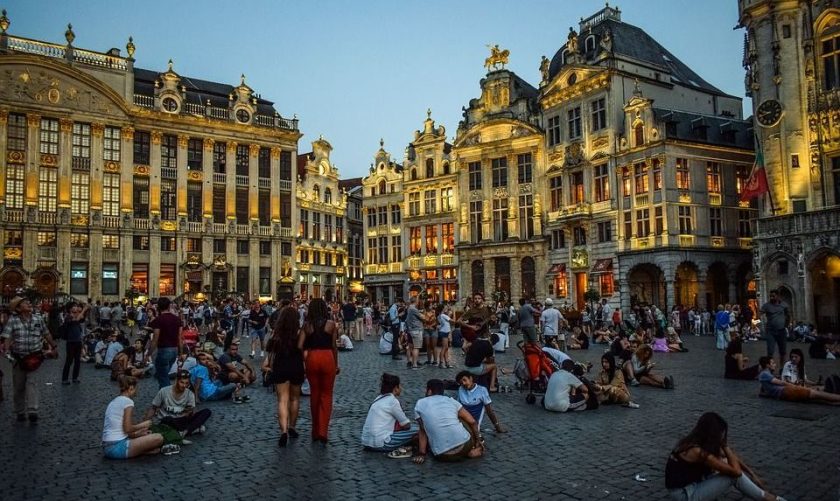
Belgium has joined the list of countries that are rebelling against their elected leadership. Over the weekend the Belgian government fell over Prime Minister Charles Michel’s trip to Morocco to sign the United Nations Migration Agreement. The agreement made no distinction between legal and illegal migrants and regarded immigration as a positive phenomenon. The Belgian people apparently did not agree. Facebook registered 1,200 Belgians agreeing that the Prime Minister was a traitor. Some users expressed concern for their children’s futures, noting that Belgian democracy is dead. Others said they would get yellow vests and join the protests.
The unrest witnessed in a number of places is focused on some specific demands but it represents much broader anger. The French yellow vests initially protested against proposed increases in fuel taxes that would have affected working people dependent on transportation disproportionately. But when that demand was met by the government of President Emmanuel Macron, the demonstrations continued and even grew, suggesting that the grievances with the government were far more extensive than the issue of a single new tax. Perhaps not surprisingly, the French government is seeking for a scapegoat and is investigating “Russian interference.” The US State Department inevitably agrees, claiming that Kremlin directed websites and social media are “amplifying the conflict.”
Some commentators looking somewhat more deeply at the riots in France have even suggested that the real issue just might be regime change, that the Macron government had become so disconnected with many of the voters through both its policies and the rhetoric justifying them that it had lost its legitimacy and there was no possibility of redemption. Any change would have to be an improvement, particularly as a new regime would be particularly sensitive to the sentiments of those being governed, at least initially. One might suggest that the prevailing sentiment that a radical change in government is needed, come what may, to shake up the system might well be called the “Trump phenomenon” as that is more-or-less what happened in the United States.
The idea that republican or democratic government will eventually deteriorate into some form of tyranny is not exactly new. Thomas Jefferson advocated a new revolution every generation to keep the spirit of government accountable to the people alive.
Call it what you will – neoliberalism, neoconservatism or globalism – the new world order, as recently deceased President George H.W. Bush once labeled it, characteristically embraces a world community in which there is free trade, free movement of workers and democracy. They all sound like good things but they are authoritarian in nature, destructive of existing communities and social systems while at the same time enriching those who promote the changes. They have also been the root cause of most of the wars fought since the Second World War, wars to “liberate” people who never asked to be invaded or bombed as part of the process.
And there are, of course, major differences between neoliberals and neoconservatives in terms of how one brings about the universal nirvana, with the liberals embracing some kind of process whereby the transformation takes place because it represents what they see, perhaps cynically, as the moral high ground and is recognized as being the right thing to do. The neocons, however, seek to enforce what they define as international standards because the United States has the power to do so in a process that makes it and its allies impossible to challenge. The latter view is promoted under the phony slogan that “Democracies do not fight other democracies.”
The fact that globalists of every type consider nationalism a threat to their broader ambitions has meant that parochial or domestic interests are often disregarded or even rejected. With that in mind, and focusing on two issues – wholesale unwelcome immigration and corrupt government run by oligarchs – one might reasonably argue that large numbers of ordinary citizens now believe themselves to be both effectively disenfranchised and demonstrably poorer as rewarding work becomes harder to find and communities are destroyed through waves of both legal and illegal immigration.
In the United States, for example, most citizens now believe that the political system does not work at all while almost none think that even when it does work it operates for the well-being of all the citizens. For the first time since the Great Depression, Americans no longer think of upward mobility. Projections by sociologists and economists suggest that the current generation growing up in the United States will likely be materially poorer than their parents. That angst and the desire to “do something” to make government more responsive to voters’ interests is why Donald Trump was elected president.
What has been occurring in Belgium, France, with Brexit in Britain, in the recent election in Italy, and also in the warnings coming from Eastern Europe about immigration and European Union community economic policies are driven by the same concerns that operated in America. Government itself is becoming the enemy. And let us not forget the countries that have already felt the lash and been subjected to the social engineering of Angela Merkel – Ireland, Spain, Portugal and Greece. All are weaker economies crushed by the one size fits all of the EURO, which eliminated the ability of some governments to manage their own economies. They and all their citizens are poorer for it.
There have been windows in history when the people have had enough abuse and so rise up in revolt. The American and French revolutions come to mind as does 1848. Perhaps we are experiencing something like that at the present time, a revolt against the pressure to conform to globalist values that have been embraced to their benefit by the elites and the establishment in much of the world. It could well become a hard fought and sometimes bloody conflict but its outcome will shape the next century. Will the people really have power in the increasingly globalized world or will it be the 1% with its government and media backing that emerges triumphant?
French opposition rejects Macron’s concessions to Yellow Vests, some demand ‘citizen revolution’
RT | December 11, 2018
Macron’s concessions to the Yellow Vests has failed to appease protesters and opposition politicians, such as Jean-Luc Mélenchon, who called for “citizen’s revolution” to continue until a fair distribution of wealth is achieved.
Immediately after French President Macron declared a “social and economic state of emergency” in response to large-scale protests by members of the Yellow Vest movement, promising a range of concessions to address their grievances, left-wing opposition politician Mélenchon called on the grassroots campaign to continue their revolution next Saturday.
“I believe that Act 5 of the citizen revolution in our country will be a moment of great mobilization.”
Macron’s promise of a €100 minimum wage increase, tax-free overtime pay and end-of-year bonuses, Mélenchon argued, will not affect any “considerable part” of the French population. Yet the leader of La France Insoumise stressed that the “decision” to rise up rests with “those who are in action.”
“We expect a real redistribution of wealth,” Benoît Hamon, a former presidential candidate and the founder of the Mouvement Génération, told BFM TV, accusing Macron’s package of measures that benefit the rich.
The Socialist Party’s first secretary, Olivier Faure, also slammed Macron’s financial concessions to struggling workers, noting that his general “course has not changed.”
Although welcoming certain tax measures, Marine Le Pen, president of the National Rally (previously National Front), accused the president’s “model” of governance based on “wild globalization, financialization of the economy, unfair competition,” of failing to address the social and cultural consequences of the Yellow Vest movement.
Macron’s speech was a “great comedy,” according to Debout la France chairman, Nicolas Dupont-Aignan, who accused the French President of “hypocrisy.”
Yet many found Melanchon’s calls to rise up against the government unreasonable, accusing the 67-year-old opposition politician of being an “opportunist” and “populist,” who is trying to hijack the social protest movement for his own gain.
The Yellow Vest protests against pension cuts and fuel tax hikes last month were organized and kept strong via social media, without help from France’s powerful labor unions or official political parties. Some noted that such a mass mobilization of all levels of society managed to achieve unprecedented concessions from the government, which the unions failed to negotiate over the last three decades.
Unz Goes Nuclear
By Israel Shamir • Unz Review • December 6, 2018
Some discoveries are just too shocking to digest. Recently I wrote of intrepid Ron Unz, the Californian maverick publisher and IT-genius, who dared to share with his readers his insights into the ideas and motifs of revisionists, or Holocaust Deniers, as their enemies call them. But this absolutely verboten topic fades into irrelevance in comparison with his most momentous discovery that has made somewhat less resonance, paradoxically, because of its magnitude. It was too big. Dark pages of the world war history or of interracial relations in 1930s, or even the whodunit of 9/11, all that is fine and very interesting, but hardly a Stop Press kind.
His other, most significant discovery is not just Stop Press, but Burn the Press Down. He discovered and proved with hard data that Jews discriminate against you to a degree you could not even guess. While you queue at the front door of the Elites, they enter freely by the back door. Chances of a smart non-Jewish “white” American kid getting there are ten-fold lower than that of a Jew. There are ten times more smart non-Jewish white American kids than smart Jewish kids, but there are more Jewish students in the Ivy League than white non-Jews. The system is biased, and not in your favour.
Once you could work your way up to success, like Henry Ford did. That was the American Dream. Not anymore. Now the only way to the best jobs, into the American elites leads through a few top colleges of the Ivy League. You can’t bypass this funnel of opportunity. “A greater and greater proportion of our financial, media, business, and political elites being drawn from a relatively small number of our leading universities” (all unattributed quotes are from the Unz essay). Unless you get the imprimatur of Harvard or Yale, your future is dim. Well-paid middle class jobs in the manufacturing sector for those lacking college degrees are scarce, and workers are being paid less now than forty years ago. When America’s richest 1 per cent has as much wealth as the bottom 95 per cent, it is winner takes all, and this winner is probably a Jew.
The elites have duties, too. The elite universities are supposed to pick the best boys and girls to lead America to its glory and greatness. By your own experience you already know that it does not happen; that the new US elites lead themselves to prosperity, while pushing you to poverty and perdition. The new elites failed you, failed your country, failed the world (always excepting the Jewish state). This failure is the main reason to explore how the elites produce their new generation.
The great surprise is that WASPs, the legendary descendants of the Founding Fathers, have lost their privilege, or even their fair chance to success. Unz proves that a smart Christian American boy of English or German parentage has ten times less chance to get into these crème-de-la-crème universities than an average Jewish boy. This very unfair way of forming tomorrow’s elites has been made possible by the sheer nepotistic networking of the universities’ admission offices. Clannishness, the Jews were (justifiably) accused of.
In actual words of Ron Unz, “Jews are enrolled at Harvard and other elite colleges at a rate some 1,000% greater than white Gentiles of similar academic performance”. One thousand per cent, OMG! Provided that these Ivy League colleges are the only sure-fire way into American elites, into best jobs and into good and important positions, this biased enrolment guarantees the Jews their position of the top dog well into next generation.
In 1920s, Jews accused the WASPs of discriminating them at university admission. The WASPs kept them under 15% of admissions. Now with Jews at the top they show what real discrimination is all about. However, there is one major difference. Then, the Jews volubly complained, now the Christians do not even dare to complain.
While the White Christian Americans kept mum, the Asians dared to speak and went to court against the colleges. The colleges have been forced to explain how they admit students. The heavily-Jewish elites of the legal system and MSM allowed this case of Asian-Americans to proceed (after many years of rejection) for a good reason: they wanted to obscure this fragrant discrimination against white Gentiles by Jews by a SEP device.
In Douglas Adams’s 1982 novel Life, the Universe and Everything, (a sequel to his Hitchhiker’s Guide), the protagonist explains: a SEP is something we can’t see, or don’t see, or our brain doesn’t let us see, because we think that it’s somebody else’s problem. That’s what SEP means. Somebody Else’s Problem. The brain just edits it out, it’s like a blind spot. SEP is the best way to hide a pink elephant in a room: people would have walked past the elephant, round it, even over it, and simply never have noticed that the thing was there.
The problem of Asian-American discrimination is an excellent SEP. Indeed, as Unz said, the Asian-Americans are discriminated at Ivy League universities (though much less than ordinary Americans). But even if they are discriminated, who cares? There are not too many of them, and they anyway manage well. Thus the real point of Unz – you are discriminated! – had been hidden.
The UNZ essay is very long with its 26,000 words, too long for average reader, so here are its salient points:
- Jews organized a clannish network to get themselves into best universities in numbers well beyond their share in population, and (!!!) well beyond their abilities;
- their fight against discrimination of Blacks has being carried at the expense of America’s white Christians. If previously discriminated minorities, be it Afro-Americans or whatever, enjoy the fruits of affirmative action (positive discrimination), it is no loss for Jews, as only Gentiles, once privileged WASPs are being screwed up.
- if once upon a time Jews had got into best colleges because they were smart, smarter than Gentile kids, now they are noticeably less smart, but they get there anyway because they are Jews.
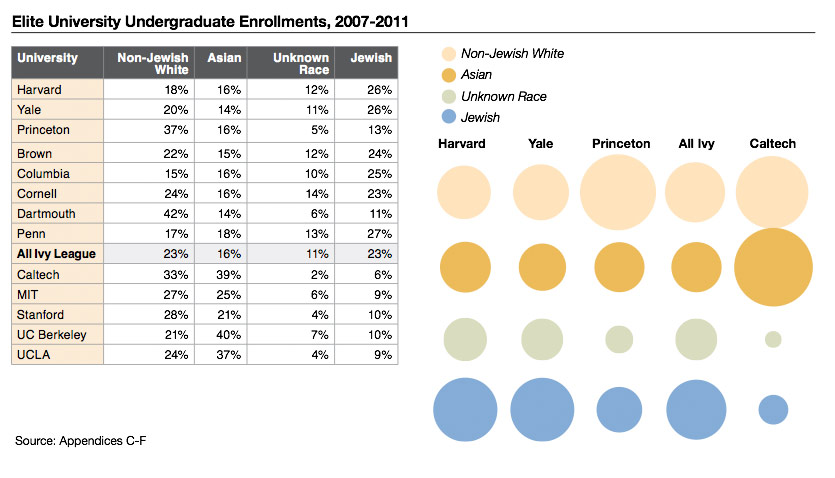
The numbers distilled by Ron Unz out of dusty spread sheets are terrifying. You can look at the diagram he compiled, or immerse yourself in the ocean of data he provides, to get convinced: the discrimination is very real.
Unz quotes a Jewish writer who exhilarates that “the WASP demographic group which had once so completely dominated America’s elite universities and virtually all the major institutions of American life had by 2000 become a small and beleaguered minority at Harvard, being actually fewer in number than the Jews whose presence they had once sought to restrict.” For a Jewish nationalist, it is a cause for celebration. For a WASP, it is a reason to regret the unwise decisions of his fathers who tried to play a fair game with Jews and were Jew’d.
But for an average American, the answer lays in the macro picture. Do the new Jewified elites manage America better than WASPs did? Are they better shepherds? Is America-2018 (with Jews getting over 25% of all seats in the express train to better future, leaving 20% or less to WASPs) better for Americans than America-1962 with 15% of Jews and 80% of WASPs in Yale and Harvard? If you belong to 1% of Americans, the answer is positive; if you are one of the 99%, it is not.
Unz is very meticulous, very cautious in his approach. He asks an almost-insulting question: perhaps the Jews are so smart (after all, that is the kin of Einstein and Freud) that their share in the Ivy League is a result of meritocratic selection? And he provides an almost-insulting answer: no, they aren’t. There are some universities that admit strictly by merit; in these universities Jews do not exactly star. Caltech, the California Institute of Technology is one of them. The Jewish presence there is quite small; Hillel, the Jewish students’ body, gives it as zero. In reality, it is about 6 per cent, like in other merit-based competitions.
It can’t be zero, for sure. In 2003, two Palestine Solidarity activists, Adam Shapiro and Huwaida Arraf, had been booed there by pro-Israeli Jews who tried their beastly best to drive away the speakers. But there are not many Jews. There are few Jewish Olympiad winners; once they were in dozens, now there are hardly any. Altogether Jewish kids make up some six per cent of NMS, the highest-performing students’ list. This is a good result, in line with Jewish admissions into meritocratic colleges, but it is four times less than what you would expect judging by their Yale admissions. The Jewish IQ, as Unz found out, is also in line with that of their Gentile peers, and not the fabulous 110-115, as the Jewish newspapers claim. Jews are not all that smart anymore, judging by their score.
Unz explains this “sudden collapse of Jewish academic achievement” by inertia. The youngsters just do not try hard enough, in contradistinction to their fathers’ generation. They will succeed, they think, by their old-school-tie connections or through their parents’ links. Indeed when you look at the face of President Trump’s son-in-law, Mr Jared Kushner, you understand that the Nature took a nap in his generation. His parents’ generation were predators and major crooks (his father actually served two years in jail for tax evasion while obtaining his two-billion-dollar loot), but Jared’s generation could not enroll or graduate without assistance, while his political meddling made a mess of already troubled American Middle East politics.
This is the Nature way to deal with problems. Thomas Mann in his 1901 novel Buddenbrooks subtitled The Decline of a Family depicts three generations of a North German family: the first generation amasses fortune, the second maintains it, the third wastes it away in Bohemian pleasures. Smart people’s kids are usually not that smart, and have much less drive. For this reason, I wouldn’t be bothered too much by Jewish achievement of the elder generation; the young generation will waste it all right.
The problem is, there is more than one way to shine. One is to be brilliant, another is to dim others to shine in their background. In Israel, the Jews promoted plethora of laws and regulations circumcising Palestinians’ ability to compete. In the US, Jewish support of migration from underdeveloped countries and discrimination of the white American students achieve a similar effect as it lowers the average ability of non-Jewish population and allows the Jews to excel in comparison.
Unz exploration could bring enormous benefits to the American society. His diagnosis of the malady allows to cure it. In his consequent article on the subject, Unz discovered that after publication of his article, the numbers of Jewish admissions in the best colleges had been sharply readjusted downwards. What was 25% (Jews in Harvard) became 12%. But do not rejoice before time. The Jews responded with subterfuge instead of correcting action. Now they refer in their statistics only to Jews who state that they are followers of Jewish faith; and this is a dwindling lot. If one counts the students who refer to themselves as “descendants of Holocaust survivors” and speak of “my true home Israel”, we are back to 25%.
So the US Jews have learned how to perpetuate their dominance, by jealously guarding the gates of the best universities. Can it be corrected?
Jews broke the glass ceiling of admissions to Harvard by mass protests and media pressure. The Gentiles are not likely to emulate their strategy as they became even more obedient and placid as if being bred for these traits. The Americans aren’t rebellious by nature; that’s why the US is so prosperous and that’s why the lot of a working American is going from bad to worse. Yes, Scylla and Charybdis guard the passage to well-being: over-rebellious folk grows poor as revolutions diminish the treasury; on the other hand, over-docile folk grows poor because their betters oppress them fearing not for harsh response. Wise elites navigate these narrow straits cautiously like the Swedes did until 1990. Obstinate elites have to be cured by revolution, like in England or France, or by state terror, as in Russia or China.
Now you have to live with Jewified elites. Historically, the record is not encouraging. Jews are not very good in the top dog position. They are too obstinate, doctrinaire and despise the low classes to whom they feel no affinity. A single person of Jewish origin can be very good as a leader (Bruno Kreisky, the Austrian chancellor, is a good example). Some Jewish politicians are very loyal – the much-denigrated Kaganovich remained loyal to Stalin when all the rest switched to Khrushchev. But when Jews form a prominent part of elites, like it happened in a few states in different times, the result is not very good. We have the example of Israel, where the natives have nor basic rights neither citizenship, and by millions they are deprived of property and locked up in the ghetto of Gaza.
The Unz revelation demonstrates the main feature of Jews: as a rule, they are immoral (or, if you prefer, they have a different, Jewish moral, as many Rabbis claim). It gives them an advantage in some dealings but eventually courts disaster. In the Tsar’s days, the Jews complained vociferously about two things: one, Numerus Clausus, (a Jewish quota of students) and two, the Pale of Settlement, a part of the country where Jews could reside freely. They – my grandparents – sounded so sincere denouncing these evils. Nowadays, the victorious Jews established the Pale of Settlement for Gentiles in Palestine, while in the US, they fixed the low quota for previous lords of the land, and very few Jews complain about it, as I noted at length.
When it is good for Jews, it is bad for Gentiles, says the Talmud. “If you hear that Caesarea (a symbol of Gentile rule) and Jerusalem (a symbol of Jewish rule) are both in ruins or that both are flourishing peacefully, do not believe it. Believe only a report that Caesarea is in ruins and Jerusalem is flourishing or that Jerusalem is in ruins and Caesarea is flourishing”. (Talmud, Tractate Megillah 6a). History confirms it – up to a point. Jews can have it good under Gentile rule, though not as good as they would like to. But under Jewish rule, not only Gentiles, but even middle-to-low-class Jews are being screwed up, as you can observe in the Jewish state of Israel – and in the heavily Jewified US, as well. Like fire, like women, – Jews are good when under control and dangerous and destructive when they are in control.
Still, there is a free will; everyone can choose one’s own way. Nobody born in the Jewish family has to stick with Jews. The best of Jews, from Christ Apostles to Joseph Brodsky and Ron Unz always escaped it to join the people.
Israel Shamir can be reached at adam@israelshamir.net
To be Remembered
By Gilad Atzmon | December 4, 2018
 George H.W. Bush, the 41st president of the United States, died last Friday. President Bush was loved by the Jews. Over the weekend we saw an endless parade of Jewish individuals and organisations paying homage to Bush for his commitment to Israel and to the Jews.
The Republican Jewish Coalition (RJC) described Bush as “a great friend of Israel, the Jewish people, and the RJC.” The group joined other Jewish voices in noting the work Bush did to help bring Jews from the former Soviet Union and Ethiopia to Israel as well as his actions to help ensure the safety of Israel. Bush also led the effort in the UN to repeal the ‘Zionism is Racism’ resolution and he stood up against Saddam Hussein who, at the time, was one of the last Arab leaders to oppose Israel and Zionism.
Yet, it was the photo of Bush at the Wailing Wall that grabbed my attention. On Saturday, the Israeli press circulated a photograph of the 41st president in suspiciously intimate proximity to the Wailing Wall.
We have seen variations of this photograph so many times that we have forgotten to ask the critical questions: What attracts world leaders to that wall? Is it possible that our world leaders are all (somehow) so libidinally attracted to walls that they do not even mind being caught on camera in such an intimate moment with that one particular wall? And if not, how do we explain the fact that so many of our world leaders are caught so close to that Jewish wall with their eyes closed? And more crucially, what is it about the Zionist culture that inspires this demand to publicise powerful goyim kissing the sacred wall?
Every world leader including the future British king who has visited Israel in the last decades has been photographed kissing, touching, flirting and even talking to that wall. Today I ask Why? It is likely that our incredibly lame world leaders do not understand the powerful symbolism of their visit to the wall nor do they grasp the reason they are then led to a formal ceremony at Yad Vashem. For the Israelis and Zionists, the visits to the wall and Yad Vashem are a significant affirmation of the Jewish national narrative. Both locate the Zionist project within an historical context.
Yad Vashem tells the Goyim’s leaders what happens to Jews when they do not have a safe haven. Yad Vashem reenforces the primacy of Jewish suffering and legitimises, at least in the Zionist psyche, the plunder of Palestine. The Wailing Wall is used to illustrate the Jewish ‘continuum’ in Palestine. It conveys the unfounded message that the Jews who returned to Palestine in the 20th century are the offspring of the Hebrews who lived there two centuries ago.
Israel is not the only state that integrates visits to shrines and holy places into its state’s ceremonial procedure for visitors. Islamic countries often expect world leaders to visit their great mosques. Hindus escort their guests to their shrines. People like to impress state visitors with the greatness of their heritage and the aesthetic and spiritual depth of their culture. But they do not expect world leaders to be photographed making love to their shrines or to their mosque’s walls. No other countries whether Muslim, Christian, Buddhist or Hindu expect world leaders to subscribe to or worship their local religious symbols. But the Jewish State does. It is even brazen enough to dress world leaders in Yarmulkes.

Featured Video

Houthis Keep Advancing as the Red Sea Crisis Deepens
or go to
Aletho News Archives – Video-Images
From the Archives
15 Saudi ‘hijackers’ were CIA agents working for US: Scholar
Press TV – April 13, 2016
Fifteen of the 9/11 “hijackers” from Saudi Arabia were CIA agents working for the United States government, which was seeking to destroy the Middle East for Israel and to double the American military budget, says Dr. Kevin Barrett, an American academic who has been studying the events of 9/11 since late 2003…. continue
Blog Roll
 Aletho News
- Macgregor: We Haven’t Seen the Worst of the Iran War Yet
- ‘We are not like everyone else’ laws that bind other nations do not apply to Israel, says Likud lawmaker
- Report: Saudi Arabia seeks allies’ assistance as missiles deplete amid war on Yemen
- Fuel Crisis Deepens: Pakistan Warns Tanker Attack in Red Sea Would Be an ‘Act of War’
- ‘Bucha massacre’ a false flag orchestrated by UK – Moscow
- China Rejects Outside Pressure on Trade Ties After New US Russia Sanctions Bill
- Houthis Keep Advancing as the Red Sea Crisis Deepens
- Iran spent $1 million to wipe out $30 billion in data center plans, and take down Amazon in the ME
- Zionist billionaire pressure to silence Macklemore sparks exodus from Ed Sheeran tour
- House Votes to End Iran War for Third Time
- If Americans Knew
- US welcomes Israeli, Iranian delegations to UN, but not Palestinians – Daily Update
- Biden’s Genocide Accomplices Targeted by New Accountability Campaign
- AIPAC’s Network Has Already Spent $67.2 Million to Shape the Midterm Elections
- Jewish Supremacist Manufacturing a Civilizational Threat to License Bigotry
- US bans Palestinian president from speaking at the UN
- Israeli Forces Detain Journalist Alaa al-Rimawi amid Widespread West Bank Raids
- Even a pro-Israel Congress member has put a hold on 40,000 one-ton bombs to Israel
- As Gaza crumbles, Israel preps new ground invasion – Daily Update
- ‘We are not like everyone else’ laws that bind other nations do not apply to Israel, says Likud lawmaker
- Trump’s govt makes ‘treasonous’ claim of weapons shortages
- No Tricks Zone
- New Study: ‘Global Drought Shows No Detectable Recent Acceleration Under Climate Warming’
- Economic Masterminds: German Socialists Suggest Taxing Productivity Gains Stemming From Using AI
- The South China Sea Has Not Been Cooperating With The Climate Change Narrative
- Energy Crisis: Germany Enters Heating Season With Historically Low Gas Reserve Fill Levels
- New Study: The Antarctic Ice Sheet Gained Mass From 2020-2024 Due To Staggering Snow And Ice Accumulation
- Study: Ocean Heating Rates From Thousands Of Years Ago ‘Dwarf’ Modern Ocean Heating Rates
- Climate Extremists Target, Attack Large-Scale Power Grid Infrastructure In Germany!
- New Study: Antarctic Ice Melt Has Contributed Less Than 1 Centimeter To Sea Level Rise In The Last 30 Years
- Fear Of Debate: Alarmist German Climate Scientist Calls On Mainstream Media To Discredit Skeptic Voices
- End-Of-August Arctic Sea Ice Extent Hasn’t Fallen In 20 Years, Official Data Show!
 Aletho News