Hundreds crammed into a room for over six hours, passing around the microphone so that everyone could weigh in. The protestors, mostly students, called the meeting in order to better articulate their message after Rio de Janeiro’s Mayor, Eduardo Paes, had requested to meet with one of the university groups. They emerged that Thursday night with five demands—”five points”—they felt would bring cohesion to the slogans splashed across the signs being waved in the street.
This meeting, or plenaria, took place on Tuesday, June 18, the day after the protests first surged and two days before over a million people took to the streets in over 100 cities across Brazil. While there is no uniformity to all the protests from city to city, and—as Kate Steiker-Ginzberg, a 23-year-old from Philadelphia who attended the plenaria insisted—there exists diversity among protestors within each city, the five points coming out of the plenaria address issues cutting across the various protests.
The first point addresses the 20-cent increase in transportation fare, what has been seen as the catalyst for the protests. While this may not sound like a significant fare hike, as Steiker-Ginzberg explains, it represents a “political miscalculation” on the part of the administration. The fare increase was implemented the same day as the Confederation Cup opened in Brazil. Since 2005, this international soccer tournament had served as a rehearsal for the World Cup, which will be held in Brazil next year. Many were frustrated that the price hike would go toward the extravagant sporting facilities instead of improving thedismal public transportation that is often slow, overcrowded, and dangerous—despite the relatively steep price Brazilians pay for their public transportation.
The fare hike was one among many contributing factors to these protests, and together with the other points addressed by the plenaria, reflects grievances that have been brewing across Brazil for quite some time. The second point concentrates specifically on the excessive spending on mega-events instead of on investment in health and education. Along with the World Cup, Brazil is slated to host the 2016 Olympics.
This taps into the broader question of who benefits from these mega-events. While the country is pouring massive amounts of public funds into the construction and improvement of stadiums, some people complain of the poor state of public infrastructure, hospital overcrowding, and low educational performancein Brazil. As soccer-player-turned-congressman Romário de Souza Faria criticizes, the money for the World Cup could have been used for “8,000 new schools, 39,000 school buses or 28,000 sports courts in the whole country.”
Cost benefit analysis of mega–eventsshows that these exorbitant affairs rarely deliver many of the economic outcomes promised. While it is estimated that Brazil will spend over $12.5 billion in preparation for the World Cup, it looks as though private interests are the ones poised to benefit most from these events. FIFA reported a profit of $202 million from the 2010 World Cup in South Africa. As their financial statement boasts, “The 2010 FIFA World Cup South Africa™ was a huge success, a fact that was reflected by its financial result.” Most of these profits are a result of selling broadcasting rights and sponsorships, with a smaller percentage coming from ticket prices. Similarly, the International Olympic Committee (IOC)garnered $250 million from the last Olympic games, the majority of those profits coming from television licensing.
Furthermore, Brazil has spent over $473 million in public funds on improvementsto the Maracanã, Rio de Janeiro’s iconic soccer stadium, which will host the World Cup Final as well as stage the opening and closing ceremonies of the Olympic games. This investment was on top of the almost $300 million that had been spent on renovations to the stadium during the last 15 years. Earlier this year, after months of negotiations, Maracanã was privatized with the granting of a 35-year contract to a consortium of investors for a comparatively low price tag of $85 million. After public outcry over the deal, a judge reversed the ruling, citing irregularities and claiming that one of the companies involved in the deal had an unfair advantage in the process. Finally, on May 13, the judgment was reversed again, allowing the privatization to continue. Beyond the importance as the site for the most high-profile moments in the upcoming mega-events, the stadium has long been a cultural symbol for Brazil. According to Steiker-Ginzberg, “this major symbol of democracy and public space and class intermingling in the city is now being destroyed and privatized.”
The megalopolises of Rio and São Paulo are not the only places the public’s money is being spent. Throughout Brazil, $13.9 million will be put toward preparing for the World Cup and the Olympics. In many of these places, such as the northeastern city of Manaus, the excessive and over-budget spending does not seem justified. This is especially true considering that after the games are over, Manaus’s $246 million Amazonia Arena is predicted to be underutilized in the city of 2.3 million people. This could be true of other stadiums around Brazil as well—Brasília, Cuiabá, and Natal simply don’t have clubs with a following that would justifythe investment over the long term.
The third concern of the plenaria focused on the criminalization of protests and the militarized response of the police to demonstrations. Social media has been rife with images of the riot police with Choque emblazoned on their shields, indicating they are “shock troops,” shooting rubber bullets, using pepper spray, and hurling seemingly endless canisters of tear gas at protestors. These crowd-control tactics have been so aggressive that some have termed this the Vinegar Revolution, in reference to the palliative effects the common kitchen staple has against tear gas. As Brazil and Security Policy expert Joseph Bateman explained in an interview with the Washington Office on Latin America, while other sectors throughout the government have opened up to civil participation since the end of the military dictatorship in 1985, the security sector has only just begun to do so, and “a lot of police still see their role as protecting the state, not protecting citizens.” This has been especially salient in São Paulo, where protests intensified in response to images of police brutality, particularly against journalists, that circulated on social media. Shock police shot a journalist, Juliana Vallone, at point-blank range in the face.
This violence against protestors is tied into the fourth point, which aims to democratize the media. There has been criticism that the major media networks, primarily O Globo, have been concentrating on the vandalism and violence of the protestors while largely ignoring the police brutality against the protestors. The fixation on the violent aspects of the protests is also at the expense of the reporting of the largely peaceful expression coming from the majority of protestors. As a university professor remarked after recently arriving for a visit to her native Rio de Janeiro, “it’s sad that some television stations only show the destruction and fail to show the people that want a better Brazil.”
The fifth point concerns the forced evictions and community removals resulting from the major urban transformation taking place in Brazil. In 2012 in São Paulo, 2,000 riot police were called in to suppress the uprising of more than 6,000 residents who refused eviction in the community of Pinheirinho. Many of these evictions throughout Brazil are being done in preparation for the World Cup and Olympics. Rio’s oldest favela, Providência, has lost its central square—the community’s only public space—to Olympic construction. Almost 5,000 residents are slated for eviction in this community alone. Altogether 170,000people throughout Brazil are facing removal or have already been evicted. The Popular Committee for the World Cup and the Olympics, a human rights group based in Rio, estimates that over 10,000 families will be affected in Rio de Janeiro alone because of these mega-events.
These forced evictions have been taking place amidst a major real estate boom throughout Brazil.

Future Trump Towers (Photo from donnabowater.com)
According to Forbes, Brazil is the country with the most rapidly increasing home prices in the world. In Rio, the rise in home prices has been four times greater than the rise in wages over the last five years. Donald Trump is investing in five skyscrapers in the city that, according to the developer’s website, will be the “largest urban office development in the BRIC [Brazil, Russia, India, and China] countries.”
Critics contend that many of these evictions are driven by economic incentives. The city of Rio de Janeiro has used a host of reasons to justify the demolition of the community of Vila Autódromo—from environmental and safety concerns to its use as a security or media zone for the Olympics. It is reported that the mayor of Rio de Janeiro, Eduardo Paes, entered into a partnership with private companies that will open up 75% of this site for private development after the Olympics. His reputation for these kinds of deals recently made headlines after a physical altercation with a constituent who accused him of catering to the interests of developers.
While the government does provide several forms of compensation to communities facing removal, the resettlement programshave systematically moved poor residents away from the high-value land and into peripheral areas of the city with little access to transportation or employment opportunities. Furthermore, O Estadão reportedthat the City of Rio de Janeiro paid $8.9 million for resettlement land to two companies—both contributors to Mayor Paes’s election campaign. After this was revealed, Paes revoked the deal.
On Saturday, June 15, communities affected by these evictions came together on the same day as the Confederation Cup opened, not far from Maracanã stadium for their own soccer tournament. The People’s Cup Against Removals was organized to “give a voice, to give time, to give space for those being excluded and for those being removed.” The stark contrast between the newly renovated stadium hosting the precursor to the World Cup and the small and humble field occupied by the People’s Cup players reflected the disparities at the heart of many of these protests. “I think that’s something that people woke up to,” remarked Steiker-Ginzberg, “the disparity between the investment in these stadiums and then people overflowing out of the public hospitals and ambulances not arriving on time . . . You can’t just reverse a 20 cent hike and expect everyone to get off the streets.”
Americans United for Separation of Church and State joined the American Civil Liberties Union of New Jersey (ACLU-NJ) and the national ACLU in filing a lawsuit today to stop the state of New Jersey from awarding more than $11 million in taxpayer funds to two higher education institutions dedicated solely to religious training and instruction.
The groups also filed a petition asking the court to immediately prevent the state from doling out grants to those two institutions, Beth Medrash Govoha and Princeton Theological Seminary.
“Religious institutions should pass the plate to the faithful, not the taxpayers,” said the Rev. Barry W. Lynn, executive director of Americans United. “Clergy training is the responsibility of religious communities, not the government.”
“We support freedom of religion; however the government has no business funding religious ministries,” said Ed Barocas, legal director of the ACLU of New Jersey. “Taxpayers should not foot the bill to train clergy or provide religious instruction, but the state is attempting to do exactly that.”
On April 29, New Jersey Gov. Chris Christie’s administration released a list of 176 college construction projects it intends to aid with money from a voter-approved bond. The New Jersey Constitution forbids any such taxpayer funds from supporting ministries or places of worship.
Yet Beth Medrash Govoha, an orthodox Jewish rabbinical school in Lakewood, is slated to receive $10.6 million from the state to pay for the construction of a new library and academic center. All courses of study at Beth Medrash Govoha are classified as “Theology/Theological Studies” or “Talmudic Studies.” The school prepares students to become rabbis and religious educators.
Similarly, Princeton Theological Seminary, a Presbyterian Christian seminary located in Princeton, is slated to receive $645,323 from the state. All courses of study at the seminary either prepare students to serve as ministers or priests in Christian religious traditions or to serve as religious educators. The New Jersey Secretary of Higher Education’s website identifies the school as a “theological institution.”
“The state of New Jersey has an important role to play in providing financial support for institutions of higher learning in our state, but public money should not be used to fund schools that are not open and welcoming to all students in New Jersey,” said Udi Ofer, executive director of the ACLU of New Jersey. “State funding of higher education should not be done at the expense of the separation of church and state.”
“Taxpayers should not be forced to pay for the training of clergy,” said Alex J. Luchenitser, associate legal director of Americans United. “These grants plainly violate the separation of church and state enshrined in the New Jersey Constitution.”
Giving public money to Beth Medrash Govoha also violates the New Jersey Law Against Discrimination. The school is identified in federal records as a single-sex school with only male students. According to state records, its entire student body of 6,538 students was all-male in 2012, and all 79 members of its faculty were male during 2011.
The lawsuit was filed in Superior Court in Trenton. The plaintiffs in the case are the ACLU-NJ, the Unitarian Universalist Legislative Ministry of New Jersey (UULMNJ) and Gloria Schor Andersen, a Voorhees Township resident who has been a public-school and a Hebrew School teacher/tutor. Andersen is also Speaker-at-Large for the Delaware Valley Chapter of Americans United for Separation of Church and State.
“As a member of the clergy, I recognize the important responsibility that faith groups have in training their next generation of leaders,” said the Rev. Craig Hirshberg, executive director of UULMNJ. “However, their religious studies should not be funded by taxpayers. When the government financially supports religious groups, it provides privileges to particular religions over others and diverts designated public funds away from programs that should benefit all citizens.”
The legislature has until June 28 to reject the grants. Some lawmakers have raised similar concerns about funding religious ministries and pressed the state for more information about its selection process.
In addition to the lawsuit, the ACLU-NJ has filed several open records requests with the state to learn more about the nature of the schools receiving funding and how the grants were awarded. The state failed to release scoring sheets and other records documenting how it determined who should receive the grants.
“These grants fly in the face of important state safeguards that protect the religious liberty of all New Jersey taxpayers,” said Daniel Mach, director of the ACLU Program on Freedom of Religion and Belief.
Along with Barocas, Luchenitser, and Mach, the attorneys representing the plaintiffs include Frank Corrado of Barry, Corrado & Grassi, P.C.; Lenora Lapidus and Mie Lewis of the ACLU Women’s Rights Project and Ayesha Khan, legal director of Americans United.
Americans United is a religious liberty watchdog group based in Washington, D.C. Founded in 1947, the organization educates Americans about the importance of church-state separation in safeguarding religious freedom.
A chief doctor at a Costa Rican government-ran hospital was arrested today on suspicion of being part of an international organ trafficking network which specializes in selling kidneys to patients in Israel, according to the Attorney General’s Office.
Attorney General Jorge Chavarria told the press that the arrested is Francisco Mora Palma, head of Nephrology at Calderon Guardia Hospital, one of the largest state medical centers in the country.
“The patients who required the transplants were in Israeli territory, and some of the (trafficking) victims [had their kidney removed] here and others were transported to Israel. We have information that at least one person died after being operated on in Israel,” Chavarria said.
The prosecutor explained that the organization has branches in Israel and Eastern Europe, though did not elaborate, citing the ongoing investigation.
Authorities have identified at least three Costa Ricans who were paid in exchange for one of their kidneys.
In addition to Mora Palma, authorities have arrested a police officer identified by the last names Cordero Solano, who collaborated with the doctor to identify possible donors.
Besides the Calderon Guardia Hospital, authorities raided other locations, including two private clinics where transplants were conducted.
“This is extremely serious,” the prosecutor said, urging those who were trafficking victims to come forward to authorities without fear of losing the money they were paid. “What we need is information to dismantle this organization,” he said.
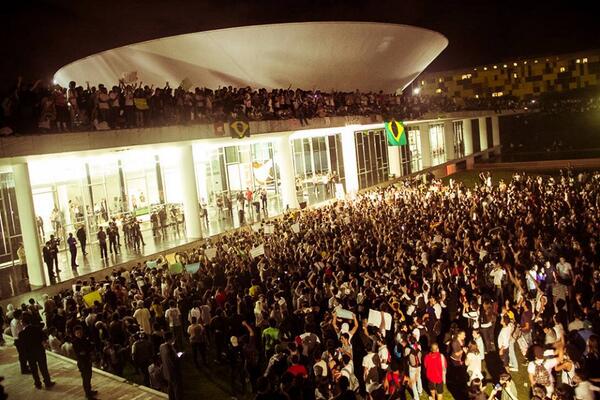
Mass protests continued throughout Brazil on Monday, with hundreds of thousands of demonstrators converging in Sao Paulo, Rio de Janeiro, Belo Horizonte, the capital of Brasilia and other cities.
Protests initially began last week following a government announcement of an increase in public transportation costs, which brought out students and young workers and led to more than 250 arrests.
According to reports by Brazilian media such as Jornal do Dia, the initially peaceful demonstrations last week became heated, and led to clashes with Brazil’s riot police that left at least 100 injured in the major cities of Brasilia, Sao Paulo, Rio de Janeiro and Belo Horizonte.
Though the protests initially began following the announcement of bus fare increases, they have evolved to include a wide range of groups that have grown dissatisfied over everything from government corruption and income inequality, as well as to outrage over the police’s harsh response to protesters last week.
In a sign that public dissatisfaction was still simmering, soccer fans booed president Dilma Rousseff on Monday during the opening of a two-week tournament at a stadium in the capital Brasilia. The heckling only intensified when the president of the global soccer body, FIFA, reprimanded the crowed for failing to show the president “respect.”
Though Rousseff was able to ride on her predecessor’s popularity, Brazil’s economic growth has slowed considerably since she took over from Luiz Inacio Lula da Silva, who is widely credited with lifting 40 million Brazilians out of poverty. Brazil’s economy has posted its worst two-year performance in over a decade, and inflation rose to 6.5 per cent in May.
At least 20,000 Brazilians were expected to demonstrate in Sao Paulo on Monday, with organizers placing the figure closer to 30,000.
This video is part of an extended interview with writer Yossi Gurvitz [ http://ygurvitz.net ] – transcribed & translated from Hebrew to English by Dena Shunra
The Lab is a new groundbreaking Israeli documentary film that redefines our entire understanding of the Jewish State, its aims, its identity and its global destructive role. I honestly believe that this film is the deepest and most important commentary on Israel.
In The Lab, Director Yotam Feldman exposes the Israeli military industry and its operation, he interviews some major protagonists within Israel’s ‘security’ trade. He elaborates on the role of the industry within the Israeli society and economy; in the last few years Israeli security exports reached an unprecedented level of $7 billion a year. A full 20% of Israeli exports are military or military related. Approximately 150,000 families in Israel are dependent on that industry. Israel is now the fourth biggest military exporter.
In the last decade, every Israeli military operation led to an immediate sharp increase in sales of Israeli military export around the world: weaponry, systems, intelligence, strategies, doctrines, knowledge, and experience.
Feldman provides us with a glimpse into a very organized universe. We visit Israeli weapon fairs around the world but we also see arenas filled to capacity with foreign generals, public officials and diplomats. They are all shopping for Israeli military products. The message is clear, the 7 billion dollars is just part of the story. Israeli military elite is now deeply interwoven with the political and military elite of every country around the globe. This emerging Israeli business buys the Jewish state influence and support.1
The Lab makes it evidently clear that the Palestinian civilian population in the West Bank and Gaza have become test subjects for Israeli tactics, weaponry and fighting philosophy (‘Fighting Torah’, Torat Lechima — as the Israelis call it). The destruction of the Palestinians has now been transformed into a very profitable industry. We are dealing here with nothing short of highly calculated murder.
Through a set of fascinating interviews, Feldman conveys a very genuine picture of the Israeli death merchants. Feldman lets them talk, he hardly interferes. They are sharp, they are genuine, they are even funny at times, occasionally witty, and a few of them, might even be charming if you did not know who they are. But make no mistake, they are sinister, some of them are clearly psychotic, they are mass murderers and they are free. They sell destruction and havoc and do it very successfully.2
Being myself an Israeli-born and raised successful musician and writer, I think I can recognize Israeli dedication, perseverance and creativity when I see it, no matter into what service it is pressed. (Perhaps I was lucky to be rescued by bebop.) Those Israeli death angels’ talent is driven into the amplification of human misery. The consequences are tragic.
Game Changer
It is far from being a secret that a century of Palestinian struggle led to practically nothing. The state of the Palestinian solidarity movement is even more embarrassing. The Lab is a game changer, for it can explain decades of impotence.
We are immersed in flawed terminology — ‘colonialism’, ‘apartheid’, ‘conflict’, ‘solution’, ‘Zionism’ are just few examples. Gaza is now a vast Laboratory — the Israelis are the ‘scientists’ and the ‘technicians’, the Palestinians are the ‘guinea pigs’. Watching The Lab must lead all of us to fundamentally question our notions. We are dealing with a premeditated war crime. The notion of resolution (as in ‘two-state solution’), for instance, is not applicable. It is clear beyond doubt that in the real world the ‘scientist’ does not negotiate with the ‘guinea pig’. The ‘scientist’ also doesn’t consider sharing reality with his ‘guinea pig’ in a ‘one democratic state.’ “The Lab” is a glimpse into the Israeli mind: you clearly do not find much compassion there.
For decades we were foolish to examine the success and failure of Israeli military operations in reference to Israeli military and political ‘objectives,’ as we surmised them. We were clearly wrong.
As we learn from Feldman’s film, the real objective of Israeli operations may as well be examining new doctrines and operational systems in order to distribute them around the world soon after. Ehud Barak, for instance, wasn’t exactly the most sophisticated Israeli minister of defense, he clearly failed to defend his people or even make them feel secure. However, he was very successful in selling Israeli weapons and doctrines.
Tel Aviv being subject to a barrage of Qassam rockets may be seen by Israelis as devastating news, but from a military industrial point of view, it was a golden opportunity to examine and promote the Israeli anti-missile system Iron Dome. If I am correct here, it becomes clear that like the Palestinians, more and more Israelis are also becoming ‘guinea pigs’ in this ever growing military laboratory.
One may wonder how and when “the Zionist dream” transformed itself into a military business. Only a few of us, writers and scholars, have attempted to answer this question. The transformation of the Jewish State into an oppression factory is apparently a direct outcome of Israel’s supremacist ideology. If we want to understand what is happening in the Jewish State, we must first grasp the notions of choseness, Jewishness and Jewish identity politics.
I guess that enough Palestinians in Gaza do realise by now that they have been part of an Israeli experiment. Every too often we learn from Palestinian doctors that while treating casualties of Israeli aggression they encounter new types of wounds. The Lab explains it but it isn’t Palestine alone. We also witness a growing similarity between the operational mode of police forces around the world and the IDF treatment of the Palestinians.
Watching Yotam Feldman’s The Lab explains it all. We are all Palestinians. We are either occupied by Israel or by its proxy forces around the world — those who are trained in Israel and implement Israeli weaponry and tactics.
African agriculture is in need of support and investment. Many initiatives are flowing from the North, including the G8’s “New Alliance for Food Security and Nutrition in Africa” and the Alliance for a Green Revolution in Africa (AGRA). These initiatives are framed in terms of the African Union’s Comprehensive African Agricultural Development Programme (CAADP). This gives them a cover of legitimacy.
But what is driving these investments, and who is set to benefit from them?
The current wave of investment emerges on the back of the gathering global crisis with financial, economic, food, energy and ecological dimensions. Africa is seen as underperforming and in control of valuable resources that capital seeks for profitable purposes. The World Bank and others tell us Africa has an abundance of available fertile land, and that Africa’s production structure is inefficient, based as it is on many small farms producing mainly for themselves and their neighbourhoods (i).
Africa is seen as a possible new frontier to make profits, with an eye on land, food and biofuels in particular. The recent investment wave must be understood in the context of consolidation of a global food regime (ii) dominated by large corporations in input supply (seed and agrochemicals) especially, but also increasingly in processing, storage, trading and distribution.
G8 and AGRA: a new wave of colonialism
Opening markets and creating space for multinationals to secure profits lie at the heart of the G8 and AGRA interventions. Both initiatives are built on the basis of public-private partnerships (PPPs) with the large multinational seed, fertiliser and agrochemical companies setting the agenda, and states and institutions (like the G8, World Bank and others) and philanthropic institutions (like AGRA and others) establishing the institutional and infrastructural mechanisms to realise this agenda.
Multinational corporations like Yara, Monsanto, Syngenta, Cargill and many others want secure markets for their products in Africa. In the first place, security means protection of their private ownership of knowledge in the form of intellectual property (IP) protection. Across Africa, so-called ‘harmonisation’ of laws and policies are underway to align African laws and systems with the interests of these multinationals.
Harmonisation of trade laws means opening borders across the continent to free trade. But this is a skewed free trade, one that favours the ‘formal sector’ of goods and services that have gone through approval and registration processes. Farmers and other producers of goods and services who cannot afford to enter the official approval system are marginalised and trading of their products is rendered illegal.
Private ownership of knowledge and material resources (for example, seed and genetic materials) means the flow of royalties out of Africa into the hands of multinational corporations. In some countries where laws protecting the interests of corporations are well established – for example in South Africa – multinationals have entirely occupied domestic seed and agrochemical sectors with profits flowing out of the country. The same is happening for agricultural services, trade, manufacturing and even selling of food.
The private companies are not acting on their own. They are using investment-friendly government policies and plans to advance their agenda.
CAADP and regional investment policies: facilitating ‘orderly’ processes of colonialism
There are many well-meaning organisations and individuals who view CAADP as an African-based investment plan. But Africa is not isolated from the world. CAADP emerged at the height of neo-liberalism globally in the early 2000s. African governments were mired in the consequences of decades of structural adjustment that saw the net outflow of financial and other resources from Africa to the rest of the world. The New Economic Partnership for Africa’s Development (NEPAD) was an initiative by selected African governments to integrate Africa into global flows of capital. The expectation was that profit-generating investment, and creating the conditions for protection of this investment, were Africa’s chance to catch up with the rest.
African governments, desperate for some financial relief, are willing to make whatever changes are necessary to bring capital into their countries. The multinationals are setting the terms: harmonisation, free trade and protection of private IP or no investment. It is therefore of little use calling for CAADP to be placed at the centre of investment plans. CAADP itself is a compromised instrument, calling for the very policies and programmes favoured by the multinationals.
Food security and corporate-driven investment in Africa
Harmonisation, free trade and the creation of institutions and infrastructure to facilitate multinational penetration into Africa are presented as the answer to food insecurity on the continent. Multinational corporations, African states, states outside Africa, philanthropic institutions, multilateral institutions such as the World Bank and even some non-government organisations are all part of this agenda. Surely so many organisations and people cannot be wrong?
The logic is that of the Green Revolution: introduce yield- and sales-enhancing technologies and systems, provide credit for producers to access these technologies, and anticipate increasing returns from sales to cover the increasing cost of inputs. Expand access to markets globally and regionally to absorb increased production.
This model can benefit some, as Green Revolutions in Asia and to a lesser extent in Latin America have shown. However, it also has negative social and ecological side effects. Green Revolution technologies benefit relatively few farmers, often at the expense of the majority. These technologies produce concentration of land ownership, increasing economies of scale (production has to be at a large scale to get into and stay in markets), and a declining number of food producing households in a context of limited other livelihood options.
Ecological concerns about Green Revolution technologies are rising to the top of the global agenda, especially loss of biodiversity when commercial hybrids and GM seed dominate (especially maize as a staple crop in Africa, and the introduction of soya as the basis of biofuels and commercial intercropping approaches), soil degradation and water pollution caused by excessive use of manufactured chemicals in synthetic fertilisers, and water shortages caused by wasteful water use in irrigation.
The Green Revolution produces uneven benefits, favouring farmers with financial resources of their own, with access to more land, and with some formal education. The majority of resource poor farmers are excluded from public support for agriculture, with infrastructure and institutional frameworks designed for the minority to benefit.
Currently African food security rests fundamentally on small-scale and localised production. The majority of the African population continue to rely on agriculture as an important, if not the main, source of income and livelihoods. In most sub-Saharan African countries, agriculture is the primary economic activity for between 50% and 90% of the population (iii). Even though there is growing urbanisation, the majority will continue to rely on agriculture for their livelihoods for decades to come. The rural population continues to grow in absolute terms even while the urban population grows as a proportion of the total population.
We know that all of these people will not benefit from these new investments. Seen as more inefficient than those producers who are in a position to adopt the new technologies, many will be forced out of agriculture to become passive consumers. Instead of building the broad base of producers, G8 and AGRA investments, supported by African government policies and resources, will narrow the base of producers.
The practical results of the recent surge in investment in African agriculture expose the empty rhetoric of African food security. Blatant land grabs are well known across the continent. Mega projects such as the ProSavanna project in northern Mozambique are displacing farmers from their lands and imposing large-scale production structures for export. Favourable investment terms (for example tax free zones and laws on repatriation of profits) undermine even the questionable benefits increased foreign exchange brings. Meanwhile actual farmers are separated from the land and the only realistic option for a livelihood. African governments and their investment ‘partners’ enable and implement these projects.
Alternatives
First and foremost, differentiated strategies are required, so that local and informal markets, proven low-input and ecologically sustainable agricultural techniques including intercropping, on-farm compost production, mixed farming systems (livestock, crops and trees), on-farm biofuel production and use, and intermediate processing and storage technologies are recognised and vigorously supported. The emphasis here is on individual and household food security first, with trade arising from surpluses beyond this. The International Assessment of Agricultural Knowledge, Science and Technology for Development (IAASTD) provides detailed and scientifically sound proposals in this regard.
Open access technologies are an essential principle, especially seed, where all recent technological advances are based on 10,000 years of collective experimentation and sharing. No-one and no corporations should be allowed to privatise the results of ongoing research. Companies can sell their new varieties, but once sold, they re-enter the common pool that anyone should be able to use and improve on at will.
Green Revolution technological development leads to an ever-increasing gap between conception and execution, that is between the knowledge that goes into producing a new seed variety and those who use the seed. An alternative, based on open source technologies, is a far closer working relationship between decentralised technicians and producers to define the research and development agenda (what traits are farmers looking for in specific locations, what crops are priorities for further development etc). Plant breeders are still able to make profits by selling new varieties to those who want to buy fresh seed, especially commercial farmers. But if farmers choose to reuse and adapt seed once they have bought it, that must be their right.
Notes
i World Bank 2009 “Awakening Africa’s sleeping giant: Prospects for commercial agriculture in Africa’s Guinea Savannah zone and beyond”, World Bank Agriculture and Rural Development Unit, Africa Regional Office
ii McMichael, P. 2009 “A food regime genealogy”, Journal of Peasant Studies, 36: 1, pp.139-169
During the world’s most secretive gathering the Bilderberg Group is set to discuss topics including cyber warfare, US foreign policy, “developments in the Middle East” and “Africa’s challenges” despite the glaring absence of regional representatives.
The Bilderberg Group, long criticized for a lack of transparency, has revealed details of its upcoming meeting. This year 138 politicians, bank bosses, billionaires, chief executives and European royalty have confirmed their attendance to the invitation-only event, set to take place in Watford, England. The list notably includes only 14 women.
The group is comprised largely of individuals from financial and business backgrounds – there will be nearly three dozen CEOs and more than two dozen Chairmen of banks and petroleum giants. Twenty-three financial institutions will be represented at the five-star Grove Hotel near Watford, Hertfordshire, including Goldman Sachs.
As the list was released, critics could not help but point fingers at problems some of the attendees are currently facing in their respective fields.
Special attention has been placed on Amazon’s founder and CEO Jeff Bezos and Google’s Eric Schmidt, as the two are currently facing unprecedented political pressure over their tax avoidance strategies. Google, for its part, has faced scrutiny amid reports that it paid just £10 million in corporation tax in Britain between 2006 and 2011, despite revenues of £11.9 billion.
Chancellor George Osborne and his Labour shadow Ed Balls, who have been making headlines with their spending and tax offers for the UK, will also rub shoulders with other participants of the Bilderberg Conference.
One of the guests is group chairman of HSBC Holdings plc, which faced a stringent investigation in 2012 for allegedly assisting in the laundering of money from Mexico, Iran and Syria for terrorist networks and drugs cartels.
Among guests there are also the 75th and 70th US Treasury Secretaries, Tim Geithner and Robert Rubin, respectively.
There will be other leading figures such as Christine Lagarde, head of the IMF, former US secretary of state and Nobel Peace Prize winner, Henry Kissinger, and David Petraeus, the former director of the CIA.
The list of prestigious names also includes the former Prime Ministers of France and Italy, François Fillon and Mario Monti.
There will also be scholars from some of the world’s most prestigious universities – one from Harvard University, two from Stanford, and one from both Oxford and Princeton.
Starting June 6 for three days, the delegates will be discussing of the record a list of topics of universal importance, determining how the world should proceed.
“The conference has always been a forum for informal, off-the-record discussions about megatrends and the major issues facing the world,” a Bilderberg spokesman said in a press release.
Originally founded in 1954 to foster dialogue between Europe and North America, this year’s topics include an expansive range of issues.
With Europe still trying to find solutions for financial problems and growing unemployment, the elite guests are set to discuss “jobs, entitlement and debt”, “politics of the European Union” and the broadly defined “current affairs”.
Among the 12 “key topics” for this year’s conference are “developments in the Middle East” and “Africa’s challenges.” The inclusion of “Africa’s challenges” is an interesting choice, as the guest list is notably absent of any major (or minor) political or academic figures from that vast continent.
Despite Bilderberg’s traditional exclusion of other areas of the world, six Turkish attendees are slated to be the only Middle Eastern voices at the conference. The inclusion of a large contingent from that country comes at an auspicious time, as political demonstrations continue throughout Turkey in opposition to the ruling AKP party.
The overlapping agendas of political and private sector leaders, as well as current and former political leaders is enough to make even the most conservative of observers start to wonder what may bear fruit as a result of the top-level, off-the-record conference.
As with gatherings of the G-8 and other international organizations such as the World Trade Organization, which tend to draw large, disruptive groups of demonstrators, Bilderberg has prepared a robust security apparatus to keep things running smoothly.
According to various reports by British media, UK taxpayers will have to bear the brunt of the ‘exceptional costs’ to police the meeting, which takes place in that country for the first time since 1998.
Max Boot, one of the nation’s leading chickenhawks, and someone who wrote in 2011, rather straightforwardly, that the United States should maintain its presence in Iraq because “it would allow us to project power and influence in the region,” has written an op-ed for The Los Angeles Times,unapologetically titled “Choosing Sides in Afghanistan.” Boot, who currently holds the gruesome title of “Jeane J. Kirkpatrick Senior Fellow in National Security Studies” at the Council of Foreign Relations, is a throwback to a simpler time, when Western intellectuals felt comfortable speaking in explicitly imperialistic terms. His honesty is almost refreshing.
Anyway, the point of his new column is to bemoan the United States’s ostensible “neutrality” in the April 2014 presidential election in Afghanistan. Boot writes, naturally, as an honest friend and ally of the Afghan people. He even includes the boast, typical of many chickenhawks, that he “visited” the country recently. He’s so brave.
He starts out by saying that the United States should threaten to withhold aid if President Karzai cancels the election and just assumes dictatorial power (there is apparently “widespread suspicion” in Afghanistan that this will happen). This seems sensible enough; we shouldn’t be providing aid to any corrupt dictators.
Then, though, Boot informs us that, while striking a position of “neutrality” in a “foreign election” might be a “nice ideal,” it is simply “impossible” in this case. Boot’s prescription, shockingly enough, is for the United States to “embrace a more politically activist role” in the presidential election of a sovereign nation. Indeed, the Unites States should “pick a favorite” among the candidates, and then “use its influence, including those notorious CIA bags of cash” to “do what it can to secure the election” of its preferred choice. Boot recognizes the “obvious objections” to such a strategy, including our disastrous record of meddling in Afghan politics, but he warns that these past “mistakes” should not “paralyze” us now. This is just an astonishing paragraph right here:
That’s all true, but we need not be paralyzed by past mistakes. In 2001, U.S. officials knew little of the Afghan political landscape. We have had a dozen years since then to learn the lay of the land, which, one hopes, would allow us to make a better choice this time around.
Think about that last sentence. Boot asserts, flat-out, that the United States must “make a better choice” in the presidential election of another sovereign nation. I wonder if the people of Afghanistan are aware that the “choice” in next year’s election is, in fact, one that ought to be made by the United States.
Imagine if a foreign writer, highly respected in domestic establishment circles, demanded that his government “embrace” a “politically activist role” in the 2016 U.S. presidential election, picking a “favorite” candidate and then “use its influence” to “secure the election” of said candidate. This is virtually unthinkable. I’m not even sure if Boot is consciously aware of how hypocritical and contemptuous all of this is. I doubt he even thinks there is anything unusual about the very notion of proposing direct interference in a foreign election. This is how deep the imperial mindset runs in people like Boot and other establishment intellectuals.
A total of 3,099 families have been removed from their homes in Rio de Janeiro and another 7,843 have been threatened with removal as part of Brazil’s preparations for hosting the 2014 World Cup and the 2016 Olympic Games, according to a study released on May 15 by the Popular Committee of the World Cup and the Olympics. The group estimates that 30,000 people have been affected, based on the average number of people in the households. The study, “Mega-Events and Human Rights Violations in Rio de Janeiro,” was produced with the collaboration of the impacted communities, the Institute for Urban and Regional Research and Planning (Ippur) and other groups, including the nongovernmental organization (NGO) Global Justice.
The city government initially offered 18,000 reais (about US$8,872) for each home. Residents said this wasn’t enough even to buy the land for a new house. The city finally agreed to pay 40,000 reais (US$19,735), which residents said would pay for a two-bedroom house in the hills. “What we’re seeing is an urban restructuring project without any participation of society,” said Orlando Alves dos Santos Junior, an urban planning professor and one of the coordinators of the May 15 study. “In fact, what’s going on under this pretext [of preparation for the sports events] is a serious urban intervention, on the basis of the real estate industry. The presence of inhabitants from the poorest classes has become an obstacle to be removed from the path.” (Adital(Brazil) 5/17/13 from Canal Ibase (Brazilian Institute of Social and Economic Analyses))
Every so often we come across a secular Jewish ‘anti’ Zionist’ who argues that Zionism is not Judaism and vice versa. Interestingly enough, I have just come across an invaluable text that illuminates this question from a rabbinical perspective. Apparently back in 1942, 757 American Rabbis added their names to a public pronouncement titled ‘Zionism an Affirmation of Judaism’. This Rabbinical rally for Zionism was declared at the time “the largest public pronouncement in all Jewish history.”
Today, we tend to believe that world Jewry’s transition towards support for Israel followed the 1967 war though some might argue that already in 1948, American Jews manifested a growing support for Zionism. However, this rabbinical pronouncement proves that as early as 1942, the American Jewish religious establishment was already deeply Zionist. And if this is not enough, the rabbis also regarded Zionism as the ‘implementation’ of Judaism. Seemingly, already then, the peak of World War two, the overwhelming majority of American Rabbis regarded Zionism, not only as fully consistent with Judaism, but as a “logical expression and implementation of it.”
In spite of the fact that early Zionist leaders were largely secular and the East European Jewish settler waves were driven by Jewish socialist ideology, the rabbis contend that “Zionism is not a secularist movement. It has its origins and roots in the authoritative religious texts of Judaism.”
Those rabbis were not a bunch of ignoramuses. They were patriotic and nationalistic and they grasped that “universalism is not a contradiction of nationalism.” The rabbis tried to differentiate between contemporaneous German Nationalism and other national movements and they definitely wanted to believe that Zionism was categorically different to Nazism. “Nationalism as such, whether it be English, French, American or Jewish, is not in itself evil. It is only militaristic and chauvinistic nationalism, that nationalism which shamelessly flouts all mandates of international morality, which is evil.” But as we know, just three years after the liberation of Auschwitz the new Jewish State launched a devastating racially driven ethnic-cleansing campaign. Zionism has proven to be militaristic and chauvinistic.
Shockingly enough, back in 1942 as many as 757 American rabbis were able to predict the outcome of the war and they realised that the suffering of European Jewry would be translated into a Jewish State . “We are not so bold as to predict the nature of the international order which will emerge from the present war. It is altogether likely, and indeed it may be desirable, that all sovereign states shall under the coming peace surrender some of their sovereignty to achieve a just and peaceful world society [a Jewish State].”
Some American patriots today are concerned with Israeli-American dual nationality and the dual aspirations of American Jews. Apparently our rabbis addressed this topic too. According to them, there is no such conflict whatsoever. All American Jews are American patriots and all American decision makers are Zionists. “Every fair-minded American knows that American Jews have only one political allegiance–and that is to America. There is nothing in Zionism to impair this loyalty. Zionism has been endorsed in our generation by every President from Woodrow Wilson to Franklin Delano Roosevelt, and has been approved by the Congress of the United States. The noblest spirits in American life, statesmen, scholars, writers, ministers and leaders of labor and industry, have lent their sympathy and encouragement to the movement.”
Back in 1942 our American rabbis were bold enough to state that defeating Hitler was far from sufficient. For them, a full solution of the Jewish question could only take place in Palestine. “Jews, and all non-Jews who are sympathetically interested in the plight of Jewry, should bear in mind that the defeat of Hitler will not of itself normalize Jewish life in Europe.”
But there was one thing the American rabbis failed to mention – the Palestinian people. For some reason, those rabbis who knew much about ‘universalism’ and in particular Jewish ‘universalism’ showed very little concern for the people of the land. I guess that after all, chosenness is a form of blindness and rabbis probably know more about this than anyone else.
A Reply by 757 Orthodox, Conservative and Reform Rabbis of America to a Statement Issued by Ninety Members of the Reform Rabbinate Charging That Zionism Is Incompatible with the Teachings of Judaism
THE SUBJOINED REPLY was prepared at the initiative of the following Rabbis who submitted it to their colleagues throughout the country for signature: Philip S. Bernstein, Barnett R. Brickner, Israel Goldstein, James G. Heller, Mordecai M. Kaplan, B. L. Levinthal, Israel H. Levinthal, Louis M. Levitsky, Joshua Loth Liebman, Joseph H. Lookstein, Jacob R. Marcus, Abraham A. Neuman, Louis I. Newman, David de Sola Pool, Abba Hillel Silver, Milton Steinberg, and Stephen S. Wise.
WE, THE UNDERSIGNED RABBIS of all elements in American Jewish religious life, have noted with concern a statement by ninety of our colleagues in which they repudiate Zionism on the ground that it is inconsistent with Jewish religious and moral doctrine. This statement misrepresents Zionism and misinterprets historic Jewish religious teaching, and we should be derelict in our duty if we did not correct the misapprehensions which it is likely to foster.
We call attention in the first place to the fact that the signatories to this statement, for whom as fellow-Rabbis we have a high regard, represent no more than a very small fraction of the American rabbinate. They constitute a minority even of the rabbinate of Reform Judaism with which they are associated. The overwhelming majority of American Rabbis regard Zionism not only as fully consistent with Judaism but as a logical expression and implementation of it.
Our colleagues concede the need for Jewish immigration into Palestine as contributing towards a solution of the vast tragedy of Jewish homelessness. They profess themselves ready to encourage such settlement. They are aware of the important achievements, social and spiritual, of the Palestinian Jewish community and they pledge to it their unstinted support. And yet, subscribing to every practical accomplishment of Zionism, they have embarked upon a public criticism of it. In explanation of their opposition they advance the consideration that Zionism is nationalistic and secularistic. On both scores they maintain it is incompatible with the Jewish religion and its universalistic outlook. They protest against the political emphasis which, they say, is now paramount in the Zionist program and which, according to them, tends to confuse both Jews and Christians as to the place and function of the Jewish group in American society. They appeal to the prophets of ancient Israel for substantiation of their views.
TREASURING the doctrines and moral principles of our faith no less than they, devoted equally to America and its democratic processes and spirit, we nonetheless find every one of their contentions totally without foundation.
Zionism is not a secularist movement. It has its origins and roots in the authoritative religious texts of Judaism. Scripture and rabbinical literature alike are replete with the promise of the restoration of Israel to its ancestral home. Anti-Zionism, not Zionism, is a departure from the Jewish religion.Nothing in the entire pronouncement of our colleagues is more painful than their appeal to the prophets of Israel—to those very prophets whose inspired and recorded words of national rebirth and restoration nurtured and sustained the hope of Israel throughout the ages.
Nor is Zionism a denial of the universalistic teachings of Judaism. Universalism is not a contradiction of nationalism. Nationalism as such, whether it be English, French, American or Jewish, is not in itself evil. It is only militaristic and chauvinistic nationalism, that nationalism which shamelessly flouts all mandates of international morality, which is evil. The prophets of Israel looked forward to the time not when all national entities would be obliterated, but when all nations would walk in the light of the Lord, live by His law and learn war no more.
Our colleagues find themselves unable to subscribe to the political emphasis “now paramount in the Zionist program.” We fail to perceive what it is to which they object. Is it to the fact that there are a regularly constituted Zionist organization and a Jewish Agency which deal with the mandatory government, the Colonial office, the League of Nations and other recognized political bodies? But obviously, even immigration and colonization are practical matters which require political action. The settlement of a half million Jews in Palestine since the last war was made possible by political action which culminated in the Balfour Declaration and the Palestine Mandate. There can be little hope of opening the doors of Palestine for mass Jewish immigration after the war without effective political action. Or is it that they object to the ultimate achievement by the Jewish community of Palestine of some form of Jewish statehood? We are not so bold as to predict the nature of the international order which will emerge from the present war. It is altogether likely, and indeed it may be desirable, that all sovereign states shall under the coming peace surrender some of their sovereignty to achieve a just and peaceful world society.
Certainly our colleagues will allow to the Jews of Palestine the same rights that are allowed to all other peoples resident on their own land. If Jews should ultimately come to constitute a majority of the population of Palestine, would our colleagues suggest that all other peoples in the post-war world shall be entitled to political self-determination, whatever form that may take, but the Jewish people in Palestine shall not have such a right?Or do they mean to suggest that the Jews in Palestine shall forever remain a minority in order not to achieve such political self-determination?
PROTESTING their sympathy both for the homeless Jews of the world and for their brethren in Palestine, our colleagues have by their pronouncement done all these a grave disservice. It may well be that to the degree to which their efforts arc at all effective, Jews who might otherwise have found a haven in Palestine will be denied one. The enemies of the Jewish homeland will be strengthened in their propaganda as a result of the aid which these Rabbis have given them. To the Jews of Palestine, facing the gravest danger in their history and fighting hard to maintain morale and hope in the teeth of the totalitarian menace, this pronouncement comes as a cruel blow.
We do not mean to imply that our colleagues intended it as such. We have no doubt that they are earnest about their fine spun theoretical objections to Zionism. We hold, however, that these objections have no merit, and further that voicing them at this time has been unwise and unkind.
We have not the least fear that our fellow Americans will be led to misconstrue the attitudes of American Jews to America because of their interest in Zionism. Every fair-minded American knows that American Jews have only one political allegiance–and that is to America. There is nothing in Zionism to impair this loyalty. Zionism has been endorsed in our generation by every President from Woodrow Wilson to Franklin Delano Roosevelt, and has been approved by the Congress of the United States. The noblest spirits in American life, statesmen, scholars, writers, ministers and leaders of labor and industry, have lent their sympathy and encouragement to the movement.
Jews, and all non-Jews who are sympathetically interested in the plight of Jewry, should bear in mind that the defeat of Hitler will not of itself normalize Jewish life in Europe.
An Allied peace which will not frankly face the problem of the national homelessness of the Jewish people will leave the age-old tragic status of European Jewry unchanged. The Jewish people is in danger of emerging from this war not only more torn and broken than any other people, but also without any prospects of a better and more secure future and without the hope that such tragedies will not recur again, and again. Following an Allied victory, the Jews of Europe, we are confident, will be restored to their political rights and to equality of citizenship. But they possessed these rights after the last war and yet the past twenty-five years have witnessed a rapid and appalling deterioration in their position. In any case, even after peace is restored Europe will be so ravaged and war-torn that large masses of Jews will elect migration to Palestine as a solution of their personal problems.
Indeed, for most of these there may be no other substantial hope of economic, social and spiritual rehabilitation.
THE freedom which, we have faith, will come to all men and nations after this war, must come not only to Jews as individuals wherever they live, permitting them to share freedom on a plane of equality with all other men, but also to the Jewish people, as such, restored in its homeland, where at long last it will be a free people within a world federation of free peoples.
Of the 757 Rabbis listed below, 214 are members of the Central Conference of American Rabbis (Reform); 247 are members of the Rabbinical Assembly of America (Conservative); and the rest are affiliated with the Rabbinical Council of America (Orthodox) or the Union of Orthodox Rabbis. The total represents the largest number of rabbis whose signatures are attached to a public pronouncement in all Jewish history.
To see the scanned image in PDF format with the list of signers, click here
Note: A version of the above statement was released to the press on November 20, 1942. By that time 818 rabbis had signed on. It appears in Samuel Halperin’s The Political World of American Zionism. (Detroit: Wayne State UP, 1961) 333.
Under current U.S. law, all our publicly traded corporations must annually disclose exactly what they pay their top executives. So why do all those CEO pay scorecards we see every spring show such different results?
USA Todayfound an 8 percent hike in 2012 CEO pay while TheNew York Times detected an 18.7 percent increase. Towers Watson, a corporate consulting firm, announced that CEO pay growth “slowed considerably,” rising at just a 1.2 percent rate last year.
What explains all these wildly divergent results? Let’s start with how corporations pay their top execs. This can get tricky.
Most executive pay today comes as stock-related compensation. Stock “options” give executives the right, down the road, to buy shares of their company stock at today’s share price. If that share price jumps, the execs can buy low and sell high. Instant windfall.
“Restricted” stock awards, on the other hand, give executives actual shares of stock, not just an option to buy them. Execs do have to wait a few years before they can actually claim these shares. No big deal. The shares will still have value in future years even if a company’s stock takes a hit.
But how should we value all this share-related compensation right now? Should CEO pay scorekeepers estimate how much stock awards granted this year will be worth in years to come? Or should scorekeepers only tally stock-related awards when execs actually profit personally from them?
Different executive pay scorekeepers give different answers. Scorekeepers also keep score on different sets of corporations. USA Today‘s new scorecard for 2012 tallies pay at 170 firms, the New York Times at just 100.
Given all this, do we have any single stat that tells us what we need to know? We do. That stat: the divide between worker and top executive pay.
America’s big-time CEOs, labor researchers at the AFL-CIO report, are now making 354 times the pay of average U.S. workers, the “largest pay gap in the world.”
Three decades ago, in 1982, American CEOs averaged just 42 times more than average U.S. workers. Two decades ago, in 1992, the gap stood at 201 times. A decade ago: 281 times.
The overall trend line, in other words, couldn’t be clearer. How can we reverse it? Identifying the specific pay gap between individual CEOs and their own workers would be a good first step.
Corporations have had to publish, for decades now, how much they pay their top execs. They haven’t had to reveal publicly how much — or how little — they pay their workers. The Dodd-Frank Wall Street Reform and Consumer Protection Act enacted in 2010 changes this dynamic, at least on paper.
Dodd-Frank requires corporations to annually disclose the gap between what they pay their CEOs and their most typical workers. But a corporate lobbying blitz has kept the Securities and Exchange Commission from writing the regulations needed to enforce this disclosure mandate.
Why do our biggest corporations so fervently oppose disclosing their CEO-worker pay ratios? Disclosure by itself, after all, won’t shove down CEO pay levels. But disclosure could open the door to other steps that could curb CEO pay excess.
Lawmakers could, for instance, choose to deny government contracts or tax breaks to corporations that pay their top executives over 25 or even 50 times what their own workers are making.
Far-fetched? Current law already denies government contracts to companies that discriminate by race or gender in their employment practices. As a society, we’ve concluded that our tax dollars must not go to corporations that widen racial or gender inequality.
So why should we let our tax dollars enrich corporations that widen our economic divide?
By Kurt Nimmo | Another Day in the Empire | April 20, 2026
In 2025, Alex Karp, the CEO of government and military tech contractor Palantir, published The New York Times best-seller, The Technological Republic: Hard Power, Soft Belief, and the Future of the West. The Wall Street Journalpraised the book as a cri de coeur, a passionate appeal “that takes aim at the tech industry for abandoning its history of helping America and its allies,” while Wired praised the book as a “readable polemic that skewers Silicon Valley for insufficient patriotism.”
On April 18, 2026, Palantir posted twenty-two points to social media summarizing the book. In addition to taking Silicon Valley to task for insufficient patriotism, advocating a role for AI in forever war, and denouncing the “psychologization of modern politics,” the Palantir post on X declares: “National service should be a universal duty. We should, as a society, seriously consider moving away from an all-volunteer force and only fight the next war if everyone shares in the risk and the cost.”
National conscription, a form of involuntary servitude, and the wars it portends, is good for business, especially for corporations within the orbit of the Pentagon, the CIA, and the national security state. Palantir fits comfortably within this amalgamation. … continue
This site is provided as a research and reference tool. Although we make every reasonable effort to ensure that the information and data provided at this site are useful, accurate, and current, we cannot guarantee that the information and data provided here will be error-free. By using this site, you assume all responsibility for and risk arising from your use of and reliance upon the contents of this site.
This site and the information available through it do not, and are not intended to constitute legal advice. Should you require legal advice, you should consult your own attorney.
Nothing within this site or linked to by this site constitutes investment advice or medical advice.
Materials accessible from or added to this site by third parties, such as comments posted, are strictly the responsibility of the third party who added such materials or made them accessible and we neither endorse nor undertake to control, monitor, edit or assume responsibility for any such third-party material.
The posting of stories, commentaries, reports, documents and links (embedded or otherwise) on this site does not in any way, shape or form, implied or otherwise, necessarily express or suggest endorsement or support of any of such posted material or parts therein.
The word “alleged” is deemed to occur before the word “fraud.” Since the rule of law still applies. To peasants, at least.
Fair Use
This site contains copyrighted material the use of which has not always been specifically authorized by the copyright owner. We are making such material available in our efforts to advance understanding of environmental, political, human rights, economic, democracy, scientific, and social justice issues, etc. We believe this constitutes a ‘fair use’ of any such copyrighted material as provided for in section 107 of the US Copyright Law. In accordance with Title 17 U.S.C. Section 107, the material on this site is distributed without profit to those who have expressed a prior interest in receiving the included information for research and educational purposes. For more info go to: http://www.law.cornell.edu/uscode/17/107.shtml. If you wish to use copyrighted material from this site for purposes of your own that go beyond ‘fair use’, you must obtain permission from the copyright owner.
DMCA Contact
This is information for anyone that wishes to challenge our “fair use” of copyrighted material.
If you are a legal copyright holder or a designated agent for such and you believe that content residing on or accessible through our website infringes a copyright and falls outside the boundaries of “Fair Use”, please send a notice of infringement by contacting atheonews@gmail.com.
We will respond and take necessary action immediately.
If notice is given of an alleged copyright violation we will act expeditiously to remove or disable access to the material(s) in question.
All 3rd party material posted on this website is copyright the respective owners / authors. Aletho News makes no claim of copyright on such material.