Jewish Fingernail Fact Check
Did a rabbi say that “a thousand Blacks aren’t worth the fingernail of a Jewish man”?
Nation Of Islam Research Group
Why, yes. More than one rabbi has expressed openly this white Jewish supremacist rhetoric in both Israel and America. And though Jewish leaders have tried mightily to portray themselves as equal rights crusaders, the mind and mentality of white supremacy runs deeply through Jewish culture and history. Now, let’s look at the Jewish fingernail facts.
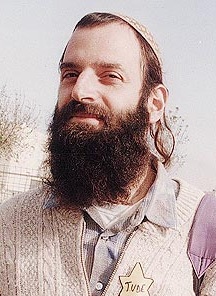
On February 25, 1994, the Brooklyn-born Israeli settler and physician Baruch Goldstein (in photo) machine-gunned 800 Muslims at prayer in Hebron’s Ibrahimi mosque, killing 29 and wounding 125, and setting off riots in which reportedly more than 100 Palestinians were killed by Israeli soldiers. The February 28, 1994, New York Times covered Goldstein’s funeral:
“One million Arabs are not worth a Jewish fingernail,” Rabbi Yaacov Perrin said in a eulogy. At the service in Jerusalem, attended by 300 people, one man shouted, “We are all Goldstein,” an opinion echoed across Qiryat Arba by neighbors who said variously that they approved of his attack on the Arabs or at the least could not judge him.
At least 100 newspapers covered the racist rabbi’s genocidal decree and the support it received in Israel from admirers of Goldstein’s massacre of Palestinians. The Times further reported that Jewish worshippers came to his grave “by the hundreds…many bowing deeply to kiss the tombstone of the Hebron mass killer and to proclaim him a holy man.” A Jerusalem college professor declared Goldstein the “greatest Jew alive,” and Rabbi Dov Lior proclaimed that Goldstein was “holier than all the martyrs of the Holocaust.”
Goldstein’s deification provides a window into the mind and manner of a strangely violent people who have in recent months perpetrated the open extermination of the Palestinian people. What has become clear is that Zionist Jews are following an ancient script—a largely unknown and unholy book of their own creation. This book prescribes one system of justice for themselves, and a system of slavery and apartheid for everyone else. It explicitly declares that all dark-skinned people (and that’s 91% of the planet) are cursed by God to be their slaves forever. It specifically decrees that Jesus, the messiah to 2.4 billion Christians, is worthy only to be boiled in feces—forever. It asserts that his mother Mary, for whom the central Nation of Islam mosque is named, was a whore. Murder, lying, cheating and stealing are endorsed options for its believers, and the preemptive killing of perceived threats is commanded.
The ~2,000-year old Babylonian Talmud is the document we refer to here. Mass murderer Goldstein was trained in the Talmud at a Brooklyn Jewish school (yeshiva), and it has become the focus of attention as its destructive tenets are applied in a live-streamed, televised genocide. Its lead exterminator is the Caucasian prime minister of Israel Benjamin Netanyahu, who announced to the world in 2014 that he would establish the Talmud as the “official basis for Israeli state law.” In other words, once passage of Talmud Law goes into effect, Caucasian Jews will be enthroned at the top of a violent race hierarchy of their own design.
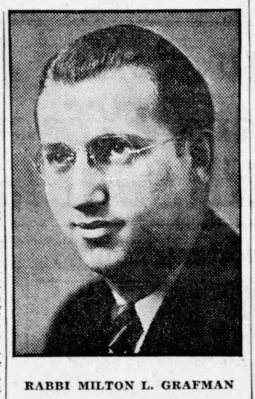
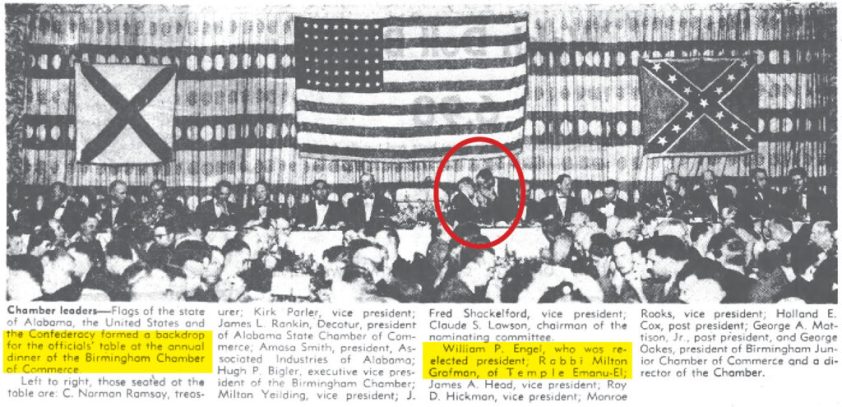
And this vile “Jewish fingernail” fraternity is not unique to Israel. In America, the very same Talmudic mentality was openly expressed by a rabbi at a meeting of the Anti-Defamation League (ADL)—with DIRECT reference to Blacks. Birmingham, Alabama, was “ground zero” of the civil rights movement led by Dr. Martin Luther King, Jr., and it is where four little Black girls were murdered in the bombing of the Sixteenth Street Baptist Church in 1963 by white terrorists. At the time, most of Birmingham’s 4,000 Jews were represented by the notorious racist and white supremacist Rabbi Milton L. Grafman, of Temple Emanu-El synagogue. It was also home to several wealthy Jews in the business community, including Chamber of Commerce president William Engel, who held the group’s meetings under the Confederate flag, with Grafman giving his holy invocation (see photo).
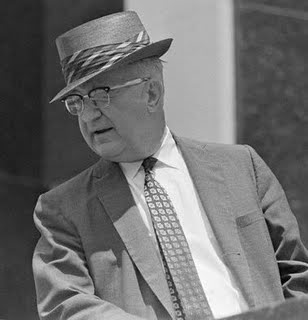
Birmingham’s notoriously vicious Commissioner of Public Safety Eugene “Bull” Connor (in photo) turned fire hoses and attack dogs on Black women and children for the world to see, yet behind the scenes Connor was supported and financed by these Jews, who, according to author Suzanne F. Nossel, “felt safe under his care.” When some progressive Jews criticized Connor, three Birmingham synagogues joined in demanding that they formally apologize to Connor, calling their charges “unfounded, unjust, and irresponsible.” That is the true picture of Black–Jewish relations in America. In fact, Rabbi Grafman was so angered by Dr. King and his freedom movement that he lashed out in that ADL meeting: “The lives of one thousand negroes are not worth a hair on the head of a single Jew!”
At the time, Grafman’s racist bloviations embarrassed the Jewish leadership who were pushing the well-oiled propaganda that Jews were committed “civil rights” crusaders. Grafman’s profile on Wikipedia, the popular on-line encyclopedia, falsely claimed that the Nation of Islam Research Group is the only source for his damning “not worth a hair” statement. The Wiki scribes dismissively wrote: “In 2019, a meme circulated by The Nation of Islam falsely attributed a racist quote to Grafman….This so-called quote was lifted from a 2013 commentary in ‘The Final Call’ by Tingba Muhammad. There is no contemporaneous or current record of the purported remarks, other than in the Final Call article. (see below)”
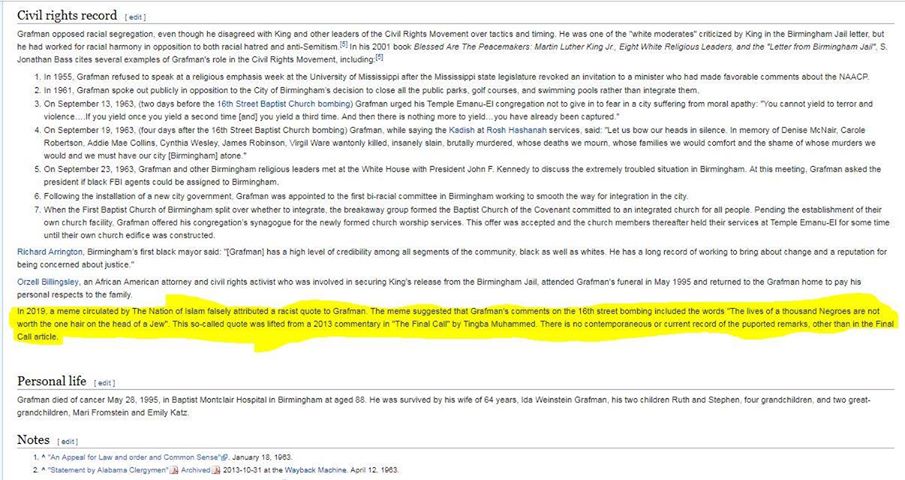
But that was merely the disingenuous protestation of a culprit caught red-handed. Nonetheless, the Wiki entry provides a great opportunity to see how the history of Blacks and Jews is corrupted and relentlessly filtered to “disappear” Jews like Grafman, Engel and Goldstein from their most egregious crimes. Has the Nation of Islam slandered Grafman, or has Wikipedia slandered the Nation of Islam? This is no small consideration, given that the Talmud’s prescribed sentence for slander is to be cursed with white skin (Arakhin 15b)! Let us now back-engineer the quote to determine whether “The Nation of Islam falsely attributed a racist quote” to Rabbi Grafman.
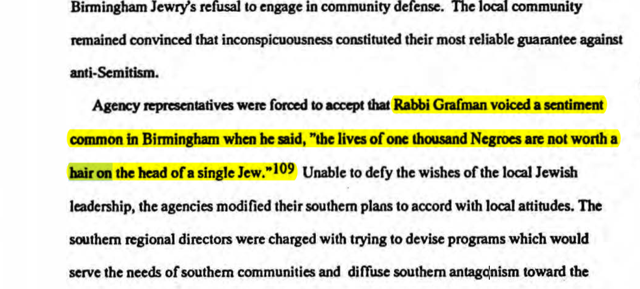
In fact, Rabbi Grafman’s “one thousand negroes” statement has been revealed in several places, but often in ways designed to obscure Grafman and the congregation that supports him. In her unpublished 1991 Harvard study titled “Weathering the Storm: The Jewish Community in Birmingham, Alabama, During the Civil Rights Revolution,” Suzanne F. Nossel writes that Jewish leaders (see screenshot) “were forced to accept that Rabbi Grafman voiced a sentiment common in Birmingham when he said, ‘the lives of one thousand Negroes are not worth a hair on the head of a single Jew.’”
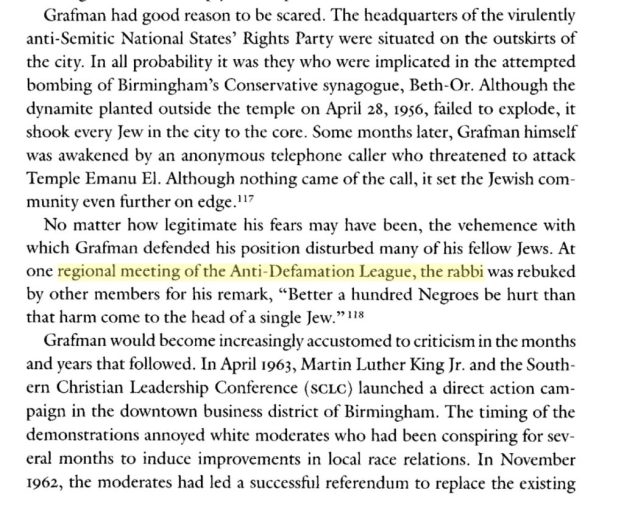
Dr. Clive Webb’s 1997 dissertation, which earned him a Ph.D. from University of Cambridge, is titled “A History of Black–Jewish Relations in the American South, 1790-1970.” It is also unpublished and thus far more difficult for the average reader to access. Webb wrote that Grafman made the following remark at that above-mentioned Anti-Defamation League meeting: “Better a hundred Negroes be hurt than that harm come to the head of a single Jew.” Webb quoted another Jew who was present who recounted that “one rabbi stood up and exclaimed that he would not risk ‘one hair on the head of my members for the life of every shvartzeh in the state’.” Shvartzeh, of course, is the Yiddish word for nigger, and that “one rabbi” is obviously Grafman. At the time, “every shvartzeh in the state” amounted to a Black population of about 1.1 million, bringing Grafman’s holocaust to Palestinian proportions.
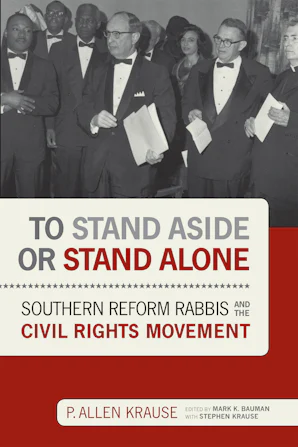
In his posthumously published 2016 book To Stand Aside or Stand Alone: Southern Reform Rabbis and the Civil Rights Movement, Rabbi P. Allen Krause reiterates (on page 74 n45) the “hundred negroes” quote that Dr. Webb revealed. On page 309 of his 2019 book American Judaism: A History, second edition, Brandeis professor Dr. Jonathan D. Sarna tried to obscure Grafman’s klanism by identifying him only as “A prominent Birmingham rabbi, who later modified his views.” Yet Sarna admits that the good rabbi “told a meeting…that he ‘wouldn’t risk one hair on the head of one of my members for the life of every shvartzeh (black) in this state.’”
Certainly, the actual beliefs held by Rabbi Grafman and his Birmingham synagogue— filled with Confederate flag-waving, segregationist backers of Bull Connor—are exactly the opposite of the carefully crafted but absolutely false image of an alleged Black–Jewish civil rights alliance. Grafman is one of many, many Jewish leaders who spoke and acted forcefully to keep Blacks from receiving true justice in America. And that is why it is no mystery why Blacks can see themselves in the plight of the world’s 15 million Palestinians, rather than in the single Jewish hair of Rabbi Grafman or the fingernail of a Baruch Goldstein.
Jews in the Apartheid South
Nation Of Islam Research Group | March 14, 2024
An important myth about the position of Jews in the American South during the slavery and Jim Crow eras continues to heavily influence common perceptions about the role of Jews as victims of hatred and bigotry. Fundamental to the popular legend is the belief that Jews in the South were somehow outsiders in a peculiarly evil culture and thus more prone to be victimized by the swirl of regional race hatreds. Nearly every published handling of that history is framed by the presumption that the well-known anti-Black racism of the South also extended to Jews, but the history of the American South shows that the “atmosphere” for Jews in the apartheid South was not just attractive but especially welcoming and, most of all, extremely profitable.
One of the most popular writers on twentieth-century Southern Jewry, Harry Golden, addressed a persistent theme about Southern Jewish history he was determined to debunk:
“The point I hope to establish… is that this ‘most Gentile’ section of America has provided the most favorable “atmosphere” the Jewish people have known in the modern world.”[1]
Golden was speaking specifically about the American South. The reverence that most bible belt evangelical Christians held for the “People of the Book” placed Jewish immigrants in an especially favored class. Their presence was even taken by many ignorant southern Gentiles as a sign of God’s sacred endorsement of their slave-based society. So Christians in the American South were time and again militantly protective of their Jewish population.[2]

One of the hundreds of slave advertisements in the Nation of Islam book, JEWS SELLING BLACKS
A century and a half before New York became the epicenter of Jewish American life, wealthy and cultured Jews thrived in the large elite community of Charleston, South Carolina. The city was both a major slave-trading center and the birthplace of Reform Judaism, the branch of religion with which most Jews identify today. It was also the home-base of multiple slave-trading Jews who had enthusiastically performed their sacred Southern duties as slave masters and slave dealers, and all had shared in the benefits of the African slave trade. The Jewish Encyclopedia made an astounding claim that put Jewish Americans at the heart of the slavocracy:
“[T]he cotton-plantations in many parts of the South were wholly in the hands of the Jews, and as a consequence slavery found its advocates among them.”[3]
In 1841, the slaveholding Charleston rabbi Gustavus Poznanski summed up the Southern Jewish American credo:
“This [Charleston] synagogue is our temple, this city our Jerusalem, this happy land our Palestine, and as our fathers defended with their lives that temple, that city, and that land, so will our sons defend this temple, this city, and this land.”[4]
After the Civil War Atlanta became the region’s new urban and industrial center, attracting enough of their faith to have the largest population of Jews of any city in the South. Jewish upward mobility was described by historian Albert Lindemann as “more striking in Atlanta than in most northern cities,”[5] and Jews routinely held positions of public trust in this ultra-Christian, militantly white supremacist region. At least twelve Jews held office in Jim Crow Atlanta between 1874 and 1911—considerable representation for a group that never exceeded three percent of the total population.[6]

Source: The Secret Relationship Between Blacks & Jews, Vol. 2: How Jews Gained Control of the Black American Economy
Scholar of Southern Jewry Dr. Mark K. Bauman maintains that of all the immigrant groups, the German Jewish community particularly “exerted power beyond its size so that it wielded considerable political influence and preferment.” Jews played a disproportionate role in the city’s economy, a high proportion being merchants, wholesalers, and tradesmen. According to one scholar:
“[Jewish] business leaders owned many of the largest commercial and manufacturing enterprises that provided employment for many local citizens…”[7]
Jews were partners in their own and Gentile law firms; they sat on grand juries; they served as bank founders, presidents, and officers; and they became officials in the chamber of commerce. “From 25 to over 35 percent” of Freemasons and many of the highest officers in the Masonic order were Jews.[8] Praise of Jews by their Gentile neighbors was effusive, as in this 1890 statement from an Alabama merchant extolling the “Hebrews of Atlanta,” in the pages of the Atlanta Constitution:
“[T]here is no one element in this city’s make-up more powerful than that. Look around you in any and every business, in every walk of life, and you will see that the leaders are the Hebrews. Everybody must admire the wonderful business capacity with which the race seems imbued, and everybody who makes any study of their home life will agree with me when I say that no people in the world are happier in their homes, none are better to their kinfolk, and none are better to the poor and needy….No religion has such well organized, such sensible and such beautiful charities…”
In that same year, a Jewish man surveying his own people’s accomplishments crowed:
“Here in Atlanta, they [Jews] are found in all walks of life, and they own, I suppose, between two [to] three million dollars’ worth of property. That is a conservative estimate.”[9]
The editor of the Atlanta-based Jewish South was bursting with justifiable optimism about the fortunes of Southern Jews when he wrote in 1878:
“[A]lthough [Judaism’s] growth in all sections of this land of the free has been most prosperous, still the South succeeded in producing the loftiest of fruits, of the greatest bounty and grandeur.[10]
“The Jews in Georgia, however, did more than merely become a part of the existing Georgia tradition. In many instances, they created, shaped, and influenced both the character and course of many of those traditions and institutions.”[Emphasis ours][11]
Jews embraced the race laws of America voluntarily and encouraged their Gentile neighbors to adhere to them unquestionably. It would take the Thirteenth Amendment, passed in 1865, to end American slavery legally, but a full thirty years later in 1896 the editors of the Jewish South newspaper opined, “Negroes are intellectually, morally, and physically an inferior race—a fact none can deny.”[14]
As lynching became the white national pastime the Jewish press turned on the most vulnerable and easy target. The Jewish Sentiment editor Frank Cohen cheer-led the lynchers and wrote in 1898:
“… The white man is not only superior to the black man but will assert his supremicy (sic) at the proper time and in the proper manner…”
It only improved for Jews as they moved into the 20th century. When the home of Jewish furniture magnate Oscar Pappenheimer burned down in May of 1914, the Atlanta police formed a cordon around the house to guard it overnight. It seems that Pappenheimer’s jewelry collection was one of the most valuable in the city. Destroyed were “the finest pipe organ in a private home in Atlanta,” three Steinway pianos, and “prized violins and cellos.”[12]
In 1906, that same Oscar Pappenheimer proposed a law targeting all Blacks: “I propose the registration of negroes in the southern states 14 years of age and more… Each person so registered should possess… a certificate… in which should be entered description, date and place of birth and, at each registration, record of abode, employment, conduct and reference….Let others decide whether it be legal to pass laws bearing on this subject with reference to the colored race only…” Pappenheimer’s Atlanta proposal was nearly identical to that which Adolf Hitler enforced against Jews in Nazi Germany 30 years later.
Jews reveled in their position as leaders among the many ethnic Europeans that settled the American South. No public position was denied to them, and the positions they attained found them eagerly swearing a solemn oath to uphold the sacred tenets of the apartheid legal system. They participated in the violence and terror that framed the slave system and stood elbow to elbow with all whites as slavery’s most ardent enforcers.[13]
It is true that the corrupt forces of historical revisionism have succeeded in burying this unsavory Jewish past, but all of these uncomfortable realities are well documented throughout the Jewish historical record. The Jewish role in the establishment and growth of apartheid societies goes even further back than Christopher Columbus and is much wider in scope than just the American South. It is a testament to the skill and reach of the Jewish myth-makers that so much race-hating Jewish history has been erased from the popular American consciousness.
[1] Harry L. Golden, Jewish Roots in the Carolinas: A Pattern of American Philo-Semitism (Greensboro, NC: Deal Printing, 1955), 6. He calls the Carolinas a “completely free society” and a “300-year-old ‘laboratory of philo-semitism.’”
[2] The Secret Relationship Between Blacks & Jews, vol. 2.
[3] Jewish Encyclopedia (1901), s.v. “agriculture.”
[4] David Philipson, The Reform Movement in Judaism (New York: Macmillan, 1907), 466-67.
[5] Albert S. Lindemann, The Jew Accused (Cambridge: Cambridge Univ. Press, 1993), 230.
[6] Steven Hertzberg, “The Jewish Community of Atlanta: From the End of the Civil War until the Eve of the Frank Case,” American Jewish Historical Quarterly 62, no. 3 (March 1973): 267.
[7] Steve Oney, And The Dead Shall Rise (New York: Pantheon Books, 2003), 7, writes that “many of Atlanta’s factories…were Jewish-owned.”
[8] Mark K. Bauman, “Jewish Community of Atlanta,” New Georgia Encyclopedia, March 15, 2004, http://www.georgiaencyclopedia.org: “Jews routinely held seats on the aldermanic board, the school board, and in the state legislature.”
[9] “Hebrews of Atlanta: The Important Part They Have Taken,” Atlanta Constitution, Jan. 12, 1890, 16.
[10] Jewish South, Feb. 8, 1878, and Nov. 7, 1879. Also, Abraham J. Peck, “That Other ‘Peculiar Institution’: Jews and Judaism in the Nineteenth Century South,” Modern Judaism 7, no. 1 (Feb. 1987): 101, 102.
[11] “A History of Jews in Georgia,” William Breman Jewish Heritage Museum, http://www.the
breman.org/research/stategeorgia.htm (retrieved April 9, 2009).
[12] “Pappenheimer Home Burned to Ground with $25,000 Loss,” Atlanta Journal, May 31, 1914, 1; Atlanta Constitution, May 31, 1914, 1.
[13] The Secret Relationship Between Blacks & Jews, vol. 2.
[14] Lindemann, The Jew Accused, 225.
FREE PDF DOWNLOAD: Highlights and Key Points of The Secret Relationship Between Blacks & Jews
French fury: Farmers sowing seeds of revolution against elites in Paris
By Rachel Marsden | RT | January 25, 2024
The French government is scrambling to get a whole lot of tractors off the nation’s major highways. Good luck with that when 89% of French citizens back the protesting farmers, according to a new Odoxa poll.
France is joining a movement that now encompasses nearly 20% of the EU, with farmers in five of the bloc’s 27 countries convoying and blockading major roads. Farmers from Poland, Romania, Germany, and the Netherlands have now been joined by their counterparts from the country virtually synonymous with revolution. And one particular incident here in France has just shifted the nascent movement into overdrive.
Alexandra Sonac, a 35-year-old cattle and corn farmer from the south of France, and three of her four family members were struck by a car in the dark early morning hours at a farmers’ highway blockade near Toulouse. Sonac and her 12-year-old daughter were killed, while her husband is in intensive care. The incident is still under investigation, but to add insult to injury, the three Armenian occupants of the vehicle that struck the family were reportedly under an expulsion order.
The symbolism here is glaring. A productive farmer resisting government economic oppression was killed by someone who has enjoyed the benefits of government laxity. Just 12% of expulsion orders were carried out by France between 2015 and 2021, one of the lowest rates in Europe, according to recent statistics.
French farmers’ complaints converge with those of their counterparts across the EU. They’re angry with their own governments, but only because these elected officials have insisted on sliding into the fitted straitjacket imposed on them by the unelected technocratic tyrants in Brussels and their top-down, ideologically driven policies. There’s a good reason why French farmers this week have ripped up and burned the same EU flag that President Emmanuel Macron insists on placing alongside the French tricolor in his various appearances.
Farmers all across the bloc have similar demands. They want a fair price for energy while the EU not only has imposed costly climate policies that treat fossil fuels like the plague, but has also decided, “for Ukraine,” to destroy its own supply of cheap Russian gas that drove Europe’s economy. Then, again for Ukraine, they decided to lift import duties on goods and services from Ukraine, allowing the EU to be flooded with truckers who undercut local providers and with equally undercutting farm products that don’t even meet the EU standards with which European farmers are forced to comply at their own expense. Farmers don’t want handouts, but they want governments to lay off the increasingly heavy taxation as their solution to filling state coffers emptied as a result of their constantly misplaced priorities. They also want their national governments to defend their interests against Brussels’ attempts to replace them with cheap foreign imports through endless free trade deals with countries whose farmers don’t operate under the same regulatory diktats, all while Brussels pushes member states (notably the Netherlands) to buy out farms whose cattle waste doesn’t serve its climate change policies.
It’s no surprise that the average person sympathizes, since they’re equally fed up with their incompetent heavy-handed government serving as a white glove for Brussels’ iron fist. They see that their gas and electricity costs are endlessly climbing, and their buying power is circling the drain, all while the French defense minister, for example, talks about how the Ukraine conflict, that has served as a convenient pretext for Europe’s transfer of wealth from the people to the elites, is such a wonderful opportunity for the military industrial complex. And when the French National Assembly approved themselves a €300 ($327) a month increase in their own allowances this week, just to offset the inflation that’s crushing the average citizen, it serves as yet another example of their total tone-deafness.
On the afternoon of January 24, a massive row of tires and manure was set ablaze by angry French farmers right in front of the prefecture of Agen, in southwest France. Some farmers present denounced the move, others voiced their support, but all agreed to being fed up. More tellingly, police and firefighters on the scene dragged their feet in reacting as the smoke extended almost to the height of the adjacent building, considered a symbol of the French state. Apparently, even frontline workers who serve the state’s institutions are getting fed up with the establishment elites. And not just in Europe, but elsewhere in the West.
Canadian Freedom Convoy truckers and their supporters were vindicated in Canadian Federal Court this week when a judge ruled that Prime Minister Justin Trudeau’s government constitutionally violated fundamental rights and freedoms when it evoked the Emergency Act against protesting opponents to the government’s Covid mandates, which they considered a violation of basic rights and freedoms. The fact that the government ordered bank accounts blocked as a deterrent against protesting should have been the first big hint of growing authoritarianism, but apparently it took a federal judge to spell it out.
German farmers and truckers who began convoying across the country earlier this month told me in Berlin that they were inspired by the Freedom Convoy as they railed against the German government’s imposition of more taxes on the diesel that fuels their farm vehicles, already pricy as a result of the government’s misguided energy policies driven by ideological, knee-jerk opposition to fossil fuels and to cheap gas from Russia. In both the Freedom Convoy and farmer cases, grotesque attempts by government officials to portray protesters as some kind of right-wing radicals, to absolve elites from responsibility, have fallen flat among the general population.
Truckers, bakers, students, firefighters, and police are already showing signs of solidarity with the farmers, backed by an overwhelming and quantified silent majority. And these national movements are finding common cause with each other around Europe and the Western world. Attempts to foster division by pitting big farms against small ones or right against left fall flat.
French Prime Minister Gabriel Attal, who only started in the job on January 9 and probably still hasn’t found all the washrooms at his new office, trudged down to the rural southern Rhone region last weekend. Attal said that “our farmers are not bandits, polluters, people who torture animals, as we sometimes hear.” Where does he hear that? In Brussels? His seduction skills could use some work. It’s like showing up for a date and saying, “Hey, you’re not as psycho as I heard you were.” What a charmer. Can’t wait to see how this diplomatic savant is going to resolve this whole mess.
A meeting last Monday between Attal and farming reps included a delegate for the Young French Farmers Union. I spoke with several of their counterparts in Berlin at that protest earlier this month — young entrepreneurs, so well-spoken and educated. These young farmers say they work 80-hour weeks and feel there is so much red tape or prohibitions from the EU that it’s paralyzing. And yet France is desperate to encourage young people to adopt farming as a profession at a time when it’s a dying business. Gee, big mystery why that might be, geniuses.
The tragic deaths of Alexandra Sonac and her daughter this week will forever stand as a symbol of struggle against the oppression of the working class by an authoritarian global governance that’s fomenting chaos as it caters to special interests increasingly divorced from those of the average citizen. No amount of tinkering by the offending governments will quell the growing unrest. Only a deep and fundamental rethinking of their relationship with their citizens, whose interests they’re supposed to serve exclusively, would have any hope of resolving this deepening crisis.
Brussels’ diktat on climate change and support for Ukraine is seen as more important than the people who actually feed the country
Rachel Marsden is a columnist, political strategist, and host of independently produced talk-shows in French and English.
They Think We are Stupid, Volume 6
Everything you need to know about our ruling class’s opinion of you
By Aaron Kheriaty, MD | Human Flourishing | January 22, 2024


Nazis and Zionists
Genocidal Hate Speech in Nazi Germany and Talmudic-Zionist “Israel”
Michael Hoffman’s Revelation of the Method | January 9, 2024
The Nazis
On 25 October 1941 we have the following statement from Hitler. It was uttered during a private dinner with his co-conspirators SS chief Heinrich Himmler, and Reinhardt Heydricht, commander of the Reichssicherheitshauptamt (Nazi Germany’s Department of Homeland Security):
“In Parliament [30 January1939 and 1941], I prophesied Jewry that the Jew will disappear from Europe if war is not avoided. This criminal race has to account for two million deaths in World War I, and now again hundreds of thousands. Don’t anybody tell me that we cannot send them into the morass! Who cares about our people? It is good if the terror precedes us that we are exterminating Jewry. The attempt to create a Jewish state will be a failure!”
From the diary of Josef Goebbels, Reich Minister of Propaganda, May 27, 1942:
“Beginning with Lublin, the Jews in the General Government are now being evacuated (abgeschoben) eastward. The procedure is a pretty barbaric one and not to be described here more definitely. Not much will remain of the Jews. On the whole it can be said that about 60 percent of them will have to be liquidated (liquidiert)…” (Die Tagebücher von Joseph Goebbels, 1941-1945; De Gruyter Saur).
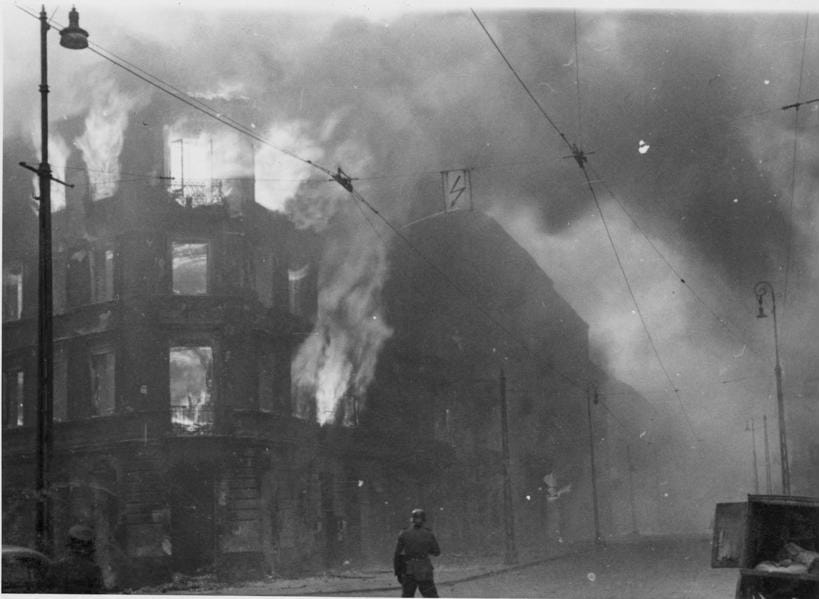
The Warsaw Ghetto Uprising, 1943
In July 1942, hundreds of thousands of Jews from the Warsaw Ghetto were being deported, most of them via the Treblinka Camp. Jewish leaders in the Warsaw Ghetto therefore decided to fight back. They started an uprising on April 19, 1943. It was put down brutally by German armed forces, for the most part within a few days, but skirmishes carried on until mid-May. Jews who survived were again generally deported.
October 6, 1943 SS chief Himmler spoke before the political elite of the Third Reich. In a brief excerpt from his long speech, we read the following (Smith/Peterson 1974, pp. 169 f.):
“I ask of you that that which I say to you in this circle be really only heard and not ever discussed. We were faced with the question: what about the women and children? – I decided to find a clear solution to this problem too. I did not consider myself justified to exterminate (only) the men – in other words, to kill them or have them killed and allow the avengers of our sons and grandsons in the form of their children to grow up.
“The difficult decision had to be made to have this people disappear from the earth. For the organization which had to execute this task, it was the most difficult which we had ever had…I felt obliged to you, as the most superior dignitary, as the most superior dignitary of the party, this political order, this political instrument of the Führer, to also speak about this question quite openly…”
October 7, 1943, the day after Himmler had given his lengthy speech about “making the Jews disappear from the earth,” Goebbels wrote: “As to the Jewish Question, (Himmler) gives a very frank and candid picture. He is of the opinion that we can solve the Jewish Question for all of Europe by the end of this year. He advocates the most radical and harshest solution, namely, that the whole of Jewry will be exterminated [auszurotten]. This is surely a consistent, if brutal, solution.”
Hans Frank (Nazi governor of occupied Poland) — diary entry for December 16, 1941: “We must destroy the Jews, wherever we find them, in order to maintain the overall structure of the Reich here. […] Currently there are in the Government General [occupied Poland] approximately 2½ million, and together with those who are kith and kin and connected in all kinds of ways, we now have 3 ½ million Jews. We cannot shoot these 3 ½ million Jews, nor can we poison them, yet we will have to take measures which will somehow lead to the goal of annihilation, and that will be done in connection with the great measures which are to be discussed together with the Reich. The territory of the General Government must be made free of Jews, as is the case in the Reich. Where and how this will happen is a matter of the means which must be used and created, and about whose effectiveness I will inform you in due time.” (IMT, Vol. 29, pp. 502f.)
On March 4, 1944, Nazi governor Frank stated (p. 687): “The Jews are a race that must be effaced. Wherever we catch one, he is coming to an end.”
Between late 1941 and late 1942, Nazi authorities deported many tens of thousands of Jews from western and central European countries to locations in the German-occupied Soviet Union… many if not most of them were killed there by the Einsatzgruppen and associated units.
“In particular the camp Maly Trostenets near Minsk (capital of Belorussia), and the prison at Fort IX near Kaunas (Lithuania) deserve to be mentioned in this context. Thousands of deported Jews were executed there.
“Jews living inside the Soviet Union were the primary target of the Einsatzgruppen and associated units…this happened primarily by way of mass shootings…German wartime documents speak of some 750,000 victims…”
“Not just one, but two Einsatzgruppen – C and D – were active in Ukraine. The most infamous crime scene associated with these units occurred in the suburbs of Ukraine’s capital Kiev, at Babi Yar… The Einsatzgruppen’s ranked death-toll list includes several entries for Ukrainian locations…(totaling approximately 138,000 victims)… Ukraine was completely occupied by Germany.. This put all of Ukraine’s remaining Jews in mortal danger, and many paid with their life.”
“SS Gruppenführer Arthur Nebe became head of Germany’s Civil Police in 1936. In June 1941, Nebe was appointed commander of Einsatzgruppe B, which he led from its inception in June, 1941 until October 1941, hence “for some four months. As such, he approved several Einsatzgruppen reports sent to Berlin which documented the execution of thousands of Jews in the deployment area of his Einsatzgruppe B.”
“SS Gruppenführer Otto Ohlendorf was the director of Office III, the “SD” (Internal Security Service) of the Reichssicherheitshauptamt (Reich Security Main Office). In 1941 he was appointed head of Einsatzgruppe D, a position he held for a year. This group operated in the southern region of the temporarily German-occupied Soviet Union (Bessarabia, southern Ukraine, Crimea, Caucasus)…“At the Nuremberg Einsatzgruppen Trial, Ohlendorf accepted responsibility for at least 90,000 victims of mass shootings carried out by Einsatzgruppe D, while he was in charge of that unit. There is an abundance of documentary evidence in support of these facts.
In the summer of 1942, the forced deportation of tens of thousands of Polish Jews from the Warsaw Ghetto was underway. When the deported Jews arrived further East, Wilhelm Kube, Nazi Commissioner for Belorussia, complained to his superior Lohse on July 31, 1942 (and later also to Alfred Rosenberg, head of the Ministry for the Occupied Eastern Territories), indicating Kube’s forces had been executing tens of thousands of Jews in the area to prevent them from supporting the partisans.”
“In Hitler’s Table Talk, Hitler drew a picture of the future of the Eastern European territories which is one of the best authenticated of his life’s visions and typical of his weltanschauung, which entailed the total disfranchisement of the subjugated. He ruled they have no claims of any kind, except to an early death. They are forbidden to learn to read and write; to concern themselves with history or politics is a crime worthy of death. Any communication whatever going beyond the confines of the village is strictly prohibited…They are to live in their filthy hovels without hygiene or inoculation, while the German settlers, strictly segregated, own splendid villages and spacious fortress farms.”
— German revisionist historian Ernst Nolte (1923-2016), author of the magisterial 1987 history, Der europäische Bürgerkrieg (“The European Civil War”).
The Zionists
“We shall try to spirit the penniless (Palestinian) population across the border…while denying it any employment in our own country… expropriation and the removal of the poor must be carried out discreetly and circumspectly.” —Theodor Herzl, founding father of Zionism, 1895
“I support compulsory transfer. I don’t see anything immoral in it” (1938). “Now a transfer of a completely different scope will have to be carried out. In many parts of the country new settlement will not be possible without transferring the Arab fellahin (Palestinian peasant farmers)….….Jewish power [in Palestine], which grows steadily, will also increase our possibilities to carry out this transfer on a large scale.”
—David Ben-Gurion, first Israeli Prime Minister, 1948
Writing in his diary in 1940 Yosef Weitz, a senior Jewish National Fund official who chaired the influential Transfer Committee before and during the Nakba (“Catastrophe”), and became known as the “Architect of Transfer,” (mass expulsion of the Palestinian population), put it thus: “The only solution is a Land of Israel devoid of Arabs. There is no room here for compromise. They must all be moved. Not one village, not one tribe can remain. Only through this transfer of the Arabs living in the Land of Israel will redemption come.”
The religious-terrorist Kach party was founded in 1971 by Brooklyn-born Rabbi Meir Kahane who argued for the immediate expulsion of the Palestinians, who he called “dogs.” In 1984, Kahane introduced legislation in the Knesset to ban all Jewish-Gentile marriages and sexual relations and revoke the Israeli citizenship of non-Jews.
In 2019, Kahane’s follower Itamar Ben Gvir formed the “Jewish Power” party, an ideological offshoot of Kach. Merging with other Talmudic-Zionist parties to form Religious Zionism in 2022, they won the third-largest share of Israel’s parliament seats. Netanyahu appointed Ben-Gvir Israeli Minister of Security. For years Ben-Gvir displayed in a place of honor in his home a portrait of Baruch Goldstein, an American-Israeli who killed 40 Palestinians and wounded more than 100 in a shooting massacre as they knelt in prayer at Hebron’s Tomb of the Patriarchs in 1994. As the Israeli Security Minister Ben-Gvir has instigated a settler reign of terror on Palestinian farmers and sheepherders on the West Bank.
In the aftermath of Goldstein’s slaughter, Noam Federman, a spokesman for the Kach party opined, “The act itself was one of greatness. It was a great act of sanctifying the Name (of God).”
Paying homage at Goldstein’s funeral, Rabbi Yaacov Perrin told mourners that “one million Arabs are not worth a Jewish fingernail.”
”Palestinians in Lebanon are two-legged animals.”
—Israeli Prime Minister Menchaem Begin (source: NY Times, August 5, 1985, p. A6)
Palestinians are cockroaches scurrying in a bottle.”
—Israeli Army Chief of Staff Rafael Eytan (source: NY Times, August 5, 1985, p. A6)
Rabbi Ovadia Yosef, the head of the powerful Israeli Shas political party and chief rabbi of Sephadic Israeli Judaism, taught that the Arab people should be exterminated, “May the Holy Name visit retribution on the Arab heads, and cause their seed to be lost, and annihilate them. It is forbidden to have pity on them. We must give them missiles with relish, annihilate them. Evil ones, damnable ones.”
—2001 Passover sermon. Cf. Haaretz, April 12, 2001. 700,000 Israelis attended Ovadia’s funeral. In its obituary, the New York Times eulogized him and omitted all reference to his calls for exterminating Arabs.
“If you believe that the Jewish state has a right to exist, then you must allow Israel to transfer the Palestinians and the Israeli-Arabs from Judea, Samaria, Gaza and Israel proper. It’s an ugly solution, but it is the only solution.”
—Ben Shapiro, American media personality, Orlando Sentinel, September 8, 2023
“Well, if everyone in Gaza is a refugee, let’s scatter them around the world. There are 2.5 million people there, every country will take in 20,000 people, 100 countries.”
— Ram Ben Barak, Member of the Knesset, ex-Mossad Deputy Director, November 1
“There should be a second Nakba.”
—Israeli agriculture minister Avi Dichter, November 11, 2023. [Nakba: the 1948 forced expulsion of 750,000 Palestinians, which culminated in the creation of the so-called “state of Israel”].

Gaza City in the early days of the Israeli terror bombings, October, 2023
“The Gaza Strip should be flattened, and for all of them (Palestinians) there is but one sentence, and that is death…Gaza has to be wiped off the map, in order to send a message to all our enemies and those who seek us harm…. In Gaza, we have to be clear, there are no innocent [civilians]. There are no “uninvolved” people.”
—Yitzhak Kroizer, Member of the Israeli parliament (“Knesset”), Nov. 5. 2023.
Tally Gotliv, an official in Binyamin Netanyahu’s Likud party, has demanded that Prime Minister Netanyahu use a nuclear bomb on Gaza. “Before we consider inserting ground troops, doomsday weapon.”
Likud member of the Knesset, Boaz Bismuth stated with reference to Gaza: “There’s no place for any humanitarian gestures.”
Israeli journalist Zvi Yehezkeli said on Israel’s Channel 13: “[We] should have killed many times 20,000 people, [we] should have begun with a blow of 100,000.”
As of January 9, 2024, the Israeli military has damaged or destroyed 70 percent of Gaza’s housing.
85 percent of the population of Gaza have been dehoused and rendered homeless.
In three months the Israelis have killed more than 22,000 Gazans, the majority of them women and children. The number of wounded, disabled and mutilated are more than twice that casualty figure. It is expected that many more Palestinian civilians will die of intentional Israeli-imposed imposed disease and hunger.
“Non-Jews are uncompassionate by nature and attacks on them curb their evil inclination.” — Torat Ha-Melekh (sometimes spelled Torat Hamelech, 2009). Torat Ha-Melekh is an Israeli rabbinic book based on the Talmud which has been widely distributed to Israeli military personnel.

A Palestinian child is treated for injuries on a hospital floor in Gaza, inflicted by the “Israeli Defense Force”, while a wounded Palestinian man awaits further medical care, autumn, 2023
Torat Ha-Melekh teaches that it is a religious duty to kill non-Jewish children on the enemy side during warfare, “if there is a good chance they will grow up to be like their evil parents.” Other reasons the Israeli authors furnish for the permission to kill non-Jewish children include if they “block the rescue of Jews… Little children are often situated in this way…it is permitted to kill them because their very presence facilitates the killing (of Jews)…(p. 215). “It is also permitted to kill the children of the leader (of the enemy) in order to put pressure on him…” (p. 215).
“We are imposing a complete siege on the city of Gaza. There will be no electricity, no food, no water, no fuel, everything is closed. We are fighting human animals and we are acting accordingly”
— Israeli Defense Minister Yoav Gallant, October 9, 2023.
On January 6, 2024 the New York Times described Gallant as “a moderate member of Mr. Netanyahu’s right-wing Likud party…” (Section A, Page 6; italics added).
“Human beasts are dealt with accordingly. Israel has imposed a total blockade on Gaza: no electricity, no water, just damage. You wanted hell—you will get hell”.
—Israeli Major General Ghassan Alian, Coordinator of the Government in the Territories, October 10
“Israel has no choice but to render Gaza into a place that is temporarily, or permanently, unfit for living.”
— Giora Eiland, Israeli Defense Ministry, October 11
“Do not leave a stone unturned in Gaza. Gaza needs to turn into Dresden. Complete incineration. Annihilate Gaza now!”
—Moshe Feiglin, Member of the Israeli Knesset, October 26, 2023. The Allied incineration by more than 800 bombers leveled the city of Dresden and burned alive tens of thousands of civilians.
Concerning the Palestinian population of Gaza: “They are not humans nor human animals, they are sub-humans and should be treated as such.”
—Arieh King, Deputy Mayor of Jerusalem, December 8
“There are no innocent [civilians] in Gaza.”
—Avigdor Lieberman, Member of the Knesset, and leader of Israel Beytenu Party, former Israeli Defense Minister, December 3
“We are too humane. Burn Gaza now, nothing less!”
—Nissim Vaturi, Deputy Speaker of the Knesset, November 17
“… we should make sure that there is a severe humanitarian disaster there (in Gaza), and severe epidemics, and horrible pressure, and cries to the sky—because that’s how wars are won… A humanitarian disaster is the only way to bring about the end of the war in a desirable way. Think about it this way: the poor women of Gaza, who are they? They are the mothers and sisters and wives of the Hamas murderers. Gaza’s system, unlike [its characterization by the US which I mentioned earlier] that there is Hamas and there are civilians—it is not true! Gaza is a state that is entirely united around its leader and its ideology for 15 years, without any dissent and with enthusiastic support….
“The weak point [of Gaza] is their civilian population…the thousands of Hamas terrorists, whose mothers and wives and children who will start suffering from severe illnesses, are the point of weakness. If we want to win the war—that’s how you win a war.”
“I agree with every word of Giora Eiland.”
—Israeli Finance Minister Bezalel Smotrich, November, 2024
“Given the collapse of Gaza’s sanitation and medical systems, as much as a quarter of Gaza’s people could die within the year, mostly from disease or lack of access to medical care.”
—Peter Beinart, Jan. 7, 2024
“Spend your energy on one thing; wiping Gaza off the face of the earth. Let the Gazan monsters fly to the southern fence and flee into Egyptian territory. Or have them die. And have them die horribly. Gaza must be wiped out. ..We require a revengeful and cruel IDF (Israeli military). Anything less than that is immoral. Simply immoral.”
—Galit Distel-Atbaryan, Member of the Knesset, November 1
“I am saying here to the citizens of Lebanon…(w)hat we are doing in Gaza we know how to do in Beirut.”
—Israeli Defense Minister Yoav Gallant, November 11.
(Gallant was telling the truth. In the summer of 1982 the Israeli air force terror-bombed the city of Beirut resulting in 20,000 civilians killed and tens of thousands wounded).
“The north of the Gaza strip—more beautiful than ever. Blowing up and flattening everything, simply a delight for the eyes.”
—Amichai Eliyahu, Israeli Minister of Heritage, November 1.
“…twice as many children have died in Gaza just since the war started on Oct. 7 as in all the conflicts worldwide in 2022…Far more women and children appear to have been killed in Gaza than in the entire first year of the Iraq war…pulverizing entire neighborhoods…Too many (people) see events through a prism in which (Israeli) lives are invaluable on one side while (Palestinian) deaths on the other are regrettable.”
—Nicholas Kristof, December 6
“This law is taught: in the case of Israel, this soul of the kelipah is derived from kelipat nogah, which contains good…The souls of the gentiles however, emanate from the other, unclean kelipot which contain no good whatever.” —Shneur Zalman of Lyady, “the Alter Rebbe.” Likkutei Amarim, (chapter 1). This sacred text is more commonly known by its first Hebrew word “Tanya.” Zalman is the founder of Chabad Lubavitch. Tanya is its revered text.
“According to this radical Hasidic teaching, divinity dwells in the inner core of every Judaic human being. Those who are non-Judaic have no humanity, no inner core in which the divine can take up residence. Those beings who are not Judaic are sub-human: empty kelipot (corporeal ‘shells’) which constitute broken vessels.
“In this theology non-Jews are broken shells who adopt the appearance of a human form which conceals their demonic essence. Those who are not Jews are the personification of purely evil materiality. Kabbalistic theology posits a cosmic dichotomy wherein the gentile represents biologically-determined, irredeemable evil. This is the esoteric rabbinic teaching which the western secret societies (also known as the ‘New Age’), understood and implemented. In the case of the indoctrination of their agent Adolf Hitler, the western occult reversed the polarities and taught Hitler that “the Jews” were the kelipot (‘untermenschen’), and the ‘Aryans’ the purely distilled essence of the divine. The Hitler/Himmler/Goebbels version of National Socialism was, unknown to these dupes themselves, a Kabbalistic teaching on the biologically-determined, irredeemable evil in the form of the ‘Jew.’ Hitlerism was Kabalism in the garments of Aryanism.”
— Michael Hoffman
“The differences between Jews and gentiles are not religious, historical, cultural or political. They are, rather, racial, genetic and scientifically unalterable. The one group is at its very root and by natural constitution ‘totally evil’ while the other is ‘totally good.’ Jewish successes in the world are completely contingent upon the failure of all other peoples. Only when the gentiles face total catastrophe do the Jews experience good fortune.”
—Rabbi Saadya Grama, Romemut Yisrael Ufarashat Hagalut (“Jewish Superiority and the Question of Exile,” 2003). Grama is an alumnus of Beth Medrash Govoha, a renowned yeshiva in Lakewood, New Jersey.
There is something infinitely more holy and unique about Jewish life than non-Jewish life.”
—Talmudic-Kabbalist Yitzhak Ginsburg, Jewish Week (N.Y.), Aug. 26, 1996
“The dissimilarity between the Jewish soul, in all its independence, inner desires, longings, character and standing vis-à-vis the soul of all the gentiles–on all of their levels–is greater and deeper than the difference between the soul of a man and the soul of an animal, for the difference in the latter case is one of quantity, while the difference in the first case is one of essential quality.”
— Abraham Isaac Kook, Chief Rabbi of Palestine, 1921-1935, “The Father of Talmudic Zionism.” [Source: David Dishon,“The Beauty of Yefet in the Tents of Shem-Gentiles and Jews in the Thought of Rav Kook,” in Havruta: A Journal of Jewish Conversation; Shalom Hartman Institute. 1 (2): 80–89.]
“Wherever there is liability for capital punishment, with regard to bloodshed, if a gentile murders another gentile, or a gentile murders a Jew, he is liable. If a Jew murders a gentile, he is exempt.”
—Babylonian Talmud, Sanhedrin 57a
Israeli Prime Minister Netanyahu, October 28: “You must remember what Amalek has done to you says our Holy Bible, and we do remember and we are fighting. Our brave troops and combatants who are now in Gaza or around Gaza and in all other regions in Israel are joining this chain of Jewish heroes, a chain that started 3,000 years ago—from Joshua to the heroes of 1948—the Six Day War, the 1973 October war—and all other wars of this country—are hero troops. They have one supreme main goal, to completely defeat the murderous enemy and to guarantee our existence in this country.”
In 1 Samuel 15:3 the judgment of God is on the Amalekites, in the form of the divine command to Saul, the first King of Israel: “Now go and smite Amalek, and utterly destroy all that they have, and spare them not; but slay both man and woman, infant and suckling, ox and sheep, camel and ass.”
These are patently the marching orders Netanyahu gave the Israeli military (‘the most moral military in the world’): slay all the civilians of Gaza and spare them not. Not even Clarence Darrow could parse it otherwise. There’s no lawyer’s loophole here; no moderating clause.
“Netanyahu’s Amalek speech was a warrant for a genocide that has been carried out to the letter, notwithstanding the delusional Gaza holocaust denial which squats in our media, churches and government atop the cadavers of thousands of ‘unclean kelipot’—bombed and burned Palestinian children and their mothers, whose deaths do not register in the conscience of America. The Talmudic-resonate belief in the worthlessness of the Palestinians is as ubiquitous and inescapable as the racist hate speech which inculcates it.”
—Michael Hoffman, January 9, 2024.
I will not be silent.
Copyright©2024 by Independent History and Research
Michael Hoffman manages the podcast, Revisionist History®. He is the author of the banned 2008 textbook Judaism Discovered (1,102 pages), and nine other volumes of history and literature, as well as 122 issues of the periodical, Revisionist History®. Michael is a former reporter for the New York bureau of the Associated Press and a former paid consultant to the news department of the New York Times. His books have been published in translation in Japan and France. He resides with his family in Coeur d’Alene, Idaho. On Twitter (“X”): https://twitter.com/HoffmanMichaelA
For Further Research
Time to fix Canada’s anti-Palestinian tax code
By Yves Engler | December 26, 2023
At the start of the month Sylvan Adams gave US$100 million to Ben-Gurion University. During a Toronto gala for the university’s Canadian fundraising branch the Canadian billionaire announced the money for “rebuilding and strengthening the south … in the wake of the Oct. 7th attack against Israel’s southern border communities.” Over the past ten weeks United Israel Appeal Canada has raised $100 million. After a recent Jewish National Fund of Canada fundraiser the registered charity’s executive Director Jeff Springer said, “We raised money for the war during this event.”
Throughout its history flare ups in Israeli violence have prompted an outpouring of financial assistance from Canadian Zionists. A significant share of that money has been underwritten by the public.
The Canadian tax code has long been used to subsidize projects in Israel and pro-apartheid groups have received large amounts in public grants. While little discussed, the ‘Zionifaction’ of charitable status is Canada’s most significant contribution to Palestinian dispossession.
Canadians provide a massive, unique, subsidy to Israel. Close to hundreds of million dollars a year in public money is funneled to a country that has long committed the crime of apartheid and tens of millions of dollars more goes to groups promoting anti-Palestinian policies within Canada.
Benefiting from the ability to grant tax credits covering as much as half of a donation, registered charities finance projects in Israel as well as Canada’s apartheid lobby. Additionally, many Canadian apartheid lobby groups receive direct government grants.
Over 200 registered Canadian charities finance projects in Israel. It’s difficult to quantify exactly how much they funnel to a country with a GDP per capita equal to Canada’s, but Just Peace Advocates research has put it at around a quarter billion dollars annually. A third of that sum would be covered by taxpayers through charitable write-offs.
Most years United Israel Appeal Canada is the largest single source of charity funds for Israel, sending between $50 and $110 million. It’s overseen by the Jewish federations of Toronto, Montréal, Winnipeg, Windsor, Calgary, Edmonton, Hamilton, London, Ottawa, Vancouver and Atlantic Canada. In addition to the funds raised by United Israel Appeal, the Jewish Federations raise hundreds of millions of dollars annually. Some of those funds are sent directly to projects in Israel.
The Federations organize Toronto’s Walk with Israel and Montréal’s annual Israel Day Celebration. The Federations also operate Israel Engagement initiatives that host Israeli teens who defer their military service for one year to volunteer to “teach about Israel through creative programs and challenging discussions.”
The Centre for Israel and Jewish Affairs (CIJA), Canada’s most influential apartheid lobby group, “is the advocacy agent of Jewish Federations across Canada”. The Federations fund many other apartheid lobby groups and Israel ‘lobby sustaining’ organizations, which are pro-apartheid but not principally focused on Israel campaigning.
Beyond benefiting from charitable status, the federations receive tens of millions of dollars in direct federal, provincial and municipal grants. Last December Ottawa put up $25 million for the Vancouver Jewish Community Centre, which includes an “Israeli Department” and is adorned with Israeli flags. Similarly, Montreal’s Sylvan Adams YM-YWHA received $8 million in federal funding in March. The facility operated by the Montréal Federation is named after a billionaire who has plowed hundreds of millions of dollars into campaigning for Israel. In 2012 UJA Toronto received $30 million in federal and provincial funding to build a new community centre.
The Federations receive tens of millions of dollars more in government grants for various initiatives ranging from security assistance to educational projects. Overseen by Federation CJA, the Montréal Holocaust Museum recently received $40 million in provincial, municipal and federal funding for its expansion (as well as a similar amount in tax subsidized donations). But the Museum is a sponsor of the ongoing Montreal Israeli Film Festival with the Israeli Consul General, Israel Bonds and other groups. The Holocaust Museum says it “is proud to have taken part in the Canadian delegation” that helped develop the International Holocaust Remembrance Alliance’s (IHRA) anti-Palestinian definition of antisemitism. When the Project Montréal municipal government refused to heed the apartheid lobby’s push to adopt the IHRA’s definition of antisemitism in 2020, the museum released a statement criticizing the party headlined “The Montreal Holocaust Museum regretfully notes the Montreal Mayor’s refusal to support the definition.”
In the last federal budget the Liberals provided $2.4 million for the Toronto Holocaust Museum, which is overseen by that city’s federation. An advocate of the IHRA’s anti-Palestinian definition of antisemitism, the Toronto Holocaust Museum also received half a million dollars in provincial funding. At the June launch of the museum speakers stood in front of Canadian, Ontario and Israeli flags.
The Federations provide funding to a slew of Israel lobby sustaining organizations from private schools to Hillels. One of those groups is Birthright Canada, which spends over three million dollars a year paying for young Jews to go to Israel. A dozen campus based Hillels are also among the federation assisted Israel lobby ‘sustaining’ registered charities. So are Israel studies and pro-apartheid Jewish studies programs established at universities by donors receiving generous tax credits.
As part of a “counterattack” against pro-Palestinian activism at Concordia, David Azrieli spent $5 million to establish Israel studies at that Montréal university (as well as $1 million on Jewish studies). More than $10 million in tax-deductible donations were made to the University of Toronto to establish the Anne Tanenbaum Centre for Jewish Studies and the Andrea and Charles Bronfman Chair in Israeli Studies. Millions more were donated to launch similar initiatives at the University of Calgary, York, McGill and other universities.
Probably the most significant cog in the lobby ‘sustaining’ wheel, private Jewish schools generally indoctrinate young minds into worshiping a violent far away state oppressing millions. TanenbaumCHAT, Bnei Akiva and more than a dozen other registered charity schools raise around fifty million dollars annually in donations. With Québec offering unique support to private schools, pro-apartheid Jewish schools receive around $10 million in direct public grants annually.
After CIJA, B’nai B’rith is the second most influential Israel lobby group. The registered charity raises about ten million dollars a year (through multiple arms). Another influential charity lobby group is Friends of Simon Wiesenthal Centre with a $7 million budget.
Honest Reporting Canada, StandWithUs Canada and Hasbara Fellowships Canada are almost entirely focused on apartheid campaigning. These registered charities have a combined annual budget of $2 million.
Israel lobby and ‘sustaining’ organizations receive upwards of $100 million a year in direct government grants. Additionally, registered charities funneling money to Israel or Canadian apartheid lobby organizations raise half a billion dollars a year (around a third covered by taxpayers).
The ability to secure significant public assistance obviously reflects Israel lobby power. Simultaneously, it strengthens the lobby’s power as well as apartheid in Israel.
The subsidies must be countered. The first step to upending Canadian assistance to apartheid and the Israel lobby is to map it, which Just Peace Advocates is doing. Additionally, anti-apartheid forces should state clearly their opposition to the Jewish Federations receiving government grants so long as they funnel money to Israel and sponsor CIJA. While that demand will garner little immediate political traction, it’s an essential step towards politicizing the federations.
More immediately relevant are ongoing efforts to press the Canada Revenue Agency to apply its own rules regarding charities its empowered with special tax status. The CRA currently forbids registered charities from supporting foreign militaries, explicitly racist organizations and West Bank settlements yet a slew of Israel focused charities do just those things. Over the past year complaints have been submitted to the CRA detailing about a dozen different charities’ – with over $100 million in revenue – violating these rules. (CRA investigations and audits are confidential so the status of the complaints is unclear.) Many other charities should be challenged and more campaigning is needed to press the CRA to take action, which they have done with Israel-focused charities. (In recent years the CRA has revoked the charitable status of a dozen organizations providing funds to Israel.)
Removing groups’ charitable status and dampening the flow of public funds to the apartheid lobby is paramount, but there’s also an ideological value to the campaigning. While apartheid apologists complain incessantly about Israel being unfairly “singled out”, pushing the CRA to apply its own rules towards massive subsidies highlights how Israel is in fact singled out for special treatment. No other wealthy, faraway, country receives a remotely comparable amount of charity fundraising.
In essence, Canada’s tax code and government grant system are structured to enable a wealthy, apartheid state, committing genocide in Gaza at the expense of the colonized Palestinians. Whether through legal or political channels, it’s imperative to push back against the staggering sums of public funds subsidizing Israel and sustaining the apartheid lobby in Canada.
Israel calls on UN chief to resign
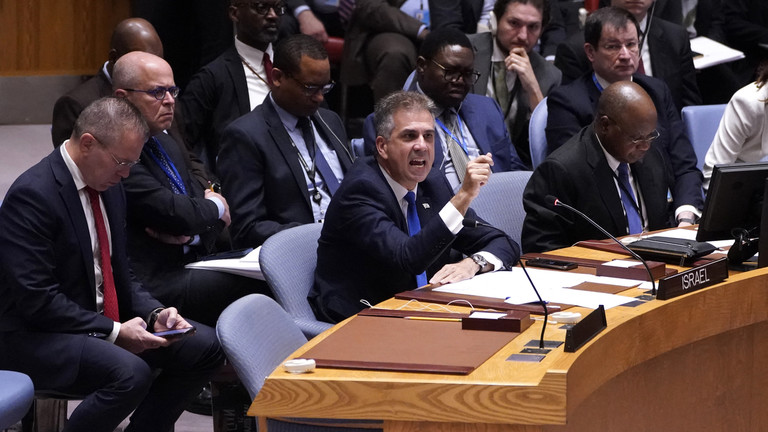
Israeli Foreign Minister Eli Cohen at a UN Security Council meeting on the conflict in Middle East, October 24, 2023. © TIMOTHY A. CLARY / AFP
RT | October 24, 2023
Israeli ambassador to the UN Gilad Erdan demanded Secretary-General Antonio Guterres step down on Tuesday, accusing him of showing “compassion” for terrorists and murderers in a speech to the Security Council.
“The UN Secretary-General, who shows understanding for the campaign of mass murder of children, women, and the elderly, is not fit to lead the UN. I call on him to resign immediately,” Erdan said on X, formerly Twitter. “There is no justification or point in talking to those who show compassion for the most terrible atrocities committed against the citizens of Israel and the Jewish people.”
The “shocking” speech by Guterres is evidence that the secretary-general “is completely disconnected from the reality in our region and that he views the massacre committed by Nazi Hamas terrorists in a distorted and immoral manner,” Erdan argued.
“His statement that, ‘the attacks by Hamas did not happen in a vacuum,’ expressed an understanding for terrorism and murder. It’s really unfathomable. It’s truly sad that the head of an organization that arose after the Holocaust holds such horrible views. A tragedy!” he posted.
Israeli Foreign Minister Eli Cohen reacted to Guterres’ speech in the Security Council by pointing his finger and yelling at the secretary-general. He then announced he would refuse to meet with him again.
“After October 7th there is no room for a balanced approach. Hamas must be wiped out from the world!” Cohen declared on X.
Guterres had condemned the “appalling” and inexcusable violence by Hamas, but noted that Gaza had been “subjected to 56 years of suffocating occupation” and that the Israeli response to October 7 attacks has amounted to collective punishment of Palestinians.
“I am deeply concerned about the clear violations of international humanitarian law that we are witnessing in Gaza. Let me be clear: No party to an armed conflict is above international humanitarian law,” Guterres told the Security Council. He also urged an “immediate humanitarian ceasefire” to facilitate the release of hostages held by Hamas, deliver aid to civilians and “ease epic suffering” in the Palestinian territory.
Speaking at the same meeting, US Secretary of State Antony Blinken insisted that the UN “must affirm the right of any nation to defend itself and to prevent such harm from repeating itself,” noting that no member of the Security Council “could or would tolerate the slaughter of its people.”
Blinken also questioned what he described as lack of international outrage, “revulsion” and explicit condemnation of the Hamas attacks.
Trudeau announces plans to euthanize “drug addicts” and “mentally ill.”
FRONT NIEUS | October 22, 2023
The Canadian government has announced plans to begin euthanizing “drug addicts” and citizens with a range of mental illnesses.
Prime Minister Justin Trudeau’s government plans to relax current “assisted suicide” laws so that more Canadians who have become a burden on taxpayer-funded health care systems can use them, Hunter Fielding reports .
However, critics compare the move to “modern eugenics”.
When Canada’s medically assisted dying (MAID) law changes in March 2024, mental health patients, including those with substance abuse problems, without other physical conditions will be eligible to be legally euthanized by the state.
A special parliamentary committee will re-examine the controversial move ahead of its implementation in coming months, following protests from Trudeau’s opponents in Canada.
Daily Mail reports: More than 10,000 Canadians were euthanized in 2021, a tenfold increase from 2016 when the practice was legalized.
In some cases, people living in poverty have agreed to die.
Currently, people with mental health conditions such as depression and personality disorders without physical conditions are not eligible for assisted suicide.
A framework for assessing people with substance use disorders for MAID is being discussed this week at an annual scientific conference in Canada.
The agenda of the workshop includes teaching participants and medical professionals to “know the difference between suicidality and a motivated desire to die.”
Zoë Dodd, a harm reduction advocate from Toronto, told VICE News that the practice is tantamount to eugenics.
She said: “I just think that MAID, when it has entered the realm of mental health and substance use, is really rooted in eugenics.
“And there are people who are really struggling with substance use and people are actually not getting the support and help that they need.”
Dr. David Martell, chief physician of Addiction Medicine at Nova Scotia Health, who is presenting the framework at the conference, told VICE News :
I don’t think it’s fair, and the government doesn’t think it’s fair, to exclude people from eligibility because their medical condition or their suffering is related to mental illness.
As a subset of these, it is not fair to exclude people from subsidies simply because their mental disorder may be partially or completely a substance use disorder.
It has to do with treating people equally.
The process for an assisted death in Canada starts with downloading a simple form online.
This means that the applicant must answer a number of questions and sign the bottom.
The applicants must then obtain the signatures of witnesses.
This is followed by a phone call and a home visit from a doctor.
If the application is approved by two different doctors, the person must wait 90 days from the time of application.
A doctor can then administer the lethal drug via an injection.
Hollywood director latest sexual predator to find refuge in Israel

MEMO | October 4, 2023
Disgraced Hollywood director Brett Ratner, who stands accused by multiple women of rape and sexual harassment, revealed last week he relocated to Israel just days after being a special guest of Prime Minister Benjamin Netanyahu at the UN General Assembly in New York.
Ratner has followed in the footsteps of other sexual predators who have fled to Israel in recent years, including another Hollywood director, Bryan Singer, who moved to Israel several years ago after being accused of rape and sexual assault of several minors.
Thanks to lax extradition laws and the so-called “law of return” known as ‘Aliyah’ – which grants citizenship to Jews across the world based on ancestral claims that are two millennia old – Israel has become a sanctuary for Jewish sexual predators as well as countless fraudsters, money launderers, and war criminals.
According to Jewish Community Watch, an organization that tracks accused pedophiles, over 60 US citizens accused of pedophilia have successfully fled to Israel in the past few years.
However, in an interview with Hareetz last year, the head of Magen for Jewish Communities, an Israeli NGO that tracks sexual predators, revealed that “there are about 100 rabbis, teachers, and other figures who have been accused, charged or convicted of sexual abuse overseas and subsequently found refuge in Israel.”
Awareness of Israel’s safe haven status for sex offenders received a boost in recent years due to the case of Israeli-Australian citizen Malka Leifer, the headmistress of an ultra-Orthodox girls’ school in Australia, who fled to Israel in 2008 after allegations surfaced of her sexually abusing female students.
She was finally extradited in 2021 and faces trial in Victoria on 70 charges of child sex abuse.
Another predator who fled to Israel and is finally facing extradition is Mexican diplomat Andres Roemer, who stands accused of rape and sexual harassment by over 60 women. After more than two years of dragging their feet, Israeli authorities arrested Roemer on Monday.
Despite the serious accusations against him, Roemer even had a street named after him in the city of Ramat Gan.
But while Roemer is finally expected to face justice, Mexico is still seeking the extradition of the former head of the criminal investigation agency, Tomas Zeron, who is wanted in connection to the disappearance of 43 students in southwestern Mexico in 2014.
Zeron is also accused of embezzling over $50 million and torturing suspects.
Despite being wanted by Interpol, Zeron has been living in an upscale apartment building in Tel Aviv since late 2019 due to his ties to the Israeli tech sector, including embattled firm NSO Group — makers of the Pegasus spyware.
Furthermore, western media reports revealed earlier this year that Israeli authorities are “unlikely” to extradite Zeron as “payback” for Mexico’s support of the Palestinian cause and their approval of UN inquiries into Israeli war crimes against Palestinians.
Featured Video

Seyed M. Marandi: Negotiations Collapsed – Return to War
or go to
Aletho News Archives – Video-Images
From the Archives
The US-Iran Scenario That Most Scares Israel
By Ali Haydar | Al-Akhbar | October 9, 2013
Israeli Prime Minister Benjamin Netanyahu issued a series of threats toward Iran and its interlocutors in the West, including the US, as serious negotiations on Iran’s nuclear program seem more plausible.
As a possible rapprochement looms between the US and Iran, Netanyahu has attempted to impose impossible Israeli conditions on the negotiators, such as the full dismantling of Iran’s nuclear program, not to mention threatening military force.
Whatever the deal that could materialize between Iran and the West, Israel is going to find itself before an open-ended path. One can foresee three possible scenarios… continue
Blog Roll
 Aletho News
- Seyed M. Marandi: Negotiations Collapsed – Return to War
- Tomorrow’s naval blockade showdown
- ‘Israel’ attacks civilians to hide its embarrassing military failures & out of pure sadism
- Any Foreign Military Vessel Approaching Hormuz Under Any Pretext ‘Will Be Dealt With Severely’: IRGC
- Diplomats slam US negotiators’ performance in Iran talks
- Trump Refuses Exit Ramp, War with Iran will Continue
- Trump Says US Naval Blockade in Strait of Hormuz Will Begin Shortly
- US, Iran end 21-hour talks without agreement
- US IRAN TALKS: Who Are the Crazy Ones Here? /Lt Col Daniel Davis
- Talks with the US end without a deal over excessive US demands: Iran
- If Americans Knew
- US-Iran ceasefire negotiations make zero progress – Daily Update
- Pro-Israel ‘Thinktanks’ and Individuals who Influence U.S. Foreign Policy
- Mearsheimer reveals how Israel dictates US policies on Iran, Gaza – video
- After killing 350+, Israel still has a “score to settle” with Lebanon before ceasefire – Daily Update
- Military aid to Israel emerges as the latest political litmus test for Democrats
- The only Palestinian children’s rights organization closes following years-long Israeli campaign against it
- ‘I Can’t Forget the Smell’: Lebanese Reel After Israel Kills Over 300 in Single Day
- DNC Shoots Down Resolutions Calling Out AIPAC and Limiting Arms to Israel
- TCN: Is Israel Blackmailing President Trump?
- Israel killed at least 303 Lebanese yesterday – who were they? Daily Update
- No Tricks Zone
- Cave Discovery Reveals Today’s Desert Climates Were Recently Far Warmer, Wetter, Teeming With Life
- German Expert: Heat Dome Led To Record Temps In Western USA…Warmer In 1934, 1936
- New Study: No Linear Warming Or Glacier Retreat Along Northern Antarctic Peninsula Since 1980s
- An Inconvenient Tree: Uncovered In Alps… Europe Much Warmer Than Today 6000 Years Ago
- New Study Reports A 60% Slowdown In Greenland’s Ice Loss Rate In The Last Decade
- Low Intensity Tornado Wrecks Major Solar Farm, Creating A Potential Toxic Dump
- New Study Finds Warming Saves Lives…Cold Temperatures 12 Times More Deadly Than Excess Heat
- German Science Blog Accuses PIK Climate Institute Of Hallucinating Climate Tipping Points
- Devastating Assessment Of Comirnaty Vaccine By Former Senior Pfizer Europe Toxicologist
- New Study: CO2 Is ‘Effectively Negligible’ As An Explanatory Climate Change Factor Since 2000
 Aletho News