From Betar to Shomrim, re-emergence of Zionist private militias in the West
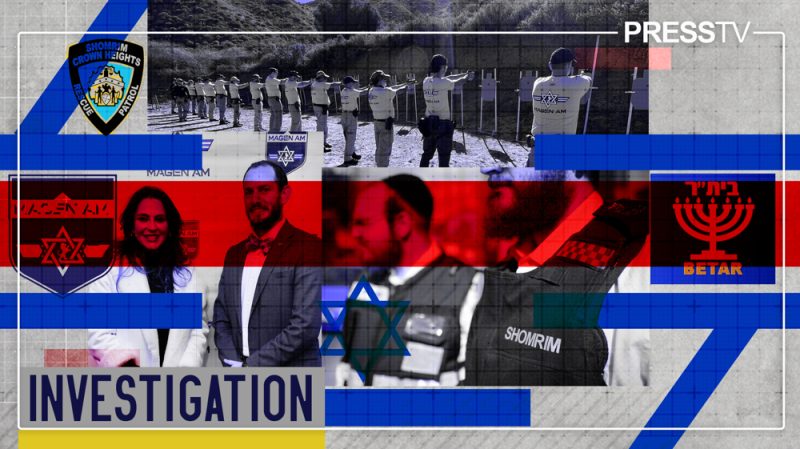
By David Miller | Press TV | May 25, 2025
In April of this year, anti-Zionist Jewish writer Alon Mizrahi claimed that Israeli Prime Minister Benjamin Netanyahu and his network of international Zionists are working to establish a policing force with powers surpassing those of national law enforcement agencies.
Mizrahi described this as the beginning of overt Jewish-Zionist policing of Western societies.
He was referring specifically to the ever more egregious statements from Betar in the US, an ultra-Zionist group affiliated with the far-right Revisionist Zionist movement founded by Vladimir Jabotinsky.
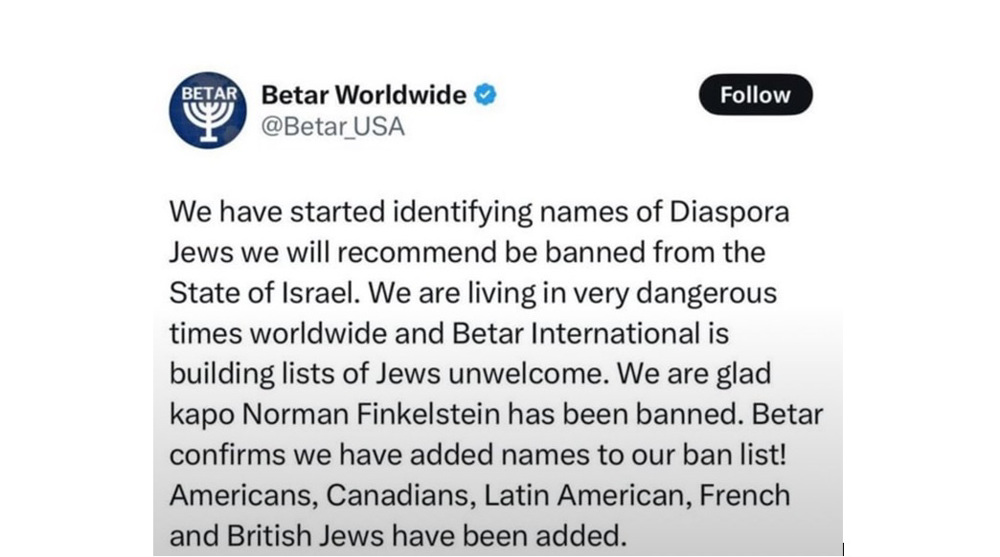
They have threatened to compile lists of Jews to be banned by the Zionist entity across North and South America, as well as Britain and France.
Mizrahi warned, “They start with Jews as a deception: all of you are next.”
However, the situation may already be far worse than what Mizrahi suggests.
Since its founding in 1923, Betar has trained as a paramilitary force. The photo below shows Menachem Begin wearing a Betar uniform in Poland in 1932.
Below it is another photo from Berlin in 1936, taken after the Nazis enacted laws outlawing other political groups in 1933.
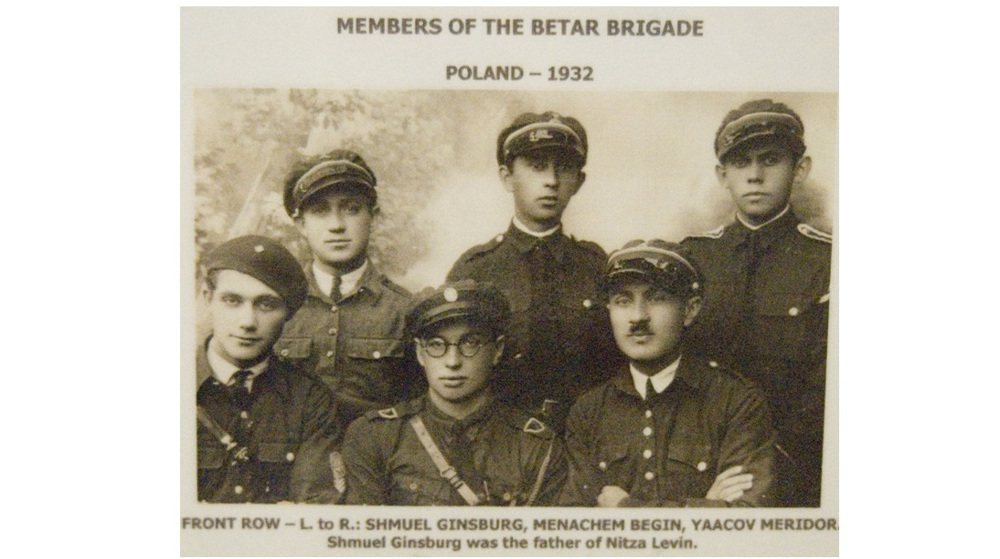
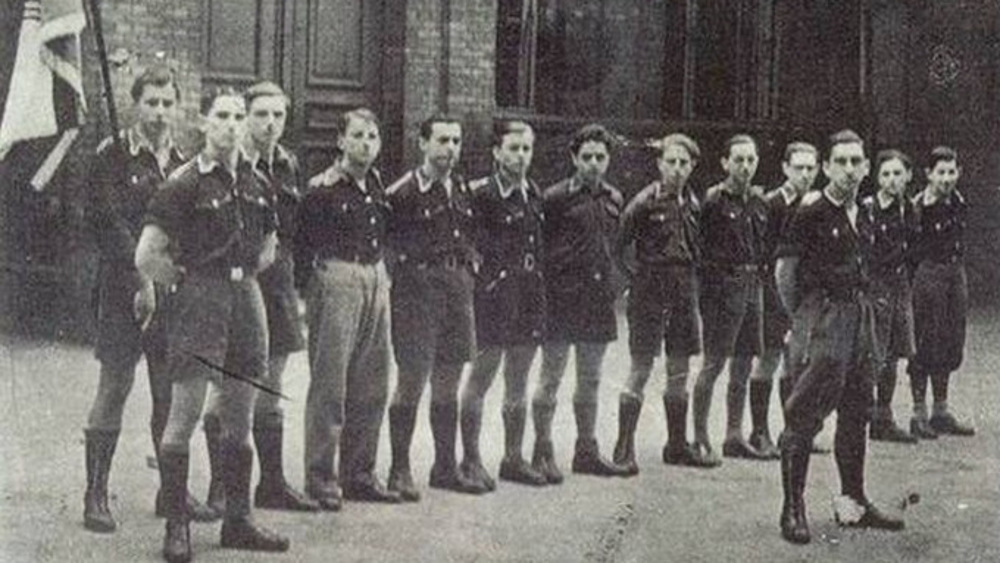
Betar was so closely aligned with the Nazis and Mussolini’s fascists that they were regarded as collaborators. By 1934, Jabotinsky and his Betar youth movement had reportedly “allied with Il Duce,” establishing a naval base north of Rome.
Late that year, Mussolini reportedly expressed support for Zionism and Jabotinsky in particular, stating: “For Zionism to succeed, you need to have a Jewish State with a Jewish flag, and Jewish language. The person who understands that is your fascist, Jabotinsky.”
This remark was made “during a private conversation with Nahum Goldman, founder of the World Jewish Congress, in November 1934,” as reported by Lenni Brenner in Zionism in the Age of Dictators.
Many senior Betar members served in the collaborationist police overseeing the Vilna Ghetto in Lithuania and were involved in betraying Jews in hiding to the Nazis.
One such member, Lotek Salzwasser, was eliminated by Jewish partisans in 1943 for his collaboration, according to Israeli press reports.
Betar and military training
One of the seven core principles of the Betar “Oath” is Magen, meaning “Protection.”
One of Betar’s ideological principles is military preparedness. Betar demands that all its members complete military seminars and know how to use weapons, in order to be ready at any time and to respond personally to a call for defense.
Betar has functioned as a militia since its inception. Here is a film of one of the French branches recorded in 2014 conducting paramilitary training exercises.
In the UK, Betar operated as a registered charity (Brit Tumbledor of Great Britain – Betar) between 1984 and 2004. It was closed down by the Charity Commission in 2004, on the grounds that it had been “Registered in error.”
In March 2025, Betar threatened to murder UN Special Rapporteur Francesca Albanese. On the very same day, the group relaunched its UK branch with a post on Instagram, claiming London “has become, with the time, an epicenter for radical Islam, for hate, for terror.” Their proposed solution?
Today, after more than 30 years, a bunch of strong young leaders stand up to say HERE WE ARE, to defend the Jewish population and to tell them that now we have a solution for the current situation, JEWS ARE NOT AFRAID ANYMORE!
Make no mistake – these threats are part of a deliberate effort to revive Jewish supremacist militias in the UK and the US.
Magen Am
The term Magen also appears in the name of a US-based private Zionist militia called Magen Am, which is currently active in Los Angeles, Orange County, and Phoenix.
Magen Am played a notably violent role in attempts to dismantle the student encampment at UCLA. The group frequently boasts about its close ties to the LAPD, sharing numerous photos of friendly interactions with police officers.
Reports indicate that Magen Am has collaborated directly with law enforcement, including working closely with the LAPD to intimidate and attack student protesters on the UCLA campus.
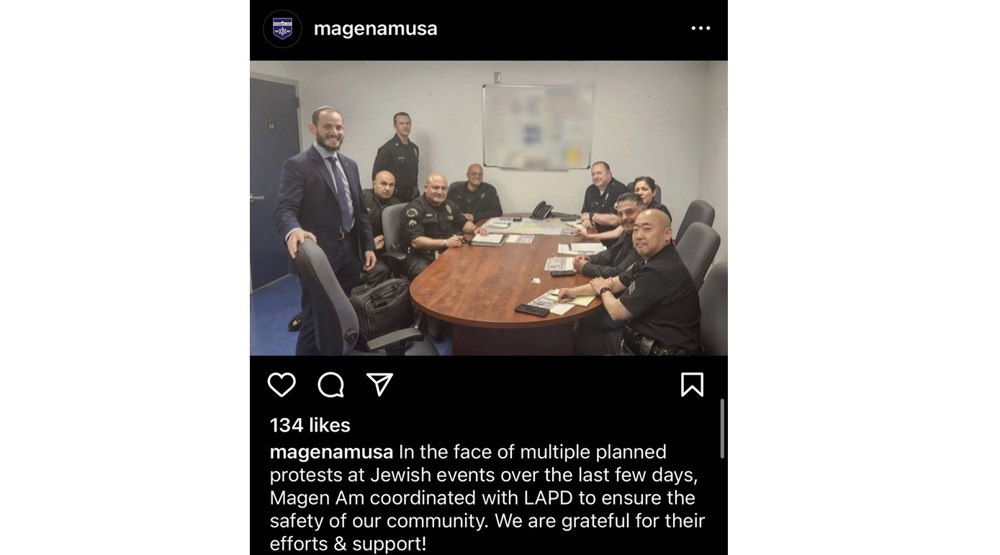
Magen Am, of course, recruits veterans of the occupation forces’ Lone Soldier programme and some then return to “serve” in the genocide as they proudly boast.

Magen Am was founded in 2017 by Yossi Eilfort, an MMA fighter-turned-Chabad rabbi. The flag of the genocidal Chabad cult was flown by the attackers on campus in Los Angeles.
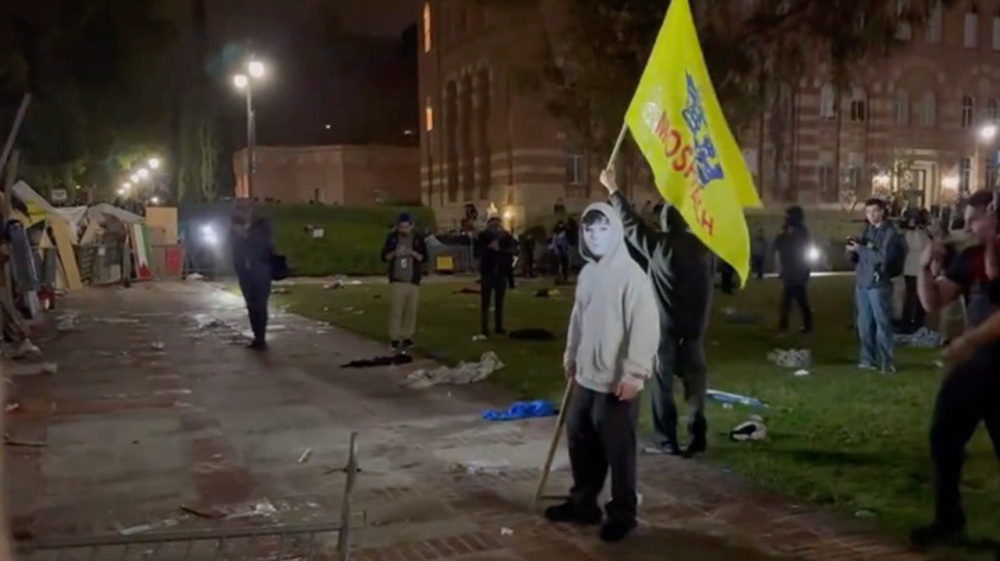
Chabad has many followers in the so-called Hilltop Youth in occupied Palestine, which the Zionist intelligence agency Shin Bet says are responsible for the overwhelming majority of so-called ‘price-tag’ revenge attacks on Palestinians.
The rise of Jewish supremacism in Western societies is becoming increasingly visible, though many continue to deny or downplay its existence.
While Zionist militias and private security firms openly collaborate to suppress student protests in the US, there is a more subtle infiltration of police forces by Zionist Jewish supremacists.
Shomrim: The Private Jewish Patrol
Shomrim is a private Jewish police force operating in parts of the US, UK, Australia, and Belgium. It is reported that “over 20 Shomrim organisations exist worldwide.”
In London, the Shomrim North West Community Patrol operates in the Borough of Barnet. Founded in 2008 by Gary Ost as a registered charity, it acts as a “mobile neighbourhood watch” and acts as eyes and ears for the Metropolitan Police.
Shomrim claims that all “Volunteers have completed training from the Metropolitan Police Counter Terrorism Command (SO15) in assisting to identify potential security threats and suspicious activity. “
One blogger notes that the genocidal cult Chabad also has a ‘nasty tendency to normalize sexual abuse and protect serial sexual predators in its ranks.” But it’s not only Chabad; there is a similar tendency throughout the Zionist movement.
No surprise, then, to find that the founder of Shomrim in London has been implicated in this.
In 2013 Police dropped their investigation into Ost, who had been arrested on suspicion of perverting the course of justice in relation to an investigation of an alleged child sexual abuser, Rabbi Chaim Halpern.
Indeed, charges against the alleged sexual predator were dropped back then, too. Yet new allegations against Rabbi Halpern have resurfaced a decade later, and the trial for these offences is still pending.
Shomrim abuses
In New York, Shomrim has faced criticism for “using excessive force against non-Jewish suspects.”
In 2014, two Shomrim members were charged as part of a group of five Hasidic men for assaulting 22-year-old Black student Taj Patterson as he walked home from a party.
Additionally, Shomrim organizers in New York have reportedly withheld information on suspected Jewish criminals. The NYPD has openly criticized the group for not always notifying police when calls come in, raising concerns about accountability and cooperation.
Given Shomrim’s protected status with law enforcement and the documented culture of sexual abuse in some ultra-Orthodox communities, credible allegations of abuse within these groups are unsurprising.
On October 11, 2023, the United States Department of Justice issued a press release that Jacob Daskal, former head of the Boro Park Shomrim Society—a private Orthodox Jewish crime-patrol group associated with the NYPD—was sentenced to 210 months in prison and fined $250,000 for transporting a minor with intent to engage in criminal sexual activity.
Daskal pleaded guilty to the charge in July 2023. As part of the sentence, Daskal is required to register as a sex offender.” The statement notes that Daskal was introduced to a 15 year old girl “as a result of his position with the Shomrim”, who he then “groomed” for sexual abuse. According to the Department of Justice statement:
“Throughout the abuse, Daskal instructed the victim to delete their communications and warned her not to tell anyone about their sexual relationship. He also used his position as a community leader to silence the victim, bragging about his law enforcement connections and warning her that disclosure would ruin her life. The victim was expelled from her religious school after revealing the relationship to the school principal.”
This case raises troubling questions: How many other abusive situations are currently unfolding within Shomrim and other Jewish militia groups?
Shomrim protects genocide
What is it that Shomrim are protecting? One illustrative example is the Crown Heights Shomrim branch, which in January this year provided security protection for the genocidal President of Israel, Yitzchak Herzog and for the leadership of the genocidal cult Chabad, as shown in the image below.

If Shomrim really wants to protect Jews in the US and UK, they should start by apprehending the entire leadership of Chabad and members of the genocidal Zionist regime.
Police reluctance toward Shomrim in the UK
Initially, UK police were resistant to Shomrim’s activities. In 2008, Chief Superintendent Steve Bending, then Hackney’s borough commander, stated, “I do not support the concept of any community having its own form of patrol service. There is a risk of other communities feeling intimidated by this course of action.”
As late as 2015, Metropolitan Police Commissioner Sir Bernard Hogan-Howe expressed his preference that Shomrim volunteers avoid uniforms resembling those of official officers.
Shomrim, however, rejected this, saying “its volunteers should not drive marked cars or wear uniforms similar to those of the police.” Gary Ost, chief executive of Shomrim in Golders Green, north-west London, stated, “Our uniforms look nothing like the police and are marked from every angle with clear wording saying ‘Shomrim’.”
Yet a glance at their uniforms and liveried vehicles often gives a very different impression.
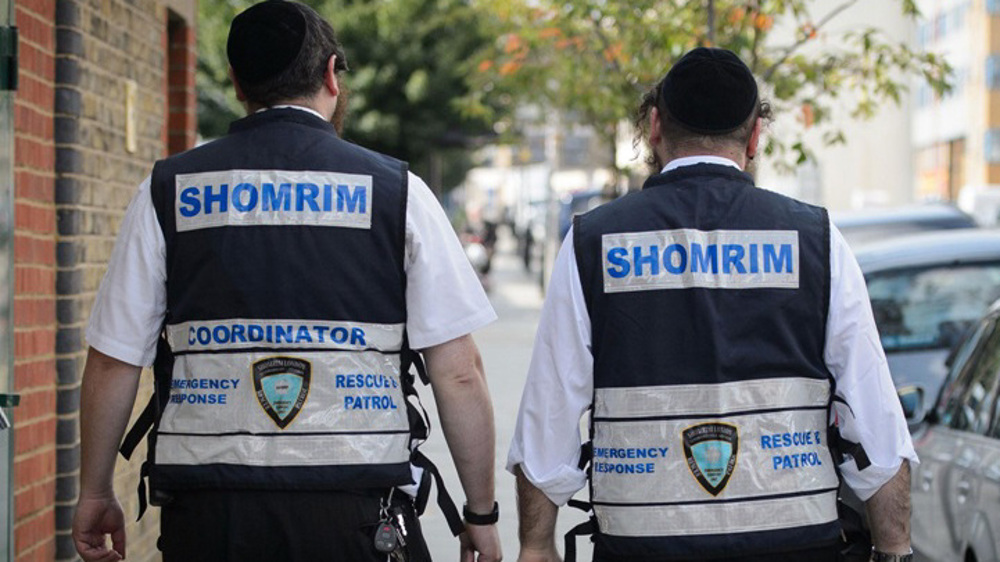

But the penetration of the police is now much more advanced and cooperation is the name of the game. There are numerous examples of apparent cordial relations between the two on the internet.
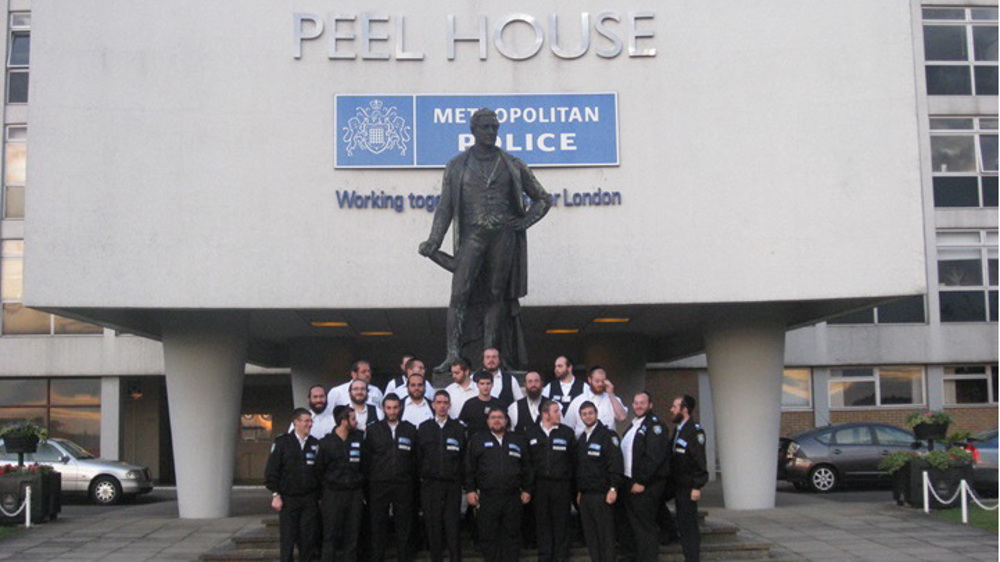
Shomrim members even posed outside Peel House, the headquarters of the Metropolitan Police.
Below is a photo of a prize giving for Shomrim members commended for their “bravery” and “exemplary service to the community” in 2020.
Shomrim chief executive Gary Ost, the one arrested in 2013, is one of the three.

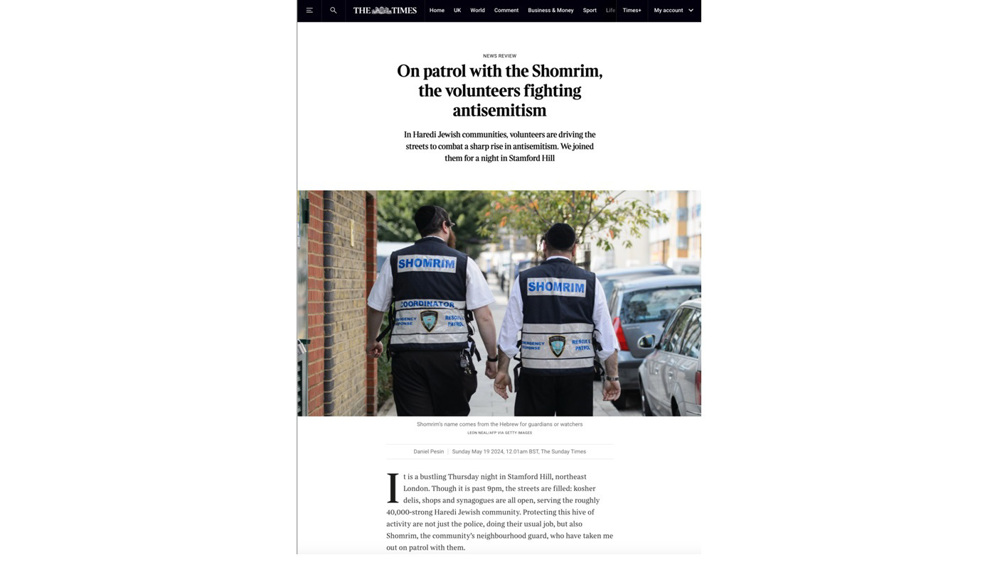
Shomrim plays a key role in shaping the narrative around the widespread antisemitism claims that Israel relies on to justify its genocidal actions.
The pressing question is: What happens when members of Shomrim break the law or commit wrongdoing? Would the police be able—or even willing—to enforce the law against them?
Alon Mizrahi, whom we cited earlier, shared his perspective in a conversation with me:
“They are pretending to be defending themselves in the most friendly country to Jews in history. While committing genocide. In a country that is so hateful of Jews that we need a private police force for Jews only in the US.
“And I have no doubt that if they can normalise this, with the kind of status that Zionist Jews have managed to create for themselves in the US; If this Jewish police force uses violence against black people, black organisers in communities who oppose the genocide, or other migrant groups or any other group, are American police going to be able to charge them?
“To use the law against them? I don’t think so. If you are in the American system, if you have a role in any part of the American system of government, in the police or any other agency, I think that at this point it is clear to you that Zionist Jews are above the law.
“The law doesn’t apply to them. So they don’t have the philosophical or legal means to deal with this. And the Zionists know this.”
Given the current climate, his assessment may well be accurate.
Michigan AG Pins Blame for Failed Prosecutions of Student Protesters on Rep. Debbie Dingell
The Michigan attorney general provided no evidence for her claim, which Dingell rejected
By Ryan Grim and Tom Perkins | Drop Site | May 11, 2025
Michigan Attorney General Dana Nessel continues to do damage control in the wake of her failed prosecution of student protesters at the University of Michigan. Nessel was forced to drop charges against students who had been arrested at a pro-Palestinian encampment last year after the judge overseeing the case indicated he was sympathetic to the defense’s argument that Nessel had been improperly biased against the defendants.
This week, in public remarks on the prosecution, she claimed without evidence that Democratic Rep. Debbie Dingell of Michigan had been the one who urged her to charge students involved in protests over Gaza. Pinning the pressure for the prosecutions on Dingell was Nessel’s way of arguing that the bias claims made against her were inaccurate—that she was not in fact pushed to take the cases by donors to her campaign who serve as senior officials at the university, but rather by the local congresswoman, Dingell.
“I heard it was from the Jewish Regents,”—that is, the Jewish members of the University of Michigan Board of Regents—“they forced me to take these cases,” Nessel said at an event this week called a “Town Hall on Hate Crimes & Extremism” in West Bloomfield Township. “I heard it was from the [Michigan Legislative] Jewish Caucus because of the money I get from them. I heard it was from Jewish donors. You know how those cases came to my office? Debbie Dingell. Debbie Dingell, I don’t know if you know this: Not Jewish. But it had to be some sort of Jewish influence.”
In a statement to Drop Site, Dingell spokesperson Michaela Johnson suggested the congresswoman was not behind the investigations, pointing to a May 2024 letter from Nessel’s office to the university in which Nessel offered to take over any investigations. The letter, which has not previously been reported, makes no reference to Dingell, but instead suggests that protests outside the homes of Board of Regents members triggered Nessel to launch an effort targeting student protesters.
“Nessel did not write the letter at our request, and Rep. Dingell had not seen that letter until today,” Johnson said. Dingell represents Ann Arbor, but previously represented Dearborn until redistricting in 2014, and she still has strong ties to the Arab-American community there. But she has remained largely silent with regard to the protests.
Amir Makled, an attorney for some of the students, said he called Dingell’s office on Friday to ask about Nessel’s allegations. He said a Dingell staffer denied the congresswoman had pushed for the investigation.
Makled said he didn’t think it was done at Dingell’s behest, but he said Dingell has been involved with the discussions because the incident occurred in her district, and she “has been giving lip service to all sides.”
But, he added, “Nessel is trying to do anything to deflect blame for her office’s misdeeds – that much seems clear to me.”
Nessel’s office didn’t respond to a request for comment over the weekend.
The university, its regents and Nessel have denied that the school recruited the attorney general.
This was not the first time Nessel had pointed the finger at Dingell. She told a local reporter several weeks ago that “the congresswoman from the 6th Congressional District” – Dingell – had put her up to it. “I stand behind the evidence and I stand behind the charges, and I appreciate the fact that this matter was referred by the congresswoman from the 6th Congressional District, who asked the state to intervene because they were concerned about what was happening on campus,” she said. “I believe what we did was the right thing, and that will be borne out in court.”
Following that report, supporters of the students who’d been charged approached Dingell at an event on March 3 to ask if Nessel’s allegation was true. According to an audio recording provided to Drop Site, it was not. “She’s told a lot of people a lot of stuff,” Dingell told the students. She was then asked directly by Jared Eno, a grad student at Michigan, if that was true: “No!” Dingell said. “She called the university and offered.” The letter supports that claim.
Nessel, in her remarks at the town hall, again claimed Rep. Rashida Tlaib of Michigan had accused her of bias linked to her Jewish background, but Tlaib’s public statements have never referenced this. “I think people at the University of Michigan put pressure on her to do this, and she fell for it,” Tlaib had said. “I think President Ono and Board of Regent members were very much heavy-handed in this.” UMich President Santa Ono, the only person Tlaib named as having applied pressure to Nessel, is not Jewish.
The AG letter was sent to Timothy G. Lynch, vice president and general counsel at the University of Michigan, and signed by Danielle Hagaman-Clark, a prosecutor in Nessel’s office. “I write today to offer the DAG’s assistance with investigating and prosecuting any cases that arise from the recent demonstrations on UM’s campus,” she wrote. “It has been widely reported that the demonstrators have not limited their protests to the campus but have also appeared at the homes of the Board of Regents. My understanding is that the Regents are not required to live in Washtenaw County, the location of UM, but that they reside in several different counties. Because the DAG has state-wide criminal authority to bring charges, we are ideally situated to review any potential cases.”
The reference to the protests outside the homes of Regents matches reporting that suggested those demonstrations, even more than the encampments, enraged the board members, who urged Nessel to prosecute.
Nessel’s prosecutor added her office was well suited to determine whether any of the speech from the protesters was illegal. “I would also note that our Department has specialized expertise in the intersection of First Amendment free speech rights in the context of a criminal prosecution. We are fluent in the law around what speech is protected and what speech is not protected,” said Hagaman-Clark, making the pitch to Michigan. The letter was sent shortly after local prosecutor Eli Savit (who is also Jewish) declined to prosecute 36 of 40 protesters arrested in connection with the occupation of an administration building, and recommended four others for diversion. “General Nessel has discussed the potential jurisdictional issues that might arise with Washtenaw County Prosecutor Eli Savit. Prosecutor Savit recognizes that his authority is confined to Washtenaw County. He is comfortable with the DAG overseeing these cases based on his jurisdiction being limited to only Washtenaw County.”
In her effort at damage control this week, Nessel claimed Dingell’s supposed request was common. “Now it’s not unusual for a congressional representative to call up the department of the attorney general and to call the attorney general herself and say ‘I’m really worried about what I see to be criminal activity occurring and either the local prosecutor is not doing anything about it,’ or ‘they’re not equipped to do anything about it. But I am scared about what I am seeing. And I think the AG’s office has to take action.’”
Nessel also told the town hall audience that she dropped the charges because the judge had ordered an evidentiary hearing into the defense’s charge that Nessel was biased against the defendants. Defense attorneys, in their recent motion to disqualify Nessel’s office over bias, pointed to a previous analysis that found she had prosecuted protesters at a much higher rate than other prosecutors in the state.
They also pointed to Nessel recusing herself from an investigation into alleged election fraud by Muslim-American city council members in nearby Hamtramck. Nessel said she wanted to avoid the appearance of bias because she was Jewish and the suspects were of Arab descent. She also noted that she had previously been critical of the Hamtramck City Council. In their motion to disqualify Nessel’s office, defense attorneys questioned how she could consider herself biased in Hamtramck but unbiased in Ann Arbor under similar circumstances.
A letter sent by the Jewish Federation of Ann Arbor to the judge urging him to allow her to remain on the case, she said, put improper pressure on the judge and should not have been sent. And the cases against the students were becoming a distraction to staff, she added, who couldn’t even attend a job fair without being “shut down by protesters.”
“We elected that rather than me being put on trial for being a Jewish prosecutor, and rather than having the federation be put on trial for an email they should not have sent—but the kind that gets sent all the time—that we would dismiss the charges against those particular defendants,” she said. An evidentiary hearing would have opened her office to discovery and made public communications about how the cases came together. Defense attorneys say she wanted to avoid that.
Liz Jacob, an attorney from the Sugar Law Center, said the claim from Nessel was another effort to deflect responsibility. “It’s alarming to see the ways that Nessel is trying to avoid accountability for her repression of free speech and brutal targeting of protesters at all costs,” Jacob said. “Both in that video and over the last several months AG Nessel has tried to blame anyone—from Congresswoman Rashida Tlaib to Debbie Dingell to the Jewish Federation of Greater Ann Arbor—to deflect criticism regarding her own deplorable treatment of pro-Palestine protesters.”
Nessel’s decision was a serious one, and Nessel should treat it seriously, Jacob said. “As the Attorney General who is directing the FBI to raid protesters homes and bringing baseless and retaliatory criminal charges against protesters, it is Nessel who must bear responsibility for targeting young people who bravely speak out against war and genocide. Nessel’s actions speak for themselves — she has aligned herself with the Trump administration’s criminalization and repression of pro-Palestine speech,” she said.
More Exciting News from the White House
Donald Trump has appointed a Jewish community liaison officer

By Philip Giraldi • Unz Review • May 2, 2025
I know that those who read my articles will be interested to learn that President Donald Trump has appointed Martin Marks to be his administration’s liaison to the American Jewish community with the title Special Assistant to the President and Director of Jewish Engagement in the White House Faith Office. Marks, whose mother handbag designer Lana Marks served as US ambassador to South Africa in Trump’s first term, appears to be well qualified for the position as “Before turning to politics, [he] was a writer and owned a yoga studio in Palm Beach.”
To be perfectly honest I was a bit confused by the appointment as the US government already has an Office of the Special Envoy for Monitoring and Combating Antisemitism and a Office of the Special Envoy for Holocaust Issues actively promoting the Jewish/Israeli line at the State Department and even worldwide. And one might observe Trump’s entire cabinet is unrelentingly Zionist in its inclinations while Congress is discussing the so-called Antisemitism Accountability Act which will turn any criticism of Israel into a crime even more so than it is regarded as such right now, ask any one of the college students who are being deported! How much “liaison” protecting the most wealthy and educated 3% of the population against the curse of perceived perpetual Jewish victimhood is still warranted? And how will such “liaison” differ from the orders delivered directly from Benjamin Netanyahu, the “Chosen” leader, of the Jewish state of Israel to provide Trump and the rest of the US government with their marching orders, just as was the case with Genocide Joe Biden and his merry band of largely Jewish/Zionist cabinet members?
Professor Jeffrey Sachs of Columbia University has described the current Donald Trump regime as an “Israel First Administration” packed with Zionists at all levels. The State Department Press Secretary Tammy Bruce has declared that “Anyone who tries to touch Israel will wind up in hell.” But there are some who are still brave enough to go against the tide. The Institute for Historical Review, which is one of the few online publishers and free speech associations that still survive in the good old USA, has been confronting the Israel Lobby for forty-seven years. In an email that appeared last week they discuss another new Jewish appointment and laid out the problem in plain English that even Donald Trump might understand:
“Power, Priorities, and Puppeteers: Who Really Governs America?”: The nomination of Yehuda Kaploun — a Chabad-Lubavitch rabbi, Trump loyalist, and confidant of Republican megadonor Miriam Adelson — as US Special Envoy to Combat Antisemitism underscores an uncomfortable reality: Zionist interests wield disproportionate influence over American politics, even as the nation fractures under economic despair. Kaploun’s appointment, framed as a defense against antisemitism, instead reveals a political dynamic that prioritizes the interests of world Jewry over the needs of ordinary Americans. Consider the timing. Household debt has soared to $18.04 trillion, credit card delinquencies hit 14-year highs, and inflation continues to erode wages. Yet policymakers focus on policing campus activism, cracking down on criticism of Israel, while ignoring the collapse of social mobility. Kaploun’s own rhetoric comparing US universities to “1930s Germany” diverts attention from the rising cost of living and the United States’ fraying social fabric. Meanwhile, pro-Israel groups like AIPAC have funneled $100+ million into elections, ensuring bipartisan fealty to policies that prioritize Israeli interests at the expense of America. This is not governance. It’s an occupation by foreign interests.”
The IHR point is well made and applies to Biden, Trump and Congress as well as to the 38 states that require citizens to sign documents or swear oaths pledging themselves not to support any boycotts of Israel if they wish to receive benefits or jobs. To even suggest that Israel and American Jews are some kind of victims who must be protected at a time when they are actively engaged in genocide and complete ethnic cleansing of literally millions of Palestinians.
My principal complaint with the government Jewish agenda is that it creates two classes of people before the rule of law, i.e. those who are Jews and must be protected and the rest of us who, on the contrary, will face the consequences if we so much as criticize Israeli or Jewish behavior. Ironically, we can criticize our own country or any other country in the world, but not Israel. If we are a legal resident or a student on an educational visa who crosses the line we can have that status erased and be deported without any due process. It also means that any encounter with law enforcement or government that has any taint of being critical of Jews can lead to two level justice, as many foreign students in the US are currently discovering.
A story last week out of Crown Heights Brooklyn illustrates precisely what I mean. Israel’s monstrous Security Chief Itamar Ben-Gvir, who believes in killing all Palestinians if it becomes necessary to remove them, was in town being cheered on by a large crowd of the indigenous Ultra Orthodox Jews. A local resident, a woman in her thirties, wondered what all of the noise was about and went out to take a look. She was immediately set upon by a large crowd of roughly one hundred, which screamed at her that she was a “Palestinian demonstrator,” which was not true. She “feared for her life as she was chased, kicked, spit at and pelted with objects by [the] mob of Orthodox Jewish men. She recalled how ‘They were shouting at me, threatening to rape me, chanting death to Arabs. I thought the police would protect me from the mob, but they did nothing to intervene.’ As the chants grew in intensity, a lone police officer who had joined her sought to escort her to safety back towards her apartment. They were followed for blocks by hundreds of men and boys jeering in Hebrew and English. Video shows two of the men kicking her in the back, another hurling a traffic cone into her head and a fourth pushing a trash can into her. She was beaten and kicked and even had a large garbage can thrown on top of her.” The woman later recalled how “I felt sheer terror. I realized at that point that I couldn’t lead this mob of men to my home. I had nowhere to go. I didn’t know what to do. I was just terrified.” After several blocks, the officer moved the woman into a police vehicle which prompted one assailant to yell, “Get her!” but the crowd erupted then in cheers as she was driven away. Interestingly, there were many police officers in the immediate area, presumably to protect all the rioting Jews from attacks by antisemites, but they had not intervened while the woman was being pursued apart from the one officer who came to her assistance.
The entire episode was filmed by bystanders and one would think that the Jews who had beaten the woman would face some consequences, but as is always the case when it is Jews/Israelis who are committing crimes there is the presumption of antisemitism at play and nothing happens. I could find nothing in the subsequent press coverage that suggests that anyone was arrested or even detained. I have previously suggested that this has also been the pattern connected to the past year’s demonstrations over the slaughter in Gaza. The universities and local police are quick to detain those normally peaceful demonstrators regarded as pro-Palestinians but when those individuals are in turn physically attacked by Jewish organized groups the Jews are not subjected to the same standard of law enforcement. To put it mildly, there is absolutely no mandate to protect Palestinians or ordinary Americans who become victims in the violent counterattacks on peace encampments staged by local Jews and, reportedly, including some Israeli army veterans in incidents at both Columbia University and the University of California at Los Angeles. Have any violent Israelis been arrested or deported? No? Apparently, the US “justice system” is focused on serving Israel at the expense of the US Constitution’s protection of free speech and free association.
The “Jewish Exemption” that is in practice at all levels of US and local government is readily discernible nearly everywhere to include the media coverage of Israeli atrocities. Israel, has, for example, its own completely illegal nuclear arsenal obtained through theft and deception from the United States, but nobody in the US government is allowed to mention that and it rarely comes up in the press. And no one is permitted to enforce American laws if they impact on Israel, like the Leahy Law which forbids military assistance to any country that violates human rights “with impunity.” Israel clearly is qualified to be sanctioned by that standard, but no US Administration has dared to enforce the law for fear that the powerful Israel Lobby will retaliate.
My point is that every time one turns around currently the government is doing something to exempt Jews or Israel from the consequences of their own behavior while at the same time the folks who criticize that behavior are being punished with denial of free speech and crippling penalties that will in some cases diminish their prospects for the rest of their lives. This has got to stop and all Americans must be treated the same under law. Jews are the most protected and coddled tribe that goes to make up what we Americans call a “country” but they are not the only ones here. It is time that the corrupted political class in this nation begin to realize that.
Philip M. Giraldi, Ph.D., is Executive Director of the Council for the National Interest, a 501(c)3 tax deductible educational foundation (Federal ID Number #52-1739023) that seeks a more interests-based U.S. foreign policy in the Middle East. Website is councilforthenationalinterest.org, address is P.O. Box 2157, Purcellville VA 20134 and its email is inform@cnionline.org.
“The masters of the universe are Jews,” former US Senator declares in Israel
By Wyatt Reed – The Grayzone – April 28, 2025
Ex-GOP Senator and Republican Jewish Coalition chair Norm Coleman proclaimed with a straight face that Jews control the world during a Jerusalem conference featuring a speech by Israeli PM Benjamin Netanyahu.
Former US Senator Norm Coleman has raised eyebrows by declaring that “the masters of the universe are Jews” at a major Zionist lobby event in Jerusalem. In an address to a summit hosted by the Adelson-funded Jewish News Syndicate on April 27, Coleman pointed to various major technology firms founded by Jews, suggesting the shared religion of the companies’ creators should translate into a greater zeal for censoring criticism of Israel.
“And when you think about it, the Masters of the Universe are Jews! We’ve got Altman at OpenAI, we’ve got [Facebook founder Mark] Zuckerberg, we’ve got [Google founder] Sergey Brin, we’ve got a group across the board. Jan Koum, y’know, founded WhatsApp. It’s us.”
The remarks came as Coleman lamented that pro-Israel propagandists are “losing the digital war” in battle for the hearts and minds of younger generations, and called for more stringent censorship of pro-Palestinian speech.
“A majority or Gen Z have an unfavorable impression of Israel. And, my friends, I think the reason for that is that we’re losing the digital war. They’re getting their information from TikTok, and… and we’re losing that war.”
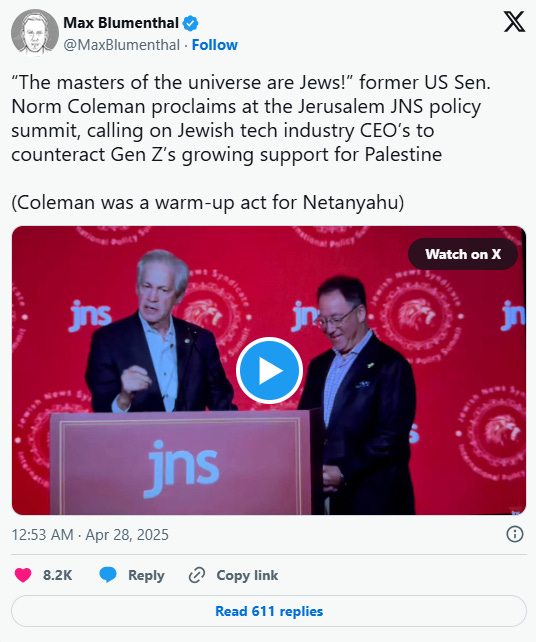
As numerous polls show young Americans are increasingly skeptical of Israel – with a recent survey showing 71% of Democrats and 50% of Republicans under age 49 now hold an unfavorable view of Israel – establishment politicians have consistently blamed TikTok’s algorithm for the decline in enthusiasm for genocide. In February, the top Democrat on the Senate intelligence committee, Mark Warner, revealed that the bill forcing China’s ByteDance to sell TikTok was motivated by the visibility of pro-Palestine content on the app.
For Coleman, though, it appears this wasn’t enough. “We have to figure out a way to win the digital battle,” he told summit attendees. “We’ve got to get our digital sneakers on, so that the truth can prevail over the lies. And when we do that, the future of Israel will be stronger because a majority of all Americans will support Israel. We’ll make that happen, we have to make it happen. Thank you, Baruch hashem.”
Israeli Prime Minister Benjamin Netanyahu took the stage directly after Coleman’s speech, highlighting Tel Aviv’s interest in the event, which was billed as the “Inaugural JNS Policy Summit to address Israel’s pressing strategic issues.”
An archetypal neoconservative, Coleman started off as an anti-war activist who once worked as a roadie for Jethro Tull, and was suspended from Hofstra University for leading a sit-in. “I went to Woodstock, and I inhaled!” he boasted at the JNS summit. After first taking office as a member of the Democratic–Farmer–Labor Party, Coleman wound up narrowly losing his Senate seat to Al Franken in 2008 as a Republican.
In addition to serving as the national chairman of the Republican Jewish Coalition and founder of the Congressional Leadership Fund super PAC, Coleman now works as a top lobbyist for the Kingdom of Saudi Arabia.
The H-1B program is about corruption and fraud, not ideology
Instead of selecting for the “best and brightest,'” the program facilitates the interests of a power cartel of middleman agencies.
By Jordan Schachtel | The Dossier | December 30, 2024
Proponents of the H-1B program argue it’s an essential opportunity to import workers with underrepresented occupational skills into America. Detractors say it serves to undermine and displace the American worker.
But before we even engage in an ideological debate between conservatives, liberals, libertarians, and socialists about the merits of H-1B, we must first recognize that the program, in its current 2024 form, is corrupt and fraudulent beyond recognition. Over the last 35 years, massive bureaucratic institutions and middlemen have formed to hijack H-1B, establishing a monopoly that wildly overrepresents certain groups of people over the rest of the world.
First, a bit of history:
The H-1B visa program was established under the Immigration Act of 1990. It was designed to enable U.S. employers to temporarily hire foreign workers in specialized occupations requiring at least a bachelor’s degree or its equivalent. Initially, the program was intended to fill skill gaps in the U.S. workforce, particularly in sectors like technology, engineering, medicine, and education, where there was a perceived shortage of American talent.
The annual cap for H-1B visas started at 65,000, but the program evolved significantly over the years. In 1998, the American Competitiveness and Workforce Improvement Act increased the cap to 115,000 visas, responding to the booming tech industry’s demand for skilled labor. This was followed by further adjustments; for instance, the H-1B Visa Reform Act of 2004 added 20,000 visas for foreign nationals holding a master’s or higher degree from U.S. universities.
Over the years, various legislative efforts have ostensibly aimed to reform the program. The H-1B Visa Reform Act of 2009 increased fees to fund retraining programs for American workers, but critics say it failed in its implementation.
The H-1B program saw its cap reached almost immediately after applications opened in the early 2000s due to high demand, leading to a lottery system for allocation. One well-known lottery-busting tactic from middleman hiring companies in India, which continues to this day, involves submitting multiple applications under different aliases for the same individual to increase their chances of selection.
Today, the H-1B visa allows holders to work in the U.S. for up to three years, extendable to six and has provisions for “dual intent,” allowing visa holders to pursue permanent residency.
According to recent data and analyses, the breakdown of H-1B visas by country of origin shows a significant concentration among two nations, with India and China leading the numbers:
India dominates the H-1B approvals list, accounting for almost three-quarters of all H-1B visa recipients.
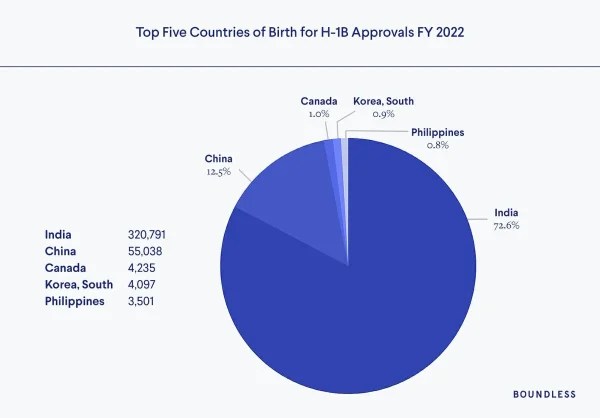
With a billion and a half people, India is still wildly overrepresented in the “talent pool,” especially because the H-1B pipeline in India tends to exclude 95 percent of the country.
India’s caste system is a complex social structure that has shaped the country’s society for millennia. Rooted in ancient Hindu scriptures, the system originally divided people into four social classes: Brahmins (priests and scholars), Kshatriyas (warriors and rulers), Vaishyas (merchants and farmers), and Shudras (laborers). In 2024, India remains a highly stratified society where one’s caste determines not only occupation but also social status, marriage prospects, and even dietary habits.
Brahmins, the elite caste Indians, only amount to about four percent of India’s population, but H-1B caters almost exclusively to Brahmins, especially when it comes to managerial roles.
The issues begin in the American university system, which continues to accommodate foreign students as an increasing percentage of total enrollment, forcing Americans to compete with the entire world for admission into elite STEM programs. The State Department hands out around half a million student visas each year, and there is seemingly no plan to roll back student visas.
Based on available data, there’s a large discrepancy between student visa holders and H-1B holders. Here’s a breakdown of student visas by country of origin in terms of percentage, focusing on the academic year 2022-2023, based on available data:
- China: Approximately 27.4%
- India: Around 25.4%
- South Korea: About 4.1%
- Canada: Roughly 2.6%
- Taiwan: About 2.1%
- Nigeria: Around 1.7%
- Japan: Approximately 1.5%
- Brazil: About 1.5%
- Saudi Arabia: Roughly 1.5%
- Mexico: About 1.4%
Around one-third of H-1B holders are U.S. university graduates, and about half come into the American workforce directly from their country of origin.
Because of the massive corruption and fraud in the talent pipeline, many current H-1B workers lack the social, cultural, and technical aptitude to mesh into an American workplace despite their claimed qualifications, leading to a major headache for their employer and the prospective American applicant who was left behind in the process.
Massive corporations like Infosys, Tata, Cognizant, Wipro, and HCL Technologies exist to facilitate this “talent” pipeline, and they have enormous influence on U.S. foreign labor policy. With a pooled value of hundreds of billions of dollars in market capitalization, they monopolized the H-1B program into a centralized cartel that recruits, hires, and fills roles in major American companies, freezing out applicants outside of the pipeline.
So, instead of finding the “best and brightest” in tech, three-quarters of all of America’s H-1B imports are likely to come from a social caste of around 50 million people, leaving behind 1.35 billion Indians in the process. In a world of 8 billion, the centralization of three-quarters of the H-1B program does no favors to Americans on either side of the debate.
According to Israel Shahak, Judaism itself is supremacist
By Bruna Frascolla | Strategic Culture Foundation | December 5, 2024
Israel Shahak (1933 – 2001) was a Polish Jew who survived both the Holocaust and the Warsaw ghetto, and lived his adult life in Israel. His surname, Hebrew in the middle of Poland, can be explained by a relevant fact: his parents were Zionists, and they changed their Yiddish last name Himmelstaub to the Hebrew Shahak. This is common among Zionists: the Netayahu family was Mileikowsky; Ben-Gurion was born Grün; Golda Meir was Golda Mabovitch.
And Israel Shahak, in turn, was anti-Zionist in a much more radical way than the current Left. In his book Jewish History, Jewish Religion: The Weight of Three Thousand Years, Shahak argues that Judaism, as it exists today and since the adoption of the Talmud, is a problem in itself, as it is totalitarian and supremacist.
The book is originally a series of newspaper articles from the 1990s prompted by the following event: in Israel, in the 1960s, a gentile collapsed during the Sabbath and an Orthodox Jew did not authorize the use of the telephone to call an ambulance. The Jews did not call because it is not lawful to violate the Sabbath to save the life of a gentile – to save the life of a Jew, it is lawful. Shahak witnessed the event and caused a series of controversies in Haaretz.
This event is very important in order to understand the way Israel thinks about its politics. Shahak convinces us that both so-called secular Zionism and religious Zionism are guided by the Talmud. Shahak’s booklet includes a brief history of Judaism. It is worth highlighting that since the Babylonian Talmud, the words of the Old Testament (or Torah) have lost its relevance because what matters is the interpretation established by the rabbis in the Talmud. This interpretation causes the ethics of the Old Testament to change completely. The “neighbor”, for example, should be interpreted as “the Jew”; it is considered that the gentile is never a Jew’s neighbor. Thus, all the universalist ethical imperatives of the Old Testament are first converted into a norm of intra-Jewish conduct; and, as a logical consequence, there is a vague field of ethics (the ethics of relations between gentiles and Jews), to be filled by the interpretation of the rabbis.
The commandment “thou shall not covet thy neighbor’s wife”, for example, comes to mean that a Jew must not covet the wife of another Jew. Nothing is said about a Jew coveting the wife of a gentile. Thus, the rabbis were able to prohibit the sexual relationship (any sexual relationship) between a Jew and a gentile in other ways: by comparing it to bestiality and punishing it as a deviation. This means not only that a Jew should not covet a gentile’s wife, but also that a Jew cannot marry a gentile, just as a man cannot marry a goat. But while it is hard to find a legal body willing to punish a goat, the same is not true of women: “If a Jew has coitus with a Gentile woman, whether she be a child of three or an adult, whether married or unmarried, and even if he is a minor aged only nine years and one day – because he had wilful coitus with her, she must be killed, as is the case with a beast, because through her a Jew got into trouble.” This is Maimonides.
Such interpretation of the word “neighbor” also applies to “man,” which is also considered synonymous with Jew. The Gentile, in fact, is something analogous to an animal. Every time a Zionist propagates a phrase that sounds humanist, it is good to remember this peculiar glossary of rabbinical origin. Picking up a Talmud to read is pointless unless one knows Hebrew, because, according to Shahak, translations of the Talmud contain distortions designed to avoid upsetting the Gentiles. These distortions are especially important in hiding what the rabbis think of Jesus Christ and Christians, who are considered inferior to Muslims.
In doctrinal matters, Shahak quotes extensively from the Talmud and Maimonides. The most basic ethical issue is the way the rabbis view gentile life: according to the sources gathered by Shahak, it is the duty of the Jew not to help a gentile if his life is in danger, unless the fact that the Jews let the gentile die causes hatred that puts the lives of the Jews at risk. It is forbidden to push a gentile into a well, but it is also forbidden to lift him out, saving his life. However, if the Gentiles realize that the Jews are letting them die, this will generate hatred and put Jewish lives at risk. This happens wherever Jews are not the majority. Thus, there is a kind of façade Judaism, for public relations, and an explicit Judaism that prevails only in Israel.
This precept has generated much debate in Jewish medicine – which is not at all Hippocratic. One topic that is much discussed is that of the Gentile pregnant on the Sabbath. A Jewish midwife and a Jewish doctor can use the Sabbath as a pretext to deceive the Gentiles and not come to her aid, even if the aid would not violate any Sabbath rules. If there is any doubt about the genocidal nature of these guidelines, Maimonides accepts that a Jew may help a pregnant gentile as long as he pays for it, and that there is another doctor capable of saving her life. After all, it would be a shame if a gentile, rather than a Jew, were to fail to earn money. Thus, the death of the pregnant woman comes first, and then the money of the Jew.
Well, given that this supremacist thought guides Judaism, and Judaism guides the State of Israel, it is clear (as Shahak argues) that the talk of two states is nonsense, because, as far as Israel is concerned, the Palestinians will not have a state. Shahak also shows how the most ardent anti-Zionists do not fail to have a rosy view of the State of Israel: it does not allow Bantustans, nor is it imperialist.
Let’s see: a typical imperialist power co-opts local elites and uses them to govern according to its own designs. Israel’s own neighbors are a testament to this, since the British Empire ruled over the Arabs rather than attempting to commit ethnic cleansing. Israel does not rule over the Arabs; instead, it tries to eliminate them, either by killing or expelling them.
As for the Bantustans, i.e., the pseudo-countries of blacks under the tutelage of South Africa, the fact is that the very intention of creating fake countries led to the creation of artificial flags and nationalism. The Palestinians, on the other hand, have no right to any manifestation of nationality. Religious Zionism is influential in Israel to the point that, under a secular administration, it could cause a diplomatic incident with its eternal ally Jordan. According to Shahak, in 1974, Israel intended to block the recognition of the PLO as the Palestinian representation. A meeting was arranged with the king of Jordan in the West Bank, where he would be received by a local Arab ruler. The reception would have a lot of Jordanian and Israeli flags. The religious wing complained that no foreign flag should be flown in Eretz Israel. The king felt the insult and recognized the PLO.
Shahak’s book is a succinct booklet with a lot of relevant information. I showed just a bit, and reading the work is highly recommended.
Is Israel Using Soccer to Export Its Racist Political Model to Europe?

By Mike Whitney • Unz Review • November 15, 2024
For the second time in 8 days, hundreds of Israeli soccer hooligans attacked unidentified fans at a football match in Paris, France. A number of videos circulating on social media show swarms of young men—mostly dressed in black with masks and stocking caps or draped in Israeli flags—pummeling an unknown Frenchman who was beaten to the ground. The extent of his injuries remains unknown.
The skirmishes took place at Thursday’s UEFA Nations League soccer game between France and Israel at the Stade de France which drew the smallest crowd in history due to the threat of hooligan violence. But although the streets of Paris were heavily patrolled by thousands of police and security guards to protect the visiting Israelis, fans of the home team received no such security. When the Maccabi Tel Aviv fans began raining-down blows on their unnamed victims, the police were nowhere to be found.
Some of the videos show terrified fans fleeing an area in the stands that was overrun by a hostile Maccabi mob sprinting across the upper deck while thousands of fans “Booed” loudly from below. The scene seemed more reminiscent of the political street fights that took place in Weimar Germany in the early 1930s than a football match in 2024. The ensuing mayhem was described by analyst Arnaud Bertrand on his Twitter site:
… There was a football match between Israel and France yesterday and this happened at the beginning of the match: a horde of Israeli supporters openly lynched some French supporters in the stands. Macron himself was in attendance at the match to show his commitment to “fighting antisemitism” after Amsterdam…
He made no public comment that I know of on these French supporters getting lynched in front of his eyes. And the police made no reported arrests. Had the reverse been the case, had this been some Israeli supporters getting lynched by a horde of French supporters, you can absolutely bet 100% that he (and all the French media) would have made a huge deal out of it. You cannot overstate the absurdism of it: because we’ve so gaslighted ourselves around “antisemitism” and so distorted the meaning of it, Western countries would literally rather let our their own citizens get lynched on their own soil – in front of the president’s eyes (!) – than face accusations being “antisemitic” in their own definition of the term. @RnaudBertrand (video)
Bertrand is using the term “lynching” in the legal sense as it relates to the “Emmett Till Anti-lynching Act” in 2022… meaning “that the actions of the Israeli supporters would most certainly be considered lynching under US law because they conspired as a mob to cause serious bodily harm based on bias regarding “the actual or perceived religion or national origin” of the person(s) – matching exactly 18 USC §249(a)(5)’s definition requiring conspiracy & serious injury in hate-motivated attacks. @RnaudBertrand
Arnaud is correct in pointing out that President Macron attended the match. Not surprisingly, Macron was joined in his luxury box by two former presidents, the current prime minister and a large portion of France’s political establishment, all of whom stand foursquare behind the violent Zionist thuggery they witnessed in the stands. (Note—Joshua Zarka, Israeli ambassador to Paris, was also at the game, while Ronen Bar, the head of Israel’s Shin Bet security service, was in France to supervise the security of Israeli players and fans.)

This is from an article at inews.uk:
Fights broke out at a sparsely attended France–Israel match at the Stade de France in Paris on Thursday night, despite a heavy security presence inside and outside the stadium. Footage on social media showed clashes between home and away fans in the stands, with one clip appearing to show men wearing Israel flags punching and kicking a man on the ground before stewards intervened.
Tensions ran high even before the match with a heavy security operation around the stadium, with 4,000 police and 1,600 civilian security personnel deployed as French authorities sought to avoid a repeat of the violent scenes around a Maccabi Tel Aviv match in Amsterdam last week. Police lines extended more than a kilometer from the stadium with barricades along the streets and helicopters buzzing overhead… Just 13,000 tickets had been sold the day before the game – reportedly the lowest attendance for any home fixture in the history of the French national team…
Israel fans sang songs in support of the Israel Defence Force (IDF) and “free the hostages,” in references to captives held by Hamas in Gaza. Some wore masks and IDF shirts.
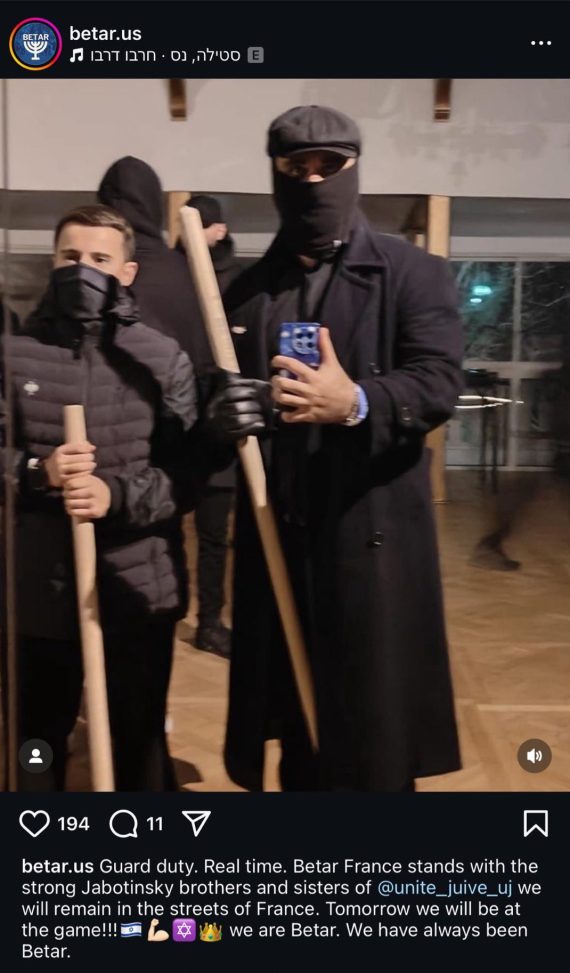
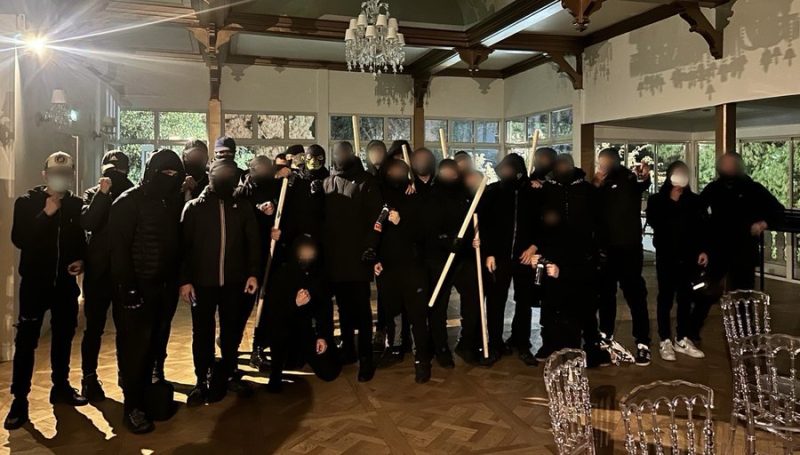
Despite Israeli government advice, some Israeli dual nationals were in Paris with Betar, an international right-wing Zionist group. Betar’s social media channels posted an image of members in the French capital holding baseball bats before the game. Fights break out at France-Israel match in Paris despite heavy security, inews.co.uk
Let’s recap:
- No expense was spared to provide security for the Maccabi hooligans, but French fans were beaten in the stands without anyone lifting a finger.
- A mere 13,000 people attended a stadium that holds 80,000, but the match was given the go-ahead regardless.
- The Maccabi mob sang military songs and bellowed racist slogans, but no government official has had the courage to order an inquiry. Note: According to the Middle East Eye, Israeli fans chanted “Free the hostages” and “Hamas, Hamas, we’re fucking you”.)

Readers should take a minute and carefully examine the photo at the top of this article. What do you see?
Do you see a gathering of typical soccer fans dressed in team colors and jerseys waving banners and singing team songs, or do you see a uniformly dressed and deeply threatening throng of black-clad troopers with stocking caps and masks who could—just as easily be conducting a military operation as attending a match of their favorite football team?
Who wears a black mask and a stocking cap to a soccer match? Who chants “Hamas, Hamas, we’re fucking you” at a soccer match?
Was this really a spontaneous get together of pumped-up Maccabi fans expressing their support for their team or a clandestine infiltration of the EU overseen by Israeli intelligence agents on secret assignment?
And be sure to take special note of the author’s last observation:
Despite Israeli government advice, some Israeli dual nationals were in Paris with Betar, an international right-wing Zionist group. Betar’s social media channels posted an image of members in the French capital holding baseball bats before the game.
Betar? The far-right youth movement founded by Vladimir Jabotinsky that fought against the British in Mandatory Palestine and was closely affiliated with the Zionist terrorist organization, the Irgun?
Here’s more from an article at the Middle East Eye:
At the demonstration in Paris, Salah Hamouri, a French-Palestinian lawyer who was deported from Jerusalem by Israel in 2022 after spending many years in prison and is now a member of Urgence Palestine, also accused the French president of sending a political message of support for Israel by attending the match.
“This match and the participation of Macron, Hollande and Sarkozy is part of France’s complicity in the ongoing genocide. It is a diplomatic green light given to the Israeli occupier for all its actions in Palestine and Lebanon and for it to continue its massacres in Palestine and in Lebanon,” he told MEE.
“Today, the low turn-out at the stadium shows that the public opinion in France is in favour of the Palestinian cause, and that the people support the people. It shows that the voice of the Palestinian people has been heard, and that a boycott needs to be implemented.” France-Israel match marked by scuffles, booing and a record-low attendance, Middle East Eye
Summary and Analysis
So, now we’ve seen two significant and politically destabilizing events in less than 10 days both of which took place in European capitals. And in both cases, the violence and racist chants were initiated by Israeli hooligans engaged in actions aimed at intimidating the public. Is there a rational explanation for this sudden uptick in social unrest attributable to Maccabi sports fans?
Of course, it could be just a coincidence linked to the behavior of overzealous sports fans who need to practice more self-restraint. That is one possibility. We cannot exclude another possibility, however, that the violence we have seen in Paris and Amsterdam is not a one-off or merely a case of exuberant young men “letting off a little steam.” We must at least consider the possibility that Israeli powerbrokers have launched this operation—using their assets in the IDF and Mossad—to advance their own strategic agenda consistent with their expansionist Zionist plan.
What we’ve seen is that the incitements on the ground have been coordinated with journalists in the legacy media and with political leaders across the West who have fabricated a narrative of growing antisemitism when, in fact, that storyline is easily debunked by the hundreds of first-person eyewitness accounts and the numerous videos on social media that prove that the sole responsibility for the violence in both cities lies entirely with the Israeli soccer thugs.
But why would political leaders and the media want to create the impression that antisemitism is on the rise? That is the question we must ask ourselves, because that is the narrative we are expected to believe.
IMHO, Israeli leaders understand that the claim of antisemitism is a powerful coercive tool that can be used to pressure parliamentarians to modify the law in ways that benefit one group over the others. Thus, as fears of a new wave of antisemitism intensify, the demand for changes to the law increase. Eventually—as in the case of Israel—equal protection is no longer equal protection. One category of people is placed above the law, while the others are crushed beneath the wheel of “second class citizenship.” This erosion of equal protection—that is attributable to the creation of “special” laws for special people—is the fast-track to apartheid, which is the end of a justice system that treats all people equally and with dignity.
Israel is frequently called an apartheid state because one group of people is treated differently (under the law) than the other. If my theory is correct, then Israeli policymakers are trying to affect those same changes in Europe, which means, they are exporting their racist political model to the continent.
Readers may want to skim the article below and decide for themselves whether this theory has any merit:
Calling for a boycott against Israel is forbidden now – and other measures against anti-Semitism, CNE
The German Bundestag took the clearest decision. Last week, the parliament accepted a resolution from both the government and the Christian Democratic opposition to protect Jewish life in the country. The title of the resolution was “Never again is now”, according to reports from the Frankfurter Allgemeine Zeitung.
According to the text, hatred against Jews and Israel is higher than “decades” since the terror attacks on October 7th 2023. The resolution also explicitly mentions that migrants especially add to this problem…. Concrete measures of the resolution are that no state money can go to organizations that… call for a boycott against Israel. Also, schools will be supported in educating about the Holocaust….
Norway
This Monday, the Norwegian Prime Minister Jonas Gahr Støre presented an action plan with 22 measures against hatred against Jews. He invited representatives of the Jewish community to a meeting to discuss the matter. “We would love we did not need an action plan”, the Prime Minister said. “But we know that it is necessary.”
The Holocaust Centre in Norway has reported that anti-Semitism is growing after many years of decrease. “It is not just one budget post that resolves this”, Støre said. “This is about something difficult as attitudes.”…
Netherlands
Also , the Dutch government has been invited to take action against anti-Semitism. On Wednesday, there was a lengthy urgency debate in the Lower House about the incidents in Amsterdam last Friday.
The debate was dominated by Geert Wilders –who is leading the largest party– who presented immigration by Muslims as the basic problem of anti-Semitism.
The Dutch society was shocked by the pogrom-style hunt of Israeli football supporters. Hundreds of Maccabi Tel Aviv supporters were asked for their passports, beaten and chased. Opposition leader Frans Timmermans expected concrete measures from the government. He advocated for appointing more detectives to track down anti-Semitic offenders and then imposing harsher penalties….
European Parliament
Also, in the European Parliament in Brussels, parties held an urgency debate about anti-Semitism later on Wednesday. The debate was requested by the Dutch MEP Bert-Jan Ruissen from the Reformed SGP party after the shocking events in Amsterdam. The title of the debate is the “deplorable escalation of violence around the football match in the Netherlands and unacceptable attacks on Israeli football fans.”
“Europe is increasingly in the grip of extremist violence and Jew-hatred”, Ruissen said in a written statement. “This must stop as soon as possible.”
Already in October, the EU ministers of Foreign Affairs adopted a declaration that condemned “all forms of anti-Semitism, racism, hatred and discrimination.” Also, in this statement, action in schools was asked to keep the Holocaust in the “collective memory”. Calling for a boycott against Israel is now forbidden, CNE
Everyone is entitled to equal treatment under the law. There should be no legal carveouts for special people.
The truth is out there, behind all the lies
By Yvonne Ridley | MEMO | November 12, 2024
There is nothing more noble than telling the truth, and yet for simply delivering nothing but the truth Palestinian journalists are being killed; they — and their families — are targeted by Israeli soldiers in Palestine and Lebanon. The death toll of journalists in Gaza alone has risen to 177, with not one newsroom left standing in the enclave.
Meanwhile, professional liars from the Zionist State’s diplomatic corps deny that its army targets journalists deliberately, even when presented with irrefutable evidence. According to Irish journalist Frank McDonald, “These shameless men and women lie on behalf of a country that is itself built on lies, mythology, terrorism, land theft and deep denial of historical truths, especially about Palestine and what successive Israeli governments have done to the Palestinians.”
Despite the rising death toll of journalists and other civilians across Gaza, the occupied West Bank (including Jerusalem) and Lebanon, Israel never tires of telling the world that it is “the only democracy” in the Middle East; we know that is simply not true on several levels, due to the fact that major human rights bodies have said that it has passed the legal threshold for classification as an apartheid state, including B’Tselem, Human Rights Watch and Amnesty International. Moreover, one of the keystones of democracy is a free press, but since October last year, 21 local radio stations, 15 local and international news agencies, 15 TV stations, six local newspapers, three broadcasting towers, eight print media and 13 media institutions have been destroyed in Gaza.
The Israeli government’s policy of terrorising and killing journalists and its ban on foreign media makes it impossible for journalists like me to get into Gaza so that we can do our jobs and report the truth of what we witness. Not that we would do that any better than the courageous Palestinian journalists, but wherever journalists are banned we all know that it is because powerful people in powerful places do not want anyone shining the light of publicity on their activities.
Meanwhile, Israel pumps out lies on a daily basis using its militarised propaganda machine as well as paid-for stooges who earn a nice living out of promoting the Zionist State as a peace-loving nation and a victim of anti-Semitism.
They are given a free ride by organisations like the BBC.
Any journalist who calls out the egregious lies and victim blaming from the apartheid state’s representative of choice is likely to disappear from public view in what is a time of unprecedented censorship.
A few days ago, we got a close up view of the slick Zionist propaganda machine in action as the notorious Maccabi Tel Aviv football fans wreaked havoc in Amsterdam. Journalists and politicians lined up to condemn the violence in the city of Anne Frank, the Jewish girl who documented her life in hiding from the Nazis during the German occupation of the Netherlands before she was sent to Bergen-Belsen concentration camp where she died.
For two days, these football fans, who have a long and grubby history of violence and racism at home and abroad, took their vile, racist antics to the Arab community in the Dutch capital. The response was one of which any community under fire would be proud; they fought back and defended themselves. The global reaction to this, though, was perverse.
European Commission president Ursula von der Leyen, aka “Frau Genocide”, expressed her outrage in the media without checking the facts. It was enough for her to know that Arabs had resisted Israeli abuse and violence in the home city of Anne Frank so it must be the fault of the immigrant community and not the foul-mouthed yobs from Tel Aviv.
The truth was just an inconvenient fact for von der Leyen and her deputy, as well as the reviled Dutch politician Geert Wilders and Free Press editor Barry Weiss. The latter two referred, somewhat hysterically, to the violence as a “pogrom” against Jews.
Even though elected members of Amsterdam’s city council confirmed to Al Jazeera that the Maccabi fans had ignited the violence, by that time British and European mainstream media were toeing the Tel Aviv line of “Jews under attack”. Words like “pogrom” were employed even though the Zionist narrative was far from the truth.
I am disgusted at the reaction of my colleagues from the mainstream media who fell for the Zionist propaganda.
While heroic Palestinian journalists are risking life and limb to bring cold hard facts to the table, their western counterparts are destroying their own integrity by putting out false information about what happened in Amsterdam last week (and what happens in Palestine under Israeli occupation).
Shameless politicians also sent out messages on social media, with bogus claims of anti-Semitism and helpless Jews under attack in Amsterdam. Investigative journalist and former Labour MP Chris Mullin saw through the lies, though, and asked: “How on earth did these people manage to present themselves as victims?”
The other question we need to ask is whether the Israeli-led violence in Amsterdam was a spillover from the impunity with which Israel is allowed to act in the occupied Palestinian territories, Lebanon, Syria and Iran. Do the Israeli thugs in Maccabi Tel Aviv colours, around 80 per cent of whom are thought to be serving in the occupation army which stands accused of committing genocide and war crimes, now feel empowered and entitled to take their thuggery wherever they like? Many may well have mental health issues arising from their experiences in Gaza and the West Bank. Having thugs running amok in Europe boasting about killing Palestinian babies just adds to the evidence lawyers need to prosecute these lawless individuals.
This is something that Frau van der Leyen might want to consider because the more she excuses and justifies the violence of Israelis on Europe’s streets, the more we will be expected to accept such aggression from these psychopaths, and the more danger we will all face.
Predictably, political thugs like Israeli Prime Minister Benjamin Netanyahu have weaponised anti-Semitism, ignoring the racism and violence of the Israeli football fans which kicked it all off in Amsterdam. When Netanyahu said that he would send the army and aircraft to get the violent Maccabi Tel Aviv fans out of Amsterdam as quickly as possible, it was an exercise in damage limitation, not out of concern for their safety in this bogus “pogrom”.
While I am sure that the 7 October Hamas-led cross-border incursion and its aftermath have had significant emotional and behavioural impacts on the Israeli public, the need for a psychological intervention has increased. If the Western media and politicians were true friends of Israel they’d realise that this is a nation with severe psychological problems that are easily triggered by the very sight of a Palestinian flag. Why else did they attack homes in Amsterdam which had such flags on display?
While it’s increasingly difficult to show any empathy or sympathy for Israeli citizens without comparing and contrasting the cause and effects of 75 years of brutality against the Palestinians, the world needs to open its eyes to the psychotic nature of the settler-colonial state and those who run its brutal military occupation. In the immediate aftermath of 7 October, there was a reported 30 per cent rise in demand for psychiatric drugs. As many as 35 per cent of war-related casualties were also found to be related to psychological issues. It is now clear that the individual mental health needs of Israelis have increased, with talk of an impending mental health “pandemic”.
Israeli Health Minister Uriel Buso has admitted that the rogue state is in the midst of its worst-ever mental health crisis since its establishment. Buso made the comment at the Enosh Mental Health 2024 Conference in Tel Aviv in September.
The crisis can be seen in Israeli football stadiums where, according to this report, the most violent fans come from Beitar Jerusalem, Hapoel Tel Aviv and Maccabi Haifa. While many hoped that 7 October would lead to a change in the mentality that had taken root on the terraces, the reality is completely opposite. Racism, violence and social polarisation have become commonplace in many football stadiums in Israel, says news journalist Ben Goldfriend. His eight-page report on the phenomenon, written in Hebrew, is depressing and strengthens the argument that Israeli football clubs should be banned from UEFA competitions and the national team should be banned from UEFA and FIFA international tournaments.
So far, 112,000 people have signed this petition calling for Israel to be suspended from all international sporting competitions. “In recent years, we have witnessed how the violent and racist atmosphere on the pitches is becoming more and more serious,” said Matan Segal, the director of the Israeli programme to kick racism and violence out of football. “The attempts to address the problems with the same means that were tried in the past have proven to be ineffective.”
The Israeli football season so far has been blighted with numerous incidents of racist chants, including — and this is astonishing — derogatory chants about the Holocaust.
I wonder what Frau Genocide or British Prime Minister Keir Starmer have to say about that.
If our leaders really are concerned about the safety of their own citizens in Europe then a travel ban should be imposed immediately on all Israeli teams and football fans, especially those serving in the rogue Israel Defence Forces. Editors across the media should instruct their best feature writers and investigative reporters to expose the violence of the Zionist State’s sports fans in exactly the same way that they exposed the true nature of English football hooliganism during the 1970s.
Israel’s National Security Council claimed on Sunday that pro-Palestinian groups were calling for attacks on Israelis and Jews in multiple European cities. Including some in the UK, “under the pretence of demonstrations and protests”. As usual, Israel has provided not one jot of evidence for its blatant lie and yet the UK Government and Sir Keir Starmer duly went along with it. “There is no place for anti-Semitism on our streets and we will not allow cultural and sporting events to be hijacked by those who seek to promote hate,” intoned Starmer. “Those who push this poison — offline and online — will face the full force of the law. Police and the security services continue to work to ensure the safety of every community in this country.”
If Starmer was genuine about protecting “every community in this country” he would ban every sporting event involving any team and fans from Israel.
Just consider this: if the Labour Home Secretary Yvette Cooper could ban the grandson of Nelson Mandela from speaking on a UK-wide speaking tour promoting peace and justice, then I’m sure that every legal mechanism is in place to crack down on Israel sports fans who feel emboldened enough to act with impunity and wreak havoc and violence on our streets.
Episode 388: SIRI TESTIFIES: NEW HAMPSHIRE “POST-LICENSURE SAFETY”
The HighWire with Del Bigtree | September 5, 2024
The next installment of attorney Aaron Siri’s expert testimony before the New Hampshire House Committee on COVID Response Efficacy. In this episode, ICAN’s lead attorney exposes the shortcomings of post-licensure safety, and shatters the claim that the connection between vaccines and autism has been ‘thoroughly studied.’
Guest: Aaron Siri, Esq.
Featured Video

Racist Seinfeld Dances for Joy as Bibi Unveils His New Map
or go to
Aletho News Archives – Video-Images
TV Drama Review
Japanese drama projects Japan’s wartime atrocities onto Chinese characters

Global Times | October 25, 2026
By portraying Chinese characters as perpetrators of ruthless violence while casting Japanese Self-Defense Forces (SDF) intelligence operatives as defenders, the season 2 of the Japanese drama Vivant has recently drawn criticism from Chinese netizens, who argue that its depiction turns historical reality on its head while ignoring Japan’s wartime atrocities.
The TBS drama series – a spy suspense story in which an alleged unofficial intelligence unit of the SDF operates across the globe — has attracted a passionate fanbase. Its currently airing season 2 opened with a household rating of 18.8 percent, the highest for a TV drama this year, according toa commentary article by Japanese media Toyo Keizai.
What draws attention is the portrayal of the enemies in the series, the article noted. Scenes in which the Chinese organization subjects kidnapped members of the SDF unit to brutal torture are repeated with unrelenting intensity.
It is rare for Japanese TV dramas to explicitly portray a real-life country as the enemy, the article noted.
Japanese Prime Minister Sanae Takaichi also made a reference to the drama, saying that she has been recording Vivant and hopes to binge-watch it over the year-end and New Year holidays, according to Japanese media outlets.
China’s CCTV News report on Sunday revealed that the drama features scenes in which Chinese personnel cut off the fingers of and stab Japanese intelligence operatives in the abdomen. Such acts bear striking similarities to the torture inflicted on Chinese nationals by invading Japanese troops during the World War II.
The drama distorts the truth by attributing these atrocities to modern Chinese characters. Beneath the surface, it subtly glorifies Japan’s cross-border overseas operations, blurs the functional boundaries of the SDF and implicitly promotes an expansionist narrative, per CCTV News. … continue
Blog Roll
 Aletho News
- EU facing trillion-euro debt hole while seeking more cash for Kiev
- How US, Europe, Persian Gulf states exhausted missile stockpiles, splurged billions to defend Israel
- Up in arms… Koreans reject U.S. empire’s plan to make South Korea the next Ukraine
- Iran, Turkey, Pakistan, Saudi Arabia could advance region-led security framework in Tehran: FM spox
- Netizens condemn Japanese drama for projecting Japan’s wartime atrocities onto Chinese characters
- Racist Seinfeld Dances for Joy as Bibi Unveils His New Map
- A West Bank War for Netanyahu’s Election Campaign, Could It Backfire?
- Yemen denounces European Parliament’s ‘hypocritical’ push to blacklist Ansarullah
- Qalibaf: UAE’s UN bid aims to ‘clear the runway’ for ‘Greater Israel’, whitewash genocide
- Pakistan reopens Iran border after boosting security: Report
- If Americans Knew
- Why Israel’s latest assault on Hebron is so significant for the West Bank
- Israel Used “Where’s Daddy?” AI to Relentlessly Murder Palestinian Journalists and Their Families in Their Homes from October to December 2023
- DAILY UPDATE: Latest essential news on Palestine, Israel, & region
- Netanyahu Says Israel Must Prepare for Banking Sanctions, Floats Crypto as a Possible Bypass
- Latest updates from Israeli assault on West Bank
- Tourism Ministry launches free food truck tour in US
- “So Much Worse Than People Realize”: Never-Before-Seen Images Reveal Damage at U.S. Bases as Troops Describe Being Abandoned
- UK Bell Review Confirms Only Anti-Israel Attitudes Are Rising, Not Antisemitism
- DAILY UPDATE: Latest essential news on Palestine, Israel, & region
- DAILY UPDATE: Latest essential news on Palestine, Israel, & region
- No Tricks Zone
- Sudden Stratospheric Warming, Powerful El Niño Combination May Lead To Extreme Europe Cold, Energy Crisis!
- Two New Studies Find Thwaites Glacier Melt Cannot Be Driven By Human Activity Or A Warming Ocean
- E-Cars Reduce CO2 Emissions By Only 41% Compared To Internal Combustion Engine Vehicles
- Predictions Made By Renowned Climate Professor Over Past Decades Have Been Proven To Be Poor
- New Study Suggests Large Regions Of The Pacific Ocean Have Been Cooling For The Last 80 Years
- Germany’s Green Energy Debacle: High Energy Costs Force Kahla Porzellan to Close After 182 Years!
- New Study: 50 Years Of The Most Aggressive ‘Net Zero’ Policies Can Only Affect The Global Climate By 0.03°C
- US September “Heat” Was No Record…Many Records Set Decades Ago
- Latest European Green Energy Debacle; Portugal’s Largest Flagship Solar Park Insolvent!
- Green Energy Debacle: German Expert Professor Fritz Vahrenholt Warns Of Severe Economic And Social Consequences

