ARD Public Broadcasting Expects Regular Germans To Eat Worms, Live In Squalor
By P Gosselin | No Tricks Zone | March 4, 2023
Privileged ARD German Public Television journalist Anja Reschke wants to turn Germans into worm-eaters, to save the planet. From paternalism to abuse.

Generously funded, spoiled ARD public television treats its regular viewers like Cinderellas who are to be exploited, to live in squalor and eat worms instead of meat. AI generated image by DALL E 2.
Hat-tip: By Daniel Matissek, AUF 1
Germany’s ARD public broadcasting network is funded to the tune of more than eight billion euros by compulsory fees levied on every German household each year.
But the network has gone far beyond its original charter of keeping the public informed and educated, and now appears to have even drifted past being an paternalistic institution with the self-assigned role of properly upbringing the masses of the working uncouth.
Let them eat worms
Today, if the latest is anything to go by, it seems the massive ARD network has gone yet a step further and now sees its viewers as Cinderellas who are to be exploited and relegated to live under forsaken conditions. Not long ago one highly paid and pampered ARD commentator even gleefully welcomed the energy price shocks and seemed glad that the uncouth masses would soon have to wear rags and live in attics. “That’s good!” said Detlef Flintz.
The latest comes from ARD left-wing know-it-all Anja Reschke who appeared in the early evening program “Wissen vor Acht” (Knowledge before Eight) with a new nutrition tip for those who don’t want to wean themselves off “climate- destroying” meat: They can can simply grow worm meat in their “kitchens of tomorrow”.
“Round and juicy” after 6 weeks!
In the ARD show, Reschke demonstrates how worms can be grown and then fattened in six to eight weeks until they become “round and juicy”.
Then all they have to do is put them in the freezer “and later they can be processed into minced meat,” says the leftie journalist Reschke. Supposedly, the plant yields 200 to 500 grams of meat per week, but uses “only a fraction of the land, food and water compared to cattle or pig farming,” Reschke enthuses.
While a kilogram of beef produces around 70 kilos of CO2, a kilo of worm meat produces “just under three kilos.”
People will just have to get over their disgust
There’s only one obstacle: We only have to “overcome our disgust against insects as food, because insects surely belong on the menu of the future,” says Rescke. It just takes a little getting used to, Reschke seems to imply as she and her dim-witted daughters at the ARD ready themselves for the royal evening ball.
Meat eaters like “consumers of child pornography”
“This is no April Fools joke,” writes AUF 1. The ARD is dead serious about it: “This madness is meant dead-seriously. The climate mania serves to encourage people in all seriousness to eat vermin in order to save the world.”
Deutschlandfunk, also a part of the massive German public broadcasting organization, recently compared meat eaters to “consumers of child pornography”.
Wow! Even Cinderella’s evil stepmother never went that far.
Green Energy: Greatest Wealth Transfer to the Rich in History
By Steve Goreham | MasterResource | February 21, 2023
We are in the midst of history’s greatest wealth transfer. Government subsidized wind systems, solar arrays, and electric vehicles overwhelmingly benefit the wealthy members of society and rich nations. The poor and middle class pay for green energy programs with higher taxes and higher electricity and energy costs. Developing nations suffer environmental damage to deliver mined materials needed for renewables in rich nations.
Since 2000, the world has spent more than $5 trillion on green energy. More than 300,000 wind turbines have been erected, millions of solar arrays were installed, more than 25 million electric vehicles (EVs) have been sold, hundreds of thousands of acres of forest were cut down to produce biomass fuel, and about three percent of agricultural land is now used to produce biofuel for vehicles. The world spends about $1 trillion per year on green energy. Government subsidies run about $200 billion annually, with more than $1 trillion in subsidies spent over the last 20 years.
World leaders obsess over the need for a renewable energy transition to save the planet from human-caused global warming. Governments deliver an endless river of cash to promote adoption of green energy. The Inflation Reduction Act of 2022 provided $370 billion in subsidies and loans for renewables and EVs. But renewable subsidies and mandates overwhelmingly favor the rich members of society at the expense of the poor.
Wind systems receive production tax credits, property tax exemptions, and sometimes receive payments even when not generating electricity. Landowners receive as much as $8,000 per turbine each year from leases for wind systems on their land. Lease income can be quite high for a landowner with many turbines. In England, ordinary taxpayers pay hundreds of millions of pounds per year in taxes that are funneled as subsidies to wind companies and wealthy land owners.
In the US, 39 states currently have net metering laws. Net metering provides a credit for electricity generated by rooftop solar systems that is fed back into the grid. Solar generators typically get credits at the retail electricity rate, about 14 cents per kilowatt-hour. This is a subsidized rate, which is more than double the roughly five cents per kilowatt-hour earned by power plants. Apartment residents and homeowners that cannot afford to install rooftop solar pay higher electricity bills to subsidize homes that receive net metering credits. Rooftop solar owners also receive federal and state tax incentives, another wealth transfer from ordinary citizens.
US federal subsidies of up to $7,500 for each electric car purchased, along with additional state subsidies, directly benefit EV buyers. The average price of an EV in the US last year was $66,000, which is out of reach for most drivers. A 2021 University of Chicago study found that California EV owners only drive 5,300 miles per year, less than half the mileage for a typical car. Most electric cars in the US are second cars for the rich.
A mid-size electric car needs a battery that weighs about a 1,000 pounds to provide acceptable driving range. Because of battery weight, EVs tend to be about 50 percent heavier than gasoline cars, which causes increased road damage. But EVs don’t pay the road tax included in the price of every gallon of gasoline. EVs should pay higher road taxes than traditional cars, but today this cost is borne by everyday gasoline car drivers.
Renewable systems require huge amounts of special metals. Electric car batteries need cobalt, nickel, and lithium to achieve high energy density and performance. Magnets in wind turbines require rare earth metals, such as neodymium and dysprosium. Large quantities of copper are essential for EV engines, batteries, wind and solar arrays, and electricity transmission systems to connect to remote wind and solar sites. According to the International Energy Agency, an EV requires about six times the special metals of a gasoline or diesel car. A wind array requires more than ten times the metals of a natural gas power plant on a delivered-electricity basis. The majority of these metals are mined in developing countries.
Almost 70 percent of cobalt is mined in the Democratic Republic of the Congo. Indonesia produces more than 30 percent of the world’s nickel. Chile produces 28 percent of the copper. China produces 60 percent of the rare earth metals. These nations struggle with serious air and water pollution from mining operations. Workers in mines also suffer from poor working conditions and the use of forced labor and child labor practices. But apparently no cost is too great so that rich people in developed nations can drive a Tesla.
To top it off, the European Union recently approved a Carbon Border Adjustment Mechanism (CBAM). The CBAM will tax goods coming from poor nations which aren’t manufactured using low-carbon processes. CBAM revenues will be a great source of funds for Europe’s green energy programs that benefit the wealthy.
In January, California, Connecticut, Hawaii, Illinois, Maryland, New York, and Washington proposed a wealth tax on billionaires. It’s interesting to note that all seven of these states mandate and heavily subsidize wind and solar arrays and electric vehicles, which transfer wealth from poor and middle-class residents to those same billionaires.
No sympathy for tycoons losing palaces and yachts abroad – Putin
RT | February 21, 2023
Ordinary Russians feel no sympathy for their rich compatriots who had their assets frozen by Western countries, President Vladimir Putin stated on Tuesday.
Addressing the Federal Assembly in his key annual program speech he argued that in their kitchen conversations ordinary Russians remembered both the privatization of the 1990s and the conspicuous consumption of the new elites.
“None of the ordinary citizens of Russia felt sorry for those who lost their capital in foreign banks. They didn’t feel sorry for those who lost their yachts and palaces abroad,” Putin stressed.
He recalled “imbalances” faced by the post-Soviet economy when Russia began to build the country again from scratch by aligning with the West.
“We were considered as a source of raw materials,” Putin said, stressing that it took Russia years to break this trend. Meanwhile, instead of expanding production and creating jobs in Russia, the wealthy “elite” spent money on luxury goods like yachts, mansions, and the education of their children abroad, Putin pointed out.
As a result, the image of the West as a safe haven for capital turned out to be “a fake” and everything was taken away from the oligarchs – savings, houses and also their yachts.
“They were simply robbed there and even legally earned money was taken away,” the president said, adding that an attractive Western lifestyle turned out to be an illusion.
Monbiot: We Must End Our Dependence On Farming
By Paul Homewood | Not A Lot Of People Know That | February 20, 2023
We must end our dependence on eating.
Why does anybody treat this nutter seriously?
Perhaps before he makes a fool of himself next time, he might like to check what the UN’s Food & Agriculture Organisation have to say on the matter:
 ABOUT 60 PERCENT of the world’s pasture land (about 2.2 million km2), just less than half the world’s usable surface is covered by grazing systems. Distributed between arid, semi arid and sub humid, humid, temperate and tropical highlands zones, this supports about 360 million cattle (half of which are in the humid savannas), and over 600 million sheep and goats, mostly in the arid rangelands. The distribution of livestock over the different ecological zones is provided in Annex Table 2.
Grazing systems supply about 9 percent of the world’s production of beef and about 30 percent of the world’s production of sheep and goat meat. For an estimated 100 million people in arid areas, and probably a similar number in other zones, grazing livestock is the only possible source of livelihood.
Environmental challenges
Grazing can be visualized as beautiful cows in lush pastures in north-western Europe or New Zealand-livestock in harmony with nature. Indeed, livestock can improve soil and vegetation cover and plant and animal biodiversity, as described in this chapter’s case studies of widely different conditions in Kenya, the western United States and Guinea. By removing biomass, which otherwise might provide the fuel for bush fires, by controlling shrub growth and by dispersing seeds through their hoofs and manure, grazing animals can improve plant species composition. In addition, trampling can stimulate grass tillering, improve seed germination and break-up hard soil crusts.
However, many people associate grazing animals with overgrazing, soil degradation and deforestation. To them livestock keeping in arid regions of the tropics provokes images of clouds of dust, bleached cow skeletons and an advancing desert. The two most quoted sources are the Global Assessment of Soil Degradation (Oldeman et al., 1991), which estimates that 680 million hectares of rangeland have become degraded since 1945, and Dregne et al., (1991) who argue that 73 percent of the world’s 4.5 billion hectares of rangeland is moderately or severely degraded. In humid areas, livestock are associated with ranch encroachment and deforestation of tropical rainforests and competition with wildlife.
Prolonged heavy grazing undoubtedly contributes to the disappearance of palatable species and the subsequent dominance by other, less palatable, herbaceous plants or bushes. Such loss of plant and, in consequence, animal biodiversity can require a long regenerative cycle (30 years in savannas, 100 years in rainforests). Excessive livestock grazing also causes soil compaction and erosion, decreased soil fertility and water infiltration, and a loss in organic matter content and water storage capacity. On the other hand, total absence of grazing also reduces biodiversity because a thick canopy of shrubs and trees develops which intercepts light and moisture and results in overprotected plant communities which are susceptible to natural disasters.
The environmental challenge is thus to identify the policies, institutions and technologies which will enhance the positive and mitigate the negative effects of grazing. Environmental challenges, issues and options differ significantly according to climate and land capabilities. Livestock-environment interactions are therefore described separately for the arid, semi-arid and sub-humid, humid rainforest, and temperate and tropical highlands grazing systems respectively. As will be seen, that differentiation is particularly important for the arid eco-systems. As aridity increases, so does variability of rainfall, to the extent that the periodicity of rain becomes the single most important factor affecting the state of the natural resource base. Classical concepts of vegetation succession and climax vegetation do not apply in such environments and new concepts are required.
https://www.fao.org/3/X5303E/x5303e05.htm
Forget climate change and all the other things that Monbiot rambles on about. His only real concern, as he makes clear at the end of his rant, is that farming takes up too much land, which he thinks should be rewilded.
And he is evidently happy to condemn billions to starvation to do it.
Will the real Kevin Bass stand up? Who is the author of the Newsweek apologia?
Just a few tweets provides a lot of information
By Meryl Nass | February 5, 2023
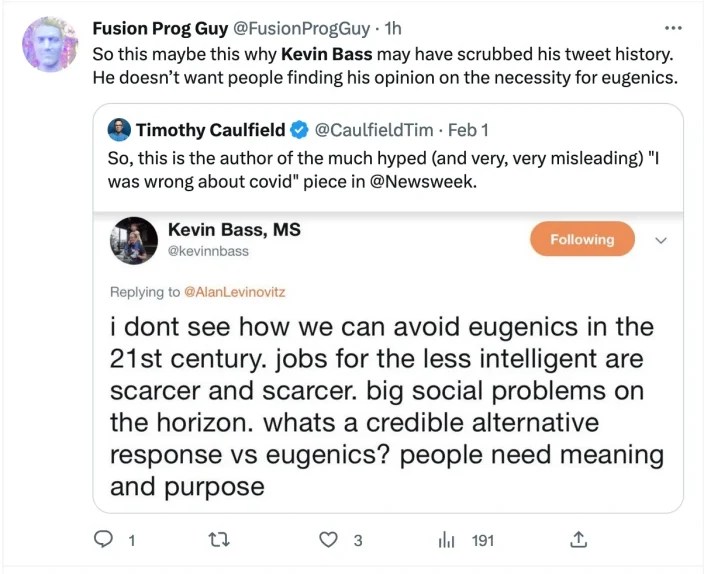
It seems he used to tweet about eugenics. He liked it.
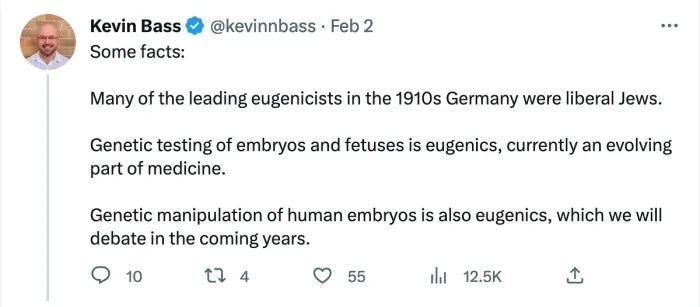
And it seems he remains intrigued with it.
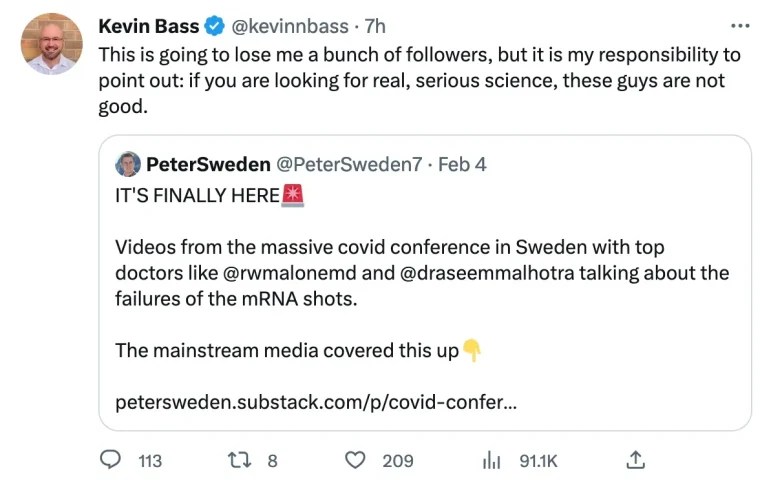
But he was not impressed with the talks by me, Aseem Malhotra, Robert Malone, Sasha Latypova. Guess what? This was not a science conference in Stockholm. It was a conference about what has really been going on these past three years. He likes the straw man argument.
So who is this Kevin Bass, who some commenters to my last post described as a twitter troll regarding nutrition and low carb diets. Why is he apologizing for mistakes that the system made? Like, he admitted to LOTS of mistakes?

He had to explain to his followers that with the Newsweek piece he has reinvented himself. He has decided to stop being an attack dog and instead bring us sweetness and light. Oops. He forgot his new persona, however, when he attacked the Stockholm conference. Who will he be tomorrow?
Jeffrey Epstein: A Jewish Individual?
Review of “One Nation under Blackmail”
The Occidental Observer | February 5, 2023
One Nation Under Blackmail: The Sordid Union between Intelligence and Organized Crime that Gave Rise to Jeffrey Epstein (Volume 1 & 2)
Whitney Webb
Trine Day, 2022
“Far from being an anomaly, Epstein was one of several men who, over the past century, have engaged in sexual blackmail activities designed to obtain damaging information (i.e., “intelligence”) on powerful individuals with the goal of controlling their activities and securing their compliance.”[1]
Jeffrey Epstein is dead and Ghislaine Maxwell is locked away in prison, and the thought-makers of our world seem keen to let the more explosive parts of the scandal dissipate from the public consciousness. As far as the mainstream media is concerned, Epstein and Maxwell were little more than well-connected socialites who ran a sex-trafficking ring for the rich and the powerful, and the focus has shifted instead to the criminal and civil cases seeking to achieve redress for the victims of sexual abuse.
On occasion some newspaper articles will mention the hidden cameras littered across Epstein’s properties, others the reams of CDs and hard drives found within them during the FBI raids. Altogether missing from the Netflix documentaries (Jeffrey Epstein: Filthy Rich [2020] and Ghislaine Maxwell: Filthy Rich [2022]) or the articles that spend their time narrowly focusing on the links between Epstein and Bill Gates, is the acknowledgement of the true nature of Epstein himself and the ultimate purpose of this sex-trafficking of minors — a sexual blackmail operation.
Not everyone is cowardly enough to let these controversial aspects lie untouched, as the newly released two-volume book One Nation Under Blackmail by independent reporter Whitney Webb seeks to blow wide open this media-enforced blackout. Utilizing primarily open-source information (that is, publicly accessible information such as books, newspapers articles and government reports),[2] Webb’s book delves into the life and times of Jeffrey Epstein and his deep ties to Jewish billionaires and Israeli intelligence. The intersection of sexual politics with Jewish power has long since been of interest to this writer, and the case of Jeffrey Epstein is easily one of the most damning instances, as evident by the large amount of popular interest in the story. A selection of other books on the Epstein/Maxwell case has appeared in bookshops over the past two years, but a cursory glance through their pages and at their appendices, where the words ‘Israel,’ ‘Jewish,’ and ‘Zionism’ are conspicuously lacking, shows you how surface-level they are in comparison to Webb’s book.
As Webb details extensively throughout the first volume, using sexual blackmail[3] to achieve political ends is far from being an Epstein innovation; it is almost certainly a tactic he learned from others in the murky world where crime meets intelligence. Nor is it something exclusive to Jews. But one can’t help but notice a consistent ethnic pattern in the known major perpetrators of this sort of behavior in Western countries. I have previously written about the Australian variety, where Jewish underworld figure Abe Saffron acquired compromising pictures of prominent Australians (more often than not with underage prostitutes) and leveraged this for his own nefarious ends. Webb (in Chapter 2: Booze and Blackmail) outlines in detail the blackmail operations ran by mob-linked figures Lewis Rosenstiel and Roy Cohn from a bugged suite at the Plaza Hotel in New York. Other non-Jews that Webb identifies as running parallel schemes, such as Saudi arms dealer Adnan Khashoggi or Craig Spence, were likewise deeply enmeshed in the same circles (Khashoggi in fact worked for Israeli intelligence).
Ultimately what is most frightening about the Epstein case, and what makes it stands out from the rest, is the sophistication of the operation, the high profile of the targets—from sitting US presidents to senior members of the British Royal Family—and the extraordinary lengths gone to in order to protect Epstein and avoid the true nature of his activities being exposed. It was as if there was something important at the heart of it all, something worthy of being protected by those in power, with lots at stake lest it be brought into public view. On a number of occasions Webb points to the underreported comments attributed to Alex Acosta, the attorney who gave Epstein his infamous plea deal in 2007, who allegedly told the Trump White House transition team that he backed off upon being told that Epstein “belonged to intelligence.”[4] At every stage where Epstein came under scrutiny, from his first legal conviction, to his second arrest and the questionable circumstances of his death, and even in the post-mortem coverage of his indiscretions, forces seemingly moved in the background to obscure and obfuscate, to clean up the mess and avoid as much detail be allowed to come to light as possible.
Like many books published by small dissident publishers with limited resources, both volumes would have been improved with editing for a more streamlined narrative, as neither makes for easy reading. Without a familiarity with the major events and actors described throughout each densely-packed chapter, the connections and the significance of the interactions between people are sometimes difficult to comprehend. Webb’s sources are conveniently compiled in endnotes at the conclusion of each chapter, and she uncovers a level of detail that makes it a worthy resource for your bookshelf that you will inevitably return to when trying to remember a name or make sense of a connection. Nevertheless, as this review concludes, the book falls short of providing a satisfying answer to the questions that readers of The Occidental Observer would go into it having, and shies away from responding to the most glaring aspects of the Epstein case of all.
ONE NATION UNDER BLACKMAIL
The central thesis of the book is that there has historically between a connection between organized crime and intelligence agencies in America, where the two are in some cases so intensely interwoven in their activities that it is difficult to tell where one ends and the other begins. This thesis, Webb claims, allows us to understand the nature of Jeffrey Epstein and his mysterious life, and that Epstein is one of many such nefarious actors who have operated on the margins of legitimacy. Volume 1 begins in the first half of the twentieth century, where Webb argues that the first connection between intelligence and organised crime was forged in America during the midst of World War II, in an undertaking known as Operation Underworld. This collaboration, specifically between the National Crime Syndicate (an alliance between the Italian and Jewish mobs) and the forerunners of the modern intelligence apparatus, came out of a sort of national security necessity that reaped geo-political dividends and continued after 1945 and into the Cold War.
Though intriguing, many of the chapters of Volume 1 deal with events and personalities of more limited relevance to the main Epstein blackmail story, covering the web of intrigue and scandal surrounding things such as Watergate, the BCCI, the China Lobby, and more obscure events like Billygate and Koreagate. Those chapters dealing with the spiritual forebears of Jeffrey Epstein are the ones that provide the most context and are the most enlightening to read. Webb presents a wealth of information about the history of the Jewish mob and other powerful Jewish figures during the middle years of the twentieth century, when wider Jewish political and cultural influence was beginning to solidify within America and the West. The cast of Jewish characters implicated in major American criminal, financial and political scandals, especially those with a direct line of descent to the Epstein blackmail operation, is staggering: the Bronfman family, Roy Cohn, Bruce Rappaport, Meyer Lanksy, Lewis Rosenstiel, Marc Rich, Max Fisher, Edmond Safra, and Robert Maxwell.
In Chapter 3, “Organised Crime and the State of Israel,” Webb underscores that much of the support given to the Zionist paramilitary groups that operated prior to the foundation of Israel—in the form of smuggled arms and funding—came from criminal networks. Canadian-Jewish liquor barons the Bronfman family, who participated in bootlegging during prohibition, financed the purchase of weapons for Haganah troops. Other Jewish mob figures with Zionist sympathies donated large sums and aided the Zionist cause during Israel’s formative years. This criminal collusion was, in Israel’s case, ongoing throughout its history and was “baked in at the very foundations of, not only its intelligence services, but the origins of the state itself.”[5]
Chapter 9, “High Tech Treason,” introduces us to Robert Maxwell, British media mogul and Israel’s Superspy, another figure of importance in Epstein’s younger years, who jumped almost seamlessly between the roles of organized crime associate and intelligence agent. Webb explores Maxwell’s involvement with the Eastern Bloc mob, including when he lobbied Israel to grant Semion Mogilevich an Israeli passport, allowing him access to the US financial system, and the PROMIS scandal, whereby Maxwell helped Israeli intelligence sell bugged computer software to governments and corporations around the world.
When MI6 attempted to recruit Maxwell for the service, it concluded, after conducting an extensive background check, that Maxwell was a “Zionist—loyal only to Israel.”[6]
Chapter 10, “Government by Blackmail: The Dark Secrets of the Reagan Era,” brings Volume 1 to a close, where many of the cast of disreputable characters revealed in earlier chapters come home to roost during the Reagan administration and the Iran-Contra scandal. The familiar figure of Roy Cohn appears again as a “political fixer” for the Reagan campaign, but Webb notes that Reagan’s intimacy with powerful Jewish figures with organised crime links goes all the way back to the very start of his career, with his mentor Lew Wasserman, the long-time president of Hollywood’s MCA, Inc. and “arguably the most powerful and influential Hollywood titan in the four decades after World War II,” acting as a political patron.
JEFFREY’S SHIKSES
Volume 1 sets the stage for Volume 2, where the interwoven networks of people introduced come together to contextualize the world that Epstein sprang from. Webb covers the underreported early years of Epstein’s financial career in the 1970s and 1980s, which are filled with just as much criminal intrigue as his later years as sex criminal, including his role as a “financial bounty hunter” allegedly working for Saudi billionaire Adnan Khashoggi. His years as an investment banker at Bear Sterns, where he was seemingly brought directly into the company by Alan Greenberg,[7] sat for many years under a cloud of suspicion that he participated in an insider trading scheme carried out by the Bronfman-owned company Seagram. Epstein’s involvement with Steven Hoffenberg in what was at the time the largest uncovered Ponzi scheme in American financial history, Towers Financial Corporation, is yet another fascinating detail largely ignored elsewhere.
How and when Epstein was inducted into the world of intelligence cannot be accurately deduced, but Webb offers a number of potential scenarios, relating to his proximity to people such as Maxwell and Khashoggi. Elsewhere she points to the direct relationship Epstein seemingly had with the highest levels of the Israeli government. Former Israeli Prime Minister and military intelligence figure Ehud Barak, another close Epstein associate, claimed that he was first introduced to Epstein by none other than Shimon Peres.[8] Webb pins the beginning of the sexual blackmail scheme to some point in the early 1990s, around the time Ghislaine Maxwell latched onto Epstein following the death of her father.
Chapter 18, “Predators” deals with the nuts and bolts of the operation, exploring in detail the various methods both Epstein and Maxwell used to recruit and procure girls. Sometimes it was through friendships with the owners of modelling companies, other times it was as simple as Maxwell approaching a girl on the street and recruiting them for “massages.” Even literally purchasing underage Slavic girls from Eastern Europe was apparently a possibility for Epstein.[9] Their relationship with Les Wexner (Epstein was Wexner’s long-time money manager) also proved fruitful, using their connection with the popular Victoria’s Secret fashion chain—a brand owned by Wexner—to pose as recruiters.
Webb first came to my attention when she conducted an interview with Maria Farmer, considered the earliest Epstein victim to report him to the authorities. The interview is long, upwards of three hours, but well worth a listen, especially when Farmer begins to discuss how she was treated by the powerful Jewish figures surrounding Epstein:
I don’t know any White supremacists, but I know a lot of Jewish supremacists… They made it very clear that I was a servant [to them] because I was White.[10]
Farmer may be unfamiliar with the word shikse, but it perfectly describes how Epstein and Maxwell considered these young gentile girls ensnared in their net of abuse. The supposed “trope” of the Jewish man lusting after the shikse finds in Epstein yet another real-life example, with underage blonde girls being his victim of choice when satisfying his own urges. Former Ghislaine Maxwell friend Christina Oxenberg, quoted in the book from an at-the-time anonymous source, relayed a conversation she once had with Maxwell about who these women were that she was “recruiting.” Maxwell reportedly dismissed them with ease: “They’re nothing, these girls. They are trash.”[11]
On the other side of the operation was of course the hidden cameras and the recording equipment. The presence of these hidden cameras in Epstein’s properties is independently confirmed by a number of eyewitnesses, court documents and early newspaper articles that detail this curious addition to Epstein’s properties, and the existence of the CDs and hard drives to store the footage is a matter of public record, including from the latest FBI raid of Epstein’s New York mansion in 2019:
Per photographs taken at the time of the raid, hard drives were found inside a safe forced open by the FBI and numerous large black binders were found in a closet that contain “CDs, carefully categorized in plastic slipcovers and thumbnails with photos on them.” When shown in court, the “homemade labels” were redacted, as judge Alison Nathan had ruled that they contained “identifying information for third parties.” Did that information involve only the names of underage girls, the names of blackmail victims, or both?[12]
The FBI conveniently lacked the warrant to seize these items, and upon returning four days later with the correct warrant, the CDs and hard drives were gone. They were later handed over by Epstein’s lawyer, but having not had the chance to view what was on them, we can only assume that this was more than enough time to delete any incriminating files.

Epstein schmoozing with elites. Left, from left: Epstein, Alan Dershowitz, Steven Pinker, and Larry Summers, presumably at Harvard. Right: with Ghislaine and Bill Clinton
Much has been made of the relationship that existed between Epstein and Donald Trump before they allegedly fell out with each other in 2004 over a property dispute in Palm Beach, Florida, but as Webb exposes in Chapter 16, “Crooked Campaigns,” Epstein and Maxwell had a far more politically intimate relationship with President Bill Clinton that coincided with his time in office and his early post-presidency years. Epstein visited the Clinton White House 17 times, and was apparently a prominent figure in the formation of the Clinton Global Initiative, which saw Clinton as a regular passenger on Epstein’s infamous plane, the “Lolita Express.” Webb refers to other attempts of sexual blackmail against Clinton, including in 1998 when Prime Minister Benjamin Netanyahu apparently threatened Clinton with tape recordings Israel had obtained proving outright that he had a sexual relationship with Monica Lewinsky, using them to pressure Clinton to pardon Israeli spy Jonathon Pollard.[13] It seems the Clinton White House, which was seeking a peaceful solution to the Israel-Palestine conflict, was of key interest.
Chapter 21, “From PROMIS to Palantir: The Future of Blackmail,” finishes off Volume 2 with the chilling insight that perhaps one of the reasons Epstein’s sexual blackmail operation collapsed was because it was allowed to collapse — it had become outdated and irrelevant. The advent of the permanent internet connection has brought about opportunities for far more widespread and even more intimate forms of blackmail, instead conducted and collected via electronic means. A technological panopticon whereby the cameras once placed by Epstein throughout his properties are instead now placed by big tech and social media companies in our own homes, omnipresent in our lives. After his 2008 conviction, both Epstein and Maxwell seemed to be shifting away from sexual blackmail and were making inroads in Silicon Valley and mixing with data-harvesting IT companies. Epstein’s previous ties with higher-ups at Microsoft and his financial support for John Brockman’s Edge Foundation gave him an in with plenty of big tech leaders, and he had re-branded himself as a tech investor, starting a company focused on collecting genetic data. Ghislaine’s siblings in the Maxwell family also have pedigree in the tech industry going back to the 1990s. As noted by Webb, “in a world where blackmail is overwhelmingly electronic, people like Jeffrey Epstein and Ghislaine Maxwell become liabilities to be silenced, rather than assets to protect.”[14]
WHO, WHAT AND WHY?
Upon finishing Volume 2, I found that many of the questions raised by Webb still remained open. Who or what is “the system” that enabled Epstein and protected him from justice? If so many people knew, why was there such an institutional resistance to speak out about Epstein? And the most important question of all: what was the goal behind collecting this sexual blackmail? Why were Epstein and his benefactors trying to control these victims? Unfortunately, Webb’s book does not provide a satisfying conclusion.
Webb does not shy away from pointing the finger at Israel or from discussing wider Zionist motivations and groups like B’nai B’rith. However, she stops frustratingly short of the obvious conclusions. Granted the reluctance is one that all those knowledgeable on the Jewish question are familiar with, and perhaps she simply avoids the discussion for the sake of keeping her book on Amazon and appealing to a wider audience, rather than have it be relegated to the ADL’s banned book department. But for an answer to the questions most readers are likely after, we are given nothing more than a few measly sentences concluding that the Epstein operation was instigated by Israeli intelligence and that those in the “power structure” and “the system” — the same people that made Epstein untouchable — have now strengthened their stranglehold over America. Ultimately, readers are given the impression that this blackmail was collected as control merely for the sake of control, power merely for the sake of power, without a deeper underpinning goal.
Upon being challenged during an interview by Jewish podcaster Adam Sosnick on the obvious Jewish identity of the key players, Webb retreats to the safe position: By referring to Israeli intelligence or Jewish criminals, one is not referring to all Jewish people, and one cannot conflate the Epstein network or powerful billionaire Zionists with the whole Jewish community, or ascribe any wider group motive to them. Sosnick also exhorts the listener to avoid speaking of groups and instead only of individuals, lest it breed hate.[15]
One is of course allowed to speak of the Chinese or Catholics or Russians in general terms and in a political sense as behaving out a sense of group identity and a sense of group interests, and it is sophistry to claim that the speaker is referring to every single Catholic in the world or every single Russian in the world. Regardless of which sociological theory of power you ascribe to, what is clearly being referred to is the organized community, the power structure that represents the wider in-group and operates towards a unique ingroup goal. In the case of the Russians, this is currently Putin and the Russian state apparatus, supplemented by the Russian military, media and business elite that do not dissent from achieving Russian strategic interests as determined by the state apparatus. For Catholics, it is the Vatican and the international network of dioceses, bolstered by the Catholic Universities, think tanks and charities. People are not forced to declare “not all Catholics” when dealing with the allegations of a cover-up of child sexual abuse within the church.
When one speaks of the Jews, it stands to reason that the same scenario should apply. That is, it quite reasonably refers to the organized Jewish community, including organizations like the ADL; the powerful figures in Israel and in the diaspora, as well as the religious and intellectual leaders, the business figures and the lobbying groups. Sure there are dissenters and outsiders, and of course there is internal debate and a difference of opinion on the best means for meeting its goals, but the organized Jewish community exists just the same, and remains firm in its fundamental goal of ensuring the security and survival of the Jewish people and the state of Israel.
Herein lies the problem for Webb and the reason behind the demand to treat Epstein as a mere “Jewish individual.” The network of powerful Jewish figures and institutions chronicled throughout Webb’s book is a network that is intimately connected to Jeffrey Epstein or to his blackmail operation: Robert Maxwell, the Pritzker Family, Larry Summers and Alan Dershowitz, Ehud Barak and Israeli intelligence, the world’s wealthiest Jewish families that formed the Mega Group (the Bronfman, Lauder and Wexner families). The list goes on and on. These are not powerless fringe figures or outsiders who are scorned by Jewish leaders or the wider Jewish community. They are the leaders of the organized Jewish community, some of whom practically direct Jewish-American cultural, political and even religious life. To remove them from the equation of power would be the equivalent of removing half of the highest-ranking members of the Vatican from the Catholic Church or leading members of the Chinese Communist Party from the Chinese state.
Using the phrase “the Jews” cuts the Gordian Knot at the heart of Webb’s attempt to understand Epstein, whom he was working for, and how he so effortlessly moved among the elite strata of society, why it was covered up, who stood to benefit from this blackmail operation, and what its ultimate aim was. With those two words, all the jumbled euphemisms of “elites” and “Zionists” melt away, and the confusing mix of organized crime and intelligence, legitimate and illegitimate enterprises seemingly working in unison with each other starts to become intelligible. The ease with which Epstein and Maxwell abused and then dismissed these young girls as mere “trash” makes more sense when you know the meaning behind the word shikse (an unclean abomination). The reason for the legal cover-up and the inhibition of the mainstream media to run the story, even when they have no direct connection to the Epstein network, is obvious when you know who the proprietors of most mainstream American media outlets are, and with whom both cultural and institutional power in the US now lies. All this interwoven association is merely two sides of the same coin—a system constructed to ensure the security of Israel and the survival of the Jewish people. To talk openly about Epstein’s true activities is to talk openly about the nature of Jewish power, and for that reason alone most will not do so, for fear of the Jews. In all, Webb has picked up the puzzle pieces and assembled them neatly on the board, but she refuses to take that final step back and honestly contemplate the picture she has pieced together.
What are we to make of the institutional silence and protection, and the dishonest shifting of the narrative to a mere sex-trafficking ring? What can you conclude from the attempt to declare anyone who dares point out the clear ethnic goal at the heart of this vile sexual blackmail operation an anti-Semitic conspiracy theorist? The only reasonable conclusion is that Epstein functioned with the support and backing of Jewry’s most powerful figures, and that the organised Jewish community is willing to conceal a criminal conspiracy of frightening proportions if it serves to benefit the Jews or would otherwise negatively affect them (by creating more anti-Jewish sentiment) if the American public knew the truth.
Had Epstein’s personal indiscretions not become too big to ignore and had it not all unravelled so spectacularly due to the pressure of the #MeToo movement, would Epstein also have been buried in honor like Robert Maxwell, with Israeli Prime Ministers and dignitaries lining up to give a tearful goodbye to yet another faithful servant to the Jewish people? If he had been released early from a prison sentence, would he also have been welcomed back to Israel with open arms like Jonathon Pollard? Epstein had already once been professionally rehabilitated by Jews after his first conviction, there’s no reason why it couldn’t have happened again.
Notes
[1] Webb, W 2022, One Nation Under Blackmail: The sordid union between Intelligence and Organised Crime that gave rise to Jeffrey Epstein (Volume 1), Trine Day, Oregon USA, p.IX.
[2] Webb does on occasion rely on interviews she conducted with figures close to the Epstein story such as Ari Ben-Menashe and Maria Farmer.
[3] As distinct from simply bribing someone with sex with a consulting adult, or honey pots traps, a tactic as old as time—think Samson and Delilah or modern versions such as the honeypot trap that captured Mordechai Vanunu.
[4] Vicki Ward, “Jeffrey Epstein’s Sick Story Played Out for Years in Plain Sight,” The Daily Beast (August 19, 2019). https://www.thedailybeast.com/jeffrey-epsteins-sick-story-played-out-for-years-in-plain-sight
[5] Webb, Op. Cit., p.93.
[6] Webb, Op. Cit., p.382.
[7] Webb, W 2022, One Nation Under Blackmail: The sordid union between Intelligence and Organised Crime that gave rise to Jeffrey Epstein (Volume 2), Trine Day, Oregon USA, p.6.
[8] Tarnopolsky, N 2019, ‘Ehud Barak: I Visited Epstein’s Island But Never Met Any Girls’, The Daily Beast, July 15, retrieved from: https://www.thedailybeast.com/israels-ehud-barak-i-visited-epsteins-island-but-never-met-any-girls
[9] Webb, Volume 2, Op. Cit., p.266-267.
[10] See https://www.youtube.com/watch?v=dtD02MeZU4o from 1:31 or so
[11] Webb, Volume 2, Op. Cit., p.276
[12] Ibid., p.58.
[13] Stoil, R. S 2014, ‘Netanyahu said to have offered Lewinsky tapes for Pollard’, The Times of Israel, July 23, retrieved from: https://www.timesofisrael.com/netanyahu-said-to-have-offered-lewinsky-tapes-for-pollard/
[14] Webb, Vol 2, Op. Cit., p.373.
[15] PBD Podcast 2020, The TRUTH About Jeffrey Epstein w/ Whitney Webb, Episode 198, retrieved from: https://youtu.be/GVVHWVoZ4kU?t=5978
Germany years away from replacing Russian gas – official
RT | January 23, 2023
Germany is a long way from fully substituting Russian pipeline gas supplies with liquefied natural gas (LNG), estimates by the country’s Economy Ministry show.
According to a document published on the Bundestag website, Germany imported 55 billion cubic meters (bcm) of Russian natural gas in 2021. The document also shows that Germany’s new Floating Storage and Regasification Units (FSRUs), which are currently being installed in a number of ports to allow the import of LNG, may reach a similar capacity no sooner than in 2026.
By 2030, those capacities are projected to increase to 76.5 bcm, or about 80% of total German gas consumption in 2021. However, the ministry notes that even once the terminals go online, the global LNG market may not have enough capacity to cover additional demand, which could push these dates further.
The ministry notes that the country’s gas storage facilities are currently well-filled, and there is no immediate danger of gas shortages. However, it acknowledges that once the stores run dry later this year and the time comes to refill them for the next heating season, Germany may face shortages. According to calculations by the Oxford Institute for Energy Studies, Germany faces a supply gap of around 30 bcm of gas this year, and the FRSUs are projected to produce less than half of this volume by the end of 2023.
“The truth is, there won’t be enough in the next three to four years of LNG production capacity in the world to meet the growing demand. So the unspoken strategy is that Germany will continue to pay crazy prices and other, less rich countries go empty-handed,” Christian Leye, a Bundestag Left Party representative told Bloomberg.
Germany did manage to reduce its dependence on Russian energy last year by importing LNG through European neighbors and boosting pipeline gas flows from Norway and the Netherlands. However, its gas storages were filled over the summer, when Russian gas still flowed directly to the country. Another problem is the cost of LNG imports, which is estimated to be four times more expensive than Russian pipeline deliveries. Germany may also face supply constraints if the Netherlands goes through with recently announced plans to shut down the Groningen gas field, the region’s largest gas deposit.
The Davos establishment reveals whom it truly fears
By Rachel Marsden | RT | January 22, 2023
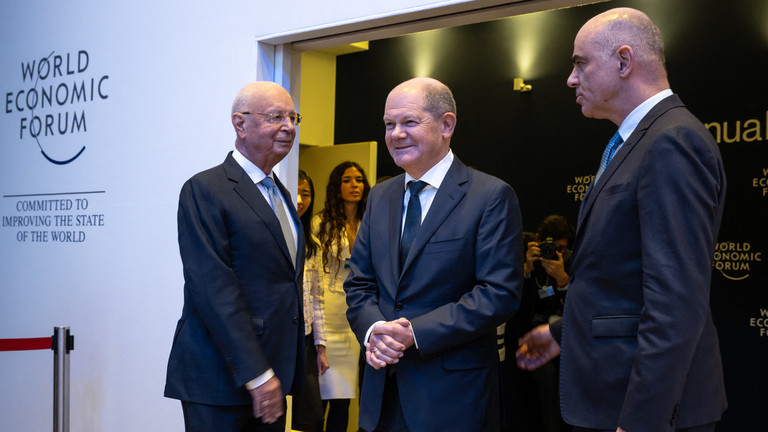
The World Economic Forum at Davos used to be THE place to see and be seen, but the idea of the richest and most influential people in the world hobnobbing around a common agenda for the world has lost its luster as the policies peddled by its attendees spark increased skepticism among average citizens.
Forum founder Klaus Schwab, the de facto frontman of the organization, has cranked out one distasteful hit after another in recent years. He has spoken of how the organization “penetrates the cabinets” of governments in its recruitment efforts. He coined the term “The Great Reset,” about which he published a book just a few months into the Covid-19 pandemic in July 2020, advocating that the pandemic be used as inspiration to “reimagine our world” at a time when much of the globe was locked down on orders of their governments – many members of which were Davos regulars. There was little appetite to turn lockdowns into a permanent lifestyle change, but here was Klaus promoting the benefits of burying the old life – all under the pretext of an event that the WEF had already wargamed in October 2019 in New York, just ahead of the crisis, in an exercise called “Event 201.” “The exercise will bring together business, government, security and public health leaders to address a hypothetical global pandemic scenario,” the WEF announced at the time. It’s all just a bit too creepy.
It’s the constant effort of top-down global coordination around murky financial interests laundered through the Davos agenda that irks the common person. The fact that just a single leader of a G7 country attended this year’s event speaks volumes about how poorly it’s now viewed. The premier of the western Canadian province of Alberta, Danielle Smith, said of the WEF after her cabinet’s swearing-in ceremony last October: “I find it distasteful when billionaires brag about how much control they have over political leaders. That is offensive… the people who should be directing government are the people who vote for them. Quite frankly, until that organization stops bragging about how much control they have over political leaders, I have no interest in being involved with them.”
Those invited to preach at the altar during the high mass of globalism this year seemed to know exactly what kind of sermon the crowd wanted to hear. German Chancellor Olaf Scholz was apparently the only G7 leader who thought it would be a good look to be seen hanging out with the unelected masters of the planet while Westerners – and Europeans in particular – grapple with the high cost of their governments’ policies in their daily lives. Scholz doubled down on the same green dreams that put Germany’s economy in peril with no viable backup plan once the European Union had effectively cut off Russian energy through sanctions. “Most importantly, our transformation toward a climate-neutral economy, the fundamental task of our century, is currently taking on an entirely new dynamic. Not in spite of but because of the Russian war, and the resulting pressure on us Europeans to change. Whether you are a business leader or a climate activist, a security policy specialist or an investor, it is now crystal clear to each and every one of us that the future belongs solely to renewables. For cost reasons, for environmental reasons, for security reasons, and because in the long run, renewables promise the best returns,” Scholz said in his address. Meanwhile, Germany is firing its coal power plants back up and reconsidering its nuclear power phase-out. How about worrying about how German industry is going to function in the next year when green initiatives, such as hydrogen imports from Portugal and Norway, aren’t set to even get off the ground until at least 2030? Scholz used his time at the podium at Davos to greenwash the economic uncertainties that Germany faces as a result of the EU’s energy sanctions on Russia. In other words, green hopes and dreams took center stage in this pitch to global investors, thus providing a convenient distraction from the more worrisome current realities.
Greenwashing was joined at Davos by the pitching of anti-democratic initiatives via concern trolling. During a panel discussion dedicated to “disrupting distrust” – which really should have been called “How can we get people to better swallow our nonsense?” – Richard Edelman, the CEO of the eponymous global communications firm, blamed the derailments on right-wingers. “My hypothesis on that is that right-wing groups have done a really good job of disenfranchising NGOs. They’ve challenged the funding sources. They’ve associated you with Bill Gates and George Soros. They’ve said that you’re world people, as opposed to what you are, which is local,” Edelman lamented, ignoring the fact that they wouldn’t have needed to fly their private jets to a “local” event. What he’s really attacking are dissidents, many of whom just happen to be populists and right-leaning. And no doubt the fact that they’re digging into the special interests laundered through many NGOs makes the job of PR pros such as Edelman more challenging.
“Edelman is a despicable human being – his job is literally being a professional liar!” Tweeted billionaire Tesla and SpaceX founder Elon Musk, whose controversial purchase of the social media platform and subsequent reversal of its heavy-handed censorship policies haven’t exactly endeared him to the Davos crowd. Mocking Schwab’s call to “master the future” in the opening keynote, Musk tweeted, “’Master the Future’ doesn’t sound ominous at all … How is WEF/Davos even a thing? Are they trying to be the boss of Earth!?” Musk then took a Twitter poll that found that 86% of 2.4 million respondents answered ‘no’ to the question of whether the WEF should “control the world.”
A WEF spokesman said that Musk hasn’t been invited to the gathering since 2015. Musk confirmed his lack of interest in attending: “My reason for declining the Davos invitation was not because I thought they were engaged in diabolical scheming, but because it sounded boring af lol.”
Boring, indeed – in the same way that a cult meeting where everyone nods their heads in agreement is a snooze fest. The last time things were even remotely interesting at Davos was when former US President Donald Trump showed up and rejected the Davos mantra of climate change doom. “The message represents a sharp departure from the official playbook at the World Economic Forum, where this year’s theme is ‘Stakeholders for a Cohesive and Sustainable World’,” wrote CNN in January 2020.
Who asked them, though? These elites represent no one’s interests but their own, which are economic and are for the benefit of their shareholders – hence the forum’s name. If the average citizen is now waking up to the fact that anything coming out of Davos should be scrutinized through that lens, then it can only be a good thing for freedom, democracy, and national sovereignty.
Rachel Marsden is a columnist, political strategist, and host of independently produced talk-shows in French and English.
Featured Video
Seyed M. Marandi: Negotiations Collapsed – Return to War
or go to
Aletho News Archives – Video-Images
From the Archives
The US-Iran Scenario That Most Scares Israel
By Ali Haydar | Al-Akhbar | October 9, 2013
Israeli Prime Minister Benjamin Netanyahu issued a series of threats toward Iran and its interlocutors in the West, including the US, as serious negotiations on Iran’s nuclear program seem more plausible.
As a possible rapprochement looms between the US and Iran, Netanyahu has attempted to impose impossible Israeli conditions on the negotiators, such as the full dismantling of Iran’s nuclear program, not to mention threatening military force.
Whatever the deal that could materialize between Iran and the West, Israel is going to find itself before an open-ended path. One can foresee three possible scenarios… continue
Blog Roll
 Aletho News
- UK, Spain reject Trump’s new scheme to blockade Hormuz Strait
- Russian frigate ‘resurfaces’, chases off NATO pirates days after Kiev ‘sank’ it
- Ukraine Targets Russian Merchant Fleet With NATO Intel Support – Presidential Aide
- Russia’s ‘shadow fleet’ makes mockery of UK naval power
- Ukraine plans to attack Russian ships with Norwegian support
- US’s ‘Very Foolish’ Double Blockade of Hormuz Strait Makes Absolutely No Sense: Here’s Why
- China issues rules on countermeasures against foreign states’ unlawful extraterritorial jurisdiction
- Seyed M. Marandi: Negotiations Collapsed – Return to War
- Tomorrow’s naval blockade showdown
- ‘Israel’ attacks civilians to hide its embarrassing military failures & out of pure sadism
- If Americans Knew
- Critical shortages in Gaza, Lebanon in ruins, “piracy” in Iran – Daily Update
- US-Iran ceasefire negotiations make zero progress – Daily Update
- Pro-Israel ‘Thinktanks’ and Individuals who Influence U.S. Foreign Policy
- Mearsheimer reveals how Israel dictates US policies on Iran, Gaza – video
- After killing 350+, Israel still has a “score to settle” with Lebanon before ceasefire – Daily Update
- Military aid to Israel emerges as the latest political litmus test for Democrats
- The only Palestinian children’s rights organization closes following years-long Israeli campaign against it
- ‘I Can’t Forget the Smell’: Lebanese Reel After Israel Kills Over 300 in Single Day
- DNC Shoots Down Resolutions Calling Out AIPAC and Limiting Arms to Israel
- TCN: Is Israel Blackmailing President Trump?
- No Tricks Zone
- Cave Discovery Reveals Today’s Desert Climates Were Recently Far Warmer, Wetter, Teeming With Life
- German Expert: Heat Dome Led To Record Temps In Western USA…Warmer In 1934, 1936
- New Study: No Linear Warming Or Glacier Retreat Along Northern Antarctic Peninsula Since 1980s
- An Inconvenient Tree: Uncovered In Alps… Europe Much Warmer Than Today 6000 Years Ago
- New Study Reports A 60% Slowdown In Greenland’s Ice Loss Rate In The Last Decade
- Low Intensity Tornado Wrecks Major Solar Farm, Creating A Potential Toxic Dump
- New Study Finds Warming Saves Lives…Cold Temperatures 12 Times More Deadly Than Excess Heat
- German Science Blog Accuses PIK Climate Institute Of Hallucinating Climate Tipping Points
- Devastating Assessment Of Comirnaty Vaccine By Former Senior Pfizer Europe Toxicologist
- New Study: CO2 Is ‘Effectively Negligible’ As An Explanatory Climate Change Factor Since 2000
 Aletho News