Disengaging from Zionism
By Kristoffer Larsson | Dissident Voice | December 7th, 2011
In 2009 the UN Human Rights Council appointed the South African Judge Richard Goldstone to head the fact-finding mission investigating possible Israeli war crimes committed in Gaza during Operation Cast Lead. Aside from being a well-respected judge, Richard Goldstone could not easily be dismissed as anti-Semitic given his Jewish origin.
Goldstone probably had no idea what awaited him. After the Mission published its findings and conclusions, the judge quickly became the victim of a vicious slander campaign. Israel’s Information Minister said that the Goldstone Report was “anti-Semitic.” Harvard Professor Alan Dershowitz informed the listeners of Israel Army Radio that Goldstone was “an evil, evil man” and “an absolute traitor,” a “man who uses his language and words against the Jewish people.” Dershowitz later apologised for calling Goldstone a traitor, saying he thought the term moser (Hebrew for informer, delator) meant “monster” (as if that was any less harsh).
“I wrote to the broadcaster, retracting my word ‘traitor,’” Dershowitz told the Forward. “But if you’re asking me deep in my heart and soul do I believe that the word fairly characterizes him, in light of the way he’s used his Jewishness, both as a shield and a sword? You know, if the shoe fits.”
In the end, it all became too much for the South African judge. He’s tried to retract parts of the report he co-authored, along with publicly defending Israel against ‘the Apartheid Slander’. And if the truth be told it seems that he has never disengaged himself from Zionism. However, the damage has already been done and the greater part of the Jewish community simply has no trust in him anymore.
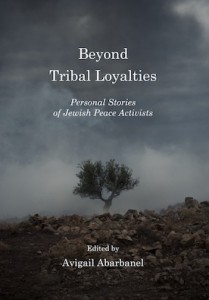 I came to think of Goldstone’s destiny as I was reading Beyond Tribal Loyalties: Personal Stories of Jewish Peace Activists. The book is an anthology with contributions from 25 Jewish activists living in different parts of the world who have come to see the conflict from the Palestinian point of view. For most Jews, criticising Israel comes at a price – relatives and Jewish friends regard it as treason, they are accused of being self-hating, and in some cases even of paving the way for another Holocaust. But these stories are not mainly about the price they have to pay for their activism; it’s about their personal journeys that led them from being (in many cases) completely uncritical supporters of Israel and Zionism into defenders of Palestinian rights.
The book is edited by Avigail Abarbanel, a psychotherapist residing in the United Kingdom. Born in Israel in 1964, Abarbanel grew up in an abusive family and was—just like most other Israelis—completely blind to Palestinians and their suffering. Instead, Jewish suffering was the ubiquitous issue. During her school years the fear of another Holocaust was “repeatedly raised and debated” and she “was taught that everyone in the world, including Arabs, hated us just because we were Jews.” Even though Palestinians make up a fifth of Israel’s population she never understood who they were. She recalls:
I resented the Arab countries around us and our “enemy from within”—or the “fifth column” as the Palestinian citizens of Israel were sometimes called—that I thought wanted to “throw us into the sea”. I resented the world that didn’t seem to understand us and was against us all the time, for what I thought was no reason except our Jewishness. I didn’t understand why “they” couldn’t just leave us in peace. I thought the reason for our suffering, anxiety and insecurity was out there. Together with everyone else I felt hard done by, hassled and unsafe.
Abarbanel later left Israel for Australia, where she earned a degree in psychotherapy. As a student she was forced to scrutinise her past. This, along with reading The Iron Wall by Avi Shlaim, led her to renounce her Israeli citizenship and eventually reject Zionism altogether.
Ronit Yarosky was also unaware of who the Palestinians were. Her family left Montreal for Israel when she was 14 years old. She did her military service and was stationed in the West Bank. The Palestinian residents served as background actors – they were there, yet unimportant. West Bank cities and towns she stayed in as a soldier “were nameless to me because they were “only” Arab towns, and therefore of no significance in my life,” she remembers. Yarosky’s conversion began as she was working on her MA thesis back in Canada. It wasn’t until she read Benny Morris’s The Birth of the Palestinian Refugee Problem that she realised that Jewish settlements were established on the ruins of Arab villages, and that her uncle was even living in a Palestinian house. When she brought this up with her mother, the latter replied: “Well, obviously.” But to Ronit the newly discovered facts was life-changing, and after she could no longer turn a blind eye to what is happening to the Palestinians.
For others like Peter Slezak, Zionism as such doesn’t appear to have been important in his childhood. As a Jew in Australia he felt as an outsider already in primary school. And with most of his relatives being Holocaust survivors, the Haggadah’s warning that “in every generation they [i.e. non-Jews] rise against us to destroy us….” can easily feel validated. Slezak, like many other Jews, used to worry that all non-Jews inevitably harbored anti-Semitic feelings, a worry that took many years to finally overcome. Instead of regarding the Holocaust as a crime against Jews and a proof of why a Jewish state is needed, he sees a universalistic message in Never again. Some Jewish friends have even cut all ties with Selzak, and he has in his own words ended up “becoming a pariah in my own community” because of his pro-Palestinian activism.
This culture of intolerance is well captured by American musician Rich Siegel when he describes himself as “a cult survivor.” There is something “very seriously wrong with Israel, and with the culture that supports it,” he writes. Siegel should know. He was an ardent Zionist as a teenager, even to the degree that he was out in the streets protesting Arafat’s appearance at the UN in 1974, this while singing along to lyrics such as “We’ll kill those Syrians.” For Siegel, the image of an innocent Israel threatened by Jew-hating Arabs first started to crack while waiting for his wife outside a train station in Rhode Island in 2004. A few activists had a book stand outside the train station and he perused Phyllis Bennis’s Understanding the Palestinian-Israeli Conflict: A Primer. He was left shocked after reading about Jews massacring Arabs at Deir Yassin, something he had never heard of. He kept on reading books about the conflict and came to understood what Zionism represented. Some of his friends and relatives are no longer part of his life, but he has no regrets.
I have here only presented glimpses from some of the 25 contributions, but they all deserve to be read in full. As a non-Jew it is difficult to fully relate to the ‘sacredness’ of the Jewish state. However, all people and cultures have their taboos that cannot be disrespected without running the risk of being questioned, persecuted or excommunicated. On a personal level, we all have inner demons holding us back until we have the courage to face them.
Hardly surprising, fear is a reoccurring theme in the stories. Zionism thrives on fears – fear of the Arabs who want to kill the Jews just because of who they are; fear of the non-Jewish world that doesn’t understand Jews because there’s an anti-Semite living in every Gentile. It is only by challenging and facing their fears that Jews can detach themselves from Zionism.
In the afterword Abarbanel writes that she struggled with finding a common denominator for all 25 contributors. But eventually she did find one thing they all share, which she terms “emotional resilience.” She defines it as “the ability to tolerate uncomfortable feelings without avoiding them or trying to make them go away,” and adds that it includes “the ability to tolerate the experience of being disapproved of, disliked and rejected by others, sometimes even by relatives and close friends.” In plain English: to have the courage to stand up for what you believe in no matter the cost.
This is what makes the book so inspiring. 25 stories written by people who struggle because they feel what they are not supposed to feel, because they do things they are not supposed to do. They have the emotional resilience and sense of justice that Richard Goldstone lacks.
~
Kristoffer Larsson studies Economics at a Swedish university. He holds a BA in Theology and is on the Board of Directors of Deir Yassin Remembered. He can be reached at: krislarsson@comhem.se.
Breaking the Silence: An interview with Yehuda Shaul
December 6, 2011 | International Solidarity Movement
West Bank – “If you don’t look nice, you don’t spend too many hours in front of the mirror,” says Yehuda Shaul, one of the founders and Executive Directors of Israeli NGO, Breaking the Silence.
“What we demand of our society is to look in the mirror, so no wonder no one likes it.”
Breaking the Silence was founded in 2004 by Israeli soldiers and veterans who collect and publish testimonies from soldiers who have served in the West Bank,Gaza and East Jerusalem since September 2000. They also hold lectures and conduct tours in Hebron and the South Hebron Hills area “with the aim of giving the Israeli public access to the reality which exists minutes from their own homes, yet is rarely portrayed in the media.”

Yehuda Shaul
The organization states that “cases of abuse towards Palestinians, looting, and destruction of property have been the norm for years, but are still explained as extreme and unique cases…While this reality is known to Israeli soldiers and commanders, Israeli society continues to turn a blind eye, and to deny what is done in its name.”
Shaul, 28, is a religious Jew and a Jerusalemite; he served as a combat soldier and a commander in an Israeli infantry unit during the Second Intifada, from March 2001 until March 2004. He grew up in a right-wing family; his high school was in an Israeli settlement in the West Bank near Ramallah, his cousins were settlers in Gaza, and his sister currently lives in a settlement. He is bearded, bulky and speaks English in a North American accent; his mother is American and his father is Canadian.
Shaul says that he always expected to become a soldier but that he had doubts from the very beginning that what he was doing was right. “But when you’re in the military you always find a way to continue because there are always things that are bigger than you – orders, missions – and I think the most important thing is the bond of comradeship.”
Two years of his service was spent in the West Bank, mostly in Hebron, where he did what all Israeli soldiers do in the Occupied Territories, ranging from the banal to the brutal – standing at checkpoints, carrying out house demolitions, firing grenades into civilian areas and using human shields.
The significant turning point came towards the end of his service as he began to think about civilian life beyond the military.
“Throughout my service it made sense; there were explanations, titles, logic – it’s only when you take one step out and you see things from a different perspective, that’s when you realize that something is wrong and we have to do something about it.”
Shaul says he didn’t really know what to do so he, “just started talking to [his] comrades about it, and very quickly [he] discovered that they all felt the same.” Shaul said,
The one thing that really shocked us was the realization that people back home had no clue. People back home who were sending us to do a job had no idea what doing the job means. In a way Breaking the Silence operates in a very simple logic; you send us to do the job, we went there, we’ve done it, we’re back, we’re not going to tell you who to vote for, but there’s one thing we demand – that you sit down and listen to what we’ve done.
Shaul, along with former soldiers Avichai Sharon and Noam Chayut, staged an exhibition in Tel Aviv in June 2004 of photographs and video footage taken in the Occupied Palestinian Territories by 65 Israeli soldiers. Shaul explains – “The idea was that – OK, this is insane what’s going on here, we need people back home to know…We didn’t really have any plans, it was a really personal thing, and it was the huge response and impact we had once we opened the gallery, with the fact that we met other veterans from other units who served other places who had the same story, that brought Breaking the Silence to where it is today.”
The Israeli military was rattled by the popularity of the exhibition as thousands of people attended; in the first week they broke into the gallery, confiscated exhibited items and hauled the organizers in for interrogation. However, Shaul says that “once they realized it just brought more attention to us, they left us alone.”
Breaking the Silence
Since the initial exhibition, the organization has grown and developed rapidly. In total Breaking the Silence now does around 400 tours and lectures a year – many of the talks are with young Israelis before they have been drafted, which Shaul claims is the organization’s main target group – “these are people who are still civilians and are not infected by the military – yet.”
Breaking the Silence also writes reports and collects testimonies, usually published anonymously, from Israeli soldiers. Almost 800 people have now testified about their experiences and conduct during occupation of Palestinian territory to Breaking the Silence.
According to Shaul, most of the soldiers that testify are low ranking commanders and officers and they tend to be people from the centre-left politically, although he estimates that 10-15% don’t come from this background. He says that usually people come forward because they had problems during their service that they have to express – “Half of the people who testify, do so because they saw the importance of doing it. There was a lot of pressure on them and then, OK, they’ve done a good thing [by testifying] – goodbye. For another big group, testifying was the first step to becoming political activists. It’s really diverse – different people, different experiences.”
Breaking the Silence knows the details of all those who testify and they claim to double check facts rigorously to ensure that testimonies are accurate, but they usually publish the results anonymously. As Shaul said,
When we started Breaking the Silence, most of the people in the first exhibition were still in service. So we had to keep their anonymity because they violated military law. Actually a lot of these investigations and threats in the beginning were to discover who they were so they could throw them in jail and shut down the project because people would be afraid. Of course there are also social repercussions and legal repercussions [in testifying].
Many of the soldiers that testify are men because they comprise the overwhelming majority of soldiers in combat units. However, Breaking the Silence has recently published a collection of testimonies from female soldiers. Shaul says that this was firstly a new way of telling a similar story but that also “this is a voice that is more silent than others. This is a unique voice and it’s an interesting voice that people must be confronted with…What comes from the testimonies is that usually women need to be worse than the men in order to prove themselves – that they’re one of the gang, one of the guys.”
In one of the testimonies, a female soldier describes how “a female soldier who can lash out is a serious fighter. Capable. A ball-breaker. There was one with me when I got there…everyone talked about what grit she had, because she could humiliate Arabs without batting an eyelash. That was the thing to do.”
The collected testimonies from Hebron show instances of extreme brutality, such as when a soldier wound metal wire so tightly round the hand of a Palestinian that his hand had to be amputated. Many of the stories are accounts of more systemic abuse, often sanctioned and encouraged by superiors, as soldiers randomly search houses, detain and beat up Palestinians and destroy and loot property just to “educate” the Palestinians or to “make our presence felt”.
Several soldiers express their disgust at the violence of the settlers in Hebron, like one who stated, ”I simply hated them…And you feel like you’re serving them. Them and their capacity for violence. There were all kinds of situations there of stark, brute, shocking violence.”
Breaking the Silence conduct tours to Hebron, showing people what life is like for the Palestinians that live in the divided city. Several thousand Israeli soldiers protect between 400-500 Israelis who live in settlements, illegal under international law, in the centre of Hebron. It is the only city in the West Bank that contains an Israeli settlement.
In 1994, Brooklyn-born settler Baruch Goldstein opened fire on worshipers as they prayed in the Ibrahimi mosque, killing 29 people and wounding many more. The Israeli authorities responded by effectively punishing the Palestinians by preventing them from accessing many streets and ordering the closure of over 1800 Palestinian shops.
Breaking the Silence explains how settlers frequently abuse and attack Palestinians in the area and how the military harass and restrict the freedoms of Palestinians at checkpoints throughout the Israeli controlled H2 sector of the city. They also show them the empty, shuttered Shuhada Street, once Hebron’s major market area and a vibrant shopping street – now desolate and forbidden for Palestinians to enter.
Given that a lot of Breaking the Silence’s work focuses on Hebron, to what extent is the city paradigmatic of the occupation?
“I think it’s the advocates of the status quo – the people who want to maintain the occupation, who try to make us think that Hebron is an extreme case,” said Shaul. “I don’t think it’s an extreme case , I think that Hebron is a gift from God. Two square kilometers where you walk for half a day and you actually understand how the West Bank works. Hebron is a microcosm of the West Bank. If you zoom out of Hebron, it’s the West Bank. Different policies you see in Hebron you can find all over. Hebron is more visual, more dense – but not extreme.”
The military and Israeli society
The military is a powerful and deeply rooted presence in Israeli society and culture. The writer Arthur Nelson claims that, “Israelis see their army as a great leveler. All teenagers are drafted, and those who serve undergo a rite of passage that forever links them with the national struggle and the national state.” Nelson points out that “Israel is a young country but the civil identification with army culture within it has been grounded in four major wars and two Intifadas.”
Despite the preeminence of the military, Shaul disputes the claim that Israeli society understands the reality of occupation and impact on the lives of the Palestinians.
I think this is one of the biggest lies of Israeli politics and Israeli society is that ‘everybody knows’ – almost no one knows. The amount of people that have the experience that I have – meaning being a combat soldier in the occupied territories in these specific years, is very very low. We’re basically talking about a few dozen thousand.
How does he explain the reluctance in Israeli society to discuss or examine what is being done in their name – is it a lack of information or do people mostly ignore the information that they have available to them?
It’s a mixture of everything. Of course Israeli society doesn’t want to know but still not everything is out there, people are not forced to confront it. Very deep inside there is a lot of optimism in the work of Breaking the Silence and a sense that we believe there is a significant minority of Israeli society that, if given the information and put in a corner, that they will have to choose whether they can stand behind this reality [the occupation] or not, they will choose our answer, which is ‘no’.
Shaul admits that “Israelis are not standing in line to listen to [Breaking the Silence],” and does not really expect them to.
“We don’t really fit into the categories of ‘human rights organization,’ ‘anti-occupation organization,’ ‘peace group’ – we don’t really fit easily into these, but out of all these groups, Breaking the Silence is the most mainstream group and I think that has a lot to do with who we are – we’re all ex-combat soldiers, in a way we’ve earned the right to speak out.”
‘The problem is the political mission…’
Breaking the Silence has taken a clear stand against the occupation of Palestinian territory, although Shaul is quick to point out that they don’t offer any political solutions. However, Shaul insists that in his view, the problem is political and systemic.
We don’t believe that the problem is the military. The problem is the political mission that the military gets”. He says that explains why Breaking the Silence doesn’t take the “mainstream human rights approach of ‘let’s identify the human rights violation, let’s identify the perpetrator, let’s make them accountable’. The problem with that is, if you actually want to put in jail every soldier that abused Palestinians, all soldiers would be in jail. It’s not that we all murdered innocent Palestinians – no. But, no one who served there has clean hands and that’s the story. There’s no way to change it if you don’t change the political mission…when you control people against their will, without giving them rights, the only way to rule them is that they will be afraid of you…if they get used to a level of fear then you have to increase it and that’s how the occupation woks, it’s very simple. So you can have a lot of investigations, as many as you want, and you can have a lot of hours about classes about morality and international law but at the end of the day when you are there to make sure that these people don’t have rights and these people do have rights, there’s no nice way of doing that, no legal way of doing that and that’s the story. In a corrupt reality, in an immoral reality, there’s no moral way to behave.
We ask Shaul if claiming that it is the political system that causes soldiers to commit crimes, is a way of excusing what happens and denying individual responsibility?
No, no, no” Shaul replied – “It’s not that I think I’m not responsible for what I’ve done. Look, when they called us in for interrogation in 2004 [after the exhibition in Tel Aviv] I was interrogated for like seven hours. I had the right to remain silent and not incriminate myself, but I said everything I can say in seven hours. Probably the list of my crimes, to talk about the stuff that I’ve done, would take more like 50 hours but I signed – I’ve used human shields, I’ve fired grenades into civilian neighborhoods…the reason why they don’t put me on trial was because putting me on the bench would mean putting the system on the bench…I think in that sense, the most political thing that I can do is to be put on trial – that’s when my message will be proven.
While there is a danger in posing that Israeli soldiers are victims of a political system, at the expense of the Palestinian victims of their crimes, Shaul said,
I didn’t say [Israeli soldiers] were victims – I said that any soldier – it doesn’t matter what his background, his socio-economic background, his age – being put in this reality, he will behave this way. I didn’t say he was a victim. We don’t see ourselves as victims. If I murdered an innocent person and I can’t fall asleep, that doesn’t make me a victim. I am a victimizer.
Shaul believes that some soldiers should be put on trial while others should not, but quickly adds “that’s not the story – I don’t really care about that. What I care about is to put society on trial. In most cases society cleans itself by putting soldiers on trial. How does it work? Very simple – once in a while someone, somehow, forces the army to admit about one event and stories pop up in the media about how ‘a soldier looted something here,’ ‘a soldier shot there.’ But always it’s being framed as ‘there’s another exceptional case, there’s another rotten apple.’ This soldier, who did that specific thing, to that specific Palestinian, in that specific place…’let’s court martial him and send him to jail and our conscience as a society is clean because we treat our bad apples.’ In a way usually when soldiers are sent to jail, the judge goes like this with the hammer,” motioning as if to strike a table top. “he basically washes us as a society, and I think this is our problem.”
But by not seeking justice for specific crimes, is there the danger that the Palestinian victims of the crimes are neglected?
Shaul replies, “Of course we don’t seek justice because I don’t know what that justice is. Who says that law is the solution for everything? No doubt that I feel better in the language of moral and immoral, than in legal and illegal. So what? We just feel as people that were there it is our moral obligation to speak out and tell the truth – that’s it.”
The future of Breaking the Silence
Shaul is highly critical of the Israeli media and says that Breaking the Silence has been struggling to get it’s voice heard. ” We see ourselves as journalists” he says – “If the Israeli media would do their job there would be no need for us. We’re basically doing what journalism’s about – exposing corruption to the public…I think Israeli journalists are first of all Israeli and these things don’t sell newspapers and people don’t want to be disrupted by this usually. There is a limit to how much you can report about the same thing. It’s been going for 45 years. It’s not news.”
Shaul is also concerned about the raft of recently proposed laws by the Israeli government that threatens the existence and funding of Israeli NGOs – ” These laws need to be looked at within a greater umbrella of other legislation that was passed and some that was not passed, of trying to shrink the space of Israeli civil society. From political appointments in the supreme court, up to libel cases. This is a regime change more than simply passing anti-democratic laws. In terms of human rights organizations, most of the laws are not really there to pass, they are there to shut down people and dominate the discourse and the debate.”
Nevertheless, Shaul feels that the organization has achieved many things.
“For me the most important is that, if you had come to me seven and a half years ago and told me that I would be sitting here and almost 800 people had testified to Breaking the Silence, I would probably laugh in your face. That’s 800 people who are saying the truth about what the occupation is.”
In terms of changing the practices of the Israeli military does he think Breaking the Silence has made an impact? ” God forbid – I don’t think we can do that. We maybe want to change the practice of the military, meaning from an occupation army into a defense army but that’s a different story.”
A point for the Israel lobby theory, from Panetta
By Philip Weiss on December 5, 2011

‘Defense’ Secretary Leon Panetta
One of the big arguments against the Israel lobby theory is that our Middle East policy is driven by the military industrial complex. And so the Iraq war was a war for oil and military spending. This cynical materialist theory (spawned by Eisenhower in ’61) dismisses my cynical theory of history (spawned by realists in 2006), which turns on ideology and religion– that many of the war’s proponents wanted to make Israel safer by invading a country that had attacked Israel.
Well when I was in Cairo recently Issandr El Amrani, who largely agrees with me, said that if American corporate interests really were driving policy in the region, why not have a robust arms race among all the feuding countries there? Why not foster an arms race between Israel and Iran and Egypt– that would be great for profits! End the treaty between Israel and Egypt, let Egypt militarize itself even more…
But we don’t foster an arms race. And Leon Panetta explicitly does not want an arms race. From the Defense Secretary’s conversation with Kenneth Pollack at the Saban Forum Friday:
MR. POLLACK: …What do you think the consequences of Iran’s acquisition of a nuclear weapon would be and why do you – (inaudible)?
SEC. PANETTA:… once Iran gets a nuclear weapon, then they’re not – you will have an arms race in the Middle East. What’s to stop Saudi Arabia from getting a nuclear weapon? What’s to stop other countries from getting nuclear weapons in that part of the world? Suddenly we have an escalation of these horrible weapons that, you know, I think create even greater devastation in the Middle East.
So a key for all of us – for all of us is to work together – together – to ensure that that does not happen. We have made good progress in these efforts. We continue to make good progress in these efforts. That’s where we ought to continue to put our pressures, our efforts, our diplomatic, our economic, experts working together to make sure that that does not happen.
How Iran Acquired A Stealth Drone
Moon of Alabama | December 5, 2011
It seems that Iran has acquired a U.S. stealth drone which was illegally flying within its airspace.
A secret U.S. surveillance drone that went missing last week in western Afghanistan appears to have crashed in Iran, in what may be the first case of such an aircraft ending up in the hands of an adversary.Iran’s news agencies asserted that the nation’s defense forces brought down the drone, which the Iranian reports said was an RQ-170 stealth aircraft. It is designed to penetrate enemy air defenses that could see and possibly shoot down less-sophisticated Predator and Reaper drones.
…
U.S. officials acknowledged Sunday that a drone had been lost near the Iranian border, but they declined to say what kind of aircraft was missing.
…
The first reports of the drone crash came from Iran’s semiofficial Fars News Agency. “Iran’s army has downed an intruding RQ-170 American drone in eastern Iran,” the Arabic-language al-Alam state television network quoted an unnamed source as saying. “The spy drone, which has been downed with little damage, was seized by the armed forces.”
Reuters wrote that a U.S. official says there is no sign Iran shot down the drone. Of course Iran never claimed that it shot it down so this is a non-denial. Iran just “downed” the drone by some electronic warfare means.
The question now is “How did they do it?” Here are my speculative ideas on that.
As this is a stealth drone detecting it is the first problem. A usual monostatic radar where the emitter of the radar beam and the receiver which catches the echo from the airplane are in the same place would not find the drone. The drone’s form and its echo reducing coating would scatter the beam too much.

But by using bistatic radar where the emitter is separated from the receiver(s) by a distance that is comparable to the expected target distance even stealthy flying objects can be detected.
Detection by electronic means is also possible if the drone is receiving and sending information via its satellite link and not just silently following a preprogrammed flightpath. While the signal from the drone to the satellite is sent in a highly directional beam, a plane equipped with the necessary radios flying above the drone and near the line of sight between the satellite and the drone should be able to locate it. If the drone used its own radar to “look around” the recently delivered Russian Avtobaza “anti-stealth” system will likely have detected it.
The Iranians say it did not shoot the drone down but “downed” it with little damage. I think they may have actually landed it.
This RQ-170 drone type became known as the “Beast of Kandahar” when it was first observed there four years ago. Flying U.S. stealth drones in Afghanistan is obvioulsy necessary to escape the Taliban’s radars (not). The drone is quite big with an estimated wingspan of 65 feet (20m) to 90 feet (27m) and a takeoff weight of some 10,000 lbs.
When the drone is in the air it is controlled via a satellite link from a remote operating station. But during start and landing the drone is piloted via line-of-sight radio by an operator near the start or landing field. This is necessary because the remote satellite link has a delay of several hundred milliseconds which is just too much latency to correct wind sheer and other problems during takeoff and landing.
What the Iranians seem to have done is to take over the drone’s line-of-sight control. This after electronically disrupting its satellite link. Disrupting the satellite link alone would not be enough as the drone would then have followed some preprogrammed action like simply flying back to where it came from. With the line-of-sight control active a satellite link disruption would not lead to a preprogrammed abort.
We can reasonably assume that the Iranians have some station near Kandahar Airport that is listening to all military radio traffic there. They had four years to analyze the radio signaling between the ground operator and such drones. Even if that control signal is encrypted pattern recognition, during many flights over four years would have given them enough information to break the code.
Iran will take care to hide the drone well as the U.S. would likely try to destroy it if its location would become known. When the Chinese collected parts of a stealth F-117 stealth plane that was downed in Yugoslavia the U.S. bombed their embassy in Belgrade.
Having acquired an only slightly damaged state of the art stealth drone Iran will be able to copy a lot of its technology as well as to find new measures against such drones. There will also bee a lot of interest from other sides into this technology. We can bet that the military attaches from the Russian, Chinese, Indian, Pakistani and other embassies are already queuing up in the Iranian Defense Ministry and ready to make some very lucrative offers.
Featured Video

Broke Princes: Saudi Arabia’s Powder Keg
or go to
Aletho News Archives – Video-Images
From the Archives
A sample of vaccine and injectable medication tragedies during my lifetime
This is what happens when you demand speedy production in an era of politicized regulation
By Meryl Nass, MD | February 12, 2022
All these tragedies have been due to failures of testing or failures in manufacturing processes. Most occurred before vaccine manufacturers were given virtually complete protection from liability in 1987.
With the duration of patent exclusivity determining how much new products earn, products are rushed to market as quickly as possible, most using a shortened path for FDA review. Recalls and market removals of approved products are much more common than they used to be. We can only expect more of these disasters in the future, especially if the products are mandated for everyone. … continue
Blog Roll
 Aletho News
- Broke Princes: Saudi Arabia’s Powder Keg
- Albania’s Crisis: Rama, Israeli Investments and the Demand for Accountability
- Hezbollah Categorically Denies Syrian Accusations: We Aim at Confronting Israeli Enemy, Not Undermining Syria’s Stability
- Trump claims funding to Israel ending in 2026 as merger of Israeli–US armies looms
- Iran Weathering The Storm, But Saudi Arabia Is Sinking
- Sunk Ships Don’t Sail Home: Why Peace Won’t Save the Oil Market and War Will Wreck It
- No Cossacks at the gates, fix Italy instead – opposition leader to Meloni
- The Pits: Zelensky’s torture chamber network in the public eye
- Moscow mocks Kiev’s language hypocrisy exposed by ‘torture chamber’ scandal
- Military ‘torture chamber’ triggers new scandal in Kiev
- If Americans Knew
- An error has occurred; the feed is probably down. Try again later.
- No Tricks Zone
- New Study: The Net Fossil Fuel Contribution To Rising Atmospheric CO2 Has Been Zero For 500 Years
- Germany’s Green Energy Transition Becoming Increasingly Expensive…Another 6 Trillion Euros!
- Sudden Stratospheric Warming, Powerful El Niño Combination May Lead To Extreme Europe Cold, Energy Crisis!
- Two New Studies Find Thwaites Glacier Melt Cannot Be Driven By Human Activity Or A Warming Ocean
- E-Cars Reduce CO2 Emissions By Only 41% Compared To Internal Combustion Engine Vehicles
- Predictions Made By Renowned Climate Professor Over Past Decades Have Been Proven To Be Poor
- New Study Suggests Large Regions Of The Pacific Ocean Have Been Cooling For The Last 80 Years
- Germany’s Green Energy Debacle: High Energy Costs Force Kahla Porzellan to Close After 182 Years!
- New Study: 50 Years Of The Most Aggressive ‘Net Zero’ Policies Can Only Affect The Global Climate By 0.03°C
- US September “Heat” Was No Record…Many Records Set Decades Ago

