President Trump claimed that Russia stole the design for hypersonic missiles during the Obama administration, stating in an interview with Fox News’ Sean Hannity that “some bad person gave them the design,” while also boasting that the US would have even better super hypersonic missiles.
Yury Knutov, military expert and historian of the Air Defense Forces, refuted Trump’s claim, explaining to Sputnik that:
First, there’s no need for Russia to steal US technology since it showcased the first hypersonic device back in 1991.
“The Soviet Union always outpaced the US in terms of resistance of materials-related work [vital for hypersonic missiles]. While the US focused on electronics and microchips,” Knutov told Sputnik.
This led to the creation of the first-ever hypersonic laboratory, Kholod (lit. Frost).
A model of the S-200 missile fitted with a Kholod was bought by the Americans in the 1990s, who thoroughly studied the relevant documentation.
Russia now has hypersonic missiles in three domains: air-based Kinzhal, sea-based Zircon, and land-based Oreshnik missiles. “Something no other country in the world has. This is why we outstrip the US in this regard.”
“The country that was the first to launch a hypersonic vehicle cannot steal anything from the US, which only last year successfully tested a hypersonic missile.”
“As for Trump’s claims, he was either misled or made up a story to compensate for the failures of the US military-industrial complex. On the other hand, Trump apparently needs an argument in Congress to increase funding for the US hypersonic weapons program,” Knutov concluded.
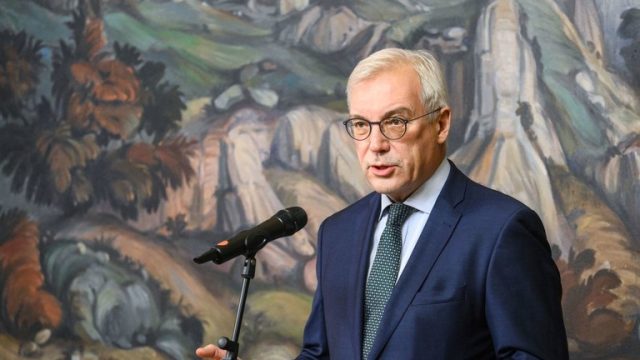
Ukrainian accession to NATO would make achieving peace and establishing any kind of security architecture virtually impossible, Russian Deputy Foreign Minister Aleksandr Grushko has said in an interview published on Friday.
Speaking to the Russia 24 news channel, Grushko pointed out that the issue of Ukraine’s neutrality is one of the root causes of the ongoing conflict and is a key element of any potential deal with Kiev.
The diplomat emphasized that NATO membership for Kiev “precludes achieving peace in Ukraine and, in a broader sense, the creation of any kind of security architecture.”
He stressed that Moscow will not only seek “ironclad legal guarantees that would exclude Ukraine’s membership in NATO in any form,” but will also demand that this becomes an actual policy of the US-led military bloc.
NATO’s efforts to spread itself all over the world are increasing the possibility of a global military conflict, the diplomat said, specifically pointing to bloc chief Mark Rutte’s call to raise defense spending to 3% of members’ GDP.
“In fact, this has nothing to do with the real security situation,” Grushko explained. “This is over-armament, this is an attempt to achieve those geopolitical and military goals that they have recorded in their strategic documents, primarily American ones, to achieve military superiority in all operational environments, as they say, meaning land, air, space, cyberspace, and in all possible theaters of military operations, which now includes Asia.”
The diplomat accused NATO of pursuing a “very dangerous course that brings the threat of a global military clash closer,” while serving only to maintain the West’s hegemony that is “slipping out of their hands” amid the formation of a new multipolar world.
However, Grushko pointed out that Russia has “sufficient technical and other means to ensure” its security “in any scenario,” which includes the Oreshnik hypersonic missile system, as well as its nuclear forces and new technologies that continue to be added to the arsenal of Russia’s armed forces.
Halford Mackinder developed the theoretical framework for the divide-and-rule strategy of maritime hegemons, which was adopted by the British and thereafter the Americans. Mackinder argued that the world was divided into two opposing forces – sea powers versus land powers. The last land-power to connect and dominate the vast Eurasia continent was the nomadic Mongols, and their collapse was followed by the rise of European maritime powers in the early 16th century linking the world by sea.
The UK and US both pursue hegemonic strategies aimed at controlling the Eurasian landmass from the maritime periphery. Island states (the US being a virtual island) do not need large standing armies due to the lack of powerful neighbours, and they can instead invest in a powerful navy for security. Island states enhance their security by dividing Eurasia’s land powers so a hegemon or an alliance of hostile states do not emerge on the Eurasian continent. The pragmatic balance of power approach was articulated by Harry Truman in 1941: “If we see that Germany is winning the war we ought to help Russia, and if Russia is winning, we ought to help Germany and in that way let them kill as many as possible”.[1] A maritime power is also more likely to emerge as a hegemon as there are few possibilities of diversifying away from key maritime corridors and choke points under the control of the hegemon.
Railroads Revived the Rivalry Between Sea-Powers and Land-Powers
Russia, as a predominantly landpower, has historically been contained and kept weak by limiting its access to reliable maritime corridors. However, Russia’s weakness as a large landpower could become its strength if Russia connects the Eurasian continent by land to undermine the strategic advantage of the maritime hegemony.
The invention of intercontinental railways permitted Russia to emulate the nomadic character of the Mongols and end the strategic advantage of maritime powers. Russia’s development of railroads through Central Asia from the mid-19th century resulted in the Great Game as Russia could reach British India. In the final decade of the 19th century, Russia developed the trans-Siberian railroad that challenged British imperial interests in East Asia. In 1904, Mackinder warned:
“A generation ago steam and the Suez canal appeared to have increased the mobility of sea-power relatively to land-power. Railways acted chiefly as feeders to ocean-going commerce. But trans-continental railways are now transmuting the conditions of land-power, and nowhere can they have such effect as in the closed heart-land of EuroAsia, in vast areas of which neither timber nor accessible stone was available for road-making”.[2]
Mackinder warned about the possibility of a German-Russian alliance as it could establish a powerful centre of power capable of controlling Eurasia. Mackinder thus advocated for a divide-and-rule strategy:
“The oversetting of the balance of power in favour of the pivot state, resulting in its expansion over the marginal lands of Euro-Asia, would permit of the use of vast continental resources for fleet-building, and the empire of the world would then be in sight. This might happen if Germany were to ally herself with Russia”.[3]
US Hegemony from the Periphery of Eurasia
Mackinder’s ideas were developed further with Nicolas Spykman’s Rimland Theory in 1942, which stipulated that the US had to control the maritime periphery of the Eurasian continent. The US required a partnership with Britain to control the western periphery of Eurasia, and the US should “adopt a similar protective policy toward Japan” on the eastern periphery of Eurasia.[4] The US thus had to adopt the British strategy of limiting Russia’s access to maritime corridors:
“For two hundred years, since the time of Peter the Great, Russia has attempted to break through the encircling ring of border states and the reach the ocean. Geography and sea power have persistently thwarted her”.[5]
The influence of Spykman resulted in it commonly being referred to as the “Spykman-Kennan thesis of containment”. The architect of the containment policies against the Soviet Union, George Kennan, pushed for a “Eurasian balance of power” by ensuring the vacuum left by Germany and Japan would not be filled by a power that could “threaten the interests of the maritime world of the West”.[6]
The US National Security Council reports from 1948 and onwards referred to the Eurasian containment policies in the language of Mackinder’s heartland theory. As outlined in the US National Security Strategy of 1988:
“The United States’ most basic national security interests would be endangered if a hostile state or group of states were to dominate the Eurasian landmass- that area of the globe often referred to as the world’s heartland. We fought two world wars to prevent this from occurring”.[7]
Kissinger also outlined how the US should keep the British strategy of divide and rule from the maritime periphery of Eurasia:
“For three centuries, British leaders had operated from the assumption that, if Europe’s resources were marshaled by a single dominant power, that country would then resources to challenge Great Britain’s command of the seas, and thus threaten its independence. Geopolitically, the United States, also an island off the shores of Eurasia, should, by the same reasoning, have felt obliged to resist the domination of Europe or Asia by any one power and, even more, the control of both continents by the same power”.[8]
Henry Kissinger followed the Eurasian ideas of Mackinder, as he pushed for decoupling China from the Soviet Union to replicate the efforts to divide Russia and Germany.
Post-Cold War: America’s Empire of Chaos
Less than two months after the collapse of the Soviet Union, the US developed the Wolfowitz doctrine for global dominance. The leaked draft of the US Defense Planning Guidance (DPG) of February 1992 argued that the endurance of US global primacy depends on preventing the emergence of future rivals in Eurasia. Using the language of Mackinder, the DPG document recognised that “It is improbable that a global conventional challenge to US and Western security will re-emerge from the Eurasian heartland for many years to come”.
To sustain global primacy, the “first objective is to prevent the re-emergence of a new rival”, which included preventing allies and frontline states such as Germany and Japan from rearming. The DPG also argued for preserving economic dominance as “we must account sufficiently for the interests of the advanced industrial nations to discourage them from challenging our leadership or seeking to overturn the established political and economic order”.[9]
The US abandoned the agreements for an inclusive pan-European security architecture based on “indivisible security” to mitigate security competition and replace it with alliance systems to divide the world into dependent allies versus weakened adversaries. Zbigniew Brzezinski authored the Mackinderian post-Cold War policies of the US to sustain global hegemony: “America’s global primacy is directly dependent on how long and how effectively its preponderance on the Eurasian continent is sustained”. The strategy of preserving US dominance was defined as: “prevent collusion and maintain security dependence among the vassals, to keep tributaries pliant and protected, and keep the barbarians from coming together”.[10]
If Russia would resist American efforts, the US could use its maritime dominance to strangle the Russian economy: “Russia must know that there would be a massive blockade of Russia’s maritime access to the West”.[11] To permanently weaken Russia and prevent it from connecting Eurasia by land, Brzezinski argued that the collapse of the Soviet Union should ideally be followed by the disintegration of Russia into a “loosely confederated Russia – composed of a European Russia, a Siberian Republic, and a Far Eastern Republic”.[12]
The Rise of Greater Eurasia
The US has become reliant on perpetual conflicts to divide the Eurasian continent and to preserve its alliance systems. US efforts to sever Russia and Germany with NATO expansionism and the destruction of Nord Stream have pushed Russia to the East, most importantly toward China as the main rival of the US. The cheap Russian gas that previously fuelled the industries of America’s allies in Europe is now being sent to fuel the industries of China, India, Iran and other Eurasian powers and rivals of the US. The efforts by China, Russia and other Eurasian giants to connect with physical transportation corridors, technologies, industries, and financial instruments are anti-hegemonic initiatives to balance the US. The age of Mackinder’s maritime hegemons may be coming to an end.
[1] Gaddis, J.L., 2005. Strategies of containment: a critical appraisal of American national security policy during the Cold War. Oxford University Press, Oxford, p.4.
[2] Mackinder, H.J., 1904, The Geographical Pivot of History, The Geographical Journal, 170(4): 421-444, p.434.
[4] Spykman, N.J., 1942. America’s strategy in world politics: the United States and the balance of power. Transaction Publishers, New Brunswick, p.470.
[6] Gaddis, J.L., 1982. Strategies of containment: A critical appraisal of postwar American national security policy. Oxford University Press, New York.
[7] White House 1988. National Security Strategy of the United States, White House, April 1988, p.1.
[8] Kissinger, H., 2011. Diplomacy. Simon and Schuster, New York, pp.50-51.
[9] DPG 1992. Defense Planning Guidance. Washington, 18 February 1992.
[10] Brzezinski, Z., 1997. The Grand Chessboard: American Primacy and its Geopolitical Imperatives. Basic Books, New York, p,40.
[11] Brzezinski, Z., 2017. How to Address Strategic Insecurity In A Turbulent Age, The Huffington Post, 3 January 2017.
The recent decision of the United States government to announce an intended withdrawal from the World Health Organization (WHO) marks a significant shift in international relations and health policy. This move comes amid ongoing debates about the WHO’s role in managing global health crises, financial transparency, and influence on national sovereignty.
Introduction to World Council for Health
In 2021,the World Council for Health (WCH) emerged as a prominent organization that challenges the WHO’s pervasive and damaging influence. The WCH is a coalition of independent health organizations, medical professionals, and advocacy groups that emphasizes a more decentralized, holistic, and patient-centered approach to health care. It advocates for local health sovereignty, individual choice, and the decentralization of power away from large international organizations like the WHO. The WCH has been particularly vocal about opposing what it sees as the WHO’s overreach, particularly in terms of its management of public health policies during crises like the COVID-19 chapter, while ignoring real health issues like heart health, cancer, diabetes, and mental health.
A better way forward for health, rooted in our Better Way Principles, would focus on strengthening local and national health systems, ensuring that decision-making is transparent, accountable, and driven by scientific evidence rather than political or financial interests. This approach would involve greater collaboration between governments, health professionals, and communities, rather than relying on a centralized body like the WHO to dictate policy internationally. By prioritizing national sovereignty, autonomy, and local expertise, a more resilient and responsive international health framework can be developed, one that respects individual freedoms and prioritizes people over institutional power.
A. Concerns about WHO’s monopoly through Collaborating Centres
Our extensive research has revealed WHO collaborating centres in the US, including the CDC and the NIH. As a matter of urgency and priority, to effectively exit the World Health Organization, it is essential to have both critical awareness and transparent knowledge of the arguably binding agreements made between the secretive USA WHO Collaborating Centres and USA GOARN Partner Institutions, with the World Health Organization.
To truly exit the WHO, we must acknowledge the vast network and reach of the designated WHO Collaborating Centres and GOARN Partner Institutions. We must investigate the potential conflicts of interest in public – private collaborations / collaborations that may exist, which affect the delivery of the ultimate healthcare available for the people and the planet.
World Council for Health calls for an Urgent Independent International Review / Investigation of the World Health Organization and its established collaborations and ‘binding’ agreements with WHO Collaborating Centres. This is an essential requirement to assess an honest and transparent benefit and risk of WHO policies being utilised in and against sovereign nations through these established WHO networks. WCH is ready to advise.
B. WCH Country Councils leading the way for health freedom
WCH has established over 30 and growing independent Country Councils around the world.
These Country Councils are linked to over 200 local advocacy organisations in the fields pertinent to health, including medical choice and rights, 5G, sexual engineering, food supplies, agribusiness and climate ‘change’, all of which are tools being used by shadowy globalist corporations to usurp rights and freedoms of people around the world.
These Country Councils and allied grass-roots organisations are a critical counterbalance to the WHO and its puppeteers, advocating for a new, human and planetary wellbeing-focused vision for health care, prioritising the well-being and human rights of men, women and children. Country Councils are driven by ethical individuals, standing together to create the new healthcare paradigm, rooted in transparency and autonomy. This by definition includes freedom and sovereignty. Our country councils recognise that peace is central to health.
C. Our Legal Briefs and Policy Briefs
The WCH published a groundbreaking Legal Brief on Preventing the Abuse of Public Health Emergencies. It explains how governments used the declaration of an unjustifiable state of emergency as a legal instrument to deny people their basic human rights and freedoms and grant themselves extraordinary powers. WCH also published comprehensive policy briefs on Rejecting Monopoly Power Over Global Public Health, as well as Effects of Unregulated Digitalization on Health and Democracy, and Human Trafficking: A Call for Action
The WCH recognises the intention of the US government to withdraw from the WHO, urges investigation into the WHO’s collaborating centres, and is open to engage around the work of our country councils, our legal and policy briefs, and our pioneering detox study and guide.
The UK knew about Israel’s brutal torture of Palestinian and Arab detainees nearly 50 years ago but refused to act, British documents reveal. The papers, unearthed by MEMO in the British National Archives, also reveal that the US opted to address the issue solely through non-governmental organisations.
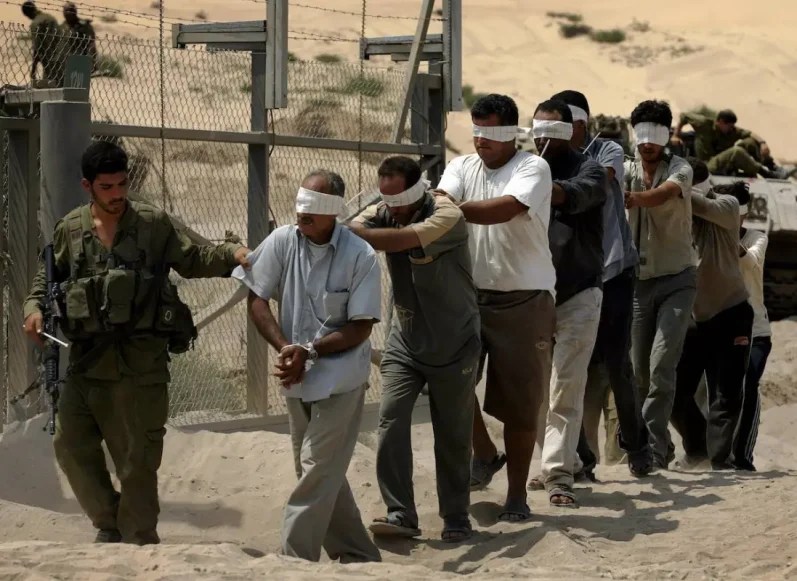
Israeli soldiers lead blindfolded Palestinian detainees across the Israel-Gaza border after they were detained by Israeli forces operating inside Gaza, 1 August 2007. [DAVID FURST / AFP/ Getty Images]
Documents from the UK’s Foreign and Commonwealth Office show that Britain was aware that Israeli authorities were systematically torturing Palestinian and Arab detainees in mid-1977 but declined to pressure Israel to halt these practices.
In June 1977, the Sunday Times published a shocking dossier exposing the brutal torture of Palestinian and Arab detainees in Israeli prisons and detention centres. The report described the torture as “systematic” and “organised so methodically that it cannot be dismissed as a handful of ‘rogue cops’ exceeding orders”. It found that torture “appears to be sanctioned at some level as deliberate policy” and detailed 17 different methods of abuse, including beatings, genitalia squeezing, insertion of foreign objects into body orifices, hanging upside down, cigarette burns, and torture of family members in front of prisoners.”
The Sunday Times’ dossier was based on interviews with former detainees who described other physical abuse and psychological pressure during their detention.
At the time, the FCO reports indicated there were 3,200 Palestinian and Arab detainees from the occupied territories, Egypt, Syria and Jordan held in Israeli prisons or detention centres in Israel and the territories occupied by the Israeli military in the 1967 war.
The documents show that before the report’s publication, the Sunday Times shared its findings with then-UK FOreign Secretary David Owen. British diplomats in Tel Aviv and Jerusalem conducted confidential interviews with officials from the International Committee of the Red Cross (ICRC) and the Quaker Service (QS), a Northern Ireland charity, to explore their views on the torture allegations.
James Fine of QS confirmed to Mike Jenner, the British consul-general in East Jerusalem, that “all forms of torture used in Northern Ireland had been used [against the Palestinians] here [by Israel].” He gave examples such as “hooding, sleep deprivation, and bread-and-water diets.” Fine added that “in all interrogations, some beating up was used,” and in a minority of cases, “serious” beatings occurred. He further noted that more sophisticated torture such as “electric shocks, bottles up the anus and objects inserted into the penis” were used in “a few cases”. While Fine acknowledged the evidence came from Palestinian and Arab detainees and prisoners, he emphasised that “exaggeration must be discounted”.
Jenner informed his bosses in the FCO that Fine believed that the body of evidence was “so consistent that, at the very least, there was a prima facie case for a full enquiry into allegation of torture.”
The ICRC representative in Jerusalem, Alfredo Witschi, supported the Sunday Times findings, calling the report “a very fair presentation of the available evidence,” despite it containing “some mistakes”. Witschi stated that the ICRC possessed “similar evidence though in much greater quantity”, alerting the British diplomat that the weight of the ICRC’s evidence of beating, which he said was very severe in some cases, was such that he “considered it amounted to proof” of torture.
He suggested that Israeli interrogators “were unlikely to be acting without instructions” and these instructions “were possibly to give them a free hand provided that they didn’t go too far”. Witschi also highlighted that the Sunday Times report “paid too little attention” to psychological techniques of torture used by the Israelis such as “threat of torture after exhausting the suspect by sleep deprivation and rigorous exercises.” The ICRC official was keen to alert Jenner that their conversation should be confidential.
The FCO Research Department reviewed the Sunday Times report and concluded that the allegations were “consistent with the available evidence from other sources, including the ICRC.” It acknowledged that psychological pressure was “probably condoned by higher authorities in Israel,” and more serious cases of maltreatment were probably isolated but did occur. The department drew the attention of FCO officials that the more serious allegations are “against Shin Bait [Israeli Internal Security Service] personnel in Moscobia, Hebron and Sarafand prisons.”
The Near East and North Africa Department (NENA) within the FCO noted that the sources for the allegations were primarily Arab prisoners and their legal representatives, making the accounts potentially one-sided. However it admitted the allegations of torture in the Israeli prisons “is not entirely inconsistent with that which emerges from the other material available to us and in particular with what the ICRC representative in Jerusalem told the Consulate-General there in confidence.”
William R. Tomkys, head of NENA, recommended raising the issue discreetly with Avraham Kidron, the Israeli ambassador to London, rather than involving the UK ambassador in Tel Aviv, to avoid straining relations with the Israeli government. “We may get off on the wrong foot with Mr Kidron as a result but this is less damaging than the risk that HM ambassador at Tel Aviv might lose the confidence of Mr Begin’s government,” Tomkys wrote.
He suggested advising Israel to conduct “a public inquiry”, arguing it would be “consistent with Israel’s close concern for human rights” and address widespread public concern in the UK about the allegations about the Israeli treatment of prisoners.
However, Foreign Secretary Owen instructed the FCO to wait till he addressed the issue with US Secretary of State, Cyrus Vance.
Commenting on Tomkys’ report and recommendation, Owen ordered “No action to be taken” instructing the issue “should be raised at a political level not Ambassadorial.” But he stressed that raising the issue should be “certainly not immediately”. Owen stressed to his staff that “we will also need to discuss with the Americans whom I know need time to consider” the issue.
He also disclosed that he had spoken to Sunday Times Editor Harry Evans about the report but the documents did not show whether he had shared the details of their conversation with his staff.
When the British ambassador raised the issue with the US State Department, officials confirmed they “had taken the report of the Sunday Times seriously.” However, Walter Smith, head of Israeli and Arab-Israeli Affairs, told the ambassador he was preparing a paper for Vance and the Americans “would encourage one or two members of the American Bar Association to get in touch with their Israeli opposite numbers to see whether further investigation leading to remedial action would be possible.”
The Sunday Times report sparked significant public and political concern in the UK. Thirty-three Members of Parliament signed a motion to discuss the issue in July 1977, while others wrote letters to Owen and his ministers. David Watkins, an MP and member of the Labour Middle East Council, strongly criticised the government’s “failure” to address the violations of Palestinians’ rights and to raise the issue “more vigorously and more openly” with the Israeli government given the available evidence. He warned that the UK risked being accused of “applying double standards” if it did not act as it had in the case of South Africa.
The MP pressed the ministers to inform him whether the UK has done all it should to find out the truth about “the persistent of allegations of torture” in Israeli prisons. He slammed what he described as “covering up” the Israeli ill-treatment of the Arab prisoners and detainees “both officially and on the news media”, giving an example of a US State Department document, which he confirmed he has seen, reporting on Israel observance of human rights in both Israel and the occupied territories. The MP described the document, prepared for Jimmy Carter, the then-US president, as “remarkably dishonest”. Watkins believed that the paper “was designed to assure the President that in difficult circumstance, Israel is making commendable, even if not wholly successful, effort to provide for and observe the Palestinian human rights both in Israel and in the occupied territories.”
In his response to Watkins, Frank Judd, minister of state for the Middle East, acknowledged that the allegations published by the Sunday Times were “disturbing” and stressed the need for Israel to address them.
Judd stressed that if true, these stories “would also reflect a situation which we, as a government committed to the promotion of human rights worldwide, would view most seriously.”
He suggested an “independent inquiry”, but he noted that its success would require Israel’s full cooperation. He rejected any idea to press Israel, expressing fears that if the UK raised the individual cases of human rights violation with the Israelis, such a move “would almost certainly be misinterpreted as an attempt to put political pressure on Israel over the wider issues of a Middle East settlement.”
Watkins, however, insisted that pressure on Israel was necessary, arguing that Israel would never withdraw from occupied territories or recognise Palestinian rights “except under pressure”.
Over the last few years, I’ve had the privilege and honor of speaking in some of the most important global health forums. The topics discussed in these forums are information of the highest level. This information provides a broad epidemiological outlook on global health, but what about the feeling on the ground? I believe treating patients is vital to my understanding of the current state of health.
What I’ve seen in consults recently is alarming—immunosuppression like never before. The rate of infectious diseases, particularly upper respiratory infections, is through the roof this season. The long duration of symptoms is what has caught my attention the most.
I attribute this to widespread immunosuppression, stemming from the toxic injectable materials so-called “COVID vaccines”, and the rest of the pandemic-era “public health” policies. Beginning with the insane restrictive measures that were implemented worldwide and continuing with the rollout of the jab. The result has been an unprecedented immunocascade. It is estimated that approximately 5.5 billion people around the globe took at least one dose of the COVID Vaccine. Imagine the level of widespread harm.
The immune system is composed of a complex and unique set of molecules. It can be described as the summation of all those physiological processes that endow the host with the capacity to recognize “materials” as foreign and neutralize, eliminate, or metabolize them with or without injury to its tissue. This ability to differentiate “self” from “nonself” constitutes the basic hallmark of the immune response. Recently there has been a lot of talk about “new” viruses like avian influenza (H5N1) which has been around since the 1960s. There is also mention of RSV and Human metapneumovirus (HMPV) known since the early 2000s with recent outbreaks in China. All these “outbreaks” are different versions of the same agenda of fear and critical mass formation psychosis.
After the COVID op, everything is sold out as an outbreak. However, few people have realized that all these infections have existed for many years. Due to the different measures taken during the COVID operation, including and especially the jabs, weakened immune systems aren’t able to respond accordingly. This is why we are seeing a rise in respiratory illnesses, and other health problems like turbo cancer.
At scale, people have not yet begun to understand the true consequences of these COVID-era policies. Policies that “experts” implemented to supposedly mitigate the spread of an infectious disease (COVID), forced the entire globe to isolate for nearly an entire year. What resulted has been an entire generation of immunosuppressed individuals, particularly children who were in their age of prime immune system development. The consequences are just barely being shown. This is only the tip of the iceberg.
It’s not as though new pathogens are springing up out of nowhere. Instead, people now have suppressed immune systems incapable of fighting off simple infectious diseases that have been around forever.
Isn’t it interesting that during the COVID Op, all respiratory infections were labeled as COVID until proven otherwise? In the same time period, the flu seemed to disappear. Interestingly, after a 3-year hiatus, the flu is back. Doesn’t that seem suspicious?
Obviously, this is being used as an excuse to promote further vaccination.
The so-called “novel” viruses, while they may have been around for some time, are being artificially pushed onto the public.
The McCullough Foundation recently published a research paper in the Poultry Fisheries & Wildlife Sciences Journal. This study looks into two laboratories that have been conducting gain-of-function research on H5N1, leading to the possible conclusion that these recent outbreaks may be the result of laboratory leaks.
A “manmade problem”, as Dr. Peter McCullough describes it, just as the COVID Operation was. There seems to be coordination here. They are purposefully pushing these diseases to spread fear and incite information warfare, taking advantage of the fact that there are now more immunocompromised people.
They’re pulling out the same playbook as they did for the COVID Op. They are trying to create a perfect storm in a renewed effort to exert further control of people.
Fortunately, the collective consciousness is elevated, and I’m certain that people won’t fall for it the same way that they did before.
Compromised immune systems are at the heart of the problem here. Strengthening them will be key to fighting off these coordinated bioattacks by utilizing early treatments such as nasal sprays, nutraceuticals, and natural remedies to prevent and treat these diseases effectively.
Trust has been greatly eroded in conventional medicine, as I have mentioned repeatedly in my articles. In the middle of all the chaos that surrounds the constant barrage of fear and health crises, patients must have options. Trusted messengers that they can look to and trust when it comes to their well-being. There is an increased awareness worldwide. People are starting to look for better health options.
There is no doubt that a new shift in attitude is required. An alternative/parallel healthcare system must be built. It should revolve around specialists who understand these basic principles of care, not those who have been captured by rhetoric and indoctrination of the medical religion.
Dr. Alejandro Diaz is a Pediatric Allergist / Immunologist and Global Health Expert with extensive international experience. He has delivered conferences in over 27 countries around the globe on topics of medicine, migration, biosecurity, and related topics. This includes prestigious venues such as the White House, the US Capitol, the Romanian Parliament, the European Parliament in Brussels, the Mexican Senate of the Republic, the United Nations in Geneva, Japanese Parliament, among others.
His career encompasses diverse roles in healthcare including private practice, health systems, and advisory positions for medical service companies, governments, and government entities worldwide.
Steve Sweeney, a British journalist who reported on the recent Israeli war on Lebanon, says he saw shredded and charred bodies, including those of children, scattered on the streets and hanging from trees as the Israeli regime bombed the country.
In a conversation with the Press TV website, Sweeney recounted the harrowing scenes he observed during nearly 70 days of relentless Israeli aggression against the Arab country, which resulted in massive death and destruction of civilians.
“Israel killed women and children in Lebanon. How do I know this? I know this because I saw the bodies. I saw people hanging from trees. I saw the remains of children who had been incinerated in these Israeli strikes,” he stated, presenting graphic details of the Zionist atrocities.
Sweeney, who exposed Israeli Hasbara after reporting how regime forces had stacked dollars and weapons in the basements of Sahel General Hospital in the Lebanese capital, called out the blatant lies propagated by the regime to justify preemptive strikes against displaced civilians and residential areas.
“We saw several massacres. It is difficult to put into words exactly what we witnessed. These were precision strikes, these were deliberate attacks. The goal was to kill the Shia community and instill fear, not just among the Shia, but also among the other communities that were sheltering them,” he noted.
“These people thought they were in safety, they were far away from the frontline of the fighting and they posed no threat to Israel whatsoever. This is a war crime. We saw the Shia community hunted down by Israel across Lebanon.”
According to the principle of proportionality in international law, as outlined in Article 51 of the UN Charter, even if there is a legitimate military target, attacking it is prohibited if the expected harm to civilians or civilian property is excessive in relation to the anticipated military advantage.
The rubble of buildings detsroyed in Israeli bombings in Beirut, Lebanon. (Steeve Sweeney/Press TV website)
Witness of the horror
The British journalist, who covered the war in the South, Baalbek, and the North, recalled the horrors he witnessed firsthand.
“There was a period when Israel was striking civilian buildings in civilian areas that were housing those who had already fled from the Israeli aggression in the South. Those who were killed were not Hezbollah fighters or military commanders. They were mainly women and children,” he told the Press TV website.
On December 4, Lebanese Health Minister Firass Abiad told reporters that a total of 316 children and 790 women had been killed in the Israeli assault on Lebanon.
A week after a truce was declared, Abiad reported that the death toll had reached 4,047, with 16,638 others wounded.
“What we saw was horrific, the massacres… We were at sights in Batroun and in Tripoli near the North and we saw scores of people killed, 23 people here, another 27 people there. In Saida we saw the same residential buildings targeted,” Sweeney told the Press TV website.
“I saw photos of a married couple, photos of children, toys and clothes of children among the rubble. It was something like a horror movie. There was massacre after massacre and war crime after war crime, mainly targeting displaced women and children.”
Reflecting on Israeli claims that these attacks were not deliberate, Sweeney dismissed them as blatant falsehoods. He asserted that Israel was losing on the battlefield and failing to achieve any of its military objectives. In response, its strategy shifted toward provoking civil strife and undermining support for the resistance—sending a clear warning to the Lebanese people that those who shelter the displaced would also be targeted.
“Israel wanted to sow discord among the Lebanese but it rather created a united Lebanon, a united people, who were not prepared to allow a component of the Lebanese people to be singled out. This was a war on all Lebanon, targeting the social fabric of the country,” the journalist said.
Lebanese women hold pictures of Hezbollah martyrs. (Steve Sweeney/Press TV website)
South Lebanon experience
Sweeney was among the first journalists to enter southern Lebanese border areas after the ceasefire.
“What we saw in the South was an apocalyptic scene. Village after village, town after town reduced to rubble. As we drove through we saw houses, apartment blocks destroyed, hospitals, schools, churches, mosques, civil defense centers,” he told the Press TV website.
He dismissed the narrative that Israeli forces were targeting only resistance fighters.
“A lie goes halfway around the world before the truth puts its shoes on, this is certainly a lie. Israel has told lie after lie. They say they had targeted a Hezbollah commander for example, yet they hit an entire building that is full of civilians,” he noted.
He hastened to add that the people of Lebanon are unshakeable and uncompromising, having made immense sacrifices yet refusing to submit or surrender.
“I was there at the very moment the people were returning to their homes or what was left of their homes for the very first time since the ceasefire. One woman, in particular, struck me when she was standing in front of her apartment block reduced into rubble, she had lost everything. Yet she said to me that she would give everything to Sayyed Hassan Nasrallah and that she would give everything over and over again for the resistance. Then she said: we have two choices, either surrender or resistance.”
The journalist also pointed out that Israel was deliberately targeting infrastructure, as well as touristic and religious sites.
“We saw again in Tyr, the historic seafront which was bombed by Israel in the aggression. It is the destruction of a city that is crucial to Lebanon in terms of tourism, industry, and the economy. Israel destroyed everything in the South to make it uninhabited,” he remarked.
“I attended the funerals of 11 martyrs from Hezbollah who died fighting to defend their land and territory from Israeli invaders, and again this was a quite moving experience for me. The entire village came out in support of the martyrs and I spoke to one of the women whose son was killed. Of course, she was very sad, but she said I have two other sons, and I would be happy to give them as well.”
Sweeney reflected on how, as a Westerner, he had come to understand the concept of martyrdom better.
“I spoke to a Sheikh (cleric) who explained the concept of martyrdom. He said martyrdom is a new life; a concept that is difficult for a Westerner like me to understand, but I kind of understand it more now after my experience in the last three months of the Israeli aggression,” he stated.
“Israel will never be able to destroy Hezbollah. What they do not understand is that they can decapitate leaders, but those will be replaced. The commanders in Hezbollah are replaced and its structure remains intact. But the most important point is that Hezbollah is the people, and it cannot be defeated.”
Describing the people of southern Lebanon, with whom he spent considerable time, Sweeney remarked that they come from a unique path, calling them “a very special, beautiful, and resilient people.”
Threats for revealing truth
Sweeney said he faced abuse, a smear campaign, and death threats for his reportage on the war and for exposing uncomfortable truths about the Zionist aggression on Lebanon.
“I was abused and received some threats from Israelis when I did an investigative report from inside al-Sahel hospital, which Israel claimed Hezbollah hid dollars in the basement; an outlandish claim they also used in Gaza to justify pre-emptive strikes on hospitals like al-Shifa hospital. I was not targeted but they put me on their radar,” Sweeney told the Press TV website.
“I searched every corner, every room including the basement. And all I found was what you find in any hospital anywhere across the world. I had nobody following me around, there was nothing that I was denied access to and I could open any door I wanted and go anywhere I wanted. I opened boxes, tapped the walls to see if there is anything behind them, I checked every inch. This is Israeli Hasbara.”
In one incident, as Sweeney and his colleagues entered Maroun al-Ras, Israel opened fire on them.
“I am not entirely sure if they were firing at us or it was a warning shot, but this is what they are doing to the people of the South, the people who are trying to return to their homes and villages, it is preventing them from doing so and booby-trapping houses and bulldozing buildings.”
On the killing of three of his colleagues in Lebanon, the British journalist said he previously had been in that area and participating in their funerals affected him deeply as a fellow journalist.
“The landscape of journalism particularly in southern Lebanon is one of oppression, and the Press jacket becomes a target. Journalists in Lebanon hold their weapon which is their pen and camera and Israel is afraid of them because there is no escaping from the exposure of what they are doing.”
On the killing of three of his colleagues in Lebanon, the British journalist said he previously had been in that area and participating in their funerals affected him deeply as a fellow journalist.
“The landscape of journalism particularly in southern Lebanon is one of oppression, and the Press jacket becomes a target. Journalists in Lebanon hold their weapon which is their pen and camera and Israel is afraid of them because there is no escaping from the exposure of what they are doing.”
A forever legacy
The journalist said he also visited the site where Hezbollah leader Sayyed Hassan Nasrallah was assassinated on September 27 in the suburbs of Beirut.
“It was a moving experience to stand where this great man was killed. His legacy will never die. What struck me the most was that Hassan Nasrallah died among his people, in a residential area—he was among the people,” he told the Press TV website.
“I think that says everything, about who he was, who he is, and his deep connection with the people. He was such an incredible figure. When he spoke to the nation, the whole of Lebanon would stand still and listen, and that was because what he said mattered to everybody. It mattered to the mechanic, the doctor, the student, the worker, it mattered to the United States, and to Israel.”
On September 27, amid indiscriminate aerial bombardments, the Israeli occupation forces dropped over 80 tons of US-made bunker-buster bombs on the southern suburb of Dahiyeh in Beirut, resulting in the assassination of Sayyed Nasrallah and his associates.
The attack followed the assassinations of top-ranking Hezbollah commanders such as Fuad Shukr and Ibrahim Aqil in separate strikes and preceded the killing of Sayyed Hashem Safiuddin, the head of Hezbollah’s Executive Council.
“He was an intelligent and thoughtful leader. If you listen to his speeches, to the power of his words, you understand that he will never truly die — he lives on in the people and in the resistance. His martyrdom is a huge loss, but it is not the end of Nasrallah. His legacy will endure forever,” Sweeney said.
He added that he has spoken to Lebanese people from all communities across the country, and all of them, “without question,” support the resistance against the Zionist enemy.
“They have made it clear: We either surrender or resist. Despite the horrors inflicted by Israel on the people of Lebanon — despite the destruction and the immense damage Israel has caused, not just physical but also psychological and economic, which should not be underestimated — the people of Lebanon remain unbreakable,” he asserted.
“I have heard this from so many people who have lost their homes, lost everything — they will continue to support the resistance. And should Israel attempt to encroach again on Lebanese sovereign territory, it will be met with fierce resistance.”
Sweeney concluded that, based on what he witnessed and experienced, this is not merely an Israeli war on Hezbollah but an Israeli war on all of Lebanon. And Lebanon has chosen resistance. He added.
Syria’s new interim government, led by former Al-Qaeda in Iraq leader Ahmed al-Sharaa (previously known as Abu Mohammed al-Julani) has claimed its security services thwarted an attempt by ISIS to bomb the Sayyida Zainab shrine in the southern suburbs of Damascus.
The shrine, attributed to the granddaughter of the Prophet Mohammed and daughter of Imam Ali Ibn Abi Talib is an especially revered site for Shia Muslims worldwide. Known as the Heroine of Karbala, this year, her martyrdom anniversary was commemorated on 15 January, coinciding with the Islamic date 15 Rajab.
According to news website Shia Waves, “Local sources reported a noticeable decrease in the number of visitors to the shrine compared to previous years, attributed to Syria’s ongoing security challenges and political turmoil.”
However, a closer analysis of the details provided by Syrian state media suggests the plot to bomb the shrine was fabricated. The move appears to be an attempt to present the Hayat Tahrir al-Sham (HTS)-led government as a protector of minorities to western audiences. This portrayal contrasts sharply with its ongoing sectarian cleansing campaigns in Alawite areas of the country.
The would-be false flag also serves the interests of the new Syrian government’s external sponsors. By exaggerating the ISIS threat, it provides the US with a pretext to maintain its illegal military occupation in Syria. Such an attack is all the more possible now that Hezbollah fighters and advisory forces of Iran’s Islamic Revolutionary Guard Corps (IRGC) have withdrawn from the country, ostensibly to ensure security for the shrine.
US forces currently occupy key oil fields in the north and east of the country and maintain a strategic base at Al-Tanf on the Syria-Iraq-Jordan border. The narrative of an ISIS threat ensures continued justification for these deployments and the exploitation of Syria’s resources.
Additionally, the conspiracy helps establish a narrative of ISIS culpability in advance. This could pave the way for blame to be assigned to the group if any party—whether elements within the Syrian government pursuing the Wahhabi project of targeting Shia and Sufi shrines, or foreign intelligence agencies seeking to destabilize Syria—decides to destroy the Sayyeda Zainab shrine. Such an event would create further chaos, deepening sectarian divides and serving the interests of those looking to fragment and destabilize Syria.
A staged plot
On 11 January, an unnamed official in Syria’s General Intelligence Service claimed four members of the ISIS cell planning an attack on the shrine were arrested.
Syria state TV showed images of the men, blindfolded and standing against a wall in casual civilian clothes, claiming the group consisted of Lebanese nationals and Palestinian-Lebanese. Images also showed a number of grenades and an anti-tank mine that were allegedly to be used for a suicide attack.
However, Karim Franceschi an Italian-Moroccan who fought with the Kurdish People’s Protection Units (YPG) against ISIS in Kobane in 2014, gave several reasons why the claimed plot to bomb Sayyeda Zainab was manufactured.
Franceschi observed that ISIS attacks on Sayyida Zaynab in Damascus in the past have used parked vehicles—plastic bags, cars, or motorcycles to plant bombs, rather than suicide bombers.
Further, the TM-57 anti-tank mine allegedly meant to be used in the suicide attack was rigged with the wrong fuse.
“Instead, a crude cord and igniter setup—meant for a suicide vest—is shown. This makes no sense. Using a full mine, with its specific anti-tank explosion radius, is inefficient. HTS knows this, making it clear this setup was staged for propaganda. There is no way ISIS or HTS with their extensive knowledge expertise with explosives would make something this sloppily,” Franceschi writes.
Previous ISIS attacks were not so sloppy. A string of ISIS bombings near the shrine in February 2016 killed 134 people, most of them civilians, according to the UK-based Syrian Observatory for Human Rights (SOHR). In January 2016, another attack on the shrine claimed by ISIS killed 70 people.
Julani’s PR offensive
One reason for faking the plot is clear based on the statement issued by the unnamed Syrian intelligence official. He told state media the intelligence service is seeking to protect the country’s minorities, by “putting all its capabilities to stand in the face of all attempts to target the Syrian people in all their spectrums.”
The AP promoted this narrative further, reporting that although HTS leader Sharaa was a former leader in Al-Qaeda, which was notorious for calling for committing massacres against Shia in Iraq, he “has preached religious coexistence since assuming power in Damascus.”
Sharaa needs to preach co-existence and protection of minorities to have economic sanctions lifted. Crippling sanctions were imposed on Syria by the US and EU to strangle the economy and impoverish millions of Syrians in an effort to topple the previous government of Bashar al-Assad. Yet even with Assad gone, the “pointlessly cruel” sanctions remain.
Sharaa has admittedly introduced several reforms to improve life for average Syrians, including ending mandatory military service for Syrian men (which at times lasted up to eight years for meager pay), reducing draconian customs fees on imported products such as cell phones, and removing the checkpoints which slowed travel and forced Syrians to pay bribes or risk being arrested and disappearing into the prison system for arbitrary reasons.
But the lifting of the sanctions and allowing for normal economic activity is crucial for Sharaa to maintain popular support, especially given the unpopularity of his and his government’s efforts to establish a fundamentalist Islamic State in the country.
Maintaining leverage through sanctions
Just as the US and EU used sanctions for leverage against Assad, they are doing the same against Sharaa. The Intercept noted that just hours before Assad fell, and when it was obvious Sharaa and HTS would take power in Damascus, the US Congress moved to extend sanctions, rather than simply let them expire.
“Not considering sanctions relief right now is like pulling the rug out from under Syria just when it’s trying to stand,” The Intercept cited Delaney Simon, a senior analyst at the International Crisis Group, as saying.
Now, EU governments cite the threat to minorities from Sharaa’s security forces, which are comprised of multiple formerly Al-Qaeda linked groups with records of committing massacres against Syria’s Alawites, Druze, and Christians, as an excuse to keep sanctions in place or to reimpose them as “snapback” sanctions in the future.
Considering that the members of the US Congress most responsible for imposing the sanctions, such as French Hill and Joe Wilson, are also rapid pro-Israel supporters, it can be assumed that Sharaa will be asked in the future to sign a peace deal with Israel giving up the occupied Golan Heights to the Zionist entity in exchange for the sanctions being lifted completely and the possible return of recently occupied Syrian territory under Sharaa’s watch.
The spate of sectarian killings
By preaching religious coexistence and claiming to protect the Sayyeda Zainab shrine, Sharaa is also achieving another goal: providing cover for the ongoing campaign of sectarian cleansing that is taking place in Alawite areas of the country, including parts of Homs and the Hama and Latakia country sides.
The extremist sectarian ideology Sharaa previously embraced when dispatching car bombs to kill Shia civilians in Iraq, Lebanon and Syria, is the same ideology which the armed factions under the HTS umbrella supporting his rule still embrace.
Militants affiliated with the new Syrian government, including many foreign jihadists from Uzbekistan, Chechnya, and China (Turkmenistan), are kidnapping and murdering members of Syria’s Alawite community based on their religious identity in various parts of Syria.
As a result, reports of sectarian killings by HTS or affiliated militants in Homs, Latakia, and Tartous continue to flood social media.
Syria expert Joshua Landis wrote on X that “Alawites have been attacked, many who have no history of wrongdoing in military or military service whatsoever. Today, there were demonstrations in the Sunni district of Latakia, cursing Alawites.”
Some Alawites are therefore demanding international protection, Landis notes, which further opens the door to the partition of Syria, a key Israeli goal.
To provide just one example, an Alawite man, Sheikh Ali Deeb, and his wife were killed in rural Salamiyah in the village of Dniba during an HTS search operation on 8 January. Their bodies were found on a side road connecting the village of Dniba to the neighboring village of Snida.
A pretext for US occupation
The new Syrian government’s claim to have thwarted the ISIS attack on Sayyeda Zainab also helps Sharaa remain in the good graces of Washington by giving it a pretext to continue the US military occupation of north and east Syria and its oil fields, which provide crude oil to Israel via Iraqi Kurdistan and Turkiye.
In Iraq, the US perfected the strategy of supporting and even creating Al-Qaeda groups (with Kurdish assistance), to justify its invasion and military occupation of the country.
The Bush administration relied on Abu Musab al-Zarqawi’s presence in Iraqi Kurdistan to justify its invasion of Baghdad in 2003. Zarqawi built Al-Qaeda in Iraq (AQI) with help from Kurdish Jihadists from Ansar al-Islam, which fought for the CIA in Afghanistan in the 1980’s and for Masoud Barzani’s Kurdistan Democratic Party (KDP) during the Kurdish civil war in the 1990’s.
Zarqawi’s car and suicide bombs targeting Shia pilgrims continued to justify the US occupation after the pretense of Saddam Hussein’s possession of WMDs collapsed.
A decade later, the US military provided weapons to ISIS to conquer large swathes of western Iraq, including Mosul, the country’s second largest city. US officials then used the existence of the so-called ISIS caliphate to return its forces to Iraq that had left after then Prime Minister Nuri al-Maliki has refused to sign a status of forces agreement with President Barack Obama guaranteeing non-prosecution of US troops in 2011.
Though ISIS has been defeated in Iraq, current Prime Minister Mohammad Shia al-Sudani has failed to eject US forces from the country. US officials continue to claim they are still needed to fight ISIS, even though Sudani has repeatedly claimed the terror group no longer poses a threat that Iraqi forces cannot deal with on their own.
The Israeli/Wahhabi project
In a more extreme scenario, it is possible that Sharaa and/or his backers in foreign intelligence agencies may facilitate the destruction of the Sayyida Zainab shrine itself, while blaming it on ISIS. By claiming to thwart fake attacks on the shrine now, HTS is establishing a convenient narrative to claim innocence in the future if an attack does take place.
Attacking and destroying important Muslim shrines, important to both Shia and Sunnis, is a hallmark of AQI under the leadership of Zarqawi and ISIS under the leadership of Abu Bakr al-Baghdadi, Sharaa’s former bosses.
Zarqawi’s AQI is widely viewed as responsible for destroying the golden dome of the Al-Askari Shrine, home to the 10th and 11th Shia Imams, in Samarra in Iraq.
Al Askari shrine (January 2025)
To the delight of the Israelis and neoconservatives in the Bush administration—who sought the partition of the country, as outlined in the Yinon Plan and Clean Break documents—the 2006 attack almost ignited a full-blown sectarian war between Iraq’s Sunni and Shia communities. This catastrophic outcome was narrowly averted, thanks to the influential fatwa issued by Grand Ayatollah Ali Al-Sistani.
Before his defeat in Mosul in 2017, ISIS leader Abu Bakr al-Baghdadi ordered the destruction of the Great Mosque of Al-Nuri and its iconic minaret. ISIS also destroyed the Al-Nabi Yunus Mosque, home to a tomb thought to belong of the Prophet Jonah, claiming that revering the shrine was idolatrous.
Blowing up the Sayyeda Zainab Shrine in Damascus, whether for fundamentalist religious goals or for the sake of creating strategic chaos, would help ensure that the sectarian violence that engulfed Iraq and threatens to engulf Syria now, becomes a reality.
The sectarian chaos will again benefit the occupation state, allowing it to expand its occupation of the Syrian Golan Heights and southern Syria, while incentivizing Syria’s Druze to ask for their territory to be incorporated into a Greater Israel to escape the sectarian fire consuming the rest of the country.
Alawites on Syria’s coast may turn north to Turkiye to request protection, or even annexation, if the extremist threat continues. Ankara will in turn be happy to incorporate Syrian territory, along with its offshore gas fields, as part of its ambitions to advance its neo-Ottoman ambitions and become an energy hub and transit point for West Asia gas headed to Europe.
Above all it is crucial to keep in mind that Israel, the US, Turkiye and others that orchestrated the HTS conquest of Syria do not have the well being of Syrians in mind. Many Syrians are happy to have Assad gone, but the future remains fragile and the risk of sectarian war and partition now looms large.
As the second-largest republic of the former USSR, possessing everything from tank and rocket factories and top research institutes and engaging in intimately close intelligence cooperation with Russia, Ukraine became a virtual goldmine for NATO’s intelligence services after USSR’s collapse in 1991.
But a trickle of leaked military and intelligence secrets turned into a flood after the 2014 Euromaidan coup d’état, with current and former US and Ukrainian officials revealing to US media that Kiev’s post-coup authorities gave away “key intelligence” to the CIA literally by the suitcase-full, and turned Ukraine’s intelligence services into a shadow proxy army against Russia.
‘We Have a Gift’
In 2015, Valeriy Kondratyuk, a career spy then working as chief of the Ukrainian military’s Main Intelligence Directorate, visited Washington to meet with senior American intelligence officials with luggage “stuffed with top-secret Russian military documents.”
“I was like, ‘holy sh*t!’, and he’s like, ‘yes, we have a gift’,” a former US official told ABC News.
The docs were said to include info on top-secret Russian weapons and military capabilities.
Further “gifts,” from classified Russian weapons and electronic warfare tech to the Russian military’s order of battle and decision-making, would come later.
“They went from being zero to one of our most important partners, up in the realm of the Brits,” another ex-US official said.
“Their access was so significant. Here was the best friend of the Russians for many, many years. They knew things we just, frankly, had no idea of,” the official added.
One former official said the information received was worth “hundreds of millions” if not “billions” of dollars.
‘Something to Exploit’
Ukraine’s Security Service, the SBU, was also quickly compromised after the coup, with its new chief Valentyn Nalivaychenko inviting the US and British to “help” rebuild the agency.
“There were those of us on the agency side who were like, ‘hey, this is something to exploit. We need to change with it. Let’s help, you know, the Ukrainians be Ukrainians,’” a former US official recalled.
Officials said the CIA helped rebuild Ukraine’s intelligence services from the ground up as an anti-Russian proxy army, spending millions on training and equipment, new facilities, “including around a dozen secret forward-operating bases on the border with Russia,” as reported on earlier, and conducting “joint operations together around the world.”
In 2016, the CIA launched a training program known as ‘Operation Goldfish’, providing Ukraine with secure communications tech, combat and espionage training with the CIA and MI6, for operations in Russia and abroad posing as Russians.
“It was a magical time,” a former US official said of the program, saying joint operations began in one year, rather than the ten years it reportedly normally takes to establish such close cooperation.
Terror Ops Inside Russia
Kondratyuk admitted to lobbying Kiev’s newfound American partners to conduct “sabotage operations” in Crimea and elsewhere in Russia, including by “pre-positioning explosives,” long-before the 2022 escalation. This reportedly included a disastrous 2016 attack on a Russian Army base that triggered a shooting battle with Russian special forces.
That attack was carried out by Unit 2245, a group of US-trained commandos made up of officers under 30 with no memories of the Soviet period or sympathies related to Ukraine’s centuries-long history of close cooperation with Russia. Among these officers was Kyrylo Budanov, the current chief of the Main Intelligence Directorate who has bragged openly about the assassination of Russian public figures, and reportedly forged contacts with terrorist actors in Syria.
US officials confirmed that the CIA actively trained Ukrainian special forces for the proxy conflict that began in 2022, with one official boasting that the Main Intelligence Directorate was “able to hit the Russians hard and… in ways that they didn’t expect” thanks to years of “investment” from US intelligence.
Officials further revealed that the CIA had lifted restrictions on operations inside Ukraine after the conflict started, with officers providing assistance with targeting on the ground, and CIA-trained Ukrainian special forces engaging Russian troops from the “first day,” including by detonating pre-planted explosives on rail and logistical lines in eastern Ukraine, and inside Russia.
The international system during the Cold War was organised under extremely zero-sum conditions. There were two centres of power with two incompatible ideologies that relied on continued tensions between two rival military alliances to preserve bloc discipline and security dependence among allies. Without other centres of power or an ideological middle ground, the loss for one was a gain for the other. Yet, faced with the possibility of nuclear war, there were also incentives to reduce the rivalry and overcome the zero-sum bloc politics.
The foundation for a pan-European security architecture to mitigate security competition was born with the Helsinki Accords in 1975, which established common rules of the game for the capitalist West and the communist East in Europe. The subsequent development of trust inspired Gorbachev’s “new thinking” and his Gaullist vision of a Common European Home to unify the continent.
In his famous speech at the UN in December 1988, Gorbachev announced that the Soviet Union would cut its military forces by 500,000 soldiers, and 50,000 Soviet soldiers would be removed from the territory of Warsaw Pact allies. In November 1989, Moscow allowed the fall of the Berlin Wall without intervening. In December 1989, Gorbachev and Bush met in Malta and declared an end to the Cold War.
In November 1990, the Charter of Paris for a New Europe was signed, an agreement based on the principles of the Helsinki Accords. The charter laid the foundation for a new inclusive pan-European security that recognised the principle of “the ending of the division of Europe” and pursuit of indivisible security (security for all or security for none):
“With the ending of the division of Europe, we will strive for a new quality in our security relations while fully respecting each other’s freedom of choice in that respect. Security is indivisible and the security of every participating State is inseparably linked to that of all the others”.
An inclusive pan-European security institution based on the Helsinki Accords (1975) and the Charter of Paris for a New Europe (1990) was eventually established in 1994 with the foundation of the Organisation for Security and Cooperation in Europe (OSCE). The OSCE Bucharest Document of December 1994 reaffirmed:
“They remain convinced that security is indivisible and that the security of each of them is inseparably linked to the security of all others. They will not strengthen their security at the expense of the security of other States”.
NATO Expansion Cancels Pan-European Security
Yet, security in Europe came in direct conflict with America’s ambitions for global hegemony. As Charles de Gaulle had famously noted, NATO was an instrument for US primacy from across the Atlantic. Preserving and expanding NATO would serve that purpose as the US could perpetuate Russia’s weakness and reviving tensions would ensure that Europe’s security dependence could be converted into economic and political obedience.
Why manage security competition when there is one dominant side? The decision to expand NATO cancelled the pan-European security agreements as the continent was redivided, and indivisible security was abandoned by expanding NATO’s security at the expense of Russia’s security. US Secretary of Defence William Perry considered resigning from his position in opposition to NATO expansion. Perry also argued that his colleagues in the Clinton administration recognised NATO expansion would cancel the post-Cold War peace with Russia, yet the prevailing sentiment was that it did not matter as Russia was now weak. However, George Kennan, the architect of the US containment policy against the Soviet Union, warned in 1997:
“Why, with all the hopeful possibilities engendered by the end of the cold war, should East-West relations become centered on the question of who would be allied with whom and, by implication, against whom”.[1]
NATO was continuously described as the “insurance guarantee” that would deal with Russia if NATO expansion would create conflicts with Russia. Secretary of State Madeleine Albright explained in April 1997: “On the off-chance that in fact Russia doesn’t work out the way that we are hoping it will… NATO is there”.[2] In 1997, then-Senator Joe Biden predicted that NATO membership for the Baltic States would cause a “vigorous and hostile” response from Russia. However, Biden argued that Russia’s alienation did not matter as they did not have any alternative partners. Biden mocked Moscow’s warnings that Russia would be compelled to look towards China in response to NATO expansion and joked that if the partnership with China failed to deliver, then Russia could alternatively form a partnership with Iran.[3]
Russia Continued to Push for a Greater Europe
When it became evident that NATO expansionism would make the inclusive OSCE irrelevant, President Yeltsin and later President Putin attempted to explore the opportunity for Russia to join NATO. They were both met with a cold shoulder in the West. Putin also attempted to establish Russia as America’s reliable partner in the Global War on Terror, but in return, the US pushed another round of NATO expansion and “colour revolutions” along Russia’s borders.
In 2008, Moscow proposed constructing a new pan-European security architecture. It was opposed by Western states as it would weaken the primacy of NATO.[4] In 2010, Moscow proposed an EU-Russia Free Trade Zone to facilitate a Greater Europe from Lisbon to Vladivostok, which would provide mutual economic benefits and mitigate the zero-sum format of the European security architecture. However, all proposals for a Helsinki-II agreement were ignored or criticised as a sinister ploy to divide the West.
Ukraine was “the brightest of all redlines” for Russia and would likely trigger a war, according to the current CIA Director William Burns.[5] Nonetheless, in February 2014, NATO-backed a coup in Kiev to pull Ukraine into NATO’s orbit. As predicted by Burns, a war began over Ukraine. The Minsk agreement could have resolved the conflict between NATO and Russia, although the NATO countries later admitted that the agreement was merely intended to buy time to arm Ukraine.
The Collapse of Pan-European Security
Gorbachev concluded that NATO expansionism betrayed the Helsinki Accords, the Charter of Paris for a New Europe, and the OSCE as agreements for pan-European security:
NATO’s eastward expansion has destroyed the European security architecture as it was defined in the Helsinki Final Act in 1975. The eastern expansion was a 180-degree reversal, a departure from the decision of the Paris Charter in 1990 taken together by all the European states to put the Cold War behind us for good. Russian proposals, like the one by former President Dmitri Medvedev that we should sit down together to work on a new security architecture, were arrogantly ignored by the West. We are now seeing the results.[6]
Putin agreed with Gorbachev’s analysis:
We have done everything wrong…. From the beginning, we failed to overcome Europe’s division. Twenty-five years ago, the Berlin Wall fell, but invisible walls were moved to the East of Europe. This has led to mutual misunderstandings and assignments of guilt. They are the cause of all crises ever since.[7]
George Kennan predicted in 1998 that when conflicts eventually start as a result of NATO expansionism, then NATO would be celebrated for defending against an aggressive Russia:
I think it is the beginning of a new cold war… There was no reason for this whatsoever. No one was threatening anybody else. This expansion would make the Founding Fathers of this country turn over in their graves…. Of course there is going to be a bad reaction from Russia, and then [the NATO expanders] will say that we always told you that is how the Russians are —but this is just wrong.[8]
Within the West, it has been nearly impossible to warn against the predictable collapse of European security. The only acceptable narrative has been that NATO expansion was merely “European integration”, as countries in the shared neighbourhood between NATO and Russia were compelled to decouple from the largest state in Europe. It was evident that redividing the continent would recreate the logic of the Cold War, and it was equally evident that a divided Europe would be less prosperous, less secure, less stable, and less relevant in the world. Yet, arguing for not dividing the continent is consistently demonised as taking Russia’s side in a divided Europe. Any deviation from NATO’s narratives comes with a high social cost as dissidents are smeared, censored and cancelled. The combination of ignorance and dishonesty by the Western political-media elites has thus prevented any course correction.
[1] G.F., Kennan, ‘A Fateful Error’, The New York Times, 5 February 1997.
[2] T.G. Carpenter and B. Conry, NATO Enlargement: Illusions and Reality. Cato Institute, 1998, p.205.
[3] G. Kaonga, ‘Video of Joe Biden Warning of Russian Hostility if NATO Expands Resurfaces’, Newsweek, 8 March 2022.
[4] G. Diesen and S. Wood, ‘Russia’s proposal for a new security system: confirming diverse perspectives’, Australian Journal of International Affairs, vol.66, no.4, 2012, pp.450-467.
[5] W.J. Burns, The Back Channel: A Memoir of American Diplomacy and the Case for Its Renewal, New York, Random House, 2019, p.233.
[6] M. Schepp and B. Sandberg, ‘Gorbachev Interview: ‘I Am Truly and Deeply Concerned’’, Spiegel, 16 January 2015.
[7] N. Bertrand, ‘PUTIN: The deterioration of Russia’s relationship with the West is the result of many ‘mistakes’’, Business Insider, 11 January 2016.
[8] T.L. Friedman, ‘Foreign Affairs; Now a Word From X.’, The New York Times, 2 May 1998.
Fifteen of the 9/11 “hijackers” from Saudi Arabia were CIA agents working for the United States government, which was seeking to destroy the Middle East for Israel and to double the American military budget, says Dr. Kevin Barrett, an American academic who has been studying the events of 9/11 since late 2003…. continue
This site is provided as a research and reference tool. Although we make every reasonable effort to ensure that the information and data provided at this site are useful, accurate, and current, we cannot guarantee that the information and data provided here will be error-free. By using this site, you assume all responsibility for and risk arising from your use of and reliance upon the contents of this site.
This site and the information available through it do not, and are not intended to constitute legal advice. Should you require legal advice, you should consult your own attorney.
Nothing within this site or linked to by this site constitutes investment advice or medical advice.
Materials accessible from or added to this site by third parties, such as comments posted, are strictly the responsibility of the third party who added such materials or made them accessible and we neither endorse nor undertake to control, monitor, edit or assume responsibility for any such third-party material.
The posting of stories, commentaries, reports, documents and links (embedded or otherwise) on this site does not in any way, shape or form, implied or otherwise, necessarily express or suggest endorsement or support of any of such posted material or parts therein.
The word “alleged” is deemed to occur before the word “fraud.” Since the rule of law still applies. To peasants, at least.
Fair Use
This site contains copyrighted material the use of which has not always been specifically authorized by the copyright owner. We are making such material available in our efforts to advance understanding of environmental, political, human rights, economic, democracy, scientific, and social justice issues, etc. We believe this constitutes a ‘fair use’ of any such copyrighted material as provided for in section 107 of the US Copyright Law. In accordance with Title 17 U.S.C. Section 107, the material on this site is distributed without profit to those who have expressed a prior interest in receiving the included information for research and educational purposes. For more info go to: http://www.law.cornell.edu/uscode/17/107.shtml. If you wish to use copyrighted material from this site for purposes of your own that go beyond ‘fair use’, you must obtain permission from the copyright owner.
DMCA Contact
This is information for anyone that wishes to challenge our “fair use” of copyrighted material.
If you are a legal copyright holder or a designated agent for such and you believe that content residing on or accessible through our website infringes a copyright and falls outside the boundaries of “Fair Use”, please send a notice of infringement by contacting atheonews@gmail.com.
We will respond and take necessary action immediately.
If notice is given of an alleged copyright violation we will act expeditiously to remove or disable access to the material(s) in question.
All 3rd party material posted on this website is copyright the respective owners / authors. Aletho News makes no claim of copyright on such material.


 Aletho News
 Aletho News