NATO’s Destruction of Ukraine Under the Guise of “Helping”
Propaganda & Proxy Wars
By Glenn Diesen | September 17, 2024
In a recent public event, the heads of the CIA and the MI6 assessed developments in the Ukraine War. The head of the MI6 applauded the invasion of Kursk for having changed the “narrative” of the war, while the head of the CIA also outlined the objective to “put a dent” in the Kremlin’s narrative about the development of the war. There can be no doubt that the invasion of Kursk was an utter disaster for Ukraine and NATO. However, controlling the narrative is imperative as the Western public will support financing the war if they believe they are helping Ukraine and the war can be won.
During the 20-year-long NATO occupation of Afghanistan, public support was also maintained by constructing a narrative of progress and helping the people of Afghanistan. Every week the Western public was reassured by the media that the war effort in Afghanistan was making great progress, until NATO fled in a great hurry as people fell off planes. Much like how the Pentagon Papers exposed the deceit of the Vietnam War, the Afghanistan Papers exposed how the war was an unmitigated disaster. Yet, in both instances, a rosy picture was presented by the media.
A leaked CIA report outlined how they could increase public support for NATO’s occupation of Afghanistan by selling it to the public as helping women. The report revealed that “Afghan women could serve as ideal messengers in humanizing the ISAF role in combating the Taliban”, and framing NATO’s occupation as a crusade for women’s rights could “overcome pervasive scepticism among women in Western Europe towards the ISAF mission”.[1] NATO Secretary-General Jens Stoltenberg even co-authored an article with Hollywood star Angelina Jolie with the title: “Why NATO must defend women’s rights”.[2] Appealing to the best in human nature to mobilise public support for doing the worst in human nature is a good description of war propaganda.
Selling the Ukraine War
The Ukraine War is sold to the public as being merely selfless “help” from NATO for Ukraine to defend itself against an expansionist Russia, motivated solely by territorial acquisition and restoring the Soviet Union. Framing the war as a simple struggle between good and evil is why NATO cannot negotiate or even pursue basic diplomacy, and peace depends on good defeating evil. In what is close to a copyright infringement of “war is peace” in George Orwell’s 1984, NATO Secretary General Jens Stoltenberg asserts that “weapons are the way to peace”.
In political propaganda, it is common to frame a war through a concept that everyone agrees with, such as the need to “help” Ukraine. We all want to help Ukraine preserve its sovereignty, territory and the lives of its citizens. However, instead of discussing what would help Ukraine, such concepts are given a fixed meaning to shut down debates. Any argument can then be framed as either being pro-Ukrainian or pro-Russian. However, what is bad for Russia is not automatically good for Ukraine. Yet, people who can be taught to speak in clichés can be taught to think in clichés. Commentary on NATO policies toward Russia is similarly framed as being pro-Western or pro-Russian, which circumvents an actual discussion about whether these policies are in the West’s interests or not.
Concepts such as “helping Ukraine” can then be filled with any content that often contradicts what “helping” entails, but corresponds with proxy war. When we unpack what NATO frames as “helping Ukraine”, we find that it rarely has the support from the majority of Ukrainians and it almost always ends up with disastrous consequences. So how does NATO “help Ukraine”?
NATO Expansion
NATO dismisses any accusations of an expansionist agenda by presenting itself as a passive actor that merely responds to Ukraine’s desire to join NATO. This narrative conceals the reality that every poll between 1991 and 2014 demonstrates that only approximately 20% of Ukrainians wanted to join NATO. When NATO promised future membership to Ukraine in 2008, 43 percent of Ukrainians considered NATO a threat to Ukraine and merely 15 percent associated NATO with protection.[3] Forty-six percent of Ukrainians answered it was more important to have close relations with Russia, while only 10 percent of Ukrainians supported close relations with the US over Russia.[4] In 2011, a NATO document acknowledged: “The greatest challenge for Ukrainian-NATO relations lies in the perception of NATO among the Ukrainian people. NATO membership is not widely supported in the country, with some polls suggesting that popular support of it is less than 20%”.[5]
Even after Russia seized Crimea in response to the Western-backed coup in 2014, only a small minority of Ukrainians wanted integration with NATO (10.3% in the South and 13.1% in the East).[6] Nonetheless, Ukraine was still pulled toward NATO even though CIA Director Burns had warned already back in 2008 that it would likely trigger a civil war in Ukraine and “Russia would have to decide whether to intervene; a decision Russia does not want to have to face”.[7] In December 2020, former British ambassador to Russia Roderic Lyne similarly warned that attempting to push Ukraine into NATO “was stupid on every level at that time. If you want to start a war with Russia, that’s the best way of doing it. Moreover, any poll in Ukraine showed that two thirds of the Ukrainian public did not want NATO membership”.[8] If the Ukrainians did not want NATO membership and we knew it would trigger a war, why was it “pro-Ukrainian”?
Regime Change in Kiev
In February 2014, NATO countries toppled the government in Ukraine under the guise of supporting a “democratic revolution”. Yanukovich had been elected in what the OSCE had recognised to be a free and fair election, and there was no evidence that Yanukovich would not have stepped down if he had lost in the next election. The Maidan protests did not enjoy democratic majority support from the Ukrainians and even fewer supported a coup.[9] British Foreign Minister William Hague deceived the public by claiming that the toppling of President Yanukovich had been done in compliance with the constitution, contrary to the clear rules in the Ukrainian constitution that specified procedures for removing the head of state.[10] A phone call leaked two weeks before the coup, exposed how Washington was planning the coup and hand-picked the new government that would be installed.[11] NATO supported the toppling of the democratically elected government that attempted to bridge a divided society, and replaced it with a divisive pro-NATO/anti-Russian government. Yet criticise the Western-backed coup in Kiev and you will be branded to be “anti-Ukrainian” and “pro-Russian”. In contrast, the people who set Ukraine on a path to destruction against their will claim to “stand with Ukraine”.
Asserting Administrative Control over Ukraine
On the first day after the coup, the head of Ukraine’s intelligence services in the new government that the US had hand-picked, called the CIA and MI6 to start a partnership for a covert war against Russia.[12] This partnership was a key reason why Russia decided to intervene militarily eight years later in February 2022.[13] The Washington Post reported: “the CIA has spent tens of millions of dollars to transform Ukraine’s Soviet-formed services into potent allies against Moscow”.[14] The US then also strengthened the far-right fascist groups in Ukraine as they functioned as a veto power on any efforts to seek peace with Russia.
Several Westerners took key positions in the Ukrainian government. In 2014, Natalie Jaresko took the position of Finance Minister of Ukraine and received Ukrainian citizenship on the same day as she took the job. Jaresko was a former US State Department official and former Economic Section Chief of the US Embassy in Ukraine. She transitioned from representing American interests in Ukraine, to representing Ukraine. The general prosecutor of Ukraine, Viktor Shokin, complained that since 2014, “the most shocking thing is that all the [government] appointments were made in agreement with the United States”. According to Shokin, Washington’s behaviour indicated that they “believed that Ukraine was their fiefdom”.[15] Biden would later take credit for having fired Ukraine’s General Prosecutor, who had opened an investigation into the Ukrainian energy company Burisma. Three months after the coup in February 2014, Hunter Biden and a close family friend of US Secretary of State, John Kerry, became board members of Burisma.[16]
After Russia invaded in February 2022, the US further strengthened its grip over Ukraine. In 2023, an American transgender who argued that Russians are not human beings became the new spokesperson for Ukraine’s Territorial Defence Forces. As Ukraine’s situation became more precarious and dependence on the West increased, Kiev largely outsourced the post-war reconstruction process to BlackRock and J.P. Morgan to manage the Ukraine Development Fund. The US asserting administrative control over the Ukrainian government was depicted as helping Ukraine with democratic governance and fighting corruption.
De-Russifying Ukraine
Decoupling Ukraine from Russia was a key objective to permanently place Ukraine in NATO’s orbit. The US-orchestrated Orange Revolution in 2004 installed the Yushchenko government that distanced itself from Russia and pursued NATO membership, however, the public eventually reversed this trajectory by electing Yanukovich. At the end of Yushchenko’s presidential term, Newsweek labelled Yushchenko the world’s most unpopular leader with a 2.7 percent approval rating.[17]
US support for the de-Russification of Ukrainian society entailed purging the political opposition, arresting the main opposition leader, banning independent media, banning the Orthodox Church, and purging the Russian language and culture. The first decree by the new Ukrainian Parliament in 2014 was a call to repeal Russian as a regional language. By 2024, Ukraine even had language inspectors to counter the spread of the Russian language.[18] The BBC reported that after the coup, Kiev’s city council was covered with large neo-Nazi banners, the American confederate flag, and portraits of the fascist ally of Hitler, Stepan Bandera.[19] A new nationalist identity was supported based on the far-right in which street names with the shared Russian or Soviet history were replaced with fascists who collaborated with Hitler. To de-Russify a country that lived in the same state as Russia for centuries and shared language, culture and faith, could not possibly coexist with democracy, stability or basic human rights. Such policies caused a deep rift in the social cohesion of the country and caused misery for millions of Ukrainians who became second-rate citizens in their own country.
Yet, these developments could be supported under the guise of “helping Ukraine” to decouple from Russia as a condition for asserting its distinctive identity and sovereignty.
The War Against Donbas
After the coup in 2014, people in Donbas rejected the new government in Kiev that had seized power with the support of the West, as predicted by CIA Director Burns. The first instinct of the new authorities and their backers in Washington was to send the military to destroy the uprising. Yet, the Ukrainian army was weak and regular soldiers were not comfortable with turning their guns on their own population. This problem was overcome by recruiting fascist militias in Western Ukraine, such as Azov, who were happy to kill. Yevhan Karas, the leader of the fascist group C14, informed his audience that the West did not give weapons to help Ukrainians but did so because “we have started a war” that was fulfilling the goals of the West. The nationalists were supported by the West due to their resilience: “because we have fun, we have fun killing and we have fun fighting”.[20]
Kiev launched an “anti-terrorist operation” against Donbas, which killed more than 14.000 Ukrainians. Ignoring all evidence about the involvement of local Ukrainians in the uprising, the Western media largely denied any agency as all fighting was done by “pro-Russian” militias or Russians themselves. Thus, the war against Ukrainians in Donbas could be sold to the Western public as helping Ukraine fight Russian influence.
Sabotaging the Minsk-2 Peace Agreement
The fighting between Kiev and Donbas came to an end with the Minsk-2 peace agreement. Both Poroshenko and Zelensky attempted to implement the Minsk-2 agreement before being opposed by the US-backed far-right.
The BBC reported in August 2015 that a clear majority of 265 MPs out of 450 had supported the first reading of the decentralisation bill to grant more autonomy to Donbas. This sparked a violent veto by the far right, it then reported: ‘Protesters led by the populist Radical Party and the ultra-nationalist Svoboda (Freedom) party—who oppose any concession to the Russian-backed separatists’ clashed with riots police that resulted in the death of a national guard member and over 100 injured.[21] Poroshenko subsequently began to abandon his efforts to implement the Minsk-2 agreement.
Zelensky was therefore able to win a landslide election victory with 73% of the votes in 2019. He won over the Ukrainian public by running on a platform of peace by promising to implement the Minsk agreement to ensure peace After Zelensky became president, he was threatened by the US-backed far right and a protest was arranged in Kiev in which approximately 10,000 people rallied against President Zelensky’s plan to end the war, which was denounced as “capitulation”.[22] After failing to assert control over the far-right groups in the military, Zelensky had to align himself closer with the nationalists and thus rejected peace with Donbas.[23]
The US assisted its government in Ukraine to ignore the UN-approved Minsk-2 peace agreement by building an increasingly powerful Ukrainian army and tying it closer to NATO. Germany and France had negotiated the Minsk-2 peace agreement in 2015, although they later revealed this had been a deceit. Angela Merkel argued in an interview with both Bild and Spiegel that the Minsk Agreement enabled her to buy time for Ukraine to build itself into a powerful and well-fortified country.[24] When her French counterpart, former president François Hollande, was asked about Merkel’s statement that the Minsk-2 peace agreement was merely intended to buy time, he confirmed: “Yes, Angela Merkel is right on this point” and added that the conflict with Russia would be resolved on the battlefield: “There will only be a way out of the conflict when Russia fails on the ground”.[25] Retired German General Harald Kujat, the former head of the German Bundeswehr and former chairman of the NATO Military Committee, later argued that the West’s sabotage of the Minsk agreement was “a breach of international law… it turns out that we are the ones who do not comply with international agreements”.[26]
NATO countries had confirmed for 7 years that the Minsk-2 peace agreement was the only path to a peaceful settlement of the conflict in Ukraine, while concurrently sabotaging the only path to peace. This path to war was done against the overwhelming will of the Ukrainian population, as evidenced by their consistent voting for a peace platform. Why should NATO efforts to overturn the result of the Ukrainian elections to sabotage the peace agreement be considered “pro-Ukrainian” or “helping Ukraine”?
Refusing Russia’s Demand for Security Guarantees in 2021
Russia demanded in 2021 security guarantees to mitigate the threats from NATO’s growing footprint in Ukraine, otherwise, the escalating threat would be resolved by military means. President Biden warned Ukraine that Russia was preparing its military for an invasion, yet he did not want to offer any security guarantees to prevent an invasion.
Kurt Volker, the former US Ambassador to NATO and former US Special Representative for Ukraine Negotiations from 2017 to 2019, even argued that Biden should not make any agreements with Putin as “the best possible outcome is not one of modest agreements and a commitment to ‘predictability,’ but one of a lack of agreements altogether. Success is confrontation”.[27] NATO Secretary General Jens Stoltenberg also acknowledged that halting NATO expansion was required to prevent an invasion: “President Putin declared in the autumn of 2021, and actually sent a draft treaty that they wanted NATO to sign, to promise no more NATO enlargement. That was what he sent us. And [it] was a pre-condition for not invad[ing] Ukraine. Of course we didn’t sign that”.[28] Under a fierce security competition in which Russia feared for its security, “helping Ukraine” would certainly have involved mitigating some of Russia’s security concerns.
Sabotaging the Istanbul Peace Negotiations in 2022
After the Minsk agreement had been sabotaged for 7 years and no security guarantees were forthcoming, Russia decided in February 2022 to use military force to impose a political settlement. On the first day after the Russian invasion, Zelensky confirmed “Today we heard from Moscow that they still want to talk. They want to talk about Ukraine’s neutral status… We are not afraid to talk about neutral status”.[29] On the third day after the invasion, Moscow and Kiev announced they would hold peace talks “without preconditions” in Belarus.[30] Zelensky even suggested later a “collective security agreement” to ensure that the security concerns of both Russia and Ukraine would be met.[31]
The US had other objectives. On the first day after the Russian invasion, Washington rejected peace without preconditions as Russia first had to withdraw all its forces from Ukraine.[32] Washington even suggested that it would not support Ukraine’s effort to resolve the conflict through a compromise as “this is a war that is in many ways bigger than Russia, it’s bigger than Ukraine”.[33] In March 2022, Zelensky argued in an interview with the Economist that “There are those in the West who don’t mind a long war because it would mean exhausting Russia, even if this means the demise of Ukraine and comes at the cost of Ukrainian lives”.[34]
According to the leader of Zelensky’s political party and Zelensky’s advisor, Russia and Ukraine were close to an agreement. Ukrainian Ambassador Oleksandr Chalyi, who participated in peace talks with Russia, confirms Putin “tried everything” to reach a peace agreement and they were able “to find a very real compromise”.[35]
Retired German General Harald Kujat, the former head of the German Bundeswehr and former chairman of the NATO Military Committee, argued that NATO provoked the war and that the US and UK sabotaged the Istanbul peace negotiations as “the West was not ready for an end to the war”.[36] The Turkish mediators confirmed: “I had the impression that there are those within the NATO member states that want the war to continue—let the war continue and Russia gets weaker. They don’t care much about the situation in Ukraine”.[37] The Israeli mediators reached the same conclusion as former Israeli Prime Minister Naftali Bennett recognised “both sides very much wanted a ceasefire” but the West “blocked” the peace agreement as a “decision by the West to keep striking Putin” rather than pursuing peace.[38]
After interviews with American and British leaders, Niall Ferguson reported in Bloomberg that a decision had been made for “the conflict to be extended and thereby bleed Putin” as “the only end game now is the end of Putin regime”.[39] Over the next two and a half years, numerous American political and military leaders expressed their support for the war as it was a great opportunity to weaken Russia as a strategic rival without using and losing American troops. The decision to fight Russia with Ukrainians was nonetheless framed consistently in the media as “helping Ukraine”.
Keeping Ukraine in the War
As Zelensky had argued in March 2022, some of its Western partners preferred “long war because it would mean exhausting Russia, even if this means the demise of Ukraine and comes at the cost of Ukrainian lives”.[40] The Americans were pressuring Ukraine to launch the disastrous counter-offensive of 2023, as a “senior Ukrainian military official recalled, the Americans were nagging about a delayed start”.[41] The New York Times reported that “American officials say they fear that Ukraine has become casualty averse, one reason it has been cautious about pressing ahead with the counteroffensive”.[42]
However, despite the disastrous casualties among the Ukrainians and the failure of the counter-offensive, the Washington Post could report that “for the United States and its NATO allies, these 18 months of war have been a strategic windfall, at relatively low cost (other than for the Ukrainians). The West’s most reckless antagonist has been rocked. NATO has grown much stronger with the additions of Sweden and Finland. Germany has weaned itself from dependence on Russian energy and, in many ways, rediscovered its sense of values. NATO squabbles make headlines, but overall, this has been a triumphal summer for the alliance”.[43] As Ukraine continues to bleed dry in the war of attrition, there are more and more videos on Ukrainian Telegram channels of more aggressive “recruitment” tactics that involve grabbing Ukrainians off the street and throwing them into vans. Yet, the discussions in NATO countries revolve around lowering the conscription age in Ukraine or deporting Ukrainian refugees that can be used to refill the trenches.
If these were our own soldiers dying in the hundreds of thousands, would we not have begun negotiations a long time ago? The incoming EU foreign policy chief has rejected any diplomacy with Russia as Putin is a “war criminal”, while also punishing EU member states such as Hungary for attempting to restore diplomacy and negotiations between Ukraine and Russia. NATO could help Ukraine by using the promise to end expansion as a bargaining chip in negotiations with Russia. Instead, NATO continues to threaten further expansion after the war, which makes any peace agreement impossible. When Ukraine begins to collapse, the US and NATO will likely call for a ceasefire to freeze the frontlines to yet again buy some time to rebuild its Ukrainian army and fight another day.
As we reflect on NATO’s policies toward Ukraine, can we conclude that they have been in the interest of Ukraine or had the support of the Ukrainians? Has it been in the interest of the West? The ability to ask critical questions is prevented by presenting all policies as being either pro-Ukrainian or pro-Russian, in which dissent is effectively criminalised. It is a common phenomenon that when political leaders create propaganda, they often end up deceiving themselves.
…..
– The text includes excerpts from my book “The Ukraine War and the Eurasian World Order” https://www.claritypress.com/product/the-ukraine-war-the-eurasian-world-order/
[1] WIKILEAKS – – CIA Red Cell Special Memorandum; Afghanistan: Sustaining West European Support for the NATO-led Mission-Why Counting on Apathy Might Not Be Enough, March 11, 2010
[2] Why Nato must defend women’s rights | Jens Stoltenberg and Angelina Jolie | The Guardian
[3] J. Ray and N. Esipova, ‘Ukrainians Likely Support Move Away From NATO’, Gallup, 2 April 2010.
[4] C. English, ‘Ukrainians See More Value in Ties With Russia Than U.S.’, Gallup, 15 February 2008.
[5] 2011 – 172 CDSDG 11 E REV1 – UKRAINE – MALAN REPORT | NATO PA (nato-pa.int).
[6] GALLUP® CORP Template (usagm.gov)
[7] W.J. Burns, ‘Nyet means nyet: Russia’s NATO Enlargement Redlines’, Wikileaks, 1 February 2008.
[8] R. Lyne, ‘The UC Interview Series: Sir Roderic Lyne by Nikita Gryazin’, Oxford University Consortium, 18 December 2020.
[9] BBC, ‘Ukraine’s revolution and the far right, BBC, 7 March 2014.
[10] D. Morrison, ‘How William Hague Deceived the House of Commons on Ukraine’, Huffington Post, 10 March 2014.
[11] BBC, ‘Ukraine crisis: Transcript of leaked Nuland-Pyatt call’, BBC, 7 February 2014.
[12] The Spy War: How the C.I.A. Secretly Helps Ukraine Fight Putin – The New York Times (nytimes.com)
[13] The Spy War: How the C.I.A. Secretly Helps Ukraine Fight Putin – The New York Times (nytimes.com)
[14] G. Miller and I. Khurshudyan, ‘Ukrainian spies with deep ties to CIA wage shadow war against Russia’, The Washington Post’, 23 October 2023.
[15] M.M. Abrahms, ‘Does Ukraine Have Kompromat on Joe Biden?’, Newsweek, 8 August 2023.
[16] P. Sonne and J. Grimaldi, ‘Biden’s Son, Kerry Family Friend Join Ukrainian Gas Producer’s Board’, The Wall Street Journal, 13 May 2014.
[17] O. Matthews, ‘Viktor Yushchenko’s Star Has Fallen’, Newsweek, 13 March 2009.
[18] Language inspectors to start working in Frankivsk | УНН (unn.ua)
[19] BBC, ‘Ukraine’s Revolution and the Far Right’, BBC, 7 March 2014.
[20] A. Rubenstein and M. Blumenthal, ‘How Ukraine’s Jewish president Zelensky made peace with neo-Nazi paramilitaries on front lines of war with Russia’, The Grayzone, 4 March 2022.
[21] BBC, ‘Ukraine crisis: Deadly anti-autonomy protest outside parliament’, BBC, 31 August 2015.
[22] A. Korniienko, ‘Thousands rally in Kyiv against Zelensky’s plan to end war with Russia’, Kyiv Post, 6 October 2019.
[23] J. Melanovski, ‘Ukrainian President Zelensky deepens alliance with far right’, WSWS, 30 April 2021.
[24] A. Osang, ‘You’re Done with Power Politics’, Spiegel, 1 December 2022.
[25] T. Prouvost ‘Hollande: ‘There will only be a way out of the conflict when Russia fails on the ground’’, The Kyiv Independent, 28 December 2022.
[26] Emma, ‘Russland will verhandeln!’ [Russia wants to negotiate!], Emma, 4 March 2023.
[27] K. Volker, ‘What Does a Successful Biden-Putin Summit Look Like? Not What You Think’, CEPA, 2 June 2021.
[28] J. Stoltenberg, ‘Opening remarks’, NATO, 7 September 2023.
[29] V. Zelensky, ‘Address by the President to Ukrainians at the end of the first day of Russia’s attacks’, President of Ukraine: Official website, 25 February 2022.
[30] S. Raskin and L. Brown, ‘Ukraine and Russia to meet for peace talks ‘without preconditions,’ Zelensky says’, New York Post, 27 February 2022.
[31] M. Hirsh, ‘Hints of a Ukraine-Russia Deal?’, Foreign Policy, 8 March 2022.
[32] US Department of State, ‘Department Press Briefing’, US Department of State, 25 February 2022.
[33] US Department of State, ‘Department Press Briefing’, US Department of State, 21 March 2022.
[34] The Economist. ‘Volodymyr Zelensky on why Ukraine must defeat Putin’ The Economist, 27 March 2022.
[35] Breaking the Stalemate to Find Peace: The Russia-Ukraine War – A Geneva Security Debate (youtube.com)
[36] J. Helmer, ‘Whr. Gen. Kujat: Ukraine War is Lost, Germany Now Faces an Angry Russia… Alone’, Veterans Today, 25 January 2023.
[37] R. Semonsen, ‘Former Israeli PM: West Blocked Russo-Ukraine Peace Deal’, The European Conservative, 7 February 2023.
[38] N. Bennett, ‘Bennett speaks out’, YouTube Channel of Naftali Bennett, 4 February 2023.
[39] N. Ferguson, ‘Putin Misunderstands History. So, Unfortunately, Does the U.S.’, Bloomberg, 22 March 2022.
[40] The Economist. ‘Volodymyr Zelensky on why Ukraine must defeat Putin’ The Economist, 27 March 2022.
[41] ‘Miscalculations, divisions marked offensive planning by U.S., Ukraine’, The Washington Post, 4 December 2023.
[42] ‘Troop Deaths and Injuries in Ukraine War Near 500,000, U.S. Officials Say’, The New York Times, 18 August 2023.
[43] D. Ignatius, ‘The West feels gloomy about Ukraine. Here’s why it shouldn’t’, The Washington Post, 18 July 2023.
“No One Preaches to Me” – Netanyahu defies the U.S. while getting billions of Americans’ tax dollars
If Americans Knew | September 14, 2024
Excerpts from the show “Daniel Davis/Deep Dive – Defiant Netanyahu – No One Preaches to Me w/Matt Hoh” which first aired on September 4, 2024.
DEEP DIVE’s tagline is “Analyzing War, Foreign Policy & Politics. 4x Combat Deployer. Unintimidated & Uncompromised. Deep love for America.”
DANIEL L. DAVIS is a senior fellow and military expert at Defense Priorities. Davis retired from the U.S. Army as a Lt. Col. after 21 years of active service. He was deployed into combat zones four times in his career, beginning with Operation Desert Storm in 1991, and then to Iraq in 2009 and Afghanistan twice (2005, 2011). He was awarded the Bronze Star Medal for Valor at the Battle of 73 Easting in 1991, and awarded a Bronze Star Medal in Afghanistan in 2011. He is the author of The Eleventh Hour in 2020 America.
His work on defense and foreign affairs has been published in The Washington Post, The New York Times, Chicago Tribune, USA TODAY, CNN, Fox News, The Guardian, TIME, POLITICO, and other publications. Davis was also the recipient of the 2012 Ridenhour Prize for Truth-telling. He is a frequent guest on Fox News, Fox Business News, NBC News, BBC, CNN, and other television networks. He lives in the Washington, DC, area.
The show’s guest is Matthew Hoh:
MATTHEW HOH has been a Senior Fellow with the Center for International Policy since 2010. In 2009, Matthew resigned in protest from his post in Afghanistan with the State Department over the American escalation of the war. Prior to his assignment in Afghanistan, Matthew took part in the American occupation of Iraq; first in 2004-5 in Salah ad Din Province with a State Department reconstruction and governance team and then in 2006-7 in Anbar Province as a Marine Corps company commander. When not deployed, Matthew worked on Afghanistan and Iraq war policy and operations issues at the Pentagon and State Department from 2002-8.
Hoh’s writings have appeared in online and print periodicals such as the Atlanta Journal Constitution, CounterPunch, CNN, Defense News, the Guardian, the Huffington Post, Mother Jones, the Raleigh News & Observer, USA Today, the Wall Street Journal and the Washington Post. He has been a guest on hundreds of news programs on radio and television networks including the BBC, CBS, CNN, CSPAN, Fox, NBC, MSNBC, NPR, Pacifica and PBS. The Council on Foreign Relations has cited Matthew’s resignation letter from his post in Afghanistan as an Essential Document.
In 2010, Hoh was named the Ridenhour Prize Recipient for Truth Telling and, in 2021, he was awarded as a Defender of Liberty by the Committee for the Republic. Matthew is a member of the Board of Directors for the Institute for Public Accuracy, an Advisory Board Member for the Committee to Defend Julian Assange and Civil Liberties, Expose Facts, North Carolina Committee to Investigate Torture, The Resistance Center for Peace and Justice, Veterans For Peace, and World Beyond War, and he is an Associate Member of Veteran Intelligence Professionals for Sanity (VIPS). He is a 100% disabled veteran and was certified by North Carolina as a Peer Support Specialist for Mental Health and Substance Use Disorder.
Congress currently gives Israel $38 million per day of Americans’ tax money – see https://ifamericansknew.org/stat/usai…
The complete episode can be seen here:  • Defiant Netanyahu – No One Preaches t…
Japan’s Mistakes at Pearl Harbor
Tales of the American Empire | September 12, 2024
The December 7, 1941 Japanese attack on Hawaii was a key moment for the American empire. This channel produced four tales explaining how this attack was provoked by American President Franklin Roosevelt who allowed it to happen. See the playlist linked in the description. While the Japanese attack was successful, it was cautious and could have caused far more damage. Should the Japanese have launched their planned third aerial attack wave? Should their six aircraft carriers have searched for the two missing American carriers? Should they have landed ground troops to invade Hawaii?
_____________________________________________________
“Japanese Invasion of Pearl Harbor”; Navy Matters; April 22, 2019; https://navy-matters.blogspot.com/201…
“The Hawaiian Islands Under Imperial Japan – 1942 Japanese Military Invasion”; John Bond; Ewa Field; September 11, 2019; https://ewafield.blogspot.com/2019/09…
Related Tale: “Treachery by US Army Generals in World War II”; • Treachery by US Army Generals in Worl…
“Harbor Defense of Pearl Harbor”; Wikipedia; http://www.fortwiki.com/Category:Harb…
Related Tales: “The Attack on Pearl Harbor”; • The Attack on Pearl Harbor
How Rothschild Banking Clan Uses Its Vast Wealth to Influence World Events and Control Governments

By Ilya Tsukanov – Sputnik – 15.09.2024
How powerful is the Rothschild banking family? How did they amass their fortune? Just how rich are they? Do they secretly control the world? Sputnik explores.
Media-shy banking firm Rothschild & Co popped up in the news recently when it was revealed that it played a key role in restructuring over $20 bln in Ukrainian debt, including by arranging face-to-face meetings between Kiev officials and vulture funds like Black Rock and Amundi. The Rothschilds are known to have played an active role in carving up Ukraine’s wealth since at least 2014 and the Euromaidan coup.
But in the global scheme of things, despite its rich black soil and immense resource wealth, Ukraine may be just a side project for the banking family, whose role in the creation of the modern international financial order goes back to the 18th century, when German banker Mayer Amschel Rothschild and his five sons forged a global banking empire with offices in Frankfurt, London, Paris, Vienna and Naples.
What is the Rothschild Banking Clan Known For?
Emerging in the heyday of European colonial empires, the Rothschilds cashed in on the vast wealth flowing to the continent to create merchant and private banking, asset management, venture capital, insurance, commodities, sovereign debt, media, transport, real estate, pharmaceuticals, mining, and energy enterprises.
Establishing close ties to the British Crown, Mayer and his sons played an instrumental role in financing and operating colonial megaprojects of the day, from the Suez Canal trade artery to the East India Company – the British imperial megacorporation which ruthlessly ruled over India as a private company through much of the 18th and 19th centuries, sucking out untold wealth.
The family proved highly active in the international politics of the tumultuous 19th and 20th centuries, betting on Britain against France during the Napoleonic Wars by financing Hessian mercenary soldiers and loaning money to the Crown, and using insider knowledge of government deliberations and a sophisticated communication system to make financial decisions that would consolidate its fortunes.
How Rich are the Rothschilds?
A big question mark surrounding the Rothschild family revolves around their net worth, with publicly available valuations varying from a paltry $1 billion to $400 billion and even $1.2 trillion – which would put the family well above the oft-published pop financial media lists of the “world’s richest,” which typically include names like the Waltons, the Arnaults, the Kochs, Elon Musk and Bill Gates.
The difficulty in establishing a precise figure stems from the family’s incredible secrecy, combined with the murky nature of finance capital. The Rothschilds ‘went dark’, financially speaking, in the early 20th century, when the introduction of national taxation schemes across Europe led family banks to formally split to create ‘independent’ financial institutions.
For instance, while reporting on the family’s public-facing business empire is often focused on the Paris, London and Singapore-based Rothschild & Co, other divisions, like the Geneva-based Edmond de Rothschild Group are less often mentioned, and they are rarely if ever mentioned together.
How Powerful are the Rothschilds?
The world of high finance is an incredibly small place, with the Rothschilds assumed to enjoy a prominent place among banking families like the Rockefellers, Morgans, Barclays, Lazards, Warburgs and others in control over the world’s top private banks, from JPMorgan Chase and Citigroup to HSBC, Deutsche Bank, Societie Generale, and others.
The Rothschilds also have ownership stakes and investments ranging from 5%-50% or more in an array of European, US and Asian mega corporations, from Glencore Mining and TotalEnergies to Siemens, Exxon, Chevron, Repsol, Shell, Mitsubishi, Itochu Corp and the Rio Tinto Mining Corporation.
In his book ‘Big Oil & Their Bankers’, researcher Dean Henderson discovered that the Rothschilds and a clique of seven other banking families enjoy a controlling stake in the New York Federal Reserve Bank – the most powerful Fed bank and the heart of America’s financial system. Other investigators believe the Rothschilds either control the city of London and the Bank of England, or own it outright, although this has been disputed.
Do Rothschilds Control the World’s Politicians?
A handful of political figures, including several of America’s founding fathers, warned about the threat posed by the rise of powerful banking clans in their day. In a letter to John Taylor in 1816, Thomas Jefferson characterized the US banking system as a “blot” in “all our constitutions, which, if not covered, will end in their destruction,” and sweep away “the fortunes and morals of our citizens.”
“I sincerely believe that banking establishments are more dangerous than standing armies, and that the principle of spending money to be paid by prosperity, under the name of funding, is but swindling futurity on a large scale,” Jefferson warned.
200 years on, Rothschild influence over world politicians has become impossible to conceal, with the family’s prominent members rubbing shoulders with the likes of Ronald Reagan, Bill Clinton, Henry Kissinger, Margaret Thatcher, Francois Mitterrand, Petro Poroshenko, Emmanuel Macron, and others, either taking advantage of business connections and sheer economic and market power, or in Macron’s case – hiring him as an investment banker before he began his political career.
Do the Rothschilds Control the World?
To suggest that the Rothschild family is so powerful that they control the planet’s entire economic and political life and world events would be a stretch, not only due to the never-ending, largely silent struggle for resources and power with competitors, but the ever-shifting geopolitical balance of the modern world, which powerful banking elites might try to influence, but never control outright. Nonetheless, overlooking these shadow forces’ actions, or worse, dismissing them as mere “ conspiracy theories,” risks an overly simplistic view on the events and processes taking place in the modern world.
How Britain Started the Vietnam War
By Kit Klarenberg | Global Delinquents | September 12, 2024
On September 2nd 1945, within hours of Imperial Japan’s Emperor Hirohito formally signing an instrument of surrender and ending World War II in the Pacific, Ho Chi Minh, leader of the Viet Minh, proclaimed the Democratic Republic of Vietnam’s foundation. Liberally citing passages from the 1776 US Declaration of Independence, Ho pledged that his newly-created state would never again be subject to foreign domination or exploitation, and evermore remain governed solely by and for its people.
Vietnam’s radical post-war euphoria was palpably captured by French photographer Germaine Krull, a French photographer who visited the country mere days later. In her diary, she observed how in Saigon, “all the streets were hung with large banners and all the walls and official buildings” bore revolutionary inscriptions. They declared; “down with French imperialism; down with the colonials; the era of colonization is over; down with slavery.” The Communist-dominated Viet-Minh’s “big red [flag] with the yellow star” could also be seen in profusion.

Japanese soldier hands over his sword to the British, September 1945
This was quite some contrast from the scenes that greeted Krull at Saigon airport. There, “an unusual situation prevailed”:
“It was being serviced entirely by the Japanese. They were doing everything: driving trucks and cars, standing guard, carrying luggage and refuelling. The British were in command of them and kept order… The Japanese performed their duties faultlessly and were perfectly disciplined.”
Krull had flown in on one of several “transport planes carrying British troops,” among them a sizeable detachment of “handsome, impeccable” Gurkhas, along with “their Scotch commanding officer.” Unstated by the photographer, their mission was to comprehensively crush the country’s dreams of independence, and re-establish France’s control over her colonial holding. Under its auspices, the “unusual situation” of Vietnam’s recently vanquished Japanese occupiers taking orders from and working alongside the British, until mere days earlier their sworn adversaries, was not restricted to Saigon airport.
Many decades later, Britain’s immediate post-war intervention in Vietnam remains virtually unknown. Yet, despite lasting just six months, the bitter conflict cost many lives, and effectively ignited the three-decade-long Vietnam War, which ended in embarrassing defeat for Western powers. The impact on the region, and wider world, endures for untold numbers of people today. It is a sordid, secret chapter in London’s recent history, urgently demanding re-evaluation.
That the British meant grave business in Vietnam is amply underscored by their Indian Army’s entire 20th Division’s deployment to the country. As journalist George Rosie reported in 1970, this force had “been at the very heart of the fighting” against Japan over Burma, and in turn control over the whole subcontinent. Across countless brutal battles, its units fought off “ferocious” attacks, “inflicting terrible casualties” on the enemy.
The 20th Division was particularly central to these efforts. By the end of World War II, Rosie recorded, “there was no more skilful, experienced and battle-hardened” unit in Burma. The Division was “probably the best division in one of the best armies in Asia.” Now, its soldiers were to target their well-honed proficiency in the art of killing against the Vietnamese. In all, 26,000 British soldiers along with 2,500 military vehicles were airdropped into Saigon for the purpose.
Three artillery regiments also arrived, while the Royal Air Force was on hand with 14 spitfires and 34 Mosquito fighter bombers in support. Backing this vast invading army were Vichy French and Japanese troops, who were provided with new weapons by their British counterparts. The official objective was to “maintain law and order and ensure internal security” in Vietnam. Still, the British and their conquered underlings were given explicit orders to savagely crush any and all local resistance, even if innocent civilians were killed:
“There is no front in these operations: we would be dealing with bands of guerillas… We may find it difficult to distinguish friend from foe… Also beware of ‘nibbling’ at opposition. Always use the maximum force available to ensure wiping out any hostile we may meet. If one uses too much, no harm is done. If one uses too small a force and it has to be extricated [sic], we will suffer casualties and encourage the enemy.”
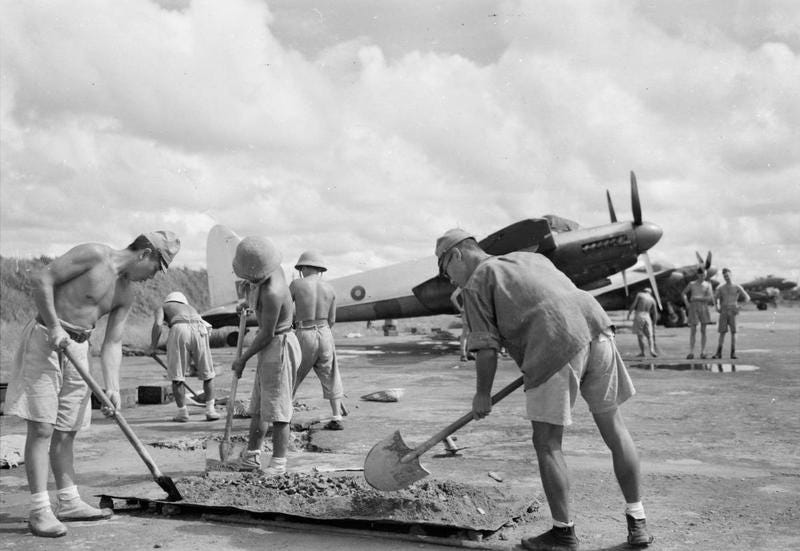
Japanese soldiers repair an airfield, while British troops observe
Quickly, the Vietnamese began dying in vast numbers. However, this bloodsoaked incursion initially went entirely unremarked upon in the British media, and parliament, for several months. As such, the public at home remained completely in the dark about their Army waging another grand foreign entanglement, let alone in tandem with its World War II enemies. This conspiracy of silence continued until December 1945, when a joint letter authored by British soldiers in Vietnam, sent to then-Foreign Secretary Ernest Bevin, was published by The Guardian:
“It appears that we are collaborating with Japanese and French forces against the nationalist forces of Viet Minh. For what purpose is this collaboration? Why are we not disarming the Japanese? We desire the definition of government policy regarding the presence of British troops in Indo-China.”
These bombshell disclosures attracted little interest, and were promptly forgotten. The signatories received a stern talking-to from a senior military official, and no further revelations about Britain’s covert war in Vietnam subsequently emerged. In the meantime, slaughter of innocent civilians continued apace. Much later, one of the signatories to the joint letter recalled of his time in the country:
“We saw homes being burned and hundreds of the local population being kept in compounds. We saw many ambulances, open at the back, carrying mainly – actually, totally – women and children, who were in bandages. I remember it very vividly. All the women and children who lived there would stand outside their homes, all dressed in black, and just grimly stare at us, really with… hatred.”
Come mid-January next year, the Viet Minh had learned lessons from launching large-scale attacks on British-led forces, which frequently ended with significant casualties due to their opponents’ superior firepower, and extensive use of machine guns. Hanoi’s freedom fighters thereafter adopted a raft of guerrilla tactics, including ambushes, assassinations, and hit-and-run raids on enemy patrols. It was the world’s first modern unconventional war. These strategies were devastatingly employed against French and US invaders over the next three decades.
Control of the mission was formally signed over by London to French generals at the end of March 1946, and most of her forces duly left Hanoi. France was emboldened by the perceived success of Britain’s intervention, believing Ho Chi Minh’s forces couldn’t withstand further onslaught from a “civilised”, professional army. This delusion led Paris to launch all-out war against Hanoi again in December that year. It ended in bitter defeat eight years later, and then the Americans stepped in.
For its part, in the post-World War II period, Britain waged a number of comparable, covert wars in every corner of the world, as its financial and military clout rapidly withered. In many cases, the US subsequently stepped in to fill London’s shoes, taking over management of far-flung crises and emergencies, and in the process Britain’s fallen empire. The past 80 years has been a neverending story of American struggle to master the dual legacies of colonialism and partition, bequeathed by its own former imperial overlord.
Featured Video
Macgregor: We Haven’t Seen the Worst of the Iran War Yet
or go to
Aletho News Archives – Video-Images
New Book
Breast Cancer: Before You Consent
A new Unbekoming paperback
Lies are Unbekoming | September 18, 2026
Peter Gøtzsche reviewed every randomised mammography screening trial ever conducted for the Cochrane Collaboration. Cochrane’s headline is that, assuming a 15% mortality reduction, one woman in 2000 avoids dying of breast cancer over ten years. Ten are overdiagnosed and treated. Two hundred experience false alarms.
But that headline assumes the reduction. When Gøtzsche looked only at the trials with adequate randomisation — the higher-quality ones — the reduction disappeared. No effect on breast cancer mortality. No effect on all-cause mortality.
This is the Cochrane finding, published in the establishment’s own database of systematic reviews.
No woman being asked to consent to a mammogram this week knows it.
That is why the new Unbekoming paperback exists. … continue
Blog Roll
 Aletho News
- US lawmaker blocks $2.8 billion weapons sale to Israel: Report
- Yemeni army claims responsibility for strikes on sensitive sites in Saudi capital, Aramco facilities in Yanbu
- Iran Judiciary issues indictments against 159 US, Israeli officials for assassination of Leader, commanders
- Turkiye revokes Iranian bank license under US sanctions campaign
- US-Denmark Agreement on Greenland Is ‘PR Stunt’ Ahead of Midterms
- Araghchi: Military intervention cannot create security; coercion cannot bring peace
- Fraud Squared
- Breast Cancer: Before You Consent
- Iran’s Plan to Shut Down AI in the Persian Gulf
- Israel seeks ‘compensation’ from Washington over Saudi F-35 sale
- If Americans Knew
- Inside Gaza’s death trap of collapsing, bombed-out buildings
- The everyday items Israel bans from Gaza every day
- Inside the siege, the ruined buildings of Gaza – Daily Update
- Debunking The Claim That Macklemore Has A “History Of Antisemitism”
- CPJ demands release of arrested Palestinian-US journalist near Bethlehem
- Robert Kraft: The Billionaire Friend of Netanyahu Pulling The Strings Behind the Macklemore/Ed Sheeran Blow Up
- Columbia Administered Fund Gives Big Money to Pro-Israel Groups
- Deportation Case of Palestinian Activist Salah Sarsour Tests First Amendment
- ‘We Will Not Forget’: Palestinians Mark 44 Years since Sabra and Shatila
- Why do we let Zionists decide what we can and can’t say?
- No Tricks Zone
- New Study: ‘Global Drought Shows No Detectable Recent Acceleration Under Climate Warming’
- Economic Masterminds: German Socialists Suggest Taxing Productivity Gains Stemming From Using AI
- The South China Sea Has Not Been Cooperating With The Climate Change Narrative
- Energy Crisis: Germany Enters Heating Season With Historically Low Gas Reserve Fill Levels
- New Study: The Antarctic Ice Sheet Gained Mass From 2020-2024 Due To Staggering Snow And Ice Accumulation
- Study: Ocean Heating Rates From Thousands Of Years Ago ‘Dwarf’ Modern Ocean Heating Rates
- Climate Extremists Target, Attack Large-Scale Power Grid Infrastructure In Germany!
- New Study: Antarctic Ice Melt Has Contributed Less Than 1 Centimeter To Sea Level Rise In The Last 30 Years
- Fear Of Debate: Alarmist German Climate Scientist Calls On Mainstream Media To Discredit Skeptic Voices
- End-Of-August Arctic Sea Ice Extent Hasn’t Fallen In 20 Years, Official Data Show!
 Aletho News