Tillerson’s Promise of More War in Syria Gets Warm Reception From Corporate Media

By Gregory Shupak | FAIR | January 29, 2018
In a speech at Stanford this month, US Secretary of State Rex Tillerson declared that America intends to keep military troops in Syria indefinitely, in pursuit of the US’s “key end states for Syria,” including “post-Assad leadership,” the marginalization of Iran and the elimination of “weapons of mass destruction” that the US claims Syria has.
Occupying a country without the permission of the host government, as America is doing in Syria, contravenes international law. Nor does the US have a legal right to pursue regime change in Syria. Yet multiple media outlets have praised Tillerson’s remarks.
Newsweek (1/19/18) ran an article from the Atlantic Council’s Frederic Hof that called Tillerson’s speech “a major improvement in the American approach to the crisis in Syria.” The piece concluded that “what Mr. Tillerson has articulated is more than good enough as a starting point for a policy reflecting American values and upholding American interests.”
The Washington Post editorial board (1/22/18) also endorsed American violation of international law, writing that
Tillerson bluntly recognized a truth that both President Trump and President Barack Obama attempted to dodge: that “it is crucial to our national defense to maintain a military and diplomatic presence in Syria, to help bring an end to that conflict, and assist the Syrian people . . . to achieve a new political future.”
The same paper’s Jennifer Rubin (1/23/18) wrote:
Belatedly, Tillerson has recognized (as critics of both Trump and President Barack Obama have long argued) that we do have a national interest in Syria, cannot tolerate the indefinite presence of Syrian President Bashar al-Assad and need to recognize that if we mean to check Iranian aggression, we will need to maintain a presence in Syria.
In Rubin’s conception, Iran’s presence in Syria—at the request of the recognized government—is “aggression,” whereas America’s is apparently legitimate.
The Atlantic (1/18/18) published a piece by Kori Schake, a self-identified supporter of “regime change [and] long-term military commitments.” Schake called Tillerson’s speech
both sensible and fanciful. It was sensible in that it gave a history of Syria’s grisly war, stated clearly America’s interest in continued involvement even as ISIS is defeated, and outlined policies consistent with those interests. It was fanciful in that the policies outlined would require a much greater measure of American involvement than has been in evidence by this administration—or were committed in yesterday’s speech—to succeed.
For Schake, the problem isn’t that the goal of America’s Syria policy is to illegally occupy a country and overthrow its government, while ratcheting up already dangerously high levels of hostility towards Iran and Russia. It’s that that the Trump administration isn’t doing enough to achieve this.
Meanwhile, accounts of Tillerson’s speech on CNN (1/18/18) and Buzzfeed (1/18/18) opt not to make any reference to the absence of a legal basis for what he describes. One of the few allusions of any kind to international law was a throwaway line in an AP report (1/24/18): “The Islamic State’s retreat also has forced the US to stretch thinner its legal rationale for operating in Syria.” What that rationale might consist of was not explained.
The Best Way to End War Is More War
Tillerson is proposing a prolongation and escalation of the war in Syria. The Syrian government will not passively allow itself to be removed by the US military, and neither will Syria’s allies from Russia, Iran and Hezbollah. So in practice, Tillerson’s policy means a wider, more dangerous conflict.
Yet the Newsweek piece (1/19/18) accepts that the plan is aimed at creating “conditions suitable for the return of refugees and internally displaced persons to their homes”—the opposite of what war produces.
Not only are media outlets failing to address the violence implicit in Tillerson’s policy, they are claiming the opposite and treating it as a plan for peace in Syria. These articles do not explain how a US-led regime change war will achieve that, instead of the years of war and slave markets such policies brought to Libya, or the half million to a million civilians killed in Iraq.
These publications take for granted that the US has a right to decide who governs Syria. For example, an Atlantic article by Paul McLeary (1/18/18) characterizes the US plan to maintain an occupying force in Syria and compel the ouster of its government as “nation-building,” though “nation-destroying” is probably more apt.
The Washington Post (1/22/18), similarly, echoes Tillerson’s claim that if the US were to “abandon” Syria, it would be “repeat[ing] the mistake the United States made in Iraq,” when “a premature departure . . . allowed Al Qaeda in Iraq to survive and eventually morph into ISIS.” The Post missed the possibility that the US’s “mistake” in Iraq was invading in the first place, one consequence of which was the birth of both Al Qaeda in Iraq and ISIS.
The paper also claims:
Critics predictably charge that Mr. Trump is launching another “endless war” in Syria. In fact, the administration has simply recognized reality: The United States cannot prevent a resurgence of Al Qaeda and the Islamic State, prevent Iran from building bases across Syria, or end a civil war that has sent millions of refugees toward Europe without maintaining control over forces and territory inside the country.
The editors go on to write that the Trump administration “has rightly absorbed the lesson that [America’s] way out [of Syria] starts with a serious and sustainable US commitment.”
In other words, the best way for the US to get out of Syria is to stay in Syria, and the best way to end the war in Syria is more war in Syria.
Robert Parry’s Legacy and the Future of Consortiumnews
By Nat Parry | Consortium News | January 28, 2018
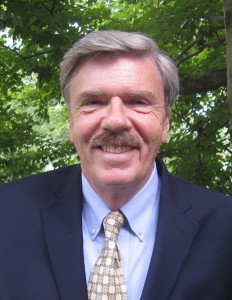
Robert Parry, 1949-2018
It is with a heavy heart that we inform Consortiumnews readers that Editor Robert Parry has passed away. As regular readers know, Robert (or Bob, as he was known to friends and family) suffered a stroke in December, which – despite his own speculation that it may have been brought on by the stress of covering Washington politics – was the result of undiagnosed pancreatic cancer that he had been unknowingly living with for the past 4-5 years.
He unfortunately suffered two more debilitating strokes in recent weeks and after the last one, was moved to hospice care on Tuesday. He passed away peacefully Saturday evening. He was 68.
Those of us close to him wish to sincerely thank readers for the kind comments and words of support posted on recent articles regarding Bob’s health issues. We read aloud many of these comments to him during his final days to let him know how much his work has meant to so many people and how much concern there was for his well-being.
I am sure that these kindnesses meant a lot to him. They also mean a lot to us as family members, as we all know how devoted he was to the mission of independent journalism and this website which has been publishing articles since the earliest days of the internet, launching all the way back in 1995.
With my dad, professional work has always been deeply personal, and his career as a journalist was thoroughly intertwined with his family life. I can recall kitchen table conversations in my early childhood that focused on the U.S.-backed wars in Central America and complaints about how his editors at The Associated Press were too timid to run articles of his that – no matter how well-documented – cast the Reagan administration in a bad light.
One of my earliest memories in fact was of my dad about to leave on assignment in the early 1980s to the war zones of El Salvador, Nicaragua and Guatemala, and the heartfelt good-bye that he wished to me and my siblings. He warned us that he was going to a very dangerous place and that there was a possibility that he might not come back.
I remember asking him why he had to go, why he couldn’t just stay at home with us. He replied that it was important to go to these places and tell the truth about what was happening there. He mentioned that children my age were being killed in these wars and that somebody had to tell their stories. I remember asking, “Kids like me?” He replied, “Yes, kids just like you.”
Bob was deeply impacted by the dirty wars of Central America in the 1980s and in many ways these conflicts – and the U.S. involvement in them – came to define the rest of his life and career. With grisly stories emerging from Nicaragua (thanks partly to journalists like him), Congress passed the Boland Amendments from 1982 to 1984, which placed limits on U.S. military assistance to the contras who were attempting to overthrow the Sandinista government through a variety of terrorist tactics.
The Reagan administration immediately began exploring ways to circumvent those legal restrictions, which led to a scheme to send secret arms shipments to the revolutionary and vehemently anti-American government of Iran and divert the profits to the contras. In 1985, Bob wrote the first stories describing this operation, which later became known as the Iran-Contra Affair.
Contra-Cocaine and October Surprise
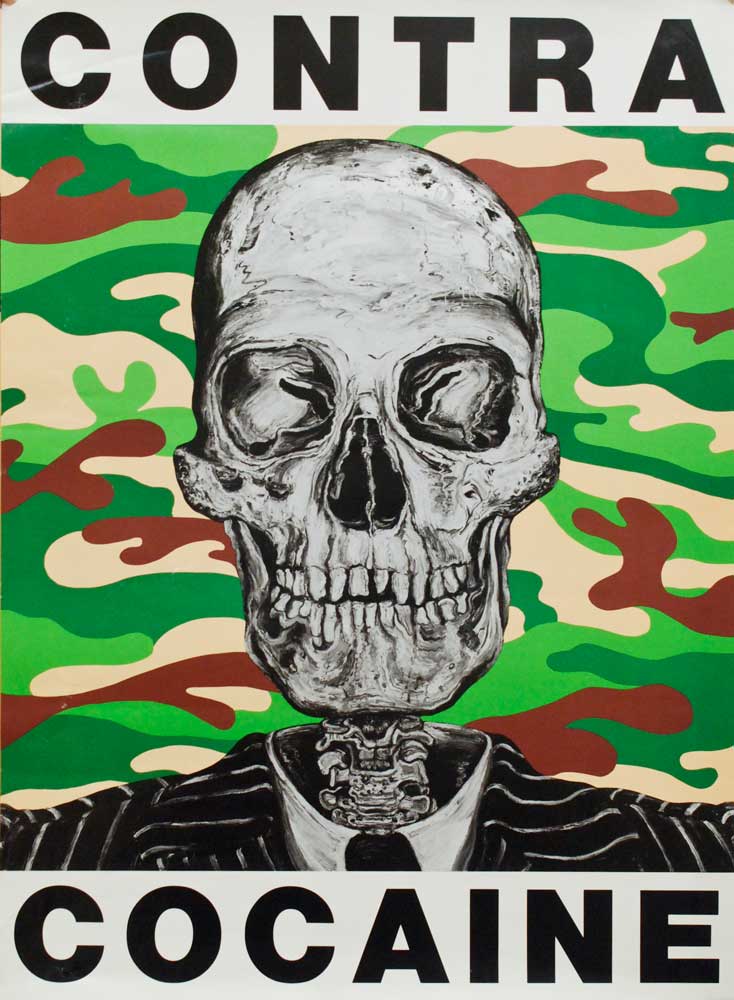
Poster by street artist and friend, Robbie Conal
Parallel to the illegal arms shipments to Iran during those days was a cocaine trafficking operation by the Nicaraguan contras and a willingness by the Reagan administration and the CIA to turn a blind eye to these activities. This, despite the fact that cocaine was flooding into the United States while Ronald Reagan was proclaiming a “war on drugs,” and a crack cocaine epidemic was devastating communities across the country.
Bob and his colleague Brian Barger were the first journalists to report on this story in late 1985, which became known as the contra-cocaine scandal and became the subject of a congressional investigation led by then-Senator John Kerry (D-Mass.) in 1986.
Continuing to pursue leads relating to Iran-Contra during a period in the late 80s when most of Washington was moving on from the scandal, Bob discovered that there was more to the story than commonly understood. He learned that the roots of the illegal arm shipments to Iran stretched back further than previously known – all the way back to the 1980 presidential campaign.
That electoral contest between incumbent Jimmy Carter and challenger Ronald Reagan had come to be largely dominated by the hostage crisis in Iran, with 52 Americans being held at the U.S. embassy in Tehran since the 1979 Iranian Revolution. The Iranian hostage crisis, along with the ailing economy, came to define a perception of an America in decline, with former Hollywood actor Ronald Reagan promising a new start for the country, a restoration of its status as a “shining city on a hill.”
The hostages were released in Tehran moments after Reagan was sworn in as president in Washington on January 20, 1981. Despite suspicions for years that there had been some sort of quid pro quo between the Reagan campaign and the Iranians, it wasn’t until Bob uncovered a trove of documents in a House office building basement in 1994 that the evidence became overwhelming that the Reagan campaign had interfered with the Carter administration’s efforts to free the hostages prior to the 1980 election. Their release sooner – what Carter hoped would be his “October Surprise” – could have given him the boost needed to win.
Examining these documents and being already well-versed on this story – having previously travelled three continents pursuing the investigation for a PBS Frontline documentary – Bob became increasingly convinced that the Reagan campaign had in fact sabotaged Carter’s hostage negotiations, possibly committing an act of treason in an effort to make sure that 52 American citizens continued to be held in a harrowing hostage situation until after Reagan secured the election.
Needless to say, this was an inconvenient story at a time – in the mid-1990s – when the national media had long since moved on from the Reagan scandals and were obsessing over new scandals, mostly related to President Bill Clinton’s sex life and failed real estate deals. Washington also wasn’t particularly interested in challenging the Reagan legacy, which at that time was beginning to solidify into a kind of mythology, with campaigns underway to name buildings and airports after the former president.
At times, Bob had doubts about his career decisions and the stories he was pursuing. As he wrote in Trick or Treason, a book outlining his investigation into the October Surprise Mystery, this search for historical truth can be painful and seemingly thankless.
“Many times,” he wrote, “I had regretted accepting Frontline’s assignment in 1990. I faulted myself for risking my future in mainstream journalism. After all, that is where the decent-paying jobs are. I had jeopardized my ability to support my four children out of an old-fashioned sense of duty, a regard for an unwritten code that expects reporters to take almost any assignment.”
Nevertheless, Bob continued his efforts to tell the full story behind both the Iran-Contra scandal and the origins of the Reagan-Bush era, ultimately leading to two things: him being pushed out of the mainstream media, and the launching of Consortiumnews.com.
I remember when he started the website, together with my older brother Sam, back in 1995. At the time, in spite of talk we were all hearing about something called “the information superhighway” and “electronic mail,” I had never visited a website and didn’t even know how to get “on line.” My dad called me in Richmond, where I was a sophomore at Virginia Commonwealth University, and told me I should check out this new “Internet site” he and Sam had just launched.
He explained over the phone how to open a browser and instructed me how to type in the URL, starting, he said, with “http,” then a colon and two forward slashes, then “www,” then “dot,” then this long address with one or two more forward slashes if I recall. (It wasn’t until years later that the website got its own domain and a simpler address.)
I went to the computer lab at the university and asked for some assistance on how to get online, dutifully typed in the URL, and opened this website – the first one I had ever visited. It was interesting, but a bit hard to read on the computer screen, so I printed out some articles to read back in my dorm room.
I quickly became a fan of “The Consortium,” as it was called back then, and continued reading articles on the October Surprise Mystery as Bob and Sam posted them on this new and exciting tool called “the Internet.” Sam had to learn HTML coding from scratch to launch this online news service, billed as “the Internet’s First Investigative ‘Zine.” For his efforts, Sam was honored with the Consortium for Independent Journalism’s first Gary Webb Freedom of the Press Award in 2015.
X-Files and Contra-Crack
At some point along the way, Bob decided that in addition to the website, where he was not only posting original articles but also providing the source documents that he had uncovered in the House office building basement, he would also take a stab at traditional publishing. He compiled the “October Surprise X-Files” into a booklet and self-published it in January 1996.
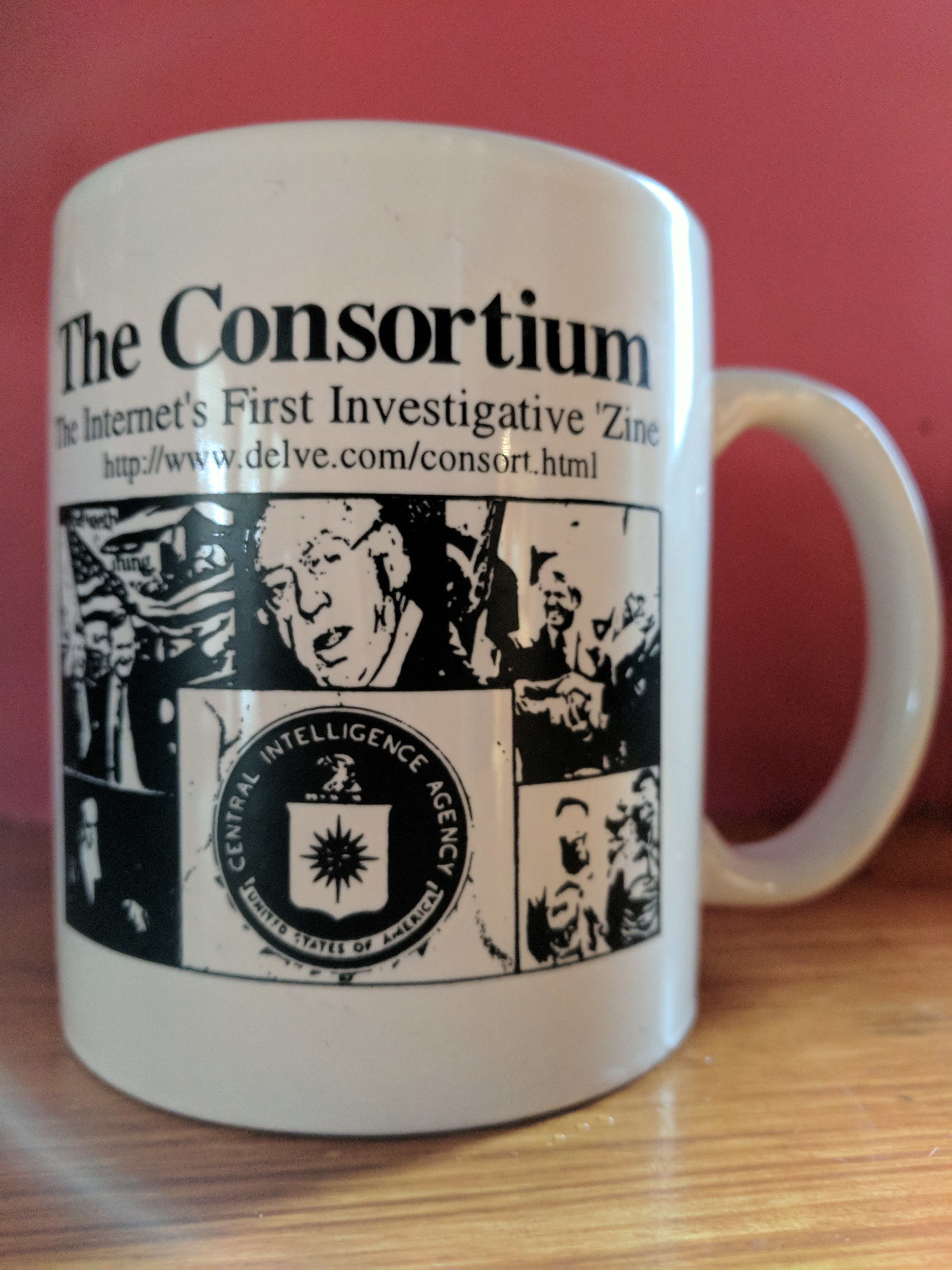
Original 1996 Consortium merchandise
He was also publishing a newsletter to complement the website, knowing that at that time, there were still plenty of people who didn’t know how to turn a computer on, much less navigate the World Wide Web. I transferred from Virginia Commonwealth University to George Mason University in the DC suburbs and started working part-time with my dad and Sam on the newsletter and website.
We worked together on the content, editing and laying it out with graphics often culled from books at our local library. We built a subscriber base through networking and purchasing mailing lists from progressive magazines. Every two weeks we would get a thousand copies printed from Sir Speedy and would spend Friday evening collating these newsletters and sending them out to our subscribers.
The launching of the website and newsletter, and later an even-more ambitious project called I.F. Magazine, happened to coincide with the publication in 1996 of Gary Webb’s “Dark Alliance” series at the San Jose Mercury-News. Webb’s series reopened the contra-cocaine controversy with a detailed examination of the drug trafficking networks in Nicaragua and Los Angeles that had helped to spread highly addictive crack cocaine across the United States.
The African-American community, in particular, was rightly outraged over this story, which offered confirmation of many long-standing suspicions that the government was complicit in the drug trade devastating their communities. African Americans had been deeply and disproportionately affected by the crack epidemic, both in terms of the direct impact of the drug and the draconian drug laws and mandatory minimum sentences that came to define the government’s approach to “the war on drugs.”
For a moment in the summer of 1996, it appeared that the renewed interest in the contra-cocaine story might offer an opportunity to revisit the crimes and misdeeds of the Reagan-Bush era, but those hopes were dashed when the “the Big Media” decided to double down on its earlier failures to cover this story properly.
Big Papers Pile On
The Los Angeles Times launched the attack on Gary Webb and his reporting at the San Jose Mercury-News, followed by equally dismissive stories at the Washington Post and New York Times. The piling on from these newspapers eventually led Mercury-News editor Jerry Ceppos to denounce Webb’s reporting and offer a mea culpa for publishing the articles.
The onslaught of hostile reporting from the big papers failed to address the basic premises of Webb’s series and did not debunk the underlying allegations of contra-cocaine smuggling or the fact that much of this cocaine ended up on American streets in the form of crack. Instead, it raised doubts by poking holes in certain details and casting the story as a “conspiracy theory.” Some of the reporting attempted to debunk claims that Webb never actually made – such as the idea that the contra-cocaine trafficking was part of a government plot to intentionally decimate the African-American community.
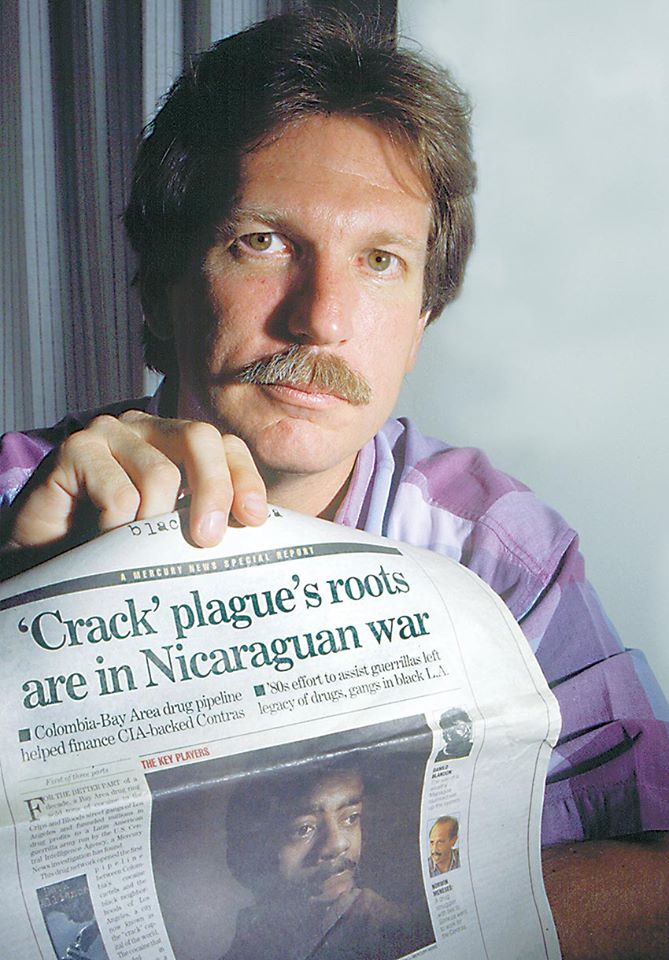
Gary Webb with his front-page Contra story
Gary Webb and Bob were in close contact during those days. Bob offered him professional and personal support, having spent his time also on the receiving end of attacks by journalistic colleagues and editors who rejected certain stories – no matter how factual – as fanciful conspiracy theories. Articles at The Consortium website and newsletter, as well as I.F. Magazine, offered details on the historical context for the “Dark Alliance” series and pushed back against the mainstream media’s onslaught of hostile and disingenuous reporting.
Bob also published the book Lost History which provided extensive details on the background for the “Dark Alliance” series, explaining that far from a baseless “conspiracy theory,” the facts and evidence strongly supported the conclusion that the Reagan-Bush administrations had colluded with drug traffickers to fund their illegal war against Nicaragua.
But sadly, the damage to Gary Webb was done. With his professional and personal life in tatters because of his courageous reporting on the contra-cocaine story, he committed suicide in 2004 at the age of 49. Speaking about this suicide later on Democracy Now, Bob noted how painful it is to be ridiculed and unfairly criticized by colleagues, as his friend had experienced.
“There’s a special pain when your colleagues in your profession turn on you, especially when you’ve done something that they should admire and should understand,” he said. “To do all that work and then have the New York Times and the Washington Post and the Los Angeles Times attack you and try to destroy your life, there’s a special pain in that.”
In consultation with his family, Bob and the Board of Directors for the Consortium for Independent Journalism launched the Gary Webb Freedom of the Press Award in 2015.
The Disastrous Presidency of George W. Bush
The presidency of George W. Bush was surreal for many of us, and no one more so than my dad.
In covering Washington politics for decades, Bob had traced many stories to “Dubya’s” father, George H.W. Bush, who had been implicated in a variety of questionable activities, including the October Surprise Mystery and Iran-Contra. He had also launched a war against Iraq in 1991 that seemed to be motivated, at least in part, to help kick “the Vietnam Syndrome,” i.e. the reluctance that the American people had felt since the Vietnam War to support military action abroad.
As Bob noted in his 1992 book Fooling America, after U.S. forces routed the Iraqi military in 1991, President Bush’s first public comment about the victory expressed his delight that it would finally put to rest the American reflex against committing troops to far-off conflicts. “By God, we’ve kicked the Vietnam Syndrome once and for all,” he exulted.
The fact that Bush-41’s son could run for president largely on name recognition confirmed to Bob the failure of the mainstream media to cover important stories properly and the need to continue building an independent media infrastructure. This conviction solidified through Campaign 2000 and the election’s ultimate outcome, when Bush assumed the White House as the first popular-vote loser in more than a century.
Despite the fact that the U.S. Supreme Court had halted the counting of votes in Florida, thus preventing an accurate determination of the rightful winner, most of the national media moved on from the story after Bush was sworn in on Jan. 20, 2001. Consortiumnews.com continued to examine the documentary record, however, and ultimately concluded that Al Gore would have been declared the winner of that election if all the legally cast ballots were counted.
At Consortiumnews, there was an unwritten editorial policy that the title “President” should never precede George W. Bush’s name, based on our view that he was not legitimately elected. But beyond those editorial decisions, we also understood the gravity of the fact that had Election 2000 been allowed to play out with all votes counted, many of the disasters of the Bush years – notably the 9/11 tragedy and the Iraq War, as well as decisions to withdraw from international agreements on arms control and climate change – might have been averted.
As all of us who lived through the post-9/11 era will recall, it was a challenging time all around, especially if you were someone critical of George W. Bush. The atmosphere in that period did not allow for much dissent. Those who stood up against the juggernaut for war – such as Phil Donahue at MSNBC, Chris Hedges at the New York Times, or even the Dixie Chicks – had their careers damaged and found themselves on the receiving end of death threats and hate mail.
While Bob’s magazine and newsletter projects had been discontinued, the website was still publishing articles, providing a home for dissenting voices that questioned the case for invading Iraq in late 2002 and early 2003. Around this time, former CIA analyst Ray McGovern and some of his colleagues founded Veteran Intelligence Professionals for Sanity and a long-running relationship with Consortiumnews was established. Several former intelligence veterans began contributing to the website, motivated by the same independent spirit of truth-telling that compelled Bob to invest so much in this project.
At a time when almost the entire mainstream media was going along with the Bush administration’s dubious case for war, this and a few other like-minded websites pushed back with well-researched articles calling into question the rationale. Although at times it might have felt as though we were just voices in the wilderness, a major groundswell of opposition to war emerged in the country, with historic marches of hundreds of thousands taking place to reject Bush’s push for war.
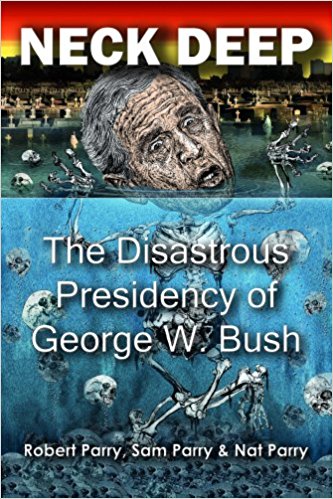
Neck Deep, published by Media Consortium in 2007
Of course, these antiwar voices were ultimately vindicated by the failure to find weapons of mass destruction in Iraq and the fact that the war and occupation proved to be a far costlier and deadlier enterprise than we had been told that it would be. Earlier assurances that it would be a “cakewalk” proved as false as the WMD claims, but as had been so often the case in Washington, there was little to no accountability from the mainstream media, the think tanks or government officials for being so spectacularly wrong.
In an effort to document the true history of that era, Bob, Sam and I co-wrote the book Neck Deep: The Disastrous Presidency of George W. Bush, which was published in late 2007. The book traced the work of Consortiumnews, juxtaposing it against the backdrop of mainstream media coverage during the Bush era, in an effort to not only correct the record, but also demonstrate that not all of us got things so wrong.
We felt it was important to remind readers – as well as future historians – that some of us knew and reported in real time the mistakes that were being made on everything from withdrawing from the Kyoto Protocol to invading Iraq to implementing a policy of torture to bungling the response to Hurricane Katrina.
Obama Era
By the time Barack Obama was elected the 44th president, Consortiumnews.com had become a home to a growing number of writers who brought new perspectives to the website’s content. While for years, the writing staff had been limited primarily to Bob, Sam and me, suddenly, Consortiumnews was receiving contributions from journalists, activists and former intelligence analysts who offered a wide range of expertise – on international law, economics, human rights, foreign policy, national security, and even religion and philosophy.
One recurring theme of articles at the website during the Obama era was the enduring effect of unchallenged narratives, how they shaped national politics and dictated government policy. Bob observed that even a supposedly left-of-center president like Obama seemed beholden to the false narratives and national mythologies dating back to the Reagan era. He pointed out that this could be at least partially attributed to the failure to establish a strong foundation for independent journalism.
In a 2010 piece called “Obama’s Fear of the Reagan Narrative,” Bob noted that Obama had defended his deal with Republicans on tax cuts for the rich because there was such a strong lingering effect of Reagan’s messaging from 30 years earlier. “He felt handcuffed by the Right’s ability to rally Americans on behalf of Reagan’s ‘government-is-the-problem’ message,” Bob wrote.
He traced Obama’s complaints about his powerlessness in the face of this dynamic to the reluctance of American progressives to invest sufficiently in media and think tanks, as conservatives had been doing for decades in waging their “the war of ideas.” As he had been arguing since the early 1990s, Robert insisted that the limits that had been placed on Obama – whether real or perceived – continued to demonstrate the power of propaganda and the need for greater investment in alternative media.
He also observed that much of the nuttiness surrounding the so-called Tea Party movement resulted from fundamental misunderstandings of American history and constitutional principles. “Democrats and progressives should be under no illusion about the new flood of know-nothingism that is about to inundate the United States in the guise of a return to ‘first principles’ and a deep respect for the U.S. Constitution,” Bob warned.
He pointed out that despite the Tea Partiers’ claimed reverence for the Constitution, they actually had very little understanding of the document, as revealed by their ahistorical claims that federal taxes are unconstitutional. In fact, as Bob observed, the Constitution represented “a major power grab by the federal government, when compared to the loosely drawn Articles of Confederation, which lacked federal taxing authority and other national powers.”
Motivated by a desire to correct falsified historical narratives spanning more than two centuries, Bob published his sixth and final book, America’s Stolen Narrative: From Washington and Madison to Nixon, Reagan and the Bushes to Obama, in 2012.
Along with revenues from book sales, growing donations from readers enabled Bob to not only pay writers but also to hire an assistant, Chelsea Gilmour, who began working for Consortiumnews in 2014. In addition to providing invaluable administrative support, Chelsea also performed duties including research, writing and fact-checking.
Political Realignment and the New McCarthyism
Although at the beginning of the Obama era – and indeed since the 1980s – the name Robert Parry had been closely associated with exposing wrongdoing by Republicans, and hence had a strong following among Democratic Party loyalists, by the end of Obama’s presidency there seemed to be a realignment taking place among some of Consortiumnews.com’s readership, which reflected more generally the shifting politics of the country.
In particular, the U.S. media’s approach to Russia and related issues, such as the violent ouster in 2014 of Ukrainian President Viktor Yanukovych, became “virtually 100 percent propaganda,” Bob said.
He noted that the full story was never told when it came to issues such as the Sergei Magnitsky case, which led to the first round of U.S. sanctions against Russia, nor the inconvenient facts related to the Euromaidan protests that led to Yanukovych’s ouster – including the reality of strong neo-Nazi influence in those protests – nor the subsequent conflict in the Donbass region of Ukraine.
Bob’s stories on Ukraine were widely cited and disseminated, and he became an important voice in presenting a fuller picture of the conflict than was possible by reading and watching only mainstream news outlets. Bob was featured prominently in Oliver Stone’s 2016 documentary “Ukraine on Fire,” where he explained how U.S.-funded political NGOs and media companies have worked with the CIA and foreign policy establishment since the 1980s to promote the U.S. geopolitical agenda.
Bob regretted that, increasingly, “the American people and the West in general are carefully shielded from hearing the ‘other side of the story.’” Indeed, he said that to even suggest that there might be another side to the story is enough to get someone branded as an apologist for Vladimir Putin or a “Kremlin stooge.”

The PropOrNot logo
This culminated in late 2016 in the blacklisting of Consortiumnews.com on a dubious website called “PropOrNot,” which was claiming to serve as a watchdog against undue “Russian influence” in the United States. The PropOrNot blacklist, including Consortiumnews and about 200 other websites deemed “Russian propaganda,” was elevated by the Washington Post as a credible source, despite the fact that the neo-McCarthyites who published the list hid behind a cloak of anonymity.
“The Post’s article by Craig Timberg,” Bob wrote on Nov. 27, 2016, “described PropOrNot simply as ‘a nonpartisan collection of researchers with foreign policy, military and technology backgrounds [who] planned to release its own findings Friday showing the startling reach and effectiveness of Russian propaganda campaigns.’”
As Bob explained in an article called “Washington Post’s Fake News Guilt,” the paper granted PropOrNot anonymity “to smear journalists who don’t march in lockstep with official pronouncements from the State Department or some other impeccable fount of never-to-be-questioned truth.”
The Post even provided an unattributed quote from the head of the shadowy website. “The way that this propaganda apparatus supported [Donald] Trump was equivalent to some massive amount of a media buy,” the anonymous smear merchant said. The Post claimed that the PropOrNot “executive director” had spoken on the condition of anonymity “to avoid being targeted by Russia’s legions of skilled hackers.”
To be clear, neither Consortiumnews nor Robert Parry ever “supported Trump,” as the above anonymous quote claims. Something interesting, however, did seem to be happening in terms of Consortiumnews’ readership in the early days of the Trump presidency, as could be gleaned from some of the comments left on articles and social media activity.
It did appear for some time at least that a good number of Trump supporters were reading Consortiumnews, which could probably be attributed to the fact that the website was one of the few outlets pushing back against both the “New Cold War” with Russia and the related story of “Russiagate,” which Bob didn’t even like referring to as a “scandal.” (As an editor, he preferred to use the word “controversy” on the website, because as far as he was concerned, the allegations against Trump and his supposed “collusion” with Russia did not rise to the level of actual scandals such as Watergate or Iran-Contra.)
In his view, the perhaps understandable hatred of Trump felt by many Americans – both inside and outside the Beltway – had led to an abandonment of old-fashioned rules of journalism and standards of fairness, which should be applied even to someone like Donald Trump.
“On a personal note, I faced harsh criticism even from friends of many years for refusing to enlist in the anti-Trump ‘Resistance,’” Bob wrote in his final article for Consortiumnews.
“The argument was that Trump was such a unique threat to America and the world that I should join in finding any justification for his ouster,” he said. “Some people saw my insistence on the same journalistic standards that I had always employed somehow a betrayal.”
He marveled that even senior editors in the mainstream media treated the unproven Russiagate allegations as flat fact.
“No skepticism was tolerated and mentioning the obvious bias among the never-Trumpers inside the FBI, Justice Department and intelligence community was decried as an attack on the integrity of the U.S. government’s institutions,” Bob wrote. “Anti-Trump ‘progressives’ were posturing as the true patriots because of their now unquestioning acceptance of the evidence-free proclamations of the U.S. intelligence and law enforcement agencies.”
An Untimely End and the Future of Consortiumnews
My dad’s untimely passing has come as a shock to us all, especially since up until a month ago, there was no indication whatsoever that he was sick in any way. He took good care of himself, never smoked, got regular check-ups, exercised, and ate well. The unexpected health issues starting with a mild stroke Christmas Eve and culminating with his admission into hospice care several days ago offer a stark reminder that nothing should be taken for granted.
And as many Consortiumnews readers have eloquently pointed out in comments left on recent articles regarding Bob’s health, it also reminds us that his brand of journalism is needed today more than ever.
“We need free will thinkers like you who value the truth based on the evidence and look past the group think in Washington to report on the real reasons for our government’s and our media’s actions which attempt to deceive us all,” wrote, for example, “FreeThinker.”
“Common sense and integrity are the hallmarks of Robert Parry’s journalism. May you get better soon for you are needed more now then ever before,” wrote “T.J.”
“We need a new generation of reporters, journalists, writers, and someone always being tenacious to follow up on the story,” added “Tina.”
As someone who has been involved with this website since its inception – as a writer, an editor and a reader – I concur with these sentiments. Readers should rest assured that despite my dad’s death, every effort will be made to ensure that the website will continue going strong.
Indeed, I think that everyone involved with this project wants to uphold the same commitment to truth telling without fear or favor that inspired Bob and his heroes like George Seldes, I.F. Stone, and Thomas Paine.
That commitment can be seen in my dad’s pursuit of stories such as those mentioned above, but also so many others – including his investigations into the financial relationship of the influential Washington Times with the Unification Church cult of Rev. Sun Myung Moon, the truth behind the Nixon campaign’s alleged efforts to sabotage President Lyndon Johnson’s Paris peace talks with Vietnamese leaders in 1968, the reality of the chemical attack in Syria in 2013, and even detailed examinations of the evidence behind the so-called “Deflategate” controversy that he felt unfairly branded his favorite football team, the New England Patriots, as cheaters.
Reviewing these journalistic achievements, it becomes clear that there are few stories that have slipped under Consortiumnews.com’s radar, and that the historical record is far more complete thanks to this website and Bob’s old-fashioned approach to journalism.
Nuclear weapons
But besides this deeply held commitment to independent journalism, it should also be recalled that, ultimately, Bob was motivated by a concern over the future of life on Earth. As someone who grew up at the height of the Cold War, he understood the dangers of allowing tensions and hysteria to spiral out of control, especially in a world such as ours with enough nuclear weapons to wipe out all life on the planet many times over.
As the United States continues down the path of a New Cold War, my dad would be pleased to know that he has such committed contributors who will enable the site to remain the indispensable home for independent journalism that it has become, and continue to push back on false narratives that threaten our very survival.
Thank you all for your support.
In lieu of flowers, Bob’s family asks you to please consider making a tax-deductible donation to the Consortium for Independent Journalism.
Tech giants struggle to find ‘Russian meddling’ in written answers to US Senate
RT | January 28, 2018
Twitter, Facebook and Google had a hard time providing evidence of “Russian meddling” on social media, transcripts from the US Senate show. However, they did shockingly reveal that RT America had purchased ads aimed at Americans.
On Friday, the US Senate Intelligence Committee released answers provided by Twitter, Facebook and Google in response to questions concerning Russia’s alleged meddlesome use of social media in the devious pursuit of uprooting American democracy.
The Senate’s questions included breathless demands that the tech giants explain why Edward Snowden and Julian Assange are “allowed” to use their services, as well as more mundane requests, such as asking Google if it can confirm crackpot rumors spread by Ukrainian President Petro Poroshenko. However, it turns out the questions were considerably more sensational and accusatory than the tech giants’ responses, which in some cases even raised doubts about the narratives being promoted by the US government and media outlets.
Why does Twitter allow users to expose US crimes? – curious senator
 Tom Cotton, the Republican senator from Arkansas, had by far the most colorful questions for the three tech giants. During his thorough interrogation of Twitter, he asked whether company’s terms of service prohibit “collaboration with Russian intelligence services to influence an election.” (Twitter reassured the good senator that exerting “artificial influence on an election [is] likely to violate any number of Twitter’s rules and policies.”)
But Cotton’s best moment came when he demanded “justification for allowing entities and individuals such as WikiLeaks, Julian Assange, and Edward Snowden to maintain Twitter accounts.”
Twitter very delicately informed Cotton that “we do not bar controversial figures from our platform or prohibit accounts from posting controversial content … So long as those accounts remain in compliance with our policies, we do not take action against their Tweets or suspend them from the platform.” Undeterred, Cotton asked these same questions to Facebook – and received very similar answers.
RT America bought ads that… ‘focused on’ Americans
In one of the more underwhelming revelations disclosed by the tech giants in the newly-released documents, Twitter reported that “of all of RT’s ad campaigns, 11 were targeted exclusively at English-language speakers, and several others—including all of @RT_America’s seven campaigns—used geographic targeting to focus on US users.”
Twitter also revealed that it had identified nine accounts as being “potentially linked to Russia that promoted election-related, English-language content.” Of these nine nefarious accounts “potentially linked” to Russia, “the most significant use of advertising was by @RT_com and @RT_America. Those two accounts collectively ran 44 different ad campaigns, accounting for nearly all of the relevant advertising we reviewed,” according to Twitter. Once again, Twitter forgot to mention that it pitched a proposal for RT to spend huge sums on advertising for the US presidential election – an offer which RT declined.
However, there is little doubt that before RT was banned from buying Twitter ads, RT America “targeted” Americans.
Facebook can’t trace ‘Russian disinformation campaign’
Senator Mark Warner of Virginia asked Facebook if it could confirm that it was “alerted” by Ukrainian activists and politicians about Russian trolls peddling disinformation on its platform. Unfortunately, Facebook’s response rained on Warner’s anti-Russia parade.
The social media giant explained that most of the “disinformation” reported by Ukrainians was nothing more than Russians calling Ukrainians “khokhol” (a common derogatory term). Facebook also said it received reports of Ukrainians calling Russians “moskal” (another mundane ethnic slur). In some cases, the slurs were deemed hate speech and removed, in accordance with the site’s Community Standards. Facebook was apparently unable to recall any other “Russian misinformation” reported by Ukrainian authorities.
Google questions ‘Ukrainian artillery hack’
In one of many Russia-gate Hail Marys lobbed by Tom Cotton, the Intelligence Committee pressed Google to comment on reports that Russia used malware implanted on Android devices to track Ukrainian artillery units, suggesting that “Russia is not only using your platforms to influence elections, but to gain an advantage on the front lines of a battlefield.”
The question backfired spectacularly, with Google responding: “We are aware of this report and we, although [sic] with others in the industry, have questioned its accuracy.”
The company cited, as one example, that the alleged malware at issue was never distributed through Google’s Play Store.
Scroll on, Russia’s not targeting your FB
Senator Kamala Harris was interested to learn about the types of targeting criteria – “such as demographic, behavioral, lookalike, or email matching” – allegedly used by Russia for its “information operations.” Again, Google’s response did not exactly launch a thousand ships.
“$4,700 of ads attributable to suspected state-sponsored Russian actors were not narrowly targeted to specific groups of users: for example, we found no evidence of targeting by geography (e.g. certain states) or by users’ inferred political preferences (e.g. right or left-leaning),” Google responded. The company added that it was “unaware of any inauthentic accounts linked to Russian information operations flagged by our users.”
Read more:
Is Putin profoundly corrupt or “incorruptible?”
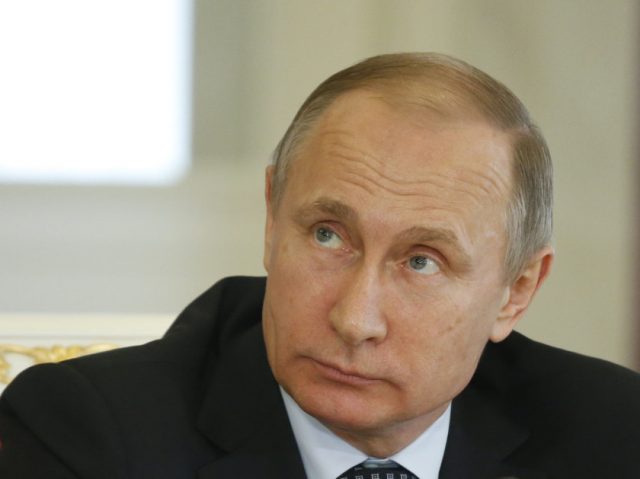
By Sharon Tennison | CCI | April 2017
As the Ukraine situation has worsened, unconscionable misinformation and hype is being poured on Russia and Vladimir Putin. Journalists and pundits must scour the Internet and thesauruses to come up with fiendish new epithets to describe both. Wherever I make presentations across America, the first question ominously asked during Q&A is always, “What about Putin?” It’s time to share my thoughts which follow:
Putin obviously has his faults and makes mistakes. Based on my earlier experience with him, and the experiences of trusted people, including U.S. officials who have worked closely with him over a period of years, Putin most likely is a straight, reliable and exceptionally inventive man.
He is obviously a long-term thinker and planner and has proven to be an excellent analyst and strategist. He is a leader who can quietly work toward his goals under mounds of accusations and myths that have been steadily leveled at him since he became Russia’s second president.
I’ve stood by silently watching the demonization of Putin grow since it began in the early 2000s –– I pondered on computer my thoughts and concerns, hoping eventually to include them in a book (which was published in 2011). The book explains my observations more thoroughly than this article.
Like others who have had direct experience with this little known man, I’ve tried to no avail to avoid being labeled a “Putin apologist”. If one is even neutral about him, they are considered “soft on Putin” by pundits, news hounds and average citizens who get their news from CNN, Fox and MSNBC.
I don’t pretend to be an expert, just a program developer in the USSR and Russia for the past 30 years. But during this time, I’ve have had far more direct, on-ground contact with Russians of all stripes across 11 time zones than any of the Western reporters or for that matter any of Washington’s officials.
I’ve been in country long enough to ponder on Russian history and culture deeply, to study their psychology and conditioning, and to understand the marked differences between American and Russian mentalities which so complicate our political relations with their leaders.
As with personalities in a family or a civic club or in a city hall, it takes understanding and compromise to be able to create workable relationships when basic conditionings are different. Washington has been notoriously disinterested in understanding these differences and attempting to meet Russia halfway.
In addition to my personal experience with Putin, I’ve had discussions with numerous American officials and U.S. businessmen who have had years of experience working with him––I believe it is safe to say that none would describe him as “brutal” or “thuggish”, or the other slanderous adjectives and nouns that are repeatedly used in western media.
I met Putin years before he ever dreamed of being president of Russia, as did many of us working in St.Petersburg during the 1990s. Since all of the slander started, I’ve become nearly obsessed with understanding his character. I think I’ve read every major speech he has given (including the full texts of his annual hours-long telephone “talk-ins” with Russian citizens).
I’ve been trying to ascertain whether he has changed for the worse since being elevated to the presidency, or whether he is a straight character cast into a role he never anticipated––and is using sheer wits to try to do the best he can to deal with Washington under extremely difficult circumstances.
If the latter is the case, and I think it is, he should get high marks for his performance over the past 14 years. It’s not by accident that Forbes declared him the most Powerful Leader of 2013, replacing Obama who was given the title for 2012. The following is my one personal experience with Putin.
The year was 1992

Putin with Anatoly Sobchak, Mayor of St. Petersburg, early 1990s. Putin was one of Sobchak’s deputies from 1992-96
It was two years after the implosion of communism; the place was St.Petersburg.
For years I had been creating programs to open up relations between the two countries and hopefully to help Soviet people to get beyond their entrenched top-down mentalities. A new program possibility emerged in my head. Since I expected it might require a signature from the Marienskii City Hall, an appointment was made.
My friend Volodya Shestakov and I showed up at a side door entrance to the Marienskii building. We found ourselves in a small, dull brown office, facing a rather trim nondescript man in a brown suit.
He inquired about my reason for coming in. After scanning the proposal I provided he began asking intelligent questions. After each of my answers, he asked the next relevant question.
I became aware that this interviewer was different from other Soviet bureaucrats who always seemed to fall into chummy conversations with foreigners with hopes of obtaining bribes in exchange for the Americans’ requests. CCI stood on the principle that we would never, never give bribes.
This bureaucrat was open, inquiring, and impersonal in demeanor. After more than an hour of careful questions and answers, he quietly explained that he had tried hard to determine if the proposal was legal, then said that unfortunately at the time it was not. A few good words about the proposal were uttered. That was all. He simply and kindly showed us to the door.
Out on the sidewalk, I said to my colleague, “Volodya, this is the first time we have ever dealt with a Soviet bureaucrat who didn’t ask us for a trip to the US or something valuable!”
I remember looking at his business card in the sunlight––it read Vladimir Vladimirovich Putin.
1994
U.S. Consul General Jack Gosnell put in an SOS call to me in St.Petersburg. He had 14 Congress members and the new American Ambassador to Russia, Thomas Pickering, coming to St.Petersburg in the next three days. He needed immediate help.
I scurried over to the Consulate and learned that Jack intended me to brief this auspicious delegation and the incoming ambassador.
I was stunned but he insisted. They were coming from Moscow and were furious about how U.S. funding was being wasted there. Jack wanted them to hear the”good news” about CCI’s programs that were showing fine results. In the next 24 hours Jack and I also set up “home” meetings in a dozen Russian entrepreneurs’ small apartments for the arriving dignitaries (St.Petersburg State Department people were aghast, since it had never been done before––but Jack overruled).
Only later in 2000, did I learn of Jack’s former three-year experience with Vladimir Putin in the 1990s while the latter was running the city for Mayor Sobchak. More on this further down.
December 31, 1999

Boris Nikolayevich Yeltsin leaves the Kremlin on the day of his resignation, December 31 1999. Prime Minister Putin (second left) became acting president.
With no warning, at the turn of the year, President Boris Yeltsin made the announcement to the world that from the next day forward he was vacating his office and leaving Russia in the hands of an unknown Vladimir Putin.
On hearing the news, I thought surely not the Putin I remembered––he could never lead Russia. The next day a NYT article included a photo.
Yes, it was the same Putin I’d met years ago! I was shocked and dismayed, telling friends, “This is a disaster for Russia, I’ve spent time with this guy, he is too introverted and too intelligent––he will never be able to relate to Russia’s masses.”
Further, I lamented: “For Russia to get up off of its knees, two things must happen: 1) The arrogant young oligarchs have to be removed by force from the Kremlin, and 2) A way must be found to remove the regional bosses (governors) from their fiefdoms across Russia’s 89 regions”.
It was clear to me that the man in the brown suit would never have the instincts or guts to tackle Russia’s overriding twin challenges.
February 2000
Almost immediately Putin began putting Russia’s oligarchs on edge. In February a question about the oligarchs came up; he clarified with a question and his answer:
What should be the relationship with the so-called oligarchs? The same as anyone else. The same as the owner of a small bakery or a shoe repair shop.
This was the first signal that the tycoons would no longer be able to flaunt government regulations or count on special access in the Kremlin. It also made the West’s capitalists nervous.
After all, these oligarchs were wealthy untouchable businessmen––good capitalists, never mind that they got their enterprises illegally and were putting their profits in offshore banks.
Four months later Putin called a meeting with the oligarchs and gave them his deal:
They could keep their illegally-gained wealth-producing Soviet enterprises and they would not be nationalized …. IF taxes were paid on their revenues and if they personally stayed out of politics.
This was the first of Putin’s “elegant solutions” to the near impossible challenges facing the new Russia. But the deal also put Putin in crosshairs with US media and officials who then began to champion the oligarchs, particularly Mikhail Khodorkovsky.
The latter became highly political, didn’t pay taxes, and prior to being apprehended and jailed was in the process of selling a major portion of Russia’s largest private oil company, Yukos Oil, to Exxon Mobil. Unfortunately, to U.S. media and governing structures, Khodorkovsky became a martyr (and remains so up to today).
March 2000
I arrived in St.Petersburg. A Russian friend (a psychologist) since 1983 came for our usual visit. My first question was, “Lena what do you think about your new president?” She laughed and retorted, “Volodya! I went to school with him!”
She began to describe Putin as a quiet youngster, poor, fond of martial arts, who stood up for kids being bullied on the playgrounds. She remembered him as a patriotic youth who applied for the KGB prematurely after graduating secondary school (they sent him away and told him to get an education).
He went to law school, later reapplied and was accepted. I must have grimaced at this, because Lena said:
Sharon in those days we all admired the KGB and believed that those who worked there were patriots and were keeping the country safe. We thought it was natural for Volodya to choose this career.
My next question was:
What do you think he will do with Yeltsin’s criminals in the Kremlin?
Putting on her psychologist hat, she pondered and replied:
If left to his normal behaviors, he will watch them for a while to be sure what is going on, then he will throw up some flares to let them know that he is watching. If they don’t respond, he will address them personally, then if the behaviors don’t change–– some will be in prison in a couple of years.
I congratulated her via email when her predictions began to show up in real time.
Throughout the 2000s
St.Petersburg’s many CCI alumni were being interviewed to determine how the PEP business training program was working and how we could make the U.S. experience more valuable for their new small businesses. Most believed that the program had been enormously important, even life changing. Last, each was asked:
So what do you think of your new president?
None responded negatively, even though at that time entrepreneurs hated Russia’s bureaucrats. Most answered similarly, “Putin registered my business a few years ago”.
Next question:
So, how much did it cost you?
To a person they replied, “Putin didn’t charge anything”. One said:
We went to Putin’s desk because the others providing registrations at the Marienskii were getting ‘rich on their seats.’
Late 2000
Into Putin’s first year as Russia’s president, US officials seemed to me to be suspect that he would be antithetical to America’s interests––his every move was called into question in American media. I couldn’t understand why and was chronicling these happenings in my computer and newsletters.
Year 2001
Jack Gosnell (former USCG mentioned earlier) explained his relationship with Putin when the latter was deputy mayor of St.Petersburg. The two of them worked closely to create joint ventures and other ways to promote relations between the two countries. Jack related that Putin was always straight up, courteous and helpful.
When Putin’s wife, Ludmila, was in a severe auto accident, Jack took the liberty (before informing Putin) to arrange hospitalization and airline travel for her to get medical care in Finland. When Jack told Putin, he reported that the latter was overcome by the generous offer, but ended saying that he couldn’t accept this favor, that Ludmila would have to recover in a Russian hospital.
She did––although medical care in Russia was abominably bad in the 1990s.
A senior CSIS officer I was friends with in the 2000s worked closely with Putin on a number of joint ventures during the 1990s. He reported that he had no dealings with Putin that were questionable, that he respected him and believed he was getting an undeserved dour reputation from U.S. media.
Matter of fact, he closed the door at CSIS when we started talking about Putin. I guessed his comments wouldn’t be acceptable if others were listening.
Another former U.S. official who will go unidentified, also reported working closely with Putin, saying there was never any hint of bribery, pressuring, nothing but respectable behaviors and helpfulness.
I had two encounters in 2013 with State Department officials regarding Putin:
At the first one, I felt free to ask the question I had previously yearned to get answered:
When did Putin become unacceptable to Washington officials and why??
Without hesitating the answer came back:
The knives were drawn’ when it was announced that Putin would be the next president.”
I questioned WHY? The answer:
I could never find out why––maybe because he was KGB.”
I offered that Bush #I, was head of the CIA. The reply was
That would have made no difference, he was our guy.
The second was a former State Department official with whom I recently shared a radio interview on Russia. Afterward when we were chatting, I remarked, “You might be interested to know that I’ve collected experiences of Putin from numerous people, some over a period of years, and they all say they had no negative experiences with Putin and there was no evidence of taking bribes”. He firmly replied:
No one has ever been able to come up with a bribery charge against Putin.”
From 2001 up to today, I’ve watched the negative U.S. media mounting against Putin …. even accusations of assassinations, poisonings, and comparing him to Hitler.
No one yet has come up with any concrete evidence for these allegations. During this time, I’ve traveled throughout Russia several times every year, and have watched the country slowly change under Putin’s watch. Taxes were lowered, inflation lessened, and laws slowly put in place. Schools and hospitals began improving. Small businesses were growing, agriculture was showing improvement, and stores were becoming stocked with food.
Alcohol challenges were less obvious, smoking was banned from buildings, and life expectancy began increasing. Highways were being laid across the country, new rails and modern trains appeared even in far out places, and the banking industry was becoming dependable. Russia was beginning to look like a decent country –– certainly not where Russians hoped it to be long term, but improving incrementally for the first time in their memories.
My 2013/14 Trips to Russia:
In addition to St.Petersburg and Moscow, in September I traveled out to the Ural Mountains, spent time in Ekaterinburg, Chelyabinsk and Perm. We traveled between cities via autos and rail––the fields and forests look healthy, small towns sport new paint and construction. Today’s Russians look like Americans (we get the same clothing from China).
Old concrete Khrushchev block houses are giving way to new multi-story private residential complexes which are lovely. High-rise business centers, fine hotels and great restaurants are now common place––and ordinary Russians frequent these places. Two and three story private homes rim these Russian cities far from Moscow.
We visited new museums, municipal buildings and huge super markets. Streets are in good repair, highways are new and well marked now, service stations look like those dotting American highways. In January I went to Novosibirsk out in Siberia where similar new architecture was noted. Streets were kept navigable with constant snowplowing, modern lighting kept the city bright all night, lots of new traffic lights (with seconds counting down to light change) have appeared.
It is astounding to me how much progress Russia has made in the past 14 years since an unknown man with no experience walked into Russia’s presidency and took over a country that was flat on its belly.
So why do our leaders and media demean and demonize Putin and Russia???
Like Lady MacBeth, do they protest too much?
Psychologists tell us that people (and countries?) project off on others what they don’t want to face in themselves. Others carry our “shadow” when we refuse to own it. We confer on others the very traits that we are horrified to acknowledge in ourselves.
Could this be why we constantly find fault with Putin and Russia?
Could it be that we project on to Putin the sins of ourselves and our leaders?
Could it be that we condemn Russia’s corruption, acting like the corruption within our corporate world doesn’t exist?
Could it be that we condemn their human rights and LGBT issues, not facing the fact that we haven’t solved our own?
Could it be that we accuse Russia of “reconstituting the USSR”––because of what we do to remain the world’s “hegemon”?
Could it be that we project nationalist behaviors on Russia, because that is what we have become and we don’t want to face it?
Could it be that we project warmongering off on Russia, because of what we have done over the past several administrations?
Some of you were around Putin in the earlier years. Please share your opinions, pro and con …. confidentiality will be assured. It’s important to develop a composite picture of this demonized leader and get the record straight. I’m quite sure that 99% of those who excoriate him in mainstream media have had no personal contact with him at all. They write articles on hearsay, rumors and fabrication, or they read scripts others have written on their tele-prompters. This is how our nation gets its “news”, such as it is.
There is a well known code of ethics among us: Is it the Truth, Is it Fair, Does it build Friendship and Goodwill, and Will it be Beneficial for All Concerned?
It seems to me that if our nation’s leaders would commit to using these four principles in international relations, the world would operate in a completely different manner, and human beings across this planet would live in better conditions than they do today.
As always your comments will be appreciated. Please resend this report to as many friends and colleagues as possible.
Sharon Tennison ran a successful NGO funded by philanthropists, American foundations, USAID and Department of State, designing new programs and refining old ones, and evaluating Russian delegates’ U.S. experiences for over 20 years. Tennison adapted the Marshall Plan Tours from the 40s/50s, and created the Production Enhancement Program (PEP) for Russian entrepreneurs, the largest ever business training program between the U.S. and Russia. Running several large programs concurrently during the 90s and 2000s, funding disappeared shortly after the 2008 financial crisis set in. Tennison still runs an orphanage program in Russia, is President and Founder, Center for Citizen Initiatives, a member of Rotary Club of Palo Alto, California, and author of The Power of Impossible Ideas: Ordinary Citizens’ Extraordinary Efforts to Avert International Crises. The author can be contacted at sharon@ccisf.org
Reflections on the Chabloz Case
I’ll sing my way to court in high heels and a frock
Give the press a winning smile from inside the dock…
Alison Chabloz song, Find me guiltyBy Nick Kollerstrom PhD | Occidental Review | January 26, 2018
Mr Gideon Falter, 34, who runs the Campaign Against Antisemitism (CAAS) was the chief witness for the Crown Prosecution service’s (CPS) against the British minstrel Alison Chabloz. On January 10th at Marylebone Magistrate’s Court we heard him swear the oath, to tell the truth, the whole truth and nothing but the truth. He then proceeded to give the court various hearsay conjectures, about what effect Ms Chabloz’ songs might be exerting, upon unspecified persons.
He averred for example that they were ‘spreading anti-semitic hatred’ and were ‘inciting to racial hatred.’ The Court was not given evidence for this,[1] nor advised where or in whom these emotions were being generated. Should he not have called witnesses to testify in support of these conjectures, or better still a psychologist to affirm that they were or had been generated?
The Court was advised of one offensive performance by Ms Chabloz, where she sang her songs ‘(((Survivors))) and ‘Nemo’s anti-Semitic Universe’ namely the London Forum in 2016 (September 24th). A problem here could be the signs of mirth and riotous applause in response to the songs: did this really show what Mr Falter had been alleging, or if not, what did?
She was recently introduced as ‘The brilliant comedienne and singer/songwriter Alison Chabloz,’ by Richie Allen, on his popular radio show (18 January).
The point of satire, is that it makes people laugh. Britain has a long tradition of satire from William Hogarth in the 18th century to Private Eye in the present time. Its future is surely at stake in this trial.
In October of 2017 she was arrested and jailed (or, ‘held in custody’) for 48 hours, for posting a video of herself singing a song. This had allegedly broken her ‘bail conditions’. As Ms Chabloz observed, “As far as I am aware, I am the only artist in modern British history to have been jailed for the heinous crime of composing and singing satirical songs which I uploaded to the Internet.”
We live in a society where just about any sacred belief is liable to be satirised for entertainment value, and those being satirised have not generally sought recourse to legal action. When punk-rock bands savagely mocked the Royal family for example, no-one prosecuted them.

Alison Chabloz
The present case was being brought under the Communications Act of 2003. A degree of public support is said to exist for its controversial section 127,[2] by people fed up with online bullying. For example, a racially motivated tweet relating to a footballer was prosecuted under it. But many have objected to its catch-all character,[3] and the DPP has stated in 2102, that its section 127 ‘should not be seen as a carte blanche for prosecuting content which, however upsetting to some, would normally fall within guarantees of freedom of expression in a democratic society,’ and that freedom of expression should include the right to say things that ‘offend, shock or disturb the state or any sector of the population.’
Last year, at least nine people a day were being arrested in the UK on such dubious grounds. Annoying someone or causing distress has never been viewed as a crime — until now. The Communications Act was basically designed for the media.[4] In contrast, songs posted up on the Web are only heard by persons who choose to listen. One exercises that choice by clicking the ‘play’ button. Ms Chabloz has not ‘communicated’ anything in the sense defined by that Act.
Normally, if a Youtube video is found to be disturbing, a complaint is put through to Youtube, rather than the person who has uploaded it. Now Ms Chabloz’ songs have either been deleted or given protective warnings by Youtube, which further complicates the question, of how and to whom she is supposed to be causing offence.
The Defence lawyer Adrian Davies had suggested at an earlier hearing that his client’s songs might be ‘offensive’ but not ‘grossly offensive,’ and that remark was reiterated by the judge in the present hearing. That is surely so: it’s not as if they were snuff movies, or featured depraved or perverted acts, or personally defamed anyone living — except for one person, Irene Zisblatt who claims that she swallowed diamonds while she was at Auschwitz. The court discussed her case, with Mr Davies pointing out that the official Yad Vashem Holocaust centre in Israel had cast doubt upon the veracity of Ms Zisblatt’s story in her book The Fifth Diamond. It features of course ze evil Nazis ripping babies in half, making lampshades out of human skin, etc. Was this not a legitimate target for satire, Mr Davis asked the Court?
Some have commented that British politics would hardly be able to function if a distinction was liable to be made between ‘offensive’ and ‘grossly offensive.’ How is the law supposed to discern such a thing?
Others have wondered if it is really appropriate for the CAAS to be registered as a charity, i.e., a tax-exempt NGO, which goes around suing people. The CPS had not wanted to take this case, but was pressured by the CAAS to do so. That applies both to the pending case of British ‘nationalist’ Jez Turner as well as Ms Chabloz: in both cases the CPS had no inclination to prosecute, but arm-twisting by the CAA made them do it. In fact, the CAA works for a foreign power: its first action upon being founded in 2014 was to intimidate the Trycicle Theatre in Cricklewood so they gave up their BDS policy on Israeli goods. Why should a group specialising in legal intimidation be awarded tax-exempt charity status?
The second witness after Mr Faulter was Stephen Silverman, the CAA’s ‘Director of Investigations and Enforcement.’ Under examination he confirmed that the online character ‘Nemo’ who had been persistently trolling Ms Chabloz, was none other than Stephen Applebaum, the CAAS’s ‘senior volunteer.’ For the last two years she had received some quite intense twitter threats and curses from this character — thus on her website ‘Nemo’ declared: ‘Even if you are acquitted, we will still go after you.’ Earlier, in the first court hearing of this case in December 2016, Mr Silverman admitted that he had been tweeting as ‘Bedlam Jones’ who had likewise been making quite intimidating comments.
So, this is a case that could work a lot better the other way round, with Alison as the innocent injured party and CAA personnel as guilty of harassment and victimisation. Clearly, the CAA needs to be stripped of its charity status. As a general comment, one can either post envenomed tweets against someone or sue them, but it may be inadvisable to try both.
The case is adjourned until March 7th.
[1] As her lawyer A.D advised the Court, the ‘personal emotional reaction’ of Mr Gideon Falter was ‘entirely irrelevant’ to the case
[2] Section 137: A person is guilty of an offence if he— (a)sends by means of a public electronic communications network, message or other matter that is grossly offensive or of an indecent, obscene or menacing character;
[3] Figures obtained by The Times through the Freedom of Information Act reveal that 3,395 people across 29 forces were arrested last year under section 127 of the Communications Act 2003, which makes it illegal to intentionally “cause annoyance, inconvenience or needless anxiety to another”, in 2016′
[4] It aimed ‘to make provision about the regulation of the provision of electronic communications networks and services … to make provision about the regulation of broadcasting and of the provision of television and radio services, etc.
Featured Video
Seyed M. Marandi: US-Iran War Inevitable: Kuwait and Bahrain May Fall
or go to
Aletho News Archives – Video-Images
From the Archives
USS Liberty Massacre: A Pivotal Moment in the Hostile Takeover of America
By Kevin Barrett | Crescent | Dhu al-Qa’dah 24, 1445
In corporate America, hostile takeovers are commonplace. They occur when an aggressor—a larger corporation or rich individuals—seizes control of a smaller corporation without asking permission.
What few recognize is that the United States itself has been subjected to a hostile takeover. Since the aggressor, the illegitimate settler colony known as “Israel,” is much smaller than the US, the takeover has necessarily been surreptitious.
As of June, 2024, Israel’s gradual takeover of the US has become obvious and undeniable—a proverbial “elephant in the living room.” … continue
Blog Roll
 Aletho News
- Seyed M. Marandi: US-Iran War Inevitable: Kuwait and Bahrain May Fall
- Leaders Condemn Ansarallah Attack on Saudi Arabia While Ignoring Illegal War Against Yemen
- Leaked: Britain’s Covert Iraqi Psyops Network
- Yemeni Armed Forces Warn Airlines Against Using Saudi Airports, Exempt Mecca and Medina
- Iran security chief says powers greater than US tried to conquer Iran but ended in ‘dustbin of history’
- Europe’s mounting social chaos… chickens coming home to roost for proxy war against Russia
- US-Russia Diesel Deal Becomes Massive Defeat for Ukraine
- Hormuz and the Looming Economic Catastrophe
- Dhubab offensive, media blitz and the rapid unraveling of Saudi-backed coalition’s new gambit
- Putin Conveys to Trump Iran’s Vision on Possible Conflict Resolution – Kremlin
- If Americans Knew
- Gaza: Ceasefire Anniversary Marks Year of Failed Promises
- The American Conservative: Mike Huckabee Should Resign
- A C-Section in Shackles: A Palestinian Woman’s Harrowing Birth in Israeli Detention
- ‘He’s Desperate’: AIPAC Begins Spending Against Abdul El-Sayed to Boost Mike Rogers:
- Trump, Hormuz, and the Looming Economic Catastrophe
- For three years, Israel has killed a child in Gaza every 71 minutes – Daily Update
- Israeli forces kill another child in Gaza – Daily Update
- Gaza ceasefire exists in name only, say more than 100 organizations
- Nearly 2 Million in Gaza Need Urgent Shelter Assistance as Winter Looms: IOM Chief Warns
- Suppressing Palestinian resistance: US charity under fire for AI monitoring of Gaza classrooms
- No Tricks Zone
- Germany’s Green Energy Debacle: High Energy Costs Force Kahla Porzellan to Close After 182 Years!
- New Study: 50 Years Of The Most Aggressive ‘Net Zero’ Policies Can Only Affect The Global Climate By 0.03°C
- US September “Heat” Was No Record…Many Records Set Decades Ago
- Latest European Green Energy Debacle; Portugal’s Largest Flagship Solar Park Insolvent!
- Green Energy Debacle: German Expert Professor Fritz Vahrenholt Warns Of Severe Economic And Social Consequences
- Two More Paleo Reconstructions Affirm Meters-Higher Sea Levels Across Ireland, Brazil 7000-6000 Years Ago
- New Study: Earth And Venus Surface Warmth Largely Explained By Convection And Lapse Rate, Not CO2 Or Radiation
- 2025 Nature Paper Claiming Worsening Global Drought Gets RETRACTED …Heavily Flawed
- New Study: ‘Global Drought Shows No Detectable Recent Acceleration Under Climate Warming’
- Economic Masterminds: German Socialists Suggest Taxing Productivity Gains Stemming From Using AI

