The FBI has reviewed thousands of criminal cases and suspects that 27 death penalty convictions may have been secured by using faulty and exaggerated testimonies that may have wrongfully linked defendants to crimes.
A joint review by the Federal Bureau of Investigation and the Justice Department was launched after the Washington Post last year reported that flawed forensic work by FBI hair examiners might have led to the convictions of innocent people. The article suggested that Justice Department officials knew of the flaws, but failed to acknowledge them.
Last July, federal officials announced that they would investigate old criminal cases to see if faulty testimonies influenced death penalty convictions. More than 21,700 FBI Laboratory files are being examined, and at least 120 convictions have already been identified as potentially suspicious. Of these, about 27 were death penalty convictions, the Post reports.
Investigators suspect that these convictions may have been influenced by FBI hair examiners who exaggerated the significance of their findings. These experts linked defendants to crimes based on “matches” from microscopic analysis of hair found at crime scenes. Many of these experts claimed that their hair analysis tests definitively confirmed the identity of the offender.
But such statements were often misleading: since the 1970s, FBI reports have usually stated that hair tests are not adequate proof to link a suspect to a crime, since these tests can be flawed.
In cases where solely a hair analysis led to a suspect’s conviction, US courts may have mistakenly locked up innocent people – or in some cases, sentenced them to death.
“One of the things good scientists do is question their assumptions,” David Christian Hassell, director of the FBI Laboratory, told the Post. “No matter what the field, what the discipline, those questions should be up for debate. That’s as true in forensics as anything else.”
The federal review of convictions has raised awareness about the problems that hair tests can pose when there is no other evidence to prove a suspect’s guilt. Texas executes more inmates than any other US state, and its Forensic Science Commission on Friday decided to scrutinize hair cases at all labs under its jurisdiction.
The review also led to a stay of execution in May. Willie Jerome Manning, a 44-year-old man convicted of murdering two college students in 1992, was scheduled to die by lethal injection in Mississippi. But the Justice Department discovered flaws in the forensic testimony that led to his conviction, which halted the execution pending further investigation.
It is unclear how many inmates are on death row or may have been executed already as a result of faulty hair tests, but the FBI says it will announce partial results of its examination later this summer. The review is currently prioritizing cases in which defendants can be punished by execution. Once that review is complete, the agency will examine cases in which defendants are currently imprisoned.
A former station chief with the CIA has been detained in Panama after being on the run from Italian police for more than a decade.
Robert Seldon Lady, 59, was reportedly brought into custody early Thursday after surfacing in the Central American country. An Italian court convicted him in 2009 in absentia of abducting an Egyptian terror suspect from the streets of Milan, and he was sentenced in early 2013 to nine years in prison. Only now, however, has he been caught, according to a statement made Thursday by the Italian justice ministry.
The case against Lady marked the first time ever that a CIA agent was accused of kidnapping and brought to trial. Twenty-two other Americans, mostly intelligence officers, were also convicted for their role in the “extraordinary rendition” of a Muslim cleric.
Lady was the station chief of the Central Intelligence Agency post in Milan during the time of the abduction. He is accused of abducting Hassan Mustafa Osama Nasr and assisting in his years’ long detention which was reportedly accompanied with bouts of torture.
“I’m not guilty. I’m only responsible for carrying out orders that I received from my superiors,” Lady told Italy’s Il Giornale newspaper in 2009.
Previously, Lady told GQ magazine in a candid interview that, “When you work in intelligence, you do things in the country in which you work that are not legal.”
“It’s a life of illegality,” said Lady, “But state institutions in the whole world have professionals in my sector, and it’s up to us to do our duty.”
“I console myself by reminding myself that I was a soldier, that I was in a war against terrorism, that I couldn’t discuss orders given to me,” Lady said to Italian journalists.
Lady had served just shy of a quarter-century with the CIA at the time of the crime. He described his former employer to GQ years later as “the vanguard of democracy” and his role as “the greatest job I ever had.”
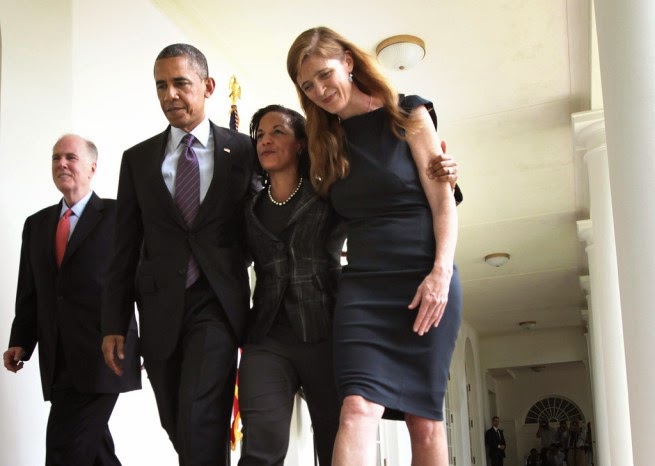
In her first appearance before the Senate Foreign Affairs Committee, Samantha Power, Obama’s pick for next U.S. Ambassador to the United Nations, made clear that she will spend her time in the role much as her predecessor Susan Rice did: acting as Israel’s consummate defender, fear-mongering about Iran, and opposing any move to champion Palestinian human rights or self-determination.
Rice, who has been appointed as Obama’s National Security Adviser, has said repeatedly that the American delegation to the UN “often works in ‘lockstep’ with the Israeli delegation” and spends “an enormous amount of time defending Israel’s right to defend itself and defending Israel’s legitimacy.”
“It’s an issue of utmost and daily concern for the United States,” she declared last year. A few months ago, she reiterated this point, insisting that her role as an apologist for the Israeli government is “a huge part of my work to the United Nations” and that the United States “will not rest in the crucial work of defending Israel’s security and legitimacy every day at the United Nations.”
Power has already proven herself a loyal replacement, disavowing any semblance of past critical thinking when it comes to Israeli human rights abuses and abrogation of international law and opposing fear-mongering about Iran’s nuclear program. It is no surprise Washington hawks and, even the Israeli government, are falling over themselves to sing her praises.
In her confirmation hearing yesterday, Power revealed her adherence to AIPAC talking points, essentially working her way down the tried and true list of boilerplate phrases. “The United States has no greater friend in the world than the State of Israel,” she said, adding, “Israel is a country with whom we share security interests and, even more fundamentally, with whom we share core values – the values of democracy, human rights, and the rule of law.”
“America has a special relationship with Israel,” she stated, to the surprise of no one and the consternation of George Washington‘s ghost. “I will stand up for Israel and work tirelessly to defend it,” she promised.
Perhaps her most disturbing comments, however, were about Iran. Shamelessly exploiting the horror of the Holocaust to fear-monger about the Islamic Republic, she declared:
“…within this organization built in the wake of the Holocaust – built in part in order to apply the lessons of the Holocaust – we also see unacceptable bias and attacks against the State of Israel. We see the absurdity of Iran chairing the UN Conference on Disarmament, despite the fact that its continued pursuit of nuclear weapons is a grave threat to international peace and security.”
Early last year, an unnamed U.S. intelligence official told the Washington Post that Iran has not decided to pursue nuclear weapons, explaining, “Our belief is that they are reserving judgment on whether to continue with key steps they haven’t taken regarding nuclear weapons.” At the time, Secretary of Defense Leon Panetta affirmed this position, admitting, “Are they trying to develop a nuclear weapon? No.”
Soon thereafter, the New York Timesreported, “Recent assessments by American spy agencies are broadly consistent with a 2007 intelligence finding that concluded that Iran had abandoned its nuclear weapons program years earlier.” This, the paper noted, “remains the consensus view of America’s 16 intelligence agencies.”
Either Samantha Power is an idiot or she’s lying.
In fact, there was a time when Power wasn’t so confident in making such a declarative statement. In a 2008 interview with Miller-McCune, Power noted that she was “not an expert on Iran,” but condemned the “American sabre-rattling” of the George W. Bush administration. “The threats – implicit and explicit – of U.S. military action have united very diverse secular, Islamist and nationalist strands,” she said, adding that American “belligerence” had “backfired.”
When asked specifically about whether she thought “Iran is trying to create nuclear weapons,” Power replied, “It would surprise me if they weren’t, but I don’t know.”
Still, she disparaged the findings of the National Intelligence Estimate and simply assumed Iran “would see as in its interests to amass as much firepower as possible,” due to the foreign threats it faces. Nevertheless, she stated, “It does not seem as though the Iranian regime is close to possessing nuclear weapons” and said that “when U.S. leaders claim Iran poses an imminent threat, they are not currently heard as credible.”
Now, five years later, Power sounds exactly like Bush’s own UN Ambassador, perennial Iran hawk John Bolton, who in 2006, insisted to the UN Security Council that “Iran had defied the international community by continuing its pursuit of nuclear weapons” and that this “pursuit of nuclear weapons constituted a direct threat to international peace and security.”
Furthermore, Power’s incredulity regarding what she deems the “absurdity of Iran chairing the UN Conference on Disarmament,” betrays her own ignorance on Iran’s constantly repeated stance regarding nuclear nonproliferation and disarmament.
Last year, Iranian Foreign Minister Ali Akbar Salehi stated that Iran fully supports the establishment of a NWFZ, but that Israel, and its American backers, presented the “only obstacle to the creation of such a zone…due to its persistent refusal to join the NPT and to place its nuclear facilities under the IAEA safeguards system.” The United States consistently blocks crucial international conferences dedicated to nuclear non-proliferation for the sole purpose of protecting Israel’s massive nuclear arsenal from scrutiny.
Samantha Power has surely embraced her new role in Turtle Bay as Israel’s stalwart apologist.
Abe Foxman, the Anti-Defamation League’s hasbarist-in-chief, once called Susan Rice a “gladiator” fighting in the United Nations on behalf of Israel. There is no question Samantha Power will, for the sake of our “special relationship” and “shared values” with an aggressive, nuclear-armed, settler-colonial apartheid state, similarly take up the sword and continue to unleash hell on the entire Middle East.
“[An Iranian nuclear bomb] was a lot further away 15 years ago when I started talking about it. It was a lot further away 10 years ago. It was a lot further away five years. It was a lot further away five months ago. They are getting there, and they are getting very, very close.”
Israeli Prime Minister Benjamin Netanyahu took to the Sunday morning airwaves to spout tired talking points about the non-existent threat Iran’s safeguarded, civilian nuclear program poses to Israel, the United States, and presumably Neptune and Krypton.
“They’re edging up to the red line,” Netanyahu said. “They haven’t crossed it yet. They’re also building faster centrifuges that would enable them to jump the line, so to speak, at a much faster rate – that is, within a few weeks.” He also said Iran is “building ICBMs [intercontinental ballistic missiles] to reach the American mainland in a few years.”
Dismissing the recent Iranian election as irrelevant to what he insists are devious Iranian intentions, Netanyahu called Hassan Rouhani, who will be inaugurated as Iran’s new president on August 3rd, “a wolf in sheep’s clothing,” whose maniacal strategy will be, “Smile and build a bomb.”
“If sanctions don’t work, they have to know that you’ll be prepared to take military action — that’s the only thing that will get their attention,” Netanyahu said, suggesting that Iranians are subhumans who only understand grunts and shoves, rather than rational actors preserving and protecting their inalienable national rights and refusing to back down to offensive and illegal demands made by serially-aggressive nuclear-armed bullies.
Netanyahu urged the United States government to “make clear that the nuclear option” – whoops, Freudian slip of the war criminal’s tongue – “the military option which is on the table is truly on the table,” but lamented that there seemed to be “no sense of urgency” when it comes to stopping Iran from doing something every intelligence agency on the planet – includingIsrael’s – says it’s not doing.
Still, an obsession is an obsession and, at least, Netanyahu isn’t ashamed of being obsessed. “Iran is the most important, the most urgent matter of all,” he whined, before throwing up a silly hodgepodge of scary-sounding words in an attempt to be taken seriously. All the problems in the world – including Israel’s ongoingcolonization of Palestine – won’t amount to a hill of beans, he cried, if the “messianic, apocalyptic, extreme regime” in Tehran acquires “atomic bombs.” Such a ghastly scenario would present “a terrible, catastrophic change for the world and for the United States,” he said, because the United States apparently isn’t part of the world. (Actually, considering the isolation the United States and Israel – along with lackey states like Palau and Micronesia – face in the United Nations, Netanyahu may be on to something here.)
Of course, the often-repeatedassessment of the U.S. intelligence community that Iran is not actually building a bomb and has no nuclear weapons program went unmentioned, as did the fact that Iran has supposedly been “a year or so” away from developing nuclear weapon for roughly a decade now.
Unsurprisingly, “Face the Nation” host Bob Schieffer challenged none of Netanyahu’s assertions; all the warmongering and propaganda was given a free pass. This is especially bizarre considering, in January 2012, then-Defense Secretary Leon Panetta told Schieffer on the same program, “Are they trying to develop a nuclear weapon? No.”
Netanyahu has been leading the charge against Iran since the mid-1990s, warning of weapons programs that don’t exist and calling for sanctions and explicit military threats. His talking points since then literally have not changed – and are identical to those he used to encourage the United States to invade Iraq a decade ago.
Here’s a reminder of why the Israeli Prime Minister’s CBS interview may actually have been a rerun:
The suggestion that Iran would soon be in possession of, or be in a position to quickly manufacture, nuclear weapons has been in constant circulation for nearly three decades. In 1984, Iran was reportedly moving “very quickly” towards a nuclear weapon and could have one as early as 1986. By the early 1990’s, the CIA predicted Iran was “making progress on a nuclear arms program and could develop a nuclear weapon by 2000,” later changing their estimate to 2003.
Israeli estimates have always been of an especially hysterical quality. In March 1992, The Jerusalem Report, noting that “Israel keeps a wary watch on Teheran’s march to the Bomb,” predicted that, “[b]y the year 2000, Iran will almost certainly have the Bomb.”
A few months later, Israeli Major General Herzl Budinger insisted that, unless “Iran’s intensive effort to develop atomic weapons is not ‘disrupted,'” it would “become a nuclear power by the end of the decade.” Then-Israeli Foreign Minister Shimon Peres shared similar assessment later that year.
On November 8, 1992, the New York Timesreported Israel was confident Iran would “become a nuclear power in a few years unless stopped.” An Israeli “senior army officer” feared “the Iranians may have a full nuclear capability by the end of the decade.”
In March 1993, a Washington Post report headlined “Israel seeking to convince U.S. that West is threatened by Iran” noted that Israeli leaders attempting to push their American counterparts into taking a stronger stance on Iran. The article quoted then-Israeli Prime Minister Yitzhak Rabin warning of “megalomaniacal” Iran intent on establishing “a Middle East empire.”
The alarm was still ringing a couple of years later when, on January 11, 1995, Benjamin Netanyahu told a nearly empty Knesset hearing that “within three to five years, we can assume that Iran will become autonomous in its ability to develop and produce a nuclear bomb, without having to import either the technology or the material.”
His solution to this crisis? “[The nuclear threat] must be uprooted by an international front headed by the U.S. It necessitates economic sanctions on Iran,” he declared.
By 1996, Israeli assessments put an Iranian nuclear bomb four years away. One year later, they confidently predicted it would happen by 2005. By mid-2001, Israel was still holding fast to its 2005 deadline and reaffirmed such a warning in 2003.
By 2004, however, an Israeli intelligence report determined that “within three years Iran would have the means to produce an atomic bomb by itself.” In 2005, Israel’s Defense Minister Shaul Mofaz said Iran was “less than one year away.” At the same time, Israeli Military Intelligence’s prediction was 2007, then 2008, later revised to 2012, then returned to 2008. In 2007, Israeli Military Intelligence said Iran would become nuclear weapons capable by mid-2009. A year later, the 2009 threshold referred to “an operable nuclear weapon,” rather than just capability.
When 2009 rolled around, then-Prime Ministerial candidate Benjamin Netanyahu told an American Congressional delegation that Israeli “experts” determined Iranian nuclear weapons capability “was probably only one or two years away,” while Israeli Defense Minister Ehud Barak put the window of opportunity to stop Iran from acquiring nuclear weapons at a mere six to 18 months. At the time, Mossad chief Meir Dagan insisted, “the Iranians will have by 2014 a bomb ready to be used, which would represent a concrete threat for Israel.”
Later that same year, Brigadier General Yossi Baidatz, “argued that it would take Iran one year to obtain a nuclear weapon and two and a half years to build an arsenal of three weapons. By 2012 Iran would be able to build one weapon within weeks and an arsenal within six months.” A month later, Netanyahu said, “Iran has the capability now to make one bomb or they could wait and make several bombs in a year or two.”
By 2010, some Israeli officials said Iran was only a year away from a bomb, some said it “one to three years away from having a breakout nuclear capability,” and others said it still had seven years to go. An unnamed “Israeli policy maker” revealed to Jeffrey Goldberg that Iran would have a nuclear weapon “nine months from June – in other words, March of 2011.” In early 2011, the prediction jumped to 2015.
Nevertheless, a year later, the Times of Londonclaimed an Israeli security report assessed Iran may become a nuclear power “within a year,” a conclusion subsequently confirmed by Ehud Barak. Six months later, in mid-2012, Barak suggested that Iran would take “several years” for Iran to “turn nuclear.” Shortly thereafter, Netanyahu reportedly put the “red line” of Iranian nuclear capability at just “a few months away,” later telling the United Nations in September (along with his trusty cartoon bomb drawing) that Iran would have “enough enriched uranium for the first bomb” by mid-to-late 2013. By October, Ehud Barak added an extra “eight to 10 months” to the timeline.
Accompanying all of these predictions, of course, have been fever-pitched threats of an ever-imminent Israeli military strike on Iran and its nuclear infrastructure. In 2012, the predictions of such an illegal assault were especially incessant. Not a month went by without hysterical rumors of a new Middle East war in the offing.
This past January, a new prediction emerged. McClatchy Newspapersreported that “Israeli intelligence officials now estimate that Iran won’t be able to build a nuclear weapon before 2015 or 2016, pushing back by several years previous assessments of Iran’s nuclear ambitions.” The report is based on “[i]ntelligence briefings given to McClatchy over the last two months” which “confirmed that various officials across Israel’s military and political echelons now think it’s unrealistic that Iran could develop a nuclear weapons arsenal before 2015. Others pushed the date back even further, to the winter of 2016.”
In early March 2013, Netanyahu claimed that “Iran is getting closer” to his self-determined “red line” of nuclear weapons capability and is “putting itself in a position to cross that line very quickly once it decides to do so.” Later that same month, in a joint press conference in Jerusalem with President Obama, Netanyahu warned of “Iran’s relentless pursuit of nuclear weapons” before reiterating his position that “in order to stop Iran’s nuclear programs peacefully, diplomacy and sanctions must be augmented by a clear and credible threat of military action.” Soon thereafter, the Israeli press publicized claims by anonymous Israeli officials that “Iran could have the capability to build a nuclear bomb by July.”
Well, it’s July, so Netanyahu tells us Iran is getting “closer and closer.”
Sadly, Netanayhu’s tired propaganda never seems to elicit the glazed-over, yawning-inducing dismissal from the U.S. press that it so sorely deserves; rather, he gets to schedule high-profile interviews on major networks whenever he wants to reissue his warmongering bromides.
A diplomatic cable sent from sent from the U.S. Embassy in Tel Aviv in 2005, published by Wikileaks, noted that, despite Israeli warnings that Iran would reach a critical nuclear weapons capability within six months, some Israeli “officials admitted informally that these estimates need to be taken with caution. The head of the MFA’s [Ministry of Foreign Affairs] strategic affairs division recalled that GOI assessments from 1993 predicted that Iran would possess an atomic bomb by 1998 at the latest.”
Another cable from 2009 wondered whether “the Israelis firmly believe” their hysterical predictions about Iran’s nuclear progress “or are using worst-case estimates to raise greater urgency from the United States).”
In truth, Netanyahu himself is increasingly viewed as an Israeli Chicken Little. In early 2013, McClatchy Newspapersreported that Israeli officials “have said there’s a widening gulf between Netanyahu’s remarks and the intelligence reports he receives,” and quoted one unnamed “intelligence officer” as wondering, “Did we cry wolf too early?”
While the alarmism will surely continue unabated, the answer is obvious.
The mainstream U.S. news media has been chuckling over the “irony” of NSA leaker Edward Snowden asking asylum from Latin American countries purported to suppress press freedom. But the smugness misses both the complex realities abroad and the U.S. government’s own assaults on information, says a group of scholars.
An Open Letter to the Media:
The supposed “irony” of whistle-blower Edward Snowden seeking asylum in countries such as Ecuador and Venezuela has become a media meme. Numerous articles, op-eds, reports and editorials in outlets such as the New York Times, the Washington Post, the Wall Street Journal, NPR, and MSNBC have hammered on this idea since the news first broke that Snowden was seeking asylum in Ecuador.
It was a predictable retread of the same meme last year when Julian Assange took refuge in the Ecuadorian embassy in London and the Ecuadorian government deliberated his asylum request for months.
Former National Security Agency contractor Edward Snowden.
Of course, any such “ironies” would be irrelevant even if they were based on factual considerations. The media has never noted the “irony” of the many thousands of people who have taken refuge in the United States, which is currently torturing people in a secret prison at Guantanamo, and regularly kills civilians in drone strikes in Afghanistan, Pakistan, Yemen, and other countries. Nor has the press noted the “irony” of refugees who have fled here from terror that was actively funded and sponsored by the U.S. government, e.g. from Nicaragua, El Salvador, Chile, and other countries.
But in fact the “irony” that U.S. journalists mention is fantastically exaggerated. It is based on the notion that the governments of Venezuela under Chávez (and now Maduro) and Ecuador under Correa have clamped down on freedom of the press. Most consumers of the U.S. media unfortunately don’t know better, since they have not been to these countries and have not been able to see that the majority of media are overwhelmingly anti-government, and that it gets away with more than the U.S. media does here in criticizing the government.
Imagine if Rupert Murdoch controlled most U.S media outlets, rather than the minority share that his News Corp actually owns – then you’d start to have some idea what the media landscape in Ecuador, Venezuela and most of Latin America looks like.
The fact is that most media outlets in Ecuador and Venezuela are privately-owned, and oppositional in their orientation. Yes, the Venezuelan government’s communications authorities let the RCTV channel’s broadcast license expire in 2007. This was not a “shut down”; the channel was found to have violated numerous media regulations regarding explicit content and others – the same kind of regulations to which media outlets are subject in the U.S. and many other countries.
Even José Miguel Vivanco of Human Rights Watch – a fierce critic of Venezuela – has said that “lack of renewal of the contract [broadcast license], per se, is not a free speech issue.” Also rarely mentioned in U.S. reporting on the RCTV case is that the channel and its owner actively and openly supported the short-lived coup d’etat against the democratically-elected government in 2002.
A July 10th piece from the Washington Post’s editorial board – which has never hid its deep hatred of Venezuela, Ecuador and other left governments in Latin America – describes another supposed grave instance of the Venezuelan government clamping down on press freedoms. The editorial, which was given greater publicity through Boing Boing and others, describes the case of journalist Nelson Bocaranda, who is credited with breaking the news of Chávez’s cancer in June 2011. The Post champions Bocaranda as a “courage[ous]” “teller of truth” and dismisses the Venezuelan government’s “charges” against him as “patently absurd.”
In fact, Bocaranda has not been charged with anything; the Venezuelan government wants to know whether Bocaranda helped incite violence following the April 14 presidential elections, after which extreme sectors of the opposition attacked Cuban-run health clinics and homes and residences of governing party leaders, and in which some nine people were killed mostly chavistas.
The government cites a Tweet by Bocaranda in which he stated false information that ballot boxes were being hidden in a specific Cuban clinic in Gallo Verde, in Maracaibo state, and that the Cubans were refusing to let them be removed. Bocaranda later deleted the Tweet, but not before it was seen by hundreds of thousands.
So while the Post dismisses the case against Bocaranda as “absurd,” the question remains: why did Bocaranda state such specific information, if he had no evidence to support it? Indeed, any such evidence would be second hand unless Bocaranda had seen the supposed “hidden” ballot boxes and the actions by the Cubans himself.
The Venezuelan government’s summons for Bocaranda to explain himself is being characterized as a grave assault on press freedom, and perhaps it is an over-reaction – after all, many journalists report false information all the time. But wasn’t Bocaranda’s Tweet irresponsible, especially given the context of a volatile political situation?
In Ecuador, President Rafael Correa has been widely condemned in the U.S. media – in much reporting as well as commentary – for suing a prominent journalist, Emilio Palacio, for defamation. The defamatory content was, in fact, serious. It relates to a 2010 incident in which Correa was first assaulted and then later held captive by rebelling police in what many observers deemed an attempt at a coup d’etat.
Military forces ultimately rescued Correa. But in a February 2011 column referring to the episode, Palacio alleged that Correa had committed “crimes against humanity,” and that he had ordered the military forces to fire on the hospital where he was being held at the time. So Correa sued Palacio for defamation and won. What some U.S. media outlets have failed to mention is that he subsequently pardoned Palacio, and had made clear from the beginning that he would have dropped the lawsuit if Palacio ran a correction.
In other words, all that Correa did was exercise his right as a citizen under the law to sue someone who had printed an outrageous lie about him. This is a right that most elected officials have in most countries, including the United States. Former AP reporter Bart Jones has written:
“Would a network that aided and abetted a coup against the government be allowed to operate in the United States? The U.S. government probably would have shut down RCTV within five minutes after a failed coup attempt — and thrown its owners in jail. Chavez’s government allowed it to continue operating for five years, and then declined to renew its 20-year license to use the public airwaves.”
Considering the massive extent of “national security” overreach following the 9/11 attacks, it is almost incomprehensible to imagine what a U.S. administration’s reaction to a coup attempt would be, but it certainly would not be as restrained as in Ecuador or Venezuela, where a fiercely critical press not only exists, but thrives.
Many commentators have cited Reporters Without Borders [known as RSF, from its French initials] and other media watchdog groups’ criticisms of Ecuador’s proposed new “Organic Law of Communication.” In an example of true irony, such supposedly objective journalists have been more critical of Ecuador’s proposed media reforms than RSF itself has been, which noted that:
“…we think that other provisions conform to international legal standards. They include restrictions on broadcasting hours for the protection of minors, the prohibition of racist and discriminatory content and the prohibition of deliberate calls for violence. Finally, the provisions governing nationally-produced broadcasting content are broadly similar to those in force in most other countries.”
Organizations such as RSF and Freedom House are supposed to be impartial arbiters of press freedom around the world and are rarely subject to scrutiny. Yet both have taken funding from the U.S. government and/or U.S.-government supported organizations such as the National Endowment for Democracy (which was set up to conduct activities “much of [which]” the “CIA used to fund covertly,” as the Washington Post reported at the time, and which also provided funding and training to organizations involved in the afore-mentioned 2002 Venezuelan coup) and other “democracy promotion” groups.
The NED has spent millions of dollars in Venezuela and Ecuador in recent years to support groups opposed to the governments there. This conflict of interest is never noted in the press, and RSF and Freedom House, when they are cited, are invariably presented as noble defenders of press freedom, for whom ulterior motives are apparently unimaginable.
The true irony in the cases of Snowden, Assange, Manning and others is that the U.S. government, while claiming to defend freedom of the press, speech and information, has launched an assault on the media that is unprecedented in U.S. history.
The extreme lengths to which it has gone to apprehend (witness the forced downing of President Evo Morales’ plane in Austria) and punish (Bradley Manning being the most obvious example) whistle-blowers is clear. Apparently less understood by some U.S. journalists is that it is part of an assault on these very freedoms that the U.S. government pretends to uphold.
The U.S. government’s pursuit of Wikileaks – through grand jury and FBI investigations, and open condemnation of Julian Assange as a “terrorist” – is a blatant attack on the press. It seems too many journalists forget – or willingly overlook – that Wikileaks is a media organization, and that the leaks that have so infuriated the U.S. government, from the “Collateral Murder” video to “Cablegate”, Wikileaks published in partnership with major media outlets including the New York Times, The Guardian, Der Spiegel and others.
Now, as Edward Snowden’s leaks are published in The Guardian and other outlets, efforts have been launched to delegitimize journalist Glenn Greenwald, and some in the media have been all too willing to take part in attacking one of their own, simply for exposing government abuse – i.e. doing journalism.
There is a long history of partnership between traditional, corporate media outlets in the U.S. and those in Latin America. Due to a variety of reasons, including educational, class and often racial backgrounds, journalists throughout the hemisphere often tend to share certain biases. It is the journalist’s duty to be as objective as possible, however, and to let the media consumer decide where the truth lies.
Likewise, eagerly going along with double standards that reinforce paradigms of “American exceptionalism” and that overlook the U.S.’ long, checkered human rights history and minimize the importance of over a century of U.S. intervention and interference in Latin America does a great injustice to journalism and the public.
Likewise, media distortions of the state of democracy and press freedoms in countries that are routinely condemned by the U.S. government – such as Venezuela and Ecuador – contribute to a climate of demonization that enables U.S. aggression against those countries and damages relations between the people of the U.S. and our foreign neighbors.
Signed by:
Thomas Adams, Visiting Professor, Tulane University
Marc Becker, Professor, Department of History, Truman State University
Julia Buxton, Venezuela specialist
Barry Carr, Honorary Research Associate, La Trobe University, Australia
George Ciccariello-Maher, Assistant Professor, Drexel University
Aviva Chomsky, Professor of History and Coordinator of Latin American Studies, Salem State University
Luis Duno-Gottberg, Associate Professor, Caribbean and Film Studies, Rice University
Steve Ellner, Professor, Universidad de Oriente, Puerto La Cruz, Venezuela
Arturo Escobar, Professor, Department of Anthropology, University of North Carolina, Chapel Hill
Nicole Fabricant, Assistant Professor, Department of Sociology/Anthropology, Towson University
Sujatha Fernandes, Associate Professor, Department of Sociology, Queens College and the Graduate
Center, City University of New York
John French, Professor, Department of History, Duke University
Lesley Gill, Professor, Department of Anthropology, Vanderbilt University
Greg Grandin, Professor, Department of History, New York University
Daniel Hellinger, Professor, Department of Political Science, Webster University
Forrest Hylton, Lecturer, History and Literature, Harvard University
Chad Montrie, Professor, Department of History, UMASS-Lowell,
Deborah Poole, Professor, Department of Anthropology, Johns Hopkins University,
Margaret Power, Professor, Department of History, Illinois Institute of Technology
Adolph Reed, Jr., Professor, Department of Political Science, University of Pennsylvania
Gerardo Renique, Associate Professor, Department of History, City College of the City University of New
York
Suzana Sawyer, Associate Professor, Department of Anthropology, University of California
T.M. Scruggs, Professor Emeritus, School of Music, University of Iowa
Steve Striffler, Professor, Department of Anthropology, University of New Orleans
Miguel Tinker Salas, Professor, Department of History, Pomona College
Sinclair Thomson, Associate Professor, Department of History, New York University
Jeffery R. Webber, Lecturer, School of Politics and International Relations, Queen Mary, University of
London
Mark Weisbrot, Co-Director, Center for Economic and Policy Research
The US and its allies have been campaigning against Syrian President Bashar al-Assad in their news outlets since the unrest began in the country. The United States and Israel have tried to use Turkish Prime Minister Recep Teyyeb Erdogan as a tool to keep the Syrian government away from Hezbollah and Iran. Refugee camps in Turkey have turned into training centers by groups such as al-Qaeda and people who are not Syrian refugees by no means.
In this edition of INFocus we set out an investigative mission in Turkey to uncover its pivotal role in Syria’s insurgency. We will also describe how foreign countries such as America, Qatar, Saudi Arabia and Libya are sending weapons into the country.
Automatic license plate readers are the most widespread location tracking technology you’ve probably never heard of. Mounted on patrol cars or stationary objects like bridges, they snap photos of every passing car, recording their plate numbers, times, and locations. At first the captured plate data was used just to check against lists of cars law enforcement hoped to locate for various reasons (to act on arrest warrants, find stolen cars, etc.). But increasingly, all of this data is being fed into massive databases that contain the location information of many millions of innocent Americans stretching back for months or even years.
This is what we have found after analyzing more than 26,000 pages of documents from police departments in cities and towns across the country, obtained through freedom of information requests by ACLU affiliates in 38 states and Washington, D.C. As it becomes increasingly clear that ours is an era of mass surveillance facilitated by ever cheaper and more powerful computing technology (think about the NSA’s call logging program), it is critical we learn how this technology is being used. License plate readers are just one example of a disturbing phenomenon: the government is increasingly using new technology to collect information about all of us, all the time, and to store it forever – providing a complete record of our lives for it to access at will.
Today, we are releasing all of the documents we have received (accessible through this interactive map and this issue page) and are publishing a report, “You Are Being Tracked,” which explains what these documents say about license plate readers: what they are capable of, how they are being used, and what privacy harms they can cause if protections aren’t put in place. We’re also offering more than a dozen recommendations we think local police departments and state legislatures should follow when they pass laws about this technology.
As is often the case with surveillance technology, there are unobjectionable – even beneficial – uses of license plate readers. We don’t object when they’re used to identify people who are driving stolen cars or are subject to an arrest warrant. But they should not become tools for tracking where each of us has driven.
License plate readers capture vast amounts of data on innocent people
Because of the way the technology works – these devices snap photos of every passing car, not just those registered to people suspected of crimes – virtually all of the data license plate readers gather is about people who are completely innocent. Data that we obtained through our records requests illustrates this point vividly.
Why we should worry
Should the government be logging for months, years, or indefinitely the movements of the other 99 percent of people, who are innocent?
The answer to this question is no. License plate reader information can be very revealing. While one snapshot at one point might not seem sensitive, as blankets of plate readers cover our streets, and as the government stores data for longer and longer, the technology quickly morphs into a powerful tracking tool.
As computer technology and storage capacity get cheaper every year, we need to prepare for a future not just where there are a few license plate reader cameras in every town, but one in which there are multiple cameras on every block.
What can location data reveal about people? Trips to places of worship, political protests, or gun ranges can be powerful indicators of people’s beliefs. Is it really the government’s business how often you go to the drug store or liquor store, what doctors you visit, and the identities of your friends? I’m sure all of us can remember something from our past that could embarrass us. If the government comes to suspect you of something in 2020, should it have access to databases stretching back years that could dig up facts about you that previously went unnoticed?
What’s happening now
Law enforcement data-retention policies today are all over the map. While some police departments store data briefly, others keep it for a long time, or indefinitely.
The government doesn’t have a great track record of using this kind of information responsibly. As our report details, the data can be abused for official purposes, like spying on protesters merely because they are exercising their constitutionally protected right to petition the government, or unofficial ones, like tracking an ex-spouse.
Prior to the rise of powerful surveillance technology, it simply wasn’t possible to watch all of the people all of the time. But as these natural limits erode and the impossible becomes possible, we have to make conscious choices about how technology should be used.
What’s the right line with license plate readers?
There is a reasonable way to regulate this technology. The primary law enforcement use of these systems is to take pictures of plates to make it possible to check them against “hot lists” of cars of interest to law enforcement. This can be done virtually instantaneously. While plates that generate a “hit” may need to be stored for investigative purposes, there is no need to store plates for months or years to achieve this purpose.
That is to say, the answer to regulating license plate readers is to have strict limits on how long plate data can be retained. While we don’t recommend a specific cutoff date, we think it should be measured in days and weeks, not months and certainly not years.
To their credit, some law enforcement agencies already comply with this principle. For example, the Minnesota State Patrol deletes all data after 48 hours.
Others keep data for longer, and the rationale given is always the same: Although you can’t tell immediately that someone is committing a crime, some of those people may well be doing something wrong, goes the argument. But in our society, the government doesn’t watch all of us all the time just in case we commit a crime.
This is not just an issue we’ll have to decide in the context of license plate readers, but the most important surveillance issue of our time. Should the NSA collect all data about everyone’s calls, just in case it’s useful to identify a terrorist? Why stop there? Why not store all of the contents of the calls we make as well? And emails? This is not just about communications or public movements. It’s also about what happens inside the home. As electric companies convert to “smart grids” that provide them data about the patterns of your electricity usage, it could well become apparent when you take a shower and whether you run your dishwasher more frequently than others in your demographic profile. … Full article
Iran Foreign Ministry Spokesman Abbas Araqchi has dismissed reports quoting Iraqi Foreign Minister Hoshyar Zebari as saying that Tehran may be sending weapons to Syria through Iraq’s airspace.
“So far, the Iraqi government has conducted intrusive inspections of some Iranian planes bound for Syria, and in all cases it was officially announced that these planes were not carrying military equipment, while in some cases they [Iraqi officials] said [the planes] were carrying food and medicine,” Araqchi said on Wednesday.
Araqchi said high-ranking Iraqi officials and the inspection team have repeatedly said the same thing about Iranian planes heading for Syria.
In an interview published by the London-based Asharq al-Awsat on June 13, the Iraqi minister said Baghdad started to inspect Iranian and Syrian planes at random last September, adding, “We have found non-lethal materials, like equipment, medicine and food.”
However, Zebari claimed, “Those planes might be carrying other stuff, but we have neither the deterrent means, nor the air defenses and fighter jets to prevent … arms shipments.”
Under pressure from the United States, Baghdad has searched several Syria-bound Iranian planes.
In April, Baghdad checked Iranian aircraft for three consecutive days. The searches, however, found nothing but humanitarian aid and commercial goods.
In October 2012, Iraq forced a Damascus-bound IranAir cargo plane from Tehran to land and searched it for weapons, but allowed it to continue as no prohibited items were found onboard.
The foreign-sponsored unrest in Syria has taken its toll on the lives of many people, including large numbers of Syrian soldiers and security personnel, since March 2011.
New York Times reporter Peter Baker has a piece today (7/16/13) about Barack Obama and Dwight Eisenhower that presents a somewhat confusing picture of both.
The article is about how Obama wields power–or, in the eyes of some critics, fails to take advantage of the “bully pulpit.”
The real point of the piece is to draw a parallel to Dwight Eisenhower’s “hidden hand” approach. According to an author of an Eisenhower book, Baker writes, “Mr. Obama was like the former president in avoiding major international conflict, relying more on covert action and letting Congress take the lead in legislation.”
Baker explains:
Just as Eisenhower, the 34th president, pulled troops out of Korea and avoided other military adventures, Mr. Obama has pulled out of Iraq, is leaving Afghanistan, has limited intervention in Libya largely to airstrikes and has resisted being drawn directly into the civil war in Syria.
Let’s try a rewrite–especially on the Obama years.
Obama withdrew troops from Iraq on the schedule inherited from Bush. His administration wanted to keep some troops there, but the Iraqi government would not allow it.
To say that Obama “is leaving Afghanistan” ignores the fact that he massively escalated the Afghan War, sending tens of thousands of additional troops to the country–essentially tripling the size of the U.S. military in the first 2 years of his term.
To say that Obama “limited intervention in Libya largely to airstrikes” is an odd way to describe what was a rather extensive bombing campaign in violation of the War Powers Act.
Baker does note that the White House has decided to formally begin arming the Syrian rebels–it is somewhat unclear how and/or when that will happen–and the CIA has reportedly been coordinating arms shipments into the country.
And, of course, one has to factor in ongoing drone wars in countries like Yemen, Afghanistan and Pakistan.
It is possible that these do not count as “military adventures,” but I think you’d have hard time explaining that to anyone in those countries.
As for Eisenhower, when the Times refers vaguely to “covert operations” during his term, one might want to spell out that the CIA was instrumental in the overthrow of governments in Iran, Guatemala and Congo, and that the CIA was deeply involved in supporting anti-government rebels in Indonesia fighting the Sukarno government–including dropping supplies to the rebels. His hands may have been “hidden,” but there’s no reason to not let the record speak for itself 50 years later.
The ethnic cleansing of Rohingya Muslims in Myanmar has shocked the world and drawn attention to rising Islamophobia in Asia. Now Muslims in Sri Lanka are under dire threat as well.
The similarities with Myanmar are striking and foreboding. Buddhist monks are at the forefront of the rising hatred, the government is taking sides against Muslims and attacks have begun.
Full scale violence is threatening to break out to create another catastrophe for Muslims in the region. There have already been a series of attacks on mosques and Muslim places of work.
Hard line, ultra nationalist groups led by Buddhist monks such as Buddhist Strength Force (BBS) and Sinhala Echo preach the same message as those of the Buddhist Rakhine in Myanmar: “Muslims are taking over, they are building too many mosques and are trying to destroy our culture.”
On this week’s INFocus we document the rising crisis in Sri Lanka and attempt to bring the world’s attention to the issue before it’s too late.
I
II
The Sri Lankan Defense Secretary recently gave his support to the monks. “It is the monks who protect this country, religion and race” he stated.
He also cautioned the ultra nationalist groups not to promote “communal hatred.” But this communiqué was delivered in English, not in Sinhala.
On this week’s INFocus, which is a sequel for last week’s episode, we try to understand the reason behind this rising hatred and where the blame truly lies.
Recent reports about the Pakistan government’s plan to allot thousands of acres of land to foreign countries and private corporations are alarming to say the least. The proponents of the plan argue that this agricultural outsourcing will attract foreign investment, helping the country to reduce its debts while generating greater productivity and rural employment. However, there is little evidence that this plan will offer any major advantages to the rural poor. Far from benefiting the poor, in fact, one is concerned that peasants may be displaced from their lands to ensure access to foreigners. Moreover, if the land that will be given away is indeed lying “idle” as some reports have claimed, why not distribute it amongst landless farmers to ensure their food security instead of privileging the needs of foreign countries? Giving large chunks of land to other states that want to secure food availability for their population goes against the very logic of sustainable local and national development, especially in times of severe food crises that Pakistan is currently facing.
Given the history of exploitative work conditions in Saudi Arabia and Gulf states, it is very likely that the new corporate farms will function like colonial plantations. According to wikipedia, “a plantation is a large farm or estate, usually in a tropical or subtropical country, where crops are grown for sale in distant markets, rather than for local consumption.” Colonial planters, like today’s advocates for corporate farming, saw themselves as investors and innovators of commercial agriculture. The history of plantations in South America, Asia and the Caribbean tells us that far from eradicating poverty, this kind of intensive transnational agriculture accelerates dependency while weakening food sovereignty among the poorer nations.
In Pakistan, there has already been a radical neglect of important livelihood issues as the country has increasingly became embroiled in a series of security crises. A lot more ink has been spilled on explaining the proliferation of religious and sectarian violence, than on the effects of economic factors in feeding these movements. Missing in these analyses is a discussion of enduring forms of structural violence that lie in extreme disparities of wealth, diminishing protections for vulnerable populations like peasant farmers, the mass movement of rural workers to urban slums, and the increasingly precarious access to food. Far from serving the poor, the state has often resorted to a militarized response in order to suppress poor peoples’ struggles for land and sustenance. This is all the more reason for us to suspect the government’s claims of “rural investment” as a justification for its proposal to lease land to foreign investors.
At the military farms in Okara, for example, tenant farmers have been struggling to retain access to the land that they have been tilling for almost a century. Since 2000, the farmers have been defying the military’s edict to impose a new tenancy system of contract farming. They have refused to sign onto a cash tenancy system because it does not guarantee secure, long-term access to the land. In fact, the contract system will make them more vulnerable to evictions. During the course of their struggle, the mazarin (landless peasants) have discovered that the military farmlands are actually owned by the Punjab Government, as the military’s official lease expired long before the creation of Pakistan.
The tenant farmers see the new contract system as a threat to their subsistence and food security. I recall talking to Nazeer Bola, a tenant farmer, about what gave the tenant farmers the will to defy the military in 2003. He simply answered, “We knew that as soon as we accept this contract system, we will be thrown out of these lands. We can accept death but we don’t accept this contract system.” Nazeer gave the example of the slum-dwellers of Karachi to illustrate what life would be like for the mazareen if they lost their rights over their lands. He argued that in contrast with the extreme poverty in the cities, even the poorest group in the village (like the lower caste kammis) had a marla (a small plot) where they could grow enough food to survive, whereas being destitute in the city meant having no place to sleep and no land to grow one’s food.
Instead of giving away land to serve other people’s food needs, the government needs to provide greater support for farmers like Nazeer Bola by ensuring their access to land, as well as by facilitating policies such as farmer cooperatives that can hold distributors accountable and collectively promote the interests of rural families.
On CBS’ “Face the Nation” on Sunday, host Bob Schieffer devoted more than six minutes of a ten-minute interview with Israeli Prime Minister Benjamin Netanyahu to the topic of Iran’s alleged pursuit of a nuclear weapon, with Netanyahu explicitly threatening to attack Iran if it crossed his personally drawn “red line” on the level of permitted refinement of nuclear fuel.
Nowhere during that interview – or in the major news articles that I read about it – was there any reference to Israel’s own rogue nuclear arsenal or how destabilizing it is for one religious state possessing nukes to threaten to attack another religious state lacking a single nuke. The imbalance in this nuclear equation is so breathtaking that you might have thought it would be at the center of a testy Q-and-A. Instead it was nowhere.
Netanyahu also was allowed to denounce Iran as “apocalyptic” without any question about Netanyahu’s own frequent references to Israel facing “existential” threats. Indeed, Israel’s attitude toward using nuclear weapons is sometimes called the “Samson Option,” recalling the Biblical hero who destroyed himself along with his enemies. So, again, you might have thought Schieffer would pounce on Netanyahu’s self-serving remark. But, nah!
In other words, it was a typical day in the life of mainstream U.S. journalism, a profession which purports to be “objective” – meaning it should treat all parties to a dispute equally – but, of course, isn’t.
An “objective” interview or article would have included at least some reference to Israel’s nuclear arsenal and the question of whether Israel has the unilateral right to wage war (or even threaten war) against another country, with the particular irony that Israel is accusing Iran of pursuing a course that Israel has already taken.
But it is expected now that “objective” U.S. journalists will avert their eyes from a reality that Israel would prefer not to mention. In the real world of U.S. journalism, “objectivity” means following the bias of the powers-that-be and framing issues within the conventional wisdom.
In the CBS interview, Netanyahu also was allowed to take a free shot at Iran and its president-elect, Hassan Rowhani, who was disparaged by Netanyahu as a “wolf in sheep’s clothing” whose strategy is to “smile and build a bomb.”
Netanyahu was given free rein, too, to demand that President Barack Obama demonstrate “by action” that he stands with Israel in its military threat against Iran. Those demands “should be backed up with ratcheted sanctions,” Netanyahu said. “They have to know you’ll be prepared to take military action; that’s the only thing that will get their attention.”
(It might be noted here that the United States has lots and lots of nuclear weapons and indeed is the only nation to have actually used them in warfare against other human beings. Meanwhile, Iran says its nuclear program is for peaceful purposes only.)
Netanyahu seemed perturbed that the Obama administration is hoping to reach an accommodation with President-elect Rowhani that would involve Iran accepting new safeguards on its nuclear program in exchange for relaxed economic sanctions.
The New York Times reported that “a senior [Obama] administration official” told reporters on Friday that Rowhani’s more moderate tone suggested he was “going in a different direction” from his predecessors and might be interested in reaching a broad settlement with the West.
In the CBS interview, Netanyahu was signaling that any accommodation with Iran – beyond one that would demand Iran’s total capitulation on its right to process uranium at all – is unacceptable to him. The U.S. press corps then repeated Netanyahu’s hard-line remarks without any of that troublesome context regarding Israel’s possession of an undeclared nuclear arsenal, considered one of the world’s most sophisticated.
That the U.S. press corps routinely fails to provide that sort of context is clear evidence that the principle of “objectivity” is one that is selectively applied, which would seem to negate the very notion of “objectivity.”
~
Investigative reporter Robert Parry broke many of the Iran-Contra stories for The Associated Press and Newsweek in the 1980s. You can buy his new book, America’s Stolen Narrative, either in print here or as an e-book (from Amazon and barnesandnoble.com).
Recycling was introduced, worldwide, as a tool to teach citizens to become compliant.
Forcing citizens to sort their rubbish into up to nine separate bags or boxes every week had absolutely nothing to do with ‘saving the planet’ and everything to do with teaching citizens (through a mixture of fines and shame) to behave ‘responsibly’ i.e. to do as they were told without looking too closely at the rationale of what they were being told to do.
The recycling never had anything to do with protecting the planet, of course. Most of the rubbish sorted, washed and collected in the UK was taken abroad, by lorry or ship or train, and burnt or dumped. It was, quite simply, impractical and not cost effective to recycle the material that had been collected. And, of course, collecting the sorted rubbish involved massive costs in terms of cash and pollution.
Today, the recycling business has reached an apogee of lunacy. Councils introduce ever more complex rules and fees. They refuse to take away much of the waste that is collected. And those wanting to take their rubbish to a ‘recycling’ centre will probably have to make an appointment and answer a host of questions.
It is no surprise that fly-tipping has become a major problem. The biggest causes of plastic in the sea are dumped fishing gear and plastic waste (much of it officially designated as recycled) which has been dumped by ships.
The good news, however, is that in Britain, recycling rates are falling. More and more people have become aware that the whole recycling movement was just another piece of manipulative trickery.
This site is provided as a research and reference tool. Although we make every reasonable effort to ensure that the information and data provided at this site are useful, accurate, and current, we cannot guarantee that the information and data provided here will be error-free. By using this site, you assume all responsibility for and risk arising from your use of and reliance upon the contents of this site.
This site and the information available through it do not, and are not intended to constitute legal advice. Should you require legal advice, you should consult your own attorney.
Nothing within this site or linked to by this site constitutes investment advice or medical advice.
Materials accessible from or added to this site by third parties, such as comments posted, are strictly the responsibility of the third party who added such materials or made them accessible and we neither endorse nor undertake to control, monitor, edit or assume responsibility for any such third-party material.
The posting of stories, commentaries, reports, documents and links (embedded or otherwise) on this site does not in any way, shape or form, implied or otherwise, necessarily express or suggest endorsement or support of any of such posted material or parts therein.
The word “alleged” is deemed to occur before the word “fraud.” Since the rule of law still applies. To peasants, at least.
Fair Use
This site contains copyrighted material the use of which has not always been specifically authorized by the copyright owner. We are making such material available in our efforts to advance understanding of environmental, political, human rights, economic, democracy, scientific, and social justice issues, etc. We believe this constitutes a ‘fair use’ of any such copyrighted material as provided for in section 107 of the US Copyright Law. In accordance with Title 17 U.S.C. Section 107, the material on this site is distributed without profit to those who have expressed a prior interest in receiving the included information for research and educational purposes. For more info go to: http://www.law.cornell.edu/uscode/17/107.shtml. If you wish to use copyrighted material from this site for purposes of your own that go beyond ‘fair use’, you must obtain permission from the copyright owner.
DMCA Contact
This is information for anyone that wishes to challenge our “fair use” of copyrighted material.
If you are a legal copyright holder or a designated agent for such and you believe that content residing on or accessible through our website infringes a copyright and falls outside the boundaries of “Fair Use”, please send a notice of infringement by contacting atheonews@gmail.com.
We will respond and take necessary action immediately.
If notice is given of an alleged copyright violation we will act expeditiously to remove or disable access to the material(s) in question.
All 3rd party material posted on this website is copyright the respective owners / authors. Aletho News makes no claim of copyright on such material.


 Aletho News

