Nine years ago a German drone nearly collided with a passenger plane over Afghanistan. The classified drone camera footage drew public attention after the German defense ministry scrapped a drone program for its lack of anti-collision technology.
Footage taken by an EMT Luna X-2000 reconnaissance drone as it passed mere meters under the left wing of an Airbus A300 passenger plane surfaced on YouTube several years ago. After the encounter, the drone was caught in the plane’s wake turbulence, lost control, and crashed over the Afghan capital Kabul, Der Spiegel reported.
The Ariana Afghan Airlines plane was carrying about 100 people on board, the magazine said. The manufacturer of the 40kg drone has claimed that the near-collision occurred after the passenger jet veered off-course without informing ground control.
The video was leaked a week after German Defense Minister Thomas de Maizière decided to scrap the $652 million EuroHawk program – meant to be a replacement for existing reconnaissance aircraft – including the Luna drones. EuroHawk is part of the NATO Global Hawk project, under which Germany was to buy Northrop Grumman RQ-4B drones and fit them with customized sensors.
However, the German military would not be able to certify the drone for use in European airspace without an anti-collision system, which would make the aircraft too expensive, de Maizière said, adding that even with such a system installed certification would not be guaranteed. German media also reported that EuroHawk suffered from technical problems and cost overruns.
Germany has bought one drone from the US manufacturer of the EuroHawk program, and was expected to purchase four more. If given the green light, the contract would be worth $1.3 billion.
De Maizière came under criticism recently for the drone program after a leaked defense ministry report showed that the drone’s flaws were apparent as early as 15 month ago. Critics have accused the minister of failing to act and continuing to spend taxpayer money on the doomed project. De Maizière will appear before the German Parliament this week to report on the issue.
Advancements in unmanned weapons systems have become a global controversy in recent years. Militaries have praised the weapons for not endangering the lives of operators, and for being generally more cost-effective than older manned hardware.
But critics are expressing increasing concerns over the collateral damage caused by drone strikes, the vague legal justifications for their use, and the potential creation of weapons that would remove human judgment altogether from the decision to pursue a target.
There is also the perception that nations with advanced drone technology – specifically the US and Israel – have an unjust capability to enforce their policies on other countries.
In 2011, when Arab revolts began to sweep the Middle East and North Africa, the view from Washington and its closest allies was one of concern. How would the removal of mostly pro-Western dictatorships affect the balance of power in the region? More importantly – how to prevent these events from boosting Iran’s influence?
Two years on, the regional competition for influence is in full throttle. In its sights – among many other developments – are recent efforts by Iran and Egypt to upgrade their relationship.
The spoilers will have none of it. Said Steven A. Cook last week on the website of that most prestigious of US institutions, the Council on Foreign Relations (CFR): “Other than some quick cash and subsidized energy, there is nothing that Tehran can offer Cairo that will, in the long run, be to Egypt’s benefit.”
He has it entirely wrong. “Quick cash and subsidized energy” can only be used to describe the superficial offerings of countries like Saudi Arabia and Qatar, both vying for influence in this new Egypt.
There is no contest whatsoever between that kind of assistance and what Iran can bring to the table. Iran has achieved its economic independence the hardest way imaginable – through a devastating eight-year war with Iraq and decades of potentially-debilitating sanctions. It has shrugged off the yoke of imperialism, built infrastructure, social services and industry from scratch, harnessed its own resources toward establishing domestic self-sufficiencies, created a dynamic – if imperfect – indigenous political system of representative government, and managed to maintain the security of its oft-threatened borders through military innovation and soft power.
In short, with similar-sized populations (Iran’s 78 million to Egypt’s 82 million) and the experience of tackling monumental state-building challenges with varying degrees of success, there is simply no country better situated to provide developmental guidance to Egypt – and other economically vulnerable Arab states – than the Islamic Republic of Iran.
Seeing is Believing
Other than a frustratingly brief trip some years ago to attend a Tehran conference where I had little opportunity to get around, I had not visited Iran in eight years. In the latter part of 2012, I made three trips to the country – in large part to discover how Iran continues to thrive despite the “biting sanctions” we keep hearing about.
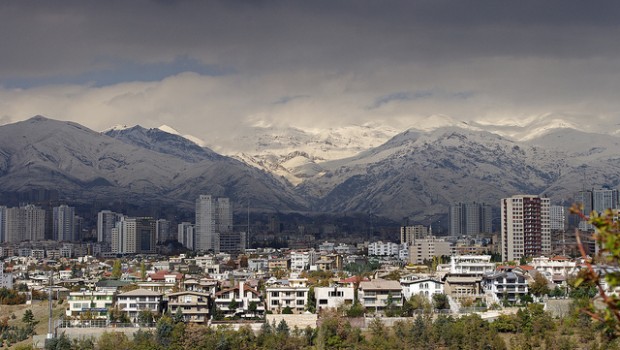
And thrive it does. Visitors land at the brand new Imam Khomeini international airport as a first step in experiencing an utterly revamped Tehran. You drive into the city on new highways, lit up almost excessively by closely aligned lampposts and the Iranian penchant for colorful lighting at major intersections. Streets are lined with trees, shrubs and flowers planted and nurtured by a succession of rather remarkable mayors that Tehran residents like to boast about.
Those are the city planners who develop well-manicured parks and children’s playgrounds to break up the urban monotony, build women’s sports facilities to encourage good health, spearhead campaigns on AIDS awareness, and pass out free condoms and hypodermic needles to prevent infection among drug users.
Tehran feels new and fresh – like it has had a facelift. New buildings abound, each more luxurious than the last, although sales have slowed dramatically in recent years, much like in other capitals hit by economic slowdown and ridiculously expensive housing. I cannot believe the greenery – this is a dry climate and I cannot seem to recall the city ever overflowing with late summer foliage like this.
New restaurants, cafés, and boutiques dot the boulevards; the bazaars are well-stocked and cleaner than I recall. Nothing seems to be in shortage – and Iranians are producing more of the food products on their supermarket shelves than ever before. In 2011, Iran ranked 11th globally in agricultural output, just behind Japan, Russia, Turkey, and Australia – and is ranked first and second worldwide in the production of a variety of fruits, vegetables, spices, and nuts ranging from apricots, cucumbers and walnuts to pistachios, saffron, and watermelon.
This is a country hell-bent on achieving self-sufficiency, after all. Under threat of increasingly punitive US-sponsored economic sanctions, Iran’s Supreme Leader Ayatollah Ali Khamenei last year promised the development of a “Resistance Economy” that will aim to stop all dependence on oil revenues and switch to knowledge-based industries and vital commodities instead.
After eight years away from the country, none of Tehran’s significant advances impressed me as much as the pollution-solution. Surrounded by the Alborz mountain range that traps pollutants, the capital has struggled for decades to lessen air pollution, much of which stemmed from aging vehicles that service a city of more than 12 million residents.
During past trips to Tehran, the stench of petrol from cars was omnipresent in congested areas – you’d have to clean blackened particles from your nose every day. In 2012, I experienced none of these things. The city still has high alerts on dangerous pollution days, but has come a long way from the days when the municipality enforced alternative driving days for cars with even and odd license plate numbers.
For starters, during my eight-year absence, Tehran has launched around 80 subway stations servicing more than 2.5 million passengers daily, and inaugurated a 60-station rapid transit bus system with just under two million daily users.
More impressive yet is the Islamic Republic’s nationwide effort to convert public transportation and privately owned vehicles from petrol engines to ones that run on Compressed Natural Gas (CNG).
Pay attention now. Iran’s experiment to switch to alternative fuel-based vehicles is the kind of super-efficient central government initiative that the country now frequently launches – with varying degrees of success. It is one of many zero-to-a-hundred projects initiated in recent years that seeks to diversify the economy, create jobs, generate revenues or solve a problem. To Iran’s credit, at least they think big and make the effort – few other governments engage in these kinds of expansive nation-building activities anymore.
Partly to help stem air pollution, and mostly to reduce the country’s dependence on imported gasoline – and therefore mitigate the effect of US-backed sanctions against companies that sold refined petroleum to Iran – the Islamic Republic embarked on an ambitious program to adopt Natural Gas Vehicles (NGV) based on alternative fuels.
In just a few years, Iran has established a fleet of around 3 million NGV, the largest in the world (by contrast, the US has just over 200,000) and now has the capacity to domestically manufacture 1.5 million CNG cylinders per year at extremely competitive costs.
Big Thinkers Build Nations
In writing this series of articles based on my Iran trips, I am constantly reminded of an MSNBC promotional ad featuring Rachel Maddow, where she stands in front of the Hoover Dam in a blue hardhat and gets sentimental about big-projects-that-build-nations:
“When you are this close to Hoover Dam, it makes you realize how small a human is in relation to this as a human project. You can’t be the guy who builds this, you can’t be the town who builds this, you can’t even be the state who builds this, you’ve got to be the country that builds something like this. This is a national project – this is a project of national significance. We’ve got those projects on the menu right now and we’ve got to figure out whether or not we are still a country that can think this big.”
The current mayor of Tehran Mohammad Bagher Ghalibaf – a former commander in the Revolutionary Guard and national police chief who is widely admired for his big thinking and ability to get the job done – happens to be one of eight candidates running for president in the June elections.
Tehran residents are attached to their mayors, and in a city of between 12 to 14 million, are able to propel them to the presidency (current Iranian President Mahmoud Ahmadinejad was the previous mayor). And after eight years in this role, you would be hard pressed to find a Tehrani who doesn’t praise Ghalibaf for his role in developing their capital. If he emerges as a national frontrunner, Tehran will push him over the line.
Among the other eight 2013 presidential contenders is Dr. Gholam-Ali Haddad-Adel, a former speaker of parliament (majlis) who holds one of Tehran’s 30 majlis seats and a close adviser to Iran’s Supreme Leader Ayatollah Ali Khamenei, to whom he is related through marriage.
I met with Haddad-Adel during one of my trips to Iran last year – not to discuss regional or domestic politics – but to learn about four “academies” set up by the Iranian government two decades ago. These academies are meant to drive “big thinking,” establish best practices, and initiate macro planning for national projects in the areas of Sciences, Medical Sciences, Arts, and the Farsi language.
The Farsi language as a big national project? As it happens, that’s the academy headed up by Haddad-Adel, who holds a PhD in philosophy and has translated Immanuel Kant’s books into the Persian language.
What could be so urgent and critical about the national language that would move a country under prohibitive international sanctions to direct resources toward it?
“Farsi is as old as Iranian civilization – they are inseparable,” explains Haddad-Adel. “We Iranians are proud of our national language and literature. We regard our Persian literature as one of the most important elements of our national identity. And we have to support this language against the dangers that threaten it – new words, idioms and terms entering the language through science, technology and culture – mostly through the English language.”
Under Haddad-Adel’s tenure, one of the 15 departments dedicated to the task of preserving the Persian language has created a nine-volume dictionary converting over 40,000 foreign words into Persian equivalents. A quick glimpse through the final volume shows that a lot of the terminology being replaced are technological, medical and scientific words (laparascopy, intra-muscular injection, binary pulsar, supramolecular). But also covered are subjects like political sciences (interdependence, deconstructionism, national security), music (chord, grand-barre, capo d’astro) and sport (play-offs, kayak, surfboard).
Seventy different university groups and more than 150 people are involved in this task. The academy has developed complicated software for finding Persian equivalents for English terms.
“Language is not something that can be improved by command though,” says Haddad-Adel. “The velocity of development is so rapid, it is not possible for the public to follow it. We try to disseminate it through cultural ways.”
Another project of the academy: a Persian-to-Persian dictionary covering at least 1,000 years of the language – and tracking words like “khasteh” which means “tired” in modern Farsi and “injured” in old Persian through its exportation to the Ottoman Empire and current usage in modern Turkey as “hastehan” which means “hospital.”
Yet another department is developing a six-volume encyclopedia containing the “whole history of Persian language and literature in the Indian subcontinent.” Explains Haddad-Adel: “Persian was welcomed by Indians. It was a language of culture and has been for more than 800 years the official language of the old Indian courts and intellectuals. British colonialism ended this.”
There is more to this than the preservation of language – cultural revivalism, national security, identity politics, nationalism are woven into the fabric of the academy’s work. The Iran of Haddad-Adel isn’t a nation in decline – it appears to be getting geared up to lead a renaissance.
Mississippi Calls on Iran for Help
I next visited the director of the Medical Sciences academy Dr. Alireza Marandi, a pediatrician by training, two-time minister of health, university professor and a current member of the Majlis from Tehran.
In 2009, I had read an article in the UK-based Sunday Times(reproduced on this blog) that told the remarkable story of Iran’s provincial health houses. The post-revolution initiative to rapidly deliver basic medical care to under-served rural areas was able, in a short time, to reduce child mortality rates by 69 percent and maternal mortality in rural areas from 300 per 100,000 births to 30.
So astounding were these results that the US state of Mississippi – which, according to the Sunday Times article, has “some of the worst health statistics in the country, including infant mortality rates for non-whites at Third World levels” – turned to Iran for advice, assistance and training on how to achieve these results back home.
Dr. Marandi was Iran’s minister of health around the time the first health houses (khaneh behdasht) were established in post-revolutionary Iran. He recalls the difficulties in getting funding back in the early 1980s:
“During the Iran-Iraq war we had very little oil to export – we were limited to about one million barrels per day. The price of oil had come down to about $7-8 per barrel. The country was under bombardment. Yet during this time, the country still focused on developing a primary healthcare system.”
That wasn’t even the hard part. When majlis-approved funding finally came in to run one pilot program in each of Iran’s provinces, the planners had a difficult time finding local men and women with the required five years of elementary education to staff the health houses – especially the girls. Today, with literacy rates among Iran’s youth (ages 15-24) at 98 percent according to the World Bank, all health house workers have at least a high school education.
The women are trained for basic healthcare procedures – monthly check-ups for mothers, vaccines for children, schedules and checklists, breastfeeding guidance, preventive care. The men are largely responsible for environmental health issues like water and sanitation – they check village water supplies, add chlorine where necessary, teach locals personal hygiene, how to disinfect things, install basic toilets, and lay water pipes.
Today, says Marandi, Iran has some 20,000 health houses in 65-70,000 villages around the country and has established a primary healthcare “network” connecting health houses to larger health centers in larger towns, which in turn plug into hospitals and specialized medical facilities in urban areas. Although challenges still exist in this system, Iran has solved a vital social service and healthcare challenge that continues to plague most developing nations.
Despite a lack of funds, Marandi’s ministry of health tackled many more major health problems in those early days. In 1983, the highest rate of immunization in Iran was 25 percent. A few years later, that rate skyrocketed to 95 percent throughout the country. Iranians desperately needed more physicians (only 12,000) and a more diversified medical worker base, so the ministry of health under Marandi pushed through a bill that took all health-related schools (midwifery, dentistry, nursing, etc) away from the ministry of education. By streamlining and adding to existing resources, in that first year 1,200 students were increased to 6,000, students were directed into undermanned specialties where jobs awaited, and new schools of medicine were built – at least one for each province.
Today, there are 120,000 physicians in Iran. The country is self-sufficient in the production of medical experts and support staff, and has diversified into specialties like fertility treatments, heart, cornea, and kidney transplants that Iranians were forced to seek outside the country a few decades ago. Iranian expertise and relatively low-costs now even draw medical tourism from near (Iraq) and far (Canada).
“We now have every sub-specialty you can think of,” says Marandi, who received an award for his accomplishments from the World Health Organization (WHO) in 2000.
While Iran has the benefit of considerable oil resources to cushion its economy, throughout the 1980s the country was broke. Economically, Iran was in not much better a position than Egypt or Jordan are today, both countries just months away from bankruptcy. There is a missionary zeal that permeates the higher echelons of government and their immediate ranks below. Many decision makers I interviewed are driven by both religious faith and geopolitics – determined to satisfy public needs and focused on discovering efficiencies that will thwart the negative effects of sanctions. Despite frequent accusations of corruption and mismanagement, clearly a lot is getting done in the country – and with a real spirit of innovation.
In the next installments, I will write about my interviews with leaders in technological and scientific fields including Iran’s controversial nuclear energy program, huge achievements in nanotechnology, political insights on what top Iranian politicians think about a Muslim Brotherhood-led Egypt, and US-sponsored sanctions…and the unexpected fact that Iran has cloned sheep.
Sharmine Narwani is a commentary writer and political analyst covering the Middle East. You can follow Sharmine on twitter @snarwani.
Barack Obama is a master trickster, a shape-shifter, and a methodical liar. The man who has arrogated to himself the right to kill at will, anywhere on the globe, accountable only to himself, based on secret information and classified legal rationales, now says he is determined that Washington’s “perpetual war” must one day end – sometime in the misty future after he is long gone from office. He informed his global audience of potential victims that he had signed a secret agreement (with himself?) that would limit drone strikes to targets that pose “a continuing, imminent threat to Americans” and cannot be captured – a policy that his White House has always claimed (falsely) to be operative. He promises to be more merciful than before, “haunted” as he is by all the nameless deaths, although he admits to having done no wrong.
He is a man of boundless introspection, inviting us to ride with him on his wildly spinning moral compass. But, most of all, he is not George Bush – of that we can be certain, if only because he is younger and oratorically gifted and Black. “Beyond Afghanistan,” he said, “we must define our effort not as a boundless ‘global war on terror,’ but rather as a series of persistent, targeted efforts to dismantle specific networks of violent extremists that threaten America.” Thus, magically, he redefined the U.S. war on terror out of existence (in perpetuity) by breaking the conflict down to its daily, constituent parts, while simultaneously affirming that America will soon travel “beyond Afghanistan” despite the fact that many thousands of Special Operations troops will continue their round the clock raids in the countryside while drones rain death from the skies for the foreseeable future.
Such conflicts, we must understand, are necessitated by the “imminence” of threats posed to U.S. security, as weighed and measured by secret means. His Eminence is the sole judge of imminence. He is also the arbiter of who is to be detained in perpetuity, without trial or (public) charge, for “association” with “terrorists” as defined by himself. He has no apologies for that.
America must turn the page on the previous era, because “the threat has shifted and evolved from the one that came to our shores on 9/11.” A reevaluation is in order, since “we have to recognize that the scale of this threat closely resembles the types of attacks we faced before 9/11.” In that case, why not call for repeal of the layers of war on terror legislation that have accumulated over the last 12 years, including Obama’s own NDAA preventive detention bill? Or, he could simply renounce these measures and refuse to employ them as a matter of policy. Instead, the president defended his own maximalist interpretation of the law, and claimed that the legal basis for his kill-at-will authority is firmly rooted in the Congress’s 2001 Authorization of Military Force (AMUF). Although he made vague reference to changes that Congress might make in the AMUF, there was no substantive indication that he sought to impose restrictions on his own or any other president’s authority to wage war precisely as he has for the last four years.
Obama’s blanket interpretation of AMUF – the legal logic – had previously been considered a state secret. It was news to much of the U.S. Senate, too, until assistant secretary of defense Michael Sheehan, in charge of special operations (death squads) at the Pentagon, told lawmakers earlier this month that the AMUF allows Obama to put “boots on the ground” anywhere he chooses, including “Yemen or the Congo,” if his classified logic compelled him to do so.
The senators were stunned – although it is no secret that Obama has already put U.S. Special Forces boots on the ground in the Democratic Republic of Congo, Uganda, the Central African Republic, and South Sudan, and has sent a combat brigade on permanent posting on the continent. Central Africa is one part of the world in which al Qaida has found little traction. The purported “bad guy” hiding in the bush, Joseph Kony, is the Christian leader of the remnants of the Lord’s Resistance Army. Obama authorized the deployment under the doctrine of Humanitarian Military Intervention, or Responsibility to Protect (R2P), a war-making notion that is, at best, ill-defined under international law and non-existent in U.S. statutes. However, if Obama is sincere (!) in wanting to phase out AMUF, as he averred last week, he’s always got R2P as a backup.
Death squad honcho Sheehan is a believer in the perpetual lifespan of AMUF, which he considers operative until al Qaida has been consigned to the “ash heap of history” – an eventuality that is “at least 10 to 20 years” away. Since this is the guy who carries out Obama’s kill orders (the identity of his counterpart in the CIA is, of course, a secret), one would think that Sheehan and Obama would be on the same page when it comes to al Qaida and AMUF. But then, we are told that page has turned.
Obama is very good at flipping pages, changing subjects, hiding the pea in his hand while we try to figure out which bowl it’s under. His call for Congress to come up with a substitute for AMUF – without yet offering his own version – is a ploy to more explicitly codify those powers assumed by Bush and expanded upon by the Obama administration. Or, the Congress can do nothing – a very likely outcome – and Obama can pretend to be the reluctant, self-restrained global assassin, preventive detainer and regime changer for the rest of his term.
Work has begun to remove the Cristopher Columbus monument from behind the Casa Rosada and transport it to Mar del Plata. A press conference is due later today to explain the move, which has attracted criticism from a number of social organisations. The statue is due to be replaced with a figure of Juana Azurduy de Padilla, a Latin American guerrilla military leader.
A crane and container started preparation work this morning but many regard the monument as part of Argentina’s cultural heritage and are concerned the statue might be damaged during the move. A quiet protest of “symbolic hugs” took place earlier this year under the monument in a bid to stop the removal from taking place.
However, a large group of protestors gathered metres away from the Casa Rosada today to vent their anger. Federal Police officers are guarding the statue while Buenos Aires mayor, Mauricio Macri, of the party PRO, has stated his desire to keep the monument where it is.
A PRO spokesperson said: “If the government wishes to remove the Christopher Columbus they must go through the necessary legislation. It belongs to the city.”
The statue is made of Carrara marble, weighs around 38 tonnes, and stands at over six metres tall. The monument has been declared part of the Buenos Aires’ cultural and historical heritage and city officials are therefore claiming the government does not have the authority to remove it.
Bolvian president Evo Morales approved the move and has donated US$1m towards the transfer project.
Charles Krauthammer likes war. Any war, really, but the War on Terror in particular. It’s kind of his raison d’être; no one cares what he has to say about domestic policy, so if this glorious clash between the Last, Best Hope on Earth and The Islamofascistterroristevildoers were to end, he might just sink into relative irrelevance.
Charles has written a new column and he is very upset that President Obama seems to believe that this war should not continue into eternity:
Obama says enough is enough. He doesn’t want us on “a perpetual wartime footing.” Well, the Cold War lasted 45 years. The War on Terror, twelve so far. By Obama’s calculus, we should have declared the Cold War over in 1958 and left Western Europe, our Pacific allies, the entire free world, to fend for itself — and consigned Eastern Europe to endless darkness.
This is actually false. Krauthammer is evidently unaware that the War on Terror was first declared by the Reagan administration in 1983. It was re-declared by the Bush administration in 2001. The United States has been waging its War on Terror, in fact, for thirty years now. Moving on:
This is John Lennon, bumper-sticker foreign policy – “Imagine World Peace.” Obama pretends that the tide of war is receding.
Just take a minute to consider the absurdity of these two sentences. As Glenn Greenwald pointed out in a recent column, Barack Obama “has spent almost five years killing people in multiple countries around the world.” It’s simply delusional to claim that Obama is some Lennon-like hippie who rejects military violence; his prosecution of this war, in several areas, has been even more ruthless and intense than that of his predecessor. Obama has surely surpassed Krauthammer’s wildest expectations in his penchant for killing Muslims around the world. Apparently, though, it’s not sufficient. More death and destruction are needed.
Krauthammer then spends a few paragraphs paying tribute to one of the other loves of his life, the prison at Guantanamo Bay, and excoriating Obama for not thinking it’s awesome and wanting to keep it open forever. Then he lies about Obama wanting to “return us to pre-9/11 defenselessness,” whatever the hell that means. Writing this column, and contemplating the possibility that more Muslims will not be killed, apparently sent Krauthammer into an emotional tailspin, because he finishes by stating that Obama’s radical pacifism is “enough to make you weep.”
This is the guy considered by Villagers to be a particularly “sophisticated” critic of Obama.
Last week the Senate passed Resolution 65, mandating a new round of sanctions against Iran and promising to support Israel if it should choose to launch a unilateral war. The bill contradicted explicit US policy in a number of areas: it imposed secondary penalties on US allies; it lowered the bar for military action to Israel’s preferred language of “nuclear capability” rather than acquisition of a nuclear weapon; and it interferes with the attempt to reach a diplomatic resolution to the nuclear impasse at a delicate time. No wonder Secretary of State John Kerry implored Congress not to pass the bill when he testified before the Senate Foreign relations committee last month.
Nevertheless, the Senate bill came to a vote on May 22, and the result – in a roll call vote – was 99-0 in favor of the bill.
In the last Congress, another Iran Sanctions measure – an amendment attached to the 2012 Defense Appropriation Bill — was also opposed by the Obama administration. The provision, probably illegal under WTO rules, mandated secondary penalties against foreign banks which did business with Iran’s oil sector (US banks were already banned from doing so). Secretary of the Treasury Tim Geithner wrote a letter to the Senate Armed Services Committee “to express the Administration’s strong opposition to this amendment because, in its current form, it threatens to undermine the effective, carefully phased, and sustainable approach we have taken to build strong international pressure against Iran.” Two State Department officials of the Administration testified against the amendment; Senate Foreign Relations Committee Chairman John Kerry also opposed the measure.
However, when the amendment’s sponsors insisted on a roll call vote, it passed 100-0. Even Senator Kerry voted for the measure he had earlier opposed.
To understand how this can happen, it is useful to look at the Israel Lobby’s legislative MO — as well as the larger dynamic around Israel advocacy within the US Congress, in our political system and in the press.
AIPAC, of course, is the premier Israel Lobby organization. Every March at its annual Conference the group assembles a huge turnout of moneyed and grassroots lobbyists. Scores of members of Congress from both parties and political aspirants of all stripes jockey to express their loyalty to the Lobby. It is at these conferences that AIPAC’s major legislative priorities for the year are unveiled. This always includes renewed (and increased) military aid for Israel and for the last ten years or so various measures to oppose, sanction and preferably make war on to overthrow the Islamic Republic of Iran — Israel’s last remaining serious military opponent in the Middle East.
Here is the way it works.
–In the days before the yearly AIPAC conference in early March, reliable members of Congress from both parties – preferably non-Jews – are prevailed upon to submit AIPAC-drafted bills with a substantial number of initial bi-partisan sponsors. This year the highlighted legislation included House Res. 850, The Nuclear Iran Prevention Act of 2013, introduced on February 28 by California Democrat Rep. Edward Royce and 31 co-sponsors (16 Democrats and 15 Republicans); and Senate Res. 65, Strongly Supporting the Full Implementation of United States and International Sanctions On Iran, also introduced on February 28 by the every dependable Senator Lindsey Graham [R-SC] and 22 initial co-sponsors (13 Democrats and 9 Republicans). Another bill, apparently a late entry from the March 2-4 Conference itself, did not follow the preferred pattern. House Res. 938, The United States-Israel Strategic Partnership Act of 2013 was introduced hurriedly on March 4 by Rep. Ileana Ros-Lehtinen [R-FL27] with only two Democratic co-sponsors. These three bills embodied AIPAC’s 2013 declared legislative priorities: Prevent Iranian Nuclear Weapons Capability; Strengthen U.S.-Israel Strategic Cooperation; Support Security Assistance for Israel.
– Then, before leaving Washington, the AIPAC Conference attendees launch themselves on Capitol Hill to recruit more co-sponsors for the AIPAC bills. Initially, this is mostly pushing on an open door, as many legislators are eager to join the bandwagon; some were simply not asked earlier in the interest of bi-partisan balance; some were not quick enough to get listed when the initial bills were introduced. Within a few weeks of the AIPAC Conference Senate Res. 65 had an additional 55 co-sponsors, House Res. 850 added more than 250 sponsors; and House Res. 983 more than 150.
–The effort continues to line up more cosponsors with the aim of securing an irresistible momentum for the bills. Many legislators simply take more time to pin down; others (few) might have been reluctant holdouts persuaded not to find themselves isolated against the AIPAC juggernaut. An AIPAC staffer once famously bragged that “in twenty-four hours, we could have the signatures of seventy senators on a napkin”. It took a little longer this time, but Senate Res. 65 already had 91 co-sponsors before it came up for a vote. House Res. 850, still pending, now has 351 co-sponsors; H. Res. 983 has 271.
–Not all AIPAC-initiated legislation follows this pattern. Other bills or amendments come up during the year and are pushed as opportunities or needs present themselves. Some of these bills – and the frequent “Congressional Letters” of support for Israel — have little practical impact on policy but are part of AIPAC’s promotion of discipline among US legislators. I call it “puppy training,” so that members of Congress are reflexively obedient to AIPAC’s legislative agenda. The 29 standing ovations for Israeli Prime Minister Benjamin Netanyahu when he addressed Congress in 2011 are a good illustration of the outcome. Pavlov had nothing on the Israel Lobby.
It might be tempting to conclude – as AIPAC and its allies contend – that Congress acts in response to the overwhelming public support for Israel. However, it is important to observe that votes on the Lobby’s bills are rarely much publicized in the US – as opposed to Israeli –mainstream media. Of course, the pro-Israel political machine, the Rightwing and Zionist blogosphere do pay close attention, ever-ready to reward or punish legislative misbehavior. Most of the public remains, by design, completely unaware of these political maneuverings. Not long ago, House Republican Whip Eric Cantor proposed voting separately on military aid to Israel so as to insulate it from potential cuts to Pentagon spending, but he was quickly persuaded to drop the idea. The Israel Lobby prefers to have the $3 billion plus in annual aid to Israel discretely hidden within the vast Defense Appropriation Bill.
So the power of AIPAC derives not fundamentally from Israel’s vast popularity. Although opinion polls do regularly confirm the public supports Israel at a much higher level than the Palestinians (no surprise), substantial pluralities still prefer that the US stay neutral in the conflict. I have seen no polling about support for the billions in military aid to Israel each year. It is hard to imagine that the majority response would be anything but negative in the light of cuts to funding other popular government programs. Not surprisingly the Lobby prefers “Don’t Ask, Don’t Tell” on the question of yearly$billions for Israel.
The apparent dominance of the Israel Lobby in Congress stems from what I would call “asymmetric politics”. AIPAC represents the power of a well-funded and single-issue political machine. It is quick to punish recalcitrant legislators – or to reward good behavior with dollars and campaign support from the many PACS and rich donors who take its direction.
On the other side, the advocates for Palestinian rights are scattered, poor and little threat to incumbent legislators. The Arab and Muslim communities cannot match the Israel Lobby’s Jewish financial base or its mobilized grassroots numbers. Many of their communities are relatively new in the US, insecure and targeted by the well-funded complex of anti-Arab, anti-Muslim mobilization since 9/11. The great mass of the public are simply not involved and not paying much attention to the Israel-Palestine conflict or much aware of pro-Israel political power in Congress.
Seen in this light, members of Congress – ever averse to risk, as are all elected officials – are behaving rationally when they defer to the Israel Lobby. They pay little or no price for playing ball with AIPAC and risk a backlash with no apparent reward if they don’t.
As for the broader anti-war and progressive movements, even when they have adopted good positions on Palestinian rights or opposing the Lobby-supported drive for war with Iran, these issues usually turn out to be “expendable” in comparison to other agendas.
Two recent examples will illustrate this dynamic.
This Spring, a well-established national peace organization, with a significant branch in Massachusetts, decided to endorse Democratic Rep. Ed Markey prior to the special primary election for John Kerry’s vacated Senate seat. Markey is on the right side of most issues progressives hold dear, but he was also an initial supporter of the Iraq War. And he has become a very reliable backer of Israel-Lobby legislative priorities, where in Massachusetts he is something of an outlier on these issues. He was among only three Massachusetts delegation co-sponsors of H. Res. 850 and among only two of H. Res. 983. He is also a dependable signer of whatever letter AIPAC is collecting signatures for, such as the one supporting the assault on Gaza a few years ago.
Some members of the peace organization argued in favor of no endorsement for Markey – at least in the primary – because of his poor record on Iran and Palestine, but they were outvoted. The majority argued that an endorsement and fundraising for Markey would give them “access” to promote better positions on these issues after the election. A cynic may wonder whether Markey, or any other progressive legislator would take this seriously. A long-serving national board member of the group resigned in protest.
Then there is Massachusetts’ celebrity Senator Elizabeth Warren. Many of her progressive supporters were uneasy over the boiler-plate pro-Israel language on her campaign web site, however there was little doubt that she was a genuine populist on other issues and would bring a rare progressive voice to the halls of Congress. This, in large measure, she has done.
However, when push came to shove, Sen. Warren was persuaded to add her name as a sponsor to Senate Res. 65 – late to be sure (not until May 7) – and she joined in the unanimous vote in favor of the bill. Now Warren, a faculty member of Harvard Law School undoubtedly knows the score on the Israel and Iran issues. It is hard to imagine she hasn’t had certain conversations in the Faculty Club about Palestine, heard about the many events at her school on issues of Human Rights and International Law in the Middle East or understood the role of the Israel Lobby in war-promotion and military spending.
No doubt Warren rationalized her vote pragmatically. Why risk becoming an isolated Senate freshman and losing her political credibility? Why not submit to what was required in order to give her space to battle on other political issues she cared about? For Senator Warren – as for so many progressives and Liberals — her seat is worth the price of a vote for AIPAC.
This is the way asymmetric politics works for the Israel Lobby. It is the dynamic that puts our country in opposition to most of the world with respect to International Law and peace in the Middle East. And it may yet succeed in getting us into a war with Iran.
Jeff Klein is a retired local union president, peace and justice activist, Palestinian rights supporter. He just started a blog at http://atmyangle.blogspot.com/ and can be reached at jjk123@comcast.net
Max Boot, one of the nation’s leading chickenhawks, and someone who wrote in 2011, rather straightforwardly, that the United States should maintain its presence in Iraq because “it would allow us to project power and influence in the region,” has written an op-ed for The Los Angeles Times,unapologetically titled “Choosing Sides in Afghanistan.” Boot, who currently holds the gruesome title of “Jeane J. Kirkpatrick Senior Fellow in National Security Studies” at the Council of Foreign Relations, is a throwback to a simpler time, when Western intellectuals felt comfortable speaking in explicitly imperialistic terms. His honesty is almost refreshing.
Anyway, the point of his new column is to bemoan the United States’s ostensible “neutrality” in the April 2014 presidential election in Afghanistan. Boot writes, naturally, as an honest friend and ally of the Afghan people. He even includes the boast, typical of many chickenhawks, that he “visited” the country recently. He’s so brave.
He starts out by saying that the United States should threaten to withhold aid if President Karzai cancels the election and just assumes dictatorial power (there is apparently “widespread suspicion” in Afghanistan that this will happen). This seems sensible enough; we shouldn’t be providing aid to any corrupt dictators.
Then, though, Boot informs us that, while striking a position of “neutrality” in a “foreign election” might be a “nice ideal,” it is simply “impossible” in this case. Boot’s prescription, shockingly enough, is for the United States to “embrace a more politically activist role” in the presidential election of a sovereign nation. Indeed, the Unites States should “pick a favorite” among the candidates, and then “use its influence, including those notorious CIA bags of cash” to “do what it can to secure the election” of its preferred choice. Boot recognizes the “obvious objections” to such a strategy, including our disastrous record of meddling in Afghan politics, but he warns that these past “mistakes” should not “paralyze” us now. This is just an astonishing paragraph right here:
That’s all true, but we need not be paralyzed by past mistakes. In 2001, U.S. officials knew little of the Afghan political landscape. We have had a dozen years since then to learn the lay of the land, which, one hopes, would allow us to make a better choice this time around.
Think about that last sentence. Boot asserts, flat-out, that the United States must “make a better choice” in the presidential election of another sovereign nation. I wonder if the people of Afghanistan are aware that the “choice” in next year’s election is, in fact, one that ought to be made by the United States.
Imagine if a foreign writer, highly respected in domestic establishment circles, demanded that his government “embrace” a “politically activist role” in the 2016 U.S. presidential election, picking a “favorite” candidate and then “use its influence” to “secure the election” of said candidate. This is virtually unthinkable. I’m not even sure if Boot is consciously aware of how hypocritical and contemptuous all of this is. I doubt he even thinks there is anything unusual about the very notion of proposing direct interference in a foreign election. This is how deep the imperial mindset runs in people like Boot and other establishment intellectuals.
The former CIA analyst who spoke out against the agency’s use of torture says he’s been deemed a “threat to public safety” and is serving his prison sentence in a crowded jail cell despite being promised admission to a federal work camp.
John Kiriakou, 48, has been at Loretto Federal Correctional Institution near Pittsburgh, Pennsylvania since February after he took a plea deal offered by the federal government. He was facing decades in prison if convicted under the charge initially lobbed by the US Department of Justice, violating the Espionage Act, but the government allowed him last year to plead guilty to a single count of disclosing information that identified a covert agent in exchange for a lesser sentence.
Kiriakou made headlines in 2007 when he spoke at length to reporters at ABC News about the Central Intelligence Agency’s use of waterboarding as an interrogation tool against suspected terrorists. Prior to the interview he spent several years working for the agency abroad following the terrorist attacks of September 11, 2001, serving as head of counterterrorism operations in Pakistan before leaving the CIA and condemning his country’s use of torture. Now three months into his prison sentence, the website Firedoglake has published the first of Kiriakou’s “Letters from Loretto.”
“I arrived here on February 28, 2013 to serve a 30-month sentence for violating the Intelligence Identities Protection act of 1982. At least that’s what the government wants people to believe. In truth, this is my punishment for blowing the whistle on the CIA’s illegal torture program and for telling the public that torture was official US government policy,” Kiriakou writes. “But that’s a different story. The purpose of this letter is to tell you about prison life.”
Despite being told by prosecutors and the presiding judge that he’d serve his sentence in Loretto’s Federal Work Camp, Kiriakou says he has been held at the main facility because the Bureau of Prisons deemed him a “threat to the public safety.”
“My cell is more like a cubicle made out of concrete block. Built to hold four men, mine holds six. Most others hold eight,” he writes.
Kiriakou says he volunteered to teach fellow prisoners as part of Loretto’s GED program, but his counselor dismissed his request. He now works as a janitor in the prison’s chapel and makes just over five dollars a month.
In regards to the other inmates, Kiriakou says he’s been largely accepted into the prison.
“My reputation preceded me, and a rumor got started that I was a CIA hitman. The Aryans whispered that I was a ‘Muslim hunter,’ but the Muslims, on the strength of my Arabic language skills and a well-timed statement of support from Louis Farrakhan have lauded me as a champion of Muslim human rights. Meanwhile, the Italians have taken a liking to me because I’m patriotic, as they are, and I have a visceral dislike of the FBI, which they do as well. I have good relations with the blacks because I’ve helped several of them write communication appeals or letters to judges and I don’t charge anything for it. And the Hispanics respect me because my cellmates, who represent a myriad of Latin drug gangs, have told them to. So far, so good,” he writes.
Elsewhere, Kiriakou says that Loretto’s Special Investigative Service, “the prison version of every police department’s detective bureau,” tried to convince him that a fellow inmate, allegedly the uncle of an accused terrorist, was told to kill him.
“But the more I thought about it, the more this made no sense. Why would the uncle of the Times Square bomber be in a low-security prison?” he writes.
“In the meantime, SIS told him that I had made a call to Washington after we met, and that I had been instructed to kill him! We both laughed at the ham-handedness by which SIS tried to get us to attack each other. If we had, we could have spent the rest of our sentences in the SHU – solitary. Instead, we’re friendly, we exchange greetings in Arabic and English, and we chat,” he says.
He also says that his cell was ransacked by prison officials in a shake-down after correcting a guard who mispronounced his name.
“Lesson learned: [Corrections officers] can treat us like subhumans but we have to show them faux respect even when it’s not earned,” he says.
Kiriakou is expected to finish his sentence in August 2015. Before going to Loretto, he said at an event in Washington, “I never tortured anybody, but I’m heading to prison while the torturers and the lawyers who papered over it and the people who deceived it and the men who destroyed the proof of it–the tapes– will never face justice.”
In 2012, Kiriakou was indicted on one count of violating the Intelligence Identities Protection Act, three counts of violating the Espionage Act, and one count of making false statements. He pleaded to the IIPA violation last October, prompting then-CIA director David Petraeus to hail the conviction.
“This case yielded the first IIPA successful prosecution in 27 years, and it marks an important victory for our Agency, for our Intelligence Community, and for our country,” Petraeus said. “Oaths do matter, and there are indeed consequences for those who believe they are above the laws.” Petraeus resigned two months later after it was revealed that he had an extramarital affair with his biographer.
There is an American tradition of frequent war. Indeed, over the course of the country’s history the United States has been at war almost constantly. Some of these have been relatively short conflicts like interventions in various Central American venues. Some have been much larger and longer affairs, like the Civil War, World War II and Vietnam.
The point to be drawn from this is that the people of the United States are (perhaps unconsciously) acclimated to always being in one sort of armed conflict or another. Unfortunately, this history renders a recent public statement by the Pentagon’s general counsel, Jeb Johnson, into just a bit of fanciful idealism. He insisted “war must be regarded as a finite, extraordinary and unnatural state of affairs.” Certainly not for Americans.
An Army sergeant peers out the door of a UH-60 Black Hawk helicopter on the way to pick up soldiers in a training operation at Joint Base Elmendorf-Richardson, Alaska, May 23, 2013. (U.S. Army photo by Percy Jones)
With their active assumption that the U.S. represents the world’s best chance for the victory of “good” against “evil,” Americans seem willing to battle on as long as they are convinced they are winning and the casualties are low. That may be why there was no popular protest when Michael Sheehan, Obama’s assistant secretary of defense for “special operations,” told a Senate hearing that the country’s “war on terror” might last “at least 10 or 20 years” longer (it has already been going on 12 years). In the mainstream media, there was not even a noticeable raising of an anchorperson’s eyebrows!
The reason given for Sheehan’s prognosis was that al-Qaida, and its franchise allies, keep recreating themselves as fast as their alleged leaders can be droned into oblivion. Missing from the congressional and media reaction was the obvious question of “how come” such groups keep recreating themselves?
Many middle-echelon State Department analysts familiar with the Middle East know the answer has something to do with the fact that U.S. policies in the region have not significantly changed since the 9/11 attacks. Most of the personnel above the middle echelon are political appointees who keep asserting that what motivates the al-Qaida types is religious fanaticism.
Of course there are religious fanatics at work on both sides of the “war on terror,” but those in the Middle East have grievances to focus on and U.S. policies are seen as one source of those. The fact that the “war on terror” is largely a consequence of American policies cemented into place by powerful special interests calls into question President Barack Obama’s recent assertion that “this is a just war, a war waged proportionally in last resort and in self-defense.”
It also suggests that the struggle is likely to go on and on until its ruinous consequences become so obvious to the voting public that the politicians are forced to break with their special-interest supporters. This is the real criterion for change, for, under the present circumstances, there will always be “terrorists” out there who, to reword (and correct) an assertion by President George W. Bush, “hate our policies.”
And what is there not to hate about draconian sanctions, the arming of dictators, and giving opened-ended support to the most racist state in the region?
Rules of Engagement
In the meantime, President Obama has been trying to create “rules of engagement” for the use of the government’s primary weapon in this endless war: those remote controlled bombs we call drones. These rules will, he says, provide “clear guidelines, oversight and accountability” and satisfy partisan congressional grumblings, if not the more pertinent questions of human rights advocates.
To this end the White House has issued guidelinesconcerning procedures for counterterrorism operations such as drone attacks. The guidelines tell us “there must be a legal basis for using lethal force” and decisions to use such “force against individual terrorists outside the United States and areas of active hostilities are made at the most senior levels of the U.S. Government.” The document then lays out other specific preconditions for the use of lethal force, among which are:
1. “Near certainty” that the terrorist target is present.
2. “Near certainty” that noncombatants will not be injured or killed.
3. An assessment that “capture is not feasible at the time of the operation.”
4. An assessment that the relevant governmental authorities in “the country where action is contemplated cannot or will not effectively address the threat to U.S. persons.”
5. An assessment that “no other reasonable alternatives exist” to effectively address the threat to U.S. persons.
Finally, “International legal principles, including respect for sovereignty and the law of armed conflict, impose important constraints on the ability of the United States to act unilaterally – and on the way in which the United States can use force. The United States respects national sovereignty and international law.”
The problem with these guidelines, beyond a number of undefined terms such as “near certainty,” “reasonable” and “feasible,” is that its criteria misrepresent reality or are utterly unreliable. For instance, under international law there is no “legal” basis for this sort of use of “lethal force.”
What the Obama administration (and the Bush regime before it) has done is take up the illegal Israeli “targeted assassination” program, which constitutes the behavior of a rogue state. Even from a domestic legal prospective, Obama’s criteria for targeted assassination will be carried out behind closed doors. There will be no due process. And there will be no accountability for “mistakes.”
Finally, nothing in the guidelines is enacted into legislation and therefore, assuming an effort to actually follow their criteria, they are specific to the Obama presidency and have no authority over his successors. As Kenneth Roth, director of Human Rights Watch, put it, “a mere promise that the U.S. will work within established guidelines . . . provides little confidence that the U.S. is complying with international law.”
Throughout the country’s history of one war following another, there has been a parallel history of cyclical deterioration and recovery of constitutional rights.
However, with the government’s wholehearted embrace of targeted assassination, as well as modern surveillance technology and the precedent of offshore prisons for “enemy combatants,” one wonders if, from now on, the recovery of rights will ever be fully equal to their loss. Maybe now it really will be all downhill for freedom in the “land of the free.”
Eikenberry, a retired lieutenant general, and Kennedy, a retired Stanford history professor, prefer a draft lottery which, they argue, would result in less willingness to go to war.
The truth is, we had a draft before Korea and Vietnam yet we still went to war and killed millions of people, including some 100,000 American GIs.
They also called for a draft “weighted to select the best-educated and most highly skilled.”
But no draft or draft lottery can ever be fair.
It’s good to recall that virtually no congressional son was drafted during Vietnam and in any future draft very few of the sons and possibly daughters of the very rich will ever be drafted, as I and millions of others were.
Anyone with political or money connections will always be able to avoid active military service.
The same situation would surely prevail if compulsory national service for all our kids is instituted, a system of government control found only among authoritarian nations.
Perhaps someday the Times’ Op Ed editors will instead commission a column defying our resident hawks and war profiteers and instead advocate allowing young people to live in peace in a country which avoids its endless and fruitless wars.
Murray Polner is the author of “No Victory Parades: The Return of the Vietnam Veteran”; editor of “When Can I Come Home: Amnesty, Exiles, Anti-War Prisoners and 0thers”; and co-author/editor with Thomas Woods Jr. of “We Who Dared To Say No To War.”
Six mass grave sites dating back to the 1936 Palestinian uprising and the 1948 Nakba were discovered around the Jaffa cemetery, the al-Aqsa Foundation for Endowment and Heritage reported Wednesday, revealing hundreds of bodies of Palestinians killed by Zionist forces.
“During [the foundation’s] repair and maintenance work on the [Kazkhana] cemetery, we discovered nozzles to dig into the ground where we found the mass graves…including hundreds of skeletons and human remains of rebels, martyrs and civilians who perished during the Nakba,” head of the Islamic Movement in Jaffa, Sheikh Mohammed Najem, said in the report.
A picture by the al-Aqsa Foundation shows skeletons buried in a mass grave
The foundation has proved the remains date back to the victims killed in the 1948 war, whether from bombings and shelling of residential neighborhoods or snipers located around the city, the report said.
“The Kazkhana cemetery has exposed the historical facts that Israel has tried to hide and erase for over 65 years relating to the massacres committed by Zionist gangs during the 1948 Palestinian Nakba,” it read.
“These mass graves have banished all doubts of the certainty of oral histories collected by historians of people who lived through the Nakba of 1948 and parts of the war documenting massacres in Jaffa and its suburbs,” the report added.
Some of the recorded histories document eyewitnesses witnessing piles of bodies scattered around in all of Jaffa’s neighborhoods, which were buried in mass graves due to the violent circumstances at the time.
The report shares an eyewitness account explaining how the residents of Jaffa were forced to move bodies to the cemetery and bury them in mass graves as the town was being heavily bombarded by Zionist forces.
“The foundation will continue to conduct research and scientifically test the remains…to send media messages to the whole world that Israel is built on the skulls of the Palestinian people,” Abed al-Majid Ighbariya, the head of the files on holy sites of the foundation, said.
The Nakba, or “Catastrophe,” refers to the expropriation and mass expulsion of Palestinians from their homeland by Zionists.
As U.S. Secretary of State John Kerry attempts to put his particular spin on resolving the generations-old crisis of Israeli oppression of the Palestinians, he has travelled to the World Economic Forum. There he waved the possibility of $4 billion investments in the Palestinian economy, from a worldwide conglomerate of investors, over a period of three years. Of course, he hasn’t specified who these investors would be. It was reported that “… Kerry did not identify specific companies with plans to set up shop in the West Bank or how he hoped to remove obstacles to Palestinian commerce.”
The U.S. government in 2013 will give Israel over $3.15 billion, an increase over the billions it gave Israel last year. Yet the U.S. doesn’t ever seem to have any problem determining where that money comes from: the U.S. taxpayer has for decades been funding the apartheid state of Israel.
Regarding removing obstacles to Palestinian commerce, perhaps we could take a look at what some of those obstacles are.
*Israel has established countless checkpoints all over the West Bank. Customers wanting to get to stores that may be a few blocks from their home may have to travel miles to get to them, because IDF (Israel Defense Forces) soldiers arbitrarily close checkpoints whenever the mood so strikes them. Or, they might leave a checkpoint open, but prevent people from passing through by asking countless questions, demanding assorted identification, or simply telling them they have to wait until the soldiers are good and ready to speak to them. That could be today, or possibly, tomorrow. Or maybe the day after. And if a potential customer decides to try a different route, through a different checkpoint, there is no guarantee the response there will be any different. Merchants attempting to get to their own stores face the same checkpoints and challenges.
*Farmers need to plant seeds, irrigate crops, care for them and eventually harvest them. This becomes difficult when they require permits from Israel to plant and harvest on their own land. A Palestinian farmer may request a permit to plant during planting season, but be granted the permit only long after planting season has passed. If he or she is fortunate enough to be given permission to plant at the appropriate time of year, he/she must simply hope that permission to harvest will be granted when appropriate. It is not unusual for Israel to grant permission to a Palestinian farmer to harvest his/her crops long after they have spoiled in the field.
*If a farmer is sufficiently lucky to be permitted to plant and harvest on his/her own land at an appropriate time, the challenges do not end. Once the crops are harvested and loaded onto vehicles to be taken to market, the checkpoints challenge is then faced. Often, farmers are delayed so long by IDF soldiers at checkpoints that their produce spoils before they are allowed to pass through.
*Israel has built an excellent road system all over the West Bank. Unfortunately, Palestinians aren’t allowed to use those roads. If a new Israeli-only road happens to cross over a Palestinian road, Palestinians are then unable to use their own road; they are not permitted to cross over an Israeli road.
*The situation in the Gaza Strip is even worse. Israel controls all the borders, land, sea and air, and permits only a very limited number of imports or exports.
Yet despite these and other unspeakable human rights violations, the U.S. provides Israel with billions and billions of dollars every year. So if Mr. Kerry would like to remove obstacles to Palestinian commerce, perhaps he might want to consider ending U.S. aid to Israel.
As has every recent Secretary of State prior to him, Mr. Kerry is pushing for renewed negotiations, without preconditions. Can anyone tell this writer how that makes sense? Israel is anxious to restart negotiations without any preconditions. Why wouldn’t it? Israel takes whatever it wants from Palestine, oppresses the people, bombs them, kills them, destroys their homes, at will, with no accountability.
Why wouldn’t Israel want to ‘negotiate’, with no preconditions? Israeli Prime Minister Benjamin Netanyahu can say to the world, managing, somehow, to keep a straight face, that he is willing to return to the bargaining table at any time. Of course, while doing so, he keeps building illegal settlements on Palestinian land, and his IDF terrorists continue to ply their trade on Palestinians.
In order for any two groups to negotiate, each must have something the other wants that can only be obtained by surrendering something the other side wants. Israel has been stealing Palestinian land for over sixty years; Palestine has nothing that Israel wants that Israel can only obtain by giving up something that Palestine wants. Israel has been given free reign, mainly by the United States, although the rest of the world has been complicit in Israel’s crimes, to take whatever it wants from Palestine, with complete impunity. Therefore, no negotiations can exist between Israel and Palestine. For Mr. Kerry to suggest that they can demonstrates either his ignorance or his firm conviction in the stupidity of the world community.
But there are signs that the world community is waking up. Palestine’s admission as a member state in the United Nations last year, passed by a huge majority, was a giant step. Now the weak, spineless Palestinian leader Mahmoud Abbas must apply to the International Criminal Court. The U.S., of course, opposes such a move, as it opposed Palestine’s admission to the United Nations. One wonders why; if Israel is not guilty of unspeakable crimes against the Palestinians, what does it have to lose if the U.N. investigates? What the U.S. seems to most fear is a loss of financial support from Israeli lobbying groups for individual reelection campaigns. Human rights? The almighty dollar trumps them every time.
How powerful is the Rothschild banking family? How did they amass their fortune? Just how rich are they? Do they secretly control the world? Sputnik explores. … continue
This site is provided as a research and reference tool. Although we make every reasonable effort to ensure that the information and data provided at this site are useful, accurate, and current, we cannot guarantee that the information and data provided here will be error-free. By using this site, you assume all responsibility for and risk arising from your use of and reliance upon the contents of this site.
This site and the information available through it do not, and are not intended to constitute legal advice. Should you require legal advice, you should consult your own attorney.
Nothing within this site or linked to by this site constitutes investment advice or medical advice.
Materials accessible from or added to this site by third parties, such as comments posted, are strictly the responsibility of the third party who added such materials or made them accessible and we neither endorse nor undertake to control, monitor, edit or assume responsibility for any such third-party material.
The posting of stories, commentaries, reports, documents and links (embedded or otherwise) on this site does not in any way, shape or form, implied or otherwise, necessarily express or suggest endorsement or support of any of such posted material or parts therein.
The word “alleged” is deemed to occur before the word “fraud.” Since the rule of law still applies. To peasants, at least.
Fair Use
This site contains copyrighted material the use of which has not always been specifically authorized by the copyright owner. We are making such material available in our efforts to advance understanding of environmental, political, human rights, economic, democracy, scientific, and social justice issues, etc. We believe this constitutes a ‘fair use’ of any such copyrighted material as provided for in section 107 of the US Copyright Law. In accordance with Title 17 U.S.C. Section 107, the material on this site is distributed without profit to those who have expressed a prior interest in receiving the included information for research and educational purposes. For more info go to: http://www.law.cornell.edu/uscode/17/107.shtml. If you wish to use copyrighted material from this site for purposes of your own that go beyond ‘fair use’, you must obtain permission from the copyright owner.
DMCA Contact
This is information for anyone that wishes to challenge our “fair use” of copyrighted material.
If you are a legal copyright holder or a designated agent for such and you believe that content residing on or accessible through our website infringes a copyright and falls outside the boundaries of “Fair Use”, please send a notice of infringement by contacting atheonews@gmail.com.
We will respond and take necessary action immediately.
If notice is given of an alleged copyright violation we will act expeditiously to remove or disable access to the material(s) in question.
All 3rd party material posted on this website is copyright the respective owners / authors. Aletho News makes no claim of copyright on such material.




 Aletho News

