Israel hinders efforts aimed at nuke-free Middle East: Iran
Press TV – April 2, 2013
An Iranian envoy to the UN has reiterated Tehran’s proposal for a Middle East free of nuclear arms, blaming the Israeli regime for hampering efforts to cleanse the entire region of all nuclear weapons.
Pointing to Israeli bids to oppose and obstruct an Iranian initiative to rid the Middle East of all atomic warheads, Iran’s Deputy Permanent Representative to the UN Gholam-Hossein Dehqani said in a Monday address to the UN Disarmament Commission (UNDC) meeting that the Islamic Republic and all Arab nations have declared their willingness to partake in a conference on eliminating all nuclear arms in the region without preconditions.
Dehqani further pointed to Iran’s insistence that all UN amendments for freeing the Middle East and the world from nuclear arms must be implemented, emphasizing that the eradication of all atomic weapons across the globe is the only ultimate guarantee for removing this threat.
The Iranian official also stressed that since the US atomic bombing of the Japanese cities of Hiroshima and Nagasaki in 1945, nuclear disarmament has remained one of the greatest global priorities and the UN General Assembly called for the abolishment of atomic bombs in a resolution at its first meeting on January 24, 1946.
Dehqani expressed regret, however, that “the maintenance of thousands of nuclear arms in the weapon depots of nuclear powers” on their own soil as well as in the territories of their allies “threatens international peace and security and the existence of human civilization.”
He further pointed to major concerns about the continued allocation of billions of dollars by countries that possess nuclear weapons for the testing and development of a new generation of atomic arms, as well as constructing new facilities to manufacture such weapons of mass destruction.
The Iranian envoy also pointed to the massive annual expenditures for the production and development of nuclear arms by some of the countries that possess atomic warheads and said there are major concerns regarding the expansion of nuclear military programs by these countries.
Calling for the total eradication of such nuclear arms, Dehqani further expressed regret about the “slow progress” on the issue of nuclear disarmament at the United Nations, reiterating the Islamic Republic’s insistence on eliminating all atomic arms based on the nation’s core opposition to all weapons of mass destruction.
The Israeli regime is widely believed to be the only possessor of nuclear weapons in the Middle East. The regime reportedly maintains between 200 and 400 atomic warheads, but under its policy of so-called nuclear ambiguity, it has never denied nor confirmed its possession of the weapons of mass destruction.
Furthermore, the Israeli regime has never allowed any international inspection of its nuclear facilities and has refused to sign the nuclear Non-Proliferation Treaty (NPT). It has also refused to join the International Atomic Energy Agency (IAEA), which limits members to civilian uses of the nuclear technology.
The UNDC meets annually in geographical working groups for three weeks in the spring, but over the years it has failed to agree on any substantial outcome. The commission, like most other UN bodies, is heavily influenced and manipulated by the US and its allies to ensure their global interests are served through the world body.
Related articles
- The Not-So-Imminent Iranian Nuke: A Year Away for a Decade
- Obama is channeling Bush fever in Iran
- Iran Backs Nuclear-Free Middle East in Dig at Israeli Arsenal – Bloomberg
- Iran nuclear issue overhyped: Ex-IAEA chief Hans Blix
- False Choices on Iran
April 2, 2013 Posted by aletho | Ethnic Cleansing, Racism, Zionism, Militarism, Timeless or most popular, War Crimes | International Atomic Energy Agency, Israel, Middle East, United Nations, United States | Leave a comment
Bled Dry
By Patrick Foy | Dossier.com | March 28, 2013
We are witnessing the slow-motion collapse of the second Anglo-Saxon imperium in less than a hundred years. There was something called Pax Britannica under the reign of Queen Victoria, a truly amazing transcontinental empire without peer in world history. That era was England’s apogee. Then, after the Queen’s diamond jubilee in June 1897, England’s prospects darkened, at first imperceptibly.
In the immediate aftermath of those two stupendous British Empire wars of the 20th Century–now known as World War I and World War II–both conveniently blamed on Germany, everything came crashing down. In short order, England was reduced to a zero, thanks to the venality, hubris and fatheadedness of its “elites”. The torch was grabbed by the second Anglo-Saxon power, in the person of our great white father, Franklin Delano Roosevelt, and his gang of dedicated Reds and starry-eyed Anglophiles.
The upshot was apparent at the Bretton Woods conference in New Hampshire in July 1944. It was here that the victors of the second blood bath decided what the spoils were going to be. England, under the leadership of that unbalanced mountebank, Winston Churchill, was only a nominal victor. The true victors were Washington and world communism.
The former held all the cards outside the communist world, since old Europe and Japan had been left in shambles and partly incinerated. And the once great British Empire of palm and pine was now truly bankrupt, thanks to Churchill and the warmongering machinations of Lloyd George and Sir Edward Grey, among other misguided statesmen, before him.
Benn Steil, director of international economics at the Council on Foreign Relations, is cited in a New York Times article of October 26th, 2012, as suggesting that readers of the recently-uncovered transcripts of the Bretton Woods Conference would discover the British Empire disintegrating before their eyes.
The same Benn Steil has now written a book, The Battle of Bretton Woods. Tony Barber, the esteemed European editor of the Financial Times, reviewed it in the FT weekend edition of February 9th/10th, 2013. Barber remarks that “… Benn Steil explains how two world wars in 31 years bled Britain dry, leaving it with minimal influence over the new international economic and monetary order established by US policymakers in the mid-1940’s.”
The gentleman representing the US at Bretton Woods was Soviet master spy, Harry Dexter White, the son of Lithuanian Jewish immigrants. Representing Britain was the celebrity economist, John Maynard Keynes. Alas, the urbane Englishman was reduced to “… the status of an articulate annoyance.” Keynes had warned the Foreign Office not to let the US “… exploit the war as an opportunity for picking the eyes out of the British Empire.” But at that point, what choice did John Bull have? None. The Great Game was over.
In the same article, Barber goes on to review another book on a related topic. “In The Leaderless Economy, Peter Temin and David Vines extend the story that Steil concludes at Bretton Woods, charting the decline and fall of the US-dominated international order that it inaugurated. They contend that the world has not recovered from the banking crisis that erupted in 2008 largely because, unlike in the 1940s, no nation is powerful enough to guide the global economy towards prosperity.”
Barber quotes the authors, Professors Temin and Vines: “Like Britain roughly a century earlier, America has become part of the problem, not the solution.” It is unclear what exactly is being referenced here. The folly related to England’s participation in the Great War of August 1914, the disgraceful Treaty of Versailles in 1919 and its reparations regime, the inability of England to cope with the Great Depression of the 1930s, or British insolvency at the end of the Second World War? Let’s say all three. For my money, the key to everything right down to the present moment remains the Great War.
Does the average American realize that he and she are being bled dry by their own “elites” who suffer from a similar myopia and arrogance as the blockheads in Whitehall who gratuitously catapulted England into two world wars? Of course not. How could they? It is being kept under wraps. Those whose interests are being advanced directly and indirectly by current circumstances do not want the music to stop. Why should they blow the whistle on themselves? Instead, they go with the flow. Everyone in Washington follows the line of least resistance.
Remember the “Peace Dividend”? That was supposed to be America’s reward for winning the Cold War in 1990/1991. Resources would be freed up to use on the home front. But something happened to derail the dividend. What was it? Oh, yes. Saddam Hussein invaded the city-state of Kuwait on August 2nd, 1990. Saddam had misinterpreted the mixed signals sent from his then-ally, America. Washington had abetted Iraq’s war on Iran for nearly a decade. With Iraq’s annexation of Kuwait, Washington was off to the races again. A full-blown crusade was the result.
In the process, half a million Iraqi children were left dead due to the economic embargo imposed by Bush I and Bill Clinton. In the process, America got hit with the atrocity of 9/11. In the process, a disarmed Iraq was targeted for “shock and awe” and overrun as part of the Global War on Terror. GWOT was the private agenda war masterminded by the Neocons for Dick Cheney & Bush II. That private agenda war continues unabated under Barack Obama, who is considered to be some sort of “progressive”.
Concurrently, Afghanistan/Pakistan became a battleground and a hotbed of terrorism. It remains a quagmire for American and NATO troops. Meanwhile, as if more problems were needed, Washington policymakers loudly and shamelessly repeat the false accusation that Iran is running a nuclear weapons program.
G.W. Bush, Dick Cheney, Hillary Clinton, Joe Biden and Barack Obama knew that accusation was false. Their own intelligence community told them so in writing. Ditto Seymour Hersh in the pages of The New Yorker. No matter. The establishment media does not bark. The campaign against Iran is a rerun of Iraq.
Finally, just the other day somewhere in Palestine, Obama fulsomely embraced Theodor Herzl and his acolytes, thereby rationalizing and condoning the wholesale dispossession of Palestinians forever. Who noticed? It was the line of least resistance as well as Obama’s ticket to the greatest personal reward. No surprise.
America is at war, all right. Yet another unnecessary war of choice. We are being bled dry like England before us. Chalk up a second global Anglo-Saxon ascendancy thrown away and destroyed thanks to the chicanery of foolish men.
Related article
April 1, 2013 Posted by aletho | Economics, Militarism, Progressive Hypocrite, Timeless or most popular, Wars for Israel | Benn Steil, British Empire, Council on Foreign Relations, Harry Dexter White, United States, World War II | Leave a comment
Afghanistan – 10 Years of Failure & Oppression
This important documentary explores the decade long war in Afghanistan. It was produced as part of Hizb ut Tahrir Australia’s recent campaign on the decade anniversary of the war. It is high time for a honest and rigorous assessment of this war and, in the Australian context, continued involvement in it. The politicians, from both sides, have regurgitated the same platitudes, built on false narratives, for ten years, as more soldiers have died, more civilians have perished and more of Afghanistan has been destroyed.
Related article
- Top Israel Lobby Senator Proposes Permanent US Air Bases For Afghanistan (alethonews.wordpress.com)
March 31, 2013 Posted by aletho | Illegal Occupation, Mainstream Media, Warmongering, Timeless or most popular, Video | Afghanistan, Australia, Hizb ut-Tahrir, NATO, Tahrir Australia, United States, War in Afghanistan (2001–present), Warfare and Conflict | Leave a comment
A Case Study of BBC Newsnight Reporting of Israel/Palestine
By Peter Allen | News Unspun | March 25, 2013
‘Why is this lying bastard lying to me?’ is a remark about interviewing politicians commonly attributed to Newsnight’s Jeremy Paxman (actually originally made by Louis Heren of The Times). For those of us who watch Newsnight and its like the question we need to ask is not only ‘why’, but also ‘how’ these lying bastards are lying to us. You may well get the feeling that what you are watching is skewed, but given the speed of TV reports it can be difficult to recognise exactly just how we are being manipulated.
There is little doubt that we are being manipulated. For example, the Glasgow University Media Group (GUMG) – in a study of BBC and ITV news bulletins – found that the Israeli perspective was used to structure news reports (see *Philo and Berry, 2011). There was also very little context given of the history of how the occupation developed and how it has been prosecuted by the Israelis. Reporters tended to use ‘loaded’ vocabulary, so only Palestinians were described as ‘militants’ or ‘gunmen’. In addition, the USA was unrealistically presented as being even-handed and trying to broker a fair peace. Many or perhaps all of these findings also appear to apply to Newsnight.
This article is based on research I carried out for my MA dissertation (the full text of which is available online). Here I’m going to analyse one Newsnight report on Israel/Palestine using a method called Critical Discourse Analysis. The full version of this uses a three-level analysis – the social context (government policy on the Middle East), the institutional context (how the BBC operates to construct news programmes on the Middle East in the context of its relationship with the state) and the text (the reports). For reasons of space I’m just going to concentrate on one programme here. This report was broadcast on 19 November 2012 amidst speculation that Israel was going to invade Gaza once again (the report can be watched online. A full transcript is also available).
CDA is a flexible approach which can analyse a number of aspects of a text – grammar, vocabulary, discourses (such as metaphors), genres and so on, with the aim of revealing the underlying presuppositions and discovering what has been left out. The results can help to illuminate the ideology of the producer. In this case, I’m going to look at the report stage by stage and point out some of the sleight of hand involved.
The first stage is the introduction to the programme which highlights the report on Gaza. The presenter Kirsty Wark begins by saying `who can stop Gaza and Israel descending into a ground war’ (line 1 of the transcript). Why does Wark set up Gaza and Israel as equal subjects of the process `descending into war’? This spuriously implies that there are two more or less equal sides with equal responsibility for the situation. A more honest introduction could be `who can stop Israel attacking Gaza and the Palestinians responding’. Wark’s verbal manipulation establishes the tone of the report which completely avoids discussing Israel’s motivation for starting the conflict.
The second stage is the studio introduction to the report itself, which concentrates on updating the viewer on the most recent events. Here we see a privileging of the Israeli point of view. In particular, Wark claims that `Israeli jets pound the Strip in retaliation for rocket attacks’ (l.11-12). The GUMG has shown that it is very common for TV news to claim that Israeli attacks on the Palestinians are `retaliation’, whether this is true or not. However, the Palestinians claim that Israel started this conflict when they killed a child in Gaza on 8 November. Why does the BBC completely ignore this (reported in The Guardian 18 November) and take the Israeli account as unproblematic?
Wark then asks one question to Diplomatic Editor Mark Urban who goes into an analysis of what has been happening. This format – which is frequent on TV news programmes – allows Urban to state his views unchallenged: a good way to establish his presuppositions as `the truth’. For example, he refers to the 2009 Israeli invasion of Gaza as a `limited conflict’ (l.33-35, from which we can guess that he wasn’t living there at the time). And although he refers to the Israeli attack on a building in Gaza which housed news organisations (l.50-52), this reference is `backgrounded’ as if it was accidental. In fact, Israel has a record (as does the USA) of attacking independent journalists, but Urban ignores this.
In the third stage we get an edited `package’ which starts to include other voices – where reporters select and incorporate the comments of interviewees into a chain with a linking voiceover. This may make it seem as if it is just telling a story in a natural way, but of course it is constructed to tell the story that the reporter wants – in other words it is ideological. The voices here are those of the Israeli and Egyptian governments, and Hamas. However, they are not treated equally. Individuals close to the governments are interviewed to give a semi-official point of view, but only a brief clip of a Hamas press conference is included – no direct interview. Why is this? Is the BBC denying a voice to Hamas, which is after all the elected representative of the people of Gaza, because the UK government will not recognise it? The BBC is funded by licence-fee payers, you and me, not the Foreign Office. But for Newsnight the importance of properly informing the viewer of events is secondary to toeing the government line. In practice, the BBC’s independence from government may be real to some degree but it is strictly limited (see my discussion of the reasons why in my original research).
Urban also discusses what will happen if Israel invades Gaza. However, this is done in a very matter-of-fact way, as if discussing military exercises. We are shown maps of Gaza with arrows and tanks, and mention of `2009’s ground push’, `severing communications’, and only additionally `producing hundreds of civilian deaths’ (l.98-101). Would the tone be the same if the US/UK security services’ lunatic fantasy of Iran attacking Israel ever happened? Would Urban calmly be discussing severing communications in Tel Aviv while we looked at graphics of tanks on maps? It hardly seems likely. The screen would be filled with voices denouncing this monstrous attack. Why aren’t we seeing this about the war crime of killing civilians in Gaza? Instead, the only external voice brought in to comment on this is Tony Blair. Newsnight chooses Britain’s major war criminal to sanitise Israel’s assault on Gaza, for that is effectively what Blair tries to do in the final stage of the programme.
Wark now asks Blair five questions. If we examine them we can see quite clearly the presuppositions that inform this report. Two of them are about Hamas receiving weapons via Egypt (l.141-143 and l.159-165) and clearly assume that there is something wrong with this. Why is this assumed? Palestine has been under occupation since 1948, and since 1967 the United Nations has called on Israel to pull back to its pre-1967 borders, which it refuses to do. Instead it uses violence to repress the Palestinians, which includes the use of weapons supplied by the USA and UK. Why should the Palestinians not have weapons to defend themselves? What about Israel’s weapons? These questions are completely suppressed by Newsnight.
It is particularly telling that Wark asks Blair `is there no pressure we can put on that this weaponry does not come through from Egypt’? Who is this `we’ exactly? Neither the UK nor the BBC is involved in the conflict, so why is Wark including the viewer in taking sides? The assumption throughout is that the Palestinians have no right to defend themselves. Even when Wark presses Blair to agree that the Israeli response has been disproportionate her question includes the ridiculous assumption that the Palestinians have been `harassing’ Israel (l.180-185). Blair’s response is a very good example of a politician trying to wriggle out of admitting the truth, which Wark fails to follow up on.
There are numerous other examples from this report which demonstrate how the BBC manipulates its reporting on this topic to favour Israel which lack of space prevents me from recounting (but you can read a fuller analysis in my original research). However, it is clear that the report is framed to privilege the Israeli viewpoint. The question remains – why? Is it the individual bias of particular journalists? That is hardly likely as the approach is consistent across a wide range of reporters. The reason lies in the relationship between the BBC and the state (see my discussion of this here). The BBC is allowed a certain amount of independence as long as certain boundaries are not crossed. One of those major boundaries is Israel’s repression of the Palestinians. We can – and should – pressurise the BBC to be more truthful. But don’t hold your breath for a positive response – we are in for a very long wait.
* Greg Philo and Mike Berry (2011) More Bad News From Israel Pluto Press
Peter Allen can be contacted at peterctluk@gmail.com
March 31, 2013 Posted by aletho | Deception, Mainstream Media, Warmongering, Militarism, Timeless or most popular | BBC, Gaza, Hamas, Israel, Kirsty Wark, Louis Heren, Middle East, Newsnight, Palestine, Zionism | Leave a comment
Obama’s loyalty speech
Al-Ahram | March 27, 2013
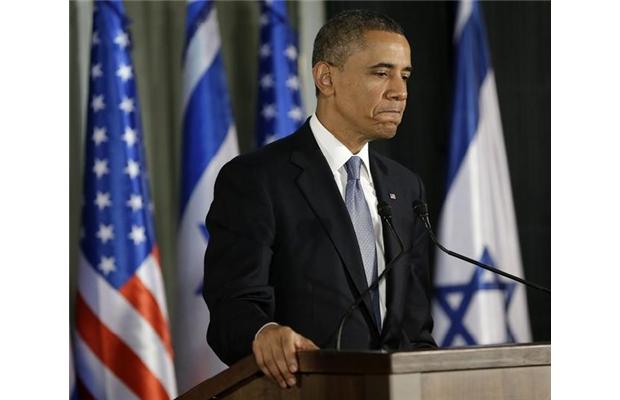
Obama’s visit to Israel and Jordan has brought joy to no one but the Israelis. The US president practically swore an oath of fealty to Israel, speaking not just as a friend and faithful ally, not as a head of state, but as a humble subordinate.
He waxed lyrical on Israel as a land of dreams, then advised the Palestinians to ignore the settlements being built on their land and issued stern warnings to Syria, Iran and Hizbullah.
So eager was Obama to court the Israelis that he suddenly started calling Netanyahu — the very man who supported his rival, Mitt Romney, in the elections — “Bibi”. Tensions between the US president and the Israeli prime minister seemed to evaporate as Obama wandered from one Biblical reference to another while praising Israel for its “shining future”.
Dressed in the colours of the Israeli flag, a blue tie over a white shirt, Obama spared the Israelis no compliment, saying that it was his honour to visit them on Israel’s 65th “independence day”.
“It is good to be in this land,” Obama said in Hebrew, before applauding Israel for being the land of kibbutz that made the desert bloom. His rhetoric was reminiscent of that of a century ago, when the promise of a “land without a people for a people without a land,” launched decades of Palestinian suffering.
Obama didn’t neglect to remind his listeners that he had introduced Passover as a White House celebration.
“After enjoying Seders [Passover] with family and friends in Chicago and on the campaign trail, I’m proud that I’ve now brought this tradition into the White House. I did so because I wanted my daughters to experience the Haggadah and the story at the centre of Passover that makes this time of year so powerful.”
After mentioning the long history of the Jewish people and their years in exile, the sad memories of the Jewish holocaust, Obama showered the Israelis with praise for their many successes.
Then, he lashed out at Iran. Iran’s nuclear programme, he said, is “not simply a challenge for Israel. It is a danger to the entire world, including the United States. A nuclear-armed Iran would raise the risk of nuclear terrorism. It would undermine the non-proliferation regime,” he stated.
Reiterating US commitment to Israeli security, Obama made a pledge: “The security of the Jewish people in Israel is so important. It cannot be taken for granted. But make no mistake. Those who adhere to the ideology of rejecting Israel’s right to exist, they might as well reject the earth beneath them and the sky above, because Israel is not going anywhere.”
The Israeli website Walla! pointed out that in his speech, the US president mentioned the word “Israel” 82 times and the word “Palestinian” only 21 times.
Obama also visited the tombs of Herzl and Rabin, then the Yad Vashaem Holocaust Memorial. But he declined to visit the tomb of Yasser Arafat. And he refused to meet the daughter of one of the political prisoners held in Israel’s detention camps.
The whole thing seemed as if the US president was telling the Palestinians and Arabs, “This is the land of the Jews; so go look for your land elsewhere!”
Now the writing is on the wall. Those who had taken the US president for a moderate should take note.
Related articles
- Israel admits: Just 0.7% of West Bank allocated to Palestinians (alethonews.wordpress.com)
- Obama’s Peace Antics in Israel – Four More Years of This? (alethonews.wordpress.com)
March 30, 2013 Posted by aletho | Ethnic Cleansing, Racism, Zionism, Progressive Hypocrite, Timeless or most popular, Wars for Israel | Hezbollah, Iran, Israel, Obama, Palestine, Syria, United States, Yasser Arafat, Zionism | Leave a comment
Goodbye Miliband; Don’t Come Back
By Stuart Littlewood | Palestine Chronicle | March 28, 2013
The tears shed by assorted media at the news of David Miliband’s departure from British politics for a new life in New York had me reaching once again for the sick-bag.
“British politics will be a poorer place without David,” said brother Ed, leader of the Labour Party.
Will it? I’m pleased to see Peter Oborne’s straight-talking piece in The Telegraph putting Miliband D in his place.
“We are, after all, talking about someone who was at best a minor politician, no towering colossus,” writes Oborne. “After Labour’s 1997 election victory he was the poster boy of a new ruling elite which seized control of the commanding heights of British politics. Anti-democratic, financially greedy and morally corrupt, this new political class has done the most enormous damage. Since David Miliband was its standard-bearer, his political career explains a great deal about what has gone wrong with British public life, about why politicians are no longer liked or trusted, and about how political parties have come to be viewed with contempt.”
Oborne makes the point that Miliband set the pattern so many others, including his brother Ed, have followed. “Obsessed by politics at university, he has never had even the faintest connection with the real world. From life in think tanks he became a Labour Party researcher and special adviser, before being parachuted into the north-eastern constituency of South Shields as an MP.”
Miliband wrote Labour’s vacuous 1997 and 2001 election manifestos and was at the heart of the Labour machine when it generated the now notorious falsehoods over Iraq. Oborne also notes the irony of Miliband’s new job heading a humanitarian organisation “when the government of which he was such a loyal member created so many of the world’s disasters”.
We are reminded that Miliband was inexperienced and had no idea how the world worked, so was out of his depth when promoted to the Foreign Office. “During his short, undistinguished career, Mr Miliband has done grave damage to British politics. He is part of the new governing élite which is sucking the heart out of our representative democracy while enriching itself in the process… David Miliband has belittled our politics and he will not be missed.”
And having gone, many will be praying the Miliband brat won’t be back.
He will be forever remembered as the British foreign secretary who shamelessly apologized to Israel’s gangsters for the risk they ran of being arrested if they set foot in London. Back in 2009 Ehud Barak, Tzipi Livni and retired general Doron Almog, cancelled engagements in London for fear of ‘having their collar felt’. Israel complained bitterly and Miliband promised Lieberman that UK laws relating to ‘universal jurisdiction’ would be changed. He asked Prime Minister Gordon Brown and Justice Minister Jack Straw for urgent action.
When the general election ousted him from the Foreign Office, Miliband’s groveling promise was eagerly taken up by his replacement, William Hague, another fanatical ‘friend of Israel’, who declared that a situation where politicians like Mrs Livni could be threatened with arrest in the UK was “completely unacceptable… We have agreed in the coalition about putting it right, we will put it right through legislation… and I phoned Mrs Livni amongst others to tell her about that and received a very warm welcome for our proposals.”
Never mind that the arrest warrants were issued to answer well-founded criminal charges. Never mind that under ‘universal jurisdiction’ all states that are party to the Geneva Conventions are under a binding obligation to seek out those suspected of having committed grave breaches of the Conventions and bring them, regardless of nationality, to justice. And never mind that there should be no hiding place for those suspected of crimes against humanity and war crimes.
Human rights activists resorted to private arrest warrants because the government was in the habit of shirking its duty under the Fourth 1949 Geneva Convention and dragged its feet until the birds had flown.
Bringing a private prosecution for a criminal offence is an ancient right in common law and, in the words of Lord Wilberforce, “a valuable constitutional safeguard against inertia or partiality on the part of the authority.” Lord Diplock, another respected Lord of Appeal, called it “a useful safeguard against capricious, corrupt or biased failure or refusal of those authorities to prosecute offenders against the criminal law”.
And the beauty of the private warrant was that it could be issued speedily.
The servile Miliband’s action disgusted those who will never forget that Tzipi Livni, Israel’s former foreign minister, was largely responsible for the terror that brought death and destruction to Gaza’s civilians during the blitzkrieg known as Operation Cast Lead. Showing no remorse, and with the blood of 1,400 dead Gazans (including 320 children and 109 women) on her hands and thousands more horribly maimed, Livni’s office issued a statement saying she was proud of it. Speaking later at a conference at Tel Aviv’s Institute for Security Studies, she said: “I would today take the same decisions.”
Any British government minister who brings this degree of obsequiousness to his job and is prepared to undermine our justice system in order to make the UK a safe haven for the likes of her, deserves to be judged harshly.
Miliband is also remembered for not having the guts to visit Gaza, or even Iran, while in office. Yet he managed to reach Gaza in 2011 with Save the Children. “I had not been able to visit while in government for security reasons,” he said in an article in The Guardian. What nonsense. The only danger would have been from an air-strike by his psychopathic friends in Tel Aviv or a Mossad assassin. Those risks go with the job. You can’t be an effective foreign secretary wrapped in cotton wool.
He said the purpose of his eventual trip to Gaza was “to get a sense of life… to get a glimpse, albeit brief, of life for the people”. A pity he didn’t do that earlier instead of wielding his ministerial power in ignorance
While David Miliband headed up foreign policy it was frankly embarrassing to be British. What magical transformation has this pipsqueak recently undergone to make him the ideal candidate to run an organization like the International Rescue Committee? With the likes of Madeleine Albright, Condoleeza Rice, Colin Powell, and Henry Kissinger on board, you might wonder about the IRC’s presence in vulnerable countries like Syria, Iraq and Afghanistan.
No-one is about to forget Albright’s infamous remark about the human misery caused by the intervention and mayhem in Iraq, that “the price is worth it”.
– Stuart Littlewood’s book Radio Free Palestine, with Foreword by Jeff Halper, can now be read on the internet by visiting http://www.radiofreepalestine.org.uk.
March 29, 2013 Posted by aletho | Ethnic Cleansing, Racism, Zionism, Timeless or most popular, War Crimes | David Miliband, Gaza, Geneva Conventions, Israel, Labour, Palestine, Peter Oborne, Politics of the United Kingdom, Tzipi Livni, Zionism | Leave a comment
Honduran Cops, The Latest U.S.-Backed Killers
By NICK ALEXANDROV | CounterPunch | March 29, 2013
Official U.S. support for bands of killers dates back to the nation’s inception, likely one reason H. Rap Brown called violence “as American as cherry pie.” The country’s founding father helped start the trend when he sent General John Sullivan to Iroquois territory in 1779, giving him explicit instructions “that the country may not be merely overrun, but destroyed.” “It will be essential to ruin their crops,” the Town Destroyer—as Washington became known—emphasized. Sullivan and his men brought their adventure to a close when they “skinned the bodies of Indians from the hips downward, to make boot tops or leggings,” historian Ernest Cruikshank wrote in the late 1800s, prompting a contemporary, John Watts de Peyster, to wonder “which were the savages, the Continental troops or the Indians,” in the situation just described.
Scholars today tend to remark only that Washington seems “more a monument than a man,” as Gordon Wood never tires of pointing out; Wood spoke a month ago at an event celebrating Washington’s birthday, beginning with the premise that the first U.S. president was great, and proceeding from there. Bertrand Russell once criticized medieval philosophy for assuming in advance it knew the truth, thereby avoiding genuine inquiry—still apparently a prerequisite for academic success, given Wood’s reputation.
The belief that indigenous groups wasted the opportunities the land provided drove policies of dispossession and extermination, the latter being the term Jefferson, Jackson, and other luminaries favored. Little wonder Hitler admired this facet of U.S. history. During the California Gold Rush, whites murdered and raped the region’s native inhabitants, some of whom had known there was gold in the area, without valuing it as an exploitable resource. What could the land’s rightful owners do with such people? “Why not annihilation?” Wizard of Oz author L. Frank Baum asked in an 1890 editorial, capturing the zeitgeist.
These assumptions about the right to control territories, and the obstacles blocking enlightened developers from achieving their aims, grew more expansive after the Native American genocide. As WWII drew to a close, U.S. planners outlined a system of “foreign missions throughout the world” in conformity with corporate aims. “We are colonizing to some extent,” Representative Eugene Worley (D-TX) affirmed, not quite doing justice to Washington’s plans to copy the British imperial model—“a good goal to shoot at, because they are the masters,” the American Maritime Council’s John E. Otterson argued, voicing views his audience, a House subcommittee, received well. After listening to Assistant Secretary of State Adolf Berle’s 1943 discussion of U.S. intentions to govern the planet’s skies, Representative Charles A. Eaton (R-NJ) asked him to “define for us the difference in principle between Mr. Hitler’s program to obtain control of all land and all peoples and all oceans and seas, and the proposed program now for America to obtain control of all the air on earth[.]”
One of Eaton’s colleagues clarified the distinction: the U.S. sought “world power as trustee for civilization,” while Hitler wanted it merely “for the benefit of a bunch of Nazi gangsters.” Any student of U.S. history should have been able to recognize the country’s pure intentions—and if, for some reason, the examples of Town Destroyer and the Gold Rush proved unpersuasive, the coming decades would further testify to its benevolence. In 1976, we see that Secretary of State Kissinger encouraged the Argentine government to carry on with its dirty war, in which the military “disappeared” as many as 30,000 people. “The quicker you succeed the better,” the Nobel Peace Laureate stressed, and by the late ’70s the CIA was bringing Argentine officers into Honduras, so they could teach their Central American counterparts what they had mastered.
Doris Rosibel Benavides Tarrius, a young psychologist, experienced first-hand the Honduran students’ aptitude. Security forces abducted her in March 1987, taking her to a facility where they raped her, and strung her up on a metal bar to shock her feet and breasts, in what was called an “airplane position.” A decade earlier, an Argentine mechanic named Marcos Queipo watched as military planes passed over the Paraná Delta, dropping mysterious packages that plummeted to the riverbanks far below. Horacio Verbitsky, an investigative journalist, learned about these flights years later, when a stranger approached him in the Buenos Aires subway. “I want to talk to you,” the man said, explaining he had helped prosecute the dirty war. “You’ll see that we did things worse than the Nazis,” Adolfo Scilingo continued, subsequently telling of how he pushed several thousand suspected subversives, each drugged into a stupor but still alive, out of airplanes. Queipo saw some of their bodies in the packages he opened, though most of the murdered have never been found.
The killings continue in Honduras, where violence targeting lawyers, human rights defenders, LGBT people, women and others has intensified since the June 2009 coup. Two School of the Americas graduates helped topple the democratically-elected leader that month, and Obama supported the ensuing presidential election, a farce the mainstream media would have ridiculed had it taken place in, say, Venezuela. Last fall, the Honduran Commission of Truth identified several patterns of repression endangering the public, which the World Bank never mentions in the summary of its “Safe Municipalities Project,” ostensibly aimed at promoting “citizen security.” One of the Bank’s real goals seems to be expanding the Honduran police’s reach into areas like Choloma—“a dustbin industrial mecca for maquiladoras,” as scholar-activist Adrienne Pine described it. Juan Carlos Bonilla, accused of extrajudicial killings, oversees the entire Honduran National Police, even though the State Department tried to claim otherwise, saying it directed U.S. funds only to vetted units outside his purview.
Allegations of death squad-style murders have been leveled at Bonilla’s men in recent years, indicating the Bank’s “security” aims apply less to human beings then they do to the current economic model, in which agribusinesses thrive, while displaced peasants are forced into manufacturing work. The situation brings to mind the Bank’s steady lending to Guatemala in the late ’70s and early ’80s, when the genocidal government was slaughtering Mayans to free up the areas designated for the Chixoy Hydroelectric Dam.
As in the past, only an enlightened few seem to grasp the land’s enormous potential as a profit source. The rest pay for their ignorance, often with their lives. It’s an old story, but no less infuriating for that—and the trend’s deep roots in the past indicate a combination of radical thinking and enormous effort is required to end the system enabling it.
Nick Alexandrov lives in Washington, DC. He can be reached at: nicholas.alexandrov@gmail.com.
Related articles
- Did the AP Catch State Department Officials Lying to Congress About Honduran Death Squads? (alethonews.wordpress.com)
- Killings Continue in Bajo Aguán as New Report Documents Abuses by U.S.-Trained Honduran Special Forces Unit (alethonews.wordpress.com)
- World Bank Must End Support for Honduran Palm Oil Company Implicated in Murder (alethonews.wordpress.com)
March 29, 2013 Posted by aletho | Ethnic Cleansing, Racism, Zionism, Subjugation - Torture, Timeless or most popular, War Crimes | California Gold Rush, George Washinton, Honduran National Police, Honduras, Latin America, Obama, Town Destroyer, United States | Leave a comment
Myths about Korean militarism
By David Whitehouse | Worxintheory | March 21, 2013
The frontier between North and South Korea is the most militarized border in the world. There is, of course, another partitioned state in Asia, India-Pakistan, where each side possesses nuclear weapons and commands hundreds of thousands of soldiers. In Korea, though, the stakes are especially high because one of the belligerents is a superpower.
On the opposite side, the world’s most likely superpower-in-the-making, China, is North Korea’s only close ally. It’s not clear that China would intervene militarily in the North’s defense, but the possibility of such action raises the stakes of confrontation even higher. The last war on the Korean peninsula, from 1950 to 1953, pitted the same two outside powers against each other. The Korean War produced well over 2 million civilian casualties.
At various times in the past 20 years, the Pentagon has estimated that one million Korean civilians, divided evenly between North and South, would die in the first days of an all-out war. More than 25 million people live in metropolitan Seoul, South Korea’s capital. The Pentagon refers to the area as the “kill box.”
US military power is overwhelming, but North Korea does possess some deterrents. That’s why there would be casualties on both sides. Chief among the North’s deterrents may be its set of more than 10,000 artillery pieces, dug into the mountains, which could bombard Seoul with explosive, incendiary or chemical weapons. There is no evidence that the North is technically capable of delivering or detonating a nuclear weapon in the South, but the regime has worked in recent years to develop suitable delivery systems and to turn their unwieldy nuclear “devices” into bombs.
In the standard media representation, the rulers of the Democratic People’s Republic of Korea (DPRK — North Korea’s official name) are uniquely bellicose, unpredictable and irrational. Some would say “inscrutable” if that word weren’t obviously racist. George W. Bush was an obvious racist, of course, so he was true to form when he called the regime’s then-General Secretary Kim Jong-il a “pygmy.”
Despite the media’s befuddlement over the regime’s motivations and intentions, they aren’t difficult to figure out. They come through quite clearly at the English-language site of the Korean National News Agency (KCNA) once you figure out how to read through the froth and invective. American reporters and editors are inclined to dismiss the KCNA’s reports because they’re pretty sure that the US can’t be “imperialist” or “arrogant,” as the KCNA claims, and because they treat State Department and Pentagon sources as generally honest and reliable.
These credulous attitudes may arise from complacency, unthinking patriotism, or the job pressures inside the corporate media. In any case, US news outlets consistently produce egregious distortions when they cover the DPRK’s conflicts with the United States. Sometimes the accounts of North Korean actions are accurate enough. Often what makes the picture false is the misrepresentation — or simple omission — of US actions.
As a result, the picture of US-DPRK relations is topsy-turvy. Below, I discuss three points that the media usually get backwards.
1) North Korea nuclearized the peninsula with its bomb test of 2006.
Wrong. The US threatened the use of nuclear weapons in the Korean War of 1950-1953, and President Eisenhower installed an ongoing nuclear arsenal beginning in 1958. The weapons included missiles, bombs and artillery shells. F-4 fighter planes were on constant alert — armed only with nuclear bombs.[1]
There were also portable “atomic demolition mines” (ADMs) that weighed just 60 pounds each. With an explosive yield equivalent to 20 kilotons of TNT, the mines were more powerful than the Hiroshima bomb. Korea specialist Bruce Cumings writes:
The ADMs were moved around in Jeeps and placed by special teams who carried them in backpacks; meanwhile, US helicopters routinely flew nuclear weapons near the DMZ [the Demilitarized Zone, which divides North from South Korea].… Meanwhile, forward deployment of nuclear weapons bred a mentality of “use ‘em or lose ‘em”; even a small North Korean attack might be cause enough to use them, lest they fall into enemy hands.[2]
President George H.W. Bush withdrew nuclear weapons from the peninsula in 1991 as a cost-free way to place the burden of disarmament on North Korea. The US, of course, was not disarming at all. The Gulf War had shown that the latest generation of “conventional” weapons could inflict suitably horrific damage, and besides, nuclear weapons would be ready-at-hand on offshore ships, submarines and planes.
2) North Korea is serial violator of the Armistice of 1953.
The DPRK regime declared on March 11 of this year that it was nullifying the armistice of 1953. Ban Ki-moon of the United Nations replied that the North could not nullify the agreement unilaterally. The UN is involved because the US fought the Korean War against North Korea and mainland China in the name of the UN. At the time, the anticommunist Taiwan government represented China on the Security Council — a fact that led the USSR to boycott the council. With mainland China excluded and the USSR boycotting, the war resolution passed without a veto.
The fighting ended with an armistice, not a peace treaty, so the “UN coalition” is still technically at war with North Korea. I’m not sure why nobody mentions being at war with China, too.
The South Korean defense ministry declared in 2011 that North Korea had violated the armistice 221 times since 1953. This includes 26 claims of military attacks. Some of these attacks were serious, including a 2010 torpedo attack that killed 46 South Korean sailors and an artillery bombardment later in the same year that killed two South Korean marines and two civilians. In the first case, North Korea denies making the attack. In the second, the regime claims that South Korea shot first.
In fact, the regime often disputes accusations of violating the armistice, declaring that their actions were responses to violations by the US and South Korea. Unfortunately, nobody seems interested in keeping records about those violations. (If somebody finds a decent account, please let us know.)
The important thing to know about armistice violations is the big one: The US deployment of nuclear weapons violates an explicit ban on the introduction of “qualitatively new” weapons to Korea. The ban applies to the whole Korean “theater,” so offshore weapons are included.[3] The US has thus committed a major violation of the Armistice continuously for 55 years.
This nuclear posture was known in the Cold War as a “first-strike” policy, since it licensed the use of nuclear weapons even without a nuclear provocation. The US renounced the first-strike option in the European theater but not in Korea. “The logic,” writes Bruce Cummings, “was that we dare not use nuclear weapons in Europe because the other side has them, but we could use them in Korea because it doesn’t.”[4]
3) North Korea has violated the nuclear Nonproliferation Treaty.
The world’s great powers came up with the nuclear Non-Proliferation Treaty (NPT) in 1968 as a way to maintain their monopoly on nuclear weapons. In the treaty, the nuclear states of that time — the US, Britain, France, the USSR and China — made a vague promise to negotiate their own disarmament in the future.
In order to induce non-nuclear states to sign, the treaty stipulated that nuclear-armed states would help the NPT’s non-nuclear members to develop nuclear power for peaceful uses such as energy production. As a further inducement, the nuclear-weapons states offered a side agreement (not in the NPT) in which they promised not to threaten non-nuclear signatories of the NPT with nuclear attack — or to carry out such attacks.
North Korea did not sign the NPT until 1985. At the time, the DPRK had a small reactor that produced plutonium waste and very little electricity. The Reagan administration feared that the waste could be stockpiled to make a weapon. The US encouraged Konstantin Chernenko, then premier of the USSR, to offer North Korea light-water reactors (LWRs), which produce no waste that can easily be converted into weapons-grade material. The energy-strapped DPRK accepted the deal and agreed to sign the NPT.[5] This was the kind of quid pro quo that the treaty’s authors anticipated when they wrote it.
The USSR was crisis-ridden in the 1980s and dithered over construction of the four promised LWRs, which would have cost about $1 billion apiece. When the Soviet state collapsed in late 1991, the DPRK lost one of its two patrons — the other was China — and entered a decade of natural disaster, economic regression and famine.[6]
With US technical help, and upon US insistence, the UN’s atomic agency (IAEA) began mandatory, intrusive inspections of the DPRK’s nuclear sites in 1992. Following the Gulf War of 1991, the US and the chief inspector of the International Atomic Energy Agency (IAEA), Hans Blix, improvised a new regime of mandatory inspections backed by the threat of Security Council sanctions. Iraq, Iran and North Korea were the intended target of these “special inspections.” The NPT does not authorize any of this.
IAEA inspectors did surmise in 1992-1993 that North Korea had probably stockpiled a significant amount of plutonium. US intelligence operatives looked over the IAEA data and concluded that the hypothesized amount of stockpiled plutonium would be enough to construct one or two nuclear weapons, although they believed that the DPRK was as yet technically incapable of making the plutonium into bombs. These intelligence estimates gave rise to an oft-quoted “worst-case scenario” according to which North Korea already possessed two nuclear weapons in the 1990s.[7]
Stockpiling plutonium may constitute a violation of the NPT, but if so, then Japan is many times more guilty than North Korea. With US approval, Japan has stored up enough plutonium to construct 5,000 warheads. Nevertheless, Japan’s nuclear sites have never been subject to UN “special inspections,” although the country’s nuclear safety record suggests that it wouldn’t be a bad idea.
North Korea declared Blix to be a stooge of the United States — which, of course, he was — and threatened to pull out of the NPT. Eventually, Clinton backed away from the crisis. He offered to provide the LWRs previously promised by the USSR in return for North Korea’s acceptance of further IAEA inspections. The deal was formally written up along with some other provisions, dubbed the “Agreed Framework,” and signed by both parties.
Like the USSR, the US never delivered the LWRs — never even broke ground on them. If we’re looking for violations of the NPT, that’s a clear one, since the NPT obligates nuclear-weapons states to help non-weapons states with nonmilitary nuclear projects.
The promise of LWRs may have been the part of the Agreed Framework that the Northern regime cared most about. For the entire time of its membership in the NPT, from 1985 to 2003, North Korea waited for assistance with nuclear electricity-production that never came. In Clinton’s second term, those who wanted to ridicule the DPRK began to point to nighttime satellite photos of East Asia that showed every country but North Korea lit up. They didn’t mention that the US played a role in turning out the lights.
Meanwhile, although the US had signed every updated version of its 1968 promise not to target non-nuclear-weapons states, Bill Clinton reaffirmed the first-strike policy against North Korea in 1993. After the Soviet Union collapsed, Clinton publicly approved the retargeting of ballistic missiles from Russia to North Korea.[8]
In January 2002, George W. Bush named North Korea, Iraq and Iran as members of an “Axis of Evil.” Then in March, a leak of Bush’s “nuclear posture review” reconfirmed the US first-strike policy. By the fall, Bush was building up troops in the Middle East to overthrow the Iraqi government. Kim Jong-il had good reason to believe that his government would be next.
In January 2003, North Korea withdrew from the NPT. The treaty itself authorizes a members’ withdrawal when its sovereignty is threatened:
“Each Party shall in exercising its national sovereignty have the right to withdraw from the Treaty if it decides that extraordinary events, related to the subject matter of this Treaty, have jeopardized the supreme interests of its country.”
There’s no doubt that George W. Bush’s “global war on terror” qualified as a set of extraordinary events that jeopardized the DPRK’s supreme interests.
In 2010, Barack Obama confirmed once again that the US “nuclear posture” was to keep targeting North Korea. For North Korea and Iran, said Defense Secretary Robert Gates, “All options are on the table.” It’s a phrase that Obama has used many times since, and it suits his understated style: Threaten the maximum, but make it sound moderate.
[1] Bruce Cumings, Parallax Visions: Making Sense of American–East Asian Relations at the End of the Century (Duke University Press Books, 1999), 127-130.
[2] Ibid., 130.
[3] Ibid., 128.
[4] Ibid., 132.
[5] Don Oberdorfer, The Two Koreas: A Contemporary History (Rev. & upd. Basic Books, 2002), 245 and 289.
[6] For more detail on North Korea’s crisis, and on the imperial interests at play in Korea from 1985 to 2003, see my “What’s at stake in North Korea” in the International Socialist Review, March-April 2003. A PDF is available here.
[7] Oberdorfer, 276.
[8] Cumings, 142.
March 29, 2013 Posted by aletho | Deception, Mainstream Media, Warmongering, Militarism, Timeless or most popular, War Crimes | George H. W. Bush, George W. Bush, Korea, Korean War, North Korea, Seoul, South Korea, United States | Leave a comment
How Big Corporations are Unpatriotic
By Ralph Nader | March 28, 2013
Many giant profitable U.S. corporations are increasingly abandoning America while draining it at the same time.
General Electric, for example, has paid no federal income taxes for a decade while becoming a net job exporter and fighting its hard-pressed workers who want collective bargaining through unions like the United Electrical Workers Union (UE). GE’s boss, Jeffrey Immelt, makes about $12,400 an hour on an 8-hour day, plus benefits and perks, presiding over this global corporate empire.
Telling by their behavior, these big companies think patriotism toward the country where they were created and prospered is for chumps. Their antennae point to places where taxes are very low, labor is wage slavery, independent unions are non-existent, governments have their hands out, and equal justice under the rule of law does not exist. China, for example, has fit that description for over 25 years.
Other than profiteering from selling Washington very expensive weapons of mass destruction, many multinational firms have little sense of true national security.
Did you know that about 80 percent of the ingredients in medicines Americans take now come from China and India where visits by FDA inspectors are infrequent and inadequate?
The lucrative U.S. drug industry – coddled with tax credits, free transfer of almost-ready-to-market drugs developed with U.S. taxpayer dollars via the National Institutes of Health – charges Americans the highest prices for drugs in the world and still wants more profits. Drug companies no longer produce many necessary medicines like penicillin in the U.S., preferring to pay slave wages abroad to import drugs back into the U.S.
Absence of patriotism has exposed our country to dependency on foreign suppliers for crucial medicines, and these foreign suppliers may not be so friendly in the future.
Giant U.S. companies are strip-mining America in numerous ways, starting with the corporate tax base. By shifting more of their profits abroad to “tax-haven” countries (like the Cayman Islands) through transfer pricing and other gimmicks, and by lobbying many other tax escapes through Congress, they can report record profits in the U.S. with diminishing tax payments. Yet they are benefiting from the public services, special privileges, and protection by our armed forces because they are U.S. corporations.
On March 27, 2013, the Washington Post reported that compared to forty years ago, big companies that “routinely cited U.S. federal tax expenses that were 25 to 50 percent of their worldwide profits,” are now reporting less than half that share. For instance, Proctor and Gamble was paying 40 percent of its total profits in taxes in 1969; today it pays 15 percent in federal taxes. Other corporations pay less or no federal income taxes.
Welcome to globalization. It induces dependency on instabilities in tiny Greece and Cyprus that shock stock investments by large domestic pension and mutual funds here in the U.S. Plus huge annual U.S. trade deficits, which signals the exporting of millions of jobs.
The corporate law firms for these big corporations were the architects of global trade agreements that make it easy and profitable to ship jobs and industries to fascist and communist regimes abroad while hollowing out U.S. communities and throwing their loyal American workers overboard. It’s not enough that large corporations are paying millions of American workers less than workers were paid in 1968, adjusted for inflation.
Corporate bosses can’t say they’re just keeping up with the competition; they muscled through the trade system that pulls down on our country’s relatively higher labor, consumer and environmental standards.
Corporate executives, when confronted with charges that show little respect for the country, its workers and its taxpayers who made possible their profits and subsidized their mismanagement, claim they must maximize their profits for their shareholders and their worker pension obligations.
Their shareholders? Is that why they’re stashing $1.7 trillion overseas in tax havens instead of paying dividends to their rightful shareholder-owners, which would stimulate our economy? Shareholders? Are those the people who have been stripped of their rights as owners and prohibited from even keeping a lid on staggeringly sky-high executive salaries ranging from $5,000 to $20,000 an hour or more, plus perks?
Why these corporate bosses can’t even abide one democratically-run shareholders’ meeting a year without gaveling down their owners and cutting time short. To get away from as many of their shareholder-owners as possible, AT&T is holding its annual meeting on April 26 in remote Cheyenne, Wyoming!
Pension obligations for their workers? The award-winning reporter for the Wall Street Journal Ellen E. Shultz demonstrates otherwise. In her gripping book Retirement Heist: How Companies Plunder and Profit from the Nest Eggs of American Workers, she shows how by “exploiting loopholes, ambiguous regulations and new accounting rules,” companies deceptively tricked employees and turned their pension plans into piggy banks, tax shelters and profit centers.
Recently, I wrote to the CEOs of the 20 largest U.S. corporations, asking if they would stand up at their annual shareholders’ meetings and on behalf of their U.S. chartered corporation (not on behalf of their boards of directors), and pledge allegiance to the flag ending with those glorious words “with liberty and justice for all.” Nineteen of the CEOs have not yet replied. One, Chevron, declined the pledge request but said their patriotism was demonstrated creating jobs and sparking economic activity in the U.S.
But when corporate lobbyists try to destroy our right of trial by jury for wrongful injuries – misnamed tort reform – when they destroy our freedom of contract – through all that brazenly one-sided fine print – when they corrupt our constitutional elections with money and unaccountable power, when they commercialize our education and patent our genes, and outsource jobs to other countries, the question of arrogantly rejected patriotism better be front-and-center for discussion by the American people.
Related article
- Beware the New Corporate Tax-Cut Scam: LIFT Is A Big LIE (ourfuture.org)
March 29, 2013 Posted by aletho | Corruption, Deception, Economics, Timeless or most popular | General Electric, Jeffrey R. Immelt, Procter & Gamble, Ralph Nader, United States | Leave a comment
Detroit and the International War of the Rich on the Poor
By RICH GIBSON – CounterPunch – March 28, 2013
Every Detroit teacher was fired in the fall of 2012.
Apparently, the nation did not notice. Hence, this story.
On March 26, 2013, 78% of the voting members of the Detroit Federation of Teachers ratified a contract which DFT president, Keith Johnson, called, “terrible.”
The contract mirrors, does not improve, an edict imposed on the union by an “Emergency Manager,” Roy Roberts, a black 74-year-old former manager at the failed General Motors corporation, once the most powerful company in the world now commonly called Government Motors. Roberts was appointed by Michigan Governor Snyder, effectively setting aside all the key actions of the elected Detroit School Board–the third state takeover in 25 years. None of them repaired the school system.
The DFT contract, though, does allow the union to continue to collect dues, the pacified labor of its members sold to Roberts for the term of the contract. DFT president Johnson will continue to receive his $142,000 salary as the rank and file accept another set of wage and benefit concessions.
Concessions, DFT members should have learned, don’t save jobs. Beginning in 1996, the DFT made concession on concession until, in the fall of 2012, every Detroit public school teacher was effectively fired and forced to reapply for a position. Hundreds of them, including teachers with 20 years and more seniority, one of them a former DFT vice president, have never been recalled.
Even before Roberts arrived, Detroit Public Schools had been shifted into a “Good School/Bad School” system, somewhat parallel to the “Good bank/Bad Bank” plan of the bailout days. Good schools get funded. Bad schools organize decay.
GM, at nearly the time of Robert’s birth, was, faced down in the Great Flint Strike of 1937 by the militant, class conscious, United Auto Workers union–seizing buildings, fighting back cops and troops. The first industrial contract was won by direct action. Where is the resistance today?
We shall see how the DFT, UAW, Johnson, Roberts, and the union movement reflect one another as the world, Detroit, and Michigan, writhe in a rising tide of barbarism–booming inequality and a real promise of endless war–that can only be combated by the potential of a mass, activist, class conscious movement which connects reason to power–for equality and justice.
The parent body of the DFT, the American Federation of Teachers, was among the first, along with the UAW, to openly redefine the relationship of unions, their members, and employers. Once defined best by the term, “contradiction,” both unions at the top adopted what once AFT president Al Shanker, and later NEA presidents, called “New Unionism.” The UAW was more direct: “Partners in Production.” Long before the 2008-09 bailouts, the union tops joined government officials and corporate bosses to declare their unity, not noting that meant the rank and file, and most of the rest of the world, would be on the other side.
The DFT now has but 4,000 members, one-third its size a decade ago, while the UAW looks at the same fate, but about 25% of its size in the union’s heyday. Wages for Detroit school workers, like auto workers, have collapsed while, in the schools and the factories, new hires work for half what the more senior employees earn.
The Detroit Public Schools were once heralded as the finest urban school system in the US, serving more than 299,000 students. Those schools, like all capitalist schools, were never truly public but always segregated by class and race, even within the city. Depending primarily on birth-class, students were taught different “facts,” by teachers (whose dress differed) using different methods, in distinctly different facilities.
Today, the divide is even more glaring. The Detroit Federation of Teachers, in 90% black Detroit, is an affiliate of the American Federation of Teachers, the smaller of the two national teachers’ unions, representing for the most part, urban areas.
Suburban Michigan, overwhelmingly white, is represented by the Michigan Education Association, linked to the larger National Education Association. The racial divide between DFT and MEA hasn’t been demolished by the union leaders, and now it’s being used to demolish their members. MEA stood aside and let Detroit rot, doing nothing. Detroit’s conditions, and management demands for concessions, spread throughout the state–an injury to one preceding an injury to all, a slogan too dangerous for today’s labor bosses.
The same conditions prevail nationwide. Eighty percent of the US teaching force is white. Minority teachers mostly remain located in the most urban areas while suburban school kids are taught by a white teaching force. The national school system is as segregated as it was at the time of Brown vs. the Board of Education; white students being the most fully segregated body.
Not too long ago, most youth could project a somewhat better life than their parents. No more. The false promise of the Obama ruse, “Anyone can make it,” is statistically shattered by the fact that the generation exiting school will do worse that their elders; probably much worse.
It follows that the commonplace call to “Save Public Schools,” is rooted in myth. It’s a demand to more deeply empower what is now a full blown corporate state, promoting a unity which never existed, insisting on a tax increase that will invariably be aimed at those working people who still have jobs, and, importantly, it is a fountain of school worker opportunism: “Save my job, pay me, and I will implement the national curriculum, proctor racist high-stakes exams, and be silent about the militarization of every level of schooling.”
Inherent in “Save Public Schools” is the nationalist view that we all share a common goal to educate all kids in a democratic society. That’s never been the case. It is, though, a good way to make a war popular.
Better: Rescue Education from the Ruling Classes!
“Save Public Schools” is usually followed by: “Stop Privatization;” targeting charter schools.
But privatization misreads reality.
The education project is an imperfect, but true, merger of the corporate, government, and military levels of US government–as were the bi-partisan bailouts of 2008 and the current bi-partisan wars.
Nearly all charter schools are, in fact, publicly funded, subject to public–if corporatized regulations.
In a word: state fascism. It cannot be made gentle nor more democratic. Why offer this perverse structure a cover of legitimacy and more power still?
Today, in fully segregated Detroit, there are less than 55,000 students. A charter system, mostly owned by private operations but funded with public money, holds another 55,000–if internal DPS figures can be trusted. Typically, they cannot. In DPS, for example, every employee at every level has had an interest in inflating attendance numbers. In capitalist schools, every child actually in a schoolroom represents a dollar value.
Corruption and incompetence ran rampant at every level of public life in Detroit for a century, but it hurt more as wealth left the city.
Days before the March 26th DFT contract ratification, the Council of Foreign Relations, led by war-hawk Condoleeza Rice (“We don’t want the smoking gun to be a mushroom cloud,”) issued its Education Task Force Report, demonstrating in clear terms that the education agenda is a war agenda: class and empire’s wars.
“Human capital will determine power in the current century, and the failure to produce that capital will undermine America’s security…Large, undereducated swaths of the population damage the ability of the United States to physically defend itself, protect its secure information, conduct diplomacy, and grow its economy.”
In the midst of World War I, a general demanded that the schools become “human munition factories.” That capitalist schools serve a capitalist state is key to grasping the war project at hand.
We can restate that the education agenda is a war agenda from another standpoint: The school unions’ relationship with The National Endowment for Democracy and Education International. NED is a well-recognized CIA front while EI is the inheritor of the CIA sponsored international teacher unions.
Leaders from both school unions retire to Education International where their salaries are not disclosed. But NEA’s ex-president, Reg Weaver is there. He was paid $686,949 for his last year in office, in a union where many teachers live in house trailers. Former NEA president Mary Hatwood Futrell is at EI. Current NEA president Dennis Van Roekel ($465,000 a year and an expense account he can live on) will surely be there. He’ll join Ed McElroy who “serves on the board of directors of Catholics in Alliance for the Common Good, Education International, and ThanksUSA. McElroy is a member of the board of directors for the National Endowment for Democracy (NED)-a private, nonprofit organization created to strengthen democratic institutions around the world through nongovernmental efforts.” (AFT web site).
The vacillating reactionary, current for-profit press and education “reform” favorite, Diane Ravitch served at the NED and is still saluting the flag and God-blessing America with the best of them.
Labor imperialism, theoretically propelled by the idea that US workers will do better if the world’s workers do worse, and in practice the AFL-CIO’s backing of CIA-corporate adventures all over the world, may have served a relatively tiny number of US workers for a short time, but at the end of the day, it inevitably failed. The lack of international solidarity of working class people is destroying the lives of workers all over the world, and the members of the AFL-CIO as well. That the class war is also a classroom war is, due to de-industrialization, a significant particular, developing world-wide.
Inside the USA, both school unions’ leaders participated in the construction of the Bush No Child Left Behind Act, the Obama move of Race to the Top, and now the nationally regimented curricula, the Common Core standards which will redouble the frenzy around high-stakes testing–and merit pay. Elites know why they have schools, if the work force never considers it.
School workers produce value in capital’s markets. When educators and kids arrive in school, they confront a billion dollar business, more powerful than unorganized kids and teachers. This is part of the answer to the critical question that is rarely asked: Why have school? Educators shape the next generation of workers and military volunteers, labor power, and they generate hope, real or false; a lynchpin of social order, control. People in pacified areas become instruments of their own oppression.
In 2012, Michigan labor, the AFL-CIO and NEA combined, placed a bill on the state ballot to make collective bargaining a legal right. They were reacting to a legislative right-to-work bill the Governor said he would not sign. In effect, the bill sought to win by a vote what had never been won in that manner–rather, victory through building seizures a la Flint in 1937, strikes, and related job actions.
In an atmosphere in which unions had proved themselves to be concession machines on the one hand, and gobblers of the public treasury on the other, Michigan electors rejected the measure. Seeing that, Governor Snyder signed the right-to-work bill, which became law in 2013.
Instead of a vote; why not build for a statewide strike?
The last thing a labor leader in the US wants is a mass of truly class conscious workers who are ready to take direct action in order to control their work places on a daily basis. On one hand, if that was the case, the labor leaders would have nothing to sell the bosses, i.e., labor peace would not be theirs to peddle, but democratically controlled by the members and, on the other hand, such a conscious mass of people would never tolerate labor leaders who make four and five times the wages of average rank and filers, live completely different lives, more in common with employers.
Simultaneous to the issuance of the Council on Foreign Relations report, the Michigan legislature passed a bill that would spread “Emergency Manager” school powers throughout the state in an Education Achievement Authority. The EM is to identify and take over up to 50 state schools, those in the bottom five percentile on test scores. The school workers may be effectively fired, as in Detroit, and, if re-hired, have no collective bargaining rights. New hires would be placed outside the Michigan retirement system.
The Detroit Federation of Teachers, since 1997, did fight back. The members launched both authorized and wildcat strikes–the latter led by radical dissident Steve Conn, a teacher at Detroit’s Cass Tech High School. Conn led the 1999 wildcat, initiating it by shouting, “All in favor of the strike walk over here,” in a mass meeting in Cobo Hall. At least 90% of the members moved.
The DFT members struck again in 2006. One of the more famous quotes by a teacher: “We asked for nothing and won less.” Time and again, DFT leaders lied about the nature of the contracts put up for ratification, until well after the votes were counted.
In each instance, the members were defeated, in the main, by their own elected leaders. In contract after contract, the DFT leaders, from John Elliot to Keith Johnson, urged concession on concession. Conn, who I believe was robbed of the DFT presidency in a fraudulent vote count in 2011, was “suspended” from membership for months–sidelined. He’s been silent since.
On the management side, a low was reached in 2010 when General School Superintendent Teresa Gueyser complained that Otis Mathis, school board president, “repeatedly fondled himself,” in front of her. Mathis was removed but not before current school board member Reverend (changed his name, not a “reverend”) David Murray complained, “well men do have these urges. He’s a young man. That’s just the way it is.” Murray has had his children removed from his care by Protective Services. And he was re-elected.
From the material angle, Detroit’s Takeover School boards, imposed by a succession of Governors beginning in the mid-nineties with former Wayne State University president David Adamany, did nothing to improve DPS by their own standard: test scores. School reform in the absence of social reform fails: think devastating poverty.
The Takeover leaders did build a dozen new schools in a district losing ten thousand students a year–and completely refurbished others, to the delight of suburban developers.
Now, the new schools sit empty, stripped by “Scrappers,” a respected local profession. When the district put fences around the empty buildings, scrappers took the fences.
In 2012, Arne Duncan, education attack dog for the demagogue Obama, called Detroit, “the worst school system in the country.” It’s a tough competition for the bottom, especially in Michigan, what with Flint, Benton Harbor, and other cities destroyed much like Detroit, but smaller.
When the Michigan right-to-work law banned dues check-off in 2012, DFT’s, Keith Johnson, complained in the union’s newspaper, the “Detroit Teacher,” that 86% of the teachers quit and wouldn’t re-sign.
Only a subsequent judge’s injunction now keeps the DFT financially afloat, a double-edged indicator-the courts want the union to exist since it has so helped heap concession on concession on the work force (10% pay cuts last year, gutted health benefits, etc., and this year, the contract imposed by the Emergency Financial Manager-EFM–even worse).
Interviewed in late 2012, Joel Scott, a former 15 year Cass Tech teacher, said, “Keith and AFT’s boss, Randi Weingarten, killed their own golden goose. What were they thinking? They must have known that even the last contract would kill the union, and now this one did. I think they must believe that the end is coming; they’ll grab whatever they can, keep deceiving people, and run away at the last moment. They’re the flip side of finance capitalists.”
Scott went on, “The real tragedy is for the kids and the rank and file members. Detroit kids will get doubly mis-educated, learn again not to like to learn, and the members are going to lose homes, after all their sacrifices.”
Now in Detroit, Scott says, “It’s a vampire city. All the lights on Warren are off; pitch darkness. [Warren is a major street on the west side]. Nobody is going to send their kids to a failed Detroit school. That will be the end of the system. It’s done.”
Emergency Manager Roberts projects a gloomy DPS future–but brighter than probably reality. He believes there will be 38,488 students by 2015. His predecessor, Robert Bobb, paid $450,000 a year, projected 58,000, but the slide continues while false hope in shape shifter forms is dangled before the kids and parents of the city–perhaps in real hopes of preventing another urban uprising.
The steady loss of students places the school system, like the city, on the edge of bankruptcy.
The ongoing sorting to the suburbs and to charters means that 20% of DPS kids are in special ed, requiring extra finances the system does not have.
In December 2012, the US Department of Education issued a report saying that only 7% of DPS kids in the 8th grade were “proficient in reading.” Only 4% were found proficient in math.
Schools, everyone from the Skillman Foundation to for-profit reporters to me, knew, are the key to the city’s survival. Detroit needed young people with kids, central to recreating the city’s tax system, filling the empty homes to overcome the scary crime rate and to make Detroit truly liveable, as it was, a delight, 40 years ago.
In the nineties, several literacy studies reported that nearly 50% of Detroiters are functionally illiterate. That is not my experience, not at that level, and having lived there half of my adult life, I say it’s a stretch, but I’ll agree the adult educational levels are more than troubling. A recent study concluded that half of Michigan residents read below the 6th grade level. In many cases, four generations of Detroiters never had a job. Unemployment among city youth is well over 50 percent.
Crime grows. Rapes and robberies were up 23% in the first months of 2013. Murders often do not get investigated: statistics are murky. Officially, murders were up about 10% at 379. A top official said, “We have lost respect for life in Detroit.”
Two-thirds of the buildings in the city, public and private, are vacant, the Mayor making unfulfilled promises year after year to bulldoze thousands of them.
Like the schools, Mayor Bing (yes, the suburban basket-baller) wants to divide the city into the Good Area/Bad Area zones. Pockets of the city are still peopled. Bing hopes to force those in areas which are mostly vacated to move into the more densely populated areas. But homes in Detroit are nearly worthless. Who will pay the moving expenses?
Detroit city government itself was taken over by an Emergency Manager on March 25th. The city, like the school system, is broke–in every conceivable way.
Former Mayor Kwame Kilpatrick and his father were convicted, in March, of a variety of felony embezzlement charges. The former police chief is in jail. Monica Conyers, wife of Congressman John, was just released. The chief of homicide has been charged with corruption and perjury. City Council President Charles Pugh had his home foreclosed.
The city has not produced a single honest and competent top leader since the death of popular radical lawyer Ken Cockrell Sr., more than twenty years ago: 1989.
Emergency Detroit Manager Orr is a bankruptcy specialist; worked on the auto bankruptcies. Many, probably most, see him using the weapon he plainly declared he held: a bankruptcy that could wipe out contracts, wages, benefits, and pensions, a la the auto bailout which cut auto workers pay by nearly half, with the UAW’s blessing and their cheers for the demagogue, Obama.
One way rulers stay in power is to choose and back the opposition’s leaders. Orr promised to keep City Council members’, and Bing’s, pay at current levels. A hug-fest ensued.
Poverty hustler Jesse Jackson quickly arrived in Detroit while the local preachers mounted a fake resistance. Mysticism, on the rise world wide, will not solve Detroit’s crisis. Proof? The counterfeit Arab Spring.
Other than the courageous fall 2012 Chicago Teachers Union strike, which has profound problems with its cries to “Save Public Schooling,” and “Save Our (sic) Schools” an ideological cul-de-sac which fails to address the whole of the problem, silent about the wars as well, there has been virtually no resistance from the US school worker force, the most unionized people in the US.
Indeed, even after four years of bashing from Democrat Arne Duncan, the personification of George W. Bush’s education program on hyper-speed, more than 95% 9,000 members of the NEA, rank and file teachers, voted to endorse an Obama second term. By the same percentage, they voted not to discuss the bi-partisan wars, an indicator of the power of the empire’s bribe.
What explains the absence of resistance in poor and working communities? Surely, there have been false flags. The Occupy movement, declaring neither leaders nor ideas, occupied nothing significant, was swept away by “hope and change!” and some minimal, if co-ordinated, police violence.
More:
*The initial anti-war marches involved hundreds of thousands of people early in 2002, yet they have vanished, evaporated. Why?
*The massive Mayday Immigrant Rights marches have been repeated, but only under nationalist and religious banners as they to begin to disappear.
*The anti-tuition hike actions, mainly in California but all over the US, were attacked, and seduced—gone.
*Wisconsin and Michigan were farcical electoral moves and both states are right-to-work bastions—where once unionism originated.
*The Arab Spring, posed in the corporate press as a series of revolutions, became the Muslim Brotherhood’s Summer.
Consumerism plays a role. With two-thirds of the US economy based on debt-driven consumption, American society is not likely to produce the solidarity built into industrial work places. Rather, the buyer faces the seller, at odds, each playing to get the better of the other.
Spectacles: the best in the Southwest being the annual Miramar (north San Diego) Air Show’s conclusion: The Wall of Fire. There, 250,000 people, adults holding babies aloft for a good view, witness a massive series of explosions, not merely a wall of fire, but burning napalm. Nobody seems to remember the burning children of Vietnam, echoing Chalmers Johnson’s thought: “Americans know so little history they cannot connect cause and effect.” Johnson predicted, before his death, the Drones would fly at home. Now they do.
Militarism: war means work and now, the military poses its mission as “a job, not an adventure,” as it moves to recruit women for combat because American men are too uneducated, too addicted, too convicted, and too unfit to fill the numbers needed for cannon fodder.
Nationalism. Racism. Sexism. The usual suspects added in do not sum up to a good explanation of the mass hysterical conversion crisis that produces a world of barbarians, top to bottom, Obama to Hillary to Kerry to Afghanistan’s Karzai to Morsi of Egypt to the guardians of Abu Ghraib and Guantanamo and the lowliest 14-year-old suicide bomber purchased by the Pakistan Taliban, or Al Qaeda, for $4,000.
With many people of the world rejecting Soviet-style socialism, never much more than capitalism with a party at the top promising benevolence in the distant future–which was all of socialism–and either rejecting, or failing to grasp, the West’s twins, capitalist exploitation and imperialist war, the project noted at the outset, connecting reasoned class conscious to unified power for equality and justice, is more urgent than ever, and surely more interesting than the shopping decade of the nineties.
More united than ever by systems of capital–transportation, communications, technology, science, exploration, marketing and more–the world is as divided as ever through nationalism, racism, sexism, mysticism, and the rise of fascism as a popular movement in varying forms–picking sides perhaps for World War III.
Even so, school workers are situated at the centripetal organizing point of North America’s de-industrialized life. They do not have to operate the school-to-war pipeline. Indeed, if they begin to recognize the contradiction between why they think they are there, and why elites want them there, perhaps those educators can rescue education from the ruling classes—then help to expose the false mandate from heaven that offers dishonest and incompetent leaders legitimacy they do not deserve,
At base: it’s vital to grasp the whole of why things are as they are and that it is right to rebel. Justice, however, demands organization. It is that, or barbarism.
Dr Rich Gibson is emeritus professor of Social Studies at San Diego State University. He lived most of his adult life in Detroit, most of that at Ardmore and Seven Mile Road. He worked as a foundry worker, an ambulance driver, a pot and pan washer, a teacher, a social worker, and as a Wayne State University professor in the College of Education. With about ten other people, he helped to found what is now the largest local in the UAW, local 6000, not auto-workers, but state employees. He can be reached at rgibson@pipeline.com
March 28, 2013 Posted by aletho | Economics, Progressive Hypocrite, Solidarity and Activism, Timeless or most popular | American Federation of Teachers, Detroit, Detroit Public School, DFT, Michigan, Obama, United States | Leave a comment
The Constitution Applies When the Government Bans Americans From the Skies
By Nusrat Choudhury & Hina Shamsi | ACLU | March 28, 2013
The government does not have the unchecked authority to place individuals on a secret blacklist without providing them any meaningful opportunity to object, the ACLU argued in a brief filed last Friday with the federal district court in Oregon.
We made the filing in Latif v. Holder, our lawsuit asserting that the government violated the Fifth Amendment due process rights of 13 Americans, including four military veterans, by placing them on the No Fly List and refusing to give them any after-the-fact explanation or a hearing at which they can clear their names.
Our brief highlighted the utter irrationality of the government’s No Fly List procedures. The plaintiffs in Latif all flew for years without any problems. But more than two years ago, they were suddenly branded as suspected terrorists based on secret evidence, publicly denied boarding on flights, and told by U.S. and airline officials that they were banned from flying perhaps forever. Each of them asked the government to remove them from the No Fly List through the only “redress” mechanism available—the Department of Homeland Security Traveler Redress Inquiry Program. But the government has refused to provide any explanation or basis for their inclusion in the list. Our clients have been stuck in limbo ever since.
We submitted evidence to the court showing that the No Fly List burdens our clients’ constitutionally protected liberties, with devastating consequences for their personal and professional lives. It deprives them of the ability to fly—an essential means of travel in modern life. It also stigmatizes them as suspected terrorists, although they have never been charged with any crime, let alone convicted of one.
Our brief argued that the Constitution’s core promise of procedural due process requires the government to provide at least some explanation and some hearing where Americans can defend themselves after it deprives them of their liberties. The government’s categorical refusal to provide either is unconstitutional. We explained:
Defendants’ refusal to provide the bare rudiments of due process stems from their embrace of an explicit policy—known as the “Glomar” policy—of refusing to confirm or deny any information concerning a person’s status on the No Fly List. The Glomar policy and Defendants’ inadequate process cannot be reconciled with governing due process doctrine. Courts routinely require notice and some form of hearing for much less severe deprivations of liberty than Plaintiffs have suffered. Thus, the government cannot suspend a student from school for ten days, or recover excess Social Security payments, or terminate state assistance for utility bills without some kind of notice and hearing.
In its own brief to the court defending its “redress” program, the government’s arguments boiled down to two sweeping—and extraordinary—claims. First, according to the government, the Constitution has nothing to say about the adequacy and fairness of the procedures the government provides Americans to challenge their inclusion on the No Fly List because “alternatives” to flying are available. We countered that argument in a separate brief (also filed on Friday) showing that the government relied on the wrong law, and by providing evidence confirming what is obvious: the No Fly List so severely restricts Americans’ ability to travel that it triggers due process rights. Not only does the list ban Americans from the skies, it even bars them from travel on boats. As a result, two of our clients have been effectively banned from traveling from the United States to be with their families in Ireland and Yemen.
The government’s second sweeping claim is that even confirming or denying No Fly List-status (much less actually providing notice of the reasons and basis for inclusion in the list) will cause a parade of national security horribles, including the disclosure of sensitive or classified information. Our brief, however, showed that this argument is based on a fiction: all of our clients already know they are on the No Fly list; they were each prevented from flying and explicitly told that they are on the list. We also pointed out that the mere possibility that sensitive national security information might be involved is no reason to categorically foreclose the hearings that due process requires.
Americans have a right to know what kind of “evidence” or innuendo is sufficient to land them on the No Fly List, and to have a hearing where they can defend themselves. Without this bare minimum, there is no meaningful check to correct the government’s mistakes or ensure that it uses the blacklisting power it claims fairly and appropriately. We are asking the court, therefore, to vindicate a basic yet fundamentally important proposition: a government black list that denies Americans the ability to fly without giving them an explanation or fair chance to clear their names violates the Constitution.
March 28, 2013 Posted by aletho | Civil Liberties, Full Spectrum Dominance, Timeless or most popular | American Civil Liberties Union, Department of Homeland Security Traveler Redress Inquiry Program, Fifth Amendment to the United States Constitution, No Fly List, United States, United States Constitution, United States Department of Homeland Security | Leave a comment
UN Sanctions on Iran: The Dance of Mutual Deniability
By Joy Gordon | Fletcher Forum | March 27, 2013
The comprehensive economic sanctions imposed on Iraq by the UN Security Council in the 1990s fundamentally changed the way we think about sanctions. Sanctions had been seen as a middle route, which was nonviolent, yet more robust than diplomacy. But in Iraq, the humanitarian impact was devastating: child mortality spiked, malnutrition was widespread, the middle class disappeared, and critical infrastructure, such as electricity and water treatment, declined precipitously and never recovered. As the humanitarian crisis continued, activists, practitioners and scholars questioned the ethical legitimacy of sanctions.
The response was the development of targeted “smart” sanctions, which would ostensibly harm only the political or military leadership of the targeted state, or block prohibited goods, without impacting the civilian population. Targeted sanctions included arms embargoes, asset freezes of individual persons and companies, visa denials, and targeted trade sanctions, such as conflict diamonds. There were still unilateral measures that were patently indiscriminate, most prominently the U.S. embargo against Cuba. But by the late 1990s, the Security Council was no longer imposing new measures that were comprehensive.
In the last couple of years we have seen a return to aggressive, deeply damaging measures that are designed to cripple the target nation’s economy as a whole, particularly in the case of Iran. The U.S. sanctions on Iran have been extreme, broadly prohibiting trade, shipping, banking transactions, and investment in Iran’s energy sector. In the last few years we’ve seen the U.S. expand these prohibitions, to restrict not only American companies, but foreign banks and companies as well. The U.S. has aggressively prosecuted major global financial institutions for violations of U.S. sanctions law, and in the last two years there have been a number of cases where banks paid penalties on the order of half a billion dollars each.
Unsurprisingly, the result has been a considerable chilling effect: it is now common to see companies refusing to engage in any transactions at all with Iranian nationals, even for clearly legal purposes. For example, a Swiss organization, the GAVI Alliance, provides vaccines to developing countries. The GAVI Alliance is not subject to U.S. law, but its efforts to provide medical goods to Cuba and Sudan are hampered by U.S. restrictions on shipping companies. Canada’s TD Bank summarily closed down the accounts of Iranians residing legally in Canada. In the U.S., there are growing reports that Iranian-Americans, who in principle are permitted to send remittances to family members in Iran, cannot find any bank in the U.S. or elsewhere that will transfer the funds.
No one could plausibly claim that the U.S. sanctions on Iran are “smart” sanctions. They have crippled Iran’s ability to export oil, to buy gasoline, to import goods of all kinds, to extract and refine oil and natural gas, and to manufacture pharmaceuticals. The irony is that the UN Security Council measures on Iran are perceived to be narrowly crafted to avoid exactly this outcome. The Security Council resolutions only require member states to address cargo, technology, or financial transactions that could contribute to Iran’s nuclear program or ballistic missiles. No one would think that such a specific mandate could have humanitarian consequences—how can depriving a country of nuclear weapons affect education and food security?
But the resolutions contain “hooks” that are then invoked by U.S. allies to impose measures that mirror those of the United States, in a kind of dance of mutual deniability. The Security Council resolutions invite nations to “exercise vigilance” in their dealings with Iran, specifically with Iran’s Central Bank, and with two of its leading banks, Bank Saderat and Bank Melli. It is hard to imagine a term that is more vague and less informative than “exercise vigilance.” After all, we exercise vigilance every time we cross a street or lock a door. But a number of U.S. allies, known as the “like-minded” countries—the European Union, Canada, Australia, Japan, and South Korea—have invoked the call to “vigilance” as justification for imposing broad, damaging measures on Iran, approaching the blanket nature and severity of the U.S. sanctions. Last year, the EU cut off gasoline sales to Iran, and blocked Iranian access to European ports and shipping lines. SWIFT, the global hub for financial messaging critical for international commercial transactions, cut off access to Iran last year.
This disconnect between a seemingly narrow mandate and its broad application is far from a coincidence; it is a deliberate strategy that affords the international community mutual deniability. The EU and the “like-minded” countries can claim that they are not acting unilaterally; they are just being vigilant, as the Security Council has asked them to. At the same time, the Security Council can maintain that it has not imposed unreasonable measures on Iran; its sanctions only concern nuclear weapons and are meant to minimize the humanitarian damage.
In the end, the result is not so different than what we saw in Iraq two decades ago. If you cripple a nation’s access to shipping, energy, and banking, that will cripple its ability to provide health care, food security, electricity, transportation, and other basic needs of its population. The dance of mutual deniability may mean that it’s harder to see how the sanctions work. But that doesn’t mean they’re doing any less harm.
Related articles
- Iran sanctions could force BP to shut down North Sea gas field (alethonews.wordpress.com)
- Why Sanctions on Iran Aren’t Working (ramyabdeljabbar.wordpress.com)
- Iran’s Bank Mellat challenges UK sanctions in Britain’s Supreme Court (en.trend.az)
- US Senate unanimously passes amendment on euro loophole in Iran sanctions policy (en.trend.az)
- NIAC Report Reveals Disconnect Between Iran Sanctions’ Goals and Results (lobelog.com)
- Deutsche Bank braced for £256 mln Iran sanctions charges – report (en.trend.az)
March 28, 2013 Posted by aletho | Deception, Timeless or most popular, War Crimes | European Union, GAVI Alliance, Human rights, Iran, Iraq, Sanctions against Iran, United States | Leave a comment
Featured Video
or go to
Aletho News Archives – Video-Images
Book Review
The Zeolite Book — First Edition, 2026, Paperback
The volcanic mineral medicine will not patent — for the toxic burden medicine will not name
Lies are Unbekoming – October 30, 2026
 Zeolite is old. It is in Roman concrete that has held for two thousand years. It’s in the water filters of ancient cisterns. It’s in the stomachs of Pacific livestock whose keepers knew, somehow, that this grey crumbling rock made the animals healthier. It’s in Soviet clinical protocols from the 1960s. It’s in the standard emergency response to the Chernobyl explosion.
In 1986, after the Chernobyl reactor failure, the Soviet Union manufactured and distributed natural zeolite at industrial scale — for soil remediation, for livestock feed, for human consumption, for the cleanup itself. Karl Hecht, who had been director of the Institute for Experimental and Clinical Pathophysiology at the Charité of Humboldt University Berlin, spent the six decades after that building the clinical research base — on silicon’s role in human health, on zeolite’s clinical safety, on its applications in ageing. In 2018, Pavelić and colleagues published a comprehensive clinical safety review of natural clinoptilolite in Frontiers in Pharmacology. In 2019, Mastinu analysed its binding affinities. In the Western medical literature, these works sit largely uncited.
What has not been treated at book length, until now, is how a volcanic mineral with six decades of Soviet clinical work behind it, two major peer-reviewed Western reviews, and ongoing clinical use across the former Eastern Bloc, remains almost entirely absent from Western medical practice — and what the toxic burden it’s meant to address actually is.
The Zeolite Book gathers the Soviet clinical record, the Western peer-reviewed studies, three contemporary practitioner voices, and three serious counterviews into one honest treatment. That’s why the book runs to seven appendices. 288 pages, four parts, three practitioner voices, three counterviews, seven appendices. The honest treatment is the argument.
Blog Roll
-
Join 2,366 other subscribers
Visits Since December 2009
- 7,793,110 hits
Looking for something?
Archives
Calendar
Categories
Aletho News Civil Liberties Corruption Deception Economics Environmentalism Ethnic Cleansing, Racism, Zionism Fake News False Flag Terrorism Full Spectrum Dominance Illegal Occupation Mainstream Media, Warmongering Malthusian Ideology, Phony Scarcity Militarism Progressive Hypocrite Russophobia Science and Pseudo-Science Solidarity and Activism Subjugation - Torture Supremacism, Social Darwinism Timeless or most popular Video War Crimes Wars for IsraelTags
Afghanistan Africa AIPAC al-Qaeda Australia BBC Benjamin Netanyahu Brazil Canada CDC Central Intelligence Agency China CIA CNN Covid-19 COVID-19 Vaccine Donald Trump Egypt European Union Facebook FBI FDA France Gaza Germany Google Hamas Hebron Hezbollah Hillary Clinton Human rights Hungary India Iran Iraq ISIS Israel Israeli settlement Japan Jerusalem Joe Biden Korea Latin America Lebanon Libya Middle East National Security Agency NATO New York Times North Korea NSA Obama Pakistan Palestine Poland Qatar Russia Sanctions against Iran Saudi Arabia Syria The Guardian Turkiye Twitter UAE UK Ukraine United Nations United States USA Venezuela Washington Post West Bank WHO Yemen Zionism
 Aletho News
- Wrong, AP and NPR: Europe’s 50,000 Heat Deaths Are a Computer-Model Estimate, Not a Real Body Count
- Questioning Your Doctor Is Now Considered A Psychological Problem (Seriously)
- London tourism expo promotes Israeli agency linked to theft of Palestinian land
- Dockworkers launch global strike against Israeli and US military shipments
- Europe facing gas price shock – Gazprom chief
- Ukraine continues recruiting people with disabilities
- Weaponized Journalism: 2021 Sayer Ji Interview with NPR
- Beyond Netanyahu: what Israel’s election means for Palestinians
- Lithuania plans universal conscription
- Lies, Damn Lies, and Ukraine News
- If Americans Knew
- An error has occurred; the feed is probably down. Try again later.
- No Tricks Zone
- Germany’s Green Energy Transition Becoming Increasingly Expensive…Another 6 Trillion Euros!
- Sudden Stratospheric Warming, Powerful El Niño Combination May Lead To Extreme Europe Cold, Energy Crisis!
- Two New Studies Find Thwaites Glacier Melt Cannot Be Driven By Human Activity Or A Warming Ocean
- E-Cars Reduce CO2 Emissions By Only 41% Compared To Internal Combustion Engine Vehicles
- Predictions Made By Renowned Climate Professor Over Past Decades Have Been Proven To Be Poor
- New Study Suggests Large Regions Of The Pacific Ocean Have Been Cooling For The Last 80 Years
- Germany’s Green Energy Debacle: High Energy Costs Force Kahla Porzellan to Close After 182 Years!
- New Study: 50 Years Of The Most Aggressive ‘Net Zero’ Policies Can Only Affect The Global Climate By 0.03°C
- US September “Heat” Was No Record…Many Records Set Decades Ago
- Latest European Green Energy Debacle; Portugal’s Largest Flagship Solar Park Insolvent!
Contact:
atheonews (at) gmail.com
Disclaimer
This site is provided as a research and reference tool. Although we make every reasonable effort to ensure that the information and data provided at this site are useful, accurate, and current, we cannot guarantee that the information and data provided here will be error-free. By using this site, you assume all responsibility for and risk arising from your use of and reliance upon the contents of this site.
This site and the information available through it do not, and are not intended to constitute legal advice. Should you require legal advice, you should consult your own attorney.
Nothing within this site or linked to by this site constitutes investment advice or medical advice.
Materials accessible from or added to this site by third parties, such as comments posted, are strictly the responsibility of the third party who added such materials or made them accessible and we neither endorse nor undertake to control, monitor, edit or assume responsibility for any such third-party material.
The posting of stories, commentaries, reports, documents and links (embedded or otherwise) on this site does not in any way, shape or form, implied or otherwise, necessarily express or suggest endorsement or support of any of such posted material or parts therein.
The word “alleged” is deemed to occur before the word “fraud.” Since the rule of law still applies. To peasants, at least.
Fair Use
This site contains copyrighted material the use of which has not always been specifically authorized by the copyright owner. We are making such material available in our efforts to advance understanding of environmental, political, human rights, economic, democracy, scientific, and social justice issues, etc. We believe this constitutes a ‘fair use’ of any such copyrighted material as provided for in section 107 of the US Copyright Law. In accordance with Title 17 U.S.C. Section 107, the material on this site is distributed without profit to those who have expressed a prior interest in receiving the included information for research and educational purposes. For more info go to: http://www.law.cornell.edu/uscode/17/107.shtml. If you wish to use copyrighted material from this site for purposes of your own that go beyond ‘fair use’, you must obtain permission from the copyright owner.
DMCA Contact
This is information for anyone that wishes to challenge our “fair use” of copyrighted material.
If you are a legal copyright holder or a designated agent for such and you believe that content residing on or accessible through our website infringes a copyright and falls outside the boundaries of “Fair Use”, please send a notice of infringement by contacting atheonews@gmail.com.
We will respond and take necessary action immediately.
If notice is given of an alleged copyright violation we will act expeditiously to remove or disable access to the material(s) in question.
All 3rd party material posted on this website is copyright the respective owners / authors. Aletho News makes no claim of copyright on such material.

