Preparing for a Post-Chávez Venezuela
Not One Step Backward, Ni Un Paso Atrás
By GEORGE CICCARIELLO-MAHER | CounterPunch | March 6, 2013
Hugo Chávez is no more, and yet the symbolic importance of the Venezuelan President that exceeded his physical persona in life, providing a condensation point around which popular struggles coalesced, will inevitably continue to function long after his death. It’s not for nothing that the words of the great revolutionary folk singer Alí Primera are on the tip of many tongues:
Los que mueren por la vida
no pueden llamarse muertos
—
Those who die for life
cannot be called dead.
A Barefoot Revolutionary
Hugo Chávez was a poor kid from the country, which tells you much of what you need to know about him. Bare feet, mud hut, perpetual sunburn, gleaning hard lessons and a strong dose of audacity from everyday experiences in that wild part of the Venezuelan flatlands, or llanos, that crash abruptly into the towering Andes mountains.
While politics was in the soil under his feet and in his every social interaction, Chávez’s first formal contact with revolutionary politics came through his elder brother, Adán, a member of the still-clandestine former guerrilla organization, Party of the Venezuelan Revolution (PRV). It was the PRV that refused intransigently to come down from the mountains in the late 1960s when the Venezuelan Communist Party decided to withdraw from the armed struggle, and it was the PRV more than any other organization that resisted Marxist orthodoxy by excavating Venezuelan and Latin American revolutionary traditions under the umbrella of “Bolivarianism.”
Through Adán, Chávez the younger was imbued with the legacy of this Venezuelan guerrilla struggle and its aspirations, a necessary and portentous counterbalance to the official doctrine he would learn in the military academy. But even as a soldier, Chávez was always irreverent to the core, and it wasn’t long before he had begun to organize with other radical officers. Their conspiratorial grouping would eventually be called the MBR-200, the Bolivarian Revolutionary Movement, and it was not a purely military affair, evolving in close contact with revolutionary communist guerrillas from the PRV and elsewhere.
The Old Venezuela
The old Venezuela is no more. The Venezuelan ancien regime was one of self-professed harmony, and it cultivated this myth to the very end. For political scientists, this translated as “Venezuelan exceptionalism”: in a sea of unrest and dictatorship, it alone remained relatively stable and “democratic.” But this was a harmony premised on the invisibility of the majority, and a stability crafted through the incorporation and neutralization of any and all oppositional movements. Those who refused to concede were murdered or imprisoned in the gulags of this “exceptional” democracy.
When Hugo Chávez first attempted to overthrow the Venezuelan government of Carlos Andrés Pérez in 1992, he was attacking a democracy in name only. Decades of two-party rule had created a system that was utterly unresponsive to the needs of the vast majority, and as economic crisis set in during the “lost decade” of the 1980s, the poor turned to rebellion and the government to brute repression. In only the most spectacular of many moments of resistance, the week-long 1989 rebellion known as the Caracazo, somewhere between 300 and 3,000 were slaughtered as Pérez ordered the military to “restore order” in the poor barrios that surround Caracas and other Venezuelan cities.
It was this rebellion more than any other, and the repression it unleashed, that led, nay forced, Chávez and others to attempt a coup with the support of revolutionary grassroots movements, and it was this coup more than any other event that led to his eventual election in 1998. Finally someone had taken a stand, and when Chávez promised on national television that the conspirators had only failed “por ahora, for now,” he was effectively promising, as did Fidel Castro nearly 40 years prior, that history would absolve him.
The New Venezuela
In many ways, it has. Under Chávez’s watch, Venezuela has become more equal, the most egalitarian country in Latin America in fact, according to the Gini coefficient of income distribution. Poverty has been reduced significantly, and extreme poverty almost stamped out. Illiteracy has been eliminated and education is freely accessible, through the university level, to even the poorest Venezuelans. Health care is free and universal. Despite catastrophic language used by the Venezuelan opposition and foreign press, the economy is strong, and has weathered the global economic crisis better than most (notably, the United States).
More important than this improvement in the social welfare of the Venezuelan majority, however, are the political transformations that the Venezuelan state and people have undergone, transformations that remain far from complete. This was not merely a populist government that sought to buy votes through handouts, but a radically democratic government that sought, often despite its own autocratic tendencies, to empower the people to intervene from below as the true “protagonists” of history. Through communal councils, cooperatives, communes, and popular militias, the Venezuelan government has radically empowered the radical grassroots, albeit not without resistance from its own bureaucrats.
But these accomplishments do not belong to Chávez alone, and in fact, they do not belong to Chávez at all. Long before Chávez, there were the revolutionary movements that tried, failed, and tried better, generating the experiences, organizations, and outlooks that would eventually propel Chávez to the helm of an untrustworthy state. Any celebration of Chávez that presents him as a savior is an insult to the people he held in such high esteem, and whose orders he followed.
Inversely, some ill-informed leftists decry him as not having been revolutionary enough, not moving quickly enough toward socialism: the revolution must be all at once or not at all. Others, here taking a page from the liberals, attack him for being authoritarian, autocratic, and undemocratic. But this all misses the most fundamental point: that the Venezuelan revolution is not Chávez. If we fail to understand why many millions of Venezuelans are in mourning today, then we have voluntarily abandoned any serious effort to understand what is going on in Venezuela.
A Combative Democrat
Even as President, Chávez’s rural persona always managed to break through the polite veneer of political leadership: as when he would often spontaneously break into llanero song, speak in country parables and refrains, or brutally attack opponents and allies alike on live television. Also arguably a legacy of the countryside was his paradoxical democratic authoritarianism: deeply respectful of the people and fervently egalitarian, he would not take no for an answer when it came to revolutionizing the country. While Chávez had long dreamed of becoming a major league pitcher, his childhood nickname, latigo, the whip, described his approach to politics at least as well as it described his fastball.
But this contradiction was not his own: direct democracy and representative democracy are rarely the sympathetic allies their names might suggest, and one of the seeming paradoxes of the Bolivarian Revolution is that it has taken a firm push from above to clear the way for radically democratic participation from below. This is what critics of Chávez and the Bolivarian Revolution mean when they suggest that he has run roughshod over democratic “checks and balances,” failing to note that such institutional constraints, however justifiable, are often far from democratic.
As a result, the two sides seem to speak completely different languages: for the one, which seems to include Republican Congressman Ed Royce bid a quick “good riddance” to Chávez, the leader was an authoritarian dictator. Such claims come as a surprise to Chavistas, however, who have elected him many times, repeatedly choosing the path of an increasingly radical revolutionary process, and who are quick to point out the contradiction between their democratic will and term limits. Many poor Venezuelans, too, were surprised at the outrage that ensued when Chávez referred to George W. Bush as “the devil” or as a “donkey.” The poor rarely grasp the role of politeness in politics, seeing it instead, intuitively but correctly, as the realm of powerful oppositions, of Bush’s own “you’re with us or you’re against us.”
The Manichean nature of Venezuelan politics in recent years has been undeniable, but we would be well advised to recognize, with Frantz Fanon, that this division between us and them, Chavistas and escualidos (or more recently, majunches), was more a reflection of a structural reality than the fault of Chávez or the Revolution. While elite Venezuelans began to mourn the disappearance of Venezuelan “harmony,” what they really meant was that, all of a sudden, poor and dark-skinned Venezuelans had appeared, had made their presence felt, and had even assumed the mantle of the government as a mechanism for pressing their demands.
Chávez certainly courted Manicheanism to mobilize the people in the struggle, but this Manicheanism also came to him, for phenotypic as well as political reasons: dark-skinned, with a wide nose and large ears, “with his very image, Chávez has shaken up the beehive of social harmony… His image upsets the wealthy women of Cuarimare.” Chávez and his supporters have long been racialized in terms that would seem scandalous anywhere else: monkey, blackie, scum, horde, rabble. Open racism exploded during the 2002 coup that unseated Chávez for less than two days, in many ways forcing him to recognize it publicly in a country that had often celebrated mestizaje and insisted that there was no racism in Venezuela. In the end, this Manicheanism has become the most important motor for driving the revolutionary process forward, unifying the people against a common enemy and preparing them for the struggle ahead.
I was supposed to meet Hugo Chávez, but he cancelled at the last minute. His unpredictability stemmed from a combination of security concerns and an irrepressible desire to do everything himself. The closest I ever got was about 10 feet away, awash in a rushing torrent of red-shirted Chavistas on the Avenida Bolívar in 2007, as the now late President drove by atop a truck. As he passed, I reached up and performed my favorite Chavista gesture: pounding palm with fist to symbolize the brutal pummeling of the opposition. As though confirming the centrality of combat in a Revolution that would outlive him, he looked at me and did the same.
The Revolution Will Not Be Reversed
What will happen next? Within 30 days, there will be elections, in which Chávez’s hand-picked successor Nicólas Maduro will almost certainly prevail against an opposition that only seems to ever come together for the purposes of then falling apart. But the future in the longer term remains unwritten. While nothing is inevitable, however, a great many poor and radicalized Venezuelans will tell you that they will not take ni un paso atras, a single step back, and that conversely, no volverán, they shall not return. And they mean it.
This is a revolutionary assurance that has never depended solely on the figure of Chávez. As I write in the introduction to my forthcoming book We Created Chávez:
“The Bolivarian Revolution is not about Hugo Chávez. He is not the center, not the driving force, not the individual revolutionary genius on whom the process as a whole relies or in whom it finds a quasi-divine inspiration. To paraphrase the great Trinidadian theorist and historian C.L.R. James: Chávez, like the Haitian revolutionary Toussaint L’Ouverture, ‘did not make the revolution. It was the revolution that made’ Chávez. Or, as a Venezuelan organizer told me, ‘Chavez didn’t create the movements, we created him.’”
In 1959, Frantz Fanon declared the Algerian Revolution irreversible, despite the fact that the country would not gain formal independence for another three years. Studying closely the transformation of Algerian culture during the course of the struggle and the creation of what he called a “new humanity,” Fanon was certain that a point of no return had been reached, writing that:
“An army can at any time reconquer the ground lost, but how can the inferiority complex, the fear and the despair of the past be re-implanted in the consciousness of the people?”
In revolution, there are no guarantees, and there’s no saying that the historical dialectic cannot be bent back upon itself, beaten and bloody. The point is simply that for the forces of reaction to do so will be no easy task. Long ago, the Venezuelan people stood up, and it is difficult if not impossible to tell a people on their feet to get back down on their knees.
George Ciccariello-Maher, teaches political theory at Drexel University in Philadelphia. He is the author of We Created Chávez: A People’s History of the Venezuelan Revolution (Duke University Press, May 2013), and can be reached at gjcm(at)drexel.edu.
Related article
- Chavez is dead, but his revolution goes on (alethonews.wordpress.com)
March 7, 2013 Posted by aletho | Economics, Solidarity and Activism, Timeless or most popular | Alí Primera, Caracas, Chavez, Communist Party of Venezuela, Hugo Chávez, Venezuela | Leave a comment
Iran nuclear issue overhyped: Ex-IAEA chief Hans Blix
Press TV – March 7, 2013
On February 22, 2012, Leader of the Islamic Revolution Ayatollah Seyyed Ali Khamenei said Iran considers the pursuit and possession of nuclear weapons “a grave sin” from every logical, religious and theoretical standpoint.
The Leader described the proliferation of nuclear weapons as “senseless, destructive and dangerous,” adding that the Iranian nation has never sought and will never seek atomic bombs as the country already has the conventional capacity to challenge the nuclear-backed powers.
A former chief of the International Atomic Energy Agency (IAEA) has dismissed as “overhyped” the Western propaganda over the ‘threat of nuclear-armed Iran,’ saying there is no evidence that Tehran is even interested in producing weapons of mass destruction.
“So far Iran has not violated the NPT (Treaty on the Non-Proliferation of Nuclear Weapons) and there is no evidence right now that suggests that Iran is producing nuclear weapons,” Hans Blix said in Dubai.
He added that no action can be justified against Iran’s nuclear activities on “mere suspicions or intentions that may not exist.”
The former IAEA chief had previously said that Iran has been more open to international inspections than most other countries would be.
Iran has repeatedly expressed its strong opposition to any production, possession or use of nuclear weapons, saying such arms have no place in the Islamic Republic’s nuclear doctrine.
On February 22, 2012, Leader of the Islamic Revolution Ayatollah Seyyed Ali Khamenei said Iran considers the pursuit and possession of nuclear weapons “a grave sin” from every logical, religious and theoretical standpoint.
The Leader described the proliferation of nuclear weapons as “senseless, destructive and dangerous,” adding that the Iranian nation has never sought and will never seek atomic bombs as the country already has the conventional capacity to challenge the nuclear-backed powers.
The US, Israel, and some of their allies have repeatedly accused Iran of pursuing non-civilian objectives in its nuclear energy program.
Iran rejects the allegations, arguing that as a committed signatory to the NPT and a member of the IAEA, it has the right to use nuclear technology for peaceful purposes.
Despite the IAEA’s numerous inspections of Iran’s nuclear facilities, the UN nuclear agency has never found any evidence showing that Iran’s civilian nuclear program has been diverted to nuclear weapons production.
Related articles
- Pretty in Pink: The Parchin Preoccupation Paradox (alethonews.wordpress.com)
- Do not repeat Iraq’s mistake on Iran: Hans Blix (payvand.com)
March 7, 2013 Posted by aletho | Deception, Mainstream Media, Warmongering, Timeless or most popular | Ali Khamenei, Hans Blix, IAEA, International Atomic Energy Agency, Iran, Nuclear Non-Proliferation Treaty | Leave a comment
Chomsky Acknowledges the Neocons as the Dominant Force in Pushing for Iraq War
By Stephen J. Sniegoski | The Passionate Attachment | March 7, 2012
Thanks to the efforts of the indefatigable James Morris, a seeming transformation of the view of the illustrious Noam Chomsky was revealed, which, if not equivalent to the change that Saul of Tarsus underwent while on the road to Damascus, was significant nonetheless. Morris seems to have a knack for ferreting out the unknown views of the famous, as was illustrated in his 2010 email exchange with General David Petraeus, then head of U.S. Central Command, in which he was able to reveal the latter’s close relationship with neocon Max Boot and his ardent desire to propitiate the pro-Zionist Jewish community at a time when it was generally thought that Petraeus was critical of the negative effects of the intimate U.S.-Israeli relationship on America’s position in the Middle East.
The Chomsky revelation took place while the latter was a guest on Phil Tourney’s “Your Voice Counts” program on Republic Broadcasting Network from 2:00 pm to 3:00pm Eastern Standard Time on Sunday, February 24, 2013. While Chomsky is a strong and very knowledgeable critic of Israel, he also has been (at least, was before this program) a stringent critic of the idea that the neocons have any significant impact on American Middle East policy. Rather, he presents a somewhat nebulous, quasi-monolithic, corporate elite, which includes the oil interests, as determining American policy in that region—as it does everywhere else in the globe—for its own economic interests. In what has been Chomsky’s view, Israel only serves as an instrument for American imperialism; that it too might benefit from American policies is, presumably, only an incidental by-product.
Chomsky was quite impressive on the program as he demonstrated extensive knowledge of the USS Liberty issue, which is a major issue of the program, since Tourney was a seaman on that ill-fated ship that was deliberately attacked by Israeli planes and gunboats during the Six Day War in June 1967, causing the deaths of 34 U.S. seamen and wounding 171 others out of a crew of 297.
Chomsky included an injection of his standard theme that Israel became a valuable strategic asset to the United States with the 1967 war when it wrecked Nasser and secular Arab nationalism in general, thus aiding America’s conservative client states, such as Saudi Arabia.
Listener phone calls were restricted to the last 15 minutes. Consequently, James Morris wasn’t able to get on the program until the last five minutes when he tried to get Chomsky to address the issue of the connection between the neocons and Israel. Morris cited then-Secretary of State Powell’s reference to the “JINSA crowd” (Jewish Institute for National Security Affairs) as the primary force for the war on Iraq within the Bush Administration. Morris went on to say that the neocons were a leading element of the Israel lobby.
After Morris made these statements, Chomsky amazingly blurted out that he “agreed completely” with him regarding the importance of the neocons—describing the neocons as “tremendously important.” Chomsky acknowledged that the neoconservatives had been the “dominant force” in the Bush administration, and that they had “pushed through” the Iraq war over many objections even from within the government. What Chomsky had said about the importance of the neocons was radically different from his usual portrayal of a monolithic corporatist dominance of U.S. Middle East policy. Chomsky even seemed to agree that the neocons held positions that diverged from those of the traditional foreign policy establishment—Morris had earlier mentioned Scowcroft and Brzezinski as opponents of the neocons.
What Chomsky said pertaining to the neocons being the leading force for the Iraq war is essentially identical to my position in “The Transparent Cabal.” And it is not only the opposite of what it appeared that he used to hold but what his protégé Norman Finkelstein continues to expound, as I discuss in my article, “Norman Finkelstein and Neocon Denial.”
Finkelstein denies that the neocons were a factor in causing the U.S. to go to war—and has nothing to do with my book, describing it as conspiracist—but he does not seem to realize that his position contrasts with that of his mentor. Since the two are quite close, it would seem that Chomsky has not even expressed this new view to Finkelstein in private conversation. When Finkelstein finds out that his mentor holds that the neocons were the “dominant force” for war with Iraq, one wonders if he will then charge him with believing in a conspiracy.
Unfortunately, however, Chomsky still stops far short of the full truth. For in his response to Morris, he went on to maintain that the neocons are different from the Israel lobby—definitely implying, though not explicitly stating, that the neocons are not motivated by the interests of Israel. He quickly put forth two arguments for this contention. First, he claimed that the neocons are simply a mainstream force in American conservatism going back to the Reagan administration. Even if true, this would not necessarily preclude their being biased in favor of Israel. However, it is not true—the neocons did not just fit into existing mainstream conservatism, but altered it to fit their own goals.
As I bring out in “The Transparent Cabal” (with numerous citations from secondary sources, this being a rather conventional view), the neocon movement originated among liberal Democrats, mainly Jewish, who gravitated to the right in the late 1960s and early 1970s. In significant part, this reflected a concern that American liberalism was moving leftward in ways detrimental to Jewish interests. In foreign policy, this involved diminished support by American liberals for Israel—in line with the world left’s support for Third World movements that included the Palestinians—and the liberals’ turn against an anti-Communist foreign policy, as a reaction to the Vietnam imbroglio, at a time when the Soviet Union’s policies were exhibiting discrimination against Soviet Jewry and opposition to Israel in support of its Arab enemies. In opposing what they saw as liberalism’s move to the left, these proto-neoconservatives did not see themselves as becoming conservative, but were dubbed with the moniker “neoconservative” by left-wing social critic Michael Harrington, who intended it as a pejorative term, and the name soon stuck.
Neoconservatives basically wanted to return mainstream American liberalism to the anti-Communist Cold War positions exemplified by President Harry Truman (1945–1953), which had held sway through the administration of Lyndon B. Johnson (1963–1969). When this effort failed to achieve success, neocons would turn to Ronald Reagan in the 1980. Despite being newcomers to the conservative camp, neoconservatives were able to find significant places in the Reagan administration, especially in the national security and foreign policy areas, although at less than Cabinet-level status.
Neoconservatives, however, did not become traditional conservatives, but instead altered the content of conservatism to their liking. “The neoconservative impulse,” pro-neocon Murray Friedman maintains in his book “The Neoconservative Revolution,” “was the spontaneous response of a group of liberal intellectuals, mainly Jewish, who sought to shape a perspective of their own while standing apart from more traditional forms of conservatism.”[Quoted in “Transparent Cabal,” pp. 39-40]
In domestic policy, neoconservatives supported the modern welfare state, in contrast to the traditional conservatives, who emphasized small government, states’ rights, and relatively unfettered capitalism. Most importantly, they differed significantly from the conservative position on foreign policy. Although the American conservatives of the Cold War era were anti-Communist and pro-military, they harbored a strain of isolationism. Their interventionism was limited largely to fighting Communism, but not to nation-building and the export of democracy, the expressed goals of the neocons. Nor did traditional conservatives view the United States as the policeman of the world. Most significantly, traditional conservatives had never championed Israel.
While traditional conservatives welcomed neoconservatives as allies in their fight against Soviet Communism and domestic liberalism, the neocons in effect acted as a Trojan Horse within conservatism: they managed to secure dominant positions in the conservative political and intellectual movement, and as soon as they gained power, they purged those traditional conservatives who opposed their agenda, particularly as it involved Israel. Support for Israel and its policies had become, and remains, a veritable litmus test for being a member of the multitudinous political action groups and think tanks that comprise the conservative movement.
In his 1996 book, “The Essential Neoconservative Reader,” editor Mark Gerson, a neocon himself who served on the board of directors of the Project for the New American Century, jubilantly observed: “The neoconservatives have so changed conservatism that what we now identify as conservatism is largely what was once neoconservatism. And in so doing, they have defined the way that vast numbers of Americans view their economy, their polity, and their society.” [Quoted in “Transparent Cabal”, p. 42]
While in domestic policy Gerson’s analysis might not be completely accurate, it would seem to be so in US national security policy, as illustrated by the near unanimous Republican opposition in the US Senate to the nomination of Chuck Hagel as Secretary of Defense because of his past statements critical of both US all-out support for Israel and its hardline position toward Iran (currently Israel’s foremost enemy) that might lead to war.
Now the fact that Cheney and Rumsfeld may not be motivated by a desire to aid Israel in their support for neocon Middle East policy, the Middle East policies they have supported have been formulated by those who identify with Israel. Since both of them have been closely associated with the neocons, Cheney more so than Rumsfeld, they were undoubtedly influenced by the pro-Israel neocons. Cheney even went so far as to serve on JINSA’s Advisory Board. And JINSA was set up in 1976 to put “the U.S.-Israel strategic relationship first.”
Moreover, as Vice President, Cheney specifically relied on advice from the eminent historian of the Middle East, Bernard Lewis, a right-wing Zionist and one of the neocons’ foremost gurus, who strongly advocated war against Iraq and other Middle Eastern states. (Barton Gellman, “Angler: The Cheney Vice Presidency,” p. 231) Chomsky has said that “Bernard Lewis is nothing but a vile propagandist,” and he presumably means a propagandist for Israel.
The influence of ideas per se was not the only factor that likely motivated Cheney. The fact that Cheney and his wife, Lynne, who was with the American Enterprise Institute (AEI—known as “neocon central”), had close personal and professional relations with the neocons also would have predisposed him to give his support to the neoconservatives and their agenda.
The same arguments would apply for Rumsfeld, with one additional one: a war on Iraq would give him the chance to demonstrate the value of his concept of a smaller, mobile, high tech American military. Rumsfeld held that a small, streamlined invasion force would be sufficient to defeat Iraq. As Bob Woodward writes in his book, “State of Denial”: “The Iraq war plan was the chess board on which Rumsfeld would test, develop, expand and modify his ideas about military transformation. And the driving concept was ‘less is more’ – new thinking about a lighter, swifter, smaller force that could do the job better. Rumsfeld’s blitzkrieg would vindicate his leadership of the Pentagon.”[“State of Denial,” p. 82]
For the neocons, Rumsfeld’s approach would not have the drawbacks of the conventional full-scale invasion initially sought by the military brass. The neocons feared that no neighboring country would provide the necessary bases from which to launch such a massive conventional attack, or that during the lengthy time period needed to assemble a large force, diplomacy might avert war or that peace forces in the U.S. might increase their size and political clout and do likewise. In short, it was this convergence on interests between the Rumsfeld and the neocons that made them so supportive of each other in the early years of the George W. Bush administration.
It must be acknowledged that the neocon Middle East war agenda did resonate with both Cheney’s and Rumsfeld’s general positions on national security policy, but there is little reason to think that they would have come up with the specifics of the policy, including even the identification of Iraq as the target, if it had not been for their neocon associates, whose policy reflected their close identification with Israel. It should also be pointed out that in Chomsky’s usual presentation of an American foreign policy shaped by the corporate elite, the actual government officials who implemented the policy were not necessarily members of the corporate elite nor motivated by a desire to advance the interests of the corporate elite as opposed to the national interest of the United States. In order for any type of elite to be successful, it is essential that it attract significant numbers of people outside of itself, which Chomsky himself has discussed at length regarding the corporate elite. This is also the very purpose of the neoconservative network and the information that it disseminates.
Acknowledging as much as he did, it is hard to see how Chomsky can fail to discern that the neocons identify with Israel. The evidence is overwhelming. The following are a few examples of this connection.
The effort to prevent Chuck Hagel from becoming the Secretary of Defense has been spearheaded by the Emergency Committee for Israel, the creation of which in 2010 was in large part the work of leading neocon, Bill Kristol, and which claims “to provide citizens with the facts they need to be sure that their public officials are supporting a strong U.S.-Israel relationship.” As Bill Kristol states: “We’re the pro-Israel wing of the pro-Israel community.” Kristol had co-founded the Project for the New American Century (PNAC), which promoted the war on Iraq. Kristol’s father, the late Irving Kristol, a godfather of neoconservatism, is noted for his identification with Israel. In 1973, he said: “Jews don’t like big military budgets. But it is now an interest of the Jews to have a large and powerful military establishment in the United States . . . American Jews who care about the survival of the state of Israel have to say, no, we don’t want to cut the military budget, it is important to keep that military budget big, so that we can defend Israel.” [Congress Bi-Weekly (1973), published by the American Jewish Congress]
Noah Pollak, a contributor to “Commentary” magazine, is the Emergency Committee’s executive director and, while living in Israel for two years, was an assistant editor at the Jerusalem-based Shalem Center.
Eliot Cohen, a veteran neocon, was a founding signatory of the Project for the New American Century and advised the Committee for the Liberation of Iraq. He coined the term “World War IV” for the war on terror. During the George Bush administration, he served on the Defense Policy Board in Bush’s first term and was closely affiliated with those neocons around Vice President Cheney. He is on the International Academic Advisory Board of the Began Sadat Center for Strategic Studies in Israel, which is affiliated with Bar Ilan University, and is involved in contract work for the Israeli government.
Douglas Feith, who as the Under Secretary of Defense for Policy in George W. Bush’s first term set up and controlled the Office of Special Plans, which spread the most specious war propaganda, was closely associated with the right-wing Zionist group, the Zionist Organization of America. In 1997, he co-founded One Jerusalem, a group whose objective was “saving a united Jerusalem as the undivided capital of Israel.” Before entering the Bush administration, Feith ran a small Washington-based law firm, which had one international office – in Israel. And the majority of the firm’s work consisted of representing Israeli interests.
Richard Perle has had very close personal connections with Israeli government officials, and has been accused of providing classified information to that country on a number of occasions. Perle not only expounded pro-Zionist views, but was a board member of the pro-Likud “Jerusalem Post” and had worked as a lobbyist for the Israeli weapons manufacturer Soltam.
Norman Podhoretz is considered a godfather, along with Irving Kristol, of the neoconservative movement. When editor of “Commentary” magazine, he wrote that “the formative question for his politics would heretofore be, ‘Is it good for the Jews?’” (“Commentary,” February 1972) In 2007, Podhoretz received the Guardian of Zion Award, which is given to individuals for their support for Israel, from Bar-Ilan University in Israel. Neocon Charles Krauthammer was the 2002 winner of the Guardian of Zion Award.
Max Singer, co-founder of the neocon Hudson Institute and its former president, who pushed for the war on Iraq, has moved to Israel, where he is a citizen and has been involved with the Institute for Zionist Strategies, which advocates the need to better infuse Zionist ideology in the Jewish people of Israel.
The neocons’ support for Israel does not necessarily mean that they were deliberately promoting the interest of Israel at the expense of the United States. Instead, as I point out in “The Transparent Cabal,” they maintained that an identity of interests existed between the two countries – Israel’s enemies being ipso facto America’s enemies. However, it is apparent from their backgrounds that the neoconservatives viewed American foreign policy in the Middle East through the lens of Israeli interest, as Israeli interest was perceived by the Likudniks.
Despite this professed view of the identity of American and Israel interests, sometimes the neocons’ actions verged on putting Israel interests above those of the United States government. For example, some leading neocons—David Wurmser, Richard Perle, and Douglas Feith—developed the “Clean Break” proposal outlining an aggressive policy for Israel intended to enhance its geostrategic position, which they presented in 1996 to then-incoming Prime Minister Benjamin Netanyahu. One part of the plan was to get the United States to disassociate itself from peace negotiations between Israel and Palestine and simply let Israel treat the Palestinians as it saw fit. “Israel,” stated the report, “can manage it’s own affairs. Such self-reliance will grant Israel greater freedom of action and remove a significant lever of [US] pressure used against it in the past.” It was highly noteworthy that the neocons would devise a strategy to enable Israel to become free from adhering to the goals of their own country. [“Transparent Cabal,” p. 93]
In conclusion, while Chomsky’s change was far from being complete, his acknowledgement that the neoconservatives were the “dominant force” in driving the U.S. to the war on Iraq in 2003 is, nonetheless, very significant. Chomsky, who was voted the “world’s top public intellectual” in a 2005 poll, certainly influences many people, most particularly on the anti-war left, and his new view should make them rethink their belief that the war was all about oil. It is to be hoped that Chomsky’s words were not a one-time aberration and that he will not revert to his previous publicly-espoused position. Rather, it is to be hoped that he will now look more deeply into the neocons’ activities and thus discern their close connection to Israel.
Stephen J. Sniegoski is the author of The Transparent Cabal: The Neoconservative Agenda, War in the Middle East, and the National Interest of Israel.
Related article
- Shameful Symbolism: Commemorating the Ten Year Anniversary of the Beginning of the Disastrous Iraq War (alethonews.wordpress.com)
March 7, 2013 Posted by aletho | Timeless or most popular, Wars for Israel | David Petraeus, Iraq, Iraq War, Jewish Institute for National Security Affairs, Noam Chomsky, Norman Finkelstein, Palestine, Ronald Reagan, Zionism | Leave a comment
US military funded, oversaw detention and torture sites during Iraq invasion
Press TV – March 7, 2013
The US military used veterans of its “dirty wars” in Latin America to set up secret detention and torture centers in Iraq and overseeing ‘some of the worst acts of torture’ during the US-led invasion of the country, a British daily reports.
Sectarian commando units, operating under direct supervision of American Special Forces veterans, who were involved in the so-called US counter-insurgency efforts against opponents of some of the most brutal Washington-backed dictatorships in Central America, “conducted some of the worst acts of torture during the US occupation and accelerated the country’s descent into full-scale civil war,” The Guardian reports Thursday.
The principal US commanders of its detention and torture operations in Iraq, according to the report, were Colonel James Steel, who directly reported to then Defense Secretary Donald Rumsfeld, and a retired colonel named James Coffman, who reported directly to General David Petraeus who later became the top American commander in Iraq and Afghanistan before his rise to directorship of the CIA spy agency.
Petraeus later resigned from his latest post after admitting to maintaining an extramarital affair with his biographer since he was a top US military commander.
The network of detention and torture centers in Iraq were funded “with millions of dollars of US funding,” the report insists.
“Coffman reported to Petraeus and described himself in an interview with the US military newspaper Star and Stripes as Petraeus’s ‘eyes and ears out on the ground’ in Iraq,” according to the daily.
“They worked hand in hand,” said Iraqi General Muntadher al-Samari, quoted in the report, which adds that he worked with Steele and Coffman for a year while the detention and torture centers were being set up.
“I never saw them apart in the 40 or 50 times I saw them inside the detention centers. They knew everything that was going on there … the torture, the most horrible kinds of torture,” General al-Samari added.
The daily says its probe of the US-sponsored detention and torture operations was triggered with the publication of classified US military logs by whistleblower group WikiLeaks, detailing “hundreds of incidents where US soldiers came across tortured detainees in a network of detention centers” run by US-funded sectarian commandos throughout Iraq.
The report further cites American and Iraqi sources as confirming that top US military commanders and officials, including Petraeus, were fully aware of the highly abusive detention and torture operations during the destructive US-led war in Iraq.
March 7, 2013 Posted by aletho | Subjugation - Torture, Timeless or most popular, War Crimes | David Petraeus, Donald Rumsfeld, Iraq, Iraq War, United States | Leave a comment
Historic ‘Plan Cóndor’ Trial Underway
By Sabrina Hummel | The Argentina Independent | March 6, 2013
Oral proceedings for the 24 suspects charged with crimes against humanity under the ‘Plan Cóndor’ trial began earlier this morning. The Federal Oral Court N° 1 will hear testimony from around 500 witnesses in a trial that is set to last for at least two years.
Operation Condor (as it is referred to in English) refers to a clandestine agreement between South American right wing dictatorships that sought to persecute and rid the Southern Cone of political dissidents, mainly leftists. Chile, Argentina, Bolivia, Brazil, Paraguay, and Uruguay were among the countries involved.
The plan allowed for political dissidents to be persecuted outside of their own countries. This was facilitated by the collaboration and exchange of information between the respective countries, the coordination of prisoner relocation, and the ‘disappearing’ of those who opposed them politically. Argentina’s ex dictator, Jorge Videla, is among those most heavily implicated in the plot.
The plan, referred to as an “annihilation device” by the federal prosecutor Miguel Angel Osorio, is responsible for 171 crimes committed in Argentina alone, most of which were carried out in the clandestine centre Automotores Orletti.
In an example of collaboration between the regimes, the daughter in law of Argentine poet Juan Gelman, María Claudia Irureta Goyena, was taken to a detention centre in Montevideo. She was killed after giving birth to her daughter, Macarena.
The human rights organisation Amnesty International said yesterday that, “the trial is a historic landmark in the fight against the impunity of crimes committed by authoritarian military governments during the 70s and 80s”.
Osorio has said that he is convinced of the existence of Operation Condor and that he believes its existence will be proved, above all, through “the actions of those implicated [in the plan] which prove that there was an illicit agreement to move people from one country to another”.
Videla, aged 87 and dressed in a blue suit and tie, listened to the opening accusations unperturbed. This is his fourth hearing related to crimes against humanity carried out under his dictatorship, when it is estimated that around 30000 people were ‘disappeared’.
March 6, 2013 Posted by aletho | Civil Liberties, Full Spectrum Dominance, Subjugation - Torture, Timeless or most popular | Argentina, Chile, Human rights, Jorge Rafael Videla, Juan Gelman, Operation Condor, Paraguay, South America | Leave a comment
Chavez is dead, but his revolution goes on
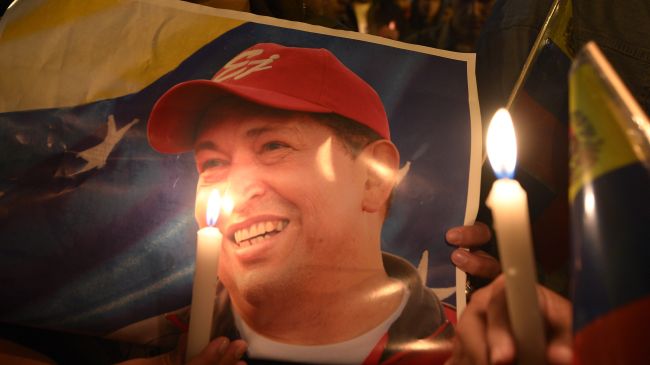
By Yusuf Fernandez | Press TV | March 6, 2013
Thousands of saddened Venezuelans poured into the streets of Caracas crying, hugging each other and shouting slogans in support of President Hugo Chavez after learning of his death. “I feel such big pain I cannot even speak,” said Yamilina Barrios, a 39-year-old office worker, to the Associated Press. “He was the best thing the country had … I adore him. Let´s hope the country calms down and we can continue the tasks he left us.”
Leaders of the continent also showed their sorrow. “We are devastated by the death of the brother Hugo Chavez,” Prensa Latina agency quoted Bolivian president Evo Morales as saying, while he was accompanied by several members of his cabinet. Chavez was “a caring brother, a fellow revolutionary, a Latin American who fought for his country, for the great homeland, as Simon Bolivar did. He gave his whole life for the liberation of the Venezuelan people, the people of Latin America and all anti-imperialist fighters in the world”.
Chavez dedicated his whole life to the cause of the oppressed and poor, the integration and unity of Latin America, the construction of a multipolar world and the fight against the imperialism. Hugo Chavez died due to the illness he had, which many suspect was inoculated to him by any of his enemies, starting by the US government.
He became notorious after a group of army officers and soldiers, led by him, tried to overthrow in 1992 the corrupt and criminal pro-US government of Venezuelan President Carlos Andres Perez, a social democratic politician who ordered a brutal and bloody crackdown on demonstrators that were protesting against IMF-austerity measures on February 27 1989. About 3,000 people were killed by troops in that episode known as “the Caracazo”.
Chavez spent two years in a military prison. After being released, he led a Boliviarian movement that had two main goals: social justice for the impoverished majority of Venezuelans and independence from the US Empire and its financial tools. In 1998, he won his first presidential election and he would never lose one from then on.
The President changed the leadership of the oil national company, PDVSA, whose revenues had benefited only a small national oligarchy and US corporations up to then. At the same time, Chavez funded various social assistance programs for the poor. These programs have improved literacy levels, health care, housing and income levels for Venezuela´s majority.
During Chavez´s years in office, poverty has been cut a half and extreme poverty by 70%. Millions of Venezuelans have had access to health care for the first time, and college enrollment doubled, with free tuition for many students. Inequality was also considerably reduced. By contrast, the two decades that preceded Chavez, Venezuela was one of the worst economic failures in Latin America, with real income per person actually falling by 14% from 1980-1998.
Chavez was the main promoter of the process for the integration of Latin America. It would lead to the creation of some Latin American blocs, such as ALBA, UNASUR or CELAC, which reduced US-dominated OAS to irrelevance. US plans to control Latin American economies through a continental free trade agreement also failed due to the opposition of Venezuela and some other countries.
Following Chavez´s revolution, Latin America has elected in recent years a group of leaders -Evo Morales in Bolivia, Rafael Correa in Ecuador and Daniel Ortega in Nicaragua- who are deeply involved in the fight for social justice in their societies and political independence for their countries and the continent on the whole. Other leaders who followed that trend -Manuel Zelaya in Honduras and Fernando de Lugo in Paraguay- were illegally toppled by US-supported right-wing coups.
In the international field, Chavez was an active promoter of a multipolar world. In order to liberate his country from an imperialist control, Venezuela established solid links with Russia, China, Iran, Syria and other countries. He supported the fight of the Palestinian people against the Zionist occupation.
Due to all these policies, Chavez earned the implacable hatred and hostility of Washington. In April 2002, the CIA backed a military coup to overthrow him. A group of right-wing leaders and generals arrested and imprison him and took over the power, in a move widely welcomed by the US and some European governments and media. However, he was saved and restored to power two days later by the rapid action of loyal military officers and soldiers and a huge popular uprising.
Even after the failure of the coup, the right-wing sectors, which dominated some private media outlets, especially channels as Venevision, Univision and Globovision, continued their permanent campaign against Chavez and his government. All kind of dirty games, including a politicized general strike, were put in place in order to overthrow him. However, all these plans failed due to the high political awareness of the Venezuelan people.
For its part, Washington used its agencies, including the CIA, to fund the political opposition and the oligarchy. According to the site venezuelanalysis.com, Capriles and the Venezuelan opposition received 20 million dollars from US organizations, such as USAID and the National Endowment for Democracy.
Media campaigns were also used as a weapon of preference against the Venezuelan government. Despite Chavez´s repeated electoral victories, successive US administrations and corporate media presented his rule as illegitimate and dictatorial. The US Embassy in Caracas became a hub of anti-Chavez activities, as it shows the recent expulsion of the US Air Force attaché, Col. David Delmonaco, and his deputy, who allegedly tried to recruit Venezuelan army officers for “destabilizing projects.”
In this context, the statement by US President, Barack Obama, which claims that Washington wants to normalize its relations with Caracas, is hypocritically insincere. Actually, the US is just attempting to look for new mechanisms to recover its control over Venezuela and change its economic, social and foreign policy.
The death of President Chavez will force the country to conduct another presidential election within 30 days. The candidate and new leader of the Bolivarian movement, Vice-President Nicolas Maduro, will be the candidate who will confront Henrique Capriles, the right-wing governor of Miranda state, who was comfortably defeated by Chavez in a presidential election held last October.
Although Washington and its Venezuelan allies hope that the death of Chavez may help them put an end to the Bolivarian revolution in Venezuela and Latin America, there are many reasons to think otherwise. The people of Venezuela are aware of the achievements and progress that has obtained at this late stage and is not willing to renounce them. On the other hand, the early, and still not clarified death of Chavez, will reinforce his figure, turning it into a symbol of a policy for the oppressed, for the independence and integration of Latin America and for a world free from imperialism.
“Oligarchies are surely celebrating when the peoples that fight for their freedom and dignity and work for equality are suffering. But it does not matter, the only thing that matters is that we are united, we fight for liberation. A lot of strength, a lot of unity. The best tribute to Chavez is unity. Unity to fight, to work for the equality of all peoples of the world,” Morales said.
Related articles
- The Revolution Within the Revolution Will Continue (alethonews.wordpress.com)
- Latin American leaders praise Chavez and prepare to travel to Caracas for his funeral on Friday (alethonews.wordpress.com)
March 6, 2013 Posted by aletho | Economics, Timeless or most popular | Chavez, Hugo Chávez, Latin America, United States, Venezuela | Leave a comment
2009: Hugo Chavez says Bush sent assassins
FLASHBACK: CIA Heart Attack Gun (1975)
~
2009: Hugo Chavez says Bush sent assassins
Related articles
- Latin American leaders praise Chavez and prepare to travel to Caracas for his funeral on Friday
- Will the U.S. Government, Media Seek to Improve Relations with Venezuela?
- US Embassy Officials Expelled from Venezuela, Government Warns of “Conspiracy Plans”
March 6, 2013 Posted by aletho | Timeless or most popular, Video, War Crimes | Leave a comment
Israel and Azerbaijan: A Strategic Alliance
By Mohamad Bdeir | Al-Akhbar | March 6, 2013
Since its early days, Israel has followed a strategy of courting alliances with neighboring non-Arab states. As such, Azerbaijan is fast becoming a key ally of the Zionist state.
Early last year, media reports revealed a massive $1.6 billion weapons deal between Azerbaijan and Israel, considered one of the largest sales in Israel’s history.
At the time, then head of the Mossad, Danny Yatom, openly encouraged the sale of weapons “to countries that are friendly to us in order to better confront Iran.”
In addition to selling weapons and containing Iran, Israel is also interested in Azerbaijan’s oil, which today constitutes 40 percent of its consumption, with plans for a pipeline connecting the two countries by way of the southeastern Turkish city of Ceyhan.
The relationship between Israel and Iran’s northern neighbor goes back over two decades, shortly after the collapse of the Soviet Union in 1991. At that time, nearly 100,000 Azeri Jews emigrated to Israel, prompting Tel Aviv to quickly find ways to develop strong ties with this strategic country.
For its part, Baku calculated that it too can benefit from such a relationship in two key areas: Israeli technology, particularly in defense and agriculture; and the support of the Zionist lobby in Washington to counterbalance Armenian influence on the Nagorno-Karabakh territorial dispute between Azerbaijan and Armenia.
A few days ago, the Israeli daily Haaretz published a report from Baku that quoted a presidential advisor as saying that in his government’s view, “Iran is the problem, and not Israel…Tehran doesn’t like our cooperation with Israel,” adding that there is “a large number of Israelis of Azeri origin with whom we continue to work.”
The report makes it clear that many in Baku are more than willing to sacrifice their relationship with Iran in favor of closer ties to Israel.
The newspaper, for example, quotes an Azerbaijani MP as follows: “There are a lot Jewish friends of Azerbaijan, and they are helping us in Washington,” noting that “Muslim Azerbaijan supports Israel, while Christian Armenia supports Iran.”
Oil also figures large in the growing relationship between the two countries, as Azerbaijan has become Tel Aviv’s largest oil supplier.
Before the Islamic revolution, Iran was Israel’s key source of oil. After the fall of the Shah, Tel Aviv turned to Mexico for three decades to supply it with more expensive oil, given the distance between the two countries.
As ties with Baku improved, Azerbaijan quickly became Israel’s main oil supplier through a pipeline that runs through Georgia to the Turkish port of Ceyhan.
According to Haaretz, Turkey reaps sizeable financial benefits from this route – a key factor in sustaining Israeli-Turkish economic ties, despite diplomatic tensions between the two countries since the Mavi Marmara massacre in 2010.
In this vein, the Haaretz report reveals that for some time now Baku has invested quite a bit of diplomatic effort in bridging the differences between its two close allies, Turkey and Israel, but with little success so far, given the hardline stance of former Israeli foreign minister Avigdor Lieberman.
Related article
March 6, 2013 Posted by aletho | Timeless or most popular | Azerbaijan, Ceyhan, Iran, Israel, Nagorno Karabakh | Leave a comment
Is the Anti-Occupation Movement Driven by Defenders of Genocide?
By Dr. PAUL LARUDEE | CounterPunch | March 6, 2013
If there is one message that unifies critics of Israel and advocates for Palestinian rights, it is “End the Occupation.” As with many unifying messages, however, it is successful partly because of its ambiguity. What land and which people are occupied? And what are the terms under which the “occupation” will be ended.The ambiguity allows groups as disparate as Hamas and J Street to chant the phrase with very different images in mind. Hamas and other anti-Zionists argue that all of the land defined by the British Mandate of Palestine is occupied territory, while J Streeters and other “soft” Zionists commonly refer only to Israel’s 1967 territorial conquests as “occupied.”
The dividing line between these two views has been articulated By Naomi Wimborne-Idrissi of JBIG (Jews Boycotting Israeli Goods):
…there are many people within the movement who share the opinion – which is general throughout the West – that Israel needs to exist as a Jewish state, should exist as a Jewish state. And there are many Jews and others in the movement who don’t want to criticize that fundamental fact.[i]
Wimborne-Idrissi is undoubtedly correct in her assessment: public opinion in the West generally supports what is called “Israel’s right to exist as a Jewish state.”[ii] However, most Palestinians fail to understand why this “right” should trump their rights and why Palestinians should be made to pay for its exercise with expulsion from their homes.
Indeed, they may be forgiven for doubting the sincerity of people that claim to advocate for justice on their behalf but fail to defend their right to return to their homes. On the one hand, these “defenders” of Palestinian human rights claim to oppose Israel’s expulsion of Palestinians, both inside the internationally recognized borders of Israel and in other areas under Israeli control. On the other hand, these same champions of Palestinians will not lift a finger to correct and defend against the more massive ethnic cleansing that occurred in 1948. It is as if 1967 is the dividing line between which criminal activity must be accepted and which must be resisted.
Do such persons really oppose ethnic cleansing as a matter of principle or merely as it suits their whim? The passage of time does not appear to be an issue. If 1948 seems like a long time ago, let us remember that there is no statute of limitations on such matters, as the prosecution of Nazi war criminals from an even earlier era illustrates.
J Streeters and other “soft” Zionists may appear to be allies of Palestinians, but they are not. Their overwhelming consideration is to create and maintain a Jewish state, and to mould it into their image of a liberal democracy that they can feel proud of. Palestinian rights and welfare are entirely subsidiary to that objective.
This explains why J Streeters defend Israel’s “right to exist,” i.e. the ethnic cleansing of 1948. They may not like ethnic cleansing, but it was necessary for the creation of a Jewish state, which has a higher order of priority. On the other hand, they see the current ethnic cleansing policies of the state of Israel as corrosive to the kind of state they would like to have. This is why they want to “end the occupation.” Look what it is doing to Israeli youth! Look at how it is driving Israel into the hands of “extremists.”
Let us therefore be clear. We are dealing with people whose opposition to ethnic cleansing is not very firm and whose primary interest in “ending the occupation” is to do what is good for Israel, not for humanity and least of all for Palestinians.[iii]
Indeed, one wonders why these advocates for Israel oppose a massive expulsion of the remaining Palestinians in all of the land held by Israel. Expulsion is clearly not a “red line” for them, and it is an expedient method of “ending the occupation.” I suspect that they harbor a nagging guilt for the theft and massacres of 1948, but not enough to want to give up the stolen property. Rather, they hope to expiate their guilt by returning a portion of the territories seized in 1967 for the purpose of creating Palestinian Bantustans. (The South African Bantustans served a similar purpose of assuaging the guilt of white supremacists.)
Regardless of the hypocritical games that Jewish supremacists in the movement play amongst themselves, Palestinians and human rights advocates must not be lured into false partnerships with them just because we share some of the same immediate tactics and objectives, such as stopping the growth of Jewish settlements, boycott of (some) Israeli products and institutions, an end to land confiscations, etc. Rather, we must expose the racist foundations and objectives of these ethically inconsistent elements within “the movement,” and avoid alliances with them.
Currently, I fear that we may be doing the opposite, i.e. allowing the “end the occupation” movement to be driven by the interests of people whose agenda requires Palestinians to give up inalienable rights and which rewards those who take those rights away from them.[iv] It is not in the interest of Palestinians and principled human rights advocates to make common cause with such morally compromised persons.
Dr. Paul Larudee is a human rights advocate and one of the co-founders of the movement to break the siege of Gaza by sea. He was deported from India on 31st December, 2012.
~
[i] Naomi Wimborne-Idrissi, http://www.youtube.com/watch?feature=player_embedded&v=gVT6abeaGas
[ii] International law does not provide for the right of states to exist. Rather, states come and go as a matter of historical and social forces. International law describes the rights and obligations of states, but does not require that any given state must exist.
[iii] Gilad Atzmon (The Wandering Who, Winchester: Zero Books, 2011, p. 102) makes a similar argument with respect to Jewish anti-Zionists, i.e. that they are motivated by what is good for Jews and that they believe that a Jewish state is bad for the Jews. Atzmon contends that this is just another instance of Jewish exceptionalism, which will be the cause of injustice even if the form of the injustice is not Zionism per se. Even if this is the case, social justice groups are notorious for pursuing justice while failing to practice it, and this may be an instance of such. I do not discount the possibility that cliquishness, tribalism and exceptionalism are causes of injustice in many cases, but ridding human nature of this tendency is beyond the scope of most advocacy efforts, even if it deserves a place in all of them.
[iv] An instance of this is the Palestinian BNC (BDS National Committee). Although nominally Palestinian, its main website is in English, with the Arabic translation largely unfinished. An unauthorized amendment to its original mission statement, inserted at an unknown time, appears to remove the property seizures of 1948 from consideration as occupied Palestinian Arab land. This appears to be a concession to “soft” Zionist elements within the BNC-led BDS movement. The amended statement does not appear in any authorized Arabic version of the mission statement.
Related article
- Jewish Voice for Weizmann (alethonews.wordpress.com)
March 6, 2013 Posted by aletho | Ethnic Cleansing, Racism, Zionism, Solidarity and Activism, Timeless or most popular | Gilad Atzmon, Human rights, Israel, Jewish State, Palestine, Zionism | Leave a comment
The Revolution Within the Revolution Will Continue
By Kevin Zeese and Margaret Flowers | Dissident Voice | March 5th, 2013
The death of Hugo Chávez is a great loss to the people of Venezuela who have been lifted out of poverty and have created a deep participatory democracy. Chavez was a leader who, in unity with the people, was able to free Venezuela from the grips of US Empire, bring dignity to the poor and working class, and was central to a Latin American revolt against US domination.
Chávez grew up a campesino, a peasant, raised in poverty. His parents were teachers, his grandmother an Indian whom he credits with teaching him solidarity with the people. During his military service, he learned about Simon Bolivar, who freed Latin America from Spanish Empire. This gradually led to the modern Bolivarian Revolution he led with the people. The Chávez transformation was built on many years of a mass political movement that continued after his election, indeed saved him when a 2002 coup briefly removed him from office. The reality is Venezuela’s 21st Century democracy is bigger than Chávez. This will become more evident now that he is gone.
The Lies They Tell Us
If Americans knew the truth about the growth of real democracy in Venezuela and other Latin American countries, they would demand economic democracy and participatory government, which together would threaten the power of concentrated wealth. Real democracy creates a huge challenge to the oligarchs and their neoliberal agenda because it is driven by human needs, not corporate greed. That is why major media in the US, which are owned by six corporations, aggressively misinform the public about Chávez and the Bolivarian Revolution.
Mark Weisbrot of the Center for Economic and Policy Research writes:
The Western media reporting has been effective. It has convinced most people outside of Venezuela that the country is run by some kind of dictatorship that has ruined it.
In fact, just the opposite is true. Venezuela, since the election of Chávez, has become one of the most democratic nations on Earth. Its wealth is increasing and being widely shared. But Venezuela has been made so toxic that even the more liberal media outlets propagate distortions to avoid being criticized as too leftist.
We spoke with Mike Fox, who went to Venezuela in 2006 to see for himself what was happening. Fox spent years documenting the rise of participatory democracy in Venezuela and Brazil. He found a grassroots movement creating the economy and government they wanted, often pushing Chávez further than he wanted to go.
They call it the “revolution within the revolution.” Venezuelan democracy and economic transformation are bigger than Chávez. Chávez opened a door to achieve the people’s goals: literacy programs in the barrios, more people attending college, universal access to health care, as well as worker-owned businesses and community councils where people make decisions for themselves. Change came through decades of struggle leading to the election of Chávez in 1998, a new constitution and ongoing work to make that constitution a reality.
Challenging American Empire
The subject of Venezuela is taboo because it has been the most successful country to repel the neoliberal assault waged by the US on Latin America. This assault included Operation Condor, launched in 1976, in which the US provided resources and assistance to bring friendly dictators who supported neoliberal policies to power throughout Latin America. These policies involved privatizing national resources and selling them to foreign corporations, de-funding and privatizing public programs such as education and health care, deregulating and reducing trade barriers.
In addition to intense political repression under these dictators between the 1960s and 1980s, which resulted in imprisonment, murder and disappearances of tens of thousands throughout Latin America, neoliberal policies led to increased wealth inequality, greater hardship for the poor and working class, as well as a decline in economic growth.
Neoliberalism in Venezuela arrived through a different path, not through a dictator. Although most of its 20th century was spent under authoritarian rule, Venezuela has had a long history of pro-democracy activism. The last dictator, Marcos Jimenez Perez, was ousted from power in 1958. After that, Venezuelans gained the right to elect their government, but they existed in a state of pseudo-democracy, much like the US currently, in which the wealthy ruled through a managed democracy that ensured the wealthy benefited most from the economy.
As it did in other parts of the world, the US pushed its neoliberal agenda on Venezuela through the International Monetary Fund (IMF) and World Bank. These institutions required Structural Adjustment Programs (SAP) as terms for development loans. As John Perkins wrote in Confessions of an Economic Hit Man, great pressure was placed on governments to take out loans for development projects. The money was loaned by the US, but went directly to US corporations who were responsible for the projects, many of which failed, leaving nations in debt and not better off. Then the debt was used as leverage to control the government’s policies so they further favored US interests. Anun Shah explains the role of the IMF and World Bank in more detail in Structural Adjustment – a Major Cause of Poverty.
Neoliberalism Leads to the Rise of Chávez
A turning point in the Venezuelan struggle for real democracy occurred in 1989. President Carlos Andres Perez ran on a platform opposing neoliberalism and promised to reform the market during his second term. But following his re-election in 1988, he reversed himself and continued to implement the “Washington Consensus” of neoliberal policies – privatization and cuts to social services. The last straw came when he ended subsidies for oil. The price of gasoline doubled and public transportation prices rose steeply.
Protests erupted in the towns surrounding the capitol, Caracas, and quickly spread into the city itself. President Perez responded by revoking multiple constitutional rights to protest and sending in security forces who killed an estimated 3,000 people, most of them in the barrios. This became known as the “Caracazo” (“the Caracas smash”) and demonstrated that the president stood with the oligarchs, not with the people.
Under President Perez, conditions continued to deteriorate for all but the wealthy in Venezuela. So people organized in their communities and with Lieutenant Colonel Hugo Chávez attempted a civilian-led coup in 1992. Chávez was jailed, and so the people organized for his release. Perez was impeached for embezzlement of 250 million bolivars and the next president, Rafael Caldera, promised to release Chávez when he was elected. Chávez was freed in 1994. He then traveled throughout the country to meet with people in their communities and organizers turned their attention to building a political movement.
Chávez ran for president in 1998 on a platform that promised to hold a constituent assembly to rewrite the constitution saying:
I swear before my people that upon this moribund constitution I will drive forth the necessary democratic transformations so that the new republic will have a Magna Carta befitting these new times.
Against the odds, Chávez won the election and became president in 1999.
While his first term was cautious and center-left, including a visit by Chávez to the NY Stock Exchange to show support for capitalism and encourage foreign investment, he kept his promise. Many groups participated in the formation of the new constitution, which was gender-neutral and included new rights for women and for the indigenous, and created a government with five branches adding a people’s and electoral branches. The new constitution was voted into place by a 70 percent majority within the year. Chávez also began to increase funding for the poor and expanded and transformed education.
Since then, Chávez has been re-elected twice. He was removed from power briefly in 2002, jailed and replaced by Pedro Carmona, the head of what is equivalent to the Chamber of Commerce. Fox commented that the media was complicit in the coup by blacking it out and putting out false information. Carmona quickly moved to revoke the constitution and disband the legislature. When the people became aware of what was happening, they rapidly mobilized and surrounded the capitol in Caracas. Chávez was reinstated in less than 48 hours.
One reason the Chávez election is called a Bolivarian Revolution is because Simon Bolivar was a military political leader who freed much of Latin America from the Spanish Empire in the early 1800s. The election of Chávez, the new constitution and the people overcoming the coup set Venezuela on the path to free itself from the US empire. These changes emboldened the transformation to sovereignty, economic democracy and participatory government.
In fact, Venezuela paid its debts to the IMF in full five years ahead of schedule and in 2007 separated from the IMF and World Bank, thus severing the tethers of the Washington Consensus. Instead, Venezuela led the way to create the Bank of the South to provide funds for projects throughout Latin America and allow other countries to free themselves from the chains of the IMF and World Bank too.
The Rise of Real Democracy
The struggle for democracy brought an understanding by the people that change only comes if they create it. The pre- Chávez era is seen as a pseudo Democracy, managed for the benefit of the oligarchs. The people viewed Chávez as a door that was opened for them to create transformational change. He was able to pass laws that aided them in their work for real democracy and better conditions. And Chávez knew that if the people did not stand with him, the oligarchs could remove him from power as they did for two days in 2002.
With this new understanding and the constitution as a tool, Chávez and the people have continued to progress in the work to rebuild Venezuela based on participatory democracy and freedom from US interference. Chávez refers to the new system as “21st century socialism.” It is very much an incomplete work in progress, but already there is a measurable difference.
Mark Weisbrot of CEPR points out that real GDP per capita in Venezuela expanded by 24 percent since 2004. In the 20 years prior to Chávez, real GDP per person actually fell. Venezuela has low foreign public debt, about 28 percent of GDP, and the interest on it is only 2 percent of GDP. Weisbrot writes:
From 2004-2011, extreme poverty was reduced by about two-thirds. Poverty was reduced by about one-half, and this measures only cash income. It does not count the access to health care that millions now have, or the doubling of college enrollment – with free tuition for many. Access to public pensions tripled. Unemployment is half of what it was when Chávez took office.
Venezuela has reduced unemployment from 20 percent to 7 percent.
As George Galloway wrote upon Chávez’s death:
Under Chávez’ revolution the oil wealth was distributed in ever rising wages and above all in ambitious social engineering. He built the fifth largest student body in the world, creating scores of new universities. More than 90% of Venezuelans ate three meals a day for the first time in the country’s history. Quality social housing for the masses became the norm with the pledge that by the end of the presidential term, now cut short, all Venezuelans would live in a dignified house.
Venezuela is making rapid progress on other measures too. It has a high human development index and a low and shrinking index of inequality. Wealth inequality in Venezuela is half of what it is in the United States. It is rated “the fifth-happiest nation in the world” by Gallup. And Pepe Escobar writes that:
No less than 22 public universities were built in the past 10 years. The number of teachers went from 65,000 to 350,000. Illiteracy has been eradicated. There is an ongoing agrarian reform.
Venezuela has undertaken significant steps to build food security through land reform and government assistance. New homes are being built, health clinics are opening in under-served areas and cooperatives for agriculture and business are growing.
Venezuelans are very happy with their democracy. On average, they gave their own democracy a score of seven out of ten while the Latin American average was 5.8. Meanwhile, 57 percent of Venezuelans reported being happy with their democracy compared to an average for Latin American countries of 38 percent, according to a poll conducted by Latinobarometro. While 81 percent voted in the last Venezuelan election, only 57.5 percent voted in the recent US election.
Chávez won that election handily as he has all of the elections he has run in since 1999. As Galloway describes him, Chávez was “the most elected leader in the modern era.” He won his last election with 55 percent of the vote but was never inaugurated due to his illness.
Beyond Voting: The Deepening of Democracy in Venezuela
This is not to say that the process has been easy or smooth. The new constitution and laws passed by Chávez have provided tools, but the government and media still contain those who are allied with the oligarchy and who resist change. People have had to struggle to see that what is written on paper is made into a reality. For example, Venezuelans now have the right to reclaim urban land that is fallow and use it for food and living. Many attempts have been made to occupy unused land and some have been met by hostility from the community or actual repression from the police. In other cases, attempts to build new universities have been held back by the bureaucratic process.
It takes time to build a new democratic structure from the bottom up. And it takes time to transition from a capitalist culture to one based on solidarity and participation. In “Venezuela Speaks,” one activist, Iraida Morocoima, says “Capitalism left us with so many vices that I think our greatest struggle is against these bad habits that have oppressed us.” She goes on to describe a necessary culture shift as, “We must understand that we are equal, while at the same time we are different, but with the same rights.”
Chávez passed a law in 2006 that united various committees in poor barrios into community councils that qualify for state funds for local projects. In the city, community councils are composed of 200 to 400 families. The councils elect spokespeople and other positions such as executive, financial and “social control” committees. The council members vote on proposals in a general assembly and work with facilitators in the government to carry through on decisions. In this way, priorities are set by the community and funds go directly to those who can carry out the project such as building a road or school. There are currently more than 20,000 community councils in Venezuela creating a grassroots base for participatory government.
A long-term goal is to form regional councils from the community councils and ultimately create a national council. Some community councils already have joined as communes, a group of several councils, which then have the capacity for greater research and to receive greater funds for large projects.
The movement to place greater decision-making capacity and control of local funds in the hands of communities is happening throughout Latin America and the world. It is called participatory budgeting and it began in Porto Alegre, Brazil in 1989 and has grown so that as many as 50,000 people now participate each year to decide as much as 20 percent of the city budget. There are more than 1,500 participatory budgets around the world in Latin America, North America, Asia, Africa, and Europe. Fox produced a documentary, Beyond Elections: Redefining Democracy in the Americas, which explains participatory budgeting in greater detail.
The Unfinished Work of Hugo Chávez Continues
The movements that brought him to power and kept him in power have been strengthened by Hugo Chávez. Now the “revolution within the revolution” will be tested. In 30 days there will be an election and former vice president, now interim president, Nicolas Maduro will likely challenge the conservative candidate Chávez defeated.
If the United States and the oligarchs think the death of Chávez means the end of the Bolivarian Revolution he led, they are in for a disappointment. This revolution, which is not limited to Venezuela, is likely to show to itself and the world that it is deep and strong. The people-powered transformation with which Chávez was in solidarity will continue.
• This article is a modified version of “The Secret Rise of 21st Century Democracy,”which originally appeared in Truthout.
Related articles
- Latin American leaders praise Chavez and prepare to travel to Caracas for his funeral on Friday
- Will the U.S. Government, Media Seek to Improve Relations with Venezuela?
- US Embassy Officials Expelled from Venezuela, Government Warns of “Conspiracy Plans”
March 6, 2013 Posted by aletho | Economics, Solidarity and Activism, Timeless or most popular | Bolivarian Revolution, Carlos Andrés Pérez, Chavez, Hugo Chávez, International Monetary Fund, Latin America, Venezuela | Leave a comment
Will the U.S. Government, Media Seek to Improve Relations with Venezuela?
By Dan Beeton | CEPR Americas Blog | March 5, 2013
Venezuelan Vice President Nicolas Maduro’s announced today that President Hugo Chávez had died at 4:25pm. According to Venezuela’s constitution [PDF], new presidential elections are supposed to be held within 30 days.
The news could prevent an opportunity for an improvement in U.S.-Venezuelan relations, but that is unlikely. Earlier in the day, Maduro announced that the Venezuelan government would expel the U.S. military attaché for unsanctioned meetings with certain Venezuelan military officers. While this is of course a significant development in U.S.-Venezuela relations that marks yet further deterioration, unfortunately it seems safe to say that most U.S. media outlets will not provide the crucial context necessary in order to understand current relations and why they are so tense.
Maduro mentioned the April 2002 coup d’etat in his press conference today. Declassified C.I.A. and other government documents reveal the U.S. role in that coup against Hugo Chávez. As Scott Wilson, former foreign editor at the Washington Post has explained:
Yes, the United States was hosting people involved in the coup before it happened. There was involvement of U.S.-sponsored NGOs in training some of the people that were involved in the coup. And in the immediate aftermath of the coup, the United States government said that it was a resignation, not a coup, effectively recognizing the government that took office very briefly until President Chavez returned.
I think that there was U.S. involvement, yes.
(Video clip here. This information has however never been reported this fully in the pages of the Washington Post itself.)
The coup was overturned two days later, but before it was the coup regime headed by businessman Pedro Carmona demonstrated its feelings about democratic institutions by dissolving the congress, the supreme court, and the constitution. The New York Times editorial board applauded the coup, writing, “Venezuelan democracy is no longer threatened by a would-be dictator.” The IMF explained that “We stand ready to assist the new administration in whatever manner they find suitable.” After the coup was overturned by Venezuelans in the streets and soldiers loyal to the elected government, and Chávez returned to Caracas from the island where his golpista kidnappers had taken him, the New York Times offered a sheepish apology for its previous applause. The U.S. government and the IMF, however, never apologized for their support for the coup.
It is also important to note that U.S. government interference in Venezuela did not stop there. The U.S. has continued to fund various groups in Venezuela opposed to the government – including political parties and media outlets. The U.S. State Department and entities such as the National Endowment for Democracy also have not disclosed who all of these recipients are, in Venezuela nor in other countries such as Bolivia, where the government has also expelled U.S. diplomats, and where the U.S. media has also done a poor job in providing context behind the deteriorating relations.
More recently, last month U.S. State Department spokesperson Victoria Nuland referred to “how the transition is going to take place” in Venezuela. Not surprisingly, the Venezuelan government also took this to be a form of meddling. Talk of a “transition” was premature, and Nuland’s statement was “nothing less than the open meddling into issues that are for Venezuelans to resolve,” according to Eleazar Diaz-Rangel, editor in chief of Venezuela’s most-widely read – and probably most objective – newspaper Últimas Noticias.
It is hard to imagine U.S. government officials making similar statements if the leader of an ally country such as the U.K. or Israel were fighting for her/his life. But when it comes to Venezuela the behavior fits a pattern of ongoing efforts to undermine the elected government.
It will also be interesting to see how the international community and the media will receive Maduro, should he become Venezuela’s next president. Chávez called on Venezuelans to support Maduro should new elections be necessary, and polls show Maduro would likely win over an Henrique Capriles or another opposition candidate. Both U.S. media outlets and U.S. government officials have often sought to blame poor relations between the U.S. and Venezuela on Chávez’s “fiery” personality; will they do the same with Maduro? Earlier media reports today indicate that the answer is probably yes. Media – and many other observers –also focused much on Chávez’s military background, something that Maduro does not have.
For his part, Maduro got an early taste of U.S. hospitality in 2006 when he was unceremoniously searched at the airport prior to departure back to Venezuela in his first U.S. trip as Venezuela’s Foreign Minister. It was an unfortunate first impression to make on the man who will probably be Venezuela’s next president.
Related articles
- President Hugo Chavez has Died
- US Embassy Officials Expelled from Venezuela, Government Warns of “Conspiracy Plans”
March 6, 2013 Posted by aletho | Mainstream Media, Warmongering, Progressive Hypocrite, Timeless or most popular | Hugo Chávez, Maduro, New York Times, Nicolás Maduro, Scott Wilson, United States, Venezuela | Leave a comment
US may use drone raids inside America: Attorney general
Press TV – March 6, 2013
The US attorney general has refused to rule out the possibility that drone strikes may be used inside the United States to kill an American citizen.
Eric Holder said a drone strike within the borders of the US and against an American citizen may be carried out in what he called an extraordinary circumstance.
He made the remarks in a statement in a response to an inquiry by Republican Senator Rand Paul, who had questioned the Justice Department on Tuesday if it believed that President Barack Obama had the legal authority to order an assassination drone strike on an American while present on US soil.
Paul said the administration’s “refusal to rule out the possibility of drone strikes on American citizens and on American soil is more than frightening — it is an affront the Constitutional due process rights of all Americans.”
At least three Americans have been reportedly killed by US drone strikes in Yemen, including Anwar al-Awlaki, his 16-year-old son Abdul-Rahman and Samir Khan.
Washington uses assassination drones in several countries, claiming that they target “terrorists.” According to witnesses, however, the attacks have mostly led to massive civilian casualties.
In September 2012, a report by the Stanford Law School and the New York University School of Law gave an alarming account of the effect that assassination drone strikes have on ordinary people in Pakistan’s tribal areas.
The report noted, “The number of ‘high-level’ targets killed as a percentage of total casualties is extremely low – estimated at just two percent.”
March 6, 2013 Posted by aletho | Civil Liberties, Progressive Hypocrite, Timeless or most popular | Anwar al-Awlaki, Eric Holder, Obama, United States | Leave a comment
Featured Video

Thomas Fazi: NATO’s Hybrid Warfare – Deception & Permanent War
or go to
Aletho News Archives – Video-Images
Book Review
The Zeolite Book — First Edition, 2026, Paperback
The volcanic mineral medicine will not patent — for the toxic burden medicine will not name
Lies are Unbekoming – October 30, 2026
 Zeolite is old. It is in Roman concrete that has held for two thousand years. It’s in the water filters of ancient cisterns. It’s in the stomachs of Pacific livestock whose keepers knew, somehow, that this grey crumbling rock made the animals healthier. It’s in Soviet clinical protocols from the 1960s. It’s in the standard emergency response to the Chernobyl explosion.
In 1986, after the Chernobyl reactor failure, the Soviet Union manufactured and distributed natural zeolite at industrial scale — for soil remediation, for livestock feed, for human consumption, for the cleanup itself. Karl Hecht, who had been director of the Institute for Experimental and Clinical Pathophysiology at the Charité of Humboldt University Berlin, spent the six decades after that building the clinical research base — on silicon’s role in human health, on zeolite’s clinical safety, on its applications in ageing. In 2018, Pavelić and colleagues published a comprehensive clinical safety review of natural clinoptilolite in Frontiers in Pharmacology. In 2019, Mastinu analysed its binding affinities. In the Western medical literature, these works sit largely uncited.
What has not been treated at book length, until now, is how a volcanic mineral with six decades of Soviet clinical work behind it, two major peer-reviewed Western reviews, and ongoing clinical use across the former Eastern Bloc, remains almost entirely absent from Western medical practice — and what the toxic burden it’s meant to address actually is.
The Zeolite Book gathers the Soviet clinical record, the Western peer-reviewed studies, three contemporary practitioner voices, and three serious counterviews into one honest treatment. That’s why the book runs to seven appendices. 288 pages, four parts, three practitioner voices, three counterviews, seven appendices. The honest treatment is the argument.
Blog Roll
-
Join 2,366 other subscribers
Visits Since December 2009
- 7,793,365 hits
Looking for something?
Archives
Calendar
Categories
Aletho News Civil Liberties Corruption Deception Economics Environmentalism Ethnic Cleansing, Racism, Zionism Fake News False Flag Terrorism Full Spectrum Dominance Illegal Occupation Mainstream Media, Warmongering Malthusian Ideology, Phony Scarcity Militarism Progressive Hypocrite Russophobia Science and Pseudo-Science Solidarity and Activism Subjugation - Torture Supremacism, Social Darwinism Timeless or most popular Video War Crimes Wars for IsraelTags
Afghanistan Africa AIPAC al-Qaeda Australia BBC Benjamin Netanyahu Brazil Canada CDC Central Intelligence Agency China CIA CNN Covid-19 COVID-19 Vaccine Donald Trump Egypt European Union Facebook FBI FDA France Gaza Germany Google Hamas Hebron Hezbollah Hillary Clinton Human rights Hungary India Iran Iraq ISIS Israel Israeli settlement Japan Jerusalem Joe Biden Korea Latin America Lebanon Libya Middle East National Security Agency NATO New York Times North Korea NSA Obama Pakistan Palestine Poland Qatar Russia Sanctions against Iran Saudi Arabia Syria The Guardian Turkiye Twitter UAE UK Ukraine United Nations United States USA Venezuela Washington Post West Bank WHO Yemen Zionism
 Aletho News
- Wrong, AP and NPR: Europe’s 50,000 Heat Deaths Are a Computer-Model Estimate, Not a Real Body Count
- Questioning Your Doctor Is Now Considered A Psychological Problem (Seriously)
- London tourism expo promotes Israeli agency linked to theft of Palestinian land
- Dockworkers launch global strike against Israeli and US military shipments
- Europe facing gas price shock – Gazprom chief
- Ukraine continues recruiting people with disabilities
- Weaponized Journalism: 2021 Sayer Ji Interview with NPR
- Beyond Netanyahu: what Israel’s election means for Palestinians
- Lithuania plans universal conscription
- Lies, Damn Lies, and Ukraine News
- If Americans Knew
- 1,300 will gather in Palo Alto on Nov. 1 for Z3 Conference on Zionism
- DAILY UPDATE: Latest essential news on Palestine, Israel, & region
- The Long Arm of AIPAC
- Genocidal intent behind Hebron assault, rights group says
- This week, Israel killed 8-year-old who survived bombing that wiped out her family
- DAILY UPDATE: Latest essential news on Palestine, Israel, & region
- Israeli soldier poses at damaged Lebanon church, sparking anger
- New Report. Manufacturing the Great Replacement: Is Israel behind one of the largest racist influence campaigns ever documented?
- ‘Arab voice doesn’t count’: Jewish Israeli blocs reject Palestinian support
- Whether Bibi Stays or Goes, the ‘Special Relationship’ Must End
- No Tricks Zone
- Germany’s Green Energy Transition Becoming Increasingly Expensive…Another 6 Trillion Euros!
- Sudden Stratospheric Warming, Powerful El Niño Combination May Lead To Extreme Europe Cold, Energy Crisis!
- Two New Studies Find Thwaites Glacier Melt Cannot Be Driven By Human Activity Or A Warming Ocean
- E-Cars Reduce CO2 Emissions By Only 41% Compared To Internal Combustion Engine Vehicles
- Predictions Made By Renowned Climate Professor Over Past Decades Have Been Proven To Be Poor
- New Study Suggests Large Regions Of The Pacific Ocean Have Been Cooling For The Last 80 Years
- Germany’s Green Energy Debacle: High Energy Costs Force Kahla Porzellan to Close After 182 Years!
- New Study: 50 Years Of The Most Aggressive ‘Net Zero’ Policies Can Only Affect The Global Climate By 0.03°C
- US September “Heat” Was No Record…Many Records Set Decades Ago
- Latest European Green Energy Debacle; Portugal’s Largest Flagship Solar Park Insolvent!
Contact:
atheonews (at) gmail.com
Disclaimer
This site is provided as a research and reference tool. Although we make every reasonable effort to ensure that the information and data provided at this site are useful, accurate, and current, we cannot guarantee that the information and data provided here will be error-free. By using this site, you assume all responsibility for and risk arising from your use of and reliance upon the contents of this site.
This site and the information available through it do not, and are not intended to constitute legal advice. Should you require legal advice, you should consult your own attorney.
Nothing within this site or linked to by this site constitutes investment advice or medical advice.
Materials accessible from or added to this site by third parties, such as comments posted, are strictly the responsibility of the third party who added such materials or made them accessible and we neither endorse nor undertake to control, monitor, edit or assume responsibility for any such third-party material.
The posting of stories, commentaries, reports, documents and links (embedded or otherwise) on this site does not in any way, shape or form, implied or otherwise, necessarily express or suggest endorsement or support of any of such posted material or parts therein.
The word “alleged” is deemed to occur before the word “fraud.” Since the rule of law still applies. To peasants, at least.
Fair Use
This site contains copyrighted material the use of which has not always been specifically authorized by the copyright owner. We are making such material available in our efforts to advance understanding of environmental, political, human rights, economic, democracy, scientific, and social justice issues, etc. We believe this constitutes a ‘fair use’ of any such copyrighted material as provided for in section 107 of the US Copyright Law. In accordance with Title 17 U.S.C. Section 107, the material on this site is distributed without profit to those who have expressed a prior interest in receiving the included information for research and educational purposes. For more info go to: http://www.law.cornell.edu/uscode/17/107.shtml. If you wish to use copyrighted material from this site for purposes of your own that go beyond ‘fair use’, you must obtain permission from the copyright owner.
DMCA Contact
This is information for anyone that wishes to challenge our “fair use” of copyrighted material.
If you are a legal copyright holder or a designated agent for such and you believe that content residing on or accessible through our website infringes a copyright and falls outside the boundaries of “Fair Use”, please send a notice of infringement by contacting atheonews@gmail.com.
We will respond and take necessary action immediately.
If notice is given of an alleged copyright violation we will act expeditiously to remove or disable access to the material(s) in question.
All 3rd party material posted on this website is copyright the respective owners / authors. Aletho News makes no claim of copyright on such material.

