When Private Ryan is shamed by quiet heroes in the Syrian Arab Army
RT | June 9, 2018
Stories of wartime heroism abound in Hollywood movie history, the gung-ho, swashbuckling images that saturate our cinema screens promote US military personnel to cult figures, ‘saving the world’.
It is the victory of fantasy over realism that distances the American public from the horrors of war.
Wars that are never on US soil but waged in distant lands, but always in the “interests of national security”. Consent is manufactured for these wars by fabricating fear and insecurity, the amplification of terrorism threats as the ever-present danger menacing the American people, held at bay by military intervention at an imagined ‘source’.
“US airstrikes on Syria were in the “vital national security and foreign policy interests” of the United States” President Trump told Congress, after the tripartite alliance of US, France and UK had unlawfully attacked Syria. An attack carried out under the pretext of a trumped-up charge of chemical attacks by the Syrian Arab Army (SAA) in the last moments of Douma’s liberation from Saudi-financed and UK-promoted extremists, Jaysh al-Islam.
Cinema is escapism and Hollywood excels in distracting a public already bamboozled by a corporate media’s expert distortion of fact to generate the narratives that instil fear and dehumanize the latest foe in the foreign policy crosshairs.
In Saving Private Ryan, the horror of battle is surround-sound deafeningly conveyed. Unremitting reality confronts our sensibility, the scream of bullets tearing into flesh, the clamour of the dying; nothing is left to the imagination. It is full frontal war.
In the movie, a detail of American soldiers is dispatched to France to bring Private Ryan home to his mother after General Marshall learns that his three brothers were killed in action. We are led to believe that the assuaging of Mama Ryan’s grief is of paramount national importance. It is an all-American feel-good-factor movie with the familiar “true grit”, the hard-bitten courage of ‘real men’ fighting to save the world and their own souls. As the movie’s tagline informs us: “In the last great invasion of the last great war, the greatest challenge for eight men… was saving one.”
As US Defence Secretary, James Mattis, said recently, when trying to explain away the wholesale devastation in Raqqa following a sustained bombing campaign by the US-led coalition – “we are the good guys and the innocent people on the battlefield know the difference” – I doubt the “innocent people” who were deliberately targeted by the coalition “precision” bombs would agree. The proclaimed war on terror, in this case Islamic State (IS, formerly ISIS/ISIL), invariably results in the massacre of innocent people whose mangled remains are dismissed as “collateral damage” in another US campaign that protects “national security”.
A campaign fought illegally in the skies above or on the ground of a sovereign nation that has never presented a threat to US security. Syria has effectively been defending US and European “national security” for seven long and tortuous years. The hordes of extremists under a variety of monikers are armed, financed and equipped by our governments and their allies in the Gulf States, to enable regime change in Syria, but you would never know it from the rhetoric they use to drown out their responsibility.
Syria is stemming the terrorist tide within its territory and the SAA is fighting and dying to contain the threat. Alongside its allies, Russia, Iran, Hezbollah – Syria is sacrificing everything to prevent the spread of a cataclysmic contagion that has been created and imposed upon them by the nations whose claims of moral superiority ring hollow when confronted by the bloodshed they leave in their wake.
The SAA is dehumanized and criminalised by media in the West, it is reduced to ‘Assad’s army”, a ‘Shia militia’ – portrayed as a ‘murderous squad of sectarian thugs’. Nothing could be further from the truth, in my experience. I have met with many families of martyred soldiers who have given their lives to defend their homeland, their people, their honour and their way of life. They fight because “a fallen building can be rebuilt, but a fallen homeland is lost forever.”

Om Al Fouz outside her home in Taldara with ISIS fighters less than 1km away. © Vanessa Beeley
There are thousands of ‘Mama Ryans’ in Syria, brave, fearless women who have suffered indescribable loss but who remain steadfast, proud of their children’s role in protecting their future. Om Al Fouz from Taldara, close to Salamiyah, has lost five sons in the genuine “war on terror”.
“When I lost the first one, I felt as if I had broken my back, I lost the second one only fifteen days later – I thought my heart had broken. Then the third, the fourth, the fifth, each time I grew stronger”.
Om Al Fouz also told me: “I have 25 grandsons, I am ready to give all my children for this battle. We are all ready to be martyred, this is our country, our dignity, our honour, our morals. We will never leave this country to anyone else”.
I met Hala in January 2018 in Salamiyah. Hala is a beautiful young girl whose husband was killed fighting with the SAA to defend her hometown and her country. Like so many families in Salamiyah, Hala expressed great pride her husband’s martyrdom but the sadness in her eyes told me she has lost her love and the father of her child.
Her husband, Fadi Afif al-Qasir, was killed defending Western Salamiyah from Nusra Front. He was 31 years old. Hala proudly showed me their wedding photographs, a stunning young couple just beginning their married life with so many hopes and dreams.
Hala told me: “When they called him to serve the homeland, he left immediately so he could defend his land, to defend his land, to defend his values……so that Syria’s voice could reach all of the countries, so that peace for Syria could prevail, so that peace would not only happen for us, so peace would be for all countries. What is entering here that we are fighting against, it is going to go outside of Syria, and if it went outside of Syria it is going to destroy all the people. So, my husband, Fadi Afif al-Qasir he offered his soul, he offered his heart, he offered his blood, to redeem the homeland”.

Hannah Al Ayek with a photo of her martyrd son Saed Nizar and alongside his brother Mohammed, her husband Ashour, daughters Sally and Isra © Vanessa Beeley
I also met Hannah Al Ayek and her family early in 2018 in Salamiyah. Her son, Saed Nizar, was not even 22-years-old when he was killed. Saed had been a helicopter engineer with the Syrian Arab Air Force. He was killed on 22 January 2013. He was on board a helicopter ferrying supplies into the base when it was brought down by a Free Syrian Army TOW missile, according to his family.
Hannah said to me: “Your coming here and talking to me about my son gives us strength. We beg you to take our voices as far as you can. My son and all our Martyrs have sacrificed themselves for the world, not just for Syria. Maybe they don’t all have the same face, but they do have the same soul.”

Ahmed Jabr with his family and photo of his martyrd son, Mohammed, in Salamiya © Vanessa Beeley
Every family I met with and interviewed made similar statements. Ahmed Jabr lost his 23-year-old son, Mohammed, on the 4 March 2013, fighting with the SAA against IS in Qaryatayn.
Ahmed told me: “We have a great army and we represent the army. The army represents us and they have sacrificed so much but thank God we have the victory on our side. They brought every foreign terrorist in the universe to our country. It is the Western countries bringing us this terrorism. Thank God we stand by our Army as one hand. Our Army defends the whole Arab world and the World from this terrorism because it will spread from Syria to the World.”
The SAA is made up of conscripts. In many cases ordinary young men and women have taken up arms to defend their people, as in Salamiyah surrounded on four sides by IS, Nusra Front, Ahrar al-Sham and a variety of extremist splinter groups. These soldiers are often inexperienced in military strategy and combat. They are facing a professional force of battle-hardened mercenaries, well equipped with more sophisticated weapons and machinery thanks to their sponsors in the West and Gulf States.

In every city, town and village in Syria you will find the displays of photos of Martyrs who have given their lives to defend their people. This is Salamiyah. © Vanessa Beeley
We in the West owe an infinite debt of gratitude to these young men and women who have resisted the terrorist spawn of our own imperialist nations. There will be no ‘Private Ryan’ films depicting their courage and bloodshed. There will be no commemorative statues erected in Washington or London in honour of their sacrifices. There will be no recognition of their unity, no acknowledgement of their dignity in Western media.
It falls upon us, the people, to salute these heroes, these defenders of humanity who have given their lives to prevent us living their torment. This is not some romantic vision of a world of complex nuances and multi-faceted truths, it is the realistic admission that without the SAA, we would be awash with extremism from the Euphrates to the Thames. Far from the din and cacophony of Hollywood generated conflict, these soldiers are the quiet heroes who have undeniably earned “the right to go home”.
May welcomes Netanyahu despite atrocities against Palestinians
PressTVUK | Jun 8, 2018
“You shouldn’t be receiving this war criminal!”
Israeli Prime Minister Benjamin Netanyahu is welcomed by EU leaders during European tour but condemned by protestors for crimes against Palestinians at every turn. Amina Taylor files this report.
Al Quds Day: Supporting Palestinians against Israeli oppression
PressTVUK | June 1, 2018
Ramadan is an opportunity to show solidarity with the Palestinian cause. Annual Al Quds marches will take place around the world next week, renewing a commitment to resistance against Israeli crimes.
See also:
US ‘losing its cards’ in Syria: Highlights of RT’s interview with Bashar Assad
RT | May 31, 2018
Washington and its “puppets” tried, and failed, to destroy Syria – and the US military will eventually be forced out of the country: These are a few of the highlights from RT’s exclusive interview with President Bashar Assad.
Speaking with RT’s Murad Gazdiev in Damascus, Assad commented on a range of topics, from the threat of direct conflict between the US and Russia, to why he doesn’t fear Israeli assassination threats.
On Victory: ‘It’s self-evident’ that Syria is ‘moving closer to the end of the conflict’
Assad noted that the “majority” of Syria is now under government control, but said that continued provocations and escalations by the United States and its allies have needlessly prolonged the seven-year conflict. With each Syrian military victory or successful reconciliation effort, the US and its partners have attempted to counteract these gains by “supporting more terrorism, bringing more terrorists to Syria, or by hindering the political process,” Assad said.
However, he stated that it was “self-evident” that “we are moving closer to the end of the conflict,” adding that “without external interference it won’t take more than a year to settle the situation in Syria.”
The Syrian leader said that whenever possible, his government has chosen negotiations and reconciliation over use of force.
“War is the worst choice but sometimes you only have this choice,” Assad told RT. “Factions like Al-Qaeda, like ISIS, like Al-Nusra, and the like-minded groups, they’re not ready for any dialogue… So, the only option to deal with those factions is force.”
He defended the government’s use of ceasefires and allowing extremists to withdraw to Idlib province, describing the agreements as strategically advantageous for the Syrian army. “If you have two or three frontiers, that’s better than having 10, maybe more than 100 at the time.”
On the US: Washington ‘losing its cards’ in Syria
Although the US forces continue to operate illegally in Syria, they will eventually be forced out of the country, Assad told RT.
“The United States is losing its cards. The main card was Al-Nusra, that was called ‘moderate,’ but when scandals started leaking that they’re not moderate, that they’re Al-Qaeda, which is supposed to be fought by the United States, they started looking for another card. This card is the SDF [Syrian Democratic Forces] now,” he said, referring to the US-backed militia group. According to Assad, once Islamic State (IS, formerly ISIS) and Al-Nusra are exterminated, the Syrian military will turn its attention on the SDF.
“We’re going to use two methods to deal with the SDF: The first one, we started opening doors for negotiations – because the majority of them are Syrians. And supposedly they like their country, they don’t like being puppets to any foreigners – that’s what we suppose.” Assad said that these commonly-shared values could allow reconciliation with the government. “We all don’t trust the Americans, [so] the one option is to live with each other as Syrians.” However, if negotiations fail, the Syrian army will be forced to liberate areas occupied by the SDF, with the Americans, or without the Americans.”
On this point Assad was adamant: “This is our land, it’s our right, it’s our duty. To liberate [these areas], and the Americans should leave. Somehow, they’re going to leave. They came to Iraq with no legal basis. And look what happened to them. They have to learn their lesson.”
On Russia: Moscow’s leadership prevented ‘direct conflict’ with US military
Syria’s president heaped praise on Moscow, claiming that Russian “wisdom” had prevented a direct conflict between Russian and American forces in Syria. “We were close to having direct conflict between the Russian forces and the American forces, and fortunately, it has been avoided, not by the wisdom of the American leadership, but by the wisdom of the Russian leadership.”
While Assad reiterated that the United States military was not welcome in Syria, he said that avoiding escalation was the key to restoring Syria’s territorial integrity. “We need the Russian support, but we need, at the same time to avoid the American foolishness in order to be able to stabilize our country.”
He emphasized that Russia has shown restraint – not weakness – in Syria, noting how Russian warnings had likely dissuaded Trump from launching a full-scale attack against Damascus.
“The Russians announced publicly that they are going to destroy the bases that are going to be used to launch missiles, and our information – we don’t have evidence, we only have information, and that information is credible information – that they were thinking about a comprehensive attack all over Syria, and that’s why the threat pushed the West to make it on a much smaller scale,” the Syrian president said.
On Israel: No longer phased by ‘threat of Israeli aggression,’ Tel Aviv in ‘panic’
Assad shrugged off Israeli threats against his own life, telling Gazdiev that “my generation – and most of the generations in Syria now – has lived under the threat of Israeli aggression. This is something in our unconscious feeling. So to say that you are afraid while living with the same threat for decades – this is nonsense.” He said that the fact that Tel Aviv has resorted to threats suggests that the Israelis are panicking.
“The Israelis have been assassinating, killing, occupying for decades now, for around seven decades, in this region, but usually they do all this without threatening. Now, why do they threaten in this way? This is panic, this is a kind of hysterical feeling because they are losing the ‘dear ones,’ the dear ones Al-Nusra and ISIS, that’s why Israel is panicking recently, and we understand their feeling.”
He said reports that Syria was helpless to stop Israeli airstrikes were inaccurate. “Our air defense is much stronger than before, thanks to the Russian support and the recent attacks by the Israelis and by the Americans and British and French proved that we are in a better situation” than at the start of the conflict seven years ago, he said. However, Assad noted that when foreign-backed fighters first poured into Syria, the first thing they did was target air defense systems – suggesting a “direct link” between the terrorists groups and Israel.
On chemical attacks: ‘Is it in our interest? Why? And why now?’
Syria’s president described the string of alleged chemical attacks as provocations that have ultimately failed to persuade the international community to give the US and its allies a military mandate in Syria.
Washington and its allies blamed the last such attack, in April, on Damascus, but Assad insisted that the Western narrative makes no sense.
“The timing of this alleged strike was after the victory of the Syrian troops in Ghouta. Let alone the fact that we don’t have chemical weapons anyway,” he told RT. Pointing to multiple reports of civilians and medical workers in the area having no knowledge of a chemical attack – with some even appearing in the Western press – Assad concluded that the alleged incident was a last-ditch Western attempt to sway international opinion – one that failed.
“They told a story, they told a lie, and the public opinion around the world and in the West didn’t buy their story, but they couldn’t withdraw. So, they had to do something, even on a smaller scale,” Assad said, referring to the joint airstrikes against purported Syrian chemical weapons facilities, carried out on April 14 by the US, UK, and France.
However, Assad acknowledged that nothing was stopping Washington from attempting similar provocations in the future. The US has “trampled on international law,” and “there’s no guarantee that it won’t happen [again].”
Assad asked: “What was the legal basis of [the April missile] attack? [Or] the so-called anti-terrorist alliance, which supports the terrorists, actually? What is the legal basis of their attack on Yemen, Afghanistan? There’s no legal basis.”
On Trump: ‘What you say is what you are’
Asked if he had a nickname for US President Donald Trump, who had previously called Assad an “animal,” Syria’s leader admitted that he wasn’t in the business of name-calling.
“This is not my language, so, I cannot use similar language. This is his language. It represents him,” he said. “I think there is a very well known principle, that what you say is what you are. So, he wanted to represent what he is, and that’s normal,” Assad added.
“The only thing that moves you is what people that you trust, people who are level-headed, people who are thoughtful, people who are moral, ethical, that’s what should move anything inside you, whether positive or negative. Somebody like Trump will move nothing for me,” he said.
On the myth of Syria’s ‘civil’ war: It was foreign-backed regime change
Assad disputed claims that the seven-year conflict has been a “civil war,” pointing out that there is no sectarian or ethnic conflicts in the areas currently controlled by the government. “Now in Damascus, in Aleppo, in Homs, in every area under Syrian government control, you will see [the whole] spectrum of Syrian society. With no exceptions.”
He noted that the term ‘civil war’ had been used widely since the beginning of the conflict in Syria – but it does not correctly characterize the conflict.
“A Syrian civil war means there are lines based either on ethnicities or sects or religion. Or maybe political opinion. In reality, in the areas in direct control by the government, which is now the majority of Syria, you have all this diversity,” Assad said. “So the word civil war is not correct. What we have actually, from the very beginning – mercenaries, Syrians and foreigners being paid by the West in order to topple the government. This is the mere reality. Everything else is just a mask to cover the real intentions.”
‘Summary executions & unacceptable brutality’: The Gaza flotilla massacre 8 years on
RT | May 31, 2018
On May 31, 2010, Israeli forces ambushed an aid flotilla heading to Gaza, killing 10 activists in a siege that drew international condemnation and sparked damning investigations, despite Israel’s efforts to control the narrative.
Six ships – three carrying international aid – were on their way to Gaza to break the blockade imposed by Israel in 2007 when Israeli forces raided the vessels in international waters, about 64 nautical miles from the blockade zone.
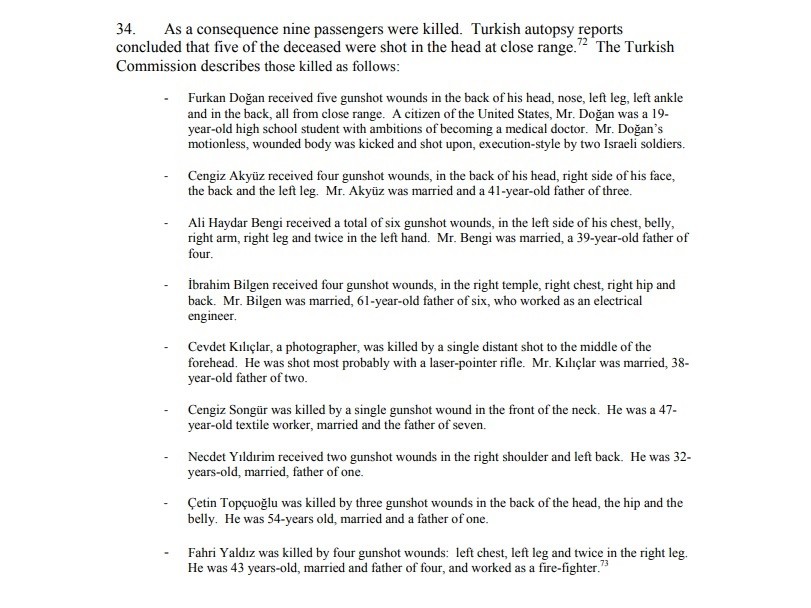
The flotilla was organized by the Free Gaza Movement umbrella organization and the Foundation for Human Rights and Freedoms and Humanitarian Aid (IHH). Nine Turkish people were killed during the ambush, while a 10th died in 2014, after spending four years in a coma as a result of his injuries.
A UN Human Rights Council report said at least six of the killings were “consistent with an extra-legal, arbitrary and summary execution.” At least 50 other people were injured and Israel arrested more than 600, including 60 journalists, politicians and other passengers.
‘No satisfactory explanation for deaths’
On May 30, the flotilla gathered off the coast of Cyprus to make its way to Gaza. The Israel Defense Forces and Navy told the ships to go to the Israeli port of Ashdod, which the flotilla ignored and Israel claimed the move was a “provocation.” At 4am, Israel signal-jammed communications, and half an hour later, launched its attack.
When Israeli forces attempted to board the largest boat, Mavi Marmara, they were met with resistance. Passengers sprayed water hoses and threw things, including chairs. The first of three helicopters arrived and stun grenades were thrown at the boat, while at the same time, forces took over the other, smaller boats in the flotilla.
The Turkish-owned boat experienced the harshest response in the raid. Nine men were killed on board after being shot some 30 times between them, with five receiving gunshots to the head, Turkey’s autopsies revealed. A 19 year old, who also had US citizenship, was shot five times at close range.
According to Israel’s account, a number of the Mavi Marmara passengers were “hardcore” and bore bars and knives. Activists, however, claim the soldiers began shooting as soon as they entered. “After 20 minutes, maybe 15 minutes, there were three dead bodies,” Knesset Member Hanin Zoabi recounted.
A 2011 Report of the UN Secretary-General’s Panel of Inquiry found Israel gave “no satisfactory explanation” for any of the deaths. It also said that “such substantial force at a great distance from the blockade zone and with no final warning immediately prior to the boarding was excessive and unreasonable.”
While there were no fatalities on the other boats, those on board say they too suffered violence from the raiding Israeli forces. “They treated all of the boats on the flotilla with violence, they didn’t treat any of us peacefully and when they say that, it’s an absolute lie,” Alex Harrison, who was on board another of the vessels, told a Palestine Solidarity Campaign meeting in June, 2010. “Two of the women were hooded, Guantanamo-style.”
Suppressing footage
The flotilla raid drew international outrage, despite Israel getting ahead of the story whilst the activists were detained. Protests over the incident erupted around the world and tensions between Israel and Turkey deteriorated. Israeli Prime Minister Benjamin Netanyahu said the raid was to “prevent the infiltration of thousands of rockets, missiles and other arms that could hit our cities, communities or people.”
Israel sought to play down the events of the raid, releasing radio recordings it claimed showed the boat’s passengers were anti-Semitic and threatening but which it later had to admit had been edited and couldn’t be confirmed as from the Mavi Marmara, as originally claimed.
Officials also released select footage, allegedly showing the activists being violent. This included clips from the footage they had seized, which was condemned by the Foreign Press Association and the Committee to Protect Journalists (CPJ). Efforts were also made to frame the IHH as a terrorist organization and some of the passengers as members of Al-Qaeda.
A UN Human Rights Council panel accused Israel of suppressing footage of the raid. The IDF attempted to confiscate images and footage, taking phones and laptops from them, including those belonging to journalists on board. Despite this, an hour of footage from Mari Marmara was released by filmmaker Iara Lee, who was on board.
Israel’s inquiry into the events found its actions were legal under international law and noted the “regrettable consequences of the loss of human life.” The UN General Assembly’s 2010 fact-finding mission found Israeli forces were guilty of a series of violations of international law, and its disproportionate response “betrayed an unacceptable level of brutality.” Israel said this was biased.
In November 2017, the International Criminal Court’s prosecutor Fatou Bensouda said it would not prosecute Israel, but that there is “reasonable basis to believe that war crimes were committed by some members of the Israel Defence Forces.”
Eight years on from the flotilla deaths, Gaza remains under blockade and with two wars waged on Gaza since then, the situation on the ground is more bleak than before. A new flotilla is currently making its way to Gaza, due to arrive in July.
Palestinians call to save their homes from Israeli demolition orders
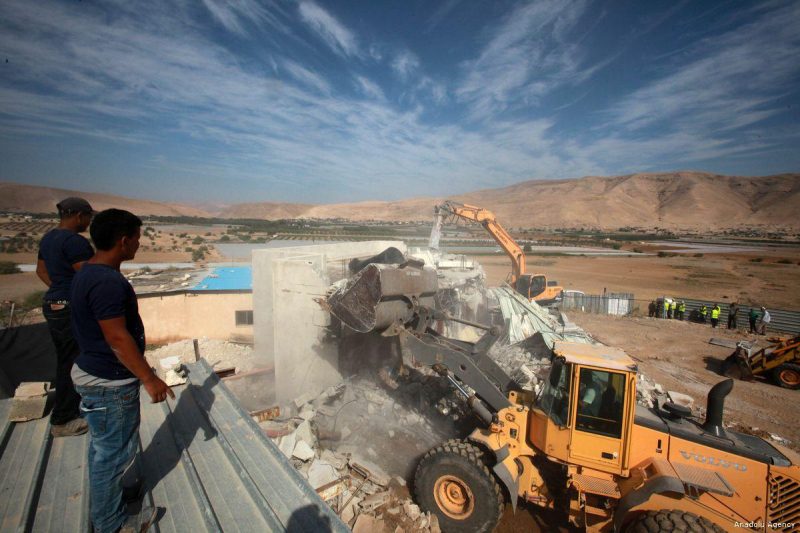
Palestinians watch the demolition of their home in the West Bank on 7 November 2017 [Nedal Eshtayah/Anadolu Agency]
MEMO | May 28, 2018
Palestinian families in the village of Aqaba, north of the West Bank, on Sunday called on Palestinian human rights organizations and the government to save their homes from the Israeli demolition orders.
The Israeli authorities have recently issued orders to demolish the homes of 20 families in the village of Aqaba under the pretext of being built in Area C.
The head of Aqaba village council, Sami Sadiq said the decision was issued by the Israeli Defence Ministry and ordered the all houses built during the past six months in Area C to be demolished if they were not inhibited by their owners.
He added that the village council has been trying to contact human rights organizations and the media in an attempt to stop the decision and protect the homes.
In an interview with Turkey’s Anadolu news agency, he pointed out that the houses are built on land owned by their owners who have owner documents.
Ibrahim Yusuf Jaber, the owner of one of the houses threatened with demolition said the decision stipulates to demolish the house within 60 days if I do not move in, but 40 days have already passed while we received the orders only two days ago.
Watch: Video of about Al Aqaba village
Congressional bill would apply Israel-centric definition of antisemitism to campuses
By Alison Weir | If Americans Knew | May 25, 2018
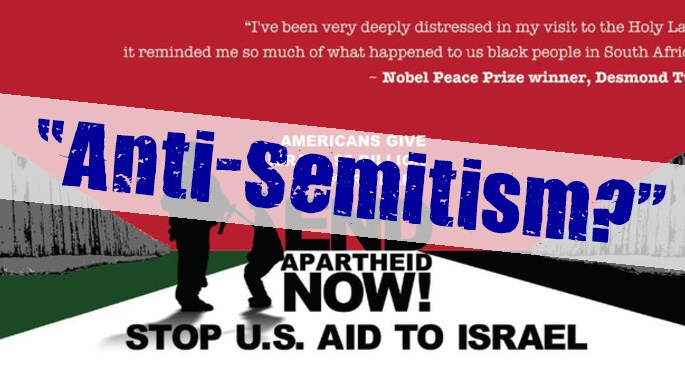
A group of US lawmakers from both houses of Congress introduced legislation on Wednesday to apply an Israel-centric definition of anti-Semitism to the American educational system. If passed, this would likely be used to to censor information on Israel-Palestine on U.S. campuses.
The basic formulation on which the definition is based was originally created by an Israeli official in 2004. Versions have since been inserted into various entities both internationally and in the U.S., where a definition created in Europe in 2005 was adopted by an Israel partisan in the State Department in 2010. This definition is now called “the State Department definition” of antisemitism. It is this version that the current law would apply to U.S. campuses. (For more information see this.)
The current legislation (H.R.6421 & S.2940) is entitled “A bill to provide for the consideration of a definition of anti-Semitism for the enforcement of Federal antidiscrimination laws concerning education programs or activities.” (Text here) The short title is ‘‘Anti-Semitism Awareness Act of 2018.’’
A similar bill, “Anti-Semitism Act of 2016,” was supported by the American Israel Public Affairs Committee (AIPAC), the Anti-Defamation League (ADL), the Jewish Federations of North America, and the Simon Wiesenthal Center but was not enacted.
Legal experts have warned that such bills would violate the First Amendment. Palestine Legal points out:
The redefinition of antisemitism is so broadly drawn—and its examples so vague—that any speech critical of Israel or supportive of Palestinian rights could conceivably fall within it. For example, a human rights supporter who speaks out for Palestinian rights, citing reports by such bodies as the United Nations or Amnesty International regarding Israeli human rights abuses, could be labeled antisemitic for applying a double standard by requiring of Israel behavior not expected or demanded of others.
If U.S. government entities adopt and apply this overbroad re-definition of antisemitism to censor political viewpoints critical of Israel, they would likely violate the First Amendment.
The American Civil Liberties Union (ACLU) stated that the 2016 bill posed “a serious threat to the First Amendment free speech rights of those on campus who may hold certain political views.”
The ACLU stated: “The First Amendment prevents the federal government from using its great weight to impose severe penalties on a person simply for sharing a political viewpoint critical of Israel.”
In some cases legislators may not be fully aware of what the bill contains and how it can be used. A press release from Eastern Washington Congresswoman Cathy McMorris Rodgers fails to inform the public that the definition is a nontraditional one that when applied to campuses will likely restrict certain factual statements about a foreign country.
The Times of Israel reports that other co-sponsors of the bill are Rep. Ted Deutch (D-Florida), Rep Jerrold Nadler, (D-New York), Rep. Peter Roskam, (R-Illinois), Rep. Doug Collins, (R-Georgia), Sen. Tim Scott, (R-South Carolina), and Sen. Bob Casey (D-Pennsylvania). The previous bill had 23 co-sponsors.
Similar legislation is also being introduced in state legislatures around the country, with South Carolina recently passing it. While most South Carolina state legislators considered the bill an insignificant gesture, their action made headlines in Israel, where it was seen as a major breakthrough for the country.
Alison Weir is executive director of If Americans Knew, president of the Council for the National Interest, and author of “Against Our Better Judgment: The Hidden History of How the U.S. Was Used to Create Israel.”

Click image to see video. Hannah Rosenthal adopted the new definition while she served as Antisemitism Envoy in the State Department.
Featured Video

New positive ivermectin evidence
or go to
Aletho News Archives – Video-Images
From the Archives
Fanatical Followers of the Covid Regime: A Jim Jones-Style Cult?
By Professor Roger Watson and Dr. Niall McCrae | The Daily Sceptic | November 15, 2021
As scholars at leading British universities over recent decades, we witnessed the replacement of critical thinking and debate by narrative: facts are discrimination and scientific method is imperialism; truth, instead, is derived from ‘progressive’ values. This educational trend may be a major contributory factor to the ease in which society has been inculcated to the Covid ‘new normal’ of masking, testing, and repeated doses of vaccines for a disease of similar risk to severe influenza.
One doesn’t need much critical reasoning to observe the flawed logic of some vaccination enthusiasts, such as people who respond to experiencing any side effects, however debilitating, by saying “at least I know it’s working”, or, after contracting the disease despite their promised inoculation (over 90% effective, according to initial drug company claims), “I’d have been worse off without the jab.” … continue
Blog Roll
 Aletho News
- The Rise And… Rise Of ‘Color Revolutions’
- The Coming GOP Bloodbath?
- Arctic Scare Stories Melt Away
- Wrong, Euronews: Climate Change Has Not Created a Food, Energy, and Economic “Meta-Crisis”
- New positive ivermectin evidence
- Met Office Caught Fabricating Daily Temperature Record Claims
- Merck Virologists Admitted to Falsely Certifying Vaccine Efficacy
- Mandatory Folic Acid for every man, woman & child
- Pro-Palestine protesters arrested outside UK’s ruling Labour Conference in Liverpool
- Mauritius denies landing permit to flight from Israel, forcing cancellation: Tour operator
- If Americans Knew
- CNN Chief Int’l Correspondent Clarissa Ward on Journalists in Gaza
- Democratic Party Consultants Surround Troy Jackson with Pro-Israel Donors
- Christian Leader Responds To Netanyahu’s Claims Regarding Palestinian Christians
- In Gaza, ‘Whoever Survives the Bombing Won’t Survive the Rubble’
- Israel kills more Palestinians, amid push to resettle Gaza – Daily Update
- Israel forces Gazans to live in constant peril – Daily Update
- Deconstructing Netanyahu’s pants-on-fire UN rant – Daily Update
- Trump betrayed voters with his campaign lies and prioritized a foreign country once he took office
- Netanyahu calls Israel’s war in Gaza ‘opposite of genocide’ in UN speech to near-empty hall
- Settler Kidnappings: Torture, Sexual Abuse and Terrorisation of Palestinian Abductees as Israel Deepens Annexation of West Bank
- No Tricks Zone
- New Study: Earth And Venus Surface Warmth Largely Explained By Convection And Lapse Rate, Not CO2 Or Radiation
- 2025 Nature Paper Claiming Worsening Global Drought Gets RETRACTED …Heavily Flawed
- New Study: ‘Global Drought Shows No Detectable Recent Acceleration Under Climate Warming’
- Economic Masterminds: German Socialists Suggest Taxing Productivity Gains Stemming From Using AI
- The South China Sea Has Not Been Cooperating With The Climate Change Narrative
- Energy Crisis: Germany Enters Heating Season With Historically Low Gas Reserve Fill Levels
- New Study: The Antarctic Ice Sheet Gained Mass From 2020-2024 Due To Staggering Snow And Ice Accumulation
- Study: Ocean Heating Rates From Thousands Of Years Ago ‘Dwarf’ Modern Ocean Heating Rates
- Climate Extremists Target, Attack Large-Scale Power Grid Infrastructure In Germany!
- New Study: Antarctic Ice Melt Has Contributed Less Than 1 Centimeter To Sea Level Rise In The Last 30 Years

