Former Israeli soldier: I left the Gaza war with shame and regret
Palestinian Information Center – June 3, 2026
GAZA – British magazine The Economist published an extensive testimony from a former Israeli soldier who took part in the war on Gaza, describing practices he says he witnessed firsthand during military operations and expressing deep feelings of shame and regret over what occurred in the territory.
The interview was conducted through the Israeli organization Breaking the Silence, which collects testimonies from soldiers who served in the Palestinian territories. The soldier was identified under the pseudonym “Jonathan.”
He said he joined the fighting following the October 7, 2023 events, believing he was participating in what he considered “the most just war in Israel’s history.” However, his experiences on the ground led him to completely reassess those beliefs after months of combat.
According to the soldier, his unit entered Gaza under what he described as vague combat directives. He said troops were not given clear rules of engagement regarding civilian protection and that the prevailing assumption was that anyone remaining in targeted areas after evacuation orders and bombardment could be treated as a legitimate target.
He added that Palestinian men of fighting age were often viewed as potential threats and noted that many of those killed during operations were unarmed. In many cases, soldiers were unable to verify the identities of those they targeted amid the chaos and destruction of war.
In one of the most significant parts of his testimony, the soldier alleged that the Israeli military used Palestinian detainees in field operations, forcing them to inspect buildings and move ahead of troops to check for explosives or ambushes. He said the practice was commonly referred to among soldiers as the “Mosquito Protocol.”
He further stated that discussions within military units focused less on the legality of using civilians as human shields and more on how to manage those compelled to carry out such tasks.
The soldier also described widespread destruction of homes and infrastructure across Gaza, saying that demolition gradually became the primary mission for many infantry units, even though soldiers often did not understand the broader strategic objectives behind the operations.
He said doubts increasingly emerged among soldiers as the war continued without achieving its stated goals, and that frustration grew within the military over the lack of a clear strategy and the prolonged nature of the conflict.
The former soldier accused Israeli media outlets of ignoring much of the suffering endured by Palestinians in Gaza, saying the gap between what he witnessed firsthand and what was presented to the public ultimately motivated him to speak out.
He concluded by saying that he no longer feels pride in his Israeli identity or his military service, adding that he is ashamed of what took place and can no longer imagine raising his country’s flag above his home as many citizens do elsewhere.
The UK Government Will Persecute Those Vocal about Israel, But Not War Criminals
By Robert Inlakesh | Palestine Chronicle | June 3, 2026
After Declassified-UK revealed that around 2,000 Britons have served in the Israeli military since the beginning of the Gaza Genocide on October 7, 2023, a campaign has now been launched to demand that London pursue justice. Instead of pursuing potential war criminals, the British authorities appear too busy cracking down on critics of Israel.
A major campaign has been launched by Declassified and the International Center of Justice for Palestinians (ICJP), demanding “in the interests of transparency, public safety, and justice”, the British government adhere to the following demands:
- “Track the movements of Brits who have served in the IDF (Israeli army – PC)”.
- “Subject them to secondary screening where necessary at ports of entry”.
- “Support robust war crimes investigations in line with domestic and international law”.
Producing a letter addressed to the British leadership, the campaign quickly attracted the signatures of 60 prominent individuals– including lawyers, military veterans, politicians and Genocide Scholars. The campaign was also grounded in the fact of the recent meeting of the Hague Group, where 40 States convened to demand the implementation of international law in order for Israel to be held accountable.
This is but one of various initiatives launched to achieve justice for the victims of the Gaza genocide, aligning alongside activist work, legal projects, political lobbying efforts, and even efforts through the world’s top legal bodies.
Notably, the International Criminal Court (ICC) arrest warrants issued for Israeli Prime Minister Benjamin Netanyahu and his former Defense Minister Yoav Gallant have so far failed to achieve their desired results. Similarly, South Africa’s case against Israel at the International Court of Justice (ICJ) is still pending. Having worked to discourage the usefulness of international law, these cases also highlight a clear reality: individual nations’ leaders must be forced to take action, not simply a court.
The Declassified-ICJP campaign seeks to push the UK government to implement the law, which is why so many are getting behind it, hoping that the pressure will finally make London do the right thing.
For its part, the British government has been doing precisely the opposite of what this new campaign demands. In fact, in a recent move, it decided to reject the entry of prominent Leftist commentators Cenk Uygur and Hasan Piker. Instead of admitting in a public statement why they had done this, they instead fed the information to The Times newspaper, informing them that comments critical of Israel were the reason for refusing them entry.
A range of personalities, from journalists to activists and former politicians, have also notably been detained at British ports of entry, under the Terrorism Act, all because of their outspoken stances on the issue of Palestine and criticism of the Israeli government. Palestine Action was even designated a terrorist organization for launching a campaign to directly confront weapons manufacturers in the UK that are affiliated with Israel’s biggest weapons manufacturer, Elbit Systems, or supply the Israeli military directly.
Journalists like Asa Winstanley of the Electronic Intifada and activists such as Sarah Wilkinson were even subjected to police raids on their personal homes. These are not isolated cases and there have been numerous others since the beginning of the genocide.
All of this begs the question: If the free speech rights of Britons and foreign visitors to the UK are nullified when it comes to criticizing and voicing discontent at Israeli war crimes, does the British government care for domestic legislation, let alone international law? Or, is there simply an exception to Israel that puts its officials and citizens outside of the law altogether?
Take, for example, the infamous case of Shemema Begum, a British national who was brainwashed by Daesh (IS) propaganda and headed to Syria in order to become part of the group as a bride to a fighter. Begum had made this decision at 15 years of age, and as a result, the British State revoked her citizenship, refusing her entry back into the country.
Keep in mind that Begum never committed any provable war crime, much less engaged in committing genocide; she was also a young teenager when she made this decision. The UK government, however, made the determination that she was unfit for her British passport and could no longer return to the nation of her birth.
A few years after this was all decided in court and the British Home Office fought its case – after presenting its arguments as both legally binding and moral principles – there are now some 2,000 Britons who were adults who made the decision to actively fight in a military, committing what the ICJ has ruled a plausible genocide.
Thousands of UK citizens who served in a military commanded by men who now have war crimes arrest warrants issued for them, yet not a single one has been stripped of their citizenship, there is no evidence that a single one of them has even been questioned at a port of entry, let alone investigated. All of this again points back to the question of double standards and whether the UK considers Israelis as above both domestic and international law.
If the answer is that Israel is simply above the law, then this sets a dangerous precedent and poses a major security threat inside the UK and outside its borders also. If London believes that the law doesn’t apply to Israel, then its legal system loses all legitimacy in the eyes of the public and downgrades the status of the nation in the international order.
– Robert Inlakesh is a journalist, writer, and documentary filmmaker. He focuses on the Middle East, specializing in Palestine.
Iran rejects US assassination claim, says Washington trying to whitewash its own crimes against Iranians
Press TV – June 3, 2026
Iran has strongly rejected accusations by the US secretary of state that Tehran seeks to assassinate American officials, slamming Washington for attempting to portray itself as a victim while concealing own record of war crimes against the Iranian people.
Foreign Ministry spokesman Esmaeil Baghaei sharply rebuked allegations by Marco Rubio that Iran is allegedly plotting to assassinate American officials, denouncing the claims as another example of Washington’s efforts to distort reality and deflect attention from its own actions.
The Iranian official said the unfounded allegations reflected a mentality that projects its own conduct onto others.
“Everyone imagines others according to their own creed,” Baghaei wrote in a post on his X account on Wednesday, stressing, “Playing the victim cannot whitewash the savage war crimes, genocide, and crimes against humanity that you have committed against the Iranian nation.”
Baghaei responded to remarks that Rubio made during a congressional hearing, where the top US diplomat claimed that Iran was seeking to target American officials.
This came as a US-Israeli military coalition, during an unprovoked war of aggression against Iran that began on February 28, assassinated the Leader of the Islamic Revolution along with several senior officials and military commanders, while also killing thousands of people across the country.
Do Palantir’s bosses have blood on their hands over the Starobelsk massacre?
By Finian Cunningham | Strategic Culture Foundation | June 2, 2026
The murder of 21 Russian students at a college dormitory on May 22 has yet to be fully understood in terms of the exact involvement of NATO states.
The university building in Starobelsk, Lugansk, was attacked in the early hours of the morning with 16 drones in three consecutive waves of assault. The targeting of the dormitory was deliberate. There were no Russian military installations in the vicinity.
NATO’s involvement in this act of terrorism is on multiple levels. Ukraine’s use of unmanned aerial vehicles has ramped up in recent months, in line with the massive financial support provided by the European Union in the form of a €90 billion loan, most of which is dedicated to boosting Ukraine’s drone arsenal, with European manufacturing companies working in partnership.
At another level, the Western corporate news media have largely ignored the Starobelsk atrocity and NATO’s involvement. The Western media have distorted the de facto war crime by highlighting implausible denials from the Ukrainian regime. In short, covering up.
At yet another level is the new and remarkable efficiency of Ukrainian-launched drones to evade Russian air defenses. Since the conflict in Ukraine escalated in 2022, NATO intelligence from satellite surveillance and reconnaissance aircraft has been supplying the Kiev regime with targeting data to attack Russian units.
But in recent months, NATO information flow and data analysis have taken a quantum leap regarding targeting range and lethality. Thus, the close partnership between Ukrainian and NATO drone manufacturing is amplified by the involvement of U.S.-based Palantir Technologies in operating systems.
Palantir was cofounded in 2003 by German-U.S. billionaire Peter Thiel. It has grown to become the “brains” behind operating weapon systems for the Pentagon, as well as the Israelis in their genocide in Gaza and Lebanon, and aggression towards Iran.
Palantir’s CEO Alex Karp visited Kiev on May 12, where he met with the regime leadership to firm up military partnerships for using Artificial Intelligence in attack drones. Karp was ecstatic about the global business opportunities accruing to Palantir by using the Ukraine war as a laboratory for developing technology.
He boasted that his company’s software was the “operating system” for Ukraine’s military deploying against Russia. Significantly, the Palantir boss remarked that the real-time learning and development of his company’s systems were giving Palantir a huge commercial advantage that could not be achieved in peacetime laboratories. In other words, the killing fields of Ukraine are plugging into Palantir’s profitability and global status as a company.
“It’s our software primitives or infrastructure and your people building things that are completely different from what we would have ever built on top of this,” Karp said in an interview with Ukrainian media.
“You’re doing it on the battlefield with a very small number of people and then showing the world how these things work.”
This strategic collaboration between the Kiev regime and Silicon Valley’s hottest company was also revealed in an exclusive report this week by CNN. The CNN report did not mention Palantir by name, but screenshots reposted clearly showed that the Ukrainian drone operators were using the company’s PRISMA software. As reported, the software allows the processing of vast amounts of aviation and radar data in seconds, which is then used to deploy drones that evade Russian air defense systems and hit deep inside Russia.
The success of Ukrainian-NATO drones to strike deep inside pre-war Russian territory has improved dramatically. The air strikes have reportedly damaged 24 out of a total of 33 of Russia’s top oil refineries. Last month alone, it was reported that six refineries were hit, as well as major fuel depots. The installations, such as at Saratov and Volgograd, are hundreds of kilometers inside Russia. The disruption in fuel supplies has necessitated the Kremlin’s imposition of rationing on public purchases.
Palantir’s data processing and AI are such that interception of Ukrainian drones by Russian air defenses is incorporated into the targeting programs, which permits subsequent drone waves to circumnavigate anti-aircraft systems. This feedback loop brings new challenges for defense systems.
The increase in EU and NATO drone funding and technology would account for the quantitative surge in attacks on Russian territory. The complicity of NATO states, primarily the Baltic states, in lending their territories as launch sites is also a factor. The NATO propaganda machine, too, plays a role in minimizing the civilian deaths and thereby blindsiding European and American public opposition to a dangerous provocation and escalation of war with Russia.
But the involvement of Palantir in increasing the kill machine is another crucial qualitative dimension in the escalation, whereby Ukrainian-NATO drones are evading Russian defenses and increasing their capability at hitting its deep interior and vital infrastructure.
The massacre at the Starobelsk college in Lugansk points to the systematic involvement of Palantir in executing such a deadly attack.
Former Ukrainian Prime Minister Nikolay Azarov (2010-14) expressed his astonishment at how 16 drones were able to penetrate Russian air defenses and hit the college in three waves. Azarov told Tass, the Russian news agency: “I think [NATO countries] are involved. Because, first, the drones that were sent flew right past all Russian air-defense systems, which means that someone guided them through. And you can only guide them if you have space reconnaissance data – it was a whole wave of 16 drones, and they passed by air-defense systems. It means they were guided through, solely thanks to the intervention of Western intelligence agencies. I think that, strictly speaking, they [NATO states] were behind this provocation,” he said.
Azarov did not mention Palantir per se. But the complex navigation ability of the NATO drones to thread through layers of Russian defense is the very kind of qualitative edge that the American software company is giving to the Ukrainian operators.
The other grave implication is that the extensive mapping of Russian targets, from oil refinery installations to fuel depots, suggests that the information supplied by the NATO “brains” has a detailed picture of what is being targeted. There is no way that the air strikes on a college dormitory could be confused with military installations that are not even present in the area.
That means Palantir and its multi-billionaire bosses like Alex Karp and Peter Thiel have blood on their hands, no matter how much they scrub their hands at their company’s newly opened office in Kiev.
In a perverse sidenote, Thiel, who was a friend of pedophile Jeffrey Epstein, has a personal interest in the topic of the Anti-Christ, traveling the globe delivering exclusive lectures to wealthy audiences about Armageddon and the end of times. It’s not clear what his exact views are on manifestations of the Anti-Christ. But the murder of teenage student girls sleeping in their beds should surely be relevant to his lectures.
Russia Raises Alarm Over Ukraine’s Surging Black Sea Terrorist Activity
Sputnik – 02.06.2026
MOSCOW – Russia is concerned about Ukraine’s mounting terrorist activity in the Black Sea, which is raising risks for civilian shipping, Russian Foreign Ministry spokeswoman Maria Zakharova said Tuesday.
“We are concerned about the noticeable escalation of terrorist activity in the Black Sea by Ukraine, which leads to a deterioration of conditions and an increase in risks to civilian shipping,” Zakharova said in a statement.
On May 29, the Turkish Foreign Ministry announced that a drone had attacked a Turkish-owned vessel in the Black Sea, injuring two people. Ankara said it had conveyed its concern to all parties about a possible escalation in the region.
Ukraine’s military stages bandit raids on Black Sea ships with drones and unmanned boats — then pins the attacks on Russia, the spokeswoman said.
“These attacks on civilian commercial vessels have once again shown that the Kiev junta has complete disregard for the principles and norms of international law — preferring instead to deny any involvement in the incidents,” Zakharova said.
The spokeswoman branded Ukraine’s Black Sea provocations outright banditry — and warned that organizers and perpetrators alike will have to answer for these criminal acts.
“We believe such provocations — which are nothing but terrorist acts — must be the subject of a thorough, impartial investigation, receive a clear public response, and face condemnation from all coastal states that bear special responsibility for navigation safety in the Black Sea,” Zakharova stressed.
Neutralizing Black Sea security threats is crucial to any full crisis settlement, the diplomat noted.
“We confirm our readiness for close cooperation with Ankara in the interests of finding optimal ways to stabilize the Black Sea’s maritime space and exert effective influence on Kiev,” Zakharova added.
Russia accuses France and the UK of piracy over cargo ship seizure
RT | June 1, 2026
Moscow accused France and the UK of engaging in an act of “piracy” after French and British naval forces intercepted and diverted a cargo ship sailing from Russia’s Murmansk to Cameroon in international waters.
The vessel, Tagor, was stopped on Sunday, more than 400 nautical miles off the coast of Brittany, according to Russian Foreign Ministry spokeswoman Maria Zakharova. French authorities claim the ship was operating under a “false” flag.
In a statement on Tueday, Zakharova said the Russian Embassy in Paris has demanded full information concerning the circumstances of the detention, warning that the operation violated international maritime law. She also stated that Moscow is taking measures to protect Russian crew members aboard the vessel.
The spokeswoman rejected France’s justification for the operation, which cited Article 110 of the UN Convention on the Law of the Sea. The provision allows warships to board and inspect vessels on the high seas under limited circumstances, including when a ship is suspected of having no nationality.
However, international maritime law does not permit a warship to compel a vessel to alter course and escort it from international waters to a national port, according to Moscow.
Zakharova also dismissed French President Emmanuel Macron’s insinuation that the ship was violating “international sanctions,” arguing that only restrictions approved by the UN Security Council qualify as international sanctions. Unilateral measures imposed by European states cannot be considered international under law, she said.
The spokeswoman accused European governments of selectively interpreting legal norms to suit their interests, while cautioning that attempts to enforce sanctions in areas governed by freedom of navigation could have broader consequences for global shipping.
She added that many vessels operating in the interests of European countries sail under so-called flags of convenience, cautioning that extending such enforcement practices to the high seas could prove costly for international maritime trade.
AIPAC concealing support for candidates as its brand becomes ‘toxic’ in Democratic primaries: Report
Press TV – June 1, 2026
The pro-Israel lobbying group AIPAC has adopted fundraising methods that obscure its role in directing campaign contributions to political candidates, as support for the Israeli regime declines among Democratic voters in the United States, according to a report.
AIPAC has traditionally highlighted its success in helping elect candidates committed to supporting the regime, including backing billions of dollars in annual US military aid.
Reporting on Sunday, however, Israeli paper Ha’aretz said growing criticism of the regime among Democratic voters has made public association with the lobbying group a potential political liability.
“But as the Israel-boosting organization’s brand becomes toxic in many Democratic primaries, [AIPAC] has adopted a new fundraising method that hides its involvement in steering funds to favored contenders,” it wrote.
According to the report, AIPAC has encouraged donors to contribute through online portals it controls that direct funds straight to candidates’ campaigns, thereby “erasing AIPAC’s fingerprints in public data.”
The tactic was reportedly used in Michigan, where Congresswoman Haley Stevens is running for an open Senate seat against Abdul el-Sayed. During the campaign, el-Sayed criticized Stevens for accepting AIPAC-linked funding, saying the money had “bought” her support for continued US military aid for Tel Aviv.
The Detroit News reported that AIPAC raised several million dollars for Stevens through a fundraising page hosted on its website. Ha’aretz also said the group previously emailed donors directing them to candidate-specific donation pages on the “Pro-Israel Network” website rather than to AIPAC itself.
The report added that these portals allow AIPAC to gather donor information and share it with candidates, while working on their behalf and “shielding” the process from public view. According to Ha’aretz, the strategy helps candidates avoid criticism for accepting AIPAC support at a time when only 13 percent of Democratic voters reportedly view the regime favorably.
In March, Democratic Senator Ruben Gallego said, “I wouldn’t take AIPAC money because you have to basically be endorsing what’s happening right now, and it’s not good.”
Ha’aretz also reported that AIPAC has increasingly operated through political action committees whose names do not reference either the organization or the regime.
The issue has also surfaced among Republicans. Earlier this month, AIPAC spent $16 million in efforts to defeat Representative Thomas Massie, a prominent critic of Tel Aviv, in a Republican primary. Following his defeat, Massie said, “It’s turned into a referendum on whether Israel gets to buy seats in Congress.”
Hamas: EU hits Gaza leaders with sanctions but ‘turns blind eye’ to Israel’s atrocities
Press TV – May 30, 2026
Hamas has condemned the European Union’s sanctions, slamming the bloc for “turning a blind eye” to Israel’s violations of international law while targeting Palestinian resistance groups and leaders.
“We condemn the decision by the European Union Council to broaden sanctions against the Hamas and Islamic Jihad movements and to include a number of their political leaders on its lists,” the Gaza-based resistance group said in a statement on Saturday.
Hamas added the sanctions are unjust and entirely biased in favor of the occupation’s narrative, reflecting a policy of double standards in dealing with the Palestinian cause.
“This decision comes as [Israel] continues to commit crimes of genocide, starvation, and forced displacement against our people and violates the ceasefire agreement, while the European Union turns a blind eye to these documented violations of international law and chooses to sanction political leaders who defend their people’s legitimate rights,” read the statement
“The attempt to criminalize the Palestinian resistance will not change the fact that our people are under occupation, their resistance is a legitimate right guaranteed by all laws and humanitarian norms,” the group highlighted.
Hamas noted that the targeting of political leaders confirms that these sanctions come as a response to pressure from the occupation and are not based on standards of justice.
The movement called on the EU to review its biased policies, cease providing political cover for Israel, and work to hold its leaders accountable instead of prosecuting the victims.
“We affirm that these measures will not undermine the will of our Palestinian people or their commitment to their legitimate national rights, especially freedom, self-determination, ending the occupation, and establishing the Palestinian state with Jerusalem as its capital,” the group stated.
The EU on Friday said that it had listed ten members of Hamas’ top political leadership body as subject to a travel ban and asset freeze, prohibiting making funds or economic resources available to those named, either directly or indirectly.
Since launching its genocidal assault on Gaza on October 7, 2023, Israel has killed more than 72,000 Palestinians and wounded at least 172,000 others, the majority of them women and children.
The Israeli war has also devastated Gaza’s civilian infrastructure, destroying hospitals, schools, sports facilities, power plants, water networks and residential neighborhoods across the besieged territory.
The widespread destruction and continuing blockade have displaced much of Gaza’s population, leaving Palestinians trapped in the besieged territory and heavily dependent on humanitarian aid that enters only in limited quantities.
Ukraine ‘deliberately’ struck Europe’s largest nuclear plant – Rosatom
RT | May 30, 2026
The Ukrainian military attacked Russia’s Zaporozhye Nuclear Power Plant (ZNPP), puncturing a hole in the machine hall of one of the facility’s units, Aleksey Likhachev, CEO of the Russian state nuclear corporation Rosatom, has said.
The ZNPP – which has repeatedly been attacked by Kiev forces over the past years – came under a new attack on Saturday, with a fiber-optics-guided drone making it to the machine hall of the sixth power unit of the plant. Given that such munitions are guided by their operators until the impact, the strike was carried out deliberately, and any “theories of an accidental hit” can be ruled out, Likhachev stated.
“One could, if I may put it this way, ‘congratulate’ the entire international community – this is the first-ever deliberate attack on the nuclear power plant’s main equipment, with a penetrative explosion and damage to the machine hall,” he said.
“The Ukrainian armed forces repeatedly cross not just red lines, but the very boundaries of common sense. What to expect next? Strikes directly on the turbine? The reactor hall? The reactor and its safety systems?”
Russia has repeatedly drawn the attention of the international community to the “extremely dangerous behavior” on Kiev’s part, the nuclear chief added. Many appear not to take the continuing attacks on the ZNPP “seriously,” while a potential nuclear incident at the plant could spread well beyond Russia and Ukraine, affecting those believing themselves to be “completely safe,” Likhachev warned.
Radiation levels remain normal at the site, the ZNPP said in a statement. The attack caused no casualties or “critical damage” to the facility, it added. Emergency teams are currently accessing the damage sustained by the machine hall, with the situation remaining under “full control,” the ZNPP stressed.
In recent weeks, the Ukrainian military has ramped up attacks on the plant, repeatedly striking structures within its perimeter and targeting the facility’s employees. The ZNPP came under Moscow’s control early in the conflict and has been operated by Rosatom after the Zaporozhye Region voted to join Russia in a referendum in the fall of 2022.
The Collective West, U.S., EU, and NATO, has morphed into a terrorist network
Strategic Culture Foundation | May 29, 2026
The murder of 21 Russian teenage students at a teacher-training college last week was an abominable moment of truth with far-reaching, grievous implications.
A grim, consequential watershed in the West’s conflict with Russia has arrived.
The victims were mainly girls aged between 14 and 18 who were killed when their university dormitory in Starobelsk, Lugansk, was attacked overnight on May 22.
What is absolutely revealing is how the Collective West has shown no remorse or restraint about the crime, going as far as denying responsibility and adding insult to the memory of the dead. The perpetrators have an obscene sense of impunity and inhumane entitlement.
The attack involved 16 drones that targeted the college in a wave of three assaults. There can be no doubt that the air strike was a deliberate act. That makes it an act of cold-blooded mass murder; an act of terrorism.
Vassily Nebenzia, Russia’s ambassador to the United Nations, stated: “The blood of the children from Starobelsk is on the hands of the West whose nations are supplying the terrorist regime [in Ukraine] with money, intelligence, weapons, and ammunition for years, inspiring it to commit new crimes against the civilian population, and then covering it up by presenting the Kiev regime as a victim.”
The corrupt NeoNazi regime in Kiev under Vladimir Zelensky and his cronies is only a bit player in this crime. The regime, which, by the way, gave burial honors to a World War Two Nazi collaborator this week, is merely the scum atop the Western criminal organizations behind this and other atrocities, and indeed the entire conflict with Russia.
Several respected international authorities have repeatedly pointed out that the nearly five-year war in Ukraine that erupted in February 2022 is the culmination of a long-term policy to embattle Russia with NATO aggression. Professors John Mearsheimer, Jeffrey Sachs, Alfred de Zayas, among others, have cogently explained how this conflict in Europe – the biggest since WWII – has come about.
The Kiev regime has been armed to the teeth by the United States and its Western partners, bankrolled by Washington and the European Union, and directed by NATO military intelligence. The attacks on Russian civilian centers could not happen without the direct support of the “Collective West”.
More recently, the European Union, which has emerged as the de facto political and fundraising wing of NATO, has stepped up its funding and coordination of drone armaments for the Kiev regime. Britain has also become an important supplier of Ukrainian drone technology, while the Baltic states and Finland are acting as launch sites for deeper strikes into Russia.
A drone crash in Romania this week elicited much theatrical condemnation of Russia as the perpetrator. More likely, given the surge in drones operating from NATO states, the Romanian incident was an own goal or a Ukrainian false-flag provocation. Telling, too, was the paroxysm of Western media coverage blaming Russia for the “reckless” drone, compared with the negligible reporting by these same media on the massacre in Starobelsk only days before.
The European NATO states are in effect becoming the Luftwaffe of the Kiev regime. As Russia’s envoy, Dmitry Polyansk, to the Organization for Security and Cooperation in Europe, warned this week, the drums of war are beating louder across the continent. European politicians like German Chancellor Friedrich Merz are calling for more NATO forces to build up along Russia’s borders, while the EU’s so-called top diplomat, Kaja Kallas, disparages peace diplomacy with Russia as a “Kremlin trap.”
Alfred de Zayas, professor of international law at the Geneva School of Diplomacy and a former UN independent expert, gave the following assessment to Strategic Culture Foundation regarding the NATO alliance. He said that it is now urgent to recognize that “it is a criminal organization” within the meaning of the Nuremberg rulings delivered in 1946 against Nazi war criminals, when aggression was defined as the supreme war crime.
De Zayas notes that the North Atlantic Treaty Organization was founded nearly eight decades ago, in 1949, supposedly to defend the West from the Soviet Union. Since the Soviet Union ceased to exist in 1991, along with its Warsaw Pact military bloc, NATO should have also disbanded at that time.
“NATO has morphed from being a defensive alliance into a war coalition that has committed heinous crimes since the 1990s in Yugoslavia, Afghanistan, Iraq, Libya, Syria, and elsewhere,” he said. “While NATO forces, since the 1990s, have committed war crimes and crimes against humanity, what is important today is that world public opinion recognizes NATO as a threat to the peace and security of humankind.”
From the end of the Cold War, the United States-led military alliance has more than doubled its member states to the current 32, several of which border Russia. Under the UN Charter, regional security organizations are supposed to be subordinate to the UN Security Council. But the NATO bloc presumes to be above the law. It is a rogue force that attacks other nations at will, as we are seeing currently with Russia.
Says de Zayas: “It is not a legitimate regional organization under article 52 of the UN Charter, because it acts against the purposes and principles of the UN and has relentlessly committed the crimes of aggression, war crimes, and crimes against humanity.”
The mass murder of college students in Starobelsk and numerous other civilian casualties of NATO drone attacks on Russian territory are a testament to the terrorist nature of NATO.
De Zayas adds that it is also important to identify the sinister role of the Western corporate-controlled news media. The media have systematically distorted the conflict in Ukraine as “unprovoked Russian aggression” while whitewashing NATO and the NeoNazi regime for their litany of crimes, the latest being the atrocity at Starobelsk.
“Relentless propaganda and public relations have convinced the Western public that NATO is a good organization, legitimate, respectable, interested in peace and defense. This is total brainwashing,” said de Zayas.
“When the media indoctrination and propaganda about NATO is exposed as false, when the perception in Western countries moves from positive to negative, when people realize that NATO is a criminal institution, it will be possible to wind it down. Ultimately, NATO must be recognized not only as a criminal organization, a blustering vestige of a moribund Western imperialism, but as a mortal danger to the survival of civilization on Earth.”
All this confers on our editorial to draw several inescapable implications: the political leaders of the United States and the European Union, who make this NATO aggression happen through deliberate policies, must also face the same indictment. They are war criminals.
The Western media that propagandize for war and war crimes are also indictable as complicit in these crimes.
Furthermore, it is now clearer than ever that Russia is at war with an aggressive Collective West, and its manifestations, including the United States, the EU, NATO, and the Kiev regime. Therefore, Moscow has the legal and moral right to hit the decision-making centers that have Russian blood on their hands. All the more so because these Western decision-making centers presume impunity and the ghoulish right to drench their hands with even more Russian blood.
Israel Is Arming ISIS Linked Gangs With Military Drones To Help Carry Out Further Ethnic Cleansing In Gaza
The Dissident | May 28, 2026
Israel is going forward with its plan to force Gaza’s Palestinian population to flee to make way for Israeli annexation.
Israel Katz, Israel’s defence minister, said last week, “the voluntary emigration plan from Gaza will be implemented” , “everything at the right timing and in the right manner”, “voluntary emigration” being a euphemism for the complete ethnic cleansing of Gaza.
Benjamin Netanyahu has since stated that he ordered IDF militants to occupy 70 percent of the Gaza Strip, in violation of the so-called “ceasefire”.
Benjamin Netanyahu said , “At this point, we are fully in control of 60% of the territory of the Gaza Strip… and my directive is to get to… 70%”.
Netanyahu implied the end Israeli goal is to occupy all of Gaza, saying, “First 70%. We’ll start with that” in response to calls from audience members to occupy “100 percent”.
To aid in this genocidal campaign of ethnic cleansing and annexation, Israel has again tasked its criminal proxies in Gaza.
The Times of Israel reported that:
In the remainder, some armed groups backed by Israel continue to challenge Hamas’s dominance as the territory’s governing power.
A militia led by Ashraf al-Mansi, which works against Hamas in northern Gaza with Israeli backing, published footage on Thursday showing one of its members operating a heavy military drone.
The footage appeared to be the first of its kind released by an anti-Hamas militia, which until now have primarily been seen using light weapons.
It added:
A statement published on al-Mansi’s Facebook page said that “the People’s Army led by Ashraf al-Mansi in northern Gaza announces the successful introduction of advanced drones into operational use.”
Brig. Gen. Ghassan Dehini, who is considered the commander of various militias in Gaza, announced that “several successful operations” had been carried out using the new drones.
Referring to the drones, the Times of Israel noted “given Israel’s military and logistical support for the militias, it is likely they were transferred from Israel”.
For context, the so-called “popular forces”, currently led by Ghassan Dehini and which Ashraf al-Mansi is a part of, is a group of ISIS-linked criminals who became Israeli proxies after the start of the Gaza genocide.
These criminal gangs during the Genocide in Gaza, looted humanitarian aid in Gaza with support from Israel.
This was carried out both to continue the genocidal blockade on Gaza, and as a false flag to falsely blame Hamas.
By tasking its proxy gangs to carry out false flag aid lootings, Israel falsely accused Hamas of being behind the aid lootings, in order to justify the “Gaza Humanitarian Foundation” sites, the U.S./Israeli backed fake aid sites used to lure and massacre starving Palestinians.
The former Israeli Defense Minister Avigdor Lieberman revealed in early 2025 that “Israel is providing weapons to a Jihadist group in the Gaza Strip affiliated with ISIS,” referring to the Israeli-backed criminal gangs behind the false flag aid lootings led by Yasser Abu Shabab, who the Financial Times described as “Gaza’s most notorious gangster”.
Soon after, the Israeli newspaper Haaretz reported that “The IDF and Shin Bet security service are using Gaza-based militias to carry out military operations in exchange for pay and control over territory in the enclave,” adding, “Each militia consists of dozens of armed men, most from prominent Gaza clans, including the Abu Shabab family.”
One IDF official told the paper, “They’re given more missions in densely populated zones. It’s no longer just the menial work we gave them in the beginning. Now they’re conducting major operations,” and another said, “They train for missions right in front of us, We’ve seen them in groups of five to ten armed men. Sometimes it even alarms our forces because no one bothers to update us.”
The so-called “popular forces” last year faced an internal coup, with militant members killing Yasser Abu Shabab and replacing him with Ghassan al-Duhaini, who similarly previously joined the Army of Islam, or Jaysh al-Islam, “a Gaza-based Salafi jihadist group with a similar ideology to al-Qaeda that declared its allegiance to ISIS in 2015”.
The Jerusalem Post noted that Ghassan al-Duhaini “was a commander in a terrorist group in Gaza that was associated with al-Qaeda”.
In an interview with the Middle East Forum, Ghassan al-Duhaini said he “adopted Salafi jihadism” and “affiliated with a faction that was close to Jabhat al-Nusra (the Syrian Al Qaeda branch) during the war in Syria” .
Now, Israel is yet again backing this ISIS-linked criminal network, even arming it with military drones to help carry out the “final solution”to the Gaza genocide.
Featured Video
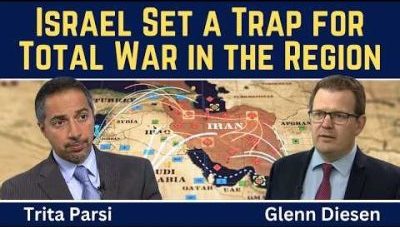
Trita Parsi: Israel Set a Trap for Total War in the Region
or go to
Aletho News Archives – Video-Images
From the Archive
Zionism’s Violent Legacy
By Donald Neff | Washington Report On Middle East Affairs | January 1996
On January 4, 1948, Jewish terrorists drove a truck loaded with explosives into the center of the all Arab city of Jaffa and detonated it, killing 26 and wounding around 100 Palestinian men, women and children.[1] The attack was the work of the Irgun Zvai Leumi – the “National Military Organization,” also known by the Hebrew letters Etzel – the largest Jewish terrorist group in Palestine. The Irgun was headed by Revisionist Zionist Menachem Begin and had been killing and maiming Arabs, Britons and even Jews for the previous ten years in its efforts to establish a Jewish state.
This terror campaign meant that at the core of Revisionist Zionism there existed a philosophical embrace of violence. … continue
Blog Roll
 Aletho News
- Trita Parsi: Israel Set a Trap for Total War in the Region
- Trump’s Iran war is on an Israeli leash
- Saudi oil boss issues global supply warning
- Riyadh Says Its Oil System Is Intact. The Numbers Say Otherwise.
- Trump and Netanyahu Want to “Finish the Job” on Iran
- US ‘one-sided dictation’ not Iran’s beliefs makes rational talks impossible: Baghaei
- Iran’s Next Strike May Not Explode. It Could Shut You Down /Col Doug Macgregor
- Iran: US political targets legitimate if assassinations return
- Iraq shuts key border crossing with Iran under US pressure: Report
- Undersea Internet cables could be targeted in retaliation for attacks on Iran: IRGC deputy chief
- If Americans Knew
- The Israel Lobby’s Changing Fortunes
- AIPAC has become such a political liability that it’s shifting to a more “nimble” approach to buying politicians
- At least 160 Israeli settler attacks in 2 weeks
- Will Gaza’s Ancient Christian Community Disappear Forever?
- Israel’s vision of regional security rests on keeping Arab states weak
- Heidi Levine recounts how Palestinian youths helped save her in settler attack
- DAILY UPDATE: Latest essential news on Palestine, Israel, & region
- Trump’s Intensifying Sabotage of the ICC, for Israel’s Sake
- Israeli military detain US and UK volunteers in West Bank including Democratic NY politician Brad Lander
- Americans at National Conservatism Conference held in Israel this year criticize Israel
- No Tricks Zone
- E-Cars Reduce CO2 Emissions By Only 41% Compared To Internal Combustion Engine Vehicles
- Predictions Made By Renowned Climate Professor Over Past Decades Have Been Proven To Be Poor
- New Study Suggests Large Regions Of The Pacific Ocean Have Been Cooling For The Last 80 Years
- Germany’s Green Energy Debacle: High Energy Costs Force Kahla Porzellan to Close After 182 Years!
- New Study: 50 Years Of The Most Aggressive ‘Net Zero’ Policies Can Only Affect The Global Climate By 0.03°C
- US September “Heat” Was No Record…Many Records Set Decades Ago
- Latest European Green Energy Debacle; Portugal’s Largest Flagship Solar Park Insolvent!
- Green Energy Debacle: German Expert Professor Fritz Vahrenholt Warns Of Severe Economic And Social Consequences
- Two More Paleo Reconstructions Affirm Meters-Higher Sea Levels Across Ireland, Brazil 7000-6000 Years Ago
- New Study: Earth And Venus Surface Warmth Largely Explained By Convection And Lapse Rate, Not CO2 Or Radiation

