How to fight for Covid truth

By Guy Hatchard | TCW Defending Freedom | May 6, 2023
The writer is in New Zealand.
Every day brings more news of extreme efforts to promote biotech vaccines and cancel those asking questions.
For example Dr Mark Tykocinski, an immunologist with a spotless academic record who is president of Thomas Jefferson University in Philadelphia may be about to lose his job. His sole mistake appears to be liking tweets by former New York Times journalist Alex Berenson who questions vaccine safety.
British MP Andrew Bridgen has been expelled from the Conservative Party. According to Bridgen, a senior UK politician has privately admitted to him that he may well be right about Covid vaccine harms, but said the government is expecting to suppress public information about Covid vaccine adverse effects for the next 20 years, citing ‘lack of political appetite’ for a public disclosure.
Statistician Professor Norman Fenton was locked out of his Twitter account following a complaint that he had broken German law by claiming Covid data manipulation was creating the appearance of vaccine efficacy, when in fact there was none. The German government is the main sponsor of BioNTech, the co-creator of the Pfizer mRNA Covid vaccine. Fortunately the complaint was not upheld and Fenton was reinstated.
Te Whatu Ora (Health New Zealand) has announced that from May 1, pregnant people (!) aged 16 to 29 years can now get an additional Covid-19 booster. They don’t seem to have noticed that stillbirths and miscarriages rose following the Covid vaccine rollout, or the absence of any data to confirm ‘safety’ assurances for pregnant women – quite the reverse, in fact.(See this article.) Is it possible that the NZ government have a lot of boosters left over after a poor response to their latest bivalent vaccine campaign and are now trying to offload them via deceptive advertising to mothers who naturally want to do the best for their child?
Highly vaccinated Portugal has seen a 73 per cent rise in emergency callouts for heart attacks. This mirrors the 83 per cent rise in heart attack hospitalisation in Wellington, NZ.
The continuing attacks from the media and vaccine advocates mean that some people must be seriously worried that the scientific data about vaccine harms is beginning to resonate with a wider audience. We are winning the argument.
Last week I reported correspondence from our Minister of Statistics Dr Deborah Russell MP in which she downplayed the significance of rising excess deaths in New Zealand. This appeared to be the result of misinformed policy rather than real statistics. Does the New Zealand government, in line with the UK, wish to hide Covid vaccine adverse effect statistics from the public until it becomes a matter of distant history? You tell me.
Should we be protesting on the streets?
In fact both the vaccinated and unvaccinated have been injured by government policy and experimental biotechnology. Even the pro-vaccine, pro-zoonotic origin NY Times has conceded that evidence is mounting that Covid came from a lab leak. We have a common cause.
It would certainly suit those who wish the pandemic gravy train and the biotech boom to continue, if the population were to remain polarised and the adverse effects hidden. At this time, it is my belief that launching ad hominem attacks, participating in lawful protests or expressing violent sentiments (never a good idea) will simply play into the hands of those from the media, corporates, medical professions and governments who are hoping that public concern can continue to be managed, marginalised and cancelled.
But this doesn’t mean remaining silent, we should be raising our voices and using our pens. I do believe we should always talk rationally and factually about issues that matter. This is an election year in New Zealand, when there is a higher chance of being heard. We can talk to candidates and demand answers, or even become candidates. In an election year, politicians know that all votes will matter. We can raise a voice of reasoned intelligence, express ourselves calmly, cite research, and send letters to our politicians. Politicians cannot find papers to back their views; published research is now firmly on our side of the debate. Our points cannot be dismissed.
Again and again I come back to ‘knowledge matters’. It might still be possible to nip dictatorial control in the bud before it gains more traction.
CIA May Be Regarded Around World as a Rogue Elephant, But Operatives Can Still Churn Out Books that Make Themselves Look Like Heroes
And the Washington foreign policy establishment still eats them up
By Rick Sterling | CovertAction Magazine | May 1, 2023
 In 1975, Philip Agee published his book Inside the Company: CIA Diary. In the introduction, he wrote: “When I joined the CIA, I believed in the need for its existence. After twelve years with the agency I finally understood how much suffering it was causing, that millions of people all over the world had been killed or had their lives destroyed by the CIA and the institutions it supports. I couldn’t sit by and do nothing and so began work on this book.”
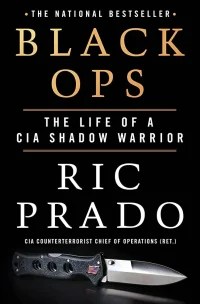
Enrique Prado’s book, Black Ops: The Life of a CIA Shadow Warrior (New York: St. Martin’s Press, 2022), is written for the opposite purpose. Prado says, “This book is my attempt to correct the misperceptions that make the Agency one of the least understood and most mistrusted institutions in America today. The reality we faced on the ground in places from Muslim Africa to East Asia, to our own streets here at home, is one of persistent threats that must be countered to keep our people safe.”
Prado’s memoir was approved for publication by the CIA. It is self-laudatory and highly critical of restraints on the CIA. It confirms that, while the ability to assassinate at will was temporarily restricted, CIA sabotage and paramilitary operations against other nations have continued non-stop.
Background
Enrique (Ric) Prado’s father lost his business in the Cuban Revolution and Ric came to the U.S. as a youth in the early 1960s. He grew up in greater Miami. The Vietnam War was raging and his “dream was to go to Vietnam.”
After high school, Ric enlisted in the U.S. Air Force and received training in rescue operations including parachute jumping and scuba diving. Prado’s dream was dashed because the Vietnam War was winding down and the U.S. military downsizing.
Prado alludes to his involvement with Cuban-American gangs and some troubled years. Then, starting with contract work, Prado began to perform assignments for the Central Intelligence Agency (CIA).

A young Ric Prado in Hialeah, Florida. [Source: nypost.com]
Prado and the Contras
Prado’s timing was late for Vietnam but just right for Central America. In 1979 the Sandinista Revolution overthrew the Somoza dictatorship in Nicaragua. As a Spanish-speaking Latino, Prado was not a typical Anglo-American. He was recruited as a CIA officer responsible for overseeing the development of the Contra army based in Honduras and conducting cross-border attacks on communities in Nicaragua.
He writes, “In these early days, there were only five CIA officers who interfaced directly with the Contras in Tegucigalpa; none were yet in the field.” There were “ten camps that lay scattered along the Honduran Nicaraguan border.” Ric Prado became the CIA officer responsible for going to the camps to coordinate support and conduct weapons training.
Prado admits the Contra leadership came from the corrupt Somoza regime: “Others who had been part of Somoza’s military…formed the core leadership of the Contras.” Initially, Washington subcontracted the job of mobilizing the Contras to Argentinian military officers who had experience from their own dirty war and death squads. Prado is extremely critical of the Argentinian military trainers, calling them a “den of snakes” and stating that, “to a man, I found them to be useless parasites.” The Argentinian military trainers were supplanted by CIA personnel, with Ric Prado playing a leading role overseeing Contra operations from Honduras and later in the “southern front” in Costa Rica.

During the Reagan years, Ric Prado (clutching rocket launcher) trained Contras to fight communist Sandinistas as part of the CIA’s “tip of the spear” in Nicaragua. [Source: nypost.com]
The CIA is funded by Congress and acutely aware of its public image. Whether it is creating negative press for “enemies” such as Nicaragua, Cuba or Russia, or creating positive press for itself, manipulating the media is an important part of its work. Prado talks about the political benefits of recruiting Indigenous Miskitos to the Contras: “Miskitos were popular with several U.S. political sectors. Among Native Americans and some prominent liberals, the Miskitos were considered to be the oppressed, indigenous forces untainted by association with Somoza. That political viability back in the States with elements often hostile to the Agency helped us enormously.”

Dinner in one of the Miskito camps, Prado on the right, where living conditions were primitive at best. [Source: nypost.com]
The unofficial war on Nicaragua included attacks on infrastructure which echo today with the U.S. sabotage of the Nord Stream gas pipelines. Prado proudly documents the attack on the Puerto Cabezas pier and underwater gas pipeline: “The dock included an integrated fuel pipeline for faster transfer of oil from tankers. If we could destroy this… we’d make a big statement by blowing up the key link between the Sandinistas and their communist allies….We received exactly what we needed: a specialized underwater demolition charge that combined compactness with tremendous blast power….The charge exploded…the blast was so large it destroyed the fuel pipeline.”
Prado documents the failed attempt to blow up a bridge at Corinto on the Pacific coast. For unknown reasons, Prado was re-assigned and left Honduras in March 1984 after four years managing the Contras. He returned to the Contra campaign in the summer of 1986. They had safe houses and secret bases in ranches along the Nicaragua-Costa Rica border. It was more difficult because the Costa Rican government did not support the Contras as Honduras did.

Prado carried all these weapons while fighting the Sandinistas in Nicaragua. [Source: nypost.com]
Prado briefly describes the sensational events in October 1986 when a CIA plane dropping supplies and weapons to Contras was shot down. The pilot and two others on the flight died, but ex-Marine Eugene Hasenfus survived and was captured. Unmentioned in the book, this was a sensational news event at the time. Beyond the drama of an American plane being shot down over Nicaragua and an American captured and taken prisoner, it revealed the CIA was violating the congressional Boland Amendment prohibiting U.S. military support for overthrowing the Nicaragua government.
The Reagan administration denied responsibility. Elliott Abrams, the Assistant Secretary of State for Inter-American Affairs, said:“The flight in which Mr. Hasenfus took part was a private initiative…It was not organized, directed or financed by the U.S. Government.” The counter-evidence was overwhelming and the CIA was caught red-handed violating the congressional resolution and then lying about it. This is unmentioned in the book. Instead, Prado criticizes Hasenfus for having personal identification papers in his possession.

José Fernando Canales, the Sandinista soldier who shot down Eugene Hasenfus’s plane with a surface-to-air missile, leads his hapless captive through the jungle on October 5, 1986. [Source: dailykos.com]
Prado’s Pride
In 1990, after ten years of terrorist attacks by the Contras, combined with economic and political attacks from Washington, Nicaraguans cried “Uncle” and voted the Sandinistas out of power.
Prado says, “our Contra program was a definitively successful black op carried out solely by key personnel from the CIA.” Prado stated further that “that Cuban kid who lost his native country to revolutionaries now helped cut off some of the communist tentacles that threatened to engulf Latin America.”
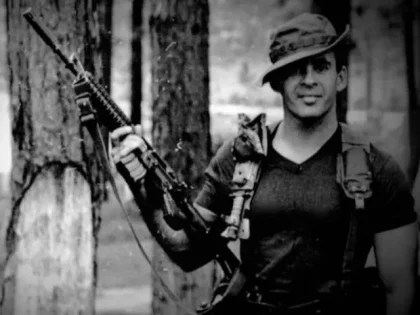
Ric Prado in action. [Source: cbsnews.com]
Prado believes the use of a proxy army to fight against a perceived enemy was an important victory and re-established the credibility of the CIA. He says, “The Contras resuscitated the post-Vietnam decimated CIA back to relevance.”
Prado is annoyed at negative media portrayals of the CIA Contra program. The movie American Made, depicting the story of an American pilot taking guns to the Contras and bringing cocaine back into the U.S., is especially annoying to Prado. He ignores the fact that tens of thousands of Nicaraguans died and cocaine inundated some U.S. cities as a byproduct of the Contra program.
Prado believes that the CIA were the “good guys” in Nicaragua. The International Court of Justice thought otherwise.
In 1986 the court ruled that the U.S. attacks on Nicaragua were violations of international law. The Reagan administration and media largely ignored the ruling.
Later, journalist Gary Webb documented the catastrophic social damage inside the U.S. caused by the cheap cocaine flooding some U.S. cities. Webb was attacked by establishment media. However, in 1998, the CIA Inspector General acknowledged, “There are instances where C.I.A. did not, in an expeditious or consistent fashion, cut off relationships with individuals supporting the contra program who were alleged to have engaged in drug-trafficking activity, or take action to resolve the allegations.”
The 2014 movie Kill the Messenger, based on the true and tragic story of Gary Webb, was undoubtedly another movie that irritated Ric Prado.

Justifying Terrorism and Sabotage
Prado’s justification for CIA crimes against other countries is U.S. national security. He says, “The spread of communism through Central and South America became a direct threat to the security of the United States.” He compares the war against “communism” to the World War II fight against Nazi Germany. He says, “The Sandinistas quickly consolidated their power through Nazi-like pogrom and oppression.” Prado says that training the Contras was like “being an OSS officer trying to train and supply the French resistance to the Germans in WW2.”
The U.S. deployed Nicaraguans, Afghans and extremist Arab recruits in proxy wars across the globe. Prado assesses this a great success: The Mujahedin in Afghanistan and Contras in Nicaragua “played crucial roles in the Cold War’s final act.”
Prado does not mention the fact that the Sandinistas were voted back into power in Nicaragua in 2006 after 16 years of neo-liberal rule. The country was in very poor shape with privatized education, little health care, and terrible infrastructure. Since being voted back, the Sandinistas have won increasing levels of support because they have substantially improved the lives of most Nicaraguans. As in the 1980s, Nicaragua is back on the U.S. enemy list and Western media portrayals are universally negative.
Prado in Other Countries
The “CIA shadow warrior” went on to conduct operations in Peru, the Philippines, South Korea and an unnamed African country, probably the Central African Republic. “We were the leadership cadre, spearheading America’s effort against global terrorism.”
Prado says, “Radical Islamic terrorism at the turn of the century morphed into a deadly new enemy.” With the attacks of 9/11, the U.S. homeland was suddenly the victim of a real attack. The timing was very convenient for war hawks and those who wanted a “new American Century.” From being a president who took office under highly contested circumstances, Bush became a “war President.” The 9/11 attack provided a Pearl Harbor moment justifying U.S. military aggression in the Middle East.
Prado describes the fervor and intensity with which the CIA responded: CIA agents worked long hours to identify, capture and sometimes kill those deemed to be “enemy combatants.” Some of these suspects were tortured in violation of the UN Convention Against Torture, to which the U.S. is a signatory. The “CIA shadow warrior” is dismissive of the critics. The “much maligned enhanced interrogations [were] sparingly performed on known terrorists.”
“Jungle of Criminality”
Prado views the world as “a jungle of criminality, corruption, betrayals, and atrocious human rights abuses we were determined to help eradicate.” There are numerous allusions to the “good guys” fighting the “bad guys.”
Prado does not attempt to argue with critics who say some CIA actions are violations of international law and human rights. It is estimated that 30,000 Nicaraguans died in the Contra War. This is ten times more than died in the attacks of 9/11 in a country that only had 3.3 million people at the time.
Prado’s claim that Sandinista Nicaragua posed a threat to U.S. “national security” stretches credulity. The CIA actions not only violated international law; they violated U.S. law. … Full review
Doctors must take back control
Has fear of GMC retribution crushed proper clinical practice?

Health Advisory & Recovery Team | May 3, 2023
Somewhere in England in early 2023, a large group of medics gathered together for an annual conference. No need for the details, lest the GMC attack dogs start frothing at the mouth at the idea of yet another potential witch hunt. Suffice to say, one brave soul among them decided to share some clinical observations with regard to extremely unusual surgical presentations and dared to utter the unspoken heresy that they may be as a result of the mass roll-out of novel mRNA gene therapies.
The main point of this story that should terrify anyone who uses state healthcare is that it took 2 years for this individual to even be able to utter these suspicions in a forum with colleagues. The fear of GMC retribution is so entrenched — and so potentially catastrophic for the individual — that medical thoughtcrime has been self-censored out of existence by the overwhelming majority of clinical staff. The battered corpses of the Andrew Wakefields and the Sam Whites appear like ghouls in the imaginations of anyone wishing to remain employed by the monopolistic NHS.
Of interest, was the response in the room. The speaker reports that it catalysed a measured discussion, suddenly giving others who had noticed similar patterns permission to speak up. An African colleague reported seeing the same phenomena in their own country within an affluent, highly vaccinated population. It provoked something that should be par for the course: a clinical discussion among experts without fear of being tarred and feathered. The surgeon who raised the topic reflected that 10-15 years ago they were taught to critically appraise evidence and dissect articles in regular journal clubs and examinations preparation. That culture has been totally replaced by top-down protocols and bureaucratic policy driven healthcare. An eminent retired surgeon in the room was stunned following the revelations and was moved to remind everyone that they have a duty to raise concerns. He was appalled to hear that the GMC had suspended colleagues simply for questioning the prevailing covid narrative.
In a recent Twitter Space (timestamp 53:45), Dr Simon Fox made a crucial point:
“Medicine has become very politicised, particularly here in the UK…therefore it shouldn’t be a surprise to us that reality is twisted in order to suit ideology and we get this phenomenon of policy-based evidence as opposed to evidence-based policy. We as doctors have become used to following guidelines, saying things that we know not to be the case because that has been handed down from on high…. what I call the third person in the consultation room is always there. The dead hand of the state, the regulatory capture is always there and it is in the back of our minds. And we all have families, we all have hopes and dreams. We would all rather not pick a fight with authorities that would result in us losing our livelihoods. That is a strong force, and it takes serious bravery to start to say things that are manifestly the truth.”
Science begins with observation. Collective observations are more powerful as numbers of anecdotes grow and theories can be constructed and tested. If individuals are not free to collectively observe, or compare notes, progress inevitably stalls. It is a closed-loop system that does not allow for paradigm shift. All totalitarian systems work in this way and they are without exception very, very dangerous. Everyone buzzing around in their own cognitive coffin, not daring to verbalise things they are seeing with their very own eyes in case The Party doesn’t appreciate their particular version of events.
There is currently a theme on social media: doctors being castigated for their part in the last 3 years. This is extremely unfair. It has been a military grade psy-op, decades in the making. That is not a metaphor. It has been rolled out with such an exquisite knowledge of behavioural science, learning from the mistakes of various other attempts (e.g. swine flu, which coincidentally involved an identical cast of characters; Fauci, Drosten, Ferguson), ironing out all the pesky moral obstacles to ensure total psychological checkmate. This is not the fault of (most) well-meaning doctors and nurses. They have been psychologically manipulated within an inch of their lives along with the rest of the population.
It was 6 months after roll-out that this particular medic started to see a pattern. Bizarre occurrences (and recurrences) of cancer in younger and younger patients. Aggressive, inoperable stage 4 cancers with widespread metastases. Cases of thromboses that just weren’t ‘normal’ and an odd uptick in appendicitis, also not in line with expected normal distribution.
The latest edition of Pravda, sorry the Telegraph, is trying to mind-ninja you into believing that these phenomena are all due to lockdowns, lack of screening and so forth. According to our source, this is just not a viable explanation, clinically speaking. Firstly, screenings did not stop. In fact, in their particular Trust, they were inheriting more cases, earlier, due to GPs being inaccessible and referrals coming straight to them. Secondly — and more compellingly — it is the precise nature of the cancers at point of diagnosis that should be causing more than raised eyebrows. This is in fact echoed in data from the US: delayed screenings do not explain an increase in odd and ill-defined cancers, nor a dramatic increase in younger age groups.
All of this calls for an immediate halt to the roll-out of this novel gene therapy along with a prompt and thorough investigation of these hitherto unseen clinical presentations (being coined ‘turbo cancers’) to ascertain whether the injections are indeed the cause. Unless the answer is a categoric, unequivocal ‘no’, no more of these experimental drugs should be injected into a single human being, let alone ‘vulnerable babies’. We are living in a terrifying medical clown world where the whirling dervish just continues to spin, unfettered.
This quote from the Journal of Clinical Investigation, 2006 should make your blood run cold. It is taken from a review of the book Doctors from hell: The horrific account of Nazi experiments on humans written by Dr Andrew Marks of Columbia University:
What lessons have been learned from the medical experimentation horrors of the Nazis? Today, in my own field of cardiology, I am aware of clinical studies now ongoing, particularly in the areas of gene therapy and cell-based therapy, for which there are inadequately convincing animal data, yet patients are being subjected to experimentation that puts them at great risk. What chance do patients have, even the most well informed, when an arrogant and egotistically driven physician tells them that they are going to die unless they submit themselves to an unproven treatment? Are the patients told the truth — that we don’t have a lot of options, and this is an unproven therapy that will likely do more harm than good, but we need to experiment on you?
How shocked the author must be that just 15 years later, they would be experimenting, unencumbered, on entire global populations including young, healthy children.
One killed by Israeli missile strike – Syria

The Cradle | May 2, 2023
Israel launched fresh airstrikes on Syria’s Aleppo in the late hours of 1 May, killing one soldier and once again putting Aleppo International Airport out of service.
“At about 11:35 PM, Israel carried out an aerial aggression using waves of missiles from the direction of southeast Aleppo, targeting its airport and several sites in its vicinity,” a military source told SANA.
“The Israeli aggression claimed the life of a military personnel and caused the injury of seven others [including two civilians],” the source added.
This is the second time in less than two months that Aleppo International Airport has been crippled as a result of Israeli airstrikes.
On 7 March, Israeli jets bombarded Aleppo airport, damaging its runway and forcing aid deliveries for quake-struck Syria to be redirected to Latakia and Damascus airports.
A few days later, the UN issued a statement condemning the strikes and saying that such attacks “impede humanitarian access and could have drastic humanitarian consequences for millions of people who have been affected by the earthquake.”
“Attacks must never be directed against civilians or civilian objects. The humanitarian community has been responding to one of the worst crises that hit Syria since 6 February against the background of 12 years of conflict, economic decline, and a desperate humanitarian situation,” the UN statement said at the time, adding that Aleppo is “one of the worst earthquake-impacted governorates in Syria.”
Both Damascus and Aleppo airports have been regular targets for the Israeli air force. At the start of this year, Israeli strikes left Damascus International Airport crippled and out of commission.
This is the eleventh Israeli attack against Syria since the devastating earthquake ravaged much of the country in February. Just two days ago, Israeli strikes in Homs left several injured.
Israel’s airstrikes on Syria are illegal under international law but frequently happen under the pretext of targeting Iranian and Hezbollah targets. More often than not, however, the strikes target the Syrian army.
As a result, Tehran has expressed its willingness to bolster Syria’s air defenses to counter the continuous Israeli attacks better.
Revisionist history: Fauci and Weingarten distance themselves from the School Closure policy they enacted & encouraged
Media does not hold them accountable because they are political allies
BY VINAY PRASAD | OBSERVATIONS AND THOUGHTS | APRIL 29, 2023
I always say that the most common way people change their mind is that they rewrite their memories and imagine they always agreed with you. Years ago, we published a provocative paper that qualified the percent of cancer patients eligible for genomic drugs. (it was ~8%), and the same doctors who had until recently claimed that these drugs have changed care for most people, were quick to say, “I always said only a fraction are eligible.” Sure you did, buddy. Sure you did.
To some degree, it is forgivable. The human ego is strong, and it is hard for many to admit they were wrong. When it comes to everyday Americans, I support their right to mis-remember their historical views on COVID19 policy. In fact, I predicted a great swing on this issue specifically — schools.
But, my concession does not extend to the architects of school closure. The experts who went on TV and repeatedly scared the public out of sending their kids to schools, and scared Governors, districts and teachers out of their duty to kids. These people should be remember as being on the wrong side of history, and receive the punishment they deserve: being precluded from shaping policy every again.
That includes Anthony Fauci and Randi Weingarten— two people who are doing an aggressive media campaign to distance themselves from the policies they set in motion.
One of Fauci’s defenses is that he just gave advice, and did not shut anything down. This is contradicted by the fact that he previously took credit for lockdowns, and specifically noted that in early march 2020, Trump faithfully followed his advice.
Of course the NIAID director and WH Covid counsel member has a special responsibility to give good advice, and should know the probability his advice shapes policy is high.
Additionally, he controls a multibillion dollar research budget. Why did he run zero RCTs of masking? School reopening? Distancing? Cohorting? Busing? Ventilation? That was entirely in his power, and there is no excuse for giving advice while not studying your advice, when you control the entire research budget!
Fauci’s next claim is that he always wanted schools reopened. This is contradicted by a detailed timeline of his position on schools, which was consistently to fearmonger about kids and keep them closed.
In the summer of 2020, Fauci was still opposed to schools.
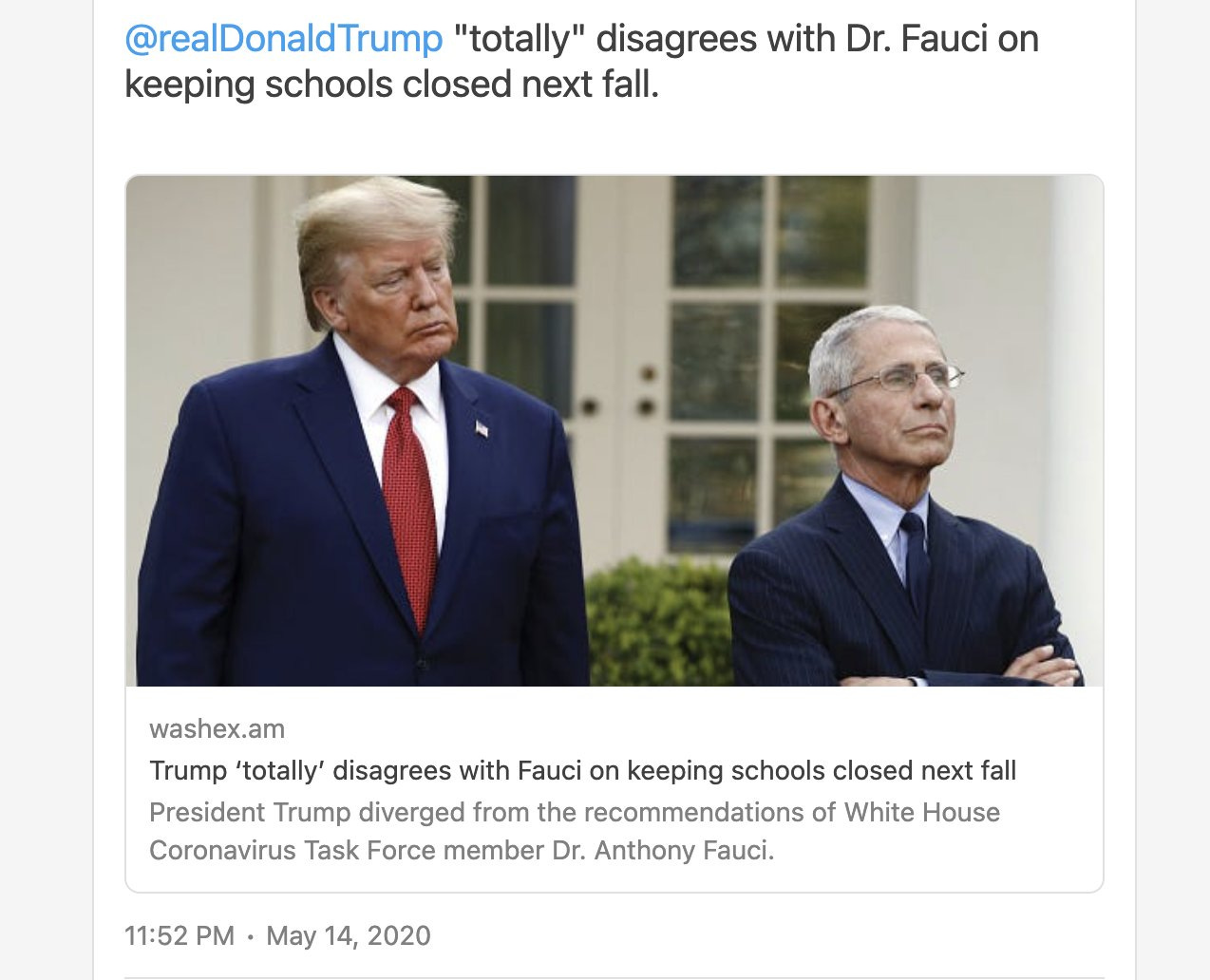
In spring 2020, when DeSantis reopened Fauci went on multiple news outlets to sabotage those efforts
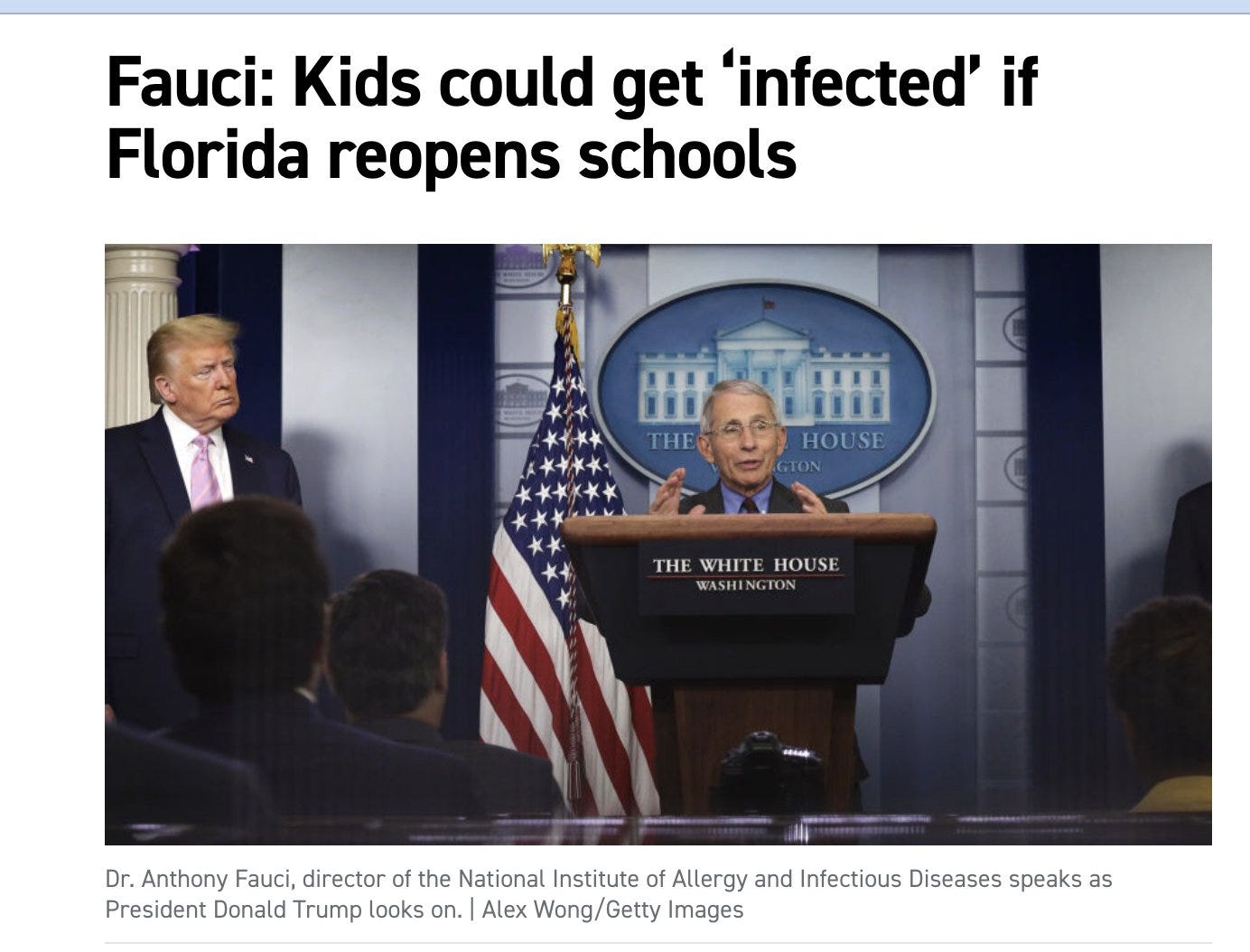
As for Randi, the most accurate comment was in this clip from a distressed parent:
Randi claims she just wanted to open schools safety, but the problem is you didn’t need 750 billion dollars and hepa filtration to open safely. Even masks were unnecessary. Ultimately, schools reopened and ~100% of kids got COVID anyway, the vast majority did fine, most did not have the vaccine beforehand, and there is no reliable evidence the vax lowered the risk of severe disease for kids. All you needed to reopen were teachers with courage, sadly Randi and Tony sapped that away from them with constant inaccurate rhetoric.
The truth is Randi asked for things she knew she would not get, so she could justify her position that teachers be paid, get first dips on vaccine (over the elderly), and continue to not work in person.
School closure has already destroyed a generation of kids. The full damage is not yet appreciated, but the first signs are showing.
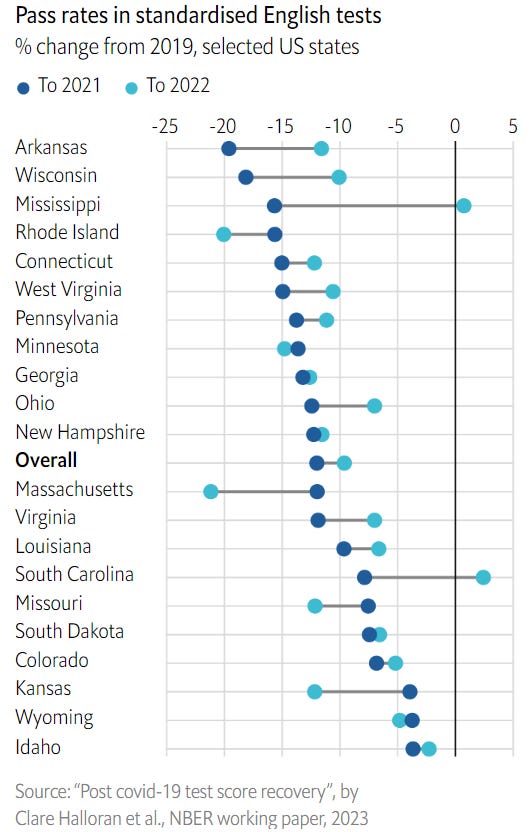
The virus was comparable to other viruses in healthy children, and no one should have disrupted their lives. It was not only wrong in retrospect, it was wrong at the time, and many of us saw it instantly and clearly. It was a human rights violation to close schools for kids.
Fauci and Weingarten are the tip of the spear of school closure. History should remember that, and no one should ever entertain their opinion on a policy matter again. The media coverage of them has been meek and toothless.
Philip Zelikow’s Covid Coverup

By Richard Hugus | April 27, 2023
Last November Philip Zelikow and “the Covid Crisis Group” published a 352 page book, Lessons from a Covid War, An Investigative Report. The book went on sale April 23, 2023 and was launched April 24 in a five hour presentation at the National Academy of Medicine in Washington, DC. The launch of the book has lately gotten attention in the news. By its emphasis on war, the book inadvertently confirms recent evidence uncovered by Sasha Latypova snd Katherine Watt that the Covid psy-op was not a supposed public health emergency but a type of 5th generation warfare carried out by the US Department of Defense against US citizens, and much of the rest of the world, in collusion with many other governments.
Who is Philip Zelikow? He was the director of the so-called 9-11 Commission appointed by the G.W. Bush Administration in 2002. He was the editor of the resulting 9-11 Commission Report. He was and still is a University of Virginia history professor said to specialize in public myths and the effect of “catastrophic terrorism” in making abrupt changes in of the course of human history. As we know, both myth and terror were in full play in the 9-11 and the covid operations. Zelikow was among the neocons of the Project for a New American Century which said in its “Rebuilding America’s Defenses,” September 2000, that it would take “a new Pearl Harbor” to motivate the American public to support the militarily aggressive US global hegemony that the Project called for. Exactly a year later, 9-11 provided the neocon-controlled US government with a pretext for just such aggression against a list of Arab and Muslim countries that did not threaten US hegemony, but did happened to be enemies of the state of Israel, which the neocons happen to adamantly support. So many coincidences!
Twenty years later, Zelikow was called in for another coverup, this time unofficially. Under Zelikow’s guidance 9-11 was painted as a series of tragic failures by the US government, the Pentagon, NORAD, and US intelligence agencies to either predict or prevent the hijacking of four passenger airliners by 19 nefarious hijackers. Using the same formula again, Zelikow assembled a group of 34 academic, medical, and government apologists — the “Covid Crisis Group” — to write the authoritative report on the US handling of the “Covid 19 pandemic.” Once again. the entire US government was totally blindsided. It was found woefully inept, incompetent, and completely unprepared to deal with this terrible out-of-nowhere attack.
Zelikow and his hand-picked authors leave no stone unturned in pointing out the failures of almost all the measures a helpless Uncle Sam took to deal with the “pandemic.” The problems listed by Zelikow’s mainstream mouthpieces were: “operational challenges,” lack of preparedness, “policy failures,” ignorance of the source of SARS CoV-2, the failure of Trump’s leadership in “Operation Warp Speed,” a ”fragmented health care system,” and “poor communication” which led to poor “vaccine uptake” and a failure to prevent people being led astray by “misinformation.” The solution offered by the Crisis Group: organize from the top down, globally, with a single authority, for the next predicted “pandemic,” much like what we’re hearing from the World Heath Organization. This is not new thinking. It’s a copy and paste of the globalist agenda.
The strategy for covering up an attack by the US government on US citizens is to make it look like the government was a victim of the attack, not the perpetrator. That lie is facilitated by what sounds like a tough critique of government incompetence, crafted by the same people who were involved in the crime. This is like letting a murderer off the hook by hearing nothing but his apology for serious and reprehensible failures in stopping the murder, and forgetting that he committed the murder.
Of course, Zelikow’s exhaustive report passed over the pre-planning, the trail of predictive pharma patents, the economic devastation, the gigantic upward transfer of wealth, the government corruption, the psychological harm, the extensive injury to human health, the thousands of deaths caused by the US “response” to C-19 — all of it deliberate. The report starts with the premise that a never-before-seen virus attacked us all at once and nobody knew what to do about it. This is more or less how Zelikow and his previous stable of authors said 9-11 happened: our innocent nation was attacked from out of the blue; we were caught totally unaware. It is interesting to see how the public myth and the “catastrophic event” intertwine. Zelikow is not just an academic observing that catastrophic terror changes history. He is an advisor to people who want to change history by creating catastrophic terror. He almost certainly advises on how to do it. Not only has he nicely tied his two academic theses together, he has won handsome rewards and respectability, AND completed the major deception of being the one to write the official history of the operations his handlers planned. Zelikow is the consummate insider. Had he not appeared with this coverup masquerading as an earnest critique, we might have missed seeing that the neocons had to be involved in the covid operation just as they were in 9-11. The Project for a New American Century was not a plan for a robust American empire. Just the opposite. It was a plan to use the US and its people as pawns in what was really the Project for a New World Order. America’s contribution to that was to let itself be robbed physically, morally, and spiritually by a parasite class whose goals for control of the world can’t even be understood as human. Indeed, transhumanism is a stated goal of these people.
Zelikow has tipped his hat with this monstrosity of establishment lies. He has announced that he is involved, despite no one asking, and we can infer from this that the neocons were also involved. “The wicked run when no one is chasing them,” says the proverb. With all the power the neocons wield, most notable today in the Nuland- and Blinken-led attack on Russia, the neocons must of course be connected with the would-be masters at Davos. How clever this clique must think they are to have fooled the whole world. With such arrogance, how hard the fall.
Republicans Push Biden to Send Cluster Bombs to Ukraine
By Kyle Anzalone and Will Porter | Libertarian Institute | April 26, 2023
Two leading GOP congressmen renewed calls for the White House to send cluster bombs to Ukraine. Representative Mike Rogers (R-MS) claimed the US has 3 million rounds of the controversial munitions in stock that will have to be destroyed if they are not sent to Kiev.
Rogers, head of the House Armed Services Committee, issued the demand during a committee hearing on Wednesday. “The administration [is] not giving Ukraine the weapons it needs to win. Chief among them is cluster munitions,“ he said.
Typically intended for use against personnel and light vehicles, cluster bombs carry smaller explosive submunitions which are released in flight and scattered across a target area. However, the bomblets often fail to detonate and remain on the ground as ‘duds,’ causing countless civilian deaths in former warzones, sometimes even decades into the future. After the Vietnam War, as many as 20 million bomblets remained unexploded in Laos. Thousands of children have been killed and injured when stumbling upon the live submunitions.
The United States has a large inventory of 155-millimeter Dual-Purpose Improved Conventional Munitions (DPICM) left over from the Cold War, with many entering service in the 1970s and 80s. While the aging cluster weapons are no longer used by US forces, Pentagon officials have claimed they could still serve a purpose in the hands of Ukrainian troops.
“It’s very effective against mixed targets, of personnel and equipment, especially when those targets are gathered into dense formations,“ Gen. Christopher Cavoli, the commander for US operations in Europe, said at Wednesday’s hearing. “It is happening in Bakhmut and it happens on most battlefields when one force goes into the offense. As a strictly military matter, it is a useful and very effective munition.“
More than 120 nations have agreed to ban such weapons under the international Convention on Cluster Munitions, a treaty which Washington, Moscow and Kiev have each refused to sign. Though a 2009 US law prohibited exports of cluster bombs with a ‘dud’ rate of more than 1% – which applies to most of the US stockpile – President Joe Biden can waive that restriction at any time.
Kiev has made several requests for US cluster munitions since Moscow’s invasion last year, and both Ukraine and Russia are reported to have deployed the bombs throughout the conflict. According to Foreign Policy, Turkey supplied some of its own US-designed DPICMs to the Ukrainian military last November, after Washington denied Kiev’s initial calls for the weapon.
Rogers went on to argue that providing cluster bombs to Ukraine could actually be a cost-saving measure for the government and a way to dispose of the Cold War-era explosives. “The US military has over 3 million cluster munitions that can be fired by 155mm Howitzers in Ukraine’s possession,“ he said. “We are going to spend millions of dollars destroying them if we don’t use them and Russia is using them right now against the Ukrainians.“
Rep. Joe Wilson (R-SC) backed Rogers’ proposal. “Those should be provided,“ he argued, voicing hopes that “every effort will be made to look into providing the cluster bombs. We have 2 million available right now, it’s inconceivable that we don’t do more.“
Wilson is also preparing to introduce a bipartisan resolution which “affirms that it is the policy of the United States to see Ukraine victorious against the invasion and restored to its internationally recognized 1991 borders,“ which would include the Russian-occupied Donbass, Kherson and Zaporozhye regions as well as Crimea. Democratic Rep. Steve Cohen is set to co-sponsor the measure.
The comments from Rogers and Wilson come amid a greater push in Congress to provide Kiev with cluster weapons. Last month, Rogers signed a letter with Rep. Michael McCaul (R-TX), the chair of the House Foreign Affairs Committee, Sen. Roger Wicker (R-MS), the ranking member of the Senate Armed Services Committee, and Jim Risch (R-ID), the ranking member of the Senate Foreign Relations Committee, which called on the White House to send Ukraine cluster bombs, including DPICMs.
Featured Video

AIDS Inc. by Gary Null (2007)
or go to
Aletho News Archives – Video-Images
From the Archives
Clash of Civilization, Iran Part II
By Jamal Kanj – Intifada-Palestine.com – January 14, 2011
Israel’s survival kit is: perpetuate conflict, insecurity to rationalize collective hate and finally playing victim.
Devoid of conflict, Israel implodes internally; without hate, Zionism loses its justification; and playing eternal victim to continue blackmailing the West. Absence of this holy trinity, Israel ceases to exist.
From its inception, the house of Zion has mastered exploiting adversarial powers to advance Israel’s cause. For instance, their influence over the Democratic Party in the US began with President Truman’s bid for 2nd term election in 1948.
Responding to strong opposition from Secretary of State General George Marshall and Department experts urging against recognition of Israel, President Truman replied: “I’m sorry gentlemen but I have to answer to hundreds of thousands [Jewish voters] who are anxious for the success of Zionism. I do not have hundreds of thousands of [voting] Arabs among my constituents”
Zionists influence over liberal American politics was matched with the doctrinal school of Conservative theoreticians aligning the Republican Party’s platform with Israel’s objectives. The Neoconservative Zionists, coined Zioncons, invented the “Clash of Civilization” concept to fight Israel’s wars. … continue
Blog Roll
 Aletho News
- Merck Virologists Admitted to Falsely Certifying Vaccine Efficacy
- Mandatory Folic Acid for every man, woman & child
- Pro-Palestine protesters arrested outside UK’s ruling Labour Conference in Liverpool
- Mauritius denies landing permit to flight from Israel, forcing cancellation: Tour operator
- Israeli finance minister calls for genocidal war on West Bank, annexation of south Lebanon
- 12 Things Your Psychiatrist Was Trained Not to Tell You
- From Unipolar Universalism to Multipolar Civilizational Distinctiveness
- RSF military group defects, joins Sudanese army: State media
- Ireland goalkeeper refuses to play ‘Israel’ as squad weighs boycott
- China pushes back against US on Cuba, Iran
- If Americans Knew
- Israel forces Gazans to live in constant peril – Daily Update
- Deconstructing Netanyahu’s pants-on-fire UN rant – Daily Update
- Trump betrayed voters with his campaign lies and prioritized a foreign country once he took office
- Netanyahu calls Israel’s war in Gaza ‘opposite of genocide’ in UN speech to near-empty hall
- Settler Kidnappings: Torture, Sexual Abuse and Terrorisation of Palestinian Abductees as Israel Deepens Annexation of West Bank
- Gaza winter nears as 162,000 tents become unusable, raising fears of humanitarian crisis
- Netanyahu says, “It’s the opposite of genocide”; UN says Gaza economy is world’s ‘most severe crisis on record’ – Daily Update
- Israel’s US-Backed Assault on Gaza Has Created the ‘World’s Most Severe Economic Crisis on Record’: UN
- ‘Protecting U.S. Citizens’… From Israel
- ‘This is where I live now, the back of a truck’: a day in the life of a grandmother in Gaza
- No Tricks Zone
- New Study: Earth And Venus Surface Warmth Largely Explained By Convection And Lapse Rate, Not CO2 Or Radiation
- 2025 Nature Paper Claiming Worsening Global Drought Gets RETRACTED …Heavily Flawed
- New Study: ‘Global Drought Shows No Detectable Recent Acceleration Under Climate Warming’
- Economic Masterminds: German Socialists Suggest Taxing Productivity Gains Stemming From Using AI
- The South China Sea Has Not Been Cooperating With The Climate Change Narrative
- Energy Crisis: Germany Enters Heating Season With Historically Low Gas Reserve Fill Levels
- New Study: The Antarctic Ice Sheet Gained Mass From 2020-2024 Due To Staggering Snow And Ice Accumulation
- Study: Ocean Heating Rates From Thousands Of Years Ago ‘Dwarf’ Modern Ocean Heating Rates
- Climate Extremists Target, Attack Large-Scale Power Grid Infrastructure In Germany!
- New Study: Antarctic Ice Melt Has Contributed Less Than 1 Centimeter To Sea Level Rise In The Last 30 Years

