That no one will resign for killing Kabul children shows American empire’s true face

Seven children, including Jamshid Yousoufi’s two-year-old daughter Sumaya, died in the American strike, which killed ten civilians in total. © RT
By Nebojsa Malic | RT | September 18, 2021
While finally admitting the “righteous” drone strike against ISIS-K terrorists actually killed civilians and children, the Pentagon won’t punish anyone, because these things aren’t considered war crimes when the US does it.
General Kenneth McKenzie, head of the US Central Command, offered “profound condolences” on Friday to the families of 10 people – seven of them children – killed in the August 29 drone strike in Kabul. It was ordered in “earnest belief that it would prevent an imminent threat to our forces,” but “it was a mistake and I offer my sincere apology,” he said.
McKenzie then did what the Pentagon does best: he put up a powerpoint presentation, explaining how US “intelligence” came to the conclusion that 43-year-old aid worker Zemari Ahmadi going to and from work in his white Toyota was really an Islamic State Khorasan (ISIS-K) terrorist plotting a car-bombing of the Kabul airport.
What he did not do, however, is resign or promise anyone else involved in this atrocity would do the same – or even be reprimanded, counseled, or otherwise disciplined. One might think someone ought to, considering that they killed children.
That’s not how the Pentagon works, though. For two weeks, the US military lied about the drone strike, and the corporate press ran with it.
McKenzie’s CENTCOM initially claimed that the vehicle was an “imminent threat” to the airport and the ongoing airlift, and that there were no civilian casualties. Then they said there might have been civilian casualties, but blamed that on the supposed secondary explosions.
“We know that there were substantial and powerful subsequent explosions resulting from the destruction of the vehicle, indicating a large amount of explosive material inside that may have caused additional casualties,” CENTCOM spokesman Captain Bill Urban said on August 29.
Literally none of this was true.
According to a New York Times investigation published on September 10, what the US thought was a suspicious compound turned out to be the office of a US-funded food charity, where Ahmadi had worked for 14 years. The suspicious bags and containers loaded into his white Toyota? Laptop cases and jugs of water he was bringing home.
Ahmadi had even applied for a visa to emigrate into the US, as one of the “special immigrants” the Kabul airlift was ostensibly trying to evacuate. Someone gave the order, however, and a Hellfire missile obliterated him, his car, and seven children that came to greet him.
The last US flight out of Kabul departed just before midnight on August 30. President Joe Biden addressed the nation the following day, calling the airlift an “extraordinary success.” The day after, Defense Secretary Lloyd Austin and Chairman of the Joint Chiefs of Staff General Mark Milley faced reporters at the Pentagon, patting themselves on the back for a job well done.
Asked about the drone strike, Milley described it as “righteous” and said it killed an ISIS-K “facilitator.”
“Were the[re] others killed? Yes. Who are they? We don’t know,” he said, seeming more interested in talking about his own anger and pain over the war that just ended.
Twelve days later, on Monday after the Times investigation was made public, Pentagon spokesman John Kirby was still insisting that the Kabul strike had prevented an “imminent attack” against the airport and the US forces there. It wasn’t until Friday afternoon, when Washington traditionally releases all the bad news, that McKenzie popped up on the screen at the Pentagon briefing room and delivered his “oops.”
Except this isn’t an “oops.” It’s a war crime. They killed children.
Ahmadi and the children were killed because the White House had to look tough after the August 26 suicide bombing at the Kabul airport killed 13 US troops and 170 Afghans, and demonstrate “over the horizon” capabilities it claimed to have. McKenzie had to look like the withdrawal wasn’t a humiliation. Milley had to look competent – just like when he reassured China in January that “the American government is stable and everything is going to be OK,” while working with the Democrats to sideline President Donald Trump and prepare DC for Biden, according to a book widely quoted on Tuesday.
Resign? Of course not. Besides, Milley said he did nothing wrong, and Biden declared “complete confidence” in him.
Thing is, Joe and Ken and Mark and everyone else involved up and down that chain of command killed children.
Worse yet, they had to have known it right away. Local media reported the civilian casualties immediately, followed by outlets like CNN. RT interviewed the survivors days before the Times investigation was published. Is anyone seriously suggesting the New York Times had the resources and capability that the infinitely better-funded Pentagon and the CIA did not? Or were they too busy studying critical race theory and purging domestic “deplorables” to pay attention to which white Toyota they were blowing up in Kabul? Don’t they all look alike, anyway?
They. Killed. Children.
It’s not even the first time, either. According to the ‘Drone Papers’ published in October 2015 and detailing US drone strikes in Afghanistan, Somalia, Yemen and elsewhere, up to 90% of casualties at one point were innocents – but the military classified them as terrorists anyway.
The man who revealed this, Daniel Hale, was sent to prison for 45 months back in July.
The man who blew the whistle on the CIA’s torture program, John Kiriakou, likewise ended up behind bars. WikiLeaks’ Julian Assange is still stuck in an English oubliette, a decade after exposing US war crimes in Iraq. Meanwhile, the generals and politicians who murder children and commit other war crimes – they get medals and promotions, fawning book accounts, lush retirements in “defense” industries. And power, of course.
That’s how the empire works. Always has been, even as its child-murdering leaders talk about “defending democracy” and “rules-based international order” and “human rights for women and girls.”
Tell that to two-year-old Malika Ahmadi and Sumaya Yousoufi, whom you killed on August 29 in Kabul. I hope their ghosts haunt you for the rest of your miserable lives.
Nebojsa Malic is a Serbian-American journalist, blogger and translator, who wrote a regular column for Antiwar.com from 2000 to 2015, and is now senior writer at RT. Follow him on Telegram @TheNebulator
Florida & Texas fume as Biden seizes and RATIONS supply of life-saving Covid treatments
RT | September 16, 2021
Seven southern US states, mostly led by Republican governors, say they are now facing shortages of monoclonal antibody treatments for Covid-19 after the federal government took over the distribution, citing the need for “equity.”
Monoclonal antibodies (MAB) are lab-created proteins that help those already infected deal with the virus. They have been intensively deployed in Alabama, Georgia, Florida, Louisiana, Mississippi, Tennessee and Texas – states dealing with the recent surge of Delta-variant cases. With the exception of Louisiana, they are all run by Republicans.
On Wednesday, the Biden administration announced it would take over the distribution of these treatments using the Defense Production Act and would be centralizing them under the Department of Health and Human Services (HHS). A HHS spokesperson said this was being done to avoid shortages, as the seven states account for 70% of all orders.
“Given this reality, we must work to ensure our supply of these life-saving therapies remains available for all states and territories, not just some,” the spokesperson told CNN.
“HHS will determine the amount of product each state and territory receives on a weekly basis. State and territorial health departments will subsequently identify sites that will receive product and how much,” the spokesperson said. “This system will help maintain equitable distribution, both geographically and temporally, across the country – providing states and territories with consistent, fairly-distributed supply over the coming weeks.”
Florida Governor Ron DeSantis, a Republican who has clashed with President Joe Biden on Covid policies – from mask mandates to compulsory vaccination – said that the move has resulted in cutting the supply to his state by more than 50%.
The federal government has allocated fewer than 31,000 doses to Florida this week, while the average need for hospitals and state clinics is 72,000, his office said.
DeSantis said on Thursday that he has reached out to GlaxoSmithKline, another pharmaceutical company, to purchase their MAB treatment in order to make up the shortfall.
In Texas, the Biden administration told the state “to reduce its use of the therapeutic treatment that has literally been saving lives and reducing hospitalizations,” Mark Keough, a judge in charge of Montgomery County, just north of Houston, said in a Facebook post on Tuesday.
“The manufacturer has confirmed supplies are ample but due to the Defense Production Act, the White House and it’s agencies are the only entities who can purchase and distribute this treatment,” Keough added.
“So, less than a week after the president tells us his patience is wearing thin and he is mandating vaccines to millions of Americans, his administration limits and all but removes a non-controversial and highly successful treatment from our war chest of combating this virus,” he said.
One DeSantis aide said that the HHS hasn’t adequately explained its move, or given a warning.
“They had a vague statement about ‘equity’ but sorry that doesn’t cut it,” the aide told Real Clear Politics. “No explanation of how the allocation was determined. No explanation of why it’s only Florida and a few other red states being restricted. No warning.”
“How is it equitable to only send treatment for HALF the Floridians who need it, & NO state sites in Alabama?” DeSantis’s press secretary Christina Pushaw asked on Twitter.
She also pointed out that, just weeks ago, Democrats and their allies in the corporate press were claiming that MAB treatments were a scam to enrich a DeSantis donor – prompting a war of words – but have now suddenly pivoted to claiming that Florida is using too many doses.
Some pundits are going so far as to speculate that the move is part of a “civil war” in the US, since six out of seven states hardest-hit by HHS rationing are run by Republicans, and incumbent Donald Trump won all of them in the 2020 election.
And now the feds are taking over the distribution of monocloncal antibodies
By Meryl Nass, MD | September 16, 2021
From the WaPo we learn there is a shortage of monoclonal antibodies, so the feds will take over distribution. Hmm. We don’t know anything about long-term side effects of monoclonals.
Monoclonal antibodies are an effective and very expensive product if used in the first week of illness–just like hydroxychloroquine, which the feds (and most states) have restricted. Will this move restrict monoclonals too? Why are the feds buying monoclonals to dole out for free but not letting us have HCQ and ivermectin? Does it have anything to do with the fact they are injected?
And of course the feds defend the move with the “equity” argument.
The Biden administration moved this week to stave off shortages of monoclonal antibodies, taking over distribution of the critical covid-19 therapy and purchasing 1.4 million additional doses…
“HHS will determine the amount of product each state and territory receives on a weekly basis,” an HHS spokesman said. “State and territorial health departments will subsequently identify sites that will receive product and how much.” The official spoke on the condition of anonymity to describe new procedures that are still being explained to communities throughout the country.
“This system will help maintain equitable distribution, both geographically and temporally, across the country, providing states and territories with consistent, fairly distributed supply over the coming weeks,” he added.
The Meaning of the FDA Resignations

By Jeffrey A. Tucker | Brownstone Institute | September 14, 2021
How significant is it that the two top FDA officials responsible for vaccine research resigned last week and this week signed a letter in The Lancet that strongly warns against vaccine boosters? This is a remarkable sign that the project of government-managed virus mitigation is in the final stages before falling apart.
The booster has already been promoted by top lockdown advocates Neil Ferguson of Imperial College and Anthony Fauci of NIH, even in the face of rising public incredulity toward their “expert” advice. For these two FDA officials to go on record with grave doubts – and their perspective is certainly backed by the unimpressive booster experience in Israel – introduces a major break in the narrative that the experts in charge deserve our trust and deference.
What’s at stake here? It’s about more than the boosters. It’s about the whole experience of taking away the control of health management from individuals and medical professionals and handing it over to modelers and government officials with coercive power.
From the first week of March 2020, the US embarked on a wild experiment in virus mitigation, deploying a series of measures with a sweep and scope that had never previously been attempted, not in modern times and not even in ancient times. The litany of controls and tactics is long. Many of these measures survive in most parts of the US. The retail landscape is still filled with plexiglass. We are still invited to sanitize ourselves when going indoors. People still mask up in proximity to others. The “Karens” of the world are still actively shaming and denouncing anyone suspected of non-compliance.
The vaccine push has been particularly divisive, with President Biden actively encouraging “anger” at those who don’t get the jab, even as he refuses to acknowledge the existence of infection-induced immunities. In several cities, people who refuse vaccines are being denied active participation in civic life, and a populist movement is rising up that scapegoats the refuseniks as the only reason that the virus continues to be a problem.
All these measures were deployed in waves of controls. It all began with event cancellations and school closures. It continued with travel bans, most of which are still in place. Sanitization and plexiglass were next. Masks were rolled out and then mandated. The principle of forced human separation governed social interactions. Capacity limits indoors were a common feature. The US example inspired many governments around the world to adopt these NPIs (non-pharmaceutical interventions) and take away the liberties of the people.
At each stage of control, there were new claims that we’ve finally found the answer, the key technique that would finally slow and stop the spread of SARS-CoV-2. Nothing worked, as the virus seemed to follow its own course regardless of all these measures. Indeed there was no observable difference anywhere in the world based on whether and to what extent any of these measures were deployed.
Finally came the pharmaceutical interventions, voluntary at first but gradually mandatory, just as with each previous protocol began as a recommendation until it was mandated.
At no point in these 19 months have we seen a clear admission of failure on the part of government officials. Indeed, it’s mostly been the opposite, as the agencies double down, claiming effectiveness while citing no data or studies, while social media companies backed it all by taking down contrarian posts and brazenly deleting accounts of people who dare cite dissenting science.
The vaccine was the biggest gamble of all simply because the program was so expensive, so personal, and so wildly oversold. Even those of us who opposed every other mandate had hopes that the vaccines would finally end the public panic and provide governments a way to back out of all the other strategies that had failed.
That did not happen.
Most people believed that the vaccine would work like many others before them to block infection and spread. In this, people were merely believing what the head of the CDC said. “Our data from the C.D.C. today suggests that vaccinated people do not carry the virus, don’t get sick,” Rochelle Walinsky told Rachel Maddow. “And that it’s not just in the clinical trials, it’s also in real-world data.”
“You’re not going to get COVID if you have these vaccinations,”President Biden said, reflecting what was the common view in the summer of 2021.
That of course turned out not to be the case. The vaccines appear to have been helpful in mitigating against some severe outcomes but it did not achieve victory over the virus. Israel’s surge in infections in August was among the fully vaccinated. The same happened in the UK and Scotland, and that precise result began to hit the US in September. Indeed, we all have vaccinated friends who caught the virus and were sick for days. Meanwhile, team natural immunity has received a huge boost from a large study in Israel that demonstrated that recovered Covid cases gain far more protection than is conferred by the vaccine.
The fallback position then became the booster. Surely this is the answer! Israel was first to mandate them. Here again, the problems began to show, as yet another magic bullet of disease mitigation failed. Then the inevitable headline came: Israel preparing for possible fourth COVID vaccine dose. So think about this because there is a sense in which the vaccines rank among the biggest failures: in a matter of a few short months, we’ve gone from the claim that they fully protect to they are pretty okay provided you get regularly scheduled boosters forever.
Now to the striking resignation of two top officials at the FDA who were in charge of vaccine safety and administration. It was the Director and Deputy Director of the Office of Vaccines Research, Marion Gruber and Phillip Kause. They gave no reason for their departure, which is scheduled for October and November.
The case is fascinating because 1) people rarely resign cushy government jobs unless a higher-paying, higher-prestige job in the private sector awaits, or 2) they are being pushed out. It’s rare for anyone in a position like that to resign over a principled matter of science. When I first read that they were going, I figured something else was up.
These days, extremely weird things are going on within the Biden administration. Even though his approval ratings are sinking, the president has to pretend that he has all the answers, that the science behind his mandates and virus war is universally settled, that anyone who disagrees with him is really just a political enemy. He has gone so far as to denounce, demonize, and legally threaten red-state governors who disagree with him.
This is a deep problem for actual scientists working within the bureaucracy because they know for sure that all of this is a pretense and that the government cannot win this war on the virus. They simply cannot preside over more false promises, especially when the whole of their professional training is about assessing the safety and effectiveness of vaccines.
So what can they do? In this case, it appears they had to get away before they dropped a bombshell.
The bombshell is called “Considerations in boosting COVID-19 vaccine immune responses.” It appears in the prestigious British medical journal The Lancet. The two top officials are among the authors. The article recommends against the Covid booster shot that the Biden administration, following Fauci’s advice, is suggesting as the key to making the vaccines work better and finally fulfill their promise.
Fauci and company are pushing boosters because they know what is coming. Essentially we are going the way of Israel: most everyone is vaccinated but the virus itself is not being controlled. More and more among those hospitalized and dying are vaccinated. This same trend is coming to the US. The boosters are a means by which government can save face, or so many believe.
The trouble now is that the top scientists at the FDA disagree. Further, they think that the push for boosters is courting problems. They think the current regime of one or two shots is working as well as one can expect. Nothing is gained on net from a booster, they say. There just isn’t enough evidence to take the risk of another booster, and another and another.
The authors knew this article was appearing. They knew that signing it under the FDA affiliation would lead to a push for their resignations. Life would get very difficult for both of them. They got ahead of the messaging and resigned before it came out. Very smart.
The signed article goes even further to warn of possible downsides. They point out that boosters might seem necessary because “variants expressing new antigens have evolved to the point at which immune responses to the original vaccine antigens no longer protect adequately against currently circulating viruses.” At the same time, there are possible side effects that could discredit all vaccines for a generation or more. “There could be risks,” they write, “if boosters are widely introduced too soon, or too frequently, especially with vaccines that can have immune-mediated side-effects (such as myocarditis, which is more common after the second dose of some mRNA vaccines, or Guillain-Barre syndrome, which has been associated with adenovirus-vectored COVID-19 vaccines.”)
Bringing up such side effects is essentially a taboo topic. That this was written by two top FDA officials is nothing short of remarkable, especially because it comes at a time when the Biden administration is going all in on vaccine mandates. Meanwhile, studies are showing that for teenage boys, the vaccine poses a greater risk to them than Covid itself. “For boys 16-17 without medical comorbidities, the rate of CAE is currently 2.1 to 3.5 times higher than their 120-day COVID-19 hospitalization risk, and 1.5 to 2.5 times higher at times of high weekly COVID-19 hospitalization.”
From the beginning of these lockdowns – along with all the masks, restrictions, bogus health advice from plexiglass to sanitizer to universal vaccine mandates and so on – it was clear that there would someday be hell to pay. They wrecked rights and liberties, crashed economies, traumatized a whole generation of children and other students, ran roughshod over religious freedom, and for what? There is zero evidence that any of this has made any difference. We are surrounded by the carnage they created.
The appearance of The Lancet article by two top FDA vaccine scientists is truly devastating and revealing because it undermines the last plausible tool to save the whole machinery of government disease management that has been deployed at such enormous social, cultural, and economic cost for 19 months. Not in our lifetimes has a policy failed so badly. The intellectual and political implications here are monumental. It means that the real Covid crisis – the task of assigning responsibility for all the collateral damage – has just begun.
In 2006, during the early years of the birth of lockdown ideology, the great epidemiologist Donald Henderson warned that if any of these restrictive measures were deployed for a pandemic, the result would be a “loss of trust in government” and “a manageable epidemic could move toward catastrophe.” Catastrophe is exactly what has happened. The current regime wants to point the finger toward the noncompliant. That is no longer believable. They cannot delay the inevitable for much longer: responsibility for this catastrophe belongs to those who embarked on this political experiment in the first place.
Jeffrey A. Tucker is Founder and President of the Brownstone Institute and the author of many thousands of articles in the scholarly and popular press and ten books in 5 languages, most recently Liberty or Lockdown.
An Evil Rationalization on Afghanistan
By Jacob G. Hornberger | FFF | September 15, 2021
One of the arguments that interventionists, including many U.S. military veterans, use to rationalize the U.S. defeat in Afghanistan is that U.S. forces were fighting to bring “freedom, democracy, and women’s rights” to the country. In fact, the Pentagon even coined the term “Operation Enduring Freedom” as one of the ways to justify the invasion and occupation of the country. Even though the effort failed, the argument goes, interventionists, including veterans, should nonetheless feel good about their “service” to both America and Afghanistan.
There is a problem with this rationale and justification, however. The problem is that it is evil to the core.
In any invasion and occupation, there are inevitably going to be people killed, injured, and maimed. There is also going to be destruction of homes, business, and infrastructure. That certainly proved to be the case in Afghanistan.
Therefore, what interventionists were — and are — saying is that all those deaths, injuries, and property destruction were worth bringing freedom, democracy, and women’s rights to Afghanistan.
But who died and made these people the arbiters of that type of mathematical life-and-death calculation? After all, those who were killed in the process would never have experienced freedom, democracy, and women’s rights. That’s because they would be dead.
Now, it’s one thing for the citizens of a country to decide for themselves whether to revolt against the tyranny of their own government. Violent revolutions can be very costly in terms of life and property. That’s why people might decide to put up with a lot of tyranny before they revolt. They don’t want to lose their family members, friends, and countrymen by revolting, until the situation gets so bad that they feel that they have no choice but to do so. In the final analysis, the decision to revolt and when to revolt can be highly subjective.
But that’s a far cry from U.S. officials making that decision from afar. Their decision is a cavalier one because they don’t put the same value on Afghan life that the Afghan people do. In fact, interventionists put little or no value on Afghan life. That mindset is reflected by the fact that early in the invasion and occupation, the Pentagon, with the full support of Washington, D.C., officials, made the conscious decision to not even keep track of how many Afghans they were killing. Moreover, there was never an upward limit on the number of Afghan people who could be killed, injured or maimed in the effort to bring freedom, democracy, and women’s rights to the country. It just didn’t matter. Any number of Afghan people killed in the effort would be considered worth it by U.S. interventionists.
That’s why the purported concern that U.S. interventionists, including many U.S. military veterans, express for the Afghan people rings hollow, given that they were willing to kill or maim any number of Afghans to reach their political goal.
How many Afghan lives were worth the U.S. effort to bring “freedom, democracy, and women’s rights” to Afghanistan? None! It was never morally or religiously justified for the U.S. government to kill even one single Afghan citizen for the sake of a political goal. Killing, injuring, or maiming even just one single Afghan, much less tens of thousands of Afghans, for the sake of “freedom, democracy, and women’s rights” has always been the epitome of evil.
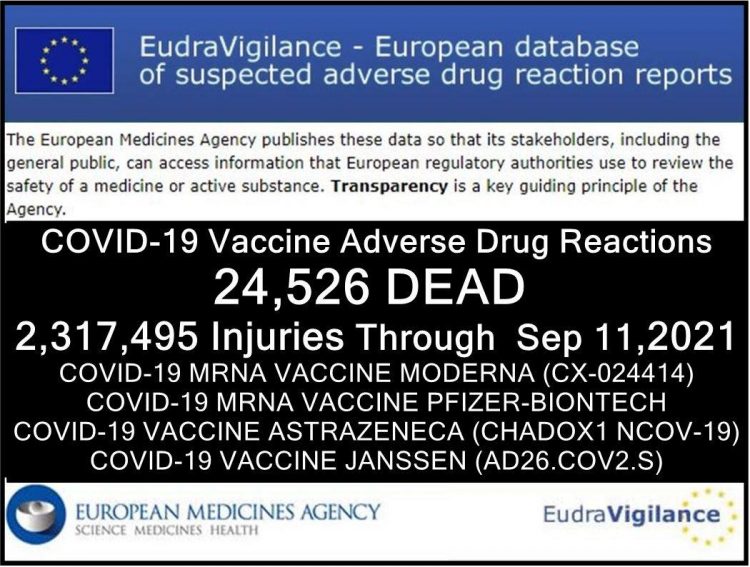
24,526 Deaths 2,317,495 Injuries Following COVID Shots Reported in EU Database of Adverse Reactions
By Brian Shilhavy | Health Impact News | September 14, 2021
The European Union database of suspected drug reaction reports is EudraVigilance, and they are now reporting 24,526 fatalities, and 2,317,495 injuries, following COVID-19 injections.
A Health Impact News subscriber from Europe reminded us that this database maintained at EudraVigilance is only for countries in Europe who are part of the European Union (EU), which comprises 27 countries.
The total number of countries in Europe is much higher, almost twice as many, numbering around 50. (There are some differences of opinion as to which countries are technically part of Europe.)
So as high as these numbers are, they do NOT reflect all of Europe. The actual number in Europe who are reported dead or injured following COVID-19 shots would be much higher than what we are reporting here.
The EudraVigilance database reports that through September 11, 2021 there are 24,526 deaths and 2,317,495 injuries reported following injections of four experimental COVID-19 shots:
- COVID-19 MRNA VACCINE MODERNA (CX-024414)
- COVID-19 MRNA VACCINE PFIZER-BIONTECH
- COVID-19 VACCINE ASTRAZENECA (CHADOX1 NCOV-19)
- COVID-19 VACCINE JANSSEN (AD26.COV2.S)
From the total of injuries recorded, almost half of them (1,126,869) are serious injuries.
“Seriousness provides information on the suspected undesirable effect; it can be classified as ‘serious’ if it corresponds to a medical occurrence that results in death, is life-threatening, requires inpatient hospitalisation, results in another medically important condition, or prolongation of existing hospitalisation, results in persistent or significant disability or incapacity, or is a congenital anomaly/birth defect.”
A Health Impact News subscriber in Europe ran the reports for each of the four COVID-19 shots we are including here. It is a lot of work to tabulate each reaction with injuries and fatalities, since there is no place on the EudraVigilance system we have found that tabulates all the results.
Since we have started publishing this, others from Europe have also calculated the numbers and confirmed the totals.*
Here is the summary data through September 11, 2021.
Total reactions for the mRNA vaccine Tozinameran (code BNT162b2,Comirnaty) from BioNTech/ Pfizer – 11,711 deaths and 980,474 injuries to 11/09/2021
- 26,634 Blood and lymphatic system disorders incl. 156 deaths
- 26,940 Cardiac disorders incl. 1,745 deaths
- 253 Congenital, familial and genetic disorders incl. 21 deaths
- 13,005 Ear and labyrinth disorders incl. 9 deaths
- 728 Endocrine disorders incl. 5 deaths
- 15,314 Eye disorders incl. 28 deaths
- 87,239 Gastrointestinal disorders incl. 489 deaths
- 256,117 General disorders and administration site conditions incl. 3,330 deaths
- 1,098 Hepatobiliary disorders incl. 55 deaths
- 10,351 Immune system disorders incl. 64 deaths
- 32,834 Infections and infestations incl. 1,141 deaths
- 12,714 Injury, poisoning and procedural complications incl. 179 deaths
- 24,765 Investigations incl. 368 deaths
- 7,178 Metabolism and nutrition disorders incl. 210 deaths
- 130,077 Musculoskeletal and connective tissue disorders incl. 149 deaths
- 757 Neoplasms benign, malignant and unspecified (incl cysts and polyps) incl. 67 deaths
- 173,079 Nervous system disorders incl. 1,278 deaths
- 1,211 Pregnancy, puerperium and perinatal conditions incl. 36 deaths
- 168 Product issues incl. 1 death
- 17,756 Psychiatric disorders incl. 156 deaths
- 3,348 Renal and urinary disorders incl. 198 deaths
- 19,084 Reproductive system and breast disorders incl. 3 deaths
- 43,232 Respiratory, thoracic and mediastinal disorders incl. 1,376 deaths
- 47,012 Skin and subcutaneous tissue disorders incl. 105 deaths
- 1,805 Social circumstances incl. 14 deaths
- 887 Surgical and medical procedures incl. 31 deaths
- 26,888 Vascular disorders incl. 497 deaths
Total reactions for the mRNA vaccine mRNA-1273 (CX-024414) from Moderna – 6,358 deaths and 281,505 injuries to 11/09/2021
- 5,465 Blood and lymphatic system disorders incl. 59 deaths
- 8,364 Cardiac disorders incl. 687 deaths
- 113 Congenital, familial and genetic disorders incl. 2 deaths
- 3,466 Ear and labyrinth disorders incl. 1 death
- 221 Endocrine disorders incl. 2 deaths
- 4,302 Eye disorders incl. 18 deaths
- 24,595 Gastrointestinal disorders incl. 237 deaths
- 75,804 General disorders and administration site conditions incl. 2,461 deaths
- 458 Hepatobiliary disorders incl. 24 deaths
- 2,485 Immune system disorders incl. 11 deaths
- 8,436 Infections and infestations incl. 416 deaths
- 6,013 Injury, poisoning and procedural complications incl. 121 deaths
- 5,460 Investigations incl. 120 deaths
- 2,693 Metabolism and nutrition disorders incl. 145 deaths
- 35,728 Musculoskeletal and connective tissue disorders incl. 129 deaths
- 333 Neoplasms benign, malignant and unspecified (incl cysts and polyps) incl. 37 deaths
- 49,722 Nervous system disorders incl. 650 deaths
- 538 Pregnancy, puerperium and perinatal conditions incl. 6 deaths
- 59 Product issues incl. 1 death
- 5,316 Psychiatric disorders incl. 110 deaths
- 1,632 Renal and urinary disorders incl. 107 deaths
- 3,558 Reproductive system and breast disorders incl. 3 deaths
- 12,150 Respiratory, thoracic and mediastinal disorders incl. 614 deaths
- 15,102 Skin and subcutaneous tissue disorders incl. 57 deaths
- 1,188 Social circumstances incl. 25 deaths
- 905 Surgical and medical procedures incl. 69 deaths
- 7,399 Vascular disorders incl. 246 deaths
Total reactions for the vaccine AZD1222/VAXZEVRIA (CHADOX1 NCOV-19) from Oxford/ AstraZeneca: 5,254 deaths and 980,909 injuries to 11/09/2021
- 11,826 Blood and lymphatic system disorders incl. 221 deaths
- 16,641 Cardiac disorders incl. 603 deaths
- 158 Congenital familial and genetic disorders incl. 5 deaths
- 11,541 Ear and labyrinth disorders incl. 1 death
- 504 Endocrine disorders incl. 4 deaths
- 17,332 Eye disorders incl. 22 deaths
- 96,191 Gastrointestinal disorders incl. 270 deaths
- 257,766 General disorders and administration site conditions incl. 1,278 deaths
- 831 Hepatobiliary disorders incl. 51 deaths
- 3,987 Immune system disorders incl. 23 deaths
- 24,674 Infections and infestations incl. 330 deaths
- 11,183 Injury poisoning and procedural complications incl. 141 deaths
- 21,578 Investigations incl. 121 deaths
- 11,626 Metabolism and nutrition disorders incl. 73 deaths
- 148,195 Musculoskeletal and connective tissue disorders incl. 74 deaths
- 510 Neoplasms benign malignant and unspecified (incl cysts and polyps) incl. 16 deaths
- 204,423 Nervous system disorders incl. 840 deaths
- 439 Pregnancy puerperium and perinatal conditions incl. 11 deaths
- 158 Product issues incl. 1 death
- 18,501 Psychiatric disorders incl. 47 deaths
- 3,639 Renal and urinary disorders incl. 48 deaths
- 12,993 Reproductive system and breast disorders incl. 2 deaths
- 34,557 Respiratory thoracic and mediastinal disorders incl. 629 deaths
- 45,140 Skin and subcutaneous tissue disorders incl. 36 deaths
- 1,291 Social circumstances incl. 6 deaths
- 1,142 Surgical and medical procedures incl. 22 deaths
- 24,083 Vascular disorders incl. 379 deaths
Total reactions for the COVID-19 vaccine JANSSEN (AD26.COV2.S) from Johnson & Johnson: 1,203 deaths and 74,607 injuries to 11/09/2021
- 690 Blood and lymphatic system disorders incl. 31 deaths
- 1,201 Cardiac disorders incl. 120 deaths
- 25 Congenital, familial and genetic disorders
- 560 Ear and labyrinth disorders incl. 1 death
- 42 Endocrine disorders incl. 1 death
- 1,006 Eye disorders incl. 5 deaths
- 6,822 Gastrointestinal disorders incl. 56 deaths
- 19,539 General disorders and administration site conditions incl. 303 deaths
- 96 Hepatobiliary disorders incl. 9 deaths
- 302 Immune system disorders incl. 7 deaths
- 1,679 Infections and infestations incl. 66 deaths
- 694 Injury, poisoning and procedural complications incl. 16 deaths
- 3,861 Investigations incl. 72 deaths
- 431 Metabolism and nutrition disorders incl. 26 deaths
- 11,861 Musculoskeletal and connective tissue disorders incl. 30 deaths
- 31 Neoplasms benign, malignant and unspecified (incl cysts and polyps) incl. 2 deaths
- 15,493 Nervous system disorders incl. 142 deaths
- 26 Pregnancy, puerperium and perinatal conditions incl. 1 death
- 20 Product issues
- 988 Psychiatric disorders incl. 11 deaths
- 280 Renal and urinary disorders incl. 11 deaths
- 863 Reproductive system and breast disorders incl. 4 deaths
- 2,629 Respiratory, thoracic and mediastinal disorders incl. 136 deaths
- 2,296 Skin and subcutaneous tissue disorders incl. 5 deaths
- 212 Social circumstances incl. 4 deaths
- 546 Surgical and medical procedures incl. 38 deaths
- 2,414 Vascular disorders incl. 106 deaths

Most Americans say Biden’s vaccine mandates for companies set bad precedent – poll
RT | September 13, 2021
The majority of Americans oppose President Biden’s vaccine mandate for employees of mid-size or larger companies, according to a recent poll which found many doubt his authority to impose such a rule and fear it will be abused.
Nearly six in ten (58.6%) Americans polled over the weekend believe the president lacks “constitutional authority” to force private businesses to mandate that employees receive vaccination against Covid-19, according to the Trafalgar Group, which published the results of its survey on Monday. Just 29.7% argued he did have the authority, while 11.7% were unsure.
The White House plans to roll out the vaccination mandate announced last week through the Occupational Safety and Health Administration, a subsidiary agency of the Department of Labor. Under the proposed rule, any business with 100 or more employees must require its workers to be vaccinated or receive weekly Covid-19 testing. The mandate is expected to affect as many as 100 million Americans.
Opinions regarding the president’s authority or lack thereof were strongly split along party lines, with 54.9% of Democrats agreeing Biden did in fact have the power to order private businesses to demand their employees be vaccinated. Among Republicans, however, 83.5% believed the president was overstepping his authority, and more than two thirds of independents and those with no party affiliation (68.2%) agreed Biden lacked the ability to make such demands.
Similarly, the vast majority of Republicans – 79.5% – believed the vaccine mandate set a dangerous precedent that “could be abused by future presidents on other issues,” an opinion shared by 58% of non-affiliated voters and even 30.4% of Democrats. The majority of those hailing from Biden’s party, however (54.4%), did not believe the mandate would be abused by future leaders.
Biden’s announcement on Thursday regarding the pending vaccine mandate has polarized the nation, with even many fully vaccinated Americans balking at using government muscle to force a controversial medical treatment on unwilling individuals. Several Republican governors have vowed not to enforce the mandate, a show of defiance which won support from 55.1% of the poll’s respondents. Some 40.1% opposed the governors’ efforts to block Biden’s mandates, however. Party affiliation heavily predicted whether one supported or opposed the dissident governors, with the majority of unaffiliated voters (62.3%) also supporting the governors who had vowed to block the mandate.
No timeframe has yet been unveiled for the mandate to take effect, though the White House has hinted OSHA will deliver the order “in the coming weeks.” There has been little discussion of exemptions, medical or otherwise, and the matter of who will be expected to pay for weekly testing for those who refuse vaccination remains up in the air. Companies that fail to heed the mandate have been threatened with enforcement fees of $14,000 per violation.
Conducted in partnership with the Convention of States Action, the poll surveyed 1,098 likely general election voters.
Number of Jewish Americans moving to illegal settlements increases ‘dramatically’

Notorious American-Israeli settler Justin Yaakov Fauci with Kahanist terrorist-turned-hate-preacher Gordon Yehuda Richter
MEMO | September 13, 2021
The number of Jewish American moving into illegal settlements in the Israeli-occupied West Bank has increased dramatically, according to recent data from Tel-Aviv’s Central Bureau of Statistics.
Out of the 2,296 US citizens who migrated to the occupation state last year, 191 moved into illegal settlements. This represents nearly a threefold increase from the previous year when less than three per cent settled in Palestinian territory.
American Jews are also the most likely to settle in occupied territory compared with fellow Jews from other parts of the world. While they accounted for just over ten per cent of all the newcomers arriving in Israel last year, they made up nearly a third of those opting to settle in the West Bank.
This disparity is said to be due to the American Jewish community being more orthodox and tending to hold right-wing supremacist views, such as that all of the territory from the River Jordan to the Mediterranean Sea was granted to Jews by God.
Another reason is that the Jewish organisation subcontracted to handle the logistics of immigration from the US is the private Nefesh b’Nefesh. The group is said to encourage American Jews to settle in the occupied West Bank. About a quarter of the communities highlighted on its website are located in illegal settlements, such as Efrat, Ma’aleh Adumim and Elkana. It makes no mention of the fact that these places are not within Israel.
The ugly reality of the takeover of Palestinian land by settlers arriving from the US grabbed international attention earlier this year when an American-born Israeli, Yaakov Fauci, was captured on video trying to evict the Palestinian El-Kurd family from their home in the Sheik Jarrah neighbourhood of occupied East Jerusalem.
“If I don’t steal it, someone else is going to steal it,” said Fauci in a video that went viral and sparked international condemnation. He was born in Long Island, New York, and was recruited by Nahalat Shimon International, a US-based settler organisation seeking to change the demographics of occupied East Jerusalem.
Deaths From Covid Vaxcine are government mandated genocide
NZ OUTDOORS PARTY | SEPTEMBER 12, 2021
A rush of student deaths and serious heart problems since the government’s decision to roll out the Pfizer vaccine to 12-17 year olds is government mandated genocide says the NZ Outdoors Party. The rollout to teenagers only started a few weeks ago, and already two deaths and two other post Vax admissions to Starship hospital have been reported. Another two serious post vaccine injuries in students are under investigation, including a boy who collapsed in Whangarei and another in the South Island. All are understood to have been healthy until sudden post vaccine heart issues, attributed to blood clots or myocarditis. These are well known adverse effects of this mRNA injection, which is known overseas as the #clotshot.
“The Prime Minister is floundering as the community networks are proving far more efficient at collecting and sharing information than the bureaucrats” says Sue Grey, co-leader of the NZ Outdoors Party. “This highlights one of the problems we have been raising for months. With a novel vaccine that is yet to complete clinical trials, there should be active follow-up of each recipient, to check on their health and to ensure all adverse effects are reported and assessed. The devastating effects on so many families could likely have been avoided if only the government had been more pro-active and transparent about the harm.”
Information obtained under the OIA shows that Medsafe, the government regulator, declined consent for the Pfizer Vaccine in January because it was not satisfied that the benefits exceeded the risks. Since then Medsafe has acknowledged the Pfizer Vax may cause myocarditis, pericarditis and thrombocytopenia ( blood clots).
In February the PfizerVax was given “provisional consent for the restricted treatment of a limited number of patients”, and subject to 58 conditions requiring more research and information.
After the High Court case raised questions about the legality of the Vaccine rollout, the government undertook an emergency law reform within 24 hours to remove the restricted use.
Recently the age limit was reduced to 12 year olds. it is understood the Prime Minister wants to inject everyone in New Zealand.
Despite its own advisors concerns, government advertising has repeatedly claimed the PfizerVax is “safe and effective” and “approved by Medsafe”. The Prime Minister herself claimed this recently in Parliamentary question time.
Many doctors and communities are furious about the ongoing devastation the PfizerVax is causing, and that people are not being told about the risks. A petition calling for an immediate suspension of the Vaccine rollout to teenagers launched today reached over 2000 signatures within hours. http://www.oursay.co.nz
The Outdoors Party says the ongoing rollout must stop immediately, and the government must start to listen both to the people they were elected to represent, and to the many doctors and international experts who have been issuing warnings for months.
“This programme must stop today, without any further excuses, and whoever is responsible must resign immediately” says Outdoors Party President Alan Simmons . End For more information call Alan Simmons alan@outdoorsparty.co.nz 0274 980304 or Sue Grey 22 6910586 suegreylawyer@gmail.com
Australia helped CIA in toppling Chile’s Allende, records show

Press TV – September 11, 2021
Australian government documents have revealed that the country assisted the US Central Intelligence Agency (CIA) in launching a coup against Chilean President Salvador Allende.
On September 11, 1973, an American-orchestrated military coup against Allende’s government resulted in a long-time dictatorship led by the coup leader Augusto Pinochet.
On the eve of the 48 anniversary of the coup, declassified documents published by the National Security Archive reveal that spies from the Australian Secret Intelligence Service (ASIS) assisted in the destabilization of Allende’s leftist government.
At the request of the CIA, ASIS established a secret base in Santiago in the fall of 1970.
Liberal Party Foreign Minister William (Billy) McMahon had reportedly approved the cooperation of ASIS agents with the CIA.
The base operated for approximately 18 months and involved Australian agents and equipment alongside several Chilean s[pies recruited by the CIA in Santiago.
The group gathered intelligence that was relayed to CIA headquarters in Langley, Virginia.
According to one of the declassified documents, Austalia’s then-Prime Minister Gough Whitlam, elected in December 1972, was “uncomfortable” with the participation of Australia, because if the acts of international espionage were made public it would be “extremely difficult” to justify their presence there.
Whitlam ordered ASIS director at the time, William Robertson, to dissolve the den of spies that Australia set up in Chile to assist the Americans to topple Allende’s democratically-elected government.
Despite Whitlam’s order, an Australian intelligence agent reportedly stayed in Santiago until after the US-led coup.
Another report also noted that the prime minister “was well aware of the importance of this (operation) to the Americans” and “was very concerned that the CIA should not interpret this decision (of the closure of the base) as a hostile gesture towards the US in general or towards the CIA in particular. “
Numerous crimes against humanity, persecution of opponents, political repression, and state terrorism were committed by the Chilean armed forces, members of Carabineros de Chile, and agents of the secret police of the Pinochet regime from 1973 to 1990.
You’re Next! Roll up your sleeve. Repeat. Repeat. Repeat…
By Meryl Nass, MD | September 10, 2021
What can I say? A demented President and widely disliked Veep are unlikely to be making decisions in Washington. We do not know who or what is making the decisions. The media and public personas all know this to be true, but no one speaks a word of it.
We have vaccines that barely work the way vaccines are supposed to. The media and anyone who chooses to look at the subject know this to be true, but never say so directly.
We have public health officials who contradict themselves and make fools of themselves on a regular basis, but no one in the media points this out.
When the government insisted on secret vaccine contracts, signed deals for purchases of 8 doses per person, chose the military to manage the program, and chose Moncef Slaoui to run the program, surely you had an inkling that something bad was happening?
What does Wikipedia say about Slaoui?
In April 2013, he co-wrote a paper with several other GSK heads that introduced the term “electroceutical” to broadly encompass medical devices that use electrical, mechanical, or light stimulation to affect electrical signaling in relevant tissue types.[18] Over the next several years, he attempted to sell a public audience on GSK’s development of bioelectronic medicine, with appearances on YouTube[19] and at futurist conferences… In 2016 he was named to the inaugural board of directors of Galvani Bioelectronics, the joint venture between GSK and Alphabet Corporation subsidiary Verily Life Sciences.
When cities started encouraging 12-17 year olds to get vaccinated in spite of parental opposition, and provided instructions on how to do so, even in some cases paying cab fare, no one in the media raised an eyebrow.
The US government, and others, are desperate to get us vaccinated, and desperate to get additional doses into us. We don’t know why. We don’t know what exactly is in these vials. We don’t know what their plans are.
But we are blind, deaf, and extremely dumb if we think it is for our health.
At which point do you say enough is enough? The bulldozers are already here.
Featured Video

No Vote, No Representation, No State: Democracy, Israeli Style
or go to
Aletho News Archives – Video-Images
From the Archives
Sanctions, War and the Policy of Dual Containment
By SASAN FAYAZMANESH | March 17, 2008
It is now nearly three decades since the Unites States adopted the policy of dual containment of Iran and Iraq. While much has been written about the containment of Iraq, there has been very little in-depth analysis of this policy when it comes to Iran. In a book that is going to be released on March 31, 2008, entitled The United States and Iran: Sanctions, Wars and the Policy of Dual Containment (Routledge), I attempt to address this shortcoming by investigating when and why the US policy of containment of Iran came about, how it evolved, and where it stands today.[1] To the extent that Israel has been involved in US policy making, the study will also include the role that Israel has played in the containment of Iran. Also, since the fate of Iran has been inextricably linked to that of Iraq, occasionally the investigation will overlap with the containment of Iraq.
The policy of dual containment of Iran and Iraq originated during the Carter Administration, but it was not until the Clinton Administration that the expression “dual containment” became popular. … continue
Blog Roll
 Aletho News
- How Israel destabilizes the Middle East: Denying sovereignty and the right to exist
- Europe’s Establishment Is Embracing War – and Losing Voters
- NATO chief advocates war of aggression
- No Vote, No Representation, No State: Democracy, Israeli Style
- Zionist Bought Senate Blocks Information About American Citizens Killed By Israel
- While Gaza dominates the UN, these are the people keeping it alive
- New Report: “Scholasticide and Genocide in Gaza: Assessment, Testimonies and Legal Analysis”
- ‘THAAD Delusion’: Iran war exposes US missile shield limits – The Atlantic
- Moscow issues warning to NATO over Russian exclave
- Yes, the Iran war has destroyed Trump’s presidency
- If Americans Knew
- Israel map in LA Times ad includes all land from the river to the sea
- Inside Lebanon’s 200-page dossier on Israeli war crimes
- Flydubai, genocide, settler violence, Trump abuse of power to deport – Daily Update
- Counting Antisemitic Incidents: What the ADL Audit Reveals — and Obscures
- Mamdani releases plan to combat antisemitism and hate crimes in New York City
- Iran’s Revolutionary Guards Publish Letter to the American People
- DMFI launches $1 million ad campaign supporting Virginia’s Elaine Luria
- US Senate blocks resolution seeking report on Americans killed by Israel
- Israeli Attacks Kill Ten Palestinians in Gaza
- Massacre at Minab: The School That Became a Grave
- No Tricks Zone
- Green Energy Debacle: German Expert Professor Fritz Vahrenholt Warns Of Severe Economic And Social Consequences
- Two More Paleo Reconstructions Affirm Meters-Higher Sea Levels Across Ireland, Brazil 7000-6000 Years Ago
- New Study: Earth And Venus Surface Warmth Largely Explained By Convection And Lapse Rate, Not CO2 Or Radiation
- 2025 Nature Paper Claiming Worsening Global Drought Gets RETRACTED …Heavily Flawed
- New Study: ‘Global Drought Shows No Detectable Recent Acceleration Under Climate Warming’
- Economic Masterminds: German Socialists Suggest Taxing Productivity Gains Stemming From Using AI
- The South China Sea Has Not Been Cooperating With The Climate Change Narrative
- Energy Crisis: Germany Enters Heating Season With Historically Low Gas Reserve Fill Levels
- New Study: The Antarctic Ice Sheet Gained Mass From 2020-2024 Due To Staggering Snow And Ice Accumulation
- Study: Ocean Heating Rates From Thousands Of Years Ago ‘Dwarf’ Modern Ocean Heating Rates

