Canada Joins ‘Friendly States’ in Opposing ICC War Crimes Investigation in Palestine
Palestine Chronicle | February 26, 2020
The Canadian government has submitted a letter to the International Criminal Court (ICC), in which it declared support for the Israeli position, thus rejecting the ICC jurisdiction over cases of alleged war crimes committed by Israel in Palestine.
The Canadian Jewish News (CJN), which reported on the letter, said that Ottawa has communicated its position to the Court on February 14, although the content of the letter has not been made public until today.
In the letter, Canada, which reminded the Court that its “financial contribution to the ICC will be $10.6 million this year,” stated that it does not recognize Palestine as a state and that the ICC has no jurisdiction on the case that is presented by the State of Palestine.
The Canadian decision followed a public demand last December by Israeli Prime Minister Benjamin Netanyahu to Canadian Prime Minister Justin Trudeau to condemn a preliminary report by the ICC that has a “reasonable basis” to investigate Israeli war crimes in the occupied territories.
Netanyahu’s letter, which was obtained by the Canadian Globe and Mail newspaper, asserted the position which was eventually adopted by the Canadian government, that the ICC has no jurisdiction over the case because Palestine does not meet the criteria of statehood.
Netanyahu’s letter read in part:
“In light of our special relations and the steadfast friendship between our countries, I urge you to publicly condemn this erroneous decision, to acknowledge there is not a Palestinian state, that the court has no jurisdiction in this matter, which involves political issues to be determined by the parties, and to voice your deep concerns regarding its dangerous ramifications to the court and the region.”
The intense Israeli lobbying followed a statement by the ICC chief prosecutor Fatou Bensouda, in which she declared to be “satisfied that there is a reasonable basis to proceed with an investigation into the situation in Palestine”.
“In brief, I am satisfied that war crimes have been or are being committed in the West Bank, including East Jerusalem, and the Gaza Strip,” she said.
Two days after Ottawa communicated its position to the ICC, Netanyahu praised what he called “efforts” by “friendly states” to prevent the ICC from launching an investigation.
No Weapon Left Behind: The American Hybrid War on China
By Pepe Escobar | Strategic Culture Foundation | February 21, 2020
The New Silk Roads – or Belt and Road Initiative (BRI) – were launched by President Xi Jinping in 2013, first in Central Asia (Nur-Sultan) and then Southeast Asia (Jakarta).
One year later, the Chinese economy overtook the U.S. on a PPP basis. Inexorably, year after year since the start of the millennium, the U.S. share of the global economy shrinks while China’s increases.
China is already the key hub of the global economy and the leading trade partner of nearly 130 nations.
While the U.S. economy is hollowed out, and the casino financing of the U.S. government – repo markets and all – reads as a dystopian nightmare, the civilization-state steps ahead in myriad areas of technological research, not least because of Made in China 2025.
China largely beats the U.S. on patent filings and produces at least 8 times as many STEM graduates a year than the U.S., earning the status of top contributor to global science.
A vast array of nations across the Global South signed on to be part of BRI, which is planned for completion in 2049. Last year alone, Chinese companies signed contracts worth up to $128 billion in large-scale infrastructure projects in dozen of nations.
The only economic competitor to the U.S. is busy reconnecting most of the world to a 21st century, fully networked version of a trade system that was at its peak for over a millennia: the Eurasian Silk Roads.
Inevitably this state of things is something interlocking sectors of the U.S. ruling class simply would not accept.
Branding BRI as a “pandemic”
As the usual suspects fret over the “stability” of the Chinese Communist Party (CCP) and the Xi Jinping administration, the fact is the Beijing leadership has had to deal with an accumulation of extremely severe issues: a swine-flu epidemic killing half the stock; the Trump-concocted trade war; Huawei accused of racketeering and about to be prevented from buying U.S. made chips; bird flu; coronavirus virtually shutting down half of China.
Add to it the incessant United States government Hybrid War propaganda barrage, trespassed by acute Sinophobia; everyone from sociopathic “officials” to self-titled councilors are either advising corporate businesses to divert global supply chains out of China or concocting outright calls for regime change – with every possible demonization in between.
There are no holds barred in the all-out offensive to kick the Chinese government while it’s down.
A Pentagon cipher at the Munich Security Conference once again declares China as the greatest threat, economically and militarily, to the U.S. – and by extension the West, forcing a wobbly EU already subordinated to NATO to be subservient to Washington on this remixed Cold War 2.0.
The whole U.S. corporate media complex repeats to exhaustion that Beijing is “lying” and losing control. Descending to sub-gutter, racist levels, hacks even accuse BRI itself of being a pandemic, with China “impossible to quarantine”.
All that is quite rich, to say the least, oozing from lavishly rewarded slaves of an unscrupulous, monopolistic, extractive, destructive, depraved, lawless oligarchy which uses debt offensively to boost their unlimited wealth and power while the lowly U.S. and global masses use debt defensively to barely survive. As Thomas Piketty has conclusively shown, inequality always relies on ideology.
We’re deep into a vicious intel war. From the point of view of Chinese intelligence, the current toxic cocktail simply cannot be attributed to just a random series of coincidences. Beijing has serial motives to piece this extraordinary chain of events as part of a coordinated Hybrid War, Full Spectrum Dominance attack on China.
Enter the Dragon Killer working hypothesis: a bio-weapon attack capable of causing immense economic damage but protected by plausible deniability. The only possible move by the “indispensable nation” on the New Great Game chessboard, considering that the U.S. cannot win a conventional war on China, and cannot win a nuclear war on China.
A biological warfare weapon?
On the surface, coronavirus is a dream bio-weapon for those fixated on wreaking havoc across China and praying for regime change.
Yet it’s complicated. This report is a decent effort trying to track the origins of coronavirus. Now compare it with the insights by Dr. Francis Boyle, international law professor at the University of Illinois and author, among others, of Biowarfare and Terrorism. He’s the man who drafted the U.S. Biological Weapons Anti-Terrorism Act of 1989 signed into law by George H. W. Bush.
Dr. Boyle is convinced coronavirus is an
“offensive biological warfare weapon” that leaped out of the Wuhan BSL-4 laboratory, although he’s “not saying it was done deliberately.”
Dr. Boyle adds, “all these BSL-4 labs by United States, Europe, Russia, China, Israel are all there to research, develop, test biological warfare agents. There’s really no legitimate scientific reason to have BSL-4 labs.” His own research led to a whopping $100 billion, by 2015, spent by the United States government on bio-warfare research: “We have well over 13,000 alleged life science scientists… testing biological weapons here in the United States. Actually this goes back and it even precedes 9/11.”
Dr. Boyle directly accuses “the Chinese government under Xi and his comrades” of a cover up “from the get-go. The first reported case was December 1, so they’d been sitting on this until they couldn’t anymore. And everything they’re telling you is a lie. It’s propaganda.”
The World Health Organization (WHO), for Dr. Boyle, is also on it: “They’ve approved many of these BSL-4 labs (…) Can’t trust anything the WHO says because they’re all bought and paid for by Big Pharma and they work in cahoots with the CDC, which is the United States government, they work in cahoots with Fort Detrick.” Fort Detrick, now a cutting-edge bio-warfare lab, previously was a notorious CIA den of mind control “experiments”.
Relying on decades of research in bio-warfare, the U.S. Deep State is totally familiar with all bio-weapon overtones. From Dresden, Hiroshima and Nagasaki to Korea, Vietnam and Fallujah, the historical record shows the United States government does not blink when it comes to unleashing weapons of mass destruction on innocent civilians.
For its part, the Pentagon’s Defense Advanced Research Project Agency (DARPA) has spent a fortune researching bats, coronaviruses and gene-editing bio-weapons. Now, conveniently – as if this was a form of divine intervention – DARPA’s “strategic allies” have been chosen to develop a genetic vaccine.
The 1996 neocon Bible, the Project for a New American Century (PNAC), unambiguously stated, “advanced forms of biological warfare that can “target” specific genotypes may transform biological warfare from the realm of terror to a politically useful tool.”
There’s no question coronavirus, so far, has been a Heaven-sent politically useful tool, reaching, with minimum investment, the desired targets of maximized U.S. global power – even if fleetingly, enhanced by a non-stop propaganda offensive – and China relatively isolated with its economy semi paralyzed.
Yet perspective is in order. The CDC estimated that up to 42.9 million people got sick during the 2018-2019 flu season in the U.S. No less than 647,000 people were hospitalized. And 61,200 died.
This report details the Chinese “people’s war” against coronavirus.
It’s up to Chinese virologists to decode its arguably synthetic origin. How China reacts, depending on the findings, will have earth-shattering consequences – literally.
Setting the stage for the Raging Twenties
After managing to reroute trade supply chains across Eurasia to its own advantage and hollow out the Heartland, American – and subordinated Western – elites are now staring into a void. And the void is staring back. A “West” ruled by the U.S. is now faced with irrelevance. BRI is in the process of reversing at least two centuries of Western dominance.
There’s no way the West and especially the “system leader” U.S. will allow it. It all started with dirty ops stirring trouble across the periphery of Eurasia – from Ukraine to Syria to Myanmar.
Now it’s when the going really gets tough. The targeted assassination of Maj. Gen. Soleimani plus coronavirus – the Wuhan flu – have really set up the stage for the Raging Twenties. The designation of choice should actually be WARS – Wuhan Acute Respiratory Syndrome. That would instantly give the game away as a War against Humanity – irrespective of where it came from.
Clinton: Destroy Syria for Israel
The New Observer | May 22, 2016
A newly-released Hilary Clinton email confirmed that the Obama administration has deliberately provoked the civil war in Syria as the “best way to help Israel.”
In an indication of her murderous and psychopathic nature, Clinton also wrote that it was the “right thing” to personally threaten Bashar Assad’s family with death.
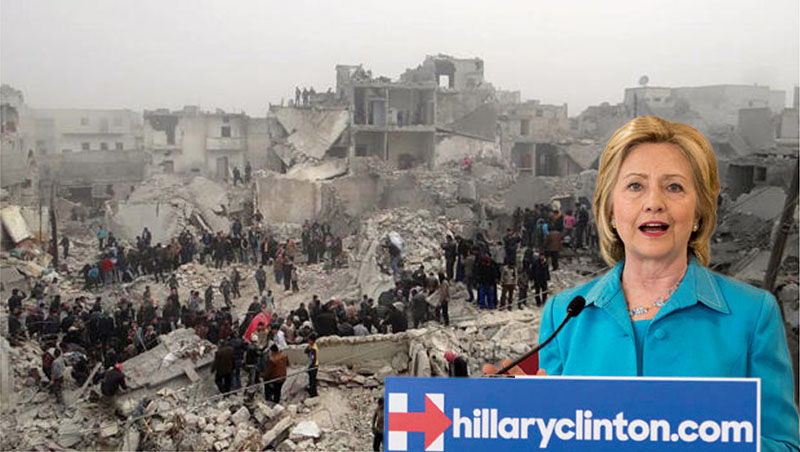
In the email, released by Wikileaks, then Secretary of State Clinton says that the “best way to help Israel” is to “use force” in Syria to overthrow the government.
The document was one of many unclassified by the US Department of State under case number F-2014-20439, Doc No. C05794498, following the uproar over Clinton’s private email server kept at her house while she served as Secretary of State from 2009 to 2013.
Although the Wikileaks transcript dates the email as December 31, 2000, this is an error on their part, as the contents of the email (in particular the reference to May 2012 talks between Iran and the west over its nuclear program in Istanbul) show that the email was in fact sent on December 31, 2012.
The email makes it clear that it has been US policy from the very beginning to violently overthrow the Syrian government—and specifically to do this because it is in Israel’s interests.
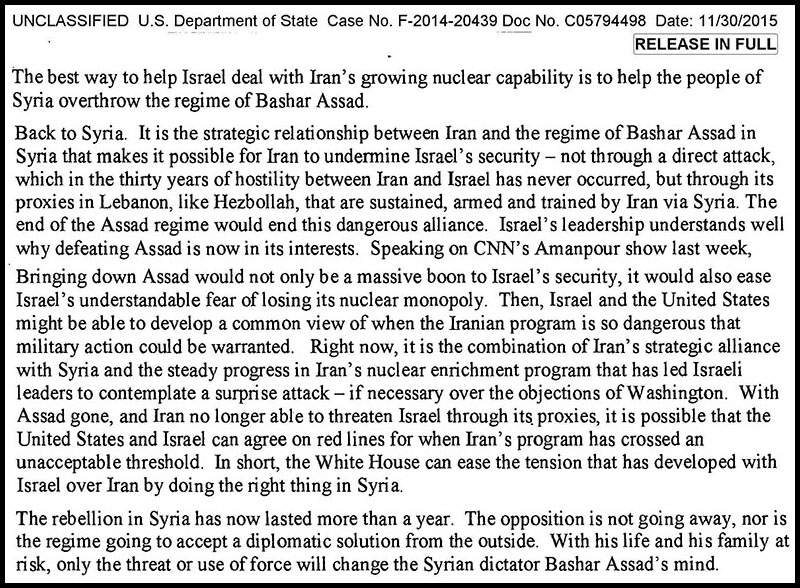
“The best way to help Israel deal with Iran’s growing nuclear capability is to help the people of Syria overthrow the regime of Bashar Assad,” Clinton forthrightly starts off by saying.
Even though all US intelligence reports had long dismissed Iran’s “atom bomb” program as a hoax (a conclusion supported by the International Atomic Energy Agency), Clinton continues to use these lies to “justify” destroying Syria in the name of Israel.
She specifically links Iran’s mythical atom bomb program to Syria because, she says, Iran’s “atom bomb” program threatens Israel’s “monopoly” on nuclear weapons in the Middle East.
If Iran were to acquire a nuclear weapon, Clinton asserts, this would allow Syria (and other “adversaries of Israel” such as Saudi Arabia and Egypt) to “go nuclear as well,” all of which would threaten Israel’s interests.
Therefore, Clinton, says, Syria has to be destroyed.
Iran’s nuclear program and Syria’s civil war may seem unconnected, but they are. What Israeli military leaders really worry about — but cannot talk about — is losing their nuclear monopoly.
An Iranian nuclear weapons capability would not only end that nuclear monopoly but could also prompt other adversaries, like Saudi Arabia and Egypt, to go nuclear as well. The result would be a precarious nuclear balance in which Israel could not respond to provocations with conventional military strikes on Syria and Lebanon, as it can today.
If Iran were to reach the threshold of a nuclear weapons state, Tehran would find it much easier to call on its allies in Syria and Hezbollah to strike Israel, knowing that its nuclear weapons would serve as a deterrent to Israel responding against Iran itself.
It is, Clinton continues, the “strategic relationship between Iran and the regime of Bashar Assad in Syria” that makes it possible for Iran to undermine Israel’s security.
This would not come about through a “direct attack,” Clinton admits, because “in the thirty years of hostility between Iran and Israel” this has never occurred, but through its alleged “proxies.”
The end of the Assad regime would end this dangerous alliance. Israel’s leadership understands well why defeating Assad is now in its interests.
Bringing down Assad would not only be a massive boon to Israel’s security, it would also ease Israel’s understandable fear of losing its nuclear monopoly.
Then, Israel and the United States might be able to develop a common view of when the Iranian program is so dangerous that military action could be warranted.
Clinton goes on to assert that directly threatening Bashar Assad “and his family” with violence is the “right thing” to do:
In short, the White House can ease the tension that has developed with Israel over Iran by doing the right thing in Syria.
With his life and his family at risk, only the threat or use of force will change the Syrian dictator Bashar Assad’s mind.
The email proves—as if any more proof was needed—that the US government has been the main sponsor of the growth of terrorism in the Middle East, and all in order to “protect” Israel.
It is also a sobering thought to consider that the “refugee” crisis which currently threatens to destroy Europe, was directly sparked off by this US government action as well, insofar as there are any genuine refugees fleeing the civil war in Syria.
In addition, over 250,000 people have been killed in the Syrian conflict, which has spread to Iraq—all thanks to Clinton and the Obama administration backing the “rebels” and stoking the fires of war in Syria.
The real and disturbing possibility that a psychopath like Clinton—whose policy has inflicted death and misery upon millions of people—could become the next president of America is the most deeply shocking thought of all.
Clinton’s public assertion that, if elected president, she would “take the relationship with Israel to the next level,” would definitively mark her, and Israel, as the enemy of not just some Arab states in the Middle East, but of all peace-loving people on earth.
Syria and “Transitional Justice”

By Helena Cobban | Just World News | February 12, 2020
Almost from the beginning of the US-supported regime-change project in Syria, US policymakers have incorporated several kinds of planning for what is called “transitional justice” into their pursuit of the project. Transitional justice (TJ) is a field that came into great vogue in the mid-1990s, after two key developments in the post-Soviet world: (1) the UN Security Council’s creation of a special International Criminal Tribunal for the Former Yugoslavia (ICTY) and (2) the agreement of the African National Congress in South Africa to negotiate an end to the Apartheid system– but with the proviso that the most heinous of the rights violators of the Apartheid era all ‘fess up to all their actions in a specially created Truth and Reconciliation Commission (TRC); and if those confessions were deemed full and heartfelt, then the perpetrators could escape prosecution for their actions.
From the early 1990s, these two approaches to TJ were in tension with each other; and that tension has lain at the heart of the rapidly burgeoning field of TJ projects ever since.
For its part, the prosecutorial/criminal-justice approach claimed descent from, crucially, the two US-dominated international courts established immediately after WW-II, in Nuremberg, and Tokyo. (The above photo is of Herman Goering on the stand, in Nuremberg.) The creation of ICTY was followed, two years later, by the Security Council’s creation of a parallel special court for Rwanda; and meantime, a broad movement emerged to press for the establishment by treaty among nations of a permanent “International Criminal Court” (ICC) which could hold accountable perpetrators of the worst forms of atrocities– described as war crimes, crimes against humanity, and genocide– in a criminal proceeding. In 1998, 120 governments adopted the “Rome Treaty” that established and set the rules for this court. In 2002, the requisite 60 countries had ratified the Rome Treaty and the ICC came into existence, headquartered in The Hague.
I have reflected at length in many earlier writings (including this 2006 book and these earlier articles: 1, 2) on some of the shortcomings of the ICC and the criminal-justice approach it adopts to dealing with the aftermath of atrocities. Suffice it here to note the following:
- The United States is not a member of the ICC; but all the presidents since 2002 have on occasion sought to use the investigative, international arrest, and prosecutorial powers of the ICC, or to threaten their use, against political figures around the world they are opposed to.
- The whole prosecutions movement since the creation of ICTY has claimed descent (and therefore a strong degree of legitimacy) from the whole Nuremberg/Tokyo Trials legacy. But all the “modern” international courts have omitted from their actual charge-sheets one of the key acts– perhaps the key act– prosecuted at Nuremberg and Tokyo: the crime of aggression, that is, the act of launching an aggressive war. The Rome Treaty listed the crime of aggression as potentially on the ICC’s docket, but its signatories have failed to reach agreement on how to define it and thus it has not in practice been chargeable.
- In March 2003, eight months after the ICC formally came into existence, the United States launched a massive, quite unjustified (and militarily successful) war of regime change in Iraq– a war that UN Secretary-General Kofi Annan later admitted lacked any legitimacy.
- One of the early acts of the “Coalition Provisional Authority” through which the US military ruled Iraq after the invasion was to establish a special tribunal to try former president Saddam Hussein and his top associates. After the CPA set up an Iraqi government (though still under its own control), this government adopted the trial plan, renaming the body the Supreme Iraqi Criminal Tribunal. Saddam was captured by US soldiers in late 2003 and sent for trial by the SICT; in November 2006, it sentenced him to death. He was held in a prison inside the US military’s “Camp Justice.” On December 30, 2006 he was taken to a scaffold earlier than the Americans had planned by a group that included SICT officials and members of Shiite militias. There, he was hanged to the jubilation of many of the witnesses, who also circulated cellphone videos of the event. Saddam’s very unseemly execution capped off a trial that had been marred throughout by grave irregularities.
This political background should be borne in mind when considering the legitimacy (or even, the utility) of any plans to use prosecutorial TJ mechanisms in connection with US-led regime-change projects in the present era– in Syria, Venezuela, or anywhere else.
In June 2019, Max Blumenthal and Ben Norton published a broad and detailed description in The Grayzone of the work of several organizations that have as their mission the collection of evidence of war crimes and other atrocities committed in Syria and to some extent also Iraq, and the compilation of this evidence into forms that can help (or even spur) the prosecution of alleged perpetrators by international courts.
Most of these organizations are funded by Western governments. Most were also, like the Syrian Network for Human Rights, founded at, or shortly after, the time that Secretary of State Hillary of Clinton and Pres. Barack Obama committed Washington to full support of the regime-change project in Syria. Other such organizations include:
- the “Commission for International Justice and Accountability”, an organization founded by an enterprising Canadian investigator called Bill Wiley, that has received funding from Canada, the EU, numerous European countries, and the United States. CIJA got a massive boost in visibility in the United States after the New Yorker published a serious of materials about it written by Ben Taub. In this one, Taub breathlessly described how, “At an undisclosed location in Western Europe, a group called the Commission for International Justice and Accountability (CIJA) is gathering evidence of war crimes perpetrated by the Syrian government… “
- The Syria Justice and Accountability Center (SJAC), which states explicitly on its website that it was founded in 2012 by the “Group of Friends of the Syrian People”– that is, the coalition of governments united in their project to overthrow the Syruian government. On its website, SJAC states that it was founded in The Hague and moved in 2016 to Washington DC, where it “is currently registered as a nonprofit corporation.” However, no organization of its name comes up in standard searches of nonprofits, while SJAC is currently listed as a project of the old cold-war organization, IREX.

Chart from p.50 of the Day After Project’s report
During their early years in existence, these organizations had as their goal the collection, preservation, and organization of materials that could, after the opposition’s overthrow of the government, serve in a war-crimes court as evidence of the organization by Syrian government officials of broad patterns of gross abuse.
The work of these documentation organizations was also inspired by “The Day After Project”, a project the federally funded U.S. Institute of Peace launched in late 2011 to plan for what decisionmakers in Washington all confidently expected would be the imminent fall of the Assad government. The Day After Project’s final report (PDF) was launched in August 2012, ostensibly by the all-Syrian group of 45 individuals who co-authored it. It contained a lengthy section on “Transitional Justice”, complete with a complex organogram showing how all the proposed parts of this project should be managed.
That was still the heyday of the thinking in official Washington that “Assad will fall any day now!” Washington– like Paris, Ankara, Doha, and other anti-Assad capitals– was full of very busy, Ahmad Chalabi-style Syrian exiles (often being handsomely paid by their Qatari, Saudi, or Emirati backers) who had managed to persuade themselves and numerous “locals” in those Western countries that any day now they would be riding into Damascus to take over the whole Syrian government. Well, in March 2003, Ahmad Chalabi did at least manage to get back to Baghdad in the wake of the US invasion of the country– though once he arrived, it was patently clear he had never enjoyed anything like the degree of popular backing within Iraqi society that he had long claimed to have. Regarding Syria, the earnest bands of exiles who were making detailed plans for their own imminent return “home” never even made it. They were unable to persuade a US government and public that had already been badly duped once, back in 2003, that the claimed “sins” of the Syrian government were bad enough to warrant a full-scale U.S. invasion– especially one that this time around (unlike in 2003) threatened to trigger a serious global showdown with a now more confident and capable Russia.
Yes, under Obama and Clinton, Washington did give the anti-Assad fighters some serious shipments of arms, along with strong political backing; and they and the Israelis did from time to time launch one-off strikes against Syrian military bases. But Obama and Clinton never signed off on a full-throated military campaign against Assad; and the anti-Assad rebels proved quite incapable of actually persuading enough Syrians to come over to their side, to win. The sides settled into a very lengthy and draining stalemate, during which the government side slowly proved able– with the help from international allies on whom it was quite legitimately able to call– to retake parts of Syria that had earlier been taken over by the foreign-armed (and increasingly jihadi-controlled) rebels.
Today, nine years into the conflict in Syria, there is no hope at all of the opposition seizing Damascus. And within the anti-Assad camp itself, extremist jihadis affiliated with either ISIS or Al-Qaeda long ago took over control, snuffing out the hopes of the Washington establishment that “moderate rebels” of the kind now firmly ensconced in Western think-tanks can ever become a significant force inside Syria. All the plans that those “moderate rebels” had made for the imminent establishment of an anti-Assad “special war-crimes court” like the one that earlier tried Saddam Hussein, or for other mechanisms of post-victory “transitional justice”, have to them a quality that is either robotic or slightly other-worldly.
 Last week I went to the launch at a Qatari-funded think-tank called the Arab Center of Washington of a book called Accountability in Syria: Achieving Transitional Justice in a Postconflict Society. I guess the Qatari funding has been running a bit low, because there were no free copies of the book being handed out, and only one sample copy that attendees could take a glance at. It costs $90. Rush right over to the link above to buy your copy!
The three panelists were: the book’s editor, Radwan Ziadeh, a longtime regime-change advocate whose only listed professional achievement is his longtime gig as a “Senior Fellow” at the Arab Center; Mai el-Saadany, a US-trained Syrian-American lawyer who now works at the Tahrir Institute for Middle East Policy; and Mohammed Alaa Ghanem, who until recently was Government Relations Director and Senior Political Adviser for the Syrian American Council, one of Washington DC’s principal regime-change organizations. Ghanem, who still has a (presumably nicely funded) affiliation with the UAE-funded Atlantic Council, is now doing a Master’s degree in international affairs at Columbia.
At one level, it was kind of a sad event. When Ziadeh started talking, he recounted that work on the book had started back in 2015– at a time when it may have been possible for regime-change advocates still to imagine that one day soon, just possibly, they could seize power in Damascus. (Hence, the reference in the book’s sub-title to a “Postconflict society.”) Poignantly, he spoke about how back then, “Aleppo”–actually, just that small portion of East Aleppo that the opposition still controlled– was becoming a center of evacuation, and how Ma’aret al-Numaan, in the opposition fighters’ Idlib redoubt, was a center of evacuation today.
In both instances, as the government regained control of terrain previously held by the jihadi extremists, the government allowed the opposition fighters and any civilians who chose to leave, to do so, and indeed, facilitated their departure. This is in notable contrast to the bloodthirsty actions the jihadi oppositionists have always taken toward the residents and defenders of areas that they’ve overtaken. But the video footage of desperate civilians fleeing in advance of the Syrian army’s arrival always looks pretty heart-wrenching.
(The videos widely circulated in the west notably do not depict the civilians who stay in the areas being brought back under Syrian government control– or, the earlier presence and activities of any of the jihadi fighters, some of whom who are Syrian and many of whom are not, who had controlled these areas so brutally over the preceding few years.)
When Mai el-Saadany spoke she stated confidently that, “The time for justice is now… We can’t afford to wait until the conflict ends.” She said that both the International Criminal Court and the UN’s doctrine of “Responsibility To Protect” (R2P) had proven useless in protecting Syria’s people; but that even without those tools there were three “accountability tools” the Syrian oppositionists could use: Documentation; a couple of different UN inquiry/documentation mechanisms; and prosecutions outside Syria, such as the one brought against two former Syrian officials by a court in Germany, last October.
When she talked about documentation, el-Saadany singled out for special praise the efforts of a group called Bellingcat–and of The New York Times.
For his part, Ghanem focused on the contribution he had made to the Accountability in Syria book, in which he looked at what he described as the “sectarian cleansing” that he saw the Syrian government as undertaking in formerly opposition-held areas over which it regained control. He accused “the Assad regime” of being dominated by Alawites and of engaging in “sectarian cleansing or demographic engineering” against “communities” in these areas, though he did not name these “communities.” He said he had been very proud to have gotten reference to this phenomenon included in the “Caesar Act”— a US sanctions measure against Syria that was signed into law in late December.
The most interesting part of this sad gathering came toward the end ( at 1h24m on the video.) A questioner had asked how the panelists thought that the kinds of “accountability”mechanisms they favored could be applied to other perpetrators of atrocities in Syria, “such as in the Turkish-controlled areas, or the SDF”, in addition to the government. At that point, Ziadeh almost completely lost it. The other two panelists, much better qualified and better prepared professionals than he, had both expressed their support for the idea that all accused perpetrators of significant atrocities, whatever their political alignment, should be subjected to the same accountability measures. (This is, after all, a key tenet to the whole field of transitional justice… Heck, in South Africa’s Truth and Reconciliation Commission, even some of the excesses of the ANC came under the same kind of scrutiny as the gross tortures of the Apartheid regime.)
Ziadeh argued that only the “Assad regime” should be addressed by any accountability mechanisms. “The Syrian government– it became not a rogue state, but deep sectarian militias, that has no regard for the life of any Syrian” he said. “It’s impossible to think of having a political settlement with this kind of militia in control of Syria… What’s the end answer? No Syrians nor anyone else have any answer for that… There is nothing to talk about! There is nothing to leverage or negotiate about. I am very pessimistic. There is no soon, any hope of a political settlement of the conflict.”
The other two panelists hewed more closely to the standard TJ script. Both argued that, while there is no “false equivalence” between the violations committed by the “Assad regime” and those committed by other parties, still, all violators should be held accountable.
Ghanem had earlier argued that accountability-seeking mechanisms could be used as “leverage” for the Syrian opposition in a future negotiated settlement. The relationship between pressure for “accountability” and momentum toward negotiations is a complex–and, as I demonstrated in this recent article, “Syria: Peacemaking or prosecutions?”, often an inverse–one. (When I wrote that piece, in early November, the prospects for reaching a negotiated political transition in Syria seemed greater than they do today.)
One misapprehension into which all three of the panelists at the Arab Center event seemed to have fallen was to conflate the idea of “accountability” almost completely with the path of criminal prosecutions. But as anyone who has studied the TJ field knows, there are numerous other mechanisms that have been used to enact accountability other than Western-style courts of law. South Africa’s TRC was one such mechanism. It was widely (and correctly) lauded for helping enable South Africans to make the transition from a deepseated system of colonial expropriation and Apartheid to a much more inclusive system that enabled the “White” colonists to remain in the country on a basis of political equality with its indigenes– and to achieve this without triggering a massive new race war between those two sides (though the transition was accompanied by very lethal fighting between the two major Black African political forces.)
The main premise of the TRC was that as part of the transition to political equality, it was necessary to draw a line under the violence of the past and to offer a full amnesty from prosecutions for all the perpetrators of that violence provided they (a) had stopped committing it; and (b) provided a full description of the violent acts they had committed, such as could help bring a degree of legal and emotional “closure” to survivors of the violence and others bereaved by it or otherwise affected by it.
The exact terms of the TRC’s “deal” with former perpetrators were painstakingly negotiated among the parties to the transition– principally, the Apartheid era’s ruling National Party and the anti-Apartheid African National Congress (ANC). The Apartheid government possessed overwhelming military and socioeconomic force throughout the whole of South Africa; and it would never have agreed to end Apartheid and transition to a one-person-one-vote system in South Africa if its leaders had not been offered an amnesty. If there had been no TRC, the whole of Southern Africa might still be riven with terrible conflicts, to this day. The “offer” of amnesty was backed up by the existence in the country of a fairly well-functioning judicial system. But the main factor motivating perpetrators to come forward and participate in the often riveting public hearings that the TRC held all around the country was the desire most of them felt to allow their families, their communities, and their country to move forward.
 In my 2006 book, Amnesty After Atrocity? Healing Nations after Genocide and War Crimes, I looked at the effectiveness of South Africa’s TRC and compared it with the very different post-conflict mechanisms that, in that same period of 1992-94, had been adopted by Mozambique and post-genocide Rwanda. Those two other cases effectively “bracketed” what the South Africans agreed to do. In Rwanda, the post-genocide government was heavily inclined towards prosecutorialism, supporting both the creation and work of a UN-established International Criminal Tribunal for Rwanda (ICTR) and the use of a very broad campaign of national-level prosecutions of suspected genocidaires. In Mozambique, by contrast, an extremely lengthy and ugly civil war was brought to an end in 1992 when the two main parties to it, the ruling Frelimo movement and the opposition Renamo, were brought together in a negotiation conducted by a Vatican-sponsored peace group and agreed to end their combat on the basis of a blanket amnesty for previous perpetrators of violence from both sides. The United Nations then stepped in with a broad program for demilitarization, demobilization, and reintegration into their home societies of the former fighters from both sides (DDR).
Intense inter-group conflict of any kind of course inflicts massive damage on a country’s economy, including its most basic infrastructure, so societies emerging from such conflicts have numerous, extremely pressing human and economic needs. In this context, the relative costs– and therefore, also opportunity costs– of the TJ mechanisms used are definitely a factor. I used public documentation to calculate the costs of these mechanisms as follows (p.209):
- Each case completed at the ICTR : $42,300,000
- Each amnesty application at the TRC: $4,290
- Each case in Rwanda’s planned “local-style” gacaca courts (projected): $581
- Mozambique: each former fighter demobilized/reintegrated: $1,075
- South Africa: each former fighter demobilized/reintegrated: $1,066.
In that concluding chapter of the book, I presented (pp.212-13) a critique of the degree of “accountability” that advocates of prosecutorialism judge that their favored approach provides, noting that the kind of personal “accountability” required of perpetrators by a court of law is very thin indeed compared with, for example, that required in TRC or other similar mechanisms.
I also presented (p.241) a list of nine “meta-tasks” that, based on my previous analysis in the book– and on my own experience of having lived and worked in an area wracked by civil conflict, during the first six years of Lebanon’s civil war– I concluded that societies recovering from grave inter-group conflict need to undertake. It runs as follows:
Top rank (all of equal urgency):
-
- Establish rigorous mechanisms to guard against any relapse back into conflict and violence.
- Actively promote reconciliation across all inter-group divisions.
- Build an equality-based domestic democratic order that allows for nonviolent resolution of internal differences and respects and enforces human rights.
- Restore the moral systems appropriate to an era of peace.
- Reintegrate former combatants from all the previously fighting parties into the new society.
- Start restoring and upgrading the community’s physical and institutional infrastructure.
- Start righting the distributional injustices of the past.
Second rank (of somewhat less urgency):
-
- Promote psychological healing for all those affected by the violence and the atrocities, restoring dignity to them. (If the top-rank tasks are all addressed, those moves will anyway do much to achieve this; but it will probably need continuing attention.)
- Establish such records of the facts as are needed to meet victims’ needs (death certificates; identification of the burial sites; etc) and to start to build a record for history.
In the real world, decisions on what to do with individuals accused of having committed grave infractions nearly always get made in the context of a negotiation over the nature and terms of a major societal transition to a new political order. “String ’em all up on the lamp-posts!” or “Line ’em all up and shoot them!” are versions of one notable, non-negotiated type of such decision– and a type that notably doesn’t augur well for the political tone of the new order. In Syria, the way that ISIS or the bunch of Al-Qaeda-affiliated jihadis who currently control Idlib treat accused government supporters who fall under their sway definitely falls into this category.
Negotiating an end to a conflict– or acting with restraint in the event no negotiation proves possible– nearly always augurs a better outcome. At the end of WW-II, in the Asian theater, the Japanese Emperor was able to negotiate surrender terms on fairly favorable terms that ensured his dynasty’s continuation in office (and his own exculpation from responsibility for any of Japan’s preceding war crimes)–but in return for allowing the Americans and their allies to set up an international criminal tribunal to try certain Japanese decisionmakers, and numerous other concessions. In Germany, there was no negotiated end to the fighting; and the Russian, French, and British leaders (whose peoples had suffered most gravely from the Nazis’ actions) were all baying for extreme retribution. But the US public was relatively distant from the battlefield. That allowed Secretary of War Henry Stimson and President Harry Truman– both of whom were also aware of the disastrous sequelae of the punitive approach the victorious Allies had imposed on post-WW-I Germany– to argue for, and implement, the much more restrained approach to post-war justice that the Nuremberg trials represented.
Recent developments in Syria make the prospect of a negotiated end to the country’s lengthy civil war seem more remote today than they did a few months ago. The country’s 22 million people have been held in the vice of this conflict, and victim to the wiles of numerous outside actors and interveners much more than to those of any domestic actors, for nine long years. (This was also, interestingly, the case in Mozambique. Much of the terrible violence that Renamo used in its campaign to control as many Mozambicans as possible as a way of pressuring and overthrowing the Frelimo government had been organized and underwritten by South Africa’s Apartheid. The intra-Mozambican negotiations that brought an end to the war only made progress after a weakened South Africa started to withdraw that support.)
Throughout the first six years of Syria’s civil war, the determination of the United States and several allied governments (Turkey, Qatar, the Saudis, the UAE) to accept nothing less than the complete overthrow of the Assad government stymied all attempts by the United Nations and others to attain a negotiated end to the war. After Pres. Trump assumed office, he was less devoted to total “regime change” than Pres. Obama had been… and since late 2018 or so, the UAE has pulled back from its focus on regime change. Turkey also, from the Astana Agreement of September 2018 on, was clearly exploring some kind of “regional super-powers mega-deal” with Russia and Iran, that could help ramp down, or even bring to a negotiated end, Syria’s civil war.
More recently, though, Trump has pulled back from his fondness for a pullback from Syria. And perhaps he has started to see US military involvement in Syria as helping to serve his broader campaign of “maximum pressure” against Iran? Turkey has also pulled back from its commitment to Astana and is currently squaring up for a possibly broader military clash with Syrian government forces?
So the prospect for a negotiated settlement to the Syrian civil war has receded some. But it has certainly not disappeared completely. If nine years of slogging fighting– accompanied by terrible, unspeakable atrocities being suffered by people from all “sides”–has not succeeded in bringing about a “decisive” victory for any side, then surely an end to this war that is negotiated in some way is the only reasonable path, and the only path that can draw a line under the suffering of the past nine years? A viable negotiating forum has already been established by the United Nations. Let us hope it can complete its work as soon as possible, and that as part of this process the negotiators can find a list of mutually acceptable ways to deal with the whole range of transitional justice issues. And these, as noted above, go considerably further than the kinds of war-crimes trials so beloved by the Western media.
Putin questions America’s creepy collection of Russian DNA for possible bio-weapons program
The US Air Force is trying collect samples of ethnic Russian DNA. If history is a guide, the purposes of this new US program are highly nefarious.

By Adam Garrie | The Duran | November 1, 2017
In recent months, the US Air Force has issued calls for ethnic Russians to provide DNA samples for a mysterious “research” program. US Air Force Captain Beau Downey claimed that the samples were required for “locomotor studies to identify various biomarkers associated with trauma.”.
Downey further stated,
“The request (by the research centre) did not specify where the samples should be received from, but to continue the study, similar samples were required. Since the supplier originally provided samples from Russia, suitable for the initial group of diseases, the control group of the samples should also be of Russian origin.
The goal is the integrity of the study, not the origin (of the samples)”
However, given the fact that the US military has attempted to obtain Russian DNA samples without the permission of the Russian government and furthermore, given the low state of Russia-US relations, many are questioning whether the sought samples are intended to be part of a biogenetic weapons program.
Biogenetic weapons are defined as biological agents designed to inflict debilitating diseases or other internal bodily afflictions on a specific group of people, based on a shared genetic code.
While it is unclear if such a weapon has ever successfully been developed, the US and Israel have in the past, attempted to create such a devastating bio-genetic weapon.
In the late 1990s, it was reported that Israel had successfully created a biogenetic weapon which was specifically designed to target Arabs and only Arabs.
An archived press clipping from 1998 reports,
“According to a Jerusalem Post report quoting the London-based Foreign Report, Israel has successfully developed what is being called an ‘ethnic-bullet’, which will target only Arabs. The report quotes an ‘unconfirmed report’ which originated in South Africa, which details how Israeli scientists have made a biological weapon tailor made to attack targets with the Arab genetic system. Long-term studies of Iraqi Jews was credited with providing the genetic code needed to target Arabs. According to the report, the ethnic-bullet program was originally developed for use in Apartheid South Africa for use against blacks. Scientist in both countries worked together towards the development of the Israeli program. Israeli officials declined to confirm the existence of the ‘ethnic bullet,’ but one told the newsletter: ‘We have a basket full of strategic surprises which we will not hesitate to use if we feel that the State of Israel is under serious threat”.
The popular US based technology magazine Wired, also ran a story on Israel’s biogenetic weapons program in 1998. The story reads,
“ISRAEL IS REPORTEDLY developing a biological weapon that would harm Arabs while leaving Jews unaffected, according to a report in London’s Sunday Times. The report, citing Israeli military and western intelligence sources, says that scientists are trying to identify distinctive genes carried by Arabs to create a genetically modified bacterium or virus.
The ‘ethno-bomb’ is reportedly Israel’s response to the threat that Iraq may be just weeks away from completing its own biological weapons.
The ‘ethno-bomb’ program is based at Israel’s Nes Tziyona research facility. Scientists are trying to use viruses and bacteria to alter DNA inside living cells and attack only those cells bearing Arabic genes.
The task is very complex because both Arabs and Jews are Semitic peoples. But according to the report, the Israelis have succeeded in isolating particular characteristics of certain Arabs, ‘particularly the Iraqi people.’
Dedi Zucker, a member of the Israeli parliament, denounced the research in the Sunday Times. ‘Morally, based on our history, and our tradition and our experience, such a weapon is monstrous and should be denied.’
Last month, Foreign Report claimed that Israel was following in the ignominious footsteps of apartheid-era research, in their supposed efforts to develop an “ethnic bullet.”
A year later, a report from Reuters citing British scientists, confirmed that such a biogenetic weapon was possible given the advanced state of genetic mapping, although the report neither confirmed nor denied the existence of an Arab killing Israel biogenetic weapon.
Russians are therefore clearly worried that the US military intends to collect samples of Russian DNA in order to engineer a biogenetic weapon similar to the ones Israel is said to have created in the 1990s. The fact that genetic mapping technology has advanced even further since the 1990s, makes this fear all the more magnified.
In the 1980s, the Soviet Union feared that the AIDS virus was created in a US military bio-weapons lab in Fort Detrick, Maryland. While the story was dismissed by the US as geo-political propaganda, many black Africans and African-Americans continue to believe that the CIA had a hand in either creating or weaponising the AIDS virus. To this day, AIDS continues to disproportionately effect black men across the globe.
The notion that AIDS was part of a CIA experiment aimed at population modification, was spoken of widely in the 1980s. The American musician Frank Zappa even wrote a musical about the alleged phenomenon called ‘Thing Fish’.
In the year 2000, the neocon think-thank that would provide the George W. Bush administration with many important advisers, the Project for the New American Century published a report which spoke of the desirability of weaponising genetically mapped biological agents for use in 21st century warfare. This was one of the factors leading to Russia banning the export of domestic DNA samples in 2007, as was reported in Russian mainstream media at the time.
While exporting Russian DNA samples remains illegal in most circumstances, the US military is still keen on flaunting Russian law.
President Vladimir Putin has responded to the latest attempts by the US military to collect Russian DNA samples in the following way,
“Do you know that biological material is being collected all over the country, from different ethnic groups and people living in different geographical regions of the Russian Federation? The question is – why is it being done? It’s being done purposefully and professionally. We are a kind of object of great interest.
Let them do what they want, and we must do what we must”.
The latter part of Putin’s statement derives from the Melian Dialogue of the Athenian historian Thucydides. In his History of the Peloponnesian War, Thucydides recounts Athenian envoys trying to convince the small island of Melos to surrender its sovereignty or be destroyed. The dialogue includes a famous line which is usually translated as “The strong do as they will and the weak submit as they must”.
Putin therefore is suggesting that no matter what the US has in store for Russia, the leadership of the Russian Federation is able and willing to take defensive matters in any scenario. The seemingly cautious statement from Putin, is actually incredibly forceful when read carefully.
Based on past experiences, the US is not operating under innocent intentions and therefore, Russia should not take any chances.
Sanders tells New York Times he would consider a preemptive strike against Iran or North Korea
By Jacob Crosse and Barry Grey | WSWS | February 14, 2020
Bernie Sanders has won the popular vote in both the New Hampshire and Iowa presidential primary contests in considerable part by presenting himself as an opponent of war. Following the criminal assassination of Iranian General Qassem Suleimani last month, Sanders was the most vocal of the Democratic presidential aspirants in criticizing Trump’s action. His poll numbers have risen in tandem with his stepped-up anti-war rhetoric.
He has repeatedly stressed his vote against the 2003 invasion of Iraq, reminding voters in the Iowa presidential debate last month, “I not only voted against that war, I helped lead the effort against that war.”
However, when speaking to the foremost newspaper of the American ruling class, the New York Times, the Sanders campaign adopts a very different tone than that employed by the candidate when addressing the public in campaign stump speeches or TV interviews.
The answers provided by Sanders’ campaign to a foreign policy survey of the Democratic presidential candidates published this month by the Times provide a very different picture of the attitude of the self-styled “democratic socialist” to American imperialism and war. In the course of the survey, the Sanders campaign is at pains to reassure the military/intelligence establishment and the financial elite of the senator’s loyalty to US imperialism and his readiness to deploy its military machine.
Perhaps most significant and chilling is the response to the third question in the Times’ survey.
Question: Would you consider military force to pre-empt an Iranian or North Korean nuclear or missile test?
Answer: Yes.
A Sanders White House, according to his campaign, would be open to launching a military strike against Iran or nuclear-armed North Korea to prevent (not respond to) not even a threatened missile or nuclear strike against the United States, but a mere weapons test. This is a breathtakingly reckless position no less incendiary than those advanced by the Trump administration.
Sanders would risk a war that could easily involve the major powers and lead to a nuclear Armageddon in order to block a weapons test by countries that have been subjected to devastating US sanctions and diplomatic, economic and military provocations for decades.
Moreover, as Sanders’ response to the Times makes clear, the so-called progressive, anti-war candidate fully subscribes to the doctrine of “preemptive war” declared to be official US policy in 2002 by the administration of George W. Bush. An illegal assertion of aggressive war as an instrument of foreign policy, this doctrine violates the principles laid down at the Nuremberg Trials of Nazi officials after World War II, the United Nations charter and other international laws and conventions on war. Sanders’ embrace of the doctrine, following in the footsteps of the Obama administration, shows that his opposition to the Iraq war was purely a question of tactics, not a principled opposition to imperialist war.
The above question is preceded by another that evokes a response fully in line with the war policies of the Obama administration, the first two-term administration in US history to preside over uninterrupted war.
Question: Would you consider military force for a humanitarian intervention?
Answer: Yes.
Among the criminal wars carried out by the United States in the name of defending “human rights” are the war in Bosnia and the bombing of Serbia in the 1990s, the 2011 air war against Libya that ended with the lynching of deposed ruler Muammar Gaddafi, and the civil war in Syria that was fomented by Washington and conducted by its Al Qaeda-linked proxy militias.
The fraudulent humanitarian pretexts for US aggression were no more legitimate than the lie of “weapons of mass destruction” used in the neo-colonial invasion of Iraq. The result of these war crimes has been the destruction of entire societies, the death of millions and dislocation of tens of millions more, along with the transformation of the Middle East into a cauldron of great power intervention and intrigue that threatens to erupt into a new world war.
Sanders fully subscribes to this doctrine of “humanitarian war” that has been particularly associated with Democratic administrations.
In response to a question from the Times on the assassination of Suleimani, the Sanders campaign calls Trump’s action illegal, but refuses to take a principled stand against targeted assassinations in general and associates itself with the attacks on Suleimani as a terrorist.
The reply states:
Clearly there is evidence that Suleimani was involved in acts of terror. He also supported attacks on US troops in Iraq. But the right question isn’t ‘was this a bad guy,’ but rather ‘does assassinating him make Americans safer?’ The answer is clearly no.
In other words, the extra-judicial killing of people by the US government is justified if it makes Americans “safer.” This is a tacit endorsement of the policy of drone assassinations that was vastly expanded under the Obama administration—a policy that included the murder of US citizens.
At another point, the Times asks:
Would you agree to begin withdrawing American troops from the Korean peninsula?
The reply is:
No, not immediately. We would work closely with our South Korean partners to move toward peace on the Korean peninsula, which is the only way we will ultimately deal with the North Korean nuclear issue.
Sanders thus supports the continued presence of tens of thousands of US troops on the Korean peninsula, just as he supports the deployment of US forces more generally to assert the global interests of the American ruling class.
On Israel, Sanders calls for a continuation of the current level of US military and civilian aid and opposes the immediate return of the US embassy from Jerusalem to Tel Aviv.
On Russia, he entirely supports the Democratic Party’s McCarthyite anti-Russia campaign and lines up behind the right-wing basis of the Democrats’ failed impeachment drive against Trump:
Question: If Russia continues on its current course in Ukraine and other former Soviet states, should the United States regard it as an adversary, or even an enemy?
Answer: Yes.
Question: Should Russia be required to return Crimea to Ukraine before it is allowed back into the G-7?
Answer: Yes.
Finally, the Times asks the Sanders campaign its position on the National Security Strategy announced by the Trump administration at the beginning of 2018. The new doctrine declares that the focus of American foreign and military strategy has shifted from the “war on terror” to the preparation for war against its major rivals, naming in particular Russia and China.
In the following exchange, Sanders tacitly accepts the great power conflict framework of the National Security Strategy, attacking Trump from the right for failing to aggressively prosecute the conflict with Russia and China:
Question: President Trump’s national security strategy calls for shifting the focus of American foreign policy away from the Middle East and Afghanistan, and back to what it refers to as the ‘revisionist’ superpowers, Russia and China. Do you agree? Why or why not?
Answer: Despite its stated strategy, the Trump administration has never followed a coherent national security strategy. In fact, Trump has escalated tensions in the Middle East and put us on the brink of war with Iran, refused to hold Russia accountable for its interference in our elections and human rights abuses, has done nothing to address our unfair trade agreement with China that only benefits wealthy corporations, and has ignored China’s mass internment of Uighurs and its brutal repression of protesters in Hong Kong. Clearly, Trump is not a president we should be taking notes from. [Emphasis added].
In a recent interview Ro Khanna, a Democratic congressman and national co-chair of the Sanders campaign, assured Atlantic writer Uri Friedman that Sanders would continue provocative “freedom of the seas” navigation operations in the Persian Gulf and the South China Sea, while committing a Sanders administration to “maintain some [troop] presence” on the multitude of bases dotting “allied” countries from Japan to Germany.
Millions of workers, students and young people are presently attracted to Sanders because they have come to despise and oppose the vast social inequality, brutality and militarism of American society and correctly associate these evils with capitalism. However, they will soon learn through bitter experience that Sanders’s opposition to the “billionaire class” is no more real than his supposed opposition to war. His foreign policy is imperialist through and through, in line with the aggressive and militaristic policy of the Democratic Party and the Obama administration.
The Democrats’ differences with Trump on foreign policy, though bitter, are tactical. Both parties share the strategic orientation of asserting US global hegemony above all through force of arms.
No matter how much Sanders blusters about inequality, it is impossible to oppose the depredations of the ruling class at home while supporting its plunder and oppression abroad.
Sanders is no more an apostle of peace than he is a representative of the working class. Both in foreign and domestic policy, he is an instrument of the ruling class for channeling the growing movement of the working class and opposition to capitalism back behind the Democratic Party and the two-party system of capitalist rule in America.
Dresden Terror Bombing, Like Hiroshima, a Maniacal Warning to Moscow

By Finian Cunningham | Strategic Culture Foundation | February 17, 2020
This weekend 75 years ago, the German city of Dresden was razed to the ground by British and American aerial bombardment. At least 25,000 mainly civilians were destroyed in raid after raid by over 1,200 heavy bombers, indiscriminately dropping high explosives and incendiaries. It took seven years just to clear the rubble.
The destruction of Dresden, a world-famous cultural center of Baroque majesty, has been long dogged by controversy. Official British and American military accounts claim it was necessary to hasten the collapse of the Third Reich; with a reasoning that resonates with US claims for dropping the atomic bombs on the Japanese cities of Hiroshima and Nagasaki in August 1945.
Critics say, however, that the mass bombing of Dresden was immaterial in the effort to defeat Nazi Germany. It was a wanton act of terror – a war crime – carried out by the British and Americans. Critics point out that most of the industrial and military targets on the outskirts of the beautiful city were largely left untouched by the bombing. British wartime leader Winston Churchill is even said to have expressed misgivings about the morality of this and other indiscriminate bombing of German civilian centers.
Ardent advocates of the terror-bombing campaign said it would exhaust German morale. A classic case of ends justifying means, no matter how vile the means.
There were also claims at the time that the damage to Nazi communication and transport lines would aid the advancing Soviet Red Army.
But there is good reason to believe that the rationale for the obliteration of Dresden was for an altogether more sinister reason. It wasn’t so much an act of terror aimed at Nazi Germany, but rather a show of maniacal power to the Soviet Union.
A British Royal Air Force memo on the Dresden operation noted that it would “show the Russians when they arrive what Bomber Command can do.” (See caption 17 in this linked photo essay.)
By mid-February 1945, the front lines of the Western and Eastern allied forces were such that the American and British ground troops had not yet entered Germany territory, while the Soviet Red Army had crossed the Oder River and were a mere 70 kilometers from Berlin, the seat of the Third Reich. Such was the keen advance of the Soviets that the Western allies were concerned that the Red Army might take all of German territory.
Rather than aiding Soviet forces from the mass bombing of Dresden, Leipzig and other cities in the German east, it seems plausible that, as the above British RAF memo indicates, the Western allies were intent on demonstrating a shockingly brutal, raw power to Moscow. Not just military power, but a will power to use any means necessary to defeat enemies.
There is a direct analogy here with the subsequent atomic bombing of Japan. At the Potsdam conference in July 1945 following the defeat of Nazi Germany and the carve-up of Berlin, giving the Western allies shared control of the German capital way beyond their final front lines, the American president Harry Truman relished the ability to drop a sinister hint to Josef Stalin about a newly acquired secret weapon – the A-bomb.
As with the earlier British and American bombing of Dresden and other German cities, there was arguably little military justification for dropping the atomic weapons on Hiroshima and Nagasaki on August 6 and 9. Like Dresden, the military significance of those cities was dubious. The death of 200,000 civilians from the atomic inferno was not a military necessity for defeating imperial Japan, as Truman’s top generals MacArthur and Eisenhower were advising him against.
So if the bombing of Hiroshima or Nagasaki was unnecessary from a military point of view to end the Pacific War, why was it done?
As with Dresden, the point was a monstrous display of terror by Western powers to let the Soviet Union know that nothing would be off-limits in the postwar geopolitical stand-off that was anticipated and which became the Cold War.
When the A-bombs were dropped on Japan, Stalin was said to have been frozen by reports of the awesome new destructive power. The Soviet Union was not to develop its A-bomb until 1949.
The terror unleashed at Hiroshima and Nagasaki seems to have had the intended effect of halting Soviet Red Army advances that were being made into the Korean Peninsula and onwards to Japan. The American troop lines were relatively remote by comparison with their Soviet counterparts, yet after the A-bombing the US was catapulted to take over both Asian-Pacific territories in the postwar period. Not unlike the precocious territorial gains that were acquired by the Western allies in defeated Nazi Germany.
Thus the moral controversies about the British and American bombing of German and Japanese cities goes way beyond arguments about the right or wrong of mass murder for the supposed purpose of ending wars. That moral hazard is difficult enough. But even more fiendish is a bigger picture; one in which the cold, calculated use of terror and genocide is not about ending war, but rather to simply exert geopolitical power against a perceived rival in the postwar era. Terror for terror sake, evil for evil sake.
A final note: it has become fashionable to falsify the Soviet victory over Nazi Germany by claiming that the Red Army became an occupying tyranny in eastern Europe after the war’s end. Suffice to say that if the Soviets committed even a fraction of the crimes that were actually carried out by the Americans and British from their aerial bombing of civilians in both Germany and Japan, one would never hear the end of deafening Western condemnations against Moscow to this day, and for decades to come.
Iran: Saudi airstrike on Yemenis, near downed jet, war crime
Press TV – February 16, 2020
Iran has denounced the international community’s silence on Saudi airstrikes, the latest of which killed at least 31 civilians in Yemen’s al-Jawf province Friday, calling it a war crime.
“The international community’s silence on these war crimes has emboldened their perpetrators to kill more civilians,” Foreign Ministry spokesman Abbas Mousavi said in Tehran on Sunday.
The United Nations office in Yemen said preliminary field reports indicated that “as many as 31 civilians were killed and 12 others injured in strikes that hit al-Hayjah area” in al-Jawf province.
The health ministry in al-Jawf province said women and children were among those killed, Yemen’s al-Masirah TV reported. They were attacked as they gathered near the wreckage of a Saudi warplane shot down on Friday evening.
Mousavi strongly condemned “the criminal attack by the Saudi-led coalition forces and offered commiserations to the bereaved families and the oppressed Yemeni people,” IRNA news agency reported.
“Over the past several years, we have repeatedly witnessed that whenever Saudi-led coalition forces or their allies suffer humiliating defeats in the battlefield, they react by cowardly slaughtering women, children and civilians with American weapons,” Mousavi said.
“Yesterday’s crime in Jawf province is just one example among dozens of their war crimes,” he added.
Saudi Arabia’s state-run news agency quoted military spokesman Col. Turki al-Maliki Saturday as saying that the tornado warplane belonging to the kingdom’s air force had been shot down over the province of Jawf on Friday.
Yemeni forces said they shot down the warplane with an advanced surface-to-air missile.
Saudi warplanes later targeted people who had gathered near the wreckage of the jet. Officials said aid workers could not reach the site of the attack due to continuous flights by Saudi warplanes over the area.
“As usual, when the most brutal US-Saudi aggression receives painful strikes in the military confrontation fields, it replies with great folly by targeting civilians,” spokesman for Yemeni armed forces Yahya Sare’e said on Saturday.
UN Humanitarian Coordinator for Yemen Lise Grande also denounced the “terrible strikes” in al-Jawf province.
“So many people are being killed in Yemen – it’s a tragedy and it’s unjustified. Under international humanitarian law parties which resort to force are obligated to protect civilians,” she said.
“Five years into this conflict and belligerents are still failing to uphold this responsibility. It’s shocking,” she added.
International aid group Save the Children also condemned the Saudi airstrikes, saying they showed the Yemen conflict was “not slowing down.”
“This latest attack must be urgently and independently investigated, and perpetrators held to account,” said Xavier Joubert, the group’s country director in Yemen.
“Those who continue to sell arms to the warring parties must realize that by supplying weapons for this war, they contribute to making atrocities like today’s all too common.”
Saudi Arabia and a coalition of its vassal states launched the war on Yemen in March 2015 in an attempt to reinstall a Riyadh-backed former regime and crush a popular Houthi movement opposed to the kingdom’s meddling in their country.
The Saudi military aggression, coupled with a naval blockade, has killed up to 100,000 people and injured many more. It has plunged Yemen into what the UN says is the world’s worst humanitarian crisis.
The UN says an estimated 24 million Yemeni people – close to 80 percent of the population – need assistance and protection.
Iran’s Foreign Ministry spokesman on Sunday stressed that the humanitarian catastrophe and violation of human rights and international laws in Yemen must end.
Conservative Friends of Israel urge UK to oppose ICC’s war crimes investigation

CFI’s August 2015 delegation to Israel: Eric Pickles MP, Guto Bebb MP, Bob Blackman MP, John Howell MP, Matthew Offord MP, Andrew Percy MP, Chloe Smith MP and Heather Wheeler MP
MEMO | February 14, 2020
The Conservative Friends of Israel (CFI) has urged the UK government to directly oppose the International Criminal Court (ICC)’s decision to open an investigation into war crimes committed in the occupied Palestinian territory.
Writing to Prime Minister Boris Johnson and Foreign Secretary Dominic Raab, senior CFI officials MP Stephen Crabb, Lord Pickles and Lord Polak, argue that “as a non-state actor the Palestinians do not meet the legal requirements of the Rome Statute”, according to a CFI press release.
In the letter, the Westminster lobby group acknowledges that “the ICC is an important institution that the UK should continue to support”, but then goes on to claim that “the Court does not have jurisdiction over the territories”.
“We would urge the UK Government to join our close allies the United States, Australia and Germany in publicly cautioning against the politization of the ICC,” CFI continued.
“The Palestinian request for ICC intervention seeks to exploit the Court, involving it in alleged crimes that do not meet the legal requirements of the Rome Statute,” the CFI stated. “This undermines the Israeli-Palestinian peace process by incentivising the demonisation and vilification of each side.”
Another argument used by CFI is to suggest that the ICC probe into war crimes in the occupied Palestinian territory could have implications for UK armed forces.
“An inquiry of this nature would also set a dangerous precedent that could lead to prosecutions against the brave men and women of our armed forces who served in Iraq and Afghanistan, initiated in the ICC by non-state actors,” the CFI letter states.
Today marks the deadline for the UK, and other governments, “to request leave to file a written observation to the ICC”, CFI notes, urging the UK to do so, and “raise important concerns about the ICC’s lack of jurisdiction over this matter and the dangerous precedent it would set”.
“The UK [should] stand with Israel against this dangerous probe.”
Gen. Soleimani assassinated to sabotage Iran’s talks with Saudis, UAE following Israeli briefing: NYT
Press TV – February 14, 2020
Washington ordered the assassination of top Iranian General Qassem Soleimani to sabotage de-escalation talks between Iran, Saudi Arabia and the United Arab Emirates following a report by Israel’s Mossad spy agency, according to the New York Times.
The paper reported on Thursday that General Soleimani had been arranging talks in Saudi Arabia and United Arab Emirates in order to de-escalate tensions with Tehran.
The Times wrote that the talks happened after Saudi Arabia and the UAE, which are central to the Trump administration’s so-called regional alliance seeking to pressure Iran, began to question the efficiency of Washington’s anti-Iran campaign.
According to the report, one such meeting took place last September in Abu Dhabi, the capital of the United Arab Emirates where a plane carrying “senior Iranian officials” landed for talks.
News of the meeting, which reached Washington only after it was notified by reports from American spy agencies, “set off alarms inside the White House”, according to the report.
The report added that a similar mediation attempt, also arranged by Gen. Soleimani, was underway between Tehran and Riyadh using Iraqi and Pakistani intermediaries.
The report wrote that the developments had greatly concerned Israel, which had been trying to push the Trump administration to exert more pressure on Tehran.
According to the Times, US Secretary of State Mike Pompeo met Mossad chief Yossi Cohen on October during a trip to Israel where he was briefed on Iran’s attempted de-escalation talks with Saudi Arabia and the UAE.
Cohen warned Pompeo that Tehran was effectively on the verge of achieving its “primary goal” of breaking up the so-called “anti-Iran” alliance.
A few months later in early January, General Soleimani was assassinated by Washington’s order while on a formal visit to Baghdad.
According to former Iraqi prime minister Adel Abdul-Mahdi, General Soleimani was due to formally meet the Iraqi premier during the trip and was carrying Tehran’s response to a message from Riyadh regarding the de-escalation talks.
Following the attack, the Trump Administration claimed that the assassination had taken place after a reported rocket attack on a US base in Iraq killed a “US civilian contractor” and that Gen. Soleimani was an “imminent threat” to US citizens.
Many US political figures have rejected the claims and have questioned why the Trump administration has failed to provide any evidence backing its actions.
The New York Times’ Thursday report, however, reveals that entirely different considerations, such as Israel’s push to undermine Iran’s attempts at peace with its regional neighbors, were behind the assassination.
‘Months of miscalculations’
According to the report, the assassination marks yet another miscalculation by the Trump administration which has failed to bend Iran through its “maximum pressure” campaign.
Following its unilateral withdrawal from the 2015 Iran nuclear deal in 2018, the US imposed unilateral sanctions against Tehran in a bid to goad Tehran to accept new terms dictated by Washington.
The Times, however, reported that a recent analysis conducted by the Central Intelligence Agency (CIA) shows that the sanctions have had little effect in fulfilling Washington’s goals.
The US has also sought to pressure Iran militarily by deploying troops to the region and creating a regional anti-Iran alliance in the region as part of if its anti-Iran campaign.
Washington called for the formation of a naval coalition in the region following a string of suspicious attacks on oil tankers in the Persian Gulf.
Iran has vehemently denied the accusations, saying the incidents appear to be false flag operations meant to frame the Islamic Republic and push US interests.
Citing instances such as the major Yemeni attack on Saudi oil facilities last September and Iran’s downing of a US Global Hawk spy craft in June, the New York Times report said stepped-up US military presence also failed to achieve its objectives.
Witnessing the Trump administration’s faltering policy in the Middle East, Saudi Arabia and the UAE were convinced to open direct talks with Tehran, the report noted.
More Lies on Iran: The White House Just Can’t Help Itself as New Facts Emerge
By Philip Giraldi | Strategic Culture Foundation | February 13, 2020
Admittedly the news cycle in the United States seldom runs longer than twenty-four hours, but that should not serve as an excuse when a major story that contradicts what the Trump Administration has been claiming appears and suddenly dies. The public that actually follows the news might recall a little more than one month ago the United States assassinated a senior Iranian official named Qassem Soleimani. Openly killing someone in the government of a country with which one is not at war is, to say the least, unusual, particularly when the crime is carried out in yet another country with which both the perpetrator and the victim have friendly relations. The justification provided by Secretary of State Mike Pompeo, speaking for the administration, was that Soleimani was in Iraq planning an “imminent” mass killing of Americans, for which no additional evidence was provided at that time or since.
It soon emerged that the Iranian was in fact in Baghdad to discuss with the Iraqi Prime Minister Adel Abdul Mahdi a plan that might lead to the de-escalation of the ongoing conflict between Saudi Arabia and Iran, a meeting that the White House apparently knew about and may even have approved. If that is so, events as they unfolded suggest that the U.S. government might have encouraged Soleimani to make his trip so he could be set up and killed. Donald Trump later dismissed the lack of any corroboration of the tale of “imminent threat” being peddled by Pompeo, stating that it didn’t really matter as Soleimani was a terrorist who deserved to die.
The incident that started the killing cycle that eventually included Soleimani consisted of a December 27th attack on a U.S. base in Iraq in which four American soldiers and two Iraqis were wounded while one U.S. contractor, an Iraqi-born translator, was killed. The United States immediately blamed Iran, claiming that it had been carried out by an Iranian supported Shi’ite militia called Kata’ib Hezbollah. It provided no evidence for that claim and retaliated by striking a Kata’ib base, killing 25 Iraqis who were in the field fighting the remnants of Islamic State (IS). The militiamen had been incorporated into the Iraqi Army and this disproportionate response led to riots outside the U.S. Embassy in Baghdad, which were also blamed on Iran by the U.S. There then followed the assassinations of Soleimani and nine senior Iraqi militia officers. Iran retaliated when it fired missiles at American forces, injuring more than one hundred soldiers, and then mistakenly shot down a passenger jet, killing an additional 176 people. As a consequence due to the killing by the U.S. of 34 Iraqis in the two incidents, the Iraqi Parliament also voted to expel all American troops.
It now appears that the original death of the American contractor that sparked the tit-for-tat conflict was not carried out by Kata’ib Hezbollah at all. An Iraqi Army investigative team has gathered convincing evidence that it was an attack staged by Islamic State. In fact, the Iraqi government has demonstrated that Kata’ib Hezbollah has had no presence in Kirkuk province, where the attack took place, since 2014. It is a heavily Sunni area where Shi’a are not welcome and is instead relatively hospitable to all-Sunni IS. It was, in fact, one of the original breeding grounds for what was to become ISIS.
This new development was reported in the New York Times in an article that was headlined “Was U.S. Wrong About Attack That Nearly Started a War With Iran? Iraqi military and intelligence officials have raised doubts about who fired the rockets that started a dangerous spiral of events.” In spite of the sensational nature of the report it generally was ignored in television news and in other mainstream media outlets, letting the Trump administration get away with yet another big lie, one that could easily have led to a war with Iran.
Iraqi investigators found and identified the abandoned white Kia pickup with an improvised Katyusha rocket launcher in the vehicle’s bed that was used to stage the attack. It was discovered down a desert road within range of the K-1 joint Iraqi-American base that was hit by at least ten missiles in December, most of which struck the American area.
There is no direct evidence tying the attack to any particular party and the improvised Kia truck is used by all sides in the regional fighting, but the Iraqi officials point to the undisputed fact that it was the Islamic State that had carried out three separate attacks near the base over the 10 days preceding December 27th. And there are reports that IS has been increasingly active in Kirkuk Province during the past year, carrying out near daily attacks with improvised roadside bombs and ambushes using small arms. There had, in fact, been reports from Iraqi intelligence that were shared with the American command warning that there might be an IS attack on K-1 itself, which is an Iraqi air base in that is shared with U.S. forces.
The intelligence on the attack has been shared with American investigators, who have also examined the pick-up truck. The Times reports that the U.S. command in Iraq continue to insist that the attack was carried out by Kata’ib based on information, including claimed communications intercepts, that it refuses to make public. The U.S. forces may not have shared the intelligence they have with the Iraqis due to concerns that it would be leaked to Iran, but senior Iraqi military officers are nevertheless perplexed by the reticence to confide in an ally.
If the Iraqi investigation of the facts around the December attack on K-1 is reliable, the Donald Trump administration’s reckless actions in Iraq in late December and early January cannot be justified. Worse still, it would appear that the White House was looking for an excuse to attack and kill a senior Iranian official to send some kind of message, a provocation that could easily have resulted in a war that would benefit no one. To be sure, the Trump administration has lied about developments in the Middle East so many times that it can no longer be trusted. Unfortunately, demanding any accountability from the Trump team would require a Congress that is willing to shoulder its responsibility for truth in government backed up by a media that is willing to take on an administration that regularly punishes anyone or any entity that dares to challenge it. That is the unfortunate reality in America today.
Democrats Ignore Trump’s Real Violations
By Ron Paul | February 10, 2020
This week the latest Democratic Party attempt to remove President Trump from office – impeachment over Trump allegedly holding up an arms deal to Ukraine – flopped. Just like “Russiagate” and the Mueller investigation, and a number of other attempts to overturn the 2016 election.
We’ve had three years of accusations and investigations with untold millions of dollars spent in a never-ending Democratic Party effort to remove President Trump from office.
Why do the Democrats keep swinging and missing at Trump? They can’t make a good case for abuse of power because they don’t really oppose Trump’s most egregious abuses of power. Congress, with a few exceptions, strongly supports the President flouting the Constitution when it comes to overseas aggression and shoveling more money into the military-industrial complex.
In April, 2018, President Trump fired 100 Tomahawk missiles into Syria allegedly as punishment for a Syrian government chemical attack in Douma. Though the US was not under imminent threat of attack from Syria, Trump didn’t wait for a Congressional declaration of war on Syria or even an authorization for a missile strike. In fact, he didn’t even wait for an investigation of the event to find out what actually happened! He just decided to send a hundred missiles – at a cost of hundreds of millions of dollars – into Syria.
We are now finding out from whistleblowers on the UN team that investigated the alleged attack that the report blaming the Syrian government was falsified and that the whole “attack” was nothing but a false flag operation.
Is such unauthorized aggression against a country with which we are not at war not worth investigating as a potential “high crime” or “misdemeanor”?
Last month, President Trump authorized the assassination of a top Iranian General, Qassim Soleimani, and a top Iraqi military officer inside Iraqi territory while Soleimani was on a diplomatic mission. Trump and his Administration tried to claim that the attack was essential because of an “imminent threat” of a Soleimani attack on US troops in the region.
We found out shortly afterward that they lied about the “imminent threat.” The assassination was not “urgent” – it was planned back in June. Trump then claimed it didn’t matter whether there was an imminent threat: Soleimani was a bad guy so he deserved to be assassinated.
But the attack was an act of war on Iran without Congressional declaration or authorization for war. Is that not perhaps a “high crime” or “misdemeanor”?
We are finding out that, contrary to Trump claims, Soleimani was not even behind the December attack on US troops in Iraq. New evidence suggests it was actually an ISIS operation attempting to goad the US into moving against Iraq’s Shia militias.
Fantasies about Trump being an agent of Putin or trying to get Ukraine to help him win the election are presented as urgent reasons Trump must be removed from office. Real-life violations of the Constitution and reckless militarism that may get us embroiled in another Middle East war are shrugged off as “business as usual” by both Democrats and Republicans in Washington.
Democrats won’t move against Trump for what may be real “high crimes” and “misdemeanors” because they support his overseas aggression. They just wish they were the ones pulling the trigger.
Copyright © 2020 by RonPaul Institute.
Featured Video
10K More U.S. Troops Deploy as Trump Weighs New Iran Strikes
or go to
Aletho News Archives – Video-Images
From the Archives
Genetic baloney in thick slices
MAYBE COULD BE INC.
By Jon Rappoport | No More Fake News | July 8, 2021
Gene research companies tend to come and go. They start out banging and popping like fireworks in the sky, and then they fade out—selling themselves to larger outfits who’ve hired better liars…
Once upon a time, it sounded easy. Start with a disease, find the gene responsible for the disease, and correct the problem.
Then, researchers wondered, was disease the result of one gene or a group of genes acting together?
Either way, the proof would be in devising cures for diseases using gene therapy. “Not yet, but soon…”
And regardless, the major need was: money. Lots and lots of money.
This need required good PR people. “We have to pump up the idea that we’re on the edge of tremendous breakthroughs. We’re always on that edge…”
This hype also needed to obscure the fact that there wasn’t (and isn’t) ANY gene cure for ANY disease. … continue
Blog Roll
 Aletho News
- Florida AG Sues Pfizer, Bourla Over Deceptive Marketing of COVID Vaccines
- Von der Leyen gifts her spin doctor a job for life
- 10K More U.S. Troops Deploy as Trump Weighs New Iran Strikes /Suliaman Ahmed
- Iranian crew declared Dena training vessel ‘unarmed’ to US warship before deadly torpedo strike: Report
- Iran’s NPT debate moves beyond parliament
- Houthis condemn Saudi claims of attack on Medina
- Fatuous False Flags
- Are Europe’s Smallest Nations Dragging the Continent into War?
- EU draws up contingency plans for possible Merz exit
- G7 caves to US blackmail, announces ‘massive’ release of diesel reserves
- If Americans Knew
- The Israeli Right Portrays Islam as Murderous. It Serves a Political Purpose
- Jordan Has Had Enough: King Abdullah’s Scathing Warning to Israel
- Israeli Colonizers (i.e. Settlers) Kill Palestinian Man Near Salfit
- New Google Maps images reveal massive scale of devastation in Gaza
- Jewish supremacy, anti-Palestinian bigotry on display in Israel – Daily Update
- Israeli Soldiers Abduct At Least 22 Across Occupied West Bank
- Eight Palestinians Killed in Israeli Attacks on Gaza
- Israeli former leaders and security chiefs threaten legal action over ‘Jewish terrorism’
- Israel map in LA Times ad includes all land from the river to the sea
- Inside Lebanon’s 200-page dossier on Israeli war crimes
- No Tricks Zone
- Green Energy Debacle: German Expert Professor Fritz Vahrenholt Warns Of Severe Economic And Social Consequences
- Two More Paleo Reconstructions Affirm Meters-Higher Sea Levels Across Ireland, Brazil 7000-6000 Years Ago
- New Study: Earth And Venus Surface Warmth Largely Explained By Convection And Lapse Rate, Not CO2 Or Radiation
- 2025 Nature Paper Claiming Worsening Global Drought Gets RETRACTED …Heavily Flawed
- New Study: ‘Global Drought Shows No Detectable Recent Acceleration Under Climate Warming’
- Economic Masterminds: German Socialists Suggest Taxing Productivity Gains Stemming From Using AI
- The South China Sea Has Not Been Cooperating With The Climate Change Narrative
- Energy Crisis: Germany Enters Heating Season With Historically Low Gas Reserve Fill Levels
- New Study: The Antarctic Ice Sheet Gained Mass From 2020-2024 Due To Staggering Snow And Ice Accumulation
- Study: Ocean Heating Rates From Thousands Of Years Ago ‘Dwarf’ Modern Ocean Heating Rates

