Scuffle Between Syrian Civilians and US Soldiers Reflects Increasing Hostility to US Troops
By Whitney Webb | MintPress News | February 12, 2020
As resistance to U.S. troop presence in both Iraq and Syria gains steam, a rare scuffle between Syrian civilians and U.S. forces broke out on Wednesday resulting in the death of one Syrian, believed to be a civilian, and the wounding of another. A U.S. soldier was also reportedly injured in the scuffle. The event is likely to escalate tensions, particularly in the Northeastern region where the incident took place, as Syria, Iraq and Iran have pushed for an end to the U.S. troop presence in the region following the killing of Iranian General Qassem Soleimani.
The clash between U.S. forces and Syrian locals took place near the town of Qamishli where the U.S. forces were conducting a patrol that, for reasons that are still unclear, entered into territory controlled by the Syrian government instead of territory occupied by the U.S. and its regional proxy, the Syrian Democratic Forces (SDF). At a Syrian military checkpoint, the U.S. patrol was met by Syrian civilians of a nearby village who gathered at the checkpoint and began throwing rocks at the U.S. convoy. Then, one Syrian took a U.S. flag off of one of the military vehicles.
Reports from activists on the ground and Syrian media then claim that U.S. troops opened fire using live ammunition and fired smoke bombs at the angry residents, killing one and wounding another. A U.S. soldier was said to have received a superficial wound, though the nature of the wound was not specified. After the scuffle, the protests grew larger, preventing more U.S. troops from arriving at the scene. In one video of the protests, a local was seen ripping a U.S. flag as he approached an American soldier.
The obstruction of the road prevented the U.S. patrol from advancing and two military vehicles had to be towed after becoming stuck in the grass after an apparent attempt to circumvent the roadblock created by the Syrian military checkpoint and supportive Syrian civilians.
A U.S. military spokesman claimed that the convoy encountered “small-arms fire” from “unknown individuals” and further asserted that “In self-defense, coalition troops returned fire… The situation was de-escalated and is under investigation.” However, critics have pointed out that the U.S. military occupation of Syria is illegal under international law and thus does not afford the U.S. military the ability to act in “self-defense” due to its status as an occupier.
The Syrian Observatory for Human Rights stated in its report on the incident that the situation was de-escalated following the appearance of a Russian military convoy and asserted that the “small-arms fire” was from pro-government militia members who fired into the air near the convoy. The incident also resulted in a few reports of U.S. coalition airstrikes on the village that occurred after the scuffle. However, both Syrian military sources and the U.S. military have denied that airstrikes took place in the area.
Fallout from Soleimani assassination grows
Though the incident in Qamishli is a rare occurrence, as nearly all media reports have pointed out, it is likely a harbinger of the region-wide push that has seen countries like Syria and Iraq take a firmer posture towards the presence American forces in their countries following the assassination of Iranian general Qassem Soleimani in January.
At the time of his death, Soleimani, serving in a diplomatic capacity, had traveled to Baghdad in a civilian aircraft and was due to meet Iraq’s Prime Minister to discuss efforts to de-escalate regional tensions and promote Iraqi sovereignty at the time of his death. A well-known Iraqi militia leader, Abu Mahdi Al-Muhandis, who many Iraqis credit with defeating Daesh (ISIS) in Iraq was also killed in the strike. Following the controversial killing of Soleimani by the United States, Iran vowed that it would seek to expel U.S. troops from the region, particularly Syria and Iraq, in retribution, among other measures.
Since Soleimani was killed, the presence of U.S. troops in both Syria and Iraq has been under increasing pressure from locals, particularly in Iraq, where millions of Iraqis recently marched in support of a full U.S. withdrawal from the country.
In Syria, where U.S. troops are occupying territory and specifically oil fields in violation of international law, local tensions with U.S. forces have also been exacerbated by recent events, as Wednesday’s incident in Qamishli clearly shows.
In Iraq, the push to expel U.S. troops has recently spurred reports that have claimed that the withdrawal of U.S. troops from several military installations in Iraq has already begun, according to the chair of Iraq’s parliamentary defense committee, Badr Al-Ziyadi. However, the Pentagon has disputed these reports and has claimed that the U.S. is still actively working with Iraq’s military to fight Daesh. In Syria, both domestic and international law considers the U.S.’ military presence in the country to be that of an illegal occupier.
Notably, both the reports of the U.S. quietly leaving Iraq and the recent incident in Qamishli, Syria follow comments from Iran’s chief foreign policy advisor, Ali Akbar Velayati, that the U.S.’ military presence in both Syria and Iraq would end very soon and specifically cited Soleimani’s assassination as the impetus for their allegedly imminent departure.
Whitney Webb is a MintPress News journalist based in Chile. She has contributed to several independent media outlets including Global Research, EcoWatch, the Ron Paul Institute and 21st Century Wire, among others. She has made several radio and television appearances and is the 2019 winner of the Serena Shim Award for Uncompromised Integrity in Journalism.
Yet Another Israeli Provocation in the Middle Eastern Skies
By Vladimir Platov – New Eastern Outlook – 11.02.2020
While using a civilian airliner as cover, four Israeli F-16 fighters approached the outskirts of Damascus and launched an attack on local residential areas late night on February 6. There’s no disputing that by adopting such tactics the Israeli Air Force endangered the civilian aircraft – an Airbus A320 owned by the private Syrian Cham Wings Airlines, arriving at Damascus from Najaf International Airport (NJF) in Iraq with 172 passengers on board. This Syrian airliner was running late and it’s clear from data provided by FlightrRadar24, that Israeli military aircraft were clearly expecting the arrival of yet another A320, owned by SyrianAir due to arrive from Tehran, hoping to provoke local air defence units into destroying the liner by mistake.
If it weren’t for the prompt actions of the flight dispatchers of Damascus International Airport and its efficient automated air traffic control system, this civilian airliner would have been in peril, but thankfully it managed to escape the kill zone, landing safely at the nearest available airfield, the Russia’s Hmeimim air base.
The situation is painfully similar to September of 2018, when 4 Israeli F-16s launched missile strikes against unknown targets in Syria’s Latakia province, using Russia’s Il-20 reconnaissance aircraft with 15 crew members aboard as cover. Predictably enough, the Israeli jets provoked a response from Syrian anti-aircraft units resulting in the destruction of the Russian aircraft. All people on board were killed.
On December 26, 2018, another Syrian airline Cham Wings Airlines plane was bound to land at Damascus International Airport, but in a bid to escape a similar provocation staged by the Israeli Ari Force, it detoured and landed at Russia’s Hmeimim airbase. On that day a total of two civilian airliners had to change their flight routes as a result of the Israeli Air Force, which threatened innocent civilians in what that can only be described as a provocation. In both cases near Damascus, the jets were operating from the airspace of a third country – Lebanon, justifying their actions by alleging to attack Iranian warehouses and convoys that were said to be used for military operations against Israel.
In both cases, passengers aboard civilian airliners were at risk as local air defense units were bound to open fire to repel the Israeli missile attacks, risking civilian aircraft approaching Damascus International. In other words, on more than on one occasion a situation similar to the tragic incident with the Iranian downing of the UIA Boeing 737, traveling from Tehran to Kiev was deliberately staged by the Israeli Air Force. As for the downed Boeing the Iranian authorities officially recognized that it was mistakenly shot down by air defence units of the Islamic Revolutionary Guards Corps (IRGC), which resulted in the untimely demise of 167 passengers and nine crew members – citizens of Iran, Ukraine, Canada, the UK, Sweden and Afghanistan. This tragedy inflicted significant political, economic and PR damage on Iran. In this regard, the clearly distinguishable similarities of the provocative attacks in Iran and Syria are obvious, which raises reasonable questions regarding the strategic command that must be planning such attacks.
It is also noteworthy that the Israeli Air Force chose the SyrianAir flight arriving from Tehran as its target, with Israel explaining all of its recent aggressive actions in Syria and the Middle East through the prism of countering the rising influence of Iran.
Thus, the Israeli General Staff conducting military operations in Syrian airspace using civilian aircraft carrying passengers as a cover is now something of a trademark of the Israeli Air Force, which isn’t afraid of putting the lives of hundreds of innocent people in harm’s way to achieve its ends.
Acting in this way, striking from cover, like highway robbers, the Israeli Air Force seeks to avoid getting caught violating Syrian airspace or even being hit by Syrian anti-aircraft missile systems. They strike Syrian territory, appearing in the sky, for example, over Lebanon, leaving Damascus’ hands tied. If Syrian air defenses shoot down an Israeli plane over Lebanon failing to officially invade Syrian airspace, then Damascus will be framed by Israel, the United States and its allies as an aggressor attempting to provoke war in the Middle East. In addition, geographical features surrounding Damascus play a huge role here. Israeli military jets would typically launch strikes against targets within Syrian territory from the Bekaa Valley, covered from all sides by mountains. They seem to appear from nowhere from behind the mountains and disappear just as rapidly, while still managing to hit various targets.
For these reasons, there can be no objective assessment regarding the efficiency of the Russian S-300 anti-aircraft missile systems delivered to Syria to allow Damascus to defend its air space.
At the same time, looking at the provocative and frankly aggressive actions of Israel who has repeatedly launched missile attacks against civilian targets inside Syria, it can be confidently said that it has already crossed the “red line” and Damascus may at any time retaliate against these aggressors, which will add one more conflict to the long list of the existing armed conflicts within the region.
The Syrian Foreign Ministry has raised the issue of Israeli air strikes on Damascus via official UN statements, while pointing out that such attacks are only possible due to US support and the UN Security Council remaining silent about them. As indicated in one of the most recent messages of the Syrian Foreign Ministry, such treacherous actions fit within the framework of Israel’s attempts to prolong the crisis and derail Damascus’ anti-terror efforts and to raise the morale of the remnants of terrorist groups. Thus Israel is acting as their supporter. In addition, this is yet another attempt made by the Israeli government to avoid discussing the most pressing regional problems including the peaceful settlement of the Palestinian-Israeli conflict, which only leads to an increase in anti-Israeli sentiments across the region and the world.
At the same time, the stubborn silence of the international community and the United Nations regarding such Israeli actions is truly surprising, when civilians, including foreign citizens, passengers of civilian aircraft arriving in Syria every day, may perish in similarly provocative attacks carried out by the Israeli Air Force in the future.
Exposed: The “Con of The Century” Will Not Bring Peace
State of Palestine, PLO Negotiations Affairs Department | February 9, 2020
Everything you need to know about Trump’s “apartheid” deal :
1. Does the plan, presented by U.S. President Trump, support an independent and sovereign State of Palestine, with East Jerusalem as its capital, or a Greater Israel between the river Jordan and the Mediterranean?
The plan outrageously dismisses the right of Palestine to exist as an independent, sovereign, and contiguous State. By sponsoring the legalization of Israeli illegal settlements and dictating that none will be dismantled, the plan simply represents the annexation of territory, rendering a free Palestine impossible. Under this plan, Israel would retain its overriding security control over vast areas of occupied Palestine, including its capital East Jerusalem and the Jordan Valley. It suggests a fictional State of Palestine, whereby it substitutes territorial contiguity with “transportation contiguity” thus undermining the very viability of Palestinian statehood. This fictional state will be divided into a series of enclaves, scattered around like an archipelago to be connected by tunnels and bridges, allowing Israel to maintain security control over Palestinian terrestrial and maritime borders, airspace, and natural resources. As such, the plan cancels all possibilities for the State of Palestine to exercise any meaningful sovereignty and the very security of the state. On the other hand, the plan outlines total support for a Greater Israel between the river Jordan and the Mediterranean.
While fully serving the interests of the State of Israel alone, the plan constitutes a continuation of the Balfour Declaration of 1917 and Israel’s Jewish-Nation State law of 2018. It aims to formalize the Greater Israel colonial project over the land of historic Palestine, which denies the national rights of the Palestinian people and only allows them to live in self-governing Bantustans with barely a handful of civil and religious rights. It relieves Israel of the burden of paying the cost of its occupation and assuming its responsibilities as an occupying power.
2. Does the plan constitute a “peace” plan or an “apartheid” plan?
By legalizing the annexation of occupied Palestinian territory to the Israeli state, and limiting Palestinians to dis-contiguous enclaves on their own land, the plan consolidates an already existing system where two sets of laws apply in the occupied Palestinian territory: one for Israeli settlers and another one for the occupied Palestinian people. While Israeli law is applicable to illegal Israeli settlers in the occupied West Bank of Palestine, Palestinians are subject to Israeli military laws and courts. Not only does the plan propose a Palestinian state with no sovereignty, but it spells out a one-state reality with two systems, whereby Palestinians continue to be denied the political, economic, cultural and social rights that are enjoyed by Israeli Jews. Indeed, with the number of Palestinians, in the State of Palestine and Palestinian citizens of Israel already surpassing the number of Israeli Jews in the land between the river Jordan and Mediterranean, Israel is one step away of becoming a full-fledged apartheid state. In all, this plan demands that the Palestinian leadership and people submit to total subjugation in Israel’s apartheid state.
3. Is the plan in line with the two-state solution on the 1967 border?
At the outset of this plan, its authors introduce the conflict as one between “the State of Israel and the Palestinians,” effectively destroying the two-state solution and deceptively erases the 1967 border, known as the Green Line. The defined borders of the internationally recognized State of Palestine by 139 nations worldwide in accordance with UN resolution 67/19 of 2012 are located within the 1967 borders, comprising the West Bank, including the capital East Jerusalem, and the Gaza Strip. On the other hand, Israel has not yet defined its borders. Not only does the map endorsed by President Trump eliminate the 1967 border, but it also recognizes Israel’s illegal facts on the ground and its de-facto ‘one state with two systems’. Unmistakably, the plan supports the realization of a Greater Israel that erodes the concept of the internationally endorsed two-state solution and replaces it with apartheid.
4. Does the plan respect international law and United Nations resolutions?
The plan brazenly violates international law and consensus, and all United Nations Resolutions concerning the question of Palestine. This includes resolutions endorsing the two-state solution, others considering Israeli settlements as illegal, resolutions recognizing East Jerusalem as the capital of the State Palestine, and deeming any alterations to Jerusalem by Israel as null and void, and resolutions recognizing the rights of Palestine refugees to return and compensation. The plan normalizes (i) the colonization of Palestine, in violation of international law and UN resolutions (ii) annexation of occupied Palestinian territory, manifestly illegal under international law and deemed a crime of aggression under Rome Statute and (iii) apartheid, recognized as a crime against humanity under the Rome Statute.
Both the US and Israel are thus defying and threatening international law and order to replace them with a racist, hegemonic and exploitative new world order. As stated by Michael Lynk, the UN Special Rapporteur on the situation of human rights in the Palestinian territory occupied since 1967: “This plan would turn the rules-based international order on its head and would permanently entrench the tragic subjugation of the Palestinians that is already existing on the ground,”. He added that: “The abandonment of these legal principles threatens to unravel the long-standing international consensus on the conflict, favouring realpolitik over rights, power over justice and conflict management over conflict resolution.”
5. Which party is rejecting the internationally-endorsed references to achieve peace?
Based on international law and relevant UN resolutions, the Palestinian Peace Initiative of 1988 marked a historic and painful compromise by accepting Israel’s right to exist on 78 percent of the land of historic Palestine, with the State of Palestine on the remaining 22 percent, comprised of the West Bank, including East Jerusalem, and the Gaza Strip. Unlike Israel, which continues to create illegal facts on the ground and to violate both international law and signed agreements, the Palestine Liberation Organization (PLO) continues to honor all its international obligations, including under signed agreements with Israel, and to seize every opportunity to achieve peace and the right of the people of Palestine to self-determination. During the past thirty-two years, the PLO has been genuinely engaged in the peace process that started with the Madrid Peace Conference of 1991 and concluded with the last round of negotiations led by the former U.S. Secretary of State John Kerry in 2014, which failed as a result of Israel’s continued use of negotiations as a smokescreen to violate Palestinian rights and international law.
On the other hand, since the signing of the Oslo Interim Agreement in 1993, Israel has been heavily engaged in a colonial process of settlement building on Palestinian territory, while continuing to violate nearly all Palestinian rights, at the expense of the peace process. Israel has been systematically destroying the very foundations of the peace process as it continues to appropriate Palestinian land and transfer of its own civilian population into the occupied Palestinian territory, in clear violation of international law.
According to the Israeli NGO Peace Now, until 1994, there was over 280,000 Jewish Israeli settlers living in occupied Palestine. In contrast, the current available statistics show that this number has almost tripled to more than 640,000 settlers living in over 200 settlements, including 42 in and around occupied Jerusalem. In fact, during the past decade alone, according to a recently published report by an Israeli settler organization, the number of Israeli settlers increased by 48 percent. In 2019 alone, there was an increase of 3.4%, which is more than double the rate of population growth in Israel proper that reached 1.9% at the beginning of 2020.
6. How does the plan prejudge core issues reserved for permanent status negotiations?
Through a series of unilateral decisions, and since its recognition of Jerusalem as Israel’s capital in late 2017, the Trump administration has methodically been undermining the permanent status negotiations mainly concerning the core issues: borders, Jerusalem, and the question of Palestine refugees. A careful reading of the Trump plan shows how all its details embody the racist vision of the most ideologically extreme Israeli settlers, who have been gradually empowered since the assassination of the former Israeli Prime Minister Yitzhak Rabin in 1995 and in fact have been leading the State of Israel for over a decade now.
Overall, the plan denies Palestinians’ sovereign statehood, recognizes Jerusalem as the capital of Israel, violates the historic status quo at Al-Aqsa Mosque Compound, by imposing time and location divisions inside the compound for different faiths, legalizes the annexation of all Israeli settlements, and categorically dismisses the rights of Palestine refugees. By allowing Israel to expand and perpetuate its colonial-settlement enterprise, the plan negates the Palestinian right to self-determination and proposes an alternative to the international terms of reference for negotiations between Israel and Palestine, all in violation of international law, UN resolutions, international consensus, and previously signed agreements. Engaging with this plan means a legitimization of Israel’s acquisition of territory by force and a perpetuation of its superiority and domination over the land and lives of the people of Palestine. In other words, it legitimizes “might over right.”
7. Can the economic part of the plan be a substitute or an alternative to a comprehensive, just and lasting peace?
The State of Palestine has the right to exercise its sovereignty with independent financial and monetary plans, control over its imports and export policies, as well as with access to its borders and natural resources, including water, minerals, natural gas, and oil resources. It is only through a just and lasting peace that Palestine can ensure the independence, prosperity, and sustainability of its economy, beginning with an end to Israel’s occupation and the fulfillment of Palestinian statehood and inalienable rights. According to various economic studies, Palestine has great economic potential and the number one obstacle to achieving that potential is the Israeli occupation. For example, in 2013, a World Bank report estimated that if Israeli restrictions on Area C of the West Bank were lifted it “could bring about significant expansion of many sectors of the Palestinian economy,” which will be able to generate $2.2 billion a year in value added terms. According to the report: “The bulk of this would come from agriculture and Dead Sea minerals exploitation.” The Dead Sea, a strategic area for Palestine, is promised to Israel in the Trump plan.
In all, the economic portion of the plan is a failed attempt to cover up for the prolongation of Israel’s belligerent occupation and the theft of Palestinian land and resources.
8. What is the position of the State of Palestine?
The State of Palestine considers the U.S. apartheid plan as blatant aggression against the inalienable rights of the people of Palestine, which were endorsed by the United Nations to enable our nation to exercise its right to self-determination, national independence and sovereignty, and the right of our refugees to return. The plan undermines international law and the role United Nations, and hence constitutes a direct threat to the people of Palestine and their just cause, and on the entire international rules-based system as we know it. It considers all Israeli settlements as legal, including those in East Jerusalem – Palestine’s internationally recognized capital, which is comprised of the Old City and the surrounding area of 6 km2.
The State of Palestine has endorsed all relevant UN resolutions and international law as the basis of any solution towards the achievement of peace. It considers the Arab Peace Initiative (API) as the foundation formula that can achieve the diplomatic and economic integration of Israel into the region in exchange for ending its occupation of all Arab territories, including the Lebanese Shebaa Farms, Arab Syrian Golan and the occupied State of Palestine, as well as achieving a just and agreed-upon solution to the question of Palestine refugees.
9. What are the positions of the international community and the Arab world?
While a number of countries “welcomed” the U.S announcement, none have endorsed the plan. But the majority of the responses were positive in insisting on the importance of the two-state solution, international law, and relevant UN resolutions as the way forward to achieve peace. This includes the European Union, through a statement issued by the High Representative/Vice-President Josep Borrell, which affirmed the EU’s position that “does not recognise Israel’s sovereignty over the territories occupied since 1967”, and considered that “Steps towards annexation, if implemented, could not pass unchallenged.” Also, the Arab League decided “to reject the American – Israeli ‘Deal of the Century’, which does not meet the minimum of the Palestinian people’s aspirations and rights, and violates all of the references of the peace process that are based on international law and the pertinent international resolutions.” Additionally, the Organization of Islamic Cooperation (OIC) reaffirmed “its rejection of any plan, deal, or initiative submitted by any party whatsoever, which is inconsistent with the legitimate and inalienable rights of the Palestinian people as enshrined in agreed international legitimacy resolutions, or not in conformity with internationally recognized terms of reference of the Middle East peace process, foremost of which is international law, UN resolutions, and the Arab Peace Initiative.”
10. What is the way forward to achieve peace?
Our vision to achieve peace is fundamentally based on the end of Israel’s colonial occupation of Palestine. An independent and viable State of Palestine can only be based on complete sovereignty over our territory and our resources; control over our borders, airspace, and maritime boundaries; and, most importantly, self-determination: the ability to freely determine the shape of our political, civil, economic, cultural and social lives. Henceforth, the way forward should be in line with international law, and the system of justice and accountability that the international legal order is designed to preserve. Any plan that flouts international law and United Nations resolutions, and instead legitimizes illegal land theft and annexation is no peace plan at all. This is why, the recent Palestinian Peace Initiative of 2018, as proposed by President Mahmoud Abbas at the United Nations Security Council, can achieve such an objective.
The Palestinian Peace Initiative calls for the implementation of the principle of the two-state solution on the 1967 borders. While proposing the convening of an international peace conference that is firmly based on international law, the plan specifies that unilateral actions that may undermine final status negotiations should not be taken. The overall vision of this plan is clear: it is based on the respect of international legitimacy and relevant UN resolutions, including with the fulfillment of a just and agreed-upon solution for Palestine refugees based on UN resolution 194 that stipulates their right to return to their homes and to just compensation. The plan calls for “East Jerusalem as the capital of the State of Palestine and an open city for the faithful of the three monotheistic religions.” It as well demands ensuring the security of both Palestine and Israel “without undermining the independence and sovereignty of either of them.” Ultimately, our vision for peace requires justice and an ability to exercise our rights freely in our homeland. We remain confident that with the support of peace-loving nations that seek to preserve the threatened international order, we will succeed in our pursuit of this just and long-lasting peace.
Kissing International Law Goodbye to Satisfy Israeli Greed
By Stuart Littlewood | American Herald Tribune | February 10, 2020
Palestinian chiefs say that Trump’s so-called peace plan contains 300 violations of international law and they will take it up with the Security Council. That’s nearly two violations per page. Given the document was put together by America and Israel, both lawless and criminal to the core, no-one is surprised. It is a brazen expression of criminal intent from start to finish.
In the UK our new Foreign Secretary, Dominic Raab, has shot to prominence. We’re told he spent the summer of 1998 at Birzeit University (in Palestine’s West Bank) working for one of the PLO’s chief negotiators on the Oslo peace accords. That doomed-to-fail initiative began in 1993 and created a form of interim governance and the framework for a final treaty by the end of 1998. So Mr Raab was there at a time when the two sides had been faffing about for 5 years achieving nothing.
In October 1998 the US, desperate to keep the charade going, convened a summit at Maryland’s Wye River Plantation at which Clinton with Yasser Arafat, Benjamin Netanyahu, and senior negotiators produced the Wye River Memorandum. Not that this did much good either. But Raab must have learned a lot about Israeli perversity and intransigence, not to mention America’s shortcomings as an honest broker.
Before entering Parliament Raab joined the Foreign Office and worked at the The Hague bringing war criminals to justice, then became an adviser on the Arab-Israeli conflict. But you wouldn’t think so when looking at his latest performances.
As reported in Jewish News Raab welcomed Trump’s so-called peace plan calling it “a serious proposal, reflecting extensive time and effort. A peace agreement between Israelis and Palestinians that leads to peaceful coexistence could unlock the potential of the entire region, and provide both sides with the opportunity for a brighter future. Only the leaders of Israel and the Palestinian territories can determine whether these proposals can meet the needs and aspirations of the people they represent.
“We encourage them to give these plans genuine and fair consideration, and explore whether they might prove a first step on the road back to negotiations.”
His boss Boris Johnson said of it: “No peace plan is perfect, but this has the merit of a two-state solution. It is a two-state solution. It would ensure that Jerusalem is the capital of Israel and of the Palestinian people.” A fatuous remark if ever there was one because (a) he clearly hadn’t read it carefully, (b) the Palestinians weren’t consulted, and (c) as Jewish News stated, a Palestinian capital would be established on the outskirts of East Jerusalem while most of Jerusalem, including the sublime and ancient walled city (which is officially Palestinian), would remain under Israeli control. That is perhaps the cruellest part of the Zionist swindle.
UK Government a ‘Force for Good’?
In the Global Britain debate on 3 February Raab pompously declared that “the third pillar of our global Britain will be the UK as an even stronger force for good in the world. Our guiding lights will remain the values of democracy, human rights and the international rule of law”.
But Alistair Carmichael (LibDem) pricked Raab’s pretty balloon, asking: “If the concept of a global Britain is to have any meaning and value, surely it must have respect for human rights and an international rules-based order at its heart. With that in mind, will the Foreign Secretary reconsider the unqualified support he gave to President Trump last week in respect of the so-called peace plan for Palestine? Will the right hon. Gentleman repudiate the proposed annexation of the West Bank and at long last support the recognition of a Palestinian state?”
Raab replied: “I gently say to the right hon. Gentleman that I do not think he has read the detail of this. Whatever else he may disagree with, the one thing that the plan put forward by the US included was a recognition of and commitment to a two-state solution. We have been absolutely clear that that is the only way in which the conflict can be resolved…. Rather than just rejecting the plan, it is important that we try to bring the parties together around the negotiating table. That is the only path to peace and to a two-state solution.”
I’d have expected Raab, by now, to be extremely sceptical of any two-state solution given the many irreversible facts on the ground that Israel has been allowed to create with impunity. And he would know better than most how many times the sides have come to the table for grotesquely lopsided negotiations and how the Israelis never honour the agreements they make.
Raab won the Clive Parry Prize for International Law while at Cambridge. So if he’s so wedded to the values of democracy, human rights and the international rule of law, why are these vital ingredients missing from his recipe for peace? It must be obvious to everyone – except Government ministers – that you cannot achieve peace without justice. And justice in the form of UN resolutions and international and humanitarian law has already spoken several times. It waits… and waits… and waits… to be implemented.
Then we had Dr Andrew Murrison, Minister of State for International Development & the Middle East, in answer to a written question: “We have made clear our deep concern about the suggestion that any parts of the Occupied Palestinian Territories should be annexed…. Any declaration of a unilateral border change undermines the rules-based international order and the UN Charter. The UK calls on all parties to refrain from actions in contravention of international law that would imperil the viability of a two-state solution, based on the 1967 lines, and make it harder to achieve a just and lasting peace.”
Dr Murrison can’t have been paying attention. Illegal border changes departing from 1947 Partition lines and 1967 lines, annexations and other actions in contempt of international law and the UN Charter have been going on for 70 years simply because none of those pillars of modern civilisation have been enforced where Israel’s concerned. Rules-based international order has been constantly undermined and is now non-existent in the Holy Land.
The question is, what does the UK Government, which is largely responsible for this sorry state of affairs, plan to do about it besides mouthing the usual limp-wristed idiocy? Is the Johnson administration happy, in George Orwell’s words, for the US-UK-Israeli boot to stamp on the human face of the Palestinians for ever?
BDS targeted
And as if the Holy Land fiasco wasn’t enough we must put up with crass ministerial utterances on the home front. Robert Jenrick, the Secretary of State for Housing, Communities & Local Government, complains that only 136 of the 343 local authorities in England have agreed to adopt the International Holocaust Remembrance Alliance (IHRA) definition of anti-Semitism and insists that all universities and local councils “must adopt” it. If they don’t, and they fail to tackle anti-Semitism, they can expect to lose public funding.
According to the Jewish Chronicle he vowed to take action against universities and “parts of local government” who have become “corrupted” by anti-Semitism. Writing in the Sunday Express, he added: “I will use my position as Secretary of State to write to all universities and local authorities to insist that they adopt the IHRA definition at the earliest opportunity. I expect them to confirm to me when they do so.”
Jenrick qualified as a lawyer so should respect warnings by top legal opinion (for example Hugh Tomlinson QC, Sir Stephen Sedley and Geoffrey Robertson QC) that the IHRA definition is “most unsatisfactory”, has no legal force, and using it to punish could be unlawful. It also undermines Article 19 of the Universal Declaration of Human Rights and Article 10 of the UK’s own Human Rights Act 1998.
But Jenrick seems to have aligned himself with sinister moves by Johnson aimed at protecting Israel from the consequences of its countless breaches of international law and crimes against the Palestinians by banning public bodies from imposing their own boycotts, disinvestment or sanctions (BDS). What could any decent administration possibly fear from BDS? It is simply a peaceful response to Israel’s thuggery. It urges non-violent pressure on Israel until it complies with international law by meeting three perfectly reasonable demands:
- Ending its unlawful occupation and colonization of all Arab lands and dismantling the Wall (international law recognises the West Bank including East Jerusalem, Gaza and the Syrian Golan Heights as occupied by Israel).
- Recognizing the fundamental rights of the Arab-Palestinian citizens of Israel to full equality.
- Respecting, protecting and promoting the rights of Palestinian refugees to return to their homes and properties as stipulated in UN Resolution 194.
So how is Boris Johnson proposing to block BDS? Briefing notes accompanying the Queen’s Speech to Parliament, which set out his Government’s programme, said:
- We will stop public institutions from imposing their own approach or views about international relations, through preventing boycotts, divestment or sanctions campaigns against foreign countries and those who trade with them.
- This will create a coherent approach to foreign relations from all public institutions, by ensuring that they do not go beyond the UK Government’s settled policy towards a foreign country. The UK Government is responsible for foreign relations and determining the best way to interact with its international neighbours.
The ban will apply to institutions across the public sector, not just councils, and will cover purchasing, procurement and investment decisions.
Johnson and his underlings just don’t get it. BDS is a legitimate, peaceful way of opposing the Israel’s illegal occupation. Put simply, as long as the Occupation is business as usual for Israel, there should be no business with Israel. Furthermore the foreign policies of successive UK governments have not met with the approval of the British people, and never will with US-Israel pimps dictating at Westminster.
If the Government’s “settled policy” towards Israel was consistent with international law and human rights conventions – as it should be – there’d be no need for BDS campaigns because the UK would already be applying sanctions. Furthermore the Conservatives’ election manifesto pledged to “ensure that no one is put off from engaging in politics…. by threats, harassment or abuse, whether in person or online.” They also promised to champion the rule of law, human rights, free trade, anti-corruption efforts and a rules-based international system – all of which Israel refuses to comply with.
Yet, only last month Jenrick announced to a Conservative Friends of Israel parliamentary reception that he would “look forward to the day” when Britain’s embassy in Israel will be “moved to Jerusalem.” And he told the Board of Deputies of British Jews he would not tolerate local authority approved BDS campaigns in the UK. “Local authorities should not be wasting time and taxpayer’s money by dabbling in foreign policy or pursuing anti-Israel political obsessions.”
By the same token one might ask why the Secretary of State for Housing, Communities and Local Government is wasting time and taxpayers’ money dabbling in foreign policy and advocating on behalf of a foreign military power? It’s not in his job spec.
Jenrick has an Israeli-born wife and is a member of Conservative Friends of Israel. Before he tries ordering local authorities what to think and do he should have the courtesy to declare these interests. According to the Guardian he’s an MP who is “on the up.” Heaven help us.
Johnson is expected to hold a Cabinet reshuffle this week. His administration is already top-heavy with Zionists and, as 80 percent of Conservative MPs are reportedly signed-up Friends of Israel, there’s no shortage of compliant stooge material to fill even more top posts.
Israel uses civilian flight as shield to raid Damascus after Syrian troops liberate Saraqib
Press TV – February 7, 2020
An Israeli airstrike, carried out as Syria troops were liberating the terrorist-held town of Saraqib in northwestern Idlib province, has endangered a civilian flight carrying 172 passengers, according to the Russian Defense Ministry.
Defense Ministry spokesman Major General Igor Konashenkov said Friday the civil Airbus-320 was heading to Damascus from the Iranian capital early Thursday when it was forced to divert its route as the Syrian capital’s air defenses were intercepting Israeli missiles.
The plane made an emergency landing in the Hmeymim air base in Syria’s western coastal province of Latakia.
“Only due to timely actions of the Damascus airport dispatchers and the efficient operation of the automated air traffic control system, the Airbus-320 managed to… successfully land at the closest alternative airfield,” Konashenkov said.
‘Israel using passenger jets as shields’
The spokesman stressed that Israel was well aware of civilian flights around Damascus and that such missions demonstrated the regime’s reckless disregard for human lives.
“The Israeli general staff’s use of passenger jets as a cover for its military operations or as a shield from Syrian missile system fire is becoming a typical trait of Israeli air force,” he said.
Russia had previously warned that Israeli airstrikes against Damascus were endangering civilian jets.
Lebanese officials have also stated that Israeli jets illegally conducting operations against Syria from the country’s airspace pose a danger to civilian aircraft in Lebanon.
In 2018, Syrian air defenses mistakenly shot down a Russian Ilyushin Il-20 reconnaissance plane after it was similarly used as a cover by Israeli warplanes, killing 15 people on board.
Syria: Saraqib fully liberated
The Israeli airstrikes took place as Syrian troops were entering the terrorist-controlled town of Saraqib, which lies at the crossroads of two key highways in the Idlib province, the last major terrorist bastion in Syria.
The town has currently been fully liberated by Syrian forces.
Damascus has highlighted that the Israeli airstrike on Thursday happened at the same time the Turkish military was deploying a military caravan in Idlib to “protect the terrorists” and halt the Syrian military advance in the province.
Damascus has slammed the operation as evidence of Tel Aviv and Ankara’s coordinated support for the terrorists.
Israel is known for conducting airstrikes against Damascus during major Syrian military advancements.
The reported joint Israeli-Turkish operations in Syria come as Ankara – which has also been a major backer for terrorists in Syria – has warned that it may resort to military action if Syria does not withdraw its troops battling terrorist forces in Idlib until the end of February.
The ongoing Syrian army offensive in Idlib was launched last August after terrorists failed to honor the Sochi de-escalation zone agreement brokered between Russian and Turkey in September 2018.
Large swathes of the province have since been liberated by Syrian troops.
Tehran offers mediation, stresses political resolution
Iran’s Ambassador to the United Nations Majid Takht-Ravanchi said Iran, as a main party to the Astana peace process, was ready to help solve disputes between Damascus and Ankara regarding the Idlib province.
“We have to guarantee that this crisis is solved politically while at the same time prohibiting terrorists from using this as an opportunity to fortify their positions, turn Idlib into a safe refuge and target more civilians,” he said.
“We have to be aware that the goal of protecting civilians doesn’t get replaced with protecting terrorists,” he added.
The UN envoy added that an Astana meeting, which is planned to be held in the near future in Tehran, provides an “indispensable opportunity” to resolve issues related to the Syria conflict.
The Astana peace process was launched by Iran, Turkey and Russia in 2017 and had a major role in reducing violence in the country by agreeing to de-escalation zones in the war-wracked country.
Palestinians in Israel are the next target for the deal of the century
![Women in Gaza come together to protest against Trump's 'peace deal' on 5 February 2020 [Mohammad Asad/Middle East Monitor]](https://i0.wp.com/www.middleeastmonitor.com/wp-content/uploads/2020/02/Women-in-Gaza-protest-against-US-peace-deal2.jpg?resize=1200%2C800&quality=85&strip=all&ssl=1)
Women in Gaza come together to protest against Trump’s ‘peace deal’ on 5 February 2020 [Mohammad Asad/Middle East Monitor]
MEMO | February 6, 2020
Israelis of all political persuasions welcomed the Trump “peace plan”, but the Palestinian citizens of the self-styled Jewish state are angry because the deal refers to land and population swaps between Israel and Palestinian Authority territory. This confirms that Israel wants to displace them, fulfilling right wing aspirations.
Arab members of the Israeli parliament have said that they will not agree to the deal of the century and its explicit annexation proposal. Nevertheless, the right-wing Israeli government now has a green light to strip citizenship from hundreds of thousands of Palestinians living in the “Triangle” in northern Israel.
It is clear that Trump’s plan is not just about taking more of the Palestinian land occupied in 1967, but that it also wants to “transfer” Palestinians from the areas occupied in 1948. Israel wants to “swap” the area with the PA; protests against this are not, therefore, simply in solidarity with the Palestinians in the West Bank and Gaza Strip, and the refugees in the diaspora. There is also a conspiracy against their existence in Israel.
The Palestinians in Israel have held crisis talks about the implications of the deal, especially for those in the Triangle, which is a predominantly Arab area in Israel, near the West Bank, divided into the Northern Triangle and the towns of Kafr Qara, Ar’ara, Baqa Al-Gharbiyye and Umm Al-Fahm, and the Southern Triangle, which includes Qalansawe, Tayibe, Kafr Qasim, Tira, Kafr Bara and Jaljulia. It is a stronghold of the Islamic movement in Israel, led by Sheikh Raed Salah.
The part of the Triangle mentioned in the Trump plan covers 350 square kilometres. The area threatened by the swap proposal covers more than 42,000 acres, inhabited by 300,000 Palestinians, who make up 20 per cent of the total Palestinian population inside Israel and have Israeli citizenship. These villages are thus a source of demographic concern for Israel due to the steadily increasing population, which is expected to reach 500,000 in the next five years, tipping the demographic balance in favour of the Palestinian Arabs.
The Triangle is more conservative in nature than the more integrated Arab regions in Israel. Swapping the land and population out of Israel will see the loss of those who best preserve traditional Palestinian identity. Local political groups believe that the land and population swap is an extension of previous efforts by Israel to liquidate the Palestinian issue; Israel wants more land but without the people of Palestine on it. It is not the first time that the Israelis have sought to transfer the largest number of Triangle residents and the least amount of land. Such a move will not only hit the Palestinians directly involved, but also their extended families and social connections, many of which will be severed.
Efforts to Judaise the Triangle areas to provide Israel with some strategic depth have included a belt of settlements on the outskirts of the Arab towns. This has caused anxiety among the Palestinians, with almost daily attacks by settlers against them and their properties. There is also a fear that another massacre like that at Kafr Qasem in 1956 is on the cards in order to make the local population leave of their own accord.
A plan developed by the late Prime Minister Ariel Sharon, called the “Seven Stars” project, tried to change the demographic nature of the Triangle. A Jewish majority was to be created by establishing religious centres, hemming-in Umm Al-Fahm so that it could not be developed further, and linking the area to settlements in the West Bank. This would also have seen the removal of the so-called Green “Armistice” Line of 1949 dividing the Palestinian territories occupied in 1948 from those occupied in 1967. The latter were supposed to form the “State of Palestine” according to the international consensus. Sharon’s project did not get beyond the discussion stage.
It is clear that Israel is seeking to buy enough time to impose a fait accompli on the ground by getting Knesset approval for the deal. Although the Arab MKs have the third largest coalition with 12 seats, their chances of thwarting the vote on the plan are almost non-existent in light of the general agreement within Israel to implement Trump’s plan.
Israelis have declared the Palestinian-Israeli population growth as a “demographic time bomb”. With a falling birth rate among Israeli Jews, the fear is that Palestinians will outnumber them across historic Palestine within the next ten years.
Land swaps to defuse this “threat” to the “Jewishness” of the state of Israel have been mooted before, of course. Post-1967, Israel’s policies in the newly-occupied territories have included the annexation of Jerusalem, still unrecognised by most countries in the world; land confiscation; house demolitions and the removal of residency rights.
In 1982 a secret document called for the Interior Ministry to crack down on the Palestinians and push them to leave their land. This was picked up by the racist General Rehavam Ze’evi in 1988, and notorious Rabbi Meir Kahane, who called for Umm Al-Fahm to be attacked as a means of provoking its residents.
By 2004, former Defence Minister Avigdor Lieberman was proposing the swap of minor Israeli settlements in the West Bank with Arab villages and towns in the Triangle, based on similar agreements made post-World War Two in different parts of the world. Donald Trump’s “peace plan” is in many ways simply a US-endorsed Judaisation project giving Israel everything that it wants, for now. Its aims and objectives mirror those of earlier schemes.
Israeli security agencies are also concerned about the growing influence and activities of the Islamic movement within the “Jewish state”, particularly in the Triangle, as its ideas are similar to those of the Muslim Brotherhood. The movement also mobilises volunteers against Israeli violations at Al-Aqsa Mosque. The fear is that the conflict will spill over into serious clashes between Palestinian Muslims and religious Jews.
The timing of the release of the deal of the century helped Benjamin Netanyahu, who faces yet another general election next month — the third in less than a year — as well as indictments for corruption. The deal is a bit of a lifeline for the Israeli Prime Minister. Nevertheless, approval and implementation of its terms may be postponed until after the election, giving the Arab MKs time to try to prevent the displacement of citizens from the Triangle.
Palestinians within Israel believe that the Trump “peace plan” is anything but peaceful, and will lead to violence. In fulfilling the aims and aspirations of the Israeli far-right, it looks set to entrench even further Israel’s status as an apartheid state, with the indigenous people facing ever more discriminatory legislation and displacement. It remains to be seen if they can prevent the implementation of the plan, at least the land swap clause, which seeks to rob so many people of their citizenship and transfer them against their will.
READ ALSO:
The PA will opt for losing Palestine if it means keeping its ‘authority’
Syrian Army captured Saraqib. Netanyahu and Erdogan come to the rescue
South Front | February 06, 2020
In Greater Idlib the defences of Hayat Tahrir al-Sham and other favorites of the foreign powers supporting ‘Syrian democracy’ are collapsing.
On February 5, the Syrian Army, supported by Russian airpower, took control of a number of villages in southeastern Idlib and southwestern Aleppo including Resafa, al-Dhahabiyah, Ajlas, Talafih and Judiydat Talafih. They besieged a Turkish observation post established near Tal Toqan and reached another one, near al-Sheikh Mansur.
Late on the same day, the army’s Tiger Forces captured the eastern entrance to Saraqib and established fire control over the open roads leading from the town. According to local sources, Hayat Tahrir al-Sham and other al-Qaeda so-called freedom fighters started fleeing the town. The Turkish Army had stuck several observation posts right in the area, but these apparently did not help.
Early on February 6, pro-government forces seized the area of Duwayr, cutting off the M5 highway north of Saraqib. Thus, the road through Saramin remained the only way to flee for militants remaining in the town. However, it is under the fire control of the Syrian Army.
Several hours after this government forces took full control of Saraqib.
Saraqib Nahiyah is the largest subdistrict of the Idlib district of the province. The subdistrict is located on the crossroad of the M4 and M5 highways. Its pre-war population was approximately 88,000. The fall of Saraqib into the hands of Damascus and its allies will allow government troops to continue the operation clearing the entire M5 highway and open the road to Idlib city itself.
Right on cue, while the Syrian Army was storming Saraqib, the Israeli Air Force delivered a wide-scale strike on targets in the countryside of the Syrian capital, Damascus, and in the province of Daraa. The Al-Kiswa area, Marj al-Sultan, Baghdad Bridge and the area south of Izraa were among the confirmed targets of the attack.
Syria’s State media claimed that the Syrian Air Defense shot down most of the Israeli missiles before they were able to reach their targets. Pro-Israeli sources claim that the strikes successfully hit Iran-related targets destroying weapon depots and HQs of Iranian-backed forces. The Israeli leadership once again officially confirmed its participation in the club of terrorism supporters in Syria.
Another member of the al-Qaeda Rescue Rangers is Mr Recep Tayyip Erdogan.
On February 5, he vowed that Turkey would deploy locally made air-defense systems along the border with Syria. The President did not provide many details on the matter, but the aforementioned systems were likely the HISAR-A low-altitude air-defense system which will be deployed along the border with Idlib.
Additionally, Erdogan delivered an ultimatum to Syria claiming that “if the Syrian regime will not retreat from Turkish observation posts in Idlib in February, Turkey itself will be obliged to make this happen.” In other words, the Turkish president threatened to declare war on Syria if the Syrian Army does not withdraw from the territory it liberated from terrorists.
Kurdish-led forces in Syria say they will keep conscription system
MEMO | February 4, 2020
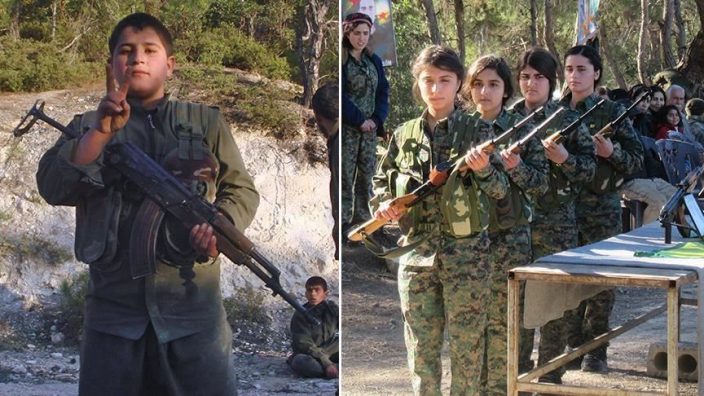
A senior Kurdish official in the “Defence Board” of the so-called Autonomous Self-Administration in Syria’s northeast town of Ain Al-Issa has stated that there are no plans to stop the controversial forced military conscription of young men in the Syrian territory currently controlled by Kurdish-led forces, known as the Syrian Defence Forces (SDF).
According to Kurdistan24 Shirin Qamar, co-chair of the Board, reiterated the decision to keep the system in place, describing the military service as “for the sake” of the defence of their homeland.
“The process is known to everyone: it includes 45 days of patriotic education and self-knowledge, as well as military training. And later on, they serve their homeland in the position of border guards,” she explained.
The Kurdish administration passed their own law making conscription compulsory in the “autonomous areas” on 14 July 2014, which was implemented in November of the same year on military-aged men and applies to all men regardless of their ethnic or religious background and regardless of whether they have previously served in the Syrian-state army.
However, every local authority in Kurdish-controlled Syria has the right to decide its own military conscription age, leading to complaints against discrimination and inconsistency.
There are documented allegations of child soldiers serving in the SDF, despite an order issued banning their recruitment in 2018.
The SDF has received funding and arms from the US to aid its efforts to combat Daesh. The force consists largely but not exclusively of YPG fighters, which is considered to be the Syrian faction of the terrorist PKK organisation. It has recently been reported that Saudi and US officials have held talks on potentially financing Arab factions who are currently affiliated to the SDF, under the pretext of “resisting the Iranian expansion attempts” in the country.
Trump Green Lights Greater Israel
Palestinians lose again

By Philip Giraldi • Unz Review • February 4, 2020
Many interested parties have already weighed in on President Donald Trump’s “Deal of the Century.” Even though it sounds like a phrase that a used car dealer would use, the “Deal” is dead serious in that it effectively denies to the Palestinians in perpetuum any political entity that has attributes of genuine sovereignty. Israel, which has just postponed a vote to immediately annex some of its illegal settlements on the West Bank with the blessing of the White House, will completely surround the fragmented Palestinian holdings by virtue of the annexation of the entire Jordan River Valley. It is the Zionist dream of a Greater “Eretz” Israel from the Jordan River to the Mediterranean Sea finally achieved. The empty shell swiss-cheese-like completely disarmed state of Palestine will have no authority over its borders and airspace, no means to defend itself and no right to manage its own water resources.
Within the territory granted to Palestinians by Trump there will remain Israeli settler enclaves guarded by soldiers and police. Israel will have total control over the entire West Bank. Millions of Palestinians under its control will de facto be stateless people without basic civil rights whose land will be stolen by settlers. They will be unable to travel even within their “state,” forced to pass through checkpoints, arrested and imprisoned for speech harming “public order” and jailed through indefinite “administrative detentions” without any charges or trial.
Gaza will be completely disarmed and connected to the West Bank by a tunnel controlled by Israel. Presumably, the Mediterranean will continue to be a restricted area for Gazan fishermen, patrolled by the Israeli navy with the offshore oil and gas reserves exploited by Israeli companies. In return for their complete surrender, the Palestinians will be required to express gratitude for being able to survive as helots in what will be largely an open-air outdoor prison. If they behave well, they may or may not get money doled out by Trump to Israel for distribution to the Palestinians as long as they keep quiet and smile as they writhe under the Israeli thumb.
One of the more interesting features of the Deal is that Trump insists that the Palestinians will have East Jerusalem as their capital while at the same time confirming that an undivided Jerusalem will be under total Israeli control. If one looks at the map provided by the White House when the Deal was unveiled, it appears that a piece of East Jerusalem is indeed shown as part of the Palestinian land. But obviously, even though it will have that area technically as its capital it will have no sovereignty over it. It is a detail that is clearly unsustainable and may in fact be a complete fiction designed to demonstrate how magnanimous Israel and the United States are in giving the Palestinians a “state.”
Trump’s one-sided Deal was crafted around Israeli interests, not those of the United States and without any input whatsoever from the Palestinians themselves. The team pulled together by presidential son-in-law Jared Kushner consisted of Orthodox Jews and they worked closely with U.S. Ambassador (sic) David Friedman, whose time in Israel has consisted mostly of being an apologist for Netanyahu, excusing accelerated Israeli settlement building as well as the weekly shooting party along the fence line in Gaza. Immediately after Trump and Netanyahu announced the outline of the Deal in Washington, Friedman stated that the Israeli government was at that point free to begin the annexation of any or all of the illegal settlements.
The sad part of what we see unfolding in front of our eyes is that the United States, long an enabler of Israel, is now openly a partner in Israeli war crimes. The Fourth Geneva Convention, adopted in 1949, was intended to protect civilians in time of war. It clearly states that occupying a territory obtained by war and colonizing it with your own people is a war crime. Germany’s demand for lebensraum for German colonists during the lead up to the Second World War and its defining the Slavs who would be displaced as Untermenschen was the crime that motivated the drafters of the Convention. Does that sound familiar? The words are probably somewhat similar in Yiddish.
Most of the mainstream media commentary on the Deal is neutral or even mildly critical, observing inter alia that it is a gift to Israeli Prime Minister Benjamin Netanyahu, who was at the podium and beaming alongside Trump. If the boost from the White House succeeds in getting Bibi reelected, Trump will expect payback big time in 2020 through the Israel Lobby’s influence over Jewish voters and from the generosity of Jewish billionaire donors named Sheldon Adelson, Paul Singer and Bernard Marcus.
That Trump has betrayed U.S. interests repeatedly in the Middle East and has also flipped on his pledge to remove American soldiers from its “loser wars,” makes him a disgrace as president, though he will likely be re-elected as the voters have been fed a steady diet of propaganda both by the mainstream media and government on Israel. That just might be because Jews are vastly over-represented both in the media and in the choke points in government that deal with the Middle East and foreign policy in general. Even liberal Jews who are critical of Israeli oppression of the Palestinians tend to rally round-the-flag at election time and vote for the candidate perceived as being “strongest” on Israel. One notes with interest that while Senator Bernie Sanders roundly condemned the Deal, Speaker of the House Nancy Pelosi saw “some areas of common ground here” in it. She would, wouldn’t she? And I am sure Senator Chuck Schumer, the self-proclaimed protector of Israel in the Senate, is secretly delighted.
In the rather less restrained alternative media, there is much banter about how the Deal is little more than a sweeping annexation plan that is really Apartheid by another name. That in itself is a bit of a fudge as the reality in Palestine is far worse than South African Apartheid ever was. Some braver individuals have observed how the United States is controlled by Israel in terms of its engagement in the Middle East, but the language used to describe the situation really misses the point. The United States vis-à-vis Israel is not controlled by Israel per se but rather by subversion from within, Jewish billionaires having bought both major political parties and a Jewish dominated media spouting nonsense about the “only democracy in the Middle East” and “America’s best friend and ally.” Israel is neither a democracy nor a friend. And the American Jews and their allies the Christian Zionists who are full time promoters of the Israel myth are little more than traitors to the United States and everything it once upon a time stood for.
The Palestinians have already rejected the Deal, but their refusal to participate will be seen by Trump and Israel as an insult, or at least it will be spun that way. Trump has already warned that his proposal is the Palestinians’ “last chance” and his United Nations Ambassador Kelly Craft has advised Palestinian President Mahmoud Abbas not to raise the issue at all with the world body. Unwillingness to embrace it will provide a good opportunity to really lower the hammer on the Arabs. The map provided by Trump shows a cluster of Bantustans surrounded by Israel soldiers and police who historically have regarded nominally Palestinian areas as a free fire zone. When violence erupts, which it will, the largely unarmed Arabs will be slaughtered and David Friedman, Donald Trump and Bibi Netanyahu will all conveniently blame it on the Palestinians as it was the Israelis who “wanted peace” and the only obstacle remaining was and is the obduracy of the Palestinians. If only they had accepted the Deal, the outcome would have been different the contrived narrative will go.
Philip M. Giraldi, Ph.D., is Executive Director of the Council for the National Interest, a 501(c)3 tax deductible educational foundation (Federal ID Number #52-1739023) that seeks a more interests-based U.S. foreign policy in the Middle East. Website is councilforthenationalinterest.org, address is P.O. Box 2157, Purcellville VA 20134 and its email is inform@cnionline.org.
Organization of Islamic Cooperation rejects Trump’s ‘deal of the century’ peace plan for Middle East
RT | February 3, 2020
The Organization of Islamic Cooperation (OIC), which consists of more than 50 Muslim-majority countries, has asked member states not to cooperate in any way with US President Donald Trump’s peace plan for Israel and Palestine.
During a special session in Jeddah, Saudi Arabia on Monday, the OIC’s executive committee called on all member states “not to engage with [Trump’s] plan or to cooperate with the US administration in implementing it in any form.” The body also asked members to refrain from any actions that “do not adhere to the inalienable rights of Palestinians.”
OIC Secretary General Yousef Al-Othaimeen said that the organization will support any international peace effort that is in accordance with international law.
Touted as the ‘deal of the century’ by the Trump administration, the plan describes the establishment of an independent Palestinian state with its capital set up in the outskirts of East Jerusalem, currently controlled by Israel.
The plan, however, allows Israel to keep existing settlements in the occupied West Bank, which the UN considers illegal under international law. The proposed roadmap also rules out the return of all Palestinian refugees, which the Palestinian Authority (PA) and the Arab world see as one of the key requirements for lasting peace.
The plan was endorsed by US ally Israel but universally rejected by the Palestinians and the Arab League, who view the plan as heavily skewed in favor of Tel Aviv.
Featured Video
10K More U.S. Troops Deploy as Trump Weighs New Iran Strikes
or go to
Aletho News Archives – Video-Images
From the Archives
Genetic baloney in thick slices
MAYBE COULD BE INC.
By Jon Rappoport | No More Fake News | July 8, 2021
Gene research companies tend to come and go. They start out banging and popping like fireworks in the sky, and then they fade out—selling themselves to larger outfits who’ve hired better liars…
Once upon a time, it sounded easy. Start with a disease, find the gene responsible for the disease, and correct the problem.
Then, researchers wondered, was disease the result of one gene or a group of genes acting together?
Either way, the proof would be in devising cures for diseases using gene therapy. “Not yet, but soon…”
And regardless, the major need was: money. Lots and lots of money.
This need required good PR people. “We have to pump up the idea that we’re on the edge of tremendous breakthroughs. We’re always on that edge…”
This hype also needed to obscure the fact that there wasn’t (and isn’t) ANY gene cure for ANY disease. … continue
Blog Roll
 Aletho News
- She Followed the Actual Data on COVID Vaccines and Masks — Her Career Took a Huge Hit
- Florida AG Sues Pfizer, Bourla Over Deceptive Marketing of COVID Vaccines
- Von der Leyen gifts her spin doctor a job for life
- 10K More U.S. Troops Deploy as Trump Weighs New Iran Strikes /Suliaman Ahmed
- Iranian crew declared Dena training vessel ‘unarmed’ to US warship before deadly torpedo strike: Report
- Iran’s NPT debate moves beyond parliament
- Houthis condemn Saudi claims of attack on Medina
- Fatuous False Flags
- Are Europe’s Smallest Nations Dragging the Continent into War?
- EU draws up contingency plans for possible Merz exit
- If Americans Knew
- The Israeli Right Portrays Islam as Murderous. It Serves a Political Purpose
- Jordan Has Had Enough: King Abdullah’s Scathing Warning to Israel
- Israeli Colonizers (i.e. Settlers) Kill Palestinian Man Near Salfit
- New Google Maps images reveal massive scale of devastation in Gaza
- Jewish supremacy, anti-Palestinian bigotry on display in Israel – Daily Update
- Israeli Soldiers Abduct At Least 22 Across Occupied West Bank
- Eight Palestinians Killed in Israeli Attacks on Gaza
- Israeli former leaders and security chiefs threaten legal action over ‘Jewish terrorism’
- Israel map in LA Times ad includes all land from the river to the sea
- Inside Lebanon’s 200-page dossier on Israeli war crimes
- No Tricks Zone
- Green Energy Debacle: German Expert Professor Fritz Vahrenholt Warns Of Severe Economic And Social Consequences
- Two More Paleo Reconstructions Affirm Meters-Higher Sea Levels Across Ireland, Brazil 7000-6000 Years Ago
- New Study: Earth And Venus Surface Warmth Largely Explained By Convection And Lapse Rate, Not CO2 Or Radiation
- 2025 Nature Paper Claiming Worsening Global Drought Gets RETRACTED …Heavily Flawed
- New Study: ‘Global Drought Shows No Detectable Recent Acceleration Under Climate Warming’
- Economic Masterminds: German Socialists Suggest Taxing Productivity Gains Stemming From Using AI
- The South China Sea Has Not Been Cooperating With The Climate Change Narrative
- Energy Crisis: Germany Enters Heating Season With Historically Low Gas Reserve Fill Levels
- New Study: The Antarctic Ice Sheet Gained Mass From 2020-2024 Due To Staggering Snow And Ice Accumulation
- Study: Ocean Heating Rates From Thousands Of Years Ago ‘Dwarf’ Modern Ocean Heating Rates

