Amazon, Israel, and the Occupation of Palestine
International Solidarity Movement | October 2, 2019
On September 22nd, Amazon quietly launched its operations in Israel, offering local delivery from a number of Israeli brands, with a Hebrew-language version of its Israel platform coming soon. Consumers in Israel now have faster and broader access to the world’s largest e-commerce marketplace, yet questions remained unanswered about Amazon’s ties with Israeli military, financial, and technology companies involved in the Occupation of Palestine as well as accusations of anti-Palestinian bias against the platform and its founder Jeff Bezos.
Though Amazon Israel was launched barely two weeks ago, Amazon’s business operations with Israel go back much further. As early as 2015, Israel Aerospace Industries (IAI) began servicing Amazon’s fleet of cargo planes, and now services 80% of Amazon’s aircraft. IAI is a wholly Israeli state owned aerospace and weapons manufacturer which supplies the Israeli army with aircraft, drones, missiles, armored vehicles, spy satellites and more. Its weapons have been used in assassinations and military invasions of Gaza. In the 1970s, IAI sold weapons to the Shah of Iran, and more recently, a UN report in August this year found IAI had sold weapons to Myanmar’s military after it began its genocide and ethnic cleansing of the Rohingya minority. IAI subsidiary Elta North America was recently commissioned to build a prototype of Donald Trump’s wall on the US-Mexico border. Amazon also works with Israeli technology firm NSLComm, which receives funding from the Israeli government, and builds network satellites “that will be used for… military applications”, according to Haaretz.
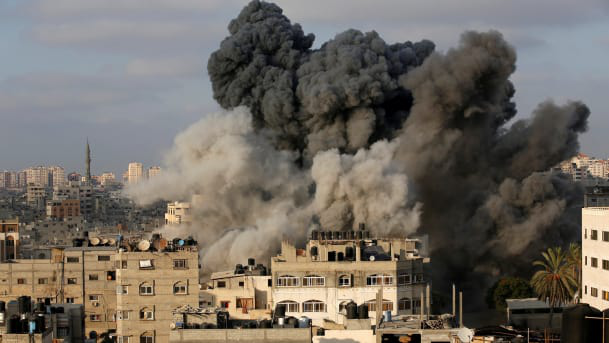
IAI, which services 80% of Amazon’s cargo planes, also provides aircraft, missiles, and other weapons to the Israeli government. Credit: MOHAMMED SALEM/ REUTERS
While Amazon’s ties with IAI and NSLComm are rarely reported in the media, its multi-million dollar contracts with another security firm has attracted widespread condemnation and protest. Amazon makes millions off providing web servers and database storage for Palantir, a private US data analysis firm which aids Immigration and Customs Enforcement (ICE) in identifying and deporting migrants. A petition this summer for Amazon to cut ties with Palantir and ICE gained over 270,000 signatures. Palantir also provides the Israeli government with so-called “predictive systems”, which analyze social media posts to identify Palestinians deemed a “threat”. The result of Palantir’s racially profiled analytics systems is that Palestinians are arrested and face long prison sentences for simply posting photos of family members killed by Israeli forces or in prison, citing Quranic verses, or calling for protests.
In the financial sector, Amazon signed agreements this year with Bank Hapoalim and Bank Leumi, two major Israeli banking institutions, to provide discounts to Amazon customers using Leumi and Hapoalim bank accounts. A 2018 report by Human Rights Watch found both banks guilty of financing construction and expansion of illegal settlements in the West Bank, while Bank Leumi also funds academic institutions in illegal settlements and programs for IDF recruits, even sponsoring gift packages and additional vacation days for Israeli soldiers during the 2014 invasion of Gaza, in which over 2,200 Palestinians, including more than 550 children, were killed. Pension funds and banks in Norway, Denmark, the Netherlands, and the UK have divested from Bank Leumi and Hapoalim due to their human rights violations, while Amazon signs new cooperation agreements with them.
Amazon’s dealings with Israeli companies supporting and profiting from the Occupation aside, many more questions remain. The most troubling of these questions surround how Amazon Israel will deal with realities on the ground in its operations. Will Amazon deliver to customers in illegal settlements? Will Amazon sell products manufactured or grown on Palestinian land seized by armed settlers and considered illegal by the UN and the international community? Will Amazon give Palestinian and Israeli sellers equal access to its platform?
A quick look at Amazon’s policies on its global site, amazon.com, give some indication as to how it might run its Israeli site. Last year, Amazon removed a top-selling T-shirt that reads “Make Israel Palestine Again”, on the grounds that it did not fulfill Amazon’s content policy. Amazon’s content policy prohibits the sale of “products that promote or glorify hatred, violence, racial, sexual, or religious intolerance or promote organizations with such views.” Amazon seems to have no problem, however, with selling “IDF” merchandise; at the time of writing this article, IDF T shirts, dresses, Halloween costumes, and even baby clothes were available on its global site. The occupation army has been accused of racism, sexism, religious intolerance, and countless acts of violence, torture, and human rights violations, not only by Palestinians but also by Israeli soldiers.
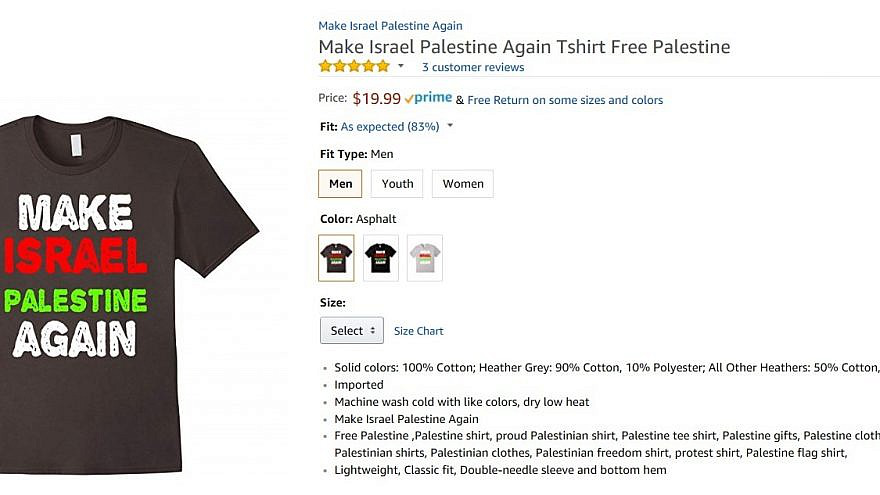
A screenshot of the “Make Israel Palestine Again” T-shirt removed by Amazon.
Amazon president, CEO, and largest shareholder Jeff Bezos, the richest man in the world since 2017 (and according to Forbes, the richest man in history) has yet to speak publicly about Palestine or Israel; he rarely gives public comments on any political issues. But indications of the Amazon founder’s political stances can be seen in the Washington Post. Jeff Bezos purchased the US paper for $250 million USD and has been its sole owner since October 2013.
The Washington Post has published a wide range of articles on Israel and Palestine, and a quick look at their articles and editorials since Bezo’s takeover in October 2013 shows where its editorial staff and leadership stand. It describes the shooting of unarmed Palestinian protesters in Gaza by Israeli snipers as “clashes”, and Netanyahu as a “prudent, even cautious, statesman” who “quietly restrained the building of Jewish settlements”, even though during his last 10 years in office over 20,000 settlement units were built in the Occupied West Bank. One Washington Post article, titled “Palestinians Kill 3 Israelis as Violence Mounts in ‘Day of Rage’”, acknowledges only in the 6th paragraph that “28 Palestinians have been killed by Israelis.” Israelis are routinely described as “killed”, but Palestinians merely “die”. Another article on electricity cuts in Gaza makes sure to inform the readers in the headline that “it’s not all Israel’s fault”. Last year, the Washington Post ran a full page advert calling New Zealand artist Lorde a “bigot” for canceling a concert in Israel.
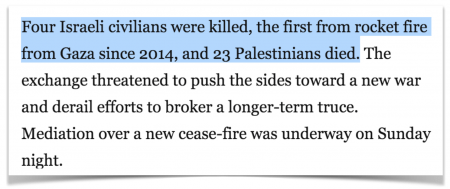
From the Washington Post (of which Amazon founder Jeff Bezos is the sole owner) on May 6, 2019. Israelis are killed, but Palestinians just “die”
Jennifer Rubin, a journalist for the Washington post, once retweeted an article describing Palestinians as “death-worshiping, innocent-butchering, child-sacrificing savages”, “devils spawn”, and “unmanned animals” who should be thrown “into the sea, to float there, food for sharks”. Her writing in the Washington Post declared that endorsements of the one-state solution “amount to calls for genocide”, and called then–Secretary of State John Kerry “intentionally obtuse”–or a liar–for not denouncing the Palestinian right of return. The Washington Post has rejected calls to remove Rubin for promoting racism and Islamophobia.
Given Amazon’s record of involvement with corporations deeply entrenched in the Israeli Occupation of Palestine, there is a high possibility of Amazon Israel failing to comply with international and human rights law in its Israeli operations. Should it fail to respect international law and engage in operations directly normalizing, supporting, and profiting from violations of Palestinian rights, Amazon may face boycott calls similar to those taken by BDS against companies like HSBC, SodaStream, Airbnb, Caterpillar, and Hewlett Packard. It remains to be seen what kind of corporate values Amazon Israel will deliver.
Saudis Blame Iran for Aramco Strikes But Retaliate by Bombing Yemeni Civilians
By Ahmed Abdulkareem | MintPress News | September 24, 2019
AMRAN, YEMEN — Unlike the burning fields of neighboring Saudi Arabia, in Yemen scenes of massive fires have become commonplace, a reality that civilians do not accept but have come to expect. For nearly five years, since the Saudi-led Coalition began its bombing campaign in Yemen, Yemeni residents have watched as their neighbors’ homes have burned to the ground, often with whole families still inside, and as schools, factories, hospitals, mosques, and markets are rendered into piles of soot and ash following massive infernos sparked by near-constant Saudi airstrikes. Yet, unlike the attacks on Saudi oil facilities, rarely do the attacks on Yemen garner international media coverage or condemnation.
Thirty-two-year-old Yemeni Bedouin Saleh Masoud Jarwan did not expect that he and his family would be the next victims of the Saudi airstrikes, but on Monday Saleh was killed along with six family members in an airstrike by Coalition jets in Yemen’s Amran province. Saleh had hoped that Yemen would be safe after the attack on the Saudi Aramco facility, assuming that the attack would be enough to encourage the Kingdom to halt its drone and missile attacks against Yemen.
The scene of the attack was illuminated in red from the massive fires that followed the airstrikes, and this fire was not fueled by oil but by the bodies of more than ten civilians, including women and children. The screaming and crying of two children who survived the initial onslaught provided a backdrop to the shouts of rescuers who frantically worked their shovels and called out to victims as they worked to free Saleh and his family from the rubble of the mosque that collapsed on them in the airstrike.
A sustained Saudi barrage
The Coalition is estimated to have carried out at least 42 airstrikes in just a 24-hour period alone. By 2 a.m. on Sunday, local residents in the al-Sawad district of North Amran were living in horror as they sheltered in schools and mosques hoping to escape death from above as at least 12 Coalition airstrikes leveled their neighborhood. Thekra, Moamer, and Kubra — three young girls between the ages of three and eight — were among those who took refuge in a local mosque, only to be killed after Saudi warplanes brought it down over their heads.
In the village of al-Addi in the Harf Sufyan district, the air was suffused with the smell of charred bodies after a Saudi airstrike hit a car, instantly killing the two civilians inside. That attack was followed hours later by airstrikes targeting the nearby home of Ahmed Jimaie.
On Tuesday, 16 civilians, including four women and seven children, were killed when Saudi airstrikes hit the home of Abbas al-Halmi in Qataba, Al-Dali governorate, according to a local resident who spoke to MintPress but was unable to provide further details on the attack. The bodies of three children were later recovered from the rubble of that attack, adding to the already staggering death toll.
Saudis blame Iran, punish Yemen
The Grand Mufti of Yemen, Shams al-Din Sharaf al-Din, the highest religious authority in Yemen, laid blame on those who declared solidarity with Saudi Arabia following last week’s Aramco attacks but remain silent in the face of atrocities committed by Saudi Arabia and the United Arab Emirates in Yemen.
These latest Saudi-led Coalition attacks came days after Yemen’s Houthis announced responsibility for a spate of retaliatory attacks against positions inside Saudi Arabia. It is unclear why the Coalition launched the ostensibly retaliatory attacks on Yemen, as they claim that it was Iran, not the Houthis, that carried out the oil-field attacks.
Mahdi al-Mashat, Ansarullah’s (the Houthis’ political bloc) president of the Supreme Political Council in the Yemeni capital, Sana’a, warned that Yemenis would not hesitate to “launch a period of great pain if their calls for peace were ignored.” Al-Mashat made the comments following an announcement that the Houthis would temporarily cease all retaliatory missile and drone attacks against the Saudi monarchy as part of a Yemeni peace initiative. Al-Mashat said:
We announce the cessation of the targeting of Saudi Arabia’s territory by airborne missiles, ballistic missiles, drones and all forms of targeting, and we await a response to this initiative with a similar or a better one to halt all forms of attack.”
That announcement came just three days before the Coalition launched its deadly attacks in Amran.
The United Nations welcomed Ansarullah’s proposal, saying in a statement issued on Saturday by the UN Special Envoy for Yemen, Martin Griffiths, that it marked an important opportunity to move forward with all necessary steps to reduce violence, military escalation, and unhelpful rhetoric.
Griffiths emphasized that the implementation of the proposal by the Houthis was in good faith and could send a powerful message of their will to end the war. Saudi Arabia has so far refused to accept the offer and Saudi Minister of State for Foreign Affairs Adel al-Jubeir dismissed it, saying, “We judge other parties by their deeds [and] actions and not by their words, so we will see.”
The peace initiative follows Houthi airstrikes on two of Saudi Arabia’s oil facilities in Abqaiq and Khurais, which led to a suspension of about 50 percent of the Arab kingdom’s crude and gas production. That attack on a vital economic interest of the Kingdom garnered widespread support among many in Yemen’s capital city of Sana’a. On September 14, the day of that attack, hundreds of thousands of residents from Sana’a and its neighboring provinces took to the streets carrying Yemeni flags and holding banners emblazoned with messages of steadfastness and support for Houthi drone and missile forces.
Many Yemenis see Aramco attack as justified last line of self-defense
For many, the Houthis’ setting fire to the Kingdom’s Aramco oil fields represented the last hope to quell Saudi attacks on Yemen. In a staggering show of solidarity on Sunday, an estimated 1,200 cars filled the streets of 70th Area, a neighborhood in southern Sana’a, to drop off food donations for families of victims of Saudi airstrikes. According to many of the families, the attack on Aramco is revenge for the blood of the estimated 100,000 people killed in the Saudi-led Coalition’s war in Yemen.
Indeed, the Coalition has used systematic economic strangulation as a weapon of war — targeting jobs, infrastructure, the agricultural sector, fuel and water pumping stations, factories, and the provision of basic services, as well as imposing a land, sea and air embargo impacting the country’s imports, causing the spread of famine throughout the country. This, to the many in Yemen who celebrated the Aramco attack, is sufficient justification for targeting the heart of Saudi Arabia’s economy.
However, many still doubt that the Houthis were capable of carrying out an attack of the scale and range of the one that struck Saudi Arabia — instead accusing Iran of orchestrating the attacks. Others await the results of an international investigation, but the Houthis, who comprise a major component of Yemen’s resistance to Saudi interference in their country, say the evidence that they carried out the attacks exists and that they will share it with the media.
The Houthis over the past two years have launched a series of sophisticated attacks on Saudi coalition targets deep inside the Kingdom, establishing a precedent for the most recent attacks. Houthi officials say the attacks on the Aramco facilities were launched from three different locations, based on their flight endurance and designated targets, and that various types of combat drones were used in the attack, some capable of carrying four precision-guided bombs and of striking their targets from several angles.
Moreover, the Houthis’ third-generation Qasef (Striker) combat drones and long-endurance Sammad-3 (Invincible-3) drones have an operational range of 1,500 kilometers to 1,700 kilometers.
The attack on Aramco came at a time when the de facto leader of the Kingdom, Crown Prince Mohammed bin Salman, was attempting to refloat the much-delayed public offering of Aramco shares, and that attack would not likely not have succeeded without the cooperation of members of Saudi royalty and former Saudi officers, according to some Houthi sources.
Ahmed AbdulKareem is a Yemeni journalist. He covers the war in Yemen for MintPress News as well as local Yemeni media.
Syrian Army Intercepts Drone Loaded With Cluster Bombs – Reports
Sputnik – September 21, 2019
The Syrian Army has intercepted a drone loaded with cluster bombs over Jebel al-Sheikh near the Golan Heights, the Syrian Arab News Agency said on Saturday.
According to the report, special services dismantled the drone, which they managed to detect and shoot down north of the city of Al Qunaitra.
In addition, Syrian intelligence agencies discovered a stash of weapons, ammunition, medicine, food, and equipment produced in Israel, in the village of Barika in the suburbs of Quneitra.
More photos of the armed drone that was found by the SAA near Israeli-occupied Golan. pic.twitter.com/9w08tqLUqd
— Within Syria (@WithinSyriaBlog) September 21, 2019
The incident comes two days after another drone interception over the Damascus suburb of Aqraba.
Israel seized control of the Golan Heights from Syria during the 1967 Six-Day War and annexed the territory in 1981, although the move was not recognised by the United Nations. In 2018, the UN General Assembly adopted a resolution urging Israel to immediately withdraw its forces from the occupied territory.
All Points Alert: Killer State at Large
By Jeremy Salt | Palestine Chronicle | September 20, 2019
The most important news coming out of occupied Palestine last week was not the blow delivered to Benyamin Netanyahu. Netanyahu or Gantz, it will be business as usual, now that the elections are over: more attacks on Gaza, possibly a large-scale war on Gaza, possibly a war on Lebanon, or Iran, who would know, as Israel always has a profusion of targets.
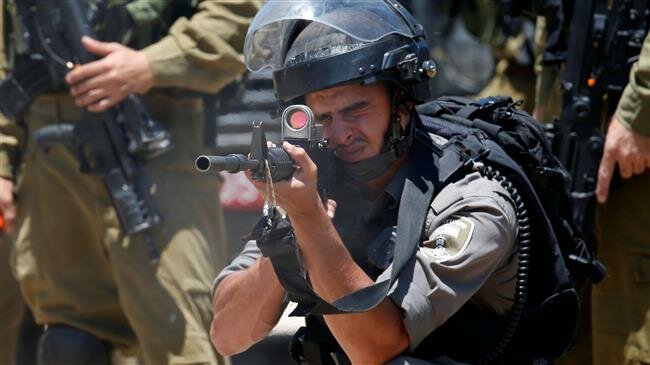
No, the most important news was not the elections but the killing of a Palestinian woman in the West Bank, only a few days after a 10-year-old boy, Abd al Rahman Yasir Shtewi, had been shot in the head by a soldier near the northern West Bank village of Kafr Qaddum during a demonstration over the closure of an access road. He was taken to hospital in critical condition.
The woman, Alaa Wahdan, was shot with an assault rifle as she walked towards a checkpoint near the Qalandiya refugee camp, built for refugees after the massacres and ethnic cleansing of Palestinians from Lydda and Ramle in 1948.
She was walking on the road, having missed the pedestrian lane allotted to the Palestinians. That was the crime for which she had to die. She was told to stop. According to the five heavily armed men who blocked her way, she pulled out a knife, a small yellow-handled thing photographed lying on the road. Alaa was five to seven meters away and the knife could have been knocked away with the butt of a gun but one of the armed men shot her instead, the bullet apparently severing an artery in her leg.
Alaa fell to the road and was left there unattended for half an hour, bleeding to death. The Palestinian Red Crescent said it was prevented from attending to her. The soldiers watched her drag herself along the roadside on her front, the blood pouring out of her body, leaving a long, wide red stain behind her. Not one of them made any attempt to comfort her or staunch the wound. They watched her bleed to death. They let her die, in line with unstated state policy.
Who Alaa was precisely, a mother, a sister, a daughter or an aunt, was of no interest to the occupiers. She was a down-page story in the media, not even worthy of being given a name, no more than the African ‘terrorists’ of the 1940s or 50s were worthy of being given a name by the British or French occupiers of their land who tortured and murdered them. In the words of Mickey Rosenfeld, the police gauleiter of occupied Jerusalem, she was no more than a “female terrorist” who was “injured moderately.” If this is so, Mr Rosenfeld, why did she die?
In the background, while Alaa crawled along the road, her lifeblood draining away, the spivs, the thieves and the war criminals quarreled over who should be next to take over the occupation of Palestine. The choice was between Netanyahu and Gantz, the outcome of the elections so close that the ‘kingmaker’ will be Avigdor Lieberman, the Moldovan immigrant who arrived in Palestine when he was 20 and lives with his wife and children on Palestinian land in the settlement of Nokdim.
Like Menahim Begin in the 1970s, Lieberman was once regarded as a thug and fanatic who would never make it into the mainstream of Zionist politics but as the mainstream has shifted further right year by year it finally reached him. He once advocated the bombing of the Aswan dam as a means of shutting up the Egyptians. He thinks the ‘Arab’ members of the Zionist ‘parliament’ are the allies of terrorists.
He wants Muslim and Christian Palestinians to be required to swear an oath of loyalty to a state which has declared itself to be a Jewish, which has practically stripped them bare of all they possess and which plans to keep going until nothing is left.
His philosophy can be summed up in his own words: “Whoever is against us there’s nothing to do …. We have to lift up an axe and remove his head … otherwise we won’t be here.” The option of handing back part of what has been stolen as a means of making peace is not even within his realm of thinking.
As for Netanyahu, his campaigning was nakedly racist. He warned against an ‘Arab’ party ending up in government and his Likud party stationed cameras outside polling booths to intimidate Palestinians and prevent them from voting. It didn’t work. They turned out in higher numbers than ever. It is the measure of this individual’s vile nature that he wanted to attack Gaza either to win or postpone the elections, riding to eventual victory over the bodies of more dead Palestinian men, women and children.
Gantz got in his way, but only for the same electoral reason, because he also is a killer of Palestinians, and currently the subject of prosecution in the Netherlands for the bombing of an apartment building in Gaza in 2014 which killed six members of the same family.
As the Palestinians well know, it makes no difference which of the parties is in power because their policies – more war, more killing, more settlements, with annexation now only a few steps away – are all the same.
The pathology of the Zionists puts them beyond reason. They do not connect up with any laws or values except their own and trying to reason with them on the basis of international law and universal values is a waste of time, pebbles thrown against the side of a tank.
In 2013 Mehdi Hassan interviewed Dani Dayon as the centerpiece of an Oxford Union debate. Until recently Dayon was the head of the Yesha settler council. Sitting in the front row, Ghada Karmi, born in Al Quds to a family that owns land on the West Bank taken over by foreign settlers like Dayon, had to endure the lies and delusions that flowed from this man’s mouth. Cutting through the arrogance and his smiling, self-assured attempts to deceive the audience, she told him what he actually was in her eyes and the eyes of the world – a common thief.
There is no mystery about what has ‘happened’ in Palestine. There is no ‘conflict of rights,’ ‘contested narratives’ or ‘disputed’ ownership. These are all propaganda phrases designed to conceal the indisputable reality. From the Mediterranean to the Jordan River, Palestine has been stolen by people whose moral right to stay there can only be conferred on them by the people whose land they have stolen. Had they ever accepted this principle, had they ever apologized for their crimes, had they agreed to share instead of wanting to take the lot, using all the brutal means at their disposal, this moral right could have been secured but they forfeited this possibility long ago, preferring endless war to the possibility of peace. There is no ‘two state’ solution in sight. Add it to the list of myths still being purveyed. There is no solution in sight at all, at least not one based on rational discussion and the application of international law.
There is no statute of limitations here. The land was stolen and will remain stolen no matter how long the Zionists hold it. There is no ‘land of Israel’. There is no ‘Temple Mount’ and no ‘tomb of the patriarchs’ in Hebron. These are all deceptions sitting atop a mountain of lies intended to bury the truth. There is Palestine, there is the Haram al Sharif, the Ibrahimi mosque in Hebron, where the settler state pogrom against the Palestinians continues without pause, and countless other sites on the map, all of them occupied and renamed. Not a drop of water in the sea or a speck of sand on the beach belongs to the Zionists. It has all been stolen.
As soon as the elections were over, ‘kingmaker’ Lieberman, leading the party of Russian ‘immigrants’ to an illegally occupied land, started stitching together a ‘national unity’ government. As excited or as preoccupied with the process as the Zionist population of Palestine might be, there is no prospect of change for the Palestinians except change for the worse.
Gantz is as much a warmonger as Netanyahu or Lieberman and as the Palestinians will continue to resist occupation of their land where and when they can, as is their natural right and their right under international law, more large-scale violence is only a matter of time. In their arrogance the Zionists are ignoring all the warning signs, the cries of ‘death to Israel’ from the Houthis, the tens of thousands of missiles in Hizbullah’s armory and the determination of Iran to defend itself and its allies. The Zionists can kick the Palestinians around, but not these powerful enemies, who have behind them the support for Palestine of Muslims everywhere, not to speak of the numerous defenders of Palestine and Palestinian rights in Europe, the US, Canada, Australia and many other countries.
The Zionists came to the Middle East as a ‘rampart’ of ‘western civilisation’ and that is where they have remained, on the ramparts, behind the palisades, the fences and the wall, fencing others out and fencing themselves in. They wanted to be in the Middle East but not of the Middle East. It was beneath them. They hijacked those aspects of its culture that suited them but looked down with contempt on the rest and they still do.
In any case, western domination was the accurate phrase, not western civilization. The ‘west’ has never been civilized, not in the Middle East or in any other lands against which it went to war and occupied. Rather, it has been utterly barbaric, as the word is generally understood, and Zionism has been part of that barbarism.
Not wanting to be part of the Middle East except on its own unacceptable terms, Zionism has to rely on powerful outside backers, a role currently filled by one of them, the United States. However, will it always be there to give the Zionist state the support it demands, will it always be capable of giving it the support it demands, will it ultimately be willing to put its own life on the line for a small state far away that is held in contempt by much of the world, not for bad reasons but for perfectly understandable ones, and one that is held in contempt as well by an increasing number of Americans?
Only arrogance could be the reason for the willingness of the Zionists to stake their future on such uncertainties, when for a small price, except in their own greedy eyes, they could have secured their place in the Middle East long ago. There is one other reason for their confidence, though, and that is their possession of nuclear weapons. At the worst, backs finally against the wall, they can take everyone down with them.
Take a serial killer out of the psychiatric ward, hand him a machine-gun and wait to see what happens. That is the prospect ahead of the Middle East as long as the Zionist state remains a killer at large.
– Jeremy Salt taught at the University of Melbourne, at Bosporus University in Istanbul and Bilkent University in Ankara for many years, specializing in the modern history of the Middle East. Among his recent publications is his 2008 book, The Unmaking of the Middle East. A History of Western Disorder in Arab Lands (University of California Press).
Dutch court starts hearing in war crime case against Israel’s Gantz
Press TV – September 17, 2019
A Dutch court has held a hearing on a war crime case against a former Israeli general challenging incumbent Israeli Prime Minister Benjamin Netanyahu in ongoing general elections.
The Hague District Court weighed on Tuesday whether it should hear a lawsuit brought by a Palestinian man seeking compensation from Benny Gantz for his role in the killing of six of his relatives during the Israeli war on the besieged Gaza Strip in 2014.
On July 20, 2014, Ismail Ziada lost his mother, three brothers, a sister-in-law, and a 12-year-old nephew when their family home was bombed by the Israeli air force.
A visitor was also killed in the Israeli bombardment.
“I was shot at a very close range with a rubber coated metal bullet in the head. I witnessed another boy being shot in the head next to me, dying on the spot,” said Ziada about his encounters with the Israeli army.
Ziada, who now lives in the Netherlands, filed a civil lawsuit in 2018 seeking damages from Gantz, who was the chief of staff of Israel’s military at the time of the bombing, and the then-air force commander Amir Eshel.
Ziada says the attack violated international humanitarian law because it deliberately targeted civilians.
The Tuesday session addressed a motion filed by Gantz and Eshel’s lawyers asking the court to dismiss the case. They argued the ex-commanders were immune because the Dutch court had no jurisdiction over the case.
Ahead of the hearing, Ziada’s lawyer, Liesbeth Zegveld, said Palestinians from Gaza could not receive fair treatment in Israeli courts.
Dutch courts can exercise universal jurisdiction over war crimes, provided the accuser cannot get a fair trial elsewhere.
Israel launched several wars on the Palestinian coastal sliver, the last of which began in early July 2014. The military aggression, which ended on August 26, 2014, killed nearly 2,200 Palestinians. Over 11,100 others were also wounded in the war.
The Gaza Strip has been under Israeli siege since June 2007. The blockade has caused a decline in the standards of living as well as unprecedented levels of unemployment and unrelenting poverty.
Iraq will respond to Israeli attacks, sees itself in war against Zionist entity: Iraqi MP
Press TV – September 14, 2019
All options are on the table in response to Israel’s recent drone strikes targeting Iraq’s Popular Mobilization Units (PMU), also known as the Hashd al-Sha’abi, according to a leading Iraqi parliamentarian.
Speaking to the Lebanese al-Mayadeen television channel on Saturday, Ahmed al-Asadi, Iraqi Lawmaker and spokesman of the Iraqi Fatah alliance said that Israel’s attacks were certainly “a declaration of war”.
The lawmaker said that Iraq viewed Israel as an occupying entity and as its enemy, adding that no treaty could halt what Iraq saw as its war against the illegitimate state.
Al-Asadi added that the pro-government PMU was part of Iraq’s security establishment and that it would surely have a role in any response to Israel.
He added that the PMU forces were on high alert against drone strikes, adding that the organization is currently negotiating with Russia, China and Iran on obtaining air defense systems in order to defend Iraq’s airspace.
The comments come as the PMU has been the target of a number of aerial strikes attributed to Israel.
Israeli authorities have openly suggested that the Tel Aviv regime may be conducting operations in Iraq, an issue which has been confirmed by American and European officials.
Speaking on Saturday, al-Asadi stressed that investigations into certain recent attacks have revealed the drones’ flight path and where they have been launched from, adding that the attacks had been clearly done with Washington’s oversight.
Referring to American military presence, the Iraqi lawmaker added that the Iraqi parliament is due to discuss foreign troop presence in the country later today.
Al-Asadi suggested that American advisory troop presence could be replaced by forces from other countries, such as Russia, China or European and Latin American countries.
‘Iran is center of regional stability’
Speaking about Iran’s role in Iraq, Al-Asadi said that Iran has a pivotal role in guaranteeing regional stability.
Referring to prominent Iraqi Shia cleric Muqtada al-Sadr’s recent visit to Tehran, al-Asadi said, that as “part of the Resistance, we are pleased to see Sadr alongside Leader of the Islamic Revolution Ayatollah Seyyed Ali Khamenei and Major General Qassem Soleimani”, who commands the Quds Force of Iran’s Islamic Revolution Guards Corps (IRGC).
The Iraqi parliamentarian also lauded the Lebanese resistance movement Hezbollah for its resistance against Israel, saying that it was a “source of inspiration” for all resistance movements in the region.
Both Washington and Tel Aviv have for long been seeking to counter the emergence of a united front of forces, usually known as the “Resistance Axis”, in the region.
The resistance movement was formed gradually countering foreign-backed terrorism and the US and its allies’ interventions in the region.
Russia prevented Israeli airstrikes in Syria, Putin warned Netanyahu: Report
Press TV – September 14, 2019
Moscow has reportedly moved to prevent Israeli airstrikes in Syria, with Russian President Vladimir Putin warning Israeli Prime Minister Benjamin Netanyahu against the strikes.
Putin told Netanyahu that allowing Israeli strikes on Syrian military assets would undermine Moscow’s relations with Damascus, the Arabic edition of the UK-based Independent newspaper reported on Friday.
The report comes after Netanyahu met with Putin in the resort city of Sochi on Thursday to discuss “security coordination” in Syria.
According to an unnamed Russian source cited in the report, Moscow has also threatened to use its “fighter jets or the S-400 air defense system” in order to counter any Israeli aircraft striking Syria.
In August, Moscow stopped an airstrike on the strategic Qasioun region near Damascus, where a Syrian S-300 missile battery is said to be placed, according to the report.
Moscow allegedly prevented another airstrike later on a Syrian outpost in the southwestern province of Quneitra and a third in the western coastal province of Latakia.
The report comes as Syria has intercepted several Israeli missile attacks in the past month, casting doubt on the extent of Russian commitment to counter Israeli ambitions.
The Israeli regime has acknowledged repeatedly launching attacks against Syria in recent years, some of which have been carried out from Lebanese airspace.
Such aggressive moves have been viewed by observers as attempts to weaken the Damascus government as it increasingly gains the upper hand fighting terrorist groups which have plagued the country since 2011.
‘A failed meeting’
The Independent report also cited unnamed Israeli sources who described Netanyahu’s meeting with Putin as “a failure”, falling short of reducing any Syria policy disagreements with Moscow.
Israeli sources added that Israel airstrikes on Syria had “embarrassed” the Russians from failing to protect its allies.
During the “failed” meeting, Netanyahu had also called for Tel Aviv to be given “freedom of action” against Iran by Russia.
The Israeli prime minister had even sought to use the meeting to “present positive message of the cooperation between the two countries” for his election campaign but failed, the report wrote.
According to the Russian source, Putin’s disagreements with Netanyahu also went as far as Putin condemning Tel Aviv’s recent actions in Lebanon, with the Russian president saying that he “rejects the aggression towards Lebanon’s sovereignty.”
Israel launched a number of drone attacks into Lebanon last month.
Following the drone raids, Sayyed Hassan Nasrallah, Hezbollah’s secretary general, vowed in a televised speech that fighters of the movement would counter any further violation of the Lebanese airspace by Israeli drones, warning the Tel Aviv regime to immediately halt such breaches.
Last week, Hezbollah fired two anti-tank guided missiles at a moving Israeli armored vehicle at the Avivim base north of the occupied territories, killing and wounding its occupants.
Human Trafficking is Booming in Yemen as the War Enters its Fifth Year
By Ahmed Abdulkareem | MintPress | September 13, 2019
AMRAN, YEMEN — The offensive war on Yemen, the most impoverished nation in the Middle East, was launched in 2015 by a U.S.-backed coalition of Arab countries led by Saudi Arabia, the richest nation in the Middle East. It has plunged a nation already struggling to provide basic services to its citizens into chaos, a nation now ruled by a ragtag consortium of different groups all thirsting for power. The result? A complete absence of law and order that has given rise to a black Suq (market) of human trafficking on a scale never before seen in Yemen.
Thirty-five-year-old Tawfiq hails from Amran, a small city in west-central Yemen famous for its ancient mud-brick high-rises dating back two millennia to the Sabean kingdom. Tawfiq was among 17 Yemeni victims of human trafficking who agreed to speak to MintPress about their harrowing ordeals. In 2016, Tawfiq — desperate to bring money home to his family, as the then-fledgling war decimated the already shaky Yemeni economy — was told by a friend that he could earn as much as $7,000 for one of his kidneys. Days later Tawfiq was on a bus to Saudi Arabia, traveling through al-Wadeeah port on the Yemen-Saudi border.
Today, Tawfiq suffers from complications arising from his kidney extraction and is now unable to carry heavy objects. He told MintPress, “I thought that removing a kidney would be a simple arrangement, but now I live in a hell of pain and suffering.” Tawfiq’s operation was crude and involved no follow-up care.
Ismail, the owner of a small electronics store in Taiz, told MintPress, as he pointed to the place where one of his kidneys use to reside, “I needed money to feed my children.” Ismail hesitated while he recounted his story, worried that the shame of what he had done would reach his family. Yet thousands of Yemeni civilians who are living in abject poverty as a result of the ongoing war are willing to allow a part of themselves to be cut out and sold in order to be able to sustain their families.
Ali al-Jailai, head of the Yemen Organisation for Combating Human Trafficking, told MintPress that the wave of famine that hit the country in 2015, when the Saudi-led war began, has augmented Yemen’s human trafficking network and left women and children the most vulnerable.
“A while back there was a case of a man who was traveling to Egypt to sell his kidney,” al-Jailai told MintPress. “We talked to him and tried to persuade him not to go, but he refused; he needed the money.” With an economy now decimated by more than four years of war, many working-class Yemenis have abandoned hopes of working a normal job and instead turn to one of the few options that remain: to sign up for the fight against Saudi Arabia and the UAE, or to sell their organs to survive.
Over 20 million Yemenis are currently in need of humanitarian assistance, according to the United Nations. Salaries for teachers and other public-sector workers have not been paid regularly since the war began and Saudi Arabia seized control of Yemen’s Central Bank, leaving vulnerable populations at increased risk of falling victim to human trafficking.
The Yemen Organisation for Combating Human Trafficking, a Sana’a-based NGO, has documented over 10,000 cases of organ sales from the start of the war in March 2015 to 2017. According to the organization, actual figures could be much higher, as many cases go unreported owing to the illegality of the practice, religious concerns, and the associated stigma of the practice in Yemen’s conservative society.
Although he lost one of his kidneys, Tawfiq was lucky. Hundreds of Yemenis, including women and children, forced to “donate” their organs, lose their lives after their livers, kidneys, spleens, corneas, or even their hearts are removed. One Yemeni family recounted to MintPress, on condition of anonymity due to the sensitivity of the case, how they found their son after he went missing: “After his abduction we found his body thrown in the street, you could see there had been an operation on his body; we asked for an autopsy and were in shock after we found his heart was gone.”
Blockading a way out
In addition to poverty and the absence of law enforcement, there are other reasons why human trafficking flourishes in Yemen, perhaps the most prominent being the blockade levied against the country by the Saudi Coalition since 2015. Before the war, Yemenis would regularly leave the country to seek better health care, employment opportunities and safety abroad — including, somewhat ironically, in neighboring Saudi Arabia. Now — with seaports, airports, highways and especially the once-bustling Sana`a International Airport effectively shuttered by the Saudi Coalition — Yemenis are no longer able to flee the violence in their country or travel to neighboring wealthy Gulf countries for stints of work to earn some cash, leaving many with few options but to resort to selling their organs out of desperation to make ends meet.
The blockade has also left a large number of Yemenis stranded abroad, including some students and others who have managed to find a way out in hopes of receiving medical treatment. It is estimated, according to data provided by the Sana`a International Airport Media Center, that nearly 4 million Yemenis are currently stranded abroad. Many of the stranded are left in a state of legal limbo, unable to secure citizenship in neighboring countries and therefore unable to work, leaving them with no way to earn money short of begging on the street or agreeing to sell their organs
The Yemen Organisation for Combating Human Trafficking told MintPress that many Yemenis who fled when the war broke out are now stuck abroad and that the organization has recorded as many as 300 cases of Yemenis stranded abroad selling their kidneys out of desperation.
Officials work with brokers and smugglers
Maha, who wished to be identified only by her first name, and her friend, who asked to remain anonymous, recounted how a Yemeni broker had managed to secure passports for them by contacting staff members at the Yemeni Consulate in Jeddah, Saudi Arabia, who then, together with a Saudi black-market organ dealer, created a formal medical report to make the sale of Maha and her friend’s kidneys look like a legitimate donor transplant. The Yemen Organisation for Combating Human Trafficking told MintPress that collusion by government officials is rampant in Egypt thanks to the large fees government employees charge for coordinating organ sales. “I used to travel to Egypt every month along with a group of girls where we would attend concerts at the Emirati Embassy; the trips were coordinated by high-level employees at the Yemeni Embassy,” Maha told MintPress.
Last year, Musa Al-Ezaki, the editor of Yemen’s widely-circulated Al-Hayat newspaper, made a very public offer to sell one of his kidneys to the highest bidder. Al-Ezaki coordinated with his brother, who was living in Egypt at the time, to place an ad in a Cario newspaper with the caption, “Under compelling circumstances I regret to announce the sale of my kidney to pay rent; if someone wants to buy a kidney, please call me.” It’s unknown if Al-Ezak ever found a buyer.
Yemen’s penal code calls for 10 years’ imprisonment for those engaged in human trafficking. However, not only are those laws not being implemented, government officials, especially those in the Aden-based government of Saudi-backed Abdrabbuh Mansur Hadi, are often directly involved in smuggling victims abroad and issuing permits to make the sale of organs appear as legitimate donations to recipients in countries that are supposed to require the approval of the Yemeni Embassy, especially Egypt.
“[In one case] we formally contacted embassy officials to coordinate with Egyptian authorities in order to return a human trafficking victim to Yemen, but they refused to respond,” al-Jailai told MintPress. “We have accurate information about the complicity of the Yemeni Embassy [staff] in Egypt and unfortunately, organized crime has been able to penetrate it.”
Owing to the collapse of an organized health care system in Yemen, organized criminal elements are smuggling victims to Egypt, the Saudi Arabia and China, according to the Yemen Organisation for Combating Human Trafficking. Yet, of the victims and brokers who spoke to MintPress, all indicated that Egypt is still one of the most favored destinations to which brokers and smugglers bring their victims.
MintPress interviewed three Yemeni brokers who said officials in Yemen were assisting them in obtaining travel documents for their victims and connecting them with brokers in Saudi Arabia and Egypt to arrange their travel, accommodation, and surgeries in direct coordination with staff in their countries’ embassies. “The government entities here [in Yemen] and in Saudi Arabia make bringing Yemenis abroad easy for us,” one of the brokers who asked to be identified as Abu Saiyad, which translates to The Hunter in English, told MintPress.
Organ brokers in Yemen do not work under the radar as their peers do in neighboring countries. They are known to most residents and wander through camps for the internally displaced and most major slums in large cities.
Harvesting prisoners of war
Owing to the increased demand for human organs, attributable in large part to the many troops who have sustained injuries while fighting in Yemen, Saudi Arabia and the UAE have also become a sizable market for Yemeni victims of human trafficking. Even some Yemeni prisoners of war captured on Yemeni battlefields have awoken to find their kidneys removed; others have had their organs harvested and been left for dead.
A number of families of prisoners of war said their loved ones had become victims of human trafficking after being captured on the front lines. They say Saudi Arabia has thus far refused to hand over their bodies. One such family told MintPress that they had evidence that the Saudi army extracted their son Ibrahim’s spleen and cornea from him before he was killed, but MintPress was unable to independently verify the claim.
In June 2019 the United States added Saudi Arabia to a list of countries it says are not doing enough to combat human trafficking. Instead, the U.S. said, the Kingdom has often jailed, fined or deported human trafficking victims, accusing them of immigration violations or prostitution rather than providing them assistance.
Despite the blacklisting of its Saudi ally, the United States is very much complicit in the human trafficking that has come to plague Yemen, according to many Yemenis, who feel that if the United States did not offer such generous support to the Coalition, their country would not be suffering a famine and hence no one would be forced to sell their organs, or their honor, to feed their children.
While Yemen’s penal code calls for 10 years’ imprisonment for those engaged in buying or selling human beings, the U.S. State Department has done nothing to publicly reprimand its coalition allies for failing to tackle trafficking in Yemen — this despite the fact the U.S.’ own report lays much of the blame at the feet of the Coalition-backed government in Aden.
Yemen’s women and girls at risk
The trafficking of human beings involves not only human organs but also sexual exploitation, and Yemen is no exception. Trafficked Yemeni women are subjected to rape, violence, extreme cruelty, and many other forms of pressure and coercion. Female trafficking victims who spoke to MintPress reported being forced into prostitution networks in Saudi Arabia and the Emiratis.
One victim, who wished to be identified only as Samerah, told MintPress:
I traveled to Egypt in February 2018. I was taken to a party featuring the Saudi Ambassador and the head of the military police in Saudi Arabia by a Yemeni and Egyptian woman. That night I was forced into having sex and the next day I was given money and returned to the embassy.”
Another trafficking victim who was forced into sex work and who refused to be identified spoke to MintPress from a rehabilitation center run by the Houthis in Sana`a. She told MintPress that she is afraid to return to her home for fear of being killed for violating her family’s honor.
Wealthy Saudi and Emirati patrons often rely on professional brokers’ networks that send trafficked women and girls to hotels in Ethiopia, Djibouti, Egypt and Dubai in exchange for a commission, according to a number of testimonies given to MintPress by both trafficked victims and brokers.
Before the war, Saudi Arabia was already using Yemen as a hub for so-called “marriage tourism.” Saudi soldiers, businessmen, and ordinary citizens would travel to Yemen to marry young girls from poor families. Many of these girls would travel back to Saudi Arabia only to be used temporarily for sex and then simply or abandoned on the streets or sold to traffickers.
Even those who voluntarily seek to sell their organs out of desperation fall victim to smugglers and brokers. Aisha, who agreed to sell her kidney to a wealthy Bahraini woman told MintPress that the woman buying her kidney told her that she had paid $30,000 for it. Aisha received only $5,000.
Ahmed AbdulKareem is a Yemeni journalist. He covers the war in Yemen for MintPress News as well as local Yemeni media.
Featured Video

Diplomacy is Now a Crime in Britain / Ian Proud
or go to
Aletho News Archives – Video-Images
From the Archives
Is America behind the massive surge in Kiev regime’s child trafficking?
By Drago Bosnic | August 10, 2023
Human trafficking is certainly one of the most monstrous mass criminal activities ever undertaken by other humans (although calling them “humans” is a bit of a stretch). And yet, there’s a special kind of this deeply repulsive crime that pushes it to diabolical proportions – child trafficking. Underage kids, particularly those who were abandoned, sold or have very poor/abusive family backgrounds, are by far the most vulnerable group. The depraved criminals who engage in such illicit activities specifically target unfortunate children and given there are millions of them all around the globe, particularly in war-torn areas, the “recruitment pool” is effectively endless. Unfortunately, the demand on the black market also seems to be constant and growing, making it a very lucrative and appealing prospect for criminals. … continue
Blog Roll
 Aletho News
- Can a Spice Rival a Drug? 10 Head-to-Head Trials Put It to the Test.
- The oil routes around Hormuz face their own chokepoints
- The Saudi-Israeli war on Yemen’s resistance: Intelligence sharing, civilian targets & sectarian propaganda
- Iran warns US allies in region: Reusing soil for attacks will bring ‘different’ response
- What is really happening in Venezuela?
- Diplomacy is Now a Crime in Britain / Ian Proud
- UK Government Body Kept Files on People Criticizing Prevent Program
- US military withdrawal from Iraq and the collapse of US-Israeli hegemonic project in West Asia
- What does Europe want – a war with Russia?
- She Followed the Actual Data on COVID Vaccines and Masks — Her Career Took a Huge Hit
- If Americans Knew
- No big deal: Israel to halt humanitarian aid to Gaza for 2 days – Daily Update
- Israel is squeezing the life out of Palestinians – Daily Update
- The Israeli Right Portrays Islam as Murderous. It Serves a Political Purpose
- Jordan Has Had Enough: King Abdullah’s Scathing Warning to Israel
- Israeli Colonizers (i.e. Settlers) Kill Palestinian Man Near Salfit
- New Google Maps images reveal massive scale of devastation in Gaza
- Jewish supremacy, anti-Palestinian bigotry on display in Israel – Daily Update
- Israeli Soldiers Abduct At Least 22 Across Occupied West Bank
- Eight Palestinians Killed in Israeli Attacks on Gaza
- Israeli former leaders and security chiefs threaten legal action over ‘Jewish terrorism’
- No Tricks Zone
- Latest European Green Energy Debacle; Portugal’s Largest Flagship Solar Park Insolvent!
- Green Energy Debacle: German Expert Professor Fritz Vahrenholt Warns Of Severe Economic And Social Consequences
- Two More Paleo Reconstructions Affirm Meters-Higher Sea Levels Across Ireland, Brazil 7000-6000 Years Ago
- New Study: Earth And Venus Surface Warmth Largely Explained By Convection And Lapse Rate, Not CO2 Or Radiation
- 2025 Nature Paper Claiming Worsening Global Drought Gets RETRACTED …Heavily Flawed
- New Study: ‘Global Drought Shows No Detectable Recent Acceleration Under Climate Warming’
- Economic Masterminds: German Socialists Suggest Taxing Productivity Gains Stemming From Using AI
- The South China Sea Has Not Been Cooperating With The Climate Change Narrative
- Energy Crisis: Germany Enters Heating Season With Historically Low Gas Reserve Fill Levels
- New Study: The Antarctic Ice Sheet Gained Mass From 2020-2024 Due To Staggering Snow And Ice Accumulation

