Israel Looks to Bolster Diplomatic Cover for New Level of Civilian Bombing in Lebanon
By Whitney Webb | MintPress News | June 28, 2019
During a conference hosted on Tuesday by the Mossad-linked Shurat HaDin or Israel Law Center (ILC), Israel’s Public Security and Strategic Affairs Minister Gilad Erdan demanded that international laws on warfare be amended because current international law pertaining to warfare “serves terrorists.”
Erdan claimed that groups like Lebanon’s Hezbollah use existing international laws of war “to destabilize the ability of democracies to defend their citizens” and “force [democracies] to fight against terrorists with their hand chained behind their backs.” The ILC’s director, Nitsana Darshan-Leitner, seconded Erdan’s claim but argued that changing international law is difficult, thus making it more practical to change how existing laws of war are interpreted, a task she suggested be performed by military prosecutors.
According to the Jerusalem Post, the laws currently governing international warfare are aimed specifically at reducing the suffering of civilians and, as the Post article suggested, Erdan wanted to change these measures aimed at protecting civilians prior to the “next war” between Israel and Lebanon because in that war “Israel will have no choice but to harm Hezbollah rocket sites and Lebanese infrastructure.” Erdan’s argument hinges on the commonly repeated accusation by Israeli officials that Hezbollah uses civilians as cover for military operations, but a comprehensive 249-page study by Human Rights Watch found that not to be the case. In fact, the study found that even “a simple movement of vehicles or persons – such as attempting to buy bread or moving about private homes – could be enough to cause a deadly Israeli airstrike that would kill civilians.”
Bolstering diplomatic cover for a coming war
As MintPress previously reported, Israel’s government has been preparing for an imminent war with Lebanon and specifically Hezbollah — which is a strong political force in Lebanon, with the coalition of which it is part holding a legislative majority in Lebanon’s parliament — for well over a year. It has warned prominent U.S. Senators not only that it planned for a “bloody” war against Lebanon, but that the Israeli military planned specifically to target Lebanese civilians and civilian infrastructure, including residential areas.
During a visit to Israel last March, U.S. Senator Lindsey Graham (R-SC), a close ally of the Trump administration, stated that Israel’s Likud-led government was requesting “ammunition, ammunition, ammunition” from the U.S. government, as well as diplomatic support for when Israel strikes civilian targets — such as “civilian apartment buildings, hospitals, and schools” — because Hezbollah has become “integrated” into these structures.
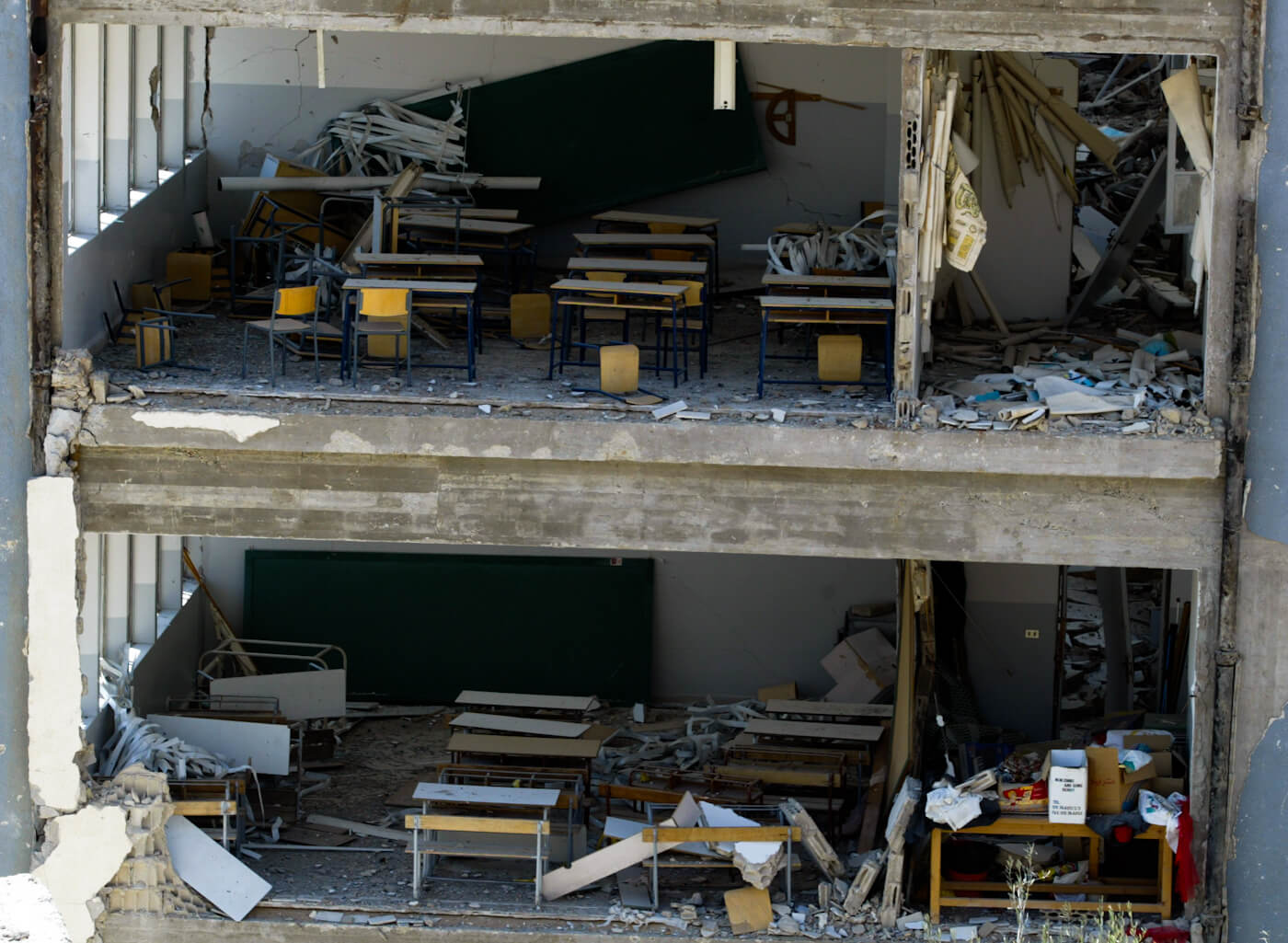
A school building destroyed by Israeli bombs in the southern Lebanese town of Bint Jbeil, Aug. 27, 2006. Sergey Ponomarev | AP
Prominent Israeli politicians have also made the case for targeting Lebanese civilians in the coming war between Israel and Lebanon. For instance, Naftali Bennett, who until recently was Israel’s minister of education, told Haaretz in 2017 that civilians “must” be targeted the next time Israel and Lebanon go to war:
The Lebanese institutions, its infrastructure, airport, power stations, traffic junctions, Lebanese Army bases –- they should all be legitimate targets if a war breaks out… This will mean sending Lebanon back to the Middle Ages.”
Past impunity expands to cover new atrocities
Under existing international law, the bombing of residential buildings, hospitals and schools is a clear war crime, though this hasn’t stopped Israel’s government from bombing these same structures in Gaza with regularity in recent years. In addition, during the 2006 war between Israel and Lebanon, Israel’s military killed at least 1,109 civilians, injured over 4,000 and displaced an estimated 1 million according to figures compiled by Human Rights Watch. The staggering civilian death toll sparked condemnation from international human-rights groups.
Thus, Erdan’s recent comments suggest that Israel’s government, in a war against Lebanon it plans to instigate under the guise of “preventative” defense, is planning to commit war crimes on a much larger scale than what was done in 2006 and is thus pushing for international law to be changed to accommodate those plans. However, Israel has long been able to avoid accountability for war crimes, especially following the U.S. adoption of the “Negroponte doctrine” to protect Israel from criticism as well as any punitive action taken by the U.N. Security Council in relation to war crimes committed by Israel.
This makes it more likely that this current push led by Erdan to alter international law is aimed more at global public opinion, by redefining international law so that Israel could avoid being accused of war crimes for such attacks on civilians and civilian infrastructure in a future war.
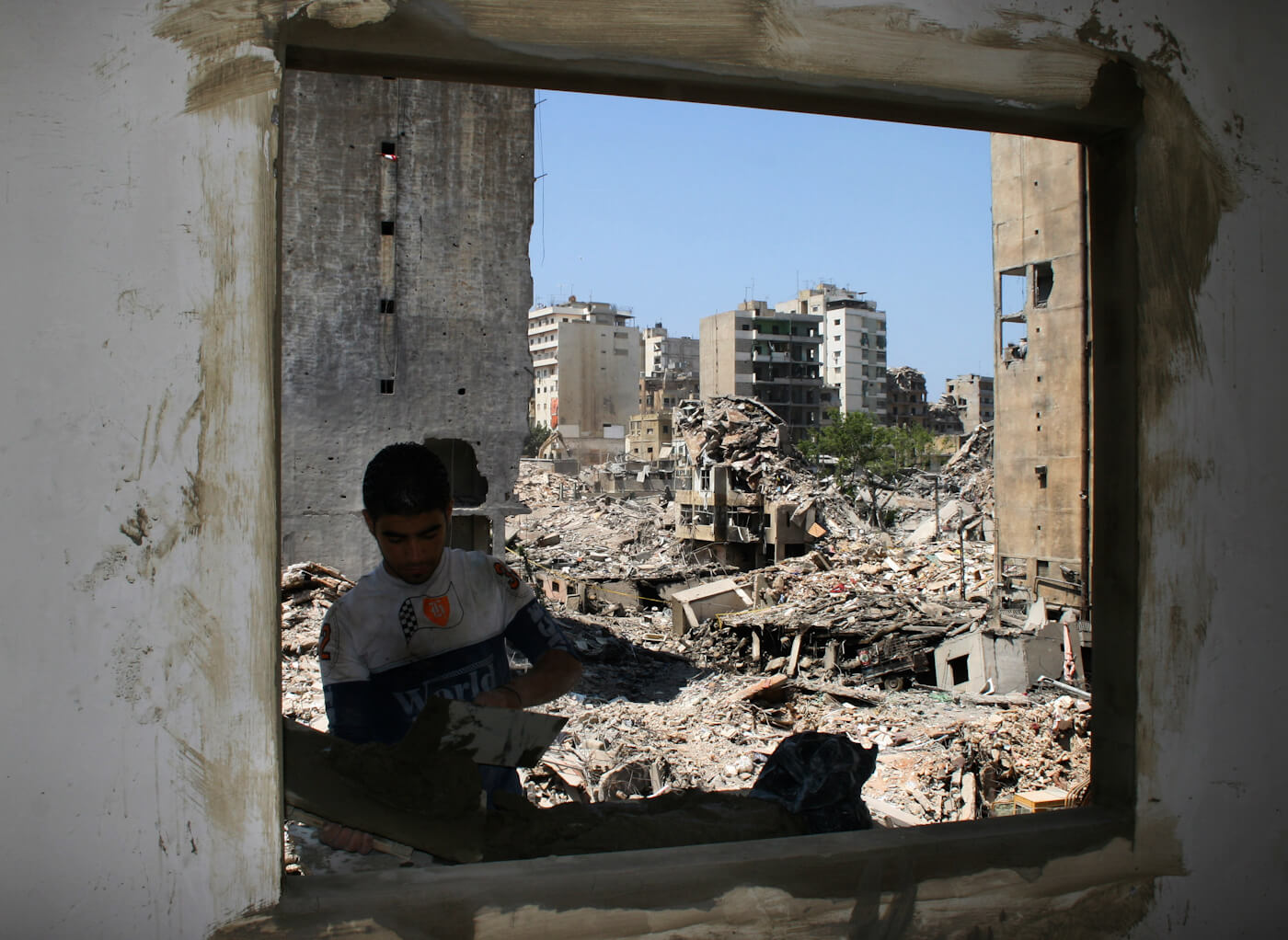
A man repairs a home, in the background buildings destroyed by Israeli airstrikes in the southern suburbs of Beirut, Lebanon, Aug. 27, 2006. Photo | AP
Part of the strategy in targeting Lebanese civilians specifically appears to be Israel’s strong desire to win a “decisive victory” against Hezbollah in this future war, as opposed to the humiliating defeat its military suffered in 2006. It appears that key figures in Israel’s government believe that the grand scale of planned attacks on Lebanese civilians and civilian infrastructure will result in so much destruction and death that it will help to ensure an Israeli victory.
Though it is unlikely Israel’s effort will succeed in changing international law, it may change how its government interprets such laws — as Darshan-Leitner recently suggested — and use such interpretations to secure even more robust diplomatic cover from its more influential allies such as the United States and to more easily avoid the war crime label from international media outlets and foreign governments. Such a move may also prompt the Trump administration in the U.S. to do the same, particularly given the slew of recent pardons given to accused and convicted U.S. war criminals by President Donald Trump.
US troops “prepared to die for the Jewish state”
In addition, the U.S. military itself is likely to quickly become embroiled in this coming Israel-Lebanon war, given that head of U.S. Central Command (CentCom), Lt. Gen. Richard Clark, told the Jerusalem Post last year that IDF leadership (as opposed to American military leadership) would “probably” have the last word as to whether U.S. forces would join the IDF during a future war and that U.S. troops were “prepared to die for the Jewish state.” IDF Brigadier General Zvika Haimovitch responded to Clark’s comments by stating: “I am sure once the order comes we will find here U.S. troops on the ground to be part of our deployment and team to defend the state of Israel.”
While much media attention has focused on the possibility of an imminent U.S. war with Iran, it is important to point out — especially in light of Israel’s comments — that Israel has been planning for over a year to go to war with Lebanon. Indeed, last year, Israeli officials told U.S. Senators Lindsey Graham and Chris Coons (D-DE) that “Southern Lebanon is where the next war is coming.”
Yet, the push for war with Iran and the planned war against Lebanon may be related, given that Hezbollah’s Secretary-General Sayyed Hassan Nasrallah stated the following late last month:
Any attack on Iran will not remain confined to Iran’s borders. The entire region will burn, leading to all U.S. forces and interests in the region being annihilated.”
Whitney Webb is a MintPress News journalist based in Chile. She has contributed to several independent media outlets including Global Research, EcoWatch, the Ron Paul Institute and 21st Century Wire, among others. She has made several radio and television appearances and is the 2019 winner of the Serena Shim Award for Uncompromised Integrity in Journalism
Democratic candidates on Israel/Palestine
By Kathryn Shihadah – If Americans Knew – June 27, 2019
Overwhelmed by the crowd of candidates for President? The issue of justice for Palestinians – in which almost everyone bows to the Israel lobby – is the ultimate litmus test for integrity. Find out where everyone stands. (This guide will be updated often.)
Keep in mind that since Palestinians in Gaza began weekly unarmed demonstrations for their internationally recognized rights on March 30, 2018 through March 22, 2019, Israeli forces killed over 271 demonstrators and injured 29,187 Gazans (6,000 of them children). During that time 2 Israelis were killed and 56 injured. A Timeline of Palestinian and Israeli deaths is here
Democratic Candidates 1-24
1. Michael Bennet (D)
(New York Times interview question, Do you think Israel meets international standards of human rights? 6/19/19) Yes. I’ve said this before and I believe it: Israel is the one essential country on the planet. I say that because of my family’s history during the Holocaust, and that doesn’t mean Israel’s perfect. Where we have disagreements, we should be able to articulate those disagreements, and I do articulate the disagreements I’ve had with Benjamin Netanyahu over the years.
(Twitter 5/6/19) “We stand behind Israel’s right to self-defense against rocket attacks by terror groups inside Gaza,” he said on Twitter. “Launching rocket attacks against innocent civilians is unacceptable and we mourn the lives lost. A cessation in violence is a necessary step toward de-escalation and stability.”
2. Joe Biden(D)
(Remarks at Saban Forum, 12/7/14)“Send a message to Bibi. I love him.” Even if he drives me crazy, Biden said. The love message came in 2014 a few months after the Gaza slaughter, in which Israel killed 500 children.
(Remarks at Yeshiva Beth Yehuda 75th Anniversary Dinner 11/15/11) About 18, 20 years ago, I was speaking to the Zionist Organization of Baltimore. And I said, I am a Zionist, for I learned you do not have to be a Jew to be a Zionist…[I]t was no surprise to my friends when I was elected to the Senate in a state less than 1 percent of the Jewish — less than 1 percent of the population is Jewish, that I got so deeply involved early on in the Senate with the business of Israel.
(Remarks at AIPAC Policy Conference 3/4/13) We opposed the unilateral efforts of the Palestinian Authority to circumvent direct negotiations by pushing for statehood and multilateral organizations like UNESCO. We stood strongly with Israel in its right to defend itself after the Goldstone ReportGaza flotillain 2010, [I spent a lot of time] going to the United Nations directly by telephone, speaking with the Secretary General, making sure that one thing was made clear, Israel had the right — had the right — to impose that blockade.
3. Bill de Blasio (D)
(New York Times interview question, Do you think Israel meets international standards of human rights? 6/19/19) I believe in the state of Israel…the one true democracy in the Middle East, and they do respect the rights of all people. There’s always more work to be done…it begins with a strong commitment to Israel…I’ve been to Israel 4 times, I’ve spent a lot of time seeing the threats that Israel faces. I firmly believe that we have to defend the state of Israel, and we have to fight against the movements that would undercut Israel, like BDS…The current administration has made a lot of mistakes that have hindered the peace process…
(Remarks at Hampton Synagogue in Westhampton Beach, 8/20/16) I think [BDS – Boycott, Divest, and Sanction is] one of the most ahistorical things I’ve ever seen…Defending Israel is a matter — from my point of view as a progressive — is a matter of being consistent with progressive values.
(Remarks at AIPAC Policy Conference, 3/25/19) As a progressive, here’s what I see when I’m in Israel. I see a multi-racial democracy. I see universal healthcare, free college, a strong labor movement. You’ve often heard it said that Israel’s America’s closest ally in the Middle East and a great center of innovation, and although that is true, I’m moved by something more than that. Israel at its core is there to shelter an oppressed people. That is why I am here to make a simple, clear, progressive case for the state of Israel. So here’s a straightforward definition for you. Progressives fight oppression. Progressives shelter those in danger. We embrace inclusion. We fight against exclusion.
4. Cory Booker (D)
(New York Times interview question, Do you think Israel meets international standards of human rights? 6/19/19) We have a problem right now in America with the way we are debating issues surrounding Israel and Israel’s security…My commitment right now is affirming Israel’s right to exist and affirming Israel’s right to defend itself against enemies which they have virtually surrounding them, but also to affirm the dignity and self-determination of the Palestinian people.
(Senate floor speech 11/29/18) Mr. President, today I wish to add myself as a cosponsor of S. 720, the Israel Anti-Boycott Act, and urge my colleagues to support this important legislation in its modified form. I have long and staunchly opposed the BDS movement and associated efforts to unfairly isolate Israel in international forums.
[Secretly recorded meeting with New Jersey AIPAC members 3/26/19) Israel is not political to me. It’s not political. I was a supporter of Israel well before I was a United State Senator. I was coming to AIPAC conferences well before I knew that one day I would be a federal officer. If I forget thee, o Israel, may I cut off my right hand. [Applause]
[Booker assured a questioner he’s always been for more money to Israel:] Unequivocally 100 percent absolutely [yes] to the 3.3 billion [a year]. I have been on the front lines every time an MOU is up to make sure Israel gets the funding it needs. I even pushed for more funding.
5. Steve Bullock (D)
(New York Times interview question, Do you think Israel meets international standards of human rights? 6/19/19) I think that Israel’s a trusted partner, a trusted friend to our country, and will continue to. I think that there have been certainly in the territories there have been challenges with decisions that currently Netanyahu has made…we could get things back on track, work with our allies, and get to a 2-state solution.
(Signatory of Governors Against BDS, an initiative of the American Jewish Committee, 12/17/17, which reads in part:) We, the undersigned Governors, reject efforts to demonize and delegitimize Israel—America’s democratic ally in the Middle East— through the boycott, divestment and sanctions (BDS) movement. The goals of the BDS movement are antithetical to our values and the values of our respective states…They malign a trusted ally that, while forced to defend itself against repeated and ongoing attempts to annihilate it, has consistently extended its hand in peace to its Palestinian neighbors and to states across the Middle East and around the world. Significantly, the BDS movement would also undermine peacemaking by suggesting that economic and political pressure on Israel can replace real negotiation…
6. Pete Buttigieg (D)
(Comment on American Jewish Committee podcast after returning from an AJC Mayors’ trip to Israel – recorded 4 days after 60 mostly unarmed Palestinians were killed by Israeli sharpshooters, 5/18/18) “Seeing the way that a country can be on the one hand very intentional, very serious, and very effective when it comes to security and on the other hand not allowing concerns about security to dominate your consciousness,” he said, “I think that’s a very important lesson that hopefully Americans can look to when we think about how to navigate a world that unfortunately has become smaller and more dangerous for all of us.”
(Remark in speech at Indiana University, 6/11/19) “If Prime Minister Netanyahu makes good on his threat to annex West Bank settlements, he should know that a President Buttigieg would take steps to ensure that American taxpayers won’t help foot the bill,”
(New York Times interview question, Do you think Israel meets international standards of human rights? 6/19/19) Israel’s human rights record is problematic and moving in the wrong direction under the current rightwing government…I’m very worried, especially with some of the latest talk about annexation of the West Bank, that their government is moving away from peace…
7. Julián Castro (D)
(New York Times interview question, Do you think Israel meets international standards of human rights? 6/19/19) I believe that Israel, like a lot of countries, wants to do the right thing, that they can get better. I do believe that we need to recognize and respect the human rights of Palestinians…Israel has to choose: it’s going to be a Jewish state or a democratic state…I recognize that [a 2-state solution] has been made harder over the years through the increase in settlements…
(Remark at Castro’s Conversations About America’s Future, Austin TX, 3/10/19) Support Israel, remain strong allies, but recognize the value of Palestinians and that they should be treated in a way that we can support on behalf of the country.
(Tweet 4/8/19) In abandoning our position as a good faith partner in the Middle East peace process, the Trump admin has enabled reckless actions like [West Bank annexation] from Netanyahu. US support for a two-state solution is on the line in November 2020.
8. John Delaney (D)
(New York Times interview question, Do you think Israel meets international standards of human rights? 6/19/19) I think Israel does meet international standards of human rights. I think Israel’s in a very difficult situation, when they’re surrounded by countries who are effectively threatening their existence, and don’t believe they have a right to exist. So I think that puts them in an exceedingly difficult situation in many respects. It’s always in the best interest of Israel to make sure their response to people who are threatening them is as measured and appropriate as possible.
(Remark before a trip to Israel as a candidate for Congress, 7/27/12. The visit included holy sites, Israeli officials and business leaders) After speaking with community leaders, faith leaders, and voters, across the District during my campaign, I came to understand that visiting Israel was necessary to obtain a full and proper perspective on our relationship with our strongest ally in the Middle East. I felt that it was vital to gain a first-hand understanding of the issues. Israel is a force for greater democracy and stability in the Middle East, and we must support its right to exist in peace and security…As a member of Congress, I will work to ensure that the US-Israel partnership remains strong” said Delaney.
9. Tulsi Gabbard (D)
(New York Times interview question, Do you think Israel meets international standards of human rights? 6/19/19) I think that there are some challenges with Israel that need to be addressed. I think that ongoing issues that we continue to see in the conflict between Israel and Palestine are complicated, but there needs to be progress made, ultimately to make sure that both the Israeli people and the Palestinian people are able to live in peace and security.
(Tweet following Gaza protest on 5/14/19, in which 60 mostly unarmed Palestinians were killed by Israeli sharpshooters) Israel needs to stop using live ammunition in its response to unarmed protesters in Gaza. It has resulted in over 50 dead and thousands seriously wounded.
(Statement after declining to condemn UN Security Council resolution critical of Israeli settlements, 1/3/17) I know how important our enduring alliance with Israel is,” she wrote. “My vote upholds my commitment to maintaining and strengthening this alliance, as well as my long-held position that the most viable path to peace between Israel and Palestine can be found through both sides negotiating a two-state solution. While I remain concerned about aspects of the UN resolution, I share the Obama administration’s reservation about the harmful impact Israeli settlement activity has on the prospects for peace.”
10. Kirsten Gillibrand (D)
(Statement released after more than 200 rockets were fired into Israel from the Gaza Strip, which were in retaliation for Israel’s breaking a ceasefire and killing 14 Palestinians in one night, 11/12/18)The escalation in violence on the Israel-Gaza border is deeply disturbing, and I am relieved that Israel’s missile defense programs were able to avert civilian fatalities from this disgraceful terror attack. I urge calm so the situation does not further escalate, and I still remain hopeful for a long-term, peaceful solution to this tragic conflict. But the only way we will accomplish that is through negotiations that create conditions for safety and economic security — not through rocket attacks or any other acts of terrorism.
(Statement, 1/11/16) Last week, I led a trip with seven of my Senate colleagues to meet with top government officials and military leaders about security concerns in Israel and our other partners in the Middle East. We heard from Israel’s leaders about the constant threat of terrorism they face, and we reaffirmed to them our commitment to supporting and protecting our closest ally and the only democracy in the Middle East.
11. Mike Gravel (D)
(In a piece for Mondoweiss, 6/19/19) [T]he two-state solution is dead, and we have killed it. The signs of its expiration are all around us. More than half a million Israeli settlers live (illegally) in Palestinian territory, and it would be politically, and logistically, impossible for them to be removed peacefully. The increasingly entrenched Israeli hard right—led by toxic figures like Ayelet Shaked and Naftali Bennett—openly advocates annexing “Area C,” which constitutes most of the West Bank…It is also apparent that a two-state solution would likely not be worth the bloodshed and chaos it would cause. So why keep up the charade?
The most obvious and humane path forward is the creation of a secular, democratic, binational state with equal rights for all. That is the model the U.S. government, with its partners in the region, should work toward and publicly highlight as the ideal outcome. This, like any real solution, would disappoint many, both those who want an official Palestinian national homeland and those who want an official Jewish homeland. But this is necessary.
Of course, the sheer power of the Israel lobby in the United States is the main hurdle to such a radical departure from traditional blind support for Israel. Thus the Israel lobby should be restricted; it is time to free American policy from the shackles of AIPAC (American Israel Public Affairs Committee), ZOA (Zionist Organization of America), and other groups…The first step should be mandating that AIPAC register as a foreign lobby under the Foreign Agents Registration Act (FARA).
Next, the U.S. should end military aid to Israel, citing the Israeli military’s complicity in crimes against the Palestinian people. It should call for a gradual demilitarization of Israel and Palestine, and should be clear with the Israeli government that the days of Israel-right-or-wrong are over.
And the U.S. should refuse to take unconstitutional steps to stifle BDS.
It’s time for a mature relationship with Israel, free of the cloying sentimentalities and tired banalities (“Israel is the only democracy in the Middle East”) that infest our political discourse surrounding it. America’s wanton indulgence of the whims of Benjamin Netanyahu and his fellow rightists will only redound to the harm of Israelis and Palestinians years down the line.
12. Kamala Harris (D)
(Statement 1/1/16)The people of the Middle East need a durable peace, and one that protects Israel’s security and interests. In the U.S. Senate, Kamala will be a staunch supporter of Israel.
(1/11/19) So having grown up in the Bay Area, I fondly remember those Jewish national fund boxes that we would use to collect donations to plant trees for Israel,” she said at the American Israel Public Affairs Committee in 2017. “Years later when I visited Israel for the first time, I saw the fruits of that effort and the Israeli ingenuity that has truly made a desert bloom.”
(New York Times interview question, Do you think Israel meets international standards of human rights? 6/19/19) Overall, yes. I think Israel as a country is dedicated to being a democracy and is one of our closest friends in that region, and that we should understand the shared values and priorities that we have as a democracy, and conduct foreign policy in a way that is consistent with understanding the alignment between the American people and the people of Israel.
13. John Hickenlooper (D)
(Comment after flareup in border violence, 5/7/19) The random rocket fire by Hamas into Israel must stop. My heart goes out to the families of the Israelis killed, and those wounded in these grievous attacks. I call on all parties to show restraint and de-escalate this situation immediately.
(New York Times interview question, Do you think Israel meets international standards of human rights? 6/19/19) Again, there are instances when you can find in almost every country places where there is disagreement for how they treat people or how they resolve internal conflicts. I continue to look at Israel as one of our strongest allies, they have been partners with the United States for a long time. Our challenge is to build on that foundation and help them be able to move towards that two-state solution that, which again, I think almost every Israeli believes is the ultimate goal.
(Interview with Jewish Insider, 6/25/19) We don’t always approve of the decisions of [the] Israeli government but most of us recognize Israel is ally of long standing, one of our strongest allies and even when someone criticizes certain activities of [the] Israeli government, it doesn’t mean we are in anyway diminishing our presence and long term support of the country.
14. Jay Inslee (D)
(New York Times interview question, Do you think Israel meets international standards of human rights? 6/19/19) I’m a longtime supporter of a democratic Israel, and I believe we have to have a two-state solution. And I would work with all parties to make sure we have that we have that; of justice for people in Palestine and democracy in Israel. And that depends on a two-state solution and I would work with everyone to achieve that. I think that all countries can improve in all respects. Certainly our ability to foster a future for the Palestinian people needs all of us to up our game. I do not believe that the present government of Israel has followed policies, and those policies can improve to encourage the ability and maintain the access of the future to a two-state solution, and we all need to be dedicated to that.
(Signatory of Governors Against BDS, an initiative of the American Jewish Committee, 12/17/17, which reads in part:) We, the undersigned Governors, reject efforts to demonize and delegitimize Israel—America’s democratic ally in the Middle East— through the boycott, divestment and sanctions (BDS) movement. The goals of the BDS movement are antithetical to our values and the values of our respective states…They malign a trusted ally that, while forced to defend itself against repeated and ongoing attempts to annihilate it, has consistently extended its hand in peace to its Palestinian neighbors and to states across the Middle East and around the world. Significantly, the BDS movement would also undermine peacemaking by suggesting that economic and political pressure on Israel can replace real negotiation…
15. Amy Klobuchar (D)
In February, The Times of Israel called Klobuchar “the candidate most closely aligned with AIPAC.”
New York Times interview question, Do you think Israel meets international standards of human rights? 6/19/19) Yes [Israel meets human rights standards]. I think Israel, however, under Prime Minister Netanyahu has been doing things that are not helpful to bringing peace to the Middle East. The way that he came out in favor of annexing the Golan Heights, what he has done when it comes to the settlements, the fact that we are not engaging in serious discussions for a two-state solution, our country and the Palestinians and the Israelis, I think that this is setting us back. And so what I would do is to reach out to restart those negotiations again. I think that President Trump has politicized this issue and has not helped in terms of American support for Israel. Israel is our beacon of democracy in the Mideast, and we have a role to play here that is very important and it shouldn’t be politicized the way the Trump administration has politicized it. And when Israel does things that I think are against public policy and international policy, I will call them out on it and I will work with them.
(Tweet following the announcement of Netanyahu’s rightwing coalition, which included radical racists, 2/27/19)This is wrong and has been rightly condemned. To quote the American Jewish Committee, ‘[The views of Otzma Yehudit] do not reflect the core values that are the very foundation of the State of Israel.
16. Wayne Messam (D)
(After returning from an independent trip to the Middle East, 4/8/19) I just recently returned from an independent fact-finding mission to Jerusalem, Ramallah, Hebron, and Tel-Aviv, meeting with top leaders from both sides of the Israeli-Palestinian conflict. I met with the Israeli Ministry of Foreign Affairs, the Deputy Speaker of the Knesset, a mayor of one of the largest settlements, and the executive director of B’Tselem – a leading human rights organization. I also met with the top negotiator on the Palestinian side who negotiated the Oslo Accords and the first woman elected to the Palestinian National Council…Over and over again, Israeli and Palestinian leaders made clear to me their desire to negotiate directly for peace. And it’s not just high-profile figures like the Deputy Speaker of the Knesset or the top negotiator for the PLO. It’s also the everyday Israeli and Palestinians – the people I met in Ramallah, Jerusalem and Tel Aviv – who quietly shared their hopes for a two-state resolution and fears of what would happen if the region were to disintegrate into an all-out religious war.
There was the Israeli cab driver, so overcome with emotion that he had to pull over, swearing his love for his Palestinian neighbors and describing how their families care for each other. Then there was the Palestinian shopkeeper, who despite living under harsh conditions in the occupied territories, displayed both compassion and understanding towards Israelis. Regular people are suffering and deserve American leadership, not misguided ideology and partisan talking points. The actions of the United States in resolving this conflict should not just reflect the interests of a small minority of right-wing, ideological voices.
We are not truly secure when our long-time friend and dear ally, Israel, feels threatened to the point of occupying and securing land as a permanent solution, instead of peace. We are not secure when the Palestinians – have been fully disenfranchised, undermining effective diplomacy, yet this is what happens when a real estate developer leads an insular negotiations process that prioritizes right-wing voices over all others…We are not secure when 53 percent of Palestinians live in poverty, including over 400,000 children.
17. Seth Moulton (D)
(New York Times interview question, Do you think Israel meets international standards of human rights? 6/19/19) Israel often does but not always [meet international standards of human rights]. And it’s incumbent on us as an ally to hold them accountable. And I have done that in Congress. I have signed legislation that is sometimes controversial, to say that we will not supply Israel with weapons and goods if they do not uphold standards for the treatment of Palestinian kids in prison for example. Now it’s not that hard for them to do this, and Israel is our most important ally in the Middle East. Now they’re a democracy that we have sworn to protect and we should. But we also have to hold our friends and allies to the same standards that we should uphold ourselves.
(Remark on HR4391, No Way To Treat A Child, 5/27/19) For decades, the Israeli-Palestinian conflict has endured despite efforts by leaders within the region and throughout the world to find peace…Despite the challenges, I still believe peace is achievable if parties recommit to negotiations towards a two-state solution that allows both nations to safely live side-by-side.
H.R. 4391 would express a Sense of Congress that any abusive or unnecessarily harsh conditions or treatment of Palestinian children during their detention by the Israeli military is a violation of international law and counter to U.S. and international human rights standards.
H.R. 4391 also prohibits the use of U.S. funds to support any abusive or inhumane detention of children…A 2013 UNICEF report showed that Israeli forces arrest, interrogate, and detain approximately 700 Palestinian children a year. While experiences vary, the Israeli military has been documented subjecting children to harsh and sometimes abusive interrogation methods, without an attorney present, that often include forced confessions signed in Hebrew. America should not support these undemocratic practices. That is why I support H.R. 4391, and I believe it will contribute towards a peaceful resolution to this complex conflict and a lasting two-state solution.
18. Beto O’Rourke (D)
(Explaining why he voted against a House resolution to refute U.N. Security Council Resolution 2334, condemning illegal Israeli settlements, 1/5/17) We should be aware of the fact that the U.N. is dangerously preoccupied with Israel…That is of great concern to me—as are other manifestations of this bias, including the Boycott Divest and Sanction (BDS) movement. There is not enough pressure applied to the Palestinian Authority and those who have leverage with its leadership to refrain from acts of terror, incitement to terror, and the cultural context (including in textbooks) that provides part of the moral underpinning for terror to thrive.
However, the settlement problem is putting at risk the very viability of the two-state solution. And I think that it is in our interest and in Israel’s interest for those settlements to cease if there is to be any hope for lasting peace; and that if settlement construction does not stop, a two-state solution will be unobtainable and Israel will lose the ability to be both a democratic and Jewish state.
19. Tim Ryan (D)
(New York Times interview question, Do you think Israel meets international standards of human rights? 6/19/19) You know I think it’s a very complicated relationship that Israel obviously has with Hamas and dealings with the Gaza Strip and the West Bank. And I think the United States needs to play a much bigger role in trying to resolve that problem. I think the president has been very disengaged and we need to be a neutral broker, but recognizing the importance of Israel and the relationship we have with them for all of the other relationships we have in that region. Well, I think they could do a better job, and I think we all need to participate in the discussion. The United States needs to maintain in some its ability to broker these peace agreements. The problem today is we are not even really trying.
(After traveling to Israel as part of a House Defense Appropriations Subcommittee delegation, 3/30/16) I was honored to have the opportunity to meet with Prime Minister Benjamin Netanyahu to discuss and reaffirm the important strategic relationship between our two nations. I remain committed to using my position on the House Appropriations Defense Subcommittee to strengthen partnerships with our allies around the globe, including our most steadfast ally in the Middle East, Israel. Touring the Iron Dome battery further emphasized the importance of this relationship, the need for increased collaboration moving forward, and the value of close friends in the region.
20. Joe Sestak (D)
(Interview with Philadelphia Jewish Exponent, 5/19/10) I strongly support Israel’s security, having visited Israel more than half a dozen times during my naval career. I believe that Israel serves as a vital ally to the United States and that the unique U.S.-Israeli friendship must be preserved and strengthened for generations to come. It is also my firm belief that the successful negotiation of a two-state solution will advance Israel’s security in the region.
The settlements dispute [details here] should not have occurred between the United States and Israel, two stalwart allies. The way it was handled by both nations has not helped bring about a positive engagement. The United States must keep in mind that if Israel does not feel secure, then it is less willing to take risks for peace, and we must continue to ensure that Israel’s security in the region is our No. 1 goal.
Sestak, a retired Navy admiral and 2-term Democratic Pennsylvania congressman, criticized Israel’s blockade of Gaza. He then ran in a Senatorial primary bid against Arlen Specter, the Israel partisan who had just switched from Republican to Democrat. The Dem establishment, including Obama, backed Specter, but Sestak won the primary. Conservative pro-Israel groups spent millions targeting Sestak, who then narrowly lost the general election to Republican Pat Toomey…
(2/24/08) I am proud to have visited Israel at least five times and to have seen firsthand the courage and steadfast resolve of its people. Throughout Israel’s nearly 60-year history, Israelis have fought overwhelming odds to reestablish the birthplace of the Jewish People, and today it remains the only democracy in the Middle East. Surrounded by challenges on all sides, Israel is steadfastly working towards its goals of peace and security.
21. Eric Swalwell (D)
(New York Times interview question, Do you think Israel meets international standards of human rights? 6/19/19) Israel is a country that needs to work with the Palestinian people to find a two-state solution. I support putting the US back into the UN Commission on Human Rights. I support increasing aid to the Palestinian people. And I’m going to fire Jared Kushner on day one, because he has no business being on the job of seeking a two-state solution or finding peace in the Middle East. It requires serious scholars and a serious leader committed to making it happen. That’s what I’m going to do on day one.
I would like to see Israel not conduct any further settlements into the West Bank. I don’t oppose any geographical changes in either region, Israel and the Palestinian area, until we have a two-state solution. So I would press both sides; for the Palestinians to sort out who speaks for them, whether it is the PA or Hamas, and for the Israelis to negotiate and have a partner on the other side to seek that two-state solution. But I’m more interested in the future, I’m not going to go back into the past, because the future depends on a stable and secure Middle East.
22. Elizabeth Warren (D)
(New York Times interview question, Do you think Israel meets international standards of human rights? 6/19/19) I think that Israel is in a really tough neighborhood. I understand that. They face enormous challenges, and they are our strong ally. We need a liberal democracy in that region and to work with that liberal democracy. But it is also the case that we need to encourage our ally, the way we would any good friend, to come to the table with the Palestinians and to work toward a permanent solution. I strongly support the two-state solution, and I believe that a good friend says to the Palestinians and to the Israelis: come to the table and negotiate. The United States cannot dictate the terms of a long-term settlement for the Palestinians and the Israelis, but what it can do is urge both of them to go there and to stay out of the way — to let them negotiate the pieces that are most important to them for a lasting peace.
(Remark after 2nd week of Great March of Return, 4/12/18. Over 30 mostly unarmed Palestinians had been killed by Israeli sharpshooters.) I am deeply concerned about the deaths and injuries in Gaza. As additional protests are planned for the coming days, the Israel Defense Forces should exercise restraint and respect the rights of Palestinians to peacefully protest.
(Letter from Warren and 9 other Senators to PM Netanyahu, 11/29/17) We write today to urge your government not to demolish the Palestinian village of Susiya and the Bedouin community of Khan al-Ahmar. The displacement of entire communities would be an irreversible step away from a 2-state solution, and we urge your government to abandon its efforts to destroy these villages.
(Also read this – Warren voted $225 million to Israel while it was in the midst of its 2014 invasion of Gaza. This year she cosponsored legislation to give Israel $38 billion.)
23. Marianne Williamson (D)
(New York Times interview question, Do you think Israel meets international standards of human rights? 6/19/19) I think there are many countries including the Untied States that behaves in ways that don’t always meet international standards of human rights. As president of the United States I would have an equally robust commitment to both the legitimate security concerns of Israel and the human rights of the Palestinians and the economic hopes and opportunities and dignity of the Palestinian people.
(Remarks during CNN interview, 4/14/19) With me as president, they will know that they have in the United States a president who listens deeply and totally hears; the leaders of the Palestinian authority will know I listen very deeply. In me, you would have a president who says those settlements are illegal. I would rescind the president’s affirmation of sovereignty of Israel over the Golan Heights…[My] love for Israel is second only to my love for the United States…The alliance of the United States with Israel is extremely important. It should be extremely important to all of us. If I’m president of the United States, the world will know, our greatest ally is humanity itself.
24. Andrew Yang (D)
(New York Times interview question, Do you think Israel meets international standards of human rights? 6/19/19) Israel is a very very important ally of the US. Certainly, some of the actions that are being taken there are deeply problematic and run afoul of some of the standards we’d like to see countries meet. I’d hesitant to say they are in violation of those standards.
… and one lone Independent
Bernie Sanders (I)
The killing of Palestinian demonstrators by Israeli forces in Gaza is tragic. It is the right of all people to protest for a better future without a violent response. I’m extremely concerned by reports that President Trump plans to recognize Jerusalem as the capital of the state of Israel. There’s a reason why all past U.S. administrations have avoided making this move, and why leaders from all over the world, including a group of former Israeli ambassadors, have warned Trump against doing it: It would dramatically undermine the prospects for an Israeli-Palestinian peace agreement, and severely, perhaps irreparably, damage the United States’ ability to broker that peace. What the U.S. should be doing now is bringing adversaries in the Middle East together to seek common solutions, not exacerbating tensions in this highly volatile region.
Israel is not, cannot, just simply expand when it wants to expand with new settlements. I think if the expansion was illegal, moving into territory that was not their territory, I think withdrawal from those territories is appropriate. I happen to think that those expansions were illegal.
I think most international observers would say that the attacks against Gaza were indiscriminate and that a lot of innocent people were killed who should not have been killed. Look, we are living, for better or worse, in a world of high technology, whether it’s drones out there that could, you know, take your nose off, and Israel has that technology. And I think there is a general belief that, with that technology, they could have been more discriminate in terms of taking out weapons that were threatening them.
(3/21/16) To my mind, as friends — long term friends with Israel — we are obligated to speak the truth as we see it. That is what real friendship demands, especially in difficult times…But it is important among friends to be honest and truthful about differences that we may have…I am here to tell the American people that, if elected president, I will work tirelessly to advance the cause of peace as a partner and as a friend to Israel. But to be successful, we have also got to be a friend not only to Israel, but to the Palestinian people, where in Gaza unemployment today is 44 percent and we have there a poverty rate which is almost as high. So when we talk about Israel and Palestinian areas, it is important to understand that today there is a whole lot of suffering among Palestinians and that cannot be ignored. You can’t have good policy that results in peace if you ignore one side.
(5/06/17) If a two-state solution fails, Takruri asked Sanders, would he support “one-state with equal rights for Israelis and Palestinians alike, and equal citizenship?” “No, I don’t,” he said. “I mean, I think if that happens, then that would be the end of the state of Israel, and I support Israel’s right to exist.”
Sanders has gone back and forth on Palestine. Unless his progressive base pushes him, he may continue to straddle the fence.
Kathryn Shihadah is staff writer for If Americans Knew. She blogs at Palestine Home.
RELATED READING:
WATCH: Elizabeth Warren supports Israel during its 2014 invasion of Gaza
JTA: Klobuchar’s meeting with Jewish Dem funders, Dear Abby grandson
Joe Sestak, early Democratic critic of Israel, announces presidential run
Presidential candidate offers a bold plan for Israel/Palestine
Tulsi Gabbard Pushes No War Agenda – and the Media Is out to Kill Her Chances
WATCH: Candidates pledge support for Israel in AJC Global Forum videos
Monsters Walk the Earth. Why These Three Countries Are the Real Troika of Evil
By Philip Giraldi | Strategic Culture Foundation | June 27, 2019
There are monsters among us. Every day I read about an American “plan” to either invade some place new or to otherwise inflict pain to convince a “non-compliant” foreign government how to behave. Last week it was Iran but next week it could just as easily again be Lebanon, Syria or Venezuela. Or even Russia or China, both of whom are seen as “threats” even though American soldiers, sailors and marines sit on their borders and not vice versa. The United States is perhaps unique in the history of the world in that it sees threats everywhere even though it is not, in fact, threatened by anyone.
Just as often, one learns about a new atrocity by Israelis inflicted on the defenseless Arabs just because they have the power to do so. Last Friday in Gaza the Israeli army shot and killed four unarmed demonstrators and injured 300 more while the Jewish state’s police invaded a Palestinian orphanage school in occupied Jerusalem and shut it down because the students were celebrating a “Yes to peace, no to war” poetry festival. Peace is not in the Israeli authorized curriculum.
And then there are the Saudis, publicly chopping the heads off of 37 “dissidents” in a mass display of barbarity, and also murdering and dismembering a hapless journalist. And let’s not forget the bombing and deliberate starving of hundreds of thousands innocent civilians in Yemen.
It is truly a troika of evil, an expression favored by US National Security Advisor John Bolton, though he was applying it to Cuba, Venezuela and Nicaragua, all “socialist” nations currently on Washington’s “hit list.” Americans, Saudis and Israelis have become monsters in the eyes of the rest of the world even if in their own minds they are endowed with special privilege due to their being “Exceptional,” “Chosen by God” or “Guardians of Mecca and Medina.” All three countries share a dishonest sense of entitlement that supports the fiction that their oppressive and often illegal behavior is somehow perfectly legitimate.
To be sure not all Americans, Saudis or Israelis are individually monsters. Many are decent people who are appalled by what their respective governments are doing. Saudi citizens live under a despotism and have little to say about their government, but there is a formidable though fragmented peace movement in slightly less totalitarian Israel and in the United States there is growing anti-war sentiment. The discomfort in America is driven by a sense that the post 9/11 conflicts have only embroiled the country more deeply in wars that have no exit and no end. Unfortunately, the peace movement in Israel will never have any real power while the anti-war activists in America are leaderless and disorganized, waiting for someone to step up and take charge.
The current foreign policy debate centers around what Washington’s next moves in the Middle East might be. The decision-making will inevitably involve the US and its “close allies” Israel and Saudi Arabia, which should not surprise anyone. While it is clear that President Donald Trump ordered an attack on Iran before canceling the action at the last minute, exactly how that played out continues to be unclear. One theory, promoted by the president himself, is that the attack would have been disproportionate, killing possibly hundreds of Iranian military personnel in exchange for one admittedly very expensive surveillance drone. Killing the Iranians would have guaranteed an immediate escalation by Iran, which has both the will and the capability to hit high value targets in and around the Persian Gulf region, a factor that may also have figured into the presidential calculus.
Trump’s cancelation of the attack immediately produced cries of rage from the usual neoconservative chickenhawk crowd in Washington as well as a more subdued reiteration of the Israeli and Saudi demands that Iran be punished, though both are also concerned that a massive Iranian retaliation would hit them hard. They are both hoping that Washington’s immensely powerful strategic armaments will succeed in knocking Iran out quickly and decisively, but they have also both learned not to completely trust the White House.
To assuage the beast, the president has initiated a package of “major” new sanctions on Iran which will no doubt hurt the Iranian people while not changing government decision making one iota. There has also been a leak of a story relating to US cyber-attacks on Iranian military and infrastructure targets, yet another attempt to act aggressive to mitigate the sounds being emitted by the neocon chorus.
To understand the stop-and-go behavior by Trump requires application of the Occam’s Razor principle, i.e. that the simplest explanation is most likely correct. For some odd reason, Donald Trump wants to be reelected president in 2020 in spite of the fact that he appears to be uncomfortable in office. A quick, successful war would enhance his chances for a second term, which is probably what Pompeo promised, but any military action that is not immediately decisive would hurt his prospects, quite possibly inflicting fatal damage. Trump apparently had an intercession by Fox news analyst Tucker Carlson, who may have explained that reality to him shortly before he decided to cancel the attack. Tucker is, for what it’s worth, a highly respected critic coming from the political right who is skeptical of wars of choice, democracy building and the global liberal order.
The truth is that all of American foreign policy during the upcoming year will be designed to pander to certain constituencies that will be crucial to the 2020 presidential election. One can bank on even more concessions being granted to Israel and its murderous thug prime minister Benjamin Netanyahu to bring in Jewish votes and, more importantly, money. John Bolton was already in Israel getting his marching orders from Netanyahu on the weekend and Pence was effusive in his praise of Israel when he spoke at the meeting in Orlando earlier in the week launching the Trump 2020 campaign, so the game is already afoot. It is an interesting process to observe how Jewish oligarchs like Sheldon Adelson contribute tens of millions of dollars to the politicians who then in turn give the Jewish state taxpayer generated tens of billions of dollars in return. Bribing corrupt politicians is one of the best investments that one can make in today’s America.
Trump will also go easy on Saudi Arabia because he wants to sell them billions of dollars’ worth of weapons which will make the key constituency of the Military Industrial Complex (MIC) happy. And he will continue to exert “maximum pressure” on Iran and Venezuela to show how tough he can be for his Make America Great audience, though avoiding war if he possibly can just in case any of the hapless victims tries to fight back and embarrass him.
So, there it is folks. War with Iran is for the moment on hold, but tune in again next week as the collective White House memory span runs to only three or four days. By next week we Americans might be at war with Mongolia.
Netanyahu boasts ‘100s of anti-Iran ops’ in Syria as Russia reminds to love thy neighbor’s security
RT | June 26, 2019
Israeli Prime Minister Benjamin Netanyahu made it clear that Israel will stop at nothing to protect itself against any perceived threats, as he boasted about Tel Aviv’s successful raids against alleged Iranian targets in the neighboring Syria.
“Israel has acted hundreds of times to prevent Iran from entrenching itself militarily in Syria,” he said, speaking ahead of a trilateral meeting between the Russian, American and Israeli national security advisers, who met in Jerusalem on Tuesday to discuss rising tensions in the Middle East and other urgent matters.
“We have acted hundreds of times to prevent Iran from delivering increasingly sophisticated weaponry to Hezbollah, or to form a second front in the north against us from the Golan Heights. Israel will continue to prevent Iran from using neighboring territory as platforms to attack us, and Israel will respond forcefully to any such attacks.”
Such belligerent statements did not sit well with the Russian Security Council Secretary Nikolai Patrushev, who called on the Israeli PM to respect the security of his neighbors as well, explaining that it was effectively the only way to ensure Israel’s own safety.
“We understand the concerns that Israel has and want those threats to be eliminated,” Patrushev said, explaining that Israel’s security is important for Moscow, but added that “one should also take the national interests of other regional nations into consideration.”
“If we do not … acknowledge and reckon with those interests, I doubt we can achieve any tangible result” in terms of regional security, the Russian Security Council secretary warned.
British Society for Middle Eastern Studies endorses boycott of Israeli universities
MEMO | June 25, 2019
The British Society for Middle Eastern Studies (BRISMES) has endorsed the Palestinian call for a boycott of Israeli academic institutions, in a vote taken at its AGM in Leeds on Monday.
According to reports on social media, the resolution supporting the Boycott, Divestment, Sanctions (BDS) campaign was easily passed, with almost 80 percent support (final numbers to be confirmed).
The resolution highlights Israel’s obstruction of “Palestinians’ right to education by destroying Palestinian universities and schools, arresting students, raiding and forcing Palestinian universities to close, and restricting Palestinians’ movement”.
The text goes on to describe the “key role” played by Israeli universities “in planning, implementing and justifying Israel’s illegal military occupation”, and claims such institutions “are maintaining a close and supportive relationship with the Israeli military”.
Examples of this relationship include “involvement in developing weapons systems, providing justification for military actions and extra-judicial killings, rewarding students serving in the occupation forces, designing and delivering special programmes for soldiers and officers, building on occupied land, and systematically discriminating against non-Jewish students”.
Proposed by Professor John Chalcraft (LSE) and seconded by Dr Rafeef Ziadah (SOAS), the resolution commits BRISMES to “endorsing the call for a boycott of Israeli academic institutions until these institutions publicly end their support and complicity in violating Palestinian rights as stipulated in international law”.
After the resolution passed, Dr Ziadah tweeted: “members of #BRISMES2019 passed a #BDS resolution @ annual general meeting earlier today. This was a real grassroots campaign, long time in the making. Congratulations to every single person who worked tirelessly to make this happen!”
Palestinian boycott campaigners welcomed the move, and urged other international academic societies to take “similar measures against racism and oppression”.
BRISMES was established in 1973 “to encourage and promote the study of the Middle East in the United Kingdom”, and brings together “teachers, researchers, students, diplomats, journalists and others who deal professionally with the Middle East”.
Will the Australian Government Join in a “Nuremberg Class” Attack on Iran?

U.S. Secretary of State Michael R. Pompeo welcomes Australian Foreign Minister Marise Payne to the U.S. Department of State in Washington, D.C., on January 30, 2019.
Credit: U.S. Department of State/ flickr
By David Macilwain | American Herald Tribune | June 24, 2019
As my father used to say in response to difficult questions – “ask no questions and you’ll be told no lies”. This seems to be the approach of Australia’s media organizations to our government’s extraordinary silence over events in the Gulf of Oman. Barring an anodyne statement condemning the attacks on civilian shipping, neither Australia’s foreign minister Marise Payne nor Prime Minister Scott Morrison has ventured an opinion on who might have been responsible for these provocative actions. This remains the case even when subsequent developments included a narrowly averted war with global repercussions, with no questions asked and no lies proffered.
In the aftermath of recent attacks on journalistic freedoms and intimidation of whistleblowers, many people have expressed the view that it is the job of journalists to hold governments and public servants to account. That the governments of both Australia and its parent Britain seek to avoid such scrutiny is clear from their actions. Draconian punishments now apply to those who are thought to “threaten national security” by revealing inconvenient truths.
So we might wonder whether the ABC’s failure to ask questions of Government ministers about the dangerous confrontation in the Persian Gulf is connected to these recent developments, which included a highly provocative police raid on the headquarters of the ABC. The ABC purports to be independent of Government, and is expected to interview ministers on behalf of the public when necessary, as well as seeking the view of shadow ministers from the opposition Labor party.
In those recent raids, which concerned an Australian equivalent of the “Collateral Murder” crime exposed by an insider in Australia’s Special Forces in Afghanistan and leaked to an ABC journalist two years ago, there was a widespread shock at the actions authorized under the police warrant. In examining the ABC’s files relating to the case, it was revealed that the recently expanded powers of police forensic officers included the deletion and alteration of computer files – though this was explained as limited to the removal of irrelevant material and identities. This could be true given that the need to rewrite history is now minimized thanks to current controls over access to information.
What was more shocking to some, however, was a widely expressed but ill-informed view from the “Murdoch Right” that the ABC raids were justified, as its actions had endangered national security. Similar views were expressed over the alleged crimes of Julian Assange, whether “narcissist” or “cyber-terrorist”, with little sympathy from fellow Australians for his persecution and torture by the UK regime.
Australian sentiment towards the Islamic Republic of Iran is similarly prejudiced, so persuading the public that Iran would have launched an attack on two tankers near the Straits of Hormuz on the basis of minimal evidence was never going to be difficult; a mere dog-whistle sufficed. What now seems worrying is that “Central Narrative Control” knew this in advance – that they could show a blurry video of Iranian forces rescuing a ship’s crew, while saying it showed them “removing a limpet mine”, and the US aligned media audience would believe that this was what they saw.
But how could people be fooled by this ridiculous story, presented with a video that didn’t stand the slightest scrutiny? Why anyway would Iran sabotage two ships as a direct provocation, while trying to make it look as though the US or its allies were responsible? This wouldn’t make any sense, as the US would have no motive for such an attack – other than to frame Iran for it as a pretext for what has now followed!
The corollary of this perverse provocation by the US or its local agents is that while an Iranian strike on the two tankers could have been understood as a response to newly imposed sanctions targeting Iran’s petrochemical industry, such an attack on civilian shipping by the US with the sole object of framing Iran would be an undoubted war crime. As in fact, it was – and we need to remember this as subsequent events and silence from the media relegate it to a later investigation, or the memory hole. (Iran has also registered a protest over the US accusations with the UN)
Those subsequent events, which we now discover have brought us to the point of a major military escalation, allow current news reports to state that “following the Iranian attack on two ships in the Gulf of Oman” – tensions on both sides are increasing; no longer is the ship attack “alleged”. Instead, a new “limpet mine” narrative has been created to reinforce the idea of the Iranian threat, and this, in turn, feeds into talk of new Uranium enrichment above the agreed levels in the JCPOA, despite this being an entirely legitimate Iranian response to the US’ failure to keep to the agreement. Contrary to the immediate wild accusations from the usual suspects that Iran is now “again” working on a nuclear bomb (it never was, since 2003 [if ever] ), the renewed enrichment remains only to the 3.7% base limit, as those nuclear-armed suspects know perfectly well.
The need to be reminded of these stages in the development of the false narrative that Iran is the aggressor is that the silence from both media and politicians has actually enabled it, simply by drawing on the prejudices of the population. It seems that only those who doubt or deny the US-led accusations against Iran have noticed the deafening silence of Australia’s leaders and the failure of the main media to ask them to show their hand. Is it possible that we could find ourselves supporting the real aggressors in a criminal attack on a peaceful and friendly nation – a classic case of “sleepwalking into war”?
Well, now it appears that this is the case. The ABC hasn’t thought to ask the foreign minister whether we agree with the US story, and whether we would support them in military action against Iran despite the lack of evidence, because there is already that assumption. Despite the early skepticism of US claims from some mainstream commentators, and parallels drawn with the proverbial Iraqi WMD fraud, those reservations appear to now be forgotten. With this comes the realization that my father’s riposte does not apply to our national broadcaster; it doesn’t fear being told lies but rather fears having to admit the obvious truth, which is that of course, we believe the US story, and will support any action that our alliance demands.
Such blindness to the truth, and blind submission to the whims of the world’s most dangerous state, was brought home by this quote from Sydney Morning Herald correspondent Michael Bachelard:
“Some have likened the escalating atmosphere to the feeling leading up to George Bush’s invasion of Iraq in 2003. So why are we suddenly using the “w” word in the Middle East again, and should Australia brace to be invited into another Coalition of the Willing?”
Bachelard presents – and perhaps believes – “Australia” to be a well-intentioned onlooker on the mixed-up politics of the Middle East, whose “contribution” would always be towards peace and security and resolution of conflict. It is a rosy-eyed view of Australia sadly prevalent amongst people whose own intentions are honorable – assuming that the leaders of our traditional allies and partner “democracies” share their honesty and integrity and benevolence. By contrast, these same people seem happy to assume the worst about our “enemies”; Bachelard’s inappropriate use of a photo of a smiling President Assad greeting Ayatollah Khamenei in Tehran in February in the above article nicely reflects this ingrained prejudice.
The reality of Australia’s role in Middle Eastern politics, on the battlefields of Syria, Iraq and Afghanistan and over Palestine and Israel is sadly very different. Despite a “modest contribution” to the Iraq invasion force, John Howard was George Bush’s closest ally, notably refusing to accept that Saddam Hussein had no WMD until around 2010. More recently the involvement of Australian fighter jets in the 2016 US coalition attack on the Syrian Army near Deir al Zour was symptomatic of Australia’s illegitimate presence in Syria, and complicity in NATO allies’ support for the insurgent forces. This intimate alignment with the US also saw Australia copying Trump’s “recognition” of Jerusalem as Israel’s capital, despite the damage this did to relations with our closest neighbor Indonesia.
In the light of this record, and the catalog of unasked questions and untold lies, we can only speculate on the Australian Government’s RSVP to America’s “invitation” to join in a “Nuremberg class” attack on Iran. With Foreign Minister Marise Payne’s record of meetings with both Pompeo and Bolton, and our shared bases and assets in the region, it seems likely such an invitation was a mere formality, likely preceding the first strikes on tankers in the Gulf of Oman.
And as with the story of the war crimes in Afghanistan, there won’t be any desire to rewrite the history of how the third Great War began, should the truth finally surface. That history has already been certified as true by the silence of “Australia’s most trusted news source” and recorded in the mind of the nation; no-one would now believe otherwise.
‘They tried hard, but failed’: Iran foiled all US attempts to carry out cyber-attacks
RT | June 24, 2019
Iran successfully prevented US cyber-attacks that targeted its infrastructure, the country’s information minister said after Washington was reported to have crippled Tehran’s missile control sites with a retaliatory cyber-strike.
Minister for Information and Communication Technology Mohammad Javad Azari-Jahromi appeared to deny reports in the US media that a massive cyber-offensive had disabled Iranian computer systems that control rocket and missile launches on Thursday.
Neither the Pentagon nor the White House commented on the reports, which claimed that the strike had been carried out by US Cyber Command in cooperation with US Central Command to avenge the downing of an unmanned US Navy drone by Iran on Thursday morning.
Stopping short of directly addressing rumors that the attack had taken place, Jahromi said that Iran has vast experience of thwarting these kind of assaults, having foiled some “33 million attacks with the [national] firewall, only within the last year.”
He specifically referred to Stuxnet, a computer worm jointly developed by the US and Israel, which was used to infiltrate Iran’s nuclear facility networks in 2009-2010.
“They try hard, but have not carried out a successful attack”.
The Washington Post reported earlier that the alleged cyber-strike had incapacitated Iran’s military command posts and control systems.
The Trump administration has been pursuing a hawkish cyber-strategy. Signed by Trump last September, the document rolled up many of the constraints that limited the usage of offensive cyber-operations in retaliation against foreign actors.
Unveiling the strategy, Trump’s national security adviser, John Bolton, who has been rallying behind a military option in Iran, announced that Washington’s “hands are not tied” anymore.
Meanwhile, Iran has exercised caution, warning that the US military should carefully assess the risks before going to war with Tehran. A senior Iranian general warned that if a conflict breaks out, “no country would be able to manage its scope and timing.”
Revealed: Israel established committee in 1967 to devise ways of encouraging Palestinian emigration
![Palestinians cross Qalandiya checkpoint to perform the first Friday Prayer of Islamic holy month of Ramadan at the Al-Aqsa Mosque, in Ramallah, West Bank on 10 May, 2019 [Issam Rimawi/Anadolu Agency]](https://i0.wp.com/www.middleeastmonitor.com/wp-content/uploads/2019/05/201920190510_2_36386259_44341321.jpg?resize=1200%2C778&quality=75&strip=all&ssl=1)
Palestinians cross Qalandiya checkpoint in Ramallah, West Bank on 10 May 2019 [Issam Rimawi/Anadolu Agency]
MEMO | June 19, 2019
Newly uncovered documents have revealed that Israeli authorities began looking for ways to encourage Palestinian emigration immediately after occupying the West Bank in 1967.
According to +972 Magazine, the discovery was made by Omri Shafer Raviv, a PhD student in the Department of Jewish History at Hebrew University. The study uses official government documents from the 1967 war and its aftermath that have only recently been declassified.
The documents uncovered by Shafer Raviv show that “mere weeks” after the Six-Day War, “Israel enlisted teams of academics in the country to find ways to encourage Palestinians to emigrate from the newly occupied territories”.
In July 1967, then-Prime Minister Levi Eshkol assembled a committee of academics “and sent them into the territories to study the newly-occupied population”.
The objective of the committee was two-fold: “to create a body responsible for ‘long-term planning’ in the occupied territories”, and, says Shafer Raviv, to find ways to ensure Palestinians did not resist the military regime while looking for ways to encourage them to leave altogether.
“Those early years set the tone for how Israeli policy looks today,” he told +972 Magazine.
According to the academic, a key goal of the Israeli government was to reduce the number of Palestinians living in the newly-occupied territories.
“We saw this most prominently in Gaza, where the authorities believed they could halve the population from 400,000 to 200,000 in order to contend with the new demographic problem.”
British weapons and personnel doing much of the killing in Yemen: Report
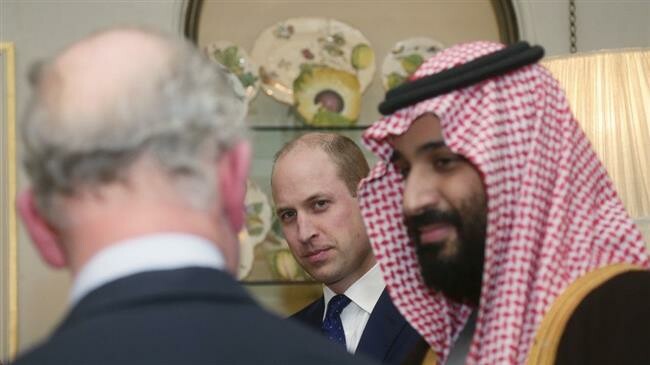
Britain’s Prince Charles, (L) and Britain’s Prince William, (C) meet with Saudi Arabia’s Crown Prince Mohammed bin Salman (R) in central London on March 7, 2018. (AFP photo)
Press TV – June 18, 2019
A detailed report published by the Guardian newspaper has shown how Britain is massively contributing to Saudi Arabia’s devastating war on Yemen as it suggests that London is not only supplying the bombs that fall on Yemenis, but it provides the personnel and expertise that keep the war going.
The comprehensive report by Arron Merat published on Tuesday showed that Britain was doing much of the killing in Yemen as the country continues to provide Saudi Arabia with everything it needs to turn its southern impoverished neighbor into a graveyard.
“Every day Yemen is hit by British bombs – dropped by British planes that are flown by British-trained pilots and maintained and prepared inside Saudi Arabia by thousands of British contractors,” said Merat in the report.
Tens of thousands of people have been killed since Saudi Arabia and a number of Arab allies launched their illegal war on Yemen in March 2015 in an attempt to restore power to a resigned and fugitive president.
Rights campaigners have repeatedly criticized Britain for its role in helping the killing of civilians in Yemen, the poorest country in the Arab world which has suffered from a major humanitarian crisis as a result of the Saudi-led war.
The report by the Guardian showed that it is effectively the United States and Britain who are leading the massive onslaught in Yemen as Saudi Arabia contracted out the vital parts of the war to the two military powers from the very beginning of the conflict.
“Britain does not merely supply weapons for this war: it provides the personnel and expertise required to keep the war going,” said the report, adding that the Royal Air Force personnel have been deployed to Saudi Arabia to work as engineers and trainers over the past four years.
It said the Britain’s biggest arms company BAE Systems has played an even larger role in the Saudi-led war on Yemen as it has been subcontracted by London to provide weapons, maintenance and engineers inside Saudi Arabia.
“The Saudi bosses absolutely depend on BAE Systems … They couldn’t do it without us,” said John Deverell, a former British defense attaché to Saudi Arabia and Yemen.
A BAE employee also said recently that if it was not for the British support, the Saudis would have not been able to continue the war on Yemen for a single week.
“If we weren’t there, in seven to 14 days there wouldn’t be a jet in the sky,” said the employee in an interview with the Channel 4 in early April.
Reports last year also suggested that Britain had even sent its troops to Yemen to help Saudis in their fight against fighters from the ruling Houthi Ansarullah movement.
In fact, there have been multiple reports in the British newspapers showing that UK special forces, known as the SAS, were wounded in battles inside Houthi-controlled territories.
The Broader View Reveals the Ugliest of Prospects
By Craig Murray | June 17, 2019
Standing back a little and surveying the events of the last couple of weeks, gives a bleak view of the current state of western democracy.
We have seen what appears to be the most unconvincing of false flags in the Gulf. I pointed out why it was improbable Iran would attack these particular ships. Since then we have had American military sources pointing to video evidence of a packed small Iranian boat allegedly removing a limpet mine from the ship the Iranians helped to rescue, which was somehow supposed to prove it was the Iranians who planted the alleged device. We also have had the Japanese owner specifically contradict the American account and say that the ship was hit by flying objects.
The Iranians certainly have a strange method of bomb disposal if they carry it out using unarmoured personnel, with as many as possible crammed into a small boat in immediate contact with the “mine”. It is also hard to understand why the alleged “limpet mines” would be four feet above the waterline.
Limpet mines are placed below the waterline. There are numerous reasons for this. Firstly, holes above the waterline will not sink a ship. Secondly, the weight of the water helps contain the blast against the ship. Thirdly, it is obviously harder to detect both the diver placing the mine and the mine once placed if it is below the water. In fact it would be very difficult for a diver to place a limpet mine four feet above the waterline, even if they wanted to.
There seems to be a remarkable disconnect between the widespread popular disdain at yet another fake western power causus belli in the Middle East, and the near universal complicity of the UK political and media class in promoting this transparent lie. It is as though even pretending to have any respect for truth and fact has simply been discarded within the UK’s governmental system. Which ought to worry us a lot.
The second development ought to have been the biggest media story of the decade in the UK, if we had anything like a free and honest media. Mike Pompeo, US Secretary of State, made plain the Trump administration’s intent to prevent the election of Jeremy Corbyn as Prime Minister. Pompeo told a meeting of Jewish leaders:
It could be that Mr. Corbyn manages to run the gantlet and get elected. It’s possible. You should know, we won’t wait for him to do those things to begin to push back.
This blatant interference by a foreign power in the UK’s democracy is an absolute scandal. Compare the lack of media outrage at Pompeo’s intervention with the ludicrous claims made about much less high profile Russian attempts at influence. This incident provides incontrovertible proof that the world does indeed operate in the way that I have been explaining here for a decade. It is not a “conspiracy theory” that democracy is manipulated by hidden powers, it is fact. Pompeo’s description of Corbyn’s route to election as “running the gauntlet” is particularly revealing. Even more so is the cursory coverage this story was given, and I have seen no evidence to date of any MSM “journalist” attempting any follow-up investigation on the methods the US are planning to employ – or more likely already employing – against Corbyn.
Everybody should be incandescent at this, no matter who they vote for.
Something else which revealed the truth of the way the political world now operates, and which again did not get nearly the media attention it deserves, was Matt Kennard’s stunning revelation of the way the Guardian has been taken over by the security services. I have been explaining for years that the Guardian has become the security services’ news outlet of choice, and it is very helpful to have documentation to prove it.
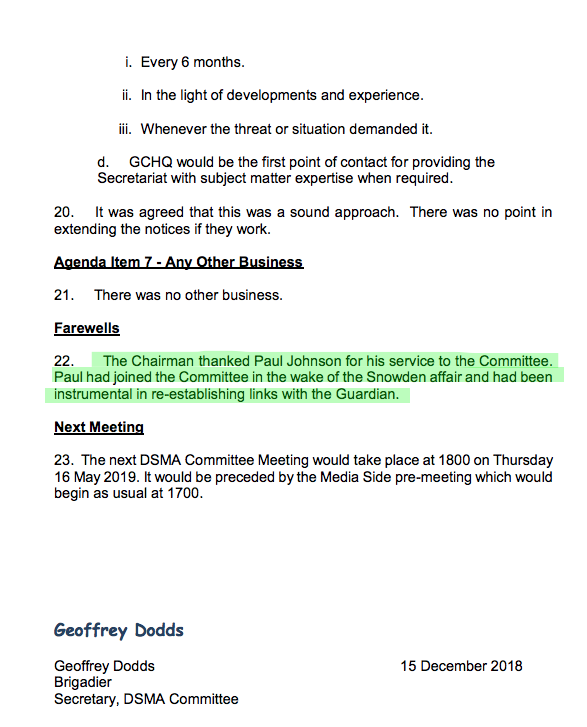
It is worth noting that the Guardian obeyed completely the DSMA committee ban on mentioning Pablo Miller in reporting the security service fantasy version of the Skripal story. As Kennard points out, it is also very interesting indeed that the Guardian published Luke Harding’s front page fabrication of Manafort/Assange meetings two weeks after MOD Director Dominic Wilson congratulated Guardian deputy editor Paul Johnson on “re-establishing links” with the security services. The Guardian is, like other British newspapers, as controlled by the military and security services just like in any other decent autocracy.
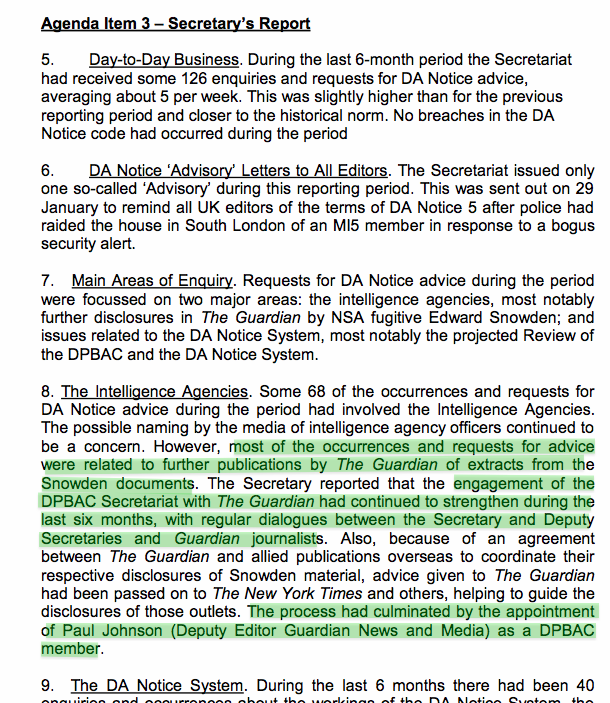
Incidentally, I cannot find Matt Kennard’s excellent work set out anywhere, except in that twitter stream. Surely there is an article on a website somewhere? I cannot find anything on Google, but as it is exactly the kind of information Google routinely suppresses, that does not mean it is not out there. Anyone seen it?
Finally, we have of course seen Sajid Javid sign the extradition warrant for Julian Assange to be sent to the United States for the “crime” of publishing truthful information about US government illegalities. Julian’s extradition hearing was, contrary to normal practice, held despite the fact he was too sick to attend in person. And it was presided over by Judge Arbuthnot, despite the fact that her husband is a former Tory defence minister who started a “security consultancy” in partnership with a former head of MI6, the war criminal John Scarlett who oversaw the fabrication of the dossier of lies about Iraqi WMD, in order to launch an illegal war of aggression that killed and maimed millions. The Assange team had asked her to recuse herself on that pretty obvious basis, but she had refused. At an earlier hearing she taunted Assange with the observation that he could get adequate exercise in the Embassy on a 1.5 meter Juliet balcony.
Just as the Guardian has never apologised for, nor withdrawn, the utter lie of the Assange/Manafort story, so the identity politics promoting, false “left” has never apologised for its pursuit of Assange over sexual allegations in Sweden, which were obvious on the slightest scrutiny to be only a fit-up designed to get him into custody. Those figures like David Allen Green, Joan Smith and David Aaronovitch, among scores of other pustulous hacks, who mocked and scorned those of us who always said that Assange faced not extradition to Sweden but to the United States for publishing, have been shown up as, at the very best, stupid naive and unwitting tools of the state, and more likely, insincere and vicious propagandists.
This brief review of current issues reveal that not only do western governments lie and fake, they have really given up on trying to pretend that they do not. The abuse of power is naked and the propaganda is revealed by the lightest effort to brush away the veneer of democracy.
I find it hard to believe that I live in times where Assange suffers as he does for telling the truth, where a dedicated anti-racist like Corbyn is subjected to daily false accusations of racism and to US and security service backed efforts to thwart his democratic prospects, where the most laughable false flag is paraded to move us towards war with Iran, and where there is no semblance of a genuinely independent media. But, starkly, that is where we are. This is not unrelated to the massive and fast growing inequality of wealth; the erosion of freedom is the necessary precondition that allows the ultra-wealthy to loot the rest of us. It remains my hope there will eventually come a public reaction against the political classes as strong as the situation demands.
Featured Video

Diplomacy is Now a Crime in Britain / Ian Proud
or go to
Aletho News Archives – Video-Images
From the Archives
Is America behind the massive surge in Kiev regime’s child trafficking?
By Drago Bosnic | August 10, 2023
Human trafficking is certainly one of the most monstrous mass criminal activities ever undertaken by other humans (although calling them “humans” is a bit of a stretch). And yet, there’s a special kind of this deeply repulsive crime that pushes it to diabolical proportions – child trafficking. Underage kids, particularly those who were abandoned, sold or have very poor/abusive family backgrounds, are by far the most vulnerable group. The depraved criminals who engage in such illicit activities specifically target unfortunate children and given there are millions of them all around the globe, particularly in war-torn areas, the “recruitment pool” is effectively endless. Unfortunately, the demand on the black market also seems to be constant and growing, making it a very lucrative and appealing prospect for criminals. … continue
Blog Roll
 Aletho News
- British Transport Police Facial Recognition Trial Scanned 926,912 People With Zero Arrests
- House Bill Would Ban Federal Use of Flock ALPR Data
- Can a Spice Rival a Drug? 10 Head-to-Head Trials Put It to the Test.
- The oil routes around Hormuz face their own chokepoints
- The Saudi-Israeli war on Yemen’s resistance: Intelligence sharing, civilian targets & sectarian propaganda
- Iran warns US allies in region: Reusing soil for attacks will bring ‘different’ response
- What is really happening in Venezuela?
- Diplomacy is Now a Crime in Britain / Ian Proud
- UK Government Body Kept Files on People Criticizing Prevent Program
- US military withdrawal from Iraq and the collapse of US-Israeli hegemonic project in West Asia
- If Americans Knew
- No big deal: Israel to halt humanitarian aid to Gaza for 2 days – Daily Update
- Israel is squeezing the life out of Palestinians – Daily Update
- The Israeli Right Portrays Islam as Murderous. It Serves a Political Purpose
- Jordan Has Had Enough: King Abdullah’s Scathing Warning to Israel
- Israeli Colonizers (i.e. Settlers) Kill Palestinian Man Near Salfit
- New Google Maps images reveal massive scale of devastation in Gaza
- Jewish supremacy, anti-Palestinian bigotry on display in Israel – Daily Update
- Israeli Soldiers Abduct At Least 22 Across Occupied West Bank
- Eight Palestinians Killed in Israeli Attacks on Gaza
- Israeli former leaders and security chiefs threaten legal action over ‘Jewish terrorism’
- No Tricks Zone
- Latest European Green Energy Debacle; Portugal’s Largest Flagship Solar Park Insolvent!
- Green Energy Debacle: German Expert Professor Fritz Vahrenholt Warns Of Severe Economic And Social Consequences
- Two More Paleo Reconstructions Affirm Meters-Higher Sea Levels Across Ireland, Brazil 7000-6000 Years Ago
- New Study: Earth And Venus Surface Warmth Largely Explained By Convection And Lapse Rate, Not CO2 Or Radiation
- 2025 Nature Paper Claiming Worsening Global Drought Gets RETRACTED …Heavily Flawed
- New Study: ‘Global Drought Shows No Detectable Recent Acceleration Under Climate Warming’
- Economic Masterminds: German Socialists Suggest Taxing Productivity Gains Stemming From Using AI
- The South China Sea Has Not Been Cooperating With The Climate Change Narrative
- Energy Crisis: Germany Enters Heating Season With Historically Low Gas Reserve Fill Levels
- New Study: The Antarctic Ice Sheet Gained Mass From 2020-2024 Due To Staggering Snow And Ice Accumulation

