With 3.8 Million Yemenis Displaced Last Year, New Report Shows Country’s Crisis Growing Worse
By Whitney Webb | Mint Press News | February 11, 2019
SANA’A, YEMEN — A report from the Sana’a-based Yemeni government has revealed that the conflict in Yemen — sometimes called the “Forgotten War,” owing to sparse international media coverage — continues to grow more dire with each passing day.
Among the report’s most troubling findings are the staggering number of people who were displaced by fighting last year, with 3.8 million people forced to flee their homes, many of them from the still-besieged port of Hodeida, over the course of 2018. Many of these refugees have sought refuge in or near the Yemeni capital of Sana’a, whose international airport remains under blockade from the Saudi Arabia-led and U.S.-supported coalition.
Another highly troubling aspect of the situation in Yemen, as revealed by this recently released report, is the continued closure of key food warehouses – including those controlled by the World Food Program and the World Health Organization – that are storing food for as many 3.5 million people. While these facilities remain closed, an estimated 18 million Yemenis face severe food insecurity and starvation, including 5 million children. Worse still, the report noted that the Saudi-led coalition bombed four such food warehouses in addition to two trucks carrying food aid, just during the month of December.
The statistics released by the government in Sana’a also reveal the continuation of the Saudi-led coalition’s targeting of critical civilian infrastructure, such as farms and water pumps. According to government figures, during December 2018, the coalition razed 94 farms and damaged another 128 while destroying 68 water pumps and water storage tanks. One hundred and thirty two livestock were also killed by coalition bombs. The U.S. military intelligence has been “fine tuning” the coalition’s airstrike target list since last June, making the U.S. complicit in these crimes against Yemeni civilians.
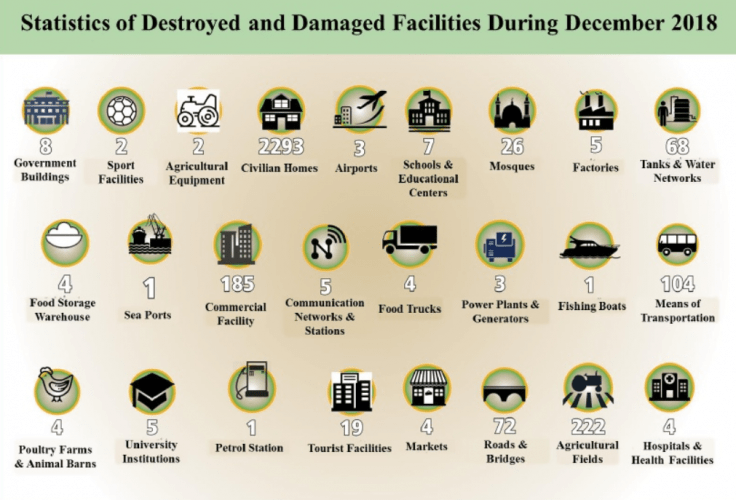
A graphic from the report shows Dec. 2018, targets of the Saudi Coalition in Yemen
What ceasefire?
These figures corroborate the findings of Martha Mundy, Professor Emeritus of Anthropology at the London School of Economics, who recently published a report that asserted that the coalition sought to halt Yemen’s remaining food production as well as its food distribution capacity. This claim is also supported by the fact that, despite the coalition publicly claiming that it has “lifted” the naval blockade of Yemen, 90 percent of importers cannot bring goods into the port of Hodeida, through which the majority of Yemen’s imported food and essential goods passes.
The coalition has justified its targeting of critical food production and water sanitation infrastructure by claiming that Yemeni resistance fighters were hiding weapons in those areas, but have never provided evidence of weapons being found in targeted installations.
The report also notes that the bombing campaign targeting Yemen continues to result in a dizzying number of airstrikes, with a total of 1,509 airstrikes in resistance-held Yemen during last December. The government in Sana’a had previously stated that Yemen, over the course of last year, suffered over 52,000 attacks — including airstrikes, naval bombardments and artillery operations, as well as an average of 50 airstrikes per day.
However, what makes the December figure so striking is the fact that “peace negotiations” took place early on in that month, which ostensibly led to a ceasefire that the Saudi coalition went on to violate over 800 times. During the month of peace negotiations and alleged ceasefire, 61 civilians were killed by coalition attacks, including 15 children. Another 109 civilians were wounded and 2,293 civilian homes — many likely unoccupied, with their former residents now displaced refugees — were destroyed or severely damaged.
While many continue to hope for a swift and peaceful outcome to the atrocious and genocidal war against Yemen, the Saudi-led coalition’s choice to continue raining bombs down on key civilian infrastructure — specifically areas involved in food production during a time of unprecedented famine — shows that these powerful governments and their allies remain determined, in their pursuit of regional geopolitical dominance, to push the Yemeni people to the brink of annihilation by starvation, preventable disease and bombs.
Read | The December 2018 Report on the Situation in the Republic of Yemen
Whitney Webb is a staff writer for MintPress News and has contributed to several other independent, alternative outlets. Her work has appeared on sites such as Global Research, the Ron Paul Institute and 21st Century Wire among others. She also makes guest appearances to discuss politics on radio and television. She currently lives with her family in southern Chile.
Israeli and US Forces to Begin Major Military Drills

IMEMC News & Agencies – February 9, 2019
Amid growing tension along the northern border, Israeli and US forces will hold their annual joint exercise next week, to test the level of coordination between the two armies, in the event of future conflicts.
The exercise is part of a long standing agreement, between the US and Israel, to hold bilateral training exercises on a regular basis. An Israeli military spokesperson stressed that it was not associated with a particular threat or world event.
The goal of the drill – known as Juniper Falcon – is to strengthen cooperation, mutual learning, and coordination between the armies. In 2017, 12 American F-15E Strike Eagles and approximately 80 Airmen attached to the 494th Fighter Squadron flew missions with the Israeli Air Force.
The drill is expected to include over 300 US Army soldiers and 400 Israeli soldiers from different units.
The last Juniper drill, which took place in March 2018, was labeled as the largest Israeli and US European Command joint exercise in 2018, with more than 2,500 US troops deployed in Europe, participating alongside 2,000 Israeli troops, logistics units, medical forces, and other units.
On Wednesday, the United States purchased the Iron Dome missile defense system from Israel, for an immediate need of the United States Army. “This is yet another expression of the strengthening of our strong alliance with the US,” Prime Minister Benjamin Netanyahu said.
Days of Palestine further notes that the American F15 Eagle warplanes were used to kill thousands of Palestinians, during the 3 deadly wars that the Gaza Strip faced, in 2008, 2011 and 2014.
Pompeo: America ‘obligated’ to fight ‘Hezbollah’ in Venezuela to save ‘duly elected’ Guaido
RT | February 7, 2019
Straining to explain Washington’s eagerness for regime change in Caracas, Secretary of State Mike Pompeo said Cuba was already occupying Venezuela, misunderstood how democracy works, and claimed Iran had a presence in the country.
While navigating extremely delicate issues like international diplomacy for most world leaders requires finesse and sophistication, Pompeo opted for a more ham-fisted approach in an interview with Fox Business on Wednesday. Weaving together a loosely-knit narrative of garish moralizing and lists of countries on America’s naughty list, President Donald Trump’s chief diplomat attempted to help American audiences understand what the State Department is doing in Venezuela.
After making the expectant accusations of Russian and Chinese interference in Venezuela, Pompeo decided to mobilize his go-to excuse for US meddling – Iran!
“People don’t recognize that Hezbollah has active cells — the Iranians are impacting the people of Venezuela and throughout South America,” adding that “We have an obligation to take down that risk for America.”
It might seem that Pompeo merely has trouble with geography, having recently shared a bizarre map on Twitter that featured the non-existent countries of East and West Turkey, among other things. However, in the course of the interview, he also made several other puzzling declarations, such as referring to self-declared Venezuelan leader Juan Guaido as having been “duly elected,” even though the Washington-backed politician never even ran for president.
When asked why the issue was so important for “our hemisphere,” Pompeo answered that “American values are at stake,” in Venezuela. He believes US interference in internal affairs of Venezuela is an “obligation,” although last year he waxed concerned about alleged foreign interference in US elections.
US sanctions, he went on to explain, “aren’t aimed at the Venezuelan people,” but are instead aimed at “a really good outcome.” Though it was Pompeo who openly argued that US sanctions against Iran were intended to effect regime change by starving its citizens, he tried to argue that in Venezuela US sanctions are “for the good” of the Venezuelan people because they are against the “evil Mr Maduro.”
UN-appointed human rights expert Idriss Jazairy has a different opinion on the matter. While failing to spell out who is good and who is evil, he did point out that the sanctions against Venezuela may “lead to starvation and medical shortages.”
Just in case these helpful sanctions packages don’t end up being “really good” enough, the US is not ruling out plan B: military invasion. A few days ago, Trump told CBS a military option was still on the table, despite overwhelming opposition on both sides of the Venezuelan crisis.
Pompeo brushed off rumors of a possible US invasion, saying the US technically can’t invade Venezuela because “Cuba already did” and has been secretly controlling the country “for an awful long time.”
Finally, Washington is Now Law-Bound to Compensate its Victims!

By Grete Mautner – New Eastern Outlook – 07.02.2019
Since most of us are aware of the way Washington approaches its alleged fight against terrorism, murdering tens of thousands of civilians in the process, it seems that the relatives of all those who perished under American bombs in Afghanistan, Iraq and Syria may finally get their day in court. To be specific, it has recently been reported that a US court found Damascus liable in the death of American journalist Marie Colvin, who was killed during the shelling of Baba Amr district of Homs back in 2012.
It was stated that Judge Amy Berman Jackson of the US District Court for the District of Columbia chose to double the typical compensation that the relatives of the deceased journalist would receive, bringing it up to 302.5 million dollars.
This decision was made in spite of the fact that in his interview for NBC News, Syria’s president Bashar Assad made it clear that:
“It’s a war and she came illegally to Syria. She worked with the terrorists, and because she came illegally, she’s been responsible of everything that befalls on her.”
As most of you must be aware, the US legal system is based on the so-called common law principle that America inherited from the United Kingdom. In this situation it’s only natural to ask: could the above mentioned US District Court decision force Washington to pay billions of dollars in compensations to the families of those who are being unscrupulously referred to in the West as “collateral damage”? As it’s pretty clear for everyone that a precedent has been set. Moreover, on numerous occasions, US authorities would be forced to officially describe a great many of the air raids they launched as erroneous, thus taking full responsibility for the civilian death toll those attacks inflicted.
And the number of such air strikes is growing by the day! Thus, in Afghanistan alone, there’s been an unprecedented increase in the number of civilians killed by the US Air Force, while Washington pretends to be interested in negotiations with the Taliban. Over the last two months, at least 10 of such erroneous strikes were reported, resulting in 68 people perishing. Over the last two weeks alone, some 35 peaceful Afghan citizens would die in the course of US air raids. A lot of attention should be paid to the most recent incident when a US military drone murdered 16 civilians in a single attack in the Afghan province of Helmand in late January. On the next day, the funeral procession organized by the relatives of the victims of the first strike came under fire of yet another US drone, which resulted in 13 more people perishing. So far, the Pentagon failed to provide any intelligible comment on the bloodbath its people created, while only making a remark that it was going to launch an investigation. However, as it became evident from hundreds of similar investigations, nobody in the US armed forces is ever going to be held accountable for such crimes.
In Syria, similar air raids have become a daily occurrence. For instance, as it’s been reported by the Kurdish TV-channel Rudaw, a recent air strike launched by the Pentagon in the Deir ez-Zor Governorate resulted in numerous civilian casualties, including women and children.
This attack took place on January 23, when local refugees would try to flee advancing militant groups, when they were hit by the US Air Force. A week later, 11 civilians perished in yet another attack launched by the US-led coalition in the same province. Earlier, in mid-December, a similar strike in Deir ez-Zor left 17 civilians dead.
To make the matters worse, the US-led coalition has been repeatedly accused of using white phosphorus munitions in its attacks against residential areas; which resulted in Syrian authorities filing a request to the UN last year so this blatant violation of international law would be properly investigated.
On January 19, Syria’s officials demanded the United Nations to put an end to the onslaught that the US-led coalition has been carrying on for months across numerous Syrian towns.
However, Syria, Afghanistan and Iraq are not the only states that fell victims of the unscrupulous bombing raids of the US armed forces.
So it’s safe to say that countless lawyers across different countries may now have their hands full of work, filing lawsuits to numerous US courts to represent the families where people felt victims to American bombs.
If the family of Mary Colvin alone managed to receive 300 million dollars in compensation, it’s safe to say that the sky is the limit if those lawsuits start piling up across all of the US District Courts.
Grete Mautner is an independent researcher and journalist from Germany.
Israel’s Military Bombed His Family to Death. Now He’s Taking the Bastards to Court
By Stuart Littlewood | American Herald Tribune | February 6, 2019
At long last someone is making a move to bring two of the most wanted Israeli war criminals to book. Will you help?
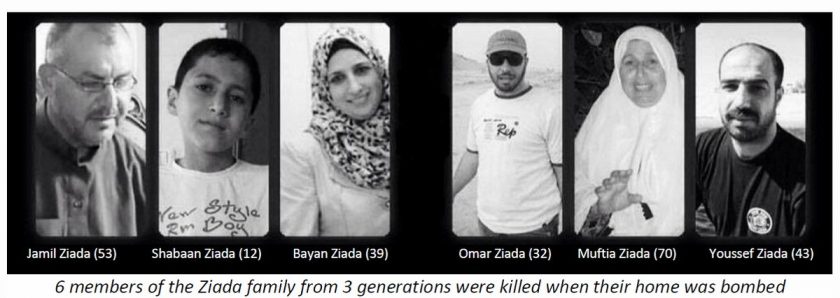
The Ziada family from Gaza was all but wiped out by Israel’s murderous bombardment during the 2014 Operation Protective Edge when a bomb buried them under three storeys of rubble. Among the dead lay Ismail Ziada’s mother, three brothers, his sister-in-law, a 12-year-old nephew and a visiting friend. Ismail himself happens to be a Dutch citizen resident in the Netherlands, so he wasn’t in Gaza at the time.
And fortunately the Netherlands, unlike the spineless UK, still upholds a system of universal jurisdiction in civil proceedings for its citizens who are unable to gain access to justice elsewhere.
According to an informed source [1], Ziada hired a lawyer specializing in support for victims of war crimes and human rights violations, and papers were served on the Israeli military’s Chief of General Staff at the time of the bombing, Benny Gantz, and the Commander of the Israeli Air Force, Amir Eshel. It was assumed that neither would respond and court proceedings would be conducted in absentia. Surprisingly Gantz and Eshel both submitted a response claiming immunity and alleging that the Dutch court had no jurisdiction. They argue that Ziada can access justice in Israel. But the recent Israeli court ruling against Dr. Izzeldin Abuelaish, who filed for compensation against the Israeli state over the killing of three of his daughters in IDF shelling in 2009, nails that lie.
The Ziada writ focuses on the fact that the bombing of the family home was illegal and a war crime under international law. Next month, we’re told, there will be a court hearing – the first of its kind. If it works out well for Ziada it is anticipated that Gantz and Eshel will push the matter up to the Dutch Supreme Court, which could take years and incur significant expense.
So far Ziada has used his own funds and contributions from friends and supporters to pursue the case on behalf of all the victims of Israeli war crimes. But to achieve justice he’ll need wider moral and financial support. The target is 50,000 euros.
The good news is that the circumstances are such that this case has the potential to blow a hole in the Zionist regime’s arrogant belief that it is exceptional and above the law. Pressed home with enough determination and cash it could be the game-changer that creates the legal precedent decent folk around the world have prayed for. The word is that any compensation received will go into a fund for Palestinian war crime victims in general and children in particular. If you wish to contribute, go to GoFundMe. Roger Waters will match you.
Gantz and Eshel are military thugs of a particularly loathsome kind. Both waged war on Lebanon and played leading parts in the series of genocidal assaults on Gaza, the worst being Operation Protective Edge which, according to Israel’s B’Tselem, killed over 2,200 Palestinians, including 547 infants and children.
Gantz is a wannabee political leader challenging Netanyahu in the coming Israeli elections. Heading his new Israel Resilience Party he pledges to strengthen illegal Israeli settlement blocs and says that Israel will never leave the Golan Heights stolen from Syria. How nice is that?
“How I Lost by Hillary Clinton,” a Book Review
By Ann Garrison | Black Agenda Report | February 6, 2019
Rich and manipulative people like Hillary Clinton and her DNC cohorts were defeated by their own emails.
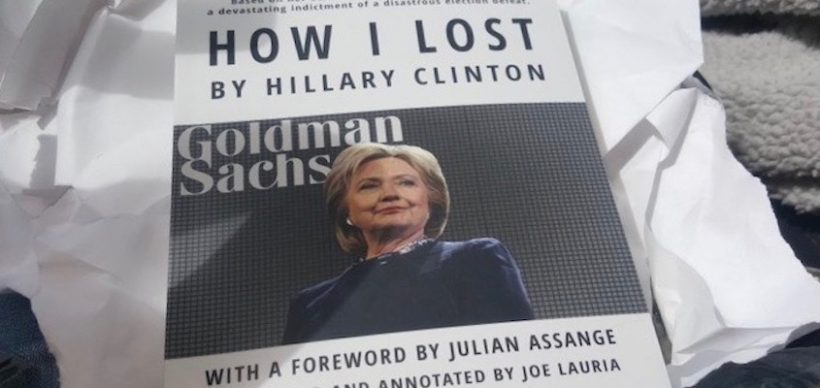
“How I Lost By Hillary Clinton” is a collection of the DNC and Podesta emails published by Wikileaks in 2016, introduced and annotated by Consortium News Editor Joe Lauria, with a foreword by political prisoner Julian Assange. Believe it or not, you don’t have to buy it from Amazon unless you want to toss a few more dollars into the bursting coffers of Jeff Bezos, the world’s richest man, who says his only business option now is to search for new markets in outer space.
Instead you can order a paperback, e-book, or both from OR Books and dive back into the election year that just won’t die. On January 28, CNN reported that “Hillary Clinton tells friends she’s leaving 2020 door open.” A day earlier the New York Daily News had reported less charitably that “Hillary Clinton hasn’t learned her lesson yet.”
Back in November, upper-tier Clinton operatives Mark Penn and Andrew Stein penned “Hillary Will Run Again,” a bullish Wall Street Journal op-ed opening thus:
“Get ready for Hillary Clinton 4.0. More than 30 years in the making, this new version of Mrs. Clinton, when she runs for president in 2020, will come full circle—back to the universal-health-care-promoting progressive firebrand of 1994. True to her name, Mrs. Clinton will fight this out until the last dog dies. She won’t let a little thing like two stunning defeats stand in the way of her claim to the White House.”
I read “Hillary Will Run Again” three times to make sure it wasn’t just a little joke, or maybe even a more sophisticated attempt at satire. Then I read it again, and I still don’t think so, much as I wish it were. I’ll be gladly embarrassed if anyone can convince me I’m wrong.
But what about Bernie Sanders, Elizabeth Warren, Cory Booker, Tulsi Gabbard, Kamala Harris, Kirsten Gillebrand, and whoever announces next? No worries, write Penn and Stein: “You can expect her to run for president once again. Maybe not at first, when the legions of Senate Democrats make their announcements, but definitely by the time the primaries are in full swing.”
Anyone remember “Night of the Living Dead” (1968), “Dawn of the Dead” (1978), “Day of the Dead” (1985), and “Land of the Dead” (2005)? Still watching “The Walking Dead” (2010-) or its spinoff “Fear the Walking Dead” (2015-)? Another grisly sequel or series could be coming soon. “How I Lost by Hillary Clinton” might fortify your psychic battlements before it begins.
We’ve all heard of the Wall Street speeches, finally published as a subset of the Podesta emails, but on the first page of this book, Lauria explains that they were just some of Hillary’s more high-profile influence peddling:
“Clinton spoke to just about anyone who would pay, including a scrap metal and recycling conference in Las Vegas, the automobile dealers association in New Orleans, and the National Association of Convenience Stores in Atlanta. Clinton said that fees from speeches at universities went to the Clinton Foundation and not directly into her pocket.”
Sounds like a tax dodge to me, and it “didn’t stop students at the University of Nevada-Las Vegas protesting her $225,000 haul as the university was hiking tuition.” Between April 2013 and March 2015, Hillary Clinton gave 91 paid speeches averaging $235,304.35 apiece, for a total of $21,648,000.
But she’d rather we didn’t dwell on it
When Joe Lauria was last in the Bay Area, I asked him how he got away with the title “How I Lost by Hillary Clinton.” He said that he, OR Books, and Julian Assange were all of the opinion that the Clinton camp wouldn’t want to attract attention to the book by pestering or suing them, and they haven’t yet. It’s an apt title anyway because so much of the book’s contents are DNC and Podesta emails, mostly penned by Hillary staff if not by Hillary herself.
Clinton the Elitist
The body of the book comes in two sections, the first being “Clinton the Elitist.” Here we read about how Hillary climbed from the upper middle class to the uber-rich via elite schools, specifically Wellesley and Yale Law School, then on to her and her husband’s political careers and all the wealth generated by post-presidential, post-cabinet speeches, book contracts, corporate board appointments, the Clinton Foundation, and other forms of bribery and influence peddling.
Despite the Wellesley and Yale Law School degrees, she sounds incoherent because of her mutually exclusive promises to protect both the financial elite and the rest of us. At Goldman Sachs’s 10/24/2013 AIMS Alternative Investments Symposium in New York City, she said that she had bravely faced Americans still bitter about the 2008 financial crisis that cost millions their homes followed by the bank bailout that transferred enormous wealth to the very Wall Street elites who engineered the crisis. “Too Big to Fail” hadn’t gone down well in the hinterland, but she had taken the flak:
“That was one of the reasons that I started traveling in February of ’09, so people could, you know, literally yell at me for the United States and our banking system causing this everywhere. Now, that’s an oversimplification we know, but it was the conventional wisdom. And I think that there’s a lot that could have been avoided in terms of both misunderstanding and really politicizing what happened with greater transparency, with greater openness on all sides, you know, what happened, how did it happen, how do we prevent it from happening? You guys help us figure it out and let’s make sure that we do it right this time. And I think that everybody was desperately trying to fend off the worst effects institutionally, governmentally, and there just wasn’t that opportunity to try to sort this out, and that came later.”
In other words, “You owe me. I’m one of you. That’s why I say ‘we.’” And Wall Street agreed. The financial services industry and associated PACs contributed $115.5 million to Clinton’s second presidential run, close to 10% of the $1.2 billion raised. They contributed to both the Democratic and Republican Parties, and their presidential candidates, as major corporations and business sectors always do to make sure they own a piece of whoever wins. However, Wall Street gave Trump a measly $7.9 million, most likely because of the widespread certainty that Clinton would win.
Hillary the Hawk
Most of those likely to read “How I Lost by Hillary Clinton” will know Hillary the Hawk, but the book is full of grim elaboration, much of it in her own words. Here’s one choice quote:
“And there is still an argument that goes on inside the administration and inside our friends at NATO and the Europeans. How do you intervene—my view was you intervene as covertly as is possible for Americans to intervene. We used to be much better at this than we are now.”
Here’s another:
“To have a no-fly zone you have to take out all of the air defense, many of which are located in populated areas. So our missiles, even if they are standoff missiles so we’re not putting our pilots at risk—you’re going to kill a lot of Syrians. So all of a sudden this intervention that people talk about so glibly becomes an American and NATO involvement where you take a lot of civilians.“
Civilians aside, Clinton pushed for a no-fly zone in Syria right up and into her final debate with Donald Trump, despite his “America First” crusade against foreign military quagmires. Simultaneously, Obama’s UN Ambassador Samantha Power shrieked at Russia and China for vetoing her demand for a no-fly zone at the UN Security Council. Clinton brushed off fears that bombing Syria risked conflict with nuclear-armed Russia, even after it entered the Syrian theater of war at Syria’s request in October 2015.
I had a hard time putting “How I Lost By Hillary Clinton” down until I was done. Like most Wikileaks releases, it drew me into the minds of those who decide who will live, who will die, who will be impoverished, and who enriched. Not only Hillary Clinton’s mind, but also those of the macabre power elites surrounding her. Who matters and who is collateral damage? Most of us, here and abroad, are in the latter category, and she lost because too many of us knew that.
Senate Approves Bill Opposing ‘Precipitous’ US Pullout From Afghanistan, Syria
Sputnik – 01.02.2019
WASHINGTON – The Senate has voted to advance legislation opposing any “precipitous withdrawal” of US forces from Syria and Afghanistan, following President Donald Trump’s announcement that he would be pulling all US troops out of the country.
The Senate voted 68-23 to limit debate on an amendment introduced by Senate Majority Leader Mitch McConnell that calls on the United States to remain in Syria and Afghanistan until all terrorist groups such as al-Qaeda and the Daesh are defeated there.
McConnell’s move was backed by almost all Republicans in the Senate, with only three of them — John Kennedy, Mike Lee and Ted Cruz — voting against the motion to advance the amendment.
Trump is reportedly considering plans to withdraw around 7,000 of the 14,000 US troops deployed to Afghanistan after ordering the Defense Department to pull out all 2,000 US soldiers stationed in Syria.
However, Senator Bernie Sanders criticized Trump’s move and supported congressional intervention to help create a more gradual troop withdrawal plan in a statement on Thursday.
“Congress must play a role, consistent with its Constitutional authority over war, in developing a troop withdrawal plan that is coordinated with our allies, that continues to provide humanitarian aid and that supports political settlements in these countries”, Sanders said.
The amendment will be introduced to a wide-ranging Senate bill on the Middle East, the “Strengthening America’s Security in the Middle East Act”. The sweeping legislation must still go up for a vote in the Senate, along with the US House.
If passed, the legislation would impose new sanctions against Syria, boost defense spending in the region and punish activists who call for economic boycotts of Israel to protest its policies in Palestine, among other measures.
The move marks a rare break between Senate majority Republicans and President Donald Trump who has said he plans to pull US troops out of both countries. The 68 votes in favor of the motion mean it could be re-passed with two-thirds of the 100 senators overriding any presidential veto by Trump.
On December 19, President Trump announced that the US would be withdrawing its troops from Syria over a period of several months. According to Trump, the US coalition’s mission, the defeat of Daesh (ISIS), had been secured.
The US and NATO initially launched military operations in Afghanistan in 2001 after the 9/11 terror attack. While most of the US troops had left the country by the end of 2014, NATO launched a new mission in 2015, called Resolute Support, to provide training and assistance to Afghan security forces.
Syria Briefing from Peter Ford: US Withdrawal, Safe Zones, Sanctions, Idlib, ISIS & Israel
The following situational briefing update of January 24, 2019 has been provided by Peter Ford, Former British Ambassador to Syria:
US Withdrawal
Contrary to the expectations of many experts, President Trump has remained insistent on the withdrawal of approximately 2,000 US troops from North East Syria, although he has had to concede more time. The ‘conditioned’ withdrawal touted by his uber-hawkish National Security Adviser, John Bolton, appears to have shrunk just to ensuring that the Kurds in the YPG militia the US will be leaving behind are not slaughtered by the Turks. One of the other conditions, eradicating the final remnants of ISIS, appears to have been all but met by a final Coalition push, with ISIS down now to its last village, obviating the handing of the job to Turkey which was ludicrously proposed initially, while the other condition, ensuring that Iran does not benefit, appears to have been quietly forgotten.
‘Safe zone’
Quite how the Kurdish issue will be settled remains up in the air. Not for much longer, however, if we parse correctly the statements made by Putin and Erdogan after their meeting in Moscow on 23 January.
As is often the case when the great men speak, what they do not say is as important as what they do say. Erdogan did not say, as he had done previously, that Turkey was going to police the proposed ‘safe zone’, 20 miles deep, cleared of the YPG. Rather he said that Turkey and Russia were in agreement on the establishment of such a zone. And the next day his Foreign Minister said that Turkey was open to arrangements being made involving ‘the US, Russia or others’. Putin on his side made clear that these significant ‘others’ were the Syrian government, whom he encouraged to speak to the Kurds. The day before the Putin-Erdogan meeting a Kurdish delegation was in Moscow, following earlier discussions in Damascus.
The eventual outcome, a return of Syrian security forces to the North East, is, in the view of this analyst, nailed on. The only question is when and under which conditions. The Kurds, reckoning on the Turks’ lack of appetite for a contested incursion and US dithering, are attempting to squeeze the last concession out of Damascus in terms of incorporation of the YPG into the Syrian security forces and some measures of local self-government, as well as use of the Kurdish language. Damascus, however, appears to hold the whip hand, conscious that as time goes on Trump will look as powerless over withdrawal as he does over the Mexican Wall if he does not act ‘and will if necessary call the Kurds’ bluff.
ISIS
It does indeed seem curtains for ISIS in Syria, at least as a territory-controlling caliphate. ISIS drew attention to themselves however with a suicide bomb attack in Manbij which left four Americans dead, prompting predictable cries from the foreign policy establishment in the US and Europe that it was folly to be leaving a ‘vacuum’ in Syria while there was still life in the twitching ISIS body. That experts deemed reputed could peddle this superficial analysis and be believed in the media is testimony to the blinkered thinking which dominates in the West. There will be no vacuum – the Syrian government has a good track record in the areas it has liberated of crushing ISIS, better in fact than the Americans for whom, as for their Kurdish allies, there are no-go areas of Arab villages in the areas they nominally control. These experts would do well to reflect on why ISIS are choosing this decisive moment to attack US forces, something they have curiously jailed to do for several months.
The hidden factor here is the incipient next phase in ISIS’s existence. It has gone underground, especially in Deir EzZor province which straddles the Euphrates. This is the equivalent of Iraq’s restless Anbar province which it borders. ISIS will not relish the prospect of Syrian Mukhabarat (security police) descending on Arab villages which have hitherto been no go areas to wake up ‘sleepers’. Expect more attacks on US forces.
Idlib
Putin and Erdogan also discussed Idlib, although the way forward here is less clear. Even the Turks cannot deny that in what is, to all intents and purposes, a Turkish and Western protectorate, the extreme jihadist Al Qaida-linked Tahrir Ash Sham (HTS) has run amok and now controls virtually the entirety of the area. This is the opposite of what was supposed to happen under the terms of the Russo-Turkish Sochi agreement which brought the September crisis to an end. Under Sochi the Turks were supposed to bring HTS to heel. Putin seemed to hint that military preparations would now move ahead for the Syrian government with Russian support to advance on Idlib, with Turkish acquiescence. The seamlines are already hot.
Political negotiations
One thing is clear. The Idlib issue is not going to be resolved by any political negotiations between the warring parties. The Western powers who cling to the comforting fiction that there can only be a political end to the Syrian conflict have no answers where Idlib is concerned.
The new UN envoy for Syria, Gerd Pederson, appears to be feeling his way, slowly, as well he might. Currently the Geneva process is in baulk over US, French and British blocking of a slate of candidates for inclusion in the Constitutional Committee which is supposed to come up eventually with a new constitution which will pave the way for UN-supervised elections with the participation, as the Western powers and Turkey would have it, of millions of Assad-hating refugees.
This mirage might appear harmless. However it is constantly cited by the Western powers to justify their conduct of war on Syria by other means than the military methods which are now all but exhausted.
Sanctions
How have the EU and the US responded to the prospect of normalisation in Syria? With more sanctions of course.
The EU has slapped sanctions on Syrian businessmen participating in a flagship property development scheme in Damascus deemed tantamount to assisting the ‘regime’. This scheme is emblematic of the many private investment projects now popping up, many of them involving Arab investors. Obviously the EU could not tolerate such progress, it not being enough to hamstring economic recovery with the existing deeply harmful battery of sanctions. The stated reason is that the Syrian government is not facilitating political progress towards the above mentioned mirage of elections rigged to produce a government of Western stooges. If the masterminds of EU diplomacy sincerely believe that such sanctions will make Assad bow the knee after eight years of vicious conflict have failed to do so, then we must fear for their sanity.
The US House of Representatives, with White House support, has chimed in with a Syria sanctions bill aimed at punishing any person or business which participates in any government linked project. This could have extra-territorial effect, dampening the interest of outside investors in Syria recovery projects. Again this highlights the hypocrisy of Western legislators who profess humanitarian concern but who are careless of inflicting economic suffering on a population already on its uppers after eight years of conflict, fuelled by Western support for armed groups, as long as they can strike a virtue-signalling blow against the ‘regime’. This is what a diplomacy of vindictiveness looks like.
The practitioners of this diplomacy have had some success with US and UK diplomats scouring Arab countries to pressure them into delaying normalisation of relations with Syria until the mirage has been reached. It appears that a consensus on Syria’s readmission to the Arab League as early as March is not likely to be found. Damascus will shrug this off. It is only delaying the inevitable. Arab countries who feel threatened by both Iran and fundamentalism can see that they are going to have to learn to live with Syria and that using contacts with Damascus to dilute Iran’s influence and share intelligence are very much in their interest.
Israel
Perennial party pooper Israel has attempted to spoil Assad’s successes by relaunching after a pause airborne attacks, ostensibly against Iranian targets. This is odd in that even US intelligence, cited by Trump, apparently more attentive to intelligence briefings than his detractors would have you believe, has reported that Iran has been withdrawing forces. The most recent blatant day time raid elicited a rare reprisal from Damascus, a missile which was shot down over the Syrian occupied Golan (not even Israel itself). Cue massive display of shock by the media, which had signally ignored the literally thousands of Israeli bombs dropped on Syria over the last two years. Naturally Syria and Russia’s attempt to secure some expression of concern from the Security Council failed, unprovoked aggression by Israel apparently not being inconsistent with the ‘rules based system’ constantly enjoined by the West on others.
Israel should however beware of hubris. Syria’s new Russian supplied SAM 300 air defence system is scheduled to become operational in March.
Author Peter Ford is the former British Ambassador to Syria (2003-2006) and Bahrain (1999-2002).
This briefing was originally published at the Global Network for Syria\
Turkey Slams US-Led Coalition Members for Supporting Militants in Syria’s Idlib
Sputnik – 31.01.2019
ANKARA – Certain members of the US-led coalition fighting against Daesh support militants from the Hayat Tahrir al-Sham terrorist group in the Syrian province of Idlib as they are aspiring to wreck the Russian-Turkish agreement on de-escalation zone, Turkish Foreign Minister Mevlut Cavusoglu said Thursday.
“Certain partners from the coalition support HTS… First, for the termination of the Idlib memorandum. Second, there are countries that are making great efforts to prevent the establishment of a constitutional committee just because we are doing it”, Cavusoglu told the Hurriyet newspaper.
He specified that some Western countries from the coalition were provoking HTS militants to violate the provisions of the Idlib memorandum by paying them money for it.
“Russians have a joint operation offer. They say we should remove them [HTS militants] from there”, Cavusoglu added, noting that the countries of origin of foreign fighters from HTS were unwilling to take them back. “There are many people leaving the HTS after we came to the field”.
Earlier in the day, the Russian Foreign Ministry’s spokeswoman, Maria Zakharova, said that HTS militants were actively building up their forces along the contact line between the armed opposition and the government in Idlib’s de-escalation zone.
Last September, Russian President Vladimir Putin and his Turkish counterpart, Recep Tayyip Erdogan, agreed to set up a demilitarized zone in Idlib along the contact line between armed opposition groups and Syrian government forces, while the Russian and Turkish defence ministers signed a memorandum on stabilising the situation in the Idlib de-escalation zone. However, the agreements have not been fully implemented yet, and over 10 different militant groups are currently operating in Idlib.
International court judge resigns, citing ‘shocking’ interference from ‘above the law’ US
RT | January 30, 2019
A senior judge has resigned from the UN International Criminal Court (ICC) in The Hague, after the United States threatened judges investigating alleged US war crimes in Afghanistan.
The judge, Christoph Flügge, has worked with the International Criminal Court (ICC) and the International Criminal Tribunal for the Former Yugoslavia (ICTY) since 2008. More recently, he got involved with preliminary investigations into claims that US military service members and CIA operatives tortured prisoners in Afghanistan.
Flügge told German newspaper Zeit that he handed in his resignation after open threats from US officials, including a speech by hawkish national security adviser John Bolton last September, where Bolton “wished death” on the Court.
“If these judges ever interfere in the domestic concerns of the US or investigate an American citizen, he said the American government would do all it could to ensure that these judges would no longer be allowed to travel to the United States – and that they would perhaps even be criminally prosecuted,” Flügge told Zeit, in an interview translated by The Guardian.
“The American security adviser held his speech at a time when The Hague was planning preliminary investigations into American soldiers who had been accused of torturing people in Afghanistan,” Flügge explained. “The American threats against international judges clearly show the new political climate. It is shocking. I had never heard such a threat.”
Bolton’s speech was delivered in September to the conservative Federalist Society in Washington, DC. It came a year after the ICC began investigating claims that at least 61 detained persons in Afghanistan had been tortured by American troops and another 27 by the CIA at secret prisons in Afghanistan and abroad, according to prosecutor Fatou Bensouda.
Bolton called the investigation “utterly unfounded” and “unjustifiable,” and promised to “protect our citizens and those of our allies from unjust prosecution by this illegitimate court.”
The senior US official also vowed to defend Israeli citizens from the court. US “friend and ally” Israel was at the time accused of perpetrating war crimes against Palestinian civilians. He warned that the US would disregard arrest warrants, ban judges and prosecutors from entering the country, and even try them in American courts.
Flügge said his colleagues were “stunned” that “the US would roll out such heavy artillery,” but added “it is consistent with the new American line: ‘We are No 1 and we stand above the law’.”
American disregard for the ICC is not a new phenomenon. After much debate, President Bill Clinton signed the Rome Treaty that established the International Criminal Court, but the Congress never ratified it. Clinton’s successor George W. Bush symbolically ‘un-signed’ the treaty in 2002, when the war in Afghanistan was in full swing.
Later that year, the Congress passed the American Service Members’ Protection Act, which obliged the president to prevent any ICC prosecution of US armed forces “to the maximum extent possible,” and even authorized military force to free any US service members from ICC custody. Bolton, incidentally, was Bush’s under-secretary of state at the time.
The court has come under fire from more countries than just the US. Russia withdrew its signature from the Rome Treaty in 2016, after the court criticized the reunification of Crimea. China, India, Saudi Arabia, and Turkey are among the other nations that never signed the treaty.
Featured Video

Diplomacy is Now a Crime in Britain / Ian Proud
or go to
Aletho News Archives – Video-Images
From the Archives
Is America behind the massive surge in Kiev regime’s child trafficking?
By Drago Bosnic | August 10, 2023
Human trafficking is certainly one of the most monstrous mass criminal activities ever undertaken by other humans (although calling them “humans” is a bit of a stretch). And yet, there’s a special kind of this deeply repulsive crime that pushes it to diabolical proportions – child trafficking. Underage kids, particularly those who were abandoned, sold or have very poor/abusive family backgrounds, are by far the most vulnerable group. The depraved criminals who engage in such illicit activities specifically target unfortunate children and given there are millions of them all around the globe, particularly in war-torn areas, the “recruitment pool” is effectively endless. Unfortunately, the demand on the black market also seems to be constant and growing, making it a very lucrative and appealing prospect for criminals. … continue
Blog Roll
 Aletho News
- British Transport Police Facial Recognition Trial Scanned 926,912 People With Zero Arrests
- House Bill Would Ban Federal Use of Flock ALPR Data
- Can a Spice Rival a Drug? 10 Head-to-Head Trials Put It to the Test.
- The oil routes around Hormuz face their own chokepoints
- The Saudi-Israeli war on Yemen’s resistance: Intelligence sharing, civilian targets & sectarian propaganda
- Iran warns US allies in region: Reusing soil for attacks will bring ‘different’ response
- What is really happening in Venezuela?
- Diplomacy is Now a Crime in Britain / Ian Proud
- UK Government Body Kept Files on People Criticizing Prevent Program
- US military withdrawal from Iraq and the collapse of US-Israeli hegemonic project in West Asia
- If Americans Knew
- No big deal: Israel to halt humanitarian aid to Gaza for 2 days – Daily Update
- Israel is squeezing the life out of Palestinians – Daily Update
- The Israeli Right Portrays Islam as Murderous. It Serves a Political Purpose
- Jordan Has Had Enough: King Abdullah’s Scathing Warning to Israel
- Israeli Colonizers (i.e. Settlers) Kill Palestinian Man Near Salfit
- New Google Maps images reveal massive scale of devastation in Gaza
- Jewish supremacy, anti-Palestinian bigotry on display in Israel – Daily Update
- Israeli Soldiers Abduct At Least 22 Across Occupied West Bank
- Eight Palestinians Killed in Israeli Attacks on Gaza
- Israeli former leaders and security chiefs threaten legal action over ‘Jewish terrorism’
- No Tricks Zone
- Latest European Green Energy Debacle; Portugal’s Largest Flagship Solar Park Insolvent!
- Green Energy Debacle: German Expert Professor Fritz Vahrenholt Warns Of Severe Economic And Social Consequences
- Two More Paleo Reconstructions Affirm Meters-Higher Sea Levels Across Ireland, Brazil 7000-6000 Years Ago
- New Study: Earth And Venus Surface Warmth Largely Explained By Convection And Lapse Rate, Not CO2 Or Radiation
- 2025 Nature Paper Claiming Worsening Global Drought Gets RETRACTED …Heavily Flawed
- New Study: ‘Global Drought Shows No Detectable Recent Acceleration Under Climate Warming’
- Economic Masterminds: German Socialists Suggest Taxing Productivity Gains Stemming From Using AI
- The South China Sea Has Not Been Cooperating With The Climate Change Narrative
- Energy Crisis: Germany Enters Heating Season With Historically Low Gas Reserve Fill Levels
- New Study: The Antarctic Ice Sheet Gained Mass From 2020-2024 Due To Staggering Snow And Ice Accumulation

