The Nobel Peace Prize in Support of War
By Terje Maloy | OffGuardian | December 6, 2018
On December 10, the 2018 Nobel Peace Prize Award Ceremony will be held in Oslo, the capital of Norway. This analysis will try to look at how the prize fits in the bigger picture, but first, some general background is appropriate:
Norway is a member of NATO and has close ties to the United States and Great Britain. The political, economic and bureaucratic elites are firmly integrated in transatlantic networks, a nexus of economic connections, think tanks, international institutions, media and a thousand other ties that bind. They tend to identify with the liberal wing of the empire, (i.e. the Democrats, not the Republicans), but will work with any US administration. The members of the Norwegian Nobel Committee are selected by the Norwegian parliament, and the Committee is nominally independent.
Despite being considered – and where the population considers itself – a ‘peace nation’, there are few countries that have eagerly joined more wars than Norway, from the attack on Yugoslavia in 1999, Afghanistan 2001, the occupation of Iraq, Mali, Libya 2011 and the ongoing occupation of Syria. Norway spends large sums of money supporting the joint Western effort to control the rest of the world through comprador intermediaries in non-governmental organizations.
This analysis will discuss some (overlapping) points about the Nobel Peace Prize:
- The prize reinforces certain grand narratives, the most important one being We are the good, and thus have the right to decide the fate of the rest of the world.
- It creates symbols for regime change operations. It beatifies modern day ‘good natives’ complaining about cruel treatment and pleading for the West to do something to liberate them (but are often remarkably unable to see Western abuses).
- It reinforces general reasons to start wars, by making specific themes very important at the same time they are being used to justify military action.
- It reinforces the narrative that enemy fights with illegal and cruel weapons. The focus on chemical weapons, as opposed to napalm or sanctions, is one example.
- It sanctifies peace treaties that are more like unilateral surrenders, advantageous to Western imperialism and capitalist interests.
- For a bunch of peaceful people, the prize winners are remarkably eager for war and bloody interventions.
- Some other points + Conclusion.
1. WE ARE THE GOOD, AND THUS HAVE THE RIGHT TO DECIDE THE FATE OF THE REST OF THE WORLD
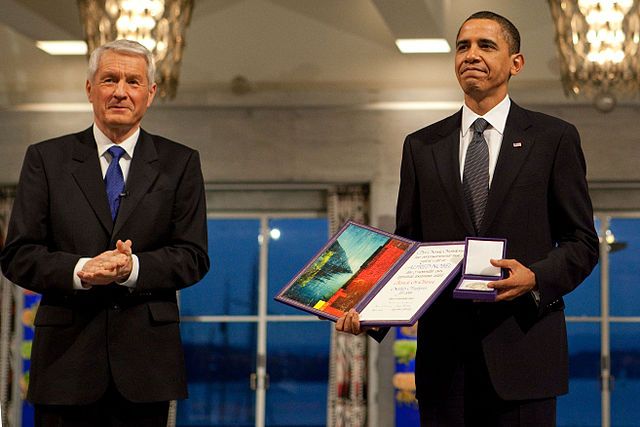
(Photo: / White House, Samantha Appleton /Public Domain)
The Nobel Peace Prize gets its prestige and press coverage because it reinforces several big narratives. If it should deviate too much from what the powerful want, it would be ignored. Of prime importance is the notion that we are the good, and we have a monopoly on interpreting reality and to decide what is important. (‘We’ in this context being people in the West, and by extension their governments and leaders). During the Cold War, the prize had a similar function. It would be interesting to take a closer look at it, but for practical purposes this analysis will mostly be limited the last 30 years. Once you start to notice certain basic themes, they are rather obvious. To put it pointedly, the Nobel Peace Prize tries to aid regime changes to achieve the Empire’s aims where it is possible to avoid direct war, but it will aid in confirming the narrative that our troops are good guys.
This explains why Western leaders so often get the prize. The point is creating an impression that there exists a more humane possibility within our current unjust world system. When they receive it, what they have actually done is not an issue. Hence the award to people like Jimmy Carter (winner 2002); as president he instigated several bloody covert interventions in Central-America, Africa and of course the Islamist fighters in Afghanistan, but has since then opposed direct US wars; or Al Gore (winner 2007), who when he was vice president didn’t shy away from using the military as a foreign policy tool (see part 7). The prize to Barack Obama (winner 2009) can be placed here.
But the main use of the prize is to create support in Western liberal opinion for interventions that would otherwise be naked imperialistic aggression.
2. A FOCUS FOR REGIME CHANGE OPERATIONS
Where a Nobel Peace Prize is awarded to a dissident of a non-western country, the CIA or the Pentagon (see point 3) often has a task force working on cracking the exact same country.
The winners have varying degrees of internal appeal in the targeted country, but the main purpose in choosing these people is not to boost their standing internally, but to justify attempts at regime change to Western liberal public opinion. Without the focus on these martyrs, these operations would look suspiciously like old style colonial domination.
Hence the beatification of Aung San Suu Kyi (winner 1991) coincided with a concerted campaign to get control over a recalcitrant, but very strategic country. Suu Kyi is in many ways typical of the people the Committee prefers. She is a known entity, having conspicuously strong personal connections to the former colonial power – Oxford educated, married to a British citizen, her children are British citizens, etc. Signaling in which direction her political compass was oriented, she asked the world to use the old colonial name Burma instead of Myanmar. She asked for harsh measures against her own country (for its own good) fitting hand in glove with the US strategy actually used. In fact, all means would be permissible to use against this regime imprisoning a modern day saint.
The Nobel Prize to Suu Kyi played an invaluable role in creating huge support, especially on the liberal left, for the draconian economic sanctions against an otherwise fairly obscure country. And maybe many of her Western supporters actually did believe that the US and UK could fund her with large sums of money and create entire NGO-networks for her with the expressed goal of subverting a sovereign nation’s government, and her intentions to still be pure and progressive.
Myanmar is immensely rich in natural resources and is positioned between China and the Indian Ocean, and China and India. Any significant land connection between these two 21st century great powers would have to go through Myanmar to avoid the Himalayas. It is also of great Chinese interest as a transit country to the Indian Ocean. Therefore, the country was targeted with a multi-approach regime change operation.
A massive press campaign was arranged over several decades, a plethora of NGOs financed, whilst “former” CIA-agents now turned missionaries were working with the ethnic guerilla forces to create military pressure. In the usual attempt to concentrate all opposition into a joint force, extreme right wing religious fanatics became the spearhead in this campaign. The sanctions imposed on Myanmar, precluded any economic development and doomed the population to a life of crushing poverty.
One could interpret the recent calls to take the prize back from Suu Kuy as disappointed buyers not getting what they paid for.
We can go forward to 2010, when a Chinese citizen, Liu Xiaobo, won the prize. There were no surprises for what future was envisaged for China:
It took Hong Kong 100 years to become what it is. Given the size of China, certainly it would need 300 years of colonisation for it to become like what Hong Kong is today. I even doubt whether 300 years would be enough.”
The lines between creating justification for a covert regime change operation and next step, a direct war, is blurry. But when required, the Prize Committee can step in to keep the focus of world opinion on the right narrative.
3. CREATING REASONS FOR WAR: WOMEN’S RIGHTS
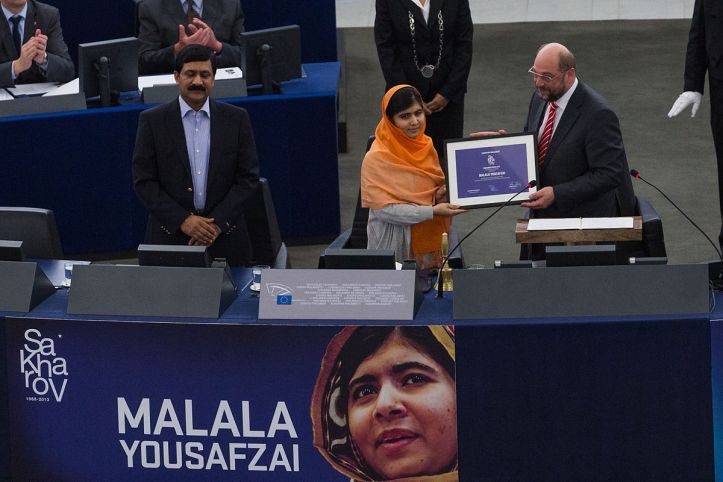
Malala Yoysafzai receives the Sakharov prize © Claude Truong-Ngoc / Wikimedia Commons
In 2003, just after the blitzkrieg on Iraq and at the very height of the George Bush’s talk of continuing the offensive to a few more countries, the committee chose to give the prize to Shirin Ebadi. By beatifying an Iranian at that time, the committee very well knew that they increased the danger of war.
Ebadi is a champion of women’s rights, a recurrent theme in NATO’s efforts to justify their wars. We know that targeting women in the West with this type of messaging has been a major effort for the organization for a long time. By giving the prize to her, they in effect created support in Western (female) public opinion for a war/regime change that would kill an untold number of Iranian women and destroy the lives of the rest, a repeat on a larger scale of what happened in Iraq.
The 2018 prize went to the fight against sexual violence in war. This happens to coincide with the very image NATO wants to promote of itself – who can forget Angelina Jolie and NATO’s General Secretary Jens Stoltenberg writing a joint article in 2017 titled “Why NATO Must Defend Women’s Rights,” where they point out that “NATO has the responsibility and opportunity to be a leading protector of women’s rights” and “can become the global military leader in how to prevent and respond to sexual violence in conflict”. How convenient that the Nobel Committee shares the same view.
A more analytic approach would point out such facts that US/NATO-interventions have made the situation for women infinitely worse in places such as Iraq, Libya and Afghanistan. An intervention to topple the legal government in Syria would certainly have created the same result.
In addition, a bit broader view would point out how allegedly stopping sexual violence against women has justified many wars of aggression. The stereotypes of cruel foreigners have not advanced noticeably from depictions of swarthy Spaniards groping blonde women in the Spanish-American war, to the claim that Gaddafi was handing out Viagra to mercenaries to rape women, as Susan Rice, the US Permanent Representative at UN told the Security Council. Amnesty International, later reported it had “not found any evidence or a single victim of rape or a doctor who knew about somebody being raped.”
Other notorious examples of how this has been used in war propaganda include Serbian rape camps during the Yugoslav wars. Allegations of mass rape were a key element of NATO’s propaganda campaign during the 1999 bombing of Yugoslavia. Clare Short, Britain’s international development secretary, claimed that the rapes were “deliberately performed in front of children, fathers and brothers.” After the war was over, there were some retractions, including from the Washington Post, which reported that “Western accusations that there were Serb-run rape camps […] all proved to be false.”
Malala Yousafzai (winner 2014), the young Pakistani girl who became a symbol of the war against the Taliban, is another figure that fits this pattern. The indefinite occupation of Afghanistan is, among plenty of other vicarious reasons, justified by improving women’s rights. This overlooks the fact that no improvement can be made under a government installed with the help of foreign bayonets. The situation for Afghan women has not improved since the occupation, but then again, the claim was only meant to create support for the war in public opinion.
The importance of creating the perception of fighting for women’s rights has long been realized in military circles.
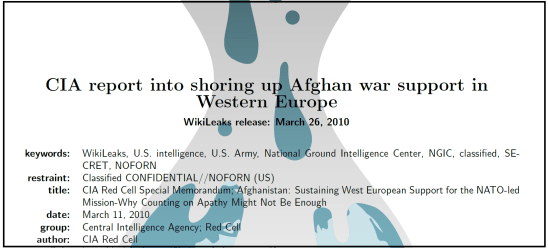
An internal CIA-document from 2010 (a few years before Malala received the prize from the Nobel Institute for her struggle against the Taliban), published by WikiLeaks, discusses how to best market the war in Afghanistan, To show how similar the Nobel Committee and the military/intelligence apparatus think, it is worth quoting the following passage:
Afghan women could serve as ideal messengers in humanizing the ISAF role in combating the Taliban because of women’s ability to speak personally and credibly about their experiences under the Taliban, their aspirations for the future, and their fears of a Taliban victory. Outreach initiatives that create media opportunities for Afghan women to share their stories with French, German, and other European women could help to overcome pervasive skepticism among women in Western Europe toward the ISAF mission.
4. THE ENEMY FIGHTS WITH ILLEGAL AND INHUMANE WEAPONS, AND IT IS IMPERATIVE TO STOP THEM
By highlighting certain themes, in this case ‘illegal weapons’, they reinforce the narrative in Western public opinion that certain things are very urgent and real problems, when in fact they are of relatively minor significance.
Poison gas is a clear example. The OPCW won the prize in 2013. Given the general situation in the Middle East, several million dead in Iraq after the US invasion and at least 400.000 dead in the covert invasion of Syria, gas is a minor factor, and even if we take the frequent claims of ‘gas massacres’ at face value (which of course we shouldn’t), is only responsible for an infinitesimal fraction of these dead.
But to reinforce a false narrative, this focus has been invaluable. The prize creates acceptance for the narrative that gas is a uniquely important and evil weapon, where it is fully justified to do anything necessary, including attacking countries, to stop the possible use of it. At the moment of writing this, Nov 24, 2018, the US just accused Iran of hiding a chemical weapons program.
Some weapons that are killing far more people in far more gruesome ways than poison gas, like napalm, would never be put on this list. And we could compare gas to sanctions, the West’s favorite and most effective weapon of mass destruction, killing the weakest, the sick, children and old people slowly, while destroying entire peoples’ right to a decent life. No other or weapon of mass destruction has killed as many people since WW2.
5. SANCTIFYING PEACE TREATIES THAT ARE NEGOTIATED SURRENDERS TO WESTERN INTERESTS

Yasser Arafat receives the prize in 1994, together with Israeli Foreign Minister Shimon Peres, Israeli Prime Minister Yitzhak Rabin CC BY-SA 3.0 File:Flickr – (GPO)
The most noticeable feature when the prize goes to creators of peace treaties, is that the treaties are more like a negotiated surrender than a just peace.
Colombia’s president Juan Manuel Santos (winner 2016) received the prize for victoriously having put the finishing touches to a long US-led counter-insurgency campaign against leftist guerilla forces. Now the reactionary oligarchy has a safe grip on the country, and can continue their neoliberal agenda, which isn’t that different from the old reactionary order. The death squads murdering leftist and human rights activist continue their activities with impunity.
The country had an extremely tarnished image in human rights issues and needed a quick touch-up to make it palatable. The most conspicuous thing the 2016-award is that the president got the prize just before Colombia became a global partner of NATO. The planning of the PR-requirements for this to happen smoothly must have been already well under way when the prize winner was decided. Remember the prize is directed at Western public opinion, and has little to do with an actual just peace in Colombia.
Yasser Arafat (co-winner 1993) got the prize so he would be tied to a peace plan with a chimerical two-state solution the Israeli side had no intention of honoring. The peace offer didn’t even include a stop in construction of Israeli settlements. No clearer signal of Israeli intentions could have been given. This is a continuation of the joint prize to Sadat and Begin in 1978, for the peace treaty between Egypt and Israel, where Israel succeeded in making a separate peace with the biggest Arab country, and could thereafter concentrate on consolidating its grip on the West Bank.
While Nelson Mandela (co-winner 1994) undoubtedly was a worthy winner, the transition deal the ANC negotiated for South Africa only transferred formal political power, and left unjust economic power structures intact. The assets of multinational companies were guaranteed, and the neoliberal policies implied in the deal doomed the large majority of the population to continued poverty.
Michail Gorbachev (winner 1990) got the prize for a unilateral and wholesale surrender of every Soviet position, both economic and political; he didn’t even keep them as bargaining cards. Trusting Western oral promises, this naiveté is unprecedented in a leader of a great power. His bad decisions made a managed transition to a mixed system impossible and abandoned the former socialist states to Western looting and a social collapse they still haven’t recovered from. No wonder he still is so popular in the West that gave him the medal as a sign of appreciation.
Finnish Martti Ahtisaari got the prize in 2008, «for his efforts on several continents and over more than three decades, to resolve international conflicts». This is very true. Left out is what should be added to the sentence, to resolve international conflicts – as a total Western victory.
Ahtisaari is directly linked to the creation of the NATO-protectorate of Kosovo. By 1999, NATO had decided to splinter Yugoslavia one more time. A 78 day aerial bombing campaign had little effect, so they sent in the diplomats. It was suggested that an envoy from a ‘neutral’ country would be more efficient. Here is how Ahtisaari handled the situation, telling the Serbs what ‘we’ would do (my emphasis):
Ahtisaari opened the meeting by declaring, “We are not here to discuss or negotiate,” […]. Ahtisaari says that Milosevic asked about the possibility of modifying the plan, to which he replied, “No. This is the best that Viktor and I have managed to do. You have to agree to it in every part.” [..] As Milosevic listened to the reading of the text, he realized that the “Russians and the Europeans had put us in the hands of the British and the Americans.”
Milosevic took the papers and asked, “What will happen if I do not sign?” In answer, “Ahtisaari made a gesture on the table,” and then moved aside the flower centerpiece. Then Ahtisaari said, “Belgrade will be like this table. We will immediately begin carpet-bombing Belgrade.” Repeating the gesture of sweeping the table, Ahtisaari threatened, “This is what we will do to Belgrade.” A moment of silence passed, and then he added, “There will be half a million dead within a week.”
The Serbians signed the treaty.
6. NOT A PEACEFUL VERY BUNCH OF PEOPLE
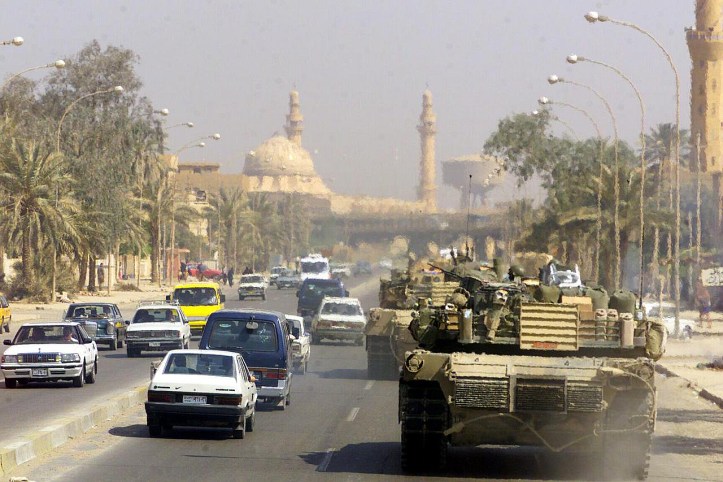
US Marine Corps tank in Baghdad, 2003 (Photo: USMC/ Public Domain)
For recipients of a peace prize, a remarkable number of them support wars.
The invasion of Iraq in 2003 was a war of aggression under the trumped up pretext of disarming Iraq of Weapons of mass destruction. It was a blatant breach of both international law and the United Nations Charter. What did the Nobel Prize Winners think of it?
Here we have Elie Wiesel (winner 1986): “I now know I was wrong, but better that than to have stood idly by”.
Jose Ramos-Horta (winner 1996) claimed approvingly that the only truly effective means of pressure on the Iraqi dictator [is] the threat of the use of force.
Liu Xiaobo (winner 2010) was clear, the “decision by President Bush is right!”. But then again, Liu had the remarkable opinion that “the major wars that the US became involved in are all ethically defensible,” including the wars in Afghanistan and Vietnam.
Former vice president Al Gore (winner 2009) had argued aggressively in favor of war in Iraq in 1991 and 1998, Bosnia in 1995 and Kosovo in 1998, and believed the 2003 Iraq war was legal based on earlier UN resolutions.
The Cold War winner Lech Walesa (1983) was an opponent of the invasion, but at least he knew where to put the blame: “It’s not the United States that is to blame for the war, but rather the EU, and in particular Germany and France. They knew the war was coming and they failed to prevent it.”
The Dalai Lama (winner 1989) was wily enough to hedge his bets, but decidedly did not condemn the war: “it’s too early to say, right or wrong”, He also supported the US/NATO military intervention in Afghanistan and the attack on Yugoslavia.
There is a similar level of support among prize winners for a direct intervention in the ‘civil’ war in Syria, a US/NATO regime change plan on the drawing board for at least 10 years before it started. The push for a no-fly zone in Syria on a Libyan model, which could then be used as a fig leaf for a full-scale assault, was immense for several years. What did the Nobel Prize winners think of this possibility?
(Keep in mind that the ‘action’ they call for, can only be either an aerial bombing or ground troops.)
Kailash Satyarthi (winner 2014) did not say anything about the fact that it was the 3 Western powers on the Security Council which started this war by spending billions of dollars arming and financing armed Islamist gangs. Stopping this support would seem to be the obvious way to stop the war, but instead we get: “The UN Security Council (UNSC) has the military power to bring this unceasing genocide to a halt.”
His co-winner Malala Yousafzai who seems to have envisaged a similar future for Syria as for Afghanistan, a Western intervention: “When I look at Syria, I see the Rwandan genocide. When I read the desperate words of Bana Alabed in Aleppo, I see Anne Frank in Amsterdam… We must act. The international community must do everything they can to end to this inhumane war”
This was echoed by former UN-leader Kofi Annan (winner 2001). Defining Aleppo as only the small part of the city occupied by Islamist gangs, he called for ‘action’. How this ‘action’ would differ from what he describes, is not clear: “The assault on Aleppo is an assault on the whole world. When hospitals, schools and homes are bombed indiscriminately, killing and maiming hundreds of innocent children, these are acts that constitute an attack on our shared, fundamental human values. Our collective cry for action must be heard, and acted upon, by all those engaged in this dreadful war.”
This wish was supported by Medecins sans Frontiers, recipient of the 1999 Nobel Peace Prize. It was the first to report the alleged gas attack in Ghouta on 21. August 2013, which the Obama-administration wanted to use as a pretext for a military assault. As it admitted, the MSF’s decision to issue a press release on the incident—which had not taken place in an MSF hospital, but in its “silent partner” facilities in rebel-controlled areas—was highly political.
MSF was well aware that their announcement of chemical weapons use would be immediately seized upon by the US to claim that Syrian President Assad had crossed a red line, and to start a bombing campaign.
The organization was here true to its roots, as the civilian part in the French military/intelligence effort to support an independent state in the oil producing parts of Nigeria, in the Biafran war of independence in 1967-1970.
Amnesty International, (winner 1977) was not much better, with its call for unspecified ‘action’: “The international community’s catastrophic failure to take concrete action to protect the people of Syria has allowed parties to the conflict, most notably the Syrian government, to commit war crimes and crimes against humanity with complete impunity, often with assistance of outside powers, particularly Russia… the international community had said ‘never again’ after the government devastated Eastern Aleppo with similar unlawful tactics. But here we are again.”
Anyway, Amnesty has a soft spot for endless NATO-interventions. In 2012, after 11 years of dismal occupation, the organization paid for advertising posters in the US applauding NATO’s actions in Afghanistan — “Keep the progress going”, purportedly doing something for women’s rights.
Tawakkol Abdel-Salam Karman is a Yemeni journalist and human rights activist that won the prize in 2009 wanted ‘protection’, writing: “Instead of protecting residents in Aleppo from brutalities of Russia, Iran and Bashar Al Assad’s regime, the world tended to mediate to provide safe corridors for the displacement of civilians,” adding, “these also are partners in crime.”
Colombian President Juan Manuel Santos (2016) voiced support for the missile attacks on Syria in March 2018.
Such bellicosity (or just as often, coy bellicosity) is nothing new in the type of people selected as winners. Henry Kissinger (winner 1973) was the most infamous war hawk to win the prize during the Cold War, but as long as it was the right side doing the fighting, plenty of others identified with this one sided world view. We can recognize all the themes mentioned above in Michael Parenti’s description of the 1975 Peace Prize winner:
Andrei Sakharov was a darling of the U.S. press, a Soviet dissident who regularly sang praises to corporate capitalism. Sakharov lambasted the U.S. peace movement for its opposition to the Vietnam War. He accused the Soviets of being the sole culprits behind the arms race and he supported every U.S. armed intervention abroad as a defense of democracy. Hailed in the west as a «human rights advocate,» Sakharov never had an unkind word for the horrific human rights violations perpetrated by the fascist regimes of faithful U.S. client states, including Pinochet’s Chile and Suharto’s Indonesia, and he aimed snide remarks at the «peaceniks» who did. He regularly attacked those in the West who opposed U.S. repressive military interventions abroad.
7. Some other points + Conclusion
You don’t have to be an prop for US/NATO power projection to win the prize, but it helps.
The prize was originally intended to be given to the person who has done most to foster peace between nations. In a subtle twist, in many cases it has changed to banning aspects of warfare, barely ever addressing war itself. Broaching such a subject honestly would be impossible without addressing the elephant in the room, US/Western imperialism. The award has had many winners who are variants of this year’s theme, sexual violence in war (which also touches on point 3, the NATO-narrative of defense of women). The focus here is on a more civilized form of war, not abolishing war as such as a means of settling disputes.
No one (apart from some military brass) is actually pro-landmines, but the Peace prize to the Campaign Against Land Mines in 1997 coincided with the increased Western interventions in places where these weapons would be a hindrance to the success of the occupation It was not in the interest of NATO forces to have their opponents using these ‘poor man’s weapons’, creating the casualties so feared by the military in modern wars, which again might increase opposition at home to war. The coalition suffered most of their casualties from IEDs, a sort of land mine, in Iraq, while having limited use of mines themselves.
There is a certain unpredictability as to who the prize will be awarded to, making it not as obviously beholden to the immediate needs of the powerful, even though the long term trend is clear. For example, there has been no Russian winner for quite a while now, and the White Helmets have not yet got the award, maybe as they are too obviously only a PR-front.
When Jean-Paul Sartre declined the Nobel Prize in Literature, he said that the prize ‘is for Western writers or Eastern rebels’. On a similar note, we might say that the Nobel Peace Prize is for Western elites or Eastern rebels.
That the selection of winners conforms to US views does not mean that there is a direct influence, although some recommendations to the Committee probably weigh heavier than others. Rather this pattern is a sign of how well socialized the Norwegian Nobel Committee members are in the transatlantic world view, where ‘our’ requirements override any genuine wish for peace.
Loophole in Bernie Sanders’ Yemen Bill Actually Allows Continued US Involvement in Yemen
By Whitney Webb | Mint Press News | December 3, 2018
Last week, many celebrated the advancement of Senate Joint Resolution (SJR) 54, which had been introduced by Senator Bernie Sanders (I-VT), as a sign that the U.S. Congress was finally willing to act to reduce the U.S.’ culpability for the situation in Yemen, currently the world’s worst humanitarian crisis.
The bill, which will be voted on by the Senate this week, has been praised by many within the anti-war movement for its bid to “end” U.S. military involvement in Yemen. Passage of the bill would, however, do no such thing.
Much of the media coverage of the bill has noted that the resolution invokes the 1973 War Powers Resolution, which prohibits the president from deploying U.S. troops into armed conflicts without congressional approval. Though that resolution has been ignored many times since its passage, particularly since the War on Terror began in 2001, SJR 54 has been promoted as a “progressive” effort to bring the U.S.’ military adventurism to heel at a time when Saudi Arabia — one of the two countries leading the war against Yemen – is under increased scrutiny.
Yet, the text of the bill itself reveals that SJR 54 invokes the War Powers Resolution in name only. Indeed, while the bill claims to be aimed at achieving “the removal of United State Armed Forces from hostilities in the Republic of Yemen that have not been authorized by Congress,” it contains a major loophole that will allow the majority of U.S. troops in Yemen – if not all – to stay.
As the bill states, it will require the president to remove troops “except United States Armed Forces engaged in operations directed at al Qaeda or associated forces.” Notably though, the only U.S. troops “on the ground” in Yemen that are involved in “hostilities” (i.e., combat operations) are those that are allegedly involved in operations targeting Al Qaeda — operations that the U.S. frequently conducts jointly with the countries waging war against western Yemen, such as the United Arab Emirates.
U.S. troops deployed in Yemen to target Al Qaeda in the Arabian Peninsula (AQAP) also collaborate with the UAE and Saudi Arabia in “intelligence sharing,” “midair refueling,” and “overhead reconnaissance” for forces involved in counterterrorism operations that the U.S. is leading. This cooperation is what the very text of SJR 54 claims to want to end, but only in regard to the coalition’s war in western Yemen. However, the current text of the bill would allow all of this cooperation to continue, just not in areas where there are no claims of AQAP presence.
Thanks to the loophole in SJR 54, all that would need to change for the U.S. military’s assistance to the Saudi/UAE coalition to remain as is would be for either the Saudis, Emiratis or the U.S. to claim that there is an AQAP presence – however small – in an area they wish to target. Given that AQAP regularly collaborates with coalition forces elsewhere in Yemen, the coalition would only need move AQAP forces near a site in western Yemen that they wish to bomb in order for U.S. military involvement in its war against Yemen’s resistance to continue unimpeded.
 Alternatively, either of those countries could supply “intelligence” that would seek to link Yemen’s resistance movement Ansarullah or the Houthis to AQAP, thus allowing U.S. involvement in the coalition’s war in Yemen to continue unchanged. This is a very likely scenario if SJR 54 is passed given that some top Trump administration officials have a history of providing false intelligence in order to justify aggressive policies and push for military intervention abroad. Furthermore, the Trump administration also has experience linking countries it doesn’t like to Al Qaeda without evidence in order to justify such policies. Thus, linking Yemen’s resistance movement to AQAP despite a lack of evidence is something the Trump administration would likely pursue were this bill to pass in its current form.
In addition, the Sanders-introduced bill will do nothing to stop the U.S.’ use of drone strikes that regularly kill scores of civilians in Yemen. Indeed, a recent investigation conducted by the Associated Press found that at least one-third of all Yemenis killed by U.S. drone strikes in Yemen were civilians, many of them children. Even though U.S. intelligence has regularly shown that the U.S. drone war in Yemen actually strengthens AQAP, this bill would do nothing to stop the U.S. military’s deadliest practice in Yemen, with a documented history of murdering civilians.
The bill’s failure to touch on the U.S. drone war in Yemen is unsurprising given that Bernie Sanders — who introduced SJR 54 — supported drone strikes and the controversial “kill lists” during the Obama administration. Furthermore, when asked on Meet the Press in 2015 if his foreign policy if elected President would involve the use of drones and Special Forces in military operations overseas, Sanders stated that it would involve “all of that and more.”
SJR 54 as mostly kabuki
Given the fact that SJR 54 provides a huge loophole that would prevent it from having the advertised effect, it seems that the measure is meant to serve other purposes, namely political, instead of its stated purpose of ending U.S. military involvement in Yemen. The bill appears to be little more than a PR stunt by Democrats and Democratic-aligned senators to distance themselves from Republicans.
This is supported by the fact that not a single Democrat in the Senate voted against the bill last week, while several Senate Democrats had voted against it earlier this year, setting up the case that only Republicans are against halting the U.S.-backed war in Yemen. Another suggestion that this is the case is how the media widely reported the vote as a “rebuke” of President Trump, as is the fact that 2020 Democratic presidential hopefuls, such as Cory Booker and Elizabeth Warren, co-sponsored this bill even though they both hold pro-war positions regarding another Middle Eastern country, Iran.
The “anti-war” credentials of Warren — as well as Bernie Sanders, who wrote SJR 54 — have long been questionable, particularly after they both backed James Mattis as Secretary of Defense even though he had led the U.S. assault on the Iraqi city of Fallujah in 2004, an attack that killed thousands of civilians and used chemical weapons that still cause birth defects in those born in Fallujah over a decade later.
Though the death of Saudi journalist and U.S. resident Jamal Khashoggi has been blamed for the change of heart of Senate Democrats and some Republicans, reporting from MintPress and others has shown that the “outrage” regarding Khashoggi’s death is not about “human rights” but about money and pushing Saudi Crown Prince to move forward with expensive weapons deals and the neoliberalization of Saudi state assets that he had tried to back away from. Viewing the situation from this lens, SJR 54 seems little more than a PR effort to cast Democrats as “anti-war” when they are just as beholden to the military-industrial complex as the Republicans.
Yet, most importantly, the toothless text of SJR 54 shows that relying on either of the corporate, war-loving political parties in the U.S. to end the country’s involvement in the war in Yemen is misguided, as such action if more likely to come about from sustained public pressure or grassroots activism than from politicians beholden to special interests such as the Saudi or weapons lobbies.
Whitney Webb is a staff writer for MintPress News and a contributor to Ben Swann’s Truth in Media. Her work has appeared on Global Research, the Ron Paul Institute and 21st Century Wire, among others. She has also made radio and TV appearances on RT and Sputnik. She currently lives with her family in southern Chile.
Canadian Jewish News Promotes ‘Terror Tourism’

By Yves Engler | Palestine Chronicle | December 3, 2018
What should we make of a media outlet that praises those who join or give money to a foreign army, which occupies territory belonging to another people, terrorizes the local population by destroying houses, restricting their movement, subjecting them to military courts and shooting unarmed protesters?
What should we call the Canadian Jewish News, an unfailing flatterer of Canadians who join or finance a military subjugating Palestinians? Would “promoter of terror tourism” be an appropriate description?
Over the past month the CJN has published at least four pieces celebrating Canadian support for the Israeli military. On November 22 it reported, “Bayli Dukes, who recently won the Israel Defence Forces’ Award of Excellence for the Southern Command of the IDF, was a biology student at York University in Toronto less than two years ago. Tired of sitting on the couch and posting on Facebook about the situation in Israel, she decided there was more she could be doing.”
A day earlier it posted an article titled “Hand-knitted tuques – a very Canadian gift for IDF soldiers” described 80-year olds in Toronto knitting “for charitable causes, such as IDF soldiers in Israel.” Through the Hats for Israeli Soldiers initiative “more than 50,000 hats have been made for combat soldiers on Israel’s front lines”, the CJN reported. The paper quoted IDF soldier Dovid Berger’s thank you letter. “I’m currently a chayal in the 51st brigade of Golani. We are now on our way to a week-long drill in the cold and wet [occupied Syrian] Golan Heights, and last night we received our beautiful black hats you sent us. Thank you so much, some of us have been borrowing each other’s hats and now there’s enough for everyone to have at least one. It really makes a big difference to us to see how people from Canada and the U.S.A. (and everywhere in the world) are really caring about us.”
A photo in its November 14 print edition was titled “Honouring IDF veterans”. The caption read: “former Israeli defense minister Moshe Yaalon … makes presentation to Montrealers who served in the Israel Defence Forces…. during the Canadian Institute for Jewish research’s 30th anniversary Gala.”
An October 30 piece in the community paper reported, “former NHL player Keith Primeau was among more than 100 Canadians who cycled through Israel over five days this month, to raise funds for disabled veterans in that country. This was the 11th Courage in Motion Bike Ride, which is organized by Beit Halochem Canada.”
The CJN regularly promotes that organization. A search of its database for “Beit Halochem” found dozens of stories about fundraisers and other initiatives supporting Aid to Disabled Veterans of Israel. A 2009 story titled “Israeli veterans enjoy 24th visit to Montreal” reported, “the annual visit was sponsored by the 25-year-old Beit Halochem Canada (Aid to Disabled Veterans of Israel), which raises funds for Israel’s Beit Halochem, a network of centres that provide therapy and support to more than 51,000 disabled vets and victims of terror.”
Another military initiative CJN promotes is Israel Defence Forces Widows & Orphans, which is partly funded by the Israeli government. “I served three years in the Nahal Brigade. I was in Lebanon, the West Bank and the Gaza Strip”, Shlomi Nahumson, director of youth programs at Widows and Orphans, told the paper in advance of a Toronto fundraiser for the group.
Another military initiative popular with CJN is Sar-El, which was founded by Israeli general Aharon Davidi in 1982. “Toronto brothers volunteer for Sar-El at height of war”, “91-year-old volunteers on Israeli army base” and “Toronto artist’s mural unites Israeli army base” are a sampling of the headlines about a program in which about 150 Canadians serve each year as volunteers on Israeli army supply bases.
At least a dozen CJN stories have promoted the Association for the Soldiers of Israel in Canada. “IDF represents all Jews, female general says” and “Community shows support for Israeli soldiers”, noted headlines about a group established in 1971 to provide financial and moral support to active duty soldiers. The later story quoted a speaker claiming, “the IDF saves lives, and not just in Israel — all over the world.”
CJN has published a series of stories sympathetic to Tzofim Garin Tzabar, which recruits non-Israeli Jews into the IDF. A 2004 article about a program supported by the IDF, Israel Scouts, Jewish Agency and Ministry of Absorption was titled “Canadian youths serve in IDF: Motivated by Zionist ideals, love of Israel.” It reported, “[Canadian Yakov] Frydman-Kohl is attending tank school at an Israeli army base somewhere near the West Bank town of Jericho. He recently completed a course in advanced training before his first deployment somewhere in the Gaza Strip.”
CJN lauded Heather Reisman and Gerry Schwartz’ Heseg Foundation for Lone Soldiers. “Philanthropists aid Israeli ‘lone soldiers’”, was the title of one story about the billionaire Toronto couple providing millions of dollars annually for these non-Israeli soldiers.
More generally, the paper has published numerous stories about Canadian ‘lone soldiers’. “Going in alone: the motivations and hardships of Israel lone soldiers”, “Parents of ‘lone soldiers’ discuss support group” and “Lone soldiers: young idealists and worried parents”, detailed Canadians fighting in the Israeli military. They’ve also publicized numerous books about Canadian and other non-Israelis joining the IDF. In one CJN quoted Abe Levine, an Ontarian who helped drive Palestinians from their homes in 1948, saying, “what I don’t understand is why Israelis don’t send 10 rockets back for every one fired from Gaza.” The story continued, “during his time in the Machal [overseas military volunteers], Levine saw most Arabs as ‘the enemy.’ Though he said he had lines he would not cross – ‘I wouldn’t kill an Arab if I just saw him standing outside his house.’”
CJN promoted Nefesh B’Nefesh’s (Jewish Souls United) recruitment of Canadians to the IDF. “Nefesh B’Nefesh brings aspiring soldiers to Israel”, noted a headline about a group that facilitates “Aliyah” for those unsatisfied with their and their ancestors’ dispossession of First Nations and want to help colonize another indigenous people.
While CJN provides positive publicity to groups promoting the Israeli military, these groups (often registered Canadian charities) finance the paper. The previously mentioned story about Nefesh B’Nefesh ended with “the reporter’s trip was partly subsidized by Nefesh B’Nefesh.” More significantly, these organizations regularly advertise in the paper. “Express your Zionism by serving as a civilian volunteer on an Israeli army supply base”, read a Sar-El ad while another noted “the Association for the soldiers of Israel invites you to show your support for the brave youth of the IDF at our gala dinner.”
Yet, while it promotes joining and financing a military actively killing Arabs, CJN accuses Palestinian Canadians of supporting terrorism. An August headline noted, “Canadian Arabic-language newspaper criticized for pro-terrorist op-ed” while a 2017 one stated, “B’nai Brith wants a Mississauga teacher fired for backing terrorists”.
The hypocrisy is glaring. While CJN accuses others, it may be this country’s biggest promoter of “terror tourism”.
– Yves Engler is the author of Canada and Israel: Building Apartheid and a number of other books. Visit his website: yvesengler.com.
US Destabilizes Iraq for Decades, US House of Representatives Has New Plan for Stabilization
By Adam Dick – Ron Paul Institute – November 28, 2018
The United States attacked Iraq in the Gulf War in 1990, followed by years of US bombing of Iraq. Then, in 2003, the US invaded and conquered Iraq in the Iraq War. Since then, many US troops have been stationed in Iraq, along with a huge contingent of US government employees and contractors from a variety of agencies, seeking to mold the country to US wishes. Still, 28 years since all this began (and longer since the previous US assistance for the Iraq government it later overthrew), the US House of Representatives approved on Tuesday a bill titled the Preventing Destabilization of Iraq Act (HR 4591).
The only way this bill title would make sense given the long history of massive US intervention failing to improve the situation in Iraq is if the bill required the end of US intervention. Instead, the bill seeks more intervention.
In particular, the Preventing Destabilization of Iraq Act calls on the US president to impose sanctions on any foreign people he determines knowingly commit “a significant act of violence that has the direct purpose or effect of — (1) threatening the peace or stability of Iraq or the Government of Iraq; (2) undermining the democratic process in Iraq; or (3) undermining significantly efforts to promote economic reconstruction and political reform in Iraq or to provide humanitarian assistance to the Iraqi people.” Further, the bill charges the US Secretary of State to determine if listed individuals should be sanctioned and if people connected to certain organizations should be considered terrorists or sanctioned. In other words, the bill calls for ramping up proven destructive policies for reshaping Iraq.
Also included in the bill is a call for action that would help push for escalating the US government’s destabilization project in Iran. The bill says the Secretary of State “shall annually establish, maintain, and publish a list of armed groups, militias, or proxy forces in Iraq receiving logistical, military, or financial assistance from Iran’s Revolutionary Guard Corps or over which Iran’s Revolutionary Guard Corps exerts any form of control or influence.” Thus, claims of Iran’s intervention in its neighboring country can be used to build the case for massive intervention in Iran, up to invasion and conquest of Iran, by a nation thousands of miles away. Not to worry, 28 years from now, the US Congress can approve a Preventing Destabilization of Iran Act.
OPCW rejects US bid for Palestine’s exclusion from Prohibition of Chemical Weapons
MEMO | December 2, 2018
Palestinians have aborted US attempts to exclude Palestine from the Organisation for the Prohibition of Chemical Weapons (OPCW), the foreign minister said Saturday.
Riyad al-Malki said the Palestinian delegation to the OPCW’s Fourth Review Conference has rejected “US attempts to add an article in the final document to cast doubts on the membership of Palestine” in the watchdog.
“Most member states have defended Palestine’s right to equal representation with other states,” he added in a statement.
Palestine officially joined the world’s chemical weapons watchdog in June.
The top Palestinian diplomat went on to vow to pursue efforts to bring Israel to accountability for using chemical weapons against the Palestinians.
OPCW member nations have failed to agree on a final document at the conference, which was held in The Hague on November 21-30.
The OPCW, an international chemical weapons watchdog, has been servicing as the implementing body for the Chemical Weapons Convention since its entry into force in 1997.
Hamas condemns recent Israeli aggression on Syria
Palestine Information Center – December 1, 2018
GAZA – Islamic Resistance Movement, Hamas, on Saturday condemned the latest Israeli aggression on Syria.
Member of the Hamas Political Bureau Khalil al-Hayya said in statements to the PIC that the world should realize that Israel is the real threat to the region and international peace.
Al-Hayya called on the world countries to put an end to Israel’s aggression before it destroys the whole region.
“We condemn in principle any Israeli aggression on an Arab or Muslim land, because it comes from an occupying state that sees itself above the law,” he added.
Israeli warplanes on Thursday launched several airstrikes on different targets in Damascus countryside and southern Syria.
Syria shoots, downs ‘hostile targets’ following Israeli attack
Press TV – November 30, 2018
Syria has shot down “hostile targets” following an Israeli attack south of the capital Damascus and foiled its goals despite the “intensity of the aggression,” state media said on Friday.
A military source did not specify the targets but dismissed earlier reports that an Israeli war plane had been downed.
Syrian air defenses responded to the attack aimed at the town of Kiswah, south of the capital Damascus Thursday night, destroying at least five missiles.
They “were able to foil its goals despite the intensity of the aggression,” state media said.
Israeli media claimed that Iranian military advisers as well as fighters from Lebanese resistance movement Hezbollah were the main target in the attack.
Israel claims that Iran’s presence in Syria as part of an advisory mission requested by Damascus poses a threat to the regime’s security. Using this pretext, Tel Aviv has struck alleged positions of Iranian and Iran-backed forces across Syria over the course of the seven-year conflict.
The attacks are usually viewed as attempts to prop up terrorist groups that have been suffering defeats at the hands of Syrian government forces.
Israel and the US have even put pressure on Russia, another close ally of Syrian President Bashar al-Assad in the war against terrorist groups, to force Iran out of Syria.
Russia says Iran’s presence in Syria is at the official request of the Syrian government and other parties are not in a position to interfere with this issue.
In October, Moscow equipped Damascus with the advanced S-300 surface-to-air missiles, days after Israeli fighter jets attacking Syrian targets used a Russian surveillance plane flying nearby as a shield and misled the Syrian air defenses to shoot it down.
Since then Israel has been very careful with its operation over Syria.
It is not yet clear whether the S-300s were among the air defense systems used in the Thursday night counterattacks.
Hamas calls on UN to support Palestinians’ right to bear arms against Israel
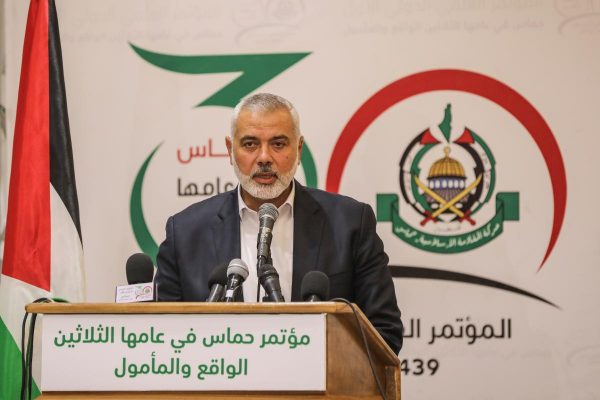
Head of the Political Bureau of Hamas Ismail Haniyeh makes a speech during a conference on 18 September, 2018 in Gaza City, Gaza [Ali Jadallah/Anadolu Agency]
MEMO | November 29, 2018
Hamas chief Ismail Haniyeh has called on the United Nations to recognise and support the Palestinian people’s right to bear arms against Israel in self-defence.
Haniyeh wrote to UN General Assembly (UNGA) President Maria Fernada Spinosa in advance of the organisation’s debate regarding Hamas rocket fire into Israel.
“We reiterate the right of our people to defend themselves and to resist the occupation, by all available means,” wrote Haniyeh, “including armed resistance, guaranteed by the international law.” He based the demand on international law drawn up and implemented by the UN, which gives states and peoples the right to defend themselves with arms if necessary, in the case of an external attack. “The General Assembly of the United Nations adopted dozens of resolutions that affirm the right of peoples to independence, self-determination and struggle by all available means, peaceful and non-peaceful, for that right. The UN singled out the Palestinian people for dozens of relevant resolutions, including 2621, 2649, 2787 and 3236,” he said.
After condemning the US for adopting Israel’s narrative of the conflict and justifying Israel’s aggression towards the Palestinians, Haniyeh insisted that “the last of these efforts is the attempt by the United States Ambassador to the United Nations… to submit a draft resolution condemning the Palestinian resistance and the right of our people to defend themselves against this racist and continuous occupation for more than seven decades.”
Israel’s Ambassador to the UN, Danny Danon, commented on Haniyeh’s letter, saying that Hamas “going to the UN for assistance is like a serial killer asking the police for assistance. Israel and the United States will continue to mobilize the countries of the world into a united front against the terrorism that Hamas engages in.”
The debate held in the UN today coincides with the International Day of Solidarity with the Palestinian People, which is held every year on 29 November. It comes two weeks after the latest Israeli assault on Gaza, which broke out after an undercover Israeli special forces operation in the strip was botched and compromised by Hamas. Days later, a ceasefire was declared, which was again broken by Israel the following morning when Israeli soldiers killed a Palestinian fisherman off the coast of Gaza.
READ: US lobbies for vote against Hamas at UN General Assembly
Canadian woman continues to fight to obtain a passport

By Rick Sterling | Rabble | November 26, 2018
In the Fall of 2012, a young man from Calgary Alberta, Damian Clairmont, received a new Canadian passport. He received this despite the fact that Canadian Security Intelligence Service (CSIS) had been secretly monitoring Damian and several others in Calgary and knew the young men were planning to join an armed extremist organization in Syria. At least five youth from Calgary did travel to Syria and Iraq where they all died with one becoming a suicide bomber reportedly killing 46 Iraqis.
In a bizarre contrast, in the spring of 2016, the Canadian government forced Damian’s mother, Christianne Boudreau, to surrender her Canadian passport. This article examines the strange circumstances and seeming irrationality.
Christianne Boudreau Countering Extremism
Unlike her son, who had been indoctrinated then recruited to join a terrorist group, Christianne Boudreau has worked with other parents internationally to create and promote educational programs to counter extremism. She converted her grief at the loss of Damian to help educate others how to prevent the same thing happening again.
Dr. Daniel Koehler, Director of the German Institute on Radicalization and De-Radicalization Studies, described her role:
Christianne Boudreau was one of the first mothers to speak out publicly against violent radicalization with her own painful personal experience of losing her son Damian. Together with Christianne, I built up a network of affected parents around the world: the Mothers for Life Network, which currently includes about 150 families from 11 countries. It is the only international parental self-help group addressing the needs of those parents. I also trained Christianne to be a family counsellor to help other parents of children undergoing violent radicalization.
Mothers for Life works with the important goal of countering extremist ideology and violence which has exploded in the West as well as the Middle East. It uses human connections and sharing among families who have experienced radicalization, not just lectures and lofty seminars.
Christianne Boudreau has travelled and spoken at many places across Canada and internationally. She says the problem is not Islam or religion. A writer documented Chris’s visit to the Islamic Institute of Toronto in an article titled “Christianne Boudreau’s visit to Toronto left us inspired.” The writer reported:
Chris was asked, ‘Do you blame Islam and Muslims for the death of your son?’ Everyone held their breath. I couldn’t look her in the eyes. ‘No, I don’t blame Muslims or Islam for what happened to my son. I blame misguidance and bad choices. It is ideology similar to that of gangs and cults. It is the same. They prey on young impressionable adolescents and exploit them.
In addition to this organizational work, Chris Boudreau has been exceptional in another way: she has dared to criticize the intelligence security service of her native Canada. When CSIS agents first contacted her in January 2013 and told her they had been monitoring Damian for nearly two years, she asked why they had not warned her about his real intentions. Why did they not prevent him from getting a new Canadian passport?
CSIS “Research”
After Damian’s death in January 2014, Chris Boudreau said she thought CSIS had some responsibility for his actions and death. In May 2014 she wrote a letter to CSIS politely expressing her questions and complaints. “We as a family have a right to know what has happened, and how our system has failed us.” She described her efforts to get answers over the previous year, how a CSIS agents had asked her to stop speaking out and asking questions. Finally, almost one half year later, CSIS Director Michel Coulombe responded to Chris’ inquiries. He did not answer her specific questions yet concluded that “the Service acted professionally and within its legislated mandate.” Regarding the warning of a CSIS agent, Director Coulombe evaded the issue by saying,“We have found no indication of an attempt to interfere in your relationship with other parties.” Regarding the disturbing consequences of radical indoctrination and violence, Coulombe said that CSIS “is conducting research to better understand this phenomenon in Canada.” This “research” is small comfort to a woman whose son was misled into joining a violent terrorist group, perhaps killing innocent Syrians and being killed himself.
Canada Takes Away Christianne Boudreau’s Passport
Fifteen months later, in February 2016, Citizenship and Immigration Canada acted in a way which definitely restricted and interfered with “her relationship with other parties”. While Chris and her son Lucas were visiting family in France, the Canadian government ordered her to surrender her Canadian passport. Christianne and her son were stuck in France, dependent on the generosity of family, for the next eighteen months. Chris was without income or ability to return home. Finally in November 2017, when Lucas’ father was dying of cancer, the Canadian embassy in France provided temporary emergency documentation so that Chris and her son could return home to Calgary.
The Official Reason Canada Took Away her Passport
Chris Boudreau has tried repeatedly to get her passport back. The official reason it was taken away and cannot be returned is that she provided “false or misleading information” in the passport application for her son Lucas. The “false and misleading” information was that she did not include the name of Lucas’ father on the passport application and did not disclose court orders from 2004-2007 which had defined the father’s visiting rights with baby Lucas (born in 2004).
In fact, Ms Boudreau was never married to the father, they did not live together when Lucas was born and Lucas’ birth certificate did not include the father’s name because the father wanted no responsibility. The applications for Lucas’ previous passports in 2007 and 2010 were filled out just the same way with no question or objection by Citizenship and Immigration Canada. In addition, there was a court order and signed agreement between Ms. Boudreau and the father in January 2016 which confirmed a summer visit with the father.
Ironically, Lucas was unable to visit the father as specified because CIC took away the passports of him and his mother in the spring of 2016. Ms. Boudreau and Lucas were unable to return to Canada until November 2017 when they received emergency travel documents as the biological father was in a terminal stage of cancer.
“Very few people have been denied passports”
Ray Boisvert, former head of CSIS counter-terrorism was previously asked why CSIS did not prevent Damian Clairmont from receiving a passport if CSIS knew about his radicalization and intentions. Boisvert responded that denying a passport to a Canadian citizen was an infringement on freedom of movement and required solid evidence. “There have been very few people who have been denied passports because the threshold is so high. And rightfully so.”
If Boisvert’s assertion is true, then why has CIC acted so harshly against Christianne Boudreau? The violation in the passport application caused little or no harm. The complaint by the biological father was resolved in the January 2016 court order and agreement. This was not an issue of parental joint custody because Christianne Boudreau had been the sole parental custodian for Lucas since his birth.
Christianne Boudreau’s Effectiveness in Countering Extremism
This extreme decision is not only harming Christianne Boudreau and her children. It is also hurting the international campaign against extremism and violent radicalism.
Dr. Koehler, Director of the German Institute on Radicalization and De-Radicalization Studies says:
Christianne’s work depends on her ability to travel, meet with other parents, participate in workshops, educate about the threat of violent radicalization and help affected families around the world. She was a main driving force behind the Mothers for Life Network and her absence from these important activities have caused serious harm to global issue of helping families in need.
Dr. Amar Amarasingam, Senior Research Fellow at the Canadian Network for Research on Terrorism, Security and Society at University of Waterloo has said:
Since the loss of her son Damian, Christianne Boudreau has been tirelessly working to try and prevent other young men and women from traveling abroad to fight. She traveled around the world to meet with other parents and families, gave talks and conducted workshops. Especially now, with ISIS fighters and families being captured by Kurdish forces and parents in Western countries trying to get in touch with them, Chris’s activism is much-needed. She is trusted by families the world over and would be an invaluable resource today. I’m not too familiar with the particulars of her case, but her ability to travel is fundamental to her work and I hope it gets sorted out soon.
In 2016, as Christianne Boudreau was having her Canadian passport revoked, CBC produced a documentary describing her good work. The producer Gail McIntyre and director/writer Eileen Thalenberg have recently written:
Christianne Boudreau was the focus of our film, A Jihadi in the Family, which was broadcast on CBC – TV in 2016. Over a period of two years, we covered her important work as founder and driving force behind the movement Mothers for Life. This organization was set up to support families and to inform educators, the public and policy makers about the early signs of radicalization and how to prevent it. Her work in this area was far-reaching – uniting mothers in North America and Europe…. Without her passport, she is unable to continue with her high profile work. This not only impacts anti-radicalization efforts, it severely affects her ability to support her herself and her son.
Public Appeal to “Return Christianne Boudreau’s Passport!”
Chris Boudreau, born in Toronto, is still being denied a Canadian passport. She has the anguish of knowing her son died in a foreign land. She has the pain of not knowing what he might have done with others in the terrorist group. She has difficulty finding a job when employers easily see and identify her as the “jihadi’s mother”. She was punished and impoverished by being left in a foreign country without a passport for a year-and-a-half.
Why is Canada denying this woman her right to travel, guaranteed to all citizens under the Canadian Charter? Most importantly, why is Canada preventing this brave woman from continuing her effective work countering international extremism?
A petition to “Return Christianne Boudreau’s Canadian Passport!” has been launched and can be seen here.
Rick Sterling can be reached at rsterling1@gmail.com.
Israel Attorney General: ‘No Palestinian state’ so ICJ illegitimate
MEMO | November 27, 2018
Israel’s Attorney General is drafting a legal opinion which will declare the International Court of Justice (ICJ) illegitimate on the grounds that there is “no Palestinian state”.
Avichai Mandelblit said yesterday that he was drafting the judgment to refute the ICJ’s legitimacy to rule on the Israel-Palestine conflict, claiming that there is no Palestinian state and citing the fact that Israel is not a member of the court.
Speaking to students at Israel’s Bar-Ilan University, Mandelblit explained: “I intend to issue an opinion soon, according to which the International Court of Justice in The Hague has no authority to discuss the Israeli-Palestinian conflict because there is no Palestinian state,” Arutz Sheva reported.
Israel has consistently rejected efforts by the ICJ and its counterpart, the International Criminal Court (ICC), to investigate its human rights record. In this, Israel has received the support of its main ally – the USA – with National Security Adviser John Bolton saying in September that the institution is “dead to [us]”. Bolton continued: “The United States will use any means necessary to protect our citizens and those of our allies from unjust prosecution by this illegitimate court.”
The ICC was quick to respond to the US’ threats, saying: “As a court of law, [the ICC] will continue to do its work undeterred, in accordance with those principles and the overarching idea of the rule of law.” The ICC added that it is an independent and impartial institution with the backing of 123 countries.
Israel’s opposition to the ICJ and ICC has become more vehement in the wake of Palestine’s appeals to the court. In January 2015 the Palestinian Authority (PA) signed the Rome Statute of the ICC, officially accepting the court’s jurisdiction over its territories and allowing a preliminary investigation into the situation in Palestine to be opened.
In May 2018, the PA specifically requested that the ICC investigate crimes committed within its territories, with Palestinian Foreign Minister Riyad Al-Maliki meeting ICC prosecutor Fatou Bensouda to discuss the issue. The request called on The Hague to investigate the forcible transfer of Palestinians, unlawful killings, illegal appropriation of land and property, demolition of Palestinian properties, repression of dissent through the unlawful killing of peaceful protesters and the policy of mass arbitrary detention and torture.
Since then the PA has called on the ICC to investigate a number of incidents. In June, the PA asked the court to prosecute Israeli Internal Security Minister Gilad Erdan for incitement after he called for Palestinians allegedly flying incendiary kites to be assassinated. In September, the PA called for an investigation into Israel’s planned demolition of the Palestinian village of Khan Al-Ahmar, which the ICC said could constitute a war crime. In October, the PA asked the ICC to investigate Israel’s escalation of illegal settlement in the West Bank city of Hebron.
Thus far neither the ICJ nor the ICC have prosecuted Israel for its actions.
Pro-Israel groups attack Rand Paul for blocking $38 billion to Israel
If Americans Knew | November 27, 2018
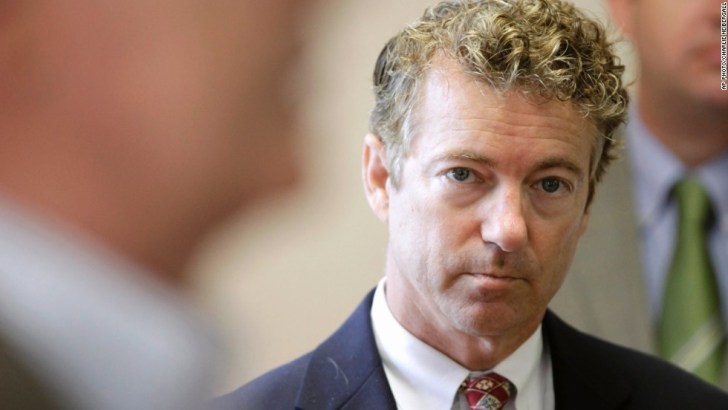
Free Beacon reports that “pro-Israel groups in America are mobilizing against Sen. Rand Paul (R., Ky.) for blocking the continuation of U.S. aid to Israel.”
Paul has placed a “block” on legislation to give Israel $38 billion over the next 10 years – $23,000 per every Jewish Israeli family of four. This is the largest military aid package in U.S. history and amounts to $7,230 per minute to Israel, or $120 per second. A stack of $38 billion dollar bills would reach ten times beyond the international space station.
A block is a legislative procedure in which a senator calls on the floor leader not to move forward with a bill and indicates that the senator may filibuster against it.
Jewish News Syndicate reported last week that the American Israel Public Affairs Committee (AIPAC) had sent an action alert to its members calling on them to pressure Paul to remove his block on the bill, ‘‘S. 2497 Ileana Ros-Lehtinen United States-Israel Security Assistance Authorization Act of 2018.’
Now, according to Free Beacon, a right-wing pro-Israel website, AIPAC has also been purchasing advertisements on Facebook attacking Paul “as the primary Senate force blocking the reauthorization of the U.S.-Israel security pact.”
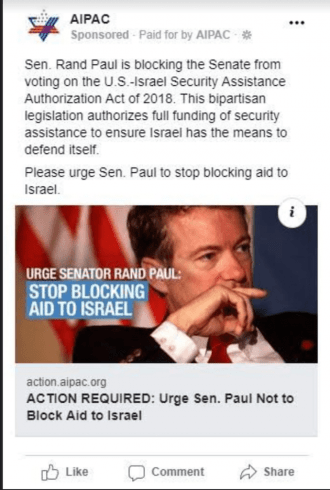
AIPAC Facebook ad against Rand Paul
Another pro-Israel group, Christians United for Israel (CUFI), has also reportedly organized an email blitz to pressure Paul to remove his hold, and has “invested heavily” in ads in Kentucky targeting Rand’s constituents.
According to Free Beacon, “Paul, a proponent of ending U.S. aid across the globe, has had multiple confrontations with the pro-Israel community over the years as result of his views. Paul has sought to hold up U.S. aid to Israel multiple times over the years, creating friction between him and top U.S. pro-Israel lobbying shops.”
Yesterday CUFI sent an email to supporters around the country saying: “Sen. Rand Paul is blocking the U.S.-Israel Security Assistance Authorization Act, S.2497. This bill is the cornerstone of U.S. support for Israel.”
In the message, CUFI calls Paul the “last obstacle to getting this bill signed into law.”
Free Beacon reports that Paul has also recently proposed suspending U.S. arms sales to Saudi Arabia and Bahrain over their attacks on what the Free Beacon calls “pro-Iran militants in Yemen.” Paul has long opposed U.S. support for the attacks on Yemen, which is on the brink of famine and has 50,000 dead.
Israel has long targeted Yemen as one of the countries that must be controlled in its quest for hegemony in the region.
Featured Video

Anthrax War – CBC The Passionate Eye
or go to
Aletho News Archives – Video-Images
Book Review
Shattered Dreams: The HPV Vaccine Exposed (2019)
By Christina England – 30 Q&As – Book Review & Summary
Lies are Unbekoming | September 4, 2026
… Gardasil received FDA fast-track approval in 2006, Cervarix followed in 2009, and Gardasil 9 was approved in December 2014 with more than double the aluminium adjuvant content of the original. The commercial context is specific. Merck was about to lose patent protection on Zocor and faced $18 billion in Vioxx injury claims from a cardiovascular drug the company had marketed while suppressing its own data showing a five-times increase in heart attacks. Analysts projected the global HPV vaccine market at $4 billion by 2011, contingent on government-funded national programs for teenage girls. The 1986 National Childhood Vaccine Injury Act had already granted manufacturers complete liability immunity. By 2013, Japan had withdrawn its HPV vaccine recommendation after cataloguing severe adverse reactions in hundreds of girls. No Western government followed. The establishment position across the UK, US, Australia, and most of Europe held, and still holds, that the vaccines are safe and effective, that reported injuries are coincidental, and that cervical cancer prevention justifies the program. The book was published into this position, not against a vacuum.
Shattered Dreams sits alongside Mary Holland’s The HPV Vaccine On Trial and Viera Scheibner’s foundational vaccination work as part of the documented record on what has been done to a generation of teenage girls under the banner of cancer prevention. The full summary unpacks three specific findings: that Merck used the aluminium adjuvant itself as the “placebo” control in 92.5% of trial subjects, making it structurally impossible to detect excess reactions from the adjuvant; that Dr. Sin Hang Lee found HPV DNA fragments bound to aluminium in every one of sixteen Gardasil samples tested, and in the blood and spleen of a New Zealand girl six months after her third dose; and that in every country with high vaccination coverage, including Australia, the UK, Norway, and Sweden, cervical cancer rates have stopped declining and started rising specifically in the vaccinated cohort. Martínez-Lavín’s 2017 calculation puts the number needed to seriously harm with Gardasil 9 at 140, and the number needed to vaccinate to prevent one case at 1,757. Thirteen young women are seriously harmed for every one who benefits. The vaccine was approved on the basis of trials that could not detect what the trials were supposed to detect, and it is still being given to twelve-year-olds today. … Read full review
Blog Roll
 Aletho News
- British Transport Police Facial Recognition Trial Scanned 926,912 People With Zero Arrests
- House Bill Would Ban Federal Use of Flock ALPR Data
- Can a Spice Rival a Drug? 10 Head-to-Head Trials Put It to the Test.
- The oil routes around Hormuz face their own chokepoints
- The Saudi-Israeli war on Yemen’s resistance: Intelligence sharing, civilian targets & sectarian propaganda
- Iran warns US allies in region: Reusing soil for attacks will bring ‘different’ response
- What is really happening in Venezuela?
- Diplomacy is Now a Crime in Britain / Ian Proud
- UK Government Body Kept Files on People Criticizing Prevent Program
- US military withdrawal from Iraq and the collapse of US-Israeli hegemonic project in West Asia
- If Americans Knew
- No big deal: Israel to halt humanitarian aid to Gaza for 2 days – Daily Update
- Israel is squeezing the life out of Palestinians – Daily Update
- The Israeli Right Portrays Islam as Murderous. It Serves a Political Purpose
- Jordan Has Had Enough: King Abdullah’s Scathing Warning to Israel
- Israeli Colonizers (i.e. Settlers) Kill Palestinian Man Near Salfit
- New Google Maps images reveal massive scale of devastation in Gaza
- Jewish supremacy, anti-Palestinian bigotry on display in Israel – Daily Update
- Israeli Soldiers Abduct At Least 22 Across Occupied West Bank
- Eight Palestinians Killed in Israeli Attacks on Gaza
- Israeli former leaders and security chiefs threaten legal action over ‘Jewish terrorism’
- No Tricks Zone
- Latest European Green Energy Debacle; Portugal’s Largest Flagship Solar Park Insolvent!
- Green Energy Debacle: German Expert Professor Fritz Vahrenholt Warns Of Severe Economic And Social Consequences
- Two More Paleo Reconstructions Affirm Meters-Higher Sea Levels Across Ireland, Brazil 7000-6000 Years Ago
- New Study: Earth And Venus Surface Warmth Largely Explained By Convection And Lapse Rate, Not CO2 Or Radiation
- 2025 Nature Paper Claiming Worsening Global Drought Gets RETRACTED …Heavily Flawed
- New Study: ‘Global Drought Shows No Detectable Recent Acceleration Under Climate Warming’
- Economic Masterminds: German Socialists Suggest Taxing Productivity Gains Stemming From Using AI
- The South China Sea Has Not Been Cooperating With The Climate Change Narrative
- Energy Crisis: Germany Enters Heating Season With Historically Low Gas Reserve Fill Levels
- New Study: The Antarctic Ice Sheet Gained Mass From 2020-2024 Due To Staggering Snow And Ice Accumulation

