World War I Homage – A Triumph of Lies and Platitudes
By Finian CUNNINGHAM | Strategic Culture Foundation | 12.11.2018
World leaders gathered in Paris on Sunday under the Arc de Triomphe to mark the centennial anniversary ending World War I. In an absurd way, the Napoleon-era arc was a fitting venue – because the ceremony and the rhetoric from President Emmanuel Macron was a “triumph” of lies and platitudes.
Among the estimated 70 international leaders were US President Trump and Russian counterpart Vladimir Putin, each sitting on either side of Macron and his wife. German Chancellor Angela Merkel was also given pride of place beside the French president.
Macron’s address to the dignitaries was supposed to be a call for international multilateralism. He urged a “brotherhood” for the cause of world peace. He also made a pointed rebuke of “nationalism” as posing a danger to peace – a remark which seemed aimed at Donald Trump who recently boasted of his politics with that very word.
But, ironically, everything about the ceremony and Macron’s speech resonated with jingoistic French nationalism, not his avowed multinationalism. As the politicians sat under the Arc de Triomphe, Macron walked around its circular esplanade in a salute to assembled French military forces bearing assault rifles and bayonets. The French anthem – The Marseillaise – was played twice, once by an army brass band, the second time sung by an army choir. There was also a military plane flyover displaying the blue, red and white tricolor of the French national flag.
In his speech, Macron talked about soldiers coming from all over the world to “die for France” during the 1914-18 Great War. He even said at one point that the war was fought for “the vision of France” and its “universal values”.
This was fluent drivel, French-style. No wonder Russia’s Putin momentarily gave a look of boredom as Macron waxed lyrical.
The speechifying and commemoration was completely detached from current realities of conflict and international tensions.
Among the “brotherhood” whom Macron was appealing to were Israeli Prime Minister Benjamin Netanyahu whose military forces continue to bomb and slaughter Palestinian civilians in illegally occupied territory. Also present was Ukrainian President Petro Poroshenko whose armed militias continue to terrorize the people of eastern Ukraine with the blatant objective of instigating a war between the US-led NATO alliance and Russia.
Listening to Macron one would think that World War I erupted mysteriously from no specific cause and that an estimated 10 million soldiers were all killed in heroic battles for noble principles.
There was, of course, no mention by Macron of imperialist warmongering and the barbaric sacrifice of humans as slaves in the service of national capitalist power interests.
Grotesquely, as the world leaders donned solemn faces and mouthed pious platitudes for peace, the whole occasion was a triumph in burying reality and the ongoing causes of wars, as well as whitewashing the very culprits responsible for wars. Among the war criminals wearing a mournful black suit was former French President Nicolas Sarkozy who launched the NATO blitzkrieg on Libya in 2011.
While the empty, self-indulgent rhetoric was ringing out, one couldn’t help but recall some of the most glaring contemporary contradictions that were blocked out with awesome Orwellian efficiency.
Just this week, reports emerged of the horrific civilian death toll from the American air force bombing the Syrian city of Raqqa. The city was razed to the ground by US air strikes last year – supposedly to defeat the ISIS terror group. Some 8,000 bodies of civilians, mainly women and children, have now been recovered by Syrian government forces. And that’s only from clearing away a tiny area of rubble for the whole city.
What the Americans did in Raqqa was a monumental war crime, all the more criminal because US forces, along with their NATO partners Britain and France, are illegally present in and assaulting sovereign Syrian territory.
As Macron was telling world leaders about “the vision of France”, hundreds were being killed in Yemen in a battle to strangle the entire population by taking the port city of Hodeida. The genocidal war on that country – which is putting up to 16 million people at risk from starvation – has been fully backed by France, the US and Britain, from their supply of warplanes and bombs to the Saudi and Emirati aggressive forces.
We could mention other specific conflicts where the culprits are clearly identified. For example, the multi-million-dollar support from Washington for the Azov Battalion and other Neo-Nazi militias in Ukraine, which openly emulate the genocidal conduct of Hitler’s Third Reich to exterminate ethnic Russians.
We could mention how US-led NATO forces continue to expand towards Russian territory with outrageous provocation. The mounting earlier this month of the biggest-ever NATO war drills since the Cold War in the Arctic region adjacent to Russia’s northern border was a brazen threat of rehearsing invasion. The announced tearing up of yet another nuclear arms control treaty unilaterally by Washington is a reckless undermining of global security.
Washington threatens China with naval forces marauding near Beijing’s maritime territory in the South China Sea. Washington blockades Iran with illegal economic warfare and openly agitates for regime change. Washington declares Venezuela, Nicaragua and Cuba a “troika of tyranny” and reserves the right to threaten each of these countries with military invasion at any time.
Meanwhile, this weekend, Russia hosted peace talks in Moscow between the warring parties of Afghanistan. It was seen as a major breakthrough in trying to bring peace to the Central Asia country which has been wracked by 17 years of violence since US forces began their ongoing military occupation – allegedly to defeat terrorism.
Elsewhere, Russia has engaged with Turkey, Germany and France to convene a summit for peaceful reconstruction of Syria. The latest summit held in Ankara at the end of last month follows several other such meetings in Astana and Sochi, largely at the behest of Russian leader Vladimir Putin, to find a political settlement to the nearly eight-year war in Syria – a war that was fomented covertly by Washington and its allies for regime change.
France’s Macron talks about “multilateralism” for world peace, yet the two countries which have arguably supported and implemented multilateralism in practice are Russia and China in their calls and policies for global partnership and economic development.
And yet it is Russia and China that are being harassed with American and European sanctions, and US military provocations.
The unilateral, lawless imperialism that engendered World War I and 20 years later World War II is still alive and dangerously vigorous. We only have to look around the present world to realize that. But when the culprits indulge in a triumph of bullshit then we also know that the world is once again in very grave danger.
European Parliament ‘Shocked’ at Amount of EU-Made Arms in Hands of Terrorists
Sputnik – 12.11.2018
This week, members of the European Parliament will gather in Strasbourg for the plenary session with a wide array of issues on the agenda, including arms exports.
A draft report on arms exports, which will be tabled at the European Parliament’s plenary session in Strasbourg later this week, suggests launching an investigation into how EU-made weapons end up in the possession of terrorists in the Middle East.
One provision of the document, presented by German MEP Sabine Lösing, says that the European Parliament is “shocked at the amount of EU-made weapons and ammunition found in the hands of Daesh in Syria and Iraq.”
The same draft highlights that some EU member-states, including Bulgaria and Romania, have failed to apply the Common Position in relation to weapons’ retransfers, which contravenes end-user certificates.
The document further proposes making it obligatory for EU member-states to “deny an export licence if there is a clear risk that the military technology or equipment to be exported might be diverted.”
The European Parliament “calls on all Member States to refuse similar transfers in the future, notably to the US and Saudi Arabia,” the draft reads.
Syrian media have on multiple occasions reported that the country’s army had discovered large stocks of arms, ammunition, vehicles and other military equipment, made in the US, Europe and Israel, while conducting mop-up operations in regions liberated from terrorists.
Germany, EU funding militants in Idlib: Report
Press TV – November 12, 2018
The German government and other EU members are funding militants still present in Idlib and involved in a conflict against the Syrian army, Germany’s Tagesspiegel newspaper has revealed.
According to the report cited by British daily the Telegraph on Sunday, “no less than 37.5 million euros” has been transferred to militant groups in Idlib by the German Ministry of Foreign Affairs.
In total, Berlin has paid nearly 49 million euros to militants fighting to topple the Syrian government and facilitated the transfer of similar funds by other EU members, it added.
Those funds included “11.3 million other sources, or 17 million euros from the European Union, for which Germany would have played an intermediary role.”
According to the report, the German government does not communicate the precise list of recipients of the funds for fear of angering Russia and other sides involved in the Syria war.
The information was revealed in an answer given by German Secretary of State for Foreign Affairs Walter Lindner to a question asked by Member of European Parliament Evrim Sommer, to which Tagesspiegel was able to have access.
The report comes after German Chancellor Angela Merkel met with Russian and Turkish leaders in Istanbul late last month to discuss a solution to the Syria conflict.
Ankara has long backed militants seeking to overthrow President Bashar al-Assad, while Moscow is a close ally of the Syrian government in its relentless fight against foreign-backed terrorists.
Merkel apparently rejected Russian President Vladimir Putin’s call to financially contribute to Syria’s reconstruction after they met outside Berlin in August.
Germany is a member of a US-led coalition which has been bombarding Syria since September 2014 without any authorization from the Syrian government or a UN mandate.
Just recently, Berlin said it was in talks with Washington and other allies about a possible involvement in airstrikes on Syria if it used chemical weapons.
Syria and Russia have warned of a “false flag” chemical attack by militants in order to give the US and its allies an excuse to target Syrian troops which have sought to evict terrorists from their last stronghold in Idlib.
Germany has reportedly deployed special forces to northern Syria to aid US-backed Kurdish militants. In September, Defense Minister Ursula von der Leyen said Germany would not reject a possible longer-term deployment of troops to the Middle East.
She made the remarks during a visit to the Azraq air base in Jordan where some 300 German troops are operating as part of the US-led coalition.
The US and its allies characterize their military presence in the region as part of their war on Daesh, but fiercely oppose a final push by Syrian troops against terrorists in Idlib.
Extremists from across Europe joined Daesh in droves in 2014, when the Takfiri terror group launched its campaign of bloodshed and destruction in Iraq and Syria.
Back then, many European leaders ignored repeated warnings that militants could return home one day and that they would pose a security challenge for years to come across the continent.
Last month, Germany said more than a hundred militants, who had been fighting in Iraq and Syria, had returned to the country, but among them only dozens were being investigated for possible terror links.
German Interior Ministry said in a statement that they knew of 124 people, who were part of at least 249 people who had traveled from Germany to Iraq and Syria.
Meanwhile, some 40 percent of at least 900 Britons who traveled to Syria to join Daesh had returned to the United Kingdom, but UK counter-terrorism chief Neil Basu said they were no longer considered a main threat.
Russia keeps Israel’s Netanyahu in anteroom
By M. K. BHADRAKUMAR | Indian Punchline | November 11, 2018
It is over a month since Israeli Prime Minister Benjamin Netanyahu had announced that he was going to Moscow to meet Russian President Vladimir Putin with a view to open a new page in the relations between the two countries following the incident over Syrian skies on September 17 when a Russian reconnaissance plane was shot down killing 15 personnel.
However, Moscow has not scheduled Netanyahu’s visit so far. Netanyahu hoped that on the sidelines of the ceremony marking the centenary of the World War 1 armistice in Paris tomorrow there might be an opportunity for a meeting with Putin. The Israelis sought a meeting. But Moscow apparently hasn’t confirmed Putin’s convenience.
Clearly, Moscow is keeping Netanyahu in the anteroom to cool his heels, signaling that it cannot be ‘business as usual’. In a hard-hitting interview with Times of Israel, the Russian ambassador to Israel Anatoly Viktorov made it clear in the weekend that the September 17 incident rankled. He said the Russian defence establishment is “extremely disappointed” with the Israeli military’s response to the incident.
Ambassador Viktorov also rubbed it in that the Israeli demand for the removal of all Iranian troops on Syrian soil is both “unrealistic” and unnecessary since Iran has no plans to attack Israel and it is Israelis, after all, who are killing Iranians and not vice versa!
Quite obviously, Russia has hardened its stance vis-à-vis Israel. Conceivably, Moscow must be pleased with the ‘new normal’. According to Russian reports, since the deployment of the awesome S-300 missile system in Syria, the Israeli Air Force “hasn’t conducted a single air mission in Syria.” That is to say, the Israeli stance that the S-300 deployment notwithstanding, Israeli jets reserve the right to attack Syria, etc. is just bravado.
Tel Aviv is not taking chances, given the scale of deployment of the S-300 and the probability that Russia has also imposed electronic countermeasures over Syria’s coastline to suppress satellite navigation, onboard radar systems and communications of warplanes attacking targets on Syrian territory.
In political terms, the longer this impasse continues, the weaker the Israeli claim that the Iranian presence in Syria threatens its security becomes. In reality, though, Israel has all along been using the ‘Iranian threat’ as a pretext to attack Syria, thereby staking claim to have a voice in any peace settlement. Israel’s agenda is to get some sort of international legitimacy for its illegal annexation of the Golan Heights.
The Russians are apparently taunting the Israelis by admitting that S-300 may not be hundred percent fool proof. In another report, a senior Syrian military official has been quoted by Russian media as saying, “There is no concept of zero probability in military strategy. We cannot say that this probability has been reduced to zero, because we are talking about open skies, extended borders, various technologies… Therefore, I cannot say that in the end there will not be such a probability, however, the probability of this aggression achieving its goals has been minimized.”
Nonetheless, for the Israelis this is a piquant situation of the “unknown unknown”. Russia is keeping Israel guessing how dangerously risky it could be for its pilots to undertake strikes under these obscure circumstances. Russia may be planning to seek an overhaul of the entire mechanism regarding Israel notifying in advance its air strikes on Syria. Israel was giving Russians only short notice before undertaking missions and had been getting away with it, but the September 17 incident has changed the calculus.
Certainly, for the overall stabilization of the Syrian situation, it is helpful that Israel is prevented from inserting itself into the security situation. Interestingly, Tehran and Damascus have left it entirely to Moscow to needle the Israelis, but it stands to reason that the three allies are also in consultation as regards any new ground rules for the Israelis in the Syrian conflict.
The bottom line is that the Israeli swagger that Netanyahu and Putin have had a special thing going between them at the personal level stands exposed.
Apparently, that is not the case. It seems Moscow deals with Israel strictly on the basis of its willingness to behave responsibly.
Given the state of play currently in the US-Russian relations, Israel is unable to leverage the Trump administration to intervene on its behalf with Moscow. At the Helsinki summit in July between Putin and President Trump, the latter had underscored Israeli security concerns as an agenda item.
Washington Post Publishes Article of Yemen’s Houthi Leader

Head of Yemen’s Revolutionary Committee, Mohammad Ali Al-Houthi
Al-Manar | November 10, 2018
The Washington Post has published on Friday the first article of the head of the Supreme Revolutionary Committee, Mohammad Ali Al-Houthi.
Houthi leader: We Want Peace for Yemen, But Saudi Airstrikes Must Stop
The continued escalation of attacks against the port city of Hodeida in Yemen by the U.S.-Saudi-Emirati coalition confirms that the American calls for a cease-fire are nothing but empty talk. The recent statements are trying to mislead the world. Saudi leaders are reckless and have no interest in diplomacy. The United States has the clout to bring an end to the conflict — but it has decided to protect a corrupt ally.
Any observer of the crimes committed in Yemen by Saudi Arabia — a campaign that has been accompanied by disinformation and a blockade of journalists trying to cover the war — can offer an account of the indiscriminate killing thousands of civilians, mostly through airstrikes. Their attacks have led to the greatest humanitarian crisis on earth.
The brutality of the Saudi regime was reflected in the murder of the journalist Jamal Khashoggi. And it can be seen in the military escalation and airstrikes in Hodeida and other cities, in defiance of all international warnings.
The blockade of the port city is meant to bring the Yemeni people to their knees. The coalition is using famine and cholera as weapons of war. It is also extorting the United Nations by threatening to cut their funds, as if it were a charity and not a responsibility required under international law and Security Council resolutions.
The United States wants to be viewed as an honest mediator — but it is in fact participating and sometimes leading the aggression on Yemen.
We are defending ourselves — but we don’t have warplanes like the ones that bomb Yemenis with banned ammunition. We can’t lift the blockade imposed on Yemeni imports and exports. We cannot cancel the air embargo and allow daily flights, or end the ban of importing basic commodities, medicines and medical equipment from any place other than the United Arab Emirates, as it is imposing on Yemeni business executives.
And the list goes on. These repressive practices are killing and destroying Yemen.
Yemen was not the one who declared the war in the first place. Even Jamal Benomar, the former United Nations envoy to Yemen, said we were close to a power-sharing deal in 2015 that was disrupted by the coalition airstrikes. We are ready to stop the missiles if the Saudi-led coalition stops its airstrikes.
But the United States’ calling to stop the war on Yemen is nothing but a way to save face after the humiliation caused by Saudi Arabia and its spoiled leader, Crown Prince Mohammed bin Salman, who has ignored Washington’s pleas to clarify Khashoggi’s murder.
Moreover, Trump and his administration clearly prefer to continue this devastating war because of the economic returns it produces — they drool over those arms sales profits.
We love peace — the kind of honorable peace defended by our revolution’s leader, Abdulmalik al-Houthi. We are ready for peace, the peace of the brave. God willing, Yemenis will remain the callers of peace and lovers of peace.
Hebron is braving a storm of Judaisation

Israeli soldiers detain a Palestinian youth in the West Bank city of Hebron, on 22 September 2017 [Mamoun Wazwaz/Apaimages]
By Nabil Al-Sahli | MEMO | November 9, 2018
The ongoing and intense settlement activity in the occupied West Bank city of Hebron confirms Israel’s deliberate policy to empty it of its Arab inhabitants and Judaise it. The Palestinian city remains the second most targeted area for illegal Jewish settlements after Jerusalem. The first settlement activity in the West Bank was the establishment of the Kfar Etzion kibbutz in the strategic area bordering Hebron.
We can say with certainty that Israel’s plans for the Ibrahimi Mosque in Hebron are no less dangerous than its Judaisation plans for Al-Aqsa Mosque in Jerusalem. Over the years, the Israeli settlers have turned a major section of the mosque into a synagogue. We do not doubt that the settlers intend to take over completely in the months and years ahead.
Perhaps it was precisely for that reason that the Israeli government announced recently a new settlement plan targeting the heart of Hebron in order to link the settlements built across the city by means of new illegal blocs. The government is funding the construction of a settlement on Al-Shuhada Street in the old city, taking advantage of Donald Trump’s Presidency in the US to adopt and “legitimise” its settlement policy in Palestine, even though all Jewish settlements across the occupied Palestinian territories, including Jerusalem, are illegal under international law. This is especially the case in Hebron and Jerusalem, which are both earmarked for even more Judaisation.
The purpose of the latest settlement outpost in Hebron is to create a new military checkpoint to harass and increase the suffering of the Palestinians prior to their eventual expulsion. The site on Al-Shuhada Street belongs to the Hebron municipality. The occupation authorities confiscated it for use as an army base and a location for settlers’ caravans. Defence Minister Avigdor Lieberman made the announcement of the 31 settlement units to be built in the heart of Al-Shuhada Street, approved by the so-called Civil Administration and Israeli government, and funded by the latter.
A few months ago Lieberman ordered the establishment of an authority to manage the municipal affairs of the settlement bloc located in the centre of Hebron. This is a Judaisation measure taken against the city’s Palestinian inhabitants with the purpose of strengthening the powers of the settlers who had previously managed their daily affairs by means of a council, which had no “legal” status.
Israel has portrayed this as being necessary to strengthen the Jewish community in the city and as a very important move in order to continue and develop settlement expansion in the West Bank, despite the existence of Palestinian-Israeli arrangements agreed in 1997 that divided Hebron into two parts. The first was the 80 per cent of the city under the complete jurisdiction of the Palestinian Authority while the remaining 20 per cent was supposed to be under Israeli security control and Palestinian civil control. Since then, the entire city was supposed to have been under the jurisdiction of the Palestinian Hebron municipality (with a population of 260,000 Palestinians and 800 Jewish settlers).
For the purpose of Judaising Hebron and displacing its indigenous Palestinian people, there have been non-stop attacks since the city’s occupation in 1967. There is a consensus among all Israeli parties to establish an administration to manage settler affairs in the city and to promote settlement activity. This explains Prime Minister Benjamin Netanyahu’s practical support for intensifying settlement activity in the West Bank, which is basically an execution of the project to annex Palestinian areas to Israel by means of “legitimate” demarcation and recognition of illegal settlements, along with granting them sovereignty.
It is a well-known fact that the establishment of settlements violates all international principles and customs, as well as the UN Charter, which outlines a long series of restrictions imposed on any occupying forces, including Israel’s. The essence of this bans occupiers from settling their own citizens in areas under occupation. This has been reiterated by UN Resolutions which deny any legal status to the Jewish settlements and ban their annexation by Israel. Indeed, the resolutions call for the dismantling of the settlements, not simply “freezing” settlement activity. The settlements in Jerusalem and Hebron are covered by this requirement.
Israel’s construction of additional settlements, and expansion of existing sites, violate Palestinian rights and international laws and conventions. The decision to build settlement blocs in Hebron and establish a council to manage Jewish settler affairs in the city breaches UN Security Council Resolution 2334. Israel should be condemned for treating international law with such contempt.
This article first appeared in Arabic in the Palestinian Information Centre on 8 November 2018
Read also:
Israel settlers storm Palestinian homes in Hebron
Israel army ‘violently harasses Palestinian family at home’ in Hebron
Israel’s diamond exports crash as BDS and war crimes impact
By Sean Clinton | MEMO | November 7, 2018
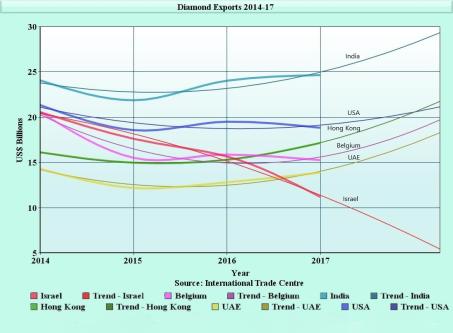
Fig.1 – Graph of diamond exports and trends from main exporting hubs
Israel’s gross diamond exports have crashed by a staggering 45 per cent since the 2014 massacre in Gaza that resulted in the death of over 2,200 people, mainly civilians including over 550 children.
The net value of Israel’s diamond exports has fallen even further, by 60 per cent from $11.25 billion to $4.4 billion over the period. This is about the same as the value of Israel’s total arms exports.
The Israeli diamond exchange initially blamed the decline on weak global demand and more recently on globalisation but the sudden steep decline shows that’s plainly not the case.
De Beers annual insight reports on the state of the global diamond market show demand increased slightly over the past five years.
No other diamond exporting country has suffered such a steep fall.
The Belgian diamond industry, which is a major hub for both the rough and polished diamond trade to and from Israel, has also been impacted by the steep decline in Israel’s exports.
Meanwhile India has gained market share and in 2016, for the first time ever, exported more diamonds to the USA than Israel which has traditionally supplied up to 50 per cent of the US market in value terms.
There can be no doubt that one of the most important and the most vulnerable sector of the Israeli economy is feeling the impact of Israel’s blood-drenched brand image.
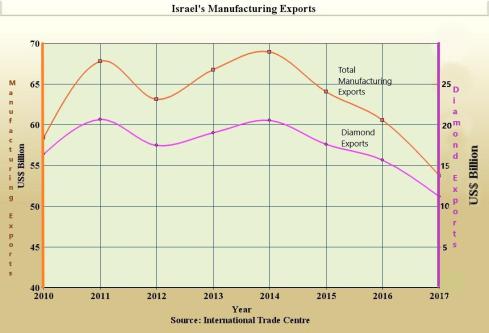
Fig. 2 – Israeli manufacturing exports declined sharply after 2014 led by a 45% fall in diamond exports. The 2012 fall in diamond exports was due to the discovery of major fraud in the Diamond Exchange.
The global campaign of boycott, divestment and sanctions (BDS) has highlighted jewellery industry links to Israeli human rights violations which are funded to a significant degree by revenue from the diamond industry. Both appear to be impacting the Israeli diamond industry particularly hard with exports down a further 6 percent in H1 2018.
The situation has become so serious that Israel is now offering to pay air fares as well as provide free hotel accommodation to attract buyers to Tel Aviv. Although the jewellery industry and NGOs have remained silent about Israel’s leading role in the diamond supply chain human rights activists have campaigned to expose it.
In 2012 activists first revealed the linkage between the Steinmetz Diamond Group (SDG) and the Givati Brigade of the Israeli military which was responsible for the 2009 massacre of the Samouni family in Gaza, a suspected war crime documented by the UN Human Rights Council and others including Israeli human rights group B’Tselem.
This set in motion a series of actions that continue to reverberate through the upper echelons of the diamond industry. When the Anglo American owned De Beers Group put a Forevermark Steinmetz diamond on display in the Tower of London in honour of the Queen of England’s Diamond Jubilee the Inminds human rights group staged regular protests outside the Tower.
A member of the Samouni family in Gaza recorded a video appealing for the blood diamond to be removed. The diamond was removed a few months later without any of the fanfare and publicity that accompanied it’s unveiling. It hasn’t been seen or heard of in public since.
Sotheby’s Diamonds is a 50:50 partnership between Sotheby’s, the famous auction house, and Diacore, the now rebranded Steinmetz Diamond Group.
Since 2012, Inminds has staged a number of protests outside Sotheby’s premises in Bond Street, London, highlighting the link to Israeli war crimes.
In January 2013, Sotheby’s CEO and board were sent a registered letter alerting them to the damage to their reputation and the risks to their brand posed by their partnership with the Steinmetz Group. Months later in Geneva, in a blaze of global publicity, Sotheby’s auctioned the Steinmetz Pink, a specimen diamond. It was bought by a syndicate of investors lead by Isaac Wolf for a world record US$83 million. The pre-auction publicity and spin gave no indication that the diamond was tarnished by association with Israeli war crimes in Gaza and was, therefore, a blood diamond. Four months after the auction it was revealed that the investors defaulted and Sotheby’s were forced to take the diamond into inventory costing them millions.
In April 2017, in a much quieter event, the blood diamond was auctioned in Hong Kong and bought by Chow Tai Fook for $71 million.
The Isaac Wolf syndicate wasn’t sued.
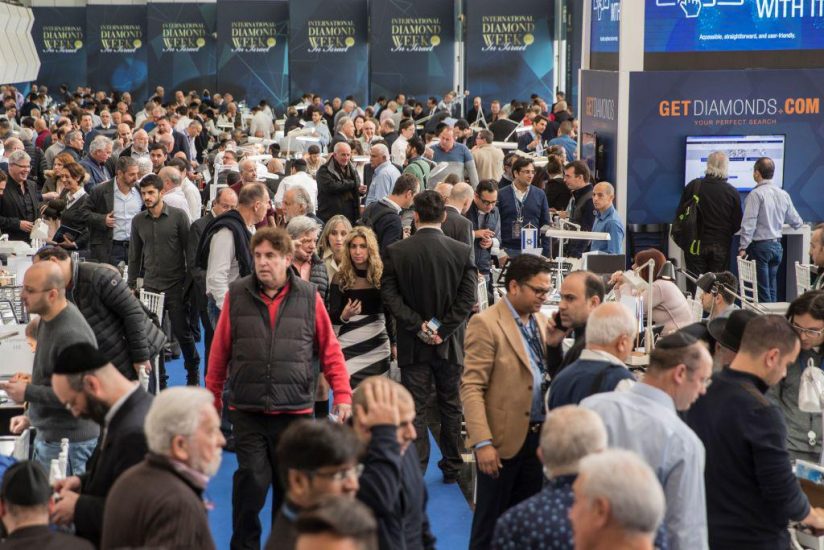
Diamond buyers and sellers attend the International Diamond Week (IDW) in the Israeli city of Ramat Gan, east of Tel Aviv on February 14, 2017. (JACK GUEZ/AFP/Getty Images)
Sotheby’s continues to partner with Diacore despite the fact that the Steinmetz Foundation “adopted” the Givati Brigade which stands accused of war crimes.
As news of the default became public it was also disclosed that Beny Steinmetz sold his interest in SDG to his brother Daniel and the company was rebranded as Diacore. Some observers believe this was an exercise designed to distance leading diamond brands including Tiffany’s, De Beers, Sotheby’s and Forevermark from the tarnished Steinmetz brand which is indelibly linked to the Samouni massacre. Evidence supporting this was leaked in the Panama Papers which showed that in 2015, Beny Steinmetz was still involved and asked Mossack Fonseca to backdate the transfer of his power of attorney to his brother to 2013.
Further indications that jewellers are shunning diamonds linked to Israeli human rights violations emerged earlier this year when it came to light, via a Tiffany & Co Form 10-K submission to the US Securities and Exchange Commission, that the iconic diamond brand had terminated a supply agreement with a Steinmetz owned mine in Sierra Leone. Tiffany’s loaned Steinmetz $50 million to develop the mine and was one of their leading buyers.
Tiffany’s divestment came following pressure from human rights activists who exposed the fact that Tiffany’s sourced diamonds from a miner that donated to and supported suspected Israeli war criminals.
Although Tiffany & Co divested from a Steinmetz mine they continue to conceal the identity of the companies they buy 25-35 per cent of their polished diamonds from. Tiffany’s customers cannot, therefore, know where their jewellery comes from as alluded to by their new CEO Alessandro Bogliono in Tiffany’s Sustainability Report 2017.
“Our customers place great value on sustainability. They want to know where their jewellery comes from, how it is made and how the jewellery-making process impacts the planet as well as its people and communities. Tiffany & Co. holds this kind of transparency dear and, through this creation of shared value, we have a unique opportunity to build meaningful, lasting relationships with our customers. We are committed to sharing more with them — and all of our stakeholders — about what, exactly, Tiffany is doing to achieve sustainability for our business and for the planet as we very broadly define that goal: enriching the people and places we reach through our business; minimising our environmental impact; improving industry-wide practices; and channelling the power of the Tiffany brand as a force for positive change in the world.”
Given Israel’s leading role in the industry and the absence of a statement from Tiffany’s stating, as they have done with Zimbabwe and Angola, they do not buy diamonds from the apartheid state, it is likely Tiffany’s are sourcing diamonds from companies in Israel.
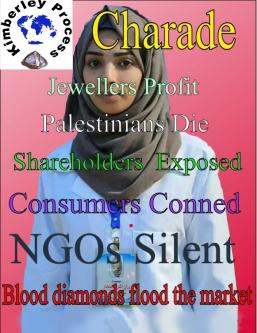
Fig. 3 – On June 1st, Rajan al-Najjar, a 21 year old paramedic, was shot dead by an Israeli sniper as she treated wounded civilians in Gaza.
Diamond companies in Israel employ people who have served in and are members of the Israeli army, have openly funded and supported attacks on the defenceless residents of Gaza, have been widely implicated in serious fraud and who discriminate against non-Jews who make up 20 per cent of the population.
Furthermore, Tiffany’s haven’t paid reparations to the Samouni family or any of the victims of the Steinmetz supported Givati Brigade. Mitigation for damage caused is a key component of “responsible sourcing” as outlined in the OECD Due Diligence Guidelines to which Tiffany and Co, a member of the UN Global Compact, claims it is committed.
Although revenue from the diamond industry is a significant source of funding for an apartheid regime that has killed over 210 Palestinians including women, children, medics and journalists and injured and maimed thousands more with live ammunition in besieged Gaza in the past six months alone, jewellers fraudulently claim diamonds processed in Israel are responsibly sourced and conflict-free.
This blood diamond cover-up and fraud is perpetuated by public companies and governments who collaborate to shield rogue regimes in Israel, Zimbabwe and Angola that they depend on to keep their coffers full, bolster dividends for shareholders and provide fat pension pots for c-suite executives.
The Kimberley Process Certification Scheme (KP), the blueprint of which was drafted by the World Diamond Council, is the primary vehicle facilitating the ongoing blood diamond trade.
Although the remit of the KP is deliberately restricted to banning rough diamonds that fund rebel violence, jewellers use it to claim other blood diamonds are conflict free even when they fund war crimes and crimes against humanity.
Shamefully, Amnesty International, Global Witness, Human Rights Watch and Impact (Partnership Africa Canada), that the public rely on to expose the blood diamond trade and speak up for the victims, have said and done nothing to hold the diamond jewellery industry to account for funding Israeli war crimes and crimes against humanity.
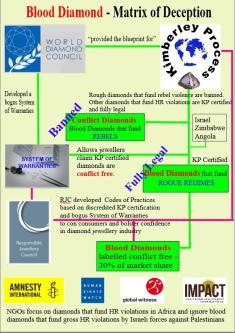
Fig.4 –The diamond industry has created a matrix of bogus schemes, warranties, standards and codes of practices to con consumers and facilitate the trade in blood diamonds that fund rogue regimes
The silence of NGO’s on Israel’s blood diamond trade means the Kimberley Process charade continues to con most people and can keep mainstream media focused on the mining sector in Africa. Meanwhile, high street jewellers launder cut and polished blood diamonds labelled responsibly sourced and conflict free to unsuspecting customers.
Hilde Hardeman is the EU chair of the Kimberley Process in 2018. Indications to date suggest that she, like others before her in South Africa and Australia, will ignore the latest call from human rights activists for Israel to be suspended from the KP until those responsible for massacres in Gaza are brought to justice and held to account.
Some voices in the jewellery industry are speaking out. The most recent example being the Ethical Jewelry Exposé: Lies, Damn Lies, and Conflict Free Diamonds, from Marc Choyt and his team at Reflective Jewellery. The exposé peels back the layers of bogus schemes “through the metaphor of Russian nesting dolls, with eight layers of babble obscuring the nefarious truth hidden at the core”.
The exposé leaves readers in no doubt as to the magnitude of the fraud being perpetrated by the key stakeholders in the diamond industry, particularly the Responsible Jewellery Council which is now chaired by Signet Jewellers Vice President of corporate affairs, David Bouffard. Signet Jewellers source many of their diamonds from companies in Israel.
The successive withdrawal of human rights organisations from the KP, including Global Witness, Impact Transform, International Alert, Fatal Transactions and Ian Smillie – a key architect of the Kimberly Process scheme – has removed the fig leaf and left its exponents exposed with their bloody diamonds in full view.
Scrambling to conceal the blood diamond trade, the industry’s most recent and emerging addition to the matrix of deception, is the use of blockchain technology to digitally log all transactions a diamond undertakes from mine to market. While the technology has the potential to give consumers the information needed to make an informed decision about the ethical provenance of a diamond, the detailed information will only be available to “authorised users” as “privacy controls” will prevent consumers from accessing “sensitive data”.
Diacore, of the Steinmetz Group, was one of the first companies in a trial conducted by De Beers Group of their blockchain system, Tracr, earlier this year. It is clear, therefore, that blockchain will provide another layer of cover for the blood diamond trade while consumers are kept in the dark.
As the EU chairs a Kimberley Process plenary meeting in Brussels from November 12-16 it will be interesting to observe the corseted language emanating from the spin doctors. No doubt they will inform the public that the major reforms aimed at strengthening the KP and giving added assurance to consumers have been agreed. But one thing is for sure, any reforms that are agreed will not extend to banning blood diamonds that fund rogue regimes guilty of gross human rights violations in Israel, Zimbabwe or Angola.
Read:
Why Israel sees BDS as a ‘strategic threat’
Trudeau’s Warm Welcome To The “White Helmets” Is Highly Hypocritical
By Andrew KORYBKO – Oriental Review – 07/11/2018
Canada has accepted over 100 so-called “White Helmets” from Syria.
Popularly described as “neutral civilian volunteers” and “humanitarian rescuers”, this organization was proven by investigative journalists Vanessa Beeley and Eva Bartlett to be linked to terrorist groups, which makes Canada’s rolling out of the red carpet for them especially controversial considering its recent tiff with Saudi Arabia over the Kingdom’s alleged violation of human rights. What’s clearly happening here is that Canada evidently has a hierarchy of human rights violators, albeit one that’s only selectively enforced when it politically suits the country to do so. Prime Minister Trudeau is a Liberal-Globalist who tries to embrace this ideology’s zeitgeist at any given moment as opposed to ever taking an independent decision, so in hindsight he can be said to have acted against the Saudis because he felt like it was the “popular” thing to do while he welcomed the “White Helmets” for the very same reason.
There’s more to it though than just blatant hypocrisy if one takes the time to analyze his country’s decision. The “White Helmets” are part of a global Hybrid War network that was put to devastatingly effective use in the War on Syria before being exposed by the aforementioned independent journalists, and Canada may have been obliged by its NATO allies to do its part in supporting this group upon its recent Israeli-assisted evacuation from the Arab Republic. Canada’s very lenient immigration regime that practically amounts to a policy of “open borders” made the country an ideal destination for these terrorist-linked forces to flee to, where the government could always try to justify its decision under any future pressure on the grounds of guilting the populace into accepting what the Mainstream Media portrays as “innocent victims of the Assad regime”, even though that’s clearly not what they are.
What’s important to keep in mind is that the growing global awareness of the “White Helmets;” true activities in Syria might eventually cause some Canadians to doubt the wisdom of their Prime Minister in letting these very controversial individuals into the country. There’s already a visible trend sweeping the world of conservative movements toppling liberal governments or at the very least hamstringing them like what recently happened in Germany, so it wouldn’t be all too unexpected if this helps fuel the flames of a similar movement in Canada that could chip away at Trudeau’s support. There’s still another year to go before Canadians head to the polls to decide whether he stays on as Prime Minister or is replaced by what could be a conservative politician, so it remains to be seen whether his warm welcome to the “White Helmets” figures into that upcoming campaign or not.
In first, UK university divests from firms supplying Israel army
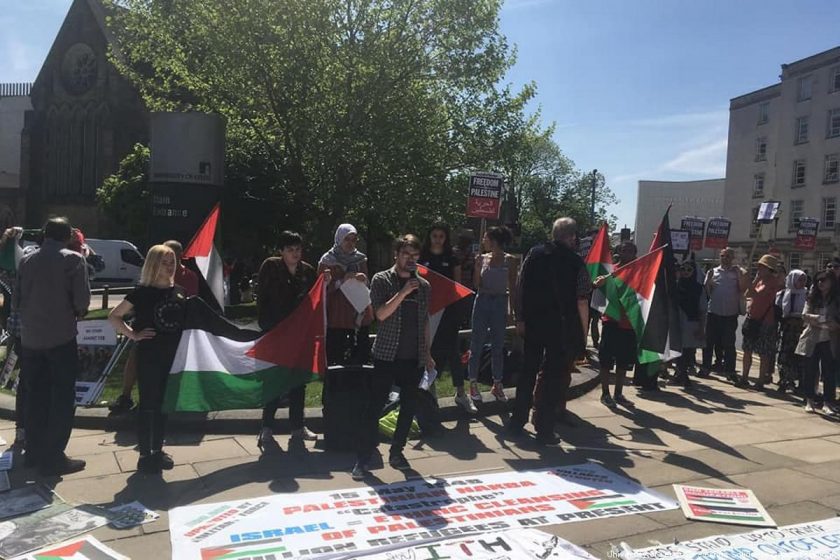
Students hold a protest calling for an end of Israel’s occupation on Gaza at Leeds University, UK on 5 May 2018
MEMO | November 5, 2018
In the first move of its kind, a UK university has divested from companies that supply military equipment to the Israeli army following a student campaign.
The University of Leeds this weekend made the decision to divest from three companies which were found to be complicit in the violation of Palestinian human rights: Airbus, United Technologies and Keyence Corporation. A fourth company – HSBC – is also under review by the university’s investment managers for its provision of loans to Elbit Systems, Caterpillar and BAE Systems, all of which sell weapons and military equipment to the Israeli government.
The move came after it emerged that the University of Leeds had invested £2.4 million ($3.1 million) in these companies this year alone. The sum was revealed by a Freedom of Information request dating back to August, under which the British public can demand access to information held by public authorities.
Students, staff, societies and alumni of the university then published an open letter to the Vice Chancellor calling for the cessation of investment in the four firms. The letter stated that: “In summer 2014, 2,251 Palestinians were killed, including 526 children, by the Israeli Defence Force in the attacks on Gaza […] the artillery used to carry out this destruction were made by Elbit Systems, funded by HSBC. The fighter jets employed by the IDF were maintained by United Technologies. The helicopters which patrol Gaza’s sea border are supplied by Airbus. Further military activity was aided by the equipment provided by Keyence Corporation. The University of Leeds knowingly enables this activity by investing in these companies.”
Our university should not enable military occupation. Our tuition fees should not fund killing. Our education should not be at the expense of a person’s life.
The move has been hailed as a victory for the Boycott, Divestment and Sanctions (BDS) movement. Co-President of the Leeds Palestine Solidarity Group, Evie Russell-Cohen, explained: “It’s clear that the Palestinian call for Boycott, Divestment and Sanctions is being heard in the UK. Students are no longer willing to see their tuition fees funding weapons companies which profit from the killing of Palestinians. This is a massive success, but we hope that it will only be the beginning of a wave change across UK Universities.”
Calls for UK universities to review their investments in companies known to assist the Israeli army have been growing in recent months. In April, activists at the University of Manchester exposed a web of connections between the university and several weapons companies, including Israel Aerospace Industries which produced drones used during Israel’s 2014 assault on the besieged Gaza Strip. The University of Manchester had previously tried to conceal its links to such companies until the Information Commissioner’s Office (ICO) – the body regulating data protection in the UK – found the university to be in contravention of the Freedom of Information Act, the same act which enabled University of Leeds students to force their institution to divest.
Irish Lawmakers Call for Arms Embargo on Israel
IMEMC | November 2, 2018
In a letter published in the Irish Times newspaper, Minister of State Finian McGrath and fifty other Irish TDs and Senators have called for an arms embargo to be placed on Israel, and for “an end to the bi-lateral arms trade between Ireland and the apartheid state”.
In addition to independent Minister McGrath, the signatories include members of Sinn Féin, Solidarity-People Before Profit, Labour, the Green Party, Independents 4 Change and other independent members of the Oireachtas, who condemn “the shooting dead of some 205 [Palestinian] protestors, including 40 children, and wounding of more than 5,000 people by live fire [on the Great March of Return] in Gaza since April”.
The letter ends by calling for “the international community, and the Irish government in particular, to take a stand to help end Israel’s decades of colonial occupation, apartheid and war crimes against the Palestinian people.”
Welcoming the statement, Ms. Fatin Al Tamimi, Chairperson of the Ireland-Palestine Solidarity Campaign (IPSC) and a Palestinian-Irish citizen said she “thanks the members of the Oireachtas for this important and principled statement of solidarity, showing once again the strong bonds between the Irish people and the Palestinian people, both of whom have struggled heroically against colonialism and oppression in their homelands.”
لإamimi noted, according to the PNN, that “the IPSC strongly echoes this call for an arms embargo on Israel, a measure that we Palestinians have long been asking for. Weapons sent to Israel are used to kill, maim and oppress my people, while weapons exported from Israel are marketed as being ‘battle tested’ on Palestinians. It is time to end this horrendous trade in death and destruction, which is a bloody stain upon the Irish state.”
Featured Video

Anthrax War – CBC The Passionate Eye
or go to
Aletho News Archives – Video-Images
Book Review
Shattered Dreams: The HPV Vaccine Exposed (2019)
By Christina England – 30 Q&As – Book Review & Summary
Lies are Unbekoming | September 4, 2026
… Gardasil received FDA fast-track approval in 2006, Cervarix followed in 2009, and Gardasil 9 was approved in December 2014 with more than double the aluminium adjuvant content of the original. The commercial context is specific. Merck was about to lose patent protection on Zocor and faced $18 billion in Vioxx injury claims from a cardiovascular drug the company had marketed while suppressing its own data showing a five-times increase in heart attacks. Analysts projected the global HPV vaccine market at $4 billion by 2011, contingent on government-funded national programs for teenage girls. The 1986 National Childhood Vaccine Injury Act had already granted manufacturers complete liability immunity. By 2013, Japan had withdrawn its HPV vaccine recommendation after cataloguing severe adverse reactions in hundreds of girls. No Western government followed. The establishment position across the UK, US, Australia, and most of Europe held, and still holds, that the vaccines are safe and effective, that reported injuries are coincidental, and that cervical cancer prevention justifies the program. The book was published into this position, not against a vacuum.
Shattered Dreams sits alongside Mary Holland’s The HPV Vaccine On Trial and Viera Scheibner’s foundational vaccination work as part of the documented record on what has been done to a generation of teenage girls under the banner of cancer prevention. The full summary unpacks three specific findings: that Merck used the aluminium adjuvant itself as the “placebo” control in 92.5% of trial subjects, making it structurally impossible to detect excess reactions from the adjuvant; that Dr. Sin Hang Lee found HPV DNA fragments bound to aluminium in every one of sixteen Gardasil samples tested, and in the blood and spleen of a New Zealand girl six months after her third dose; and that in every country with high vaccination coverage, including Australia, the UK, Norway, and Sweden, cervical cancer rates have stopped declining and started rising specifically in the vaccinated cohort. Martínez-Lavín’s 2017 calculation puts the number needed to seriously harm with Gardasil 9 at 140, and the number needed to vaccinate to prevent one case at 1,757. Thirteen young women are seriously harmed for every one who benefits. The vaccine was approved on the basis of trials that could not detect what the trials were supposed to detect, and it is still being given to twelve-year-olds today. … Read full review
Blog Roll
 Aletho News
- Ukraine’s EU neighbors reject new plea from Kiev – Politico
- British Transport Police Facial Recognition Trial Scanned 926,912 People With Zero Arrests
- House Bill Would Ban Federal Use of Flock ALPR Data
- Can a Spice Rival a Drug? 10 Head-to-Head Trials Put It to the Test.
- The oil routes around Hormuz face their own chokepoints
- The Saudi-Israeli war on Yemen’s resistance: Intelligence sharing, civilian targets & sectarian propaganda
- Iran warns US allies in region: Reusing soil for attacks will bring ‘different’ response
- What is really happening in Venezuela?
- Diplomacy is Now a Crime in Britain / Ian Proud
- UK Government Body Kept Files on People Criticizing Prevent Program
- If Americans Knew
- Targeting the rescuers: Inside Israel’s war on paramedics in Lebanon
- No big deal: Israel to halt humanitarian aid to Gaza for 2 days – Daily Update
- Israel is squeezing the life out of Palestinians – Daily Update
- The Israeli Right Portrays Islam as Murderous. It Serves a Political Purpose
- Jordan Has Had Enough: King Abdullah’s Scathing Warning to Israel
- Israeli Colonizers (i.e. Settlers) Kill Palestinian Man Near Salfit
- New Google Maps images reveal massive scale of devastation in Gaza
- Jewish supremacy, anti-Palestinian bigotry on display in Israel – Daily Update
- Israeli Soldiers Abduct At Least 22 Across Occupied West Bank
- Eight Palestinians Killed in Israeli Attacks on Gaza
- No Tricks Zone
- Latest European Green Energy Debacle; Portugal’s Largest Flagship Solar Park Insolvent!
- Green Energy Debacle: German Expert Professor Fritz Vahrenholt Warns Of Severe Economic And Social Consequences
- Two More Paleo Reconstructions Affirm Meters-Higher Sea Levels Across Ireland, Brazil 7000-6000 Years Ago
- New Study: Earth And Venus Surface Warmth Largely Explained By Convection And Lapse Rate, Not CO2 Or Radiation
- 2025 Nature Paper Claiming Worsening Global Drought Gets RETRACTED …Heavily Flawed
- New Study: ‘Global Drought Shows No Detectable Recent Acceleration Under Climate Warming’
- Economic Masterminds: German Socialists Suggest Taxing Productivity Gains Stemming From Using AI
- The South China Sea Has Not Been Cooperating With The Climate Change Narrative
- Energy Crisis: Germany Enters Heating Season With Historically Low Gas Reserve Fill Levels
- New Study: The Antarctic Ice Sheet Gained Mass From 2020-2024 Due To Staggering Snow And Ice Accumulation

