“Just Another Mother Murdered”
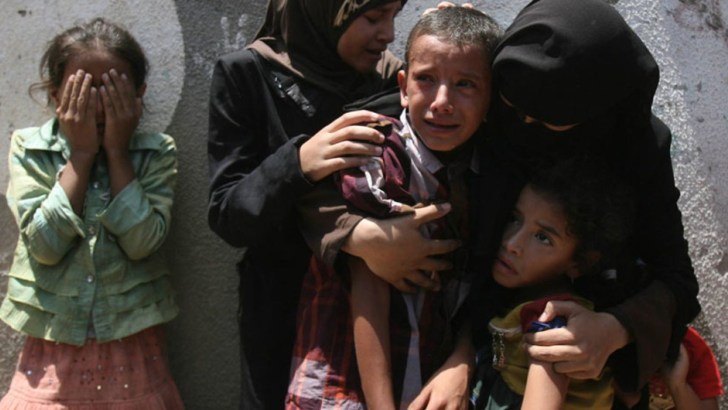
Palestinian children weep in Rafah, southern Gaza Strip (July 15, 2014)
A dozen years ago Alison Weir described how U.S. media ignored a Palestinian death… This pattern has persisted year after year after year…
By Alison Weir – If Americans Knew – October 6, 2006
Almost no one bothered to report it. A search of the nation’s largest newspapers turned up nothing in USA Today, the Boston Globe, Boston Herald, Chicago Sun-Times, Atlanta Journal-Constitution, San Francisco Chronicle, Seattle Times, St. Louis Post-Dispatch, Houston Chronicle, Tampa Tribune, etc.
There was nothing on CBS, NBC, ABC, CNN, PBS, NPR, Fox News. Nothing.
The LA Times, the Washington Post, the New York Times, and Associated Press each had one sentence, at most, telling about her. All three left out the details, the LA Times had her age significantly off, and the Washington Post reported that she had been killed by an Israeli tank shell.
It hadn’t been a tank shell that had killer her, according to witnesses. It had been bullets, multiple ones, fired up close.
Neighbors report that Israeli soldiers had been beating her husband because he wasn’t answering their questions. Foolishly or valiantly, how is one to say, the 35-year-old woman had interfered. She tried to explain that her husband was deaf, screamed at the soldiers that her husband couldn’t hear them and attempted to stop them from hitting him. So they shot her. Several times.
Her name was Itemad Ismail Abu Mo’ammar.
She didn’t die, though. That took longer. It required her life to flow out of her in the form of blood for several hours, as Israeli soldiers refused to allow an ambulance to transport her to help. Her husband and children could do nothing to save her.
Finally, after approximately five hours, an ambulance was allowed to take her to a hospital, where physicians were able to render one service: pronounce her dead, a few days before the commencement of Ramadan, a season of family gatherings much like the Christmas season for Americans. She left 11 children. None of this was in the Washington Post story, which had reported her death in one half of one sentence.
Her husband’s brother, who lived in the same house, was also killed. He was a 28-year-old farmer.
Why did this all happen? The family lived behind a resistance fighter wanted by Israel. They were simply “collateral damage” in a failed Israeli assassination/kidnapping operation.
All together, five Palestinians were killed that day. The other three were young shepherds killed in another area, two 15 years old and one 14, who seem to have simply been in the wrong place at the wrong time. Gaza.
None of this was reported in most of America’s news media, and so the American public never learned about a mother bleeding to death in front of her children, or young shepherds being blown to pieces. Apparently, it just wasn’t newsworthy.
A Case Study of “Good” News Coverage
The Washington Post at least mentioned these deaths, so perhaps those who care about journalistic standards should laud the Post for its coverage.
And yet, the Post in its short report got so much so wrong.
In addition to misreporting Itemad’s cause of death and omitting critical facts, the Post’s story portrayed the entire context incorrectly, telling readers that these five deaths had broken a period of “relative calm.”
The fact is that while it was true that in the previous six months not a single Israeli child had been killed by Palestinians, during this period Israelis had killed 75 Palestinian young people, including an 8-month-old and several three-year-olds.
I phoned the Post and spoke to a foreign editor about the need to run a correction, providing information on Itemad’s murder. The editor said that she would pass this on to their correspondent (who is based in Israel), but explained that it was “impossible for him to go to Gaza.” When I disagreed, she amended the “impossible” to “very difficult.” She neglected to mention that the Post has access to stringers in Gaza available to check out any incident the editors deem important.
Next, I wrote a letter to the paper containing the above information. Happily, the Post letters department apparently checked it out and decided it was a good letter. They sent an email informing me that they were considering my letter for publication and needed to confirm that I was the one who had written it, and that I had not sent the information elsewhere.
I replied in the affirmative, we exchanged a few more messages, and everything appeared on target. Normally, when publications contact you in this way, your letter is published shortly thereafter. I waited in anticipation. And waited.
It is now almost two weeks after their report, and I have just been informed that the paper has decided not to print my letter. The Post has apparently determined that there is no need to run a correction.
I think I understand.
Although the Washington Post’s statement of principles proclaims, “This newspaper is pledged to minimize the number of errors we make and to correct those that occur… Accuracy is our goal; candor is our defense,” the American Society of Newspaper Editors clarifies these ethical requirements: corrections need only be printed when the error of commission or omission is “significant.”
And, after all, these were only Palestinians, and it was just another mother dead.
Alison Weir is the founder and executive director of If Americans Knew. She is the author of Against Our Better Judgment: The Hidden History of How the U.S. Was Used to Create Israel.
Another Palestinian mother has just been killed. For a list of Palestinian and Israeli women killed see this Timeline.
United States Did It Again: Warplanes Use White Phosphorous Munitions in Syria
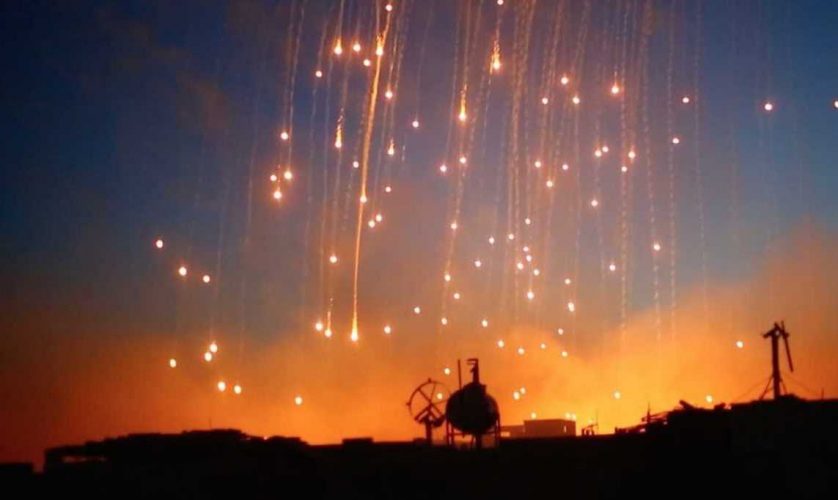
By Peter KORZUN | Strategic Culture Foundation | 14.10.2018
The US-led coalition used white phosphorus (WP) munitions delivering air strikes in the Syrian province of Deir Ez-Zor on Oct.13. The attack resulted in casualties among civilians. Last month, WP munitions were also used by two US Air Force (USAF) F-15s in an attack on the town of Hajin, Deir-ez-Zor. The Syrian government has repeatedly condemned the US-led coalition, which says the need to fight ISIS justifies its military actions while denying the fact it uses white phosphorous projectiles.
WP does not fall into the category of chemical weapons banned by the Chemical Weapons Convention but it is an incendiary weapon. As such, it cannot be used against non-combatants. Protocol III of the Convention on Certain Conventional Weapons “prohibits the use of said incendiary weapons against civilians (already forbidden by the Geneva Conventions) or in civilian areas”. The substance ignites spontaneously upon contact with air, producing a dense white smoke. The heat could reach 800-900°C. No water will help. Severe injuries to internal organs could be caused when absorbed through skin, ingested, or inhaled. Burning particles of white phosphorus produce thermal and chemical burns if they come into contact with skin.
It’s not Syria only where the US used WP munitions. White phosphorous artillery shells were used in Iraq during the assault on Fallujah in 2004. The US admitted the fact. There have also been media reports about the WP use in Mosul, Iraq and Raqqa, Syria. Last year, the Washington Post published photographs of US Marines equipped with white phosphorus projectiles to be used in the battle for Raqqa. The source offered similar pictures showing WP munitions with US Army units outside Iraqi Mosul.
The Human Rights Watch has warned about dangers coming from the use of WP in urban areas. According to Steve Goose, arms director at Human Rights Watch, “No matter how white phosphorus is used, it poses a high risk of horrific and long-lasting harm in crowded cities like Raqqa and Mosul and any other areas with concentrations of civilians.”
In 2015, the United States used depleted uranium (DU) in Syria. DU is not banned by an international treaty but its use runs counter to the International Humanitarian Law (IHW). Article 36 of the Additional Protocol I to the Geneva Conventions requires to ensure that “any new weapon means or method of warfare does not contravene existing rules of international law.” It says “General principles of the laws of war/IHL prohibit weapons and means or methods of warfare that cause superfluous injury or unnecessary suffering, have indiscriminate effects or cause widespread, long-term and severe damage to the natural environment.” In 2012, the UN General Assembly tried to adopt a resolution restricting the use of DU. The move was supported by 155 states, with 27 abstaining and four, including the United States, voting against.
The American military has used cluster bombs against civilians in Yemen. The US is not one of the 102 states parties to the 2008 Convention on Cluster Munitions, which prohibits the weapons that open in the air, dispersing multiple bomblets or submunitions over a wide area. Many submunitions fail to explode on initial impact, acting like landmines for years. The Pentagon refuses to give cluster munitions and American field commanders are authorized to use them at their discretion.
The US continues to run biological programs, operating more than 20 laboratories around the world in blatant violation of the UN Biological Weapons Convention. An opinion paper published on Oct. 4 in the journal Science, written by an international group of researchers claims the US Defense Advanced Research Projects Agency (DARPA) is potentially developing insects as a means of delivering a “new class of biological weapon.”
In 2011, US police used tear gas and other chemical irritants against Occupy protesters. Tear gas is prohibited for use against enemy soldiers in battle by the Chemical Weapons Convention but it’s all right with America’s law enforcement agencies using the dangerous substance against their own people.
There is no justification for using WP at the time ISIS has been reduced to insignificance in Syria but Washington did it again. It violated international law after having unilaterally imposed sanctions on Russia without any evidence to support the relevant accusations. It should also be remembered that, unlike Russia, the US has so far failed to meet its obligations and destroy the chemical weapons stockpile. The use of substances to harm civilians is a serious matter that should be addressed at the ongoing 79th session on UN General Assembly. America’s non-compliance with generally accepted norms is the most acute problem on the international security agenda.
Israeli historian thinks 1956 massacre was part of a secret plan to expel Palestinians

Issachar “Yiska” Shadmi, right, following his show trial.
If Americans Knew | October 13, 2018
Israel’s Ha’aretz newspaper reports that the highest Israeli officer tried for Israel’s 1956 Kafr Qasem massacre admitted before his death that his trial was staged to protect military and political elites.
Israeli historian Adam Raz believes that a secret plan to transfer Israel’s Arabs was behind the 1956 attack, in which Israeli soldiers shot dead 19 men, 6 women, and 23 children (some reports give the total killed as 51). They were allegedly killed because they had violated an Israeli imposed curfew, of which they were unaware.
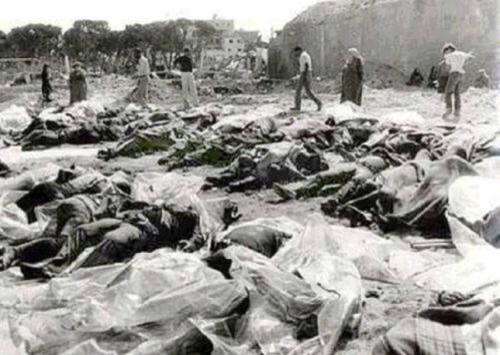
Palestinian villagers killed by Israeli forces in Kafr Qasim, October 29, 1956
The Israelis who perpetrated the massacre were courtmartialed and convicted, but their sentences were soon commuted, they received presidential pardons and were released from jail. Some were awarded desirable jobs; Ben Gurion appointed the batallion commander head of security at the Dimona nuclear reactor.
The most senior defendant, Col. Issachar Shadmi, commander of the brigade in charge of the area, was fined 10 pennies for exceeding authority.

Issachar “Yiska” Shadmi, after his trial, holding the 10-prutot coin he had to pay as a fine.
Until his death last month at the age of 96, Shadmi lived in a spacious home in an upscale neighborhood of Tel Aviv.
Ha’aretz journalist Ofer Aderet interviewed Shadmi in 2017.
During the interview Shadmi said that the 1958 court case was “a show trial, staged in order to keep Israel’s security and political elite – including Prime Minister Ben-Gurion, IDF Chief of Staff Moshe Dayan, and GOC Central Command (and later chief of staff) Tzvi Tzur – from having to take responsibility for the massacre.”
The trial, Aderet reports, “was intended to mislead the international community with regard to Israel’s ostensible pursuit of justice.”
Shadmi said: “They explained to me that they needed to put me on trial, because if I had tried in my own country and convicted, even if I was fined only a penny, I wouldn’t go to The Hague…. If they didn’t prosecute me… I would be tried at The Hague. And that is something that neither I nor the country were interested in.”
Aderet writes that Shadmi said he was well compensated as a civilian for going along with the show trial: “I turned into a major Defense Ministry building contractor.”
Israeli historian Adam Raz has filed a lawsuit demanding that Israel declassify documents relating to the affair. He says: “Most of the material is still classified. I was surprised to discover that it’s easier to write about the history of Israel’s nuclear program than about Israel’s policies regarding its Arab citizens.”
Raz believes that another reason for the show trial was to hide a secret program called “Operation Mole.” The goal was to expel Palestinians from the area. He says: “The public is familiar with the ‘Mole’ program only as a rumor.” says Raz; much of the documentation remains classified in the IDF archive.
Aderet writes: “Raz thinks one must see the Kafr Qasem massacre in this context: ‘The massacre wasn’t perpetrated by a group of soldiers who were out of control, as has been argued until today. From their point of view they were following orders, which in essence would lead to the expulsion of the villagers,’ he says. Or, in other words, they were operating in line with the directives of Operation Mole, as they understood them.”
Raz has written a book about the massacre scheduled to be published this month, but it appears it will only be available in Hebrew.
US Coalition Strikes Syrian Town Using Banned White Phosphorus – Reports
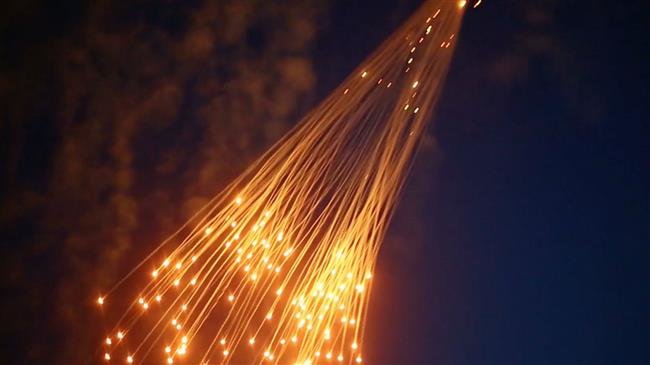
Sputnik – October 13, 2018
The reported strikes are not the first time that the US-led coalition has been accused of using the banned munitions in recent weeks. Last month, the Russian military reported that US strikes using white phosphorus had resulted in major fires and civilian casualties in the eastern Syrian province of Deir Ez-Zor.
The strikes, taking place Saturday across multiple districts in the town of Hajin, Deir Ez-Zor province, included the use of white phosphorus, the Syrian Arab News Agency (SANA) has reported, citing local sources.
The agency did not provide any immediate information about possible civilian casualties.
Syrian television station Ikhbariya later reported that several people had been killed and several others injured following separate coalition strikes in al-Soussa, Deir Ez-Zor in an attack which hit a local bakery.
SANA said the strikes involving the use of white phosphorus appeared to have been carried out “under the pretext of fighting Daesh (ISIS).”
The coalition has not yet made any official commentary regarding the alleged incident.
This week, the United Nations’ humanitarian watchdog expressed concern regarding the safety of an estimated 10,000 civilians believed to be trapped in the Hajin area amid reports of civilian deaths during ongoing SDF and coalition operations in the area against Daesh.
Saturday’s incident was not the first suspected use of white phosphorus by the US-led coalition. Last month, the coalition denied using the substance in Syria after the Russian Center for Syrian Reconciliation issued a report of airstrikes carried out using the internationally-prohibited weapons by US F-15 fighter jets on September 8. Damascus has repeatedly accused the coalition of using white phosphorus in its attacks, charging Western forces of using the agent in strikes which have led to the deaths of multiple civilians, including children, last year.
Under Geneva Conventions, white phosphorus munitions are prohibited for use against civilians or in civilian areas.
US-led coalition operations in Syria are not sanctioned by Syrian government, nor the UN.
‘Evidence’ Saudi-led coalition aims to destroy food production in Houthi-controlled Yemen – report
RT | October 13, 2018
As the war in Yemen rages on, a new report says there is “strong evidence” that the Saudi-led coalition has aimed to destroy food production and distribution in areas of the country controlled by Houthi rebels.
The report, titled ‘Strategies of the Coalition in the Yemen War: Aerial Bombardment and Food War’, is a compilation of data from various sources on the impact of the coalition’s bombing campaign on the production and distribution of food in rural Yemen, and on fishing along the Red Sea coast.
“If one places the damage to the resources of food producers (farmers, herders, and fishers) alongside the targeting of food processing, storage and transport in urban areas and the wider economic war, there is strong evidence that Coalition strategy has aimed to destroy food production and distribution in the areas under the control of Sanaa,” the report, published earlier this week by the World Peace Foundation, says.
It goes on to explain that the deliberate destruction of “family farming and artisanal fishing” is a war crime.
The report includes data collected by several organizations within Yemen, including the Yemen Data Project, the Ministry of Agriculture and Irrigation, and the Ministry of Fish Wealth.
Read more
Yemenis grieve beside the grave of a child killed in last month’s coalition airstrike on a school bus © Naif Rahma Pompeo says Saudi coalition exercising caution in Yemen – facts show that’s not true
“Together, the data detail the overall levels of targeting civilian, military and unknown sites… the systematic targeting of agricultural areas including the character of the site, and the frequency and timeline of targeting.”
It goes on to document the killing of fishermen along Yemen’s Red Sea coast, and the destruction of boats and infrastructure required to support small-scale fishing which “otherwise could provide life-saving food for a civilian population on the brink of famine.”
The report cites data from the General Authority of Fishing in the Red Sea when it states that 146 fishermen have died as a result of coalition airstrikes from the beginning of the war until December 2017.
Yemen has seen major civilian loss and suffering since the country’s civil war broke out in 2015, with many on the brink of starvation. The country has also endured a major cholera outbreak and a severe lack of medical supplies which has led to many cancer patients having to forego treatment.
Over 16,000 civilians are believed to have perished since the start of the civil war. Meanwhile, the UN and rights groups have repeatedly accused the Saudi-led coalition of not sparing the lives of civilians during its aerial bombardment of Yemen. Up to 50 people were killed when a wedding was bombed in April, while an attack on a bus saw dozens, including many children, die in August.
FILE PHOTO A displaced Yemeni woman from Hodeida cooks food outside a shelter © AFP / Essa Ahmed
The coalition has denied allegations that it is targeting civilians. It did, however, express regret over the bus attack. Such an admission is rare for the coalition, particularly after it previously referred to the bus attack as being “legitimate.”
The Saudi-led coalition intervened in the conflict in Yemen in 2015, in an effort to restore the internationally recognized government after it was driven out by Houthi rebels.
The Two Brett Kavanaugh Stories
By Philip M. GIRALDI | Strategic Culture Foundation | 11.10.2018
There were two simultaneous Brett Kavanaugh stories. Together, as part of the confirmation process regarding his nomination as Supreme Court Justice, they revealed how political discourse in the United States has reached a new low, with debate over the man’s possible predilection to make judgments based on his own preferences rather than the US Constitution being ignored in favor of the politically motivated kabuki theater that was deliberately arranged to avoid that issue and instead go after his character.
Consider first of all, his flaws as a candidate. He was regularly framed as a “conservative,” but what did that mean in the context of his career? Some of the critics are referring to his time spent as a government lawyer, specifically for the George W. Bush Administration, where he was a supporter of wide executive authority in the context of the war against terror while others point to his decisions and writings during his time as a US Circuit judge from 2006 until the present. That meant essentially that Kavanaugh then supported and apparently continues to support what is now referred to as the John Yoo doctrine, named after the Department of Justice lawyer who penned the memo that made the case for the president to act unilaterally to do whatever is required in national security cases even if there be no direct or immediate threat. Yoo specifically argued that the president, by virtue of his office, is not bound by the War Crimes Act. This theory of government, also more broadly dubbed the unitary executive, was popularized by Yoo, fellow government lawyer Jay Bybee and Eric Posner of the University of Chicago.
For those who find Kavanaugh unacceptable in terms of his judicial philosophy, this repudiation of the constitutional principle of three branches of government that check each other was enough to disqualify him from a position on the Supreme Court, principally as it impacts on both the first and second articles of the constitution by granting to the president the authority to both begin and continue a war on his own recognizance. It also means that the president on his own authority can suspend first and fourth amendment rights to freedom of speech and association as well as freedom from illegal search. He supported, for example, the government’s “right” to conduct mass searches of private data such as was conducted by the NSA. Kavanaugh supports government authority to legitimize incarceration without trial and to order assassinations and torture. Kavanaugh is also on record as favoring limiting the public’s right to use the courts to redress government overreach.
But curiously enough, or perhaps not so curiously, Kavanaugh was treated with kid gloves on those critical issues, basically because both major parties are now supportive of the unitary executive concept even if they would not admit that to be the case. Bill Clinton launched cruise missiles attacks on Sudan and Afghanistan on his own authority and involved the US in a war in the Balkans. George W. Bush did the same in approving torture and expanding the war on terror to Iraq and also globally, while Barack Obama attacked both the Syrian and Libyan governments and assassinated US citizens abroad, all acts of war or war crimes carried out without a congressional declaration of war or without any real pushback by the judiciary.
The failure of Congress to carry out its duty to review Kavanaugh’s ability or lack thereof to interpret the constitution impartially was the more important story line in the confirmation process but it was ignored by the media. The other narrative that ran simultaneously, the purely political attempt made by the Democrats and some Republicans to destroy Kavanaugh as a person through the exploitation of random claims of sexual assault dating from more than thirty-five years ago, was an attempt to discredit the candidate that everyone knew right from the beginning could not be substantiated.
This all means that the important issue of Kavanaugh’s likely comportment as a judge was subjected to too little inquiry while his character as evidenced by tales from his past life received far too much attention. Ironically, the media, which has been frantically searching for an explanation for the breakdown of democracy in the United States, has been pillorying the Russians and more recently the Chinese for outside interference in the process, while ignoring the intense public dissatisfaction with the government it has been allowed to have by the Establishment, which is exemplified by the dystopic reality demonstrated by Kavanaugh. Some Americans would have rejected him based on his merits as a judge, but the case was not clearly made. Many instead came to view him as a victim of a vicious personal campaign and that was apparently enough to win confirmation, at least as reckoned by the calculus of those in Congress who cast the actual votes. In either case, the system failed to produce a good result and we only have our polarized and dysfunctional government to blame for that failure.
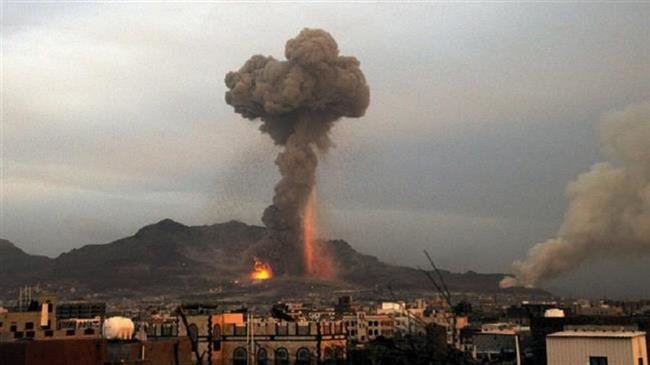
US foreign military sales for 2018 total $55.66B, up 33 percent
Press TV – October 9, 2018
Sales of US military equipment to foreign governments have increased by 33 percent compared to the previous year’s total, a US administration official says.
Lieutenant General Charles Hooper, director of the Defense Security Cooperation Agency, told Reuters on Tuesday that the US foreign military sales hit 55.6 billion dollars in the fiscal year ending September 30.
According to Reuters, the increase in foreign military sales came in part because the Trump administration rolled out a new “Buy American” plan in April that relaxed restrictions on sales while encouraging US officials to take a bigger role in increasing business overseas for the US weapons industry.
Hooper said the $55.6 billion figure represented signed letters of agreement for foreign military sales between the United States and allies.
The United States sold over $40 billion worth of weapons last year, maintaining its position as the world’s dominant arms supplier.
A report by the Stockholm International Peace Research Institute (SIPRI) revealed in March that the US has increased its arms sales by 25 percent over the past five years.
It also said some half of US arms exports during that period have gone to the Middle East, and that Saudi Arabia registered a 225-percent rise in military purchases – almost all from the US and Europe.
Saudi Arabia was the first country US President Donald Trump visited after taking office last year. It was announced during his visit to Riyadh that Washington could sell $110 billion in military equipment to Saudi Arabia in a period of 10 years. The State Department said at the time that the deal could grow to $350 billion over a decade.
The massive arms sales come despite repeated international calls on the US to stop supporting the Saudis with modern weaponry, which the kingdom has, according to many reports, used in its devastating war on Yemen.
The White House has also been criticized by both human rights groups and US lawmakers in Congress from both political parties for allowing its Saudi ally to bomb Yemen.
Some 15,000 Yemenis have been killed and thousands more injured since the onset of the Saudi-led aggression in March 2015.
Washington has denied it is directly supplying the Saudis with weapons in the war but numerous reports have suggested that US arms have played a part in massive civilian casualties.
Featured Video

Anthrax War – CBC The Passionate Eye
or go to
Aletho News Archives – Video-Images
Book Review
Shattered Dreams: The HPV Vaccine Exposed (2019)
By Christina England – 30 Q&As – Book Review & Summary
Lies are Unbekoming | September 4, 2026
… Gardasil received FDA fast-track approval in 2006, Cervarix followed in 2009, and Gardasil 9 was approved in December 2014 with more than double the aluminium adjuvant content of the original. The commercial context is specific. Merck was about to lose patent protection on Zocor and faced $18 billion in Vioxx injury claims from a cardiovascular drug the company had marketed while suppressing its own data showing a five-times increase in heart attacks. Analysts projected the global HPV vaccine market at $4 billion by 2011, contingent on government-funded national programs for teenage girls. The 1986 National Childhood Vaccine Injury Act had already granted manufacturers complete liability immunity. By 2013, Japan had withdrawn its HPV vaccine recommendation after cataloguing severe adverse reactions in hundreds of girls. No Western government followed. The establishment position across the UK, US, Australia, and most of Europe held, and still holds, that the vaccines are safe and effective, that reported injuries are coincidental, and that cervical cancer prevention justifies the program. The book was published into this position, not against a vacuum.
Shattered Dreams sits alongside Mary Holland’s The HPV Vaccine On Trial and Viera Scheibner’s foundational vaccination work as part of the documented record on what has been done to a generation of teenage girls under the banner of cancer prevention. The full summary unpacks three specific findings: that Merck used the aluminium adjuvant itself as the “placebo” control in 92.5% of trial subjects, making it structurally impossible to detect excess reactions from the adjuvant; that Dr. Sin Hang Lee found HPV DNA fragments bound to aluminium in every one of sixteen Gardasil samples tested, and in the blood and spleen of a New Zealand girl six months after her third dose; and that in every country with high vaccination coverage, including Australia, the UK, Norway, and Sweden, cervical cancer rates have stopped declining and started rising specifically in the vaccinated cohort. Martínez-Lavín’s 2017 calculation puts the number needed to seriously harm with Gardasil 9 at 140, and the number needed to vaccinate to prevent one case at 1,757. Thirteen young women are seriously harmed for every one who benefits. The vaccine was approved on the basis of trials that could not detect what the trials were supposed to detect, and it is still being given to twelve-year-olds today. … Read full review
Blog Roll
 Aletho News
- Swiss scammed out of millions by Ukraine-linked call centers – media
- Germany facing potential ‘violent conflict’ with Russia – spy chief
- Ukraine’s EU neighbors reject new plea from Kiev – Politico
- British Transport Police Facial Recognition Trial Scanned 926,912 People With Zero Arrests
- House Bill Would Ban Federal Use of Flock ALPR Data
- Can a Spice Rival a Drug? 10 Head-to-Head Trials Put It to the Test.
- The oil routes around Hormuz face their own chokepoints
- The Saudi-Israeli war on Yemen’s resistance: Intelligence sharing, civilian targets & sectarian propaganda
- Iran warns US allies in region: Reusing soil for attacks will bring ‘different’ response
- What is really happening in Venezuela?
- If Americans Knew
- A U.S. Jewish Fund’s Ambitious Bid to Put a Settler Elite in Control of Israel’s Security
- As genocide drags on, “Zionism is racism” becomes official policy in one UK party – Daily Update
- Targeting the rescuers: Inside Israel’s war on paramedics in Lebanon
- No big deal: Israel to halt humanitarian aid to Gaza for 2 days – Daily Update
- Israel is squeezing the life out of Palestinians – Daily Update
- The Israeli Right Portrays Islam as Murderous. It Serves a Political Purpose
- Jordan Has Had Enough: King Abdullah’s Scathing Warning to Israel
- Israeli Colonizers (i.e. Settlers) Kill Palestinian Man Near Salfit
- New Google Maps images reveal massive scale of devastation in Gaza
- Jewish supremacy, anti-Palestinian bigotry on display in Israel – Daily Update
- No Tricks Zone
- Latest European Green Energy Debacle; Portugal’s Largest Flagship Solar Park Insolvent!
- Green Energy Debacle: German Expert Professor Fritz Vahrenholt Warns Of Severe Economic And Social Consequences
- Two More Paleo Reconstructions Affirm Meters-Higher Sea Levels Across Ireland, Brazil 7000-6000 Years Ago
- New Study: Earth And Venus Surface Warmth Largely Explained By Convection And Lapse Rate, Not CO2 Or Radiation
- 2025 Nature Paper Claiming Worsening Global Drought Gets RETRACTED …Heavily Flawed
- New Study: ‘Global Drought Shows No Detectable Recent Acceleration Under Climate Warming’
- Economic Masterminds: German Socialists Suggest Taxing Productivity Gains Stemming From Using AI
- The South China Sea Has Not Been Cooperating With The Climate Change Narrative
- Energy Crisis: Germany Enters Heating Season With Historically Low Gas Reserve Fill Levels
- New Study: The Antarctic Ice Sheet Gained Mass From 2020-2024 Due To Staggering Snow And Ice Accumulation

