International Team of Researchers Concerned Over US Efforts to Create Bio-Weapons

By Peter KORZUN | Strategic Culture Foundation | 08.10.2018
In 1969, US President Richard Nixon ended all offensive aspects of the US bio-weapons program — the first category of weapons prohibited by an international treaty. In 1975, the US ratified both the 1925 Geneva Protocol and the 1972 Biological Weapons Convention (BWC) — the international treaties outlawing biological warfare. But many reports from different sources offer reason to believe that the US military is developing a new generation of weapons in violation of the international treaties Washington is a party to.
An opinion paper published on Oct. 4 in the journal Science, written by an international group of researchers led by Richard Guy Reeves from the Max Planck Institute for Evolutionary Biology in Germany, claims the US Defense Advanced Research Projects Agency (DARPA) is potentially developing insects as a means of delivering a “new class of biological weapon.”
The official goal of Insect Allies, an ongoing research program, is to disperse infectious, genetically modified viruses that have been engineered to edit crop chromosomes directly in the field. But there is a reason to believe that the program is actually an effort to develop biological agents and a means of delivery intended for hostile purposes. If true, this would constitute a breach of the Biological Weapons Convention (BWC).
The researchers warn the project could be used to create drought-resistant crops as an “agricultural bio-weapon.” The Washington Post cited Silja Voeneky, the co-author of the Science article and a professor of international law at the University of Freiburg, who stated, “We argue that there is the risk that the program is seen as not justified by peaceful purposes.” According to her, “To use insects as a vector to spread diseases is a classical bio-weapon.”
DARPA’s program manager for Insect Allies, Blake Bextine, acknowledged that the project involves new technologies that potentially could be deployed for “dual use,” in theory, for either defensive or offensive purposes. But that’s true for almost any advanced technology, he added.
The simple fact alone that Insect Allies is a military program naturally raises questions. The US Defense Department says its research agency has been tasked with this problem because food security is a component of national security. The State Department has explained that the project is for peaceful purposes and does not violate the BWC. This does not sound very convincing!
Just a few hours before the scathing report published by Science hit the press, Russian Maj. Gen. Igor Kirillov, the commander of the Russian Armed Forces’ Radiological, Chemical, and Biological Defense Troops, accused the US military of carrying out large-scale, covert, biological warfare research using labs located in Georgia, Ukraine, Azerbaijan, Uzbekistan and elsewhere. The Russian military is concerned about the outbreaks of African swine fever that first began in Georgia in 2007 and then spread into Russia, Europe, and China. “The infection strain in the samples collected from animals killed by the disease in those nations was identical to the Georgia-2007 strain,” Igor Kirillov emphasized.
The documents released by former Georgian State Security Minister Igor Giorgadze have confirmed that the US-funded Richard G. Lugar Center for Public Health Research in Tbilisi, Georgia, was used as a cover for secret military biological research. The Russian military believes the spread of viral diseases in southern Russia could have been linked to the activities of the Lugar Center. Identical information has also been obtained from other sources. US investigative journalist Jeffrey Silverman, who has lived in Georgia for over 25 years, tells the same story about the US military’s biological research effort in that country.
In October 2017, Russian President Vladimir Putin issued a statement claiming that someone was collecting “biological material” from various ethnic groups and regions of Russia.
Last summer, the US Air Force’s Air Education and Training Command sought samples of ribonucleic acid (RNA) and synovial fluid from Russian subjects who “must be Caucasian.” It was looking for at least 12 RNA samples from Russians of European ancestry, as well as 27 samples of synovial fluid. Only Russian specimens. It wanted no tissue samples from Ukraine.
In January 2018 Dilyana Gaytandzhieva, a well-known Bulgarian investigative journalist, published an extensive report confirming the fact that the US military has never stopped its bio-weapons research that it conducts in many countries. According to her, it regularly produces deadly viruses, bacteria, and toxins in direct violation of the UN Convention on the prohibition of biological weapons, and that hundreds of thousands of unwitting people are systematically being exposed to dangerous pathogens and other incurable diseases.
No, the reports about the US violations of the BWC cannot be dismissed as mere Russian propaganda. Neither the journal Science nor the authors of the sensational article that has drawn so much public attention have any ties to Russia. Too many sources, based in a variety of geographic locations and publishing reports by a wide range of people, all tell the same story. The programs in question are always under the control of the military, not other, civilian agencies. The issue of US non-compliance with the BWC has not been in the spotlight and has been overlooked in comparison to the problems related to other weapons of mass destruction. But if the United States so flagrantly violates the BWC, can it be trusted with other international arms-control treaties? Russia appears to be trying to draw public attention to this issue. Other nations should join this effort. The time is right to ask the US to stop dodging awkward questions and provide some clear answers to them.
Jerusalem: Israel settlers occupy buildings near Al-Aqsa Mosque
MEMO | October 4, 2018
 Israeli settlers have occupied two Palestinian buildings near Al-Aqsa Mosque in occupied East Jerusalem.
In the early hours of this morning, Israeli settlers stormed a building in the Muslim Quarter of the Old City. According to Wafa, the “settlers moved into the building owned by the Joudeh family, which was used as a clinic” in the Aqbat Darwish area, near Al-Aqsa Mosque.
This was the second building in Jerusalem to be taken over in the past two days. Yesterday settlers occupied a building in the Wadi Hilweh area of Silwan, situated just outside the walls of the Old City and below Al-Aqsa Mosque.
This is not the first time these areas have been targeted by illegal Israeli settlers, with Silwan in particular repeatedly facing attempts to drive Palestinian inhabitants from their homes. The “City of David” national park – a tourist site and archaeological dig run by right-wing settler group City of David Foundation (also known as Elad) – is situated in Batan Al-Hawa in Silwan and is frequently used as justification for such illegal activity.
In July, the Israeli Knesset advanced a new law that would allow residential construction in the “City of David” national park. According to a report by Haaretz, “the minutes of the [Elad] committee’s previous meeting in January made it clear that Elad and its leader, David Beeri, are behind the bill, which is designed to promote construction at the site.”
In August a “heritage centre” was opened in the park, with the inauguration attended by senior Israeli and US figures. A Palestinian resident of Silwan, Yakoub Al-Rajabi, explained that: “We know that this was a well-orchestrated plan to force us to leave […] And if we stay, it will paralyse us and isolate us in our homes”.
Since 2002, 700 Palestinians have been facing eviction from their land in Batan Al-Hawa. Their land was transferred to the Benvenisti Trust when Israel’s Justice Ministry issued title deeds to the organisation for the land in question. The trust is controlled by Ateret Cohanim, a right-wing organisation that encourages Jewish Israelis to settle illegally in Palestinian neighbourhoods of Jerusalem.
In June, Israel admitted that its decision to evict the Palestinians of Batan Al-Hawa was “flawed” and that it had not properly investigated the nature of the trust, or the Ottoman-era law that applies to the case. Despite the admission, a number of families have already been evicted from Batan Al-Hawa or are embroiled in court battles to save their homes.
Other areas of Jerusalem are also targeted for illegal Israeli settlement. According to statistics from the Jerusalem Institute, as of 2015 there were some 211,000 Jewish Israelis living in occupied East Jerusalem, amounting to 40 per cent of all inhabitants in these neighbourhoods. The statistics also demonstrate that the number of Israelis living in illegal Jerusalem settlements has grown consistently since the city was occupied in 1967.
READ ALSO: Israel settlers flood Khan Al-Ahmar with waste water
Israel minister: Merkel should not discuss Khan Al-Ahmar during visit
MEMO | October 4, 2018
Israeli Culture and Sports Minister Miri Regev yesterday called on German Chancellor Angela Merkel to take care of her country’s interests and not to mention the demolition of the Palestinian village of Khan Al-Ahmar during her official visit to Israel, news site Arutz Sheva reported.
Regev’s comments came after reports circulated that Merkel threatened to cancel her trip to Israel if the West Bank village of Khan Al-Ahmar was demolished.
“I think that her statement is out of place, and we certainly do not interfere with the decisions of the courts in other countries, and I expect that they will not interfere with the decisions of the Israeli court,” Regev said.
“I propose to the German chancellor that she deal with the internal problems of her own country or deal with the very good cooperation system between Germany and Israel,” the Israeli minister from the Likud said.
She added: “We respect the chancellor and her government, but I expect every leader to take care of the internal affairs of his country only.”
In response to the claims, Israeli MK Bezalel Smotrich also tweeted: “If I was prime minister I would evict the village while Merkel’s aircraft is in the air. So that she will then turn around and go back.”
During her speech at Haifa University Merkel rejected the reports as “fake news”, claiming she did not make such a demand.
US Openly Threatens Russia with War: Goodbye Diplomacy, Hello Stone Age
By Peter KORZUN | Strategic Culture Foundation | 04.10.2018
US Ambassador to NATO Kay Bailey Hutchison is a highly placed diplomat. Her words, whatever they may be, are official, which includes the ultimatums and threats that have become the language increasingly used by US diplomats to implement the policy of forceful persuasion or coercive diplomacy. Bellicose declarations are being used this way as a tool.
On Oct. 2, the ambassador proved it again. According to her statement, Washington is ready to use force against Russia. Actually, she presented an ultimatum — Moscow must stop the development of a missile that the US believes to be in violation of the Intermediate-Range Nuclear Forces Treaty (INF Treaty). If not, the American military will destroy it before the weapon becomes operational. “At that point, we would be looking at the capability to take out a (Russian) missile that could hit any of our countries,” Hutchison stated at a news conference. “Counter measures (by the United States) would be to take out the missiles that are in development by Russia in violation of the treaty,” she added. “They are on notice.” This is nothing other than a direct warning of a preemptive strike.
It is true that compliance with the INF Treaty is a controversial issue. Moscow has many times claimed that Washington was in violation, and that position has been substantiated. For instance, the Aegis Ashore system, which has been installed in Romania and is to be deployed in Poland, uses the Mk-41 launcher that is capable of firing intermediate-range Tomahawk missiles. This is a flagrant breach of the INF Treaty. The fact is undeniable. The US accuses Moscow of possessing and testing a ground-launched cruise missile with a range capability of 500 km to 5,500 km (310-3,417 miles), but there has never been any proof to support this claim. Russia has consistently denied the charges. It says the missile in question — the 9M729 — is in compliance with the provisions of the treaty and has never been upgraded or tested for the prohibited range.
This is a reasonable assertion. After all, there is no way to prevent such tests from being detected and monitored by satellites. The US could raise the issue with the Special Verification Commission (SVC). Instead it threatens to start a war.
This is momentous, because the ambassador’s words were not a botched statement or an offhand comment, but in fact followed another “warning” made by a US official recently.
Speaking on Sept. 28 at an industry event in Pennsylvania hosted by the Consumer Energy Alliance, Interior Secretary Ryan Zinke suggested that the US Navy could be used to impose a blockade to restrict Russia’s energy trade. “The United States has that ability, with our Navy, to make sure the sea lanes are open, and, if necessary, to blockade… to make sure that their energy does not go to market,” he said, revealing that this was an option. The Interior Department has nothing to do with foreign policy, but Mr. Zinke is a high-ranking member of the administration.
Two bellicose statements made one after another and both are just short of a declaration of war! A blockade is a hostile act that would be countered with force, and the US is well aware of this. It is also well aware that Russia will defend itself. It’s important to note that no comments or explanations have come from the White House. This confirms the fact that what the officials have said reflects the administration’s position.
This brings to mind the fact that the Interdiction and Modernization of Sanctions Act has passed the House of Representatives. The legislation includes the authority to inspect Chinese, Iranian, Syrian, and Russian ports. Among the latter are the ports of Nakhodka, Vanino, and Vladivostok. This is an openly hostile act and a blatant violation of international law. If the bill becomes law, it will likely start a war with the US acting as the aggressor.
Trident Juncture, the largest training event held by NATO since 2002, kicks off on October 25 and will last until November 7, 2018. It will take place in close proximity to Russia’s borders. Russia’s Vostok-2018 exercise in September was the biggest seen there since the Cold War, but it was held in the Far East, far from NATO’s area of responsibility. It’s NATO, not Russia, who is escalating the already tense situation in Europe by holding such a large-scale exercise adjacent to Russia’s borders.
Russia is not the only country to be threatened with war. Attempts are being made to intimidate China as well. Tensions are running high in the South China Sea, where US and Chinese ships had an “unsafe” interaction with each other on Sept. 30. A collision was barely avoided. As a result, US Defense Secretary James Mattis had to suspend his visit to China when it was called off by Beijing [*]. The security dialog between the two nations has stalled.
Perhaps the only thing left to do is to give up on having a normal relationship with the United States. Ambassador Hutchison’s statement is sending a clear message of: “forget about diplomacy, we’re back to the Stone Age,” with Washington leading the way. This is the new reality, so get used to it. Just shrug it off and try to live without the US, but be vigilant and ready to repel an attack that is very likely on the way.
It should be noted that Moscow has never threatened the US with military action. It has never deployed military forces in proximity to America’s shores. It did not start all those unending sanctions and trade wars. When exposing the US violations of international agreements, it has never claimed that the use of force was an option. It has tried hard to revive the dialog on arms control and to coordinate operations in Syria. But it has also had to issue warnings about consequences, in case it were provoked to respond to a hostile act. If the worst happens, we’ll all know who is to blame. Washington bears the responsibility for pushing the world to the brink of war.
* China says Washington canceled military talks, not Beijing
Press TV – October 4, 2018
China has rejected an allegation by the United States that Beijing has canceled security talks with Washington planned for this month, saying that US officials have “distorted the facts.”
An unnamed US official had told Reuters on Sunday that China had canceled the security meeting between American Secretary of Defense James Mattis and his Chinese counterpart, alleging that China had been unable to make its defense secretary available for the scheduled talks.
On Wednesday, Beijing effectively said that that assertion was a lie. … continue
UAE recruiting Africans for Saudi-led war: Report
Press TV – October 3, 2018
The United Arab Emirates (UAE), Saudi Arabia’s key partner in the ongoing Riyadh-led invasion of Yemen, has reportedly been recruiting tribesmen from northern and central parts of Africa to fight in the war.
The campaign features Emirati envoys “seducing” the tribesmen across a vast area spanning southern Libya as well as entire Chad and Niger, who earn a living by herding as well as human and material smuggling, the Middle East Monitor (MEMO) press monitoring organization reported on Wednesday.
“This campaign is supervised by Emirati officials who gained material profits in collaboration with human traffickers,” the report added.
An awareness campaign has been launched by Chadian activists, led by campaigner Mohamed Zain Ibrahim, to warn the tribesmen against joining the Saudi-led war.
“The Arabs of the [Persian] Gulf region, especially the UAE and Saudi Arabia, have never bothered to get to know the Arabs of the desert, and today they are asking for their support and seducing them to fight by their side in Yemen!” MEMO cited Ibrahim as telling pan-Arab Arabi21 electronic newspaper.
The envoys offer potential mercenaries such incentives as sums ranging from $900 to $3,000, in addition to acquiring UAE citizenship in return for their applying for jobs in Emirati security companies.
Ibrahim said the job opportunities were “an actual military recruitment campaign to gather mercenaries for the Yemeni war and use them to fight the people of Yemen, who are Arabs and Muslims as well, and all that for a bunch of dollars.”
“A delegation of Emirati people in business visited Niger in January 2018, where they met Arab tribal leaders and recruited 10,000 tribesmen living between Libya, Chad, and Niger,” MEMO said.
The Emirates has been contributing heavily to the 2015-present war, which seeks to reinstall Yemen’s former Saudi-allied officials.
In addition to their own forces, both Riyadh and Abu Dhabi have deployed thousands of militants across the violence-scarred country to intensify the invasion.
The Emirati side began beefing up its contribution in June, when the coalition launched a much-criticized offensive against al-Hudaydah, Yemen’s key port city, which receives the bulk of its imports.
Elderly man killed by Israeli gunfire east of Gaza
Palestine Information Center | October 2, 2018
 AL-MAGHAZI – An elderly Palestinian man was killed on Tuesday evening by Israeli tank fire east of al-Maghazi refugee camp in the middle area of the Gaza Strip.
The PIC reporter said that Ibrahim al-Arrouqi, 78, was hit with a 250-mm bullet fired by an Israeli tank stationed on the Israeli side of the border fence east of Gaza.
He added that al-Arrouqi was shot while sitting in front of his house which is relatively far from the border fence.
As Saudis Defend Against War Crimes Allegations, Saudi Airstrike in Yemen Kills Entire Family
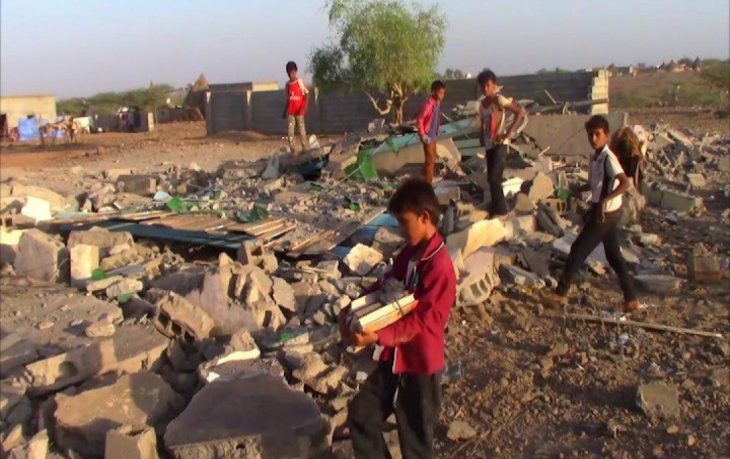
Locals walks among the rubble of Hussein al-Hajouri`s brick and mud home which was destroyed by a Saudi airstrike on October 3, 2018. Photo | Ahmed AbdulKareem
By Ahmed Abdulkareem | MintPress News | October 2, 2018
HAJJAH, YEMEN – Saudi Arabia, backed by the United States, carried out an airstrike targeting a displaced family in the Mustaba district in the province of Hajjah, southwestern Yemen early Tuesday morning. A man, his wife, and their nine-year old only-daughter were killed in the strike, along with 10 others.
A 30-year-old witness told MintPress News :
Two airstrikes targeted Hussein al-Hajouri`s house at 2 a.m., killing Hussein and his wife and daughter. We found some parts of their bodies 100 meters from the house that was bombed; some of it is still under the rubble.”
Rescue efforts were complicated by fear of additional strikes, as Saudi warplanes continued to circle the area after the initial strikes. Saudi Arabia has been known to use double-tap strikes in Yemen, carrying out an initial airstrike and then circling back to target rescuers.
The latest attack comes just hours after Saudi Arabia admitted that its forces have committed what it called “certain mistakes” in Yemen, after increasing pressure from international bodies and human-rights groups that accuse the kingdom of carrying out war crimes in the country.
Saudi Defense Ministry spokesman Osaiker Alotaibi told a panel of 18 independent experts on Monday that a coalition investigation had uncovered “the existence of certain unintentional mistakes in a number of these operations,” adding that “the task force recommended that perpetrators should be held to account and victims should enjoy redress.”
In her response to the Saudi Defense Ministry, the panel’s chairwoman, Renate Winter, wondered why schools and hospitals had been targeted repeatedly:
You say it’s an accident. How many such accidents can you bear and how many such accidents can people in Yemen bear?”
Last month, investigators launched an international inquiry into war crimes in Yemen and found evidence of such crimes committed in the country. Their August 28 report said Saudi airstrikes had caused most of the documented civilian casualties.
Since the war began in 2015, the U.S.-backed, Saudi-led coalition has repeatedly targeted displaced civilians. In the most recent such attack before today, airstrikes targeted displaced families near the port city of Hodeida on August 24, killing or wounding 31 people, 24 of whom were children. Many of the victims of the strike belonged to a single family.
More recently, at least two Yemeni civilians were killed and three others wounded when Saudi warplanes struck a vehicle in the city of Abs in Hajjah, on Tuesday.
This week, one person was killed and a number of others sustained injuries after Saudi fighter jets conducted an airstrike on Munirah city in Hodeida, western Yemen. Saudi jets also conducted an airstrike on the residential area of Ghaferah in the Dhahir district in the northern province of Saada, killing a child and wounding several others.
Over 600,000 civilians have been killed or injured in Yemen since the Saudi-led coalition began its attacks in 2015, according to Yemen’s Ministry of Human Rights based in Sana’a. The U.S.-backed coalition’s blockade on Yemen has also triggered an epidemic of disease and famine across the country.
Ahmed AbdulKareem is a Yemeni journalist. He covers the war in Yemen for MintPress News as well as local Yemeni media.
‘We’d take out Russia’s nukes,’ US NATO envoy says, claiming ‘banned’ missiles are being developed
RT | October 2, 2018
The US would look into ways of “taking out” new Russian missiles if they become operational, the US envoy to NATO said, accusing Moscow of developing a weapon that “violates” the Soviet-US nuclear arms treaty.
US Ambassador to NATO Kay Bailey Hutchison didn’t miss an opportunity to fire a warning shot in the direction of Russia when accusing it of building new nuclear missiles that would allegedly be pointed at Europe. Should such missiles be completed, she said at the Tuesday briefing, “at that point, we would be looking at the capability to take out a [Russian] missile that could hit any of our countries.”
Hutchison then doubled down on the threat, saying: “Counter measures [by the United States] would be to take out the missiles that are in development by Russia in violation of the treaty.” She added: “They are on notice.”
Hutchison was referring to the Intermediate-Range Nuclear Forces Treaty (INF), which bans the use of all nuclear and conventional missiles, as well as their launchers, that have ranges of between 500km and 5,500km. The US has claimed that Moscow is not complying with the INF treaty, an accusation that Russia has repeatedly rejected.
“We have been trying to send a message to Russia for several years that we know they are violating the treaty, we have shown Russia the evidence that we have that they are violating the treaty,” Hutchison maintained.
The Russian Foreign Ministry blasted the statements made by the US envoy as “aggressive and destructive,” adding that they will get a detailed response from Russian military experts. NATO doesn’t understand the degree of its responsibility and the danger posed by such aggressive rhetoric, the ministry said.
Hutchison’s comment came several weeks after President Donald Trump signed the US National Defense Authorization Act (NDAA) for 2019. The document contains, among other things, allegations that Moscow violated the INF Treaty.
Moscow, in turn, accuses the US and “some of its allies” of knowingly violating the INF by deploying Mk-41 launching systems close to Russian borders. These can be easily repurposed for firing banned ground-based cruise missiles, it says, while Washington denies the accusations.
Under the 2019 NDAA, US legislators allocated $58 million to counter Russia’s alleged non-compliance with the INF Treaty. The measures to counter the alleged activities include a “research and development program on a ground-launched intermediate-range missile,” which, somehow, should not itself violate the treaty.
Russian lawmakers have also promised countermeasures. “If the missile announced by Congress indeed makes it into the American arsenal, we will have to develop and adopt the same thing. Russia has the military and technical capacities for that,” Viktor Bondarev, the head of the defense committee of Russia’s Federal Council, has said.
Bolivia: Morales Seeks New Relationship With Chile After Ruling
teleSUR | September 29, 2018
Bolivia’s President Evo Morales hopes to start a “new era” in his nation’s relationship with Chile once the International Court of Justice rules on Bolivia’s demand for sea access on Monday.
The new age will take “advantage of our potentialities, promoting integration for the well being of our peoples,” Morales said. “It’s necessary to cure injuries from the past.”
After a years-long process, the court will decide whether the Chilean government must negotiate a sea exit for Bolivia. La Paz issued the demand in April 2013.
Morales said he values peaceful solutions for international disputes, based on international law.
“Bolivia will never give up in its cause, that’s why the Bolivian people will gather on October 1 without divisions, without difference around our three-color flag, our wiphala and our sea claim flag,” he said. “Our reunion with the sea is not only possible, but inevitable.”
He also asked the people of Chile to understand the demand shouldn’t be considered an “unfriendly act,” but rather an opportunity.
Bolivia demanded the court declare Chile must negotiate an exit for the Pacific Ocean, based on diplomatic evidence it has previously agreed to do so.
Chile is denying any negotiation based on a 1904 treaty between both countries, giving up 120,000 square kilometers of territory, including 400 shore kilometers, to Chile.
The treaty was a result of the War of the Pacific, in which Bolivia and Peru fought against Chile between 1879 and 1883.
The UN’s International Court of Justice is legally binding but it has no means to enforce its rulings over the states.
Featured Video

Anthrax War – CBC The Passionate Eye
or go to
Aletho News Archives – Video-Images
Book Review
Shattered Dreams: The HPV Vaccine Exposed (2019)
By Christina England – 30 Q&As – Book Review & Summary
Lies are Unbekoming | September 4, 2026
… Gardasil received FDA fast-track approval in 2006, Cervarix followed in 2009, and Gardasil 9 was approved in December 2014 with more than double the aluminium adjuvant content of the original. The commercial context is specific. Merck was about to lose patent protection on Zocor and faced $18 billion in Vioxx injury claims from a cardiovascular drug the company had marketed while suppressing its own data showing a five-times increase in heart attacks. Analysts projected the global HPV vaccine market at $4 billion by 2011, contingent on government-funded national programs for teenage girls. The 1986 National Childhood Vaccine Injury Act had already granted manufacturers complete liability immunity. By 2013, Japan had withdrawn its HPV vaccine recommendation after cataloguing severe adverse reactions in hundreds of girls. No Western government followed. The establishment position across the UK, US, Australia, and most of Europe held, and still holds, that the vaccines are safe and effective, that reported injuries are coincidental, and that cervical cancer prevention justifies the program. The book was published into this position, not against a vacuum.
Shattered Dreams sits alongside Mary Holland’s The HPV Vaccine On Trial and Viera Scheibner’s foundational vaccination work as part of the documented record on what has been done to a generation of teenage girls under the banner of cancer prevention. The full summary unpacks three specific findings: that Merck used the aluminium adjuvant itself as the “placebo” control in 92.5% of trial subjects, making it structurally impossible to detect excess reactions from the adjuvant; that Dr. Sin Hang Lee found HPV DNA fragments bound to aluminium in every one of sixteen Gardasil samples tested, and in the blood and spleen of a New Zealand girl six months after her third dose; and that in every country with high vaccination coverage, including Australia, the UK, Norway, and Sweden, cervical cancer rates have stopped declining and started rising specifically in the vaccinated cohort. Martínez-Lavín’s 2017 calculation puts the number needed to seriously harm with Gardasil 9 at 140, and the number needed to vaccinate to prevent one case at 1,757. Thirteen young women are seriously harmed for every one who benefits. The vaccine was approved on the basis of trials that could not detect what the trials were supposed to detect, and it is still being given to twelve-year-olds today. … Read full review
Blog Roll
 Aletho News
- Swiss scammed out of millions by Ukraine-linked call centers – media
- Germany facing potential ‘violent conflict’ with Russia – spy chief
- Ukraine’s EU neighbors reject new plea from Kiev – Politico
- British Transport Police Facial Recognition Trial Scanned 926,912 People With Zero Arrests
- House Bill Would Ban Federal Use of Flock ALPR Data
- Can a Spice Rival a Drug? 10 Head-to-Head Trials Put It to the Test.
- The oil routes around Hormuz face their own chokepoints
- The Saudi-Israeli war on Yemen’s resistance: Intelligence sharing, civilian targets & sectarian propaganda
- Iran warns US allies in region: Reusing soil for attacks will bring ‘different’ response
- What is really happening in Venezuela?
- If Americans Knew
- New IDF Website Frames Slain Gaza Journalists as Terrorists
- Israeli media: After settlers beat him mercilessly, they stuffed dirt into his mouth
- Americans Are Paying the Price to Preserve Israel’s Nuclear Hegemony
- A U.S. Jewish Fund’s Ambitious Bid to Put a Settler Elite in Control of Israel’s Security
- As genocide drags on, “Zionism is racism” becomes official policy in one UK party – Daily Update
- Targeting the rescuers: Inside Israel’s war on paramedics in Lebanon
- No big deal: Israel to halt humanitarian aid to Gaza for 2 days – Daily Update
- Israel is squeezing the life out of Palestinians – Daily Update
- The Israeli Right Portrays Islam as Murderous. It Serves a Political Purpose
- Jordan Has Had Enough: King Abdullah’s Scathing Warning to Israel
- No Tricks Zone
- Latest European Green Energy Debacle; Portugal’s Largest Flagship Solar Park Insolvent!
- Green Energy Debacle: German Expert Professor Fritz Vahrenholt Warns Of Severe Economic And Social Consequences
- Two More Paleo Reconstructions Affirm Meters-Higher Sea Levels Across Ireland, Brazil 7000-6000 Years Ago
- New Study: Earth And Venus Surface Warmth Largely Explained By Convection And Lapse Rate, Not CO2 Or Radiation
- 2025 Nature Paper Claiming Worsening Global Drought Gets RETRACTED …Heavily Flawed
- New Study: ‘Global Drought Shows No Detectable Recent Acceleration Under Climate Warming’
- Economic Masterminds: German Socialists Suggest Taxing Productivity Gains Stemming From Using AI
- The South China Sea Has Not Been Cooperating With The Climate Change Narrative
- Energy Crisis: Germany Enters Heating Season With Historically Low Gas Reserve Fill Levels
- New Study: The Antarctic Ice Sheet Gained Mass From 2020-2024 Due To Staggering Snow And Ice Accumulation

