Lieberman urges Israel to pull out of UN rights body, demands US to follow suit
Press TV – May 17, 2018
The Israeli minister of military affairs has lashed out at the United Nations Human Rights Council (UNHRC) for its condemnation of the recent Gaza carnage, saying Tel Aviv and the US should immediately withdraw from the Geneva-based body.
In a post on his Twitter account, Avigdor Lieberman claimed that “Israel is under a double attack,” one from Gaza and another campaign of “hypocrisy headed by the United Nations Human Rights Council.”
“We must stop permitting this celebration of hypocrisy and immediately withdraw from the Human Rights Council, and work diligently so that the United States joins us in this step,” he added.
Lieberman’s comments came two days after the Office of the UN High Commissioner for Human Right condemned “the appalling, deadly violence in Gaza.”
“The rules on the use of force under international law have been repeated many times but appear to have been ignored again and again. It seems anyone is liable to be shot dead or injured: women, children, press personnel, first responders, bystanders, and at almost any point up to 700m from the fence,” it noted.
The 47-member UNHRC is also scheduled to hold a special session on Friday to discuss “the deteriorating human rights situation in the occupied Palestinian territory, including East Jerusalem [al-Quds].”
Israeli forces killed at least 62 Palestinians during protests near the Gaza fence on the eve of the 70th anniversary of the Nakba Day (the Day of Catastrophe), which coincided this year with Washington’s embassy relocation from Tel Aviv to occupied Jerusalem al-Quds.
More than 2,700 Palestinians were also wounded as the Israeli forces used snipers, airstrikes, tank fire and tear gas to target the demonstrators.
The UN Security Council held an emergency meeting on Tuesday over the Gaza bloodshed.
The US, however, blocked the adoption of a Kuwait-drafted statement that expressed “outrage and sorrow” at the Gaza killings and called for an “independent and transparent investigation” into the massacre.
Hamas won ‘PR war’
In a relevant development, a senior Israeli army spokesman said that the Gaza killings had handed a PR victory to the Palestinian resistance movement, Hamas, which governs the besieged territory and organized the anti-occupation protests there.
During a briefing to the Jewish Federations of North America, Lieutenant Colonel Jonathan Conricus acknowledged that the Israeli military had failed to minimize the number of the casualties in Gaza and that some victims had been hit by mistake.
“We haven’t been able to get that message out of how it is from our side… – and the ‘winning picture’ overwhelmingly, by a knockout, unfortunately, have been the graphics from the Palestinian side. The amount of casualties has done us a tremendous disservice, unfortunately, and it has been very difficult to tell our story,” he said.
See also:
UN rights body urges probe into Gaza carnage
The UN rights body calls for an investigation into recent Israel’s massacre of Palestinian protesters in Gaza.
UNSC holds emergency meeting on Israeli violence
Washington has already blocked the adoption of a UN statement calling for an investigation into the killing of Palestinians.
Emily Thornberry powerfully condemns the Gaza massacre committed by the state of Israel
Bypass Mainstream Media | May 15, 2018
Kill and Kill and Kill
By Saree Makdisi | CounterPunch | May 16, 2018
Two spectacles unfolded in Palestine on Monday. In Gaza, Israeli army snipers shot and killed 58 Palestinians—including six children—and injured almost three thousand others amid scenes of smoke, fire, teargas, dust, agony and blood. At exactly the same time, to the tinkling of champagne glasses at a glittering reception barely fifty miles away in Jerusalem, Jared Kushner and an elegant Ivanka Trump oversaw the opening of Donald Trump’s new embassy there. The juxtaposition of these two contemporaneous scenes encapsulates at a single glance the entirety of Zionism’s murderous conflict with the Palestinian people.
The Palestinians targeted and executed one-by-one by Israeli snipers had gathered to demand their right of return to their lands and homes inside the rest of Palestine, from the coastal plain up to and including Jerusalem. They or their parents or grandparents were driven from their homes during the Zionist ethnic cleansing of Palestine in 1948 for the simple reason that they are not Jewish: too many non-Jews in the putative Jewish state would not make for much of a Jewish state after all. (“There could be no Jewish state with a large and hostile Arab minority in its midst. There would be no such state. It would not be able to exist,” the Israeli historian Benny Morris bluntly pointed out in an interview justifying ethnic cleansing with the newspaper Ha’aretz in 2004; “a Jewish state would not have come into being without the uprooting of 700,000 Palestinians . . . [therefore] it was necessary to uproot them”). They have been denied the right to return to their homes ever since for the same reason: they are not Jewish, and their presence would upset the carefully-engineered demographic tables maintained by the state to preserve its tenuous claim to an exclusively Jewish identity. The maintenance of that demographic balance and the suspension of their political and human rights are inseparable from one another: the one enables, produces and requires the other.
The demographer Arnon Sofer of Haifa University is the architect of the current isolation of Gaza. In 2004, he advised the government of Ariel Sharon to withdraw Israeli forces from within Gaza, seal the territory off from the outside world, and simply shoot anyone who tries to break out. “When 2.5 million people live in a closed-off Gaza, it’s going to be a human catastrophe,” Sofer told an interviewer in the Jerusalem Post (11 November 2004); “Those people will become even bigger animals than they are today, with the aid of an insane fundamentalist Islam. The pressure at the border will be awful. It’s going to be a terrible war. So, if we want to remain alive, we will have to kill and kill and kill. All day, every day.” He added that “the only thing that concerns me is how to ensure that the boys and men who are going to have to do the killing will be able to return home to their families and be normal human beings.”
This imperative to kill and kill and kill human “animals” explains the violence taking place at the gates of Gaza—which has been sealed off precisely according to Sofer’s prescription—for the past several weeks, most calamitously this Monday. The killing now taking place is, in other words, exactly, to the letter, the “killing and killing and killing” he called for fourteen years ago. Calmly premeditated and intentionally designed by its architect, it is equally calmly and intentionally being carried out by Israeli soldiers (about whose psychological traumas I, unlike Sofer, am not even remotely interested). In response to the current killing and shooting, a senior member of the Israeli parliament, Avi Dichter, reassured his audience on live television on Monday that they need not be unduly concerned. Their army, he told them, “has enough bullets for everyone.” If every man, woman and child in Gaza gathers at the gate, in other words, there is a bullet for every one of them. They can all be killed, no problem.
Remember Kurtz in Heart of Darkness? “Exterminate the brutes!” The genocidal intent expressed by the likes of Sofer and Dichter—mainstream and senior figures in Israeli politics—is so obvious as to make assiduous interpretation of their words unnecessary. The people of Gaza are exterminable because they are not Jewish: that is what the situation amounts to, not according to critics of the siege of Gaza, but according to its architects, planners, enablers and supporters. For that exterminability, and the ability to calmly and methodically transact it (“kill and kill and kill”) guarantees one thing, according to Sofer (in that same interview): “it guarantees a Zionist-Jewish state with an overwhelming majority of Jews.” To be clear then: according to its own planners and architects—these are their words, not mine—the maintenance of a “Zionist-Jewish” state fundamentally requires the Israeli army to prepare itself with a bullet for every man, woman and child in Gaza, and to shoot them one by one if they approach the gates penning them in. And if none of them are left after the smoke clears, well, so much the better; Israeli “boys and men” will return to their families and sleep better at night for not having to kill them any longer.
Exactly as Israeli snipers were following their orders to “kill and kill and kill,” Jared Kushner was marking the occasion of the opening of the embassy with an inane speech extolling the virtues of his bombastic father in law. Kushner was empowered to present this speech not because of his qualifications (he has none), not because of his accomplishments (he has none), not because of his insights (he has none), not because of his charisma or strength of character (he has none), not because of his oratorial skills (he has none), and certainly not because of the rousing qualities of the speech itself (it had none). He was empowered to do so simply because he is Jewish; that is the one single attribute that brings him to the table: an act of birth.
But acts of birth are randomly distributed by the hand of fate. And fate played one hand to Jared Kushner and a different hand to Ezzedine al-Samaak (14 years old), Ahmad al-Shair (16 years old), Said al-Khair (16 years old), Ibrahim al-Zarqa (18 years old) and Iman al-Sheikh (19 years old). They were all born in Gaza, refugees and the children of refugees driven by Zionist shock troops from their homes elsewhere in southwestern Palestine in 1948. Unlike Jared Kushner, who was in Jerusalem because he is Jewish, they cannot go to Jerusalem, because they are not Jewish. Unlike Jared Kushner, who can go to Jerusalem whenever he wants in the future because he is Jewish, they will never go to Jerusalem because they were shot in the head by Israeli army snipers on Monday and they are now all dead. Having robbed them of their past and their present, the state of Israel stole their future as well. And it did so—it could do so—simply because they are not Jewish.
There is a direct link between the events in Jerusalem and those taking place in Gaza; Netanyahu himself pointed it out. “We are here in Jerusalem, protected by the brave soldiers of the army of Israel,” he said at the opening ceremony on Monday, “and our brave soldiers, our brave soldiers are protecting the borders of Israel as we speak today.” By “brave soldiers,” of course, he meant cowardly snipers hiding in reinforced positions and shooting unarmed civilians at a distance of 1,000 meters; and by “protecting” he meant killing and killing and killing, exactly according to Dr. Sofer’s prescription.
There are two racial groups in close proximity in Palestine. The members of one racial group—the one to which Netanyahu and Kushner belong—are free to come and go as they please, to live life, to travel, to study, to work, to raise children. The members of the other racial group are to varying degrees denied those rights, though nowhere more starkly and abjectly than in Gaza, where over two million people have simply been rounded up and warehoused without prospects or hopes, let alone rights, simply because their very existence is deemed to be a mortal threat to the exclusive racial identity of a state that was violently established on their land and at their expense. To maintain the exclusive identity of that state, these people must either accept their fate as essentially human cargo in permanent storage—a superfluous population—or take the bullets that the Israeli army has prepared for each one of them.
And that, fundamentally, is what Zionism’s conflict with the Palestinians is all about. At few other moments than the present has the juxtaposition between the racially privileged and the racially dehumanized and exterminable been so crystal clear. Liberal Zionists like Peter Beinart or Roger Cohen may wring their hands and bewail the crude and explicit viciousness of Netanyahu and his circle or the hideousness of the spectacle unfolding at the locked gates of Gaza. They harken back to the golden days of the 1950s and 1960s, when the Palestinians seemed (to the fevered Zionist imagination) to have quietly vanished, as though by magic. But what is happening today is not an aberration. This is what Zionism has always entailed and what it will always entail. “Colonialism is not a thinking machine, nor a body endowed with reasoning faculties,” Frantz Fanon once pointed out. “It is violence in its natural state.” It is not possible for a settler-colonial regime to racially enable one people at the expense of another people without the use of violence. As Arnon Sofer himself admits, the maintenance of a “Zionist-Jewish state with an overwhelming majority of Jews” requires permanent institutionalized violence. That was already true in 1948 and it remains true today and it will remain true until this project of racial exclusivism and privilege is abandoned once and for all for the hideous anachronism that it is.
 Saree Makdisi’s latest book is Palestine Inside Out.
A dozen googlers quit over Google’s military drone contract
boing boing | May 15, 2018
Google’s “Project Maven” is supplying machine-learning tools to the Pentagon to support drone strikes; the project has been hugely divisive within Google, with employees pointing out that the company is wildly profitable and doesn’t need to compromise on its ethics to keep its doors open; that the drone program is a system of extrajudicial killing far from the battlefield; and that the firm’s long-term health depends on its ability to win and retain the trust of users around the world, which will be harder if Google becomes a de facto wing of the US military.
A dozen googlers have put their money where their mouths are, publicly resigning over the contract; 4,000 more googlers have signed an open letter to the company’s CEO asking him to cancel the contract.
Companies have an emergent property of profit-seeking without regard to ethics or human flourishing, but individuals within companies retain their human sense of decency; that’s why we need to include techies in our plan for fixing tech.
A dozen Google employees quit over military drone project [Ron Amadeo/Ars Technica]
One resigning employee questioned why Google is even bothering with such a controversial program when it is already so massive. “It’s not like Google is this little machine-learning startup that’s trying to find clients in different industries,” the anonymous employee told Gizmodo. “It just seems like it makes sense for Google and Google’s reputation to stay out of that.”
“Actions speak louder than words, and that’s a standard I hold myself to as well,” another resigning employee told Gizmodo. “I wasn’t happy just voicing my concerns internally. The strongest possible statement I could take against this was to leave.”
‘Expel the Israeli ambassador’: Irish FM blasted for double standards over Gaza and Skripal case
RT | May 15, 2018
Ireland’s foreign minister is being accused of hypocrisy for failing to expel Israel’s ambassador over the IDF killing 60 Palestinians on Monday, despite sending a Russian diplomat home over the Skripal case without evidence.
Foreign Minister and Deputy Prime Minister Simon Coveney expelled a Russian diplomat in March following Britain’s claim that Russia was behind the poisoning of double agent Sergei Skripal and his daughter Yulia in Salisbury, England. The decision faced pushback from many in Ireland who claimed it was a hasty move, made before any evidence was presented.
Opposition politicians and activists are now questioning why the same robust response applied in the aftermath of the Skripal case has not been implemented in a situation where 60 people were killed and thousands more injured by Israeli forces.
Coveney issued a statement on Gaza, Monday, saying we all have “a political responsibility to try to reduce tensions and protect unarmed protesters.” He said he was “gravely concerned that the use of force seems disproportionate to the threat” and called for an independent investigation.
The minister also summoned Israeli Ambassador Ze’ev Boker to a meeting on Tuesday to express his “shock and dismay” at Monday’s events, The Journal reports.
Sinn Fein leader Mary Lou McDonald says Coveney’s actions don’t go far enough, however, and called for the Israeli ambassador to Ireland to be expelled.
“I know that the Tánaiste [Deputy Prime Minister] has called in the Israeli ambassador – actually the Tánaiste should be sending the Israeli ambassador home. The Irish State now needs to recall our diplomatic mission from Israel,” she said.
The Irish Palestinian Solidarity Campaign (IPSC) is also calling for diplomatic expulsion. “This is the single deadliest day for Palestinians in the occupied territories in four years,” IPSC National Chairperson Fatin Al Tamimi said. “The ambassador for apartheid and his staff should be expelled, and the Irish Ambassador in Tel Aviv recalled, just as South Africa has done.”
Irish people on social media called Coveney out for taking a different tack in his treatment of the Russian diplomat, suggesting the Irish government is happy to follow Britain’s orders but will fail to act on “crimes against humanity.”
Meanwhile, the Irish Palestinian Solidarity Campaign (IPSC) will hold protests across the country Tuesday, calling for an end to the “ongoing massacre of unarmed Palestinians” by Israeli forces.
Gaza killings: Names and faces of those killed by Israeli forces this week
Middle East Eye | May 15, 2018
Eight-month-old Laila is youngest Palestinian killed in Gaza on Monday, the deadliest day since 2014 war.

From left: Ahmed Alrantisi, Laila Anwar Al-Ghandoor, Ahmed Altetr, Alaa Alkhatib Ezz el-din Alsamaak, Motassem Abu Louley (screengrab)
Sixty-two people were either killed or died of wounds inflicted by Israeli forces in the Gaza Strip on Monday and Tuesday as thousands of Palestinians demonstrated across the occupied territory to mark the 70th anniversary of the Nakba.
As of Tuesday afternoon, the Gaza Ministry of Health released the names of 59 Palestinians killed:
1. Laila Anwar Al-Ghandoor, 8 months old
2. Ezz el-din Musa Mohamed Alsamaak, 14 years old
3. Wisaal Fadl Ezzat Alsheikh Khalil, 15 years old
4. Ahmed Adel Musa Alshaer, 16 years old
5. Saeed Mohamed Abu Alkheir, 16 years old
6. Ibrahim Ahmed Alzarqa, 18 years old
7. Eman Ali Sadiq Alsheikh, 19 years old
8. Zayid Mohamed Hasan Omar, 19 years old
9. Motassem Fawzy Abu Louley, 20 years old
10. Anas Hamdan Salim Qadeeh, 21 years old
11. Mohamed Abd Alsalam Harz, 21 years old

From left: Fadi Abu Salah, Motaz Al-Nunu, Jihad Mohammed Othman Mousa, Mousa Jabr Abdulsalam Abu Hasnayn, Ezz Eldeen Nahid Aloyutey, Anas Hamdan Salim Qadeeh
12. Yehia Ismail Rajab Aldaqoor, 22 years old
13. Mustafa Mohamed Samir Mahmoud Almasry, 22 years old
14. Ezz Eldeen Nahid Aloyutey, 23 years old
15. Mahmoud Mustafa Ahmed Assaf, 23 years old
16. Ahmed Fayez Harb Shahadah, 23 years old
17. Ahmed Awad Allah, 24 years old
18. Khalil Ismail Khalil Mansor, 25 years old
19. Mohamed Ashraf Abu Sitta, 26 years old
20. Bilal Ahmed Abu Diqah, 26 years old
21. Ahmed Majed Qaasim Ata Allah, 27 years old

From left: Mahmoud Wael Mahmoud Jundeyah, Ibrahim Ahmed Alzarqa, Musab Yousef Abu Leilah, Jihad Mufid Al-Farra, Saeed Mohamed Abu Alkheir, Mohamed Hasan Mustafa Alabadilah (screengrab)
22. Mahmoud Rabah Abu Maamar, 28 years old
23.Musab Yousef Abu Leilah, 28 years old
24. Ahmed Fawzy Altetr, 28 years old
25. Mohamed Abdelrahman Meqdad, 28 years old
26. Obaidah Salim Farhan, 30 years old
27. Jihad Mufid Al-Farra, 30 years old
28. Fadi Hassan Abu Salah, 30 years old
29. Motaz Bassam Kamil Al-Nunu, 31 years old
30. Mohammed Riyad Abdulrahman Alamudi, 31 years old
31. Jihad Mohammed Othman Mousa, 31 years old
32. Shahir Mahmoud Mohammed Almadhoon, 32 years old
33. Mousa Jabr Abdulsalam Abu Hasnayn, 35 years old

From left: Shahir Mahmoud Mohammed Almadhoon, Khalil Ismail Khalil Mansor, Mahmoud Saber Hamad Abu Taeemah, Mohamed Ashraf Abu Sitta, Mustafa Mohamed Samir Mahmoud Almasry, Obaidah Salim Farhan (screengrab)
34. Mohammed Mahmoud Abdulmoti Abdal’al, 39 years old
35. Ahmed Mohammed Ibrahim Hamdan, 27 years old
36. Ismail Khalil Ramadhan Aldaahuk, 30 years old
37. Ahmed Mahmoud Mohammed Alrantisi, 27 years old
38. Alaa Alnoor Ahmed Alkhatib, 28 years old
39. Mahmoud Yahya Abdawahab Hussain, 24 years old
40. Ahmed Abdullah Aladini, 30 years old
41. Saadi Said Fahmi Abu Salah, 16 years old
42. Ahmed Zahir Hamid Alshawa, 24 years old
43. Mohammed Hani Hosni Alnajjar, 33 years old
44. Fadl Mohamed Ata Habshy, 34 years old
45. Mokhtar Kaamil Salim Abu Khamash, 23 years old
46. Mahmoud Wael Mahmoud Jundeyah, 21 years old
47. Abdulrahman Sami Abu Mattar, 18 years old
48. Ahmed Salim Alyaan Aljarf, 26 years old

From left: Mohammed Hani Hosni Alnajjar, Yehia Ismail Rajab Aldaqoor, Mohammed Riyad Abdulrahman Alamudi, Ahmed Adel Musa Alshaer, Fadl Mohamed Ata Habshy, Ismail Khalil Ramadhan Aldaahuk (screengrab)
49. Mahmoud Sulayman Ibrahim Aql, 32 years old
50. Mohamed Hasan Mustafa Alabadilah, 25 years old
51. Kamil Jihad Kamil Mihna, 19 years old
52. Mahmoud Saber Hamad Abu Taeemah, 23 years old
53. Ali Mohamed Ahmed Khafajah, 21 years old
54. Abdelsalam Yousef Abdelwahab, 39 years old
55. Mohamed Samir Duwedar, 27 years old
56. Talal Adel Ibrahim Mattar, 16 years old
57. Omar Jomaa Abu Ful, 30 years old
58. Nasser Ahmed Mahmoud Ghrab, 51 years old
59. Bilal Badeer Hussein Al-Ashram, 18 years old
60 – 62: Unidentified
Middle East Eye has live coverage of protests in Palestine and Israel here.
Jewish Past vs Jewish State
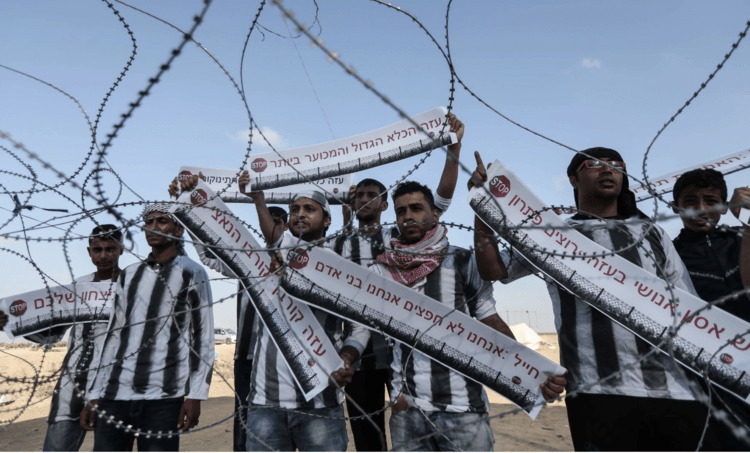
Young Palestinians protestors at the Gaza border carry signs in Hebrew: “Soldier, we are not objects, we are human beings.’
By Gilad Atzmon | May 14, 2018
Zionism promised to solve the Jewish problem. It vowed to fix Diaspora Jews by means of a ‘homecoming,’ to make the Jews loved, empathic, bond them to the soil; in essence, to make them ‘people like all other people.’
The horrific scenes flooding in from Gaza today demonstrate that Zionism failed miserably. The Jewish State is an embarrassment to its original humanist endeavour and to humanity in general.
Just today, at least 43 Palestinian protestors have been killed and 2,200 wounded by Israeli troops at the Gaza border. Some reports suggest that half of the injuries were caused by live ammunition. This is devastating news. The criminality of Israel is institutional. This is not about one odd sniper who laughs as he shoots a young Palestinian in the knee, crippling him for life. Israel is displaying a systematic hierarchic murderous apparatus designed to sustain the oppression of the indigenous people of the land for an unlimited period.
Despite the Zionist dream, the Jewish state isn’t loved by its neighbours. It isn’t loved by the rest of the world either. In fact Israel’s actions evoke global repulsion. Instead of solving the Jewish problem, Zionism has only relocated the problem and amplified the symptoms it vowed to eliminate.
Truth can be a disturbing notion; no matter how much you try to suppress it, truth manages to come out. Accordingly, it is impossible to grasp the history of Jewish suffering without taking into consideration the atrocious actions of the Jewish state. As it happens, Israeli politics is driven by a complete dismissal of the other. The Israeli military operation in Gaza is simply a license to murder. One would hope that a state that names itself the Jewish State would be slightly more vigilant with its excessive use of power.
By now I believe that Israel is going to be remembered as the darkest chapter in Jewish history and beyond.
Featured Video

Anthrax War – CBC The Passionate Eye
or go to
Aletho News Archives – Video-Images
Book Review
Shattered Dreams: The HPV Vaccine Exposed (2019)
By Christina England – 30 Q&As – Book Review & Summary
Lies are Unbekoming | September 4, 2026
… Gardasil received FDA fast-track approval in 2006, Cervarix followed in 2009, and Gardasil 9 was approved in December 2014 with more than double the aluminium adjuvant content of the original. The commercial context is specific. Merck was about to lose patent protection on Zocor and faced $18 billion in Vioxx injury claims from a cardiovascular drug the company had marketed while suppressing its own data showing a five-times increase in heart attacks. Analysts projected the global HPV vaccine market at $4 billion by 2011, contingent on government-funded national programs for teenage girls. The 1986 National Childhood Vaccine Injury Act had already granted manufacturers complete liability immunity. By 2013, Japan had withdrawn its HPV vaccine recommendation after cataloguing severe adverse reactions in hundreds of girls. No Western government followed. The establishment position across the UK, US, Australia, and most of Europe held, and still holds, that the vaccines are safe and effective, that reported injuries are coincidental, and that cervical cancer prevention justifies the program. The book was published into this position, not against a vacuum.
Shattered Dreams sits alongside Mary Holland’s The HPV Vaccine On Trial and Viera Scheibner’s foundational vaccination work as part of the documented record on what has been done to a generation of teenage girls under the banner of cancer prevention. The full summary unpacks three specific findings: that Merck used the aluminium adjuvant itself as the “placebo” control in 92.5% of trial subjects, making it structurally impossible to detect excess reactions from the adjuvant; that Dr. Sin Hang Lee found HPV DNA fragments bound to aluminium in every one of sixteen Gardasil samples tested, and in the blood and spleen of a New Zealand girl six months after her third dose; and that in every country with high vaccination coverage, including Australia, the UK, Norway, and Sweden, cervical cancer rates have stopped declining and started rising specifically in the vaccinated cohort. Martínez-Lavín’s 2017 calculation puts the number needed to seriously harm with Gardasil 9 at 140, and the number needed to vaccinate to prevent one case at 1,757. Thirteen young women are seriously harmed for every one who benefits. The vaccine was approved on the basis of trials that could not detect what the trials were supposed to detect, and it is still being given to twelve-year-olds today. … Read full review
Blog Roll
 Aletho News
- Georgia’s Largest Healthcare System Will Fire Employees Who Refuse Flu Vaccine
- The Five-Year Fuel Crisis: Why the World Economy Is Paying for a War It Thinks Is Ending
- Trump’s Big Bluff on Iran
- Swiss scammed out of millions by Ukraine-linked call centers – media
- Germany facing potential ‘violent conflict’ with Russia – spy chief
- Ukraine’s EU neighbors reject new plea from Kiev – Politico
- British Transport Police Facial Recognition Trial Scanned 926,912 People With Zero Arrests
- House Bill Would Ban Federal Use of Flock ALPR Data
- Can a Spice Rival a Drug? 10 Head-to-Head Trials Put It to the Test.
- The oil routes around Hormuz face their own chokepoints
- If Americans Knew
- “We See Our Homes Now From A Satellite, Like Strangers”
- Watch “Gaza: Doctors Under Attack”, originally censored by BBC
- NAZA: Israeli embassies in UK and US promote rival documentary to challenge Gaza genocide allegations
- David Ellison appoints Israeli to lead merged Paramount-Warner studios
- Turkish Red Crescent helps elderly Gaza man walk again after Israel confiscates his prosthetic limb
- Four Palestinians Killed in Israeli Attacks in Gaza
- Two Palestinian youths killed and village razed as Israeli attacks on West Bank continue
- Two more Christian women victims of Israeli raids on Gaza
- Cruelty, Deprivation, Indignity: A Journalist’s 22 Months in Israeli Prison
- New IDF Website Frames Slain Gaza Journalists as Terrorists
- No Tricks Zone
- Latest European Green Energy Debacle; Portugal’s Largest Flagship Solar Park Insolvent!
- Green Energy Debacle: German Expert Professor Fritz Vahrenholt Warns Of Severe Economic And Social Consequences
- Two More Paleo Reconstructions Affirm Meters-Higher Sea Levels Across Ireland, Brazil 7000-6000 Years Ago
- New Study: Earth And Venus Surface Warmth Largely Explained By Convection And Lapse Rate, Not CO2 Or Radiation
- 2025 Nature Paper Claiming Worsening Global Drought Gets RETRACTED …Heavily Flawed
- New Study: ‘Global Drought Shows No Detectable Recent Acceleration Under Climate Warming’
- Economic Masterminds: German Socialists Suggest Taxing Productivity Gains Stemming From Using AI
- The South China Sea Has Not Been Cooperating With The Climate Change Narrative
- Energy Crisis: Germany Enters Heating Season With Historically Low Gas Reserve Fill Levels
- New Study: The Antarctic Ice Sheet Gained Mass From 2020-2024 Due To Staggering Snow And Ice Accumulation

