Any US missiles fired at Syria will be shot down, launch sites targeted – Russian envoy to Lebanon
RT | April 11, 2018
The Russian military reserves the right to shoot down missiles and destroy launch sites in the event of US aggression against Syria, Moscow’s envoy to Lebanon Alexander Zasypkin has warned.
Zasypkin stressed that “the Russian forces will confront any US aggression on Syria, by intercepting the missiles and striking their launch pads,” al-Manar TV website reported, citing the envoy.
Speaking to the channel, the ambassador also said that the allegations of a chemical attack were being used to justify “offensive acts” in Syria, while “the US and Western escalation against Syria will lead to a major crisis.”
The statement comes after Washington threatened a “forceful response” against Syria after an alleged chemical attack in the Damascus suburb of Douma on Saturday. The US was quick to pin the blame on the Syrian government, basing its accusations on unverified data and images, including reports from the infamous, rebel-linked White Helmets ‘civil defense’ group.
On Tuesday, the UN Security Council failed to pass three consecutive resolutions calling for an investigation into the alleged use of chemical weapons in Syria. A Russian-sponsored draft backing a fact-finding mission at the site by the Organization for the Prohibition of Chemical Weapons (OPCW) is the latest to have been rejected by the body.
As the initiative was voted down by the US, the UK, France and Poland; Russia’s UN envoy Vassily Nebenzia once again called for the West to “refrain from the plans which you might be harboring with regards to Syria.”
Earlier on Tuesday, the OPCW announced that is preparing deploy its team to Douma “shortly” to investigate the reports of an attack there. Earlier, Russian specialists at the site had found no traces of chemical weapons or any victims treated for chemical poisoning.
While US President Donald Trump is weighing up options, reports emerged signaling that Washington is beefing up its forces in the Middle East. On Monday, the guided-missile destroyer ‘Donald Cook’ departed the port of Larnaca in Cyprus, reportedly heading towards Syria. Meanwhile on Wednesday, the USS ‘Harry S. Truman’ aircraft carrier, accompanied by strike groups, is scheduled to set sail for a “regular” mission to the Middle East and Europe.
Meanwhile, Eurocontrol – an EU body tasked with handling air traffic over the continent – issued a Rapid Alert Notification, warning flight operators in the Eastern Mediterranean about “the possible launch of airstrikes into Syria with air-to-ground and/or cruise missiles within the next 72 hours.”
While the West is poised for a military response to the alleged chemical incident in Syria, Moscow is warning against further destabilization of the region. Russia hopes that all the sides will “avoid any steps which are not provoked by anything in reality and can substantially destabilize the already fragile situation in the region,” Kremlin spokesman Dmitry Peskov stated on Wednesday.
Nonsense about Syria gas attacks reveals US ideology of tyranny
By Stephen Gowans | what’s left | April 11, 2018
Ideologues of US power, notably those ensconced in the editorial offices of the New York Times and Wall Street Journal, believe that the United States has an imprescriptible right to exercise an absolutist tyranny over the world, to define the boundary between civilization and barbarism, and that Washington is unbound by international law, but free to wield it as a tool against the barbarians. In the ideology of US despotism, the compass of civilization includes states that submit to “US leadership”, a euphemized version of “US tyranny,” while states which favor an international order based on the UN Charter’s ideal of the sovereignty and equality of states (Syria, North Korea, Cuba, Iran and Venezuela are among the supporters of this alternative, democratic, order) are relegated to the category of barbarism. Once a state has been located outside of civilization, Western legal traditions—testing accusations against evidence and the assumption of innocence until culpability is credibly demonstrated— no longer apply. The “barbaric” state becomes guilty of all acts of which it is accused, regardless of whether there exists credible evidence to corroborate the accusation.
In a 9 April editorial “In Syria, Trump faces the limits of bluster” The New York Times attributes a global leadership role to the United States, which it urges the Trump administration to exercise by creating “an independent investigation that could lead to prosecution” of the Syrian leadership “in a tribunal like the International Criminal Court,” a court the United States itself rejects and refuses to be bound by.
The New York Times’ editors lay out steps Washington ought to take if “the Syrian regime’s guilt is determined,” but conclude all the same that the Syrian government is guilty on all charges, contrary to the reality that the US State Department, British Foreign Office, and its own reporters, have acknowledged that the chemical attack allegations against the Syrian government are unverified and unconfirmed. What’s more, the sources of the allegations are the White Helmets and Syrian American Medical Society, partisan outfits, funded by Western governments, and allied with anti-government insurgents, who have an interest in fabricating atrocities to defame their enemy and to justify continued and even elevated Western intervention in Syria.
Additionally, US Defense Secretary Jim Mattis, at a 2 February news conference, admitted that the Pentagon has no evidence that the Syrian military has ever used chemical weapons. This, however, didn’t stop the New York Times’ editors from declaring that Syria has failed to honor its agreement to destroy its chemical weapons under a 2013 pact or that it is responsible “for most of the 85 chemical attacks in the country over the past five years.” A newspaper which proclaims itself to live up to the highest standards of journalism, indeed, to set the gold standard, appears to have no trouble creating facts out of thin air.
The editors lay out steps the Trump administration should take once a legal imprimatur is conferred upon a pre-judgement of guilt. Inevitably, military action is called for. “If a Russian veto prevents Security Council action, then Mr. Trump needs to work with our allies, through NATO or otherwise,” the editors counsel—a call for the US administration to violate international law (again.)
“The use of poison gas,” the newspaper of record observes one paragraph later, “is a war crime under international law,” a curious observation given the editors’ dim view of international law as evidenced by their urging Washington to act without Security Council authorization in order to exercise “America’s traditional leadership role.” It should be recalled that the Third Reich, Fascist Italy, and Imperial Japan also claimed leadership roles, to say nothing of imperial Britain and imperial France, the latter of which is eager to rehabilitate its colonial tyranny over its former Syrian mandate under the guise of punishing the “barbarian” Assad for outrages against civilization.
The Pentagon has the world’s largest stockpile of weaponized poison gas. The point of having it is to possibly use it, despite its prohibition under the very same international law the New York Times condemns Syria (without evidence) of violating. Thus, the ideologues of US tyranny reveal that international law is a matter of significance only to countries the United States defines as its enemies (the barbarians), and not to the United States itself, which is free to act as it pleases against the barbarians, according to its own laws, as the guarantor of a global moral order. Needless to say, the idea that the United States, the principle source of disorder, suffering and decay in the world, has even a soupcon of moral authority, is risible, if not a sick joke—a truth of which most of the world’s population is only too aware.
In 1970, the United Nations General Assembly passed Resolution 2625, which, inter alia, declared that “States have the duty to refrain from propaganda for wars of aggression,” a resolution of apparently no significance to the New York Times, which is only too happy to spread propaganda for wars of aggression in the service of a US tyranny which, far from exercising moral authority, continues to spread its dark wings over the whole world, led by a madman at the top of a system of global oppression and exploitation, from which has sprung a program of neo-colonial warfare and escalating confrontation with China and Russia.
Taking the World to the Brink
By Rick Sterling | Consortium News | April 10, 2018
Western neoconservatives and hawks are driving the international situation to increasing tension and danger. Not content with the destruction of Iraq and Libya based on false claims, they are now pressing for a direct US attack on Syria.
As a dangerous prelude, Israeli jets flying over Lebanese airspace fired missiles against the T4/Tiyas Airbase west of Palmyra following reports on Sunday of a chemical weapons attack in Douma, a suburb of Damascus under rebel control.
As reported at Tass, the Chief of Russia’s General Staff, Valery Gerasimov, predicted the alleged use of chemicals almost a month ago. The report from March 13 says, “Russia has hard facts about preparations for staging the use of chemical weapons against civilians by the government forces. After the provocation, the US plans to accuse Syria’s government forces of using chemical weapons … furnish the so-called ‘evidence’ … and Washington plans to deliver a missile and bomb strike against Damascus’ government districts.”
Gerasimov noted that Russian military advisors are staying in the Syrian Defense Ministry’s facilities in Damascus and “in the event of a threat to our military servicemen’s lives, Russia’s Armed Forces will take retaliatory measures to target both the missiles and their delivery vehicles.”
The situation is clearly fraught with the risk of sliding into international conflict between the two biggest nuclear weapons powers with all that that implies. Civilization itself is being put in peril so that the West can continue supporting sectarian armed groups seeking to overthrow the Assad government, in violation of international law and the UN Charter.
The most powerful country in the world is now led by a real estate, hotel and entertainment mogul without political experience. Behind the scenes, there is an entrenched foreign policy establishment determined to maintain and reclaim U.S. unilateral “leadership” of the world. American leaders fear that the U.S. is losing influence, prestige and power around the world. Israel and Saudi Arabia are seeing their designs on regional dominance failing.
East Ghouta, Damascus
East Ghouta is a district of farms and towns on the north-east outskirts of Damascus. For the past six years, various armed factions controlled the area. On a nearly daily basis, they launched mortar and hell cannon missile attacks into Damascus, and have killed thousands of civilians. This author personally witnessed two such mortar attacks in April 2014.
By the end of March most of East Ghouta had been retaken by the government. With the peaceful evacuation of armed militants, civilians flooded into the humanitarian corridors and then government camps for the displaced. The campaign was proceeding quickly with minimal loss of life as the Russian Reconciliation officers negotiated agreements which allowed the militants to keep small weapons and be transported to Idlib in the north.
Journalist Vanessa Beeley documented the situation including the happiness and relief of many civilians as they finally made it to safety. One described the feeling as “like being reborn”. Robert Fisk of Britain’s Independent newspaper was on site and reported what he saw first hand in stories titled Watching on as Islamist fighters are evacuated from war-torn Eastern Ghouta and Western howls of outrage over the Ghouta siege ring hollow.
As reported at the Russian Reconciliation Centre, by the end of March, 105,857 civilians had moved into government controlled areas while 13,793 militants, plus 23,433 family members had been transported north. Those who wanted to stay, including former fighters, were welcomed. They could rejoin Syrian society with the same rights and obligations as other Syrians.
The last remaining opposition stronghold was the town of Douma, controlled by the Saudi-funded Jaish al Islam. Negotiations were prolonged because Jaish al Islam did not want to go to Idlib, which is dominated by another militant opposition group, Jabhat al Nusra also known as Hayat Tahrir al Sham. It is the al Qaeda affiliate in Syria.
The Chemical Incident
On Saturday, April 7, video and stories claiming a chemical weapons attack in Douma were broadcast. The video showed dozens of dead children. On Sunday the story grabbed western mainstream media headlines. U.S. President Trump quickly came to a conclusion: “President Putin, Russia and Iran are responsible for backing Animal Assad. Big price to pay”.
There has been no objective investigation. The media claims are based on statements and videos from members of the Syrian American Medical Society (SAMS) and the White Helmets. Both organizations receive significant funding from the US government and are not neutral as aid organizations should be. They both call for Western intervention in Syria.
Chemical weapons have emerged as the quick and easy justification for aggression. One year ago, in April 2017, it was the incident at Khan Shaykoun. That resulted in a US attack on a Syrian air base just days later. As reported here by Consortium News‘ late founder, Robert Parry, the subsequent investigation discovered that dozens of victims had shown up in hospitals in diverse locations and up to 100 kms away from the scene of the crime before the event happened. Indicative of apparent bias by the investigators, this red flag pointing to fraud was not probed further. If it was just a few victims or just one location, it might be a mistake in time record-keeping. However in this case there were dozens of discrepancies in multiple locations, clearly raising the possibility of fraud.
Now we have the incident in Douma. The armed opposition is in retreat. They are losing the war and are desperate. They have tried since 2012 to pressure the U.S. and NATO to intervene directly on their side. The rebels have access to chemical weapons in East Ghouta and they have a motive. They also have thousands of prisoners. This group put hundreds of prisoners, primarily women and children, in cages on the streets of Douma.
Who Benefits?
The timing of the chemical weapons incidents is also noteworthy. As documented here, one year ago on March 30, 2017, U.S. Ambassador to the UN Nikki Haley said U.S. policy was no longer focused on getting Assad out. Five days later the chemical incident at Khan Sheikhoun happened, followed quickly by blaming the Syrian government without evidence, then the U.S. attack on a Syrian air base and a then restoration of the demand that “Assad must go.”
On March 29 this year, Trump said that U.S. forces will withdraw from Syria “very soon.” This was followed by outcries from the media and political establishment. Once again, following Saturday’s incident, the U.S. is again threatening to intervene. The chemical weapons incidents have consistently resulted in the reversal of a proposed change in hostility toward Syria.
Neoconservatives and the supporters of ‘regime change’ foreign policy have various theories why the Assad government would perpetrate a chemical weapons attack. Senator John McCain says the Syrian President was “emboldened” by Trump’s call to withdraw. Juan Cole, an academic who promoted the assaults on Libya in 2011, has a different theory. He says “Chemical weapons are used by desperate regimes that are either outnumbered by the enemy or are reluctant to take casualties in their militaries. Barrel-bombing Douma with chem seems to have appealed to the regime as a tactic for this reason. It had potential of frightening the Douma population into deserting the Army of Islam.”
In contrast with his theory, chemical weapons were used extensively by the U.S. in Vietnam and Iraq when they were far from desperate. As evidenced in the flow of civilians into government held areas, most of the civilian population are happy to get away from the sectarian and violent Army of Islam (“Jaish al Islam”). Cole seems to be basing his theories on inaccurate western media coverage just as he did regarding Libya where sensational claims about a looming massacre in Benghazi were later shown to be fraudulent.
It’s clear who benefits from sensational media coverage about a chemical weapons incident: those who seek to want the U.S. to intervene militarily. Every time there is an incident, and well before an investigation has even begun, it is seized on by governments and organizations who’ve sought regime change in Syria since the start of the war, and perhaps even earlier.
Manipulating Public Opinion
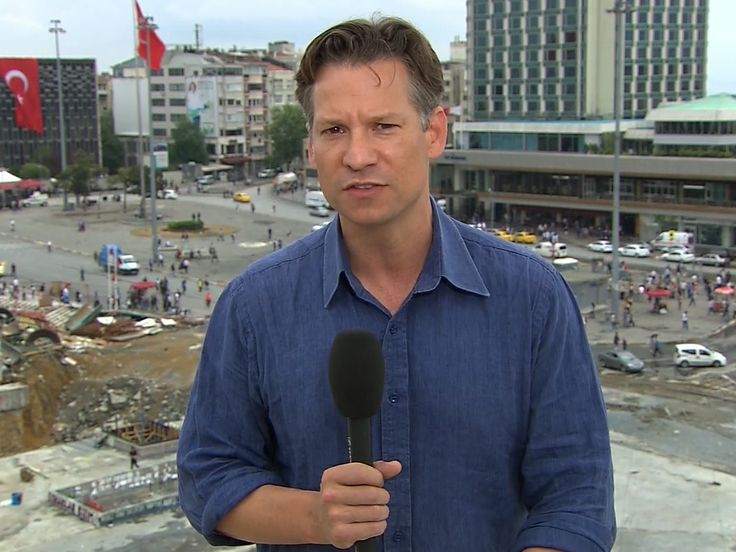
NBC chief foreign correspondent Richard Engel, exposed as part of hoax
The manipulation of western opinion about the Syrian conflict using fake events is not theory; it has been proven. A good example is the fake kidnapping of NBC reporter Richard Engel in December 2012. Engel and his media team were reportedly kidnapped and threatened with death by “shabiha” supporters of the Syrian president. After days in captivity the American team was supposedly rescued by Free Syrian Army “rebels” after a shootout. In 2015 it was confirmed this was a hoax perpetrated by the FSA and their American supporters. The entire charade was carried out by the “rebels”. The goal was to demonize the Assad government and its supporters, and to romanticize and increase support for the armed opposition. Neither Engel nor NBC confessed to the reality until it was about to be exposed years later, pointing to duplicity and collusion in the deception.
Four and half years ago, on August 21, 2013, the most famous chemical weapons incident occurred. The Syrian government was immediately accused of launching a sarin attack which killed hundreds of children and civilians. Over the next six months investigations were carried out. The conclusions of Seymour Hersh, Parry and the research site whoghouta.com concluded that the attack was almost certainly not from the government but actually from one of the ‘rebel’ factions with support from Turkish intelligence services. Two Turkish parliamentary deputies held a press conference and publicly revealed some of the evidence. The intent then, as now, was to provide justification and provocation for the US and NATO to bomb Syrian government installations.
The Drums are Pounding
Today there is the imminent possibility of a major attack based on the allegations of a clearly biased source, with international law and legal due process tossed aside. Why is violence being threatened before there is a serious, independent investigation of the chemical incident? If the accusations against Syria are true, why not let it be investigated, especially now that the area was liberated on Monday and safe access can be provided?
The drums of war are pounding. After over one year of incessant Russia bashing and disinformation, is the public ready to go to war with Russia over Syria? Neoconservative hawks and their Israeli and Saudi allies do not seem alarmed by this prospect. Their plans and predictions for Iraq, Libya and Yemen were delusional fantasies with the price paid in blood by the people of those countries and in treasure by Americans as well. Sadly, there has not been any accountability for the media and political establishment that promoted and launched those wars. Now they want to escalate the aggression by attacking Syria, causing vastly more blood to flow and risking confrontation with a country which can fight back.
Rick Sterling is an investigative journalist based in the San Francisco Bay Area. He can be contacted at rsterling1@gmail.com
Pentagon Capitalism and Silicon Valley: Google’s Drone War Project Shows Big Data’s Military Roots
By Elliott GABRIEL | Mint Press News | April 6, 2018
Google — the advertising and search engine monolith that once touted its official commitment, “Don’t be evil” — has thrown its full weight behind the U.S. military-industrial complex’s fast-advancing unmanned drone program – and more than three thousand of its employees will have none of it.
In a letter to Google CEO Sundar Pichai, over 3,100 employees invoked the now-discarded slogan in an appeal demanding that the company not allow its artificial intelligence technology to be used to improve the targeting capabilities of the United States’ deadly drone fleet. Google’s Project Maven is an AI surveillance engine that uses footage captured by the U.S. Armed Forces’ unmanned aerial vehicles to detect and track objects such as vehicles, while combing through, organizing, and feeding the processed data to the Pentagon.
Watch | Project Maven: The Pentagon’s New Artificial Intelligence
The letter, which is fast making the rounds on Google campuses and internal communication servers, demands the cancellation of the project and the public adoption of a policy pledging that neither Google nor its contractors produce technology for warfare. The letter states:
“This plan will irreparably damage Google’s brand and its ability to compete for talent. Amid growing fears of biased and weaponized AI, Google is already struggling to keep the public’s trust. By entering into this contract, Google will join the ranks of companies like Palantir, Raytheon, and General Dynamics. The argument that other firms, like Microsoft and Amazon, are also participating doesn’t make this any less risky for Google. Google’s unique history, its motto Don’t Be Evil, and its direct reach into the lives of billions of users set it apart.”
However, journalist and author Yasha Levine has explained in his new book Surveillance Valley: The Secret Military History of the Internet that Google has long been a leading Silicon Valley vendor to the U.S. repressive state:
“Over the years, [Google] supplied mapping technology used by the U.S. Army in Iraq, hosted data for the Central Intelligence Agency, indexed the National Security Agency’s vast intelligence databases, built military robots, co-launched a spy satellite with the Pentagon, and leased its cloud computing platform to help police departments predict crime. And Google is not alone. From Amazon to eBay to Facebook … Some parts of these companies are so thoroughly intertwined with America’s security services that it is hard to tell where they end and the U.S. government begins.
The grim calculus of remote-controlled warfare
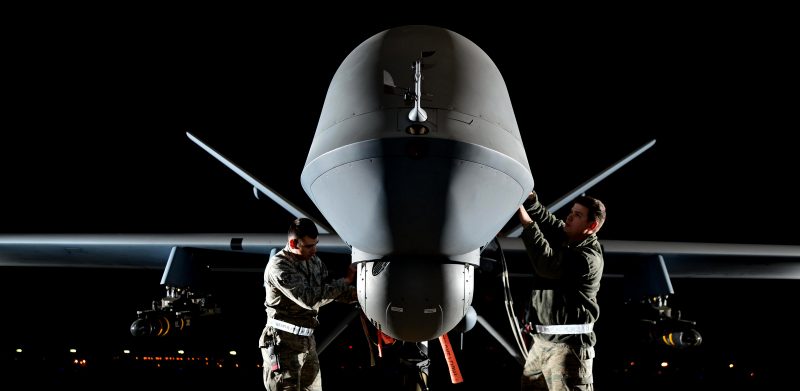
An Air Force RPA reconnaissance drone is retrofitted for use in attack squadron. (Photo: U.S. Air Force)
Thousands of alleged “combatants” have been killed in U.S. drone strikes since the start of the post-9/11 “War on Terror.” Former President Barack Obama ramped up the targeted killing program using drones in 2009, pledging that the use of unmanned aerial platforms was part of a “just war—a war waged proportionally, in last resort, and in self-defense.”
Reports have shown that the use of drones in such locales as Afghanistan, Iraq, Libya, Pakistan, Syria, Yemen and other theaters of operations have claimed a vast number of civilian lives — over 15,000 in 2017, according to surveys. According to New York Times Magazine, which surveyed 150 Coalition drone strikes carried out in Iraq over an 18-month period, one out of every five strikes kills civilians.
Watch | Suffering in Silence: a documentary about the war on terror in Pakistan
The American Civil Liberties Union has denounced the use of such tactics as contrary to international law:
“A program of targeted killing far from any battlefield, without charge or trial … violates international law, under which lethal force may be used outside armed conflict zones only as a last resort to prevent imminent threats, when non-lethal means are not available.
There is very little information available to the public about the U.S. targeting of people far from any battlefield, so we don’t know when, where and against whom targeted killing can be authorized … The secrecy and lack of standards for sentencing people to death, resulting in a startling lack of oversight and safeguards, is one of our prime concerns with this program.”
In 2007 at the height of George W. Bush’s “troop surge” in Iraq, Google enlisted in the “Global War on Terror” in a discrete partnership with Lockheed Martin. While enhanced versions of Google Earth were already at the disposal of government agencies, the tech firm helped to design a Google Earth product for the Pentagon’s National Geospatial-Intelligence Agency that displayed a visual representation of U.S. and Iraqi military bases in Iraq as well as the location of Sunni and Shiite neighborhoods in Baghdad, allowing occupation forces to oversee and manage the bloody fratricidal warfare between the groups as well as the possible location of insurgent organizations within their ranks.
It was during this same year that the development and use of Air Force drones in the Iraqi quagmire dramatically increased, nearly doubling between January and October of 2007.
Google defends its public image (and low-profile military ties)
Claiming that it values the input of its employees as an “important part” of its company culture, Google has promised to address the AI-drone issue without making specific comments on the employees’ demands. In a statement Tuesday, the company said:
“Any military use of machine learning naturally raises valid concerns. We’re actively engaged across the company in a comprehensive discussion of this important topic and also with outside experts, as we continue to develop our policies around the development and use of our machine learning technologies.”
Google has also defended its participation in the Pentagon program with the claim that its usage is specifically for non-offensive purposes and uses open-source object-recognition software based on non-classified data that’s freely available to any users of the Google Cloud, and could in fact save lives while saving labor through the use of AI.
Google’s own top corporate chiefs are quite close to the Pentagon: Google vice president Milo Medin serves on the Department of Defense’s tech advisory body, the Defense Innovation Board, which is also chaired by former Google executive chairman Eric Schmidt, who remains an executive board member at Google’s parent company, Alphabet Inc.
Google itself has long been interested in developing its own line of drone products, including private delivery drones.
The company is also a leader in AI and machine-learning technology. Its subsidiary DeepMind Technologies, Inc. has recently developed a program based on Google Street View that allows AI-based platforms to take part in long-range navigation and cross complicated urban environments. The navigator AI system is capable of steering everything from autonomous, self-driving cars to robotic vacuums and even unmanned drones.
Watch | Eric Schmidt at the Artificial Intelligence and Global Security Summit
Last November in a keynote address on artificial intelligence in warfare before Washington-based think-tank the Center for a New American Security, Schmidt pinned anxiety about his company’s acquisition of DeepMind on “a general concern in the tech community of somehow the military-industrial complex using their stuff to kill people incorrectly, if you will.”
“It comes from a, it’s essentially related to the history of the Vietnam War and the founding of the tech industry,” Schmidt added.

Indeed, Levine argues:
“In the 1960s, America was a global power overseeing an increasingly volatile world: conflicts and regional insurgencies against U.S.-allied governments from South America to Southeast Asia and the Middle East. These were not traditional wars that involved big armies but guerrilla campaigns and local rebellions, frequently fought in regions where Americans had little previous experience. Who were these people? Why were they rebelling? What could be done to stop them? In military circles, it was believed that these questions were of vital importance to America’s pacification efforts, and some argued that the only effective way to answer them was to develop and leverage computer-aided information technology.”
Surveillance capitalism’s military-industrial roots
In a 2014 essay for Monthly Review magazine titled “Surveillance Capitalism: Monopoly-Finance Capital, the Military-Industrial Complex, and the Digital Age,” authors John Bellamy Foster and Robert W. McChesney coined the phrase surveillance capitalism, tracing its origins to the inception of a post-World War II “new Pentagon capitalism” that came to be known as the military-industrial complex.
Under the model – revolutionized by then-Army Chief of Staff and later President Dwight D. Eisenhower – the U.S. technological, scientific research and industrial capacity were to become “organic parts of our military structure” in conditions of national emergency, effectively giving the civilian economy a dual-use purpose. In a 1946 memorandum, Eisenhower noted:
“The future security of the nation… demands that all those civilian resources which by conversion or redirection constitute our main support in time of emergency be associated closely with the activities of the Army in time of peace.”
The model became a permanent feature of the U.S. economy, giving birth to a sprawling military-civilian economic base Eisenhower famously criticized in his 1961 farewell address to the nation. Civilian industry, science, and academia were used alongside an exorbitant and perpetually-expanding war budget to underwrite the Defense Department’s never-ending state of conflict with Cold War enemies and unruly populations, making the world safe for the unchallenged reign of U.S. monopoly capitalism (imperialism) and “pump-priming” the economy whenever an additional surge of “military Keynesian” government spending was required.
Watch | Richard Wolff On Trump’s Defence Spending
According to the popular history of the internet’s origin, it was conceived in 1969 by scientists at the Defense Department’s Advanced Research Projects Agency (ARPA), who sought to create a means of “internetworking” Pentagon-sponsored computer mainframes belonging to government agencies, universities and defense contractors across the United States and NATO bloc. Known as Arpanet, the decentralized system allowed for military nodes – down to a battlefield level – to network and share data quickly and wirelessly. In the event of a nuclear strike or major war where swathes of the network were destroyed, the Arpanet would remain operational.
Levine posits that a primary purpose of conceiving the “information superhighway” was the need for a computerized counterinsurgency tool that could predict and check the “perceived global spread of communism” and provide real-time surveillance of potential threat groups:
“The Internet came out of this effort: an attempt to build computer systems that could collect and share intelligence, watch the world in real time, and study and analyze people and political movements with the ultimate goal of predicting and preventing social upheaval. Some even dreamed of creating a sort of early warning radar for human societies: a networked computer system that watched for social and political threats and intercepted them in much the same way that traditional radar did for hostile aircraft. In other words, the Internet was hardwired to be a surveillance tool from the start. No matter what we use the network for today — dating, directions, encrypted chat, email, or just reading the news — it always had a dual-use nature rooted in intelligence gathering and war.”
The Arpanet system formed the backbone of U.S. military communications from 1969 until 1989, when the World Wide Web was introduced to civilian consumers. The unveiling of the World Wide Web opened the floodgates to the use of the internet by users across the globe, as well as its subsequent commercialization and the resulting dot com boom of the mid-to-late 1990s, when Google was founded.
Watch | Yasha Levine on why we lost our fear of computers as tools of social control
The rapid advance of digital technology has ensured that the U.S. economy — and social life itself — is now dominated by big-data giants like Google, Apple, Facebook and Amazon (GAFA), as well as Microsoft, Intel, Cisco Systems, IBM and Hewlett-Packard. This new technology-dominated market environment, where private user info is parsed, monetized, packaged and sold, has been encapsulated by the well-worn cliché: “data is the new gold.”
Vast strides in biometrics, analytics research, AI, and deep-learning technology – perfected not only by Google but by academic researchers and technology firms across the globe – have vastly boosted the state’s ability to surveil and control populations and police dissent across the globe. Many of the technologies developed by global arms, surveillance, and data-analysis firms are supplied to countries requiring tailor-made solutions to unrest such as India, China, Myanmar, Saudi Arabia, Egypt, Bahrain, and Azerbaijan.
The extent of Silicon Valley’s integration with the U.S. government was laid bare to the public in 2013, when Edward Snowden provided evidence proving that the U.S. National Security Agency (NSA) and Federal Bureau of Investigation (FBI) had direct access to the internal servers of nine major tech firms – AOL, Apple, Facebook, Google, Microsoft, PalTalk, Skype, YouTube, and Yahoo – each of which provided direct access through major internet service providers to the NSA through its secret projects like Boundless Informant and Prism.
Foster and McChesney explained:
“These monopolistic corporate entities readily cooperate with the repressive arm of the state in the form of its military, intelligence, and police functions. The result is to enhance enormously the secret national security state, relative to the government as a whole.
Edward Snowden’s revelations of the NSA’s Prism program, together with other leaks, have shown a pattern of a tight interweaving of the military with giant computer-Internet corporations, creating what has been called a ‘military-digital complex.’ Indeed, Beatrice Edwards, the executive director of the Government Accountability Project, argues that what has emerged is a ‘government-corporate surveillance complex.”
Information superiority and the modern battlefield
At present, the digitalization of the military-industrial complex gives the United States a commanding edge in terms of military technology and high-tech warfare, which is augmented by optical spy satellites capable of capturing remarkably detailed ground-level imagery, successive generations of wireless networking technologies, pattern-recognition and machine-learning systems, and unmanned warfighting platforms.
As a matter of survival, however, all modern militaries – both regular and irregular, large and small – are being forced to adapt to the digitization of warfare. China, Russia, and even non-state actors like Lebanese resistance group Hezbollah are fast making technological advances to keep pace in the informationized battlefield.
The weaponized nature of digital technology is a pandora’s box that may prove impossible to close. Be that as it may, Google’s employees are livid about their participation in these developments:
“We cannot outsource the moral responsibility of our technologies to third parties … Building this technology to assist the U.S. Government in military surveillance – and potentially lethal outcomes – is not acceptable.”
While the tech conglomerate workers’ attempt to decouple Google from the Pentagon may be in vain, one can only applaud their efforts to protest the tech conglomerate’s complicity in the bloodshed wrought by U.S. imperialism through its array of increasingly high-tech implements of death.
Syria chemical attack: Theresa May says Assad’s allies should be held to account
RT | April 9, 2018
Prime Minister Theresa May said all supporters of Syria’s leader Bashar Assad should be held to account over an alleged chemical attack on a formerly rebel-held town. Russia says there is currently no evidence of the attack.
Speaking in Copenhagen, Denmark, the Tory leader said that if allegations of a chemical attack against the town of Douma, Eastern Ghouta are confirmed, Assad – along with his allies, which include Iran and Russia – should pay the price.
“Yes, this is about the actions, the brutal actions of Assad and his regime, but it’s also about the backers of that regime. And, of course, Russia is one of those backers,” May said during a news conference in Denmark.
“This is a brutal regime that is attacking its own people, and we are very clear that it must be held to account, and its backers must be held to account too,” she told reporters as she stood beside her Danish counterpart, Lars Lokke Rasmussen, a close ally.
Allegations of the attack in Eastern Ghouta on Saturday, which is thought to have killed 70 people, were reported by the humanitarian aid group, the White Helmets. The group, however, has itself been repeatedly accused of having ties to terrorists.
Syria and Russia have rejected the claims as “fabrication,” while Russia’s Foreign Minister Sergei Lavrov said no evidence has been found of chemical weapons being deployed in Douma.
Theresa May’s comments come after the US and France threatened a “joint, strong response,” with US President Donald Trump tweeting that there will be a “big price to pay” for the attack.
Douma Chemical Attack: Another Link in the Chain of Staged Provocations
By Peter KORZUN | Strategic Culture Foundation | 09.04.2018
What happened in Syria on April 7 had been expected. While raising hue and cry over the alleged chemical attack in Douma, a rebel-held suburb of the capital, Western officials and media wasted no time to put the blame on the Assad government.
The US State Department issued a statement saying that by shielding Damascus Moscow has breached its international commitments. The administration immediately called on Russia to cease its support of Syria’s government. President Trump wants an international action. As usual, few people in the West raised their voices to emphasize the need to investigate first and make conclusions afterwards.
It strikes the eye that Moscow’s warnings about a CW provocation being prepared to dash the rising hopes for peaceful settlement in Syria appear to be forgotten! The Defense Ministry shared the information that the ringleaders of Jabhat al-Nusra and the Free Syrian Army were plotting false flag chemical attacks in areas under their control. Moscow warned but the West did not listen.
It’s the same old song and dance. Last year, the Syrian government was blamed for a sarin gas attack on Khan Sheikhun that prompted a US cruise missile strike on a Syrian air base. The American president’s approval ratings went up as a result. This time, the alleged attack occurred right after the Russia-Turkey-Iran summit that took place in Ankara on April 4 to promote the Syria conflict settlement.
As before, all “evidence” boils down to White Helmets’ report and a video going viral that does not look or sound very convincing. There was no independent verification. The White Helmets have iffy reputation, to put it mildly. The organization is known to pursue political interests of outside actors.
No explanation was given to a simple question: what does Syria’s government need this attack for? It is victorious everywhere and the operation in Eastern Ghouta has been a success. Douma is the last remaining stronghold still controlled by rebels in the area and will be liberated soon. It’s a matter of a few days. The army’s combat actions are supported by Russian aviation. What does Syria’s government stand to gain by using CW? Nothing.
Syria army units are operating in Douma. By launching an attack, the Syrian government would hit its own troops, This argument appears to be largely missing in Western media reports. President Trump has recently promised to withdraw American forces from Syria. Why would President Assad give him a pretext to renege on his word?
But the world “indignation” against Russia-supported President Assad benefits the extremists a lot. They are cornered and need time to take a breath and receive support. Actually, the ballyhoo raised in the West is their only chance to at least slow down the offensive. A government forces’ victory in Douma would deal a heavy blow to terrorist groups, sounding the death knell for the rebellion. Sounds simple but that’s what it is. There is each and every reason to believe the incident was staged by terrorists.
Right after the alleged attack, they asked for talks. The ringleaders believe that this is their chance for a negotiated truce. The militants keep their fingers crossed hoping that NATO member states which clandestinely support them will get involved one way or another. Just last February, Secretary of Defense James Mattis warned Syria of “dire consequences” if it executed chemical strikes. French President Macron said he would order strikes if CW were used. It’s worth noting that today the US president’s National Security Team is led by a person known as a trigger happy hawk advocating the use of force as a foreign policy tool.
The US and France have been harboring plans to launch a joint operation in Syria for some time. Only a few days ago, a contingent of French forces arrived in Manbij to join American allies there. Actually, a NATO operation has been launched leaving Turkey, a bloc’s member, out in the cold. It’s an open secret that the US-led coalition pursues the goal of partitioning Syria to “contain” Russia, roll back Iran, win the support of rich Persian Gulf Arab states to boost lucrative arms trade and bolster the US and France’s clout in the Middle East.
It would be naïve to think that the chemical attack in Syria and the Skripal scandal are two separate events. They are links in the same chain. With the spy poisoning case leading nowhere, the anti-Russia campaign needs a new impetus. The alleged CW attack is a good pretext to spur the efforts. But any strike in Syria would pose a risk to the lives of Russian servicemen. It could make Moscow respond. The US-led coalition is playing with fire. And as in the Skripal case, the reaction is the same – blame first, wait for the results of investigation second. It just shows that the West is not interested in the truth. It’s looking for new pretexts to damage Russia’s reputation and thus reduce its global clout.
Moscow warns Trump against attack on Syria
By M K Bhadrakumar | Indian Punchline | April 9, 2018
The US President Donald Trump has appeared himself at the barricades facing Russia, finally. He has done everything possible so far not to get entangled in the New Cold War. And the Kremlin gave him the benefit of doubt so far. But no more.
How far Trump is seeking a confrontation with Vladimir Putin is hard to say but he is an intelligent man who would know that there is nothing personal about Russian policies. This is the first time Trump has directly criticized Vladimir Putin by name. Trump’s tweet on Sunday is provocative:
- Many dead, including women and children, in mindless CHEMICAL attack in Syria. Area of atrocity is in lockdown and encircled by Syrian Army, making it completely inaccessible to outside world. President Putin, Russia and Iran are responsible for backing Animal Assad. Big price to pay. Open area immediately for medical help and verification. Another humanitarian disaster for no reason whatsoever. SICK! If President Obama had crossed his stated Red Line In The Sand, the Syrian disaster would have ended long ago! Animal Assad would have been history!
Moscow lost no time to point out that the so-called chemical attack is fake news. In fact, Moscow has been alerting its allies in Syria that precisely this sort of a false flag operation by the Saudi and US-backed terrorist group Jeish al-Islam (which is staring at defeat by the Syrian government forces in Eastern Ghouta) could be expected.
History is repeating. A similar false-flag was staged in Eastern Ghouta in 2013 and it almost prompted then US President Barack Obama to move naval fleets to the Mediterranean for war on Syria, but a prompt Russian initiative on chemical disarmament of Syria under the auspices of the UN defused the US-Saudi plot. Subsequently, investigations by western journalists, including from Associated Press, found that the then Saudi Intelligence Chief, Prince Bandar Bin Sultan only had supplied a chemically armed warhead to the terrorist group in Eastern Ghouta.
The Russian Foreign Minister Sergey Lavrov disclosed today in Moscow that the Syrian government had transferred to the UN Security Council and the OPCW the intelligence reports to the effect that a provocation was being prepared with the use of chlorine in East Ghouta. Lavrov added: “The US is taking steps not to leave (Syria) as President [Donald] Trump said, and leave Syria for others, but to establish a foothold there for a very long time – experts believe so.”
So, the big question is what Trump could be up to. Trump mentioned Obama in his tweet. For sure, Moscow is on alert. The Russian Foreign Ministry issued another warning to Washington on Sunday that any US interference in Syria will be “absolutely unacceptable and can lead to very grave consequences.” The text of the statement is reproduced below:
- The Syrian government army is conducting an operation to free civilians in Eastern Ghouta, a suburb of Damascus, from the control of militants and terrorists. The greater part of this suburb has been liberated. Irreconcilable radicals have mounted fierce resistance in the town of Douma, where they use the remaining civilians as a human shield.
- In this situation, the Russian Centre for Reconciliation in Syria and the Syrian government forces have created humanitarian corridors for the evacuation of civilians. They will continue with this effort. However, those who are not interested in the early elimination of one of the last seats of terrorism in Syria and in a genuine political settlement are doing their best to hinder the evacuation of civilians.
- False information is being planted about the alleged use of chlorine and other toxic agents by the Syrian government forces. The latest fake news about a chemical attack on Douma was reported yesterday. These reports are again referenced to the notorious White Helmets, which have been proved more than once to be working hand in glove with the terrorists, as well as to other pseudo-humanitarian organisations headquartered in the UK and the US.
- We recently warned of the possibility of such dangerous provocations. The goal of these absolutely unsubstantiated lies is to protect the terrorists and the irreconcilable radical opposition that has rejected a political settlement, as well as to justify the possible use of force by external actors.
- We have to say once again that military interference in Syria, where Russian forces have been deployed at the request of the legitimate government, under contrived and false pretexts is absolutely unacceptable and can lead to very grave consequences.
The detailed Russian explanation suggests that a criticality has arisen. Two Israeli jets fired missiles at a Syrian airbase in Homs province today early morning from Lebanese air space inflicting heavy casualties. Israeli drones have been reported over Lebanon. This could be a dry run for US operations.
Syrian Air Defenses respond to ‘missile attack’ on airbase in Homs – state media
RT | April 9, 2018
A military airport in Homs province has been targeted in a “missile attack,” SANA reports. Although Syrian air defense systems allegedly intercepted at least eight projectiles, several people were reportedly injured and killed.
Several missiles were launched at Syria’s T-4 air base in the east of Homs province, SANA reports, citing a military source. According to the agency, the attack has “probably” been carried out by the United States.
There are several “martyrs and wounded” as a result of the strike, SANA added, without specifying the number of casualties.
While the US Defense Department is “aware” of reports of an alleged missile strike, it has dismissed reports of any US involvement.
“At this time, the Department of Defense is not conducting air strikes in Syria,” the Pentagon told Reuters in a statement. “However, we continue to closely watch the situation and support the ongoing diplomatic efforts to hold those who use chemical weapons, in Syria and otherwise, accountable.”
According to Lebanon’s Al Mayadeen broadcaster, the missiles were coming from the Mediterranean Sea, through Lebanese airspace. Meanwhile, Al Masdar News is reporting that “unknown jets” have entered Syrian airspace from Lebanon, and is speculating that the jets could be Israeli. In response, the Syrian Air Defense system at Mezzeh Air Base was activated, the report added.
Almost precisely a year ago, on April 7, 2017, the US carried out a strike against Syria’s Shayrat Airbase, launching a volley of 59 Tomahawk cruise missiles from the Mediterranean Sea. Back then, Washington justified the attack as a necessary response in the wake of reports of a deadly chemical attack in Idlib province, without waiting any on any investigation into the incident.
The latest news comes as Damascus faces fresh accusations of allegedly targeting civilians in a chlorine attack, which were put forward by the controversial White Helmets group, which is always to the fore in Western media coverage of the Syrian conflict.
Damascus, meanwhile, has denied the accusations, while the Russian Foreign Ministry denounced the latest reports as another example of a “continuous series of fake news about the use of chlorine and other chemical agents by the government forces.”
Amid escalating tensions, the Joint Chiefs of Staff and the US Central Command (CENTCOM), have allegedly been compiling lists of potential targets and attack options to present to Trump and his national security team, senior US military officials told Israel’s i24NEWS.
Israeli officials had, throughout Sunday, advocated striking targets in Syria, calling on Washington to retaliate against Damascus in response to the alleged Douma chemical attack. The charge was led by the Israeli Strategic Affairs and Public Security Minister Gilad Erdan, who told the Army Radio on Sunday that he personally hopes that the US would take military action against the Syrian government. Among an array of politicians, Israeli opposition leader Isaac Herzog also called on the US to take “decisive military action” against Syria. The idea of Israel’s intervention in Syria was also supported by the Israeli Chief Rabbi Yitzhak Yosef, who urged his followers “to try and stop this massacre.”
Donald Trump’s fury, meanwhile, focused on Damascus and the Syrian president Bashar Assad, whom the US president called an “animal.” The US leader also lashed out against Iran and Russia for supporting Assad, saying there is a “big price” to pay for the latest chemical attack.
Trump has already held talks with his French counterpart Emmanuel Macron, after which both leaders decided to form a united front against Russia at the upcoming United Nations Security Council meetings, planned for Monday. Macron previously indicated that France might consider unilateral actions, including a military strike if chemical weapons were ever used in Syria again.
Featured Video
Anthrax War – CBC The Passionate Eye
or go to
Aletho News Archives – Video-Images
Book Review
Shattered Dreams: The HPV Vaccine Exposed (2019)
By Christina England – 30 Q&As – Book Review & Summary
Lies are Unbekoming | September 4, 2026
… Gardasil received FDA fast-track approval in 2006, Cervarix followed in 2009, and Gardasil 9 was approved in December 2014 with more than double the aluminium adjuvant content of the original. The commercial context is specific. Merck was about to lose patent protection on Zocor and faced $18 billion in Vioxx injury claims from a cardiovascular drug the company had marketed while suppressing its own data showing a five-times increase in heart attacks. Analysts projected the global HPV vaccine market at $4 billion by 2011, contingent on government-funded national programs for teenage girls. The 1986 National Childhood Vaccine Injury Act had already granted manufacturers complete liability immunity. By 2013, Japan had withdrawn its HPV vaccine recommendation after cataloguing severe adverse reactions in hundreds of girls. No Western government followed. The establishment position across the UK, US, Australia, and most of Europe held, and still holds, that the vaccines are safe and effective, that reported injuries are coincidental, and that cervical cancer prevention justifies the program. The book was published into this position, not against a vacuum.
Shattered Dreams sits alongside Mary Holland’s The HPV Vaccine On Trial and Viera Scheibner’s foundational vaccination work as part of the documented record on what has been done to a generation of teenage girls under the banner of cancer prevention. The full summary unpacks three specific findings: that Merck used the aluminium adjuvant itself as the “placebo” control in 92.5% of trial subjects, making it structurally impossible to detect excess reactions from the adjuvant; that Dr. Sin Hang Lee found HPV DNA fragments bound to aluminium in every one of sixteen Gardasil samples tested, and in the blood and spleen of a New Zealand girl six months after her third dose; and that in every country with high vaccination coverage, including Australia, the UK, Norway, and Sweden, cervical cancer rates have stopped declining and started rising specifically in the vaccinated cohort. Martínez-Lavín’s 2017 calculation puts the number needed to seriously harm with Gardasil 9 at 140, and the number needed to vaccinate to prevent one case at 1,757. Thirteen young women are seriously harmed for every one who benefits. The vaccine was approved on the basis of trials that could not detect what the trials were supposed to detect, and it is still being given to twelve-year-olds today. … Read full review
Blog Roll
 Aletho News
- The Maidan Killings and the False-Flag Case
- Georgia’s Largest Healthcare System Will Fire Employees Who Refuse Flu Vaccine
- The Five-Year Fuel Crisis: Why the World Economy Is Paying for a War It Thinks Is Ending
- Trump’s Big Bluff on Iran
- Swiss scammed out of millions by Ukraine-linked call centers – media
- Germany facing potential ‘violent conflict’ with Russia – spy chief
- Ukraine’s EU neighbors reject new plea from Kiev – Politico
- British Transport Police Facial Recognition Trial Scanned 926,912 People With Zero Arrests
- House Bill Would Ban Federal Use of Flock ALPR Data
- Can a Spice Rival a Drug? 10 Head-to-Head Trials Put It to the Test.
- If Americans Knew
- “We See Our Homes Now From A Satellite, Like Strangers”
- Watch “Gaza: Doctors Under Attack”, originally censored by BBC
- NAZA: Israeli embassies in UK and US promote rival documentary to challenge Gaza genocide allegations
- David Ellison appoints Israeli to lead merged Paramount-Warner studios
- Turkish Red Crescent helps elderly Gaza man walk again after Israel confiscates his prosthetic limb
- Four Palestinians Killed in Israeli Attacks in Gaza
- Two Palestinian youths killed and village razed as Israeli attacks on West Bank continue
- Two more Christian women victims of Israeli raids on Gaza
- Cruelty, Deprivation, Indignity: A Journalist’s 22 Months in Israeli Prison
- New IDF Website Frames Slain Gaza Journalists as Terrorists
- No Tricks Zone
- Latest European Green Energy Debacle; Portugal’s Largest Flagship Solar Park Insolvent!
- Green Energy Debacle: German Expert Professor Fritz Vahrenholt Warns Of Severe Economic And Social Consequences
- Two More Paleo Reconstructions Affirm Meters-Higher Sea Levels Across Ireland, Brazil 7000-6000 Years Ago
- New Study: Earth And Venus Surface Warmth Largely Explained By Convection And Lapse Rate, Not CO2 Or Radiation
- 2025 Nature Paper Claiming Worsening Global Drought Gets RETRACTED …Heavily Flawed
- New Study: ‘Global Drought Shows No Detectable Recent Acceleration Under Climate Warming’
- Economic Masterminds: German Socialists Suggest Taxing Productivity Gains Stemming From Using AI
- The South China Sea Has Not Been Cooperating With The Climate Change Narrative
- Energy Crisis: Germany Enters Heating Season With Historically Low Gas Reserve Fill Levels
- New Study: The Antarctic Ice Sheet Gained Mass From 2020-2024 Due To Staggering Snow And Ice Accumulation

