Weapons of Mass Distraction

By Eric Striker • National Justice • October 22, 2020
The most remarkable thing about the Iraq war debacle isn’t the trillions of dollars wasted or hundreds of thousands of innocent people and US servicemen killed, but the fact that all of the journalists who promoted the lie to the American people were never held to account.
During the 2000s, a bipartisan cabal of overwhelmingly Jewish media personalities coordinated with American intelligence services to concoct the lie that Saddam Hussein was developing weapons of mass destruction to use against the United States.
The role of neoconservatives in this endeavor, primarily as Bush administration officials coordinating the war, is well known. What has been forgotten is the integral role “liberal” publications like the New York Times, Washington Post and others played in selling the WMD hoax.
The Times’ Judith Miller is credited with being one of the first to plant unsubstantiated WMD tales in popular consciousness, but other Jews — many of them also seen as unambiguously “liberal” — also played an active role in lying to drum up support for Bush’s war for Israel: Ezra Klein (currently of Vox ), Jeffrey Goldberg (now editor of The Atlantic), and Jonathan Chait (star columnist at the New Yorker). That’s just a shortlist.
Amazingly, every one of these individuals has only grown in prestige and influence in the press in the aftermath. Even Iraq war sin chicken Judith Miller remained unapologetic in her 2015 rehabilitation tours. She has since 2016 been hired by conservative outlets like Fox News and City Journal, now dedicating her columns to promoting foreign election meddling claims.
The gravest problem now with our Jewish controlled media is that all of the Iraq war disinformation agents, not just Miller, are now amongst the loudest amplifiers of the US intelligence community’s latest baseless hysterics alleging that every act of low-level trolling, dissenting political opinion, or news report (including initially the Hunter Biden story) that they find inconvenient is an inorganic product of Russian, Chinese or Iranian “election meddling” or “disinformation.”
To what ends? To lower public confidence in liberal institutions? To cause division and polarization? To make people afraid to vote and even more afraid of the outcome? The intelligence community’s Chicken Littles are doing this on a much wider scale than any supposed foreign agent.
Earlier today, the Director of National Intelligence John Ratcliffe held an “important” national security conference besides American NKVD leader Christopher Wray claiming that crudely written emails sent by someone impersonating the pro-Trump group, Proud Boys, telling registered Democrats in Florida not to vote was in fact an act of “election interference” by Iran. Intelligence operatives at the announcement also mentioned that Russia was conspiring with them by harvesting US political registrations for ill-intended reasons. No evidence was provided for either allegation.
The claim is ridiculous because, first of all, Florida political registrations are publicly available and easily found online. Anyone can obtain them without engaging in cyber crime or hacking.
Secondly, unflinching hostility towards Iran and over the top loyalty to Israel first is an issue Joe Biden and Donald Trump both enthusiastically agree on.
Trump and Biden are equally bad for Iran in distinct ways. Biden supports escalating Washington’s military presence in Syria and placing pressure on Iraq to cut ties with Iran.
Trump on the other hand has for the last few years attempted to starve the Iranian people into submission with “maximum pressure” sanctions, but this has been paired with military retreats in geostrategic zones of the Middle East that Israel believes are important to maintain a foothold in.
The Iranians and Russians don’t have a dog in America’s 2020 election fight between Oreo and Hydrox. Seeing how only 67% of Democrats are excited to vote for Joe Biden, it looks like Biden’s uninspired and mailed-in candidacy is the foremost act of interference in his campaign.
Meanwhile, Iran has responded with fury typical of a falsely accused man. The nation’s diplomats have lodged an official complaint at the United Nations demanding the FBI and DNI stop making frivolous accusations of trying to intimidate voters in America. President Hassan Rouhani’s counter is that both candidates — who are just spokesmen for Washington’s permanent bureaucracy — are enemies of the Iranian nation.
Today’s press conference by Wray and Ratcliffe was more akin to the despots in 1984 switching back and forth between blaming Eurasia (Russia) and Eastasia (China and Iran) during Hate Week. It’s a moronic distraction from their moronic failures, corruption and the artificially induced climate of fear they have created in our homeland.
It’s an attempt to shoehorn into tonight’s debate the non-issues of “election interference” and “disinformation” that most of the American public, which is suffering from problems like hunger and unemployment, has tuned out.
From weapons of mass destruction to weapons of mass distraction, both personify the Jewish post-truth order.
Yes, there is a World Zionist Congress – and it’s meeting now
By Alison Weir | If Americans Knew | October 21, 2020
I’m sometimes astounded at the fact that a major political movement over a century old is so little known among Americans – especially since it has had a momentous impact on the world in general and on the U.S. in particular, causing multiple wars, vast population displacement, and global instability.
In my travels around the US, I’ve found that most Americans know extremely little about Zionism. I would guess that the vast majority of Americans could not define the term (that was certainly my situation for most of my life), and that a great many may not have even heard of it.
And among those who have heard the term, many may think it refers to some antisemitic conspiracy theory.
The fact is, however, that Zionism – according to the dictionary, “a worldwide Jewish movement that resulted in the establishment and development of the state of Israel and that now supports the state of Israel as a Jewish homeland” – is both very real and extremely significant.
Zionism succeeded in establishing the state of Israel in 1948 after decades of sometimes open and sometimes covert efforts. It promoted a successful, though extremely false, slogan – “a land without a people for a people without a land” – and succeeded in perpetrating one of the major hoaxes of the 20th century, in which victims (indigenous Palestinians) were designated aggressors, and aggressors (Zionist colonists) were portrayed as victims (as documented by diverse authors, and perpetrated through the silencing of others).
And today this movement contains numerous powerful international entities (see the list below), while remaining largely invisible to millions of citizens of the country that gives Israel massive amounts of money, shields Israel internationally, and has fought at least one war (against Iraq) on Israel’s behalf.
The dictionary definition captures only the simplest meaning of the word, but not its deep impact: how Israel was established and what supporting Israel today enables.
As numerous historians have documented, Israel was established through a war of ethnic cleansing, in the words of a major Israeli historian, in which approximately 750,000 men, women, and children were violently expelled. Hundreds of villages were destroyed and much of the indigenous population was displaced, their ancestral homes and land confiscated and the former owners made into penniless refugees.
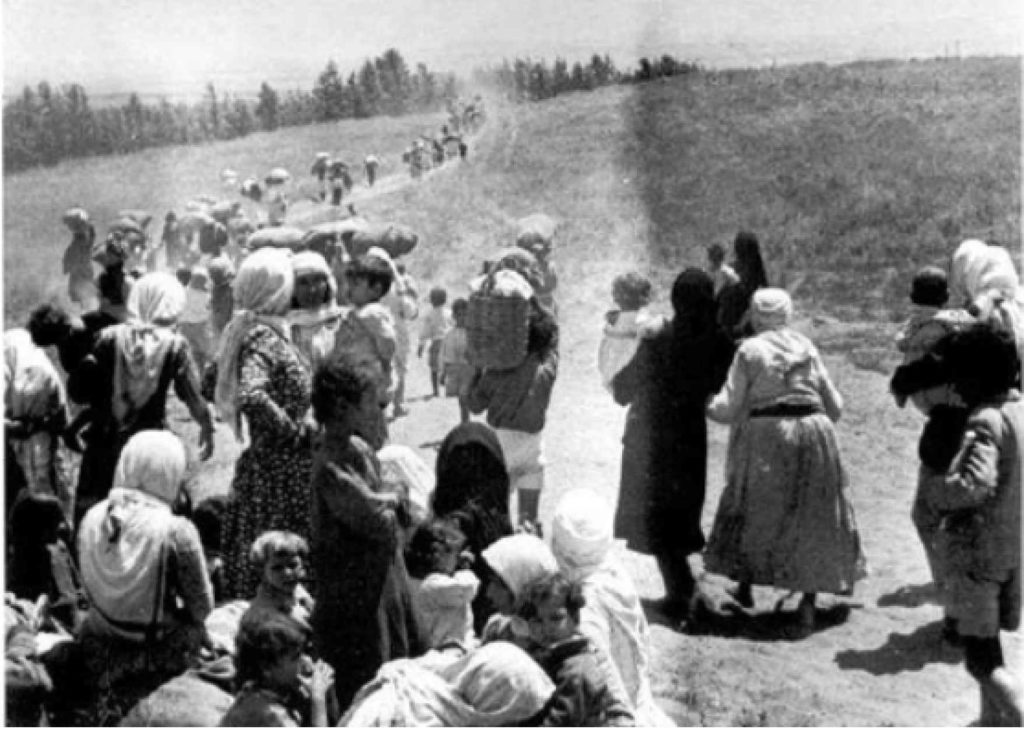
Palestinians forced out in 1948 during Israel’s founding war.
Today, in its pursuit of the Jewish identity mentioned in the definition, Israel continues to confiscate Palestinian land, actively discriminates against the remnants of the non-Jewish population that remain in the area, and holds the four and a half million people in the remaining portion of their land (the West Bank and Gaza), in two virtual prisons, their ability to leave and to return to their homes controlled by Israel.
Palestinian villages are invaded daily, people terrorized and abducted, homes and crops are regularly destroyed; for over a year there was a weekly mass demonstration during which Israeli forces shot unarmed demonstrators every week. (To see these actions go here.)
Zionist movement in the US – a century of activism
As I describe in my book, the Zionist movement in the U.S. began in the late 1800s and played a significant role in the events that led to the establishment of Israel.
Today the pro-Israel lobby is probably the most powerful and pervasive special interest group in the U.S. Its members have diverse views and sometimes sharply disagree with one another on aspects of the issue, but all share one goal: support for Israel.
Israel partisans have become extremely influential in both political parties and have obtained numerous US policies of support for Israel. Most recently, they are promoting bills to expend $19 million per day on behalf of Israel; altogether, 90 bills for Israel have been introduced in the current Congress alone. In addition, there is also considerable evidence that Israel partisans were central in pushing the US into invading Iraq, and that many are similarly active in demonizing Iran. (See this, this, this, and this.)
Conspiracy theory?
Since little of the above is known by the general American public (U.S. media rarely report any of this), some Americans are under the impression that even suggesting there is a “world Zionist movement” is an antisemitic conspiracy theory. (In fact, even discussing the Israel lobby in the U.S. can be dangerous to reputations and careers. For example, respected professors John Mearsheimer and Stephen Walt were attacked as “antisemitic” for their scholarly work in detailing the power of the Israel lobby.)
The fact is, however, that the World Zionist Organization has been in existence since the late 1800s, and this is just one of a number of international organizations that work on behalf of Israel.
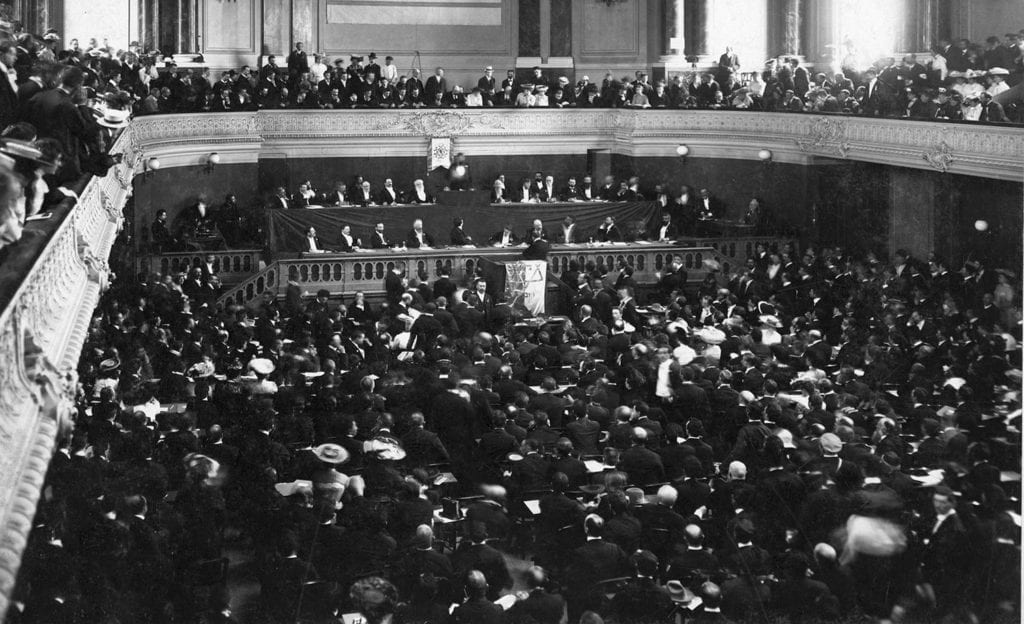
The First Zionist Congress, held in Basel, Switzerland in 1897.
Moreover, all of these are very public – if one knows where to look. Currently, the World Zionist Organization is holding its 38th Congress in an online format from Israel.
World Zionist Organization
While US mainstream media have largely failed to even mention this organization and event, it has been big news in the Israeli and Jewish-American press, with numerous stories leading up to the event. … continue
US, Western intelligence services behind creation of Takfiri terrorist groups: Yemen leader
Press TV – October 19, 2020
The leader of Yemen’s Houthi Ansarullah movement has held the United States and Western intelligence services responsible for the creation of Takfiri terrorist groups, saying France’s external intelligence agency plays a significant role in this regard.
“Takfiris are supported by the US, France and Western countries. They are the parties that have stood by Takfiris to target Muslims as they massacre them. The United States and its allies in Syria, Yemen, and other countries are supporting Takfiris, because they are using the extremists to tarnish the image of Islam. Western intelligence agencies, including the one in France, are involved in monitoring and supporting them,” Abdul-Malik al-Houthi said at a televised speech broadcast live from the Yemeni capital of Sana’a on Monday evening.
Houthi also warned that distortion and misinterpretation of Islamic teachings have created a deep rift among Muslims and posed serious problems to them.
“Enemies have used such deviation to insult the Holy Qur’an and Islam. There is no mercy or sympathy whatsoever in the Western civilization. They trample on [the rights of] human societies, deprive people of their freedom, plunder their wealth and occupy their lands, and then lecture others on human rights,” he highlighted.
The Ansarullah chief then questioned Western states’ respect for human rights in Yemen, Palestine and other Arab and Muslim countries, saying US President Donald “Trump is proud that he is ready to give Arab lands to the [Israeli] enemy and expropriate them as he did in the Syrian Golan Heights. What sort of civilization is this?”
Houthi went on to say that insulting Islam is allowed while criticizing Zionists is prohibited in France and whoever does so will be brought to trial.
“In the West, on the other hand, you are allowed to insult Islam and prophets, become atheists and insult God. But you are not permitted to insult Zionists and stand up to them,” the Yemeni Ansarullah leader pointed out.
“In the world, there is a blatant and insulting attack on the Prophet [Muhammad (PBUH)], Islam and Muslims, and the campaign seeks to target our faith with the goal of cultural dominance,” Houthi noted.
The Ansarullah leader stressed that efforts are being made to turn Muslim nations into subordinates of the US, Western states and the Israeli regime.
“Plots aimed at enslaving and distancing us from our religious teachings and identity must not be accepted at all,” he said.
He then denounced French President Emmanuel Macron’s recent anti-Islam remarks as a form of hostility toward the Muslim world.
“France and the West are insulting Islam and the Prophet Muhammad (PBUH). At the same time, they are caring for Zionists and don’t stand any insults directed at them,” he said.
The Ansarullah leader finally held arrogant powers, led by the US and the Israeli regime, accountable for the sufferings of nations worldwide.
Beijing Calls US Threats to Impose Sanctions Over Arms Supply to Iran Senseless
BEIJING – The US threats to impose sanctions on anyone supplying weapons to Iran are senseless, as such restrictions would be illegitimate, Chinese Foreign Ministry Spokesman Zhao Lijian said at a briefing on Monday.
The Iranian Foreign Ministry stated on Sunday, referring to the UN Security Council resolution 2231 (2015), that all restrictions on the transfer of arms to the country were terminated. US Secretary of State Mike Pompeo responded by saying that the US was ready to sanction any individual or entity that supplied conventional arms to Iran.
“The US actions are absolutely senseless. The US has even stated that China is going to supply arms to Iran. Chinese arms export policy has demonstrated our responsibility, while the US peddles arms and ammunition everywhere, uses military trade to serve geopolitical interests, and even openly interferes in the internal affairs of other countries,” Zhao told reporters.
He added that “the US has withdrawn from the Arms Trade Treaty and does not have any right to make irresponsible statements concerning China.”
The Chinese official stressed that the UN Security Council had already lifted the arms embargo from Iran.
On 14 July 2015, Iran, Russia, China, the US, Great Britain, Germany and France signed settlement agreements for the Iranian nuclear program. The Joint Comprehensive Plan of Action came into force on 18 October 2015, and, according to its provisions, sanctions were imposed on Iran, one of which banned conventional weapon sales to Iran for five years.
The US proposed prolonging the arms sale embargo in the UN Security Council on 14 August 2020, but the proposition was declined. Consequently, Iran is now able to procure any arms without restrictions.
Iran to use funds in Iraq for basic goods imports: CBI governor
Press TV – October 12, 2020
Iraq has agreed to release Iranian funds blocked in the Arab country because of American sanctions for Iran’s purchase of staples and basic goods, the Central Bank of Iran (CBI) governor Abdolnasser Hemmati said after meetings with senior Iraqi officials in Baghdad on Monday.
Hemmati said in a post on his Instagram page that some “good agreements” had been reached on the issue in a trilateral meeting involving him and his Iraqi counterpart as well as the CEO of Trade Bank of Iraq (TBI) where the Iranian funds are blocked.
Iran has billions of dollars in a TBI account which processes Iraq’s payments for imports of natural gas and electricity from Iran.
However, the funds have been blocked because of US sanctions on Iran which restricts the use of dollar for transactions involving Tehran.
Hemmati said Iraqi Prime Minister Mustafa Al-Kadhimi had welcomed the agreement to use the funds to reimburse Iran’s basic goods imports.
“In the meeting with the Iraqi premier … he issued the required orders to the Iraqi central bank and the TBI to speed up the implementation of the agreement,” said Hemmati, adding that Kadhimi had vowed to personally follow up the case on a weekly basis.
Hemmati made a first visit to Baghdad in June to pursue the case of blocked funds in Iraq. The CBI governor had expressed optimistic remarks about the release of funds in Iraq on that occasion but a final decision on the issue has been waiting reportedly because of growing American pressure on Baghdad.
A high-ranking trade and banking delegation accompanied Hemmati in his Monday trip to Iraq. The top banker said the visit would bolster the already growing trade relations between the two countries.
Iraq is only second to China in purchase of goods and services from Iran with recent figures showing Iranian exports to the Arab country reached $565 million in value terms in the Persian calendar month to September 21.
US forces must leave Iraq or will be forcibly expelled: Kata’ib Hezbollah
Press TV – October 10, 2020
Iraq’s anti-terror Kata’ib Hezbollah group, which is part of the country’s Popular Mobilization Units (PMU), has warned American forces against remaining in the Arab country, saying they will be forcibly expelled by means of resistance if they insist on maintaining their presence much to the dismay of Iraqis.
Muhammad Mohi, spokesman for Kata’ib Hezbollah, told Yemen’s Arabic-language al-Masirah television network on Saturday that the resistance will become stronger if the US insists on its obstinacy regarding its exit from Iraq.
Kata’ib Hezbollah is an anti-US unit operating under Hashd al-Sha’abi – an Iraqi umbrella group also known as PMU, which includes more than 40 militia groups fighting Takfiri terrorism.
He further slammed the US for making attempts to dissolve the PMU, saying Washington will fail to limit the role of the anti-terror forces.
The Iraqi forces, he said, are able to counter any possible threat against the country, adding that by remaining in the region, the US wants to guarantee the security of Israel and implement US President Donald Trump’s so-called deal of the century.
“The cause of the crises in the region is the American arrogance and its attempt to dominate the world,” he said, adding that the US” must respect the will of Iraq,” and immediately leave the country.
Reiterating the military capabilities of Iraqi resistance groups, Mohi called on the country’s parliament to implement its decision to expel American forces from Iraq.
Hashd al-Sha’abi fighters have played a major role in the liberation of areas held by Daesh terrorists ever since the Takfiri group launched an offensive in the country, overrunning vast swathes in lightning attacks.
In November 2016, the Iraqi parliament voted to integrate the PMU, which was formed shortly after the emergence of Daesh in Iraq in 2014, into the military.
The popular group, however, is a thorn in the side of the United States, which is widely believed to be managing an array of militant groups, including Daesh, to advance its Israel-centric agenda in the region.
In 2009, the US State Department blacklisted Kata’ib Hezbollah and imposed sanctions on the group, which has been the frequent target of American airstrikes in Iraq.
Iraqi lawmakers unanimously approved a bill on January 5, demanding the withdrawal of all foreign troops following the US assassination of Lieutenant General Qassem Soleimani, the commander of the Quds Force of Iran’s Islamic Revolution Guards Corps, along with Abu Mahdi al-Muhandis, the deputy head of Iraq’s PMU, and their companions.
Later on January 9, former Iraqi prime minister, Adel Abdul-Mahdi, called on the United States to dispatch a delegation to Baghdad tasked with formulating a mechanism for the move.
The 78-year-old politician said Iraq rejected any violation of its sovereignty, particularly the US military’s violation of Iraqi airspace in the assassination airstrike.
The US has refused to withdraw its troops, with Trump balking at the idea with the threat to seize Iraq’s oil money held in bank accounts in the United States.
More on the Anti-Semitism Scam: Jewish Students Get Protected Status
By Philip Giraldi | American Herald Tribune | October 10, 2020
In both the United States and Europe there has been an increase in the passage of laws that are intended to protect Jews. Indeed, one might say that one of the few growth industries in Donald Trump’s United States has been the protection of Jewish citizens and their property from a largely contrived wave of anti-Semitism that is allegedly sweeping the nation. Even while potentially catastrophic developments both in the Middle East and the United States continue to unfold, the threat of anti-Semitism continues to find its way into much of the news cycle in the mainstream media.
A survey conducted last month in all fifty states was released with the headline “First-Ever 50-State Survey On Holocaust Knowledge Of American Millennials And Gen Z Reveals Shocking Results. Disturbing Findings Reveal Significant Number Of Millennials And Gen Z Can’t Name A Single Concentration Camp Or Ghetto, Believe That Two Million Or Fewer Jews Were Killed And A Concerning Percentage Believe That Jews Caused The Holocaust.”
The survey is based on the premise that detailed knowledge of the so-called holocaust should be an essential part of everyone’s education. Currently, 12 states already require holocaust instruction in their public school curricula, though that includes five of the six biggest states, and recently passed federal legislation will eventually fund holocaust education everywhere in the U.S. But, of course, the real back story that one must not mention is that the standard holocaust narrative is at least as much fiction as fact and it is employed regularly to create special benefits and protections for both Jews in general and also for the State of Israel. That is why the usual sources in the media become outraged whenever it seems that the propaganda is not effective.
The ignorance of the holocaust story inevitably received wide play in the mainstream media but there are a number of things that all Americans should know about the anti-Semitism hysteria that drives the process. First of all, the extent to which there is actual anti-Semitism and the background to many of the incidents has been deliberately distorted or even ignored by the press and by the government at all levels. Anti-Semitism is hatred of Jews for either their religion or their ethnicity, but many of the so-called anti-Semitic incidents are actually related to the policies advanced by the state of Israel. Organizations like the Anti-Defamation League (ADL), which have a vested interest in keeping the number of anti-Semitic incidents high, deliberately conflate the two issues in their reports.
In its 2018 report, ADL reported “1,879 acts,” in the United States during the course of the year. It is not a particularly large number given the size and population of the U.S. and also with respect to what is included. There were certainly some physical attacks, including two shooting incidents at synagogues in Pittsburgh and Poway, but most of the incidents were much less kinetic, including shouting and name calling on university campuses between groups supportive of and opposed to Israel’s repression of the Palestinians.
Europe is way ahead of the game when it comes to punishing so-called holocaust denial or anti-Semitism, which now includes any criticism of Jews and/or of Israel. As one critic put it, Europeans generally can exercise something like free speech, but the speech is limited by certain rules that must be observed. Three weeks ago, the French nationalist writer and critic of Jewish power Hervé Ryssen was jailed for the fifth time for the crime of “hate speech.” He faces up to 17 months in prison for having been found guilty of “…insult, provocation, and public defamation due to origin, ethnicity, nationality, race, or religion.” In 2016 he was imprisoned for 5 months, in 2017 for 6 months and in 2018 for one year on similar charges. He also had to pay a 2000 Euros fine to the National Bureau of Vigilance Against Anti-Semitism. In January 2020, Ryssen was found guilty of “contesting the existence of crimes against humanity,” i.e. questioning the so-called holocaust which labels him as a négationniste, a “holocaust denier.”
Ryssen has written numerous books on Jewish power in Europe and on Israel. His scholarship has rarely been questioned, but his willingness to speak out sometimes boldly on issues that are forbidden has put him in prison more often than not. Curiously, the French law against vilifying ethnic groups and religions has de facto only rarely been applied to protecting either Christians or Muslims. Satirical magazine Charlie Hebdo continues to “blaspheme” against both religions without any intervention from the authorities, but it is careful not to make fun of Jews.
The United States is clearly moving in the direction of France, at least insofar as the Jewish community and Israel are concerned. But it is also refreshing to note that a revived progressive wing of the Democratic Party is engaging in a bit of pushback. Three weeks ago, 162 Democratic congressmen plus one Republican and one independent actually voted against an amendment intended to “Protect Jewish Students from Antisemitism at School.”
The vote took place on Sept. 16th, and was over a Republican proposed amendment to the Equity and Inclusion Enforcement Act (H.R.2574). The amendment designated anti-Semitism to be a form of discrimination included in the bill and would allow private citizens to file lawsuits claiming damages under the Civil Rights Act’s Title VI, focusing particularly on education programs. In spite of the considerable level of opposition, unfortunately the amendment still passed by a vote of 255 to 164.
According to the Concerned Women for America (CWA), a group that lobbied for the added language, “The amendment ensures that recipients of federal education funding act against anti-Semitism in our communities. The Boycott, Divestment, and Sanctions movement (BDS) on college campuses is one of the ways such discrimination is being displayed.” The bill allows suits directed against any program receiving federal money if it can be claimed that one is the victim of discriminatory practices that negatively affect a protected class more than another class. Previously, the protected classes were identified as “race, color, or national origin,” but Jews and, by extension, Israel are now also protected. The specific additional language that was inserted was: “In carrying out the responsibilities of the recipient under this title, the employee or employees designated under this section shall consider antisemitism to be discrimination on the basis of race, color, or national origin as prohibited by this title.”
In practice, the new legislation will mean that Jewish students or their families or proxies can use Civil Rights legislation to sue educational institutions if they are made uncomfortable by the presence of critics of Israel. The real targets are groups like BDS, which have obtained some traction on university campuses and have been targeted by both the Israeli government and domestic Israel Lobby organizations. But, of course, the real danger is that once protected status is granted to one chosen group that promotes the interests of a foreign government there is no control over how “hate speech” will be defined and the consequences for American fundamental liberties will be catastrophic, moving far closer to the European model of freedom limited by “rules.”
Iran Does Not Care about US Election Result: Spokesman
Al-Manar | October 5, 2020
It does not matter for Iran who will win the upcoming presidential election in the US, Iran’s Foreign Ministry spokesperson said, noting that there is a clear path for Washington to reverse its hostile policies against Tehran.
“It is not important at all what is said inside the election campaigns in the US. Our criterion is the (UNSC) Resolution (2231) and the JCPOA,” Saeed Khatibzadeh told Tasnim at a press conference on Monday, when asked about the reports that the election campaign of US Democratic candidate Joe Biden has cited a change in the timing of the JCPOA articles after the US’ withdrawal from the deal.
Trump has pulled the US out of the JCPOA and has brazenly displayed his signature on the withdrawal order, the spokesman deplored. “It does not make much difference which party takes the power (in the US). If the US intends to return to the correct path, the road is clear.”
Washington must admit to making a mistake, stop the economic war and terrorism against Iran, return to its JCPOA commitments, and make up for the damages caused by its withdrawal from the 2015 nuclear deal, the Iranian spokesman added.
In remarks in September, Iran’s permanent representative and ambassador to the United Nations Majid Takht-Ravanchi said it does not matter to the Islamic Republic who wins the US presidential election as long as Washington has not shifted its unlawful policy of sanctions.
In July, Iranian Foreign Minister Mohammad Javad Zarif said no matter who wins the 2020 presidential election in the US, the next American administration must compensate the Islamic Republic for the losses that its predecessor has inflicted on the Iranian people.
“It is not important for us who will win the upcoming election in the US, but it is important for us to see Washington rectify its approach towards Tehran,” Zarif said.
Israel constantly meddled in Yemen’s internal affairs under slain dictator: Army spokesman
Press TV – October 4, 2020
The spokesman for Yemeni Armed Forces, Brigadier General Yahya Saree, says Israel constantly intervened in the internal affairs of the Arab country during the reign of slain dictator, Ali Abdullah Saleh.
Speaking at a press conference broadcast live from the capital Sana’a on Sunday evening, Saree highlighted that the Yemeni nation is confronting a Saudi-led military aggression, which seeks to accomplish the desired objectives of the Tel Aviv regime.
“Yemen has long been at the main target of US-Israeli plots and the ongoing onslaught clearly proves this. The Armed Forces call upon Yemenis from all walks of life to raise their awareness about the real intentions of foreigners. Our struggle is nothing but a fateful battle for liberation and independence,” he said.
Saree noted that there were secret relations between Saleh’s government and Israel, which dated back to the year 2000, stating that there were even mutual visits between officials from both sides.
The high-ranking Yemeni military official then showed a number of documents indicating that Israeli authorities wished to control not only the strategic Bab-el-Mandeb strait, which connects the Red Sea to the Gulf of Aden, Yemeni islands and the port of Hudaydah, but also wanted to be in charge of Yemen’s economic, cultural, agricultural, security and military sectors.
Saree added that Saleh’s regime started to normalize ties with the Israel many years ago, and reached a high level of communication and coordination with Israel at various arenas in 2007.
“On July 14 of that year, Israeli diplomat Bruce Kashdan arrived in Sana’a according to available documents on an unannounced visit, which lasted 48 hours. During that trip, the Israeli official met with Yemeni military and security top brass who are relatives of Saleh,” Saree underlined.
He added, “The Israeli official left Sana’a International Airport on July 16, 2007. The visit had been arranged by Yemeni officials, and the United Arab Emirates (UAE) played the leading role in it. The Israeli diplomat had earlier visited Yemen on February 2, 2005.”
Saree noted that the visits to Sana’a were not simply aimed at normalization between Yemen and Israel, but sought close trade cooperation, entry of Israeli products into the Yemeni market and their promotion, as well as discussion on the implementation of joint projects.
One of the most important discussions in the field of civil aviation was an agreement that would allow Israeli airliners to cross Yemen’s airspace, Saree pointed out.
The top military official went on to say that an Israeli parliamentary delegation paid a visit to Sana’a in early March 1996, and that the delegates enjoyed a remarkable reception and met with several high-ranking political and security officials.
“On March 30, 2000, Ali Abdullah Saleh confirmed that he had met with Israeli President Ezer Weizman. The Israeli media broke the news of the meeting only ten minutes afterwards, putting the former Yemeni president to shame.
“Before that, specifically on January 31, 1997, Saleh confirmed to an Arab official that there were visits by Israeli officials to Yemen,” Saree commented.
The spokesman for the Yemeni Armed Forces then warned against Israel’s plan to naturalize tens of thousands of Yemeni-born Jews, emphasizing that such scenarios pose a grave threat to Yemen’s national security.
Yemeni people have strongly condemned the UAE and Bahrain over signing contentious US-mediated normalization deals with Israel.
Israeli Prime Minister Benjamin Netanyahu signed the deals with Emirati Foreign Minister Sheikh Abdullah bin Zayed Al Nahyan and Bahrain’s Foreign Minister Abdullatif Al Zayani during an official ceremony hosted by US President Donald Trump at the White House on September 15.
Palestinians, who seek an independent state in the occupied West Bank and Gaza, with East Jerusalem al-Quds as its capital, view the deals as betrayal of their cause.
Palestinian President Mahmoud Abbas protested the normalization deals with Israel, saying they will be fruitless as long as the United States and Israel do not recognize the rights of the Palestinian nation and refuse to resolve the issue of Palestinian refugees.
Featured Video

Trita Parsi: Middle East Unraveling — Are We on the Path to World War?
or go to
Aletho News Archives – Video-Images
New Book
Trans agenda is ‘normalization of sadism’ – US author

RT | September 23, 2026
The US Democratic Party has embraced a transgender agenda that amounts to “the normalization of sadism,” author A.J. Rice has said, warning that radical trans policies would return if the party is allowed to regain power.
Speaking to RT’s America First host Scotty Nell Hughes about his new book, ‘The Curse of the Bearded Lady: How the Trans Mafia Whacked American Sanity’, Rice argued that activists have gained significant influence in schools, medicine, and corporate America while people who questioned the agenda have faced pressure to stay silent.
The author described the “trans mafia” as the sprawling network of people and institutions that have helped the movement gain influence. He singled out parts of academia, wealthy backers, and corporations, and stated that providers of transition-related treatment also have a financial incentive to keep young people in their care indefinitely.
Rice argued that the consequences of these policies ultimately fall on children who are being drawn toward gender-affirming medical treatments and on girls who are expected to share locker rooms or compete in sports with biological males.
He noted that while voters rejected the Democrats’ approach to gender in 2024, the party, which has been “captured by madness,” has since only doubled down and is seeking what is effectively “the normalization of sadism.” … Full report
Blog Roll
 Aletho News
- Integrity Initiative: UK-funded network framed dissent as Russian disinformation for years
- ‘We don’t seek permission to defend our country’: Snippets from President Pezeshkian’s UNGA address
- NATO chief wants Europeans to fight American wars [for Israel]
- German chemicals giant reveals details of downsizing
- Refaat Al-Areer Was The Canary In The Coal Mine In Israel’s War On The Truth
- Israeli election committee bars candidate from Knesset race over Gaza war opposition
- French-Lebanese man files war crimes complaint over Israeli attacks
- Mahan Air Flight Lands in China Despite US Threat against Iranian Airlines
- US eyes $10bn fund to rebuild war-battered Gulf infrastructure
- Trump meets Rodríguez near Maduro’s prison as Venezuela’s oil flows to US
- If Americans Knew
- Caught on Tape: AIPAC CEO Boasted of Controlling Trump’s National Security Officials
- Why Hamas Attacked Israel in October 2023 – Israeli professor Ilan Pappé
- They see them, then kill them: Israeli quadcopters track, deliberately target civilians in Gaza
- Winter could turn Gaza’s treacherous, war-damaged buildings into deathtraps
- Majority of Democratic Voters Want to Prosecute Both Biden and Trump Administration Officials Over Gaza
- As Gaza languishes, world leaders gather at the UN – Daily Update
- Sanctions are collective punishment: immoral and self-defeating
- Phosphorus Munitions Fired by Israel Burn Groves, Orchards in Southern Lebanon
- Israel Carries Out New Ceasefire Violations Across Gaza
- AI – Emphasis on the ‘I’: Israel Is Funding AI Chatbot Propaganda
- No Tricks Zone
- New Study: Earth And Venus Surface Warmth Largely Explained By Convection And Lapse Rate, Not CO2 Or Radiation
- 2025 Nature Paper Claiming Worsening Global Drought Gets RETRACTED …Heavily Flawed
- New Study: ‘Global Drought Shows No Detectable Recent Acceleration Under Climate Warming’
- Economic Masterminds: German Socialists Suggest Taxing Productivity Gains Stemming From Using AI
- The South China Sea Has Not Been Cooperating With The Climate Change Narrative
- Energy Crisis: Germany Enters Heating Season With Historically Low Gas Reserve Fill Levels
- New Study: The Antarctic Ice Sheet Gained Mass From 2020-2024 Due To Staggering Snow And Ice Accumulation
- Study: Ocean Heating Rates From Thousands Of Years Ago ‘Dwarf’ Modern Ocean Heating Rates
- Climate Extremists Target, Attack Large-Scale Power Grid Infrastructure In Germany!
- New Study: Antarctic Ice Melt Has Contributed Less Than 1 Centimeter To Sea Level Rise In The Last 30 Years

