Will Lebanon be the next US-NATO humanitarian war?
By Steven Sahiounie | Mideast discourse | October 2, 2020
The waters off Lebanon are the scene of a gathering Armada of French and American naval ships. What appeared at first to be a humanitarian response to the devastating Beirut Port explosion on August 4, is now feared to be the prelude of the next US-NATO humanitarian war.
French President Emmanuel Macron blamed Hezbollah and all of the Lebanese politicians Sunday and warned of a new civil war. “I’m ashamed of the Lebanese political leaders. Ashamed,” Macron repeated.
He accused them of “collective betrayal” while putting their parties and personal greed above the needs of the Lebanese people.
Some political observers now believe that Lebanon may well be going the way of Somalia, as evidenced by the characteristics of a failing state, such as lack of governance, corruption and incompetence, chronic humanitarian problems, and persistent social tensions.
Prime minister-designate Moustapha Adib stepped down September 26, and Lebanon’s Central Bank reserves may soon dry up and the government would no longer be able to subsidize basic goods such as fuel, medicine, and wheat.
Macron has been pressing Lebanese politicians to form a Cabinet made up of technocrats that can work on urgent reforms, and Macron has traveled twice to Beirut since August 4, while making it a personal mission to try to repair the devastated country, which some see as a neo-colonial farce.
Macron criticized the Lebanese system of sectarian politics, “as if competence was linked to religious confession.”
He lambasted Hezbollah demanding to know its characteristics and identity, and he criticized Lebanese political leaders from all parties and dynasties. Each Lebanese faction has found a foreign godfather and has ended up as a pawn in a regional and international chess game. Tens of billions of dollars have reportedly been looted by politicians and deposited in European and American banks.
US-NATO Humanitarian wars
In 1999 NATO updated its ‘Strategic Concept’ to allow members to defend not only other members but also conduct ‘non-Article 5 Response Operations’. It would be under this mechanism that a US-NATO military operation, along with an Arab Gulf coalition, would be used to attack, invade and defeat Hezbollah in Lebanon.
Since 2002, it was agreed that NATO forces could be sent “wherever they are needed,” regardless of the location, and in 2006 the NATO Response Force (NRF) of 25,000 troops has been fully operational.
US President Bill Clinton and NATO waged the humanitarian war on the former Yugoslavia, which broke a larger nation into ‘bite-sized’ pieces.
Critics of the US-NATO bombing of Yugoslavia have argued that certain attacks forming part of the campaign violated international humanitarian law. Noam Chomsky argued that the main objective of the US-NATO war was to force Yugoslavia into the Western economic system since it was the only country in the region that stood alone in defiance of the US world domination.
Hezbollah targeted by US-NATO war machine
Hezbollah’s prominence in the Lebanese government caused foreign donors and investors to stay away, because of US sanctions targeted on anyone with ties to the group, based on their designation as a terrorist group.
Hezbollah’s leader, Sayyed Hassan Nasrallah, said on Tuesday, “We welcomed President Macron when he visited Lebanon and we welcomed the French initiative, but not for him to be judge, jury and executioner, and ruler of Lebanon.”
Nasrallah has headed the group since 1992 as Secretary-General; however, its military wing is considered as a terrorist organization in 21 countries, as well as by the Arab League and the European Union.
Hezbollah’s 1985 manifesto listed its objectives as the expulsion of “the Americans, the French and their allies definitely from Lebanon, putting an end to any colonialist entity on our land”.
In 2008, the Lebanese government unanimously recognized Hezbollah’s existence as an armed organization and guarantees its right to “liberate or recover occupied lands”.
Hezbollah is an armed resistance group, as well as a political party that has seats in Parliament through free and fair elections. Their ally in Parliament is the ‘Amal Movement’, and together they hold the majority of Parliamentary seats. In a democracy, the majority rules and this is why recently Hezbollah and Amal insisted on choosing the Finance minister, which became a conflict point in the view of Macron.
Hezbollah is resisting the Israeli occupation of Shebaa Farms, an area in the far south of Lebanon. Moreover, Hezbollah also is resisting the Israeli occupation of Palestine. At one time, all of the Arab world demanded the rights for the Palestinian people, who have lived under brutal military occupation since 1948, and the UN has ratified resolutions calling for a 2-state solution, where Palestine would be given the land of the 1967 borders, and both Israel and Palestine would live side by side in peace.
In 2017, Ron Prosor, former Israeli ambassador to the UN said Hezbollah was then “10 times as strong now as it was in 2006, and its military infrastructure permeates Lebanon.” He added that Lebanese President Michel Aoun has also “embraced” Hezbollah’s arsenal as “a principal element of Lebanon’s defense.”
Many critics tried to blame Hezbollah for the Beirut Port blast on August 4, but the Lebanese officials and locals admitted that Hezbollah had no access to the Port, or authority over it. Even officials known to be antagonistic of Hezbollah admitted that the blame would not plausibly stick on Hezbollah. The exact cause is not known, but it may have been an accident borne of corruption and ineptitude, or it could be sabotage, according to President Michel Aoun. MP Machnouck, member of the Sunni-led ‘Future Party’ stated he was convinced Israel was responsible.
The elimination of Hezbollah is Israel’s top priority
A former director of Israel’s Counter-Terrorism Bureau, Brig. Gen. Nitzan Nuriel, said that another war between Israel and Hezbollah was “only a question of time.”
Hezbollah is the only force that Israel has faced that has caused the Israeli Defense Forces to retreat without success. Defeating Hezbollah is a top Israeli priority.
Under the Obama Administration’s Middle Eastern policy, Iran became a negotiations partner, while pressuring Israel to conclude a peace agreement with the Palestinians.
Netanyahu recently gave a virtual speech to the UN Security Council, in which he displayed a detailed map of Beirut, and he predicted the location of where a future explosion would occur, and he blamed Hezbollah for having a weapons factory and warehouse at the location, which was a residential area. During the Netanyahu speech, Nasrallah was also giving a live televised speech in Lebanon and was told what Netanyahu had claimed. He immediately invited all media to go to the location that Netanyahu portrayed in his map, and inspect for themselves if there were any weapons or warehouse present. Later, the media arrived, and live local TV coverage showed that in fact, the location was a cooking gas canister factory. This confirmed the Israeli accusation was false and led experts to assume a direct connection between the Port blast, and the Israeli proposed blast in Netanyahu’s map.
The Israeli occupation of Lebanon
Israel occupied the south of Lebanon for 23 years, during which men, women, and children were imprisoned in Khiam Prison, where they were routinely tortured, abused and many died. Hezbollah aligned with many other Lebanese resistance groups, who resisted the occupation vociferously until Israel gave up and left in 2000. The south of Lebanon is populated by both Shite Muslims and Christians. The steadfastness of Hezbollah is remembered by those Lebanese citizens. However, the North of Lebanon was never occupied and lived free of fear, oppression, and intimidation which may have influenced many Lebanese citizens to either support or reject Hezbollah. As they say, “Your view depends on where your seat is.”
Using ISIS as ground troops by US-NATO
Recently, the Lebanese Army fought fierce battles against Radical Islamic terrorists near Tripoli in the north, in the area of Wadi Khalid.
In 2016, Efraim Inbar, an Israeli scholar, and the director of the Begin-Sadat Center for Strategic Studies wrote, “The continuing existence of ISIS serves a strategic purpose,” and added that ISIS “can be a useful tool in undermining” Iran, Hezbollah, Syria, and Russia and should not be defeated. He wrote, “Stability is not a value in and of itself. It is desirable only if it serves our interests,” and stressed that the West’s “main enemy” is not ISIS; it is Iran.
Saudi Arabia part of the Coalition against Hezbollah
The King of Saudi Arabia rarely gives speeches; however, he made a televised speech in which he accused Hezbollah of the Beirut Port blast, apparently unaware that that accusation has been debunked. This is the same King who summoned Prime Minister Saad Hariri from Lebanon to be kidnapped and forced to resign in Saudi Arabia. It was President Macron who personally negotiated Hariri’s freedom.
It appears that Saudi Arabia will be among the first Arab countries to send support for a US-NATO attack on Lebanon to eliminate Hezbollah.
Steven Sahiounie is an award-winning journalist and political commentator.
US asks Sudan to normalize ties with Israel in return for coming off terror list
Press TV – September 26, 2020
The United States is pressing Sudan to establish diplomatic relations with Israel in return for removal of the Northeast African country from a US list of states that sponsor terrorism.
Three Sudanese government officials familiar with the matter, however, told Reuters news agency on Thursday that Khartoum is resisting the linkage of the two issues.
“Sudan has completed all the necessary conditions” an official said on condition of anonymity. “We expect to be removed from the list soon.”
Back in 1993, the US designated Sudan as a state sponsor of terrorism, cutting it off from financial markets and strangling its economy over allegations that the government of former longtime leader Omar al-Bashir was supporting “terrorism.”
Sudan’s interim government took power last year after Bashir was overthrown by the army following mass popular protests. It is set to remain in office until elections in 2022.
Sudanese officials argue that their country’s designation as a state sponsor of terrorism is now undeserved as Bashir’s regime has been toppled, and Sudan has cooperated with the US on counter-terrorism ever since.
Earlier this week, US officials indicated during talks with Chairman of the Sovereignty Council of Sudan, General Abdel Fattah al-Burhan, that they want Khartoum to follow the United Arab Emirates (UAE) and Bahrain in establishment of ties with the Tel Aviv regime.
“Sudan made clear to the American side that there is no relationship between removing Sudan from the terror list and exploring relations with Israel,” another Sudanese government source stated.
Even if a normalization deal is struck between Sudan and Israel, the US Congress must still pass a necessary legislation to restore Sudan’s sovereign immunity.
Sudan wants the legislation passed before it reaches a $335 million financial settlement with victims of al-Qaeda terror attacks on US embassies in Kenya and Tanzania in 1998.
Sudan’s lawyers in the United States said it had already paid an additional $72 million to victims of the families of 17 US sailors, who were killed during an attack on the USS Cole while it was docked in Yemen’s Aden Port in 2000. The attack was apparently sponsored by slain al-Qaeda founder Osama bin Laden who was living in Sudan prior to the attack.
“We want to ensure the passing of the immunity law so that we can put an end to the settlements matter,” a Sudanese official said.
In February, Sudan’s ruling council head Abdel-Fattah al-Burhan met with Israeli prime minister Benjamin Netanyahu in Uganda, sparking anger among politicians and public at home, where anti-Israel and pro-Palestine sentiments run high.
Sudan has been widely tipped to be the next Arab country that would normalize ties with Israel after the UAE and Bahrain agreed to do so as part of US-brokered agreements.
Netanyahu signed agreements with Emirati Foreign Minister Sheikh Abdullah bin Zayed Al Nahyan and Bahrain’s Foreign Minister Abdullatif Al Zayani during an official ceremony hosted by US President Donald Trump at the White House on September 15.
Palestinians, who seek an independent state in the occupied West Bank and Gaza, with East Jerusalem al-Quds as its capital view the deals as betrayal of their cause.
Palestinian President Mahmoud Abbas protested the normalization deals with Israel, saying they will be fruitless as long as the United States and the Israeli regime do not recognize the rights of the Palestinian nation and refuse to resolve the issue of Palestinian refugees.
Kuwait reiterates unswerving support for Palestinian cause, nation
Meanwhile, Kuwaiti Prime Minister Sheikh Sabah al-Khalid Al Sabah highlighted on Friday that his country firmly supports Palestinians in their struggle to achieve their inalienable rights and to establish an independent sovereign state with Jerusalem al-Quds as its capital.
Addressing the General Debate of the 75th Session of the United Nations General Assembly, Sabah emphasized that “the Palestinian cause still has a central, historical and pivotal place in our Arab and Muslim worlds.”
He noted that Kuwait’s principled and firm position is to support the Palestinian people in their struggle to obtain their legitimate rights.
The Kuwaiti prime minister then underscored the significance of resumption of so-called peace negotiations between Palestinians and the Israeli regime, stating that the talks should bring an end to the Israeli occupation and lead to creation of an independent Palestinian state on the borders before June 4, 1967, with East Jerusalem al-Quds as its capital.
Bahraini regime forces arrest poet critical of normalization with Israel
Separately, Bahraini regime forces have arrested a literary figure after he criticized the tiny Persian Gulf kingdom’s normalization with the Israeli regime.
Bahraini activists said the forces arrested the poet Abdul Hussein Ahmed Ali, days after he published a poem in condemnation of the deal, the Arabic-language Bahrain Mirror news website reported.
“I am not flattering to those who speak this day … Let them hear my words far and wide … Bahrainis are proud, honorable and noble, and do not accept the pledge of allegiance to a criminal and a perpetrator,” a part of the poem read.
Are You Feeling Safer? ‘War of the Worlds’ Pits U.S. and Israel Against Everyone Else
By Philip Giraldi – Strategic Culture Foundation – September 24, 2020
The media being focused on an upcoming election, coronavirus, fires on the West Coast and burgeoning BLM and Antifa unrest, it is perhaps no surprise that some stories are not exactly making it through to the evening news. Last week an important vote in the United Nations General Assembly went heavily against the United States. It was regarding a non-binding resolution that sought to suspend all economic sanctions worldwide while the coronavirus cases continue to increase. It called for “intensified international cooperation and solidarity to contain, mitigate and overcome the pandemic and its consequences.” It was a humanitarian gesture to help overwhelmed governments and health care systems cope with the pandemic by having a free hand to import food and medicines.
The final tally was 169 to 2, with only Israel and the United States voting against. Both governments apparently viewed the U.N. resolution as problematical because they fully support the unilateral economic warfare that they have been waging to bring about regime change in countries like Iran, Syria and Venezuela. Sanctions imposed on those countries are designed to punish the people more than the governments in the expectation that there will be an uprising to bring about regime change. This, of course, has never actually happened as a consequence of sanctions and all that is really delivered is suffering. When they cast their ballots, some delegates at the U.N. might even have been recalling former Secretary of State Madeleine Albright’s claim that the death of 500,000 Iraqi children due to U.S. imposed sanctions had been “worth it.”
Clearly, a huge majority of the world’s governments, to include the closest U.S. allies, no longer buy the American big lie when it claims to be the leader of the free world, a promoter of liberal democracy and a force for good. The vote prompted one observer, John Whitbeck, a former international lawyer based in Paris, to comment how “On almost every significant issue facing mankind and the planet, it is Israel and the United States against mankind and the planet.”
The United Nations was not the only venue where the U.S. was able to demonstrate what kind of nation it has become. Estimates of how many civilians have been killed directly or indirectly as a consequence of the so-called Global War on Terror initiated by George W. Bush are in the millions, with roughly 4 million being frequently cited. Nearly all of the dead have been Muslims. Now there is a new estimate of the number of civilians that have fled their homes as a result of the worldwide conflict initiated by Washington and its dwindling number of allies since 2001. The estimate comes from Brown University’s “Costs of War Project,” which has issued a report Creating Refugees: Displacement Caused by the United States Post-9/11 Wars that seeks to quantify those who have “fled their homes in the eight most violent wars the U.S. military has launched or participated in since 2001.”
The project tracks the number of refugees, asylum seekers applying for refugee status, and internally displaced people or persons (IDPs) in the countries that America and its allies have most targeted since 9/11: Afghanistan, Iraq, Pakistan, Yemen, Somalia, the Philippines, Libya and Syria. All are predominantly Muslim countries with the sole exception of the Philippines, which has a large Muslim minority.
The estimate suggests that between 37 and 59 million civilians have become displaced, with an extremely sharp increase occurring in the past year when the total was calculated to be 21 million. The largest number of those displaced were from Iraq, where fighting against Islamic State has been intermittent, estimated at 9.2 million. Syria, which has seen fighting between the government and various foreign supported insurgencies, had the second-highest number of displacements at 7.1 million. Afghanistan, which has seen a resurgent Taliban, was third having an estimated 5.3 million people displaced.
The authors of the report observe that even the lower figure of 37 million is “almost as large as the population of Canada” and “more than those displaced by any other war or disaster since at least the start of the 20th century with the sole exception of World War II.” And it is also important to note what is not included in the study. The report has excluded sub-Saharan Africa as well as several Arab nations generally considered to be U.S. allies. These constitute “the millions more who have been displaced by other post-9/11 conflicts where U.S. forces have been involved in ‘counterterror’ activities in more limited yet significant ways, including in: Burkina Faso, Cameroon, Central African Republic, Chad, Democratic Republic of the Congo, Mali, Niger, Saudi Arabia, and Tunisia.”
Yemen should be added to that list given U.S. military materiel assistance that has enabled the Saudi Arabian bombing attacks on that country, also producing a wave of refugees. There are also reports that the White House is becoming concerned over the situation in Yemen as pressure is growing to initiate an international investigation of the Saudi war crimes in that civilian infrastructure targets to include hospitals and schools are being deliberately targeted.
And even the United States Congress has begun to notice that something bad is taking place as there is growing concern that both the Saudi and U.S. governments might be charged with war crimes over the civilian deaths. Reports are now suggesting that as early as 2016, when Barack Obama was still president, the State Department’s legal office concluded that “top American officials could be charged with war crimes for approving bomb sales to the Saudis and their partners” that have killed more than 125,000 including at least 13,400 targeted civilians.
That conclusion preceded the steps undertaken by the Donald Trump White House to make arms sales to the Saudis and their allies in the United Arab Emirates central to his foreign policy, a program that has become an integral part of the promotion of the “Deal of the Century” Israeli-Palestinian peace plan. Given that, current senior State Department officials have repressed the assessment made in 2016 and have also “gone to great lengths” to conceal the legal office finding. A State Department inspector general investigation earlier this year considered the Department’s failure to address the legal risks of selling offensive weapons to the Saudis, but the details were hidden by placing them in a classified part of the public report released in August, heavily redacted so that even Congressmen with high level access could not see them.
Democrats in Congress, which had previously blocked some arms sales in the conflict, are looking into the Saudi connection because it can do damage to Trump, but it would be far better if they were to look at what the United States and Israel have been up to more generally speaking. The U.S. benefits from the fact that even though international judges and tribunals are increasingly embracing the concept of holding Americans accountable for war crimes since the start of the GWOT, U.S. refusal to cooperate has been daunting. Last March, when the International Criminal Court (ICC) in The Hague authorized its chief prosecutor to open an investigation into U.S. crimes in Afghanistan the White House reacted by imposing sanctions on the chief prosecutor and his staff lawyer. And Washington has also warned that any tribunal going after Israel will face the wrath of the United States.
Nevertheless, when you are on the losing side on a vote in a respected international body by 169 to 2 someone in Washington should at least be smart enough to discern that something is very, very wrong. But I wouldn’t count on anyone named Trump or Biden to work that out.
Pro-Women’s Rights Supreme Court Judge Ruth Ginsburg Utterly Ignored Palestinian Genocide
By Gideon Polya | Dissident Voice | September 20, 2020
On the occasion of the death of the remarkable, pro-women’s rights US Supreme Court judge but fervent supporter of genocidally racist Zionism, Ruth Bader Ginsburg (RBG), one notes that in her outstanding over 60 year career she was utterly silent about the human rights of Palestinians, and that women and children are 75% of the 14 million sorely oppressed Palestinians, the 7 million Exiled Palestinians, the 8 million Palestinian refugees, the 5 million Occupied Palestinians with zero human rights in the military-guarded Gaza Concentration Camp (2 million) and West Bank ghettoes (3 million), and the 2 million Palestinian Israelis living as Third Class citizens of Apartheid Israel under over 60 race-based laws.
Genocidally racist American and British Zionists played a key role in the Balfour Declaration and the defeat of Germany in WW1 that had the dreadful consequences of Nazi German anti-Jewish anti-Semitism, WW2, the WW2 Jewish Holocaust (5-6 million Jews killed through violence or deprivation) and the ongoing Palestinian Genocide (2.2 million Palestinian deaths from violence, 0.1 million, or from imposed deprivation, 2.1 million, since the Australia-assisted British invasion of the oil-rich Middle East in 1914).1
Silence is complicity. Kathryn Shihadah has written about these horrendous historical realities and has described Judge Ginsburg’s Palestinian Genocide-complicit silence as “Progressive Except Palestine” (PEP) (2017): “Ginsburg [first Jewish woman on the US Supreme Court] has pursued justice wholeheartedly all her life, and has throughout her career advocated for progressive causes. In 1972, she co-founded the Women’s Rights Project at the ACLU, and fought more than 300 gender discrimination cases between 1973 and 1974. But these admirable convictions we see in Ginsburg that are common among many Americans – empathy toward the marginalized, advocacy for defenseless – suddenly evaporate in certain situations. Perhaps it’s subconscious, but there lurks another loyalty ready to override the cause of true justice and compassion. Ruth Bader Ginsburg is among the many influential members of the P.E.P. Club: Progressive Except Palestine. For someone dedicated to liberty and justice for all, she is resoundingly silent on the issue of Palestine. Nowhere in her recently published collection of writings, My Own Works , do the words ‘Palestine’ or ‘Palestinian’ appear. Even ‘Arab’ is nowhere to be found, although she discusses the Holocaust, Zionism, and Israel.”
Kathryn Shihadah has further commented on the malignant impact of Zionist US Supreme Court judges on WW1, WW2, the Jewish Holocaust and the Zionist invasion of Palestine (2017): “Ruth Bader Ginsburg is [was] a big fan of the Supreme Court’s first Jewish justice, Louis Dembitz Brandeis. Brandeis is revered today as a great judge, but at the time of his appointment – 1916 – he was recognized by some as ‘unscrupulous’ in his methods and at times ‘unethical’ in his behaviour… In 1916, President Woodrow Wilson named Brandeis to the Supreme Court. As required, Brandeis officially resigned from his formal affiliations, including stepping down from his leadership role in Zionism. However, he zealously continued his work on a more informal basis, even from his Supreme Court chambers. Later, he would persuade the next 2 Jewish justices – Cardozo and Frankfurter – to join the ranks of the Zionist Organization of America, assuring a continued, subtle partiality toward the Jewish project… Samuel Landman, secretary of the World Zionist Organization, claimed in a 1936 article in World Jewry, that it was ‘Jewish help that brought USA into the war on the side of the Allies.’ The goal was not victory for the Allies, but real estate in Palestine, so Brandeis and associate Felix Frankfurter reportedly worked to ensure the war would last until Palestine was in the bag. They even reportedly sabotaged a potential opportunity to end the war in May 1917 (18 months early), which would have saved much destruction and many lives, including Brandeis’ fellow Americans. Eventually, of course, Germany was defeated. According to historian Henry Wickham Steed, one of Germany’s top generals considered the Balfour Declaration to be ‘the cleverest thing done by the Allies in the way of propaganda,’ and wished Germany had thought of it first. Landman further stated that Germany was aware of the Jewish connection, and, chillingly, this ‘contributed in no small measure to the prominence which anti-Semitism occupie[d] in the Nazi program’ only a few decades later. This horrific irony can not be overstated.”2
Seen in the light of this appalling history, at a personal level for me another ultimate consequence of malignant racist Zionism was the extermination of all but a dozen of my family in the ethnic cleansing of Jews from Hungary in 1944-1945. It is now too late to tell the famed human rights advocate but shamefully pro-Zionist and Palestinian human rights-ignoring Ruth Bader Ginsburg that silence is complicity.
Below is a 50-item summary of a century of horrors inflicted upon the Palestinians but utterly ignored by famed, pro-human rights, Jewish American Supreme Court judge, Ruth Bader Ginsburg:
(1). The ongoing Palestinian Genocide has been associated with 2.2 million Palestinian deaths from violence, 0.1 million, or from imposed deprivation, 2.1 million, since the British invasion of the Middle East in WW1.
(2). Eminent International law expert Professor Francis Boyle (University of Illinois) has stated: “The Palestinians have been the victims of genocide as defined by the 1948 Convention on the Prevention and Punishment of the Crime of Genocide, under which a government can be guilty of genocide even if it intends to destroy a mere “part” of the group”.
(3). Of 14 million Palestinians (75% women and children), 7 million are Exiled from Palestine, 5 million are Occupied Palestinians highly abusively confined under military rule to the Gaza Concentration Camp (2 million) or to West Bank ghettoes (3 million), and nearly 2 million are Palestinian Israelis living as Third Class citizens under over 60 Nazi-style, race-based laws.
(4). In 1880 there were 25,000 Jews (mostly immigrants) and 500,000 Indigenous Arab Palestinians living in Palestine.
(5). The Palestinian Genocide commenced with the famine deaths of 100,000 Palestinians associated with conquest of Palestine in WW1 by the British and the Australian and New Zealand Army Corps (ANZAC).
(6). Palestine became disposable British ”property” with the 1916 Sykes Picot Agreement that divided the oil-rich Middle East between the UK and France.
(7). The notorious Balfour Declaration from racist Lord Balfour to Zionist Lord Rothschild (2 November 1917) was sent only 2 days after the Australian cavalry charge victory over the Turks at Beersheba, Palestine (31 October 1917).
(8). The draft of the Balfour Declaration was strongly opposed by anti-racist Jewish British Government Minister Sir Edwin Montagu (only the second British Jew to enter the British Cabinet) as a grave injustice to the Indigenous Palestinians, and as “anti-Semitic and in result will prove a rallying ground for Anti-Semites in every country in the world”. Australia’s anti-racist Jewish Governor General Sir Isaac Isaacs, the first Australian-born Governor General, was also resolutely anti-Zionist.
(9). Orthodox Jewish rabbis, most notably the outstanding German rabbi Samson Raphael Hirsch (after whom my great grandfather was named), were resolutely opposed to Zionism.
(10). Fervently pro-Zionist Jewish British historian Professor Sir Martin Gilbert in a book on WW1 stated that the Balfour Declaration was offered as an inducement for Zionist Communists to keep Russia in WW1. Professor Martin Gilbert has documented about 20 suggested locations around the world for a Jewish state, and indeed genocidal racist Theodor Herzl (the founder of Zionism) suggested Argentina as an alternative to Palestine.
(11). The violent killing of Indigenous Palestinians commenced with the 10 December 1918 Surafend Massacre by Australian and New Zealand Army Corps (ANZAC) soldiers in which about 100 Palestinian villagers were massacred.
(12). Genocidally racist American and British Zionists played a key role in the Balfour Declaration and the defeat of Germany in WW1 that had the dreadful consequences of Nazi German anti-Jewish anti-Semitism, the horrors of WW2, the WW2 Jewish Holocaust (5-6 million Jews killed through violence or deprivation), the ongoing Palestinian Genocide and the ongoing, US-imposed Muslim Holocaust and Muslim Genocide.
(13). Zionists contributed to the WW2 Jewish Holocaust by collaborating with the Nazis before and during WW2, and opposing Jewish refugees finding sanctuary anywhere except Palestine.
(14). In 2020 there are 13.9 million Israeli subjects, these comprising 6.6 million Jewish Israelis, 1.9 million Indigenous Palestinian Israelis, 5 million Occupied Palestinians, and 0.4 million non-Jewish and non-Arab Israeli subjects. Jewish Israelis are a 47% minority of the subjects of Apartheid Israel, and Indigenous Palestinians are 50% of Apartheid Israeli subjects.
(15). UN General Assembly Resolution 3246 (29 November 1974) states in part: “7. Strongly condemns all Governments which do not recognize the right to self-determination and independence of peoples under colonial and foreign domination and alien subjugation, notably the peoples of Africa and the Palestinian people”.
(16). 90% of Palestine has now been ethnically cleansed of Indigenous Palestinian inhabitants in an ongoing war criminal ethnic cleansing that has been repeatedly condemned by the UN and most recently by UN Security Council Resolution 2334 that was unanimously supported except for a remarkable Obama US abstention.
(17). Apartheid Israel has also annexed and ethnically cleansed a small part of Lebanon and a large part of Syria.
(18). There are 8 million Palestinian refugees, 7 million Exiled Palestinians, 5 million Occupied Palestinians, and 1.9 million Israeli Palestinians, with all of these 14 million Palestinians variously excluded from all or part of Palestine, a land known as such for about 2,500 years after the Philistine coastal inhabitants of circa 1,000 BCE.
(19). 5 million Occupied Palestinians have zero (0) of the human rights set out in the 30 Articles of the Universal Charter of Human Rights.
(20). Nearly 2 million Palestinian Israelis live as Third Class citizens under over 60 Nazi-style race-based discriminatory laws and under threat of further genocidal mass expulsion.
(21). Despite massive and deadly imposed deprivation and repeated episodes of genocidal mass expulsion (800,000 in the 1948 Nakba or catstrophe and 400,000 in the 1967 Naksa or setback), Indigenous Palestinians today represent 50% of the subjects of Apartheid Israel (the ruling Jewish Israelis represent a 47% minority).
(22). 73% of the Indigenous Palestinian subjects of Apartheid Israel cannot vote for the government ruling them i.e. they are subject to egregious Apartheid that has been described by anti-racist Jewish and non-Jewish South African anti-Apartheid heroes as worse than Apartheid in South Africa.
(23). Dr H. F. Verwoerd (Prime Minister of South Africa from 1958 until his assassination in 1966 and the “Architect of Apartheid” in South Africa) at the UN (1961): “Israel is not consistent in its new anti-apartheid attitude… they took Israel away from the Arabs after the Arabs lived there for a thousand years. In that, I agree with them. Israel, like South Africa, is an apartheid state.”
(24). The “GDP per capita” is US$42,000 for Apartheid Israel but a deadly $3,000 for Occupied Palestinians.
(25). 50% of the egregiously mal-treated Occupied Palestinians are children and 75% are women and children.
(26). In the 21st century each year an average of about 550 Occupied Palestinians have been killed violently by Apartheid Israel, and a further average of about 4,200 have died annually from imposed deprivation.
(27). In the 21st century there have been 1,615 non-terrorism Israeli deaths from homicide by Israelis, 164 Israeli deaths from terrorism in Israel (excluding Jerusalem), 1,183 further Israeli deaths from terrorism elsewhere in Zionist-ruled Palestine, 9,505 Occupied Palestinian deaths by Israelis, and 72,000 Occupied Palestinian avoidable deaths from imposed deprivation (2017 estimates).
(28). In the period 1920 – February 2017 there were 3,847 Israeli/Zionist deaths from Palestinian violence as compared to about 100,000 Palestinians violently killed by Zionists and about 2 million Palestinians dying from imposed deprivation.
(29). In the 21st century each year an average of 70 Zionists are killed by Palestinians versus 550 Palestinians violently killed by Apartheid Israel, and through imposed deprivation, each year Apartheid Israel passively murders about 2,700 under-5 year old Palestinian infants and passively murders 4,200 Occupied Palestinians in general who die avoidably from deprivation each year. under Israeli Apartheid.
(30). There is a circa 10 year life expectancy gap between Occupied Palestinians and Israelis, this grossly violating Articles 55 and 56 of the Geneva Convention Relative to the Protection of Civilian Persons in Time of War that demand that an Occupier must provide life-sustaining food and medical services to the Occupied subjects “to the fullest extent of the means available to it”.
(31). UN experts have recently described conditions in the illegally blockaded and regularly shelled and bombed Gaza Concentration Camp as verging on the “unliveable”.
(32). Apartheid Israel has attacked 13 countries and occupied 5, whereas Iran that Apartheid Israel threatens with nuclear destruction has not invaded another country for 1,300 years (i.e. from the time of the Sassanian Empire).
(33). Arabic has been the main language of Palestine for 1,400 years, and Indigenous Palestinians are 50% of the subjects of Apartheid Israel. However Arabic was relegated to merely a “special language” in the recent Nazi-style Apartheid Israeli “Jewish Nation State Legislation”.
(34). In its genocidal treatment of the Palestinians, US-, UK-, Canada-, France- , EU- and Australia-backed Apartheid Israel ignores numerous UN General Assembly Resolutions and UN Security Council Resolutions, the UN Genocide Convention, the Geneva Convention, the Universal Declaration of Human Rights, the Rights of the Child Convention, the UN Declaration on the Rights of Indigenous Peoples, the UN Refugee Convention, the UN Convention on Apartheid, and many other aspects of International Law.
(35). Apartheid Israel has violently invaded the territory of 13 countries (this including planes and ships, to whit Egypt, Syria, Lebanon, Palestine, Jordan, Turkey, Iraq, Iran, Sudan, Libya, Uganda, Tunisia, and the US (the attack on the USS Liberty in 1967 that killed 34 and wounded 171), and has occupied the territory of 5 other countries, namely Egypt, Syria, Lebanon, Palestine, and Jordan.
(36). The 1950-2005 avoidable deaths (excess deaths) from deprivation in 5 countries variously occupied by Apartheid Israeli total 24 million.
(37). Of 5 million Occupied Palestinians (half of them children), many are routinely blackmailed through imprisonment, torture or denial of life-saving medical care to spy on fellow Palestinians for Apartheid Israel.
(38). 5 million Occupied Palestinians (half of them children) are excluded by armed military check points from Jews-only areas and Jews-only roads.
(39). 50% of Israeli children are physically, psychologically or sexually abused each year, but 100% of Occupied Palestinian children are subject to traumatizing human rights abuse by the serial war criminal Israel Defence Force (IDF) through actual or threatened deadly violence.
(40). With continuing deadly blockade and after repeated, large-scale destruction of homes, schools, hospitals and infrastructure, conditions in the Gaza Concentration Camp are appalling. Only about 30 Israelis gave ever been killed by home-made Gaza rockets but the grossly disproportionate Israeli bombing and shelling reprisals have devastated densely populated Gaza, and killed 4,600 and wounded about 20,000, most disastrously in 2008-2009 and in 2014.
(41). Since March 2018 the Israelis have killed about 200 unarmed Palestinians and wounded about 20,000 more out of scores of thousands of unarmed Occupied Palestinians protesting the Occupation weekly in Gaza (in the 1960 Sharpeville Massacre in Apartheid South Africa police killed 69 demonstrators and wounded 220 more).
(42). Apartheid Israel backed Apartheid South Africa and was variously complicit in the Guatemalan Mayan Genocide, the Sri Lanka Tamil Genocide, the Myanmar Rohingya Genocide, the Iraqi Genocide and the US-backed neo-Nazi Ukrainian Revolution.
(43). In repeated recent elections 6.6 million Jewish Israelis have overwhelmingly supported Apartheid, Occupation and the ongoing Palestinian Genocide.
(44). Apartheid Israel reportedly has up to 400 nuclear weapons, has 6 German-supplied submarine launch platforms, and helped Apartheid South Africa acquire nuclear weapons.
(45). Jewish Israelis overwhelmingly derive from Yemeni, Berber and Khazar converts to Judaism whereas it is actually the Indigenous Palestinians who are the descendants of the Jewish and non-Jewish inhabitants of Palestine at the time of that wonderful, Aramaic-speaking, Palestinian humanitarian, Jesus.
(46). Molecular biological and linguistic studies variously reveal that the Ashkenazim (the minority ruling Apartheid Israel) derive from Khazar converts to Judaism in the first millennium CE, and that there is a substantial prehistoric European ancestry amongst Ashkenazi maternal lineages.
(47). Zionist leaders from genocidal racists Theodor Herzl (Palestinian Genocide) and Winston Churchill (WW2 Bengali Holocaust) to genocidally racist Israeli prime ministers from David Ben Gurion to Benjamin Netanyahu have uttered deeply racist and indeed genocidal comments about Palestinians that would be totally unacceptable in the “politically correct Western democracies that back Apartheid Israel.3
(48). President John F. Kennedy and his brother Robert Kennedy unsuccessfully sought registration of Zionists as agents of a foreign power. Successive US administrations became beholden to the Zionists after Apartheid Israel acquired nuclear weapons by 1967 with French and US help.
(49). Successive US administrations have committed $6 trillion to Zionist-backed wars in which 32 million Muslims have died from violence (5 million) or deprivation (27 million) in 20 countries invaded by the US Alliance since the US government’s 9-11 false flag atrocity that killed 3,000 people.
(50). Over 30 million Americans have died preventably since 9-11 from “lifestyle choice” and “political choice” reasons. Thus successive US administrations have committed $6 trillion to killing over 30 million Muslims abroad instead of trying to keep 30 million Americans alive at home.
- For a detailed and documented analysis of the horrendous death toll in a century of Zionist-promoted wars and attendant holocausts and genocides see Gideon Polya, US-Imposed Post-9/11 Muslim Holocaust & Muslim Genocide, 400 pages, Korsgaard Publishing, Germany, 4 June 2020; and Gideon Polya, “Racist Mainstream ignores US-Imposed Post-9/11 Muslim Holocaust & Muslim Genocide,” Countercurrents, 17 July 2020. [↩]
- See Kathryn Shihadah, “Ruth Bader Ginsburg: at 84, where does she get her PEP (Progressive Except Palestine)?”, Israel-Palestine News, 20 December 2017. [↩]
- See “Zionist quotes re racism and Palestinian Genocide,” Palestinian Genocide. [↩]
 Gideon Polya is a biochemist, writer, humanitarian activist, and artist. His latest book is US-Imposed Post-9/11 Muslim Holocaust & Muslim Genocide (2020).
Moscow Slams US’ Statement on Restoration of Iran Sanctions as ‘Theatrical Performance’
Sputnik – 20.09.2020
MOSCOW – The United States’ claim that the UN sanctions on Iran were restored is misleading as the UN Security Council (UNSC) took no steps leading to the restoration of restrictions, the Russian Foreign Ministry said in a statement on Sunday.
“The US continues to mislead the international community by speculating that the UN Security Council conducted some sort of procedures to restore the effect of UNSC resolutions on Iran sanctions, which were cancelled after the signing of the 2015 Joint Comprehensive Plan of Action (JCPOA)”, the official statement from Russia read.
“The facts are that the UN Security Council did not take any action that would lead to the restoration of old sanctions against Iran. All that Washington does is nothing more than a theatrical performance staged in order to subordinate the Security Council to its policy of ‘maximum pressure’ on Iran and turn this authoritative body into its handy tool,” the statement continued.
Moscow further urged Washington to “have enough courage to face the truth and stop speaking on behalf of the UN Security Council”.
Earlier in the day, US Secretary of State Mike Pompeo welcomed “the return of virtually all previously terminated UN sanctions on the Islamic Republic of Iran” under the snapback mechanism of UN Security Council Resolution 2231.
As stressed in the statement, Resolution 2231 has remained intact and all of its provisions, therefore, must be implemented “in the initially agreed mode and volume on the basis of reciprocity among all states”.
Democrats not serious to stop US weapons sales to the Saudis: Former US diplomat
Press TV – September 18, 2020
The Democrats are not serious to put down the US sales of weapons to the Saudis and to Israel and other countries, says J. Michael Springmann, a former US diplomat in Saudi Arabia.
US Secretary of State Mike Pompeo’s top aides have been questioned by Congress over President Donald Trump’s dismissal of a top administration official while he was investigating billions of dollars of arms sales to Saudi Arabia.
Top aides to Pompeo went before a congressional panel on Wednesday to defend Trump’s decision to fire former Department of State Inspector General Steve Linick.
Springmann said, “There are two points to keep in mind when considering the House of Representatives’ investigation of the firing of Steve Linick, the former State Department Inspector General, back in May of this year.”
“The first, of course, is that Linick was probing the sale of huge amounts of weapons to Saudi Arabia for use in Yemen, and other issues. Apparently, it was alleged that Secretary of State Pompeo and his wife used government officials to do personal things for them. I’m not sure what that is and there are no specifics. Linick claimed he had been bullied when he was asking questions, and wanted answers and not getting them. And I think there’s something to that,” he told Press TV in an interview on Friday.
“The other issue, of course, is that this is an election year. In a bit more than a month and a half, we have general elections for president and a third of the Senate and all of the House of Representatives. So Elliot Engel, the Democrat, who’s been doing most of the questioning of Pompeo, was also one of the Democrats who led the impeachment proceedings in the House of Representatives against Donald Trump. Eliot Engel of course has lost his seat in Congress. He lost in a primary, and he will be on his way out. And in the primary, the people running against him charged him with taking more money from defense contractors than 144 Republicans in the House of Representatives. So, I think that Engel is playing politics. He’s a strong supporter of Israel and he is trying to do his very best to get Donald Trump out of office,” said Springmann who is based in Washington.
“So I think it’s a nasty combination of events, with Trump trying to sell more weapons to the Saudis than they need, and also Engel playing politics for all he’s worth. The real issue is that the Democrats all have defense contractors in their districts, or most of them I guess, or they get money from defense contractors so that when push comes to shove, the Democrats don’t really fight against this. Yes, they passed a resolution in the House of Representatives and tried to get the same resolution through the Republican-controlled Senate, but they didn’t have the votes to overcome Donald Trump’s veto,” he added.
“So if the Democrats were really serious, they would reject the money from the defense contractors and unite to put down the sales of weapons to the Saudis and to Israel and other countries that don’t need them but use them to harm their neighbors. Unfortunately, the Democrats are not united enough because they’re too busy playing politics and too busy taking the money from defense contractors to produce results,” he stated.
“In sum, we need to look at all sides of the matter and not just listen to Elliot Engel,” he concluded.
In May, Trump abruptly fired Linick from his position as the State watchdog, while he was probing the administration’s last year’s decision to allow $8 billion in military sales to Saudi Arabia, United Arab Emirates and Jordan despite congressional opposition.
Congress had objected to the transactions, warning that providing the Saudis with more weapons could contribute to the human catastrophe in war-torn Yemen, where the Kingdom has been waging a devastating war for more than five years.
An estimated 100,000 people have lost their lives in the Saudi war.
Congress had also expressed concern that the military transaction would possibly leave US officials vulnerable to war crimes charges.
“The news of Inspector General Linick’s firing did come as a surprise… Any time one is terminated, it naturally will raise some questions,” said Representative Michael McCaul, the committee’s top Republican.
Linick, who was responsible for preventing government waste, fraud and abuse, was also investigating allegations that Pompeo and his wife misused government resources by having department staff handle personal matters.
Representative Eliot Engel, the Democratic chairman of the House of Representatives Foreign Affairs Committee asked if Linick was fired “because he was getting closer and closer to matters that were embarrassing for Mr Pompeo and his family.”
Expert skeptical US would return to Iran nuclear deal under Biden
Press TV – September 15, 2020
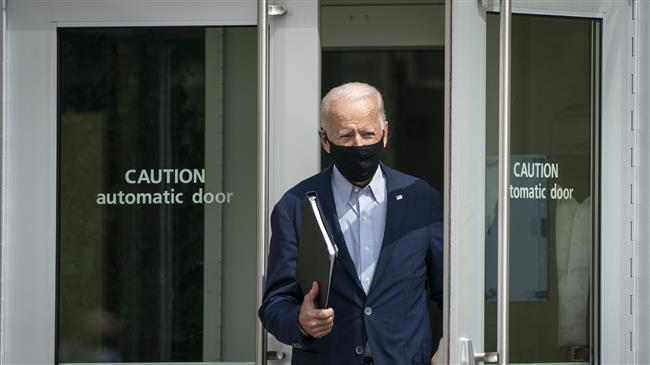
A former American Senate foreign policy analyst has expressed skepticism that a Joe Biden administration would re-enter into the nuclear agreement with Iran.
Democratic presidential candidate Joe Biden has said that if elected he will return the United States to the Iran nuclear deal as a starting point for follow-on negotiations.
Biden said in a recent article for CNN’s website that the US will rejoin the 2015 deal if Iran returns to what he called “strict compliance” with the nuclear accord, known as the Joint Comprehensive Plan of Action (JCPOA).
James Jatras, a former Senate foreign policy adviser in Washington, told Press TV on Tuesday that “It’s hard to know how much we can make of Joe Biden’s claim that he would return to the JCPOA, if he is elected president.”
“I noticed that he caveats that with ‘Iran must return to full compliance.’ And of course, we know that Iran has taken certain steps that she feels to be necessary given the US pullout from the agreement and the fact that the Europeans have failed to follow through with their obligations under the agreement,” he added.
“So I don’t know what Biden or more importantly his advisors, like Nick Burns or Evelyn Farkas, have in mind of what would constitute full Iranian compliance such that Biden could say: ‘OK, fine now, we’ll enter into this plan,’” he noticed.
“He also talks about follow on negotiations, which raises the specter that additional demands would be placed on Tehran before even a Biden administration would be comfortable re-entering the agreement. So I am somewhat skeptical that he would actually do that,” he observed.
Biden’s Republican rival, President Donald Trump, withdrew the US from the Iran deal over two years ago. Trump said it was a bad deal that needs to be re-negotiated.
Iran has time and again said it will not renegotiate the existing accord or make a new one with the US as long as sanctions remain in place.
Since scrapping the JCPOA in May 2018, the Trump administration has unleashed its “toughest ever” sanctions to bring Iran’s economy to its knees, but it keeps humming and is getting back on its feet.
Democrats Go All-Out for Israel
Joe is a Zionist and Kamala panders to Jewish donors
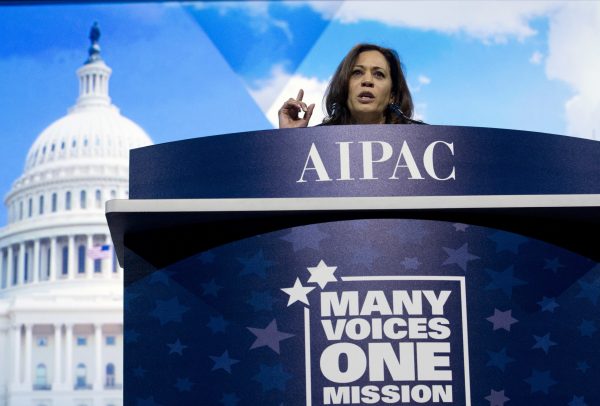
Sen. Kamala Harris speaks at the 2017 American Israel Public Affairs Committee (AIPAC) Policy Conference, March 28, 2017, at the Washington Convention Center. (AP Photo/Jose Luis Magana)
By Philip Giraldi • Unz Review • September 15, 2020
Those of us who have longed for an end to America’s military engagement in the Middle East have hoped for a candidate who was not tied hand and foot to Israel, which is the root cause of the badly-broken and essentially pointless U.S. foreign policy in the region. But the real tragedy is that in spite of Israel’s near-constant interference in government process at all levels in the United States, no candidate will mention it except in the most laudatory fashion. It will be praised as America’s best friend and closest ally, but there’s a price the U.S. has paid for all that balderdash while it has simultaneously been turning itself into the slave of the Jewish state will never surface.
The Democratic Party leadership is owned by Israel through its big Jewish donors whose billions come with only one string attached, i.e. that the Jewish state must be protected, empowered and enriched no matter what damage it does to actual U.S. interests. Number one Israeli-American billionaire donor Haim Saban has said that he has only one interest, and that is Israel. How such a man can have major influence over American foreign policy and the internal workings of one of its two major parties might be considered the death of real democracy. At the Israel America Council’s National Conference Nancy Pelosi explicitly put Israel’s interests before America’s: “I have said to people when they ask me if this Capitol crumbled to the ground, the one thing that would remain is our commitment to our aid… and I don’t even call it aid… our cooperation with Israel. That’s fundamental to who we are.”
Jews are not surprisingly considerably over-represented in the Democratic Party Establishment. The influence of powerful Jewish Democrats recently insured that there would be no criticism of Israel, nor mention of Palestine, in the party platform for November’s election. So extreme is the virulence of some Jews against the Palestinians that a liberal Zionist Rabbi Mark Winer speaking at a Joe Biden rally in Florida recently denounced “progressives” as infected with the “anti-Semitism virus” over their support for Palestinian rights and the Boycott, Divestment and Sanctions (BDS) movement. No one even sought to challenge him. Another progressive Zionist Rabbi Jill Jacobs tweeted about how liberals have to embrace Israel to avoid offending Jews. She wrote: While Israel is likely the most divisive issue in the progressive world, setting a litmus test that one cannot consider oneself pro-Israel, or support two states, would divide the vast majority of Jews from the left. Not what we need when fighting white nationalism.
So-called white nationalists therefore appear to be the preferred enemies of progressive Jews, requiring one to close ranks even – or perhaps especially – when Palestinians are being brutalized. Joe Biden does not venture into that extreme-think zone, but he has made his loyalties clear. He has said that “You don’t have to be Jewish to be a Zionist. I am a Zionist.” More recently he has denounced Trump as “bad for Israel.” And to demonstrate his bona fides, he kicked Democratic Party Palestinian-activist Linda Sarsour under the bus when she appeared on a DNC convention panel discussing how to appeal to Muslim voters. Biden’s campaign office issued a statement saying that he “… has been a strong supporter of Israel and a vehement opponent of anti-Semitism his entire life, and he obviously condemns her views and opposes BDS, as does the Democratic platform. She has no role in the Biden campaign whatsoever.”
With that lead in, it is difficult to imagine how Biden would suddenly recognize the humanity of the long-suffering Palestinians, to include those who are, like he claims to be, Catholic. Biden is close to AIPAC and has spoken at their annual convention a number of times. He is opposed to putting any pressure on the Jewish state at any time and for any reason, which presumably includes not even protecting U.S. interests or the lives and property of American citizens.
Biden also worked for President Barack Obama and was a colleague in office of Hillary Clinton. Both did the usual pander to Israel and neither was particularly well disposed to the Palestinians, though Obama talked the talk of a man of peace so effectively that he was awarded a Nobel Prize. Bear in mind that Obama personally disliked Israeli Prime Minister Benjamin Netanyahu, but he increased the money from the U.S. Treasury going directly to Israel to $3.8 billion per annum and guaranteed it for ten years, an unprecedented move. The fact is that money was and is illegal under American law due to the 1976 Symington Amendment, which banned any aid to any country with a nuclear program that was not declared and subject to inspection under the terms of the Nuclear Non-Proliferation Treaty. Obama, who claims to be a “constitutional lawyer,” surely was aware of that but rewarded Israel anyway.
One can expect nothing from Kamala Harris. Her husband is Jewish and she has made her career in California by sleeping with power brokers and pandering to Israel. She, like Biden, has been a fixture at the AIPAC annual conference. She has already made her mark with the party’s pro-Israel crowd by having a conference call with 1,800 Jewish Democratic donors, during which she repeatedly assured them a Biden-Harris Administration will never resort to cutting current levels of aid over any “political decisions that Israel makes,” adding personally “… and I couldn’t agree more.” She promised to demonstrate what she described as “unwavering support” for Israel. She also reminded the donors that Joe Biden had been behind the “largest military aid package” to any country ever when President Obama signed off on the $38 billion package in 2016.
Optimists point to the fact that the Democrats have now elected a number of congressmen who are willing to criticize Israel and they also cite opinion polls that suggest that a majority of registered Democrats want fair treatment for the Palestinians without any major bias in favor of the Jewish state. In spite of a news blackout on stories critical of Israel, there is broad understanding of the fact that the Israelis are serial human rights abusers. But those observations matter little in a situation in which the top of the party, to include those who manage elections and allocate money to promising prospective candidates, identify as strongly and often passionately friends of Israel. That is not an accident and one can assume that major effort has gone into maintaining that level of control.
How exactly this fissure in the Democratic Party will play out after November is anyone’s guess and, of course, if Trump wins there will be an autopsy to find out who to blame. Israel certainly won’t be looked at because no one is allowed to talk about it anyway, but some progressives at least will demand a review of a foreign policy platform that was heavy on intervention and global democracy promotion and light on getting along with adversaries, making it largely indistinguishable from that of the Republicans.
Israel for its part has played its cards carefully. It knows that either Biden or Trump will do whatever it wants, but it has deferred its planned annexation of much of the Palestinian West Bank, which will now take place after the election. It did that knowing that otherwise some liberals in the Democratic Party might try to turn Israel into an issue and split the Jewish community while also alienating Jewish donors and some Jewish voters if the annexation had taken place. After November 3rd, no matter who wins Israel will benefit and will have a free hand to do anything it wishes to the Palestinians. Or perhaps one should say the “remaining Palestinians” until they are all gone.
Philip M. Giraldi, Ph.D., is Executive Director of the Council for the National Interest, a 501(c)3 tax deductible educational foundation (Federal ID Number #52-1739023) that seeks a more interests-based U.S. foreign policy in the Middle East. Website is https://councilforthenationalinterest.org, address is P.O. Box 2157, Purcellville VA 20134 and its email is inform@cnionline.org.
Israeli warplanes use US Tanf Zone to bomb Syria again
Al-Masdar News | September 11, 2020
BEIRUT, LEBANON – The U.S. Al-Tanf Zone in southeastern Homs has once again been used by the Israeli Defense Forces (IDF) to bomb an area in Syria, a source in the Syrian Arab Army (SAA) in Damascus told Al-Masdar News.
According to the source, missiles fired from the Al-Tanf area targeted the town of Al-Safira in southern Aleppo, resulting in a number of explosions and at least two deaths.
The source said a number of missiles targeted the Scientific Research Lab, with a few managing to hit the facility.
He would add that the building suffered damage, but it is believed to be minimal at this time.
The U.S.-led Coalition contends that they are using the Al-Tanf Zone to prevent the Islamic State (ISIS/ISIL/IS/Daesh) from returning; however, it is the Syrian Army that has solely faced ISIS in the Homs Governorate.
Thursday night’s attack by the Israeli Defense Forces marks the second time this month and the third time in the last two weeks that they have targeted a site inside of Syria.
The previous attacks targeted the T-4 Airbase in Homs and the Damascus International Airport area.
The attack last night hit the town that has the largest Iranian presence in northern Syria; it has been used by the Islamic Revolutionary Guard Corps (IRGC) to coordinate with its allied forces in Aleppo and the Idlib countrysides.
US Fails to Control Lebanon Because Hezbollah, Amal ‘Represent the Majority’ – Journalist
Sputnik – 10.09.2020
While US officials claim that their recent sanctioning of former Lebanese government ministers was designed to expose the corruption of the country’s politicians, one expert tells Sputnik that Washington’s recent action is nothing more than a continuation of a longstanding, but unsuccessful, Western campaign to control Lebanon.
US Assistant Secretary of State for Near Eastern Affairs David Schenke declared on Tuesday that political allies of Hezbollah will have to “choose between bullets and ballots,” as they stand to be held “accountable for any enabling of [Hezbollah’s] terrorist and illicit activities,” Arab News reported.
This came amid the two-day Lebanon leg of Schenke’s tour of the Middle East, which also included stops in Qatar and Kuwait.
That same day, the US Department of the Treasury’s Office of Foreign Assets Control sanctioned former Lebanese Minister of Transportation and Public Works Yusuf Finyanus and former Lebanese Minister of Finance Ali Hassan Khalil, who Washington claims “provided material support to [Hezbollah] and engaged in corruption.”
Laith Marouf, an award-winning multimedia producer as well as a media policy and law consultant with the Community Media Advocacy Center, joined Radio Sputnik’s By Any Means Necessary on Wednesday and told hosts Sean Blackmon and Jacquie Luqman that what is occurring right now is a continuation of “twenty-some” years of attempts by Washington and “imperial forces” to control Lebanon’s government.
Marouf explained that Khalil is a member of the Amal Movement, which is “allied with Hezbollah,” and Finyanus is aligned with the Christian Marada party of Suleiman Frangieh. These parties are “allied with the sovereigntist movements in Lebanon,” which virtually means they “represent the majority of the [country’s] population.”
Because of this, he asserted, the US’ attempts to gain control have been unsuccessful. “The majority of the Lebanese have lived [through] the crises,” he said, referring to a “cycle” of Western military aggression and sanctions that has occurred in the years following the Lebanese Civil War.
“There’s not going to be a change in the population demographics without a major, major war,” he argued.
Hypocrisy Thy Name Is Zion
Jewish groups support BLM while ignoring Palestinian genocide

By Philip Giraldi • Unz Review • September 8, 2020
There is a tendency on the part of major Jewish groups in the United States and in Europe to discover what they describe as anti-Semitism wherever one turns. Last month, a statue of the well-known and highly respected 18th century French writer and political philosopher Voltaire was removed from outside the Académie Française in Paris. Voltaire was a major figure in the “Enlightenment,” during which what we now call science and applied rationalism challenged the authority of the church and the King.
The statue had recently been vandalized by the French version of Black Lives Matter (BLM) because Voltaire had reportedly invested in the French East India Company, which engaged in the triangular trade between Europe, Africa and the New World. The commodities included Africans who were destined to become slaves in the European colonies. Beyond that Voltaire, a man of his times, believed blacks to have “little or no intelligence” and also considered Jews to be born “with raging fanaticism in their hearts.”
Voltaire was reportedly much admired by Hitler, so perhaps it would not be off base to suggest that in France, where the Jewish community is extremely powerful while Africans are not, it was Voltaire cast as the anti-Semite that consigned his statue to a government warehouse never to be seen again. By that reasoning, one expects that the world will soon have a ban on the music of Richard Wagner and Ludwig van Beethoven as they too were admired by Hitler.
The idea that someone can change history by ignoring aspects of it means that school textbooks are being rewritten at a furious pace to make sure that there is overwhelming coverage of the holocaust and black achievement. Also, the erasing of monuments is being pursued with singular intensity in the United States, where the Founding Fathers and other dead white males are being one by one consigned to the trash heap. Doing so, unfortunately, also destroys the learning experience that can be derived from using the monuments as visual mechanisms for confronting and understanding the mistakes made in the past. A commission set up by the mayor of the District of Columbia has, for example, compiled a hit list of monuments and commemorations that must be either removed, renamed or placed into “context.” It includes the Jefferson Memorial and the Washington Monument. The name “Columbia” is, of course, certain to be changed.
Interestingly, Jewish groups in the United States have been in the forefront in supporting BLM’s apparent mission to upend what used to pass for America’s European-derived culture. Ironically, that culture includes free speech, democracy and mercantilism, all of which have greatly benefited Jews. The narrative is, of course, being wrapped around the common cause of blacks and Jews together fighting against the alleged white nationalists who are being blamed by the media for much of the violence taking place even when videos taken at the scenes of the rioting definitely show nearly all black mobs doing the arson and looting.
And blacks who are skeptical of the Jewish role are quickly put in their place, as was Rodney Muhammad of Philadelphia, who was removed from his executive position with the NAACP after expressing skepticism about all the Jewish friends that blacks suddenly appeared to be acquiring, quoting an observation often attributed to the now disgraced Voltaire on a Facebook entry, “To learn who rules over you, simply find out who you are not allowed to criticize.”
The lead organization in shaping the acceptable narrative is the Anti-Defamation League (ADL), which promotes itself as “Fighting Hate for Good.” In other words, anyone on the other side of the narrative is by definition a “hater.” ADL apparently advertised an online discussion topic for August 28th, shortly after the shooting incident in Kenosha Wisconsin that killed two white men and injured a third. The headline reads “Why all white American middle schoolers must publicly condemn the Anti-Semitic murders by white supremacist Kyle Rittenhouse.”
If the ad is indeed genuine, one notes immediately that the killings are being framed as anti-Semitism without any actual evidence to suggest that anything like that was involved or that the shooter knew the religion of those who were confronting him. All three of the “victims” are described as BLM supporters, which they apparently were, but it ignores the fact that they were also Antifa activists and all three had criminal records involving violence. One of them, Joseph Rosenbaum, is, to be sure Jewish, and also a pedophile, and the other two might also be Jews if ADL is correct, but that does not seem to have been material in what took place. Credible accounts of the shooting suggest that Rittenhouse was attacked by the three, one of whom, Grosskreutz, had a gun, and was being beaten on his head with Huber’s sidewalk surfboard. He responded in self-defense.
And ADL is not alone in its defense of BLM. More than six hundred Jewish groups have signed on to a full page newspaper ad supporting the movement. The ad says “We speak with one voice when we say, unequivocally: Black Lives Matter” and then goes on to assert “There are politicians and political movements in this country who build power by deliberately manufacturing fear to divide us against each other. All too often, anti-Semitism is at the center of these manufactured divisions.”
So, once again, it is all about the perpetual victimhood of Jews. That Jews constitute the wealthiest and best educated demographic in the United States would seem to suggest that they are especially favored, which they are, rather than targeted by raging mobs of hillbillies. More than 90% of discretionary Department of Homeland Security funds goes to protect Jewish facilities and the Department of Education and Congress are always prepared to create new rules protecting Jews from feeling “uncomfortable” in their occasional interactions with critics of Israel.
Jews largely think and vote progressive, which is part of the reason for aligning with blacks even though rioting and looting is likely to affect them more than other demographics as many of them might still have businesses in the cities that are most likely to be hit. But there is also a much bigger reason to do so. Many blacks in BLM as well as progressive white supporters were beginning to suggest that the movement should broaden its agenda and recognize inter alia the suffering of others, to include the Palestinian people. A strong show of support from Jewish groups, backed up by what one might presume to be a flow of contributions to the cause, would presumably be a way of nipping that sentiment in the bud just as Jewish donors to the Democratic Party were able to block any language in the party platform sympathetic to the Palestinians.
It is of course the ultimate irony that Jewish groups are very sensitive to the suffering of blacks in the United State while at the same time largely ignoring the war crimes and other devastation going on in Israel and Palestine at the hands of their co-religionists. The beating and shooting of unarmed and non-resisting Palestinians, to include children, the destruction of the livelihoods of farmers, and the demolition of homes to make way for Jewish settlers is beyond belief and is largely invisible as the Jewish influenced U.S. media does not report it. It is, simply put, genocide. And on top of that, Israel has been bombing defenseless civilians in Gaza nearly daily of late, attacking and destabilizing Lebanon and Syria, and also conniving with American Secretary of State Mike Pompeo to go to war with Iran.
It should not be surprising if black groups would be suspicious of the motives of the Jewish organizations that suddenly seem to want to be friendly. When Rodney Muhammad was removed from his position with the NAACP in Philadelphia, Jonathan Greenblatt, the head of ADL, tweeted “Credit to Executive Committee of Philly NAACP & National NAACP for taking action here. We hope this will enable new opportunities for collaboration as the local Black & Jewish communities can do more to fight against hate & push for dignity of all people.”
Greenblatt has been a leader in the fight to criminalize both criticism of Israel and also the free speech being exercised by supporters of the non-violent Boycott, Divestment and Sanctions movement (BDS). For him, “dignity of all people” clearly does not include Palestinians or even anyone who peacefully supports their cause.
Philip M. Giraldi, Ph.D., is Executive Director of the Council for the National Interest, a 501(c)3 tax deductible educational foundation (Federal ID Number #52-1739023) that seeks a more interests-based U.S. foreign policy in the Middle East. Website is https://councilforthenationalinterest.org, address is P.O. Box 2157, Purcellville VA 20134 and its email is inform@cnionline.org.
Featured Video

Trita Parsi: Middle East Unraveling — Are We on the Path to World War?
or go to
Aletho News Archives – Video-Images
New Book
Trans agenda is ‘normalization of sadism’ – US author

RT | September 23, 2026
The US Democratic Party has embraced a transgender agenda that amounts to “the normalization of sadism,” author A.J. Rice has said, warning that radical trans policies would return if the party is allowed to regain power.
Speaking to RT’s America First host Scotty Nell Hughes about his new book, ‘The Curse of the Bearded Lady: How the Trans Mafia Whacked American Sanity’, Rice argued that activists have gained significant influence in schools, medicine, and corporate America while people who questioned the agenda have faced pressure to stay silent.
The author described the “trans mafia” as the sprawling network of people and institutions that have helped the movement gain influence. He singled out parts of academia, wealthy backers, and corporations, and stated that providers of transition-related treatment also have a financial incentive to keep young people in their care indefinitely.
Rice argued that the consequences of these policies ultimately fall on children who are being drawn toward gender-affirming medical treatments and on girls who are expected to share locker rooms or compete in sports with biological males.
He noted that while voters rejected the Democrats’ approach to gender in 2024, the party, which has been “captured by madness,” has since only doubled down and is seeking what is effectively “the normalization of sadism.” … Full report
Blog Roll
 Aletho News
- Integrity Initiative: UK-funded network framed dissent as Russian disinformation for years
- ‘We don’t seek permission to defend our country’: Snippets from President Pezeshkian’s UNGA address
- NATO chief wants Europeans to fight American wars [for Israel]
- German chemicals giant reveals details of downsizing
- Refaat Al-Areer Was The Canary In The Coal Mine In Israel’s War On The Truth
- Israeli election committee bars candidate from Knesset race over Gaza war opposition
- French-Lebanese man files war crimes complaint over Israeli attacks
- Mahan Air Flight Lands in China Despite US Threat against Iranian Airlines
- US eyes $10bn fund to rebuild war-battered Gulf infrastructure
- Trump meets Rodríguez near Maduro’s prison as Venezuela’s oil flows to US
- If Americans Knew
- Caught on Tape: AIPAC CEO Boasted of Controlling Trump’s National Security Officials
- Why Hamas Attacked Israel in October 2023 – Israeli professor Ilan Pappé
- They see them, then kill them: Israeli quadcopters track, deliberately target civilians in Gaza
- Winter could turn Gaza’s treacherous, war-damaged buildings into deathtraps
- Majority of Democratic Voters Want to Prosecute Both Biden and Trump Administration Officials Over Gaza
- As Gaza languishes, world leaders gather at the UN – Daily Update
- Sanctions are collective punishment: immoral and self-defeating
- Phosphorus Munitions Fired by Israel Burn Groves, Orchards in Southern Lebanon
- Israel Carries Out New Ceasefire Violations Across Gaza
- AI – Emphasis on the ‘I’: Israel Is Funding AI Chatbot Propaganda
- No Tricks Zone
- New Study: Earth And Venus Surface Warmth Largely Explained By Convection And Lapse Rate, Not CO2 Or Radiation
- 2025 Nature Paper Claiming Worsening Global Drought Gets RETRACTED …Heavily Flawed
- New Study: ‘Global Drought Shows No Detectable Recent Acceleration Under Climate Warming’
- Economic Masterminds: German Socialists Suggest Taxing Productivity Gains Stemming From Using AI
- The South China Sea Has Not Been Cooperating With The Climate Change Narrative
- Energy Crisis: Germany Enters Heating Season With Historically Low Gas Reserve Fill Levels
- New Study: The Antarctic Ice Sheet Gained Mass From 2020-2024 Due To Staggering Snow And Ice Accumulation
- Study: Ocean Heating Rates From Thousands Of Years Ago ‘Dwarf’ Modern Ocean Heating Rates
- Climate Extremists Target, Attack Large-Scale Power Grid Infrastructure In Germany!
- New Study: Antarctic Ice Melt Has Contributed Less Than 1 Centimeter To Sea Level Rise In The Last 30 Years

