For Cliff May, War Pays
By Daniel McAdams | Ron Paul Institute | August 8, 2019
 To say that Clifford May, founder of the Foundation for the Defense of Democracies, loves war would be an understatement. He loves almost everything about war and he thinks the US should be in a lot more of them. He thinks that the US should never go home, should never withdraw troops, should forever be searching for “bad guys” to fight, lest they come find us and fight us here. Because the rest of the world is exclusively focused on how to invade and destroy the United States.
He likes to invoke Sun Tzu and Clausewitz and Plato to make his case for endless wars. Neocons love to do that because it makes them sound erudite and grounded in history – when in fact they are neither.
About the only thing Clifford May does not love about war is fighting it himself.
While others of May’s generation were being blown to bits in that lost cause called “Vietnam,” May was drinking brewskis at Sarah Lawrence College and then Columbia University. His experience of war consists of covering it as a pampered correspondent of the shining lights of the mainstream US media like Newsweek and the New York Times.
Not only does May disdain the idea of soiling his dainty hands with the real blood and guts of war, he actually disdains those unlucky young Americans who find themselves churned up in the endless killing machine called “US empire.”
In a recent Washington Times editorial, tellingly titled, “Why endless wars can’t be ended,” May argues that members of the US military should be constantly in battle. Not a moment’s rest from the killing and being killed. After all…
… the men and women volunteering to serve in America’s armed forces are not doing so in order to hang around the house drinking brewskies.
May’s is a rare look into the utter contempt the neoconservatives feel for members of the United States military. Veteran suicides are an epidemic in the United States and are in fact the second leading cause of death in the US military. Veterans make up 18 percent of all US suicides while representing only 8.5 percent of the population.
Why are veterans killing themselves at a rate of 20 per day? A recent study found that the risk of military suicide rises with rapidly repeating deployments – just the kind of constant warfare that Cliff May calls for in his Washington Times article this week.
After all, what the hell else would these kids be doing if they weren’t driving themselves to suicide from endless wars… hanging around the house drinking brewskis?” Right, Cliff?
In the Washington Times piece this week, May argues passionately against President Trump’s stated goal of removing US troops from their positions occupying parts of Syria. US troops in Syria are, in his telling, “both preventing a revival of the Islamic State, and helping contain the Islamic Republic of Iran.”
This above sentence is key to understanding May’s constant push for more US involvement in the Middle East. Hint: It’s not really about America.
May’s Foundation for the Defense of Democracies is lavishly funded by single-issue billionaires who believe they are helping Israel by sending US troops to the Middle East to constantly provoke and kill those they believe are Israel’s enemies. Thus far it has not brought peace any closer to either Israel or its rivals in the region. In fact the opposite. But the money keeps flowing so May keeps blowing. And American troops (along with millions of innocents in the target countries) keep on dying.
Just as the neocons like it.
Zarif: US Can’t Build Gulf Coalition, Iran Welcomes Neighbors Leaving B-Team
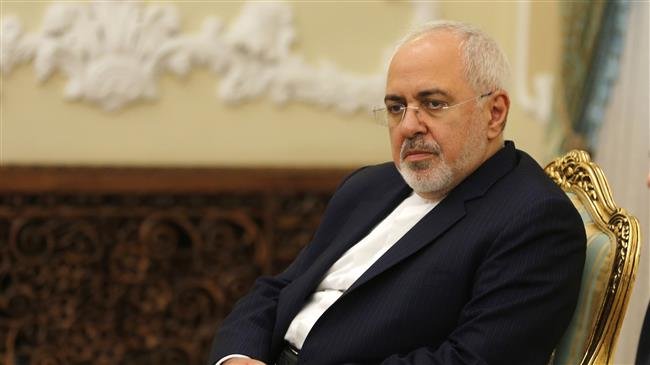
Al-Manar | August 5, 2019
Iranian Foreign Minister Mohammad Javad Zarif said the United States is unable to build a naval coalition to escort tankers in the Gulf because its allies are too “ashamed” to join it.
In a press conference held on the occasion of the national journalists’ day, the top Iranian diplomat said that the B-team is shrinking in members, adding that Iran welcomes neighboring countries leaving the team of ‘wickedness’.
“Today the United States is alone in the world and cannot create a coalition. Countries that are its friends are too ashamed of being in a coalition with them,” Zarif told a news conference in Tehran.
“They brought this situation upon themselves, with lawbreaking, by creating tensions and crises.”
Talking further about US, Zarif said Washington “has never won,” noting that it has been forced out of Syria, Iraq, Afghanistan.
“US has lost all wars it had engaged in throughout 70 years except for its invasion of Grenada,” the top Iranian diplomat said, stressing: Era of the ‘greatest’ and ‘hegemonic’ power is over.”
Asked about reports that he had been invited to meet Trump in the White House, Zarif said he had turned it down despite the threat of sanctions against him.
“I was told in New York I would be sanctioned in two weeks unless I accepted that offer, which fortunately I did not,” said the Iranian minister.
“When I travel to New York I head for UN not the US,” he affirmed.
Zarif then talked about the B-team, a term popularized by Zarif and refers to a group of politicians who share an inclination toward potential war with Iran, and the letter “b” in their names. They include US National Security Adviser John Bolton, Israeli Prime Minister Benjamin Netanyahu, Saudi Crown Prince Mohammed bin Salman, and Abu Dhabi Crown Prince Mohammed bin Zayed Al Nahyan.
“The B-team is shrinking in members. We welcome our neighbors leaving the team,” Zarif said, adding “we have always been ready to hold talks with our neighbors. Iran, Iraq and the six countries of the Persian Gulf Cooperation Council need to have talks with one other and sign the non-aggression pact.”
Tulsi Gabbard’s Military Nonsense
By Adam Dick | Ron Paul Institute | August 4, 2019
Rep. Tulsi Gabbard (D-HI), in a Thursday interview with host Chris Cuomo at CNN, reacted to criticism from fellow Democratic presidential candidate Sen Kamala Harris (D-CA), after the candidates’ dust-up in a debate the day before, by stating, “the only response that I have heard her and her campaign give is to push out smear attacks on me, claim that I am somehow some kind of foreign agent or a traitor to my country, the country that I love, the country that I put my life on the line to serve, the country that I still serve today as a soldier in the Army National Guard.”
This statement from Gabbard is nonsense. Soldiers serving in the National Guard and other parts of the United States military in military interventions as has Gabbard are not serving their country. They are serving the exertion of power by the US government. Indeed, Gabbard in the interview expresses her opposition to the sending of the US military members “to fight in these wasteful, counterproductive regime change wars.”
So, while Gabbard disparages a list of the US government’s military interventions overseas, she has nothing but praise for the carrying out of those wars by military members. In the interview she calls military members her “fellow brothers and sisters in uniform.” She set this tone clearly in her February speech announcing her campaign. Gabbard then proclaimed:
And our men and women in uniform, generation after generation, motivated by love for one another and for our country, have been willing to sacrifice everything for us. They don’t just raise their hand and volunteer to serve only to fight for one religion but not another, to fight for people of one race but not another, people of one political party but not another. No. When we raise our right hand and volunteer to serve, we set aside our own interests to serve our country, to fight for all Americans.
We serve as one, indivisible, united, unbreakable — united by this bond of love for each other and love for our country. It is this principle of service above self that is at the heart of every soldier, at the heart of every service member, and it is in this spirit that today I announce my candidacy for president of the United States of America.
What a load of hooey.
Gabbard had a special position for some of her time in the military including when she was deployed to Iraq during the Iraq War — being employed in a medical group. Ron Paul, another US House of Representatives member who ran for president years before, has explained a reason he chose to become a doctor was that he knew he could be drafted into the military and wanted to avoid being tasked with killing people. Medical workers in the military can even find themselves tasked with helping sick and injured civilians where the US is at war and even opposition fighters. Such actions, sometimes undertaken by military medical workers not supportive of the war, were well presented in the television series MASH that took place during the Korean War.
In calling herself a soldier to defend her patriotism bona fides and frequently referencing her “brothers and sisters in uniform,” Gabbard is obscuring any distinction between certain medical roles in the military she has had and the more common role of advancing killing and destruction.
There can be reason to praise the providing of medical serviced by US military members in conflicts overseas, especially when those services are readily provided to the victims of and opponents of the US government’s intervention in addition to the people implementing the intervention. But, where Gabbard crosses the line into nonsense is in heaping adulation on the people who operate the killing machine loosed abroad by the US government.
Some of the military people operating the killing machine are duped or ignorant, in need of education. Some want out but, unlike workers in most other occupations, are not allowed to quit their jobs. Others are far less sympathetic. But, contrary to Gabbard’s characterization, none of them are serving their country or putting their lives on the line for their country. They may be fighting for Boeing, Raytheon, a president’s quest for a legacy, an officer’s desire for a promotion, or a number of other purposes, but they are not fighting for their country. Their country, as Gabbard has pointed out in regard to some overseas military interventions, would be better off if they were never deployed.
The Media Is Reluctant to Report Israel Boasts of Killing Iranians

Israel’s Regional Cooperation Minister Tzachi Hanegbi. Credit: Facebook
By Philip Giraldi | American Herald Tribune | July 27, 2019
It is rare that a high official in a government will admit that his country has been killing foreigners without any declaration of war or being subjected to an imminent threat, but that is exactly what Israeli Regional Cooperation Minister Tzachi Hanegbi has done recently, boasting on a Sunday morning talk radio show that “Israel is the only country in the world that has been killing Iranians for two years now.”
Hanegbi’s candid admission of a policy that is a war crime included his description of how Israel “strikes the Iranians hundreds of times in Syria, sometimes admits it and sometimes foreign reports reveal it. Sometimes the chief of staff [reveals it], sometimes the outgoing air force chief [reveals it], but it’s all coordinated policy.”
The interviewer then asked “what would happen should Israel get in trouble with Iran?” and Hanegbi responded that “You can see that the Iranians are very limited in their responses [to Britain’s seizure of their tanker], and it’s not because they don’t have abilities, it’s because they understand that Israel means business.”
Hangebi went on to add that Israel is “very aggressive when it comes to our national security… We still didn’t see the Iranians backing off from their intention to entrench themselves militarily in Syria, and this campaign isn’t over. But they know exactly who to mess with, and who can be annoyed. We can’t.”
The minister’s comments inevitably were not reported in the western media, which is reluctant to air anything that demonstrates just how irresponsible Israeli policies actually are. In the United States, in particular, the Jewish state is consistently portrayed as some kind of perpetual victim in spite of the fact that it is the only nuclear armed power in its neighborhood as well as having the most powerful conventional military arsenal.
The Iranian government did not respond directly to the report of the Israeli minister’s comments, but there was some mention on Tehran’s Press TV local broadcast, which noted that “This is how Israelis are freely and proudly talking about killing Iranians! Just imagine what would happen if it was the other way around!” Indeed. A boast by Iran that it had been very successful at killing Israelis would have produced shocked headlines in every European and American newspaper.
The Israeli admission that it is attacking targets in Syria should come as no surprise to anyone who has been following developments in the region. That there have been hundreds of attacks may be an exaggeration to impress the Israeli listeners regarding their country’s military prowess, but it is certainly true that numerous incidents have been recorded both by the Syrian government and by foreign observers. In one notorious incident on Christmas Day 2018, Israeli warplanes masked their approach to targets inside Syria by flying closely behind civilian airliners transiting the region. It has been speculated that they hoped that Syrian air defenses would respond by shooting down a civilian plane, creating a major crisis for the Bashar al-Assad government. In the event, the Syrians held their fire and the Israeli warplanes launched their missiles against targets near Damascus, killing Syrian military personnel and civilians on the ground.
What is astonishing is that Minister Hangebi does not perceive the implications of the Israeli government’s apparent willingness to kill Syrians on the ground by intent and also as collateral damage even though it is not at war with Damascus. It does so with the stated objective of killing Iranians even though it is also not at war with Iran. It is, to state it succinctly, several war crimes tied up in one package and it would make the Jewish state uniquely a rogue among nations but for the fact that the United States has done the same sort of thing with cruise missile strikes in Syria, though not in as sustained a fashion as have the Israelis.
Israel’s willingness to use its armed forces in what might be described as non-traditional roles creates some very specific problems for the region. One particular concern is that the Israelis might stage a false flag attack, possibly in cooperation with its temporary friend Saudi Arabia, to draw outside powers into a war with Iran. The recent incidents involving mining two tankers, attributed to Iran but much more likely a false flag, nearly succeeded in doing just that. Subsequent incidents involving the seizures of a tanker carrying Iranian oil by the British and a retaliatory move against two British tankers by the Iranians have threatened to escalate into a shooting war. There should be little doubt that any ambiguous armed exchange involving Iran and Israel would see the American Jewish dominated media immediately laying the blame on the Iranians, producing demands by the Israel Lobby, Christian Zionists and Congress to get involved in the conflict.
There should also be particular concern over developments in neighboring Iraq, even though the country is not yet under attack by the Israelis. Shi’te militias in the country, linked to Iran, have long demanded that American military bases be closed down. Recent rocket attacks on the bases have been blamed on the militias, with Washington placing particular emphasis on the militia links to the Iranian Revolutionary Guard Corp, which has now been listed as a state sponsor of terrorism by the U.S. State Department. The Israelis are well aware of the dynamics of what is going on in Iraq and might be inclined to stage an incident in that country that will kill Americans and be blamed on the Iranians. The comments by Minister Hangebi that Israel is “very aggressive when it comes to our national security” would strongly suggest that his country is prepared to do anything – even something quite stupid – to eliminate what it sees as the Iranian threat.
The tragedy in all this for Americans is that Washington is being led into war by an Israeli propaganda and influence machine that is second to none. In May four hundred Congressmen signed on to a generic bill that was intended as a blanket endorsement of Israeli behavior and a blank check for the ruthless Netanyahu government to do whatever it sees fit in “self-defense,” with Washington willing to be dragged into a conflict in which it has no real interest just to show its loyalty to the Zionist enterprise. More recently, by last Tuesday’s vote of 398 to 176, another Congressional bill condemned and established penalties against the nonviolent Boycott, Divestment and Sanctions (BDS) movement, which has become a bête noire for all of Israel’s friends. If America is ever to regain its independence from foreign entanglements the time to start is now and the process should begin by disengaging from Israel.
Iran Delenda Est
By Stephen J. Sniegoski • Unz Review • July 25, 2019
After Carthage had been significantly weakened by Rome in the Second Punic War (218 to 201 BC), Cato the Elder, a leading Roman senator, is said to have ended all his speeches with the words: “Carthago delenda est!” (“Carthage must be destroyed!”). This destruction ultimately took place in the Third Punic War (149–146 BC). A somewhat similar situation exists today in the United States, where war hawks demand that Iran–which in no way could effectively attack the United States, or even conquer America’s Middle East so-called allies—be stripped of its ability to protect itself.
Of course, what makes the American situation different from ancient Rome’s is that Rome sought to eliminate Carthage for its own interests whereas the United States is largely acting to advance the military interests of Israel (and to a lesser extent Saudi Arabia) because of the immense power of the Israel lobby in the United States. In short, the destruction of Iranian power would enable Israel to solidify its dominance of the Middle East.
An insightful article by James North notes: “Iran in 2019 is no danger to U.S. interests anywhere. . . . The U.S. is squeezing Iran mainly because Israel wants it to. . . . Iran is the only regional power that is deterring him [Netanyahu] from completely annexing the West Bank. Iran is also a major supporter of Hamas, the resistance movement in Gaza.”
As North points out: “Israel wants the Iranian government destroyed, and Netanyahu has been instigating the United States for years to attack Teheran.” Obviously, Israel does not want any country in the Middle East to be able to contest its hegemonic power, which it maintains by virtue of its influence on the U.S. government and through its possession of top- level military weapons—especially its nuclear arsenal—the threatened use of which would likely cause the United States to intercede on Israel’s behalf to prevent a nuclear holocaust.
Support for Israel does not mean that American presidents have done everything sought by the Israel lobby, especially when it required outright war. Bush the Younger, for example, did not make war on Iran after defeating Saddam’s Iraq in 2003, although that was what Israel and its American supporters sought. And President Obama’s nuclear deal with Iran [Joint Comprehensive Plan of Action (JCPOA)] in 2015 to prevent its development of nuclear weapons was vehemently opposed by Israel and its American myrmidons because they regarded it as far too favorable toward Iran, especially since it would terminate sanctions that had been placed upon it.
While Iran is not allowed to develop nuclear weapons, a 2019 report by Stockholm International Peace Research Institute (SIPRI) described Israel’s nuclear arsenal as consisting of: “30 gravity bombs capable of delivering nuclear weapons by fighter jets; an additional 50 warheads that can be delivered by land-based ballistic missiles; and an unknown number of nuclear-armed, sea-launched cruise missiles that would grant Israel a sea-based second-strike capability.” Considering this completely unbalanced nuclear-arms situation, it would be reasonable to assume that Iran is threatened far more by Israel than Israel is by Iran. But that is not how the Alice-in-Wonderland U.S. media and politicians present the situation.
Israel and its American supporters wanted an overall diminution of Iranian military power—not just a restraint on nuclear power—which they contended would be enhanced by the increased wealth accruing to Iran due to the nuclear deal’s elimination of existing sanctions. Obama, however, held that he had maintained Israel’s military superiority over Iran. As Avi Schlaim, an Israeli historian, wrote: “Obama has given Israel considerably more money and arms than any of his predecessors. He has fully lived up to America’s formal commitment to preserve Israel’s ‘qualitative military edge’ by supplying his ally with ever more sophisticated weapons systems. His parting gift to Israel was a staggering military aid package of $38bn for the next 10 years. This represents an increase from the current $3.1 to $3.8bn per annum. It is also the largest military aid package from one country to another in the annals of human history.”
Donald Trump ran in the 2016 U.S. presidential election as something of a non-interventionist, especially promising to stay out of conflicts in the Middle East. Trump stated that “[w]e will stop racing to topple foreign regimes that we know nothing about, that we shouldn’t be involved with. Instead, our focus must be on defeating terrorism and destroying ISIS, and we will. Almost two year later, Trump would continue to repeat his non-interventionist promise when he stated on December 19, 2018, that “[w]e have defeated ISIS in Syria, my only reason for being there during the Trump Presidency.” However, from the beginning of Trump’s presidential campaign, his expressed non-interventionist position was negated by his staunch support for the interests of Israel.
Trump made the renegotiation of the Iran nuclear deal—a deal he described as disastrous—as one of his main foreign affairs campaign promises. Moreover, hardline supporters of Israel loomed large in his campaign team, such as son-in-law Jared Kushner, David M. Friedman, and Jason D. Greenblatt. And Trump selected Michael Flynn, a strong critic of Iran, who was a senior adviser to Trump during his presidential campaign and also his first national security adviser. Flynn’s pro-Israel credentials loomed large since he had coauthored a book, The Field of Fight: How We Can Win the Global War Against Radical Islam and Its Allies, with staunch neocon Michael Ledeen.
Trump’s advisers would become even more pro-Israel and anti-Iran with the addition of John Bolton, who played a significant role in bringing about the war on Iraq in 2003, as national security adviser in April 2018, and Mike Pompeo who became Secretary of State in April 2018. Both of these key figures have pushed for an attack on Iran.
Like many evangelical Christians, Pompeo is more supportive of Israel than most Jews. He has said that it is “possible” that Trump is meant to save the Jewish people, like Esther in the Old Testament, who used her wiles to prevent a massacre of Persian Jews.
Trump announced the U.S. withdrawal from the nuclear deal with Iran on May 8, 2018. This carried out his campaign promise and was something he could do unilaterally since the nuclear deal was a non-binding political agreement, not a treaty ratified by the U.S. Senate. Trump alleged that Iran was violating the agreement though there was no evidence for this. The International Atomic Energy Agency (IAEA), which was authorized to verify and monitor the nuclear deal, had repeatedly found Iran to be in compliance, and the Trump administration had not officially disputed IAEA’s assessment when the United States was still a member of the JCPOA.
After pulling out of the nuclear agreement, the United States was in the strange position of demanding that Iran still abide by it. Furthermore, the United States levied a series of sanctions which quickly had a devastating impact upon the Iranian economy.
On May 21, 2018 , almost two weeks after the United States exited from the nuclear deal, Secretary of State Pompeo, in a speech to the conservative Heritage Foundation, presented 12 demands (he would shortly add one more, human rights) for inclusion in any new nuclear treaty with Iran, most of which being unrelated to nuclear weapons. These requirements included: terminating support for any alleged terrorist groups—which meant groups hostile to Israel and Saudi Arabia, such as Hamas, Hezbollah, and the Houthis; removal of all forces under Iranian command in Syria, even though Iran played a significant role in defeating the Jihadi rebels there; disarming and demobilizing Shiite militias in Iraq, even though these militias played a major role in defeating ISIS; ending the Islamic Revolutionary Guard Corps’ support for alleged terrorists from the perspective of Israel and Saudi Arabia; ceasing Iran’s threatening behavior against its neighbors such as Israel, Saudi Arabia, and the United Arab Emirates; and ending threats to international shipping and cyberattacks. The totality of these requirements would have left Iran unable to defend itself against its enemies. In short, Pompeo’s demands could only be accepted by a government of a thoroughly defeated country. His demands emulated Rome’s treatment of Carthage after the Second Punic War before it was obliterated following the Third Punic War.
While the neocons and Israel firsters in his administration are pushing for war with the Iran, Trump acts as if he wants to avoid such a conflict. He certainly had the opportunity to launch war with Iran after it downed a U.S. surveillance drone—a massive RQ-4A Global Hawk costing around $130 million–over the Strait of Hormuz, which the United States claimed was in international waters. Whether this was true of not, the U.S. government has had a history of going to war over questionable, or outright false claims, such as the sinking of the U.S.S. Maine that led to the Spanish-American War; the alleged attack on an American ship in Gulf of Tonkin, which caused a much greater involvement in the Vietnam War; and the claim that Iraq had WMD, which ultimately led to the U.S. invasion of that country.
According to reports, Trump’s advisers were divided on how to respond. Bolton, Pompeo, and the CIA director, Gina Haspel, sought a military response, which Pentagon officials opposed. Trump initially called for a military strike on Iran in response but then aborted the mission at the last moment because, he claimed, it would lead to a large number of Iranian casualties, which was disproportionate to what Iran had done.
One interesting explanation for the non-attack put forth by the website Moon of Alabama provides some information that indicates that Trump planned a fake attack and instructed members of his administration to ask the Iranians for permission to bomb an area of their country that would not do any real damage. The Iranians, however, rejected this setup. While Trump’s explanation might seem questionable, given the myriad of leaks that have come out of his administration, it is hard to believe that this aforementioned strategy would be discussed, much less be proposed to Iran.
Trump realizes that war with Iran would not lead to any easy victory for the U.S. and would cause a devastating impact on the world oil market. He not only would want to avoid this situation per se but would grasp the likelihood that a war with Iran would entail a morass that would almost guarantee his defeat in the 2020 election, for it is quite clear that most Americans are opposed to such a war.
But how does this approach affect Israel and its American minions? Philip Weiss, a staunch Jewish critic of Israel, contends: “Trump’s climbdown represents a real defeat for the Israel lobby. Clearly Israel and its rightwing supporters wanted an attack on Iran and they did not get it.” But as I pointed out earlier, the Israel lobby does not get everything it wants especially when its plan might embroil the United States in a large war.
But what about Trump’s need for funds from large pro-Israel donors for the 2020 election? Last-minute funds from multi-billionaire Sheldon Adelson were quite likely the key to Trump’s hairbreadth victory in the 2016 election. Would he get support from Adelson and other pro-Zionist billionaires if he does not make war on Iran as they desire?
As pointed out earlier, if the United States were enmeshed in war with Iran, Trump would almost be guaranteed to lose the 2020 election no matter how much money Adelson and his fellow pro-Israel plutocrats contribute to his campaign. Also, this group will not be as crucial for Trump in the 2020 election because he has already amassed a large war chest, which was lacking in 2016. Moreover, Republican funders who provided monetary support to other Republican candidates in the 2016 primary election would have these funds available for Trump in 2020 since almost all would prefer Trump over any Democrat.
Furthermore, even if Trump does not make war on Iran, he has provided benefits to Israel and the Adelsons that the Democrats are not likely to offer. For example, Trump has moved the U.S. embassy to Jerusalem, recognized Syria’s Golan Heights as part of Israel, and, of course, placed heavy sanctions on Iran.
Moreover, Trump awarded the Presidential Medal of Freedom to Adelson’s wife, Miriam, and she has reciprocated, writing: “Would it be too much to pray for a day when the Bible gets a ‘Book of Trump,’ much like it has a ‘Book of Esther’ celebrating the deliverance of the Jews from ancient Persia?”
Given what Trump has already done for Israel and the Adelsons, it would be quite reasonable that the couple would believe that Trump would take a more militant stance toward Iran, even making war, in his second administration when he would not have to worry about re-election. Also, there is no evidence that any Democratic candidate for the presidency would do as much for Israel.
The fact of the matter is that by pulling out of Obama’s nuclear agreement and threatening sanctions on all countries that attempt to deal with Iran, the United States has already seriously weakened Iran, forcing it to greatly reduce its funding of Syrian groups and even its closest ally Hezbollah.
As an article in the Washington Post of May 18, 2019, points out: “Hezbollah, the best funded and most senior of Tehran’s proxies, has seen a sharp fall in its revenue and is being forced to make draconian cuts to its spending, according to Hezbollah officials, members and supporters.
“Fighters are being furloughed or assigned to the reserves, where they receive lower salaries or no pay at all, said a Hezbollah employee with one of the group’s administrative units. Many of them are being withdrawn from Syria, where the militia has played an instrumental role in fighting on behalf of President Bashar al-Assad and ensuring his survival.”
In addition to this diminution of support, Israel has been bombing Iranian targets in Syria. And Syria is of vital importance to Iran. Leading figures in Iran have referred to Syria as “a golden ring of resistance against Israel” and Iran’s “35th province.” Assad’s Syria has provided a conduit for arms from Iran to reach Hezbollah and, to a lesser extent, Hamas. With Iranian arms those groups play a critical role in Iran’s strategy to deter, and if necessary, retaliate against an Israeli attack on it. However, a weakened Hezbollah would not be able to effectively attack Israel, much less provide substantial help to Iran in combat with the United States.
But how long will the Iranian populace be willing to have their government supply its allies as their own standard of living continues to plummet due to the U.S. sanctions? Iran is not a totalitarian state, such as North Korea where the population is virtually under total control. There is considerable evidence that while the great bulk of the Iranian population is willing to undergo great sacrifice in defense of their own country, they are not willing to do the same in support of Iran’s allies. And a significant number of Iranians are already critical of these ties.
If the United States continues to rely on sanctions but does not attack Iran militarily, it could cause Iran to give up supporting its proxies, who themselves would have become weaker as a result of diminished support from Iran.
Although the current Iranian government could support some type of compromise peace, it certainly would not concede to the harsh demands put forth by Pompeo. Iranian Foreign Minister Mohammad Javad Zarif told NBC News that “room for negotiation is wide open” once the United States removes its stringent sanctions, but another Iranian official, presumably at the behest of Ayatollah Khamenei, who is the actual ruler of Iran, added that negotiations would not include Iran’s missiles.
What has been the result of Trump’s treatment of Iran? There has yet to be a Carthaginian peace that Israel and its American supporters would like. Iran will remain a power that could resist Israel. However, the sanctions have weakened Iran and its allies, which should mean that Iran will not be as aggressive as it has been, and thus Israel’s position in the Middle East has improved for the time being. Nonetheless, it is not apparent how long this will continue. And undoubtedly Israel and its American supporters will continue to believe, or at least pretend to believe, that Israel still faces annihilation unless the United States does more for it.
Israel-born Treasury official is at the center of U.S. policies on Iran
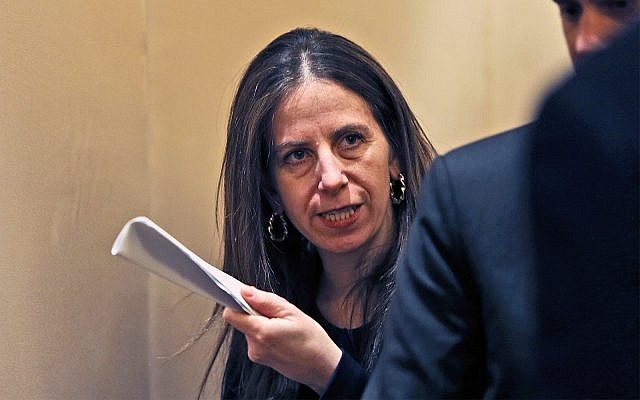
Sigal P. Mandelker, the undersecretary for terrorism and financial intelligence at the US Treasury in Dubai, UAE, July 12, 2018. (AP Photo/Kamran Jebreili, Jewish Insider )
At the Center of U.S. Iran policies is an Israel-born Treasury official named Sigal Mandelker. The Atlantic writes that her ‘hand is on the lever’ of crippling economic sanctions meant to force Iran’s ‘capitulation or demise’… meanwhile the Treasury Department refuses to divulge whether Mandelker is still an Israeli citizen… (Iran has long been in Israeli crosshairs)
By Alison Weir | If Americans Knew | July 23, 2019
According to a just published report in the Atlantic and a previous article by a former CIA officer, an Israeli-born individual is at the center of U.S. policies targeting Iran.
The Atlantic reports that financial sanctions are the “key tool” the United States has been using against Iran during “the past three presidential administrations.” And Treasury official Sigal Mandelker” is the one with her hand on the lever.”
According to the article, “Because Trump is anxious to avoid war with Iran but also eager to push the Iranians, she is one of the most powerful officials designing the strategy Trump’s administration hopes will force Iranian capitulation—or, failing that, perhaps even the government’s collapse.”
Mandelker has been working on governmental policies since 2006 – the year in which U.S. officials “focused on finding ways to cut off Iran from the global financial system.”
According to Mandelker’s Treasury Department bio, from 2006-2009, Mandelker served as Deputy Assistant Attorney General in the Criminal Division of the Department of Justice. Prior to that, she was Counselor to the Secretary of Homeland Security, “where she advised the Secretary and worked extensively on intelligence, national security, counterterrorism, and border security matters.”
In 2017 Mandelker was named Under Secretary of the Treasury for Terrorism and Financial Intelligence. As we will see, this office was created at the behest of Israel partisans. It provides a powerful position from which to direct policies.
In this position she is in charge of “developing and implementing U.S. government strategies to combat terrorist [sic] financing and money laundering… She oversees the operation and coordinates actions of the Office of Foreign Assets Control (OFAC), Financial Crimes Enforcement Network (FinCEN), the Office of Intelligence and Analysis (OIA), and the Office of Terrorist Financing and Financial Crimes (TFFC).”
In the years just before her 2017 Under Secretary appointment, Mandelker was a partner at Proskauer Rose LLP, a powerful, politically connected international law firm with ties to Israel. The pro-Israel website Algemeiner,* reports: “Historically, Proskauer Rose was known as a ‘Jewish’ law firm.” Partner Joseph M. Proskauer was “a Democratic Party stalwart, friend of politicians, state judge, civic and philanthropic personality, and major fund raiser for the state of Israel.”
Born in Israel
It appears that Mandelker is or was an Israeli citizen who was born in Israel. While this is periodically referred to in Israeli and Jewish media, the Treasury Department has refused to answer whether Mandelker is still an Israeli citizen, despite numerous email and phone inquiries requesting this information about a high U.S. official.
The information is particularly relevant since U.S. attacks on Israel’s neighbors are often pushed by Israel partisans concerned with maintaining Israeli hegemony in the region.
Dual citizenship became permissible in the U.S. in 1967 under a decision by the Abe Fortas Supreme Court in a case on behalf of Israel that broke a 200 year American tradition. Today, many Americans feel that such a potential conflict of interest by governmental officials should, at minimum, be divulged to the U.S. public, and perhaps disallowed.
Israel has long targeted Iran for attack.
From Israel’s earliest days, Ben Gurion wrote about the need to neutralize Israeli neighbors who might potentially support Palestinian rights. This strategy has also been enunciated in various strategy documents, including the Yinon Oded Plan and A Clean Break: A New Strategy for Securing the Realm (the realm was Israel).
Israel and pro-Israel groups in the U.S. have frequently promoted anti-Iran policies, despite the fact that U.S. intelligence agencies have found that Iran is not developing nuclear weapons and that accusations claiming this have proven unfounded. (Israel has in the range of 100-300 nuclear weapons and has refused to sign the Non-Proliferation Treaty, the only Middle East state that has not signed the NPT.)
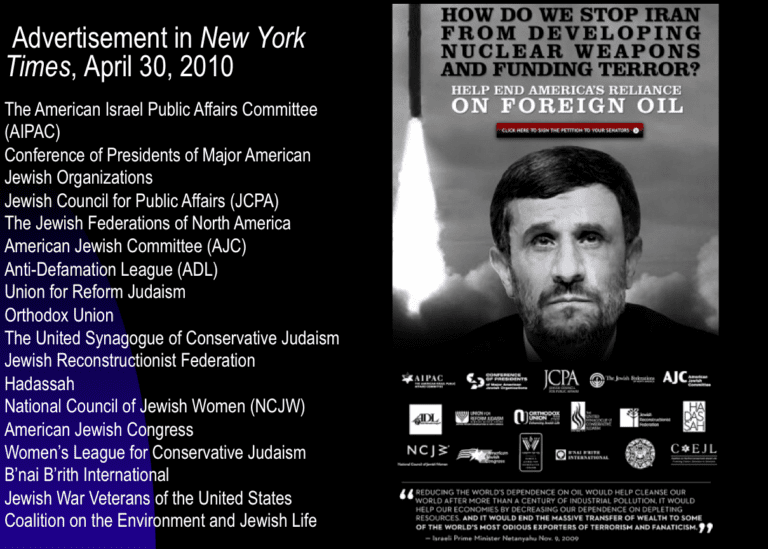
Advertisement placed in New York Times with the names of the sponsoring groups.
Israel partisans & Treasury’s “Office of Terrorism”
The Atlantic reports that Stuart Levey was the founding official in the role Mandelker now holds. Mideast analyst Grant Smith writes: “AIPAC and its associated think tank, the Washington Institute for Near East Policy (WINEP), were instrumental in lobbying the president for the creation of the Office of Terrorism and Financial Intelligence unit early in 2004. The Israel lobby also vetted Stuart Levey who President Bush approved to lead the new unit.”
Israel partisans continued to abound. Levey was then succeeded by David S. Cohen (Israel advocate Alan Dershowitz recommended Cohen for his first job, with Israel partisan Nathan Lewin). The Secretary of the Treasury, Steven Mnuchin, is also an Israel partisan.
Former CIA officer and current executive director of the Council for the National Interest Philip Giraldi investigated this situation and found that Israel partisans have pervaded the office. He writes:
… A key component in the Israeli penetration of the U. S. government has been President George W. Bush’s 2004 signing off on the creation of the Office of Terrorism and Financial Intelligence (OTFI) within the Department of the Treasury. The group’s website proclaims that it is responsible for “safeguarding the financial system against illicit use and combating rogue nations, terrorist facilitators, weapons of mass destruction (WMD) proliferators, money launderers, drug kingpins, and other national security threats,” but it has from its founding been really all about safeguarding Israel’s perceived interests. Grant Smith notes however, how “the secretive office has a special blind spot for major terrorism generators, such as tax-exempt money laundering from the United States into illegal Israeli settlements and proliferation financing and weapons technology smuggling into Israel’s clandestine nuclear weapons complex.”
The first head of the office was Undersecretary of Treasury Stuart Levey, who operated secretly within the Treasury itself while also coordinating regularly both with the Israeli government as well as with pro-Israel organizations like AIPAC, WINEP and the Foundation for the Defense of Democracies (FDD). Levey also traveled regularly to Israel on the taxpayer’s dime, as did his three successors in office.
Levey left OTFI in 2011 and was replaced by David Cohen. It was reported then and subsequently that counterterrorism position at OTFI were all filled by individuals who were both Jewish and Zionist. Cohen continued the Levey tradition of resisting any transparency regarding what the office was up to. Smith reports how, on September 12, 2012, he refused to answer reporter questions “about Israel’s possession of nuclear weapons, and whether sanctioning Iran, a signatory to the Treaty on the Non-Proliferation of Nuclear Weapons, over its internationally-inspected civilian nuclear program was an example of endemic double standards at OTFI.”
Cohen was in turn succeeded in 2015 by Adam Szubin who was then replaced in 2017 by Sigal Pearl Mandelker, a former and possibly current Israeli citizen. All of the heads of OTFI have therefore been Jewish and Zionist. All work closely with the Israeli government, all travel to Israel frequently on “official business” and they all are in close liaison with the Jewish groups most often described as part of the Israel Lobby. And the result has been that many of the victims of OTFI have been generally enemies of Israel, as defined by Israel and America’s Jewish lobbyists. OTFI’s Specially Designated Nationals And Blocked Persons List (SDN), which includes sanctions and enforcement options , features many Middle Eastern Muslim and Christian names and companies but nothing in any way comparable relating to Israel and Israelis, many of whom are well known to law enforcement otherwise as weapons traffickers and money launderers . And once placed on the SDN there is no transparent way to be removed, even if the entry was clearly in error.
Here in the United States, action by OTFI has meant that Islamic charities have been shut down and individuals exercising their right to free speech through criticism of the Jewish state have been imprisoned. If the Israel Anti-Boycott Act succeeds in making its way through congress the OTFI model will presumably become the law of the land when it comes to curtailing free speech whenever Israel is involved…
Mandelker frequently speaks movingly of her parents’ suffering under the Nazis. She seems to equate Iran with Hitler, despite the fact that Germany was defeated almost three-quarters of a century ago, and that today it is her birth country that is based on discrimination against people who are not of the preferred religion or ethnicity.
The economic policies Mandelker and others have engineered against Iran are creating significant humanitarian hardship, which seems to be the plan – just as Israel partisans worked to destabilize and eventually attack Iraq. Today, we are teetering on the brink of escalation that could again cost untold lives and damage the U.S. even more.
Perhaps it’s time for Americans to stop allowing the Treasury Department to be weaponized by partisans working in the perceived interests of a foreign country.
Alison Weir is executive director of If Americans Knew, president of the Council for the National Interest, and author of Against Our Better Judgment: The Hidden History of How the U.S. Was Used to Create Israel.
* According to Wikipedia, “The Algemeiner Journal, known informally as The Algemeiner is a New York-based newspaper, covering American and international Jewish and Israel-related news. Former Senator Joseph Lieberman described the paper and the Jacobson Foundation as “independent truth telling advocates for the Jewish people and Israel”.[2] The Algemeiner‘s Advisory Board was chaired by Nobel laureate, writer and activist Elie Wiesel…. In 1972, Gershon Jacobson founded the Yiddish-language Der Algemeiner Journal, after consulting with the Lubavitcher Rebbe Menachem Mendel Schneerson.[3] He served as editor and publisher from its inception until his death in 2005.[4]
Israel’s Agents of Influence
Trips to Israel, a “Nationalism Conference,” Epstein and more
By Philip Giraldi • Unz Review • July 23, 2019
Some journalists in the Jewish media are starting to complain that President Donald Trump is “loving Israel” just a little too much since he keeps citing his concern for the Jewish state as the driving force behind some of his erratic behavior. It is a viewpoint that I most definitely share, though I would describe the apparent White House lovefest with the Israel as a “lot too much.” When the President of the United States calls a congresswoman an anti-Semite and demands that she apologize to him personally and also to Israel it is definitely a lot too much.
So Israel is always in the news, or so it seems, though it is often not in the news when the story might be derogatory. The story disappears from sight as soon as it is determined that Israel might be involved, as is currently the case with Jeffrey Epstein, or Israeli activity is excised completely as was the case with the Mueller investigation where Russiagate should have really been called Israelgate as it was Israel that was seeking favors from the incoming Trump Administration, not Russia. As Noam Chomsky put it, Israeli interference in American politics “vastly overwhelms” anything Russia has done.
I have recently written about how the Jewish state works hard to brainwash the American people and limit the foreign policy options of the U.S. government, to include aggressive efforts to obtain what the intelligence agencies would call “agents of influence.” Agents of influence live and work in one country while simultaneously and treacherously advancing the interests of another nation. It is what George Washington warned about in his Farewell Address when he counseled “Against the insidious wiles of foreign influence (I conjure you to believe me, fellow citizens) the jealousy of a free people ought to be constantly awake, since history and experience prove that foreign influence is one of the most baneful foes of republican government.”
Foreign influence as a potential national security threat is also a status defined in legal terms by the Foreign Agents Registration Act of 1938 (FARA), which requires anyone working on behalf of a foreign government to register and make transparent sources of income.
Uniquely, no foundation or individual working in America to advance the interests of the Jewish state has ever been required to register under FARA even though many, like the odious American Israel Public Affairs Committee (AIPAC), boast unambiguously on their websites that they are “America’s pro-Israel Lobby.” Many of the foundations are regarded as educational or charitable 501(c)3 tax exempt non-profits, which means the U.S. taxpayer is helping support their activity. But being a non-profit charity does not necessarily mean austerity, as the salaries of top employees are generous. Canadian Jew Mark Dubowitz of the Foundation for the Defense of Democracies (FDD), a 501(c)3, is paid $560,000 in salary and benefits. FDD has for many years been calling for war against Iran.
The most recent foundation being set up by Israel’s friends to promote the interests of the Jewish state is the Edmund Burke Foundation, which hosted a conference on “Nationalism” last week. The conference was interesting in that the Burke Foundation is headed by an Israeli and an American Jew who has served as Executive Director of the Christians United For Israel (CUFI). The event was held at the Washington D.C. Ritz-Carlton, suggesting that the Burkeans are not short of cash. Pro-Israel groups always seem to have plenty of Benjamins.
A number of traditional conservatives and even some organizations were fooled by the promotional material and speakers’ list into thinking that the program was legitimate and would focus on supporting national interests as well as foreign policy restraint, but some at least had their eyes opened when John Bolton, as featured speaker, was vigorously applauded by at least half of the audience.
Some potential critics of the agenda were not invited or even deliberately denied tickets to limit dissent, and several attendees were appalled by what they had witnessed, which was essentially an affirmation of status quo foreign policy, to the benefit of the hawks in Washington and Israel. Inevitably, some delusional dimwits were unable to understand that they were being used and were oddly entranced by what they were seeing and hearing. And don’t worry if you are among those who missed the event. It will probably be replayed in a few months under a different name and with a slightly different cast of characters.
The most visible Israeli tool for generating contacts with Americans that might prove useful is the all- expenses-paid VIP junkets that are arranged for Congressmen. New Congressmen routinely travel to Israel for a dog-and-pony show within months of their taking office. One of Congress’s leading cheerleaders for Israel, Maryland’s Steny Hoyer has visited the Jewish state many times and can be relied on to pressure freshman congressmen to make the trip. Other Americans who might be influential in the future are also feted by the Israeli hospitality machine. American military cadets from the service academies and colleges are now being brought to Israel to learn a fictional version of the Israeli-Palestinian conflict. Undoubtedly, some of them are set up for intelligence approaches after they are commissioned.
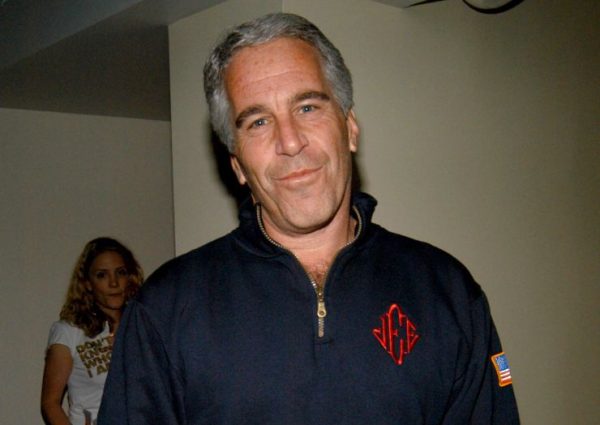
Which brings us to the pedophile Jeffrey Epstein story and how it is being handled by government and covered in the media since the story exploded two weeks ago. No one outside the alternative media seems to be interested in the possibility, or rather likelihood, that Epstein was working for a foreign intelligence service, which would most likely be Israel. In the media the Epstein story died almost immediately, submerged in the tale of Donald Trump telling several congresswomen to go back where they came from.
It is unlikely that the spying aspect of Epstein’s alleged crimes will even be investigated both because it involves the Jewish state and also because it appears to include participation by leading politicians from both parties and other public figures. The Deep State will make the story die, which just might also be what happens to Epstein in jail.
The evidence that Epstein was involved in intelligence work most likely bribing or blackmailing prominent individuals to act on behalf of Israel, derives both from the statement made by former U.S. Attorney for Miami Alexander Acosta that “I was told Epstein ‘belonged to intelligence’ and to leave it alone” and from other external evidence. Epstein was making videos of his guests having sex with his young girls, which is a version of a classic intelligence entrapment technique referred to as a “honey trap” that is employed by every major spy agency worldwide. And the Acosta quote – will it ever be fully investigated? Who told him that Epstein was “intelligence” and what were the circumstances?
Jeffrey’s sources of income have also been questioned. Epstein’s sole identified business connection was Ohio billionaire Les Wexner, who maintained very close ties to the upper echelons of the Israeli diplomatic and intelligence establishment. Epstein served as Wexner’s trustee when the latter was forming the Mega Group, created by Wexner and Edgar Bronfman to generate positive views of Israel as a cover for Israeli propaganda dissemination in America.
Epstein’s lack of an identifiable income stream rather suggests that he might have been supported by a government agency of some kind. He had hidden in his Manhattan house a great deal of cash, diamonds and an Austrian passport. The diamonds might have represented payment in kind from Israel, which is capital of the world diamond trade, and the existence of the passport is intriguing. It has been described in the media as “fake” but that can mean anything. The passport, dating from the 1980s, was apparently authentic with a photo of Epstein and a fake name inserted in it, but it might plausibly be the product of a government document forgery lab. Why Austria? Because Austria was at the time politically neutral and the passport would be a good one for traveling anywhere. It would be much preferred by spy agencies or by agents who wanted to travel anonymously.
That Epstein would be linked to Israel rather than to some other intelligence service is due to his relationship with Ghislaine Maxwell, whose father Robert, a Czech Jew who became a naturalized British citizen, was believed by C.I.A. and other intelligence services to be a long-time agent of Mossad. After he died under mysterious circumstances, he was given a state funeral in Israel that was attended by every current and former head of the Jewish state’s intelligence service as well as by the country’s prime minister Yitzhak Shamir. Ghislaine was reportedly Epstein’s close friend and a procurer of his young girl victims.
As most of Israel’s agents of influence are now on Martha’s Vineyard where they gather in July and August, it would be wonderful to cut off all transportation and communication with the island and leave them there, but that would be unfair to the genuine year-round residents. Alternatively, I would be happy just to see Israel’s dire influence over the United States exposed by the media and discussed in public fora by the more than 20 Democratic Party presidential wannabes. As that is not likely to happen, I would settle for a real honest-to-God investigation of Epstein and what he was doing coupled with a move by the Treasury and Justice departments against all the hundreds of pro-Israel groups that have never registered under FARA. It’s a big job to uncover Israeli subversion, but somebody needs to start doing it.
Philip M. Giraldi, Ph.D., is Executive Director of the Council for the National Interest, a 501(c)3 tax deductible educational foundation (Federal ID Number #52-1739023) that seeks a more interests-based U.S. foreign policy in the Middle East. Website is councilforthenationalinterest.org, address is P.O. Box 2157, Purcellville VA 20134 and its email is inform@cnionline.org
Israel’s Choice for U.S. President
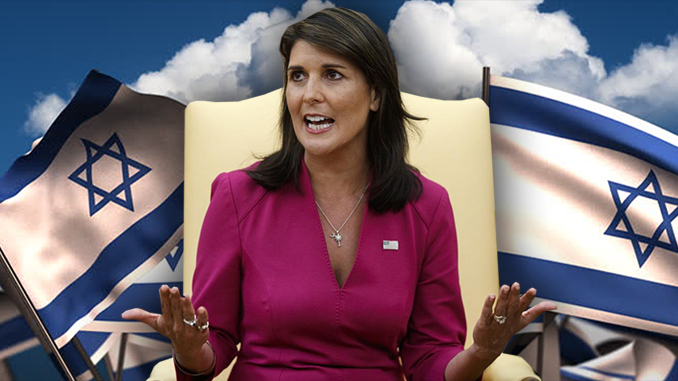
By Philip Giraldi | American Free Press | July 18, 2019
In late June, President Donald Trump flailed away with his own particular brand of non-diplomacy at the G20 Summit in Japan, but it is worthwhile noting on the plus side that his administration is so inept that it could not even plan and execute a proper coup in Venezuela. Nor has it been able to concoct sufficient lies about Iran effective enough to create a casus belli and unleash the B-52s. There is a certain comfort in knowing that the United States is now governed by the Three Stooges—“Larry” Trump, “Moe” Pompeo, and “Curly” Bolton—which means that starting new wars might just be beyond their cognitive ability to make mischief.
The real irony is that stupidity is both bipartisan and contagious in the federal government. The Democrats have not quite figured out that instead of playing identity politics, talking about reparations, gay rights, “undocumented migrants,” and free college, they should instead be discussing more important issues, notably the impending nuclear holocaust being stumbled into by the Trumpsters, which just might bring to an end life on this planet as we know it.
A college friend recently asked me what my nightmare scenario for a totally dysfunctional foreign and national security policy might be. I responded without thinking that it really is all about war and peace, that the worst case would be the impeachment of a bumbling Trump and his replacement by a much more capable and vicious Vice President Mike Pence, who actually wants to end the world so he can be raptured up to heaven.
But my answer was wrong. Trump is unlikely to be impeached by a Senate in which the GOP holds a majority, so Pence’s ascent to the throne is not currently plausible unless the president suffers a cardiac arrest after ingesting too many cheeseburgers. The real danger is what comes after Trump, in 2024. The preferred candidate by Israel and its lobby, and therefore the prohibitive favorite, is Trump’s former United Nations Ambassador Nikki Haley. If you think Trump is blindly and blatantly pro-Israel at the expense of American interests, just wait until you see Haley’s naked self-interest at work.
Haley resigned from her position at the UN last October. Like many others in the foreign policy establishment, she was all for Israel because she understood that leaning that way provided instant access to money and plenty of positive press coverage. Completely ignorant of possible consequences, she declared that Washington was “locked and loaded,” prepared to exercise lethal military options against Syria and its Russian and Iranian allies, seen as enemies by Israel. Immediately upon taking office at the United Nations she complained that “nowhere has the UN’s failure been more consistent and more outrageous than in its bias against our close ally Israel” and vowed that the “days of Israel bashing are over.” Not surprisingly, she was greeted by rounds of applause and cheering when she spoke at the annual meeting of the American Israel Public Affairs Committee (AIPAC) last March, saying, “When I come to AIPAC I am with friends.”
Haley’s embrace of Israeli points of view was unrelenting, including blocking any investigation of the Israeli army’s slaughter of unarmed Palestinian demonstrators in Gaza. She also led the effort to cut funds going to the agency providing critical food and medical assistance to millions of Palestinian refugees. In February 2017, she blocked the appointment of former Palestinian Prime Minister Salam Fayyad to a diplomatic position at the United Nations because he was a Palestinian. In a congressional hearing she was asked about the decision: “Is it this administration’s position that support for Israel and support for the appointment of a well-qualified individual of Palestinian nationality to an appointment at the UN are mutually exclusive?” Haley responded yes, that the administration is “supporting Israel” by blocking every Palestinian.
Not surprisingly, Haley consistently took a hard line against Iran, aggressively supporting Trump’s abrogation of the agreement to control its nuclear weapons, and she famously warned that Washington would be “taking names” of countries that don’t support its agenda in the Middle East. If Haley were a recruited agent of influence for the Israeli Mossad she could not have been more cooperative than she apparently was voluntarily.
When Haley resigned, The New York Times predictably produced an astonishing editorial headlined “Nikki Haley Will Be Missed.” Other praise of her upon her impending departure from the UN was related to whom exactly she managed to please while she was in office. The ubiquitous neocon-in-chief Bill Kristol has long been promoting Haley for president. One leading member of Kristol’s neocon chorus, Mark Dubowitz of the Foundation for Defense of Democracies, tweeted, “Thank you @nikkihaley for your remarkable service. We look forward to welcoming you back to public service as president of the United States.” Dubowitz is a Canadian Jew, and it would be nice if he could be deported to a remote Internet-free spot on Baffin Island where he can cease interfering in American politics, but that would mean putting an end to the $560,000 in salary and benefits that he enjoys for being one of Israel’s most reliable Fifth Column traitors in the United States.
Nikki was also praised by Israeli Prime Minister Benjamin Netanyahu. “I would like to thank Ambassador @nikkihaley, who led the uncompromising struggle against hypocrisy at the UN, and on behalf of the truth and justice of our country. Best of luck!” The Israeli Army itself had nice things to say, tweeting, “Thank you @nikkihaley for your service in the @UN and unwavering support for Israel and the truth. The soldiers of the Israel Defense Forces salute you!”
It should surprise no one that Haley has recently been in Israel as the guest of the GOP’s leading donors, Sheldon and Miriam Adelson. Ha’aretz enthused over how she “. . . has a wonderful laugh. It’s warm, rounded, and the perfect length to fill the distance between you and her. Haley’s chuckle makes you feel for a moment that you genuinely amuse her, in a good way, so much so that you forget that the laugh came instead of the question you just asked her. When she runs for president, as she no doubt will one day, expect her to deploy that laugh a lot. It’s a valuable political tool. My question at which Haley laughed was ‘does the path to the White House pass through Jerusalem?’ She was in town as the guest of honor at the Israel Hayom Forum for U.S.-Israel Relations, and though I didn’t get an answer, Haley’s willingness to endure the five hours of the ‘forum’ reflected, if not the durability of U.S.-Israel relations, then certainly her relentlessness and professionalism as a politician. . . . Everything about Haley throughout the grueling evening, at least when on public display, showed her meticulous planning and determination, starting with her attire. Her long—and long-sleeved— dress on a sweltering Jerusalem summer evening contrasted with the much shorter dresses all around and drew approval from ultra-Orthodox men. ‘Wow, she really understands tzniess,’ one of them whispered to me, using the Yiddish word for modesty.”
So, Israel is just waiting for President Nikki to arrive and the line about the “path to the White House” running through Jerusalem is the kind of double entendre banter that close friends regularly exchange when discussing something that they know to be true.
It seems inevitable that we Americans go from one lover of Israel to another at the White House due largely to the impact of the narrative contrived through Zionist manipulation of the media and the direct corruption of the government itself by Jewish money. But even by that low standard, Haley is something else. She is a true believer with a fanatical gleam in her eye, just like Pence and Pompeo are in their dispensationalism, and that is very, very scary. Having her at the helm should be anyone’s worst foreign policy nightmare.
Iran and Hezbollah Stand Ready for War
By Jeremy Salt | American Herald Tribune | July 18, 2019
Individually or collectively the construct known as ‘the West’ has had its foot on the neck of the Middle East and North Africa for more than two centuries. Occasionally the foot has been lifted but never voluntarily, only when ‘the West’ was no longer capable of holding it in place. Examples are France’s unwilling retreats from Syria in 1946 and Algeria in 1962, and Britain’s final loss of control over Egypt following the failure of the ‘tripartite aggression’ of 1956, otherwise known as the Suez War.
When they came to Palestine the Zionists packaged themselves as standing on the ramparts of civilization against barbarism. As ‘Western civilization’ had always been spectacularly uncivilized in its treatment of black and brown people, the Zionists were standing on the ramparts of Western barbarism, not civilization.
An existential moment seems to be approaching in Middle Eastern history. The so-called West has dominated the region and North Africa since Napoleon landed a French army in Egypt in 1798. Since then, few countries that have escaped invasion, occupation, subversion and the overthrow of governments.
The record is seamless, continuing with the destruction of Iraq, Libya and Syria and the current confrontation with Iran. Ever-tightening sanctions imposed since the 1979 revolution are designed to implode the country from within, with military attack repeatedly threatened by the US and Israel.
Unless and until this long historical cycle of violence across the region is broken, the Middle East seems doomed to suffer its repetition endlessly. At this juncture of history, however, the West is not what it used to be and is no longer capable of imposing its will on the Middle East except at tremendous cost to itself.
The former imperial powers, Britain and France, are now no more than satraps of one power, the US, a single imperial power in noticeable decline. The costs of its wars alone have been enormous. Since 2001 it is estimated to have spent $5.6 trillion on wars in the Middle East and Afghanistan and on combatting ‘terrorism’ in other arenas.
This is money every American knows – and Donald Trump said in 2016 that he knew – is needed for urban redevelopment and the upgrading of broken infrastructure and inadequate social services across the country. Furthermore, there is no American public appetite for more wars in the Middle East.
Conversely, as imperial decline approaches the point of imperial exhaustion, the determination of the ‘axis of resistance’ is strengthening. It is now speaking back to the West and Israel in the same dominant language that the west has always used, which of course is the language of force. In the mainstream media, this will be called ‘defiance’ rather than what it is, which is the rising determination of the people of the Middle East to determine their own future and finally shake off the fetters of external domination. The message being sent forth by both Iran and Hezbollah is that if the collective West and/or Israel dare attack again they will be ready for them.
The message being sent forth by both Iran and Hezbollah is that if the collective West and/or Israel dare attack again they will be ready for them.
This is not empty talk. Hassan Nasrallah, Hezbollah’s Secretary-General, always means what he says and only says what he means. No-one follows his statements more closely and takes them more seriously than the Israeli military command. He is an enemy who has earned their respect.
In June Iran’s Revolutionary Guard shot down a $200 million RQ-4 high altitude drone, the biggest and most sophisticated in the US drone fleet. Although the US had only recently designated the Revolutionary Guard as a “foreign terrorist organization,” and although it claimed, falsely, that the drone had been flying over international waters, it did not retaliate. Trump claimed that he called an attack off when he learned that it would cause 150 civilian casualties. In fact, the real reason seems to have been that Iran passed on the message through a third party that if the US attacked it would immediately strike at US targets in the Gulf.
John Bolton and Benyamin Netanyahu have been pushing hard for war, against strong resistance within the US administration. If they succeed, Iran has warned that it will immediately close the Strait of Hormuz to all shipping and retaliate against US military bases and other targets in the gulf. Any war started in the gulf will quickly spread across the region, involving Israel. Conversely, any war started by Israel against Lebanon and Hezbollah will quickly spread to the gulf.
The effects will be felt around the world with an infinitely worse effect on the global economy than the energy crisis which followed the 1973 war, when Israel was caught napping in the occupied Sinai and would have lost the war but for Anwar Sadat’s betrayal of his Syrian wartime ally, Hafez al Assad and but for emergency arms shipments flown directly to Israel’s Sinai front by the US.
Hassan Nasrallah is showing such confidence that it has to be assumed that he knows something about Hezbollah’s weaponry that we don’t and Israel probably does not either. Very probably it is the capacity to seriously degrade Israel’s air power. This is an issue Iran and Hezbollah have been working on for decades, as it is the key to the outcome of any future war.
Hezbollah is far stronger now than it was when it humiliated Israel in 2006. It can fire enough missiles simultaneously to overwhelm Israel’s anti-missile systems. They can reach any corner of enemy territory. If Hezbollah is also capable of shooting down aircraft, Israel faces the prospect of starting another war it cannot win, with far worse consequences than it has ever faced in its history.
Israel has had one outstanding victory since 1948. This was in 1967 when it attacked Egypt and Syria, rendering their ground forces useless by destroying their air ccover before going on to occupy the Golan Heights and the rest of Palestine. It was this war that gave rise to the myth of Israeli invincibility, exploded only six years later when Egyptian forces crossed the Suez Canal and routed the occupying Israeli forces.
Israel’s 1982 war on Lebanon was more of an onslaught on a defenseless civilian population, a prelude to its massacres by air and artillery in Gaza. Close to 20,000 people, overwhelmingly civilians, were killed in Lebanon before it was over. Given the combination of airpower, artillery, armor and the number of ground troops (80,000 to 100,000) Israel simply swamped lightly-armed Palestinian and Syrian resistance.
Israel’s occupation of southern Lebanon lasted for more than two decades before being ended by Hezbollah in 2000. Since 1985 Hezbollah had vastly improved its capacities at all levels, including electronic warfare, enabling it to intercept Israeli communications and ambush and destroy even elite units. Unable to defeat Hezbollah and facing a rising tide of anti-war sentiment at home, the Israeli government finally decided to cut and run, virtually overnight.
Frustrated, Israel struck back in 2006, only to be thwarted again in an even more humiliating defeat. Its reserves were so poorly disciplined that commanders hesitated to send them into battle, but even elite forces such as the Golani Brigade were outfought by Hezbollah’s part-time soldiers. Even with total command of the air Israel proved incapable of seizing and holding territory only a few kilometers north of the armistice line. Thoughts of advancing across the Litani river and taking on the professional core of Hezbollah’s fighting forces had to be abandoned.
The US held the door open for Israel week after week, giving it the time it said it needed to finish off Hezbollah. Suffering one setback after another, however, Israel was not up to the task. After 34 days it had had enough and retreated, leaving behind the wreckage of dozens of armored vehicles, including the supposedly invulnerable Merkava tank, destroyed by Hezbollah’s Sagger anti-tank missiles. Hezbollah had also taken the war to sea, crippling an Israeli warship in an apparent missile strike.
The unpalatable truth for the Israeli military command was that its ground forces had been outsmarted and outfought along Hezbollah’s first line of defense in the south. Even with its air power Israel proved incapable of moving beyond this line.
In the years since 1982, as the weaknesses behind the myth of the ‘invincible’ Israeli armed forces have been gradually exposed, the enemies Israel has vowed so often to obliterate have been catching up, reaching the point of armed capacity where Nasrallah says Israel is too frightened to attack again.
He has mocked it for taking 13 years to discover tunnels Hezbollah had dug from Lebanon. In a recent interview with Al Manar television station, marking the 13th anniversary of the 2006 war, he taunted Israel by showing a map of all the strategic targets Hezbollah will hit along the coastal strip if Israel dares to go to war again. They include Ben-Gurion airport, petrochemical plants, arms depots and the ports of Tel Aviv and Ashdod (Palestinian Isdud).
Nasrallah referred to “game-changing” offensive weapons that could bring Israel to “the verge of vanishing.” They include drones and precision missiles but when asked whether Hezbollah also had anti-aircraft missiles he would not say, referring only to a policy of “constructive ambiguity.”
Hezbollah claims that it can reach any part of Israel with its missiles and is capable of inflicting massive destruction of civilian and military targets. A land invasion has also been planned, with Nasrallah saying Hezbollah has “several scenarios” for the penetration of Galilee by its forces.
Since 2006 Israel has repeatedly threatened to destroy Lebanon in the next war. The template would be Dahiyeh, the largely Shia suburb of Beirut, which Israel sought to obliterate from the air in 2006. Military, intelligence and political figures have all threatened that the next time around the ‘Dahiyeh strategy’ would be applied to the entire country. One Israeli ‘ defense official’ says that in the next war Lebanon will “experience” a level of destruction not seen since the Second World War. “ …. We will crush it and grind it to the ground.” (David Kenner, ‘Why Israel fears Iran’s presence in Syria,’ The Atlantic, July 22, 2018).
Nevertheless, behind the bluster and threats lies fear. No one but Hezbollah and perhaps Iran really knows the size and capacity of Hezbollah’s missile arsenal but US and Israeli estimates put the number at between 100,000-130,000. Hezbollah is capable of firing 1200-1500 missiles a day. In recent years Israel’s developing nightmare has been that these weapons would be launched in sufficient numbers and with sufficient accuracy to destroy civilian and military infrastructure and paralyze daily life. In fact, as Nasrallah’s confident remarks indicate, that point seems to have been reached.
Just as Hezbollah is ready for the next war so is Iran. The target of European subversion and intrigue since the 19th century, Iran has been threatened and punished with economic sanctions, assassination and subversion since it dared to take hold of its own future in 1979. Telegraphing their punches in advance, the US and Israel have repeatedly threatened it with obliteration.
The scholar Sayed Mohammad Marandi has written on Iran’s position in the face of these continuing threats (‘Iran faces US aggression and European hypocrisy but this time it’s ready,’ Middle East Eye, July 12, 2019). Basically, Iran has had enough. Writes Professor Marandi: ‘Repeated threats of nuclear holocaust and genocide by Israel’s Prime Minister Netanyahu and Trump are deeply embedded in western civilization’s centuries-old tradition of colonization, mass slaughter and moral absence.”
Given the west’s record “there is no reason to expect that a declining and desperate empire will conduct itself in a civilized manner today.” Iran’s preparations include the development of a formidable arsenal of missiles, the acquisition of weaponry needed to fight a sea war in the gulf and the construction of underground military facilities.
Retaliation by Iran would involve the destruction of oil and gas facilities as well as oil tankers and other shipping on both sides of the Strait of Hormuz. Finally, “western establishment politicians and pundits seem to thrill at sending nations back to the stone age. But be sure that if there is war, this time around Iran and its allies will make sure they come along for the ride.”
As Professor Marandi, as President Rouhani and Ayatollah Khamenei have all made clear, and as Nasrallah has made clear, these current targets of the west are prepared to fight back with all the weapons at their disposal. This is not a question of the Iranian government or Hezbollah merely being punished but being destroyed, at a time, however, that the West – as led by the US – has never been in a weaker position to impose its will without incurring incalculable military and economic costs to itself.
If John Bolton and Benyamin Netanyahu get the war they want, Iran and Hezbollah, knowing that the object is their destruction, will strike back with full force from day one. The devastation on both sides would be massive, with the possible use of nuclear weapons part of the picture. A climactic point seems to be approaching fast in the history of the Middle East.
Pandering to Christian Zionism: Trump Outreach on Display in Washington
By Philip Giraldi | Strategic Culture Foundation | July 18, 2019
In Washington on the weekend after the Fourth of July, Israel was praised and Iran was condemned in the strongest terms, with a bit of a call to arms thrown in to prepare the nation for an inevitable war. It might just seem like a normal work week in the nation’s capital, but this time around there was a difference. The rhetoric came from no less than five senior officials in the Trump Administration and the audience consisted of 5,000 cheering members from the Christian Zionist evangelical group called Christians United for Israel (CUFI).
Christian Zionism is not a religion per se, but rather a set of beliefs based on interpretations of specific parts of the Bible – notably the book of Revelations and parts of Ezekiel, Daniel, and Isaiah – that has made the return of the Jews to the Holy Land a precondition for the Second Coming of Christ. The belief that Israel is essential to the process has led to the fusion of Christianity with Zionism, hence the name of the movement. The political significance of this viewpoint is enormous, meaning that a large block of Christians promotes and votes for a non-reality based foreign policy based on a controversial interpretation of the Bible that it embraces with considerable passion.
It would be a mistake to dismiss CUFI as just another group of bible-thumpers whose brains have long since ceased to function when the subject is Israel. It claims to have seven million members and it serves as a mechanism for uniting evangelicals around the issue of Israel. Given its numbers alone and concentration is certain states, it therefore constitutes a formidable voting bloc that can be counted on to cast its ballots nearly 100% Republican, as long as the Republican in question is reliably pro-Israel. Beyond that, there are an estimated 60 million evangelical voters throughout the country and they will likely follow the lead of groups like CUFI and vote reflecting their religious beliefs, to include Trump’s highly visible support for the Jewish state.
Trump’s reelection campaign is reported to be already “… developing an aggressive, state-by-state plan to mobilize even more evangelical voters than supported him last time.” This will include, “voter registration drives at churches in battleground states such as Ohio, Nevada and Florida.” Without overwhelming evangelical support, Trump reelection in 2020 is unlikely, hence the dispatch of all available White House heavyweights to CUFI’s annual summit at the Washington Convention Center.
Though it is an organization that defines itself as Christian, CUFI makes no effort to support surviving Christian communities in the Middle East as most of them are hostile to Israel. The group also supports war against Iran as a precursor to total global conflict. Hagee has explained that “The United States must join Israel in a pre-emptive military strike against Iran to fulfill God’s plan for both Israel and the West… a biblically prophesied end-time confrontation with Iran, which will lead to the Rapture, Tribulation, and Second Coming of Christ.”
CUFI operates out of the Cornerstone Church in San Antonio Texas. It was founded at the church in 2006 and is headed by John Hagee, a leading evangelical who has been courted both by the Trump Administration and by Israel itself, which presented him with a a Lear business yet complete with a crew so he would be able to do his proselytizing in some comfort. He frequently appears at commemorations in Israel, is a regular at the annual AIPAC meeting and has been a guest at the White House. He was present at the Trump administration’s ceremony last year when it moved the US Embassy to Jerusalem and gave a speech. He has said that “there has never been a more pro-Israeli president than Donald Trump.”
Present at the CUFI summit were Vice President Mike Pence, Secretary of State Mike Pompeo, National Security Advisor John Bolton, US Ambassador to Israel David Friedman, and US negotiator in the Middle East Jason Greenblatt. Lest there be any confusion, the White House was represented by two Christian Zionists, two Jewish Zionists and John Bolton, who has been variously described. All five have been urging a military response against Iran for its alleged “aggression” in the Middle East. Israeli Prime Minister also addressed the conference via videolink, with his similar “analysis” of the Iranian threat. There were also a number of Republican Senators present, to include Ted Cruz, Marco Rubio, Roy Blunt and Tim Scott.
The speeches were all pretty much the same but perhaps the most suggestive was the 2,000 word plus exhortation delivered by Pompeo. His presentation was entitled “The US and Israel: a Friendship for Freedom.” He asked, in a speech full of religious metaphors and biblical references, his audience to “compare Israel’s reverence for liberty with the restrictions on religious freedom facing Christians and people of all faiths throughout the rest of the Middle East,” where “if a Muslim leaves Islam it is considered an apostasy, and it is punishable indeed by death.”
Pompeo was more interested in stirring up his audience than he was in historical fact. He said “In Iraq, Syria, and other countries in the region, the last remnants of ancient Christian communities are at near-extinction because of persecution from ISIS and other malign actors. And just one example: before 2003, there were an estimated 1.5 million Christians living in Iraq. Today, sadly, almost a quarter of a million.”
Pompeo, whose grasp of current events appears to be a bit shaky, did not mention two of the principal reasons that Christianity has been declining in the region. First and foremost is the Iraq War, started by the United States for no good reason, which unleashed forces that led to the destruction of religious minorities. Second, he did not note the constant punishment delivered by Israel on the Palestinians, which has led to the departure of many Christians in that community. Nor did he say anything about the reverse of the coin, Syria, where Christians are well integrated and protected by the al-Assad government which Pompeo and Bolton are seeking to destroy to benefit Israel.
The Secretary of State also delivered the expected pitch for four more years of Donald Trump, saying “But thank God. Thank God we have a leader in President Trump – an immovable friend of Israel. His commitment, his commitment – President Trump’s commitment is the strongest in history, and it’s been one of the best parts of my job to turn that commitment into real action.”
But it has to be Pompeo’s conclusion that perhaps should be regarded as a joke, though it appears that no one in the audience was laughing. He said “Our country is intended to do all it can, in cooperating with other nations, to help create peace and preserve peace [throughout] the world. It is given to defend the spiritual values – the moral code – against the vast forces of evil that seek to destroy them.”
It was a reiteration of Pompeo’s earlier “America is a force for good” speech delivered in Cairo in January. Nobody believed it then and nobody believes it now, given what has been actually occurring over the past 18 years. It would be interesting to know if Pompeo himself actually thinks it to be true. If he does, he should be selling hot dogs from a food truck rather than presiding as Secretary of State.
So, the bottom line is that the Trump Administration pandering to Hagee and company is shameful. Christian Zionist involvement in American politics on behalf of the Washington’s relationship with Israel does not serve any conceivable US national interests unless one assumes that Israel and the United States are essentially the same polity, which is unsustainable. On the contrary, the Christian Zionist politicizing has been a major element in supporting the generally obtuse US foreign policy in the Middle East region and vis-à-vis other Muslim countries, a policy that has contributed to at least four wars while making the world a more dangerous place for all Americans. Christian Zionist promoted foreign policy serves a particularly narrowly construed parochial interest that, ironically, is intended to do whatever it takes to bring about the end of the world, possibly a victory for gentlemen like Pastor John Hagee if his interpretation of the bible is correct, but undeniably a disaster for the rest of us.
Israel businessman working with army has his eye on Syria oil
MEMO | July 17, 2019
An American-Israeli businessman has been granted permission to export oil extracted from Kurdish areas under the control of Syria’s pro-Washington Democratic Forces. Arab news sources have cited Moti Kahana as the person charged with facilitating the sale of crude oil produced in oil fields controlled by the Kurds in eastern Syria to Israel.
Lebanese newspaper Al-Akhbar, which published the story said its claim was based on leaked documents. Kahana however has swiftly came out to reject the story but admitted to Israel Hayom that he has in fact tried to end Syrian oil sales to Iran. On his Facebook page, Kahana wrote that he opposes the Iranian presence in Syria, which he says belongs to the Syrian people.
The leaked Al-Akhbar document contained a letter from the joint president of the Executive Committee of the so-called Democratic Syria Council which is said to have authorised Kahana to represent the Council on all matters related to the sale of Syrian oil in areas controlled by Kurdish militias.
The United States has given strong backing to the Kurdish groups in its fight against Daesh forces, angering Turkey, which considers these militias a terrorist group.
Explaining his presence in Syria, Kahana told Israel Hayom: “It’s important for me to explain that I do not serve any side in this story because I have one goal – for Syria to be democratic, free and live in good neighbourliness with Israel. I don’t serve Israel, I am an American citizen, but everyone can benefit from this.”
His remarks to the Israeli daily did however suggest that Kahana at least sees himself as having a vital role in the export of Syrian oil if he hasn’t been granted permission already. “The moment the Trump administration gives its approval, we can begin to export this oil at fair prices, and to use it to build and defend democratic Syria, push Iran and ISIS [Daesh] out of the country and usher in progress and democracy,” said Kahana.
A profile of Kahana by the Israeli American Council describes him as “philanthropist who has donated considerable money and time providing support for the Syrian opposition.” It also says that he works in “tandem” with the Israeli army and in “recovering ancient Jewish artifacts, including Torah scrolls in danger of destruction, from synagogues in Syria.”
‘Trump assigns Rand Paul as Iran liaison’
Press TV – July 17, 2019
US President Donald Trump has reportedly assigned Sen. Rand Paul (R-Ky.) as a liaison to Iran in a stated effort to de-escalate tensions with Tehran.
Trump signed off the proposal this weekend, four US officials told Politico on Wednesday.
The report was released a day after Trump and his state secretary, Mike Pompeo, spoke of “progress” and “deal” with Iran.
According to Politico, assignment of the “dovish” Kentucky Republican could hamper the administration’s so-called “maximum pressure” campaign.
On Saturday, Paul played a round of golf with the president at his club in Sterling, Virginia, along with Sens. Lindsey Graham (R-S.C.) and David Perdue (R-Ga.).
Neither the White House nor Paul’s office has commented about US media questions on a meeting between Paul and Iranian Foreign Minister Mohammad Javad Zarif, who is currently in New York.
The anti-war senator waned Pompeo during an April hearing on Capitol Hill about going to war with Iran through bypassing congressional approval.
“You do not have the permission of Congress to go to war with Iran,” Paul told Pompeo. “Only Congress can declare war.”
The report came as restrictions were imposed on Zarif during his New York visit.
Tehran has said that the restrictions imposed on Zarif, travelling between the United Nations and the Iranian UN mission or the Iranian UN ambassador’s residence, would not affect his “work schedule.”
The US is obliged to allow access to the United Nations, based on a 1947 agreement, involving UN headquarters.
Featured Video
Integrity Initiative: UK-funded network framed dissent as Russian disinformation for years
or go to
Aletho News Archives – Video-Images
From the Archives
Why Saudi Ties to 9/11 Mean U.S. Ties to 9/11
By Kevin Ryan | Dig Within | September 27, 2015
Media interest in Saudi Arabian connections to the crimes of 9/11 has centered on calls for the release of the 28 missing pages from the Joint Congressional Inquiry’s report. However, those calls focus on the question of hijacker financing and omit the most interesting links between the 9/11 attacks and Saudi Arabia—links that implicate powerful people in the United States. Here are twenty examples. … continue
Blog Roll
 Aletho News
- Senate Rejects Iran War Powers Resolution Passed By House
- ‘We did not attack Pakistan with drones’: Afghan sources
- Iraqi Resistance faction links arms to sovereignty, questions US exit
- Cannon fodder no more… South Korea rejects Trump’s pressure to join his criminal war on Iran
- Neria Leiter Was A Legitimate Military Target
- Integrity Initiative: UK-funded network framed dissent as Russian disinformation for years
- ‘We don’t seek permission to defend our country’: Snippets from President Pezeshkian’s UNGA address
- NATO chief wants Europeans to fight American wars [for Israel]
- German chemicals giant reveals details of downsizing
- Refaat Al-Areer Was The Canary In The Coal Mine In Israel’s War On The Truth
- If Americans Knew
- Israel displaces hundreds of Palestinians amid wave of demolitions in West Bank
- Aid, reconstruction, and Israel’s history of obstruction in Gaza
- Trump administration digs an ever-deeper hole of complicity in genocide – Daily Update
- US-Israel $2.8 Billion Arms Deal, 40,000-Bomb Supply Faces New Gaza Complicity Accusations
- Caught on Tape: AIPAC CEO Boasted of Controlling Trump’s National Security Officials
- Why Hamas Attacked Israel in October 2023 – Israeli professor Ilan Pappé
- They see them, then kill them: Israeli quadcopters track, deliberately target civilians in Gaza
- Winter could turn Gaza’s treacherous, war-damaged buildings into deathtraps
- Majority of Democratic Voters Want to Prosecute Both Biden and Trump Administration Officials Over Gaza
- As Gaza languishes, world leaders gather at the UN – Daily Update
- No Tricks Zone
- New Study: Earth And Venus Surface Warmth Largely Explained By Convection And Lapse Rate, Not CO2 Or Radiation
- 2025 Nature Paper Claiming Worsening Global Drought Gets RETRACTED …Heavily Flawed
- New Study: ‘Global Drought Shows No Detectable Recent Acceleration Under Climate Warming’
- Economic Masterminds: German Socialists Suggest Taxing Productivity Gains Stemming From Using AI
- The South China Sea Has Not Been Cooperating With The Climate Change Narrative
- Energy Crisis: Germany Enters Heating Season With Historically Low Gas Reserve Fill Levels
- New Study: The Antarctic Ice Sheet Gained Mass From 2020-2024 Due To Staggering Snow And Ice Accumulation
- Study: Ocean Heating Rates From Thousands Of Years Ago ‘Dwarf’ Modern Ocean Heating Rates
- Climate Extremists Target, Attack Large-Scale Power Grid Infrastructure In Germany!
- New Study: Antarctic Ice Melt Has Contributed Less Than 1 Centimeter To Sea Level Rise In The Last 30 Years

