US-backed SDF militants kill six civilians during raid in Syria’s Dayr al-Zawr
Press TV – May 9, 2019
Kurdish-led militants from the so-called Syrian Democratic Forces (SDF), backed by helicopters from the US-led coalition, have reportedly stormed a town in Syria’s eastern province of Dayr al-Zawr, killing and injuring a number of locals.
Local sources, requesting not to be named, told Syria’s official news agency SANA that the US-sponsored militants laid siege to the al-Katef neighborhood of al-Shuhayl town for more than two hours on Thursday, before raiding the area and firing at people indiscriminately.
The sources added that six civilians lost their lives and four others sustained injuries as a result. SDF militants rounded up a number of local residents as well.
Back in late April, hundreds of people took to the streets in the northeastern Syrian towns of al-Busayrah, Masheikh, al-Tayyana as well as the villages of Tal al-Dhaman, al-Namliyah and Tayyeb Al Faall to protest the presence of SDF militants, rising cases of abduction and assassination in their areas and plunder of Syria’s oil wealth by the US-sponsored forces.
The protesters closed the main roads to their areas, burning tires and demanding the expulsion of SDF militants from their hometowns.
Local sources said the Kurdish-led militants fired indiscriminately at demonstrators in al-Tayyana to disperse the protest. There were no reports about possible casualties.
The development came only a day after dozens of people staged demonstrations in the towns of al-Shuhayl, al-Sur and al-Hissan as well as Mweileh village against the presence of SDF militants in their areas.
Local residents, speaking on condition of anonymity, said the Kurdish-led forces opened fire on protesters in Hissan, injuring a number of them.
SDF militants illegally transport Dayr al-Zawr’s crude oil to neighboring Hasakah province in Syria’s northeast, a move that has angered local people.
The United States has long been providing the SDF, a Kurdish alliance, with arms and militants, calling them a key partner in the purported fight against the Daesh terrorist group.
Many observers, however, see the support in the context of Washington’s plans to carve out a foothold in the Arab country.
Such support has also angered Washington’s NATO ally, Turkey, which views militants of the People’s Protection Units (YPG), the backbone of the SDF, as a terrorist organization tied to the homegrown Kurdistan Workers’ Party (PKK) militant group.
The PKK has been seeking an autonomous Kurdish region in Turkey since 1984.
Senior diplomat: Withdrawal from nuclear deal on Iran’s agenda

Iranian Deputy Foreign Minister for Political Affairs Abbas Araqchi during an interview with state TV on May 08, 2019.
Press TV – May 8, 2019
A senior Iranian diplomat says the Islamic Republic has put a “step-by-step” withdrawal from the 2015 nuclear deal, known as the Joint Comprehensive Plan of Action (JCPOA), on the agenda.
“We have not left the JCPOA so far, but we have put such a move on our agenda and that would happen step-by-step,” Iranian Deputy Foreign Minister for Political Affairs Abbas Araqchi said in an interview on Wednesday.
“No country can accuse Iran of breaching or leaving the nuclear deal,” the diplomat noted, adding that all the measures Tehran has adopted so far, including Wednesday’s move, has been within the deal’s framework.
The ambassadors of the countries remaining in the nuclear deal — France, Britain, Germany, Russia and China — on Wednesday received a letter penned by Iranian President Hassan Rouhani elaborating the suspension of some of Iran’s commitments under the accord, officially called the JCPOA.
The letter was handed over by Araqchi to the ambassadors of the five countries, who had been invited to the Foreign Ministry. The document specifies the details of the decision taken by Iran’s Supreme National Security Council, which is chaired by Rouhani himself.
The document says Tehran has exercised utmost self-restraint and patience since Washington’s exit from the deal last May, and has given the remaining signatories “considerable” time at their own request to compensate for Washington’s withdrawal and guarantee Iran’s interests.
Nevertheless, the other parties have failed to adopt any “practical measures” to blunt the impact of the economic sanctions that were re-imposed against Tehran by the US following its withdrawal, the statement said.
The Islamic Republic is thus entitled to restore the balance between its rights and obligations under the JCPOA, and has no option but to “reduce its commitments” within the framework of the deal, it added.
At the current stage, the statement said, Iran will no longer consider itself committed to the limits agreed under the deal on its stocks of enriched uranium and heavy water stocks.
Under the JCPOA, Iran is allowed to keep 300 kilograms of uranium enriched up to 3.67 percent. The deal requires Tehran to sell off any enriched uranium above the limit on international markets in return for natural uranium.
Tehran’s stock of heavy water is also restricted to 130 tonnes under the deal, which also calls for Iran’s excess heavy water to be sold to a foreign buyer.
The council has given Iran’s partners in the deal “60 days to meet their commitments, especially in the banking and oil sectors,” said the statement.
If they fail to address Iran’s concerns, Tehran will suspend the implementation of two more commitments under the JCPOA, according to the statement.
In the next stage, Tehran will no longer be bound by its commitment to enrich uranium up to 3.67 percent and will also begin developing its Arak heavy water reactor based on its pre-JCPOA plans, it added.
Trump’s “Deal of the Century” Will Use Sanctions, Military Threats to Force Palestinian Acceptance
By Whitney Webb | MintPress News | May 8, 2019
The Israeli newspaper Israel Hayom, owned by top Trump donor Sheldon Adelson, has published in Hebrew a leaked draft of the Trump administration’s “Deal of the Century” for the Israel-Palestine conflict. The draft was given to the newspaper by an official from Israel’s Foreign Ministry, which is currently headed by Israeli Prime Minister Benjamin Netanyahu. The plan, which has been drafted by President Donald Trump’s son-in-law Jared Kushner and Jason Greenblatt, is expected to be released this June after the conclusion of the Muslim holy month of Ramadan, according to Mondoweiss.
The draft plan published by Israel Hayom, while in keeping with many of the details that have been leaked to the press in past weeks and months, contains several new and troubling claims, including the Trump administration’s plan to force Palestinian leadership to accept the plan through threats of economic strangulation and military force.
For instance, if Palestinian leadership — such as the Palestinian Authority (PA) or Hamas — rejects the Trump administration’s “peace plan,” the United States will respond aggressively by ensuring that “no country in the world transfer money” to Palestine, which would apparently be accomplished through U.S. sanctions. With Palestine’s economy and the livelihood of many Palestinians dependent on foreign aid, such an act would amount to economic strangulation of the over 6 million Palestinians in the West Bank and around 2 million Palestinians in the Gaza Strip.
Furthermore, if the PA accepts the plan but Gaza’s leadership — i.e., Hamas — rejects it, “the U.S. will back Israel to personally harm leaders of Hamas and Islamic Jihad” and the U.S. will hold Hamas fully responsible for any future “round of violence between Israel and Hamas,” regardless of the circumstances that initiate that violence. In other words, the Trump administration is willing to join a future war against the embattled Gaza Strip, described by the United Nations as an open-air prison that is already largely unlivable for its inhabitants and under a full blockade, if Hamas rejects the Trump administration’s plan for the Israel-Palestine conflict.
Thus, the draft plan states that the Trump administration’s tactic of negotiating with the Palestinians involves a combination of threats of economic destruction and military destruction aimed at bullying an already dispossessed people into accepting a plan that clearly favors their occupiers.
Creating a “new” Palestine
In addition to the Trump administration’s apparent game plan to force Palestinian compliance with the so-called “Deal of the Century,” the plan also calls for the creation of a demilitarized state of “New Palestine” that would be incredibly small, as the document calls for the Israeli annexation of the entirety of the Jordan Valley (around 30 percent of the West Bank) and the annexation of all illegal Israeli settlements in the West Bank, which now cover well over half of what international law maintains is Palestinian territory.
This “new” state would be showered in aid from several countries, including the Gulf monarchies, European nations and the United States, allegedly amounting to $30 billion over the next five years. Most of the funding, according to the plan, will come from oil-producing Gulf states like Saudi Arabia. It is unclear whether “New Palestine” would be considered a sovereign state and whether it would be allowed to apply for full membership in the United Nations.
While the plan would allow “New Palestine” access to Jerusalem as a shared, undivided capital with Israel, Palestinians would be responsible for paying the state of Israel for their security because it would be forbidden from having its own army. In other words, Palestinians would be forced to pay the Israel Defense Force (IDF), the military force that has occupied the West Bank for over 50 years, to “protect” them despite the fact the Palestinians are regularly extrajudicially murdered by IDF soldiers. However, the apparent “concession” offered by the Trump administration in this regard would be allowing the “New Palestine” to maintain a police force with “light weaponry.”
In addition, the plan apparently concedes to some past Palestinian demands, such as the release of Palestinian prisoners over a three-year period. However, the draft of the plan published by Israel Hayom does not address Palestinian refugees or the right of return of those refugees in any capacity.
Outsourcing the destruction of Palestine
The fact that this draft of the plan was released to the Netanyahu- and Trump-aligned Israel Hayom by Israel’s Foreign Ministry — itself run by Netanyahu — strongly suggests that Israel’s government was ready to make the details of the plan known to the Israeli public. The draft, which was dismissed by at least one unnamed White House official as “speculative,” reveals an Israeli-centric plan that will likely be rejected by both Israeli right-wing hardliners and a majority of Palestinians.
However, Israel’s leadership is likely to accept the plan only because they know that the Palestinians will reject it, allowing them to blame the failure of the Trump administration-brokered “peace process” on the Palestinians.
Indeed, Dr. Riyad Mansour, the Palestinian ambassador to the United Nations, affirmed on Tuesday that the PA considered the “peace plan” as merely a pretext to a long-planned West Bank land grab by Israel and planned to reject the so-called “Deal of the Century. “If what we read is what is to be expected from this plan, then it seems that the objective of it is not a solution to the conflict, but to give pretext to the Israeli government to annex other portions [of the West Bank],” Mansour recently stated at UN headquarters.
Mansour added:
Some in the [Trump] administration, they think, ‘Yes, what will help peace is break the legs of the Palestinians, break one arm and five teeth, and when they are on the ground they will come crawling to you for anything you offer them.’ Those who think that way don’t know the Palestinians.”
The Palestinian plan to reject the Trump administration’s deal is no secret, with the outgoing French ambassador recently describing the plan as “dead on arrival.” This fact of assured rejection makes all the details of the plan irrelevant, save for the part of the plan that deals with “penalties” for the Palestinians if they reject the plan.
Those penalties should draw the most concern as the “peace plan” is made public, as it harkens coming U.S. military involvement in a future war between Israel and Gaza –regardless of whether that war is initiated by Gazans or Israelis — as well as extreme economic hardship on the West Bank through U.S. sanctions.
Netanyahu has made no secret of the fact that he does not want the two-state solution provided in this U.S. plan, even if the Palestinian “state” is demilitarized and minuscule. However, if the Palestinians reject the plan — as he knows they will — the United States will do the work of further destroying Palestine for him by committing to a future U.S. invasion of Gaza and to the economic strangulation of the West Bank. These “penalties” will allow Israel’s government to blame Palestinians for their own foreign-imposed hardship while giving Netanyahu’s government leeway to fulfill its long-standing goal of “conquering” the Gaza Strip and completely annexing the entirety of the West Bank.
As Mansour noted, the “peace plan” is indeed a pretext, but for far more than a land grab. Instead, it is a pretext for outsourcing the destruction of Palestine to the United States under the cover of a “peace process” that no diplomats — in Israel, Palestine or elsewhere — have at any point taken seriously since the early days of the Trump administration.
Whitney Webb is a MintPress News journalist based in Chile. She has contributed to several independent media outlets including Global Research, EcoWatch, the Ron Paul Institute and 21st Century Wire, among others. She has made several radio and television appearances and is the 2019 winner of the Serena Shim Award for Uncompromised Integrity in Journalism.
New Iran sanctions: Trump threatens anyone trading aluminum, iron, steel & copper
RT | May 8, 2019
The US has imposed sweeping new sanctions on anyone who trades with Iran in iron, steel, copper, aluminum and related products, escalating the economic blockade of Tehran as the nuclear deal continues to unravel.
An executive order signed by US President Donald Trump on Wednesday says the property of anyone who owns or operates or engages in “significant” transactions with Iran’s metals sector will be seized by the US under sanctions laws. Likewise, anyone accused of materially assisting, sponsoring or supporting anyone who is sanctioned will have their property blocked as well.
The blocked property “may not be transferred, paid, exported, withdrawn, or otherwise dealt in,” says the executive order. The sanctions apply to property inside the US, or in possession or control of any US person.
The Treasury Department announced it would allow a 90-day “wind-down” period for any transactions related to Iran’s metal sector.
The new sanctions are part of the continuing US policy to “deny Iran all paths to both a nuclear weapon and intercontinental ballistic missiles, and to counter the totality of Iran’s malign influence in the Middle East,” it said, adding that revenues from the metals trade could be used to “provide funding and support for the proliferation of weapons of mass destruction, terrorist groups and networks, campaigns of regional aggression, and military expansion.”
Metals are said to represent about 10 percent of Iran’s exports.
Trump’s latest move comes exactly a year after he unilaterally withdraw the US from the JCPOA nuclear agreement, negotiated by his predecessor in 2015 to limit Iran’s ability to develop atomic weapons. Tehran has consistently claimed its nuclear program was peaceful, but Israel has disagreed and actively campaigned against the deal.
Earlier on Wednesday, Iran announced it would no longer sell excess uranium and heavy water as provided under the JCPOA, citing last week’s decision by the US to end sanction waivers on these transactions. Tehran officially remains party to the JCPOA, but has grown increasingly frustrated by the lack of practical steps from Europe to offset US sanctions.
Iran stops selling excess uranium, will enrich to higher level in 60 days unless Europe acts
RT | May 8, 2019
Iran’s President Rouhani announced a gradual scale-down of the country’s nuclear commitments. Tehran refused to dispose of excessive heavy water and uranium, and said additional measures will be taken over periods of 60 days.
The deal signed with Iran by leading world powers and the EU, offered Tehran a relief of sanctions in exchange for voluntarily restrictions of its nuclear industry. Last year the US broke its commitments under the deal and has been seeking to cripple Iran’s economy with economic sanction. Iran nevertheless remained faithful to its commitments as other signatories pledged to keep the deal alive by withstanding to US pressure.
On Wednesday, President Hassan Rouhani announced on national television that Iran will be suspending some of its commitments under the deal, which is also called Joint Comprehensive Plan of Action (JCPOA), due to continued US violation and a failure of European signatories to compensate for the damage done by Washington.
As of now, Tehran will no longer sell off excessive enriched uranium and heavy water, the Iranian president said. Under JCPOA terms, it is required to dispose of those materials if production exceeds certain thresholds.
Other signatories will have 60 days to negotiate with Iran and address its concerns, particularly in oil industry and banking sector, which Washington targets with its sanctions. If an agreement is reached, the suspension will be reversed.
Otherwise Iran will no longer be bound by an obligation not to enrich uranium over a certain level and may restore the shut heavy water nuclear reactor in Arak, which was supposed to be repurposed with the help of other signatories under the nuclear deal.
After those measures are implemented, 60 more days will be given for negotiations, Rouhani warned. And then Iran may take additional unspecified measures, he said.
Rouhani defended the JCPOA as a deal that was beneficial to Iran and detrimental to the enemies of Iran. He said only “radicals in the US,” Israel and Saudi-led Arab nations were interested in destroying it.
“Today is not the end of the nuclear deal,” he stated, calling on other signatories to act and salvage the agreement.
The deal was signed under US President Barack Obama, but the Trump administration sided with Israel, which believed the agreement to be a threat to its national security and sought to undermine it. Washington withdrew from the JCPOA in May last year.
US responsible for ‘unacceptable’ deadlock on JCPOA – Lavrov
RT | May 8, 2019
The irresponsible policies of the US have put the multilateral pact on Iran’s nuclear program at risk of failure, the Russian foreign minister said, adding that Washington should try diplomacy instead of threats for a change.
Sergey Lavrov criticized the US during a meeting with his Iranian counterpart Javad Zarif, who personally brought a letter from his government informing Russia about Tehran’s latest decision on the nuclear agreement. Russia is one of the signatories of the 2015 document, also known as JCPOA, which offered Iran relief from economic sanctions in exchange for accepting restriction on its nuclear industry.
“As I understand, our main task here is to discuss the unacceptable situation, which has unfolded around the JCPOA as a result of irresponsible behavior by the United States,” the Russian diplomat said before negotiations with the Iranians.
The Iranian minister said Tehran’s actions came in response to the US withdrawal from the deal, and were not meant to destroy the agreement. “[They] can be reversed. There is a 60-day windows of opportunity for diplomacy,” he said.
Later in the day, Lavrov lamented the current US administration’s habit of coercing other nations with threats of sanctions or direct use of military force, be it in the Middle East or Venezuela.
“The day before yesterday, I met US Secretary of State Mike Pompeo in Finland and called on him to use instruments of diplomacy instead of threats when dealing with all issues of contention, and to stick to international law and UN principles, which require the peaceful resolution of conflicts,” he said. “One has to have a taste for diplomacy, which probably not everyone has today.”
Iran on Wednesday announced that it will no longer observe the limits on reserves of enriched uranium and heavy water established by the deal, calling it a response to the US withdrawal from the JCPOA exactly a year ago. Unless European signatories of the agreement deliver on their promise to protect the Iranian economy from unilateral sanctions reimposed by the US over the last 12 months, Iran would take further action, President Hassan Rouhani said in a televised address.
All signatories were formally notified about Tehran’s decision, with Zarif using his coinciding visit to Moscow to offer personal explanations about why it was taken.
Lavrov stressed that Russia appreciated Iran’s continued compliance with the JCPOA even after the US broke its side of the bargain.
US to Sanction Implementation of UN Security Council Resolution
By Peter Jenkins | LobeLog | May 6, 2019
On May 3, the U.S. Department of State announced:
Starting May 4, assistance to expand Iran’s Bushehr Nuclear Power Plant beyond the existing reactor unit could be sanctionable. In addition, activities to transfer enriched uranium out of Iran in exchange for natural uranium could be sanctionable. Iran must stop all proliferation-sensitive activities, including uranium enrichment, and we will not accept actions that support the continuation of such enrichment. We will also no longer permit the storage for Iran of heavy water it has produced in excess of current limits; any such heavy water must no longer be available to Iran in any fashion.
This latest U.S. diktat amounts to a frontal assault on UN Security Council Resolution 2231 of July 20, 2015, which reads in part:
[The Security Council] Calls upon all member states…to take such actions as may be appropriate to support the implementation of the JCPOA, including by taking actions commensurate with the implementation plans set out in the JCPOA and this resolution, and by refraining from actions that undermine implementation of commitments under the JCPOA.
The Security Council adopted this resolution six days after Iran, the United States, the United Kingdom, France, Germany, Russia, China, and the European Union agreed to the Joint Comprehensive Plan of Action (JCPOA). This agreement was designed to restrict Iran’s nuclear activities while International Atomic Energy Agency (IAEA) inspectors look systematically into whether Iran’s nuclear program is “exclusively peaceful.”
Not content with ceasing to implement the JCPOA after the United States pulled out a year ago, the Trump administration is seeking to undermine the implementation of JCPOA commitments by threatening to punish others with sanctions.
The other state most clearly targeted by the diktat is Iran. Paragraph A.7 of the JCPOA stipulates:
During [a] 15 year period Iran will keep its uranium stockpile under 300 kg of enriched uranium hexafluoride…. The excess quantities are to be sold and delivered to [an] international buyer in return for natural uranium delivered to Iran.” And paragraph B.10 requires: “There will be no accumulation of heavy water in Iran for 15 years. All excess heavy water will be made available for export to the international market.
But the U.S. statement of May 3 leaves open the possibility that other states engaging in “activities to transfer enriched uranium” and activities that “support the continuation of enrichment” in Iran could be sanctionable, and that the storage of heavy water on Iran’s behalf will be punished. In other words, henceforth other states run the risk of attracting U.S. sanctions if they “support the implementation” of paragraphs A.7 and B.10 of the JCPOA.
It would be interesting to know whether this is a post-1945 “first.” On several occasions, the United States has turned a blind eye to a client state’s failure to implement the provisions of UN Security Council resolutions. But could this be the first time that the United States has threatened to sanction states for implementing such provisions?
On May 4, the EU High Representative and the Foreign Ministers of France, Germany, and the U.K. issued a statement:
We.…. take note with regret and concern of the decision by the United States not to extend waivers with regards to trade in oil with Iran. We also note with concern the decision by the United States not to fully renew waivers for nuclear non-proliferation projects in the framework of the JCPoA. The lifting of nuclear-related sanctions is an essential part of the JCPoA – it aims at having a positive impact not only on trade and economic relations with Iran, but most importantly on the lives of the Iranian people. We deeply regret the re-imposition of sanctions by the United States following their withdrawal from the JCPoA.
It may be that the reference to non-proliferation projects is intended to encompass the May 3 diktat. If so, this expression of concern is better than silence. But it is hardly commensurate with a frontal assault on the implementation of UN Security Council obligations.
What the situation requires is a Security Council debate and forthright condemnation of U.S. contravention of Resolution 2231.
Iran to even the nuclear score with US
By M. K. BHADRAKUMAR | Indian Punchline | May 7, 2019
It is going to be 30 years in another six months since the USS Abraham Lincoln, named in honour of the 16th US President, was commissioned on Nov. 11, 1989 as the 5th Nimitz-class aircraft carrier of the American Navy. Now, as it leaves Croatia and heads toward the Persian Gulf, the carrier would have mixed emotions.
Its finest moment in all of these thirty years came on a sunny day off the coast of San Diego on May 1, 2003, when the then commander-in-chief President George W. Bush landed on its deck in the co-pilot’s seat of a Navy fighter jet to give a “thumbs-up” sign and declare victory in the war in Iraq.
“Major combat operations in Iraq have ended,” Bush said, the infamous “Mission Accomplished” banner hovering over him. “In the battle of Iraq, the United States and our allies have prevailed,” the C-in-C declared.
Sixteen years later, USS Abraham Lincoln is going back to the Persian Gulf in atonement — to confront the real winner of the Iraq War and US’ number one enemy, Iran. The irony of this improbable moment cannot be lost on the 5,000-odd men and women on board the carrier when the US National Security Advisor John Bolton announced their new deployment at 9.30 pm on Sunday. The statement said,
“In response to a number of troubling and escalatory indications and warnings, the United States is deploying the USS Abraham Lincoln Carrier Strike Group and a bomber task force to the U.S. Central Command region to send a clear and unmistakable message to the Iranian regime that any attack on United States interests or on those of our allies will be met with unrelenting force. The United States is not seeking war with the Iranian regime, but we are fully prepared to respond to any attack, whether by proxy, the Islamic Revolutionary Guard Corps, or regular Iranian forces.”
Bolton didn’t go into specifics. To be sure, the sudden announcement — unusual for a Sunday and extraordinary for its timing at 9.30 pm — has triggered speculation. However, Tehran has taken Bolton’s words in its stride, dismissing them as “psywar”. One plausible explanation seems to be that 8th May happens to be the first anniversary of the announcement by President Trump on the US’ withdrawal from the Iran nuclear deal and the fact of the matter is that the anniversary highlights three things.
First, the US and a clutch of Middle Eastern allies aside, the international community has continued to support the Iran nuclear deal. The US’ stark isolation is visible. Second, the US’ punitive sanctions against Iran have taken a heavy toll on the latter’s economy. Growth has stagnated while people face numerous privations in day-to-day life. Three, notwithstanding the above, there are no signs of Tehran changing its policies to compromise with the US’ regional strategies.
Importantly, Tehran has also let it be known that on the anniversary date on May 8, President Hassan Rouhani will announce its retaliatory actions against the US withdrawal from the nuclear deal. The Tehran Times, which reflects establishment views, quoted “sources” to the effect Iran proposes to jettison some of the limitations on its nuclear activities (which had been suspended under the 2015) agreement. Specifically, the report goes to explain, that while Tehran as of now does not intend to quit the nuclear deal (although discarded by Washington), it will take measured steps within the ambit of articles 26 and 36 of the 2015 agreement.
Tehran has already notified the European Union (which, along with UK, France and Germany, is a signatory of the agreement) of its intention. An urgent meeting of the so-called Joint Commission (E3+EU3) is due to take place in Brussels today with Iran’s deputy foreign minister and chief negotiator Abbas Araghchi. This is as per article 36 of the nuclear deal, which prescribes the modalities of arbitration. (The Tehran Times report is here.)
Meanwhile, Tehran is mulling over the options available to it. An influential Iranian strategic thinker who is close to the power circles in Tehran and used to be a spokesman for Iran’s nuclear negotiators in the past, Seyed Hossein Mousavian, wrote in the Middle East Eye on Monday about the growing perception in Tehran that the White House is “laying siege to Iran in ways similar to the way the Bush administration did as it prepared to wage an illegal war against Iraq.
Mousavian warned, “With the US constantly increasing sanctions and pressures, with other world powers failing to provide assurances for the JCPOA’s (Iran nuclear deal) economic benefits, Iran’s patience is running out. It is left with two options: A gradual withdrawal from the JCPOA or an immediate departure from Non-proliferation Treaty and the JCPOA simultaneously.”
Mousavian concludes: “Both options are risky. The possibility of military confrontation exists in both options, but the latter is more effective because the United States will no longer be able to use the NPT as an instrument against Iran. In return, withdrawing from the NPT will bolster Iran’s position on the negotiation table more than ever by giving it more bargaining power.” (Ambassador Mousavian’s opinion piece is here.)
Significantly, there have also been reports recently that Iran’s Foreign Minister Javad Zarif is planning to visit North Korea.
Of course, with its back pushed against the wall, Trump administration is leaving Iran with no choice but to retaliate. (The question of capitulation to US bullying simply does not arise.)
Now, if Iran quits the NPT, it has nothing to lose in the prevailing circumstances where its integration into the international community is in any case blocked by US sanctions. On the other hand, without Iran’s inclusion, the roof over the nuclear non-proliferation architecture will collapse overnight.
Suffice to say, Tehran is forcing the international community to push back at the Trump administration and restore the status quo ante in regard of the 2015 deal. But the Europeans have neither the political will nor the capacity or grit to measure up to Iran’s expectations.
The US knows it. Thus, a flashpoint is arising. Clearly, Iran will not precipitate any military confrontation. But then, Israel is also waiting in the wings to cook up some dirty tricks that leads to a US-Iran conflict. Herein lies the risk.
Having said that, Tehran is betting that Trump himself doesn’t want war with Iran. Possibly, Bolton who works for Israeli interests is punching above his weight. But the brinkmanship itself is incredibly dangerous. A US-Iran war is unthinkable, as the consequences will be disastrous not only for both and regionally but also for the world economy and international security. Worse still, Iran does not even threaten US interests directly.
It is highly unlikely that Trump would ever contemplate a replay of the infamous George W. Bush moment aboard the USS Abraham Lincoln. Simply put, Iran is not Saddam’s Iraq. In Syria, Iraq and Afghanistan alone, there are 20,000 American troops deployed within Iran’s missile range.

Besides, Hezbollah has comprehensively targeted Israel. Israeli estimates put the number of Hezbollah rockets at anywhere up to 200,000. Read a thoughtful analysis by the Atlantic magazine entitled The Many Ways Iran Could Target the United States, here.
Israeli Intelligence Warned White House Of “Iran Plot” To Strike US Troops
By Tyler Durden – Zero Hedge – 05/06/2019
On Sunday night US national security advisor John Bolton threatened Iran with “unrelenting force” while announcing the deployment of the USS Abraham Lincoln Carrier Strike Group and a bomber task force to the Persian Gulf region, saying further it sends a “clear and unmistakable” message to the Iranian regime.
Bolton’s statement also cited a “number of troubling and escalatory indications and warnings” from Iran, which later on Monday morning CNN Pentagon correspondent Barbara Starr described based on unnamed US defense officials as including “specific and credible” Iranian threats against US assets in Syria, Iraq, and at sea.
CNN’s Starr reported the following:
US officials tell me the threats from Iran included “specific and credible” intelligence that Iranian forces and proxies were targeting US forces in Syria, Iraq and at sea. There were multiple threads of intelligence about multiple locations, the officials said.
It turns out, perhaps predictably, that the ultimate source of these claims is none other than Israeli intelligence.
Axios White House correspondent Barak Ravid reports:
Israel passed information on an alleged Iranian plot to attack U.S. interests in the Gulf to the U.S. before national security adviser John Bolton threatened Iran with “unrelenting force” last night, senior Israeli officials told me.
This also comes as some high level Israeli defense officials have claimed Iran ordered the Palestinian Islamic Jihad to initiate a conflict in Gaza in order to distract Israel from stopping supposed Iranian expansion inside Syria.
Thus it appears an entire US carrier strike group is now responding to what the White House believes is credible intelligence provided by the Israelis. Or, it could simply fit with Prime Minister Benjamin Netanyahu’s long stated intent to convince Washington to take preemptive military action against Iran.
Axios reports the Israeli intelligence is “not very specific at this stage” but that the “intelligence gathered by Israel, primarily by the Mossad intelligence agency, is understood to be part of the reason for Bolton’s announcement.” The threats against US interests also reportedly include locations in Saudi Arabia and the UAE.
But the most obvious question must be asked: could Tel Aviv be setting up its more powerful ally in a “wag the dog” scenario to initiate war against Israel’s archenemy Iran?
More New ‘AIPACs’ Popping Up
Concern that Israel is losing its grip on U.S. politicians is breeding even more pro-Zionist lobby groups
By Philip Giraldi | American Free Press | April 30, 2019
New organizations dedicated to “defending” Israel are proliferating due to concerns that the American people are finally waking up to the fact that they have been getting ripped off by a vast Zionist conspiracy for the past 70-plus years. Ironically, while it has become possible to criticize Israel even in the mainstream media, the United States government itself has become more firmly in the grasp of the Israel lobby, most recently manifested in bills passed by Congress pledging undying love and affection for war criminal Benjamin Netanyahu and all his works. This has been due in large part to the effective lobbying by the American Israel Public Affairs Committee (AIPAC), which met in Washington in March and drew 18,000 of its supporters to both show up and lobby their congressmen.
The congressional love affair with Israel has been accompanied by billions of dollars in U.S. taxpayer-provided Danegeld per annum plus a de facto commitment to send American soldiers to fight and die for Israel even if Netanyahu starts a war for no reason whatsoever.
By one estimate there are 600 groups operating in the United States with the objective of promoting Israel’s interests. They run the gamut, politically speaking, and include leftward leaning organizations, like J Street, that aggressively support a two-state solution for Israel-Palestine while at the same time ignoring the fact that Israel has expanded its settlements in such a fashion as to make a Palestinian state unrealizable. On the extreme right is a group founded in 2010, which calls itself the Emergency Committee for Israel (ECI), headed by none other than Bill Kristol, former editor of the now thankfully defunct Weekly Standard magazine. The ECI board included Rachel Abrams, wife of pardoned felon Elliott Abrams, who is currently seeking to destroy Venezuela.
ECI is largely inactive at the present time, but when it was launched it claimed to be the most pro-Israel of all pro-Israel groups, which would be quite an achievement. It was most active in 2010-14 when it ran full-page ads against liberal advocacy groups, attacked the Occupy Wall Street movement for being anti-Semitic, and criticized individual congressmen for not being sufficiently pro-Israel. In 2013 the group came out against the proposed appointment of Chuck Hagel as secretary of defense because he had once mildly criticized Israel.
The recent controversy over comments critical of Israel and its lobby made by newly elected Rep. Ilhan Omar (D-Minn.) has sparked a wave of pro-Israel activism in and around Congress. At the end of January a new political group was formed by several prominent veteran Democrats, “alarmed by the party’s drift from its longstanding alignment with Israel.” The new group, which is calling itself the Democratic Majority for Israel (DMI), will support Democratic Party candidates who “stand unwaveringly” with the Jewish state.
The group, which is headed by Mark Mellman, a leading Democratic Party pollster, already has some “substantial” funding from the usual Jewish Democratic Party donors and it is interested in assisting potential candidates who are unambiguously supportive of Israel because of “shared values” and its contribution as “one of America’s strongest allies.” The website promises: “We will work to maintain and strengthen support for Israel among Democratic leaders including presidential and congressional candidates as well as with the grassroots of progressive movements. We are committed to doing so because we recognize that America’s relationship with Israel, the sole democracy in the Middle East, is a mutually beneficial one based on shared values and shared interests.”
Due to the fact that the common values and interests are difficult to identify—as they hardly exist and Israel is neither an ally nor a democracy—it might be tough sledding to convince skeptics of the actual value of the relationship for Americans. Instead, one suspects that the group will rely on the usual appeals to tribal or religious sentiment and citations of the holocaust coupled with threats of anti-Semitism leveled against those who question the formula. In reality, DMI, which will be active in state primaries, will likely create incentives through development of a funding mechanism for potential candidates who are enthusiastic about Israel while withholding funds from those who are not.
And there will be opposition to the snake oil DMI is selling, not only from Omar. She and Palestinian-American Rashida Tlaib of Michigan both support the Boycott, Divestment, and Sanctions (BDS) movement against Israel, and there are also a number of other new congressmen who will not hesitate to criticize Israel when it uses lethal force against Palestinian demonstrators. There are also reports that Democratic Party-declared presidential candidates Kamala Harris, Bernie Sanders, Elizabeth Warren, Beto O’Rourke, Pete Buttigieg, Kirsten Gillibrand, Jay Inslee, and Julian Castro have all confirmed they didn’t attend the AIPAC conference this year, possibly linked to a call by the leading progressive grassroots organization MoveOn for a boycott. Opinion polls also indicate that Democrats who sympathize more with Israel than with the Palestinians is at an all-time low of 19%.
Another new bipartisan pro-Israel political action committee was also launched in March in Washington. Pro-Israel America is headed by two former senior AIPAC staff members, Jonathan Missner and Jeff Mendelsohn. It is intended to provide political donations to candidates from either major party who adopt pro-Israel positions. On its initial list, it endorsed a total of 27 candidates— 14 Democrats and 13 Republicans—all of whom have demonstrated a willingness to support pro-Israel legislation in Congress.
The list predictably includes Sens. Lindsey Graham (R-S.C.) and Chris Coons (D-Del.); Rep. Steny Hoyer (D-Md.), the majority leader in the House; Rep. Eliot Engel (D-N.Y.), the chairman of the House Foreign Affairs Committee; and Rep. Michael McCaul (R-Texas), the Foreign Affairs Committee’s ranking Republican.
A press release from Pro-Israel America composed by Mendelsohn stated its mission: “The best way to strengthen the U.S.-Israel relationship is to elect pro-Israel candidates to Congress, and that requires political action from the thousands of Americans who care deeply about this issue.”
The Pro-Israel America website, which is still under construction, will reportedly encourage small donations to political campaigns, unlike the usual practice of bundling to create large contributions. Potential donors will be able to go to the website, evaluate candidates based on their pro-Israel credentials, and then contribute directly to their campaigns.
Finally, there is a third new online group called Jexodus, headed by a swimsuit model named Elizabeth Pipko, that is trying to convince Jewish voters to leave the Democratic Party and become Republicans because the GOP is now the party of Israel. It is hard to argue with that, as President Donald Trump has now moved the U.S. embassy to Jerusalem and recognized Israeli sovereignty over the Golan Heights, while Secretary of State Mike Pompeo has declared that God elected Trump to save the Jews from Iran. There will likely be even more concessions to Netanyahu in the lead-up to America’s own upcoming election in 2020.
All of the pro-Israel groups taken together constitute a veritable political juggernaut that seeks to advantage Israel and benefit it directly without regard for the damage done to American democracy and to actual U.S. interests. They should rightly be seen as organizations that regard their loyalty to the United States as negotiable, but they try to obfuscate the issue by claiming, wrongly, that there exist compelling reasons why Israel and the U.S. should continue to be best friends.
As Americans increasingly begin to appreciate how Israel is in fact a serious liability, that line will not continue to sell very well, no matter how many congressmen and tame journalists are bought and no matter how many new groups pop up like mushrooms funded by Jewish billionaires. Change is coming.
Philip Giraldi is a former CIA counter-terrorism specialist and military intelligence officer and a columnist and television commentator. He is also the executive director of the Council for the National Interest.
Mahathir: Israel “ root cause of world instability”

Palestine Information Center – May 2, 2019
KUALA LUMPUR – Malaysian premier Mahathir Mohamed has described Israel as a terrorist nation and the root cause of instability in the world.
Addressing youths at Al Sharq Annual Conference 2019 in Kuala Lumpur, the Malaysian leader stressed that the time had come for the international community to stand together and end Israel’s occupation of Palestine.
“Apartheid, genocide, crimes against humanity, crimes of aggression and all the evil that mankind can inflict on others can be compiled in Palestine — courtesy of the barbaric, arrogant, terrorist nation called Israel.”
“Until and unless the international community is committed to finding a solution to bring an end to the occupation of the land belonging to the Palestinians, the region and the rest of the world will not have much of a chance for stability and order,” he said in his keynote address before opening the conference, held the first time in Malaysia.
His remarks received overwhelming applause from the participants.
Mahathir also said the senseless murder of innocent people continued in the invasion of Afghanistan and Iraq by the US-led coalition in 2001 and 2003 which had seen more tumult than stability in the region before the Arab Spring came about.
“Nations like Syria, Libya and Yemen today provide images of a human tragedy while the rest of the world watch helplessly.”
“Their sufferings did not originate from internal strife but rather interference and interventions from external powers which obviously were doing it out of self-interest, disguised under the veil of democracy and human rights,” he said.
The premier underlined that ancient civilizations or rather these cradles of civilization were pummeled to pulp by present day powers that have styled themselves as the leaders of modern-day civilization.
“There is nothing civilized in their actions or behavior. The only thing they can showcase is technology capable of producing weaponry that are extremely efficient in maiming, killing and murdering people by the thousands,” he stressed.
Featured Video
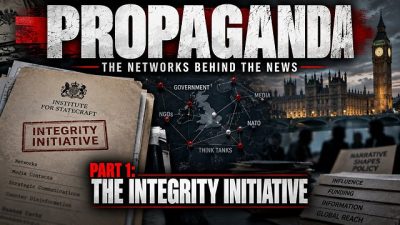
Integrity Initiative: UK-funded network framed dissent as Russian disinformation for years
or go to
Aletho News Archives – Video-Images
From the Archives
Why Saudi Ties to 9/11 Mean U.S. Ties to 9/11
By Kevin Ryan | Dig Within | September 27, 2015
Media interest in Saudi Arabian connections to the crimes of 9/11 has centered on calls for the release of the 28 missing pages from the Joint Congressional Inquiry’s report. However, those calls focus on the question of hijacker financing and omit the most interesting links between the 9/11 attacks and Saudi Arabia—links that implicate powerful people in the United States. Here are twenty examples. … continue
Blog Roll
 Aletho News
- IAEA inspectors cannot return to Iran amid US threats: Russia
- Senate Rejects Iran War Powers Resolution Passed By House
- ‘We did not attack Pakistan with drones’: Afghan sources
- Iraqi Resistance faction links arms to sovereignty, questions US exit
- Cannon fodder no more… South Korea rejects Trump’s pressure to join his criminal war on Iran
- Neria Leiter Was A Legitimate Military Target
- Integrity Initiative: UK-funded network framed dissent as Russian disinformation for years
- ‘We don’t seek permission to defend our country’: Snippets from President Pezeshkian’s UNGA address
- NATO chief wants Europeans to fight American wars [for Israel]
- German chemicals giant reveals details of downsizing
- If Americans Knew
- Israel displaces hundreds of Palestinians amid wave of demolitions in West Bank
- Aid, reconstruction, and Israel’s history of obstruction in Gaza
- Trump administration digs an ever-deeper hole of complicity in genocide – Daily Update
- US-Israel $2.8 Billion Arms Deal, 40,000-Bomb Supply Faces New Gaza Complicity Accusations
- Caught on Tape: AIPAC CEO Boasted of Controlling Trump’s National Security Officials
- Why Hamas Attacked Israel in October 2023 – Israeli professor Ilan Pappé
- They see them, then kill them: Israeli quadcopters track, deliberately target civilians in Gaza
- Winter could turn Gaza’s treacherous, war-damaged buildings into deathtraps
- Majority of Democratic Voters Want to Prosecute Both Biden and Trump Administration Officials Over Gaza
- As Gaza languishes, world leaders gather at the UN – Daily Update
- No Tricks Zone
- New Study: Earth And Venus Surface Warmth Largely Explained By Convection And Lapse Rate, Not CO2 Or Radiation
- 2025 Nature Paper Claiming Worsening Global Drought Gets RETRACTED …Heavily Flawed
- New Study: ‘Global Drought Shows No Detectable Recent Acceleration Under Climate Warming’
- Economic Masterminds: German Socialists Suggest Taxing Productivity Gains Stemming From Using AI
- The South China Sea Has Not Been Cooperating With The Climate Change Narrative
- Energy Crisis: Germany Enters Heating Season With Historically Low Gas Reserve Fill Levels
- New Study: The Antarctic Ice Sheet Gained Mass From 2020-2024 Due To Staggering Snow And Ice Accumulation
- Study: Ocean Heating Rates From Thousands Of Years Ago ‘Dwarf’ Modern Ocean Heating Rates
- Climate Extremists Target, Attack Large-Scale Power Grid Infrastructure In Germany!
- New Study: Antarctic Ice Melt Has Contributed Less Than 1 Centimeter To Sea Level Rise In The Last 30 Years

