Zarif’s reminder to E3: No prohibition on enrichment under JCPOA
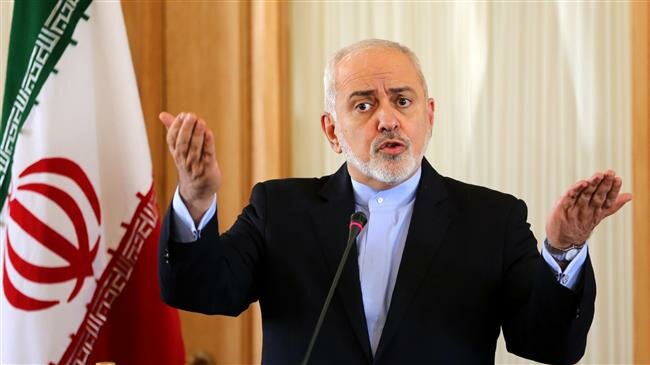
Press TV – April 15, 2019
Iran’s Foreign Minister Mohammad Javad Zarif has reminded the Europeans that a 2015 nuclear deal, known as the JCPOA, does not prohibit the country from enriching uranium.
Zarif’s reprimand in a Monday tweet came after French Ambassador to the US Gerard Araud said Tehran should not need to be “massively enriching uranium after the JCPOA.”
“Reminder to our E3 partners in #JCPOA: There is NO prohibition on the enrichment of uranium by Iran under #NPT, JCPOA or UNSCR 2231,” Zarif tweeted, addressing France, Germany and Britain.
The three European countries opted to remain in the nuclear deal after US President Donald Trump abandoned it last May and reimposed sanctions on the Islamic Republic.
Araud tweeted Saturday that “sanctions could be reimposed” on Iran once the nuclear deal expires after 10 years, prompting the Islamic Republic to summon France’s ambassador to Tehran.
“Neither now, nor in 2025 or beyond. Might be useful for European partners to actually read the document they signed on to, and pledged to defend,” Zarif retorted on Monday.
In January, France’s Foreign Minister Jean-Yves Le Drian threatened Iran with sanctions if it did not address what he alleged as international concerns over Tehran’s ballistic missile program.
“We are ready, if the talks don’t yield results, to apply sanctions firmly, and they know it,” Le Drian said.
Earlier this month, Britain, France and Germany accused Iran of “developing missile technology in violation of UN resolution,” and called for a full UN report in a letter delivered to UN chief Antonio Guterres.
The EU trio also claimed that Iran’s launch of a space vehicle and unveiling of two new ballistic missiles in February were inconsistent with UN Security Council Resolution 2231, which was adopted just after the signing of the 2015 nuclear agreement.
Resolution 2231 calls on Iran “not to undertake any activity related to ballistic missiles designed to be capable of delivering nuclear weapons.”
Iran denies having any such program and the International Atomic Energy Agency (IAEA) has repeatedly confirmed the peaceful nature of Tehran’s nuclear activities.
In his Saturday tweet, deleted later, Araud said, “As we said in 2002 that enriching uranium without a credible civilian program was illegal under the NPT, we’ll be able to react likewise in 2025 if necessary. Sanctions were imposed. Sanctions could be reimposed.”
Iran’s Foreign Ministry called Araud’s remarks “unacceptable” and in “open violation” of the nuclear deal.
The ministry’s Hossein Sadat Meidani called for an explanation from Paris, saying that if the case is not addressed, Tehran will pursue it based on the mechanisms envisaged in the JCPOA.
Iranian Deputy Foreign Minister Abbas Araqchi also warned France of adverse effects of Araud’s remarks, saying such statements amount to blatant violation of the nuclear accord.
Under the JCPOA, Iran undertook to put limits on its nuclear program in exchange for the removal of nuclear-related sanctions imposed against the country.
Last month, IAEA head Yukiya Amano once again reaffirmed Iran’s compliance with its commitments under the deal.
Zarif Slams EU over Not Fulfilling Nuclear Deal Commitments
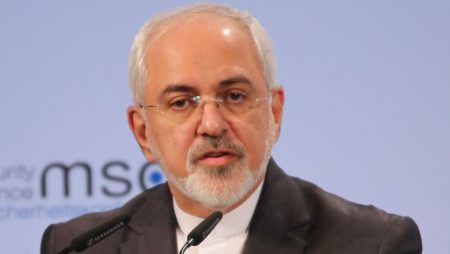
Iranian Foreign Minister Mohamamd Zarif
Al-Manar | April 14, 2019
Iran’s Foreign Minister Mohamamd Javad Zarif slammed the EU on Sunday over delays in the implementation of the new mechanism for non-dollar trade with the Islamic Republic.
In comments on Sunday, the top Iranian diplomat deplored the European signatories to the 2015 Iran nuclear deal for failing to fulfill their commitments under the agreement, saying it is long overdue.
The Europeans are far behind on fulfilling their commitments under the Joint Comprehensive Plan of Action (JCPOA), Zarif said, adding: “They (EU) should not assume that the Islamic Republic of Iran will be waiting for them.”
Describing INSTEX -a payment channel that the three EU signatories to the JCPOA have set up to maintain trade with Iran- as a preliminary measure, Zarif said the Europeans need to work hard for a long time to honor their commitments.
The Iranian minister further noted that Iran has maintained close ties with its neighbors and has launched mechanisms similar to the INSTEX with many other countries.
“While the European countries have proposed INSTEX to maintain business ties with Iran in defiance of the US sanctions, the payment channel has not been put into practice yet,” he added.
On the other hand, Zarif said Iran will ask the international community to take a position on the US designation of its Revolutionary Guards as a terrorist organization.
“Today … we will send messages to foreign ministers of all countries to tell them it is necessary for them to express their stances, and to warn them that this unprecedented and dangerous U.S. measure has had and will have consequences,” Zarif was quoted as saying by state news agency IRNA.
The Iranian diplomat said he had also sent letters to United Nations Secretary-General Antonio Guterres and the United Nations Security Council to protest against “this illegal U.S. measure”.
Where Trump’s and Bibi’s Interests Clash
By Pat Buchanan • Unz Review • April 12, 2019
On Monday, President Donald Trump designated the Islamic Revolutionary Guard Corps a terrorist organization, the first time the United States has designated part of another nation’s government as such a threat.
Iran’s Supreme National Security Council responded by declaring U.S. Central Command a terrorist group.
With 5,000 U.S. troops in Iraq and 2,000 in Syria, often in proximity to Iranian units, this inches America closer to war.
Why did we do it? What benefit did the U.S. derive?
How do we now negotiate with the IRGC on missile tests?
Israel’s Bibi Netanyahu took credit for Trump’s decision, tweeting, “Once again you are keeping the world safe from Iran aggression and terrorism. … Thank you for accepting another important request of mine.”
Previous “requests” to which Trump acceded include moving the U.S. embassy to Jerusalem, declaring Jerusalem Israel’s eternal capital, closing the Palestinian consulate and cutting off aid, and U.S. recognition of the Golan Heights, captured from Syria in 1967, as sovereign Israeli territory.
What Bibi wants, Bibi gets.
One hopes his future requests will not include a demand that we cease dithering and deliver the same “shock and awe” to Iran that George W. Bush delivered to Saddam Hussein’s Iraq.
With Bibi’s election win Tuesday, his fifth, the secret Mideast peace plan Trump’s son-in-law Jared Kushner has been laboring on these last two years is likely to be unveiled.
Yet it is hard to see how Jared’s baby is not stillborn.
Bibi is not going to accept a Palestinian right of return to Israel, or a sharing of the Holy City with a Palestinian state ruled by a successor of Yasser Arafat. And as Bibi fought Ariel Sharon’s withdrawal of the 8,000 Jewish settlers from Gaza, he is not going to order the removal of tens of thousands of Jewish settlers from homes on the West Bank.
Indeed, on the eve of his reelection Tuesday, Bibi promised Israelis he would begin the annexation of Jewish settlements on the West Bank.
As for Trump, he is the most popular man in Israel. And he is not going to force Bibi to do what Bibi does not want to do and thereby imperil his major political gains in the U.S. Jewish community.
Given the indulgence of the progressive wing of the Democratic Party for BDS, the anti-Israel Boycott, Divestment and Sanction movement, and the divisions among Democrats over Netanyahu’s expansionism, the president’s pro-Israel stance has proven a political winner for the GOP.
But while a U.S. war with Iran may be what Bibi wants, it is not what America wants or needs.
Consider what 20 years of U.S. wars in the Mideast have cost this country, as China has stayed out of the region and pushed its power and influence into Asia, Africa and Europe.
In Afghanistan, the Taliban have regained control of more territory than they have held since 2001, and they are negotiating with the Americans for a withdrawal of our remaining 14,000 troops.
Cost of the Afghan war: 2,400 U.S. dead, 32,000 wounded, $1 trillion sunk, and the U.S. on the precipice of a potential strategic defeat.
So dreadful has become the five-year Yemeni civil war between Iran-backed Houthi rebels and the Saudi-backed regime they ousted that the U.S. House and Senate have invoked the War Powers Act and directed Trump to terminate U.S. assistance for the Saudi intervention.
In Libya, where a U.S.-led NATO intervention overthrew Colonel Gadhafi in 2011, a renegade general now controls two-thirds of the country and is mounting an assault on Tripoli. U.S. soldiers and diplomats fled the capital last week.
In Syria, President Bashar Assad, with the support of Russia, Iran and Hezbollah, defeated the U.S. backed-rebels years ago.
The Syrian Kurdish militia we partnered with to crush ISIS have been designated as terrorists by the Turks, who promise to annihilate the Kurds if they try to return to homes along the Turkish border.
As for Turkey itself, President Erdogan says he will take delivery this summer of a Russian-made S-400 air and missile defense system.
Go through with that, says the U.S., and we cancel your order for 100 F-35s. The justified U.S. fear: Russia’s S-400 system will be tested against America’s most advanced fifth-generation fighter, the F-35.
If Turkey does not cancel the S-400, a NATO crisis appears imminent.
In Iraq, where 5,000 U.S. troops remain, the government has both pro-U.S. and pro-Iran elements in Baghdad, and mutual designation of the IRGC and CENT-COM as terrorist organizations can only present hellish problems for America’s soldiers and diplomats still in that country.
Bottom line: Though Bibi and John Bolton may want war with Iran, U.S. national interests, based on the awful experience of two decades, and Trump’s political interests, dictate that he not start any more wars.
Not a single Middle East war this century has gone as we planned or hoped.
Copyright 2019 Creators.com.
Turkey Confirms Interest in Russian Su-35, Su-57 If US Denies It the F-35
By Andrei Martyanov | Reminiscence of the Future | April 10, 2019
It is really fascinating to observe the whole process but Turks seem to be in full reactive armor mode and refuse to yield to US pressure on the issue of F-35, which is, by default, the issue of S-400.
Turkey warned on Wednesday that it could buy jets and additional air defense systems from Russia if it cannot get Patriot missile shields and F-35 jets from Washington, raising the prospect of ever deeper defense ties between Moscow and a NATO member.
President Tayyip Erdogan’s existing plans to buy Russian S-400 missile defenses have already alarmed the United States, which says they are not compatible with NATO systems and would compromise the security of F-35 jets Turkey is due to receive.
Washington has offered Ankara both carrot and stick in response, proposing to sell it the Raytheon Co. Patriot systems instead of the S-400s, while at the same time warning of sanctions and a halt in the F-35 fighter jet sales if the Russian deal goes ahead.
Turkey has shown no sign of giving ground and Erdogan, who held talks with President Vladimir Putin in Moscow this week, was quoted on Wednesday as saying the July date for delivery of the first S-400s could even be brought forward.
Foreign Minister Mevlut Cavusoglu also reiterated Turkey’s stance that the S-400 purchase was a done deal and that it would meet its defense needs from elsewhere if necessary.
“If the United States is willing to sell, then we’ll buy Patriots. However, if the United States doesn’t want to sell, we may buy more S-400s or other systems,” Cavusoglu told Turkish broadcaster NTV.
“If the F-35s don’t work out, I will again have to procure the jets I need from elsewhere … There are (Russian) SU-34, SU-57 and others. I will absolutely meet my needs from somewhere until I can produce it myself,” he said.
My main question here is if Turkey knows that F-35 is a…. turkey? I am pretty sure Turks do. Of course, behind all this back-and-forth on S-400 are things much more substantial than even top-notch air defense for Turkey—namely massive economic developments in Eurasia.
It is also obvious that Turks are now in the bargain mode with Russia across the whole spectrum of issues — gas, nuclear power, military, tourism, agriculture, to name a few — and that could be indicative of a tectonic shift in Turkey’s geopolitical orientation but we cannot be sure 100% yet.
On F-35 issue, however, one should not discount the possibility of Turks getting off at the last opportunity from this program in order for a bigger, better thing. This thing are Su-35 of latest modifications and Su-57 which is hitting serial production in 2020 and China expressing interest in this aircraft while already operating full Russian versions of Su-35.
And so the drama is being played out in a front of our very own eyes (and ears). Turkey is getting S-400 (for warm-up), now what will Greece do? Who knows, but implications are enormous for Turkey, NATO and, of course, the United States.
The US knows that this could be bad, very bad but with Trump being surrounded with neocons and Israel having very serious issues with Turkey, who said that the White House will not continue with self-defeating policies in general, and towards Turkey in particular because of Israel— you may see it for yourself.
Most likely Trump and his “court” of Israeli-firsters, aided by US Congress fully corrupted and bought by Israeli lobby, will continue to self-destruct to make Israeli masters feel better, and situation with Turkey is one such example.
So, here is the news of today and for now, at least, it seems the contract will go ahead but, again, knowing that in this region words mean very little we just have to wait to see how it will play out to the very end. Fascinating!
Egypt pulls out of anti-Iran alliance envisioned by US, allies: Report
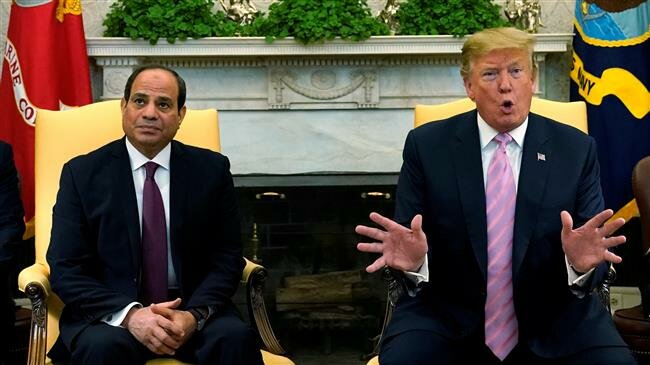
US President Donald Trump meets with his Egyptian counterpart, Abdel Fattah el-Sisi, at the White House in Washington on April 9, 2019. (Photo by Reuters)
Press TV | April 11, 2019
Egypt has reportedly turned its back on a US-led initiative to establish a NATO-style alliance of Arab countries primarily aimed at countering Iran out of concerns that such a coalition could increase tensions with the Islamic Republic, among other reasons.
Four sources familiar with the matter told Reuters on Thursday that Cairo had informed the US and the members of what is to be called the Middle East Strategic Alliance (MESA) of the withdrawal plan ahead of their Sunday’s meeting in the Saudi capital, Riyadh.
One of the sources, speaking on condition of anonymity, said that Egypt had not sent a delegation to the Riyadh event.
An Arab source stressed that Egypt had pulled out of the so-called “Arab NATO” because of its doubts about the seriousness of the proposal as well as the danger that such an Arab front would increase tensions with Tehran.
Other reasons were uncertainty about whether US President Donald Trump will win a second term in 2020 and whether his successor may scrap the initiative to form an anti-Iran alliance, the Arab source added.
Reuters described Cairo’s move as a blow to the Trump administration’s anti-Iran strategy.
A Saudi source also confirmed problems with the plan, saying, “It’s not moving well.”
Meanwhile, two other sources emphasized that the remaining MESA members were moving ahead with the initiative and would press Egypt diplomatically to revoke its withdrawal from the anti-Iran group.
“We all want them back,” said one of the sources.
The Arab source, however, noted that Egypt could not be convinced to return to the so-called “Arab NATO,” which is comprised of Jordan and six Persian Gulf Arab countries, including Saudi Arabia, the United Arab Emirates, Bahrain, Kuwait, Oman and Qatar.
Egyptian officials have not yet commented on the report.
The alliance was first proposed by Saudi Arabia back in 2017 in a bid to counter Iran as well as Russia and China, according to a classified White House document reviewed by Reuters last year.
It has, however, faced several obstacles such as a diplomatic standoff between Qatar and a Saudi-led quartet of countries and the fallout of the state-sponsored killing of dissident Saudi journalist Jamal Khashoggi.
The problems have delayed a summit in the United States, which would feature the signing of a preliminary accord on the anti-Iran alliance.
The report about Cairo’s withdrawal plan came following a meeting between Egyptian President Abdel Fattah el-Sisi and Trump in Washington.
Before the meeting, Trump had said he would exchange views with Sisi on security issues, but it was not clear whether they discussed the MESA issue.
The US and its allies in the Persian Gulf view regional powerhouse Iran as a common “threat.” They constantly accuse the Islamic Republic of “regional interference,” a claim Tehran vehemently rejects.
Trump – who came to office in early 2017 with a highly belligerent anti-Iran agenda – has been pressing its Arab allies to act on the Saudi initiative and move to form the NATO-like military alliance.
In parallel, the US president has also been encouraging the Arabs to step up their attempts towards normalization with the regime in Israel in favor of a coalition against Iran.
In February, a controversial US-organized summit in Warsaw, Poland, brought together Israeli Prime Minister Benjamin Netanyahu and representatives from a number of Arab states, including Oman, Morocco, Saudi Arabia, the United Arab Emirates, Bahrain, Qatar, Jordan, Egypt, Tunisia and Kuwait, among other participants.
On the sidelines of that event, Netanyahu said the Arab countries participating in the Warsaw forum were “sitting down together with Israel in order to advance the common interest of war with Iran.”
Tehran has also repeatedly warned the Persian Gulf littoral states against the US’s divisive policies in the Middle East, saying the planned Arab alliance would merely be a tool for the US to fuel tensions in the region and advance its own agenda there.
Nasrallah Warns: US Moves Will Not Remain Without a Response
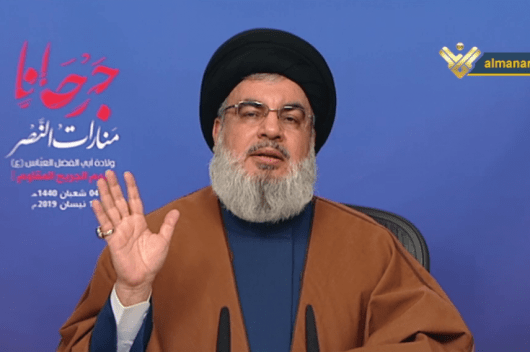
Al-Manar – April 10, 2019
Hezbollah Secretary General Sayyed Hasan Nasrallah stressed that victories achieved in Lebanon are not the result of US and its allies’ tenders, indicating that the US sanctions and measures against Iran and its allies in the region “will not remain without a response.”
In a televised speech commemorating the day of Resistance Wounded Fighters, Sayyed Nasrallah emphasized that the security and peace “we are enjoying were made by our men, women, detainees and wounded, and these terrorists do not have the right to show that they are the ones who gave us stability.”
Sayyed Nasrallah considered that the US is humiliating an entire nation for the sake of terrorist ‘Israel’ and terrorist groups which it’s providing all facilities to.
As he voiced support to the Iranian Revolutionary Guards, His eminence condemned and decried the US decision to classify the IRGC as a “terrorist organization,” saying the US insolence and folly set a precedent. “This decision shows that the US audacity and folly went beyond limits.”
“Blacklisting the IRGC is an evidence that it is strong and not weak and this is an expected move by the Great Satan,” Sayyed Nasrallah said, adding that it was also a proof of the US failure and fiasco in the region.
His eminence dismissed reports about possible sanctions against Speaker Nabih Berri and other Hezbollah allies as “mere intimidation.”
We’ll Respond at the Right Time
The Hezbollah S.G. stressed that the Revolutionary Guards has a great role in defending the peoples of the region and had sacrificed a large number of martyrs and wounded for the sake of people of our region, indicating that it occupies a central, advanced, and the most influential place regionally.
“Until now we have only settled with condemnation, denouncement, patience, and managing the situation calmly in the face of sanctions and terror lists, but our patience does not mean that we, the axis of resistance, do not have the cards of strength,” Hezbollah’s S.G. warned, indicating that options remain open.
“It seems that the US blacklists will be prolonged. Our choices are open but we will act calmly, with a cool head and at the right time, in all battlefields and arenas,” Sayyed Nasrallah said. It is our natural right and ethical, religious and humanitarian duty to confront all those who might threaten our country, resistance and achievements through their sanctions and measures, he added.
Sayyed Nasrallah expressed his solidarity and support to the Iranian people who have been plagued by floods which hit Iranian areas. He said that Trump, who is bragging about humanitarianism, is blocking aid for Iranians suffering from the hurricane, expressing gratitude to all humanitarian efforts to collect aid to flood victims in Iran.
Yemen’s Steadfastness Protects the Palestinian Cause
Regarding the war on Yemen, His Eminence pointed out that four years have passed on the war and no one sees that the unarmed and oppressed people who are still steadfast and growing stronger are still fighting armies, pointing out that the war on Yemen is an American-Saudi-British-Israeli aggression.
Sayyed Nasrallah said that had Bin Salman won in Yemen war, he would have forced the Palestinians to sign on the deal of the century, stressing that Yemeni’s steadfastness throughout these years have protected the Palestinians. “What would have happened to Gulf countries and leaderships had the authoritarian Bin Salman won the war on Yemen?” he wondered, “he would have been presented as the great historical leader and victory will be presented in a misleading way.”
The Hezbollah leader indicated that there was an American insistence by Trump personally to continue the war on Yemen, pointing out that the steadfastness of the Yemeni people protects the Palestinian cause and Palestine and every occupied Arab land.
US Move to Blacklist Hezbollah Allies a Scarecrow
Sayyed Nasrallah briefly addressed the internal situation. He criticized what he called the US provocative policy of instigating strife in Lebanon, pointing out that it was continuing despite the failure of Pompeo’s recent visit.
He pointed that it was surprising that some Lebanese in Washington were working on blacklisting Hezbollah’s allies and friends in Lebanon. “The US move of blacklisting Hezbollah allies in Lebanon is just a scarecrow till now. There is not a single indication about an intention to place Nabih Berri and other allies on the terror list and we sense that there are Lebanese in Washington who are working in this direction, but so far this remains an intimidation campaign. When the matter reaches our allies, this means that they are targeting all our people.”
Unity, Resistance Only Way for a Free Lebanon
As for Lebanese concerns that Trump’s decision on the Golan Heights might affect the status of the Shebaa Farms and the Kfarshouba Hills, Sayyed Nasrallah said: “Our territorial border is linked to our national will and not to Trump’s decision.”
“We were killed and wounded and massacres were committed in our villages and cities through Israel’s aggression and the US support. Our peace, security and achievements were made by our people, martyrs and wounded. The achievements that were made in Lebanon are not from the blessings of America.”
Sayyed Nasrallah stressed the importance of the current spirit of cooperation among the political forces in addressing the current situation regardless of any tensions here or there. “Lebanese should choose between keeping Lebanon in the safe zone or responding to those who are leading it towards sedition,” Sayyed Nasrallah said, adding that the only way for keeping Lebanon free, sovereign and stable is through unity and resistance.
“I voice my support to Speaker Nabih Berri who has repented in Doha in front of the world’s parliamentarians to say the truth with a loud voice and show everyone the path of salvation: unity and resistance,” his eminence said.
Sayyed Nasrallah began his speech by hailing all wounded fighters who suffered and sacrificed themselves for the sake of this nation, saying: “thanks to your sacrifices, we are enjoying victories, security and the power of deterrence. The enemy doesn’t dare to wage any war because of your wounds and sacrifices.”
He said there was no place for neutrality in the battle of truth and in defending the oppressed.
Throughout his speech, Sayyed Nasrallah recalled the martyrdom anniversary of Sayyed Mohammad Baqer Al-Sadr and his sister, and hailed his enormous intellectual achievements.
Don’t expect US-Iran war before 2021
By M. K. BHADRAKUMAR | Indian Punchline | April 10, 2019
There is no reason to disbelieve the boast by Israeli Prime Minister Benjamin Netanyahu claiming credit personally for US President Donald Trump’s decision to designate Iran’s elite Islamic Revolutionary Guards (IRGC) as a “foreign terrorist organisation” under American law. It is common knowledge that all major decisions and most minor decisions by Trump regarding the West Asian situation are dictated by Israel’s interests.
Deep-pocketed Jewish billionaires such as Sheldon and Miriam Adelson, far-right Christian evangelicals and the well-known Israeli lobby wield enormous influence over Trump whose son-in-law Jared Kushner is also known to be an ardent Zionist who has funded West Bank settlements. Both decisions by Trump in recent weeks — granting US recognition to the illegal Israeli annexation of Syria’s Golan Heights region as well as yesterday’s move against Iran’s IRGC — are to be seen as motivated by the desire to bolster Netanyahu’s campaign seeking a fresh term in Israel’s parliamentary election on April 9.
The Pentagon and the State Department had reportedly expressed misgivings over Trump’s decision branding IRGC as a terrorist organisation. Indeed, Trump’s announcement on April 8 says clearly that the US state department will take the lead role in implementing this decision. Trump avoided voicing any intention to confronting the IRGC militarily and instead underscored his decision is to impose economic sanctions against the Iranian security organisation.
Considering that the IRGC has a long reach in the economic arena, especially in vital sectors such as energy, telecommunications, etc., in effect, Trump’s decision amounts to an extension of the US sanctions against Iran. Therefore, as Trump put it, the decision becomes a template of his “maximum pressure” strategy against Iran, which has been under implementation.
Tehran’s reaction has been surprisingly restrained under the circumstances. To be sure, Tehran has retaliated by naming the US Central Command (which is headquartered in Doha and covers the so-called Greater Middle East stretching from the Levant to Central Asia) as a terrorist organisation. Interestingly, Iranian reports highlighted that it is a “tit-for-tat” measure — that is, a move Iran had no choice but to make. The overall mood is one of resignation that the Trump administration is under the Israeli spell and has taken a step that is not exactly in American interests.
There have been no threatening statements from Tehran directed at the US, either. In a highly nuanced remark, the influential chairman of the National Security and Foreign Policy Commission of the Iranian Parliament, Heshmatollah Falahatpisheh hastened to clarify that Iran’s measures against the US Central Command, in response to US anti-IRGC move, is defensive, not a declaration of war.
Again, Iran’s powerful Supreme National Security Council, which is the apex executive body on foreign and security policies, has also restricted itself to saying in a statement, “Undoubtedly, the US regime will bear all the responsibilities for the dangerous consequences of its adventurist move.” This must be noted carefully as a signal to the US defence and security establishment.
Most important, Iran’s Supreme Leader Ayatollah Ali Khamenei estimated Trump’s move as only to be expected, given the IRGC’s pivotal role in countering Iran’s enemies. He said the US move will fall flat. The head of Iran’s Revolutionary Guards, Gen. Mohammad Ali Jafari was quoted as saying, “This U.S. move was quite laughable since the Revolutionary Guards are in people’s hearts … The Revolutionary Guards will increase its defensive and offensive capabilities in coming year.”
On the political plane, however, Tehran will step up its “resistance”. More Iranian support for Hamas can be expected. Similarly, the US move, coming hot on the heels of recognising the Israeli occupation of the Golan Heights, will only further further consolidate the “resistance”. The known unknown is going to be the impact on Afghanistan. Tehran has links with the Taliban. But it has been voicing strong backing for President Ashraf Ghani’s insistence that the peace talks should be “Afghan-led, Afghan-controlled.” Iran’s overriding concern is the stability of Afghanistan and the welfare of the Shi’ite communities. Conceivably, the US must be factoring in the imperative need to discourage Iran from playing a spoiler role in Afghanistan.
Among the Iranian security agencies, it is the IRGC that is in the driver’s seat in steering policies in Syria, Iraq and Afghanistan. The point is, the US Central Command and the IRGC (plus various Iran-backed militia forces) “co-habitate” these theatres. It is inconceivable that the US would precipitate any hostile moves against the IRGC that draw forth retaliation and jeopardise the safety and security of American personnel. Iran has the capacity to infect pain and give sleepless nights to the US personnel deployed under the Central Command and, to be sure, the Pentagon and the CIA are well aware of that.
We may, therefore, expect a tacit understanding by the two antagonistic parties to stay out of each other’s path. Of course, that is easier said than done, since these are high kinetic theatres witnessing acute confrontation. But then, the US-Iran tango has a 40-year history of shadow boxing.
Some shrill rhetoric can be expected from the US side, especially from US secretary of state Mike Pompeo and National Security Advisor John Bolton. Both are stridently “anti-Iran”. Bolton had been in the payroll of Iranian dissident groups based in the West. Both Pompeo and Bolton are passionately devoted to serving Israeli interests. But, in the final analysis, it is Trump — and Trump alone — who matters.
Quite obviously, Trump will be extremely wary of getting into a shooting war with Iran. Trump knows only too well that a war with Iran will have regional ramifications and can hurt his presidency. His game plan through this year and the next will be to ensure that his “maximum pressure” strategy deters Iran from causing any serious political embarrassment during his campaign, which is due to start later this year, for his re-election bid in 2020.
Suffice to say, Trump’s IRGC designation is unlikely to lead to any shooting war with Iran — till end-2020, at least. Having said that, there will be no let-up in Tehran’s pursuit of “resistance” in Syria and Iraq. And, given the pivotal role of the IRGC in Iran’s foreign and security policies, any form of direct engagement politically or at the diplomatic level between Washington and Tehran can be ruled out. Having said that, make no mistake that the US’ regional strategies in Syria and Iraq will come under severe challenge. To be sure, a strategic stalemate is Israel’s objective too as the guarantee against US retrenchment from the Middle East.
Secret Document Reveals Plans for Civil War in Lebanon, Israeli False Flags, and Invasion
By Randi Nord | Geopolitics Alert | April 5, 2019
Beirut – During his visit with US Secretary of State, Mike Pompeo, Lebanese President Michael Aoun reportedly received a US-Israeli document detailing plans for creating a civil war in Lebanon with covert false flag operations and possible Israeli invasion.
Although the source of the document is Israeli and created in partnership with Washington, no one knows who presented it to Aoun. The Lebanese TV station, Al-Jadeed, initially reported the document on Lebanese TV and a video on its website. Geopolitics Alert translated the report for this article.
Israel and the United States Foment Civil War in Lebanon
The document details American plans to splinter the Lebanese Internal Security Forces, a domestic institution separate from the Lebanese Army. The plans involve Washington investing 200 million dollars into the Internal Security Forces (ISF) under the guise of keeping the peace but with the covert goal of creating sectarian conflict against Hezbollah with 2.5 million specifically dedicated to this purpose.
The document states the ultimate goal is to destabilize the country by creating a civil war in Lebanon which will “help Israel on the international scene.” The United States and Israel plan to accomplish this by supporting “democratic forces,” sounding remarkably similar to the same strategy used in Syria, Libya, Venezuela, and elsewhere.
According to the document, although “full load of our firepower will be unleashed,” they somehow do not anticipate any casualties. They do, however, expect the civil war to “trigger requests” for intervention from the Israeli Defense Forces (IDF) which Israel must only agree to after extreme reluctance.
The document says Israel will also play an important role by creating “covert false flag operations” as the conflict progresses. Perhaps these operations would include chemical attacks similar to the chemical attacks on civilians in Syria or even direct attacks on Lebanese or Israel civilians to blame on Hezbollah and justify international intervention.
The document admits that the United States and Israel will need an unprecedented amount of credibility to pull this off and also admits that the Lebanese Army may be an obstacle, likely due to the Army’s diverse makeup. As a legitimate political party with members throughout all aspects of Lebanese society, Hezbollah already has members and allies throughout the ISF as well as the Army.
Understanding Israel’s Role in The F-35 Dispute Between the US and Turkey
By Adam Garrie | EurasiaFuture | 2019-04-02
The United States has just cut off its nose to spite its face by announcing that Washington will halt delivery of equipment related to the F-35 fighter jet to Turkey. This makes life more difficult for both Turkey and the US as Turkey played a key role in the development of the F-35.
Is this about Russia or is it about Israel?
Throughout 2018, the US threatened to halt delivery of the F-35s to Turkey due to Ankara’s insistence that it will purchase the Russian made S-400 missile defence system. But while on the surface, the row between Turkey and the US appears to be one stemming from a reality in which Turkey has warm relations with Moscow whilst the US does not, there is an Israeli factor at hand that may be the overriding factor at play. The fact that Israel’s ally India has more or less received a green light from the US to purchase S-400s makes this reality all the more clear.
In May of last year, Russian media outlet Sputnik reporting the following:
“According to a top Israeli defence official, the Jewish state seeks to remain the only country in the region with F-35 jets to maintain its military’s qualitative edge. The discussions between Israel and the United States have also reportedly touched upon the jet’s performance-enhancing software; unnamed sources confirmed to Haaretz that the matter is ‘part of the negotiations,’ while Israel has denied having talks over the F-35 deal, under which Turkey is expected to obtain 100 stealth fighter jets”.
Whilst anti-Turkish forces do exist in the US owing to Turkey’s increasingly warm relations to countries as diverse as Russia, Iran and China, the fact that recent years and months have seen a dramatic decline in Turkey-Israel relations has clearly played a part in America’s move to effectively remove Turkey from the F-35 project that it had been a part of from the earliest stages of the jet’s development.
While the Pentagon had previously expressed its willingness to follow through with its pledged delivery of US made F-35 fighter jets to Turkey, Congressional opposition fuelled by a unique alliance of the US based Armenian, Hellenic and Jewish lobbies continues to oppose the US delivery of the jets to NATO member Turkey.
What one is witnessing in the United States is a perfect storm of geopolitical brinkmanship which has allied with domestic ethno-religious agitation groups in a malaise of open Turkophobia. From the perspective of many in Congress from both major US parties, delivering the F-35s to Turkey would violate the Countering America’s Adversaries Through Sanctions Act (CAATSA) which allows for US sanctions on otherwise neutral or even allied countries who purchase weapons from nations being directly sanctioned by Washington. The directly sanctioned nations in question are Russia, Iran and the DPRK (North Korea).
Because of Turkey’s agreement to purchase Russia’s S-400 missile defence systems, Ankara is now being targeted by members of the US Congress keen to exert what amounts to a blackmail clause in CAATSA which would threaten any nation with sanctions for the “offence” of purchasing Russian weapons.
From healthy relations to the ultimate strain
Turkey was the first Muslim majority nation to recognise Israel and prior to recent decades, Ankara and Tel Aviv have had a generally healthy relationship. This dramatically changed in 2010 when Israeli commandos illegally boarded the MV Mavi Marmara in international waters. The MV Mavi Marmara was a privately chartered Turkish flagged ship carrying mostly Turkish activists on their way to Gaza in order to deliver much needed humanitarian supplies to besieged Palestinians. The gruesome raid killed ten Turks and resulted in the lowest ebb in Ankara-Tel Aviv relations until now.
A new anti-Turkish alliance in the eastern Mediterranean and among US based pressure groups
For much of the 20th and 21st centuries, the large American based Hellenic and Armenian lobbies have agitated for a less friendly US approach to Turkey. For the Armenian lobby, the main goal is to convince the US Federal government to recognise the tragic events of 1915 as “The Armenian Genocide” while the Hellenic lobby has sought to persuade Washington to pressure Ankara into acknowledging the early 20th century conflict in western Anatolia as the “Pontic Genocide”. Additionally, the US Hellenic lobby has for years attempted to persuade NATO to take a tougher line on the status of Northern Cyprus. Thus far, none of these lobbying attempts have met with the desired success of the respective lobbies at a Federal level.
While the US based Jewish lobby is traditionally more powerful than either the Hellenic or Armenian lobbies, the US Jewish lobby has generally had little negative to say about Turkey in-line with the fact that of all of the Muslim majority governments in the region Tel Aviv had its best relations with Ankara, as well as the overriding reality that Turkey never passed any antisemitic legislation as most of the powers of Europe did prior to the mid-20th century.
But with Turkish President Erdoğan openly calling for a wider pan-Islamic movement for Palestine, all the while calling Israel a terrorist state, the US Jewish lobby like Israeli politicians, have joined traditional foes of Turkey in openly agitating for a more anti-Turkish position form the US government.
This has expressed itself both domestically in the US and geopolitically in terms of Israel’s new regional partnerships. Against this background, it is perhaps not surprising that Gilad Erdan, a member of Benjamin Netanyahu’s Likud faction has called for Tel Aviv to recognise the events of 1915 as an “Armenian Genocide”. If Israel were to officially to do this, it would represent a clear break between Tel Aviv and Ankara and quite possibly a point of no return. The more Turkey stands up for Palestine, the more voices like those of Erdan will become amplified in arguing for a move that is less about Armenia (a traditionally anti-Zionist nation) than about sending a clear message to Turkey that the partnership has run its course.
Israel and The Craiova Group
Formed in 2015, the fledgling Craiova Group is a partnership between Greece, Serbia, Bulgaria and Romania aimed at fostering deeper cooperation between the four south-eastern European nations. While the group has generally been far less notable in terms of its aims and accomplishments vis-a-vis the Three Seas Initiative linking Baltic eastern and central Europe with the European nations of south-east, this month the Craiova Group came into its own as the official organisation which will carry out Israel’s attempt to isolate Turkey in the wider eastern Mediterranean region.
On the 2nd of November, 2018, Israeli leader Benjamin Netanyahu took part in a Craiova Group summit in Varna, Bulgaria. There, Netanyahu said,
“I am here at the summit of four countries – Bulgaria, Greece, Serbia and Romania.This is the first time that they have invited a leader outside these four countries to participate in their summit. This is a great honor for Israel and reflects Israel’s rising status in the world.
Each one of the leaders has individually told me that they will try to improve their consideration of Israel in relevant votes both at the EU and the UN. They all want to promote the gas pipeline from Leviathan to Europe and the Balkans.They are also very interested in Israeli gas and Israeli technology, and they would very much like Israel’s friendship. This is a good sign”.
Netanyahu also discussed making the Craiova Group integral to Tel Aviv’s plans to construct the East Med Pipeline, a joint Israeli-Hellenic project that will see a gas pipeline travelling from disputed Israeli waters through to disputed Cypriot waters and finally into mainland Europe via The Hellenic Republic. But while Netanyahu’s speech talked about unity against the supposed threat of Islam which clearly played to the sentiments of many in Greece, Bulgaria, Serbia and Romania where the racist anti-Turkish/anti-Muslim hashtag “#nokebab” has become a cultural phenomenon, the pipeline alliance that Israel is trying to secure is clearly aimed at boxing Turkey into a corner in its own territorial waters.
At present, Ankara and Nicosia are in the midst of a heated row regarding rights to offshore gas fields in the waters off the island of Cyprus. At present, while there is no realistic plan for Nicosia to militarily enter the Turkish North of the divided island, Nicosia is opposed to Turkish plans to begin extracting gas in the waters off of the disputed territory of the Turkish Republic of Northern Cyprus (aka Northern Cyprus). To put it another way, in spite of rhetoric to the contrary, the government in Nicosia clearly cares about controlling the waters off of Cyprus more than it cares about controlling the island’s total landmass.
But far from being just a new chapter in the age old Hellenic-Turkish disputes of the region, this particular conflict is also being driven by Israel whose government is keen to see Tel Aviv, Nicosia and Athens work jointly on an East Med pipeline that excludes Turkey while at the same time impinging on offshore territory that Turkey claims it has an inalienable right to exploit. Now, Israel looks to bolster these plans which have already seen Egypt pivoting ever closer to Tel Aviv and Nicosia by also drawing Bulgaria, Serbia and Romania into the project.
When one remembers that during the ultimately brief Turkish-Israeli rapprochement of 2016, there were talks of a joint gas project between Tel Aviv and Ankara, the underpinnings of the present conflict become all the more clear.
To further understand the background of the severe downgrade in Turko-Israeli relations that has now become a rivalry for energy supremacy in the eastern Mediterranean, it is important to understand the following that was originally published in Eurasia Future in May of last year:
“The Turkish government has just announced the effective expulsion of Eitan Na’eh, Israel’s Ambassador to Ankara. According to the Daily Sabah,
‘Na’eh was asked to leave Turkey indefinitely by the Turkish ministry of foreign affairs following the Israeli bloodshed and his tweets’.
Pipeline politics no more
Against this background, erstwhile plans for a Turkey to Israel East Mediterranean pipeline have stalled. As a result, Tel Aviv has pivoted closer to Turkey’s regional rival Egypt (which has said next to nothing about Palestine in recent days), while most importantly there is now talk of an EU sponsored East Mediterranean pipeline between Israel, Cyprus, Greece and Italy.
According to a report from New Europe,
“The EastMed gas pipeline would circumvent Turkey, which has increased tensions with Cyprus, Greece and Israel recently, providing a way to transport newly discovered gas supplies from the East Mediterranean to Europe. The talks in Nicosia in May[2018] follow a memorandum of understanding regarding the EastMed pipeline, which was signed in December.
According to the Public Gas Corporation of Greece (DEPA), the EastMed will connect the recently discovered gas fields in the Levantine Basin, in the southeast Mediterranean, with mainland Greece and is projected to carry 8-14 billion cubic meters per year of natural gas to Greece and Europe.
According to DEPA, the approximately 1900 kilometer long pipeline (700 kilometers on-shore, 1200 off-shore) consists of the three following main sections, as well as compressor stations located in Cyprus and Crete: a pipeline from the fields to Cyprus, a pipeline connecting Cyprus to Crete, and a pipeline from Crete crossing mainland Greece up to the Ionian coast.
From there the EastMed can link up with the offshore Poseidon pipeline enabling the delivery of additional diversified sources from the Levantine to Italy and beyond. The EastMed pipeline is preliminarily designed to have exit points in Cyprus, Crete, and mainland Greece as well as the connection point with the Poseidon pipeline”.
The deal to create such a pipeline was sealed in December of 2017 while glowing reports from pro-EU media touted the deal as a means of allowing Europe to decrease its dependence on Russian gas while also offering Israel a chance to swap Turkey for EU partners. As Turkey’s long paralytic bid to join the EU is now de-facto over, both Europe and Israel’s cooperation over a new East Mediterranean gas pipeline has the effect of drawing Russia and Turkey into an even closer partnership than the one they are currently in.
At the moment the Turkstream pipeline designed to bring Russian gas into Europe via Turkey is a major joint project between Moscow and Ankara. Now, both the EU and Israel are looking to challenge this route with a pipeline of their own in a similar region. In reality, there is enough demand for gas in Europe and Israel to mean that both pipelines can coexist, but the geopolitical optics are clear enough. Tel Aviv has joined forces with the most anti-Ankara states in the EU in order to cut Turkey out of Israel’s future.
The importance of Turkey’s Soft Power in the Sunni Muslim world
President Erdoğan has already proved himself to be the ‘Sultan of Soft Power’ in the wider Sunni Muslim world. Without clear leadership from Egypt, Saudi Arabia or Qatar and with Saddam’s always controversial Iraqi government long out of power, Erdoğan has positioned himself as a champion for Palestine not only in Turkey and the Sunni Arab world but beyond. Because of this, one should never underestimate how far Turkey will take its support of Palestine vis-a-vis Tel Aviv, not least because the more Erdoğan voices his opinions in support of Palestine, the more he is respected and supported both in Turkey and far beyond.
Israel supporting Turkey’s main rivals
Because Israel has taken clear moves away from Turkey and towards its hated Hellenic rivals, officials in Ankara who in the past may have been hesitant to sever ties with Tel Aviv because of economic considerations may now be much closer to doing so. Israel’s intensifying military cooperation with both Greece and Cyprus are a further sign that when it comes to Turkey, Tel Aviv is doing everything in its power to replace its once healthy Turkish partnership with that of countries with notoriously poor and always heated relations with Ankara.
Then there is the issue of Kurdish ethno-nationalism in both Syria and Iraq. Uniquely in the world, the United States and Israel are supporters of Kurdish separatism both in northern Syria and northern Iraq. President Erdoğan has already made it clear that this is one of several red lines that Israel can cross in respect of maintaining even semi-normal relations. During the attempted illegal Kurdish succession from Iraq in the autumn of 2017, Erdoğan posed the following rhetorical statements to Kurdish secessionists in Iraq,
“Who will recognize your independence? Israel. The world is not about Israel?…
…“You should know that the waving of Israeli flags there will not save you!”
Conclusion
In order to connect these dots, one must ask some vital questions:
1. Why is the US treating its longstanding NATO partner Turkey much worse than it is treating its new Indian partner over the purchase of the same Russian made S-400 defensive weapons?
2. With Turkey and Israel competing for regional soft power influence, regional influence in respect of gas pipelines and competing in respect of building new diplomatic alliances in the Eastern Mediterranean, could Israel be preparing options to lead military assaults on Turkish assets (perhaps in Cyprus) and as such fears Turkey’s ownership of F-35 as well as S-400s?
3. As Russia is both an Israel and Turkish ally, is Tel Aviv attempting to use the US to pressure Turkey to choose between its Russian and American partners knowing that Moscow will not do so?
4. As Israel owns F-35s but not S-4000s, is Tel Aviv worried that if Turkey had both, it would be able to seriously counter possible Israeli aerial bombardments against Turkish assets in the wider region?
When one looks at the overall state of Turkey-Israel relations and what Israeli officials have themselves said about Turkey and the F-35s, it begins to become ever more apparent that the F-35/S-400 issue is as much if not more about Tel Aviv than it is about the neo-Cold War between Washington and Moscow.
US, Israel punish Turkey’s Erdogan
By M. K. BHADRAKUMAR | Indian Punchline | April 2, 2019
“Turkey is a global “swing state.” It has a large and growing economy, a strategic location, a democratic government, and mixed views about prevailing international arrangements. Like the other three global swing states — Brazil, India, and Indonesia — Turkey’s choices will influence whether today’s international order evolves and endures or fragments and fails.”
The above passage is reproduced from a policy brief titled Turkey: A Global Swing State by the German Marshall Fund of the United States, the American think tank. Indeed, from the US perspective, several fault lines in regional politics are affected by Turkish policies. At least half a dozen major templates can be readily identified: Syrian conflict, Kurdish autonomy, Palestinian problem and Israel’s security, US sanctions against Russia and Iran, Turkey’s entente with Russia, Qatar, Iran, etc., NATO presence in the Black Sea and Mediterranean and the alliance’s base in Incirlik and so on.
It is no big secret that the US and its European allies and Israel view Turkish President Recep Erdogan’s regional policies with growing disquiet. Erdogan’s independent foreign policies weaken western regional strategies and his support for Hamas (and his visceral dislike of Netanyahu) isolates Israel in the region.
On the other hand, the US’ containment strategies against Russia and Iran are undermined by Erdogan’s policies. The Turkish-Russian-Iranian troika created new facts on the ground in Syria and rendered untenable the US military presence in Syria. Turkey frontally challenges the US’ alliance with Syrian Kurds. The deepening Turkish-Russian partnership challenges the cohesion of NATO. The so-called Middle Eastern Entente between Turkey, Qatar and Iran creates much-needed strategic depth for Tehran.
Suffice to say, Erdogan has become a thorn in the flesh for the US and Israel. All this goes to explain the unusually high level of western interest in Turkey’s local elections, which concluded on Sunday. The big question is how far the election results affect Erdogan’s hold on power. Put differently, do the election results show any signs of this charismatic politician losing his grip?
The turnout of voters has been appreciably high — 84.67%. Overall, AK Party (Erdogan’s party) and its ultra-nationalist ally MHP (under the banner People’s Alliance) polled 51.62% votes as against the secular ‘Kemalist’ and liberal opposition (known as National Alliance) which secured 37.56% votes.
The AKP is leading the race securing 16 metropolitan municipalities (out of 30) and taken control of 24 cities, with the main opposition winning in 10 municipalities. But the opposition has wrested control of Ankara and may have scraped through in Istanbul, the country’s main centre of business and industry.
On the whole, there has been no significant shift in the established pattern of social and political polarisation — the southern (Mediterranean) and western (Aegean) provinces supporting the opposition parties with liberal, ‘westernist’, secular outlook, while the Islamist AK Party retains its vast power base in the deeply conservative Anatolian heartland.
Simply put, the AK Party emerges as the winner for the 15th consecutive election under Erdogan’s stewardship. Erdogan said in an address to the nation, “There will be no elections for four and a half years. What will we do? We will focus on national and international issues, and hopefully raise our country above the level of our contemporaries.” Erdogan prioritised the strengthening of the economy, development and job creation.
A pall of gloom would have descended on the western capitals as the realisation sinks in that Erdogan will be around as Turkey’s helmsman for the foreseeable future. Turkey’s presidential and parliamentary elections are due only in 2023.
It is a sign of the times that Russian President Vladimir Putin telephoned Erdogan on Monday to congratulate him. Erdogan is due to travel to Russia next week to co-chair with Putin the eighth meeting of the High-Level Russian-Turkish Cooperation Council scheduled for April 8 in Moscow.
Erdogan’s meeting with Putin will be crucial as both sides are conscious that stormy days lie ahead in Turkish-American relations. Turkish Foreign Minister Mevlut Cavusoglu is due to travel to the US even as Washington is ratcheting up pressure on Ankara to pull out of the S-400 missile deal with Russia and to comply with the US sanctions on Iran.
Things may come to a head between the two NATO allies in the coming weeks since Russia is due to deliver to Turkey in July the first batch of the missile system. Turkey is buying four batteries of the S-400 air defence system for $2.5 billion.
On Thursday, a bipartisan bill was introduced in the US senate to block the transfer of F-35 stealth fighter jets to Turkey unless Ankara scrapped the S-400 deal. The US is also reportedly considering removing Ankara from the joint production program on F-35s. But the Turkish Foreign Minister Cavusoglu reiterated on Friday that Ankara will go ahead with the missile deal with Russia. He scotched the rumours that Ankara might resell the missiles to a third country.
More importantly, last Tuesday, the US introduced sanctions on 25 individuals and firms on grounds of violation of sanctions on Iran, including firms and persons based in Turkey. On Wednesday, Sigal Mandelker, undersecretary for terrorism and financial intelligence in the US Treasury, called on Turkey to strictly observe the sanctions against Iran.
Without doubt, the Israeli lobby in Washington is pulling all stops to punish Erdogan. His support for Iran and Hamas infuriate Israel. Erdogan said last week that Turkey will never accept Israel’s illegal occupation of Golan Heights and intends to raise the issue in the UN. The US media which is heavily under Jewish influence has been harshly critical of Erdogan. Sunday’s election results are being displayed as ‘setback’ for Erdogan. Given the Jewish influence on Wall Street, the game plan would be to create difficulties for the Turkish economy so that mass discontent rises to threaten Erdogan’s popularity.
At such a sensitive juncture when an escalation of tension in ties between Ankara and Washington looks possible in the days ahead and Turkey is hard-pressed to strike a balance between the US and Moscow, the results of the local elections on Sunday would relieve the pressure on Erdogan. But the loss of control of Ankara and Istanbul creates new headaches.
The head of the Nationalist Movement Party (MHP) Devlet Bahçeli, ally and coalition partner of Erdogan, said on Monday that “external forces seeking to implement shady machinations over Turkey have failed” in the local elections. Bahceli said that the “economic hitmen, currency gangs, terrorist groups and intentions” lost hope thanks to the will of the nation and “got the answer they deserved.”
However, looking ahead, Bahceli added, “Elections are now past and Turkey has replenished its hope. It is of crucial importance to focus on worsening social and economic issues along with international challenges.”
Jewish Power Rolls Over Washington
AIPAC gathering is full of lies and liars
By Philip Giraldi • Unz Review • April 2, 2019
The American Israel Public Affairs Committee (AIPAC) has just completed its annual summit in Washington. It claims that 18,000 supporters attended the event, which concluded with a day of lobbying Congress by the attendees. Numerous American politicians addressed the gathering and it is completely reasonable to observe that the meeting constituted the most powerful gathering of people dedicated to promoting the interests of a foreign nation ever witnessed in any country in the history of the world.
There are a number of things that one should understand about the Jewish state of Israel and its powerful American domestic lobby. First of all, the charge that the actions of The Lobby (referred to with capital letters because of its uniqueness and power) inevitably involves dual or even singular allegiance based on religion or tribe to a country where the lobbyist does not actually reside is completely correct by definition of what AIPAC is and why it exists. It claims to work to “ensure that the Jewish state is safe, strong and secure” through “foreign aid, government partnerships, [and] joint anti-terrorism efforts…,” all of which involve the U.S. as the donor and Israel as the recipient.
Being a citizen of a country is not just an accident of birth. It requires loyalty to the interests of that country and to one’s fellow citizens. No two countries have identical interests, something that is particularly true when one is considering Israel, an ethno-religious autocracy, and the United States, where The Lobby works assiduously to compel the American government at all levels to adopt positions that are beneficial to Israel and almost invariably harmful to U.S. interests. Asserting that the two nations have nearly identical interests is little more than a fraud.
Second, there is the claim that Israel benefits American security. That is also a lie. Washington’s relationship with Israel, which is now more subservient than it ever has been, is a major liability that is and always has been damaging to both American regional and global interests. The recent decisions to move the U.S. Embassy to Jerusalem and to recognize Israeli sovereignty over the Golan Heights were ill-conceived and have been condemned by the world community, including by nearly all of America’s genuine close allies.
The harm done by the Israeli connection to policy formulation in Washington and to U.S. troops based in the Middle East has been noted both by Admiral Thomas Moorer and General David Petraeus, with Moorer decrying how “If the American people understood what a grip those people have got on our government, they would rise up in arms. Our citizens certainly don’t have any idea what goes on.” Petraeus complained to a Senate Committee that U.S. favoritism towards Israel puts American soldiers based in the Middle East at risk. He was quickly forced to recant, however.
Former CIA Deputy Director Admiral Bobby Inman has also rejected the claim that Israel is a security asset by observing that “Israeli spies have done more harm and have damaged the United States more than the intelligence agents of all other countries on earth combined… They are the gravest threat to our national security.” Inman was referring to American Jewish spy Jonathan Pollard, who stole for Israel an entire roomful of the most highly classified defense information. Israeli spies, including current Prime Minister Benjamin Netanyahu and Hollywood movie producer Arnon Milchan, also participated in the systematic theft of weapons grade uranium and nuclear triggers in the 1960s so Israel could secretly create a nuclear weapons arsenal. The FBI, for its part, in its annual counterintelligence report, consistently identifies Israel as the “friendly” country that spies most persistently against the U.S. FBI Agents have testified that there are very few prosecutions of the swarms of Israeli spies due to “political pressure.”
Third, there is the myth that the United States and Israel have “shared values,” which is meant to imply that both are liberal democracies where freedom and human rights prevail, beacons of light offering enlightened leadership in a world where tyranny threatens at every turn. This was stressed in the opening remarks last weekend by AIPAC Executive Director Howard Kohr, who described Israel as “A nation always striving to be better, more just and true to the message of its founders, a nation dedicated to freedom of religion for people of all faiths. We do our work for all to see. What unites our pro-Israel movement is the passion for bringing American and Israel closer for the benefit of both and the benefit of all. We look like America because we are America.”
Kohr is, of course, preaching to an audience that wants desperately to believe what he says in spite of what they have been able to see with their own eyes in the media when it dares to publish a story criticizing Israel. Jewish hypocrisy about one standard for Israel and Jews plus another standard for everyone else operates pretty much out in the open if one knows where to look. Zionist Organization of America’s Morton Klein, who once tweeted regarding a “filthy Arab,” was interviewed by journalist Nathan Thrall and asked why he believed it was “utterly racist and despicable” to support a “white nationalist” ethnic group but not racist for Israel to do the same. He responded “Israel is a unique situation. This is really a Jewish state given to us by God. God did not create a state for white people or for black people.” Senator Charles Schumer, the Democratic minority leader, who calls himself the Senate’s “shomer” or guardian for American Jews, had a slightly different take on it: “Of course, we say it’s our land, the Torah says it, but they don’t believe in the Torah. So that’s the reason there is not peace.”
But Kohr, Klein and Schumer all know as well as anyone that Israeli Jews, fortified by their conceit of being a “Chosen people,” are not interchangeable with contemporary Americans, or at least not “like” the Americans who still care about their country. There are hundreds of mostly Jewish pro-Israel organizations in America, having a combined endowment of $16 billion, that are actively propagandizing and promoting Israeli interests by ignoring or lying about the downside of the relationship. The University of Michigan affiliate of the Hillel International campus organization alone has a multistory headquarters supported by a budget of $2 million and a staff of 15. It hosts an emissary of the Jewish Agency for Israel, an Israeli government supported promotional enterprise.
So, what is the meaning of the “American” in AIPAC? Requiring a religious-ethnic litmus test for full citizenship and rights is Israeli, not American. Having local government admissions committees that can bar Israeli-Palestinian citizens based on “social suitability” would not be acceptable to most Americans. Demanding a unique Israeli right to exist while denying it to Israel’s neighbors; demolishing homes while poisoning Palestinian livestock and destroying orchards; shooting children for throwing stones; and inflicting death, terror and deprivation upon the imprisoned people of Gaza are all everyday common practice for the Israeli government.
Israel and AIPAC have relentlessly pursued their agenda while also corrupting the Congress of the United States to support the Israeli government with money and political cover. Israel and friends like Kohr routinely make baseless charges of anti-Semitism against critics while also legislating against free-speech to eliminate any and all criticism. This drive to make Israel uniquely free from any critique has become the norm in the United States, but it is a norm driven by Israeli interests and Israel’s friends, most of whom are Jewish billionaires or Jewish organizations that meet regularly and discuss what they might do to benefit the Jewish state.
And the fourth big lie is that the American people support Israel on religious as well as cultural grounds, not because mostly Jewish money has corrupted our political system and media. Indeed, many Christian fundamentalists have various takes on what Israel means, but their influence is limited. The Israel-thing is Jewish in all ways that matter and its sanitized Exodus-version that has been sold to the public is essentially a complete fraud nurtured by the media, also Jewish controlled, by Hollywood, and by the Establishment.
Mondoweiss reported recently that
“This weekend the New York Times breaks one of the biggest taboos, describing the responsibility of Jewish donors for the Democratic Party’s slavish support for Israel. Nathan Thrall’s groundbreaking piece repeats a lot of data we’ve reported here and says in essence that it really is about the Benjamins, as Rep. Ilhan Omar said so famously. The donor class of the party is overwhelmingly Jewish, and Jews are still largely wed to Zionism– that’s the nut.” Ben Rhodes, a former deputy national-security adviser to ex-President Barack Obama recounted in the article how “a more assertive policy toward Israel” never evolved “The Washington view of Israel-Palestine is still shaped by the [Jewish] donor class.”
And the support for Israel goes beyond money. The Times article included an October 2018
“Survey of 800 American voters who identify as Jewish, conducted by the Mellman Group on behalf of the Jewish Electoral Institute, 92 percent said that they are ‘generally pro-Israel.’ In the same poll — conducted after the United States closed the Palestinian diplomatic mission in Washington, moved the U.S. Embassy in Israel from Tel Aviv to Jerusalem, appointed a fund-raiser for the settlements as U.S. ambassador and cut humanitarian aid to Palestinians — roughly half of American Jews said they approved of President Trump’s handling of relations with Israel. On what is considered the most divisive issue in U.S.-Israel relations, the establishment of Israeli settlements in the West Bank, a November 2018 post-midterm election poll of more than 1,000 American Jews that was commissioned by J Street, the pro-Israel lobby aligned with Democrats, found that roughly half said the expansion of settlements had no impact on how they felt about Israel. According to a 2013 Pew survey, 44 percent of Americans and 40 percent of American Jews believe that Israel was given to the Jewish people by God, [a] fact that Jews believe they have rights in historic Palestine that non-Jews do not.”
And one only has to listen to the AIPAC speeches made by leading members of the U.S. government establishment to appreciate the essential hypocrisy over the U.S. wag-the-dog relationship with the Jewish state of Israel. House Majority Leader Steny Hoyer led the parade of Democrats on the first evening of AIPAC, thundering “When someone accuses American supporters of Israel of dual loyalty, I say: Accuse me, I am part of a large, bipartisan coalition in Congress supporting Israel—an overwhelming majority of the United States Congress. I tell Israel’s accusers and detractors: Accuse me.”
Well, Steny there is a certain irony in your request and to be sure you should be accused over betrayal of your oath to uphold the constitution against all enemies “domestic and foreign.” Hoyer is a product of the heavily Jewish Maryland Democratic Party machine that has also produced Pelosi and Senator Ben Cardin. Pelosi told the AIPAC audience about her father in Baltimore, a so-called Shabbos goy who would perform services for Jews on the sabbath and who would also speak Yiddish while at home with his Italian family. Cardin meanwhile has been the sponsor of legislation to make criticism or boycotting of Israel illegal, up to and including heavy fines and prison time.
Hoyer, widely regarded as one of the most pro-Israel non-Jewish congressman, also boasted to AIPAC about the 15 official trips to Israel he’s made in forty years in Congress, accompanied by more than 150 fellow Democrats. “This August, I will travel with what I expect will be our largest delegation ever—probably more than 30 Democratic members of Congress, including many freshmen.”
Steny Hoyer will be on an AIPAC affiliate sponsored trip in which any contact with Palestinians will be both incidental and carefully managed. He also clearly has no problem in spending the taxpayer’s dime to go to Israel on additional “codels” to get further propagandized. He is flat out wrong about Israel in general, but don’t expect him to be convinced otherwise, which may be somehow related to the $317,525 in pro-Israel PAC contributions he has received.
There was much more at the AIPAC Summit. House Speaker Nancy Pelosi denounced “the pernicious myth of dual loyalty and foreign allegiance” while Secretary of State Mike Pompeo, fresh from selling out U.S. interests on a visit to Israel, declared that “We live in dangerous times. We have to speak the truth. Anti-Semitism should and must be rejected by all decent people. Anti-Semitism – anti-Zionism is anti-Semitism, and any nation that espouses anti-Zionism, like Iran, must be confronted. We must defend the rightful homeland of the Jewish people.”
Vice President Mike Pence, like Pompeo an evangelical Christian, piled on in his Monday prime time speech, declaring that “Anyone who aspires to the highest office of the land should not be afraid to stand with the strongest supporters of Israel in America. It is wrong to boycott Israel. It is wrong to boycott AIPAC. Anti-Semitism has no place in the Congress of the United States of America. Anyone who slanders this historic alliance between the United States and Israel should never have a seat on the Foreign Affairs Committee.”
Clearly, there is considerable evidence to support the theory that one has to be completely ignorant to hold high office in the United States. Rejecting Zionism and/or questioning Israeli policies is not anti-Semitism and the Jewish state is in fact no actual ally of the United States. Nor is there any mandate to defend it in its questionable “rightful homeland.” Furthermore, dual-loyalty is what the relationship with Israel is all about and it is Jewish money and political power that makes the whole thing work to Israel’s benefit.
But the good news is that all the lying blather from the likes of Steny Hoyer and Howard Kohr reveals their desperation. They are running scared because “the times they are a changing.” Sure, Congressmen will continue to be bought and sold and Jewish money and the access to power that it buys will be able to prevail in the short term in a conspiratorial fashion. But, in the long run, everyone knows deep down that loyalty to Israel is not loyalty to the United States. And what Israel is doing is evil, as is becoming increasingly clear. It is trying to convince Washington to make war on Iran, a country that does not threaten the U.S., while the willingness of the American people to continue to look the other way as Benjamin Netanyahu uses army snipers to shoot down unarmed demonstrators who are starving will not continue indefinitely. It must not continue and we Americans should do whatever it takes to stop it.
Philip M. Giraldi, Ph.D., is Executive Director of the Council for the National Interest, a 501(c)3 tax deductible educational foundation that seeks a more interests-based U.S. foreign policy in the Middle East. Website is councilforthenationalinterest.org, address is P.O. Box 2157, Purcellville VA 20134 and its email is inform@cnionline.org.
Featured Video
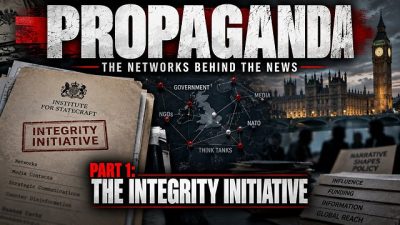
Integrity Initiative: UK-funded network framed dissent as Russian disinformation for years
or go to
Aletho News Archives – Video-Images
From the Archives
Why Saudi Ties to 9/11 Mean U.S. Ties to 9/11
By Kevin Ryan | Dig Within | September 27, 2015
Media interest in Saudi Arabian connections to the crimes of 9/11 has centered on calls for the release of the 28 missing pages from the Joint Congressional Inquiry’s report. However, those calls focus on the question of hijacker financing and omit the most interesting links between the 9/11 attacks and Saudi Arabia—links that implicate powerful people in the United States. Here are twenty examples. … continue
Blog Roll
 Aletho News
- ‘A Big Victory’ – Palestine Chronicle Wins Two-Year Legal Battle
- IAEA inspectors cannot return to Iran amid US threats: Russia
- Senate Rejects Iran War Powers Resolution Passed By House
- ‘We did not attack Pakistan with drones’: Afghan sources
- Iraqi Resistance faction links arms to sovereignty, questions US exit
- Cannon fodder no more… South Korea rejects Trump’s pressure to join his criminal war on Iran
- Neria Leiter Was A Legitimate Military Target
- Integrity Initiative: UK-funded network framed dissent as Russian disinformation for years
- ‘We don’t seek permission to defend our country’: Snippets from President Pezeshkian’s UNGA address
- NATO chief wants Europeans to fight American wars [for Israel]
- If Americans Knew
- In UN Speech, Iran’s President Displays Pictures of Children Killed by US, Brings Attention to Israel’s Nuclear Arsenal
- Israel displaces hundreds of Palestinians amid wave of demolitions in West Bank
- Aid, reconstruction, and Israel’s history of obstruction in Gaza
- Trump administration digs an ever-deeper hole of complicity in genocide – Daily Update
- US-Israel $2.8 Billion Arms Deal, 40,000-Bomb Supply Faces New Gaza Complicity Accusations
- Caught on Tape: AIPAC CEO Boasted of Controlling Trump’s National Security Officials
- Why Hamas Attacked Israel in October 2023 – Israeli professor Ilan Pappé
- They see them, then kill them: Israeli quadcopters track, deliberately target civilians in Gaza
- Winter could turn Gaza’s treacherous, war-damaged buildings into deathtraps
- Majority of Democratic Voters Want to Prosecute Both Biden and Trump Administration Officials Over Gaza
- No Tricks Zone
- New Study: Earth And Venus Surface Warmth Largely Explained By Convection And Lapse Rate, Not CO2 Or Radiation
- 2025 Nature Paper Claiming Worsening Global Drought Gets RETRACTED …Heavily Flawed
- New Study: ‘Global Drought Shows No Detectable Recent Acceleration Under Climate Warming’
- Economic Masterminds: German Socialists Suggest Taxing Productivity Gains Stemming From Using AI
- The South China Sea Has Not Been Cooperating With The Climate Change Narrative
- Energy Crisis: Germany Enters Heating Season With Historically Low Gas Reserve Fill Levels
- New Study: The Antarctic Ice Sheet Gained Mass From 2020-2024 Due To Staggering Snow And Ice Accumulation
- Study: Ocean Heating Rates From Thousands Of Years Ago ‘Dwarf’ Modern Ocean Heating Rates
- Climate Extremists Target, Attack Large-Scale Power Grid Infrastructure In Germany!
- New Study: Antarctic Ice Melt Has Contributed Less Than 1 Centimeter To Sea Level Rise In The Last 30 Years

