Nasrallah on the End of US Hegemony: Trump will Leave the Middle East, Region Already Reshaping – PART II
Interview of Sayed Hassan Nasrallah, Hezbollah Secretary General, with Ghassan Ben Jeddou, founder of the pan-Arab and anti-imperialist Al-Mayadeen channel, January 26, 2019.
Transcript:
Ghassan Ben Jeddou: (The US forces withdrawal from Syria announced by Trump) is therefore not a mere tactical maneuver. You say he is serious and sincere in his desire to withdraw, but this reflects a failure, if not a defeat, not for Trump especially but for the American (hegemony) project in general.
Hassan Nasrallah: Obviously this is all at once a failure, a dead end and a defeat. Currently, the cause of his hesitation is that (his advisers) tell him that the Kurds are their allies (and that they should not abandon them). I’ll explain why we saw these hesitations recently (as regards the US withdrawal from Syria).
When Trump said that US troops would withdraw and that there was only sand and death in Syria, he also said something even more important: “Does the USA want to be the Policeman of the Middle East? Do we want to be there forever?” With this statement, he hinted, and even more than hinted (this is an explicit indication), that all these US forces in the Middle East were not to stay, and that in time he would conduct (a full) withdrawal. What effect did this statement produce in the region, Professor Ghassan? Let us leave the question of Israel for later.
This statement caused, within the Saudi regime, in a number of Gulf countries enemies of Syria, and among all the allies of the United States in the region, – be they organizations, parties or personalities, not to mention the States – an immense feeling of fear and despair. And Trump knows them well (and he knew the effect that his statement would cause). When he says (to Saudi Arabia and the Gulf countries) that “You would not last two weeks (in power) without American (military) support”, or “Without us, your planes would get off the ground but couldn’t land”, “Without us, you Saudis would speak Persian.” He tells them all this, and adds “We will not remain the (Middle East’s) policeman, we will leave the region.” This caused a state of confusion, despair and fear in the region. That’s the first point.
That is why all the countries and groups (who rely on the US), starting with the Kurdish parties, came to Beirut and asked to meet with Hezbollah. We met them. Then they went…
Ghassan Ben Jeddou: Who are you talking about ?
Hassan Nasrallah: Kurdish parties, who are responsible for negotiating on behalf of the Kurdish units. They came to talk to us, and from there they went to Moscow and then to Iraq to request that Iraq serves as an intermediary with President Bashar al-Assad. Today, the Kurds and the Kurdish movements are (hopelessly) seeking…
Ghassan Ben Jeddou: Who are you talking about exactly? The Syrian Democratic Forces?
Hassan Nasrallah: Yes, the Syrian Democratic Forces, Kurd bodies and representatives in charge of negotiating. Very quickly, they rushed to Moscow, to Iraq, to Lebanon. Why? Because Trump has abandoned them, he forsake them, he betrayed them. This is regarding the East of the Euphrates.
Regarding the (US-aligned) countries, (they panicked at the idea of being abandoned), and they all began to think (intensely and reconsider their positions). They review their stances and try to strengthen their relations with Russia, they reconsider their relations with Iran. Even in Syria, the priorities of some countries are not the same anymore. And now we can talk about the issue (of the relations between) Arab (countries) and Syria. You want me to tell you this story now, or later?
Ghassan Ben Jeddou: Please, go ahead.
Hassan Nasrallah: According to my information, all that we saw in recent weeks, namely the Emirates reopening their embassy in Syria…
Ghassan Ben Jeddou: And before that, the President (of Sudan) al-Bashir (coming to Syria).
Hassan Nasrallah: Indeed. The President al-Bashir came to Syria. Did he come on his own?
Ghassan Ben Jeddou: What is your information?
Hassan Nasrallah: He got a green light from Saudi Arabia.
Ghassan Ben Jeddou: This is your information?
Hassan Nasrallah: Yes. A green light from Saudi Arabia and the Gulf countries.
At the end, lately, President al-Bashir rallied them. And the fact that (an Arab President) meets Bashar al-Assad is something of vital importance to (Saudi Arabia and the Emirates).
Ghassan Ben Jeddou: So this visit was not an arrangement of Russia that would have angered Saudi Arabia and the UAE (as some media have claimed)?
Hassan Nasrallah: No, under no circumstances. The current problem between President al-Bashir and Saudi Arabia has nothing to do with his visit to Syria. It concerns the fact that Saudi Arabia has not kept its promises and financial commitments made to President al-Bashir in return for his sending brigades of the Sudanese army to fight in Yemen – and Sudan’s involvement in this war is very unfortunate. This issue has nothing to do with Syria.
Anyway, the visit of President al-Bashir (to Syria), the reopening of the UAE embassy, the announcement of the Foreign Minister of Bahrain – and by the way, his statement was false, he was lying – who claimed that their embassy in Syria had always remained open, etc. But this is not true. Anyway, we started to see an Arab atmosphere (different with regard to Syria), we see Saudi advances, (Syrian) delegations visited Cairo, and there is talk about the coming of President al-Sissi and others to Damascus, etc. What is the reason ? And here I also speak basing myself on sound information that come from more than one (trustworthy) source.
In light of the decision of Trump to withdraw, and after the resignation of Mattis, who was seen as a guarantee by many, and because of the visible concern within the US administration, there was a great wave of panic in Saudi Arabia and the UAE – and with all their allies and instruments, but especially these two countries in particular. They met in Abu Dhabi to assess the situation – and their options – at a very high level. They assessed their situation in Syria and said:
“The battle against President Bashar al-Assad is over, and our groups have failed. All the movements we financed are now with Erdogan, isn’t it? All those who fought in Syria, in southern Syria, which were financed by Saudi Arabia, the UAE and Israel, have gradually retreated (following their consecutive defeats) and are now all in the North, that is to say (in the hands of) Erdogan. The battle against President Assad is over as regards the armed factions, groups and parties that we supported, as well as our various networks of influence: our whole project collapsed. Assad will certainly remain in office, the Syrian State won, the opposing Axis triumphed in Syria. There remains (only) one danger (that we can prevent): Erdogan –sorry, I mean Trump– made the decision to withdraw (his troops from Syria), and therefore, the only refuge of the Kurds is Assad and Damascus, (to avoid) the invasion of the East of the Euphrates by Turkey.”
Trump told Erdogan that Syria is his. If Syria is (abandoned to) Erdogan, if Turkey wants to invade Syria, it is a very dangerous project for Saudi Arabia and the Emirates. Imagine that their analysis reached this conclusion: the main danger in Syria is not Iran…
Ghassan Ben Jeddou: This is the conclusion reached by the UAE and Saudi Arabia?
Hassan Nasrallah: Yes. (The main danger in their eyes) is not Iran. The main danger (today) is Turkey. Iran comes in second position. President Assad, whose position is fully consolidated in Syria, is third, and (Saudi Arabia and the UAE) are even willing to have relations with him. They may also agree with Russia and get some guarantees from her, etc. Russia is less problematic in their eyes. They consider that the main danger is Turkey.
You know, (Saudi Arabia and the UAE) always think in sectarian terms. Ultimately, (in their eyes), Iran – and do not blame me for my frankness – is a Shiite country, and therefore may only have limited influence in Syria, etc. On the other hand, Turkey is a Sunni country, which has a certain presence in Syria, historical relations with that country, is a neighboring country and has a common border, so if Turkey enters (permanently) in Syria, it will be the end and no one will be able to get them out. (That’s how they see things).
Is it because their heart burns for Syria (that they fear a Turkish invasion)? Certainly not. Never. They couldn’t care less about the fate of Syria (and Syrians). But they believe that the advance of the Turkish project in Syria would be the advance of the (opponent) Axis, namely Turkey, Qatar and the Muslim Brotherhood. And that would revive this project, which targets, according to them, the Saudi regime, the UAE regime, the Egyptian regime, etc.
Ghassan Ben Jeddou: And this is the reason of their opening (towards the Syrian regime)?
Hassan Nasrallah: That is why they decided to get closer to Syria and to restore relations with President Assad and the Syrian State, while remaining in their hostility towards Iran, but trying to agree with Russia in order to put obstacles in the way of any progress of Erdogan’s (neo-Ottoman) project in Syria and therefore in the region.
Ghassan Ben Jeddou: But what happened to them so that they’d interrupt their rapprochement with Damascus?
Hassan Nasrallah: The opening (towards Syria) began, and they started talking about the return of Syria in the Arab League. President al-Bashir visited President Assad and told him about it. And Assad’s position did not surprise me.
Ghassan Ben Jeddou: What have they offered? What is your information?
Hassan Nasrallah: They asked Syria to submit a written request indicating that given the new circumstances in the region (end of the war in Syria, etc.) and their concern for the Arab States and Arab Unity & Cooperation, they wanted to regain their statute of member of the Arab League.
Ghassan Ben Jeddou: This is the message they gave him?
Hassan Nasrallah: Yes. Of course, I refer to the substance of their proposal, and I do not quote it by heart.
Ghassan Ben Jeddou: And then?
Hassan Nasrallah: (Assad’s) answer (was as follows): “Syria has never walked out of the Arab League (voluntarily), so we cannot request to come back to it. We never submitted a resignation that we should now withdraw. It is up to those who have kicked us out to ask us to come back.” And this is a noble and dignified position, and perfectly predictable. It is not a surprise. If Arab regimes think that they merely have to tell President Assad that their doors are open and that Syria can come back (to the Arab League), to see him feel a huge relief and run with joy in their arms, they are deluded. Syria will resume its place in the Arab world, and it is in its interest. But she will come back with all her dignity (and not slavishly).
What is new is that the US has made an assessment of Trump’s accomplishments, “But what have you done? Where are our allies?” So-and-so is (getting closer to) Russia, so-and-so is with President Bashar al-Assad, so-and-so considers that now, the main danger in Syria is Turkey (major NATO member) and not Iran, while the US want their (main) enemy to remain Iran. What to do (in this situation of dramatic decline of US influence in the Middle East)?
Allow me to say, about Lebanon and all the Lebanese political forces that were betting on the fall of the Syrian State and regime, that you can imagine in what state they found themselves when they heard Mr. Trump declare that he would withdraw from Syria.
Therefore, the US decided to ask Mr. Pompeo to tour the region to boost the morale of all States and groups who are devastated by the announcement of the US withdrawal from Syria (and the Middle East), and began to reconsider their choices, their relationships and their future and to grab on to their thrones (in a fit of panic). (This Pompeo visit aimed to) try to put them back on their feet, to boost their morale and to assure them that the US supports them and won’t give up on them, that they do not intend to leave the region, and as a proof, he invited them to participate with the United States to a conference in Warsaw meant to deal with Iran, its influence and its threat, (in an attempt) to put them back in confrontation with Iran, at least in terms of appearances.
(Pompeo) sent David Hill to Lebanon – for Pompeo (feels) too important to come himself to Lebanon – with the same message, to reassure those who felt frightened, demoralized, anxious and lost by the US policy in the Middle-East.
But since we have arrived at this point of our discussion, I want to conclude this presentation with this statement: the United States will not manage to do more than they have already done. I declare to the governments of the region, to their leaders, to their peoples, to their movements and to Israel – because we will finally come to Israel –, that the US are deserting our region. They will flee Syria – it may take several months, but the decision is taken.
O my brothers, they are fleeing from Afghanistan. And do you know who they leave (in charge of) Afghanistan? They leave the Taliban! Because in the agreement, Trump won the Taliban’s commitment not to allow Al Qaeda and ISIS (to settle) back in Afghanistan. Trump considers that the Taliban represent the government of tomorrow, who can (already) provide guarantees to the US government. Isn’t it a humiliating defeat for the US in Afghanistan? Especially since the Taliban are officially considered as a terrorist organization (by the US), and Washington claims to never negotiate with terrorists.
The United States will flee. There will be no more US forces waging war in our region. Trump won’t launch a war for the eyes of Mohammad Bin Salman (Crown Prince of Saudi Arabia), nor for the eyes of Mohammed bin Zayed (UAE Crown Prince), not even for Netanyahu’s eyes – and clearly, Netanyahu’s eyes are much more valuable to Trump. Not even for the eyes of Netanyahu! Trump, the US and the situation of the United States, either inside at the level of the economy, etc., etc., etc., do not allow them to launch a new war in our region. There will be no US war in the region.
What does Trump want then? (For him), it is from their own pocket that States, regimes and forces (allied to the US in the Middle East must fight), with their own money, their own media, their own blood… Trump wants to bring them together again to put them (alone) against Iran. And if, against Iran, for 40 years – we are at the 40th anniversary (of the Islamic Revolution) –, the United States and all the tyrants on Earth have been unable to do anything to bring down this regime and this blessed Islamic Republic, then (what could the Arab States do by themselves)?
Ghassan Ben Jeddou: But Eminent Sayed, relatively, (the United States), haven’t they won? You just revealed a very important information, namely that the Saudis and Emiratis gathered and concluded that the major strategic change that you just presented will occur (inevitably). But it seems that Trump still won. First, he slowed down the rush of Arab countries to Damascus, and secondly, today, we hear a new discourse from the Arab countries, namely that…
Hassan Nasrallah: The fact that he stopped the momentum of the Arab countries is natural. He can keep them in check easily. Do you think that these countries are courageous, independent, that they have an independent process of decision, and may rebel against their American master? Never. That is why…
Ghassan Ben Jeddou: What I mean is that the US managed to put all their allies –Saudi Arabia, the UAE and all others– into line.
Hassan Nasrallah: Yes, but this is not a success. Trump only prevented that everything collapses quickly. But (it is mere damage control and) the collapse process is still ongoing.
Ghassan Ben Jeddou: Has he stopped or only slowed down the process of opening the Arab countries towards Syria?
Hassan Nasrallah: What we have heard and what was reported to us is that they are undecided. There is no clear choice to maintain the absence (of relations with Damascus) or stay in a completely negative attitude (against Syria). I give you a proof of that. Two days ago, there was a meeting between a UAE economic delegation and a Syrian delegation. I do not remember if it was held in Damascus or in the Emirates. This means that at least, at an intermediate level, these relations will continue. (Sooner or later), it will be revealed that very important people in Arab countries secretly came to Damascus, although these meetings were not made public. But it is for the Syrian leadership (to reveal this issue). And I speak of meetings at the highest level.
 Ghassan Ben Jeddou: At the political or security level?
Hassan Nasrallah: At least at the security level.
Ghassan Ben Jeddou: For example heads of intelligence services?
Hassan Nasrallah: For example.
Ghassan Ben Jeddou: Policymakers?
Hassan Nasrallah: Yes.
Ghassan Ben Jeddou: From these (most) influential Gulf countries (Saudi Arabia and UAE)?
Hassan Nasrallah: Let’s just say from Arab countries, (don’t try to force me) to reveal more about their identity or titles – whether Sheikh or Sayed, Professor or Hajj, Doctor or Engineer, etc. What I have revealed is enough (I will say no more).
Ghassan Ben Jeddou: Influential and active Arab countries?
Hassan Nasrallah: Currently, the United States wants and strives to retain forcefully these Arab countries back (to prevent them from making a step towards Damascus, Moscow, etc.) But of course, so far, they haven’t brought anything substantial to convince them and reassure them (that this is the right choice), and that the United States have not abandoned Syria to Turkey. For this is what Saudi Arabia, the Emirates, President al-Sissi and Egypt, and all the others, want to hear clearly.
That is why we will perhaps see, on the Arab question, a slowdown or coldness in the momentum towards Syria, but I exclude that this movement can be completely stopped. Therefore I conclude this point by saying that the United States failed in Syria. Of course, after this fiasco, the one who loses the most and who is in the greatest distress is Netanyahu.
Ghassan Ben Jeddou: Yes. […]
Nasrallah on the End of US Hegemony: Trump will Leave the Middle East, Region Already Reshaping – PART I
Interview of Sayed Hassan Nasrallah, Hezbollah Secretary General, with Ghassan Ben Jeddou, founder of the pan-Arab and anti-imperialist Al-Mayadeen channel, January 26, 2019.
Transcript:
[…] Ghassan Ben Jeddou: But I want to return to the United States, as a fact of utmost importance just occurred, Eminent Sayed, on the general and strategic perspective: Trump said he would withdraw (US troops) from Syria, saying that the country was nothing but “sand and death”. My specific question is this: is it (just) a tactical withdrawal, meaning that the United States will withdraw (just) a part of their forces to leave you in a quagmire? Or is it a true (and full) withdrawal, which means a defeat for the United States?
Hassan Nasrallah: I think whenever Trump talks about his intention to withdraw US forces, he is true and sincere. The word “sincere” (applied to Trump) makes you laugh? I mean he is honest with himself (he says what he thinks). During his campaign, he made election promises, and after two years there will be new presidential elections. And everything he has promised to do, he wants to do it. In fact, he already achieved some of his election promises.
One of those promises was: “Why are we sending our children (to fight) abroad and die in a far away region to defend it, to be killed and spend (huge sums of) money?” He stated that the United States spent 7 000 billion…
Ghassan Ben Jeddou: 7 trillion dollars.
Hassan Nasrallah: 7 trillion equals 7 thousand billion. And a few days ago, he said: “We spent 7 000 billion, we sent our armed forces, we made all these sacrifices (in the Middle East), and in the end, I have to go to Iraq in secret, at night? This clearly indicates our failure!” So every time (he talks about his desire to withdraw, he is sincere). Even when he said: “If we continue to defend, for example, Saudi Arabia or the Gulf states, they have to pay for that. If we defend Europe, Europe must pay. If we defend Japan, Japan must pay.”
Obama… sorry, Trump is a charming person! When we listened to Obama, he spoke about human rights, democracy, (free) elections, etc. His attitude and his words were steeped in hypocrisy.
Ghassan Ben Jeddou: When he spoke of the Arab Spring…
Hassan Nasrallah: We’ll come back to this point. From day one, all we hear from Trump is “millions, billions, dollars…” I’m relearning English (thanks to him), you see… And “They have to pay, they have to pay, there are both rich and poor people among them, etc.” Very well. That is why he hasn’t respected anyone in his statements. He was very insulting to Saudi Arabia, and in respect to the Gulf countries in general, including his closest allies, such as Europe, Japan and South Korea, (he didn’t spare anyone). As we say in Lebanese, he buried them alive (under his torrent of abuse). He wants everyone to pay all the US expenses, rightly or wrongly, he makes them (spit) money (forcefully), even as he (already) plunders their resources, raw materials, their future, he confiscates their political freedom and imposes them (US) companies, etc., but he doesn’t pay attention to all this. All that matters to him is that he protects them, so they have to pay billions of dollars for this protection. Thus, he is committed to bring his forces out (of Syria, etc.).
What is happening today in Afghanistan? Even today, to prove that we are broadcasting live – but it should be enough that you say so, without need for additional evidence –, the Taliban announced that they and the US delegation led by Khalil Zad Zalmai had met in Doha and had reached a draft agreement, which may be renegotiated if necessary, and which stipulates that within 18 months, all foreign forces should have left Afghanistan. That’s (what) Trump (is doing)! And we must keep this in mind and remind it to the others when addressing Lebanon and the peoples of the region, so they know that the days of US hegemony in our region (are counted).
As I see it, since the day he became President, Trump intends to withdraw the modest US forces present in Syria under the pretext of the international coalition (against ISIS) since the time of Obama. But the advisers surrounding Trump dissuaded him from doing so because of the growing power of Iran, Russia and President Assad (which would be exacerbated if US withdrew), etc. And they started all over again, and the guy (Trump) stood with patience. He gave them time (to make progress in Syria) but he saw that it was useless. That is why 7 months ago, or so it seems to me, in a speech, he said: “We will leave Syria soon, very soon.”
We are at a time when we must be careful with translations, and ensure that they are accurate, so I asked a (Hezbollah) brother who had the text of the speech in English to send it to me and highlight the passage where he said “soon, very soon”. (And this passage was indeed saying) “soon, very soon” (quote in English). So the media had faithfully translated his remarks.
Everyone went beserk after this statement, with protestations from Mattis, the former Defense Secretary (who resigned in December 2018), and other people denouncing this US withdrawal, which would represent a victory offered free of charge to Iran in the first place, to Russia and to President Assad, a wrong decision, an (ill-advised) visceral reaction, etc. They went to see him. These are important facts that I must relate to you, it is sound information and I could even give you the source. (Mattis, Bolton and others of their ilk) went to see Trump and told him to give them some time. If he was keen to get out of Syria, he should at least give them time to gain (something in the field) in exchange for the withdrawal. Trump said he had no problem with the idea, and asked them how long it would take them. They said 6 months. These 6 months have not been officially announced, but CNN and other US media reported that Trump had given 6 month to his Defense Secretary to prepare the withdrawal from Syria.
The Americans went to the Russians and told them… I am sorry to mix the Lebanese dialect and literary Arabic. The United States told Russia that they were ready to get out of all Syria and leave absolutely no soldier behind – I convey their words accurately –, and they were even ready to leave the Al-Tanf region, which has a special significance. Yesterday, a US official said they would leave Syria, but remain at Al Tanf (American base at the Syrian-Iraqi and Syrian-Jordanian border), but back then, they said they’d even leave Al-Tanf, but on condition that Iranian forces leave Syria, and Hezbollah also of course. The United States asked the Russians to go talk to the Iranians and with President Assad to tell them about this agreement proposal, namely an Iranian withdrawal would be carried out together with a full US withdrawal from Syria. And the Americans asserted they were quite ready to conclude such an agreement.
Trump was determined to withdraw his troops even without this bargain, but those around him told him to wait a bit for them to get this deal. The Russians have therefore communicated this proposal to the Iranians, and President Putin informed President Rouhani, who informed me myself. Similarly, the Russians sent a high level delegation to Damascus who met with President Assad and conveyed this proposal to him. The Russians waited a response from Iran and a response from Syria.
On the Iranian side, I am one of the people they have consulted on this issue, and I told them (that in my opinion), the United States would withdraw from Syria in any case, whether the Iranians remained or left; the US try to get something in return to save face and cover their withdrawal (because in truth, they are defeated), to pretend they leave after scoring a big victory, namely the withdrawal of Iranian forces – because ISIS was not eradicated –, to be presented in the United States as a huge success for Trump, and as an even greater success by Netanyahu in the Israeli entity.
Iran has categorically rejected this proposal, saying that they were present at the request of the Syrian government to combat terrorism and takfiri groups, which were still present in Syria. The reason for their presence being still valid, there was no reason to leave. Final point. End of the discussion. President Assad made the same answer, saying he refused that Iran leave Syria – talking about Iranian forces may not be entirely fair, but there are generals, officers, consultants, logistics, etc. President Assad refused on principle to put on the same footing Iranians and Americans, because the first came at his request, and the second are occupants. “The first are friends and the latter are supporting my enemies, (he said). The battle is not over, and even if the Iranians wanted to leave, I would not accept it, and I would ask them to stay.” This US project has failed.
To be honest, it should be noted that the Russians haven’t put any pressure on Assad (for him to accept this proposal), they only conveyed the message. For you know that in the media, there is much talk about the Russian-Iranian issue (to present an alleged divergence or opposition in Syria). It is true that the Russians sometimes exaggerate (in their demands, and exert too much pressure), but to be fair and accurate, (this time), the Russians have only transmitted a message, and in an appropriate (and respectful) way. They said that there was this proposal, and asked (Iran and Syria) their opinion. And when both answered no, this response was forwarded to the US. End of story.
Trump was informed that the attempt had failed, and he began to ask them to work seriously to liquidate ISIS because they had only 6 months. This is why recently, operations and bombings against ISIS intensified and real massacres were committed to end ISIS in this last pocket of the Deir Ezzor region where they are present.
When 6 months have passed, Trump surprised no one (when announcing the US withdrawal from Syria). Mattis, the Defense Secretary, and other officials, had known for 7 months that they only had 6 months before them. You got nothing, you’ve done nothing, so the guy (Trump) decided to leave Syria. Why does he leave Syria? I’m coming to it. He said there was only sand and death (there), nothing else, and that he had no reason to stay. In his eyes, the Syrian people has no value, he couldn’t care less about the future of Syria – and there is even a positive aspect to this. Neither elections, nor freedom, nor democracy, nor any of this interests him. Ultimately, what does he care about in Syria? He cares about Israel, and perhaps about some red lines, some limitations and some (armed) groups. And he believes that he can guarantee his interests through the political hegemony, the political resolution (of the conflict in Syria), pressures, etc.
And he also said something (important): the US Air Force retains its undisputed presence in the Syrian skies. When Trump bombed Damascus after the chemical masquerade, where did his aircraft come from? It came from Qatar and the Mediterranean Sea, from their Al Udeid base (in Qatar) or whatever. Trump does not need to have a military presence in Syria (ground troops) to pursue his military pressure (and stay active and influential). He can do it from his other bases. So he can get out of the Eastern Euphrates region and thus achieve one of his election promises.
But this withdrawal also reflects a failure. The idea to withdraw troops from Syria, Afghanistan and Iraq, the reduced number of troops, reconsideration (of their doctrine) are in fact a new strategy. This is what I call the Trump version of the American (hegemony) project.
Translation: unz.com/sayedhasan
Syria’s Rukban Now Little More Than a US-Controlled Concentration Camp – and the Pentagon Won’t Let Refugees Leave
By Whitney Webb | MintPress News | March 28, 2019
DAMASCUS, SYRIA — The United States military has rejected offers to resolve the growing humanitarian crisis in the Rukban refugee camp in Syria, which sits inside a 55 km zone occupied by the U.S. along the Syria-Jordan border. The U.S. has also refused to let any of the estimated 40,000 refugees — the majority of which are women and children — leave the camp voluntarily, even though children are dying in droves from lack of food, adequate shelter and medical care. The U.S. has also not provided humanitarian aid to the camp even though a U.S. military base is located just 20 km (12.4 miles) away.
The growing desperation inside the Rukban camp has received sparse media coverage, likely because of the U.S.’ control over the area in which the camp is located. The U.S. has been accused of refusing to let civilians leave the area — even though nearly all have expressed a desire to either return to Syrian government-held territory or seek refuge in neighboring countries such as Turkey — because the camp’s presence helps to justify the U.S.’ illegal occupation of the area.
Though the U.S. has long justified its presence in al-Tanf as necessary to defeat Daesh (ISIS), the U.S. government has also acknowledged that al-Tanf’s true strategic importance lies in U.S. efforts to “contain” Iran by blocking a connection from Iran to Syria through Iraq. Al-Tanf lies near the area where the borders of Syria, Iraq and Jordan meet. Thus, in the U.S.’ game of brinkmanship with Iran, Rukban’s estimated 40,000 inhabitants have become pawns whose basic needs are ignored by their occupiers.
U.S. shows no interest in meeting
On Tuesday, delegations from Russia, Syria, the UN, and the Rukban refugee camp met to discuss the fate of the camp’s inhabitants after a UN survey found that 95 percent of the camp’s inhabitants wanted to leave the camp, while 83 percent wanted to return to their hometowns in areas of Syria now under Syrian government control.
However, the U.S. military and State Department officials in nearby Jordan rejected an invitation to Tuesday’s meeting. The U.S. military also prohibited a Syrian-Russian delegation from entering the Rukban camp on Tuesday. The delegation had sought to assess conditions in the camp, which have become increasingly desperate according to reports from a variety of outlets, including U.S. government-funded outlets like Voice of America.
The U.S.’ refusal to attend the meeting or allow the delegation passage comes less than a month after the U.S. military blocked the entry of evacuation buses overseen by Russian and Syrian forces that would have allowed refugees to leave the camp.
The buses would have entered through the “humanitarian corridors” that were recently opened on the Syrian-controlled side of the U.S.-occupied enclave. While camp inhabitants can, in theory, leave the camp through the corridors on foot, the barren area’s remoteness makes such evacuations unfeasible without vehicle transport. Although some families have left this way, the lack of record keeping within the camp has made it impossible to know how many have tried leaving this way since the corridors were opened last month.
An often overlooked problem that has prevented them from leaving is that U.S.-backed and U.S.-trained “moderate rebel” groups have been known to block camp inhabitants from leaving, demanding large payments in U.S. dollars to leave the area. The U.S. military took control of Al-Tanf alongside “moderate” rebel forces in 2014 after wresting the area from Daesh. Many of those opposition groups have since been revealed to have ties and sympathies to terrorist groups, including Daesh.
The U.S. has not given a reason for its rejection of Tuesday’s meeting and had previously said that its rejection of the evacuation buses was based on its view that the buses did not meet the U.S.’ “protection standards.”
Horrific conditions and a U.S. shrug
While the U.S. has blocked refugees from leaving on Russian-Syrian buses under U.S. “protection,” it has done little to abet the suffering of the tens of thousands of civilians in Rukban, even though the area is under complete U.S. military control and a U.S. military base is just a few miles away. Indeed, the extent of U.S. “aid” to the Rukban camp has been medical training of the handful of nurses in the camp, who work in conditions they describe as being like “the Stone Age” owing to the chronic lack of basic medications and doctors.
While medical care is decidedly lacking, the most pressing problem is the access to food, as starvation has become a real threat for those living in Rukban. Last October the opposition-aligned news service, the Syrian Observatory for Human Rights (SOHR), reported that the Rukban camp had been without food or essential supplies for months. Only two aid deliveries, managed jointly by the Syrian Arab Red Crescent (SARC) and the UN, were able to enter the camp.
One of those shipments, however, almost didn’t happen after the UN delayed the aid “for logistical and security reasons.” While the UN did not specify which “security reasons” had prompted the delay, it was apparently not the Syrian government, as the UN also said in the same statement that the convoy had received approval from Damascus. This suggests that the “security” concerns were related to U.S.-backed militants in the U.S.-controlled area surrounding al-Tanf. Notably, Russian and Syrian sources have claimed that these same militants often “plunder” the aid intended for the camp’s inhabitants for themselves.
Since then, the situation inside the camp has continued to deteriorate. Indeed, things have gotten so desperate that, in January, a mother attempted to set herself and her three children on fire after she couldn’t find food for three straight days and preferred to give her children a quick death rather than watch them starve. Others in the camp rescued the family, though the mother and her infant were seriously injured. Recently aid from the UN and SARC arrived in early February, the first aid shipment in over three months.
The lack of food combined with the lack of medical care has been responsible for scores of deaths in the camp — the majority of which are of children under the age of two, who often die from malnutrition and preventable diseases. Others have died from freezing weather owing to a lack of adequate shelter, with eight children dying in January for that very reason. Satellite images taken of the camp in early March showed the recent creation of a mass grave containing an estimated 300 bodies adjacent to the camp.
Despite the desperate conditions less than 13 miles from its military base, the U.S. has declined to send food, doctors, medical supplies or other forms of aid to Rukban’s inhabitants, while also preventing them from leaving. However, the U.S. has been providing militant groups in the same area with military and logistical support.
Rukban provides a pretext
In addition to presiding over the squalid and starvation conditions in the Rukban camp, the U.S. has also given militant groups present in the area it controls — including Daesh terrorists who have “embedded” themselves in the camp on the U.S.’ watch — free rein to terrorize the camp’s refugees. These militant groups not only control the flow of food and aid in the camp but terrorize its most vulnerable inhabitants, forcing women and children into sex slavery and engaging in human trafficking. All of this is taking place in a “deconfliction zone” controlled by the U.S. military.
These extremist groups, including Daesh, are well-armed, according to Jordanian Brigadier General Sami Kafawin, who told NBC News in 2017 that these groups “have whole weapons systems … small arms, RPGs, anti-aircraft.”
The official reason for the U.S. base in al-Tanf has long been counterterrorism operations that ostensibly target Daesh. However, very few attacks against the terror group have been launched from this base and a UN report released last August found that Daesh had been given “breathing space” in U.S.-occupied areas of Syria, including al-Tanf. The U.S. has stated that it uses the al-Tanf base to train Syrian opposition fighters who then control the area around the base, including Rukban.
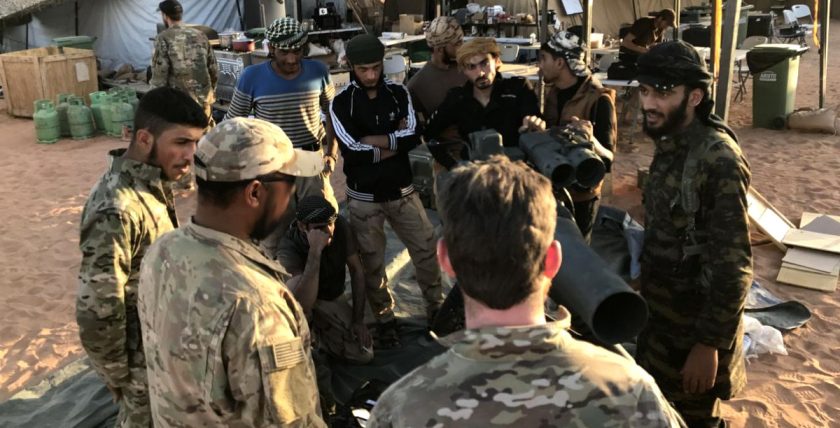
Unidentified Syrian rebels surround a piece of US weaponry during training by an American special forces member in Tanf. Photo | Hammurabi’s Justice News
With the U.S. now having claimed that Daesh has been completely defeated in Syria, the official justification for its illegal occupation of Syrian territory is wearing thin. With that justification now on shaky ground, the U.S. is increasingly having to acknowledge its main motive for its presence in al-Tanf — containing Iran and keeping Syria divided.
Indeed, a recent Reuters article notes that the U.S.-controlled area around al-Tanf that includes the Rukban camp “is designed to shield U.S. troops at the Tanf garrison and maintain for Washington a strategic foothold in an area close to a crucial supply route for Iranian weapons entering Syria from Iraq.” This was confirmed by General Joseph Votel late last year when he told NBC News that the U.S. base in al-Tanf was key in countering “the sway of Iran” in Syria.
This followed statements made last July by National Security Advisor John Bolton that U.S. troops would remain in Syria “as long as the Iranian menace continues throughout the Middle East.” This policy of Iran containment has clearly guided U.S. policy in Syria of late, with at least 1,000 U.S. troops set to stay in Syria illegally despite Daesh’s defeat and President Donald Trump’s recent calls for a troop withdrawal.
The U.S. has been accused of using the civilians trapped in Rukban as a “shield” for its continued operations in Syria aimed at containing Iran’s regional influence. Russian Foreign Minister Sergei Lavrov said earlier this month that “the fact that people are not allowed to leave [the camp] and are held hostage makes one suggest that the U.S. needs this camp to continue justifying its illegitimate presence there.” There appear to be few other explanations for the U.S.’ refusal to let camp inhabitants leave the area.
The hypocrisy of U.S. “humanitarian concerns”
The situation in the Rukban camp reveals the dark reality behind the U.S.’ occupation of Syrian territory in Al-Tanf and elsewhere. In order to pursue its policy of Iran “containment” and a divided and partitioned Syria, the U.S. is willing to imprison some 40,000 people — many of them children — in a concentration camp where international aid is blocked and where food is so scarce that mothers are setting themselves and their children on fire so they can avoid slowly starving to death.
According to the Cambridge Dictionary, a concentration camp is defined as “a place where large numbers of people are kept as prisoners in extremely bad conditions, especially for political reasons.” It is undeniable that the Rukban camp fits this definition to the letter.
That the U.S. justifies its aggressive policies around the world — from Syria to Venezuela and elsewhere — as being motivated by “humanitarian concerns” — when a refugee camp under the U.S.’ complete control in Syria is facing starvation conditions and its inhabitants are being forcefully kept confined in the camp by the U.S. military despite their expressed desire to leave — is an obscene Orwellian twist. All this to “contain” Iranian influence in the Middle East.
Whitney Webb is a MintPress News journalist based in Chile. She has contributed to several independent media outlets including Global Research, EcoWatch, the Ron Paul Institute and 21st Century Wire, among others. She has made several radio and television appearances and is the 2019 winner of the Serena Shim Award for Uncompromised Integrity in Journalism.
Sayyed Nasrallah: “Liar” Pompeo Visited Lebanon to Incite against Hezbollah
Al-Manar – March 26, 2019
Hezbollah Secretary General Sayyed Hasan Nasrallah lashed out at “liar” US Secretary of State, Mike Pompeo, who visited Lebanon last week, stressing that the US official’s remarks didn’t contain just single true issue.
In a speech broadcast via Al-Manar on Tuesday, Sayyed Nasrallah commented on Pompeo’s joint press conference with Lebanese Foreign Minister, Gebran Bassil last week.
The resistance leader stressed that the US official had visited Lebanon to incite the Lebanese people against Hezbollah, noting that had it not been for Hezbollah, Pompeo would have not made his visit to Lebanon.
On the other hand, Sayyed Nasrallah commented on the US decision to recognize the so-called “Israeli sovereignty” on the occupied Golan Heights, describing the move as “crucial and decisive event in the Arab-Israeli struggle.”
Recognition of ‘Israeli Sovereignty’
Sayyed Nasrallah started his speech by offering condolences to Iraqis over the Mosul ferry disaster which killed dozens of people earlier last week.
His eminence then saluted Palestinian people over their steadfastness in face of continued Israeli aggression in Gaza and West Bank.
Sayyed Nasrallah also didn’t forget to salute Yemeni people, over their heroic achievements throughout four years of Saudi-led war on the Arab impoverished country.
Hezbollah S.G. described the US move to recognize ‘Israeli sovereignty’ over Golan Heights a crucial and decisive event in the Arab-Israeli struggle, noting that “condemnation statements are no more enough.”
Talking about the indications of the US move, Sayyed Nasrallah said President Donald Trump’s decision means that he doesn’t care about millions of Muslims and Arabs- including his allies-, as well as about international laws, noting that the entire world recognizes the Syrian sovereignty on the Golan Heights.
“The entire world recognizes Golan as a Syrian land. Only Trump was the exception, just for the sake of ‘Israel’. This proves that the US administration neither recognize the United Nations nor the international laws, and uses these organizations just to serve its own interests.”
In this context, Sayyed Nasrallah stressed that the international organizations and laws are incapable of restoring the rights of the people.
“The top priority of the US administrations and especially the current administration is ‘Israel’. There is no consideration for any other issue when it comes for the interest of ‘Israel’.”
Sayyed Nasrallah meanwhile, recalled when Trump administration recognized Al-Quds (Jerusalem) as the capital of the Zionist entity, stressing that the silence of the Muslim and Arab world “opened the door for all these violations.”
“After the move to recognize Al-Quds what was been left more? The Arabs and Muslims stance towards Al-Quds has encouraged Trump to take similar actions regarding the Golan,” Sayyed Nasrallah said.
Sayyed Nasrallah called on Arab states to withdraw the 2002 Arab initiative during an upcoming Arab summit in Tunis. On the other hand Sayyed Nasrallah stressed that the only way to regain Syrian, Lebanese and Palestinian occupied lands from the Zionist entity is the resistance.
“Liar” Pompeo
Sayyed Nasrallah the commented at statement made by Pompeo last week at length, discussing most of the points mentioned by the US official during his press conference with FM Bassil.
“First, in shape: Pompeo was reading a written statement in which Hezbollah was mentioned 18 times while Iran was mentioned 19 times. He refused to answer the reporters’ questions.”
“We feel happy when an official from the world’s most powerful state is concerned over our role. We feel happy when the administration of The Great Satan is annoyed by Hezbollah.”
Sayyed Nasrallah said that Pompeo’s remarks on Hezbollah “made us more faithful that we are in the right position.”
“Second, in the content: I didn’t find in Pompeo’s remarks a single true and right statement. The US is fighting in the region on behalf of ‘Israel’.”
“Pompeo talked about stability and prosperity in Lebanon. He described Hezbollah as the main problem in the country and the region for the past 34 years. However he didn’t mention massacres and crimes committed by the Israeli occupation throughout these years. According to Pompeo, ‘Israel’ poses no threat to Lebanon and the region, but Hezbollah does, and this is a big lie.”
“Pompeo said that Hezbollah is an obstacle in front of the Lebanese people’s dreams. Is that true? The Lebanese people dream of securing peace in their country, dream of regaining its land and in preventing other countries from violating its wealth, dream of building a powerful state and countering corruption. Does Hezbollah pose an obstacle in this regard, or it is a party that has been working to achieve these dreams?” Sayyed Nasrallah wondered.
Commenting on Pompeo’s remarks that Hezbollah is seeking destruction through its “terrorists wing”, Sayyed Nasrallah lashed out the US official, stressing that the US itself has been for many years seeking destruction and committing crimes across the world.
Touching upon Hezbollah’s engagement in the Syrian war, Sayyed Nasrallah said that Pompeo in his remarks last week in Beirut was addressing Hezbollah’s incubating environment, stressing that the Lebanese resistance party had defended Lebanon against Takfiri terrorists supported by the US.
“All know what Lebanon’s fate would have been if ISIL and Nusra had controlled Syria.”
Commenting on Pompeo’s question on how Hezbollah missiles can save Lebanon, Sayyed Nasrallah described such remarks as “stupid”, stressing that Israeli attacks against Lebanon have been since years ago.
“An official from the most terrorist state in the world came to Lebanon to incite the Lebanese people against Hezbollah’s resistance.”
Sayyed Nasrallah then described Pompeo as a “liar”, recalling the US official remarks on Syrian refugees.
“The US has been preventing Syrian refugees in Rukban camp and other areas from returning to their land.”
Commenting on Pompeo’s remarks when he asked “what Hezbollah and Iran have offered to Lebanon,” Sayyed Nasrallah addressed the US official as saying: “Had it not been for Hezbollah, you would have not made your visit to Lebanon.”
Bolton blasts Turkey for maintaining ‘very bad’ relations with Israel
Press TV – March 18, 2019
US National Security Adviser John Bolton has not ruled out that Turkey is a “foe” of the United States, blasting Ankara for maintaining a “very bad” relationship with Washington’s close ally Israel.
When asked by AM 970 radio host John Catsimatidis on Sunday whether Turkey was a “friend or foe” to the US, Bolton refused to give a straight answer and instead cited several major stumbling blocks in ties.
“Well you know they’re still a NATO ally; we’re trying to work with them, but they’ve got a very bad relationship with our close friends in Israel. That’s something we need to look out on,” Bolton said.
A war of words began between Turkey and Israel recently, when Israeli Prime Minister Benjamin Netanyau said the occupied territories only belong to the Jewish people and not all citizens.
Turkish presidential spokesman Ibrahim Kalin strongly condemned Netanyahu’s “blatant racism and discrimination.”
In response, the Israeli premier called Turkey’s President Recep Tayyip Erdogan a “dictator” who jails journalists and judges.
Erdogan, however, called Netanyahu a “thief” and a “tyrant who massacred seven-year-old Palestinian children.”
The war of words continued Friday when the Turkish president rebuked Netanyahu’s son for suggesting the city of Istanbul was under “Turkish occupation”.
“You occupied the whole of Palestine!” Erdogan fired back at Netanyahu’s son, saying it is actually the Tel Aviv regime which has occupied the entire Palestinian land.
Elsewhere in his Sunday comments Bolton said that disagreements “with respect to the conflict in Syria” were another issue affecting bilateral ties between the US and Turkey.
He said US President Donald Trump “would like to have a good relationship with Turkey; he’d like to see US trade with Turkey increase, but we need them to help us out in some of these other problems in Syria and elsewhere in the region.”
US support for YPG militants, whom Ankara views as terrorists and their group an extension of the outlawed Kurdistan Workers’ Party (PKK), has angered Turkey.
The US has been arming and training Kurdish militants under the banner of helping them fight Daesh, but Syria and several other countries see ulterior motives behind the deployment.
President Trump’s decision last year to leave Syria has exposed the Kurdish group to possible Turkish attacks.
Fears of a Turkish assault have led the Kurds to strike an agreement with the Syrian government to leave Manbij in exchange for military support in case they come under attack from Turkey.
Turkey, a key US ally in the region, has repeatedly questioned Washington’s deployment of heavy weapons in Syria despite the defeat of Daesh in much of the Arab country.
Bolton slams Turkey over S-400 deal
In his talks to AM 970 radio, Bolton further blasted Turkey for refusing to abandon a deal to purchase S-400 air defense missile systems from Russia, a major obstacle to US-Turkish relations.
“We’re concerned about their purchase of the Russian air defense system called the S-400 – that’s a big problem,” Bolton said.
The United States has warned Turkey of “grave consequences” if Ankara goes ahead with the plan to purchase Russian S-400 missile systems.
Moscow and Ankara finalized an agreement on the delivery of the S-400 missile systems in December 2017.
Last April, Erdogan and his Russian counterpart Vladimir Putin said in Ankara that they had agreed to expedite the delivery which could be made between late 2019 and early 2020.
Washington has reportedly proposed to deliver one US-made Patriot missile battery by the end of 2019, on the condition that Ankara abandons the deal with Moscow.
The S-400 is an advanced Russian missile system designed to detect, track, and destroy planes, drones, or missiles as far as 402 kilometers away. It has previously been sold only to China and India.
Turkey is striving to boost its air defense, particularly after Washington decided in 2015 to withdraw its Patriot surface-to-air missile system from Turkey’s border with Syria, a move that weakened Turkey’s air defense.
Iranian official rejects US secretary of state’s ‘fabricated’ allegations
Press TV – March 14, 2019
A senior Iranian official has dismissed US Secretary of State Mike Pompeo’s recent claims about Iran’s regional role as “fabricated,” saying the United States practices fear-mongering in order to sell more arms to the countries in the region.
“Certain US officials, influenced by the Zionist lobby, have been making utmost efforts to intoxicate the atmosphere against Iran,” Iran’s Foreign Ministry Spokesman Bahram Qassemi said on Thursday.
In a meeting with United Nations Secretary General Antonio Guterres on Wednesday, Pompeo expressed concerns over what he called Iran’s “destructive and disruptive activities” across the Middle East region.
Qassemi said US officials were making up allegations against Iran in order to sustain an appearance of crisis in West Asia and thus increase American arms sales to the region.
The Iranian official also censured remarks made by Pompeo in the CERAWeek conference — an annual US oil and gas industry forum — regarding relations between the Islamic Republic and Iraq.
Addressing the conference in Houston on Tuesday, Pompeo had said, “Iran uses its energy exports to exert undue influence all across the Middle East, most particularly today on Iraq.”
Qassemi said Pompeo was angered by the close relations between Iran and Iraq.
“The relations between Iran and Iraq have been established totally based on the will of the two countries’ leaders and nations and [have been] based on mutual respect and trust and shared interests,” he said, adding that neither of the two countries was seeking to impose its will on the other.
On Monday, Iranian President Hassan Rouhani traveled to Iraq at the head of a high-ranking delegation. The state visit featured several meetings between President Rouhani and Iraq’s top leadership, and the signing of memorandums of understanding for the expansion of bilateral ties in various fields, including the energy sector.
On Wednesday, President Rouhani traveled to the Iraqi city of Najaf to meet with senior religious leaders there, including most prominently with Iraq’s top Shia cleric Grand Ayatollah Ali al-Sistani. Rouhani was the first Iranian president ever to meet with Ayatollah Sistani, signifying the depth of bilateral relations between Tehran and Baghdad.
Qassemi, the Iranian Foreign Ministry spokesman, pointed to the deep-rooted relations between Iran and Iraq and said the two countries had stood by each other during “tough times.”
Earlier, US President Donald Trump had made an unannounced and very brief trip to Iraq in the dark of the night and landed at a military base where he only met US soldiers and no Iraqi officials before he left the country.
Whose Interests Are Served by the US Occupation of East Syria: America’s or Israel’s?
By Mike Whitney • Unz Review • March 11, 2019
What is Israel’s stake in east Syria? Has Israel influenced Washington’s decision to maintain a long-term military presence in Syria? How does Israel benefit from the splintering of Syria into smaller statelets and from undermining the power of the central government in Damascus? Did Israel’s regional ambitions factor into Trump’s decision to shrug off Turkey’s national security concerns and create an independent Kurdish state on Syrian sovereign territory? What is the connection between the Kurdish independence movement and the state of Israel?
The Pentagon does everything in its power to conceal the number and location of US military bases in a war zone. That rule applies to east Syria as well, which means we cannot confirm with absolute certainty how many bases really exist. Even so, in 2017, a Turkish news agency, “Anadolu Agency published an infographic on Tuesday showing 10 locations in which US troops were stationed. Two airbases, eight military points in PKK/PYD-controlled areas.”
According to a report in Orient.Net : “The 8 military sites, according to the agency, host military personnel involved in coordinating the aerial and artillery bombardments of US forces, training Kurdish military personnel, planning special operations and participating in intensive combat operations.” (“AA’s map of US bases in Syria infuriates Pentagon”, orient.net )
The location of these bases is unimportant, what is important is that there has been no indication that Washington has any plan to close these bases down or to withdraw American troops. In fact, as the New York Times reported just weeks ago, the number of US troops has actually increased by roughly 1,000 since Trump made his withdrawal announcement in mid-December. We think that is especially significant in view of Trump’s surprising comments last week, that he now agrees “100%” with maintaining a military presence in Syria. His sudden reversal shows that the opponents of the “withdrawal plan” have prevailed and the US is not going to leave Syria after all. It’s also worth noting that Trump administration has made no effort to implement the “Manbij Roadmap” which requires the US to coordinate its withdrawal with the Turkish military in order to maintain security and avoid a vacuum that could be filled by hostile elements. Ankara and Washington agreed to this arrangement long ago in order to expel Kurdish militants (who Turkey identifies as “terrorists”) from the area along the border. It appears now that Trump will not honor that deal, mainly because Trump intends to be in Syria for the long-haul.
But, why? Why would Trump risk a confrontation with a critical NATO ally (Turkey) merely to hold a 20 mile-deep stretch of land that has no strategic value to the United States? It doesn’t make sense, does it?
Now in earlier articles we have argued that influential think tanks, like the Brookings Institute, have played a critical role in shaping Washington’s Syria policy, and that indeed is true. Just take a look at this short excerpt from a piece by Brookings Michael E. O’Hanlon titled “Deconstructing Syria: A new strategy for America’s most hopeless war”. Here’s an excerpt:
“… the only realistic path forward may be a plan that in effect deconstructs Syria…. the international community should work to create pockets with more viable security and governance within Syria over time… The idea would be to help moderate elements establish reliable safe zones within Syria once they were able…. Creation of these sanctuaries would produce autonomous zones that would never again have to face the prospect of rule by either Assad or ISIL….
The interim goal might be a confederal Syria, with several highly autonomous zones… The confederation would likely require support from an international peacekeeping force… to help provide relief for populations within them, and to train and equip more recruits so that the zones could be stabilized and then gradually expanded.” (“Deconstructing Syria: A new strategy for America’s most hopeless war”, Michael E. O’Hanlon, Brookings Institute)
Strategic planners and think-tank pundits have long sought to break up Syria, that’s old news. What’s new is the emergence of powerful neocons operating in the White House and State Department (John Bolton, Jared Kushner, Mike Pompeo) who, we suspect, are using their influence to shape policy in a way that is sympathetic to Israel’s regional ambitions. It’s worth noting, that Zionist plans to dismember surrounding Arab states to ensure Israeli superiority, date back more than 30 years. The so called Yinon plan was a fairly straightforward strategy to balkanize the Middle East’s geopolitical environment to enhance Israeli regional hegemony while “A Clean Break” was a more recent adaptation which emphasized “weakening, containing or even rolling back Syria” and “removing Saddam Hussein from power in Iraq.” In any event, many right-wing Israelis seem to think that chopping up sovereign Arab states into smaller bite-sized pieces, governed by tribal leaders or Washington’s puppets, will unavoidably boost Tel Aviv’s power across the Middle East.
But how does the US military occupation of east Syria fit in with all this?
Well, the US occupation effectively creates an independent Kurdish state in the heart of the Arab world which helps to weaken Israel’s rivals. That’s why some have referred to emerging Kurdistan as a “second Israel”. Here’s how Seth Frantzman, a research associate at the Rubin Center for Research in International Affairs in Herzliya, explains it:
“Israel would welcome another state in the region that shares its concerns about the rising power of Iran, including the threat of Iranian-backed Shia militias in Iraq,” says Frantzman. “Reports have also indicated that oil from Kurdistan is purchased by Israel.” (“Why Israel supports an independent Iraqi Kurdistan”, CNN)
While its true that Kurdish oil may provide an added incentive for long-term occupation, the real goal is to block a “land corridor” from opening (that would connect Beirut, to Damascus, to Baghdad to Tehran) and to further undermine Iran’s growing influence in the region. Those are the real objectives. In fact, US military operations in Syria are actually part of a broader campaign directed at Iran, a campaign that undoubtedly has the full support of neocons Pompeo and Bolton.
Check out this lengthy quote from a piece by Rauf Baker at The Begin-Sadat Center for Strategic Studies which helps to put the whole Israel-Kurdistan issue into perspective:
“Since declaring “Rojava” in northern and northeastern Syria in 2013, the Democratic Union Party (PYD) and its military arm, the People’s Protection Units (YPG), both of which are linked to the PKK, have built a uniquely viable entity amid the surrounding bedlam. (Note: The PKK, is on the State Departments list of terrorist organizations and has been conducting a war on Turkey for more than 3 decades.)
The ancient proverb “the enemy of my enemy is my friend” could be useful to Israel in this grim scenario. The Syrian regime continues to uphold its traditional anti-Israel stance, and is in any case largely dependent on Iran, Hezbollah, and the other Shiite militias, all of which want Israel destroyed….
The Syrian Kurdish parties opposing PYD are openly linked to Ankara, which is ruled by a president, Recep Tayyip Erdoğan, who is obsessed with power and whose ideology considers the entire State of Israel to be illegitimately occupied by Jews. Moreover, he has recently established a rapprochement with Tehran – a worrying development…
Iran is now closer than ever to securing a land corridor that will connect it to the Mediterranean through Iraq, Syria, and Lebanon. This corridor will expand its sphere of influence from the Strait of Hormuz in the east to the Mediterranean in the west, and will ensure that Israel is surrounded by land and sea…
Should Israel strengthen its relationship with the Syrian Kurds, its gains would extend beyond strategic, political, and security benefits. Rojava’s natural resources, especially its oil, can contribute to Israel’s energy supply and be invested in projects such as an oil pipeline through Jordan to Israel. US troops are stationed at several military bases in Rojava, which could offer an alternative to Incirlik Air Base in Turkey...
It appears abundantly clear that the Kurds are the most qualified, if not the only, candidate in Syria on which Israel can count for support… Israel should act swiftly to support the emerging Kurdish region in Syria...
It is very much in Israel’s interest to have a reliable and trustworthy friend in the new Syria. If Jerusalem hopes, together with its ally in Washington, to prevent Tehran from establishing its long-sought land corridor, it will need to strengthen its influence in the Syrian Kurdish region to serve as a wall blocking Iran’s ambitions.” (“The Syrian Kurds: Israel’s Forgotten Ally”, Rauf Baker, BESA Center)
So, the question is: Whose interests are really served by the US occupation of east Syria: America’s or Israel’s?
Pakistan Must Resist Demands From “Friends”
The Perfectionistas | March 9, 2019
Someone needs to send the Pakistani government a copy of the picture book If You Give a Mouse a Cookie.
In it, a pestering mouse asks a boy for a cookie, and after he obliges, the rodent gets pushier with his demands until he’s moved into the exhausted boy’s house.
Similarly, Pakistan is surrounded by a nest of mice, actually wolves in sheep’s clothing, pressuring the nuclear-armed country through a carrots-and-sticks policy to oblige to their demands to join the anti-Iran coalition. These countries include America, Israel, Saudi Arabia, and United Arab Emirates, all bent on waging war with Iran and aware they can’t do it without cooperation from Pakistan.
Prime Minister Imran Khan’s government has so far resisted pressure to join the war path but future prospects look precarious, unfortunately, as the government shows signs of capitulating under stress and altering policies to oblige outsiders.
This week, for example, under global pressure to reign in terrorists, the government seized hundreds of institutions run by banned outfits and apprehended their leaders. That’s the right thing to do, of course, but should be done on principle not under pressure.
Buckling under pressure sends signals to others that, if enough force is applied, Pakistan will come around and do as told.
High on the American-Israeli-Saudi axis to-do list for Pakistan right now is normalizing relations with Israel, something most Arab countries have done de facto but are waiting for 200-million strong Pakistan to do first so they can declare it officially. Pakistan’s founder Muhammad Ali Jinnah refused to recognize Israel in 1947, and that has remained the country’s policy.
While getting Pakistan to change course on Israel is a tall order, especially with Pakistani officials accusing Israelis of involvement in India’s foiled attacks on Pakistan last month, the pressure is on nonetheless, and has been intensified since Khan, whose ex-wife has Jewish roots, took office last year.
Khan insists normalization with Israel is not on the table but some in his government have already succumbed to the normalization narrative.
Last month Pakistan’s Foreign Minister Shah Mehmood Qureshi told an Israeli news portal that “Pakistan is interested in advancing its relations with Israel,” according to media reports, and in November MNA Asma Hadid tried coaxing colleagues to support Israel during a meeting of the National Assembly. The media also claims that the Pakistani government allowed a plane carrying a senior Israeli official to fly into Islamabad from Tel Aviv last fall. And although the Pakistani passport says it is “valid for all countries of the world except Israel,” a Pakistani Jew was allowed to fly to Israel for the first time in January.
Others pushing Pakistan to establish diplomatic ties with Israel include:
- Military men: Pakistan’s former President Retired General Pervez Musharraf told reporters in Dubai last month that “there is no harm to establish a relationship with Israel” as it will help “counter India,” buttressing the arguments of those who say India’s attacks were the “sticks” to get Pakistan to normalize relations with Israel.

- Media: Pakistan’s English-language newspaper Daily News editorialized last week that Pakistan should explore ties with Israel as the two “are not enemies.”
- Lobby: The Pakistan Israel Alliance (PIA) of London “seeks to build bridges and better understanding between Israelis and Pakistanis,” according to its Facebook page. PIA offers ways of “maintaining relations” off-the-record, including the pre-revoluton Iranian model (recognize Israel secretly like the Shah of Iran), Jordanian model (close political and military ties without official recognition), or Chinese model (establish military contacts before political relations), according to a February 2018 post on its Facebook page.
- Literature: PIA’s publishing arm Pak Israel News releases books in Urdu celebrating Zionism, such as “Zionism, Israel, and Palestinians” and “The State of Israel: In War and Peace and Islamic Terrorism.”
Even if Pakistan does sell its soul and recognizes Israel, demands on the country–like those on the boy in If You Give a Mouse a Cookie–will not stop until Pakistan too is weakened to the point of collapse. These demands include helping the American-Israeli-Saudi axis wage war on Iran and the nuclear disarmament of Pakistan. Scholar Syed Jawad Naqvi predicts Pakistan will eventually be pressured to shut its nuclear program and sell its technology to Saudi Arabia.
Pakistan can learn from the disastrous affects of capitulating to outside pressures from Iran. Iran’s economy is in shambles after agreeing to curb its nuclear program under a 2013 deal with the US and five other countries. Not only did the the US start putting demands on Iran’s missile program next but it then backed out of the agreement altogether and imposed stringent sanctions on the Iranian nation.
Iran’s Supreme Leader Imam Ali Khamanei had warned its politicians that acquiescence to demands will lead to attempts to “bring the country’s decision-making… centers under their control.”
“The point is Iran doesn’t follow arrogant powers,” Khamanei said in 2016. “In this war, willpowers are fighting. The stronger willpower will win.”
Pakistan, too, must strengthen its resolve and resist outside pressures. That is the only way to fail the best-laid schemes of mice and men.
Is The UK Prepared To Add Iran to Its List Of Terrorists? Tightening The Noose Around The Neck of The Community That Supports Hezbollah
By Elijah Magnier | American Herald Tribune | March 5, 2019
The UK government has added the political and military branches of Lebanese Hezbollah to its terrorist list following a decision initiated by Home Secretary Sajid Javid and approved by Parliament. Hezbollah, or the “Party of God” is now one of the 74 foreign groups and 14 other groups related to Northern Ireland on the list. Any support to this organisation falls under the Terrorism Act of 2000. In the same act, under the rubric of fund-raising, offences, article 15, it clearly states that any person commits an offence if he invites others to provide money or other property to a proscribed group. Since the General Secretary of Hezbollah Sayed Hassan Nasrallah and the government of Iran both overtly acknowledge the financial, military, technical, intelligence and other social services support that Iran provides to the organisation, a clear question arises for the UK government: Will the Iranian government be included on its terrorism list, or is the UK government ready to violate its own law? What is the real purpose behind the UK decision?
The point is not to identify Hezbollah as a terrorist group. The goal is rather to prevent donations from reaching Hezbollah at a time when Iran is under heavy sanctions meant to limit its cash flow and, consequently, impede its financial support to groups like Hezbollah in Lebanon, the Syrian government, and other groups in Iraq and Yemen. This is what the UK Home Secretary Sajid Javid meant by “secret intelligence” during his last intervention at the House of Commons. Time will tell if this secret intelligence has been correctly understood and will serve the UK’s desired objectives.
The Terrorism Act of 2000, under funding arrangements, article 17 (a) and (b), states as follows: “A person commits an offence if he enters into or becomes concerned in an arrangement as a result of which money or other property is made available or is to be made available to another… that will or may be used for the purposes of terrorism”.
Article 12, under the rubric “Support”, is explicit: “A person commits an offence if he invites support, provision of money for a proscribed organisation, and arranges a meeting to support or encourage support for a proscribed organisation, or participates in a private meeting…”
The text of the articles is unambiguous: anyone who supports or meets with Hezbollah individuals or commanders is subject to a maximum of 10 years of prison. These clauses cannot but apply to Iran, the first and utmost supporter of Hezbollah.
Iranian officials, beginning with Foreign Minister Jawad Zarif, can no longer visitSayed Nasrallah and then go to the UK or meet UK officials without risk of imprisonment, now that the UK officially classifies Hezbollah as a terrorist organisation.
Hezbollah’s yearly budget to operate in Syria and Lebanon and to support any other group with weapons or transfer of expertise is provided by the Iranian government, together with additional funds that Sayed Ali Khamenei provides from donations to the Imam Reza shrine. Thus, in accordance with the 2000 legislation, the UK can be expected to cut its relationship with Iran at once.
Politically speaking, Hezbollah meets in private and overtly with all political leaders of Lebanon. These meetings begin with the Christian President Michel Aoun, the Sunni Prime Minister Saad Hariri, the Shia Speaker Nabih Berri, and the Ministers of Foreign affairs Joubran Basil, Defence Elias bu Saab, Health Jamil Jabq and Finance Ali Hasan Khalil, and most political leaders of the country. This imposes – theoretically – on the UK government the obligation to reject any entry visa to all these politicians and to prevent any meetings with their diplomats after March the 3d, 2019.
What if the UK breaks its own laws and its officials meet with Hezbollah officials or those who hold private meetings with its leaders, in defiance of the UK Terrorism Act of 2000? If this happens, it will be difficult for any UK court to uphold a solid case against any Hezbollah supporter since UK officials regularly meet with their Iranian counterparts, who are responsible for funding Hezbollah.
The “Party of God” has no offices or representatives in any city around the world, even among the millions in the Lebanese community living abroad. Of course, there are thousands of Hezbollah supporters in the Lebanese Diaspora, notably Christians from the Tayyar al-Watani party led by President Aoun and his son-in-law the Foreign Minister Basil. And there are many more supporters among Shia in the diaspora who originate from the south of Lebanon, the Bekaa Valley, Beirut and its suburbs. They have family members or cousins who operate within Hezbollah or at least support the organisation; some of these “Diaspora Shia” have adopted overtly Hezbollah’s cause on their own personal initiative.
Most of these Lebanese consider the cause of Hezbollah as their own because the group defended their Christian villages and cities from al-Qaeda and ISIS when these groups were based on the borders with Lebanon and in the Lebanese city of Arsal, with plans to expand into Lebanon. They consider Hezbollah the only force capable of protecting their homes in the south of Lebanon from any future Israeli aggression, in the face of daily Israeli violations of Lebanese sea, air and ground sovereignty.
There is no doubt that these enthusiastic Lebanese will be the favourite targets of Britain’s domestic security forces who are looking to register “a security achievement” of any kind. The problem was on the table in many cities around the world when Lebanese Shia sought to fulfil their Islamic tithing duty by donating 20% of their year-end profits. According to some Fatwas (Shia are free to follow the highest religious authority in accordance with their understanding of Islam), this 20% can be donated to the “Islamic Resistance”, i.e. Hezbollah. From now on anyone sending money for this Islamic purpose that ends up in Hezbollah coffers must be considered a financer of a terrorist organisation.
This same issue was a serious problem for Lebanese in the USA who were obliged to stop sending money back to Lebanon except for family members. Lebanese communities in many countries voluntarily observed the same restrictions in order to avoid severe penalties or jail in the west, causing a reduction in donations to Hezbollah. Thus, Hezbollah today relies exclusively on Iranian support.
The new measures in the UK do not aim to interfere with Hezbollah’s “non-existent” presence in the West and equally non-existent bank accounts abroad, nor do they aim to close Hezbollah offices that do not exist abroad. The new measures have the goal of tightening the noose around the neck of the community that supports Hezbollah.
The West began this process inside Lebanon by going after Lebanese banks and the accounts of wealthy Shia. Even exchange offices who change Hezbollah’s euros into dollars were included on the terrorist list. Wealthy Shia businessmen who sympathise with Hezbollah and who were involved in projects in Iraq saw their assets frozen by Iraq’s former Prime Minister Haidar Abadi in response to an official US request.
The western measures may succeed in making life more difficult for pro-Hezbollah Christians and Shia around the world. Nevertheless, the majority of Lebanese cannot renounce Hezbollah any more than they can renounce their own families, because Hezbollah is integral to their existence; nor is it confined to their homes and family members. Its ideology of Resistance informs their creed and world view, and this is the case whether or not they believe in Islam.
Featured Video
Integrity Initiative: UK-funded network framed dissent as Russian disinformation for years
or go to
Aletho News Archives – Video-Images
From the Archives
Why Saudi Ties to 9/11 Mean U.S. Ties to 9/11
By Kevin Ryan | Dig Within | September 27, 2015
Media interest in Saudi Arabian connections to the crimes of 9/11 has centered on calls for the release of the 28 missing pages from the Joint Congressional Inquiry’s report. However, those calls focus on the question of hijacker financing and omit the most interesting links between the 9/11 attacks and Saudi Arabia—links that implicate powerful people in the United States. Here are twenty examples. … continue
Blog Roll
 Aletho News
- ‘A Big Victory’ – Palestine Chronicle Wins Two-Year Legal Battle
- IAEA inspectors cannot return to Iran amid US threats: Russia
- Senate Rejects Iran War Powers Resolution Passed By House
- ‘We did not attack Pakistan with drones’: Afghan sources
- Iraqi Resistance faction links arms to sovereignty, questions US exit
- Cannon fodder no more… South Korea rejects Trump’s pressure to join his criminal war on Iran
- Neria Leiter Was A Legitimate Military Target
- Integrity Initiative: UK-funded network framed dissent as Russian disinformation for years
- ‘We don’t seek permission to defend our country’: Snippets from President Pezeshkian’s UNGA address
- NATO chief wants Europeans to fight American wars [for Israel]
- If Americans Knew
- In UN Speech, Iran’s President Displays Pictures of Children Killed by US, Brings Attention to Israel’s Nuclear Arsenal
- Israel displaces hundreds of Palestinians amid wave of demolitions in West Bank
- Aid, reconstruction, and Israel’s history of obstruction in Gaza
- Trump administration digs an ever-deeper hole of complicity in genocide – Daily Update
- US-Israel $2.8 Billion Arms Deal, 40,000-Bomb Supply Faces New Gaza Complicity Accusations
- Caught on Tape: AIPAC CEO Boasted of Controlling Trump’s National Security Officials
- Why Hamas Attacked Israel in October 2023 – Israeli professor Ilan Pappé
- They see them, then kill them: Israeli quadcopters track, deliberately target civilians in Gaza
- Winter could turn Gaza’s treacherous, war-damaged buildings into deathtraps
- Majority of Democratic Voters Want to Prosecute Both Biden and Trump Administration Officials Over Gaza
- No Tricks Zone
- New Study: Earth And Venus Surface Warmth Largely Explained By Convection And Lapse Rate, Not CO2 Or Radiation
- 2025 Nature Paper Claiming Worsening Global Drought Gets RETRACTED …Heavily Flawed
- New Study: ‘Global Drought Shows No Detectable Recent Acceleration Under Climate Warming’
- Economic Masterminds: German Socialists Suggest Taxing Productivity Gains Stemming From Using AI
- The South China Sea Has Not Been Cooperating With The Climate Change Narrative
- Energy Crisis: Germany Enters Heating Season With Historically Low Gas Reserve Fill Levels
- New Study: The Antarctic Ice Sheet Gained Mass From 2020-2024 Due To Staggering Snow And Ice Accumulation
- Study: Ocean Heating Rates From Thousands Of Years Ago ‘Dwarf’ Modern Ocean Heating Rates
- Climate Extremists Target, Attack Large-Scale Power Grid Infrastructure In Germany!
- New Study: Antarctic Ice Melt Has Contributed Less Than 1 Centimeter To Sea Level Rise In The Last 30 Years

