I was recently asked to participate and give a presentation at a closed, and invitation-only, conference in Washington, DC, on February 6th, 2019. The topic was: “Strategic Implications of Recent US Decisions on Syria”. I attended the conference and gave a presentation. The following is a summary of some of the things I said.
Upon my introduction, I informed the audience that I hold dual nationality, Syrian by birth and American by choice. In over five decades of academic work, I was always plagued by a nightmare of a war between the US and Syria, my two countries; unfortunately, this eventually become a reality. However, I should qualify; the ongoing war in Syria is not between the US and Syria, for there is no conflict between the Syrians and the Americans. It is a war waged by Washington against Syria in the service of Israel and some regional powers; Washington is waging a proxy war on Syria.
I briefly introduced Syria and its historic and religious importance. Syria is the cradle of civilization and home of the three monotheistic religions, where they started or flourished. I also reminded the audience that Syria is an archeological treasure; of the five oldest and continually inhabited cities, three are in Syria: Aleppo, the oldest, Damascus, the third and Latakia, the fifth. Following this introduction, I moved to the subject of the conference, dividing it into two sub topics:
- Trump Decisions to serve American interests in Syria; and
- Strategic Implications for Syria.
1. Trump’s Decisions
The first important decision taken by Trump was the establishment of the Zionist band in his administration made of five senior officials responsible for the formulation of American foreign policy. At no time in American history has there been such a concentration of Zionist power in the top echelon of a presidential administration. At the top of the Zionist band is Trump, the Commander-in-Chief; followed by Jared Kushner, his son in law and senior advisor; then comes John Bolton, national security advisor, Mike Pompeo, the Secretary of State, David Friedman, US Ambassador to Israel and lastly, the recently departed US Ambassador to the UN, ‘Nikki’ Haley. The formation of this Zionist band has had an adverse effect on Syria with further negative implications for Arabs and Muslims.
As for decisions to serve specific American interests in Syria, the White House, and a variety of American officials, have emphasized four American interests in the ongoing crisis in Syria: fight terrorism, protect the Kurds, roll back and contain Iran and Israel’s security.
Regarding the American ‘War on Terrorism’; people worldwide are skeptical of the American contention of waging a war on terrorism. When the uprising began in Syria in March 2011, America, and its regional allies, activated their many sleeper cells and opened their borders for swarms of tens of thousands of terrorists from all over the world to descend upon Syria. Once in, they were organized, equipped and financed to start their mission of rampage for ‘Regime Change’ and to render Syria a failed state. The plan failed and the terrorists became superfluous and a burden. They had to be eliminated and thus the American War on Terrorism in Syria which will conclude soon, says Trump.
As for the Kurds, they are Syrian citizens, who may have been discriminated against at one time or another. With the Syrian uprising, some of the Kurds were seduced by Washington. Unfortunately for them, and for Syria, they took the American bait. Washington will eventually drop them; it has already started the process with Israeli acquiescence. Israel originally supported the Kurdish plan to establish an autonomous state in the Arab region which would legitimize the existence of a Jewish state in the region. However, in view of the ongoing normalization process between Israel and some Arab states, a Kurdish state has become superfluous. Ultimately, Kurds will return to the Syrian fold where they belong. The modern history of the Kurds is victimization, partly due to their own doing; they are divided, prone to making bad decisions and ‘bit more than they can chew’. I recall a meeting I had with a politically active Kurdish group at the start of the Syrian uprising. After a brief introduction, the leader of the group unfolded a map of Kurdistan and put it on the table. I looked at the map and I was shocked at its contents. The western part of Kurdistan on the map, the Syrian Hasakah province, a northeastern province of Syria, in which the Kurds are a minority, was renamed ‘West Kurdistan’. I remember remarking that West Kurdistan is Syria’s Hasakah province, Syrian territory. The leader’s answer was “it is no more Syrian”. The Kurds, some of whom are relatively newcomers to Syria escaping Turkish mistreatment during the early decades of the last century, are a component of the Syrian society. For the Kurds to have special consideration in a united and unitary Syria may be possible, but secession or autonomy are fantasies.
The last two presumed American interests in Syria, rolling back and containing Iran and securing Israel, are interconnected. As for rolling back and containing Iran, it is to prevent Iran from establishing a land corridor connecting Iran with Iraq, Syria and Lebanon. In 2004 King Abdullah of Jordan warned the Arabs of the development of such a corridor and dubbed it a ‘Shiite Crescent’, a rather unfortunate provocative sectarian concept. It should be noted that most of this land corridor is known since ancient times as the Fertile Crescent. An appropriate name for the Shiite Crescent could have been the Levant Crescent or better yet, the Levant Cooperation Council, similar to the Gulf Cooperation Council, a pact of four states, Iran, Iraq, Syria and Lebanon facing common domestic, regional and international threats.
While the misnamed Shiite Crescent has been well covered and debated among Western intellectual, political, and military circles, another developing crescent, the Zionist Crescent, has escaped conversation and debate. The essence of the Zionist Crescent is the neutralization of Egypt to the West of Israel, Syria to the North and Iraq to the East, the three major historic Arab centers of power, which form a crescent around Israel and constitute the thrust of security threats to Israel. Egypt, the first segment of the Zionist Crescent, was neutralized in the 1979 peace treaty with Israel. Iraq, the second segment, was neutralized during the American invasion in 2003. Israel hoped Syria, the last segment of the Crescent, will be neutralized during the uprising in Syria; it was not to be.
Washington claims that rolling back and containing Iran and Israeli security constitute essential American interests; they are not – they are, essentially, Israeli interests. Washington is merely an instrument to serve Israeli interests and even potentially wage a war against Iran in the service of Israel, a la the invasion of Iraq in 2003. Iran is not a threat to America but could conceivably be a threat to Israel. However, Israel and behind it Washington, constitute a clear and present danger to Iran.
2. Strategic Implications for Syria
The original plan Washington and its allies sought was regime change and if successful, Syria a mosaic of religious, sectarian, and ethnic components, would become a failed state divided into Sunni, Alawite, Druse and Kurdish substates fighting continuous wars. Thus, the completion of the third and last segment of the Zionist Crescent. The plan failed, thanks to the persistence of the Syrian leadership, the Syrian people, and the help of genuine allies, Russia and Iran. Syria lives and the third segment of the Zionist Crescent is void, for the time being.
March 5, 2019
Posted by aletho |
Ethnic Cleansing, Racism, Zionism, Timeless or most popular, Wars for Israel | Israel, Middle East, Syria, United States, Zionism |
Leave a comment
This is a slightly revised version of essay that originally appeared in CounterPunch in December 2002.
Since the long-forgotten days when the State Department’s Middle East policy was run by a group of so-called Arabists, U.S. policy on Israel and the Arab world has increasingly become the purview of officials well known for tilting toward Israel. From the 1920s roughly to 1990, Arabists, who had a personal history and an educational background in the Arab world and were accused by supporters of Israel of being totally biased toward Arab interests, held sway at the State Department and, despite having limited power in the policymaking circles of any administration, helped maintain some semblance of U.S. balance by keeping policy from tipping over totally toward Israel. But Arabists have been steadily replaced by their exact opposites, what some observers are calling Israelists, and policymaking circles throughout government now no longer even make a pretense of exhibiting balance between Israeli and Arab, particularly Palestinian, interests.
In the Clinton administration, the three most senior State Department officials dealing with the Palestinian-Israeli peace process were all partisans of Israel to one degree or another. All had lived at least for brief periods in Israel and maintained ties with Israel while in office, occasionally vacationing there. One of these officials had worked both as a pro-Israel lobbyist and as director of a pro-Israel think tank in Washington before taking a position in the Clinton administration from which he helped make policy on Palestinian-Israeli issues. Another has headed the pro-Israel think tank since leaving government.
The link between active promoters of Israeli interests and policymaking circles is stronger by several orders of magnitude in the Bush administration, which is peppered with people who have long records of activism on behalf of Israel in the United States, of policy advocacy in Israel, and of promoting an agenda for Israel often at odds with existing U.S. policy. These people, who can fairly be called Israeli loyalists, are now at all levels of government, from desk officers at the Defense Department to the deputy secretary level at both State and Defense, as well as on the National Security Council staff and in the vice president’s office.
We still tiptoe around putting a name to this phenomenon. We write articles about the neo-conservatives’ agenda on U.S.-Israeli relations and imply that in the neo-con universe there is little light between the two countries. We talk openly about the Israeli bias in the U.S. media. We make wry jokes about Congress being “Israeli-occupied territory.” Jason Vest in The Nation magazine reported forthrightly that some of the think tanks that hold sway over Bush administration thinking see no difference between U.S. and Israeli national security interests. But we never pronounce the particular words that best describe the real meaning of those observations and wry remarks. It’s time, however, that we say the words out loud and deal with what they really signify.
Dual loyalties. The issue we are dealing with in the Bush administration is dual loyalties — the double allegiance of those myriad officials at high and middle levels who cannot distinguish U.S. interests from Israeli interests, who baldly promote the supposed identity of interests between the United States and Israel, who spent their early careers giving policy advice to right-wing Israeli governments and now give the identical advice to a right-wing U.S. government, and who, one suspects, are so wrapped up in their concern for the fate of Israel that they honestly do not know whether their own passion about advancing the U.S. imperium is motivated primarily by America-first patriotism or is governed first and foremost by a desire to secure Israel’s safety and predominance in the Middle East through the advancement of the U.S. imperium.
“Dual loyalties” has always been one of those red flags posted around the subject of Israel and the Arab-Israeli conflict, something that induces horrified gasps and rapid heartbeats because of its implication of Jewish disloyalty to the United States and the common assumption that anyone who would speak such a canard is ipso facto an anti-Semite. (We have a Jewish friend who is not bothered by the term in the least, who believes that U.S. and Israeli interests should be identical and sees it as perfectly natural for American Jews to feel as much loyalty to Israel as they do to the United States. But this is clearly not the usual reaction when the subject of dual loyalties arises.)
Although much has been written about the neo-cons who dot the Bush administration, the treatment of the their ties to Israel has generally been very gingerly. Although much has come to light recently about the fact that ridding Iraq both of its leader and of its weapons inventory has been on the neo-con agenda since long before there was a Bush administration, little has been said about the link between this goal and the neo-cons’ overriding desire to provide greater security for Israel. But an examination of the cast of characters in Bush administration policymaking circles reveals a startlingly pervasive network of pro-Israel activists, and an examination of the neo-cons’ voluminous written record shows that Israel comes up constantly as a neo-con reference point, always mentioned with the United States as the beneficiary of a recommended policy, always linked with the United States when national interests are at issue.
The Begats
First to the cast of characters. Beneath cabinet level, the list of pro-Israel neo-cons who are either policy functionaries themselves or advise policymakers from perches just on the edges of government reads like the old biblical “begats.” Deputy Secretary of Defense Paul Wolfowitz leads the pack. He was a protégé of Richard Perle, who heads the prominent Pentagon advisory body, the Defense Policy Board. Many of today’s neo-cons, including Perle, are the intellectual progeny of the late Senator Henry “Scoop” Jackson, a strong defense hawk and one of Israel’s most strident congressional supporters in the 1970s.
Wolfowitz in turn is the mentor of Lewis “Scooter” Libby, now Vice President Cheney’s chief of staff who was first a student of Wolfowitz and later a subordinate during the 1980s in both the State and the Defense Departments. Another Perle protégé is Douglas Feith, who is currently undersecretary of defense for policy, the department’s number-three man, and has worked closely with Perle both as a lobbyist for Turkey and in co-authoring strategy papers for right-wing Israeli governments. Assistant Secretaries Peter Rodman and Dov Zackheim, old hands from the Reagan administration when the neo-cons first flourished, fill out the subcabinet ranks at Defense. At lower levels, the Israel and the Syria/Lebanon desk officers at Defense are imports from the Washington Institute for Near East Policy, a think tank spun off from the pro-Israel lobby organization, AIPAC.
Neo-cons have not made many inroads at the State Department, except for John Bolton, an American Enterprise Institute hawk and Israeli proponent who is said to have been forced on a reluctant Colin Powell as undersecretary for arms control. Bolton’s special assistant is David Wurmser, who wrote and/or co-authored with Perle and Feith at least two strategy papers for Israeli Prime Minister Netanyahu in 1996. Wurmser’s wife, Meyrav Wurmser, is a co-founder of the media-watch website MEMRI (Middle East Media Research Institute), which is run by retired Israeli military and intelligence officers and specializes in translating and widely circulating Arab media and statements by Arab leaders. A recent investigation by the Guardian of London found that MEMRI’s translations are skewed by being highly selective. Although it inevitably translates and circulates the most extreme of Arab statements, it ignores moderate Arab commentary and extremist Hebrew statements.
In the vice president’s office, Cheney has established his own personal national security staff, run by aides known to be very pro-Israel. The deputy director of the staff, John Hannah, is a former fellow of the Israeli-oriented Washington Institute. On the National Security Council staff, the newly appointed director of Middle East affairs is Elliott Abrams, who came to prominence after pleading guilty to withholding information from Congress during the Iran-contra scandal (and was pardoned by President Bush the elder) and who has long been a vocal proponent of right-wing Israeli positions. Putting him in a key policymaking position on the Palestinian-Israeli conflict is like entrusting the henhouse to a fox.
Pro-Israel activists with close links to the administration are also busy in the information arena inside and outside government. The head of Radio Liberty, a Cold War propaganda holdover now converted to service in the “war on terror,” is Thomas Dine, who was the very active head of AIPAC throughout most of the Reagan and the Bush-41 administrations. Elsewhere on the periphery, William Kristol, son of neo-con originals Irving Kristol and Gertrude Himmelfarb, is closely linked to the administration’s pro-Israel coterie and serves as its cheerleader through the Rupert Murdoch-owned magazine that he edits, The Weekly Standard. Some of Bush’s speechwriters — including David Frum, who coined the term “axis of evil” for Bush’s state-of-the-union address but was forced to resign when his wife publicly bragged about his linguistic prowess — have come from The Weekly Standard. Frank Gaffney, another Jackson and Perle protégé and Reagan administration defense official, puts his pro-Israel oar in from his think tank, the Center for Security Policy, and through frequent media appearances and regular columns in the Washington Times.
The incestuous nature of the proliferating boards and think tanks, whose membership lists are more or less identical and totally interchangeable, is frighteningly insidious. Several scholars at the American Enterprise Institute, including former Reagan UN ambassador and long-time supporter of the Israeli right wing Jeane Kirkpatrick, make their pro-Israel views known vocally from the sidelines and occupy positions on other boards. Probably the most important organization, in terms of its influence on Bush administration policy formulation, is the Jewish Institute for National Security Affairs (JINSA). Formed after the 1973 Arab-Israeli war specifically to bring Israel’s security concerns to the attention of U.S. policymakers and concentrating also on broad defense issues, the extremely hawkish, right-wing JINSA has always had a high-powered board able to place its members inside conservative U.S. administrations. Cheney, Bolton, and Feith were members until they entered the Bush administration. Several lower level JINSA functionaries are now working in the Defense Department. Perle is still a member, as are Kirkpatrick, former CIA director and leading Iraq-war hawk James Woolsey, and old-time rabid pro-Israel types like Eugene Rostow and Michael Ledeen. Both JINSA and Gaffney’s Center for Security Policy are heavily underwritten by Irving Moskowitz, a right-wing American Zionist, California business magnate (his money comes from bingo parlors), and JINSA board member who has lavishly financed the establishment of several religious settlements in Arab East Jerusalem.
By Their Own Testimony
Most of the neo-cons now in government have left a long paper trail giving clear evidence of their fervently right-wing pro-Israel, and fervently anti-Palestinian, sentiments. Whether being pro-Israel, even pro right-wing Israel, constitutes having dual loyalties — that is, a desire to further Israel’s interests that equals or exceeds the desire to further U.S. interests — is obviously not easy to determine, but the record gives some clues.
Wolfowitz himself has been circumspect in public, writing primarily about broader strategic issues rather than about Israel specifically or even the Middle East, but it is clear that at bottom Israel is a major interest and may be the principal reason for his near obsession with the effort, of which he is the primary spearhead, to dump Saddam Hussein, remake the Iraqi government in an American image, and then further redraw the Middle East map by accomplishing the same goals in Syria, Iran, and perhaps other countries. Profiles of Wolfowitz paint him as having two distinct aspects: one obsessively bent on advancing U.S. dominance throughout the world, ruthless and uncompromising, seriously prepared to “end states,” as he once put it, that support terrorism in any way, a velociraptor in the words of one former colleague cited in the Economist; the other a softer aspect, which shows him to be a soft-spoken political moralist, an ardent democrat, even a bleeding heart on social issues, and desirous for purely moral and humanitarian reasons of modernizing and democratizing the Islamic world.
But his interest in Israel always crops up. Even profiles that downplay his attachment to Israel nonetheless always mention the influence the Holocaust, in which several of his family perished, has had on his thinking. One source inside the administration has described him frankly as “over-the-top crazy when it comes to Israel.” Although this probably accurately describes most of the rest of the neo-con coterie, and Wolfowitz is guilty at least by association, he is actually more complex and nuanced than this. A recent New York Times Magazine profile by the Times’ Bill Keller cites critics who say that “Israel exercises a powerful gravitational pull on the man” and notes that as a teenager Wolfowitz lived in Israel during his mathematician father’s sabbatical semester there. His sister is married to an Israeli. Keller even somewhat reluctantly acknowledges the accuracy of one characterization of Wolfowitz as “Israel-centric.” But Keller goes through considerable contortions to shun what he calls “the offensive suggestion of dual loyalty” and in the process makes one wonder if he is protesting too much. Keller concludes that Wolfowitz is less animated by the security of Israel than by the promise of a more moderate Islam. He cites as evidence Wolfowitz’s admiration for Egyptian President Anwar Sadat for making peace with Israel and also draws on a former Wolfowitz subordinate who says that “as a moral man, he might have found Israel the heart of the Middle East story. But as a policy maker, Turkey and the gulf and Egypt didn’t loom any less large for him.”
These remarks are revealing. Anyone not so fearful of broaching the issue of dual loyalties might at least have raised the suggestion that Wolfowitz’s real concern may indeed be to ensure Israel’s security. Otherwise, why do his overriding interests seem to be reinventing Anwar Sadats throughout the Middle East by transforming the Arab and Muslim worlds and thereby making life safer for Israel, and a passion for fighting a pre-emptive war against Iraq — when there are critical areas totally apart from the Middle East and myriad other broad strategic issues that any deputy secretary of defense should be thinking about just as much? His current interest in Turkey, which is shared by the other neo-cons, some of whom have served as lobbyists for Turkey, seems also to be directed at securing Israel’s place in the region; there seems little reason for particular interest in this moderate Islamic, non-Arab country, other than that it is a moderate Islamic but non-Arab neighbor of Israel. Furthermore, the notion suggested by the Wolfowitz subordinate that any moral man would obviously look to Israel as the “heart of the Middle East story” is itself an Israel-centered idea: the assumption that Israel is a moral state, always pursuing moral policies, and that any moral person would naturally attach himself to Israel automatically presumes that there is an identity of interests between the United States and Israel; only those who assume such a complete coincidence of interests accept the notion that Israel is, across the board, a moral state.
Others among the neo-con policymakers have been more direct and open in expressing their pro-Israel views. Douglas Feith has been the most prolific of the group, with a two-decade-long record of policy papers, many co-authored with Perle, propounding a strongly anti-Palestinian, pro-Likud view. He views the Palestinians as not constituting a legitimate national group, believes that the West Bank and Gaza belong to Israel by right, and has long advocated that the U.S. abandon any mediating effort altogether and particularly foreswear the land-for-peace formula.
In 1996, Feith, Perle, and both David and Meyrav Wurmser were among the authors of a policy paper issued by an Israeli think tank and written for newly elected Israeli Prime Minister Netanyahu that urged Israel to make a “clean break” from pursuit of the peace process, particularly its land-for-peace aspects, which the authors regarded as a prescription for Israel’s annihilation. Arabs must rather accept a “peace-for-peace” formula through unconditional acceptance of Israel’s rights, including its territorial rights in the occupied territories. The paper advocated that Israel “engage every possible energy on rebuilding Zionism” by disengaging from economic and political dependence on the U.S. while maintaining a more “mature,” self-reliant partnership with the U.S. not focused “narrowly on territorial disputes.” Greater self-reliance would, these freelance policymakers told Netanyahu, give Israel “greater freedom of action and remove a significant lever of pressure [i.e., U.S. pressure] used against it in the past.”
The paper advocated, even as far back as 1996, containment of the threat against Israel by working closely with — guess who? — Turkey, as well as with Jordan, apparently regarded as the only reliably moderate Arab regime. Jordan had become attractive for these strategists because it was at the time working with opposition elements in Iraq to reestablish a Hashemite monarchy there that would have been allied by blood lines and political leanings to the Hashemite throne in Jordan. The paper’s authors saw the principal threat to Israel coming, we should not be surprised to discover now, from Iraq and Syria and advised that focusing on the removal of Saddam Hussein would kill two birds with one stone by also thwarting Syria’s regional ambitions. In what amounts to a prelude to the neo-cons’ principal policy thrust in the Bush administration, the paper spoke frankly of Israel’s interest in overturning the Iraqi leadership and replacing it with a malleable monarchy. Referring to Saddam Hussein’s ouster as “an important Israeli strategic objective,” the paper observed that “Iraq’s future could affect the strategic balance in the Middle East profoundly” — meaning give Israel unquestioned predominance in the region. The authors urged therefore that Israel support the Hashemites in their “efforts to redefine Iraq.”
In a much longer policy document written at about the same time for the same Israeli think tank, David Wurmser repeatedly linked the U.S. and Israel when talking about national interests in the Middle East. The “battle to dominate and define Iraq,” he wrote “is, by extension, the battle to dominate the balance of power in the Levant over the long run,” and “the United States and Israel” can fight this battle together. Repeated references to U.S. and Israeli strategic policy, pitted against a “Saudi-Iraqi-Syrian-Iranian-PLO axis,” and to strategic moves that establish a balance of power in which the United States and Israel are ascendant, in alliance with Turkey and Jordan, betray a thought process that cannot separate U.S. from Israeli interests.
Perle gave further impetus to this thrust when six years later, in September 2002, he gave a briefing for Pentagon officials that included a slide depicting a recommended strategic goal for the U.S. in the Middle East: all of Palestine as Israel, Jordan as Palestine, and Iraq as the Hashemite kingdom. Secretary of Defense Rumsfeld seems to have taken this aboard, since he spoke at about the same time of the West Bank and Gaza as the “so-called occupied territories” — effectively turning all of Palestine into Israel.
Elliott Abrams is another unabashed supporter of the Israeli right, now bringing his links with Israel into the service of U.S. policymaking on Palestinian-Israeli issues. The neo-con community is crowing about Abrams’ appointment as Middle East director on the NSC staff (where this Iran-contra criminal has already been working since mid-2001, badly miscast as the director for, of all things, democracy and human rights). The Weekly Standard’s Fred Barnes has hailed his appointment as a decisive move that neatly cocks a snook at the pro-Palestinian wimps at the State Department. Accurately characterizing Abrams as “more pro-Israel, less solicitous of Palestinians” than the State Department and strongly opposed to the Palestinian-Israeli peace process, Barnes gloats that the Abrams triumph signals that the White House will not cede control of Middle East policy to Colin Powell and the “foreign service bureaucrats.” Abrams comes to the post after a year in which it had effectively been left vacant. His predecessor, Zalmay Khalilzad, has been serving concurrently as Bush’s personal representative to Afghanistan since the fall of the Taliban and has devoted little time to the NSC job, but several attempts to appoint a successor early this year were vetoed by neo-con hawks who felt the appointees were not devoted enough to Israel.
Although Abrams has no particular Middle East expertise, he has managed to insert himself in the Middle East debate repeatedly over the years. He has a family interest in propounding a pro-Israel view; he is the son-in-law of Norman Podhoretz, one of the original neo-cons and a long-time strident supporter of right-wing Israeli causes as editor of Commentary magazine, and Midge Decter, a frequent right-wing commentator. Abrams has written a good deal on the Palestinian-Israeli conflict, opposing U.S. mediation and any effort to press for Israeli concessions. In an article published in advance of the 2000 elections, he propounded a rationale for a U.S. missile defense system, and a foreign policy agenda in general, geared almost entirely toward ensuring Israel’s security. “It is a simple fact,” he wrote, that the possession of missiles and weapons of mass destruction by Iraq and Iran vastly increases Israel’s vulnerability, and this threat would be greatly diminished if the U.S. provided a missile shield and brought about the demise of Saddam Hussein. He concluded with a wholehearted assertion of the identity of U.S. and Israeli interests: “The next decade will present enormous opportunities to advance American interests in the Middle East [by] boldly asserting our support of our friends” — that is, of course, Israel. Many of the fundamental negotiating issues critical to Israel, he said, are also critical to U.S. policy in the region and “require the United States to defend its interests and allies” rather than giving in to Palestinian demands.
Neo-cons in the Henhouse
The neo-con strategy papers half a dozen years ago were dotted with concepts like “redefining Iraq,” “redrawing the map of the Middle East,” “nurturing alternatives to Arafat,” all of which have in recent months become familiar parts of the Bush administration’s diplomatic lingo. Objectives laid out in these papers as important strategic goals for Israel — including the ouster of Saddam Hussein, the strategic transformation of the entire Middle East, the death of the Palestinian-Israeli peace process, regime change wherever the U.S. and Israel don’t happen to like the existing government, the abandonment of any effort to forge a comprehensive Arab-Israeli peace or even a narrower Palestinian-Israeli peace — have now become, under the guidance of this group of pro-Israel neo-cons, important strategic goals for the United States. The enthusiasm with which senior administration officials like Bush himself, Cheney, and Rumsfeld have adopted strategic themes originally defined for Israel’s guidance — and did so in many cases well before September 11 and the so-called war on terror — testifies to the persuasiveness of a neo-con philosophy focused narrowly on Israel and the pervasiveness of the network throughout policymaking councils.
Does all this add up to dual loyalties to Israel and the United States? Many would still contend indignantly that it does not, and that it is anti-Semitic to suggest such a thing. In fact, zealous advocacy of Israel’s causes may be just that — zealotry, an emotional connection to Israel that still leaves room for primary loyalty to the United States — and affection for Israel is not in any case a sentiment limited to Jews. But passion and emotion — and, as George Washington wisely advised, a passionate attachment to any country — have no place in foreign policy formulation, and it is mere hair-splitting to suggest that a passionate attachment to another country is not loyalty to that country. Zealotry clouds judgment, and emotion should never be the basis for policymaking.
Zealotry can lead to extreme actions to sustain policies, as is apparently occurring in the Rumsfeld-Wolfowitz-Feith Defense Department. People knowledgeable of the intelligence community have said, according to a recent article in The American Prospect, that the CIA is under tremendous pressure to produce intelligence more supportive of war with Iraq — as one former CIA official put it, “to support policies that have already been adopted.” Key Defense Department officials, including Feith, are said to be attempting to make the case for pre-emptive war by producing their own unverified intelligence. Wolfowitz betrayed his lack of concern for real evidence when, in answer to a recent question about where the evidence is for Iraq’s possession of weapons of mass destruction, he replied, “It’s like the judge said about pornography. I can’t define it, but I will know it when I see it.”
Zealotry can also lead to a myopic focus on the wrong issues in a conflict or crisis, as is occurring among all Bush policymakers with regard to the Palestinian-Israeli conflict. The administration’s obsessive focus on deposing Yasir Arafat, a policy suggested by the neo-cons years before Bush came to office, is a dodge and a diversion that merely perpetuates the conflict by failing to address its real roots. Advocates of this policy fail or refuse to see that, however unappealing the Palestinian leadership, it is not the cause of the conflict, and “regime change” among the Palestinians will do nothing to end the violence. The administration’s utter refusal to engage in any mediation process that might produce a stable, equitable peace, also a neo-con strategy based on the paranoid belief that any peace involving territorial compromise will spell the annihilation of Israel, will also merely prolong the violence. Zealotry produces blindness: the zealous effort to pursue Israel’s right-wing agenda has blinded the dual loyalists in the administration to the true face of Israel as occupier, to any concern for justice or equity and any consideration that interests other than Israel’s are involved, and indeed to any pragmatic consideration that continued unquestioning accommodation of Israel, far from bringing an end to violence, will actually lead to its tragic escalation and to increased terrorism against both the United States and Israel.
What does it matter, in the end, if these men split their loyalties between the United States and Israel? Apart from the evidence of the policy distortions that arise from zealotry, one need only ask whether it can be mere coincidence that those in the Bush administration who most strongly promote “regime change” in Iraq are also those who most strongly support the policies of the Israeli right wing. And would it bother most Americans to know that the United States is planning a war against Iraq for the benefit of Israel? Can it be mere coincidence, for example, that Vice President Cheney, now the leading senior-level proponent of war with Iraq, repudiated just this option for all the right reasons in the immediate aftermath of the Gulf War in 1991? He was defense secretary at the time, and in an interview with the New York Times on April 13, 1991, he said:
“If you’re going to go in and try to topple Saddam Hussein, you have to go to Baghdad. Once you’ve got Baghdad, it’s not clear what you will do with it. It’s not clear what kind of government you would put in place of the one that’s currently there now. Is it going to be a Shia regime, a Sunni regime or a Kurdish regime? Or one that tilts toward the Ba’athists, or one that tilts toward the Islamic fundamentalists. How much credibility is that government going to have if it’s set up by the United States military when it’s there? How long does the United States military have to stay to protect the people that sign on for the government, and what happens to it once we leave?”
Since Cheney clearly changed his mind between 1991 and today, is it not legitimate to ask why, and whether Israel might have a greater influence over U.S. foreign policy now than it had in 1991? After all, notwithstanding his wisdom in rejecting an expansion of the war on Iraq a decade ago, Cheney was just as interested in promoting U.S. imperialism and was at that same moment in the early 1990s outlining a plan for world domination by the United States, one that did not include conquering Iraq at any point along the way. The only new ingredient in the mix today that is inducing Cheney to begin the march to U.S. world domination by conquering Iraq is the presence in the Bush-Cheney administration of a bevy of aggressive right-wing neo-con hawks who have long backed the Jewish fundamentalists of Israel’s own right wing and who have been advocating some move on Iraq for at least the last half dozen years.
The suggestion that the war with Iraq is being planned at Israel’s behest, or at the instigation of policymakers whose main motivation is trying to create a secure environment for Israel, is strong. Many Israeli analysts believe this. The Israeli commentator Akiva Eldar recently observed frankly in a Ha’aretz column that Perle, Feith, and their fellow strategists “are walking a fine line between their loyalty to American governments and Israeli interests.” The suggestion of dual loyalties is not a verboten subject in the Israeli press, as it is in the United States. Peace activist Uri Avnery, who knows Israeli Prime Minister Sharon well, has written that Sharon has long planned grandiose schemes for restructuring the Middle East and that “the winds blowing now in Washington remind me of Sharon. I have absolutely no proof that the Bushies got their ideas from him . But the style is the same.”
The dual loyalists in the Bush administration have given added impetus to the growth of a messianic strain of Christian fundamentalism that has allied itself with Israel in preparation for the so-called End of Days. These crazed fundamentalists see Israel’s domination over all of Palestine as a necessary step toward fulfillment of the biblical Millennium, consider any Israeli relinquishment of territory in Palestine as a sacrilege, and view warfare between Jews and Arabs as a divinely ordained prelude to Armageddon. These right-wing Christian extremists have a profound influence on Bush and his administration, with the result that the Jewish fundamentalists working for the perpetuation of Israel’s domination in Palestine and the Christian fundamentalists working for the Millennium strengthen and reinforce each other’s policies in administration councils. The Armageddon that Christian Zionists seem to be actively promoting and that Israeli loyalists inside the administration have tactically allied themselves with raises the horrifying but very real prospect of an apocalyptic Christian-Islamic war. The neo-cons seem unconcerned, and Bush’s occasional pro forma remonstrations against blaming all Islam for the sins of Islamic extremists do nothing to make this prospect less likely.
These two strains of Jewish and Christian fundamentalism have dovetailed into an agenda for a vast imperial project to restructure the Middle East, all further reinforced by the happy coincidence of great oil resources up for grabs and a president and vice president heavily invested in oil. All of these factors — the dual loyalties of an extensive network of policymakers allied with Israel, the influence of a fanatical wing of Christian fundamentalists, and oil — probably factor in more or less equally to the administration’s calculations on the Palestinian-Israeli situation and on war with Iraq. But the most critical factor directing U.S. policymaking is the group of Israeli loyalists: neither Christian fundamentalist support for Israel nor oil calculations would carry the weight in administration councils that they do without the pivotal input of those loyalists, who clearly know how to play to the Christian fanatics and undoubtedly also know that their own and Israel’s bread is buttered by the oil interests of people like Bush and Cheney. This is where loyalty to Israel by government officials colors and influences U.S. policymaking in ways that are extremely dangerous.
Bill Christison was a senior official of the CIA. He served as a National Intelligence Officer and as Director of the CIA’s Office of Regional and Political Analysis. He is a contributor to Imperial Crusades, CounterPunch’s new history of the wars on Iraq and Afghanistan.
Kathleen Christison, a former CIA political analyst, is the author of Perceptions of Palestine: Their Influence on U.S. Middle East Policy and Wound of Dispossession: Telling the Palestinian Story.
March 3, 2019
Posted by aletho |
Ethnic Cleansing, Racism, Zionism, Timeless or most popular, Wars for Israel | Middle East, United States, Zionism |
Leave a comment
The news that Bernie Sanders is going to stand for president again was met with cries of joy by those who should really know better. It’ll all end in tears, as the US system doesn’t allow a genuinely transformative president.
When will they ever learn? Even after the latest reality check, with Donald Trump, the president who was going to ‘drain the swamp‘ and sideline the neocons, appointing a whole host of swamp dwellers to his team – and hardline pro-Iraq War hawk John Bolton to be his National Security Advisor – there are still, quite incredibly, a lot of people who are getting very excited about the 2020 presidential race.
This time, Bernie will do it, we’re told. And what a difference this true ‘Man of the People’ will make! Then there’s Tulsi, who’s pledged to oppose ‘regime change’ wars. She’ll stick it to the neocons, all right.
But going by past history, it ain’t going to happen. Neither Sanders or Gabbard are likely to make it to the White House. Even if they did, the odds are they’d follow much the same policies as their predecessors – as Obama did after Bush, and Trump after Obama.
One loses count of the number of presidential candidates who were billed as ’game changers’. People who were going to shake the system up. Take on Wall Street and the special interest groups. Give ‘the little people’ a voice in the White House. Stop the Wars. But it never happened.
The system was simply too strong.
Anyone remember when Howard Dean threw his hat into the ring? The governor of Vermont was one of the front-runners for the Democratic nomination in 2004. He opposed the Iraq War. Yipee! He built a grassroots campaign based on small donations. Yipee! But it all ended in tears. We can blame that ‘scream’ if we like, but there were powerful forces in the Democratic establishment against him and his campaign fizzled out like Bernie’s did twelve years later. But would President Dean have made much of a difference? Seeing how he morphed into a foreign policy hawk afterwards, the answer is not very likely. In 2016, Dean, the ‘insurgent‘ of 2003 backed Hillary Clinton over Bernie.
The system has various mechanisms for (a) preventing candidates who want to change the status quo from becoming president and (b) making them toe the line if they are elected.
First and foremost there’s money. As Danielle Ryan detailed in a previous OpEd, it’s not Russia that’s damaging American ‘democracy’– it’s the billions of dollars that have to be raised.
It sounds so thrilling to build a presidential campaign on small donations, but the sad truth is that the big donors will always hold a sizeable advantage. America really is the best ‘democracy’ money can buy.
Linked to this there are the very powerful lobby groups, the most powerful of which in foreign policy, is the pro-Israel lobby which expects – and indeed demands – loyalty towards Israel and hostility towards foreign actors Israel doesn’t like.
Then there’s the role of the corporate media, ownership of which is highly concentrated in enforcing pro-Establishment narratives.
Consider the way the ‘anti-war’ candidate Tulsi Gabbard went on the back-foot when being aggressively questioned on Syria on ABC’s the View by the daughter of the late neocon Senator John McCain.
“You have said that the Syrian president, Assad, is not the enemy of the United States yet he’s used chemical weapons against his own people 300 times,” McCain said.
Instead of responding to this by asking for McCain’s sources for the ‘300 times claim’ and reiterating that Assad was not an enemy of the US, which he clearly isn’t, Gabbard said there was “no disputing the fact that Bashar Assad and Syria is a brutal dictator” who has “used chemical weapons and other weapons against his people.”
In other words she caved in. The system 1 Tulsi Gabbard 0.
On foreign policy, Bernie surrendered a long time ago. He’s the classic example of a ‘licensed radical’, namely he’s allowed some leeway to slam the gross iniquities of American turbo-capitalism, but knows the score when there’s an external ’official enemy‘ to be demonised.
The system needs someone like him to give it a ‘democratic’ veneer, but again appearances can be very deceptive. As ever, Venezuela is a good litmus test.
The self-declared ’democratic socialist’ Bernie, the man so many leftists in America and worldwide are pinning their hopes on, in 2015 referred to democratic socialist Hugo Chavez, probably the most elected man in the world, “a dead communist dictator”– having praised Venezuela and its greater income equality, years earlier.
While he hasn’t called Nicolas Maduro a ‘dictator’ yet, he did parrot a ruling class trope by saying that the last Venezuelan election “was not free or fair.”
He also called on the Venezuelan government not to use violence against protesters. That sounds reasonable enough, but what if protesters themselves use violence against government supporters, as when a black man was burnt alive in Caracas? Is the government still not allowed to respond forcefully to protect people?
On foreign policy Bernie is the ’good cop’, to John Bolton’s ‘bad cop’. He won‘t support direct military action against the target state, but he’ll undermine its legitimacy all the same. Look at how since 2016 he’s indulged in evidence-free Russophobia like the most rabid neocon.
Only last July Bernie introduced a ‘Resolution to protect American Democracy from Russian Meddling’.
“If President Trump won’t confront Putin about interference in our elections and his destabilizing policies, Congress must act. Tweets and speeches are fine, but we need more from Republican senators now,” Sanders said.
Senator Joe McCarthy would have been proud of him.
Bernie supporters will argue that toeing the line on foreign policy means their man can prioritise on domestic reforms, but how can he really change things at home if military budgets are not significantly cut and the wars continue?
The idea that any meaningful change comes through the present system in America is at best over-optimistic and at worst, hopefully naive. Only when we accept that the US is not a ’democracy’ but a regime, when everyone who stands for high office – however well-intentioned – is pulled towards promoting pro-imperialist, pro-neoliberal, elite-friendly policies, then we can make some real progress. Continuing to participate in the ’elections are so very important’ charade only prolongs the agony. And in case anyone thinks this is just an American problem, it most certainly isn’t.
Look at Britain and how Jeremy Corbyn, who did promise something really different when first elected as Labour leader in 2015, has been brought into line. Corbyn’s main problem was that he was taking over as leader of a party whose parliamentary representatives were overwhelmingly opposed to any real change. But rather than move against them Corbyn chose to compromise and his party is down to 30 percent in the polls. The one-time anti-war radical, who was going to transform Britain ’for the many not the few’ now looks a shadow of his former self.
If voting changed anything they’d abolish it. That might sound glib, but as we look at how the system operates, we can see that there’s so much truth in it.
February 28, 2019
Posted by aletho |
Militarism, Timeless or most popular, Wars for Israel | UK, United States |
Leave a comment
Fake news about a terrorist connection could serve as a pretext for war
Observers of developments in the Middle East have long taken it as a given that the United States and Israel are seeking for an excuse to attack Iran. The recently terminated conference in Warsaw had that objective, which was clearly expressed by Israeli Prime Minister Benjamin Netanyahu, but it failed to rally European and Middle Eastern states to support the cause. On the contrary, there was strong sentiment coming from Europe in particular that normalizing relations with Iran within the context of the 2015 multi party nuclear agreement is the preferred way to go both to avoid a major war and to prevent nuclear weapons proliferation.
There are foundations in Washington, all closely linked to Israel and its lobby in the U.S., that are wholly dedicated to making the case for war against Iran. They seek pretexts in various dark corners, including claims that Iran is cheating on its nuclear program, that it is developing ballistic missiles that will enable it to deliver its secret nuclear warheads onto targets in Europe and even the United States, that it is an oppressive, dictatorial government that must be subjected to regime change to liberate the Iranian people and give them democracy, and, most stridently, that it is provoking and supporting wars and threats against U.S. allies all throughout the Middle East.
Dissecting the claims about Iran, one might reasonably counter that rigorous inspections by the United Nations International Atomic Energy Agency (IAEA) confirm that Tehran has no nuclear weapons program, a view that is supported by the U.S. intelligence community in its recent Worldwide Threat Assessment. Beyond that, Iran’s limited missile program can be regarded as largely defensive given the constant threats from Israel and the U.S. and one might well accept that the removal of the Iranian government is a task best suited for the Iranian people, not delivered through military intervention by a foreign power that has been starving the country through economic warfare. And as for provoking wars in the Middle East, look to the United States and Israel, not Iran.
So the hawks in Washington, by which one means National Security Adviser John Bolton, Secretary of State Mike Pompeo and, apparently President Donald Trump himself when the subject is Iran, have been somewhat frustrated by the lack of a clear casus belli to hang their war on. No doubt prodded by Netanyahu, they have apparently revived an old story to give them what they want, even going so far as to develop an argument that would justify an attack on Iran without a declaration of war while also lacking any imminent threat from Tehran to justify a preemptive strike.
What may be the new Iran policy was recently outlined in a Washington Times article, which unfortunately has received relatively little attention from either the media, the punditry or from the few policymakers themselves who have intermittently been mildly critical of Washington’s propensity to strike first and think about it afterwards.
The article is entitled “Exclusive: Iran-al Qaeda alliance May Provide Legal Rationale for U.S. military strikes.” The article’s main points should be taken seriously by anyone concerned over what is about to unfold in the Persian Gulf because it is not just the usual fluff emanating from the hubris-induced meanderings of some think tank, though it does include some of that. It also cites government officials by name and others who are not named but are clearly in the administration.
As an ex-CIA case officer who worked on the Iran target for a number of years, I was shocked when I read the Times’ article, primarily because it sounded like a repeat of the fabricated intelligence that was used against both Iraq and Iran in 2001 through 2003. It is based on the premise that war with Iran is desirable for the United States and, acting behind the scenes, Israel, so it is therefore necessary to come up with an excuse to start it. As the threat of terrorism is always a good tactic to convince the American public that something must be done, that is what the article tries to do and it is particularly discouraging to read as it appears to reflect opinion in the White House.
As I have been writing quite critically about the CIA and the Middle East for a number of years, I am accustomed to considerable push-back from former colleagues. But in this case, the calls and emails I received from former intelligence officers who shared my experience of the Middle East and had read the article went strongly the other way, condemning the use of both fake and contrived intelligence to start another unnecessary war.
The article states that Iran is supporting al Qaeda by providing money, weapons and sanctuary across the Middle East to enable it to undertake new terrorist attacks. It is doing so in spite of ideological differences because of a common enemy: the United States. Per the article and its sources, this connivance has now “evolved into an unacceptable global security threat” with the White House intent on “establishing a potential legal justification for military strikes against Iran or its proxies.”
One might reasonably ask why the United States cares if Iran is helping al Qaeda as both are already enemies who are lying on the Made in U.S.A. chopping block waiting for the ax to fall. The reason lies in the Authorization to Use Military Force, originally drafted post 9/11 to provide a legal fig leaf to pursue al Qaeda worldwide, but since modified to permit also going after “associated groups.” If Iran is plausibly an associated group then President Trump and his band of self-righteous maniacs egged on by Netanyahu can declare “bombs away Mr. Ayatollah.” And if Israel is involved, there will be a full benediction coming from Congress and the media. So is this administration both capable and willing to start a major war based on bullshit? You betcha!
The Times suggests how it all works as follows: “Congressional and legal sources say the law may now provide a legal rationale for striking Iranian territory or proxies should President Trump decide that Tehran poses a looming threat to the U.S. or Israel and that economic sanctions are not strong enough to neutralize the threat.” The paper does not bother to explain what might constitute a “looming threat” to the United States from puny Iran but it is enough to note that Israel, as usual, is right in the middle of everything and, exercising its option of perpetual victim-hood, it is apparently threatened in spite of its nuclear arsenal and overwhelming regional military superiority guaranteed by act of the U.S. Congress.
Curiously, though several cited administration officials wedded to the hard-line against Iran because it is alleged to be the “world’s leading state sponsor of terrorism” were willing to provide their opinions on the Iran-al Qaeda axis, the authors of the recent Worldwide Threat Assessment issued by the intelligence community apparently have never heard of it. The State Department meanwhile sees an Iranian pipeline moving al Qaeda’s men and money to targets in central and south Asia, though that assessment hardly jives with the fact that the only recent major attack attributed to al Qaeda was carried out on February 13th in southeastern Iran against the Iranian Revolutionary Guard, a bombing that killed 27 guardsmen.
The State annual threat assessment also particularly condemns Iran for funding groups like Hezbollah and Hamas, both of which are, not coincidentally, enemies of Israel who would care less about “threatening” the United States but for the fact that it is constantly meddling in the Middle East on behalf of the Jewish state.
And when in doubt, the authors of the article went to “old reliable,” the leading neocon think tank the Foundation for the Defense of Democracies, which, by the way, works closely with the Israeli government and never, ever has criticized the state of democracy in Israel. One of its spokesmen was quick off the mark: “The Trump administration is right to focus on Tehran’s full range of malign activities, and that should include a focus on Tehran’s long-standing support for al Qaeda.”
Indeed, the one expert cited in the Times story who actually is an expert and examined original documents rather than reeling off approved government and think tank talking points contradicted the Iran-al Qaeda narrative. “Nelly Lahoud, a former terrorism analyst at the U.S. Military Academy and now a New America Foundation fellow, was one of the first to review documents seized from bin Laden’s hideout in Abbottabad, Pakistan. She wrote in an analysis for the Atlantic Council this fall that the bin Laden files revealed a deep strain of skepticism and hostility toward the Iranian regime, mixed with a recognition by al Qaeda leaders of the need to avoid a complete break with Tehran. In none of the documents, which date from 2004 to just days before bin Laden’s death, ‘did I find references pointing to collaboration between al Qaeda and Iran to carry out terrorism,’ she concluded.”
So going after Iran is the name of the game even if the al Qaeda story is basically untrue. The stakes are high and whatever has to be produced, deduced or fabricated to justify a war is fair game. Iran and terrorism? Perfect. Let’s try that one out because, after all, invading Iran will be a cakewalk and the people will be in the streets cheering our tanks as they roll by. What could possibly go wrong?
Philip M. Giraldi, Ph.D., is Executive Director of the Council for the National Interest, a 501(c)3 tax deductible educational foundation that seeks a more interests-based U.S. foreign policy in the Middle East. Website is www.councilforthenationalinterest.org, address is P.O. Box 2157, Purcellville VA 20134 and its email is inform@cnionline.org.
February 26, 2019
Posted by aletho |
Deception, Fake News, Mainstream Media, Warmongering, Timeless or most popular, Wars for Israel | Iran, Israel, Middle East, United States, Zionism |
Leave a comment
The British government is to impose a full ban on activities of the Lebanese Resistance Movement Hezbollah as London becomes increasingly irritated by the group’s political and military success in the Middle East.
UK Home Secretary (interior minister) Sajid Javid said on Monday that the government will designate the entire Hezbollah organization as a terrorist entity as of Friday subject to the approval of the parliament.
Javid, an extreme right-wing politician of the Pakistani origin, said the UK government was no longer able to maintain a distinction between Hezbollah’s political and military activities and thus will include the group’s political unit in its blacklist.
“Hezbollah is continuing in its attempts to destabilize the fragile situation in the Middle East – and we are no longer able to distinguish between their already banned military wing and the political party,” said Javid, adding, “Because of this, I have taken the decision to proscribe the group in its entirety,” he added in a statement.
Britain has become increasingly angered by Hezbollah’s role in an anti-militancy campaign in Syria, where London has for the past eight years supported terrorist groups opposed to the government of President Bashar al-Assad.
Hezbollah has played a major role in helping Assad purge the Syrian territory from terrorist groups. The intervention, once criticized inside Lebanon, has helped the resistance movement increase its political clout as the group now controls three ministries, a first on the history of the Lebanese government.
The Israeli regime swiftly welcomed Javid’s announcement with Israeli Security Minister Gilad Erdan saying in a tweet that the European Union, which unlike the United States has opposed designation of Hezbollah as terrorist entity, should follow suit.
There was no official reaction from Hezbollah although lawmakers representing the group in the Lebanese parliament said UK decision was a “violation of sovereignty”.
UK’s move to outlaw Hezbollah in its entirety would mean that anyone expressing support for the religiously-oriented organization could end up in UK jail for up to 10 year.
February 25, 2019
Posted by aletho |
Ethnic Cleansing, Racism, Zionism, Full Spectrum Dominance, Wars for Israel | Hezbollah, Israel, Lebanon, Syria, UK |
Leave a comment
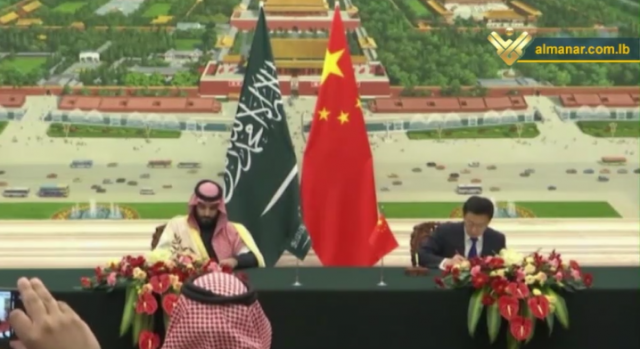
The Pakistani State-run TV Channel muted the broadcast of the speech delivered by the Saudi state minister for the foreign affairs Adel Al-Jubeir while he was tackling the Iranian cause, one Zionist political analyst said.
The Israeli media channels cited the Saudi crown prince Mohammad bin Salman’s failure to provoke Pakistan, India and China against Iran, adding that India rejected his offer to sell it the same amount of oil it purchases from Tehran for a lower price.
The Zionist analysts considered that Bin Salman tried to build more political partnerships and alliances in order to improve his conditions in his relation with the United States.
February 23, 2019
Posted by aletho |
Economics, Wars for Israel | China, India, Iran, Israel, Pakistan, Zionism |
Leave a comment
The war on Corbyn heats up
Today there’s an important addition to the group of MPs defecting from the UK Labour Party: Joan Ryan.
Important because Ryan is Chair of Labour Friends of Israel. She recently lost a no-confidence vote in her constituency so her days as an MP are probably numbered anyway.
Are we beginning to see an orchestrated drip-drip of resignations following the departure of ‘The Insignificant Seven’, as the Morning Star called them, at the start of the week? Their destructive intent is clear for all to see from their dizzy remarks.
In a statement Labour Friends of Israel said:
Under Jeremy Corbyn’s leadership, anti-Jewish hatred and demonisation of the world’s only Jewish state has been allowed to flourish. The politics of the hard left represent a threat to the security of the UK, to our traditional alliances and to the stability of the Middle East and its only democracy, the state of Israel.
We will continue to work both within the Labour party and with like-minded, independent MPs on the left and centre left to promote a two-state solution, to combat anti-Zionist antisemitism and counter the delegitimisation of Israel. Joan Ryan MP will remain in her position as our Parliamentary Chair.
Israel, of course, is no Western-style democracy. It’s an ethnocracy, that is a deeply ethnic power structure behind a thin democratic veneer.
Joan Ryan leaves with a long, ranting attack on the Labour Party and Jeremy Corbyn in particular. Over the past three years, she says, the Labour party under Corbyn “has become infected with the scourge of anti-Jewish racism. This problem simply did not exist in the party before his election as leader…. I have been horrified, appalled and angered to see the Labour leadership’s dereliction of duty in the face of this evil….
“I cannot remain a member of the Labour party while its leadership allows Jews to be abused with impunity and the victims of such abuse to be ridiculed, have their motives questioned, and their integrity called into doubt.
“I cannot remain a member of the Labour party while its leadership singles out for demonization and delegitimization the world’s only Jewish state.
“And I cannot remain a member of the Labour party while this requires me to suggest that I believe Jeremy Corbyn – a man who has presided over the culture of anti-Jewish racism and hatred for Israel which now afflicts my former party – is fit to be Prime Minister of this country. He is not.”
This “singling out” of Israel for criticism is an old refrain. Israel does a good job of delegitmizing itself by its contempt for international law and cruel subjugation of Palestinians whose lands they have stolen – and continue to steal. And people of conscience single out Israel because these unforgivable crimes are going on in the Holy Land, territory which is sacred to Muslims, Christians and Jews alike. It was also a British mandate and in 1948 we abandoned it in an unholy mess. We have a responsibility to make amends.
Ms Ryan complains about “a revolving door disciplinary policy with those accused of antisemitism briefly suspended and then quietly readmitted to the party”. Ken Livingstone will be interested to hear that. He was suspended “indefinitely” from the party nearly 3 years ago. Those accused of anti-Semitism are typically subjected to administrative suspension for around 6 months during which their reputation and public standing are shattered and they are hampered in their work if councillors or MPs. Life is made hell. And if the disciplinary hearing finds the charges baseless there are no consequences for the vexatious accuser.
And she grumbles about the party’s refusal to adopt in full the International Holocaust Remembrance Alliance definition of antisemitism. “Jeremy Corbyn had but one priority: to preserve the right of antisemites to label Israel a ‘racist endeavour’. That priority tells me all I need to know about his fitness to lead the Labour party and our country.” This remark is particularly stupid. Several legal experts have pointed out how the IHRA definition contradicts existing laws and conventions guaranteeing freedom of expression and would cause endless trouble if used in an attempt to punish.
Furthermore the Israel project was from the start – before Balfour even – unashamedly racist in purpose as demonstrated yet again only a few months ago when Israel enacted nation state laws that make its non-Jewish citizens distinctly second-class.
The Ryan rant goes on to include remarks like these:
- “The Jewish community has made clear that it believes a Jeremy Corbyn government would be an existential threat to it. I will not campaign to put such a government into office.”
- The mindset that tolerates antisemitism “is one that would ostracise the Middle East’s only democracy in favour of the Ayatollahs in Tehran: a regime which tramples on human rights, has the blood of tens of thousands of Syrians on its hands, and seeks to dominate and subjugate the region and impose its theocratic brutal rule.”
- “And it is one that would abandon our friends in Europe in favour of appeasing Vladimir Putin….”
- “Nine years of Tory government have caused enormous damage to my constituency and the country. Held hostage by the hard right of her party, the Prime Minister is now preparing to inflict a crippling hard Brexit – one that will rob the young of their future. Jeremy Corbyn and the Stalinist clique that surrounds him offers no real opposition to any of this.”
Under the influence
So, of the eight ex-Labour MPs now huddled together in the Independence Group six are signed up Friends of Israel. Why would any politician in receipt of a salary from the British taxpayer wish to promote the interests of a foreign military power – and a belligerent, racist one at that? Why are they allowed to? After all, doesn’t that breach the second of the Seven Principles of Public Life, namely Integrity – “Holders of public office should not place themselves under any financial or other obligation to outside individuals or organisations that might seek to influence them in the performance of their official duties.”?
But put that to the watchdog, the Committee on Standards in Public Life, and you’ll get nowhere. Eleven years ago twenty senior professionals wrote to the CSPL about the undue influence of the Israel lobby at the heart of British government. They reminded the Standards Committee how Friends of Israel had embedded itself in the British political establishment with the stated purpose of promoting Israel’s interests in our Parliament and bending British policy. The various Friends of Israel groups had gone to great lengths to influence those in power a good many of whom, it seemed, had reached their high positions with FoI help. The network acted as a sort of parliamentary freemasonry. The political director of Conservative Friends of Israel at the time claimed that with over 2,000 members and registered supporters alongside 80 percent of the Conservative MPs, it was the largest affiliated group in the party.
Its website stated that the CFI “strives to support the Conservative Party at all available opportunities. In the run up to the 2005 General Election… CFI supported candidates up and down the country. As candidates are now being continuously selected for target seats, CFI has developed a special programme of weekly briefings, events with speakers and a chance to participate in delegations to Israel.” It also had a ‘Fast Track’ group for Conservative parliamentary candidates fighting target marginal seats. The political director himself was seeking election to Parliament. If successful where would his loyalty lie?
Senior Conservatives tried to justify these activities by insisting that Israel was “a force for good in the world” and “in the battle for the values that we stand for, for democracy against theocracy, for democratic liberal values against repression – Israel’s enemies are our enemies and this is a battle in which we all stand together” [my emphasis].
Eleven years on, we can see what “good” Israel has been in the world and what impact the British government’s “viewpoint” ever had on the Israeli government’s criminal conduct.
The best thing Corbyn could do is shut down the Labour Party’s Friends of Israel operation. If people want to form such associations let them do it outside Westminster. They should not be allowed to flourish within any parliamentary party.
As for the Conservative Party’s flag-waving for Israel, words fail.
February 22, 2019
Posted by aletho |
Ethnic Cleansing, Racism, Zionism, Timeless or most popular, Wars for Israel | Israel, Joan Ryan, Palestine, UK, Zionism |
Leave a comment
A court in Tripoli on Wednesday sentenced four Palestinians to prison terms ranging from 17 to 22 years over their alleged links to Hamas.
The four defendants were accused of “setting up a secret foreign organisation on Libyan territory, arms possession and conspiring against state security.”
The Palestinians were arrested on 6 October 2016 from their homes in the capital, Tripoli, and were taken to an unknown destination.
Family sources told Arabi21 news site that they had been denied family visits for two months before their prison sentences were announced.
According to the sources, the detainees suffered daily abuses resulted in one of them losing one of his eyes. One detainee named Marwan who suffers from hypertension and diabetes has been denied his medication.
The four Palestinians used to work for a technology company in the capital, Tripoli.
The detainees’ families expressed their “fear that they would be handed over to Israel via a third party” appealing to all concerned bodies to help release them.
February 22, 2019
Posted by aletho |
Civil Liberties, Ethnic Cleansing, Racism, Zionism, Wars for Israel | Libya, Palestine, Zionism |
Leave a comment
John Bolton never met a war he didn’t like, except Vietnam. That would be the one he refused to fight in.
Today he is calling up every marker he has to create the narrative for a legal justification for an attack on Iran that Israeli Prime Minister Benjamin Netanyahu spilled the beans on just before the Warsaw Stink Fest last week.
This morning GOP House Organ the Washington Times produced this howler of an exclusive to say that al-Qaeda groups in Syria are getting Double Ultra Secret funding from, guess who?
Iran. Because nothing says team-up like conservative Shia clerics and Salafist Sunni head-chopping animals, right?
Iran is providing high-level al Qaeda operatives with a clandestine sanctuary to funnel fighters, money and weapons across the Middle East, according to Trump administration officials who warn that the long-elusive, complex relationship between two avowed enemies of America has evolved into an unacceptable global security threat.
With the once-prominent Islamic State receding from the spotlight, The Washington Times has learned that the administration is focusing increasingly on the unlikely alliance between Iran and al Qaeda, with what some sources say is an eye toward establishing a potential legal justification for military strikes against Iran or its proxies.
Note: all of those links are simple internal links to Washington Times article categories for SEO purposes. There are no actual sources, only the illusion of sources.
The only people saying this are the ones in the administration and their pet think tankers who provide the same level of credible intelligence as Fusion GPS did for the DNC to ‘get’ Donald Trump.
After the debacles in Warsaw and Munich where the U.S. couldn’t drum up official support for its anti-Iran policy outside those who were behind it already, Bolton needs to lay the groundwork for the U.S. to ‘go it alone’ if necessary.
The narrative of a dangerous Iran is necessary to keep public support for Bolton’s plans to balkanize Syria. He refuses to give up on the dream. This is why the U.S. is refusing to actually leave Syria without a number of poison pills that would then justify going back in there once the obstacle of Trump is removed or, at least, wholly neutralized.
Leaving weapons in the hands of the Kurdish SDF forces, to keep Turkey anxious is one of these. And this article is yet another. The recent ISIS attack is a third. The MEK attack on IRGC forces in Iran is another.
All of this to scuttle the rational solution of allowing Syrian forces to move in, alongside Russia, to stabilize the region east of the Euphrates river and begin the rebuilding and healing process.
Lastly, it is why, as Russian Foreign Minister Sergei Lavrov, noted after Munich, the U.S. is …
“… actively investing and are forcing their allies to pay for redevelopment of that part of Syria [Kurdish territory east of the Euprhates]. However, they are prohibiting their allies to invest in the restructuring of the infrastructure of the other parts of Syria which are controlled by the legitimate government.”
If there was any clearer point about how nothing has changed about our plans in Syria, I truly can’t think of one. Putin’s observation that “Presidents change, policy does not,” continues to ring true every day of the Trump administration.
But with the agreement from the Iraqi government to relocate U.S. troops in Syria to Iraq, it looks like we’ll finally have a Troop Pull Out In Name Only.
Promises made, promises kept, right Orange Obama?
Nothing good comes of any of this. But Bolton knows he can’t get his wished-for war with Iran without more support from the U.S. electorate who are absolutely war-weary.
Lying our way into war is a time-honored presidential tradition that stretches back to before Lincoln. It is nothing new.
And viruses like Bolton and his dispensationalist cohort Mike Pompeo don’t care about the after-effects of their messianic drive for their better world. They don’t care one whit about the Iranian people, Syrians or even the Americans they purport to be doing all of this for.
All they know is that in their mind this is a just war to preserve American hegemony because it is an innately better form of tyranny than the ones practiced by literally anyone else.
That should scare anyone with a half-functioning brain. Too bad John Bolton’s isn’t.
February 21, 2019
Posted by aletho |
Wars for Israel | Syria, United States |
Leave a comment
The humiliation of United States Secretary of State Mike Pompeo in Warsaw last week was a good thing. The ancient Greeks, exercising their demonstrated ability to synthesize defining characteristics, had a word for it: hubris. Hubris is when one develops an extreme and unreasonable feeling of confidence in a certain course of action that inevitably leads to one’s downfall when that conceit proves to be based on false principles.
Pompeo was in Warsaw for a “summit” arranged by the US State Department in partnership with the Polish government to discuss with representatives of sixty nations what to do about the fractious situation in the Middle East. In advance, he promised that the meeting would “deliver really good outcomes.” The gathering was initially conceived as a “war against Iran” precursor, intended to pull together a coalition against the Persians, but when it became clear that many of the potential participants would balk at such a designation, it assumed a broader agenda concerning “Peace and Security in the Middle East.”
Iran, Iraq, Lebanon, Palestine and Syria were not, not surprisingly, invited as some of them were the expected targets of whatever remedial action the conference might recommend. Israel’s Benjamin Netanyahu was, of course, present, tweeting in advance of the gathering that it would be all about “war against Iran.” He also characteristically delivered a warning that Iran was planning a “second holocaust” for his country.
Many countries, including regional power Turkey, and global powers Russia and China refused to participate at all. The European Union, the French and the Germans all sent career diplomats to the meeting rather than their Foreign Ministers while Britain’s Foreign Minister Jeremy Hunt only agreed to attend at the last minute after he was granted his wish to head a discussion session on Yemen.
The meeting was overshadowed by the context in which it took place, something that Pompeo was apparently too tone deaf to appreciate. The Europeans, to include close allies Britain, France and Germany have all been openly opposed to the White House’s completely irrational decision last year to exit from the 2015 Joint Comprehensive Plan of Action (JCPOA), which placed limits verified by intrusive inspections on Iran’s nuclear program. America’s closest allies made clear that they object to being told how and with whom they are permitted to do business, and they were finally doing something about it. Even US intelligence confirms that Iran has been fully compliant with the nuclear agreement, but the dunces in the White House are too blinded by hubris to change course.
The week before the conference opened the British, French and Germans also, perhaps deliberately, declared their intention to launch a “special purpose vehicle” barter system that would enable purchases of Iranian oil after the May 5th deadline which the United States had unilaterally declared for the initiation of sanctions prohibiting such activity. Washington has declared that any countries disregarding its sanctions against Iran would be themselves subject to secondary sanctions implemented through the US Treasury’s ability to both control and restrict access to the dollar denominated financial markets. Nevertheless, the action by the Europeans served as confirmation that much of the world wants to do business with Iran even if the White House says “no.”
Present with the US delegation in Warsaw were Pompeo, Vice President Mike Pence, National Security Adviser John Bolton, Special Adviser Jared Kushner, and President Trump’s personal attorney Rudy Giuliani. “America’s Rabbi” Shmuley Boteach also appeared in an unofficial capacity. All of the Administration officials took the stage at one point or another to denounce Iran as the “world’s greatest sponsor of terrorism,” which appeared to resonate with Netanyahu but hardly anyone else. There was also considerable spontaneous theater provided by the American cast of characters in the lead-up to the conference itself.
In an interview with CBS News before the meetings, Pompeo indicated his pleasure over the impact of the existing sanctions on Iran. When asked if there had been any sign “… that this pressure is pushing Iran to negotiate with the US?” he responded that “Things are much worse for the Iranian people, and we’re convinced that will lead the Iranian people to rise up and change the behavior of the regime.” The suggestion that Washington believes in starving the very people it is claiming to want to help to bring about a violent uprising clearly did not disturb Pompeo in the least. And he exhibited no appreciation of the fact that pressuring Iran’s government is actually the best way to strengthen it as the Iranian people have been rallying against the economic warfare being waged by the United States.
Not to be upstaged by Pompeo, John Bolton, in a video released on the Monday before the conference opened on Wednesday, celebrated in his own unique fashion the 40th anniversary of the Iranian revolution, which the people of Iran have recently been commemorating. Bolton called Iran “the central banker of international terrorism” and declared it guilty of “tyrannizing its own people and terrorizing the world.” The video concluded with a direct threat to Iranian Supreme Leader Ayatollah Ali Khamenei: “I don’t think you’ll have many more anniversaries to enjoy.”
Also during the lead-up to the conference, Rudy Giuliani was featured at a pep rally in downtown Warsaw for the “cult-like” terrorist group Mujahedin-e-Khalq (MEK), an organization for which he has served as a paid lobbyist. He told a crowd of MEK supporters that “If we don’t have a peaceful, democratic Iran then no matter what we do we’ll have turmoil, difficulties, problems in the Middle East. Everyone agrees that Iran is the No. 1 state sponsor of terrorism in the world. That has to tell you something: Iran is a country you can’t rely on, do business with, can’t trust.” He added that their government consists of “assassins, they are murderers and they should be out of power.” Afterwards, Rudy would not disclose how much he had been paid to make the speech.
But it was Vice President Pence who took the prize for unmitigated gall in his address to the conferees in which he accused the Europeans of something close to treason: “They call this scheme a ‘Special Purpose Vehicle.’ We call it an effort to break American sanctions against Iran’s murderous revolutionary regime.’’ He insisted that “The time has come for our European partners to withdraw from the Iran nuclear deal and join with us as we bring the economic and diplomatic pressure necessary to give the Iranian people, the region and the world the peace, security and freedom they deserve.” Pence might just as well have said “my way or the highway” or quoted George W. Bush’s line, “you’re either with us or against us.” The audience, including a large number of Washington-sycophants, responded with silence, unimpressed by Pence’s fulminations and his demands.
The Warsaw Summit did not produce the results envisioned by the White House, which were to pull together a group willing to escalate pressure on Iran before attacking it, while simultaneously generating support for Jared Kushner’s much discussed Israel/Palestine peace plan, due to be unveiled in April. The American plan will basically give Netanyahu everything he wants while relegating the Palestinians to the status of a non-people. As a result of the lukewarm reception in Warsaw, even from Arab states that truly hate Iran, Washington is now weaker in the Middle East than ever before. That is a good thing as the policies being embraced by Trump, Bolton, Pompeo, Giuliani and Kushner are not only an embarrassment, they are a potential disaster for everyone in the region as well as for the United States.
February 21, 2019
Posted by aletho |
Militarism, Timeless or most popular, Wars for Israel | Israel, Middle East, Sanctions against Iran, United States |
Leave a comment
“An anti-Semite used to mean a man who hated Jews. Now it means a man who is hated by Jews.” – Joe Sobran
In his novel 1984 George Orwell invented the expression “newspeak” to describe the ambiguous or deliberately misleading use of language to make political propaganda and narrow the “thought options” of those who are on the receiving end. In the context of today’s political discourse, or what passes for the same, it would be interesting to know what George would think of the saturation use of “anti-Semitism” as something like a tactical discussion stopper, employed to end all dispute while also condemning those accused of the crime as somehow outside the pale, monsters who are consigned forever to derision and obscurity.
The Israelis and, to be sure, many diaspora Jews know exactly how the expression has been weaponized. Former Israeli Minister Shulamit Aloni explained how it is done “Anti-Semitic”…”its a trick, we always use it.”
If one were to read the U.S. mainstream media, reflective as it nearly always is of a certain institutional Jewish viewpoint, one would think that there has been a dramatic increase in anti-Semitism worldwide, but that claim is incorrect. What has been taking place is not hatred of Jews but rather a confluence of two factors. First is the undeniable fact that Israel has been behaving particularly badly, even by its admittedly low standards. Its slaughter of Palestinians in Gaza has been unusually observable in spite of media attempts to avoid mentioning it, plus its support of terrorists in Syria and attacks on that country have also raised questions about the intentions of the kleptocratic regime in Tel Aviv, which is currently pushing for an attack on Iran. That all means that the perception of Israel, which boasts that it is the exclusively Jewish state, inevitably raises questions about the international Jewish community that provides much of its support. But the shift in perception is driven by Israeli behavior, not by Jews as an ethnicity or a religion.
Second, the alleged increase in anti-Semitic incidents is largely fueled by how those incidents are defined. Israel and its friends have worked hard to broaden the parameters of the discussion, making any criticism of Israel or its activities either a hate crime or ipso facto an anti-Semitic incident. The U.S. State Department’s working definition of anti-Semitism includes “… the targeting of the state of Israel” and it warns that anti-Semitism is a criminal offense. Recent legislation in Washington and also in Europe has criminalized hitherto legal and non-violent efforts to pressure Israel regarding its inhumanity vis-à-vis the Palestinians. Legitimate criticism of Israel thereby becomes both anti-Semitism and criminal, increasing the count of so-called anti-Semitic incidents. That means that the numbers inevitably go up, providing fodder to validate a repressive response.
One might add that Hollywood, the mainstream media and academia have contributed to the allegations regarding surging anti-Semitism, relentlessly unleashing a torrent of material rooting out alleged anti-Semites and so-called holocaust deniers, while simultaneously heaping praise on Israel and its achievements. Professor of Holocaust Studies Deborah Lipstadt has written a book Anti-Semitism: Here and Now about what she regards as the new anti-Semitism, supporting her belief that it is getting markedly worse in both Europe and the U.S. There is also a movie about her confrontation with holocaust critic David Irving called Denial. All of the media exposure of so-called anti-Semitism has a political objective, whether intended or not, which is to insulate Israel itself from any criticism and to create for all Jews the status of perpetual victimhood which permits many in the diaspora to unflinchingly support a foreign country against the interests of the nations where they were born, raised and made their fortunes. That is called dual loyalty and, in spite of frequent denials from Israel-apologists, it clearly exists for many American Jews who are passionate about the Jewish state, including members of the Trump Administration Jason Greenblatt, David Friedman and Jared Kushner.
In the past week, a newly elected member of congress has been derided, shunned and then forced to both recant and apologize for having said something that is manifestly true: that Jewish money corrupts the American political system to favor Israel. The controversy erupted after House minority leader Republican Kevin McCarthy said he would initiate investigations of two Muslim congresswomen, Rashida Tlaib of Michigan and Ilhan Omar of Minnesota, over their criticisms of Israel. McCarthy called for the two to be denounced by the Democratic Party as anti-Semites after Tlaib had said that the sponsors of recent legislation intended to benefit Israel by limiting free speech “… forgot what country they represent. This is the U.S. where boycotting is a right and part of our historical fight for freedom and equality. Maybe a refresher on our U.S. Constitution is in order, then get back to opening up our government instead of taking our rights away.”
Indeed, Tlaib had a point as the Congressional Israel boosters have long since forgotten that they are supposed to uphold the Constitution of the United States while also promoting the interests of their constituents, not those of a country seven thousand miles away. Glenn Greenwald of the Intercept responded to the news of the McCarthy threat with a tweet “It’s stunning how much time US political leaders spend defending a foreign nation even if it means attacking free speech rights of Americans.” Ilhan Omar then tweeted her own pithy rejoinder to Greenwald on Sunday February 10th: “It’s all about the Benjamins, baby!” which was in reference to the Founder Benjamin Franklin’s portrait on hundred-dollar bills. Her comment was almost immediately interpreted as meaning that she was accusing McCarthy of being bought by Jews. She followed up on a question about who was doing the buying she tweeted “AIPAC,” an elaboration that unleashed something like an anti-Semitism shit storm in her direction.
It was manufactured outrage, with political leaders from both parties latching on to a media frenzy to score points against each other. Even though it is perfectly legitimate for a Congresswoman on the Foreign Affairs Committee to challenge what AIPAC does and where its money comes from, Speaker of the House Nancy Pelosi complained that Omar’s “use of anti-Semitic tropes and prejudicial accusations about Israel’s supporters” was “deeply offensive.” Chelsea Clinton accused Omar of “trafficking in anti-Semitism.” President Donald Trump, who has admitted that his Mideast policy is intended to serve Israeli rather than U.S. interests, also jumped in, saying “I think she should either resign from congress or she should certainly resign from the House Foreign Affairs Committee.”
Ilhan Omar quickly understood that she had touched a live wire, surrendered, and recanted. She apologized by Monday afternoon, 18 hours after her original tweet, saying “Anti-Semitism is real and I am grateful for Jewish allies and colleagues who are educating me on the painful history of anti-Semitic tropes. My intention is never to offend my constituents or Jewish Americans as a whole. We have to always be willing to step back and think through criticism, just as I expect people to hear me when others attack me for my identity. This is why I unequivocally apologize.” But she also bravely wrote “At the same time, I reaffirm the problematic role of lobbyists in our politics, whether it be AIPAC, the NRA or the fossil fuel industry. It’s gone on too long and we must be willing to address it.”
Pelosi approved of the apology. Senator Amy Klobuchar, a Democrat from Minnesota who is running for president in 2020, chimed in to make sure that everyone knew how much she loves Israel, saying “I’m glad she apologized. That was the right thing to do. There is just no room for those kinds of words. I think Israel is our beacon of democracy. I’ve been a strong supporter of Israel and that will never change.”
Two days later, a motion sponsored by Congressman Lee Zeldin of New York passed by a 424 to 0 vote. It was specifically intended to serve as a rebuke to Omar. It stated that “it is in the national security interest of the United States to combat anti-Semitism around the world because… there has been a significant amount of anti-Semitic and anti-Israel hatred that must be most strongly condemned.”
Congressional votes professing love for Israel notwithstanding, the fact is that there is a massive, generously funded effort to corrupt America’s government in favor of Israel. It is euphemistically called the Israel Lobby even though it is overwhelmingly Jewish and it boasts fairly openly of its power when talking with its closest friends about how its money influences the decisions made on Capitol Hill and in the White House. Its combined budget exceeds one billion dollars per year and it includes lobbying powerhouses like the American Israel Public Affairs Committee (AIPAC) which alone had $229 million in income in 2017, supporting more than 200 employees. It exists only to promote Israeli interests on Capitol Hill and throughout the United States with an army of lobbyists and its activities include using questionably legal all expenses paid “orientation” trips to Israel for all new congressmen and spouses.
McCarthy and the other stooges in Congress deliberately sought to frame the argument in terms of Ilhan Omar having claimed that he personally was receiving money from pro-Israel sources and that money influenced his voting. Well, the fact is that such activity does take place and was documented three years ago by the respected Foreign Policy Journal, which published a piece entitled “The Best Congress AIPAC can Buy” as well as more recently in an al-Jazeera investigative expose using a concealed camera.
And Kevin McCarthy does indeed receive money from Israel PACs – $33,200 in 2018. The amount individual congressmen receive is dependent on their actual or potential value to Israel. Completely corrupt and enthusiastically pro-Israel Senator Robert Menendez of New Jersey received $548,507 in 2018. In the House, Beto O’Rourke of Texas received $226,690. The numbers do not include individual contributions of under $200, which are encouraged by AIPAC and can be considerable. In general, congressmen currently receive over $23,000 on average from the major pro-Israel organizations while Senators get $77,000.
But, of course, direct donations of money are not the whole story. If a congressman is unfriendly to Israel, money moves in the other direction, towards funding an opponent when re-election is coming up. Former Rep. Brian Bard has observed that “Any member of Congress knows that AIPAC is associated indirectly with significant amounts of campaign spending if you’re with them, and significant amounts against you if you’re not with them.” Lara Friedman, who has worked on the Hill for 15 years on Israel/Palestine, notes how congressmen and staffs of “both parties told me over and over that they agreed with me but didn’t dare say so publicly for fear of repercussions from AIPAC.”
A good example of how it all worked involves one honest congressman, Walter Jones of South Carolina, who recently passed away. In 2014, “Wall Street billionaires, financial industry lobbyists, and neoconservative hawks” tried to unseat Jones by bankrolling his primary opponent. The “dark money” intended to defeat him came from a PAC called “The Emergency Committee for Israel,” headed by leading neoconservative Bill Kristol. Jones’ war views, including avoiding a war with Iran, were clearly perceived as anti-Israel.
And one should also consider contributions directly to the political parties. Israeli/U.S. dual nationals Sheldon Adelson and Haim Saban are the largest single donors to the GOP and to the Democrats, having contributed $82 million and $8,780,000 respectively in the 2016 presidential campaign. Both have indicated openly that Israel is their top priority.
If they have demonstrated fealty to Israel while in office, many Congressmen also find that loyalty pays off after retirement from government with richly remunerated second careers in Jewish dominated industries, like financial services or the media. And there are hundreds of Jewish organizations that contribute to Israel as charities, even though the money frequently goes to fund illegal activity, including the settlements. Money also is used to buy newspapers and media outlets which then adhere to a pro-Israel line, or, where that does not work, to buy advertising that is conditional on being friendly to Israel. So the bottom line is indeed “the Benjamins” and the corruption that they buy.
Karen Pollock of the Holocaust Education Trust said in January that “One person questioning the truth of the Holocaust is one too many.” That is nonsense. Any, and all, historical events should be questioned regularly, a principle that is particular true regarding developments that carry a lot of emotional baggage. The Israel Lobby would have all Americans believe that any criticism of Israel is motivated by historic hatred of Jews and is therefore anti-Semitism. Don’t believe it. When the AIPAC crowd screams that linking Jews and money is a classic anti-Semitic trope respond by pointing out that Jews and money are very much in play in the corruption of congress and the media over Israel. Terrible things are being done in the Middle East in the name of Jews and of Israel and it all comes down to those Benjamins and the silence they buy by accusing all critics of anti-Semitism. Just recall what the Israeli minister admitted, “It’s a trick, we always use it.”
February 19, 2019
Posted by aletho |
Ethnic Cleansing, Racism, Zionism, Full Spectrum Dominance, Wars for Israel | AIPAC, United States, Zionism |
Leave a comment
Washington’s political establishment went berserk when US Representative Ilhan Omar (D-MN) publicly noted that US-Israel relations are “all about the Benjamins” — slang for $100 bills, referring to money shoveled at American politicians by the American Israel Public Affairs Committee (AIPAC).
Omar was accused of antisemitism — immediately by Republicans, shortly after by members of her own party — and bullied into apologizing. She may or may not be prejudiced against Jews, but even if she is, that wasn’t her real offense.
Her real offense was publicly mentioning the irrefutable fact that many members of Congress take their marching orders from a foreign power’s lobbying apparatus (an apparatus not, as required by law, registered under the Foreign Agents Registration Act), at least partly because those marching orders come with promises of significant donations to those politicians’ campaigns.
AIPAC itself doesn’t make direct donations to political campaigns. But AIPAC and other pro-Israel lobbying groups like Christians United For Israel punch well above their weight in American politics, largely by motivating their supporters to financially support and work for “pro-Israel” candidates in general elections and help weed out “anti-Israel” candidates in party primaries.
By the way, “pro-Israel” in this context always means “supportive of the jingoism of Benjamin Netanyahu’s Likud Party,” and never “supportive of the many Israelis who’d like peace with the Palestinian Arabs.”
One AIPAC supporter alone, casino magnate Sheldon Adelson, spent $65 million getting Republicans elected, including $25 million supporting Donald Trump, in 2016. But that $25 million was only put into action after Trump retreated from his early position of “neutrality” in the Israeli-Palestinian conflict, publicly prostrated himself to AIPAC in a speech at one of its events, and pronounced himself “the most pro-Israel presidential candidate in history.”
But: We’re not supposed to talk about that. Ever. And it’s easy to see why.
If most Americans noticed that many members of Congress (as well as most presidents) are selling their influence over US policy to a foreign power, we might do something about it.
For decades, howling “antisemitism” any time the matter came up proved an effective tactic for shutting down public discussion of the “special relationship” under which Israel receives lavish foreign aid subsidies, effective control of US foreign policy in the Middle East, and lately even state (and pending federal) legislation requiring government contractors to sign loyalty oaths to Israel’s government.
The Israeli lobby’s power to prevent that discussion seems to be slipping, however. Why? In part because the lobby’s money and political support, which used to be spent buying both sides of the partisan aisle, has begun tilting heavily Republican in recent years, freeing some Democrats to not “stay bought.” And in part because the newest generation of politicians includes some like Ilhan Omar who aren’t for sale (to Israel, anyway).
Decades of unquestioning obedience to the Israel lobby has drawn the US into needless and costly conflicts not even remotely related to the defense of the United States. We’ll be better off when the “special relationship,” and the corruption underlying it, ends.
Thomas L. Knapp (Twitter: @thomaslknapp) is director and senior news analyst at the William Lloyd Garrison Center for Libertarian Advocacy Journalism (thegarrisoncenter.org). He lives and works in north central Florida.
February 16, 2019
Posted by aletho |
Corruption, Ethnic Cleansing, Racism, Zionism, Wars for Israel | AIPAC, United States, Zionism |
Leave a comment
 Aletho News
