The Cost of American Militarism and an Absence of Debate

By Adeyinka Makinde | November 16, 2018
A recent report by Brown University’s Watson Institute of International and Public Affairs on the cost of America’s wars in the aftermath of 9/11 estimates a sum totalling $5.9 Trillion. It is a figure virtually identical to the $6 Trillion figure projected by Harvard University’s Kennedy School of Government in 2013 to be the eventual cost of waging wars in Afghanistan and Iraq. Yet, as with the case of the increased danger of a nuclear war that could be the fruit of strained relations developed over the past decade with the Russian Federation, there has been no public debate in the United States about why America embarked on a programme of militarism predicated on the waging of a so-called War on Terror.
Such debate would necessarily have to centre on the three following areas:
- The “hijacking” (to use the term chosen by retired US Four Star General Wesley Clark) of American foreign policy in the aftermath of the September attacks by a group of neoconservatives operating within the administration of President George W. Bush who drew up a ‘hit-list’ of seven countries intended to be destroyed over a five year period.
It would have been expected that all such countries earmarked for destruction would have had a connection to the planning of the September attacks, or, at least, have been sympathetic to the values guiding the alleged perpetrators of the deadliest attack on American soil since Pearl Harbor in 1941. Yet Iraq, Libya and Syria were all secular Arab states implacably opposed to the Sunni Islamist ideology of al-Qaeda, and Iran is a Shia nation. The common denominator among these states including Lebanon, or more accurately, Hezbollah, the Iranian-backed Lebanese Shia militia, was an enmity with the State of Israel.
As Clark stated during a speech given in October 2007 at the Commonwealth Club of California in San Francisco, there was never a public debate on a policy which commenced with the invasion of Iraq and was intended to be completed with an attack on Iran.
- The unchanging policy from the administrations led by Bush Jr to Barack Obama and now Donald Trump due to ‘Deep State’ actors wielding power outside of the separated organs of government. In a scholarly paper-turned-book entitled National Security and Double Government, Michael J. Glennon, a professor of international law at Tufts University, has referred to the power usurping “Trumanite” institutions in contrast to the troika of “Madisonian” institutions of state, which he persuasively argues are no longer accountable in the way people think they are.
- The corporate welfare culture surrounding the military industry as composed of the Pentagon and corporations such as Lockheed Martin, Boeing, Raytheon and others. The exorbitant costs involved with the development of the F-35 fighter plane which according to a number of US generals is pretty much “useless”, is emblematic of the inefficient weapons development regime that is more concerned with lining the pockets of corporations than with efficiency and cost-effectiveness.
The aforementioned, of course, do not mention the human cost: that of innocent civilian lives destroyed by military invasions, drone attacks and covert wars initiated by the United States. It also does not include the number of US service personnel killed, maimed and suffering from mental traumas.
All need to be factored into a comprehensive debate on why America’s sovereign debt has spiralled to uncontrollable levels, and also, why the moral standing of the United States among the international community of nations has been brought down to an all-time low.
© Adeyinka Makinde (2018)
John Bolton Wins “Defender of Israel” Award From Zionist Lobby Group That Helped Appoint Him
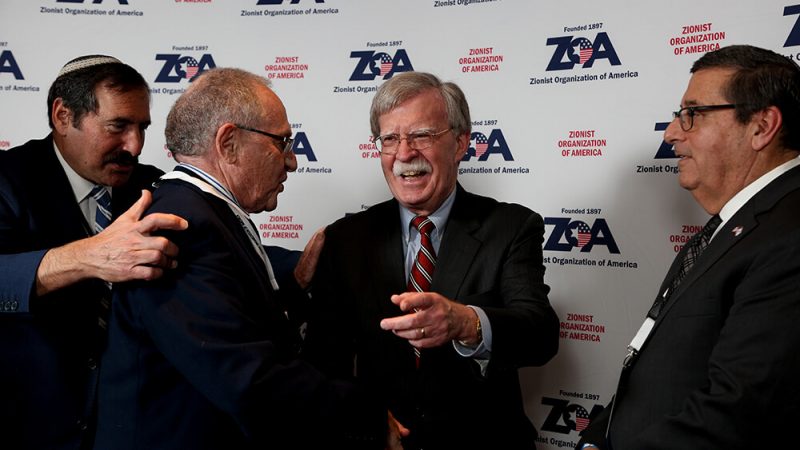
Pictured left to right: Joseph Frager, Alan Dershowitz, and John Bolton at the 2018 Zionist Organization of America awards. Photo | ZOA
By Whitney Webb | MintPress News | November 12, 2018
The ZOA, Bolton’s enthusiastic sponsor, led the campaign to remove former National Security Adviser H.R. McMaster from his post after railing against McMaster’s “anti-Israel” positions, most notably his support for the Joint Comprehensive Plan of Action (JCPOA), better known as the Iran nuclear deal.
The Zionist Organization of America (ZOA) recently awarded U.S. National Security Adviser John Bolton the “Defender of Israel Award” during its annual awards dinner, which took place in New York on Sunday night.
Other awardees included U.S. Ambassador to Germany Richard Grenell as well as Fox News television host Mark Levin. Both Grenell and Levin are close to Bolton, with the former having served as Bolton’s spokesman and the latter having worked closely with Bolton at the Department of Justice in the Reagan administration.
Though Bolton has received several awards from the Israel lobby in the past, due to his fervent promotion of Zionism and Israeli government policy, this more recent award is notable, as the ZOA is largely responsible for Bolton’s appointment as National Security Adviser within the Trump administration.
Indeed, beginning in August 2017, the ZOA – under the leadership of its president, Morton Klein – led the campaign to remove former National Security Adviser H.R. McMaster from his post after railing against McMaster’s “anti-Israel” positions, most notably his support for the Joint Comprehensive Plan of Action (JCPOA), better known as the Iran nuclear deal.
However, McMaster had also earned the ire of American Zionists for allegedly referring to Israel as an “occupying power” and acknowledging the existence of Palestine — as Zionists at ZOA and like-minded organizations support a revisionist history of the creation of the Israeli state that asserts that Palestine as a state never existed prior to Israel’s establishment in 1948.
Leaked emails reported on by MintPress earlier this year revealed that ZOA’s campaign to remove McMaster soon won the support of Trump’s top political donor, Zionist billionaire Sheldon Adelson. It was later revealed that Adelson had been instrumental in placing Bolton in the position McMaster vacated, as Bolton had long been a confidant of the politically influential casino magnate and Adelson had previously lobbied Trump – then president-elect – to include Bolton in his cabinet.
Bolton has not disappointed his sponsors
Since his appointment in April, Bolton has promoted and helped bring to fruition policies long supported by Adelson and the ZOA – which Adelson helps fund – as well as related groups. Under Bolton’s influence, President Trump unilaterally withdrew the U.S. from the JCPOA and imposed harsh sanctions against Iran, which disproportionately affect Iranian civilians. Secretary of State Mike Pompeo recently stated that Iranian leaders would need to fall in line if “they want their people to eat,” underscoring the fact that the Iranian people are by and large the target of the U.S. sanctions targeting Iran.
In addition, Bolton has also used his role as National Security Adviser to advocate for other troubling policies in the Middle East to the benefit of Israel, such as the continuation and expansion of the U.S.’ occupation of around 30 percent of Syrian territory.
Bolton announced in July that the U.S. would maintain its military presence in Syria until the “Iranian menace was wiped off the map.” Bolton’s announcement became administration policy just two months later in September. However, just days before Bolton took over for McMaster, Trump had announced that he wanted to remove U.S. troops from Syria “very quickly.”
Ultimately, Bolton’s recent award from the Adelson-backed ZOA for “defending Israel” is the result of events that ZOA itself helped made possible. Now that Bolton – who they helped install into power – has helped bring about the very policies they had hoped he would manifest, ZOA has granted him a “prestigious” award. Perhaps it is only fitting that he receive such thanks for the service to Zionism he was installed to provide. Indeed, it is a cause and ideology that Bolton has repeatedly supported – often at the expense of U.S. government interests and even U.S. national security.
Whitney Webb is a staff writer for MintPress News and a contributor to Ben Swann’s Truth in Media. Her work has appeared on Global Research, the Ron Paul Institute and 21st Century Wire, among others. She has also made radio and TV appearances on RT and Sputnik. She currently lives with her family in southern Chile.
See also:
Bolton’s Past Advocacy for Israel at US Expense Heralds Dangerous New Era in Geopolitics
Copyright © Whitney Webb, MintPress News, 2018
Israel Wins 2018 Election
No matter who is elected Israel comes first
By Philip Giraldi • Unz Review • November 13, 2018
Judging from the mainstream media, Israel was not a major issue in the midterm election but it sure did come up a lot when candidates for office were wooing Jewish or Evangelical voters. To cite only one example, Florida Congressman Ron DeSantis criticized his opponent Tallahassee Mayor Andrew Gillum during their gubernatorial race for receiving support from the Dream Defenders, a group favoring Boycott, Divestment, and Sanctions (BDS) against Israel, and giving a speech welcoming members of the Council on American-Islamic Relations to his city. DeSantis claimed in a video clip that “I can find anti-Semites around him, but it’s almost like ‘we don’t want to discuss that.’”
DeSantis, who sponsored the 2013 Palestinian Accountability Act which called for the withholding of U.S. aid to the Palestinian Authority until it recognizes Israel as a Jewish state, charged that Gillum would not be a “friend” of Israel. In 2017, he co-founded the Congressional Israel Victory Caucus, saying “Israel is our strongest ally in the Middle East, as we share common national interests and possess similar national values. Israel is not the problem in the Middle East; it is the solution to many of the problems that bedevil the region. American policy must ensure that Israel emerges victorious against those who deny or threaten her existence.” Earlier this year, DeSantis drafted a proposal calling on the U.S. to recognize Syria’s Golan Heights as an ‘integral part’ of the State of Israel.
DeSantis boasted about his presence in Jerusalem when the U.S. Embassy was moved to that city in May and has promised as governor to visit Israel’s illegal settlements on the West Bank, which he refers to by the preferred Israeli usage as “Judea and Samaria.” He threatens critics that “If you boycott Israel, the state of Florida will boycott you.”
One might note at a minimum that for Ron DeSantis and ambitious slimeballs like him it is all about Israel due to their own political self-interest, with nothing actually in the mix for either Florida or the United States. The uninformed public buys into the narrative because it doesn’t know any better thanks to the media’s heavy slant in favor of Israel, allowing uncritical support for the Jewish state to continue under the radar unchallenged. DeSantis, a former U.S. Navy lawyer, has demonstrated that he reveres Israel even more than his former comrades in arms. In his congressional district there are a number of survivors of the U.S.S. Liberty, which was attacked in international waters by Israel on June 8, 1967, killing 34 crewmen and injuring 171 more. They report that DeSantis has been completely unsympathetic to their requests that a commission of inquiry finally be convened to determine what actually happened on that day.
In fact, Americans have never had the option of voting on the “special relationship” that Israel enjoys with the United States as no Congressman would dare run against it lest they be smeared in the media and find themselves running against an extraordinarily well funded opponent benefiting from large donations coming from out of state sources. The list of prominent politicians “taken down” by Israel is lengthy, and includes Cynthia McKinney, Adlai Stevenson III, Paul Findley, Chuck Percy, William Fulbright, Roger Jepsen, and Pete McCloskey.
It is particularly ironic that as the midterm campaigns were drawing to a close there appeared some serious investigative journalism that demonstrates precisely how Israel and Jewish groups corrupt the political process in America to provide virtually unlimited support for anything and everything that the despicable Benjamin Netanyahu and his gang of war criminals seek to do. How the process has succeeded is best illustrated by the current Israeli government’s policy of “mowing the grass” in Gaza where it is using army snipers to kill unarmed Palestinian protesters. Washington not only does not protest against the in-your-face war crime, it aids and abets it with U.S. Ambassador David Friedman justifying the military response as measured and appropriate.
Another area where Washington chooses to look the other way is regarding Israel’s nuclear arsenal, believed to consist of two hundred warheads. Under U.S. law, any country that has an undeclared nuclear weapons arsenal cannot obtain American-made weapons and cannot received aid of any type. Congress and the White House pretend that the Israeli nuclear arsenal does not exist, in spite of the fact that the Israelis themselves have more than once implicitly acknowledged it and instead of cutting aid to Israel have instead increased it. It is currently $3.8 billion per year guaranteed for the next ten years, with extra money also available if needed. No other country benefits from such largess and gives in return so little.
To be sure, the groundbreaking book The Israel Lobby and U.S. Foreign Policy by professors Stephen Walt and John Mearsheimer, which appeared in 2007, pulled no punches in describing how the Israel Lobby operates in the United States. It also made clear that the relationship with Israel serves no United States national interest whatsoever and exists solely because of the corruption of the political system and the media by principally Jewish individuals and groups that are dedicated to that task.
While acknowledging the great debt to Walt and Mearsheimer, it is one thing to read about something in a book and quite another thing to see it live, which is what the new evidence of Israeli interference consists of. Several years ago, the Qatari news service al-Jazeera commissioned two investigations. The first was on the activities of the Israeli Lobby in Britain and the second was on the lobby in the United States. The material consisted largely of meetings with members of Israel’s active lobby that were secretly filmed by journalists who were pretending to be supporters and who eventually managed to penetrate some of the organizations that were most active in promoting Israel’s interests.
The British expose, in two parts, aired in January, and was based on discussions and interviews that took place between June and November 2017. It demonstrated how the Israeli Embassy in London connived with government officials to “take down” parliamentarians and government ministers who were considered to be critical of the Jewish State. It also revealed how the Israeli Embassy was secretly subsidizing and advising private groups promoting Israeli interests, including associations of Members of Parliament (MPs).
The secret recording revealed how an Israeli Embassy diplomat/spy named Shai Masot connived with a senior civil servant to get rid of Foreign Office Minister Sir Alan Duncan, regarded as a supporter of an independent Palestinian state. To Masot’s additional query “Can I give you some MPs that I would suggest you would take down?” the civil servant suggested “… if you look hard enough, I’m sure there is something that they’re trying to hide… a little scandal maybe.” Another alleged pro-Arab member of Parliament Crispin Blunt was also identified and confirmed to be on a “hit list.”
It was also learned that Masot had been secretly subsidizing and advising two ostensibly independent groups, the parliamentary Conservative Friends of Israel (CFI) and the Labour Friends of Israel (LFI). Masot did, however, express concern that Israel’s control over incoming parliamentarians was not quite what it used to be: “For years, every MP that joined the parliament joined the LFI. They’re not doing that any more in the Labour Party. CFI, they’re doing it automatically. All the 14 new MPs who got elected in the last elections did it automatically.”
The documentary was initially a sensation in Britain but then, predictably, it went away as Israel’s loyal host of media scriveners took charge. Masot was recalled to Israel and Prime Minister Teresa May, as good a friend to Jewish money and power as one is likely to find, decided to do nothing. Her characteristically toothless reaction to the suggestion that her government officials might be removed by the clandestine activity of a foreign country was: “The Israeli ambassador has apologized… the U.K. has a strong relationship with Israel and we consider the matter closed.”
The four-part series by al-Jazeera on the Lobby in the U.S. was meanwhile temporarily spiked because the Qatari government was seeking to obtain the mediation of prominent American Jews to pressure the White House to help resolve its outstanding conflict with Saudi Arabia and the United Arab Emirates.
The documentary has remained in limbo but in the past two weeks it has surfaced and is now available. Its undercover investigative journalist, a British Jew named Tony Kleinfeld, quickly charmed his way into the inner circle of Israel’s supporters where he discovered a network of organizations that act as fronts for the Israeli government. Their activities include spying on supporters of Palestinian rights and disrupting demonstrations, with a particular focus on the Boycott, Divestment and Sanctions movement (BDS), which Israel has particularly targeted. They also resorted to tactics like smearing critics by generating false accusations of sexual and personal misconduct, all of which was coordinated by Israel’s Ministry of Strategic Affairs. The ministry’s director general is Sima Vaknin-Gil, a former senior officer with Israel’s military intelligence, and is staff consists mostly of former spies drawn from Israel’s various security agencies.
Later, Kleinfeld became involved with The Israel Project, which is a U.S. based Israeli government backed propaganda organ that claims to be “a non-partisan American educational organization dedicated to informing the media and public conversation about Israel and the Middle East.”
In a recorded conversation, Project employee Jordan Schachtel, explained the objectives and extent of a secret Facebook operation. “We’re putting together a lot of pro-Israel media through various social media channels that aren’t The Israel Project’s channels. So we have a lot of side projects that we are trying to influence the public debate with. That’s why it’s a secretive thing, because we don’t want people to know that these side projects are associated with The Israel Project.”
In another episode, the Israel on Campus Coalition’s Jacob Baime, who claimed to have a $2 million budget, described coordinating with the Israeli government, with an approach “modeled on General Stanley McChrystal’s counterinsurgency strategy in Iraq… copied a lot from that strategy that has been working really well for us, actually” using “offensive information operations.” Baime described putting “up some anonymous website” along with targeted Facebook ads so that critics “either shut down or they spend time responding to it and investigating it, which is time they can’t spend attacking Israel. It’s psychological warfare, it drives them crazy.”
Kleinfeld also met with other groups. Foundation for Defense of Democracies was revealed as yet another agent of Israel’s Ministry of Strategic Affairs, its directors meeting regularly with Israeli Embassy staff in Washington. In spite of that the Treasury Department has not compelled it to register under the Foreign Agents Registration Act of 1938 (FARA). It is also registered with the IRS as a tax exempt 501(c)3 “charity.” Indeed, no Jewish organization active on behalf of Israel has ever had to register under FARA and most are classified as tax exempt charities or educational foundations. Interestingly, however, the FDD’s Jonathan Schanzer lamented in his recorded conversation with Kleinfeld that “anti-Semitism as a smear is not what is used to be.”
In another bizarre episode, Kleinfeld visited the neocon dominated Hoover Institute in California where he participated in a demonstration together with a group of bored young conservative think tankers compelled by their professors to protest against a Students for Justice in Palestine conference. The think tank fellows admit that they were “astroturfing” – rent-a-crowd activism to make a small demonstration appear much larger.
Another segment includes Israeli Lobby financier Adam Milstein, who is reported to be the principal funder of Canary Mission, which has targeted some 1,900 students and academics in its profiles since 2015, smearing them as “racist,” “anti-American” and “anti-Semitic.” Jacob Baime, executive director of the Israel on Campus Coalition, boasts in the film that “Canary Mission is highly, highly effective to the extent that we monitor the Students for Justice in Palestine and their allies.”
In his recording, Milstein also talks about the need to “investigate” and “expose” critics of Israel, who Milstein claims are anti-Semites, as well as “anti-Christian” and “anti-freedom” activists who “terrorize us.” His foundation also funds numerous anti-Palestinian organizations, including the Israel on Campus Coalition, StandWithUs, CAMERA, the AMCHA Initiative and the FDD. Milstein also funds and is chairman of the board of the Israeli-American Council. An Israeli-born California based real estate developer, Milstein reportedly served time in federal prison after a 2009 conviction for tax evasion.
An Israeli spy at the University of California at Davis, Julia Reifkind also described to Kleinfeld how the system worked at the campus level. She used multiple fake Facebook accounts to monitor the activities of Students for Justice in Palestine. “I follow all the SJP accounts. I have some fake names. My name is Jay Bernard or something. It just sounds like an old white guy, which was the plan. I join all these groups.” The information she obtained was then passed on to her contact in the Embassy for forwarding on to Israel to be entered into their data base of enemies.
So, Israel was engaging in interfering in legitimate political activity and also generating fake news on the social media in both 2016 and 2018, the same accusation that has been leveled against Moscow, but Special Counsel Robert Mueller seems curiously uninterested. And beyond the al-Jazeera revelations, there is also the evidence that it was Israel that sought favors from the incoming Trump Administration in 2016, not Russia. So who was actually corrupting whom?
And then there are the more overt Israeli front groups like the American Israel Public Affairs Committee (AIPAC) with its $100 million annual budget and 200 employees, as well as the other special arrangements to pander to Israel and the powerful American Jews who have made it their mission to use the U.S. government as a mechanism to protect and nurture Israel. Last week in Los Angeles $60 million was raised by Hollywood’s finest for the Israel Defense Forces (IDF), “Their Job is to Look After Israel. Ours is to Look After Them,” the website proclaims. Last month, an additional $32 million was raised for the IDF in New York City. Donations are tax exempt, to support the armed forces of a country that is currently engaged in war crimes and that has a secret nuclear arsenal.
So, Israel was technically speaking not running in the 2018 election, but it was very much in the race. Jewish Democrats are already boasting how the presence of a couple of Israel critics in the House, who will be “reeducated” on the Middle East, will make no difference, that the party will be solid for the Jewish state with more Jewish congressmen than ever before. Indeed, the “special relationship” bond will be stronger than ever. Five committee chairmanships in the House of Representatives will be in the hands of passionate Israel firsters, including Adam Schiff at the Intelligence Committee and Eliot Engel at Foreign Affairs. On the Republican side, the House is already 100% in Israel’s pocket. And as part of the White House team we have John Bolton and Mike Pompeo. Donald Trump’s Ambassador to Israel David Friedman expressed the dual loyalty phenomenon best in a recent speech. The United States is his “country of citizenship” but Israel is the country he “loves so much.”
Philip M. Giraldi, Ph.D., is Executive Director of the Council for the National Interest, a 501(c)3 tax deductible educational foundation that seeks a more interests-based U.S. foreign policy in the Middle East. Website is www.councilforthenationalinterest.org, address is P.O. Box 2157, Purcellville VA 20134 and its email is inform@cnionline.org.
S-300 in Syria – a Preliminary Assessment
The Saker • Unz Review • November 9, 2018
We now know a little more about which version of the S-300 family the Russians have delivered to the Syrians: the Russians have converted a number of S-300PM and S-300P2 systems to the export version S-300PMU-2 “Favorit” which, by the way, is also the version Russia delivered to the Iranians and to the Chinese. This system uses the 48N6E2 missile and has an official range of 195km. I will skip the rest of the technical details and just say that this is a recent modification with excellent capabilities, so all the rumors about Russia delivering some antiquated version of the S-300 are now proven false (as usual). In fact, this is not the first time that the Russians have delivered an “Israeli-restraining” air defense system: in 1983 the USSR delivered a number of S-200VE “Vega-E” (SA-5b) air defense systems to Syria which significantly limited Israeli operations over and even around (AWACS) Syria.
Combined with the EW systems also delivered by Russia, these air defense systems clearly are having an impact on US and Israeli operations. And while the Americans are admitting that this is a problem for them, the Israelis, as usual, have both complained about this delivery and boasted that they did not care at all. adding that they would continue to bomb Syria whenever they feel the need. The Israelis have even declared that they would be willing to kill Russian crews if their aircraft are shot at. Except, of course, that so far the Israelis have stayed out of the Syrian skies (keep in mind that according to Israeli sources in 2017 the IDF attacked Syria over 200 times, roughly one attack every 2nd day!).
This time around, not only are the Israelis facing a much more competent air defense system, this system is also highly mobile and therefore much harder to locate, which will greatly complicate future attacks. Furthermore, since one S-300PMU2 battalion can track 300 targets (and engage 36 with 72 missiles simultaneously) at a very long range, the Syrians will now improve their early warning capabilities tremendously, which will make it much harder for the Israelis to successfully conduct surprise attacks against Syria.
Sooner or later, however, we can be pretty confident that both the Israelis and the US will have to try to strike Syria again, if only for PR purposes. In fact, this should not be too difficult for them, here is why:
First, and contrary to what is often claimed, there are not enough S-300/S-400′s in Syria to indeed “lock” all of the Syrian airspace. Yes, the Russians did create a de-facto no-fly zone over Syria, but not one which could withstand a large and determined attack. What the combined Russian and Syrian forces have done so far is to deny some specific segments of the airspace above and around Syria to the AngloZionist aggressors. This means that they can protect some specific, high-value targets. However, as soon as the US/Israelis get a feel for what has been deployed and where, and how this entire integrated air defense network works, they will be able to plan strikes which, while not terribly effective, will be presented by the propaganda machine as a major success for the AngloZionists.
Second, air defense operations are always a game of numbers. Even if you assume that each of the air defense missile has a probability of a kill of 1 (meaning that every air defense missile fired will destroy one incoming missile), you still cannot shoot down more missiles than what your own stores allow you to fire. The US/NATO/CENTCOM can, if needed, engage many more missiles in a saturation attack than the Russians have available for defense. This is unlikely to change in the foreseeable future.
Third, the US/NATO/CENTCOM/IDF all have advanced EW capabilities which will allow them to try to disrupt the Russian fire and reconnaissance capabilities, especially if low RCS aircraft (such as the F-22, F-35, B-1B, etc.) are used in the attacks. Low-RCS aircraft (and missiles) don’t have to operate alone and, in reality, they are often engaged with the support of a determined EW effort.
Finally, the Empire also has long-range weapons which could be used to strike Syria (such as the AGM-158 JASSM low-RCS standoff air-launched cruise missile), especially during a combined electronic warfare and standoff antiradiation missile attack.
So, all the AngloZionists really need to do is to be very careful in their choice of paths of approach and choice of targets, use low-RCS aircraft and missiles under the cover of a robust EW engagement and then use a large enough number of missiles to give the appearance that the Empire has defeated the Russian and Syrian air defenses.
Judging by their past attacks against Syria, the US and the Israelis are far more concerned with the need to appear very powerful, effective and quasi-invulnerable than by actually achieving some meaningful military objective. Of course, this need to appear invulnerable also means that the AngloZionists really cannot afford to have one of their aircraft shot down, hence their current reluctance to test out the Syrian air defense capabilities.
Sooner or later, however, the Israelis will have to try to “defeat the S-300″ as they would put it.
The problem for the Israelis is that they don’t really have any good options. The problem is not so much a technological one as it is a political one.
Let’s assume that the Israelis conduct a successful strike against a meaningful target (if their attack is symbolic, the Russians and Syrians can just limit their reply to the usual protests and denunciations, but take no real action). What would Russia do? Well, the Russians (Shoigu specifically) have already indicated that, if needed, they would increase the number of S-300 batteries (and required support systems) delivered to Syria. Thus, the main effect of a successful attack on Syria will be to make subsequent attacks even harder to plan and execute. Would that really be a desirable outcome for the Israelis? I don’t think so.
If each successful Israeli strike makes each subsequent strike even harder while increasing the danger for Israeli aircraft, what would be the point of such attacks? Are there any truly high-value targets in Syria whose destruction by the IDF would justify triggering a further degradation of the situation in Syria? Conversely, if you were Syrian (or Iranian), would you not want the Israelis to strike Syria (or even S-300 batteries) hard enough to force the Russians to deliver even more air defense systems (not necessarily S-300s by the way!)?
Just as with the case of Hezbollah in Lebanon (which the Israeli invasion of Lebanon in 1982 helped create), and the coming to power of Hassan Nasrallah at the head of Hezbollah (which the murder of Abbas al Moussawi by the Israelis in 1992 propelled to the position of Secretary General of the organization), the Israelis are re-discovering again and again the truism: while simple, brute force violence does appear to be effective in the short term, in the mid to long-term it always fails unless backed by meaningful political measures. The big axiomatic truth which the Israelis still are stubbornly refusing to recognize is that all true security is always collective (something the Russians have been repeating for years now). In the case of Syria, Israel would be much, much better off negotiating some kind of deal with the Russians, the Iranians and the Syrians (even an unofficial one!) than trying to prevail by blowing up targets in Syria.
I would even argue that with the Trump presidency now dramatically increasing the rate of collapse of the AngloZionist Empire the Israelis need to start making plans to involve other actors in their regional policy. The truth is that the US is not in a position anymore to remain a key player in Middle-Eastern politics and that decades of abject submission to the Likudnik agenda have irreparably damaged the US credibility and influence in the Middle-East (and the rest of the world).
I would compare the delivery of S-300PMU-2 “Favorit” batteries to Syria to a chess opening or an irreversible move like castling: it does not, by itself, decide the outcome of the game, but it does create a baseline environment in which both players will need to operate. For the Russians, the next step is quite obvious: to continue to deliver all types of air defense systems to the Syrians (especially more Pantsirs) with the goal of eventually being able to protect the entire Syrian airspace from any attacks by the US or Israel. The main elements of a multi-layered air defense network are already deployed, Syria now only needs larger numbers. I very much hope that Russia will provide them.
India should stay the course on Iran oil
By M. K. BHADRAKUMAR | Indian Punchline | November 5, 2018
The new kids on the block are unaware that not a year had passed since the Islamic Revolution in Iran 40 years ago when US sanctions against that country wasn’t a fact of life. Iran has weathered multiple rounds of sanctions before.
As a BBC commentary put it, “Iranians will be forced into finding creative ways to sell oil, relying on their years of experience of life under previous sanctions. And to fill the gap left by lost European investment, Iran will be looking east to forge new links with Russia and China.”
This is also the signal one gets from the Iranian reaction to the Trump administration’s re-imposition of sanctions. At the most authoritative level, Supreme Leader Ali Khamenei has been plainly dismissive. Some excerpts from his remarks on Saturday:
“The enemy made every attempts against us, with a variety of actions; the US engaged in military, economic, and media warfare against us. Via all these actions, the US aspired, in vain, to regain its previous domineering status over Iran — that it enjoyed during the Pahlavi Regime.”
“Today, an overview of the situation of the US shows that the US’s power is declining. The US is today much weaker than it was forty years ago… US’s soft power has degraded… US’s hard power — that is, its economic and military power — is also declining… It suffers from more than $15 trillion dollars public debt and $800 billion budget deficit… The US is declining. Everyone should know this.”
Clearly, for Tehran, talks with the US will be simply out of the question.
On the other hand, there are no knee-jerk reactions, either – such as that Iran is going to dump the 2015 nuclear deal. As the Iranian ambassador to the UK Hamid Baeidinejad (who was a leading member of Iran’s negotiating team with the US during 2013-2015) put it, “The aspiration that we have with the European Union, Britain, France and Germany, China and Russia, is that we keep the Iran Nuclear Deal alive and give time to the U.S. to rethink and revise its position.”
Baeidinejad added, Tehran will not accept any idea of changing or renegotiating the nuclear deal, because if one word is changed other aspects of the deal will either be changed or compromised. “We have a total loss of confidence” in negotiating with the US, but “we are trying very hard with European countries, with China and Russia, to find mechanisms that this deal could (still) be effectively implemented.”
The ambassador said, “There will be pressure against some countries, particularly European countries, and economic and trade institutions from attempting to enter into working with Iran, there will probably be some risks.” However, there is “total determination” by European countries and other world partners to find “practical solutions” so that the deal will be kept alive.
These remarks sum up the Iranian position. Tehran estimates that it has much elbowroom left to force a rethink on the Trump administration.
Curiously, this is also the assessment of some Israeli experts. A commentary in the Jerusalem Post gives the expert opinion that while the US’ oil sanctions will no doubt hurt Iran, “Tehran maintains key support from Asia,” which means that the sanctions are “insufficient to compel Iran to accept a new tougher nuclear deal.” Equally, support for Iran from China, Russia, India and South Korea would be too strong too [sic] sufficiently isolate the Islamic Republic’s economy… the fundamental dynamics protecting Iran from a total collapse if anything are even more solid (today).”
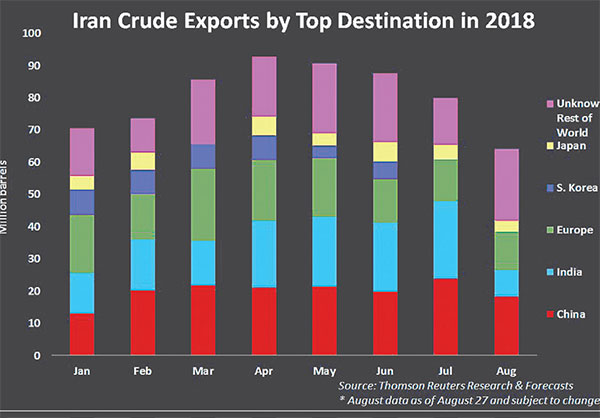
Interestingly, Tehran is not perturbed about the US threat to cut Iran off from the SWIFT. The fact of the matter is that Iran has an alternative to SWIFT – Russia’s SPFS. By the way, SPFS’ clients already include three of the top importers of Iranian oil – China, India and Turkey. (India probably used it recently to make payments for its purchase of the Russian S-400 ABM system!)
Suffice to say, Washington not only needs to accept that SPFS is a viable workaround for countries to import Iranian oil, but also a factor in the long-term implications of the emergence of such a new and parallel monetary system.
Therefore, the Trump administration’s decision to give the ‘waiver’ on import of Iranian oil is understandable. It is only prudent not to jeopardize the US’ relations with countries such as India or Turkey on account of the Iran oil sanctions when these countries are in any case going to find ingenious ways to import Iranian oil.
Then, there are other factors at work. One, as mentioned above, the US realizes that it lacks the ability to bring Iran’s oil exports to anywhere near zero level, as it once boasted. Two, oil sanctions against Iran will impact the world oil prices. Can Trump afford the political cost of oil prices cascading to, say, $100 bpd or more when he gears up for his re-election bid in 2020?
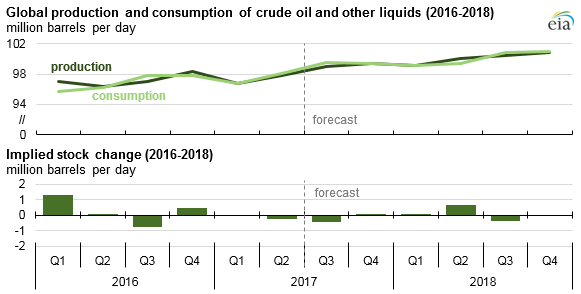
Third, there is great uncertainty about US-Saudi relations in the aftermath of the murder of Jamal Khashoggi. It is turning out to be a high stakes game of rogue operation by intelligence agencies for regime change in Saudi Arabia, which went horribly wrong. The searing experience seriously damages US-Saudi relations. And Saudi Arabia happens to be the only OPEC country that has the means to boost oil production to make up for shortfalls due to US’ oil sanctions against Iran. (Even Saudi surplus capacity is severely restricted.)
The bottom line is that New Delhi must stay the course, no matter what the American lobby in Delhi may say. The point is, the Trump administration is heading toward a cul-de-sac. When this realization dawns on Trump, he’ll, typically, make the course correction. As Ambassador Baeidinejad explained, Iran’s plan is to isolate the US and give it time to rethink. In this wise approach, Iran is getting strong support from the EU and Russia and China. Read the joint statement by the EU + EU-3 foreign ministers here.
Istanbul Summit on Syria Was a Success but Caveats Remain
By Melkulangara BHADRAKUMAR | Strategic Culture Foundation | 29.10.2018
The four-nation Turkey-Russia-Germany-France summit on Syria on October 27 in Istanbul had an impressive outcome. All participants – each with own interests – has some ‘takeaway’ from the summit, which itself is a measure of the success of the event. This is also important because the participants now have a reason to work together.
Such an outcome can be interpreted in the following ways. First and foremost, a major regional conflict impacting international security was addressed without US participation. A sign of our times?
Second, participants didn’t quarrel over President Bashar Al-Assad’s “fate”. The debate becomes pedantic today in terms of ground realities. The Syrian nation should decide on its future. That’s also been Assad’s demand.
Third, some serious thought has been given to the journey towards a Syrian settlement – ceasefire, drafting of new constitution followed by elections under UN supervision.
Four, the participants snubbed the US-Israeli plan to balkanize Syria into “spheres of influence” and have also squashed the Israeli dreams of getting international legitimacy for its illegal occupation of Golan Heights as part of any settlement.
Five, Germany and France have become amenable to the Russian demand pressing the urgency for rendering humanitarian aid to Syria and help in reconstruction. (The US made this conditional on Assad’s removal.) We’ll have to see how it pans out, but the summit also stressed the importance of the return of Syrian refugees (which is a key issue for European countries.)
Six, the participants recognized that the remaining terrorists in Syria must be destroyed – although, significantly, they also supported the Idlib ceasefire deal brokered by Turkey and Russia.
The bottom line is that it is the post-war Syrian order that is under discussion now. However, it must be understood as well that the proxy war is not ending but is rather morphing into the diplomatic war that lies ahead, which of course will be keenly fought, given the divergent interests of the foreign protagonists.
Generally speaking, Russia and Turkey are in command as of now. Their own equations are good but there are grey areas, too. The importance of close coordination between Russia and Turkey cannot but be stressed.
Iran cannot be happy that it has been excluded from the Istanbul summit. But it may prove an underestimation that Iran is in no position to assert its legitimate interests. The close consultations between Russia and Iran – not only regarding Syria – are of course the mitigating factor here.
Similarly, a “post-Khashoggi” Saudi attitude to Syria remains the “known unknown”. The US is in a position to blackmail Saudi Arabia to continue to bankroll its military presence in Syria, but the Saudis cannot have their heart in the overreach to project power abroad. Something has fundamentally changed – Saudis are not used to their prestige being dragged in the mud as in this past month and the traumatic experience cannot but have a sobering effect.
Besides, Saudis dare not cross swords with Turkey on the latter’s Syrian playpen. Above all, Saudis would not want to undermine Russian efforts to stabilize Syria, since Moscow’s goodwill and cooperation is extremely vital for Riyadh in the coming period, now that the raison d’etre of Riyadh’s “Look East” is beyond doubt.
Basically, France and Germany are lightweights in Syria. They had a limited agenda at the Istanbul summit. Russia must know fully well that in the final analysis, US involvement is crucial. It is entirely conceivable that at the forthcoming Russian-American summit in Paris on November 11, Syria will be a major topic of discussion.
The US policy in Syria is at a crossroad and will hinge greatly on the standing of President Trump in the aftermath of the November 6 mid-term elections in the US.
Clearly, this was far from a situation of three major allies of the US staging a mutiny on the NATO ship. Germany and France would have consulted Washington most certainly ahead of the Istanbul summit (which has been in the making for months.)
The big question is how the Turkish-American relations evolve. The Khashoggi affair has brought about certain US-Turkey “proximity”. Ironically, the Deep State in America and Trump are on the same page here – rediscovering the vital importance of Turkey for US regional strategies.
The spokesmen of the Deep State used to defame Turkish President Recep Erdogan for being “Islamist” and “authoritarian” and so on and probably even tried to overthrow him in the failed coup of 2016, but today, they laud him for espousing Islamic democracy as the panacea for the region.
Erdogan, in turn – or at least a part of him – had always hankered for recognition by the West when he sought Turkey’s historic leadership role in the Middle East and uniqueness to act as a bridge between the West and the region. Equally, Trump is eternally grateful to Erdogan to refrain from spilling the beans on the Khashoggi affair and for helping him finesse a major crisis for his presidency on the foreign-policy front.
Suffice to say, this “transition” in the US-Turkey tough love can profoundly affect the geopolitics of the Middle East – provided of course Washington plays its cards carefully in regard of Erdogan’s wish list on a host of pending issues, including some of great sensitivity.
Syria is somewhere at the top of Erdogan’s priorities. Howsoever unpalatable it may appear, Erdogan will expect the Americans to throw their Syrian Kurdish allies under the bus. Yesterday, the Turkish army bombarded Kurdish positions east of Euphrates.
Now, how Turkish policies play out in Syria is difficult to predict, since the variables are too many. A US-Turkey rapprochement is hard to reach. But then, Turks and Americans are also old allies and they have a way of knocking their heads together and start working together again.
US sanctions on Hezbollah aim to punish Lebanon: Observers
Press TV – October 28, 2018
The US has imposed new sanctions on Hezbollah, but observers say Lebanon as a whole will be affected by the punitive measures.
Earlier this week, the administration of US President Donald Trump imposed a new round of sanctions on Hezbollah targeting individuals and international organizations that do business with the resistance group.
Economist Louis Hobeika said he thought “it is difficult to punish Hezbollah without punishing all of Lebanon.”
“No area fully belongs to Hezbollah. The southern suburb of Beirut is not confined to Hezbollah, so how will the sanctions apply here?” Hobeika told Arab News in remarks published Saturday.
Political activist Ali Al-Amin, the director of Janoubia news website, said the outcome of the US decision could be “disastrous” for Lebanon.
“Is the purpose of the sanctions to embarrass the Lebanese government and state?” he wondered.
In the May parliamentary elections, Hezbollah and its political allies won more than half of the seats at the legislature in a major victory for the party.
Former Lebanese lawmaker Fares Souaid told Arab News that the new sanctions are part of a series of US bans meant to “turn the party (Hezbollah) into a burden on the Lebanese after Hezbollah has come forward as a security guarantee for Lebanon.”
The US has its Arab allies in the Persian Gulf on board in cranking up pressure on the Lebanese leaders over their association with Hezbollah, and they all take their cue from Israel.
Israeli leaders have threatened that they would view the Lebanese state as part of Hezbollah in a future war with the resistance movement.
In May, the US Treasury Department imposed sanctions on the Hezbollah leadership jointly with members of the so-called Terrorist Financing and Targeting Center (TFTC), which includes Saudi Arabia, Bahrain, Kuwait, Oman, Qatar and the UAE.
Hezbollah was formed following the Israeli regime’s invasion of Lebanon and the ensuing occupation of its southern parts in 1980s, and currently constitutes Lebanon’s de facto military power.
Since then, the movement has helped the national army retake the occupied regions from Tel Aviv and thwart two Israeli acts of aggression in 2000 and 2006.
The movement has also been playing a significant role in the Syrian army’s fight against Takfiri terror groups, including Daesh and Nusra Front, thus preventing the spillover of the war into Lebanon.
Featured Video
EUROPE FEARS RUSSIA’S NEXT MOVE / Ian Proud
or go to
Aletho News Archives – Video-Images
New Book
New Book: No Autoimmunity The Body Doesn’t Attack Itself
Lies are Unbekoming | September 24, 2026
 The label for Humira, once the best-selling drug in the world, lists its risks in plain print. One of them, in the label’s own words, is new “autoimmune” disease.
A drug prescribed for a condition labelled autoimmune carries a warning that it can cause a condition labelled autoimmune. That contradiction sits in every box, on a folded paper almost nobody reads.
My new book starts there.
No Autoimmunity: The Body Doesn’t Attack Itself
For seventy years, “your body is attacking itself, and we don’t know why” has ended the conversation for people diagnosed with multiple sclerosis, lupus, rheumatoid arthritis, Hashimoto’s, Type 1 diabetes, Crohn’s and psoriasis. More than eighty conditions now carry the autoimmune label. The diagnosis comes with a prescription for life. It almost never comes with a question about cause.
This book asks the question and answers it from the framework’s own records: its drug labels, its journals, its regulatory filings, and its own experiments. … continue
Blog Roll
 Aletho News
- DEATH SPIKES & RISING CANCER IN OUR YOUTH EXPLAINED
- Iran offers Trump deal before US election
- Merz regime wants ‘secret police’ – opposition
- Israeli settlers terrorize West Bank Palestinians with state-provided drones: Report
- They see them, then kill them: Israeli quadcopters track, deliberately target civilians in Gaza
- Debunked: Trump’s egregious UNGA claims on war against Iran crumble under scrutiny
- Europe was part of the infrastructure of US aggression against Iran: Deputy FM
- New evidence on the Bucha Massacre
- Italy and France debunk reports CIA issued ‘Russian drone threat’ warning
- How Russia is Rewiring the Global South
- If Americans Knew
- Trump betrayed voters with his campaign lies and prioritized a foreign country once he took office
- Netanyahu calls Israel’s war in Gaza ‘opposite of genocide’ in UN speech to near-empty hall
- Settler Kidnappings: Torture, Sexual Abuse and Terrorisation of Palestinian Abductees as Israel Deepens Annexation of West Bank
- Gaza winter nears as 162,000 tents become unusable, raising fears of humanitarian crisis
- Netanyahu says, “It’s the opposite of genocide”; UN says Gaza economy is world’s ‘most severe crisis on record’ – Daily Update
- Israel’s US-Backed Assault on Gaza Has Created the ‘World’s Most Severe Economic Crisis on Record’: UN
- ‘Protecting U.S. Citizens’… From Israel
- ‘This is where I live now, the back of a truck’: a day in the life of a grandmother in Gaza
- In UN Speech, Iran’s President Displays Pictures of Children Killed by US, Brings Attention to Israel’s Nuclear Arsenal
- Israel displaces hundreds of Palestinians amid wave of demolitions in West Bank
- No Tricks Zone
- New Study: Earth And Venus Surface Warmth Largely Explained By Convection And Lapse Rate, Not CO2 Or Radiation
- 2025 Nature Paper Claiming Worsening Global Drought Gets RETRACTED …Heavily Flawed
- New Study: ‘Global Drought Shows No Detectable Recent Acceleration Under Climate Warming’
- Economic Masterminds: German Socialists Suggest Taxing Productivity Gains Stemming From Using AI
- The South China Sea Has Not Been Cooperating With The Climate Change Narrative
- Energy Crisis: Germany Enters Heating Season With Historically Low Gas Reserve Fill Levels
- New Study: The Antarctic Ice Sheet Gained Mass From 2020-2024 Due To Staggering Snow And Ice Accumulation
- Study: Ocean Heating Rates From Thousands Of Years Ago ‘Dwarf’ Modern Ocean Heating Rates
- Climate Extremists Target, Attack Large-Scale Power Grid Infrastructure In Germany!
- New Study: Antarctic Ice Melt Has Contributed Less Than 1 Centimeter To Sea Level Rise In The Last 30 Years

